
What “Library Rug” Means and Why This Room Is Different
A home library is more than a room for storage; it is an architectural commitment to quietude and intellectual legacy. Whether it houses a lifetime of first editions or serves as a modern executive study, the library requires a foundation that balances gravity with comfort. The right library rug does not just fill the floor, it anchors the heavy millwork, absorbs the sharp edges of the room, and defines the ‘inner sanctum’ where deep work happens.
Selecting a library rug requires a different set of rules than a high-traffic foyer or a social living room. In the library, we look for visual weight that can stand up to floor-to-ceiling shelving and materials that offer tactile warmth for long hours of contemplation. From the structured geometry of a Persian Heriz to the muted elegance of a distressed Oushak, your choice of rug determines the scholarly ‘soul’ of the space.
Helpful reading: the Rug Buying Guide and guidance on placement and proportion.
Explore the other room guides: Study, Living Room, Family Room, Dining Room, Bedroom, Foyer / Entry, Kids Rooms.
Definition of a library rug
A library rug is not defined by a specific weaving tradition, regional origin, or pattern. It is an application category, not a single style. While many associate the look with classic traditional rugs from Persia or Oriental design area rugs, a home library rug is technically defined by its function within the space. Its primary role is to serve as a foundation for a quiet, contemplative environment.
This rug supports the specific activities of reading, research, and storage. It must accommodate static heavy furniture, such as floor-to-ceiling bookcases and wingback chairs, while providing comfort for extended periods of sitting. Unlike high-traffic hallway runner rugs or a stain-resistant kitchen mat, a library rug prioritizes acoustic dampening and visual weight. It anchors the room, transforming a space full of shelving into a cohesive, inviting sanctuary.
Selected for comfort, quality, beauty and endurance.
Shop For The Perfect Library Rugs.Why libraries are rug-dependent rooms
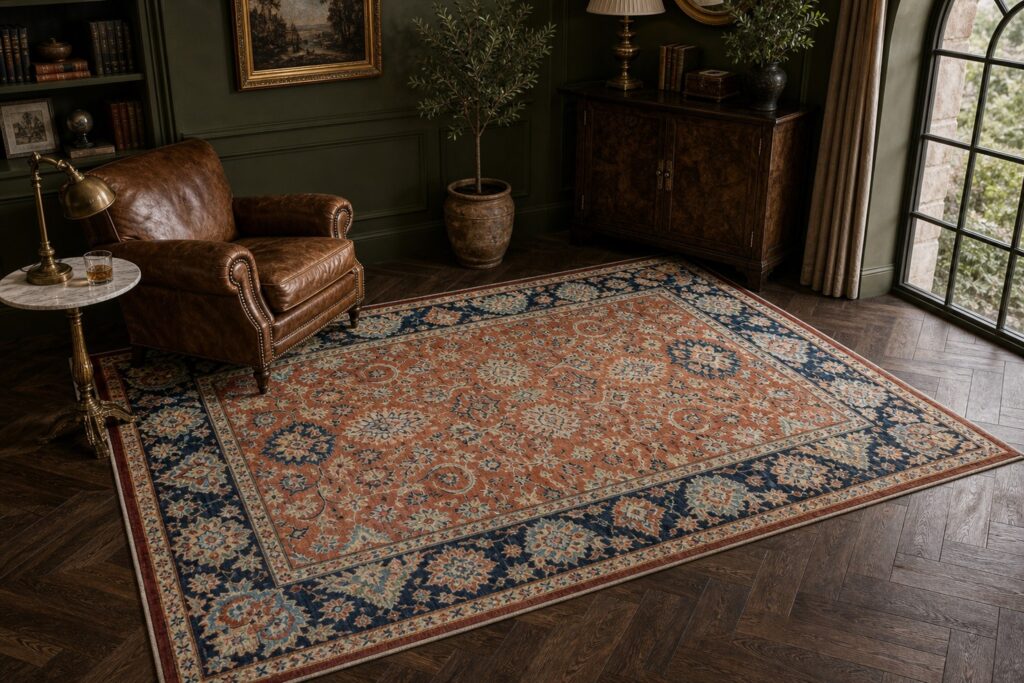
Libraries impose stricter requirements on flooring than almost any other room in the house. The unique combination of noise sensitivity, dust generation from books, and heavy furniture loads makes this a rug-dependent space. Hard surfaces like hardwood or tile reflect sound waves, creating sharp echoes that distract from concentration.
Can a rug reduce echo in a library?
Yes. Soft, porous surfaces absorb sound energy rather than reflecting it. Installing a dense rug significantly lowers the ambient noise floor, reducing the “room ring” caused by hard covers and wooden shelves.
Beyond acoustics, libraries face specific maintenance issues. Books and paper degrade over time, generating significant amounts of dust. Area rugs can trap these airborne particles, holding them until they can be vacuumed. This keeps the air quality higher than in rooms with bare floors where dust circulates freely. Furthermore, the sheer weight of fully loaded bookshelves and solid wood desks, requires a protective buffer. This is to help prevent permanent indentation or scratching of the subfloor.
Library rug vs a rug for a study vs an office rug
While the terms are often used interchangeably, there are distinct functional differences between a reading room rug and a rug designed for an active office. A dedicated library typically features stationary seating. This allows for higher pile heights, plush textures, and softer fibers that prioritize luxury and warmth.
In contrast, a home office or study usually centers around a desk with a rolling chair. If the pile height is too high in a workspace, the wheels will catch, making the room annoying to use rather than cozy. A study / library rug that must accommodate a rolling chair requires a low-pile or flatweave construction to facilitate movement.
When selecting a library rug, it is vital to distinguish between a room for relaxation (library) and a room for active work (office). For a comprehensive breakdown of workspace-specific requirements, refer to our guide on Buying rugs for the study.
The 4 core goals
- Acoustic Control: Silence is the defining characteristic of a library; the rug must act as a sound absorber to dampen footsteps, voices, and environmental noise.
- Floor Protection: Libraries contain some of the heaviest furniture in a home; a rug provides a critical barrier that distributes weight and prevents damage to the flooring underneath.
- Visual Anchoring: Without a rug, a room lined with Vertical shelving can feel ungrounded and cluttered; the rug centers the space and connects the furniture.
- Comfort and Warmth: Readers remain sedentary for long periods; thermal insulation and tactile softness are essential to keep the room comfortable during extended use.
Library rug “success criteria” snapshot
| Goal | What to Look For |
|---|---|
| Silence | Dense pile height, wool construction, felt or cork underlayment to maximize sound absorption. |
| Durability | Resilient natural fibers (like wool) that bounce back from the compression of heavy furniture legs. |
| Chair Mobility | For desks: Low pile (under 1/4 inch) or tight loop construction to allow wheels to roll smoothly. |
| Aesthetics | Rich, saturated colors or intricate patterns that complement the visual busyness of book spines without clashing. |
Performance Targets for a Home Library
Sound dampening and echo control
A true library is a sanctuary of focus, and in such a space, silence is a physical requirement. Beyond the visual weight of a fine textile, a hand-knotted wool rug serves as the room’s primary acoustic engine. While silk may offer a shimmering luster, it is the dense, lanolin-rich wool of a Persian Tabriz rug or a thick-piled Persian Heriz / Serapi carpet, that performs the vital task of sound absorption.
Medium-pile weave acts as a ‘sonic sponge,’ dampening the sharp echoes of turning pages and footfalls against hardwood, transforming a hollow room into a muffled, private world of study. In the curation of a library, we do not merely choose a floor covering; we choose the atmospheric ‘hush’ that allows for deep thought.
Can a rug reduce echo in a library?
Yes, significantly. A library rug serves as an acoustic damper that breaks the cycle of sound reflection. By covering a large percentage of the floor with porous material, the rug absorbs sound energy rather than reflecting it. This creates the hushed atmosphere required for deep concentration. The most effective rugs for this purpose feature dense fibers that muffle foot traffic, ensuring that movement within the room does not disturb readers.
Stable footing and edge-flatness
In a library setting, lighting is often moody, focused on specific reading nooks or shelves rather than illuminating the floor evenly. This lower ambient light increases the importance of edge behavior and slip resistance. A curled corner or a shifting rug becomes a significant trip hazard, particularly when users are carrying heavy stacks of books or focusing on the shelves rather than their footing.
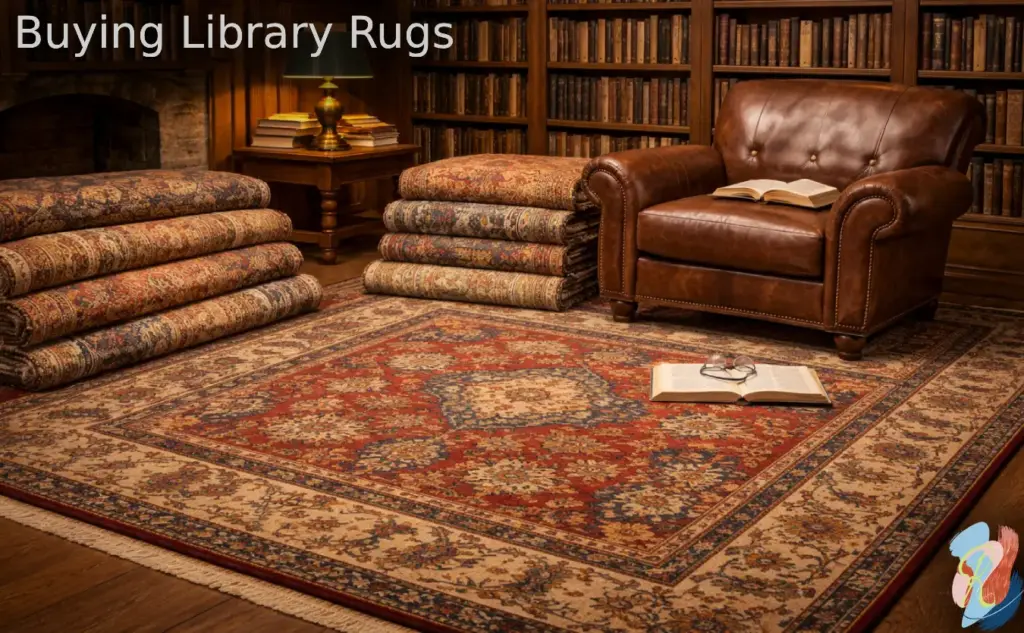
The best rug for home library safety is one that lays completely flat immediately upon unrolling and resists curling over time. Utilizing a high-quality rug pad is not merely a matter of comfort; it is a critical safety tool. A firm, rubberized pad locks the rug to the subfloor, preventing the creeping and bunching that leads to falls. Proper edge finishing, such as serging or binding, also ensures the perimeter remains stable and flat underfoot.
Low dust-shedding
Books are naturally dust-prone objects, attracting particulate matter that can damage paper over time. A rug should not exacerbate this issue. Poor quality rugs, particularly loose-staple synthetics or lower-grade wools, shed fibers continuously, adding to the dust load in the room. This increases the cleaning frequency required to keep the air quality suitable for book preservation.
A rug for reading nook placements must be constructed from continuous filament fibers or high-quality, long-staple wool that resists shedding. This minimizes the amount of airborne fiber accumulating on book spines and shelves. Selecting a low-shedding material ensures that the maintenance effort goes toward caring for the collection, not cleaning up after the floor covering.
Heavy-furniture resilience
Libraries house some of the heaviest static loads in a residential property. Floor-to-ceiling bookcases, solid wood desks, and wingback chairs exert immense pressure on the floor. A durable area rug for study room environments must possess high structural density to withstand this crushing weight without suffering permanent damage.
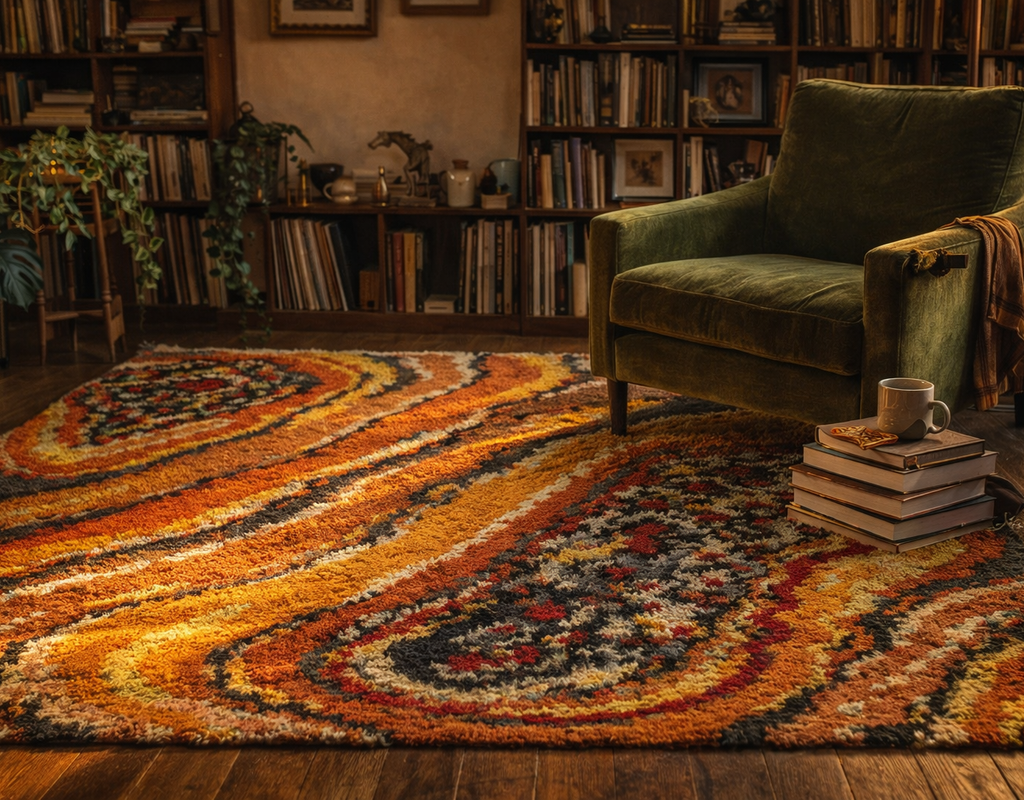
Density matters as much as, if not more than, pile height. A high-pile rug with low density will flatten completely under a bookcase leg, allowing the furniture to damage the rug’s backing and potentially the floor underneath. A dense, tightly woven rug resists this compression, providing a sturdy buffer that supports the weight while retaining its visual structure.
Library rug performance checklist
- High Density Pile: Resists permanent indentation from heavy bookcases and static furniture legs better than loose, airy weaves.
- Acoustic Absorption Rating: Reduces ambient echo and muffles footsteps to maintain the silence required for focus.
- Zero-Shed Construction: Prevents loose rug fibers from becoming airborne dust that accumulates on books and shelving.
- Anti-Slip Foundation: Prevents movement and edge curling, which are critical safety hazards in rooms with low or focused lighting.
The Librarian’s Palette: Curating by Aesthetic
Where to place this: Directly after the “Acoustics & Intellectual Silence” section and the first Shopping Box. This transitions the reader from functional needs to visual inspiration.
A library rug serves as the room’s visual anchor. To choose the right ‘look,’ one must consider the era of the architecture and the tone of the wood.
Here is how we categorize the most successful library aesthetics:
- The “Old World Scholar” (Antique Persian Bakshaish, Heriz & Serapi Rugs): Known for their bold, geometric design medallions and “stiff” oak-leaf patterns. These Northwest Persian rugs have the structural gravity to stand up to heavy, dark wood shelving and leather-bound books.
- The “Airy Academic” (Sultanabad & Ziegler Carpets): If your library has large windows or white-painted millwork, the antique Persian Sultanabad rugs offer a more relaxed, floral “all-over” pattern. They provide elegance without the visual density of a central medallion.
- The “Modern Intellectual” (Antique Turkish Rugs From Oushak): For a minimalist or contemporary study, antique Turkish Oushak rugs in “stone,” “fawn,” or “sage” tones provides a muted, tonal foundation that feels like a quiet gallery space.
- The “Creative Studio” (Antique Caucasian Kazak Rugs): Highly energetic, primary-colored geometries. These antique tribal Caucasian rugs are perfect for smaller home offices or creative libraries where you want a spark of tribal history and movement.
- The “Zen Scholar” (Early Chinese Ningxia Rugs): These 18th and 19th-century antique Chinese rugs are the pinnacle of “Intellectual Minimalism.” With their open fields, Buddhist fretwork borders, and soft “imperial yellow” or “monk’s robe” blue palettes, they create a serene, meditative environment.
- The “Iron Rug” (Antique Persian Bidjar Rugs): In high-traffic libraries, the Bidjar is the ultimate choice. Known as the “Iron Rug of Persia,” its weave is so dense that it is nearly indestructible. They typically feature saturated reds and blues in a “Herati” (fish) rug designs or tribal “Garous” rug patterns.
- The ‘Iron Rug’ Guarantee: For libraries with rolling chairs, we specifically recommend our Antique Bidjars. Their unique ‘wet-weft’ construction involves pounding the foundation threads while damp, creating a pile so dense that it is physically impossible for dust or chair casters to penetrate the foundation. It is the most durable textile ever woven.
- The “Grand Estate” (Antique Agra Rugs From India): Originating from the city of the Taj Mahal, antique Agra rugs were often commissioned for British Victorian libraries. They are famous for their oversized, flowing floral patterns and sophisticated “earth” tones—tobacco, olive, and deep gold
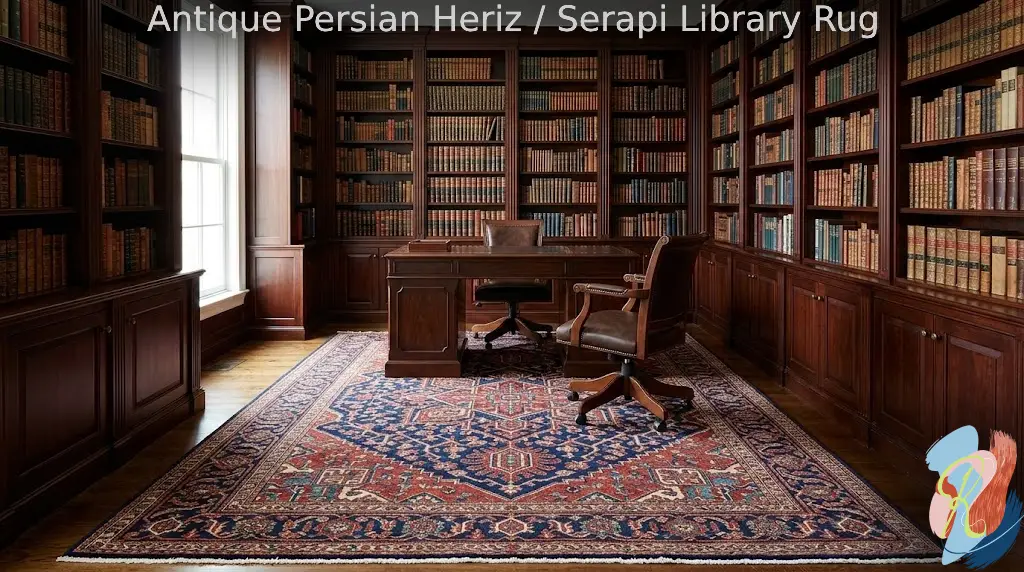
The Wood Stain Coordination Matrix
In a library, the rug must converse with the cabinetry. Use this guide to match your textile to your architectural wood tones.
| Wood Finish | Recommended Tones | Best Rug Styles |
|---|---|---|
| Walnut / Dark Oak | Terracotta, Sage, Rust, Tobacco | Agra or Sultanabad |
| Mahogany / Cherry | Navy, Indigo, Slate, Deep Teal | Bidjar or Tabriz |
| Reclaimed / Light Pine | Soft Gold, Pale Blue, Stone, Sand | Early Ningxia or Distressed Oushak |
| White / Grey Millwork | Ruby Red, Emerald, Deep Saffron | Heriz or Caucasian Kazak |
Selected for comfort, quality, beauty and endurance.
Shop For The Perfect Library Rugs.Construction Choices That Actually Work in Libraries
Hand-knotted rugs
For long-term service in a library, a hand knotted pile rug for study spaces is unrivaled in performance and longevity. These rugs are constructed by tying individual knots onto a structural warp and weft foundation, creating a dense, integrated textile that does not rely on adhesives to hold it together. This mechanical durability makes them uniquely suited to withstand the crushing weight of heavy bookcases and wingback chairs.
Unlike other constructions, hand-knotted rugs are repairable. If a heavy desk leg wears a hole in the pile over decades of use, a specialist can re-knot the damaged area. While the initial investment is higher, their ability to survive the static load of a library without delaminating makes them the most pragmatic choice for a “forever” room. The dense pile also offers superior sound dampening compared to lighter weaves, contributing to the room’s acoustic isolation.
Flatweave and kilim rugs
When the library serves primarily as a workspace with a rolling chair, pile height becomes the enemy of function. A flatweave rug for office chair mobility is often the superior choice because it lacks a vertical pile that can catch wheels or create resistance.
Is low-pile best for library rolling chairs?
Yes. A low-pile or zero-pile construction is essential for allowing caster wheels to glide smoothly. Deep pile creates drag, straining both the user’s legs and the chair’s mechanism, and eventually leading to ruts in the rug. Flat woven kilims for library use offer a tightly woven, flat surface that facilitates movement while still adding visual warmth and acoustic softening to the floor. These flat weave rugs are generally lighter, so a high-quality rug pad is mandatory to prevent them from bunching up under the friction of rolling wheels.
Tufted rugs
Tufted rugs are popular for their lower price point and plush feel, but they present specific challenges in a library environment. These rugs are made by punching yarn through a canvas backing and securing it with latex glue and a secondary backing cloth. The heavy reliance on adhesive creates two potential failure points: shedding and delamination.
Because the yarn is not knotted, tufted rugs often shed fibers significantly, contributing to dust accumulation—a critical issue in rooms housing sensitive book collections. Over time, the latex glue can dry out and crumble, especially under the pressure of heavy furniture, leading to a “crunchy” feel and a loss of structural integrity. While a tufted rug can provide short-term comfort, the backing quality determines whether it will survive the rigors of a static, furniture-heavy room.
Desk-forward vs lounge-forward libraries
Selecting the right construction requires analyzing the primary activity of the room. A low pile rug for desk chair zones is non-negotiable for “desk-forward” libraries where research and writing take precedence. In these spaces, functionality and ease of movement dictate a flatweave or very low-pile knotted construction.
Conversely, “lounge-forward” libraries—spaces dedicated to reading in a stationary armchair—benefit from the acoustic depth and underfoot comfort of thicker, hand-knotted piles. In these setups, the rug does not need to accommodate movement, allowing the owner to prioritize luxury and sound absorption over surface smoothness. Understanding this distinction ensures the rug’s construction aligns with the room’s actual daily use rather than just its aesthetic.
Comparison matrix
| Construction | Best for Desk | Best for Lounge | Chair Mobility | Typical Tradeoffs |
|---|---|---|---|---|
| Hand-Knotted | Yes (if low pile) | Ideal | Medium | Higher cost; heavy furniture requires furniture cups to prevent pile crushing. |
| Flatweave / Kilim | Ideal | Good | High | Less acoustic dampening; requires a strong pad to prevent slipping. |
| Hand-Tufted | No | Good | Low | Prone to shedding (dust); glue backing breaks down under heavy loads. |
| Machine-Made (Power Loom) | Yes (if tight weave) | Good | Medium / High | synthetic fibers may not age well; edge finishing can unravel. |
Pile Height, Density, and “Chair Reality”
Low-to-medium pile “sweet spot”
A common misconception in home design is that thicker always means better or more luxurious. In a library setting, however, excessive thickness can create instability for tall bookcases and make walking feel laborious. The ideal profile for most library applications is a low-to-medium pile height (approximately 1/4 to 1/2 inch). This represents the functional “sweet spot.”
This height offers enough cushion to serve as an effective library rug for hardwood floors, providing necessary sound dampening and thermal warmth, yet remains firm enough to support static furniture loads without shifting. For a workspace within the library, a dense rug for desk area usage is superior to a plush one. Density—the number of fiber tufts per Square inch—provides the resilience required to support weight, whereas pile height merely adds volume. A short, extremely dense rug will outlast a tall, loose rug every time.
Rolling-chair compatibility
When a rolling chair enters the room, the rules of rug selection change strictly. The interface between the caster wheels and the rug surface is the primary failure point in many home offices. A low pile rug for rolling chair mobility is non-negotiable.
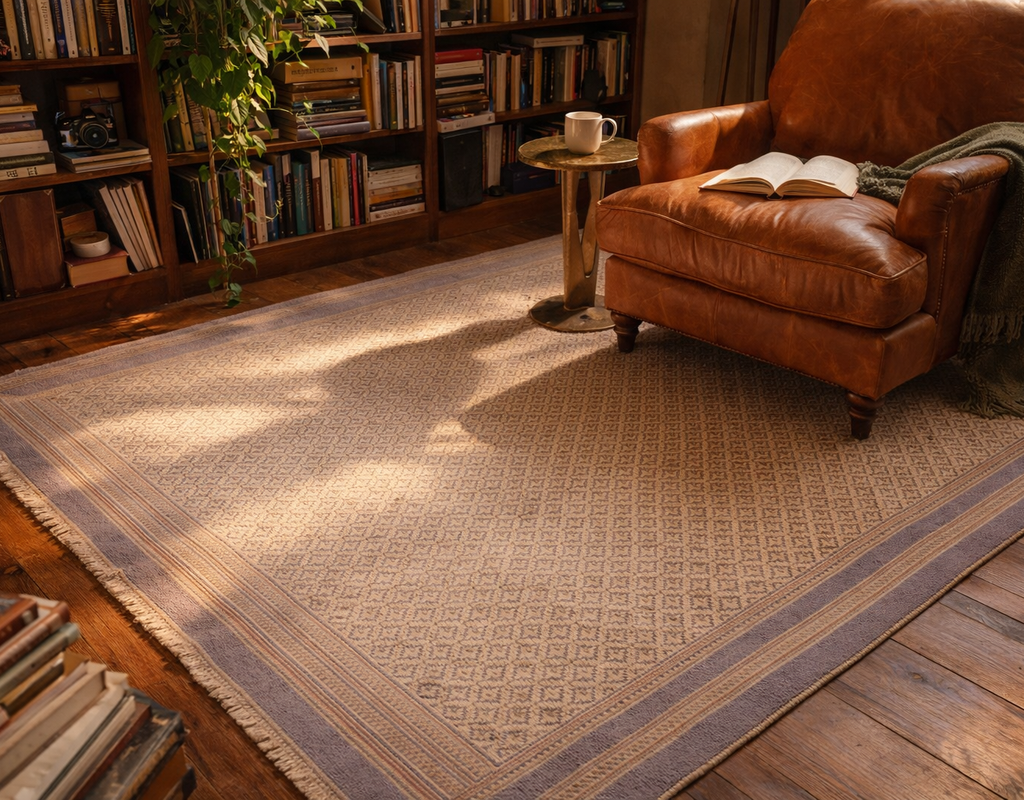
Is low-pile best for library rolling chairs?
Yes. To function correctly, a rolling chair requires a surface with minimal friction. The best rug pile height for office chair use is generally under 1/4 inch (6mm) or a tightly woven flatweave. This prevents the wheels from sinking into the material, allowing the user to glide between the desk and the shelves without physical strain or damage to the floor covering.
Why do chairs snag on thick a library rug?
Chairs snag on thick rugs due to two physical forces: wheel drag and pile grab. When a heavy chair sits on a plush rug, the wheels sink deep into the fibers, creating a depression. To move the chair, the user must apply significant force to push the wheels “uphill” out of these divots.
As the wheels rotate, they do not just roll over the surface; they grip and twist the long fibers. This torque can rip fibers out of the backing or cause the yarns to untwist and fuzz, leading to premature bald spots and structural delamination. This is why a dense, low-profile construction is critical for longevity in desk zones.
What happens when a library rug is too small
One of the most damaging scenarios for a library rug is improper sizing relative to the desk chair’s range of motion.
What happens when a library rug is too small?
If the rug does not extend fully past the desk’s perimeter, the rear wheels of the chair will repeatedly drop off the edge of the rug onto the hard floor when the user slides back. This creates an annoying “bump” that breaks concentration. More importantly, every time the user attempts to roll back onto the rug, the wheels grind against the edge binding. This repetitive friction destroys the serging or binding tape, causing the rug to fray and unzip at the borders. A properly sized library rug must contain the chair’s entire travel radius.
Fast selector guide
- Flatweave / Zero Pile: Best for heavy rolling chair use; offers zero resistance to wheels but provides less acoustic absorption.
- Low Pile (1/4 inch): The universal balance; provides comfort and sound deadening while still allowing chairs to roll reasonably well.
- Medium To High Pile (>1/2 inch): Restricted to “lounge-forward” libraries with stationary reading chairs; provides maximum luxury but traps wheels immediately.
- High Density: Regardless of height, higher density prevents furniture indentations and extends the lifespan of the rug under heavy loads.
Fibers and Foundations for Library Conditions
Wool as the baseline library fiber
For a dedicated reading space, wool is the functional gold standard. The primary reason a wool rug for library use outperforms synthetic alternatives is the fiber’s natural crimp. At a microscopic level, wool fibers are shaped like a coil or spring. This structure gives the rug “memory,” allowing it to compress under the weight of heavy oak desks or wingback chairs and then recover its shape once the weight is shifted.
This resilience makes wool the best fiber for reading room rug applications where static heavy furniture is common. Unlike Polypropylene or Viscose, which can crush permanently into flat, shiny spots, wool bounces back. Additionally, wool is inherently flame-retardant and possesses superior sound-absorbing qualities, contributing to the hushed atmosphere essential for a library.
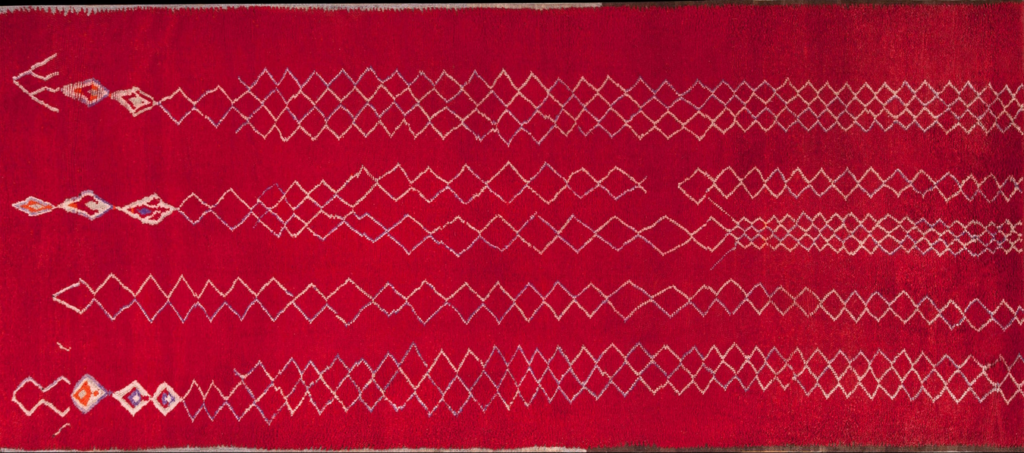
Cotton foundations for structure
While the pile gets the attention, the foundation—the warp and weft yarns that form the rug’s skeleton—dictates its stability. Cotton is the preferred foundation material for a high-quality library rug because of its rigidity. A cotton foundation does not stretch significantly over time. This structural stability ensures that the rug maintains its Rectangular shape and does not distort or go “out of square” under the torque of heavy bookcases or the friction of foot traffic.

Plant fibers (jute/sisal) in libraries
Plant fibers like jute, sisal, and seagrass offer a distinct, academic aesthetic and a very low pile profile that works well for rolling chairs. A jute rug in study environments provides a flat, durable natural fiber rug surface that doesn’t trap wheels. However, these fibers are naturally coarse, making them less comfortable for readers who prefer to sit on the floor or rest their feet on a soft surface.
Critically, plant fiber rugs can be abrasive on both sides. The coarse fibers on the underside of a sisal rug can act like sandpaper against delicate hardwood floors as the rug shifts slightly during use. Therefore, a high-quality felt or rubber rug pad is mandatory when using plant fibers to prevent the rug from grinding away the floor’s finish.
Silk highlights
Silk is synonymous with luxury, offering a lustrous sheen that defines intricate patterns. However, in a working library, silk should be approached with caution. It is significantly more fragile than wool and less resistant to abrasion. Pure silk pile area rugs are generally too delicate for the heavy traffic of a main library area or the grinding action of chair wheels.
The most strategic use of of these luxurious area rugs in a library is as an accent material—blended into a wool rug to highlight specific design elements. This allows the owner to enjoy the visual depth of silk while relying on the wool pile to do the heavy lifting regarding durability and crush resistance.
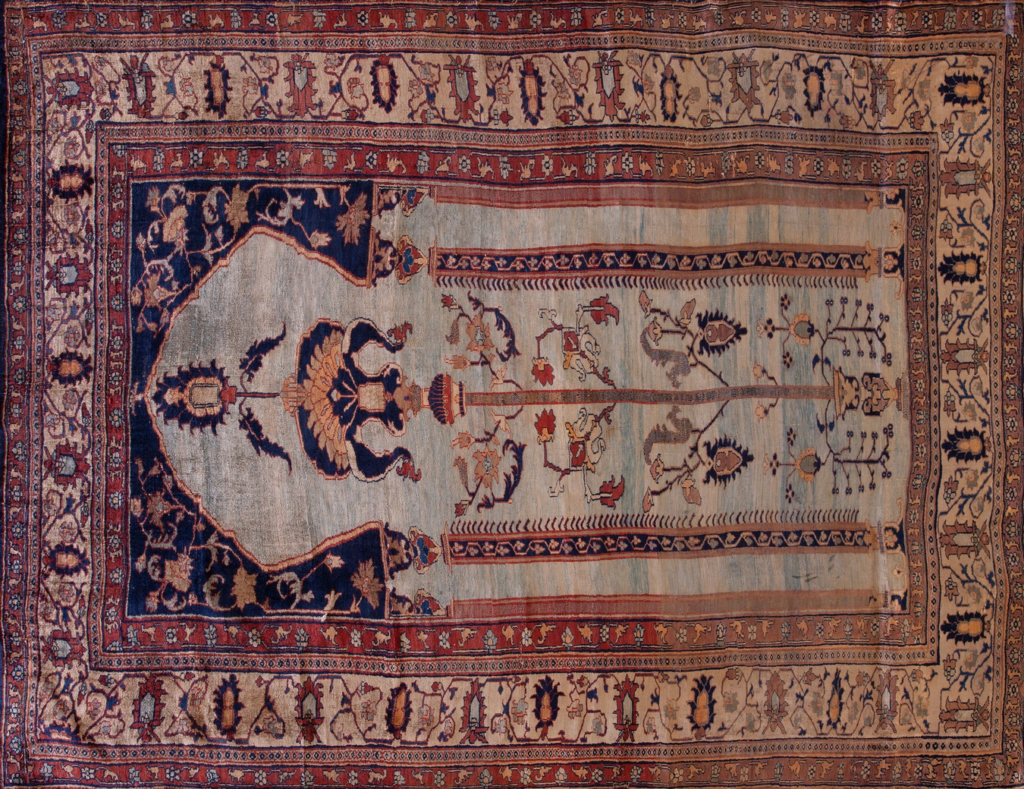
Are washable rugs practical for home libraries?
Generally, standard washable rugs lack the density and pile thickness required for adequate sound dampening in a library. While they offer easy cleaning, they often fail to provide the acoustic isolation or the cushioned feel underfoot that defines a luxury reading room. Detailed maintenance strategies and specific washable options.
Fiber comparison
| Fiber | Feel Underfoot | Chair Compatibility | Dust/Shedding | Durability | Best Library Use |
|---|---|---|---|---|---|
| Wool | Soft, resilient, warm | Medium (depends on pile height) | Low to Medium (sheds initially, then stabilizes) | Excellent (High recovery) | The “forever” rug for lounge or desk areas. |
| Jute / Sisal | Coarse, textured, firm | High (Low friction for wheels) | High (can shed brittle fibers) | Good (High abrasion resistance) | Desk zones requiring smooth rolling surfaces. |
| Silk (Pure) | Smooth, cool, luxurious | Low (Delicate) | Very Low | Low (Prone to staining/wear) | Low-traffic reading corners only. |
| Silk (Accent) | Soft highlights | Medium | Low | Good (Protected by wool) | Decorative centerpieces in mixed-use libraries. |
| Synthetics | Soft (plastic feel) | Medium | Low | Medium (Permanent crushing) | Budget-conscious temporary setups. |
Rug Pads, Grip, and Safety in Quiet Rooms
Rug pads are not optional in many libraries
In a functional home library, a rug pad acts as critical safety infrastructure rather than an optional accessory. The combination of heavy furniture, focused reading activities, and potentially dim, atmospheric lighting makes stability paramount. A best rug pad for library rug applications locks the textile to the subfloor, preventing the dangerous “creep” or shifting that occurs when users walk across the room or adjust their chairs. Without this foundation, even a heavy wool rug can drift over time, creating unpredictable footing.
Beyond stability, pads extend the lifespan of the rug itself. They act as shock absorbers, compressing under foot traffic to reduce the friction between the rug backing and the hard floor. This is especially vital in libraries with hardwood floors, where grit trapped under a shifting rug can act like sandpaper, damaging the wood finish permanently.
Trip-risk control: edges, corners, bindings
The most common safety hazard in a library is a curled rug corner. Because libraries often feature lower light levels to create a cozy reading ambiance, visual cues for trip hazards are reduced. A rug that curls at the edges becomes an invisible obstacle. To prevent rug curling in study environments, a high-quality pad with a stiffened surface or a rubberized grip is essential. It holds the corners down by adhering them to the floor, ensuring the perimeter remains perfectly flat.
Edge flatness also protects the rug’s structural integrity. A curled edge is highly susceptible to being kicked, caught by chair wheels, or vacuumed aggressively, leading to frayed bindings and unraveled serging. Ensuring the rug lies flat is the single most effective way to prevent accelerated wear on the borders.
When furniture load changes pad needs
The presence of heavy library furniture—such as solid wood desks and floor-to-ceiling bookcases—alters the requirements for a rug pad. Standard foam pads often compress completely under these loads, losing their grip and cushioning properties. For areas with extreme weight, a dense felt or felt-rubber hybrid pad is superior.
These denser pads resist “bottoming out” under the point load of a bookcase leg. This resistance protects the rug fibers from being crushed against the hard subfloor, preventing permanent indentations. If a rug is anchored by a massive bookcase on one side but free-floating on the other, a high-grip pad is mandatory to prevent the free side from buckling or wrinkling as the anchored side is held fast.
“Skip a pad?” myth-busting
Should you skip a rug pad in a library?
No. Skipping a pad is a false economy that compromises safety and accelerates floor damage. A common myth is that heavy rugs don’t need pads because their weight holds them in place. While a heavy rug may not slide as easily as a flatweave, it will still shift microscopically with every footstep. Over time, this movement scuffs the floor and stresses the rug’s weave. Furthermore, a rug safety pad hardwood floor protector provides essential air circulation, preventing moisture from becoming trapped between the rug and the wood, which can lead to mold or finish discoloration.
Pad selection guide
| Floor Type | Pad Type | Grip Level | Cushion Level | Best For |
|---|---|---|---|---|
| Hardwood | Natural Rubber & Felt Hybrid | High | Medium/High | All-purpose library use. Grips floor, cushions feet, protects wood. |
| Tile / Stone | 100% Natural Rubber (Open Weave) | Maximum | Low/Medium | High-traffic areas where slip resistance is the only priority. |
| Carpet | Polyester Felt (Adhesive Surface) | High (Prevents creeping) | Medium | Layering a rug over wall-to-wall carpet to prevent bunching. |
| Heated Floors | Heat-Safe Felt or Rubber | Medium | Medium | Ensuring pad material does not degrade or stick to the floor when heated. |
| Concrete | Thick Felt | Low | Maximum | Adding warmth and softness to industrial-style library floors. |
Sizing and Placement for Real Library Layouts
What size rug fits a home library?
The correct library rug size guide does not offer a single number but rather a strategy based on functional zones.
What size rug fits a home library?
A rug in a library must be sized according to the “work” it is doing. If the room is a comprehensive study with wall-to-wall shelves, the rug should be large enough to leave an 18-inch border of exposed floor around the perimeter, ensuring it doesn’t run under heavy bookcases where it might become trapped. If the library is a shared space, the rug size should define the specific activity zone—such as the reading corner or the desk area—rather than trying to fill the entire room.
How big should a rug be under a desk?
A common error is sizing the rug to fit only the desk itself. This creates a functional failure as soon as the chair is used.
How big should a rug be under a desk?
The rug must accommodate the “push-back zone.” A rug size for desk and chair layouts should extend at least 24 to 36 inches behind the desk edge where the chair sits. This ensures that even when the user pushes back fully to stand up or recline, the chair’s rear wheels remain on the rug. If the wheels constantly roll off the edge and have to be dragged back on, it damages the rug binding and annoys the user.
How far should a rug extend past chair legs?
For stationary reading chairs, the rug should extend at least 12 to 18 inches beyond the back legs. This visual buffer prevents the chair from looking like it is perching precariously on a postage stamp. Functionally, it ensures that if the chair shifts slightly during use, it won’t slide off the rug and scratch the floor.
What rug size fits two chairs and a table?
For a conversation nook with two wingback chairs and a small table between them, 5’x8′ or 6’x9′ size area rugs are typically ideal. This size is sufficient to place all legs of both chairs and the table on the rug, creating a cohesive “island” within the room. This “all legs on” approach is critical for anchoring seating groups to prevent the furniture from feeling disjointed.
How should a rug anchor a reading nook?
A reading nook is an intimate space that requires clear definition. The reading nook rug placement should center the primary chair and its accompanying ottoman and lamp. The rug acts as a visual frame. If the nook is in a corner, orient the rug squarely with the walls, ensuring the front legs of the chair sit deeply on the rug to connect it to the space.
Can rugs define library desk and lounge zones?
Yes. In larger libraries, using two separate rugs is an effective way to zone the room without building walls. You can place a durable, flatweave rug under the desk for work and a plush, high-pile wool rug in the lounge area for reading. This visual separation signals the brain to switch modes between “focus” and “relax.”
Can a round rug work in a narrow library?
Yes. A round rug softens the rigid, linear geometry of a room filled with rectangular shelves and books. In a narrow library or a square corner, a round rug under a solitary reading chair prevents the space from feeling cramped by eliminating corners that would otherwise butt against the walls.
Sizing cheat sheet
- The Desk Rule: Add 30 inches to every side of the desk where a chair will move; this prevents wheels from dropping off the edge.
- The Bookshelf Buffer: Keep the rug edge 3-6 inches away from the face of floor-to-ceiling bookcases so doors can open and you aren’t forced to lift heavy shelves to place the rug.
- The Runner Solution: Use a runner for bookcase hallway layouts (narrow paths between shelves) to dampen footsteps (echo reduction) while leaving the shelving accessible.
- The “All Legs” Standard: For lounge chairs, aim to have all four legs on the rug to lock the furniture in place and prevent tipping or wobbling.
Bookshelves, Runners, and Library-Specific Obstacles
Should a library rug go under bookshelves?
Generally, no. placing a rug under bookshelves creates significant structural and maintenance challenges. Bookcases filled with paper are incredibly heavy; this weight compresses the rug pile unevenly, potentially causing the shelving unit to lean forward over time if the back legs sit on a tack strip or bare floor while the front legs sit on the rug.
From a practical standpoint, installing shelving on top of a rug “locks” the textile in place. If the rug needs cleaning, repair, or replacement, you must unload and dismantle the entire library infrastructure to remove it. The best practice is to stop the rug 3 to 6 inches in front of the shelving toe-kick. This creates a visual border of hard flooring that frames the room and allows for easier cleaning.
Where should a runner sit between bookcases?
In narrow library aisles or corridors formed by facing shelves, the runner should be centered precisely between the two units. A runner between bookcases serves two purposes: it dampens the acoustic “tunnel effect” common in narrow, hard-surfaced hallways, and it provides a soft path for browsing.
For proper placement, ensure equal amounts of hard flooring are visible on both the left and right sides of the runner. If the runner is off-center, the aisle will feel visually unbalanced and chaotic. The pile direction should run parallel to the shelves to guide the eye down the length of the collection.
How do you measure a runner for shelves?
To determine the correct narrow library runner size, do not measure wall-to-wall. Instead, measure the width of the open floor space between the bookshelves or baseboards. Subtract 6 to 8 inches from this total width to allow for a 3-to-4-inch strip of exposed floor on either side. This “breathing room” prevents the space from looking stuffed.
For length, measure the full hallway and subtract 12 to 24 inches. This leaves a gap at both ends of the runner, ensuring it doesn’t butt up against the threshold or end wall. Crucially, check the swing radius of any lower cabinet doors on your bookcases. If the doors swing out, the rug pile must be low enough to clear them, or the rug width must be narrow enough that the doors stop before hitting the edge binding.
Does a rug against baseboards trap dust?
Yes. Rugs installed tightly against baseboards or bookcases without a gap are prone to “filtration soiling.” This occurs when air currents circulate through the gap between the floor and the wall, forcing dust and pollutants into the carpet edges where the vacuum crevice tool cannot easily reach.
In a dust-sensitive room like a library, leaving a 6-inch gap between the rug edge and the baseboards allows for thorough cleaning. You can easily run a vacuum nozzle along the hard floor perimeter to capture the dust bunnies and paper fibers that migrate to the edges of the room, keeping the air quality higher for book preservation.
Library ladder compatibility
How do you place rugs with a library ladder?
Library ladder rug placement depends entirely on the ladder’s mechanism. If you have a rolling ladder with wheels that contact the floor, the rug cannot extend into the ladder’s travel path. The wheels will snag on the rug edge, making movement difficult and dangerous. In this scenario, the rug must be sized so that its edge sits inside the ladder’s track line, leaving the wheel path on the bare floor.
If the ladder is a “hook” style or is suspended entirely from a top rail without floor wheels, you have more flexibility. However, you must still ensure the ladder’s feet do not land awkwardly on the rug’s edge when the ladder is angled out for use, which could cause instability for the climber.
Scenario table
| Layout Type | Runner Width | End Clearance | Notes |
|---|---|---|---|
| Narrow Aisle | Aisle width minus 6–8 inches | 12 inches from each end | Ensure pile height clears lower cabinet doors. |
| Wide Corridor | Aisle width minus 10–12 inches | 18–24 inches from each end | Wider floor margins feel more formal and grand. |
| Rolling Ladder Zone | Distance between ladder tracks minus 4 inches | Standard | Rug must stay strictly inside the wheel track zone. |
| Perimeter Shelving | Room width minus (Shelf Depth + 12 inches) | 6-inch perimeter margin | Keeps rug edge 6 inches away from shelf toe-kicks. |
Style Logic for Libraries Without Trend Fluff
Rugs as “grounding” and visual framing
In a home library, the walls are visually heavy, filled with vertical lines of spines and shelving. A rug must counterbalance this verticality by grounding the space. An effective library rug uses a clearly defined border to create a “frame” on the floor that mirrors the architectural structure of the bookcases.
This establishes a sense of containment and order, which is psychologically linked to focus and study. Without a strong perimeter border, the room can feel like it is floating or unfinished, lacking the gravity required for a serious reading space.
Motifs that suit libraries
The most successful library rug feature motifs that imply order rather than chaos. Central medallions work exceptionally well because they provide a focal point that aligns with the symmetry of the room. Intricate floral rug design patterns (featuring vines and florals) offer an organic counterpoint to the rigid geometry of bookshelves, softening the hard lines without disrupting the structure.
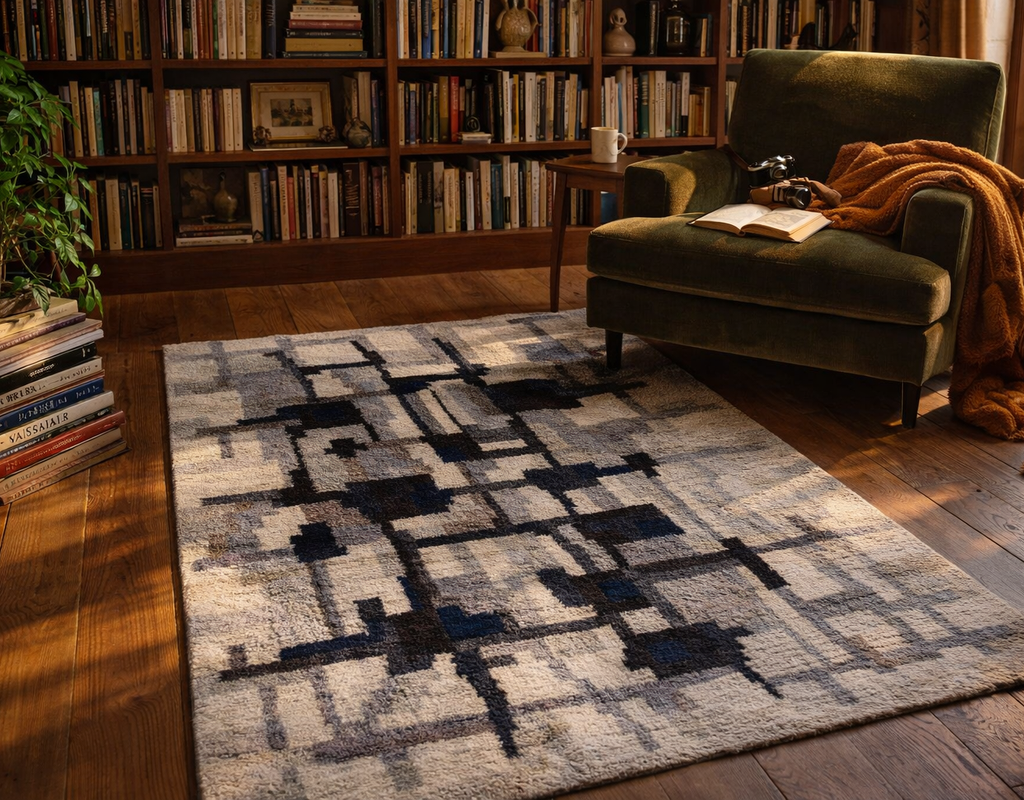
Geometric Tribal rug designs or large scale Arts And Crafts patterns also thrive here, as their repetitive nature echoes the rhythm of books on a shelf. Conversely, highly Abstract, chaotic, or high-contrast modern art rugs can feel “busy” and distracting at reading distance, competing for attention rather than supporting the room’s primary function.
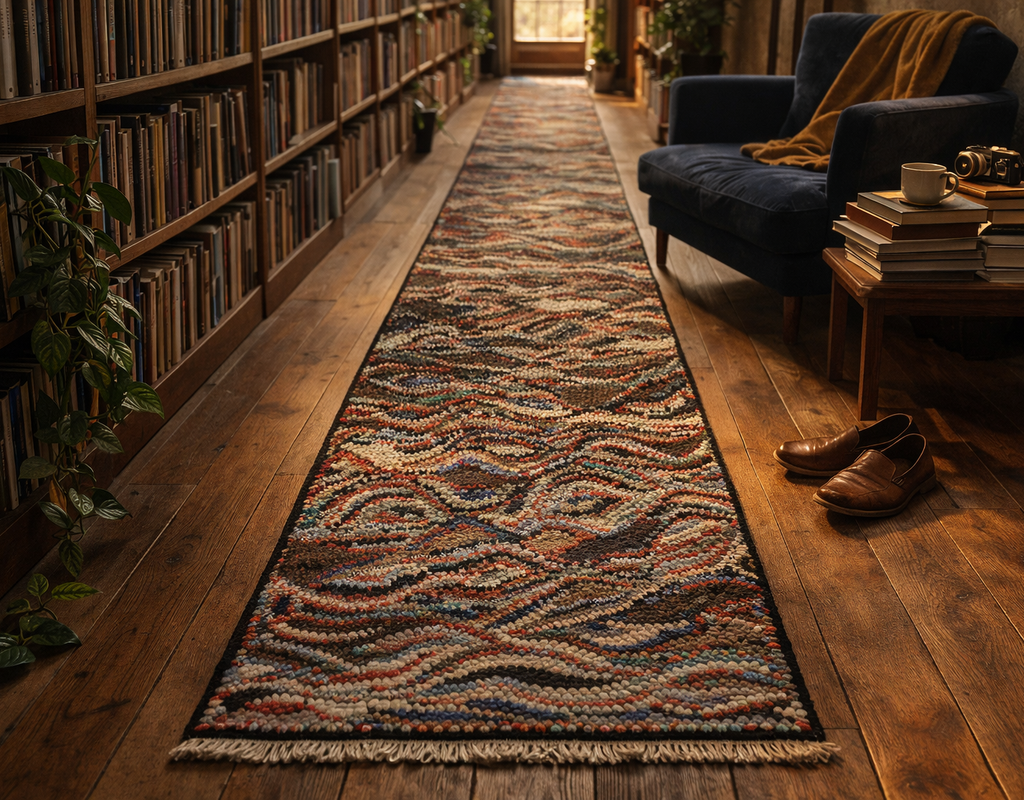
Palette strategy with book spines
Books are colorful objects. A wall of books creates a “confetti” effect of multi-colored spines. The rug palette must be strategic to avoid visual overload. A calm patterned rug for reading room environments often uses a restricted palette—deep blues, rich reds, or earth tones—that absorbs visual weight rather than adding more noise.
Alternatively, if the library is paneled in dark wood, a rug with saturated, jewel-tone colors can hold its own against the heavy joinery. The goal is to avoid a mid-tone “mush” where the rug and the books blend into a single, indiscernible texture.
Arts & Crafts association
The Arts and Crafts movement emphasized honesty of materials, hand-craftsmanship, and nature-inspired motifs—values that align perfectly with the ethos of a traditional home library. An arts and crafts style rug (such as a William Morris design) brings a layer of intellectual history to the floor. These rugs prioritize intricate, repeating patterns of leaves and trellises that feel structured yet organic, providing a sophisticated backdrop that feels curated rather than decorative.
Vintage character vs practical limits
A vintage rug in library settings adds undeniable soul and gravitas, instantly making a new room feel established. The natural patina of a worn patinaed antique area rug suggests history and permanence, fitting the mood of a room dedicated to knowledge.
However, vintage rugs have practical limits. They may be thinner or more fragile than new constructions. In a high-traffic library with rolling chairs, a fragile antique is a liability. Vintage rugs are best reserved for “lounge” zones with stationary armchairs, where their character can be admired without being subjected to the grinding wear of caster wheels.
Layering rugs in libraries
Is layering rugs in libraries still in style?
Yes, but with strict caveats regarding safety. Layering a smaller, patterned rug over a large, neutral sisal or jute base is a classic library look that adds texture and defines a specific reading nook.
However, layering introduces edge hazards. The top rug must be thin and flat enough that it doesn’t create a tripping point. Furthermore, if you layer under a rolling chair, the wheels will constantly bunch up the top layer, creating a frustrating experience. Layering should be restricted to stationary seating areas where traction and edge control can be maintained.
Style do’s and don’ts
- Do: Mirror Structure: Use rugs with borders or central medallions to reflect the architectural symmetry of the bookshelves.
- Do: Go Darker: Darker, richer grounds (navy bluess, deep reds) anchor the room and hide the inevitable dust from books better than pastels.
- Don’t: Pick High-Contrast Chaos: Avoid jagged, high-contrast abstract patterns that vibrate visually and distract from the calm atmosphere needed for reading.
- Don’t: Match Book Colors Exactly: Trying to match Rug Colors to specific book spines is futile; aim for a complementary palette that supports the overall wood tone and lighting.
Maintenance and Conservation Mindset for Book Rooms
Vacuuming for libraries
The preservation of a library rug is inextricably linked to the preservation of the books themselves. Books and paper degrade over time, creating a specific type of fine, cellulosic dust that settles into the rug pile. Learning how to clean a library rug requires a shift from “cleaning for appearance” to “cleaning for air quality.”
Consistent dust management is superior to occasional deep cleaning. Vacuuming wool pile area rugs in study environments should be done weekly using a machine with adjustable height settings. For wool and hand-knotted rugs, disengage the beater bar (the rotating brush). The beater bar can pull fibers loose and create a fuzzy, worn appearance on the surface. Instead, use high suction to lift dust from the base of the knots without mechanically abrading the pile.
Cleaning around fringes and older textiles
If your library features an older or antique rug, the fringe requires special handling. The fringe is not merely decorative; it is the exposed warp threads of the rug’s foundation. If the fringe is torn away by an aggressive vacuum, the entire rug can begin to unravel.
Never run a vacuum cleaner head over the fringe. The suction and brush will chew the delicate threads. Instead, stop the vacuum head several inches short of the edge. To clean the fringe itself, use a handheld upholstery tool with low suction, or sweep the fringe outward with a soft-bristled hand brush. This gentle approach preserves the structural integrity of the textile.
Humidity and temperature stability
Books and natural fiber rugs share a common enemy: environmental instability. Just as fluctuating humidity causes book bindings to warp and paper to fox, it causes natural fibers like wool and cotton to expand and contract. High humidity promotes mold and mildew growth within the rug’s foundation, which can go unnoticed until a musty smell permeates the room. Conversely, extreme dryness can make the backing brittle, leading to cracks.
maintaining a stable relative humidity (ideally between 45% and 55%) protects the entire contents of the library. If the room is prone to dampness, a dehumidifier is a mandatory investment to prevent fungal damage to both your literature and your floor coverings.
Storage: rolling vs folding
If the library is being painted or renovated, the rug must be stored correctly to prevent permanent damage. Always roll the rug; never fold it. Folding a rug creates sharp creases that stress the foundation yarns. Over time—or even after just a few weeks in storage—these creases can become permanent cracks in the backing.
Roll the rug tightly against the grain of the pile. Ideally, wrap it in a breathable material like Tyvek or a cotton sheet, rather than airtight plastic, which can trap moisture and lead to rot. Store the rolled rug horizontally off the ground; standing it vertically on one end can cause the rug to slump and distort its shape.
Pest management
Libraries are often kept dark and quiet—conditions that clothes moths and carpet beetles find ideal. These pests feed on protein-based fibers like wool and silk. The larvae tend to eat in undisturbed areas, meaning the danger zone is often directly underneath heavy bookcases or wingback chairs that are rarely moved.
Effective moth prevention for wool rugs involves an Integrated Pest Management (IPM) approach. This means regular monitoring rather than just reacting to an infestation. Once a month, use a crevice tool to vacuum underneath furniture legs and along baseboards where insect larvae hide. If you see small casings or balding spots in the rug pile, immediate professional treatment is required to save the rug.
Washable rugs practicality
Are washable rugs practical for home libraries?
For high-traffic family libraries or rooms where drinks are frequently consumed, a washable rug for home library use offers convenience, but it comes with performance tradeoffs. While being able to machine wash a rug is excellent for spill management, these rugs generally lack the density and weight of traditional wool rugs.
As a result, they offer less sound dampening and often have poorer edge stability, making them prone to curling under rolling chairs. If you choose a washable option, ensure it is paired with a heavy-duty, cushioned rug pad to artificially add the mass and stability required for a quiet, safe reading room.
Maintenance schedule
- Weekly Suction Vacuuming: Removes abrasive dust and paper fibers before they settle deep into the pile and act like sandpaper against the yarns.
- Monthly “Under-Furniture” Check: Disturbs potential pest habitats (moths/beetles) in the dark, quiet zones beneath desks and chairs.
- Annual 180-Degree Rotation: Distributes foot traffic and sunlight exposure evenly, preventing one side from wearing out or fading while the other remains new.
- 3-5 Year Professional Wash: Removes the oily soils and deep-set grime that home vacuums cannot reach, restoring the fiber’s luster and bounce.
The Rugs On Net Difference: A Legacy of Curation
Since 1970, our family has specialized in more than just floor coverings. We specialize in the preservation of rug history. When buying a library rug from Rugs On Net means accessing a curated collection that has been vetted for the specific demands of a scholarly environment.
- Hand-Selected for Integrity: We don’t bulk-buy. Every Bidjar, Tabriz, and Oushak in our collection is hand-inspected for knot density and wool quality to ensure it can withstand the weight of heavy library furniture.
- Expert Color Coordination: With decades of experience working alongside interior designers, we understand how a textile interacts with walnut, mahogany, and cherry millwork. We provide the historical context that big-box retailers simply cannot.
- Heirloom Sustainability: We focus on natural, vegetal-dyed wools that age gracefully. Our rugs are not ‘disposable’ decor; they are investments designed to be passed down alongside your book collection.
- A Boutique Family Approach: When you call us, you aren’t reaching a call center. You are speaking with curators who know the specific history, origin, and soul of every piece in our gallery.
Selected for comfort, quality, beauty and endurance.
Shop For The Perfect Library Rugs.FAQ
- What is the biggest mistake when buying library rugs?
The biggest mistake is choosing a thick, plush rug, which makes chairs unstable and increases wear in a functional library space.
- Can library rugs work in commercial or office libraries?
Yes, low-pile, tightly woven library rugs are commonly used in offices and institutions for durability and noise control.
- Should library rugs match furniture or walls?
Library rugs usually complement furniture tones rather than walls, helping ground the room and create a cohesive reading environment.
- Are handmade rugs better for libraries?
Handmade library rugs are often denser and more durable, making them well-suited for long-term use in quiet, furniture-heavy rooms.
- How do you prevent library rugs from curling?
Use a properly sized rug pad and choose well-finished edges, as curling is more common with thin or poorly bound library rugs.
- Can runners be used as library rugs?
Yes, runner-style library rugs are ideal for narrow reading aisles or walkways between bookcases.
- What shapes work best for library rugs?
Rectangular library rugs are most common, fitting desks and seating layouts, though runners work well between shelves.
- Are library rugs good for allergy-sensitive spaces?
Wool library rugs can trap dust until vacuumed, which may help allergies compared to bare floors that allow particles to circulate.
- Can library rugs protect hardwood floors?
Yes, library rugs protect floors from chair scratches, foot traffic, and heavy furniture when used with an appropriate pad.
- Should library rugs be thick or thin?
Thin, dense library rugs are preferred over thick ones, as they allow easier movement of chairs and reduce tripping hazards.
- Are synthetic rugs suitable for libraries?
Synthetic library rugs can work in budget or office settings, but natural fibers usually provide better longevity and sound absorption.
- How often should library rugs be cleaned?
Library rugs typically need vacuuming weekly and professional cleaning every 12–24 months, depending on foot traffic.
- Can antique or vintage rugs be used in libraries?
Yes, antique or vintage rugs work well in libraries if they are structurally sound, adding character while offering dense, durable construction.
- How durable should library rugs be?
Library rugs should be tightly woven and dense, as they support heavy furniture and frequent walking in concentrated areas.
- Are patterned library rugs better than solid ones?
Subtle patterns are often better for library rugs since they disguise dust and traffic marks while remaining visually quiet.
- What colors work best for library rugs?
Muted, darker tones like navy, brown, olive, or burgundy are popular for library rugs because they hide wear and create a calm atmosphere.
- Do library rugs need rug pads?
Yes, a rug pad adds grip, protects floors, and extends the life of library rugs by reducing friction and wear.
- Are rugs safe for rolling chairs in libraries?
Low-pile or flatweave library rugs are safest for rolling chairs, especially when paired with a firm rug pad to prevent bunching.
- What rug size works best for a home library?
Most home library rugs range from 6×9 to 9×12, large enough to cover seating or desk areas without crowding bookcases.
- Should library rugs be placed under furniture?
Library rugs should extend under desks or seating by at least 12–18 inches to anchor furniture and prevent shifting during use.
- Do library rugs help with noise reduction?
Yes, library rugs absorb sound from footsteps and chair movement, noticeably reducing echo in rooms with hard floors and bookshelves.
- What materials are best for library rugs?
Wool library rugs are preferred for durability and sound absorption, while cotton flatweaves are lighter options for smaller or low-traffic libraries.
- Are flatweave rugs good for libraries?
Yes, flatweave library rugs are excellent because they lie flat, shed less, and are easy to clean, making them ideal for study and reading spaces.
- What pile height is best for library rugs?
Low to medium pile library rugs work best, usually under 0.5 inches, because they reduce tripping risks and allow desks and chairs to sit evenly.
- What makes library rugs different from other area rugs?
Library rugs are chosen for quiet, stability, and durability, often with low to medium pile to reduce noise and allow chairs and foot traffic to move smoothly.