
Ningxia Rugs
Key takeaways: antique Ningxia rugs
- What they are: the oldest Chinese weaving tradition in our collection, from the Ningxia region of north-central China on the upper Yellow River, woven from the 17th to the 19th century for monasteries, the imperial court and merchants. They are the earliest chapter of our antique Chinese rugs collection.
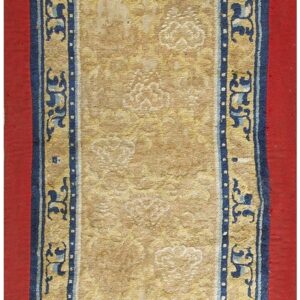
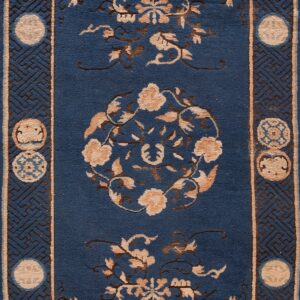
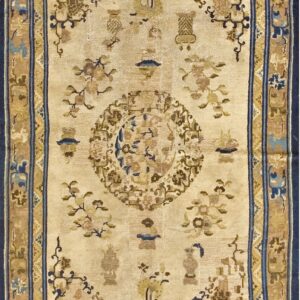
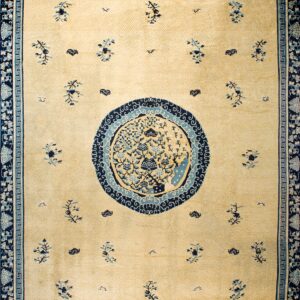
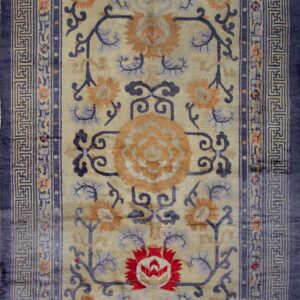
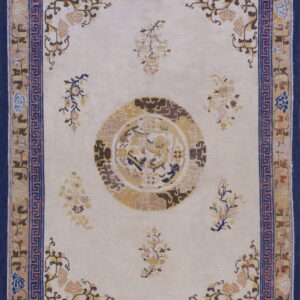
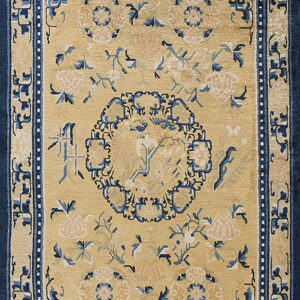
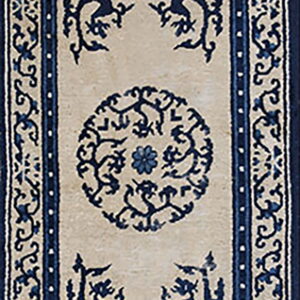
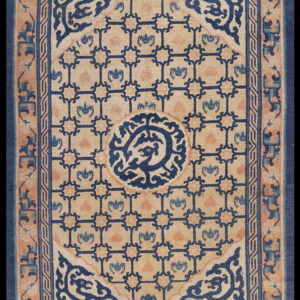
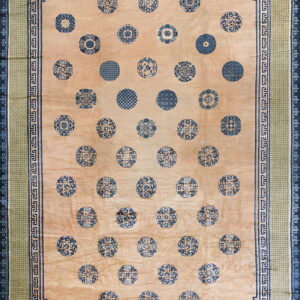
- How to spot one: mellow golds, apricots and ivories with faded indigo, a few bold motifs such as fu lions, dragons, lotus or a shou medallion, and a fret or cloud border, all on a soft, supple, loosely knotted rug.
- Made for a purpose: many Ningxia pieces are working formats rather than floor carpets, such as square seat and throne covers, pillar rugs made to wrap temple columns, kang rugs for heated platform beds, and saddle rugs.
- Age is part of the look: vegetable dyes soften over centuries, and browns set with iron mordants often corrode into a low, textured line. Honest, even wear is expected.
- Our collection: more than 150 Ningxia rugs in stock in New York, including more than 110 from the 19th century and more than 30 from the 18th century or earlier. Square formats are unusually common, with more than 40.
- Buying with confidence: every rug is inspected before it is listed, shipping is free within the continental United States, and there is a 4-day in-home trial. See buying with confidence.
- The finest examples: ten of our earliest Ningxia carpets and rugs, from the 17th to the 19th century, are shown with close up photographs in our collection highlights. Read the collector's guide to antique Ningxia carpets.
Antique Ningxia rugs represent one of China’s most historic and distinctive hand‑knotted carpet traditions, emerging from the Ningxia region in north‑central China, an area long celebrated for its high‑quality wool and weaving heritage. These carpets date back at least to the Qing era and were among the first Chinese rugs to attract attention both domestically and abroad, with early examples supplied to imperial halls, monasteries, merchants, and later Western markets.
What sets Ningxia rugs apart is their balanced, formal aesthetic and classic Chinese motifs, often rendered with stylized floral sprays, cloud bands, dragons, fretwork and auspicious symbols against soft, warm grounds of golden yellow, beige, blue and red. Woven on a cotton foundation with a moderately coarse but resilient wool pile, these carpets combine rich cultural imagery with robust construction, qualities that make them both beautiful and practical. Whether featuring central medallions, open‑field designs, or decorative borders, Ningxia rugs bring a sense of timeless artistry and cultural depth to interiors, appealing to collectors, design lovers and anyone seeking a rug with genuine historical character.
Antique Chinese Ningxia rugs are among the most revered and historically significant examples of Chinese weaving artistry, often distinguished by their pale fields and simple archaic motifs. Utilizing selective rich accent colors like imperial yellow and indigo, these pieces offer a tranquil elegance highly sought after by collectors, and you can discover more about the history and unique characteristics of this ancient style in our detailed guide.
Ningxia carpets are the oldest pieces in our antique Chinese rugs collection, one of the largest in the United States with more than 1,850 antique Chinese rugs in stock.
Ningxia is the oldest of the Chinese weaving traditions represented here. Our ningxia buying and identification guide covers current price bands, what to look for and what moves the value.
Antique Ningxia rugs at a glance
The table sums up what defines a Ningxia rug and what is on this page right now. Counts and prices come from our in-stock Ningxia rugs on September 27, 2026 and change as rugs sell.
| Feature | Antique Ningxia rugs |
|---|---|
| Where woven | The Ningxia region of north-central China, on the upper Yellow River between Gansu and Inner Mongolia, with Yinchuan as its historic center. Rugs also traveled along trade routes to Tibet and Mongolia. |
| When woven | 17th to 19th century, reaching its height under the Qing dynasty, when both the court and Buddhist monasteries ordered Ningxia carpets |
| Dates in our collection | More than 110 from the 19th century; more than 30 from the 18th century or earlier, including a few catalogued as 17th century; 11 from the early 20th century |
| Materials | Wool pile on a cotton foundation. The wool of the local Tan sheep is rich in lanolin, which gives the pile its soft, almost flannel-like feel. Two silk pieces are in stock. |
| Construction | Hand-knotted, double wefted and loosely knotted compared with later Peking rugs, which gives a thin, supple handle and bold, legible drawing |
| Palettes | Saffron and gold, apricot, camel and ivory grounds with indigo, soft brown and faded red. In stock: ivory and cream, more than 70; yellow and gold, more than 40; coral and pink, 20; blue, 19. |
| Signature motifs | Fret borders (more than 50 rugs), cloud bands (more than 40), fu lions (more than 25) and dragons (more than 20), with lotus, peony, bats, shou characters, and mountains and waves. Medallion layouts are the most common, on more than 90 rugs. |
| Formats and shapes | More than 90 rectangles, more than 40 squares, 15 long and narrow pieces, 3 rounds, and 6 horse covers |
| Sizes in stock | About half are small scatter sizes. 2 x 3, more than 30; 6 x 9, 16; 4 x 6, 13; 5 x 7, 13; 5 x 8, 11; 8 x 10, 11; 3 x 5, 9; plus squares such as 11 x 11 and 13 x 13, and runners |
| Price range (in stock) | From $800 to $675,000. The median is about $13,300, and half of our Ningxia rugs are priced between $5,850 and $26,750, a wider spread than our Peking or Art Deco rugs because age and rarity vary so much. Prices are in US dollars. |
| In stock now | More than 150 Ningxia rugs, held at our New York showroom |
Prefer to see a rug in person?
-
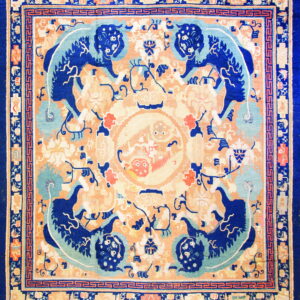
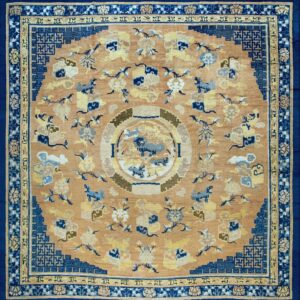
Rare Early 18th Century Antique Foo Dog Chinese Square Ningxia Carpet
$375,000.00 Antique RugsSKU: 21376Rug sizes: 12 ft 8 in x 13 ft 4 in (3.86 m x 4.06 m) -
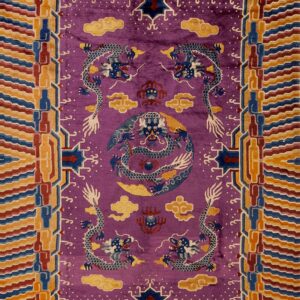
Antique Purple Ningxia Chinese Allover Knotted Rug
$17,200.00 Antique RugsSKU: 24745Rug sizes: 6 ft 4 in x 9 ft (1.93 m x 2.74 m) -
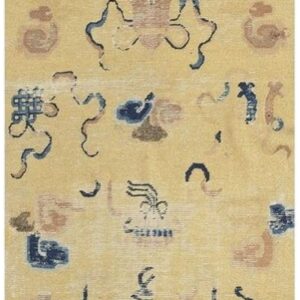
1920s Yellow Field Geometric Antique Chinese Ningxia Knotted Wool Rug
$12,400.00 Antique RugsSKU: 25916Rug sizes: 3 ft 3 in x 8 ft 3 in (0.99 m x 2.51 m) -
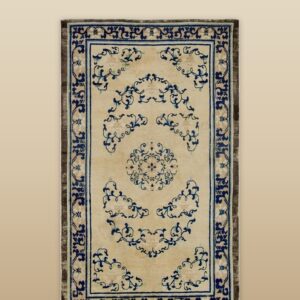
1700s Beige Field Medallion Qing Style Antique Chinese Ningxia Small Rug
$23,400.00 Antique RugsSKU: 25956Rug sizes: 5 ft 3 in x 8 ft 6 in (1.60 m x 2.59 m) -
1880s Ivory Medallion Antique Chinese Ningxia Rug 5′ 4″ X 8′ 3″ Handknotted Wool Carpet
$5,800.00 Antique RugsSKU: 40-2435Rug sizes: 5 ft 4 in x 8 ft 3 in (1.63 m x 2.51 m) -
1890s Tan Beige Medallion Antique Chinese Ningxia Runner 2’4″ X 9′ Handknotted Wool Carpet
$3,000.00 Antique RugsSKU: 40-482Rug sizes: 2 ft 4 in x 9 ft (0.71 m x 2.74 m) -
Antique Chinese Ningxia Rug 3’8″×6’8″ Camel/Yellow Ground, Geometric Foo Dog Design, 1880s
$5,200.00 Antique RugsSKU: 6879Rug sizes: 3 ft 8 in x 6 ft 8 in (1.12 m x 2.03 m) -
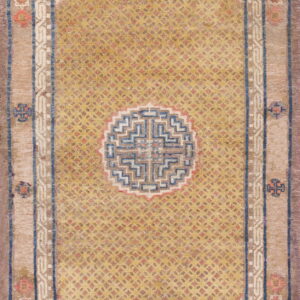
Antique Chinese Ningxia Rug 5’10″×10′ Ivory Field, Beige Medallion with Greek Key, 1880s
$5,200.00 Antique RugsSKU: 6878Rug sizes: 5 ft 10 in x 10 ft (1.78 m x 3.05 m) -
Antique Chinese Ningxia Rug 2’2″×4’3″ Ivory Field, Red Border, Geometric Design, 1880s
$5,200.00 Antique RugsSKU: 6877Rug sizes: 2 ft 2 in x 4 ft 3 in (0.66 m x 1.30 m) -
Navy Blue Antique Floral Chinese Small Scatter Size Ningxia Rug
$3,900.00 Antique RugsSKU: 23358Rug sizes: 3 ft x 5 ft 6 in (0.91 m x 1.68 m) -
Late 19th Century Ivory Antique Chinese Central Floral Medallion Ningxia Rug
$6,800.00 Antique RugsSKU: 19004Rug sizes: 5 ft x 8 ft (1.52 m x 2.44 m) -
Large Size Rare Late 18th Century Antique Ivory Scenic Floral Cloud Band Chinese Ningxia Carpet
$90,000.00 Antique RugsSKU: 20233Rug sizes: 13 ft 6 in x 16 ft 6 in (4.11 m x 5.03 m) -
Antique Chinese Lions Food Dogs Design Square 18th Century Ningxia Rug
$148,500.00 Antique RugsSKU: 18355Rug sizes: 13 ft 6 in x 13 ft 10 in (4.11 m x 4.22 m) -
Small Square Antique White and Blue Chinese Ningxia Area Rug
$19,500.00 Antique RugsSKU: 21912Rug sizes: 5 ft 9 in x 6 ft 4 in (1.75 m x 1.93 m) -
Antique Square Room Size Ivory Late 19th Century Chinese Ningxia Rug
$14,100.00 Antique RugsSKU: 23510Rug sizes: 8 ft 8 in x 9 ft 10 in (2.64 m x 3.00 m) -
Antique Large Room Size Ivory Chinese Allover Floral Ningxia Rug
$19,500.00 Antique RugsSKU: 22544Rug sizes: 10 ft 4 in x 15 ft 6 in (3.15 m x 4.72 m) -
Antique Early 19th Century Chinese Ningxia Square Scatter Size Coral Wool Rug
$800.00 Antique RugsSKU: 21922Rug sizes: 1 ft 8 in x 2 ft (0.51 m x 0.61 m) -
Blue Antique Small Scatter Size Square Chinese Dragon Cloud Band Ningxia Rug
$9,750.00 Antique RugsSKU: 25091Rug sizes: 3 ft x 3 ft 2 in (0.91 m x 0.97 m) -
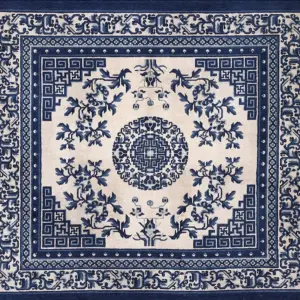
Mid 19th Century Antique White and Blue Color Floral Chinese Ningxia Medallion Rug
$27,000.00 Antique RugsSKU: 25192Rug sizes: 5 ft 9 in x 9 ft 2 in (1.75 m x 2.79 m) -
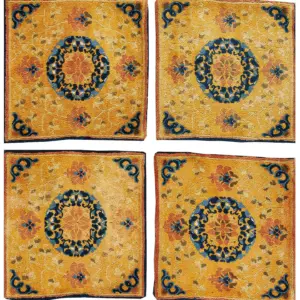
Set of 7 Antique Small Square Yellow Chinese Ningxia Rugs
$22,500.00 Antique RugsSKU: 25198Rug sizes: 2 ft 2 in x 2 ft 2 in (0.66 m x 0.66 m) -
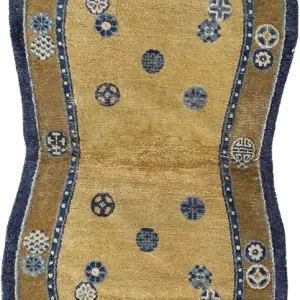
Antique Mid 18th century Chinese Horse Saddle Cover Yellow Ningxia Rug
$23,000.00 Antique RugsSKU: 21427Rug sizes: 2 ft 4 in x 4 ft 6 in (0.71 m x 1.37 m) -
Small Scatter Size Antique 19th Century Chinese Ningxia Medallion Yellow Rug
$5,500.00 Antique RugsSKU: 21025Rug sizes: 3 ft x 5 ft 10 in (0.91 m x 1.78 m) -
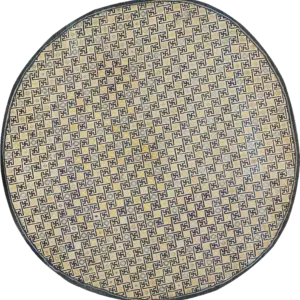
Rare Round Antique 18th Century Chinese Geometric Wan Design Ivory Ningxia Rug
$45,000.00 Antique RugsSKU: 21620Rug sizes: 9 ft 1 in x 9 ft 1 in (2.77 m x 2.77 m) -
Rare Antique Chinese Floral Wool Square Saddle Horse Cover Ningxia Rug
$13,500.00 Antique RugsSKU: 26041Rug sizes: 2 ft 6 in x 2 ft 6 in (0.76 m x 0.76 m) -
Artistic Floral Pattern Light Color Antique Luxurious Chinese Silk Rug
$18,800.00 Antique RugsSKU: 25983Rug sizes: 5 ft 2 in x 7 ft 10 in (1.57 m x 2.39 m) -
Light Ivory Color Early 19th Century Antique Chinese Ningxia Area Rug
$14,250.00 Antique RugsSKU: 25898Rug sizes: 6 ft 6 in x 8 ft 6 in (1.98 m x 2.59 m) -
Early 19th Century Floral Antique Yellow Chinese Ningxia Rug
$39,000.00 Antique RugsSKU: 25828Rug sizes: 5 ft 4 in x 9 ft 8 in (1.63 m x 2.95 m) -
Antique 1850s Chinese Ningxia Wool Hallway Runner Rug
$13,300.00 Antique RugsSKU: 25813Rug sizes: 2 ft 8 in x 12 ft 6 in (0.81 m x 3.81 m) -
Antique Chinese Ningxia Blue 1800s Hallway Runner Rug
$17,200.00 Antique RugsSKU: 25539Rug sizes: 2 ft 2 in x 13 ft 10 in (0.66 m x 4.22 m) -
Antique Chinese Ningxia Hallway Runner Wool Yellow Rug
$28,100.00 Antique RugsSKU: 25472Rug sizes: 2 ft 3 in x 18 ft (0.69 m x 5.49 m) -
Antique Chinese Ningxia Foo Dog Design Hallway Runner Rug
$8,800.00 Antique RugsSKU: 25465Rug sizes: 2 ft 4 in x 7 ft 2 in (0.71 m x 2.18 m) -
Yellow and Blue Mid 18th Century Antique Chinese Ningxia Rug
$24,000.00 Antique RugsSKU: 25466Rug sizes: 6 ft 10 in x 11 ft 6 in (2.08 m x 3.51 m) -
Geometric Medallion Rectangle Wool Antique 1850s Hand Knotted Pile Blue Rug
$18,750.00 Antique RugsSKU: 25390Rug sizes: 5 ft 6 in x 7 ft 9 in (1.68 m x 2.36 m) -
Antique Allover Geometric Wool Hand Knotted Pile Coral 1850s Rug
$70,200.00 Antique RugsSKU: 25340Rug sizes: 11 ft 6 in x 15 ft 7 in (3.51 m x 4.75 m) -
Coral Antique Chinese Pillar Carpet Hallway Runner Rug
$7,500.00 Antique RugsSKU: 25334Rug sizes: 3 ft 7 in x 8 ft 10 in (1.09 m x 2.69 m) -
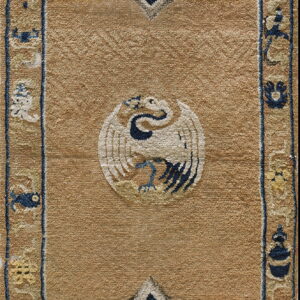
Natural Color Antique Chinese White Crane Design Mid 19th Century Ningxia Rug
$4,125.00 Antique RugsSKU: 25289Rug sizes: 2 ft 1 in x 4 ft (0.64 m x 1.22 m)
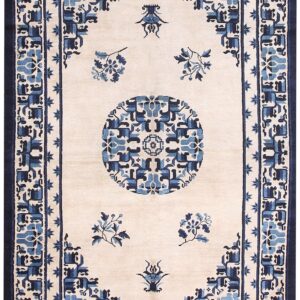
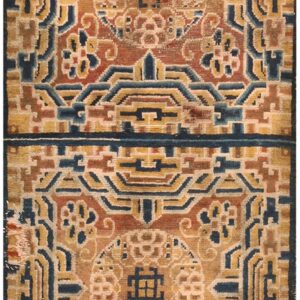
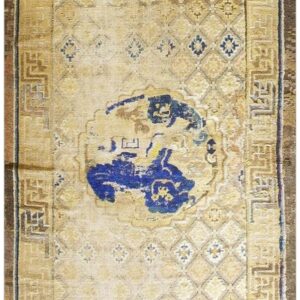
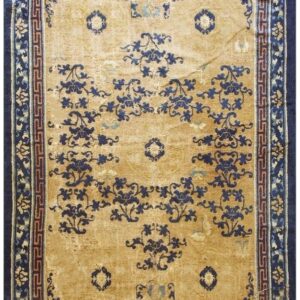
What is a Ningxia rug?
A Ningxia rug is an antique hand-knotted carpet from the Ningxia region of north-central China, woven mainly from the 17th to the 19th century and known for soft wool, mellow golden palettes and a few bold, symbolic motifs. It is the classical Chinese carpet: the tradition that supplied monasteries, the imperial court and scholars' homes long before the export rugs of Beijing and Tianjin.
You will also see the name spelled "Ning-hsia" or "Ningsia" in older books and auction catalogs. Ningxia sits on the upper reaches of the Yellow River, bordered by Gansu to the west and Inner Mongolia to the north and east. Its semi-arid grasslands suited sheep, and the local Tan sheep gave a lustrous, lanolin-rich wool that explains the famously soft handle of these rugs.
Ningxia rugs also traveled. Carried along trade routes into Tibet and Mongolia, they lined prayer halls, wrapped temple columns and covered meditation seats, which is why Buddhist imagery runs so deep in the tradition.
How do you identify an antique Ningxia rug?
Look for a warm, mellowed palette, a few boldly drawn symbols in open space, and a soft, flexible rug that feels thin in the hand. Then look closely at how the colors have aged, because age is part of what you are buying.
- Gold, camel or ivory grounds. Saffron yellow is the signature, with indigo motifs, soft browns and ivory. Yellow carried imperial and monastic meaning in China and Tibet, but many Ningxia rugs use camel, apricot, ivory or blue grounds instead.
- Bold drawing, low density. The knotting is moderate to low, so motifs are large and legible rather than finely detailed. That is a deliberate choice for pieces meant to read across a temple floor, not a weakness.
- A soft, supple handle. A Ningxia rug folds and drapes more easily than a firm Peking rug and feels warm and cushy underfoot.
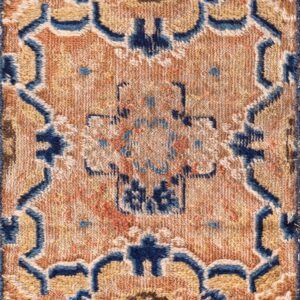
- Corroded browns. Brown dyes set with iron-based mordants slowly eat into the wool, leaving a lower, textured outline or guard stripe. On older pieces this corrosion is a reliable sign of age.
- Softened reds and yellows. Vegetable dyes mellow over the centuries into the glow collectors look for. Very bright, uniform color suggests a later piece or a reproduction.
- Hand-knotted from the back. Expect visible knots and a fringe made from the warp threads. Machine-serged edges or a stiff, glued backing point to a modern copy.
For how Ningxia rugs compare with the later families, read Peking vs Ningxia vs Art Deco rugs. Ningxia rugs are the collector's choice there: older, subtler and scarcer than a Peking rug.
What types of Ningxia rugs are there?
Ningxia weavers made carpets for specific jobs, so the format often tells you what a rug was for. Several of these formats appear in our collection.
| Format | What it was for | How to recognize it |
|---|---|---|
| Throne and seat rugs | Thrones and seats of honor in palaces and temples | Often square, with a medallion or cosmic landscape rather than a dragon placed underfoot. Square pieces make up more than 40 of our Ningxia rugs. |
| Chair seat and back sets | Covers for a matching seat and chair back | Small pieces woven as coordinated pairs |
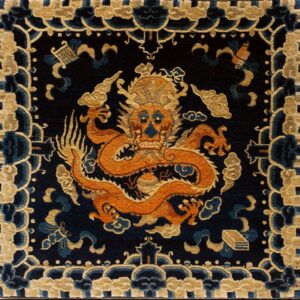
| Pillar rugs | Wrapped around wooden temple columns | Long and narrow, drawn so the design, often a coiling dragon, meets seamlessly when wrapped |
| Kang rugs | Covers for the raised, heated brick platform beds of northern China | Long, narrow formats sized for the platform |
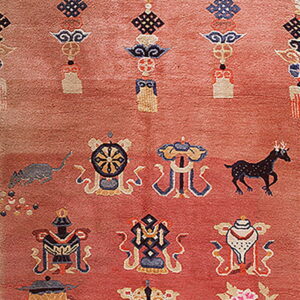
| Meditation mats | Personal seats for monks in Buddhist practice | Small, intimate compositions such as a single shou character, floral sprays or the Hundred Antiques |
| Saddle rugs and horse covers | Padding and decoration for a horse and rider | Often two-part with a central notch; we currently have 6 horse covers |
| Room carpets | Palace halls, monasteries and grand houses | Larger rectangles with medallions or allover designs |
For the full history of the region and its workshops, read our Ningxia rug guide.
How do you decorate with a Ningxia rug?
Treat a Ningxia rug as a work of art first and a floor covering second: give it a quiet room, good light and a place where it can be seen. Their mellow golds and open drawing suit both classic interiors and spare, modern ones.
- Warm neutrals. Saffron, camel and apricot grounds glow against walnut, oak, linen, plaster and aged brass, and sit calmly in minimalist rooms.
- Studies and libraries. A Ningxia carries the scholarly, meditative mood it was made for. Small pieces suit a reading chair, a desk or the foot of a bed, away from the heaviest traffic.
- Squares as art. A square seat or throne rug makes a striking centerpiece under a round table or in a small entry, or it can be hung.
- On the wall. Many collectors hang pillar rugs, seat rugs and fragile pieces. Use a hand-sewn sleeve with a slat or hook-and-loop system that spreads the weight, never nails or clips.
- Mixed collections. A Ningxia pairs well with Chinese ceramics, scroll paintings and lacquer, and gives depth to a room built around a later Chinese Art Deco rug.
How do you care for an antique Ningxia rug?
Handle a Ningxia rug more gently than a later Chinese rug: its looser weave, older dyes and age-softened wool reward light use, a good pad and a specialist's hand. With that care it stays sound for generations.
- Choose low traffic. Place antique Ningxia rugs where they will not take heavy daily wear, and use felt glides under furniture.
- Use a breathable pad. A felt or felt-and-natural-rubber pad reduces wear on the thin foundation and stops slipping.
- Vacuum lightly. Use suction only, with no beater bar, and never let a robot vacuum near the fringe or older fibers.
- Keep it dry. Excess moisture weakens the cotton foundation, and corroded browns are already fragile. Blot spills with plain water, never soak.
- Wash with a specialist. Old vegetable dyes and corroded areas need an expert. Our rug cleaning service checks for fragile areas and old repairs before washing.
- Guard against moths. Pieces kept folded, stored or hung in quiet rooms are exactly where moth larvae thrive. Our moth-proofing service washes the rug first and then treats the fibers.
Glossary of Ningxia rug terms
- Tan sheep
- A sheep breed native to Ningxia whose lanolin-rich, silky wool gives Ningxia rugs their soft, flannel-like pile.
- Yinchuan
- The regional capital of Ningxia and the historic hub of its rug trade, supplying both palace and monastery furnishings.
- Pillar rug
- A long rug woven to wrap around a temple column, drawn so the pattern meets when wrapped. A coiling dragon is a classic design.
- Kang rug
- A rug for the kang, the heated brick platform bed of northern Chinese homes. Kang rugs tend to be long and narrow.
- Throne rug
- A seat or dais cover for the emperor, nobility or monks, often square, showing a medallion or cosmic landscape rather than a dragon underfoot.
- Khaden
- A small meditation mat used by monks in Buddhist practice, one of the formats Ningxia weavers made for monasteries.
- Hundred Antiques
- A design made of scholarly and auspicious objects, such as scrolls, vases and incense burners, meant to inspire contemplation.
- Fu lions (foo dogs)
- Guardian lions that protect a doorway or seat, a favorite subject on Ningxia seat rugs.
- Iron mordant corrosion
- The slow wearing away of wool dyed brown with iron-based mordants. The lowered, textured brown areas it leaves are a mark of age.
Ningxia Rugs: Frequently Asked Questions
How old are the Ningxia rugs in your collection?
Most of our Ningxia rugs date from the 19th century, more than 110 of them, and more than 30 date from the 18th century or earlier. A few are from the early 20th century. Every listing states the approximate age.
Are all Ningxia rugs yellow?
No. Saffron and gold grounds are the best known, but Ningxia rugs also come in ivory, camel, apricot, coral and blue schemes. In our current collection, ivory and cream is actually the most common ground, followed by yellow and gold.
How are Ningxia rugs different from Peking rugs?
Ningxia rugs are generally older, from the 17th to the 19th century, with warm golden palettes, Buddhist and scholarly motifs and a soft, loosely knotted handle. Peking rugs are later, more densely knotted and firmer, and usually use blues on ivory.
Can I use an antique Ningxia rug on the floor?
Yes, in the right spot. Choose a lower traffic room, use a breathable felt pad, vacuum with suction only, and keep pets' claws and heavy furniture legs off fragile areas. The most delicate pieces are better hung on a wall.
Do you ship Ningxia rugs, and can I return one?
Shipping is free within the continental United States. International orders ship for a flat $495 per order ($350 to Canada, $395 to Mexico), with customs fees, duties and taxes paid by the buyer; rugs over 100 years old are usually classed as antiques for customs, which in many countries means lower import charges. US buyers get a 4-day in-home trial; see our shipping policy and returns policy.
Can I sell my Ningxia rug or have it appraised?
Yes. We buy antique rugs outright: send photographs and measurements, and Kevin Rahmanan reviews the photos and decides. Consignment is also offered. For a value, we give a free Quick Opinion by phone or email from photographs, and a free In-Depth Appraisal Report for insurance and estates. See what is my antique Chinese rug worth or contact us.
Watch: from our New York gallery
Let’s explore one of the classic period pieces from our Ningxia collection.
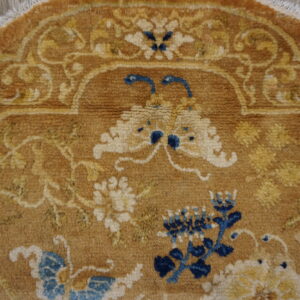
A story of butterflies and peonies…
250 years strong!
More on our YouTube channel.