
Caucasus Rugs
Key takeaways: antique Caucasian rugs
- What they are: hand-knotted and flatwoven village rugs from the mountain belt between the Black Sea and the Caspian, in what is now Azerbaijan, Armenia, Georgia and the southern Russian republics, mostly woven between about 1850 and 1930.
- How to recognize one: angular geometric drawing with curves redrawn as steps, high-contrast color, the symmetrical knot, and usually an all-wool foundation.
- They are small: Caucasian looms were narrow village looms, so most rugs are scatter sizes, prayer rugs and long narrow runners. True room-size Caucasian carpets are rare.
- Nineteenth century is normal here: more than 170 of our Caucasian rugs are 19th century or earlier, a far higher share than in any other group we carry.
- Main groups: Kazak, Shirvan, Karabagh and Kuba in pile, and soumak, verneh and kilim in flatweave.
- Our collection: more than 240 Caucasian rugs at our New York showroom. Our founder, Kevin Rahmanan, bought his first antique rug, a Caucasian, at 21.
- Buying with confidence: every rug is inspected before it is listed, each listing states origin, approximate age, materials and measured size, shipping is free within the continental United States, and there is a 4-day in-home trial. See buying with confidence.
Caucasian rugs represent one of the most visually distinctive and culturally layered traditions in the world of hand-woven carpets, emerging from the rugged highlands and interlinked weaving communities of the Caucasus region, an area that spans modern Azerbaijan, Armenia, Georgia, and parts of southern Russia and northwest Iran. Unlike carpets produced in large urban workshops, Caucasian rugs were historically woven in village and tribal settings, where weavers translated local symbols, natural surroundings, and community memory into bold geometric designs and expressive color narratives.
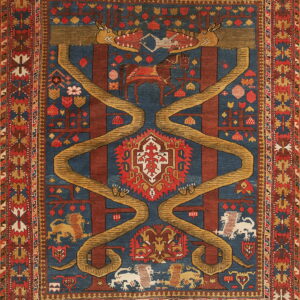
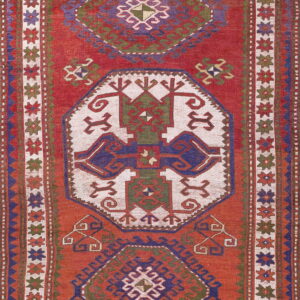
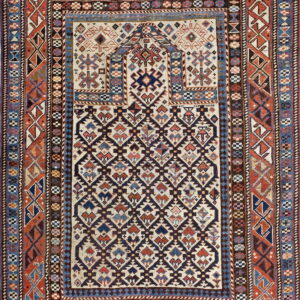
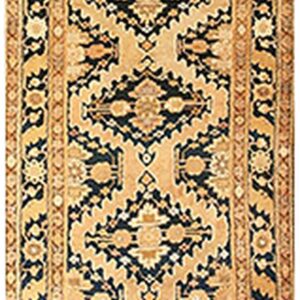
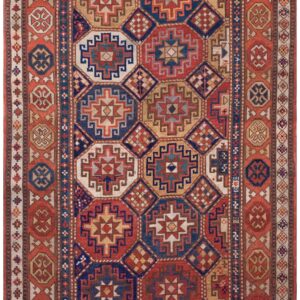
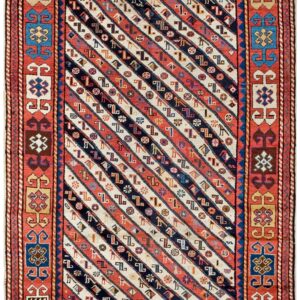
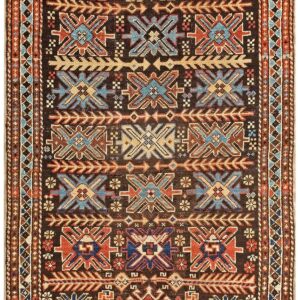
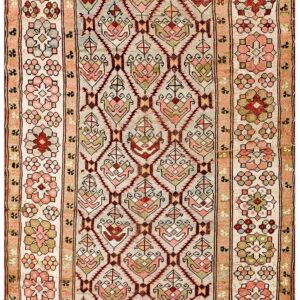
The artistry of Caucasian carpets is defined by striking geometry, rhythmic patterning, and confident use of space. Common motifs include octagonal medallions, stars, hooked motifs, stylized animals and birds, latticework, and symbolic emblems that vary by locality but share a shared visual language emphasizing clarity and strength. Color plays a vital role as well, with rich reds, vibrant blues, deep ivories, and earthy tones derived from natural dyes creating carpets that feel both dynamic and grounded.
Technically, Caucasian rugs are typically hand-knotted with durable wool piles and woven with proportional respect for form and field, resulting in pieces that balance structural resilience with visual energy. Because they were woven for everyday use in homes and communal spaces, these carpets often exhibit a compelling blend of functional sturdiness and artistic expression, qualities that have made them enduring favorites among collectors, designers, and those who appreciate textiles with deep cultural resonance.
Today, Caucasian rugs are celebrated not just for their graphic boldness, but also for the way they capture the geographic diversity, tribal identities, and interwoven histories of the peoples who created them, bringing a powerful sense of narrative and place to interiors of all styles.
Caucasian rugs are renowned for their powerful geometric designs, bold colors, and tribal authenticity, embodying the rich artistic heritage of the mountainous region they originate from. Discover the fascinating weaving traditions of the area, including highly collectible types like the vigorous Kazak and the finely detailed Shirvan, or read more about the history and characteristics of all rugs from the Caucasus.
Antique Caucasian rugs at a glance
The table below summarizes the main facts about antique Caucasian rugs, drawn from our guides and from the live collection on this page. Counts and prices were taken from our in-stock Caucasian rugs on September 27, 2026 and change as rugs sell.
| Feature | Antique Caucasian rugs |
|---|---|
| Where they were woven | The Caucasus, between the Black Sea and the Caspian: modern Azerbaijan, Armenia, Georgia and the southern Russian republics such as Dagestan. Kazak in the southwest, Karabagh in the south, Shirvan in the east, Kuba in the northeast. |
| Main types in our collection | Kazak, more than 80; Shirvan, 45; Karabagh, 25; Kuba, 18; Soumak, 13; Seychour, 11; Moghan, 10; kilims, 10; verneh, 8; Lori Pambak, 4 |
| Periods | Mostly about 1850 to 1930. In our collection, 170 are 19th century, 2 are 18th century or earlier, more than 50 date from 1900 to 1925, and about 20 are from the 1930s. |
| Materials | Wool, almost without exception: wool pile, and characteristically wool warps and wefts as well. Only 2 of our Caucasian rugs include cotton or silk. |
| Construction and knotting | Hand-knotted pile with the symmetrical knot, more than 210 in stock; flatweaves such as soumak, verneh and kilim, 31 in stock. Knot counts are moderate by design. |
| Typical palettes | High-contrast and unblended: deep indigo blue, madder red, ivory, apricot, and acid yellows and greens. Blue is the most common ground in our collection, followed by red and rust and then coral. |
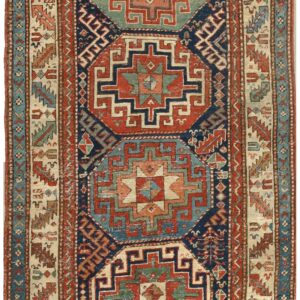
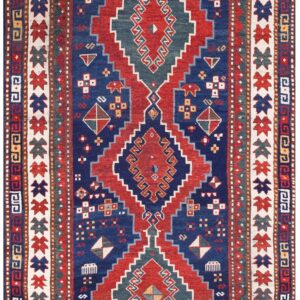
| Signature motifs | Hooked medallions, stepped polygons, latch hooks, eight-pointed stars, the Lesghi star, ram's horns, keyhole and prayer layouts, stylized animals and birds, and the running-dog border |
| Shapes in stock | Rectangular, about 150; long and narrow runners, more than 70; square, more than 20 |
| Most common sizes in stock | 4 x 6, 39; 3 x 5, 30; 3 x 9, 30; 3 x 7, 24; 5 x 7, 21; 4 x 10, 19; 5 x 8, 18. Only a handful reach 8 x 10 or 9 x 12. |
| Price range (antique, in stock) | For our Caucasian rugs dated 1925 or earlier: from $1,600 to $120,000. The median is about $8,100, and half are priced between $5,800 and $11,400. Prices are in US dollars. |
| In stock | More than 240 Caucasian rugs, of which more than 220 are dated 1925 or earlier |
Prefer to see a rug in person?
-
Antique Caucasian Geometric Medallion Square Wool Hand Knotted Pile Blue 1890s Rug
$15,000.00 Antique RugsSKU: 21277Rug sizes: 4 ft 4 in x 5 ft 2 in (1.32 m x 1.57 m) -
Classic Tribal Geometric Antique Caucasian Red Lori Pambak Rug
$3,400.00 Antique RugsSKU: 18521Rug sizes: 4 ft 9 in x 6 ft 10 in (1.45 m x 2.08 m) -
Late 19th Century Ivory Antique Caucasian Dagestan Prayer Design Tribal Rug
$3,750.00 Antique RugsSKU: 18046Rug sizes: 4 ft x 5 ft (1.22 m x 1.52 m) -
Charming Tan-Camel Background Color and Black Border With Rhombus Pattern Antique Caucasian Karabagh Rug
$16,500.00 Antique RugsSKU: 40-373Rug sizes: 3 ft 10 in x 23 ft 6 in (1.17 m x 7.16 m) -
Remarkable Red-Ruby Background Color With Black Border and Medallion/Crest Design Antique Caucasian Karabagh Rug
$11,400.00 Antique RugsSKU: 40-671Rug sizes: 4 ft 10 in x 9 ft 3 in (1.47 m x 2.82 m) -
1890s Yellow Diamond Antique Caucasian Talish Long Rug 3’4″ X 7’6″ Knotted Wool Rug
$6,800.00 Antique RugsSKU: 40-4523Rug sizes: 3 ft 4 in x 7 ft 6 in (1.02 m x 2.29 m) -
1870s Multicolor Diamond Tribal Antique Caucasian Kuba Kilim Flatweave Wool Rug
$6,500.00 Antique RugsSKU: 20-2025Rug sizes: 6 ft x 11 ft 4 in (1.83 m x 3.45 m) -
1880s Yellow Antique Geometric Tribal Knotted Wool Caucasian Tallish Runner
$15,600.00 Antique RugsSKU: 6938Rug sizes: 3 ft x 13 ft (0.91 m x 3.96 m) -
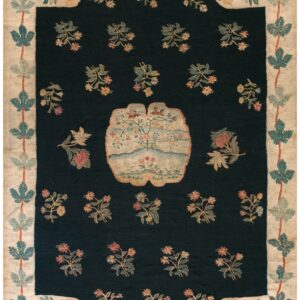
Antique Bessarabian Flat-Weave Carpet 7’3″×11’4″ Black Medallion, Ivory Border, 18th Century / Circa 1750
$34,000.00 Antique RugsSKU: 21018Rug sizes: 7 ft 3 in x 11 ft (2.21 m x 3.35 m) -
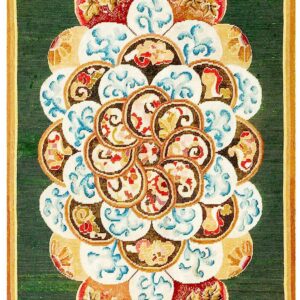
Antique European Needlepoint Rug, Green Floral Central Pattern
$4,500.00 Antique RugsSKU: 20-2017Rug sizes: 2 ft 1 in x 4 ft 4 in (0.64 m x 1.32 m) -
Antique Caucasian Moghan Rug, Hand-Knotted Wool
$6,800.00 Antique RugsSKU: 19747Rug sizes: 3 ft 7 in x 9 ft 3 in (1.09 m x 2.82 m) -
Antique Caucasian Shirvan Rug, Blue Perpedil Tribal Design, Square Format
$3,750.00 Antique RugsSKU: 19657Rug sizes: 4 ft x 4 ft 9 in (1.22 m x 1.45 m) -
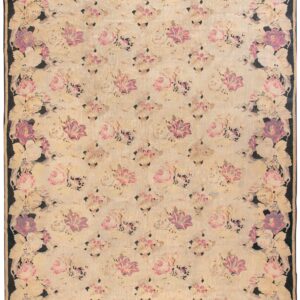
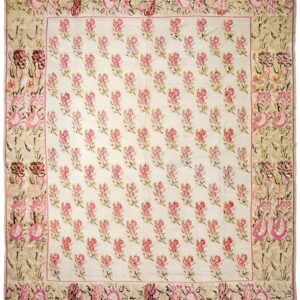
Antique European Bessarabian Kilim, Ivory Roses, Flat-Weave, 1870s
$41,000.00 Antique RugsSKU: 19430Rug sizes: 9 ft 6 in x 16 ft (2.90 m x 4.88 m) -
Antique Bessarabian Flat-Weave Carpet 12’10″×14’6″ Ivory Floral, Mid-19th Century, Circa 1850
$81,500.00 Antique RugsSKU: 19245Rug sizes: 12 ft 10 in x 14 ft 6 in (3.91 m x 4.42 m) -
Antique Caucasian Shirvan Rug, Blue Symmetric Design, Ivory Border, Circa 1930
$2,950.00 Vintage RugsSKU: 19113Rug sizes: 3 ft 4 in x 5 ft 1 in (1.02 m x 1.55 m) -
Antique Caucasian Kazak Rug, Blue Medallion Design, 1890s
$8,800.00 Antique RugsSKU: 19108Rug sizes: 4 ft x 7 ft 7 in (1.22 m x 2.31 m) -
Antique Caucasian Kazak Rug , Blue Geometric Tribal, 1900s
$4,200.00 Antique RugsSKU: 19107Rug sizes: 3 ft 6 in x 5 ft 10 in (1.07 m x 1.78 m) -
Antique Caucasian Long Rug Brown Tribal Geometric, 1890s
$8,800.00 Antique RugsSKU: 19104Rug sizes: 4 ft x 8 ft (1.22 m x 2.44 m) -
Antique Caucasian Kazak Rug Red on Red Geometric, 19th Century
$4,400.00 Antique RugsSKU: 19102Rug sizes: 3 ft x 6 ft (0.91 m x 1.83 m) -
Antique Caucasian Moghan Long Rug, Multi Geometric, Ivory Border, Circa 1890
$9,800.00 Antique RugsSKU: 19101Rug sizes: 3 ft 5 in x 9 ft 5 in (1.04 m x 2.87 m) -
Antique Caucasian Kazak Long Rug Multi Geometric, Rose Pink Border, Circa 1890
$7,400.00 Antique RugsSKU: 19098Rug sizes: 4 ft x 8 ft 2 in (1.22 m x 2.49 m) -
Antique Caucasian Long Rug, Ivory Tribal Geometric, 1880s
$9,000.00 Antique RugsSKU: 18953Rug sizes: 3 ft 9 in x 8 ft 3 in (1.14 m x 2.51 m) -
Antique Caucasian Karabagh Rug, Brown Tribal, Ivory Border, Circa 1900
$2,300.00 Antique RugsSKU: 18014Rug sizes: 3 ft 4 in x 6 ft 3 in (1.02 m x 1.91 m) -
Antique Caucasian Karabagh Rug, Pale Sky Blue, Ivory Border, Circa 1900
$3,750.00 Antique RugsSKU: 18009Rug sizes: 3 ft 6 in x 7 ft 1 in (1.07 m x 2.16 m) -
Antique Caucasian Kuba Rug, Hand-Knotted Tribal Composition
$8,100.00 Antique RugsSKU: 17901Rug sizes: 3 ft 6 in x 10 ft (1.07 m x 3.05 m) -
Bold Red Antique Tribal Geometric Late 19th Century Caucasian Lori Pambak Rug
$18,800.00 Antique RugsSKU: 20005Rug sizes: 6 ft x 11 ft (1.83 m x 3.35 m) -
Late 19th Century Antique Red Tribal Geometric Square Caucasian Kilim Verneh Flat-Weave Carpet
$9,800.00 Antique RugsSKU: 20-2048Rug sizes: 5 ft 8 in x 6 ft 4 in (1.73 m x 1.93 m) -
Red Color Solid Open Field Mid 19th Century Tribal Geometric Caucasian Kazak Carpet
$13,000.00 Antique RugsSKU: 20310Rug sizes: 4 ft x 8 ft 8 in (1.22 m x 2.64 m) -
Small Antique Earth Tone Caucasian Tribal Geometric Birds Eagle Kazak Design Seychour Rug
$5,400.00 Antique RugsSKU: 18244Rug sizes: 3 ft 7 in x 5 ft 6 in (1.09 m x 1.68 m) -
Antique Colorful Late 19th Century Tribal Geometric Flatweave Caucasian Kilim Rug
$3,300.00 Antique RugsSKU: 19292Rug sizes: 4 ft 2 in x 8 ft 6 in (1.27 m x 2.59 m) -
Antique Tribal Square Kazak Rug – Red Solid Open Field
$2,650.00 Antique RugsSKU: 18017Rug sizes: 3 ft 5 in x 4 ft (1.04 m x 1.22 m) -
Early 20th Century Antique Blue Tribal Geometric Small Square Caucasian Shirvan Rug
$2,700.00 Antique RugsSKU: 18011Rug sizes: 4 ft x 4 ft 6 in (1.22 m x 1.37 m) -
Red Antique Allover Tribal Geometric Design Small Caucasian Kuba Rug
$3,400.00 Antique RugsSKU: 19746Rug sizes: 3 ft 3 in x 4 ft 4 in (0.99 m x 1.32 m) -
Small Size Red Tribal Geometric Antique Late 19th Century Caucasian Kazak Rug
$5,000.00 Antique RugsSKU: 18054Rug sizes: 4 ft 4 in x 6 ft (1.32 m x 1.83 m) -
Bold Bright Red Antique Late 19th Century Tribal Geometric Caucasian Kazak Rug
$5,600.00 Antique RugsSKU: 19293Rug sizes: 3 ft 7 in x 6 ft 3 in (1.09 m x 1.91 m) -
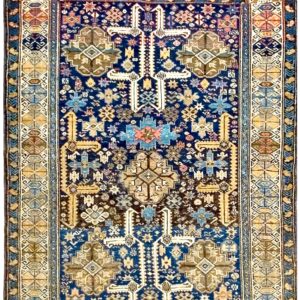
Small Colorful Antique Late 19th Century Tribal Geometric Key Hole Design Caucasian Shirvan Rug
$5,800.00 Antique RugsSKU: 19510Rug sizes: 3 ft 5 in x 4 ft 5 in (1.04 m x 1.35 m)
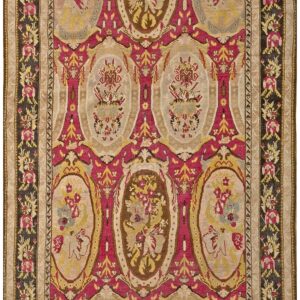
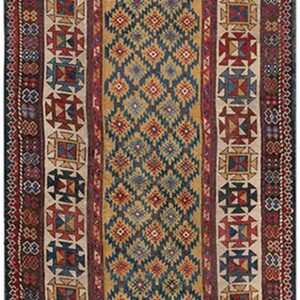
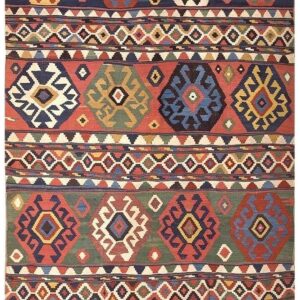
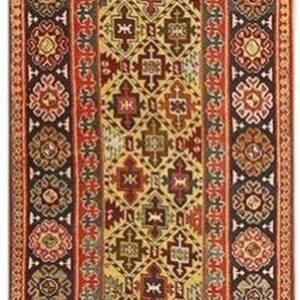
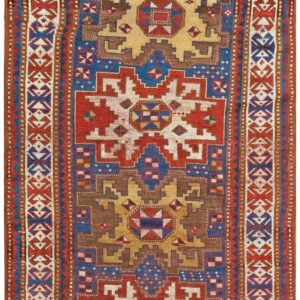
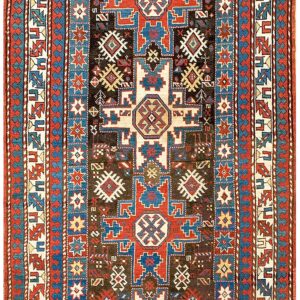
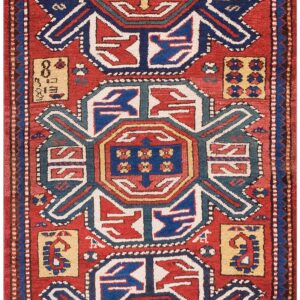
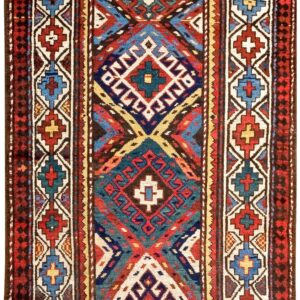
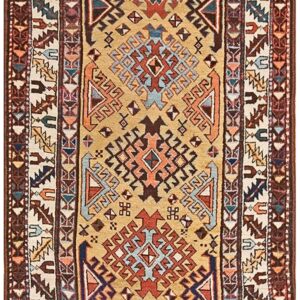
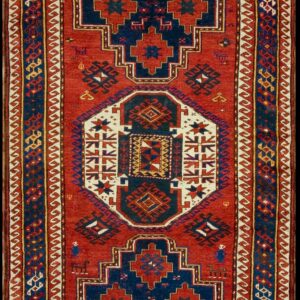
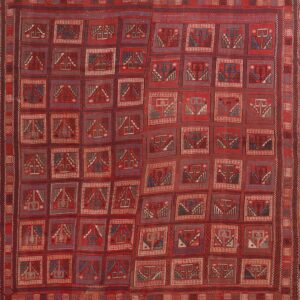
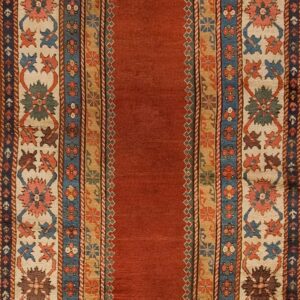
What is an antique Caucasian rug?
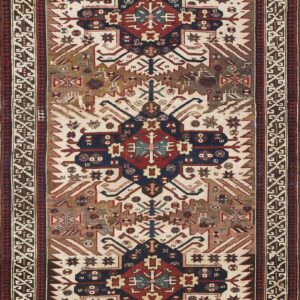
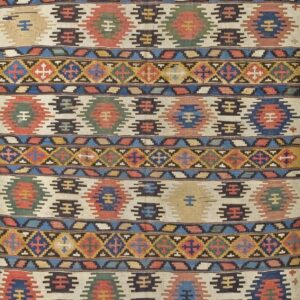
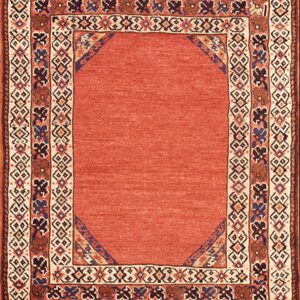
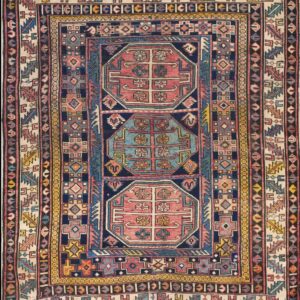
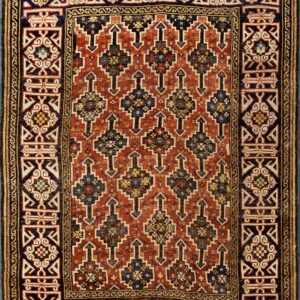
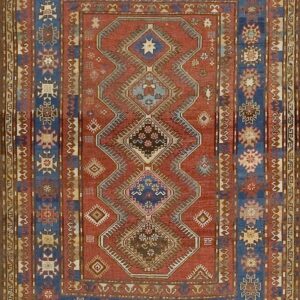
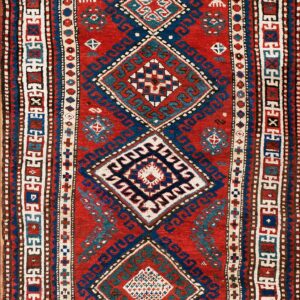
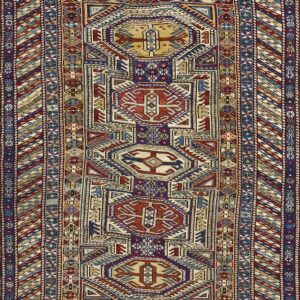
An antique Caucasian rug is a hand-knotted or flatwoven rug made in the Caucasus mountain region between the Black Sea and the Caspian, generally between about 1850 and 1930. It is village and small workshop weaving, typically all wool with the symmetrical knot, and almost always geometric rather than floral. Because these rugs were woven for homes and a local market rather than for the European export trade, they carry the local design vocabulary of each valley and village with unusual directness. For the region, its weaving centers and its symbols in depth, read our rugs of the Caucasus reference; for measured prices, formats and what to check before buying, read our antique Caucasian rugs buying guide.
What are the main types of Caucasian rugs?
"Caucasian" is an umbrella over named weaving groups that differ in scale, fineness and format. These are the groups in our collection.
- Kazak. Our largest group and the one most people picture: large-scale drawing, few elements, saturated red, blue and ivory, and coarse, glossy wool with a long pile. See our Kazak page.
- Shirvan. The opposite temperament: finer and flatter, with a shorter pile, smaller repeating elements and often a dense all-over field. See our Shirvan page.
- Karabagh. The group that produced long gallery carpets and absorbed the most outside influence, including European floral drawing. If you want a larger Caucasian rug, search here first.
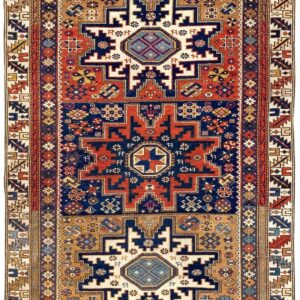
- Kuba. The fine end of the eastern Caucasus: tighter weave, smaller scale, complex borders, frequently ivory grounds, and the radiating Lesghi star.
- Soumak, verneh and kilim. Flatweaves. Soumak is a technique, weft wrapping rather than knotting, which gives a flat rug with a braided-looking face and loose yarn ends on the back. In this region flatweaves are not the budget end; our soumaks sit among the highest priced Caucasian groups.
- Smaller groups. Seychour, Moghan, Lori Pambak, Dagestan, Talish and Chi Chi rugs, each with its own local drawing.
How can you tell if a Caucasian rug is antique?
Check four things together, in this order: the foundation, the knot, the drawing and the color. None is conclusive alone, but together they separate a Caucasian village rug from a Persian city rug or a later copy.
- Foundation. Caucasian village weaving is characteristically all wool, warps and wefts both, where Persian city weaving is usually on cotton. A wool foundation feels slightly springy rather than board-flat. See our foundations, warps and wefts guide.
- Knot. The symmetrical knot is the norm, and knot counts are moderate. That is a design choice, not a weakness; our guide to rug knots and KPSI explains why.
- Drawing. Angular almost without exception, with curves redrawn as a staircase. The drawing is not mechanically regular: a border runs out of room at a corner and the weaver improvises the turn. That is evidence of weaving from memory, and a point in the rug's favor.
- Color. Many antique Caucasian rugs predate the general spread of synthetic dyes, so abrash is extremely common. Synthetic dyes did reach the region from the 1870s onward, so check stability as well; our natural vs synthetic dyes guide has tests you can run in daylight.
- Condition. Check the foundation before the pile. Worn pile on a sound foundation is repairable; brittle warps, splits or dry rot along a fold are a different matter. Look for a border complete on three sides and cut on the fourth, the sign of a larger rug trimmed down.
How do you decorate with an antique Caucasian rug?
Use Caucasian rugs where antique rugs live best at small scale: entrances, hallways, studies, bedsides, landings and stair tops. Their bold geometry reads clearly at a distance and sits well with modern, mid-century and traditional furniture alike.
- Hallways. Long, narrow Caucasian runners are plentiful, with more than 70 in stock and sizes such as 3 x 9 and 4 x 10 among the most common.
- Groups of rugs. Two or three Caucasian rugs that share a palette can furnish a large floor and talk to each other across the room.
- Bedrooms and studies. A 4 x 6 or 5 x 7 Kazak or Shirvan at a bedside or under a desk chair adds color without covering the floor.
- On the wall. Small prayer rugs and flatweaves such as soumaks and vernehs hang well and show their drawing at eye level.
- Large rooms. Room-size Caucasian carpets are rare. For a living room, look at Karabagh gallery carpets first, plan on more than one rug, or consider a room-size Oushak or Sultanabad. Our rug size guide explains how to measure.
How do you care for an antique Caucasian rug?
Put a non-slip pad under it, rotate it once or twice a year, vacuum gently without a beater bar, keep it out of prolonged direct sun, and have it washed by a rug specialist. Small rugs are moved, folded and walked on more than large ones, so their ends and sides need the most attention.
- Ends and sides. Keep the fringe and selvages away from the vacuum brush, and have loose ends secured before they unravel further.
- Spills. Blot at once, never rub or soak, and test any cleaner on a hidden spot first. Saturated reds and blues deserve particular care.
- Professional washing. Our rug cleaning service in Manhattan washes hand-knotted rugs and flatweaves with a pH-balanced process, after checking for old repairs and fragile areas.
- Moths. An all-wool rug, pile and foundation, is attractive to moth larvae in dark, undisturbed spots. Our moth-proofing service washes the rug first and then treats the fibers.
- Shape. A rug that has pulled out of square or will not lie flat can be corrected with blocking and stretching.
- Storage. Clean first, roll pile-in rather than folding, wrap in breathable cotton, and keep it off the floor.
Glossary of antique Caucasian rug terms
These are the terms you will meet most often in our listings and guides for Caucasian rugs.
- Kazak
- Bold, large-scale village rugs with few elements, saturated color and a long, glossy pile. Shop Kazak rugs.
- Shirvan
- Finer, flatter rugs from the eastern Caucasus with a short pile and small repeating elements. Shop Shirvan rugs.
- Kuba
- Finely woven rugs from the northeast Caucasus, known for complex borders, ivory grounds and the Lesghi star.
- Karabagh
- A southern Caucasian group known for larger gallery carpets and for European-influenced floral drawing.
- Soumak
- A flatweave made by wrapping wefts around the warps. It has no knots and leaves loose yarn ends on the back.
- Verneh
- A Caucasian flatweave, often with small animal or geometric figures, related to soumak brocading.
- Lesghi star
- A crisp, radiating star motif associated with Kuba and Dagestan weaving.
- Latch hook
- A small hooked projection along the edges of medallions and motifs, one of the most common Caucasian design elements.
- Symmetrical knot
- The Turkish or Ghiordes knot, tied around two warps. It is the norm across the Caucasus.
- Running dog
- A hooked, wave-like border pattern, sometimes called a Greek key border.
- Abrash
- Soft bands of tonal variation within one color, from changes in dye lot. Very common in 19th century Caucasian rugs.
Antique Caucasian Rugs: Frequently Asked Questions
How many antique Caucasian rugs does Rugs On Net have?
We have more than 240 Caucasian rugs in stock, of which more than 220 are dated 1925 or earlier and 170 are 19th century. Kazak is the largest group, followed by Shirvan, Karabagh, Kuba and Soumak, and all of them are held at our New York showroom.
Why are Caucasian rugs so small?
They were woven on narrow village looms for domestic use and a local market, not for the European export trade that organized Persian weaving around large room sizes. In our stock the most common sizes are 4 x 6, 3 x 5 and 3 x 9, and only a handful reach 8 x 10 or 9 x 12.
How can you tell a Caucasian rug from a Persian rug?
Look at four tendencies together: the foundation is usually all wool where Persian city weaving is usually cotton, the knot is usually symmetrical rather than asymmetrical, the drawing is angular with curves redrawn as steps, and the palette is high contrast and unblended. Size is a strong hint too, since large Caucasian rugs are rare.
What does an antique Caucasian rug cost?
In our stock on September 27, 2026, Caucasian rugs dated 1925 or earlier had a median price of about $8,100, with half between $5,800 and $11,400. You pay less in total than for a room-size carpet because the rugs are small, but more per square foot, because you are buying age, wool and drawing rather than coverage.
Do you ship antique Caucasian rugs, and can I return one?
Yes. Shipping is free within the continental United States, and international orders ship at a flat rate of $495 per order ($350 to Canada, $395 to Mexico), with tracking. Orders ship in 1 to 3 business days. Customs fees, import duties and taxes are paid by the buyer on delivery. US buyers get a 4-day in-home trial starting the day the rug is delivered; see our shipping policy and returns policy.
Do you buy or appraise antique Caucasian rugs?
Yes. We buy antique rugs outright: send photographs and measurements, and Kevin Rahmanan reviews the photos and decides. Consignment is also offered. For a value, we give a free Quick Opinion by phone or email from photographs, and a free In-Depth Appraisal Report for insurance, estate valuation and documentation. See sell your antique rug or contact us.