
Kazak Rugs
Key takeaways: Kazak rugs
- What they are: bold, thick piled village rugs from the Kazak (Qazax) district of the South Caucasus, in the uplands where present day Armenia, Azerbaijan and Georgia meet.
- How to recognize one: large scale geometric medallions with few elements, saturated red, blue and ivory, and a long, glossy wool pile.
- Who wove them: Armenian, Azeri and Georgian village weavers. "Kazak" is a trade name for the region and the style, not for a tribe or a people.
- The golden age: the 19th century, when Kazak weaving flourished as carpets became prized trade goods in Europe and the Ottoman markets.
- Our collection: 84 antique Kazak rugs, 61 of them from the 19th century, mostly scatter rugs and long runners.
- Buying with confidence: every listing states origin, approximate age, materials and measured size, shipping is free within the continental United States, and there is a 4 day in home trial. See buying with confidence.
Kazak rugs are among the most recognizable and beloved tribal carpets from the Caucasus region, particularly associated with weaving communities in what is now Armenia, Azerbaijan, and Georgia. These hand‑knotted rugs are celebrated for their bold geometric patterns, oversized medallions, and vibrant color contrasts, which give them a striking visual presence that sets them apart from more closely detailed Persian or floral styles. Antique Kazaks were traditionally woven with high‑quality mountain wool and rich natural dyes in deep reds, blues, ivories and greens, creating textiles that are both durable and visually radiant.
A hallmark of the Kazak aesthetic is its strong, open composition — large shapes like diamonds, crosses, and stylized tribal symbols are confidently spaced across the field, often framed by boldly patterned borders that enhance the overall graphic energy. These characteristics reflect a tribal artistic language rooted in nomadic and village weaving traditions, where form and color express cultural identity as much as function.
Whether used as a dramatic focal point in a living room or layered within a more eclectic décor scheme, Kazak rugs bring a sense of architectural clarity, historical depth, and enduring craftsmanship to interiors, appealing to both collectors and design enthusiasts alike.
Antique Kazak rugs are celebrated for their distinctive, tribal aesthetic, featuring striking geometric motifs and rich, saturated color palettes that make them highly sought-after collector pieces. Woven with exceptional skill and often showcasing iconic medallions and bold borders, these handcrafted masterpieces bring a spirited intensity to traditional and contemporary spaces; discover more about the enduring appeal and characteristics of Kazak rugs.
Kazak rugs at a glance
The table below summarizes the main facts about Kazak rugs, drawn from our Kazak rug guide and our antique Caucasian rugs guide and from the in-stock Kazak rugs on this page on November 22, 2026. Counts and prices change as rugs sell.
| Feature | Kazak rugs |
|---|---|
| Where they were woven | Villages of the Kazak district in the South Caucasus |
| Construction | Hand knotted wool pile with the symmetric (Turkish) knot, usually on a wool foundation, with several wefts, often dyed red, between the rows of knots. That gives a Kazak its thickness and ribbed back. |
| Ages in our collection | 61 antique Kazaks from the 19th century, including pieces from the 1850s and 1860s, 15 from about 1900, and 8 from the 1920s and 1930s |
| Materials | All wool |
| Typical palettes | Coral and salmon, red and rust, and blue above all, with ivory, gold, green and multicolor pieces |
| Signature designs | Large geometric and star medallions, keyhole (prayer arch) designs, boteh, eight pointed stars and protective symbols |
| Sizes in stock | Mostly scatter rugs from 4 x 6 to 5 x 7, 28 long narrow rugs and runners such as 3 x 7 to 3 x 12, and 6 square rugs |
| Price range, antique | From $1,600 to $26,000; the median is about $6,200, and half are priced between about $4,900 and $7,500 |
| New Kazak style rugs | 9 new hand knotted Kazak style rugs, mostly in 8 x 10 and 9 x 12 sizes, from about $1,200 to $2,700; each listing states its origin |
| In stock | 93 Kazak rugs: 84 antique and 9 new |
Prefer to see a rug in person?
-
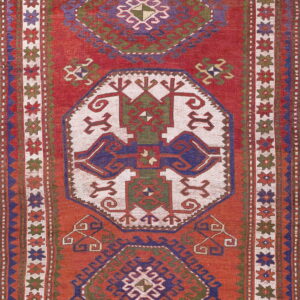
Classic Tribal Geometric Antique Caucasian Red Lori Pambak Rug
$3,000.00 Antique RugsSKU: 18521Rug sizes: 4 ft 9 in x 6 ft 10 in (1.45 m x 2.08 m) -
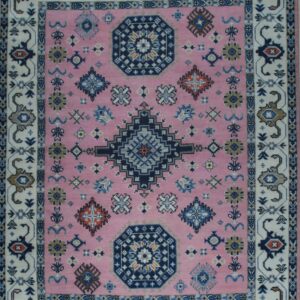
Pink and Ivory Traditional Kazak Hand-Knotted Wool Rug 8′ x 10′
$1,244.00 New RugsSKU: KC15109PK8X10Rug sizes: 8 ft x 10 ft (2.44 m x 3.05 m) -
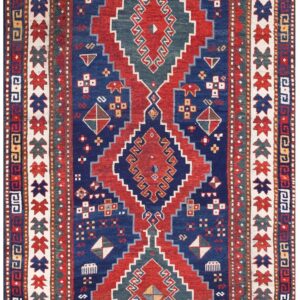
Antique Caucasian Kazak Rug, Blue Medallion Design, 1890s
$7,500.00 Antique RugsSKU: 19108Rug sizes: 4 ft x 7 ft 7 in (1.22 m x 2.31 m) -
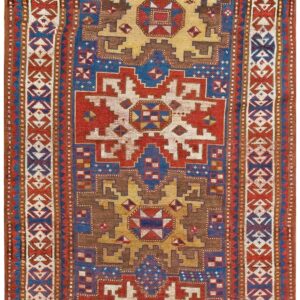
Antique Caucasian Kazak Rug , Blue Geometric Tribal, 1900s
$3,600.00 Antique RugsSKU: 19107Rug sizes: 3 ft 6 in x 5 ft 10 in (1.07 m x 1.78 m) -
Antique Caucasian Kazak Rug Red on Red Geometric, 19th Century
$3,600.00 Antique RugsSKU: 19102Rug sizes: 3 ft x 6 ft (0.91 m x 1.83 m) -
Antique Caucasian Kazak Long Rug Multi Geometric, Rose Pink Border, Circa 1890
$6,200.00 Antique RugsSKU: 19098Rug sizes: 4 ft x 8 ft 2 in (1.22 m x 2.49 m) -
Red Color Solid Open Field Mid 19th Century Tribal Geometric Caucasian Kazak Carpet
$11,100.00 Antique RugsSKU: 20310Rug sizes: 4 ft x 8 ft 8 in (1.22 m x 2.64 m) -
Antique Tribal Square Kazak Rug – Red Solid Open Field
$2,300.00 Antique RugsSKU: 18017Rug sizes: 3 ft 5 in x 4 ft (1.04 m x 1.22 m) -
Small Size Red Tribal Geometric Antique Late 19th Century Caucasian Kazak Rug
$4,300.00 Antique RugsSKU: 18054Rug sizes: 4 ft 4 in x 6 ft (1.32 m x 1.83 m) -
Bold Bright Red Antique Late 19th Century Tribal Geometric Caucasian Kazak Rug
$4,900.00 Antique RugsSKU: 19293Rug sizes: 3 ft 7 in x 6 ft 3 in (1.09 m x 1.91 m) -
Small Bold Tribal Geometric Red Antique Caucasian Kazak Rug
$5,200.00 Antique RugsSKU: 18468Rug sizes: 4 ft 7 in x 6 ft 6 in (1.40 m x 1.98 m) -
Small Red Tribal Geometric Antique Bold Caucasian Kazak Scatter Rug
$6,800.00 Antique RugsSKU: 4671Rug sizes: 4 ft 4 in x 5 ft 3 in (1.32 m x 1.60 m) -
Antique Yellow Tribal Geometric Caucasian Kazak Hallway Runner Rug
$6,200.00 Antique RugsSKU: 18768Rug sizes: 3 ft 2 in x 8 ft 10 in (0.97 m x 2.69 m) -
Antique Late 19th Century Tribal Geometric Caucasian Kazak Paisley Pattern Hallway Runner Rug
$8,500.00 Antique RugsSKU: 18731Rug sizes: 3 ft 9 in x 8 ft (1.14 m x 2.44 m) -
Red Tribal Geometric Antique 19th Century Caucasian Borchalou Kazak Rug
$7,200.00 Antique RugsSKU: 19262Rug sizes: 4 ft 3 in x 7 ft 5 in (1.30 m x 2.26 m) -
Red Rustic Antique Allover Tribal Geometric Pattern Caucasus Kazak Wool Pile Rug
$7,500.00 Antique RugsSKU: 19040Rug sizes: 4 ft x 9 ft 2 in (1.22 m x 2.79 m) -
Tribal Geometric Brown Earth Tone Antique Small Late 19th Century Caucasus Kazak Rug
$7,800.00 Antique RugsSKU: 18806Rug sizes: 3 ft 6 in x 6 ft 3 in (1.07 m x 1.91 m) -
Red Rustic Antique Tribal Geometric Pattern Caucasian Kazak Rug
$6,500.00 Antique RugsSKU: 17766Rug sizes: 4 ft 4 in x 9 ft 1 in (1.32 m x 2.77 m) -
Tribal Geometric Colorful Jewel Tone Antique Caucasian Kazak Rug
$6,500.00 Antique RugsSKU: 19277Rug sizes: 4 ft 6 in x 9 ft 3 in (1.37 m x 2.82 m) -
Blue Ground Tribal Geometric Figural Pattern Antique Caucasian Kazak Rug
$6,500.00 Antique RugsSKU: 18639Rug sizes: 4 ft 10 in x 7 ft 1 in (1.47 m x 2.16 m) -
Antique Caucasian Geometric Medallion Wool Hand Knotted Pile Coral 1930s Rug
$1,600.00 Antique RugsSKU: 6737Rug sizes: 3 ft x 4 ft 3 in (0.91 m x 1.30 m) -
Coral Rustic Antique Tribal Paisley Design Caucasian Hand Knotted Pile Rug
$7,200.00 Antique RugsSKU: 6641Rug sizes: 4 ft 2 in x 7 ft 9 in (1.27 m x 2.36 m) -
Hand Knotted Wool Pile Antique Caucasian Tribal Geometric Keyhole Design Rug
$5,900.00 Antique RugsSKU: 6594Rug sizes: 4 ft 7 in x 6 ft 5 in (1.40 m x 1.96 m) -
Antique Kazak Caucasian Blue 1900s Hallway Runner Rug
$5,900.00 Antique RugsSKU: 6520Rug sizes: 3 ft x 9 ft 5 in (0.91 m x 2.87 m) -
Wool Pile Vintage Caucasian Geometric Rustic Kazak Coral Rug
$4,600.00 Antique RugsSKU: 6519Rug sizes: 4 ft 8 in x 9 ft 6 in (1.42 m x 2.90 m) -
Red Late 19th Century Primitive Tribal Antique Hand Knotted Caucasian Pile Rug
$8,800.00 Antique RugsSKU: 6445Rug sizes: 4 ft 6 in x 8 ft (1.37 m x 2.44 m) -
Antique Late 19th Century Tribal Geometric Caucasian Red Hallway Runner
$6,500.00 Antique RugsSKU: 6344Rug sizes: 3 ft 8 in x 11 ft 7 in (1.12 m x 3.53 m) -
Antique Caucasian Red Field Tribal Geometric Pattern Scatter Size Rug
$4,500.00 Antique RugsSKU: 6233Rug sizes: 3 ft 9 in x 7 ft 3 in (1.14 m x 2.21 m) -
1900s Geometric Medallion Caucasian Antique Hand Knotted Pile Red Wool Rug
$4,500.00 Antique RugsSKU: 5626Rug sizes: 3 ft 10 in x 5 ft 9 in (1.17 m x 1.75 m) -
Artistic Tribal Antique Late 19th Century Green Caucasian Kazak Rug
$6,000.00 Antique RugsSKU: 4865Rug sizes: 4 ft 2 in x 6 ft 10 in (1.27 m x 2.08 m) -
Antique Caucasian Geometric Medallion Wool Hand Knotted Pile Red 1900s Rug
$6,500.00 Antique RugsSKU: 2691Rug sizes: 4 ft 9 in x 7 ft (1.45 m x 2.13 m) -
Antique Caucasian Tribal Geometric Akstafa Coral Rug
$19,500.00 Antique RugsSKU: 25987Rug sizes: 5 ft x 7 ft (1.52 m x 2.13 m) -
Small Square Antique Caucasian Kazak Tribal Throw Rug
$3,000.00 Antique RugsSKU: 25522Rug sizes: 3 ft 4 in x 3 ft 8 in (1.02 m x 1.12 m) -
Tribal Design Red Late 19th Century Antique Caucasian Kazak Rug
$5,900.00 Antique RugsSKU: 25521Rug sizes: 4 ft 6 in x 5 ft 8 in (1.37 m x 1.73 m) -
Blue , Ivory Beige Cream White , Red Late 19th Century Tribal Geometric Antique Key Hole Design Caucasian Kazak Rug – Blue, Ivory Beige Cream White, Red
$15,600.00 Antique RugsSKU: 24513Rug sizes: 5 ft x 6 ft 10 in (1.52 m x 2.08 m) -
Red Antique Wool Pile Tribal Caucasian Kazak Rug
$3,600.00 Antique RugsSKU: 22194Rug sizes: 3 ft 6 in x 7 ft 9 in (1.07 m x 2.36 m)
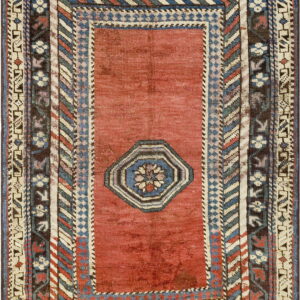
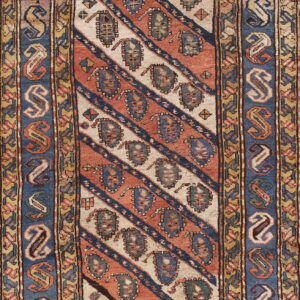
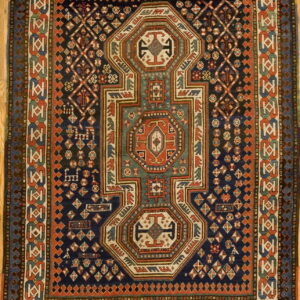
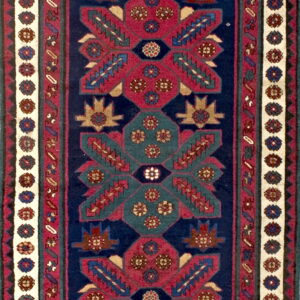
What are the main types of Kazak rugs?
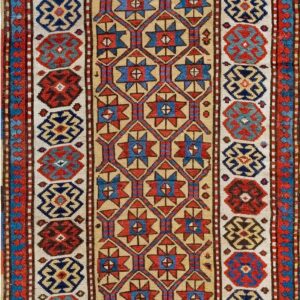
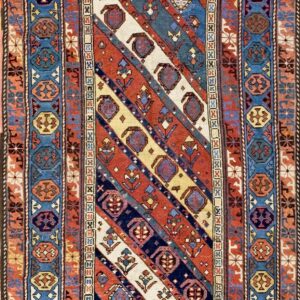
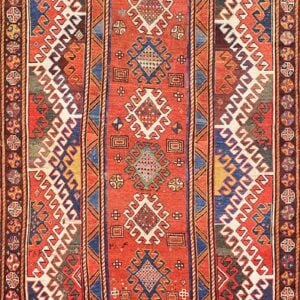
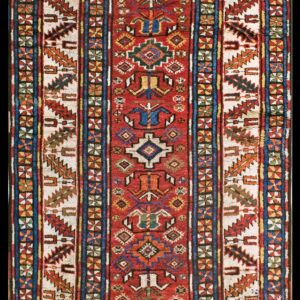
Within the Kazak family, dealers and collectors name groups by their designs. The best known are:
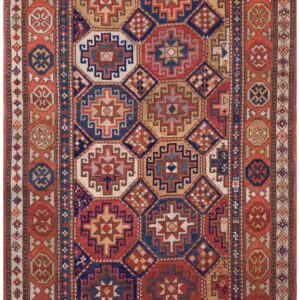
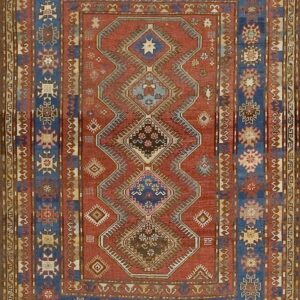
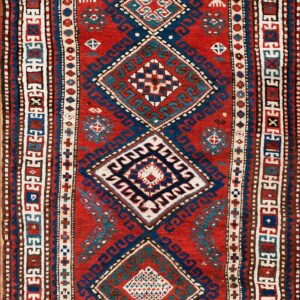
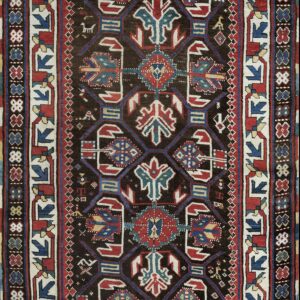
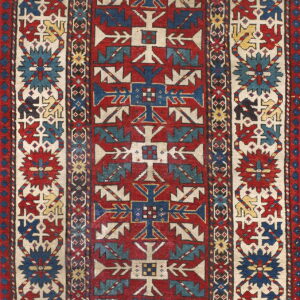
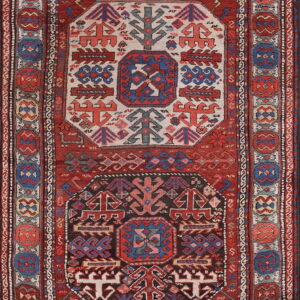
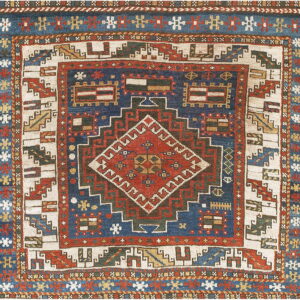
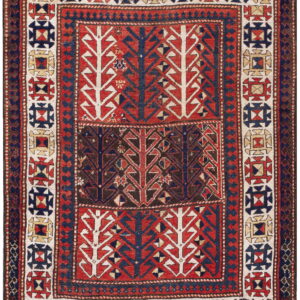
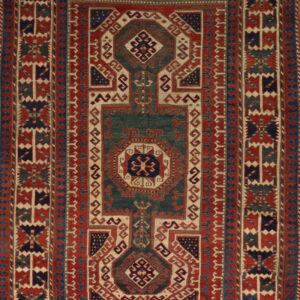
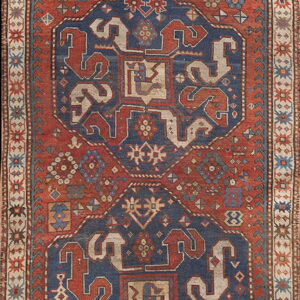
- Lori Pambak. Vertical strings of star medallions on red fields, with a finer weave than most Kazaks.
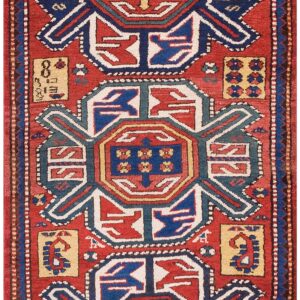
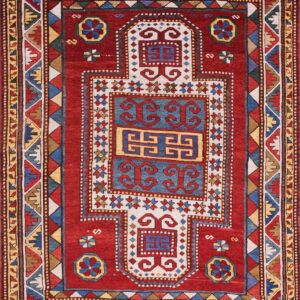
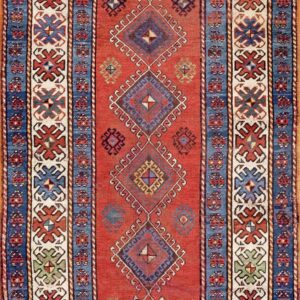
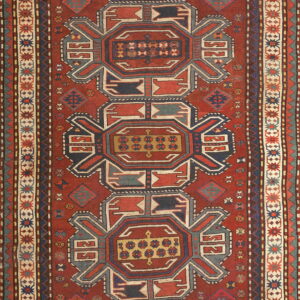
- Sewan, the shield Kazak. A large cruciform shield medallion on a vivid red ground.
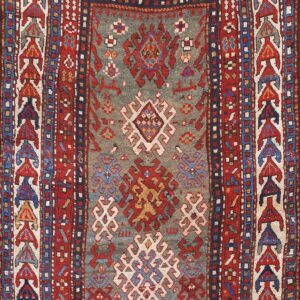
- Karachopf. Green or teal fields with bold star shaped medallions at the center.
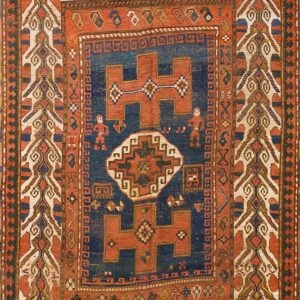
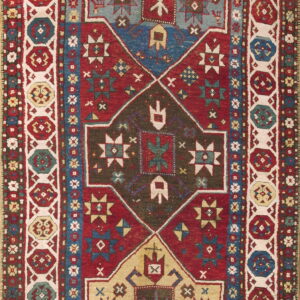
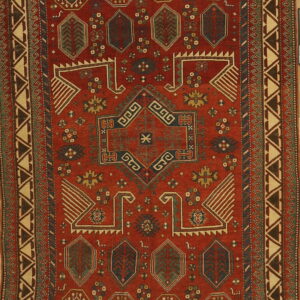
- Fachralo. A prayer rug format, with an arch framing a central medallion, often on light blue or green fields.
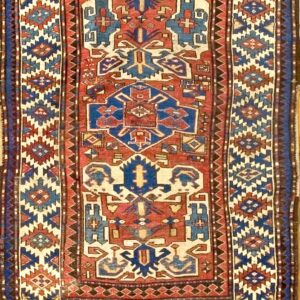
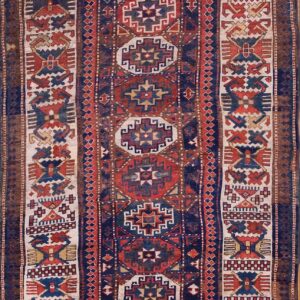
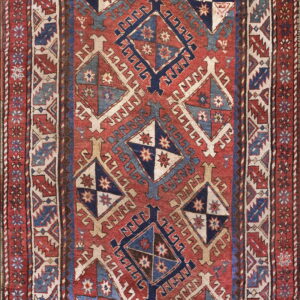
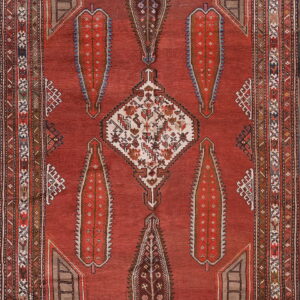
- Bordjalou. Rustic rugs with brown, ivory and blue fields and simple geometric figures.
Our collection includes Lori Pambak and Sewan examples alongside classic medallion Kazaks. Our Kazak rug guide goes further into each group.
Kazak, Shirvan, Kuba or Karabagh: what is the difference?
All four are named weaving groups of the Caucasus, and each has its own character. A Kazak means large scale drawing, few elements and a long, glossy pile. A Shirvan is finer and flatter, with smaller repeating elements. A Kuba is finer still, with complex borders and often an ivory ground. Karabagh is the group that made larger gallery carpets and took the most outside design influence. Our antique Caucasian rugs guide sets the groups side by side, and our Shirvan rugs show the contrast.
Against a Persian rug, the differences run together: a Caucasian rug usually has a wool foundation rather than cotton, the symmetric rather than the asymmetric knot, and angular geometric rather than curving floral drawing.
How can you tell if a Kazak rug is antique?
- Dyes. Madder reds, indigo blues and plant yellows age gracefully and show gentle abrash. Harsh, flat color points to synthetic dyes. Our guide to natural vs synthetic dyes shows the difference.
- Foundation. Antique Kazaks are usually wool on wool; cotton warps were introduced in some later pieces. See our guide to rug foundations, warps and wefts.
- Back. Several wefts, often red, between the rows of knots give the back a ribbed look.
- Wool and wear. Lustrous, lanolin rich wool that has worn evenly, and a supple handle.
- Age on the label. Every listing on this site states the approximate age; see antique vs vintage vs new rugs.
What makes an antique Kazak valuable?
- Age. 19th century Kazaks, with their dye quality and balanced drawing, are the most sought after.
- Color. Saturated, natural color with abrash.
- Design. A strong, well drawn composition, and recognized groups such as Lori Pambak and Sewan.
- Condition. Even pile and original ends and sides.
- Size and shape. Most Kazaks are scatter rugs and long rugs, so larger and square pieces are scarcer. See what moves the value of an antique rug.
How do you decorate with a Kazak rug?
- Modern rooms. The bold, graphic drawing of a Kazak anchors a contemporary room as well as a traditional one.
- Halls and stairs. Long Kazak runners suit hallways and corridors.
- Small spaces. Scatter size Kazaks suit entries, bedsides, studies and reading corners, and layer well over a larger rug.
- On the wall. A strong antique Kazak is also a fine textile to hang.
- Measure first. Our rug size guide explains how to measure.
How do you care for a Kazak rug?
- Pad and rotation. Use a quality pad, especially under a small rug, and rotate it once or twice a year.
- Vacuuming. Vacuum without a beater bar.
- Light and spills. Keep it out of prolonged direct sun and blot spills at once.
- Washing. Have it hand washed by a rug specialist. Our rug cleaning service in Manhattan washes hand knotted rugs.
- Moths. Wool rugs under furniture attract moth larvae; our moth proofing service treats the fibers after washing.
Glossary of Kazak rug terms
- Kazak (Qazax)
- A district of the South Caucasus that gives its name to a family of bold, thick piled village rugs.
- Symmetric (Turkish) knot
- A knot tied around two warps, the norm across the Caucasus.
- Abrash
- Gentle color variation across a rug, caused by natural dyes and small batches of wool.
- Lori Pambak
- A Kazak group with vertical strings of star medallions on a red field.
- Sewan
- The shield Kazak, with a large cruciform medallion.
- Boteh
- A teardrop or paisley motif.
Kazak Rugs: Frequently Asked Questions
What is a Kazak rug?
A Kazak rug is a hand knotted village rug from the Kazak (Qazax) district of the South Caucasus, where present day Armenia, Azerbaijan and Georgia meet. Kazaks are known for large, bold geometric medallions, saturated red, blue and ivory, and a long, glossy wool pile.
Who made Kazak rugs?
Armenian, Azeri and Georgian village weavers. The name is a geographic trade label for carpets from the Kazak district, not the name of a tribe or an ethnic group.
How old are the antique Kazak rugs on this page?
We have 84 antique Kazak rugs: 61 from the 19th century, including pieces from the 1850s and 1860s, 15 from about 1900 and 8 from the 1920s and 1930s. Every listing states the approximate age.
How much is an antique Kazak rug worth?
Our antique Kazaks range from about $1,600 to $26,000, with a median of about $6,200, and half are priced between about $4,900 and $7,500. Age, color, design, condition and size move a rug within that range.
Why are most Kazak rugs small?
Kazaks were village rugs, and most Kazaks on the market, including ours, are scatter sizes and long rugs rather than room size carpets. Ours run from about 3 x 5 to 6 x 9, along with runners and a few square rugs.
What is the difference between a Kazak and a Shirvan rug?
Both are Caucasian, but a Kazak has large scale drawing, few elements and a long, glossy pile, while a Shirvan is finer and flatter, with smaller repeating elements. See our antique Caucasian rugs guide.
Can I try a Kazak rug at home?
Yes. Shipping is free within the continental United States, and every rug comes with a 4 day in home trial starting the day it is delivered. You can also see the rugs by appointment at our showroom at 36 East 31st Street, 9th floor, New York, where Rugs On Net has been since 1979. Interior designers can join our trade program.
Watch: from our New York gallery
On a Kazak rug like this one, the large cross medallion is not decoration, it is a declaration. The cross was central to Armenian life long before it was formalized elsewhere, and in Caucasian rugs it becomes a woven shield.
More on our YouTube channel.