
What “Standard Rug Sizes” Means
Defining “Standard” Historically vs. Today
The idea of standard rug sizes has shifted significantly over time. In historical weaving cultures, “standard” referred to functional fit within daily life: prayer rugs sized for kneeling, runners made for narrow corridors, or palace oversized carpets woven to span vast reception halls. Measurements were grounded in traditional units such as the Persian zar, approximately 105 cm, or multiples like dozar (about 130–140 cm by 200–210 cm).
By contrast, today’s retail landscape defines “standard” as a set of fixed size categories aligned to typical room layouts and furniture groupings. Rather than cultural function, the modern standard reflects a menu of dimensions designed to simplify shopping and accommodate contemporary interiors.
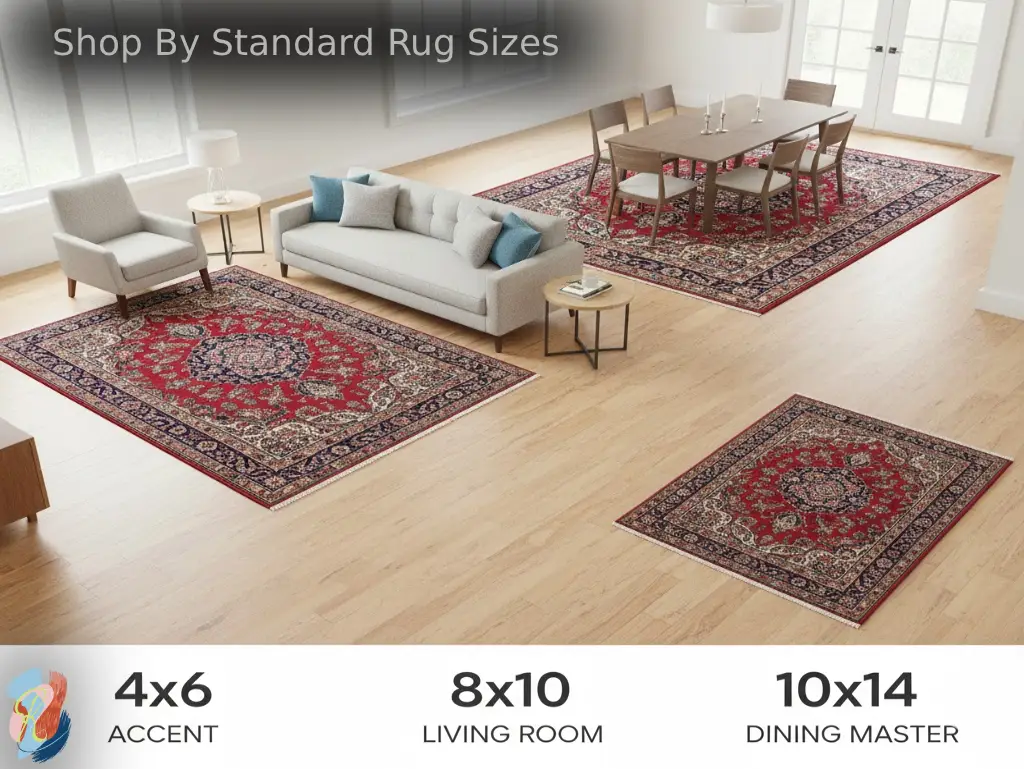
Browse our collection by dimension below. Each category is curated to solve specific spatial requirements, from intimate accent zones to estate-scale foundations.
View our rug collection by standard rug sizes:
 1 x 2 Rugs |  10 x 14 Rugs |  11 x 11 Carpets |  12 x 15 Rugs |  12 x 18 Rugs |  12 X 22 Rugs |  12 x 26+ Rugs |  13 x 13 Carpets |
 13 x 16 Rugs |  14 x 20 Carpets |  15 X 17 Rugs |  15 x 25 Rugs |  16 x 21 Carpets |  2 x 3 Rugs |  21 x 22 Rugs |  3 X 10 Rugs |
 3 x 12 Carpets |  3 x 14 Rugs |  3 X 16 Carpets |  3 x 20+ Carpets |  3 x 5 Rugs |  3 x 7 Rugs |  3 x 9 Rugs |  4 x 10 Carpets |
 4 x 4 Rugs |  4 x 6 Rugs |  5 x 7 Carpets |  5 X 8 Rugs |  6 X 12 Rugs |  6 X 16 Rugs |  6 x 20 Carpets |  6 x 6 Rugs |
 6 x 9 Rugs |  7 x 13 Rugs |  7 x 18 Rugs |  8 x 10 Rugs |  8 x 8 Rugs |  9 x 12 Rugs |  9 X 19 Rugs |  9 X 24 Rugs |
Measurement Systems
Rug measurements have always depended on the systems used in their regions of origin. Traditional units like the zar were based on human scale, while today, both feet / inches and centimeters dominate retail listings. To translate across systems, reference charts remain essential.
| Label | Feet (approx.) | Centimeters (approx.) |
|---|---|---|
| 2×3 | 2′×3′ | 60×90 cm |
| 3×5 | 3′×5′ | 90×150 cm |
| 4×6 | 4′×6′ | 120×180 cm |
| 5×8 | 5′×8′ | 160×230 cm |
| 6×9 | 6′×9′ | 180×270 cm |
| 8×10 | 8′×10′ | 200×300 cm |
| 9×12 | 9′×12′ | 250×350 cm |
| 10×14 | 10′×14′ | 300×425 cm |
These conversions, though widely used, should be double-checked since rug sizes variance of 2–5% is normal in handmade weaving. Listing exact rug measurements rather than just labels ensures accuracy for buyers.
Recurring Ratios
Beyond fixed numbers, rug size ratios recur in both historical and modern weaving. Ratios such as 1:1.25, 1:1.33, and 1:1.6 determine overall balance. A 6×9 rug (1:1.5 ratio) allows central medallions to align with borders harmoniously, while a 4×6 rug (1:1.5 ratio again) creates scaled versions of the same geometric logic. These proportions, echoed in architecture and art, help explain why certain rug shapes feel visually stable and practical in a room.
Why Size Matters for Design and Use
- Furniture fit: A rug too small isolates furniture, while the correct size anchors seating groups.
- Room proportion: Balanced rug dimensions expand or contract perceived room scale.
- Design clarity: Patterns like medallions or allover repeats rely on proper ratio to remain legible.
- Traffic flow: Well-sized rugs guide pathways, preventing tripping hazards.
- Cultural use : Traditional functions, like prayer rugs, depend entirely on fitting body or ritual scale.
Variance Tolerance in Handmade Rugs
Unlike machine production, handmade weaving introduces small deviations. A hand-knotted rug listed as 8×10 feet may actually measure 7′10″×10′2″. Such rug size variance—typically within ±2–5%—is considered normal and does not reduce quality. Slight tapering or irregularity may even confirm authenticity, signaling that a rug was woven by hand on a traditional loom. Buyers should always look at exact rug measurements, not just standard labels, to ensure proper fit.
What Sizes Are Considered Standard?
Across rooms, retail convention has set the most common standard rug sizes: 2×3, 3×5, 4×6, 5×8, 6×9, 8×10, 9×12, 10×14, 12×15 and 12×18 feet in the U.S., or their metric equivalents of 80×150, 120×180, 160×230, 200×300, 250×350, 366×457 and 366×549 cm in Europe. These categories act as the global rug size chart, bridging traditional weaving heritage with modern home design needs.
Traditional Size Systems: Fast Overview
Nomadic vs. Urban Workshop Formats
- Nomadic rugs: Nomadic weavers relied on horizontal ground looms that could be dismantled and carried. These portable looms restricted rug width, leading to long, narrow formats ideal for tent floors and corridors. The limited span created a distinct family of traditional rug formats still recognizable today.
- Urban workshop rugs: Permanent vertical looms in city workshops allowed broad, expansive weavings. These facilities enabled the production of palace-scale carpets and large room pieces, unconstrained by portability. As a result, workshops drove the development of grand carpets that defined urban court culture.
Function-Driven Types
- Prayer rugs: The prayer rug size was set by the human body, just large enough for kneeling and prostration, usually around 2–3 feet by 4–6 feet. Consistent proportions were dictated by ritual rather than décor.
- Tent rugs: Nomadic households used narrow weavings joined together to cover tent floors or act as dividers. Their portability matched seasonal migrations.
- Palace oversized carpets: The palace carpet size was dictated by monumental halls and royal patronage. Enormous looms or stitched panels created rugs spanning tens of feet, serving both ceremonial and decorative roles.
Loom Constraints and Portability
The maximum width of a rug has always reflected loom type. Nomadic loom width restricted output to portable strips, while fixed urban looms permitted oversized carpets. This structural reality explains why traditional rugs cluster into predictable size families. Loom choice, not just design, determined how a weaving could scale.
Ensemble Layouts in Room Traditions
Persian traditions often employed an ensemble system: a large central carpet flanked by side runners and a headpiece, collectively framing seating arrangements along room perimeters. These coordinated layouts created both symmetry and hierarchy, with the central rug anchoring the ensemble. Flatweaves were also stitched in panels to achieve larger coverage where single-loom output was insufficient, extending function without abandoning tradition.
Pro Tip for Large Spaces: When shopping for oversized areas, remember that a rug’s maximum width is traditionally limited by the loom type it was woven on. In larger estates, we often suggest using an ‘ensemble’ approach—arranging multiple hand-knotted pieces to frame different social zones within a single grand room.
Persian Formats & Terms
Core Size Categories
Persian weaving developed precise terms that link rug measurements directly to function. These names, still used in catalogs and scholarship, encode cultural expectations about where and how each rug should be placed.
| Term | Approx. Size | Use |
|---|---|---|
| Dozar | 130–140 × 200–210 cm | Versatile size common in antiques; often used as a portable room rug. |
| Zar-o-nim | ~100 × 150 cm | Compact format for bedside placement, entryways, or small niches. |
| Ghalicheh | 120–150 × 180–240 cm | Small-to-medium carpet bridging between dozar and full ghali. |
| Ghali | ≥190 × 280 cm | Full room coverage, serving as the anchor piece in domestic or ceremonial settings. |
Runners and Gallery Carpets
Persian weaving also developed elongated rugs for framing space.
| Format | Width × Length | Role |
|---|---|---|
| Kenareh | 80–120 cm wide; up to ~6 m long | Narrow runner placed along room sides or corridors; balances the central carpet. |
| Kelleh | 150–200 cm wide; 3–6 m long (length ≥2× width) | A “gallery carpet” designed for halls, mosque galleries, or as the headpiece in ensembles. |
The Kenareh runner and Kelleh dimensions illustrate how Persian rug formats evolved to suit rectangular rooms and extended seating traditions. Together, they formed ensembles where a ghali anchored the center, kenarehs lined the sides, and a kelleh defined the head of the room.
Palace Carpets and Court Scale
At the Safavid court, weaving reached monumental proportions. Palace commissions produced ghali carpets spanning entire reception halls, some exceeding 10 meters in length. Exemplars such as the Ardabil Carpet demonstrate both the technical mastery of large-scale looms and the ceremonial importance of court textiles. These monumental rugs transcended domestic use, acting as dynastic symbols as well as functional floor coverings.
Village Variability and Loom Limits
- Local looms set constraints: Village workshops often had smaller looms, restricting rugs to dozar or zar-o-nim formats.
- Community preference shaped output: Villagers wove rugs for local homes, where compact, practical pieces were more useful than palace-scale carpets.
- Variability confirmed handwork: Slight irregularities in village rugs stemmed from loom limits and weaver improvisation, making them distinct from workshop uniformity.
Shopping the Traditional Formats: Kelleh and Ensembles
When you browse our oversized inventory, you may notice proportions that don’t fit the typical modern 9×12 rectangle.
This is because traditional Persian rug formats were engineered for specific architectural functions:
- The Kelleh (Gallery Carpet): These are long, wide rugs designed to span the center of a grand hall. If you are looking to buy a rug for a long, grand dining room, a Kelleh offers the perfect linear stretch that standard sizes lack.
- Rug Ensembles: Historically, large social spaces weren’t covered by one giant rug, but by a ‘set’ of four rugs designed to frame a room. You can shop for similar effects by layering a central anchor with coordinating runners to define seating areas in a modern open-concept home.
- Social Seating Patterns: Many antique formats were woven to ‘encode’ where guests should sit. When you view these designs, notice how the borders and central fields are scaled to frame furniture, rather than just covering the floor.
Anatolian & Caucasian Formats
Prayer Rugs and Cushion Mats
Anatolian weaving is strongly associated with compact personal formats.
| Term | Approx. Size | Function |
|---|---|---|
| Seccade | 80–120 × 150–180 cm | Personal prayer rug size, often with niche or mihrab motif framing the field. |
| Yastik | 40–70 × 80–120 cm | Small cushion or mat format; doubled as a scatter rug or portable seat covering. |
The Seccade size became a hallmark of Anatolian weaving, balancing portability with ritual use. The Yastik dimensions reflect domestic needs, serving as cushion covers and multipurpose textiles in village households.
Runners and Village Scatter Sizes
- Yolluk (runners): Long, narrow weavings suited to corridors, mosque aisles, and galleries; their elongated form prefigured today’s standard hallway runner sizes.
- Village scatters: Typical Caucasian rugs ranged from ~3×5 to 5×8 feet, reflecting loom widths in domestic settings. These practical dimensions aligned with everyday home interiors rather than monumental spaces.
Karabagh Kelleh and Long Galleries
The Karabagh region in the Caucasus is noted for its production of kelleh carpets—elongated formats that stretched the gallery carpet tradition. These long rugs drew influence from both Persian prototypes and local Caucasian aesthetics, creating palace-scale weavings that bridged regional traditions. Karabagh kelleh thus exemplify how cultural exchange shaped rug dimensions and proportions beyond local domestic needs.
Flatweave vs. Pile Size Ranges
Format was also tied to technique. Flatweaves, such as kilims, could be woven in panels and stitched together, allowing broader coverage from modest looms. Pile rugs, by contrast, were constrained by the loom’s maximum width, reinforcing the dominance of mid-size and runner proportions in rural production. This flatweave vs. pile distinction shows how technique directly influenced rug size ranges in Anatolia and the Caucasus.
Traditional Proportions: The Anatolian & Caucasian Scale
When you shop for Caucasian and Anatolian rugs, you will notice that their dimensions are a direct reflection of the nomadic and village looms on which they were woven.
These sizes weren’t chosen for modern catalogs; they were dictated by the portable nature of the weaver’s life:
- Compact Prayer Rugs: View our collection of small-format Anatolian rugs to see how ritual function created a consistent scale (typically 3′ x 5′). These are the perfect choice for buying an accent piece for an entryway or bedside.
- The Origin of Runners: Many modern hallway standards are modeled after regional Caucasian ‘long-format’ rugs. Because village looms were restricted in width, the weavers grew their designs vertically. Browse our runners to find these authentic, narrow masterpieces that fit modern corridors with historical precision.
- Village Loom Widths: If you find a rug with a slightly irregular ‘narrow-but-long’ footprint, you are viewing a piece of textile history. These widths were determined by the physical span of a single village loom, making them a prime selection for unique architectural nooks and transitional landings.
Central Asian & Tribal Formats
Turkmen Carpets: Main, Ensi, and Namazlyk
Central Asian weaving developed specific forms tied to nomadic life in yurts.
| Item | Typical Size | Use |
|---|---|---|
| Main carpet | ~2 × 3 m | Family seating carpet spread on yurt floors; the primary ground covering. |
| Ensi | ~1.2 × 1.5–1.8 m | Yurt door covering, often with cross-panel layout symbolizing the entrance. |
| Namazlyk | ~3 × 5 ft (≈ 1 × 1.5 m) | Prayer rug with a niche-like top, fulfilling ritual requirements. |
These formats illustrate how main carpet dimensions and Turkmen ensi size were dictated by the architecture of the yurt and daily ritual practices.
Bags, Bands, and Felts
- Torba and chuval: Narrow bag faces, often under 1 × 1.5 m, served as storage containers, tent decoration, or bridal dowry textiles. Their uniform sizes matched the storage needs of nomadic life.
- Tent bands: Long woven strips, sometimes exceeding 10 m, reinforced yurt structures and added ornamentation. Their linear format reflected functional necessity.
- Felts (shyrdaks): Panels of felt, often ~2 × 3 m, were joined to cover larger areas. Shyrdak panel sizes were standardized so multiple pieces could align seamlessly inside the yurt.
Panel Assembly for Large Floors
Because large single-piece carpets were impractical for portable looms, nomads relied on panel assembly. Yurt interiors were divided into zones: main carpets for seating, felts for insulation, and ensi for the entry. The modularity of ~2 × 3 m panels made transport and setup efficient while still achieving full-floor coverage when combined.
Portability vs. Scale Trade-offs
Nomadic weaving prioritized portability. Looms had to be dismantled and carried, capping maximum width. As a result, large single-piece carpets were rare, and modular solutions—felts, assembled kilims, or multiple main carpets—dominated. The balance between function and mobility explains why Central Asian formats stayed compact but repeatable, ensuring flexibility across seasonal migrations.
Engineering the Tribal Footprint: Function Over Fashion
When you browse our tribal and nomadic rugs, you are viewing dimensions that were engineered for survival and utility. Unlike workshop carpets, tribal sizes remained consistent for centuries.
This is because they were built to fit the specific physical requirements of nomadic life:
- Fixed Dimensions for Utility: Tribal rugs, such as Bakhtiari or Qashqai pieces, were often woven to standard profiles to fit tent entrances or storage chests. This consistency makes them a reliable choice when you need to buy an accent piece for a specific architectural nook.
- Modular Assemblies: Because tribal looms were portable and narrow, oversized rugs were rare. Instead, large floor areas were covered by joining smaller, modular weavings together. Shop our tribal collection for these authentic, manageable sizes that offer a rich, textured ‘island’ of color without overwhelming a room.
- Standard Profiles: Whether it’s a ‘mafrash’ (storage bag) or a ‘pardah’ (door hanging), the dimensions you see today were once functional tools. Review these pieces for their historical integrity; they bring a grounded, purposeful scale to modern interiors that generic factory rugs simply cannot replicate.”
Chinese, Indian / Mughal, Himalayan Formats
Chinese Carpets: Mats, Palace, Pillar, and Round
Chinese weaving encompassed both intimate and monumental scales.
| Format | Approx. Size | Placement/Use |
|---|---|---|
| Mats | 2′×2′ or 2′×3′ | Placed on kang platforms or for individual seating. |
| Palace carpets | Often >5×8 m, woven in strips | Covered vast palace halls; strips were joined to overcome loom limits. |
| Pillar rugs | Sized to column circumference | Wrapped around structural columns; required special mounting. |
| Round rugs | Variable diameters (often 2–4 m) | Placed under tables or in halls; adapted to circular architecture. |
Chinese palace carpet size pushed weaving to extremes, while pillar rug size reveals how architecture created unique textile solutions. Round rugs show that not all carpets followed rectangular conventions, prefiguring later design debates on proportion.
Mughal Room Carpets and Colonial Standards
- Mughal court rugs: Woven to room dimensions, often several meters across, serving as platforms for durbar ceremonies. Scale reflected imperial display.
- Colonial era standards: Under British influence, the standard rug sizes aligned to Western room proportions, introducing fixed categories that paralleled emerging global retail standards.
These shifts illustrate how Mughal grandeur adapted into measurable units under colonial trade.
Tibetan Rugs: Khaden, Tiger, and Saddle
Tibetan weaving emphasized personal scale, with standardized formats for everyday and ritual use.
| Item | Approx. Size | Function |
|---|---|---|
| Khaden | ~3×6 ft (≈90×180 cm) | Sleeping or seating mat for family platforms. |
| Tiger rug | ~3–3.5 × 5–6 ft | Meditation carpet, symbolizing protection and strength. |
| Saddle rug | Compact, ~2×3 ft or smaller | Placed under saddles; decorative and practical. |
The khaden dimensions standardized domestic comfort, while tiger rugs carried symbolic significance beyond function.
Paired Carpets and Symmetry
Chinese and Mughal traditions also wove carpets in matched sets. These pairs created balanced room ensembles, reinforcing architectural symmetry. Set weaving extended rug formats beyond individual pieces into coordinated décor systems, mirroring Persian ensemble practices.
Architectural Problem Solving: From Palace Strips to Himalayan Mats
When you browse our oversized and specialty collections, you are seeing the results of ancient architectural problem-solving.
These formats were engineered to overcome the physical limitations of early buildings:
- Palace-Scale Engineering: Historically, grand reception halls were often interrupted by massive structural pillars. To navigate these, palace weavers developed ‘strip assembly’ techniques and unique shapes. View our large-format rugs to find pieces that can unify expansive rooms or frame permanent architectural features with ease.
- The Himalayan Khaden: In Tibet and the Himalayas, the Khaden was a standardized personal mat (roughly 3′ x 6′) used for both sitting and sleeping. Shop these versatile pieces when you need a high-pile, durable accent for a home office, a cozy reading nook, or even a luxury wall hanging.
- The Physics of Round Rugs: Unlike standard rectangles, round rugs follow a different set of proportional rules. They are the ideal choice for ‘breaking the grid’ of a boxy room or sitting beneath a circular dining table. Review our round inventory to find a shape that encourages a softer, curvilinear flow in your home’s high-traffic zones.
Looms, Technique & Function Shape Size
Horizontal vs. Vertical Looms
- Horizontal looms: Staked into the ground, they were portable for nomadic use but capped rug loom width at narrow spans. Their convenience for migration meant rugs were often long and narrow rather than broad.
- Vertical looms: Fixed in workshops, these allowed larger widths and greater height. Permanent frames made it possible to weave palace carpets, extending rug dimensions far beyond nomadic capabilities.
Flatweave vs. Pile
- Flatweaves: Kilims and other flatwoven rugs could be extended in length with relative ease since tension was lower. Weavers sometimes stitched panels together to achieve greater floor coverage. Flatweave length limits were practical but rarely architectural.
- Pile rugs: Dense knotted pile required strict tension across warp and weft. Width was constrained by loom size, and length demanded careful management to keep edges aligned. Larger pile carpets could only be produced on permanent looms with strong frames.
Function-First Sizing
Cultural use cases created repeating rug dimensions across regions.
| Use | Typical Size | Why |
|---|---|---|
| Prayer | ~2–3 × 4–6 ft | Sized for one person; ritual dictates scale. |
| Door (ensi) | ~4 × 5–6 ft | Covered yurt entrances; matched doorways. |
| Hall/runner | Narrow width × up to 20 ft | Guided traffic in corridors or mosque aisles. |
| Throne/palace | 15+ ft width, variable length | Ceremonial; showcased royal authority and required monumental looms. |
These archetypes show how function-first sizing explains recurring patterns more than arbitrary design.
Teams of Weavers for Very Large Widths
Massive pile carpets, such as Safavid palace commissions, demanded teams working simultaneously across a loom. Synchronization was essential: multiple weavers knotted side by side to maintain straight rows, while assistants managed tension at the loom’s edges. This pile carpet tension control prevented distortion in monumental pieces. Team weaving thus became both a technical and organizational solution for carpets measuring many meters across.
The Engineering of Scale: Loom Architecture & Structural Integrity
When you shop for large-format rugs, you are viewing the results of a high-stakes engineering feat. The dimensions of a hand-knotted rug are fundamentally governed by the architecture of the loom and the coordination of the weaving team.
Here is why:
- Loom-Defined Widths: The maximum width of any authentic rug is limited by the size of the loom frame. Because of this, very wide rugs are rare and highly sought after. View our oversized collection to find pieces that pushed the boundaries of traditional loom architecture.
- Coordinated Weaving Teams: For very large carpets, teams of master weavers must work in perfect synchronization for months or years. Review these grand-scale pieces for their ‘structural integrity’—a well-built rug will have a straight, even foundation that stays flat on your floor for decades.
- Cultural Size Archetypes: Many sizes we categorize as ‘standard’ today actually began as specific cultural archetypes, such as prayer rugs or gallery runners. Select these traditional formats when you want a rug that feels naturally balanced and historically grounded in your home.
Shapes & Formats Across Cultures
Rectangles and Squares
- Rectangles dominate: The warp-and-weft grid of weaving naturally produces rectangular forms, and rectangular rugs align neatly with room proportions. This made them the global default.
- Squares: Square formats served as throne mats, seat covers, or small meditation rugs. Their balanced proportions conveyed formality and symmetry, though they remained secondary to rectangular weavings.
Runners and Gallery Carpets
Runner rug dimensions grew directly from architectural needs. Long, narrow carpets lined corridors, mosque aisles, and reception halls. Gallery carpets like the Persian kelleh or Caucasian yolluk extended these proportions even further, setting precedents for today’s hallway runner standards. Their elongated forms were practical as well as ceremonial, guiding circulation through space.
Round, Niche, and Animal Forms
Unique shapes developed where cultural aesthetics called for more than rectangles.
| Shape | Role | Sizes/Notes |
|---|---|---|
| Round rugs | Chinese halls, under tables | Diameters from ~2–4 m; round rug sizing followed architectural needs rather than rectangular ratios. |
| Niche-shaped rugs | Prayer rugs, altar orientation | 2–3 × 4–6 ft; the prayer rug niche shape provided directional guidance. |
| Animal-form rugs | Tibetan tiger rugs, symbolism | ~3–3.5 × 5–6 ft; tiger rug outline embodied power, meditation, and protection. |
These culturally specific shapes reveal how symbolism and architecture shaped rug dimensions beyond function alone.
Strip Assembly for Oversize Carpets
To achieve monumental coverage, weavers often joined strips. In China and Persia, palace carpets exceeding loom widths were produced in multiple panels stitched together with reinforced seams. This join method allowed oversize carpets to cover entire halls while maintaining design continuity. The practice highlights how ingenuity expanded the range of possible rug formats beyond the inherent constraints of loom size.
The Geometry of Function: Solving Spatial Challenges
When you browse our collection by shape, you are viewing a set of practical solutions to architectural scale. Historically, the shape of a rug was a direct signal of its intended purpose, and these traditions still provide the best blueprints for modern home layouts.
Examples:
- Functional Archetypes: From narrow runners designed for stone corridors to throne-sized squares for formal seating, every shape serves a structural goal. View our gallery and corridor rugs to find the perfect linear anchor for long, transitional spaces.
- Culturally Specific Forms: Unique shapes like round rugs or meditation mats were engineered for specific focus points. Shop our round collection to break the rigid grid of a square room or to provide a centered, organic foundation beneath a chandelier.
- Architectural Problem Solving: In palace weaving, master artisans often used ‘stitched strips’ to create massive carpets that could bypass pillars or fill irregular banquet halls. Review our oversized inventory for these clever engineering solutions that allow a hand-knotted textile to adapt to even the most complex floor plans.
Evolution to “Standard Sizes” (Trade → Industry)
Renaissance Table-Carpet Exports
- Small formats dominated: Early Western imports in the Renaissance were often used as table coverings rather than floor pieces. Portable dimensions—roughly 3×5 or 4×6 feet—suited furniture scale and transport ease.
- Cultural adaptation: Demand from Europe encouraged weavers to adjust traditional dimensions, establishing the first precedents for adapting formats to foreign interiors.
19th-Century Ziegler and Colonial Workshops
Timeline of change:
- Ziegler commissions (late 19th century): This Manchester-based firm established workshops in Persia to align output with Western living rooms. Ziegler carpet sizes such as 9×12 feet became benchmarks, shaping expectations for larger residential coverage.
- Colonial India: Workshops in Agra and other centers produced colonial rug standards like 9×12, 12×15, and 12×18 feet to furnish British mansions and government buildings. These large dimensions formalized the scale of modern “room-size” carpets.
Machine Catalogs and Fixed Size Menus
- Industrialization: The advent of machine weaving in Europe and America created cataloged SKUs. These machine-made rug sizes—2×3, 5×8, 8×10, 9×12—were printed in catalogs, fixing consumer expectations.
- Predictability: Consumers began to shop by size label as much as by pattern, reinforcing the notion of a universal menu of “standard rug sizes.”
Convergence and Feedback to Handmade
The success of industrial catalogs fed back into handmade production. Exporters began labeling traditional carpets with foot and metric equivalents, such as 8×10 or 200×300 cm, even when the weaving itself varied slightly. This size convergence meant that by the early 20th century, handmade and machine-made carpets shared common retail categories.
The Evolution of Modern Standards: Global Fit & Local Tradition
When you shop our collection today, you are seeing a perfect harmony between age-old weaving traditions and the architectural needs of the modern Western home. The “standard rug sizes” we recognize now are the result of a fascinating shift in the global rug market.
Here is why:
- Adapting to Modern Floor Plans: As Western interior design evolved, handmade weaving adapted. Master weavers began adjusting their looms to produce the 8×10 and 9×12 footprints that define modern living rooms. View our standard-sized rugs to find pieces that offer historical soul with a perfect, contemporary fit.
- The Rise of the Catalog Standard: The early 20th-century shift toward retail catalogs helped define the ‘menu’ of sizes we use today. Browse our inventory to see how these now-standard dimensions allow for a predictable, professional furniture layout while maintaining the unique character of a hand-knotted piece.
- Bridging the Heritage Gap: Despite these global standards, every rug remains a product of its origin. Review our collection to see how traditional patterns—originally designed for nomadic tents or village homes—have been masterfully scaled to fit the grand dimensions of today’s estates without losing their design integrity.
Modern Commercial Standards & Regions
US, EU, and Asian Mappings with Ratios
Modern retail has distilled centuries of weaving practice into fixed categories. The most common area rug sizes in the U.S. include 5×8, 6×9, 8×10, 9×12, and 10×14 feet. European equivalent for these standard rug sizes are given in rounded metric dimensions such as 160×230, 200×300, 250×350, and 300×400 cm. Asian manufacturers typically align to either U.S. feet-based labels or EU metric grids, depending on export markets.
The Global Standard Rug Size Chart:
| Label | Feet | Centimeters | Ratio |
|---|---|---|---|
| 5×8 | 5′×8′ | 160×230 cm | 1:1.6 |
| 6×9 | 6′×9′ | 180×270 cm | 1:1.5 |
| 8×10 | 8′×10′ | 200×300 cm | 1:1.25 |
| 9×12 | 9′×12′ | 250×350 cm | 1:1.33 |
| 10×14 | 10′×14′ | 300×425 cm | 1:1.4 |
Ratios matter: they govern whether central medallion motifs or border repeats scale correctly across formats, ensuring that a design created for a 9×12 can also be woven effectively at 5×8.
Runner Width and Length Conventions
Runner width standards are highly consistent across catalogs. Most fall between 26–36 inches (65–90 cm) wide, with lengths typically 8–14 feet (240–430 cm). These proportions mirror architectural hallways and staircases, continuing the runner traditions seen in historical kelleh and yolluk formats.
Metric Rounding, Variance, and Labeling
- Metric rounding: EU labels round dimensions to simple multiples (e.g., 200×300 cm) even when actual measures differ slightly.
- Variance: Handmade rugs often deviate by 2–5% due to loom and tension shifts; precise centimeter listings help avoid confusion.
- Labeling: Retailers must publish both the standardized label (e.g., 8×10) and the exact measurement (e.g., 244×305 cm) for transparency.
Round Rug Diameters in Catalogs
Round rugs, increasingly popular in modern interiors, are sold by diameter. Common catalog options include 4′, 6′, 8′, and 10′ rounds (120, 180, 240, and 300 cm).
- Why diameters matter: Circular rugs follow a single dimension rather than a width-to-length ratio, so clarity in measurement prevents misfit.
- Why ratios differ: Unlike rectangles, round rug sizing relates to furniture groupings—such as under circular tables—rather than repeating design ratios.
The Math of Design: Ratios, Measurements, and Regional Scales
When you browse our global inventory, you are looking at a system where mathematical ratios ensure that a design remains beautiful, whether it is woven as a small accent or a palace-sized anchor.
Understanding these technical details helps you select the perfect fit for your specific floor plan:
- Design Transfer & Ratios: A master design—like a central medallion or an all-over repeat—is carefully scaled to ensure the borders and field remain in proportion across different sizes. View our various size categories to see how a consistent pattern logic is maintained from a 5×8 up to a 10×14.
- Feet vs. Centimeters: Depending on the weaving region, rugs are often labeled in either imperial or metric units. Review our detailed descriptions for exact conversions, ensuring your selection aligns perfectly with your room’s dimensions, whether you are shopping from a U.S. or European perspective.
- The Importance of Exact Measure: Because every piece is hand-knotted, there is a natural ‘handmade variance.’ An 8×10 rug may actually be 7’11” x 10’2”. We provide exact measurements for every piece so you can buy with confidence, knowing precisely how much ‘floor reveal’ you will have around your furniture.
- Runner Width Standards: Our runners follow strict width bands (typically 2’6″ to 3’6″) to match standard architectural hallways. Shop our runner collection to find the specific linear footprint that secures your high-traffic corridors while maintaining a professional, custom-fit look.
Room-Fit Sizing Playbook (Practical Heuristics)
Living Rooms: Clearances and Sofa Leg Rules
- Wall setback: Always leave 8–18 inches between the rug edge and walls. This frames the rug and prevents cramped edges.
- Sofa placement: Place at least the front legs of sofas and chairs on the rug. This stabilizes groupings visually and keeps the room feeling anchored.
- Rug size choice: An 8×10 living room rug size suits most sofa arrangements, covering both the coffee table and front legs of surrounding seating. A 5×8 is often too small for groupings, leaving furniture adrift.
Bedrooms: Queen and King Beds
| Bed | Layout | Size |
|---|---|---|
| Queen | Rug placed horizontally | 8×10 |
| Queen | Rug vertical at foot only | 6×9 (if oriented carefully) |
| King | Rug horizontally under bed | 9×12 |
- Queen bed rug size: 8×10 works best, covering nightstands and extending beyond the foot.
- King bed rug size: 9×12 ensures enough coverage on all sides.
- Orientation shift: Rotating the rug vertically allows a 6×9 to work for a queen bed but not a king.
Dining Rooms: Chair Clearance by Seat Count
| Seats | Table | Rug Size |
|---|---|---|
| 6 chairs | 36–42″ × 60–72″ table | 8×10 |
| 8 chairs | 42–48″ × 72–96″ table | 9×12 |
| 10–12 chairs | 48″ × 96–120″+ table | 10×14 or larger |
- Dining rug clearance: Extend the rug 24–30 inches beyond table edges to allow full chair pullback.
- Calculation formula: Rug length / width = Table length/width + (2 × chair clearance).
Entryways, Small Apartments, and Open-Concept Spaces
- Entryways: Rugs should allow 2–4 inches of clearance from doors when they swing open. Small runners or 3×5 mats work if scaled properly.
- Small apartments: Use 6×9 or 8×10 rugs to unify seating zones; they make compact spaces feel larger by grouping furniture visually.
- Open-concept rug sizing: Choose a rug large enough to define an entire zone (living, dining, etc.), not just the footprint of furniture legs. This creates natural boundaries in expansive layouts.
Placement Engineering: The Rules of Room Proportion
When you shop for a new foundation, the success of the room depends on the ‘math of placement.’ Following these professional standards ensures that your rug anchors the space rather than floating aimlessly within it.
Placement and size suggestions:
- The Living Room Border: For the best architectural balance, view rugs that allow for an 8–18 inch border of exposed flooring between the rug and the walls. A standard 8×10 is typically the ideal anchor for living rooms; a 5×8 is often technically undersized for a full seating group.
- The ‘Front Legs’ Rule: To unify a room, select a size that allows at least the front legs of your sofa and armchairs to rest securely on the pile. This creates a single, cohesive conversational island.
- Bedroom Rugs Foundation: For a master suite, buy based on your bed size. A Queen bed typically requires an 8×10, while a King bed is best paired with a 9×12 to ensure a generous, soft landing on all three sides of the frame.
- Dining by Chair Clearance: Don’t shop based on the table size alone. Review our dining-scale rugs by adding at least 24–30 inches to each side of your table; this ensures that chairs remain on the rug even when pulled out for guests.
- Unifying Open Concepts: In small or open-plan homes, view our mid-sized options to define specific zones—like a reading nook or breakfast corner—without crowding the surrounding walkways.
Runners & Hallways: Precision Rules
Hallway Widths vs. Runner Widths
Runner selection depends on maintaining balanced margins.
| Hallway Width | Runner Width | Margin Exposed |
|---|---|---|
| 36″ (91 cm) | 26–28″ (66–71 cm) | 4–5″ per side |
| 42″ (107 cm) | 28–30″ (71–76 cm) | 6–7″ per side |
| 48″ (122 cm) | 30–32″ (76–81 cm) | 8–9″ per side |
This approach ensures 3–6 inches of visible floor on either side, a proportion that visually widens narrow corridors while preventing crowding. The right runner width for hallway selection is therefore tied directly to corridor dimensions.
Start/Stop Positions: Door and Stair Notes
- Start 6–12 inches from doorways: Leaving a short gap avoids rugs being caught under door swings and creates a clear transition.
- Stop before thresholds: Runners should end before entering another flooring type or stair run, preventing awkward overlaps.
- Align to sightlines, not strict centering: In irregular or asymmetrical halls, prioritize visual flow over exact centering. This keeps the hallway balanced to the eye.
- Stair runners: When continuing onto stairs, begin just after the landing and stop at the base or top tread for clean sightlines.
Multiple Runners in Long Corridors
Very long hallways may require more than one runner.
In these cases, spacing matters more than sheer length:
- Leave consistent gaps of 12–24 inches between runners.
- Avoid forcing rugs to meet at thresholds; instead, preserve rhythm by repeating equal spacing. This technique elongates the corridor without breaking visual flow.
Safety: Anti-Slip Pads and Thresholds
- Anti-slip underlay: Thin pads keep runners in place and extend rug durability by reducing wear.
- Threshold awareness: Runners must sit flush at transitions to prevent tripping.
- Edge stability: Pads also prevent curling at corners and doorways, where rugs face the most traffic.
Engineering the Perfect Hallway: Width, Clearance, and Flow
When you shop for a long and narrow runner, the goal is to enhance the architectural flow of your home while protecting your flooring. Hallways are high-friction areas, and their unique geometry requires specific placement rules.
For example:
- The ‘Reveal’ Rule: To visually widen a narrow corridor, view runners that leave a consistent ‘reveal’ of 3–6 inches of flooring on either side. This margin creates a framed look that feels intentional rather than crowded.
- Managing Door Swings: Before you buy your runner, measure the clearance of any swinging doors. Ensure the rug’s start and stop points allow for full door mobility, or select a low-pile hand-knotted piece that provides a slim enough profile for the door to pass over.
- The Multi-Runner Harmony: In exceptionally long halls, it is often better to select two or three matching runners rather than one massive piece. Maintain consistent gaps (typically 4–6 inches) between each rug to create a rhythmic, harmonious visual path.
- Structural Safety: High-traffic runners must remain stationary to prevent fiber wear and tripping hazards. We recommend reviewing our premium anti-slip pads to ensure your runner stays perfectly aligned without compromising the durability or comfort of the wool.
Design & Proportion at Different Sizes
Border-to-Field Ratios by Size
Rug design depends as much on proportion as on motif. Borders that overwhelm the field make a rug look cramped, while too-narrow frames feel incomplete.
Ideal rug border proportions shift with size:
| Rug Size | Border % of Total Width |
|---|---|
| Small (2×3, 3×5) | 8–12% |
| Medium (4×6, 5×8) | 10–15% |
| Large (8×10, 9×12+) | 12–18% |
Smaller rugs benefit from tighter borders to preserve field area, while large carpets can afford expanded borders and even layered guard stripes.
Motif Scaling: Medallion vs. Allover
- Medallion layouts: Medallions require generous space. On small rugs they often feel crowded, so larger carpets are preferred for this format. Medallion layout scaling works best when central motifs have room to breathe.
- Allover repeats: Small or mid-size rugs favor repeating patterns, which eliminate scale problems and allow designs to flow edge to edge.
- Scaling strategies: Weavers either enlarge motifs to fit bigger rugs or multiply repeats to maintain density. Both methods preserve aesthetic integrity.
Corner Resolution and Repeat Math
Borders must reconcile at the corners. In high-quality rugs, motifs meet seamlessly where horizontal and vertical repeats converge. This pattern repeat math—whether floral tendrils or geometric hooks—requires planning at the cartoon stage. A reconciled corner signals mastery, while awkward truncations reveal shortcuts. Connoisseurs often judge craftsmanship by this detail alone.
Cartoon vs. Freehand Effects
- Cartooned rugs: Workshops used full-scale design cartoons to map repeats and ensure border accuracy. This allowed precise corner joins and proportional control.
- Freehand rugs: Tribal and village weavers often worked without cartoons, improvising as they wove. This produced charm and individuality but could lead to irregular borders or off-scale medallions.
The Art of the Ratio: Why Proportions Matter
When you view our inventory across different sizes, you are seeing the result of precise mathematical scaling. A master weaver doesn’t just ‘stretch’ a pattern; they redraw the entire blueprint.
They do this to ensure the design remains harmonious at every scale:
- Redrawn for Scale: Whether you buy a small accent or a grand carpet, notice how the central motifs are rescaled to fit the new dimensions. This ensures that a pattern that looks delicate on a 4×6 doesn’t look clunky or oversized on a 10×14.
- The Precision of Corner Joins: In high-quality weaving, the borders meet at the corners in a seamless, ‘resolved’ pattern. Review our close-up photography to see these corner joins; they are the ultimate indicator of a master weaver’s skill and attention to detail.
- Balancing the Border and Field: A common mistake in low-quality rugs is a border that ‘suffocates’ the central field. We select pieces with perfect ratio targets, ensuring the borders frame the central artistry without overwhelming the visual field.
- Mathematical Artistry: At the highest level, mathematics and artistry meet. When you select a hand-knotted rug from our collection, you are investing in a balanced masterpiece where every motif, border, and knot is calculated for maximum visual impact.
Size, Usage & Value in the Market
Rarity and Demand by Size Bracket
- Palace-size rugs: Very large antiques are scarce, but their market is limited because few homes or institutions can house them. Palace size rug value is high per piece but harder to realize in practice.
- Medium-large rugs (8×10, 9×12): These “decorator sizes” fit standard interiors and sell consistently. They balance availability, practicality, and visual impact.
- Small rugs and mats: Compact weavings, when exceptional, can be elite collectibles. Collectible small rugs such as early prayer mats or finely woven rugs command strong demand from connoisseurs despite limited square footage.
Price per Square Foot Caveats
- Artistry vs. area: While rugs are sometimes priced by square foot, artistry, rarity, and condition frequently outweigh raw size. A 3×5 masterpiece can exceed the price of an average 10×14.
- Condition adjustments: Wear, restoration, or fading can depress value even when area is large.
- Type-dependent pricing: Different traditions carry different benchmarks; a palace-size Chinese rug may not command the same per-foot value as a palace-size Persian carpet. Thus, rug price per square foot is only a rough baseline.
Decorator vs. Collector Priorities
| Size | Pros | Cons |
|---|---|---|
| Small rugs | Portable, displayable, often collectible | Limited use in modern interiors |
| Medium-large | Fits most interiors, steady decorator demand | Less rarity; prices capped by abundance |
| Palace-size | Impressive scale, rare survivals | Narrow buyer pool; high storage and handling costs |
This divide underscores the difference between usability for decorators and rarity-driven value for collectors.
“Sweet Spot” Sizes by Type
- Persian Heriz Serapi Rugs — Best around 9×12, where bold medallions read clearly.
- Caucasian tribal rugs — Sweet spot closer to 4×6 or 5×8, preserving motif clarity without overexpansion.
- Chinese palace carpets — Achieve maximum impact in monumental 12×18 or larger, though demand is institution-heavy.
- Tibetan khaden — Always strongest at personal scale (~3×6), matching cultural function.
Understanding Market Value: Size vs. Collectability
When you review rug prices, it is important to understand that value is driven by more than just square footage. Whether you are shopping for a functional floor covering or a museum-quality investment, several factors influence the market value of a hand-knotted piece.
Things to keep in mind:
- The Usability Factor: While massive, palace-sized carpets are rare, standard rug sizes (like 8×10 and 9×12) often command a high value since they are in constant demand. Shop for rugs using the ‘sweet spot’ standard rug sizes for the best balance of resale value and luxury rugs.
- Artistry Over Area: A small, masterfully woven silk rug with a high knot count can be far more valuable than a generic, oversized wool carpet. When you view our collection, look for the complexity of the motifs and the rarity of the dye lots—these are the true drivers of long-term value.
- Condition and Rarity: For collectors, rarity is the primary goal, but for most homeowners, the structural condition is paramount. Select pieces that offer both; we prioritize rugs with ‘full-pile’ integrity and original borders, ensuring your investment is both beautiful today and durable for the next generation.
- Investment Scaling: Mere size doesn’t guarantee a return on investment. Instead, buy for artistry and provenance. A piece with a documented history or a signature from a famous workshop (like Mohtashem or Haji Jalili) will always outperform a larger, anonymous weaving in the global market.
Conservation by Size & Shape
Handling and Storage for Large Carpets
- Roll, don’t fold: Folding introduces permanent creases and weakens fibers. Large carpets should be rolled on wide, acid-free tubes to distribute stress evenly.
- Support weight: When moving, use multiple handlers or lifting slings. Even support prevents stretching or tearing.
- Vertical storage caution: Storing upright without wide supports risks sagging. Rolled storage on shelves is the safest option for rolling large carpets.
Mounting Irregular Shapes Safely
- Custom mounts: Carpets with niches, scalloped edges, or animal outlines require outline backings. These stabilize fragile perimeters and prevent curling.
- Slanted supports: Mounting at a slight angle reduces strain compared to hanging flat.
- Case study: tiger rugs: Mounting tiger rugs demands stitched supports that follow the shape, ensuring claws and contours retain alignment without fray.
Small Textile Risks: Curl and Edge Wear
- Curling: Lightweight mats and Yastik rugs tend to curl at the corners. Stitched mounts or discreet tackings prevent trip hazards and distortion.
- Edge wear: Small rugs often receive disproportionate traffic; reinforced bindings or borders reduce unraveling.
- Adhesives avoided: Stitched methods are reversible, unlike adhesives that can stain or stiffen textiles.
Preventive Care: Pads, Light, and Pests
- Pads and underlays: Cushioning extends life by reducing abrasion and distributing foot pressure, essential in both display and domestic use.
- Light control: Rotate display locations and limit UV exposure to prevent dye fading.
- Pest monitoring: Moths and beetles target wool and silk; regular inspection and cool, dry storage prevent infestations.
- Environmental checks: Stable humidity and moderate temperatures guard against cracking and warping.
Preserving the Foundation: Structural Support and Longevity
When you buy a masterwork, maintaining its structural integrity is as important as the initial selection. High-end hand-knotted textiles are resilient, but they rely on specific care standards to prevent the physical distortions that can occur over decades of use.
Some suggestions:
- The Necessity of Even Support: To avoid permanent stretching or fiber tears, always ensure your rug has even support. For large-scale carpets, view our professional underlays that distribute foot pressure and prevent ‘stress-points’ on the warp and weft.
- Displaying Irregular Shapes: If you select oval rugs, round, or unique shapes, remember that their perimeters are more susceptible to ‘edge-curl.’ We recommend custom, discreet mounts for wall display or high-quality grips for floor use to stabilize these organic contours.
- Preventive Care vs. Reactive Repair: A consistent preventive routine is the best way to protect your investment. Review your rug’s condition annually for signs of edge wear or moth activity. Addressing a small ‘fringe-thinning’ issue now is significantly more cost-effective than a full structural restoration later.
- Storage Engineering: If you must rotate your collection, never fold your rugs. Shop for acid-free storage tubes and always roll the carpet with the pile facing inward to protect the fiber tips from crushing or environmental exposure.”
| Room Type | Recommended Size | Action |
|---|---|---|
| Small Foyer / Entryway | 2×3 to 3×5 | View Entry Rugs |
| Standard Dining (6 Chairs) | 8×10 | Shop 8×10 |
| Grand Living / Great Room | 9×12 to 12×15 | View Large Anchors |
| Long Hallway / Corridor | 2.5×10 to 3×12 | Browse Runners |
Custom, Rounds, Layering & Odd Rooms
When Custom Sizing Is Best
- Bay windows and alcoves: A custom rug size ensures coverage without awkward overlaps into circulation paths.
- Asymmetrical rooms: Standard rectangles may leave gaps; custom shapes resolve imbalances.
- Built-ins and fireplaces: Tailored rugs fit seamlessly around fixed features, preventing wasted coverage or unsafe overhangs.
Custom orders avoid compromise when standard rug sizes misfit unique spaces.
Round Rug Rules vs. Rectangles
Round rugs follow the same clearance math as rectangular rugs, but measured by diameter.
| Room | Diameter Rule | Placement |
|---|---|---|
| Dining | Table diameter + 24–30″ | Ensures chairs remain on rug when pulled out |
| Living | Sized to seating circle or fixture centroid | Centers arrangement or chandelier |
| Entry | 4–6′ rounds | Scales to available footprint, leaving 2–4″ clearance from walls/doors |
Thus, a round dining rug size follows the same logic as rectangles: extend the rug perimeter by chair clearance.
Layered Rugs Change Target Sizes
- Base rug slightly larger: Creates a framing border around the vignette.
- Topper defines function: Smaller accent rugs (e.g., hides, kilims) add focus and texture.
- Proportional planning: Layering requires mindful borders; too small a base looks accidental, while deliberate spacing elevates the arrangement.
Yes, layered rug sizing has shifted choices in modern interiors, with designers selecting slightly oversized bases to accommodate this trend.
Strategies for Odd Geometries
- Paper templates: Cut kraft paper or tape out the rug footprint to verify proportions and clearances.
- Door swing checks: Templates confirm rugs won’t catch thresholds or obstruct circulation.
- Custom tailoring: For irregular footprints, templates can be sent to manufacturers to produce a perfect fit.
This method answers whether to custom-size a rug for odd-shaped rooms: when paper testing shows no standard dimension works, customization is the best solution.
Solving Irregular Spaces: Custom Shapes, Round Rugs, and Layering
When you view our inventory, you aren’t just looking at floor coverings; you are looking at tools to solve architectural puzzles. In rooms with unique layouts, following standard rectangular rules can lead to visual ‘compromise.’
Use these techniques to select the perfect fit:
- Custom Dimensions for Odd Spaces: In rooms with alcoves, bay windows, or fireplaces, standard sizes may create awkward gaps. Shop our custom-sized options to ensure full coverage that aligns with your home’s unique footprint.
- The Math of Round Rugs: Don’t let the shape confuse your measurements. Browse our round rugs using the same ‘clearance math’ as rectangles—ensure the diameter allows for at least 8–18 inches of floor reveal to keep the room feeling open.
- The Art of Layering: Layering a smaller, decorative rug over a larger neutral base is a master-level design move. When shopping for a layering piece, look for a ‘target size’ that leaves an intentional 12–24 inch border of the base rug visible.
- Planning with Templates: To ensure you buy the right size for an irregular room, we recommend laying out brown craft paper or painter’s tape on your floor. This ‘paper template’ is the most reliable tool for visualizing how a 9×12 or 8×10 will interact with your furniture and walkways.
FAQ
- Are US standard rug sizes the same as Europe’s?
Similar, but Europe lists metric sizes (e.g., 200×300 cm ≈ 6’7″x9’10”). Expect minor nominal differences by manufacturer.
- How do standard rug sizes affect price?
Price generally increases with area; a 9×12 has \~35% more surface than an 8×10 (108 vs. 80 sq ft). Material and construction can double costs.
- Are there standard stair runner rug sizes?
Stair runners typically come 27″–32″ wide. Total length depends on tread count and depth; order extra for turns.
- What standard rug sizes work for home offices?
Ensure the chair rolls fully on the rug; 5×7 under a desk works, 8×10 fits desk plus chair movement. Leave 24″ behind the chair.
- Can I layer standard rug sizes effectively?
Yes—place a neutral 8×10 beneath a patterned 5×7 or 6×9. The offset adds texture and defines zones.
- What rug pad dimensions match standard rug sizes?
Choose a pad about 1″ smaller on all sides—e.g., a 7’10″x9’10” pad for an 8×10 rug. Trim pads to fit if needed.
- Do standard rug sizes vary by brand?
Slightly. Actual rug dimensions can be 1–3″ different from the labeled size, so check the product listing.
- What are standard outdoor rug sizes?
5×7, 6×9, 8×10, and 9×12 are common outdoors. Size to extend 24″ beyond chair legs for dining sets.
- What standard rug sizes suit a sectional?
A 9×12 typically fits medium sectionals; small sectionals can use 8×10. Ensure at least the front edges of all pieces sit on the rug.
- How do standard rug sizes compare for small apartments?
6×9 often anchors a compact living room; 8×10 works in studios. Use runners (2×6–10) to connect zones.
- How much floor should show with standard area rug sizes?
Aim to show 12–18″ of floor around the rug in most rooms. In small rooms, 8–12″ can look better.
- Are there standard square rug sizes?
Yes—4′, 6′, 8′, 9′, and 10′ squares are common. Match square rugs to square rooms or seating groupings.
- What standard rug sizes fit under coffee tables?
For small seating, 5×7 or 5×8 works; larger setups suit 8×10. Keep 12–18″ of walkway between rug edge and walls.
- What standard rug sizes work in kitchens?
Use a 2×3 at the sink and a 2×7–10 runner along a galley. In front of an island, leave a 4–6″ margin from base cabinets.
- Which standard rug sizes are best for entryways?
2×3, 3×5, or 4×6 fit most foyers. Ensure door clearance if your rug plus pad is thick.
- What are standard runner rug sizes for hallways?
Runner widths are typically 2’–3′, with lengths from 6′ to 14′. Leave 4–6″ of floor around the runner.
- What standard round rug sizes work under round tables?
Common round rug sizes are 6′, 8′, 9′, and 10′. For a 42–48″ round table, an 8′ round usually fits chairs.
- What standard dining room rug sizes should I consider?
Add at least 24″ to each table side so chairs stay on the rug when pulled out. A 6-seat rectangle often needs 8×10.
- What standard rug sizes are right for twin or full beds?
For twin, use 5×8 or 6×9; for full, 6×9 or 8×10. Two 2×6 runners on each side is an alternative.
- What standard rug sizes fit a king bed?
A 9×12 is ideal under a king bed. An 8×10 is the minimum if nightstands remain off the rug.
- What standard rug sizes fit a queen bed?
An 8×10 usually fits a queen bed best, giving 18–24″ around the sides. A 6×9 can work in tight rooms.
- For sofas, how do I pick among standard area rug sizes?
Choose a rug at least as wide as the sofa, ideally extending 6–8″ beyond each arm. The “two-thirds” rule keeps proportions balanced.
- Which standard rug sizes work best for a living room?
8×10 and 9×12 suit most seating areas. Leave a 12–18″ border of floor around the rug to avoid a wall-to-wall look.
- How do standard rug sizes translate to centimeters?
Approximate conversions: 5×8 ≈ 150×240 cm, 6×9 ≈ 180×270 cm, 8×10 ≈ 240×300 cm, 9×12 ≈ 270×365 cm. Rounds follow diameter equivalents (e.g., 8′ ≈ 240 cm).
- What are the most common standard area rug sizes?
Standard area rug sizes include 2×3, 3×5, 4×6, 5×7/5×8, 6×9, 8×10, 9×12, 10×14, and 12×15. Small rounds/squares are typically 4′, 6′, 8′, 9′, 10′, and 12′.