
A Gabbeh is a hand knotted wool rug from the Zagros mountains of south west Persia, woven with a long coarse pile and a design made of blocks, bars and simple figures instead of curved floral detail. The weavers are the Qashqai and Luri tribes of Fars and Luristan, and the same groups, together with the Khamseh confederation around Shiraz, wove the finer knotted rugs that the trade sells under their own names. This page covers all four names together, because they come from one region and because buyers meet them as one decision.
Everything below is measured from the antique rugs we actually hold today: 26 rugs titled Gabbeh, Qashqai, Khamseh or Luri, against the other 4,847 antique rugs in stock. Where our own records contradict themselves, and they do, the page says which field we trusted.
The short answer
- We hold 13 antique Gabbehs, 9 Khamsehs, 4 Qashqais and 1 Persian Luri, 26 rugs in total, every one of them wool and every one of them recorded as Persian.
- Prices run $700 to $14,300, median $5,900, which is $129 a square foot against $153 for the rest of our antique stock.
- They come small. Median 40 square feet against 61, 18 of 26 under 50 square feet, nothing oversized, and nothing wider than 7ft 8in.
- The drawing is geometric and never floral: 92.3% carry our geometric pattern value against 38.2%, and 0 of 26 carry the floral value against 49.0% of the rest.
- The Gabbehs are young and the Khamsehs are old: 1 of 13 Gabbehs carries a 19th century date against 6 of 9 Khamsehs.
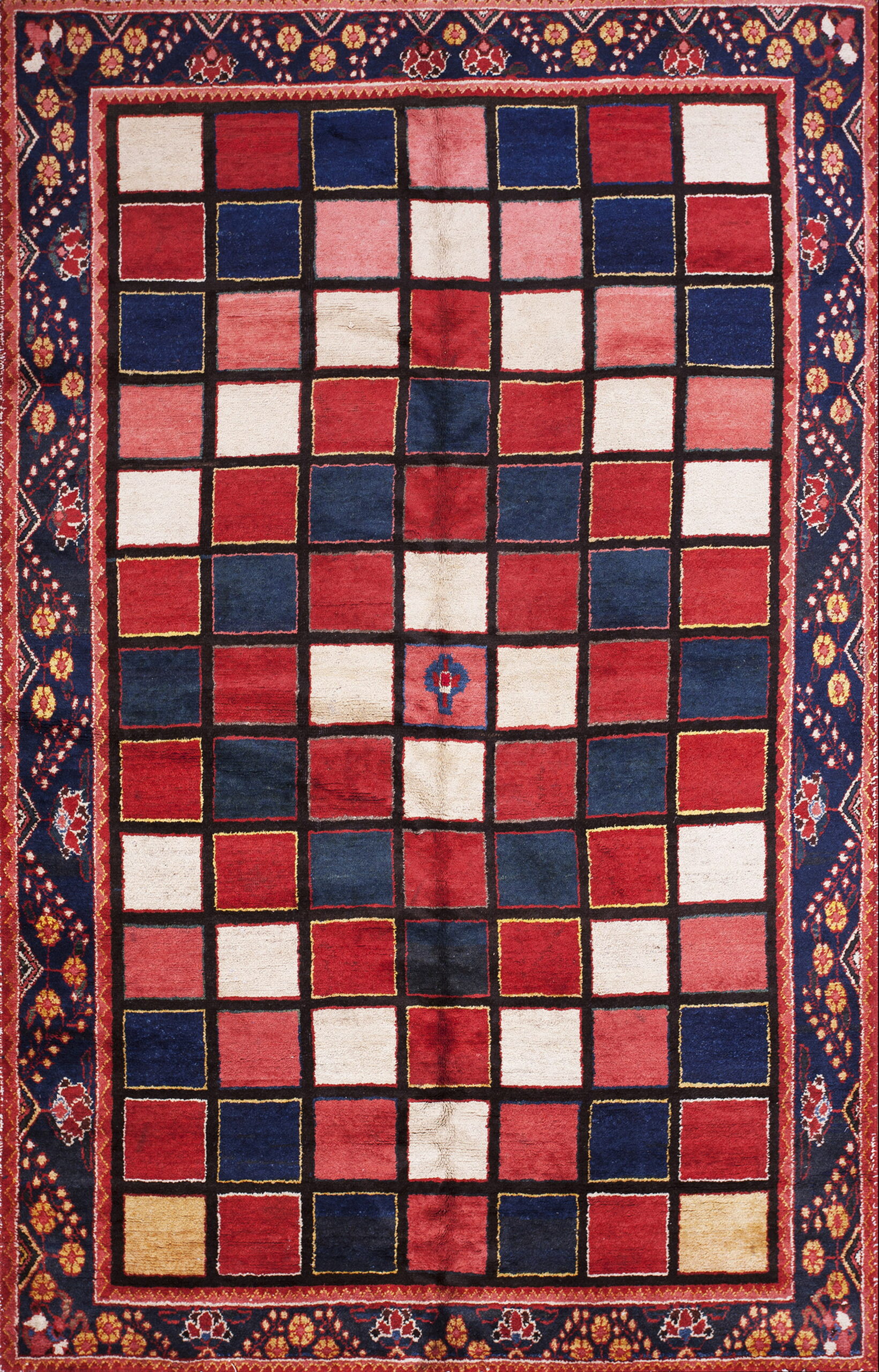
Gabbeh, Qashqai, Khamseh and Luri: who wove what
The four names are not four constructions. They are one weaving region, split by tribal politics and by what the trade decided to call things.
Qashqai
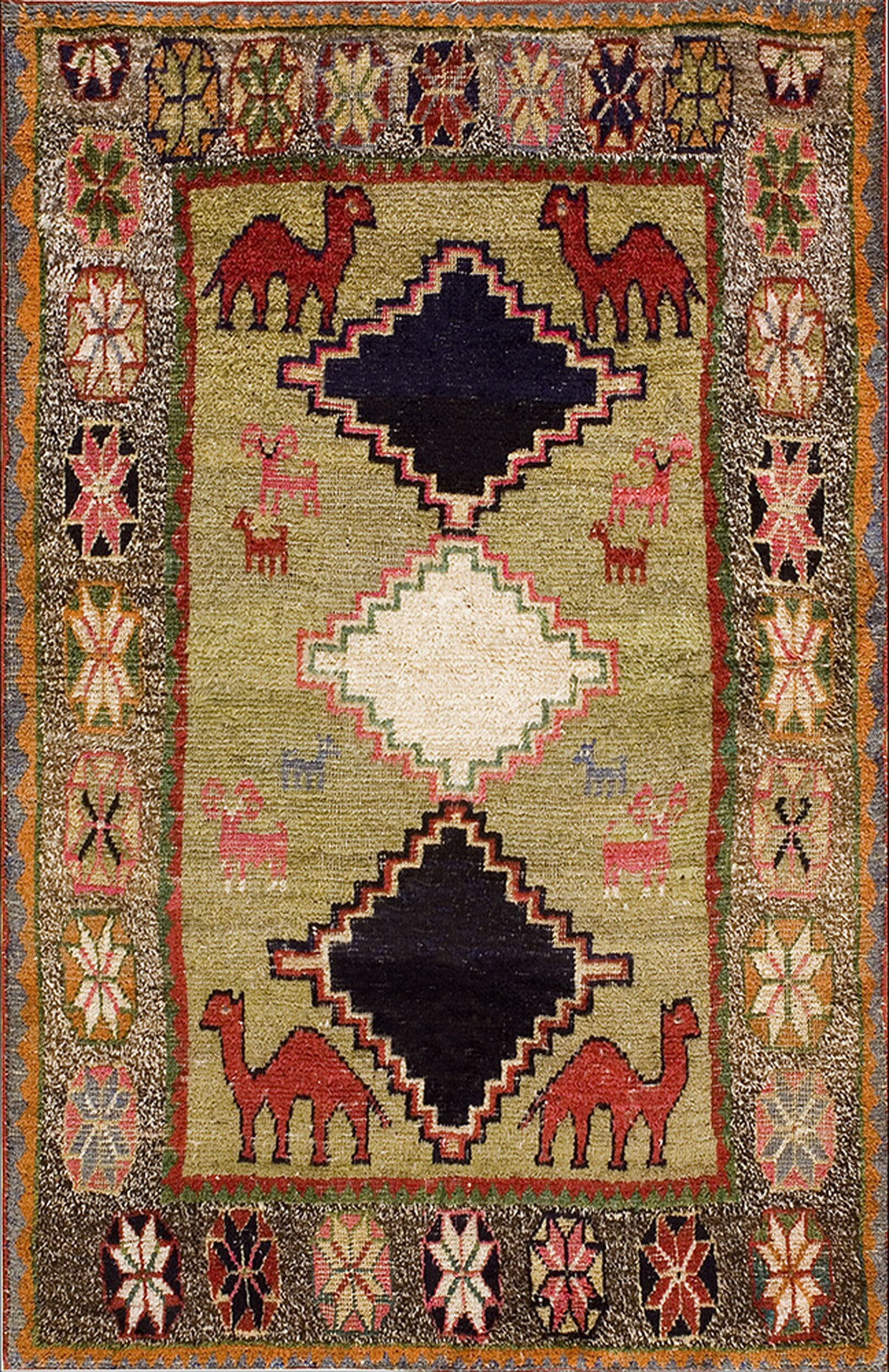
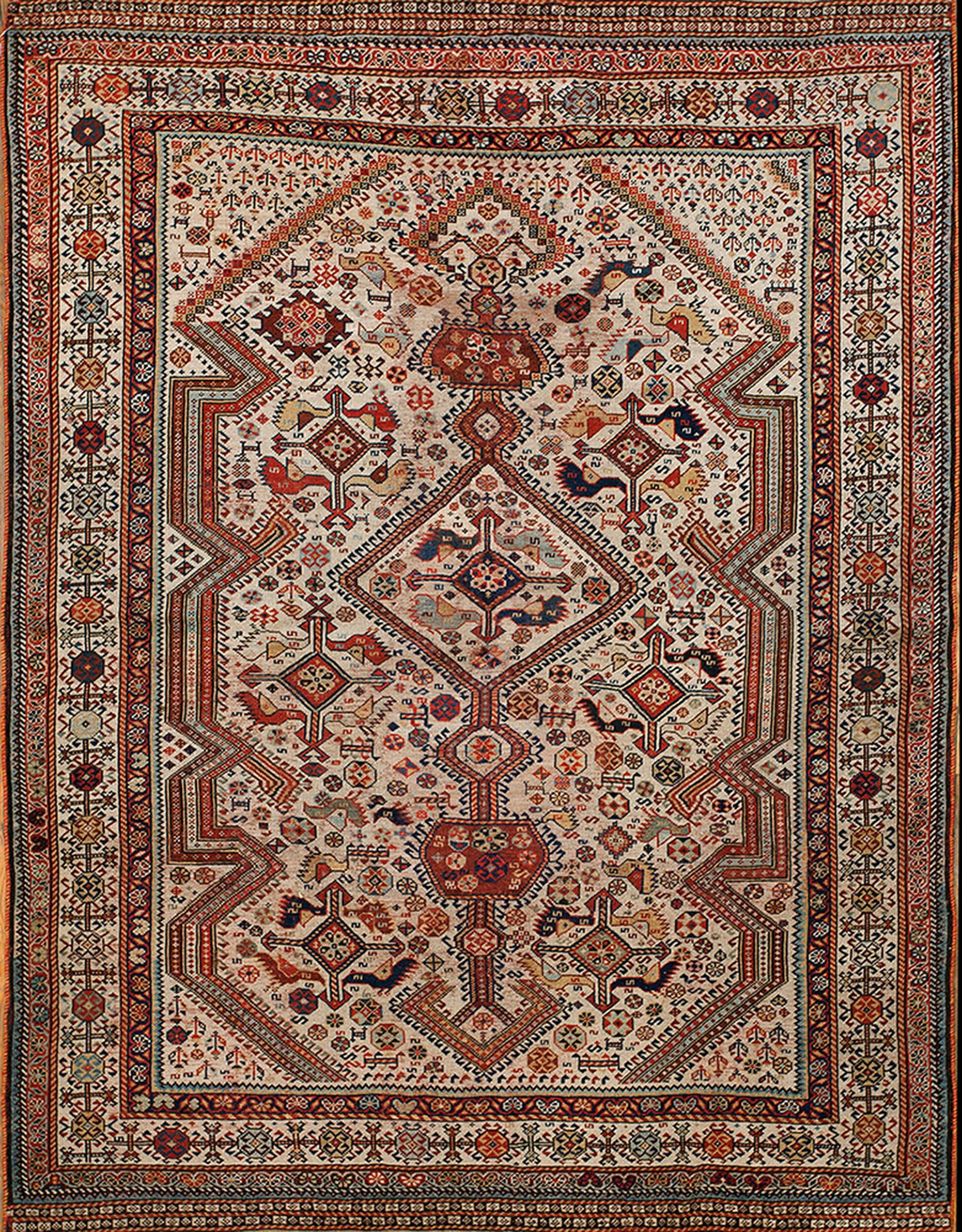
The Qashqai are a Turkic speaking confederation whose summer and winter pastures run through Fars province around Shiraz. Their knotted rugs are the finest drawing in this family, usually a field of stacked or linked medallions with the space between filled by small animals, birds and rosettes. We hold 4, two knotted and two flat woven, from $5,900 to $14,300. The name is spelled a dozen ways and our own catalogue uses two of them, Qashqai and Ghashgaie, which is worth knowing if you search by name. All four now have their own archive, Qashqai rugs, and the two flat woven ones also appear under flat woven kilims.
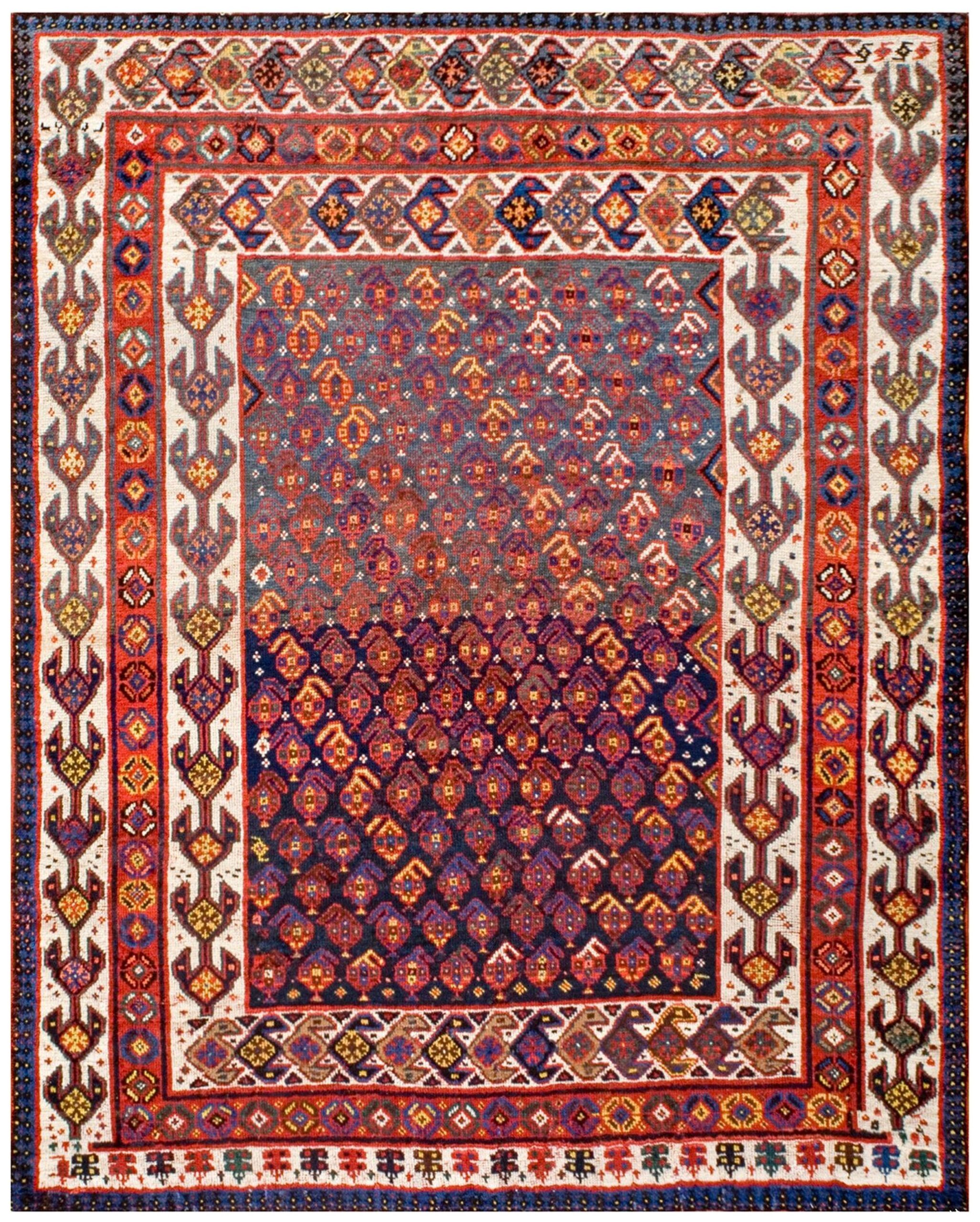
Khamseh
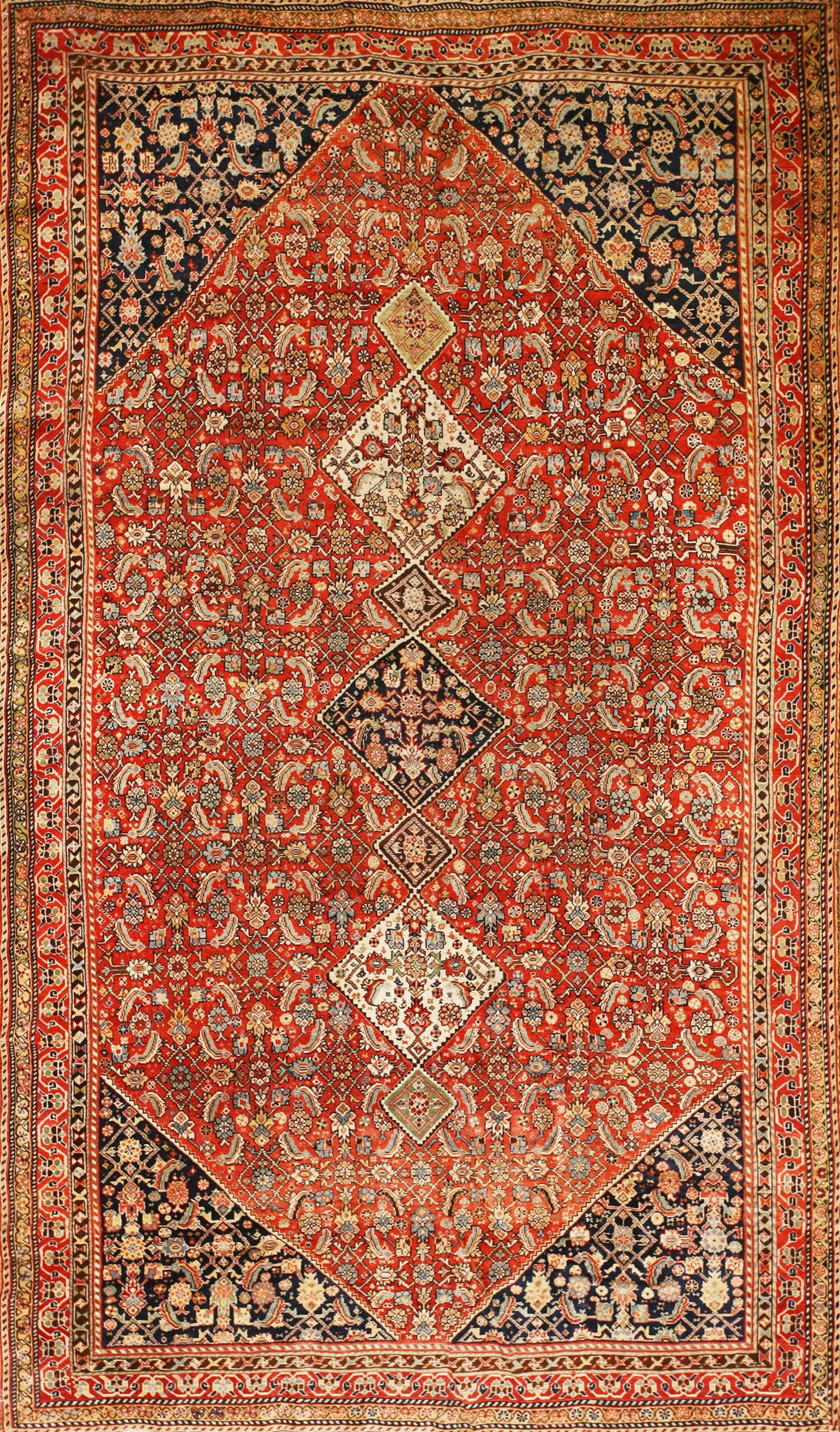
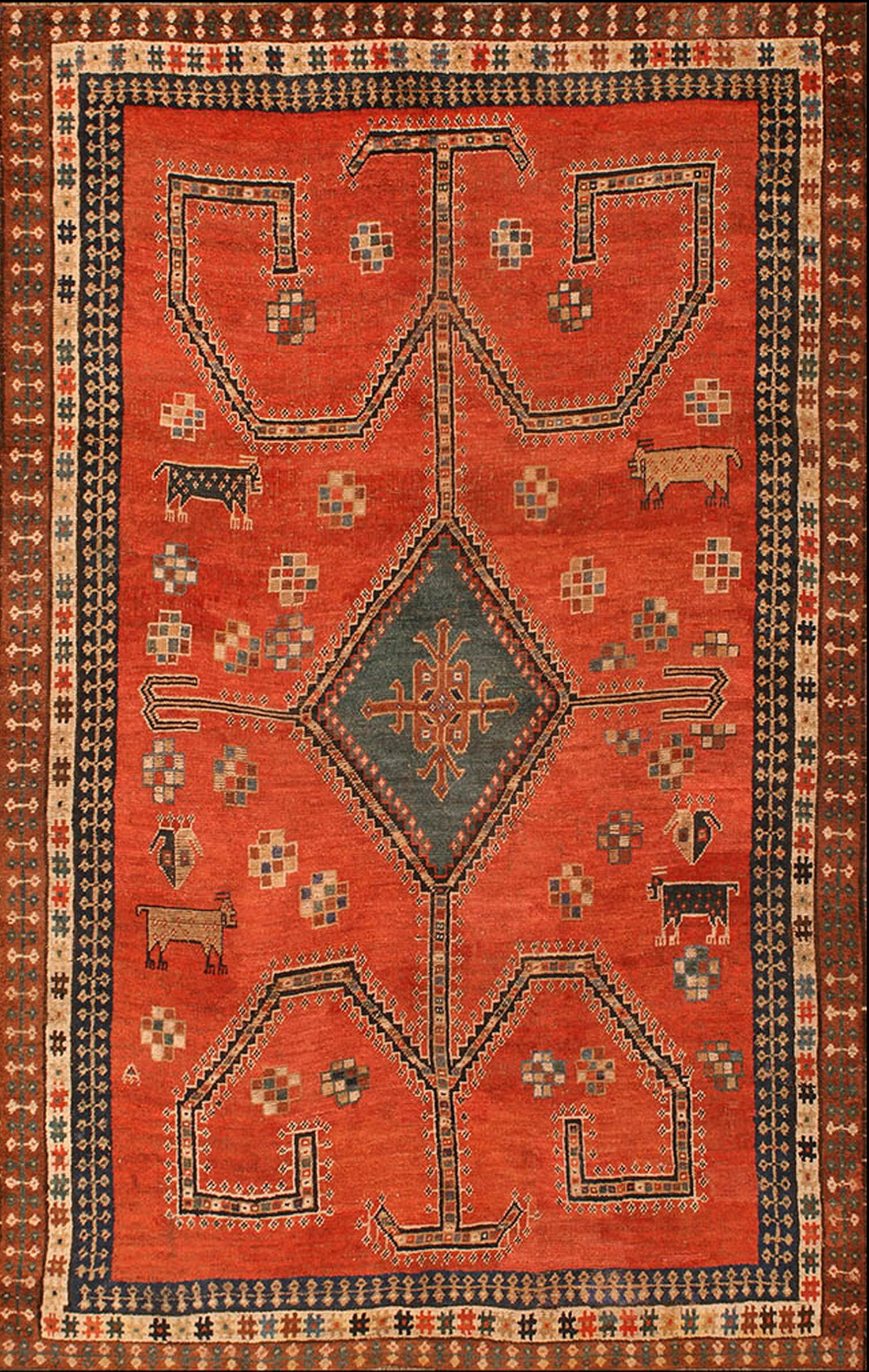
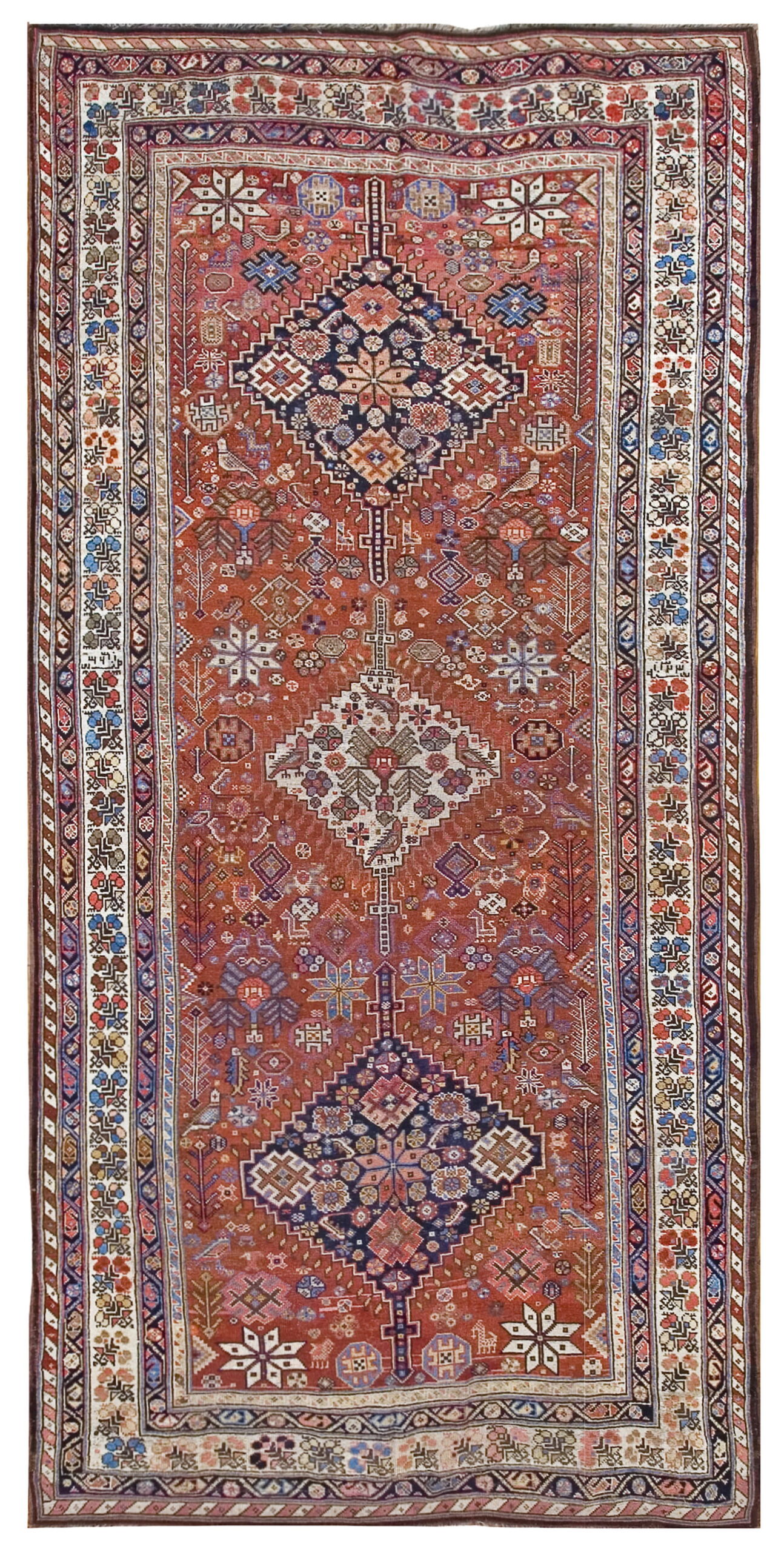
The Khamseh, meaning five, was a confederation of five tribes assembled in the 1860s in the same province, partly as a counterweight to the Qashqai. Their rugs are the oldest things in this family on our floor: 6 of 9 carry a 19th century date. The drawing to look for is a column of large stepped or hooked diamond medallions, as on the rust red Khamseh with three stacked diamonds and on the navy gallery piece. Browse them on the Khamse rugs archive, which the site spells without the h.
One thing the archive description gets wrong is worth correcting in public, because it is the sort of claim that gets repeated. It calls Khamseh rugs famous for bird motifs. Bird figures are indeed a documented Khamseh habit, but of our 9 exactly 1 carries our bird design tag, and the palette it names first, chocolate brown, appears on none of them. What they actually are is blue and red: four blue, two red or rust, two ivory, one coral.
Gabbeh
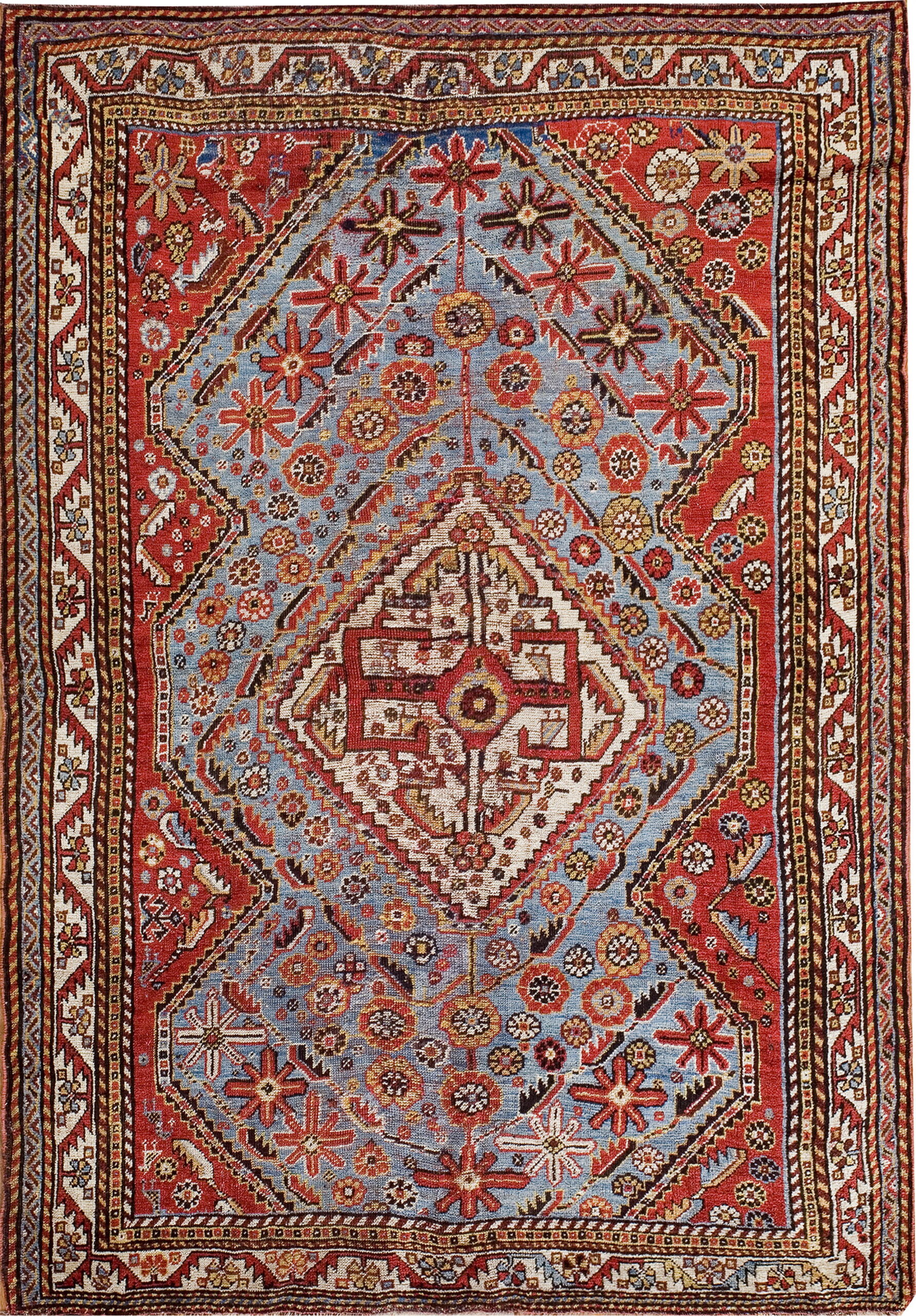
Gabbeh is the Persian word for raw or unclipped, and it names the coarse long pile rugs the Qashqai and Luri wove for their own tents and houses rather than for sale. That origin story is the trade account and it is plausible, but our records cannot confirm it piece by piece, so treat it as background rather than as provenance. What is on our floor is 13 rugs from $3,000 to $7,500, median $5,900, median size 37 square feet, and all but 2 of them dated circa 1920 or 1930. The Gabbeh rugs archive also carries later and contemporary pieces, so filter to antique rugs if you only want the old ones.
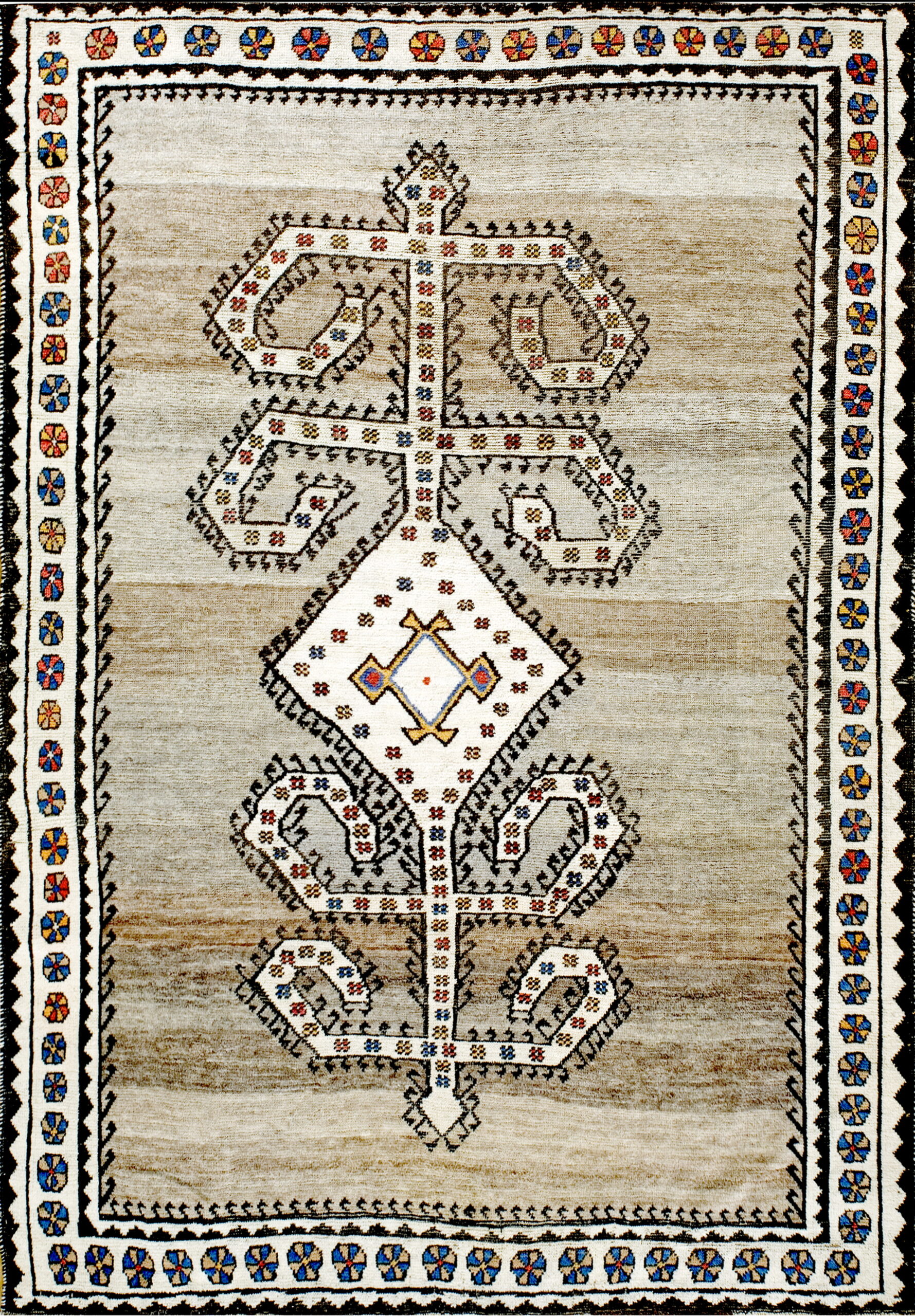
Luri
The Luri or Lur are the tribes of Luristan, west of Fars, and their weaving sits between Gabbeh coarseness and Bakhtiari structure. We hold exactly one antique Persian Luri, a 1900s indigo piece at $3,600, and it carries Bakhtiari as a second type value, which is honest about how blurred the boundary is. A warning for anyone searching: four more rugs in our catalogue match the letters luri or lori and none of them is Persian. They are Lori Pambak Kazaks from the Caucasus, named after two valleys in Armenia, and they belong with the antique Caucasian rugs.
How to tell them apart on the floor
Four things separate this family from the city workshop carpets most people have seen, and they are all visible without turning the rug over.
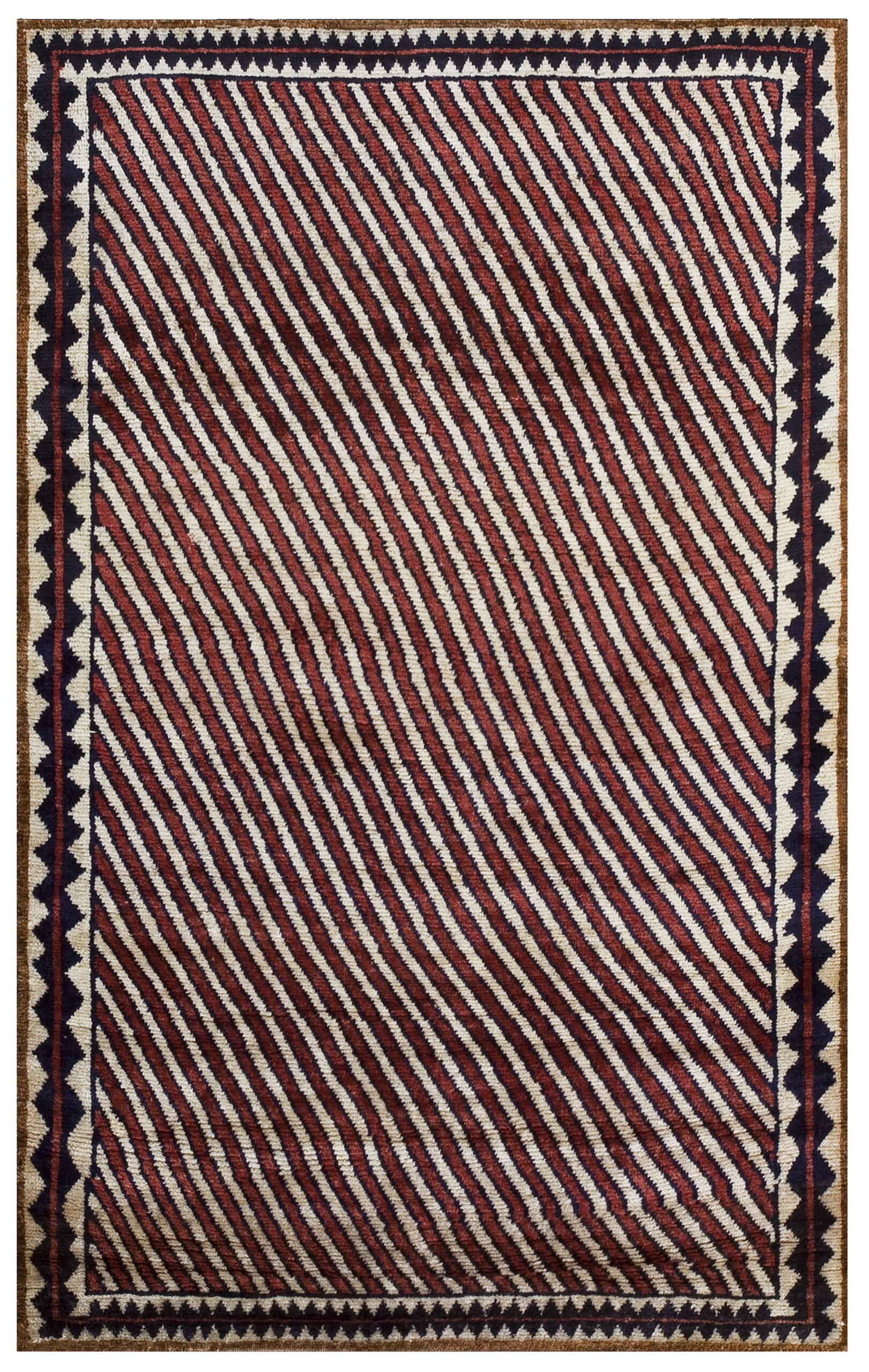
- The drawing is built, not drawn. Diamonds, bars, hooks and blocks, assembled from memory rather than copied from a paper cartoon, so the two ends of a border often resolve differently.
- There is no curved floral detail. Not one of our 26 carries the floral value that sits on 49.0% of the rest of the collection.
- Colour arrives in bands. Abrash, the horizontal shift that appears when a new batch of handspun yarn enters the weaving, is common here and is a sign of small batch natural dyeing rather than a fault.
- The format is small. A room size south Persian tribal rug exists but is unusual, and an oversized one is not something we currently hold at all.
What does not separate them is the word tribal, which our own catalogue applies to 997 rugs, and the word nomadic, which appears in exactly 3 of 4,873 antique titles. All 3 of those are in this group, which tells you more about our cataloguing habits than about the looms.
The checkerboard, measured
The one design cluster that genuinely identifies this group is the grid. 6 of our 26 carry the checkerboard and checkered design value, 23.1% of the group against 0.5% of everything else, a rate 48.63 times the catalogue norm. Counting titles instead of tags makes it starker: 10 rugs in the whole antique collection have checkerboard or checkered in the title, 6 of them are these Gabbehs and the remaining 4 are American hooked rugs and a quilt. Every Persian checkerboard rug we own is a Gabbeh.
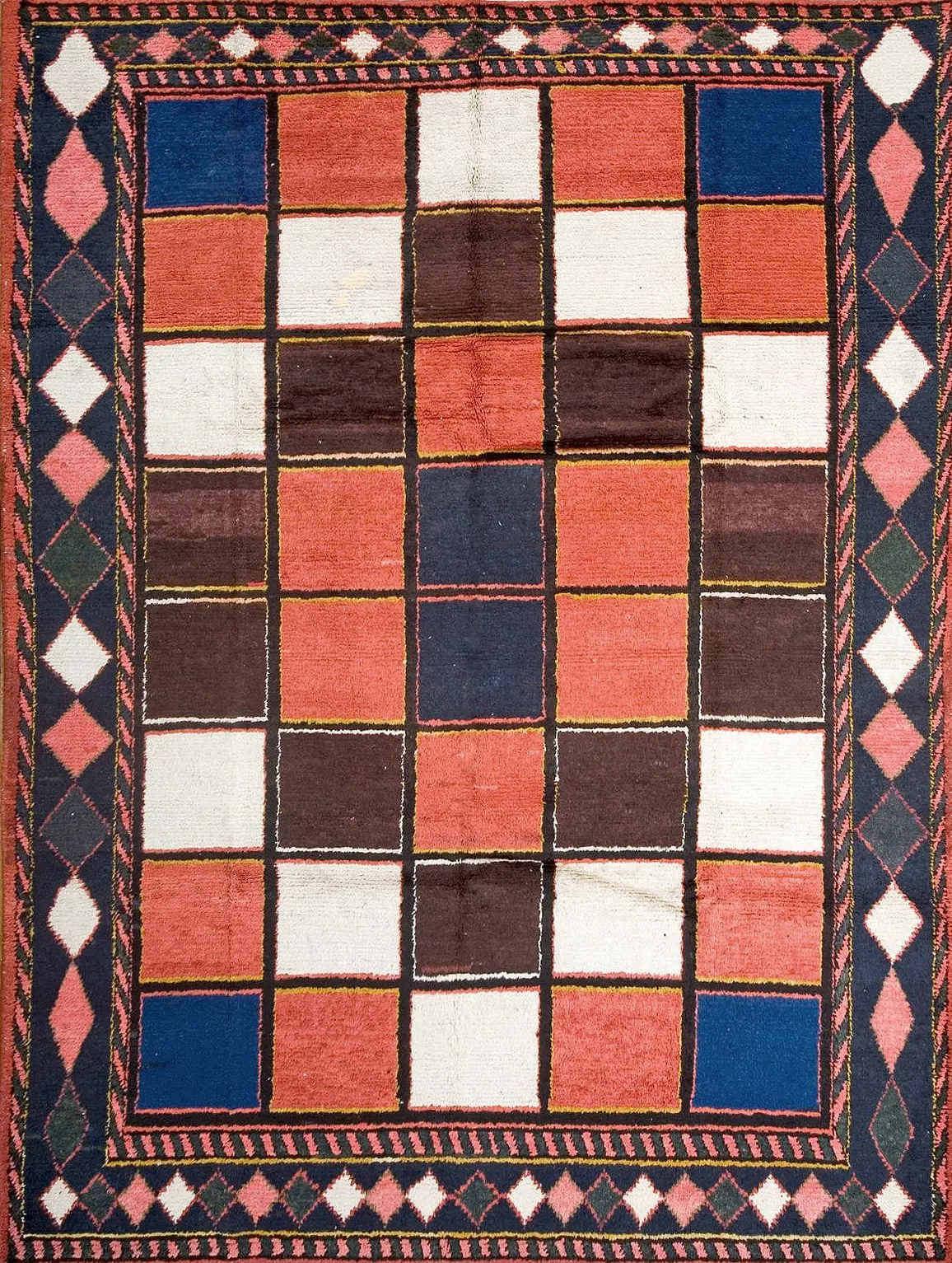
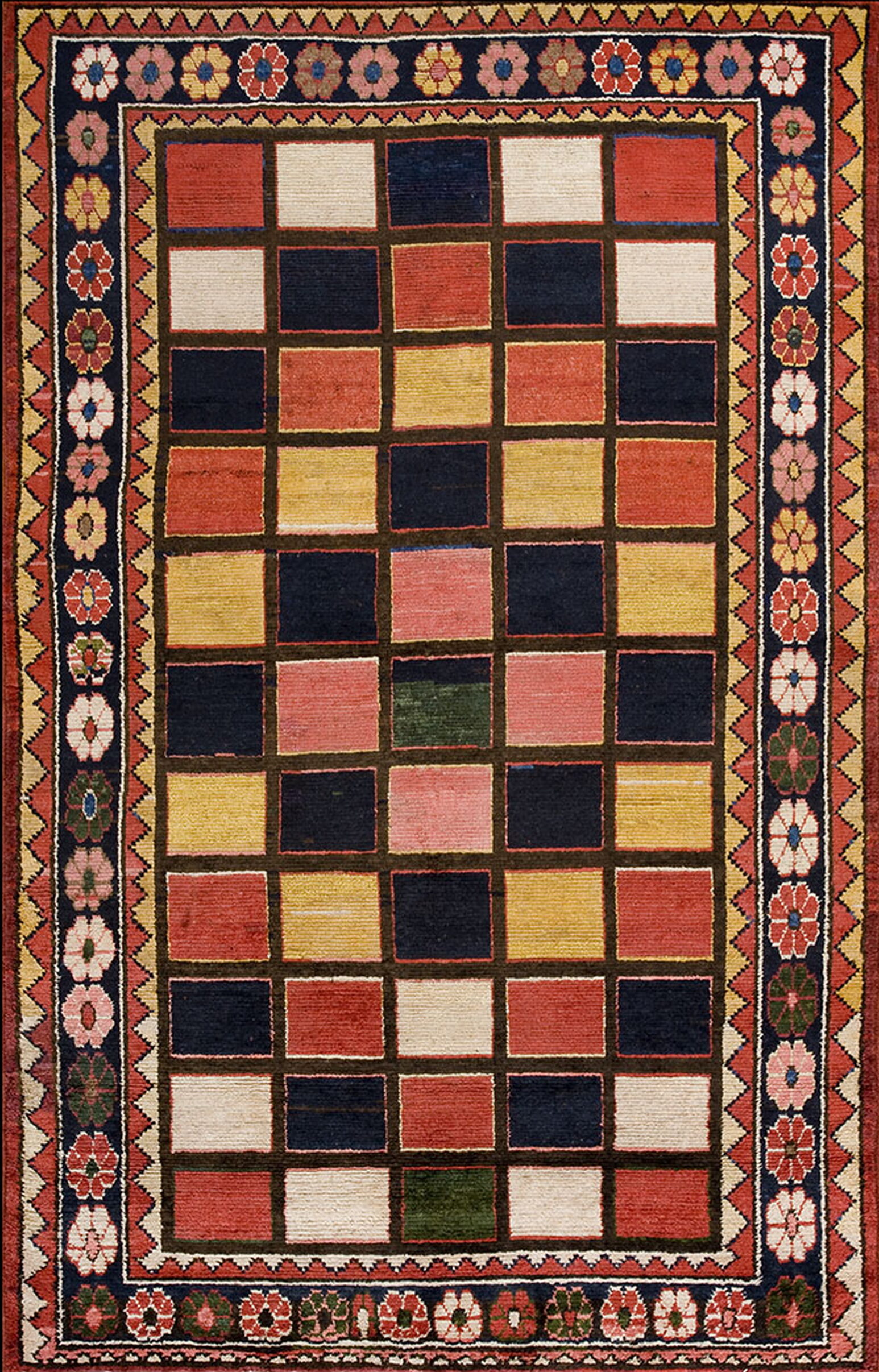
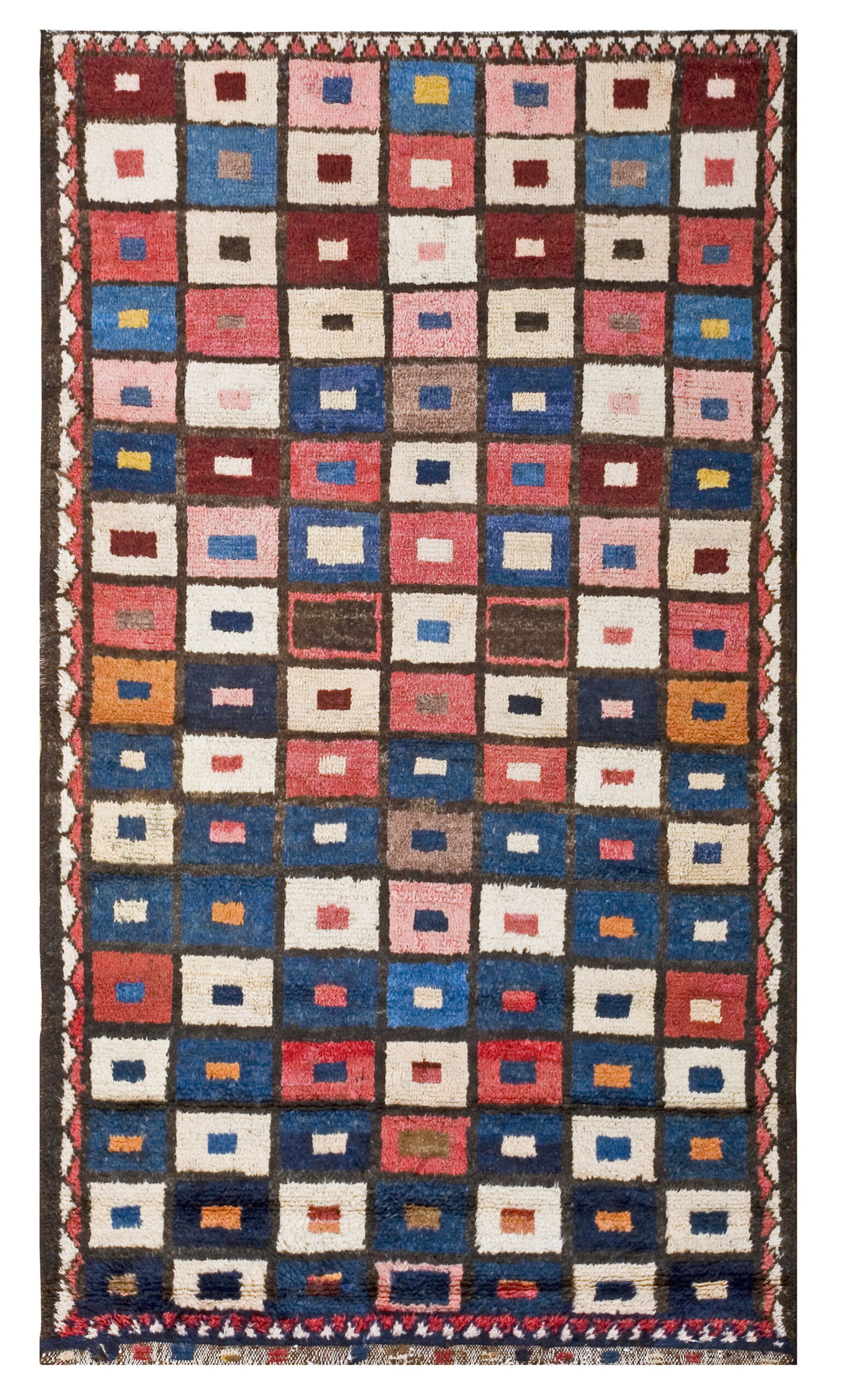
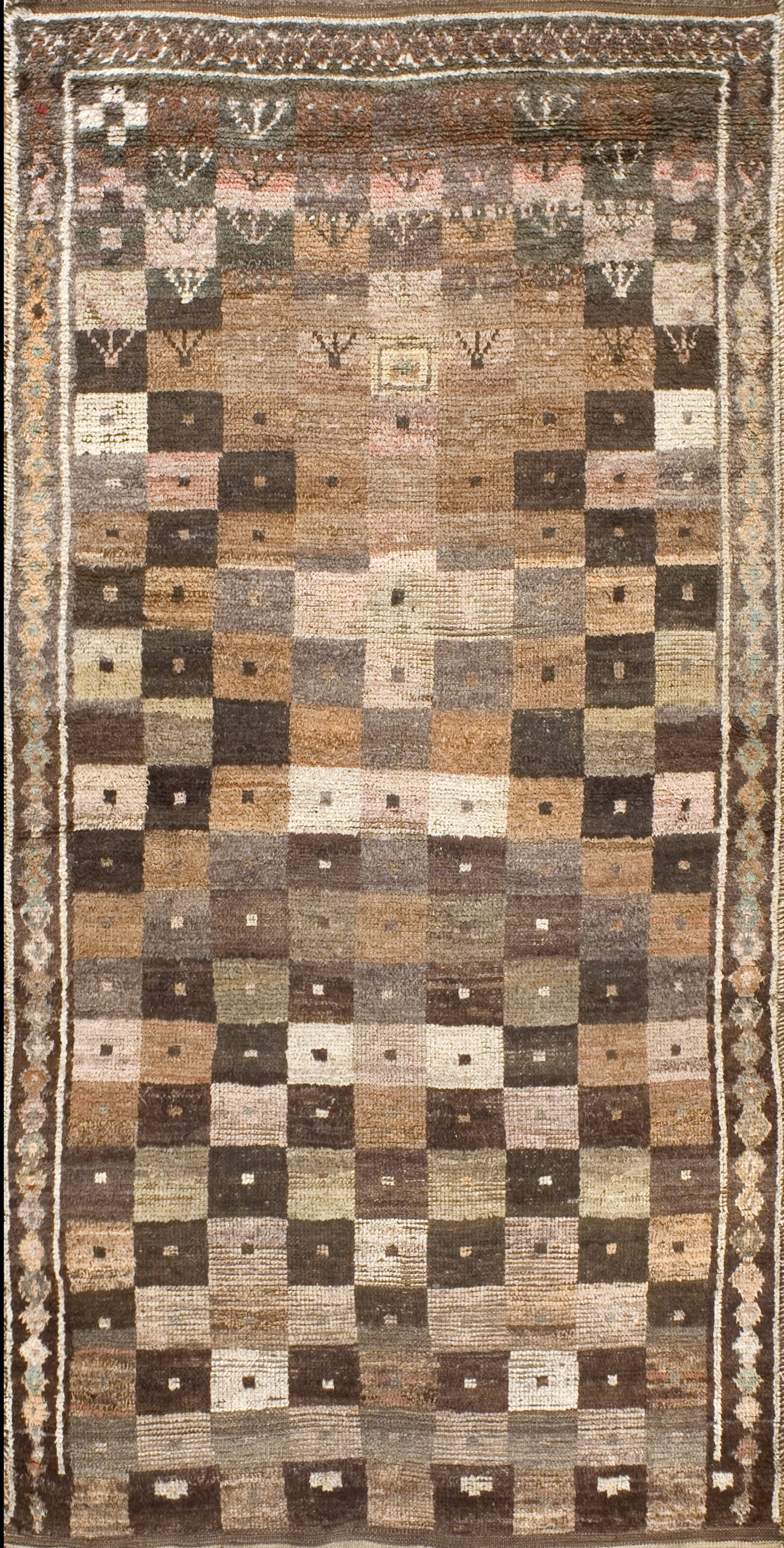
This is also where the archive copy for Gabbeh rugs is worth reading sceptically. It describes minimalist designs and large expanses of variegated colour. Across our 13 antique Gabbehs, 0 carry the solid or open field value that would record exactly that, while 6 of the titles say checkerboard. Minimal is what the type is famous for abroad. Dense grids are what we actually have.
Animals, camels and other small figures
Figures are the other thing buyers come for. 2 of the group carry our animal design value, 3.21 times the catalogue rate, and one of them is also 1 of only 4 rugs in the entire collection tagged with the camel design. If you want the wider story of that motif, the legacy camels design page covers it across cultures.
Sizes: what this family actually comes in
Our size field is not reliable here, so every number in this section is computed from the measured inches on each rug. The field disagrees with itself inside these 26 rugs: a 36 square foot Qashqai is tagged room size while a 46 square foot Gabbeh and a 45 square foot Khamseh are tagged small scatter.
| Measured area | This family | Rest of our antique stock |
|---|---|---|
| Under 50 square feet | 18 of 26 | 44.3% |
| Over 100 square feet | 1 of 26 | 35.9% |
| Carries our oversized value | 0 of 26 | 9.7% |
| Median area | 40 square feet | 61 square feet |
| Median long side | 8.5 feet | 10.0 feet |
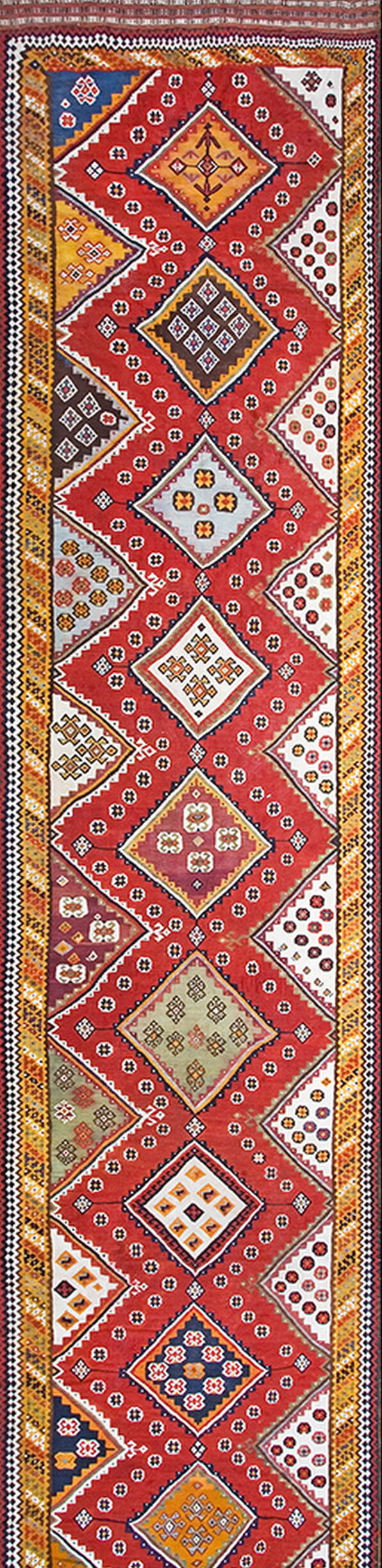
The commonest formats are the ones a tribal loom and a tribal household needed: 4 by 6, 5 by 7, 5 by 8 and 6 by 9, which between them account for 15 of the 26. At the extremes we have a 19 by 27 inch Khamseh mat at $700 and a Qashqai kilim runner over 40 feet long at $14,300, which is the only piece in the group over 100 square feet and sits on the 3 by 20 and longer archive. For a hall, the two wide gallery Khamsehs and that kilim are the realistic options.
The narrow loom argument, tested and dropped
The usual explanation for small tribal rugs is the portable loom: a loom that travels has to be narrow, so the rugs are narrow. Our data does not support it, and this is the second type guide in the series to drop the claim after measuring it.
Raw, it looks convincing. Median width across the group is 59 inches against 74 for the rest, 4 of 26 exceed 6 feet wide against 50.3% of the others, and 0 of 26 exceed 8 feet wide against 38.7%. But these are small rugs, and small rugs are narrow whoever wove them. Comparing like with like, among rugs under 80 square feet the group median width is 59 inches against 48 for the rest, and 3 of 24 exceed 6 feet wide against 15.0%. Size for size they are not narrower than anything else we hold.
What remains true, and useful, is the ceiling. Nothing in this family is wider than 7ft 8in, and that is a real constraint when you are shopping for a wide room. Why it is true we cannot show from our own records, so we do not claim it.
Prices, and what the headline discount really is
The group median is $5,900 against $9,000 across the rest of our antique stock, which reads as a 0.66x discount. By the square foot it is $129 against $153, or 0.84x. Both of those compare rugs of very different sizes and ages, so neither is the answer.
| Measured area | This family, median per square foot | Rest of stock | Ratio | n |
|---|---|---|---|---|
| 10 to 30 sq ft | $129 | $180 | 0.72x | 6 against 1,029 |
| 15 to 40 sq ft | $140 | $183 | 0.76x | 11 against 1,228 |
| 20 to 45 sq ft | $140 | $180 | 0.78x | 13 against 1,155 |
| 25 to 50 sq ft | $140 | $178 | 0.79x | 15 against 1,063 |
| 30 to 60 sq ft | $140 | $171 | 0.82x | 13 against 1,018 |
| 40 to 80 sq ft | $128 | $153 | 0.84x | 11 against 972 |
| 60 to 100 sq ft | $104 | $139 | 0.75x | 6 against 698 |
Matched on area alone the discount is consistent, 0.72x to 0.84x across all 7 publishable cuts. Then add the date, because the rest of the collection charges 1.5 to 1.59 times as much per square foot for 19th century work at the same size, as the rest of stock column in the next table shows, and this family is 69.2% 20th century.
| Period and area | This family | Rest of stock | Ratio | n |
|---|---|---|---|---|
| 19th century, 20 to 45 sq ft | $165 | $222 | 0.74x | 4 against 428 |
| 19th century, 25 to 50 sq ft | $165 | $221 | 0.74x | 6 against 399 |
| 19th century, 30 to 60 sq ft | $173 | $219 | 0.79x | 5 against 376 |
| 19th century, 40 to 80 sq ft | $191 | $211 | 0.9x | 4 against 347 |
| 20th century, 10 to 30 sq ft | $130 | $156 | 0.83x | 5 against 711 |
| 20th century, 20 to 45 sq ft | $130 | $148 | 0.88x | 9 against 727 |
| 20th century, 25 to 50 sq ft | $129 | $146 | 0.88x | 9 against 664 |
| 20th century, 30 to 60 sq ft | $124 | $142 | 0.87x | 8 against 642 |
| 20th century, 40 to 80 sq ft | $111 | $133 | 0.83x | 7 against 625 |
| 20th century, 60 to 100 sq ft | $98 | $120 | 0.82x | 5 against 458 |
Matched on both, the discount mostly disappears: 0.74x to 0.9x on the 19th century cuts and 0.82x to 0.88x on the 20th century ones. South Persian tribal weaving is priced within about a tenth of the market, size for size and age for age. It looks cheap in a list because the rugs are small and mostly younger than the collection average, not because the weaving is discounted. The practical reading for a buyer: you are not paying a premium for the name, and you are not getting a bargain either.
Inside the group, price by area spreads 4.8 times over, from $63 a square foot on the navy gallery Khamseh to $303 on the 1890s red Khamseh, and the bigger the rug the less it costs by the foot. Per name, with the counts, because four of these samples are small:
| Name | In stock | Price range | Median | Median per sq ft | 19th century |
|---|---|---|---|---|---|
| Gabbeh | 13 | $3,000 to $7,500 | $5,900 | $129 | 1 of 13 |
| Khamseh | 9 | $700 to $14,300 | $5,900 | $156 | 6 of 9 |
| Qashqai | 4 | $5,900 to $14,300 | $6,050 | $127 | 2 of 4 |
| Luri | 1 | $3,600 to $3,600 | $3,600 | $130 | 0 of 1 |
Age: the Khamsehs are old, the Gabbehs are not
This is the sharpest internal split the series has measured inside one family. 6 of 9 Khamsehs carry a 19th century date, four of them circa 1890 and one circa 1880, while 1 of 13 Gabbehs does, and 11 of the 13 are circa 1920 or 1930. Across the group 8 of 26 are 19th century, against 32.9% of the rest of our antique stock.
That is partly a fact about survival and partly a fact about the market. Coarse pile rugs made for a weaver’s own floor were used until they failed, so the early ones are rare, while the Khamseh and Qashqai pieces that reached the western trade in the 19th century were bought as carpets and kept as carpets. If you want a genuinely 19th century south Persian tribal rug, you are shopping the Khamseh and Qashqai end of this page, not the Gabbeh end. A circa date on this site is an estimate from construction, dyes and design, not a document, and we treat a decade as the smallest honest unit.
Colour
The palette is where this family earns its reputation and also where our records quietly correct the folklore. Multicolour jewel tones run at 26.9% against 11.9%, 2.27 times the catalogue rate, which is what the checkerboard Gabbehs are doing. Coral and salmon run at 1.67x and red and rust at 1.38x. Blue is exactly at the catalogue rate, 1.0x, so indigo is normal here rather than characteristic.
The clear negative is ivory. Ivory, beige and cream sit on 2 of 26 rugs here, 7.7% against 29.1% of the rest, which is 0.26x. If you are furnishing a pale room, this is a saturated category and the two ivory pieces, the 1880s Khamseh and a small ivory Khamseh scatter, are most of what there is. Green is almost as scarce: one rug, the camel Gabbeh, and green is a difficult colour to get from natural dyes, which is part of why it is rare on any tribal rug.
What the word “tribal” means on this site
Tribal is the most used and least precise word in the rug trade, and our own catalogue is a good example of why. The tribal design value sits on 997 of our 4,873 in-stock antiques, 20.5% of the collection, and it spreads across 80 different type values. The largest blocks inside it are 117 Navajo weavings, 91 north west Persian rugs, 83 Turkish Oushaks and 69 Kurdish rugs. Only 13 of them are Gabbehs.
So the word marks a visual family, geometric drawing without a paper cartoon, and not a people. It is a good filter when you want that look and a bad basis for an attribution. 19 of the 26 rugs on this page have tribal in their titles, which is our description of the design, and as noted above the word nomadic appears in 3 titles in the whole collection. When you want to know who wove a rug, read the type value, the recorded origin, the structure and the description, in that order. The legacy geometric designs page is the better place to browse the look itself.
Where this family sits next to the rest of Persian weaving
If you are choosing between tribal groups rather than inside one, the comparison that matters is format and price by area. All of these numbers come from the same pull as the rest of the page.
| Group | What it is good for | Where to read more |
|---|---|---|
| Gabbeh, Qashqai, Khamseh, Luri | Small saturated geometric rugs, 4 by 6 to 6 by 9, nothing oversized | This page, and the Gabbeh and Khamse archives |
| Afshar | The same region further east, scatter sizes, boteh and coral, no room sizes | Antique Afshar rugs guide |
| Bakhtiari | The large format tribal answer, garden compartment designs, nearly 40% are 12 by 15 or bigger | Antique Bakhtiari rugs guide |
| Baluch | The cheapest way into tribal weaving, small dark prayer rugs and bag faces | Antique Baluch rugs guide |
| Kurdish | North west Persia, runners and long narrow formats, stronger wool | Antique Kurdish rugs guide |
| Caucasian, including Lori Pambak | Bolder scale, ivory grounds, medallion rugs from the mountains north of Persia | Antique Caucasian rugs guide |
| Flat woven kilims | No pile, lighter, usually cheaper by the foot, including the Qashqai pieces here | Antique kilim rugs guide |
For the wider context, the antique Persian rugs guide covers how the city, village and tribal traditions relate, and the legacy rugs of Persia and Iran page is the long historical read.
What to check before you buy, including on us
Three of these checks apply to any dealer. The fourth is about reading our own records, which contradict themselves often enough that it is worth saying out loud.
- Measure it yourself. Ask for the width and the length in inches at both ends. Tribal rugs are rarely true rectangles, and a rug described as square frequently is not. One of ours is a case in point: a Khamseh titled Square measures 19 by 27 inches, a ratio of 1.42, and our shape field repeats the error.
- Read the pile from the photographs, not the label. Our pile field has two values for the whole collection, so it cannot tell you how long a Gabbeh pile is. Ask for a raking light or side on photograph.
- Treat a stacked attribution as uncertainty. When a title carries two or three tribal names at once, as our Qashqai or Khamseh piece honestly does, it means nobody can settle it from the rug. That is normal and it is not a defect, but it should be priced and described as what it is.
- Ask what the circa date rests on. One rug in this group, that same Qashqai or Khamseh, says late 19th century in its own description and carries no date value at all in our filters, so it will not appear when you browse by 19th century. We are fixing records like that as we find them.
One thing we will not give you is a knot count. Nothing in our records holds a measured knot density for any rug in this family, and a tribal rug is exactly where fineness and quality come apart, so a number invented for a listing would be worse than no number at all.
The rest of what we hold today
Sixteen of the 26 rugs are pictured above. The others are a coral Gabbeh in a 4 by 10 format at $5,900, a blue Gabbeh with serrated diamonds at $3,600, a grid field Gabbeh in jewel tones at $5,200, a diamond lattice Gabbeh scatter at $3,600, a brown Qashqai kilim at $5,900, the navy and ivory Qashqai or Khamseh at $5,900, a coral Khamseh with three stacked diamonds at $8,500, and a small ivory Khamseh at $1,200. Everything is wool, every piece is Persian, and the knotted ones sit on the hand knotted pile archive while the two Qashqai kilims sit on flat weave. For the small formats specifically, the small scatter size and long and narrow archives are the quickest way to browse, and wool rugs covers the material.
If you like this look but need a bigger rug, the Bakhtiari and Afshar archives are the nearest neighbours, and the geometric and striped archives will show you the same drawing on other weaves, pile and flat woven alike.
Frequently asked questions
What is a Gabbeh rug?
A Gabbeh is a hand knotted wool rug from the Zagros mountains of south west Persia, woven with a long coarse pile and a drawing that is built from blocks, bars and simple figures rather than from curved floral detail. The weavers are the Qashqai and Luri tribes of Fars and Luristan. The word is used in the trade for the look as much as for the origin, so always check where a rug is actually recorded as coming from.
What is the difference between a Gabbeh, a Qashqai and a Khamseh rug?
They come from the same corner of Persia and overlap in technique, so the difference is one of attribution rather than construction. Qashqai and Khamseh are tribal confederations around Shiraz in Fars province, and their rugs are usually finer in the drawing, with stacked diamond medallions and small filler figures. Gabbeh names the coarse long pile weaving those same groups made for their own use. In our stock the Gabbehs are mostly 1920s and 1930s and the Khamsehs mostly 19th century, which is why the two read so differently on the floor.
How much do antique Gabbeh and south Persian tribal rugs cost?
Ours run from $700 to $14,300, with a median of $5,900. By area that is $129 a square foot against $153 across the other 4,847 antique rugs we hold. The headline looks like a 0.66x discount, but most of that is format and date: matched on measured area and on period the group prices within about a tenth of the market.
Are Gabbeh rugs valuable?
They are mid market antiques rather than investment carpets, and the numbers are steady rather than dramatic. Our 13 antique Gabbehs run $3,000 to $7,500 at a median of $5,900 and $129 a square foot. The dearest rug in the whole family is not a Gabbeh at all: it is a 19th century Khamseh at $14,300.
What sizes do antique Gabbeh rugs come in?
Small ones. The median across the 26 is 40 square feet against 61 for the rest of our antique stock, 18 of 26 are under 50 square feet, and the widest piece in the group measures 92 inches across. Nothing in the group carries our oversized value, against 9.7% of the rest, so if you need a 10 by 14 this is the wrong category to shop.
Is a Gabbeh rug thick?
Longer in the pile than a city carpet, yes, and that is part of what the name means. But our records cannot prove it rug by rug: the pile field on this site has only two values, and all 13 of our Gabbehs carry the same one that most pile rugs carry. Judge the depth from the photographs and from the handle of the particular rug, not from a label, and ask for a side view if it matters to you.
What do the animals and the checkerboards mean?
The animals are usually read as the weaver’s own flock and surroundings, drawn from memory: camels, horses, birds and dogs reduced to a few blocks of colour. The grid and checkerboard fields are a compositional habit rather than a symbol. What we can measure is how distinctive they are here: 6 of the 10 rugs in our entire antique collection whose titles say checkerboard or checkered are these Gabbehs, and the other 4 are American folk pieces.
Are these rugs flat woven or knotted?
Mostly knotted. 24 of 26 are hand knotted pile and 2 are flat woven, both of those being Qashqai kilims, including a runner just over 40 feet long. The same tribes wove in both techniques, so the weave does not settle the attribution and the attribution does not predict the weave.
Will a Gabbeh work in a busy hallway or kitchen?
All 26 carry our high traffic value, and a long pile wool rug on a handspun wool foundation is genuinely hard wearing. The practical limits are size and shape rather than durability: most of these are 4 by 6 to 6 by 9 pieces, so in a hall you are looking at the two gallery width Khamsehs or the long Qashqai kilim rather than at a Gabbeh.
Why does our own catalogue call 992 rugs tribal?
Because tribal in the rug trade describes a look: geometric drawing, village or nomadic workmanship, no cartoon on paper. Our Designs field applies it to 997 in-stock antiques, 20.5% of the collection, spread across 80 different type values from Navajo to Oushak. It is a useful filter and a poor attribution. If you want to know who wove a rug, read the type, the origin and the structure, not the word tribal.
Measurements, dates and prices on this page were read from our live catalogue on 8 November 2026. If a rug has sold by the time you read it, the archives linked through the page show what has taken its place, and we are happy to say what a particular piece is if you send a photograph of the back and the two measurements.