
A Bakshaish is a hand knotted wool carpet from the village of Bakshaish in the Heriz district of northwest Iran, and it is the oldest and loosest member of that regional family. Where a Heriz is firm, centred and built for the late Victorian export trade, a Bakshaish is drawn large, left open, and dated a generation earlier. Collectors buy them for exactly that: a carpet the size of a dining room with the drawing of a village rug.
Every number on this page is measured from the antique rugs we hold in stock today, not from the literature: 44 Bakshaish carpets on our Bakshaish archive, compared against the other 4,830 antique rugs in the collection. For the history of the village, the etymology of the name and the auction record, read our longer Bakshaish history page. This page is about what they look like, what sizes they come in, and what they cost.
Key takeaways
- We hold 44 antique Bakshaish carpets, every one of them wool, hand knotted pile and recorded as Persian.
- 43 of 44 carry a nineteenth century date against 32.3% of the rest of our antique stock. This is the oldest group of its size on the floor.
- Prices run $3,300 to $162,500, median $23,400. That is $257 a square foot against $152 across the collection.
- The premium is not one number. Matched on area and on century, the small ones run 0.64x to 1.0x, at or under the market, and the large ones 1.2x to 2.08x above it.
- They come long rather than small: median long side 14.2 feet against 10.0, 68.2% over 12 feet, and only 4 small scatters in the whole group.
- The drawing is geometric and almost never floral: 79.5% carry our geometric value against 38.2%, and the floral value appears on 6 of 44 against 49.0%.

One weave, five spellings, and a catalogue split down the middle
Bakshaish reaches English through Persian, so there is no correct spelling, only habits. The trade writes Bakshaish, Bakshaiesh, Bakhshaiesh, Bakshayesh and Baksheesh, and dealers who have handled the same carpet will spell it two ways in one conversation. Our own catalogue is split: 36 rugs say Bakshaish in the title and 4 say Bakshaiesh or Bakhshaiesh, with no rug carrying both. A buyer who types one spelling into a search box sees one half of the stock and has no way of knowing the other half exists.
This is worth saying out loud because it is not only our problem. Any dealer site, any auction archive and any price database keyed on the title will show you a fraction of what it holds. The fix is to browse the category rather than search the name: our Bakshaish archive carries all 44 regardless of how each one happens to be titled, along with later pieces that are not antique.

Two further quirks are worth knowing if you compare our pages against each other. 2 of the 44 are titled as Heriz Serapi carpets and carry both attributions, which is honest: the district boundary is a gradient and some carpets genuinely sit on it. Another 2 name no weave at all in the title and are identified only by their archive. Where a rug carries two names we have not picked one for you.
What the drawing actually looks like
The Bakshaish look is a few very large motifs with air around them. A Heriz fills its field; a Bakshaish leaves the ground visible and lets one shape dominate. Measured against the rest of our antique collection, the group is 2.08x as likely to carry our geometric pattern value (35 of 44) and only 0.28x as likely to carry floral (6 of 44, against 49.0% of everything else). 28 are drawn as an allover repeat rather than around a centre.
One received idea needs correcting, and it is a claim our own archive page makes, so we will correct it here. The description on that archive says Bakshaish designs typically feature large scale medallions. On our floor they typically do not. The medallion value appears on 11 of 44, which is 25.0% against 29.2% for the rest of our antiques: slightly below average, not characteristic. What is characteristic, when a medallion does appear, is that it floats on empty ground. 3 carry our open field medallion value at 2.17x our rate.

The plant drawings are the real signature
The distinctive thing about Bakshaish drawing is not the medallion, it is the garden. Our group is 5.17x as likely as the rest of the collection to carry one of the plant and garden design values, 17 of 44 against 7.5%, and on the rarest of those values the group owns a large share of everything we hold:
| Drawing | In this group | In our whole antique collection | Share |
|---|---|---|---|
| Shrub | 2 | 13 | 15.4% |
| Weeping willow | 2 | 15 | 13.3% |
| Garden compartment | 2 | 25 | 8.0% |
| Cypress tree | 2 | 47 | 4.3% |
| Herati or mahi fish | 8 | 127 | 6.3% |
| Trellis and lattice | 5 | 191 | 2.6% |
| Boteh paisley | 3 | 99 | 3.0% |
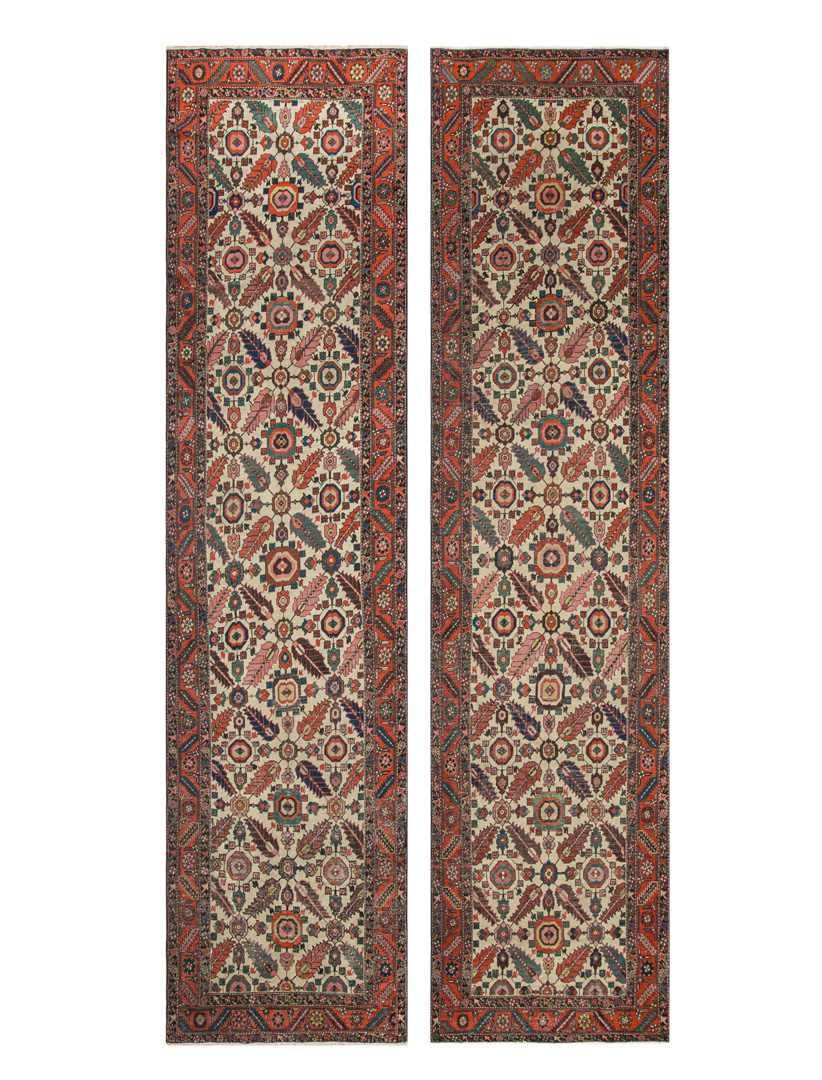
The share column is the one to read. This group is 0.9% of our antique stock, so on a plant drawing it should hold about one rug in a hundred. It holds 2 of the 13 shrub rugs we own, 2 of the 15 weeping willows and 2 of the 25 garden compartment carpets: between a sixth and a thirteenth of each, out of one percent of the stock. The 7.38x on the Herati fish pattern is the commercial counterpart. That small repeating diamond and leaf motif is the one classical Persian device these weavers used constantly, and in the photographs below you can see how large and loose they drew it, which is why it reads as geometry rather than as flowers.


Colour
Earth and ivory, not jewel tones. Ivory, beige and cream leads at 14 of 44, then blue at 11, red and rust at 9 and brown earth tone at 8. The two that mark the group out are the quiet ones: red and rust runs 2.47x our average and brown earth tone 2.77x. Blue and coral sit exactly at our collection average, which is itself worth knowing: the soft terracotta and camel grounds people associate with the name are common here but they are not unique to it.

Sizes: runners at one end, carpets at the other, little in between
The format distribution is the single most practical thing to know before you shop this weave. Bakshaish rugs come either long and narrow or large and square ish, and the middle of the range is thin. Median area is 110 square feet against 60 for the rest of our antiques, median long side 14.2 feet against 10.0, and the longest piece we hold measures 21.8 feet.
| Format | How many | Area | Price range | Median | Median per square foot |
|---|---|---|---|---|---|
| Scatter, under 45 sq ft | 4 | 12 to 32 sq ft | $3,600 to $23,400 | $8,450 | $399 |
| Hallway runner | 10 | 31 to 53 sq ft | $3,300 to $10,400 | $5,250 | $110 |
| Area, 59 to 108 sq ft | 8 | 59 to 108 sq ft | $11,100 to $58,500 | $25,350 | $349 |
| Room size, 112 to 177 sq ft | 14 | 112 to 177 sq ft | $12,800 to $97,500 | $32,850 | $230 |
| Oversized, over 200 sq ft | 8 | 221 to 353 sq ft | $37,500 to $162,500 | $87,750 | $304 |
Against our own collection the shape of that table is unusual in two directions at once. Switching from the tape to our own size tags, which is how the archives are browsed, the hallway runner value appears on 9 of 44, 2.67x our rate, and oversized on 8 at 1.9x, with wide gallery carpets at 2.35x. Meanwhile small scatters run at 0.26x, 4 rugs out of 44. If you want a 3 by 5 Bakshaish you will wait.
The long narrow end is the sharpest signal in the group. 5 of our 44 carry the 3 by 14 standard size, which is 5 of the 63 rugs at that size in our entire antique collection, and 11 carry the long and narrow shape value at 1.98x our rate. At the other end, 2 are 14 by 20 and 2 are 16 by 21 or larger. The common western sizes are the gap: only 3 are 9 by 12, against 12.1% of the rest of our stock, so if a 9 by 12 is what the room needs, expect to look at Heriz, Sultanabad and Mahal as well.
One argument we are deliberately not making: that these carpets prove an unusually wide village loom. It is the obvious story and the measurement does not support it. 45.5% of the group is wider than 8 feet against 38.4% of the rest, which is no difference at all. What is genuinely different is length: 68.2% over 12 feet against 30.0%, and 52.3% over 14 feet against 21.0%. These are long carpets, not wide ones.

What they cost, and why the premium depends on the size
The headline is easy and misleading. Our Bakshaish median is $23,400 against $8,800 for the other 4,830 antique rugs we hold, a 2.66x ratio, and per square foot $257 against $152, 1.69x. Both of those numbers mostly measure the fact that the group is old and large rather than that Bakshaish is dear.
Two things have to be held constant before a price ratio means anything. The first is size, because big rugs cost more in total and less per foot. The second is age, and it is the one almost nobody controls for. Across our whole collection, nineteenth century work costs between 1.5x and 1.69x per square foot at every size band we can measure, and this group is 97.7% nineteenth century against 32.3%. Compare a Bakshaish only against other antiques of the same measured area and the same century and the picture changes completely.
| Measured area | Bakshaish | Other 19th century antiques | Ratio | Per square foot | Sample |
|---|---|---|---|---|---|
| 20 to 45 sq ft | $7,200 | $7,200 | 1.0x | $209 against $222 | 6 and 423 |
| 25 to 55 sq ft | $5,900 | $7,800 | 0.76x | $142 against $220 | 10 and 441 |
| 40 to 80 sq ft | $7,200 | $11,300 | 0.64x | $154 against $212 | 11 and 337 |
| 60 to 100 sq ft | $23,750 | $16,300 | 1.46x | $338 against $198 | 6 and 235 |
| 80 to 130 sq ft | $24,700 | $19,500 | 1.27x | $237 against $181 | 9 and 266 |
| 100 to 160 sq ft | $26,350 | $21,900 | 1.2x | $214 against $172 | 12 and 257 |
| 120 to 200 sq ft | $37,700 | $26,000 | 1.45x | $247 against $173 | 10 and 243 |
| 150 to 260 sq ft | $71,500 | $34,450 | 2.08x | $323 against $179 | 7 and 220 |
| 200 to 400 sq ft | $87,750 | $48,000 | 1.83x | $304 against $178 | 8 and 161 |
Read down the ratio column. Below 80 square feet a Bakshaish costs the same as or less than a comparable nineteenth century rug, bottoming at 0.64x in the 40 to 80 square foot cut on 11 rugs. Above 60 square feet it costs more, and the premium grows with scale to 2.08x in the 150 to 260 cut. Per square foot the same pattern holds, which is the check that matters: a ratio that moves on price but not on price per foot is usually just a size difference in disguise.
That split is the single most useful fact on this page, and it is not what the literature on this weave would lead you to expect. The famous Bakshaish, the one that sets auction records, is a large nineteenth century carpet, and the market prices it accordingly. The runners and small rugs from the same village, in the same decades, by the same hands, carry no premium at all. Ours start at $3,300 and the cheapest per square foot is a 14 foot Herati runner at $67 a square foot, against $851 for a small geometric area rug measuring 4ft 7in by 6ft. That is 12.8 times, inside one weave, in one shop, on the same day.


A note on how to use the table above rather than the headline. If you are choosing between a Bakshaish and another antique at the same size, the honest comparison is within your own size band, against rugs of the same age. If you are comparing a Bakshaish runner to a new runner, you are not comparing like with like at all: read our guide to how rug age is determined first.
The oldest group of this size we hold
43 of 44 carry a nineteenth century date. For context, 32.3% of our other antique rugs do. The decade values cluster in a thirty year window: 10 in the 1870s, 21 in the 1880s and 8 in the 1890s.
That concentration is the whole story of the weave, and it is why a twentieth century Bakshaish is nearly a contradiction in terms. The village was drawn into the Tabriz export trade in the 1880s and 1890s, and the commercial grades that trade wanted were Heriz and Serapi: firmer, heavier, with a centred medallion and a full field, woven to standard western sizes. The old loose drawing did not survive the shift. When you see a carpet sold as Bakshaish that looks crisp and even, the question to ask is not whether it is a good rug but whether it is a Heriz.
Every date on this page, and on every antique rug page anywhere, is an estimate. Ages are read from the wool, the dye behaviour, the drawing conventions and the pattern of wear, and a careful estimate is good to a decade or two. We record them as circa for that reason. Be sceptical of any village carpet dated to the exact year unless the rug is actually inscribed.
Bakshaish, Heriz, Serapi and Serab: telling them apart
All four names come from one corner of northwest Iran, within a day of each other, and the trade treats them as four products. On the floor they separate quite cleanly once you know what to look at.
- Bakshaish. Earliest and loosest. Large motifs, visible empty ground, soft camel and ivory fields, drawing that drifts out of symmetry. Mostly 1870s to 1890s. 44 in stock, median $23,400.
- Heriz. The commercial standard of the district: firm, heavy, a big stepped medallion with corner spandrels and a full field, woven to western room sizes from the 1890s. If the symmetry is good, think Heriz.
- Serapi. The trade’s name for the finest and usually earliest grade of Heriz weaving rather than a separate village. Lighter handle, more delicate drawing, higher price. Our catalogue files it with Heriz on one combined archive.
- Serab. A different animal entirely despite the geography: camel ground, repeating pole medallions and almost always a runner or gallery carpet. If it is long, narrow and camel coloured with a column of medallions, start with Serab.

The overlap is real and we do not pretend otherwise. 2 of the 44 carry both attributions, and the Northwest Persian archive exists precisely for carpets from this region that no one can pin to a village. If a seller is certain to the village on a rug with no provenance, that certainty is the thing to question. Our longer Heriz history page and the rug glossary cover the district names in more depth.

What our records cannot tell you, and how to check it yourself
Three claims get made about Bakshaish rugs constantly, including on our own pages, and none of them is something a catalogue record can establish. Knowing which is which makes you a better buyer of any antique rug, not just this one.
Camel colour is not camel hair
7 of our 44 descriptions use the word camel, and every one of them is describing the colour of the ground. Our materials field reads wool on all 44, and the catalogue has no camel fibre value anywhere in its vocabulary, so a rug could not be recorded as camel hair even if it were. Undyed camel wool was genuinely used in northwest Persia, but it cannot be told from a lanolin rich natural sheep wool in a photograph. Ask for the back and the fringe, and handle it if you can.
The foundation is not in the record
What the warp and weft are made of is the most useful single identification test on a northwest Persian carpet, and we do not record it as a field: our materials value describes the pile. Exactly one of our 44 descriptions asserts a cotton foundation. So read it off the rug: fold it back, look at the fringe and the warp threads showing between the knot rows at the ends, and see whether they are cotton (dull white, slightly stiff) or wool (softer, often coloured). Our guide to rug foundations, warps and wefts walks through it, and the knots and knot count guide explains why knot density on a village carpet is a poor proxy for quality. We publish no knot count on these carpets, because we have not counted them.
Dyes are described, not tested
26 of our 44 descriptions mention natural or vegetable dyes. That is the reasonable expectation for a village carpet woven in the 1870s and 1880s, and it is not a laboratory result. What you can actually see is abrash, the horizontal banding where a weaver moved to a new batch of yarn, and the way natural dyes change hue with the light instead of staying flat. Both are visible in the photographs above. Our guide to natural and synthetic dyes shows what to look for, and the five minute appraiser checklist puts the whole set of tests in order.

Living with one
42 of 44 carry our high traffic durability value, and that is not marketing: a wool pile that has already survived 140 years is more forgiving than a new rug. Most of these carpets were made for rooms and corridors that were walked on daily. The sensible rules are the ordinary ones. Use a good pad. Rotate twice a year so one end does not take all the light and all the traffic. Keep an open ivory or camel field out of direct sun, because that is exactly where fading shows. Vacuum without a beater bar and in the direction of the pile. Have it professionally washed every few years rather than cleaned wet at home.
On condition, set your expectations at the age. At 140 years a carpet of this kind normally shows some low pile, old reweaving in the borders, a reduced end or a replaced selvedge. None of that is a fault to be discovered later; it belongs in the description and in the price. The 2 rugs in this group that carry our low traffic value are the ones where wear has gone far enough that we would hang them or put them in a quiet room. Ask which category a rug is in before you buy, and ask for photographs of the back and the ends.
Every antique Bakshaish we have in stock
All 44 carpets on the Bakshaish archive today, dearest first. Sizes are measured, not rounded to a standard. The per square foot column is the number to compare across rows.
$3,300 to $162,500, 33 distinct prices across 44 carpets. One row needs a footnote: the pair of runners is priced for both rugs, so its per foot figure is not comparable and it is excluded from every average on this page.
Frequently asked questions
What is a Bakshaish rug?
A Bakshaish is a hand knotted wool carpet from the village and district of Bakshaish in the Heriz region of northwest Iran, east of Tabriz. It is the oldest and most loosely drawn member of that regional family: large angular motifs, generous empty space, soft earth and ivory grounds, and a drawing that reads as invented rather than copied from a workshop cartoon. Almost all genuine examples date to the second half of the nineteenth century, because the village had largely stopped weaving this way by about 1900.
How do you spell Bakshaish, and does it matter?
It matters when you search. The name is transliterated from Persian so the trade writes it Bakshaish, Bakshaiesh, Bakhshaiesh, Bakshayesh and Baksheesh, and our own catalogue uses two of those spellings: 36 of our rugs say Bakshaish in the title and 4 say Bakshaiesh or Bakhshaiesh, with no overlap. Search one spelling and you see most of the stock; search the other and you see four rugs. Browse the archive instead of the search box and you get all 44.
How much does an antique Bakshaish rug cost?
Ours run $3,300 to $162,500 with a median of $23,400, which works out at $257 a square foot against $152 across the other 4,830 antique rugs we hold. The spread inside the one weave is the thing to understand: 49 times from the cheapest rug to the dearest, and 12.8 times per square foot. A Bakshaish hallway runner starts at $3,300. A room size carpet starts at $12,800 and an oversized one at $37,500.
Are Bakshaish rugs a good value?
Size decides it. Matched against other antique rugs of the same measured area and the same century, our small Bakshaish rugs price at or below the market: 1.0x in the 20 to 45 square foot cut, 0.76x at 25 to 55, 0.64x at 40 to 80. The large ones carry a real premium on the same comparison, from 1.2x at 100 to 160 square feet up to 2.08x at 150 to 260. So the runners and scatters are the cheap way into a famous nineteenth century village weave, and the room size and oversized carpets are where collectors bid.
What sizes do Bakshaish rugs come in?
Long ones. The median across our 44 is 110 square feet against 60 for the rest of our antique stock, the median long side is 14.2 feet against 10.0, and 68.2% are longer than 12 feet against 30.0%. Measured, they arrive in two clumps: 10 are hallway runners and 22 are room size or larger, with only 4 true scatters. On our size tags the scatter value runs at 0.26x our rate and the hallway runner value at 2.67x, so either way this is not a category to shop for a 3 by 5.
What is the difference between a Bakshaish and a Heriz or Serapi rug?
They are neighbours in one district and the distinction is one of grade and date rather than of place. Heriz is the commercial standard of the region: a firm, heavy carpet with a large stepped medallion and corner spandrels, mostly woven from the 1890s onward for the American market. Serapi is the trade’s name for the finest and usually earliest grade of that weaving. Bakshaish sits before and beside both, with a looser knot, a lighter handle, more open ground, and drawing that wanders. If the medallion is crisply centred and the field is full, you are probably looking at a Heriz. If the motifs are large, lopsided and surrounded by space, Bakshaish.
Are Bakshaish rugs tribal or nomadic?
Tribal describes the drawing. Nomadic describes a way of life, and it does not apply here. Bakshaish was a settled farming village in a district of settled villages, weaving on fixed upright looms, which is precisely why carpets 14 and 18 feet long exist at all. Our own records show the confusion: 29 of 44 carry our tribal design value, 8 of the product descriptions call the weaving nomadic, and nothing in the records supports that word. Read tribal as a description of bold, village drawn geometry.
How old are antique Bakshaish rugs?
Older than almost anything else of comparable size. 43 of our 44 carry a nineteenth century date against 32.3% of the rest of our antique stock, and the decade values cluster tightly: 10 in the 1870s, 21 in the 1880s, 8 in the 1890s. Treat every one of those as circa. Rug dates are estimates read from wool, dyes, drawing and wear, accurate to a decade or two at best, and a date given to the exact year on a village carpet deserves suspicion unless the rug is inscribed.
Is the field really camel hair?
Usually it is camel colour, not camel hair, and the two get run together constantly. 7 of our 44 descriptions use the word camel and every one of them is describing the shade of the ground. Our material field reads wool on all 44, and the catalogue has no camel fibre value anywhere to record even if a rug had one. Camel hair cannot be identified from a photograph, so if the fibre genuinely matters to you, ask for a close view of the back and the fringe and judge the handle in person.
Will a Bakshaish survive a hallway or a dining room?
Yes, and that is what most of them were made for. 42 of 44 carry our high traffic durability value, and a wool pile with a century and a half of wear already behind it is more forgiving than a new rug, not less. The practical cautions are ordinary: a good pad, rotation twice a year so one end does not fade and flatten alone, no direct sun on an open field, and a professional wash rather than a wet home clean. Thin spots and old reweaves are normal at this age and belong in the price, not in a surprise.
Prices and availability on this page were read from our own catalogue on 2026-11-07 and change as rugs sell. Browse the live Bakshaish archive, the wider Northwest Persian collection or all antique rugs, and read Rugs of Persia and Iran for the regions around this one.