
The Cradle of Weaving: A 2,500-Year History
The history of rug origins is a journey along the Silk Road. While weaving techniques evolved independently across many cultures, the Pazyryk Carpet (c. 5th Century BC) remains the world’s oldest surviving proof of the craft. Discovered in the Altai Mountains but featuring sophisticated Persian Achaemenid motifs, it establishes Central Asia and the Iranian plateau as the primary “Point of Origin” from which all master-weaving traditions flow.
Defining Authenticity: Origin vs. Design
In the study of fine carpets, Origin refers strictly to the geographic location of the loom. A common industry trap is confusing Design with Origin. For example, a rug may feature a “Persian motif,” but if woven in India, it is an Indo-Persian rug. True provenance is determined by the specific workshop, village, or nomadic tribe, as these factors dictate the wool quality, the tension of the weave, and the local dye chemistry unique to that land.
Structural Anatomy: How to Identify Origin
| Identification Test | Persian (City & Tribal) | Turkish & Caucasian |
|---|---|---|
| The Knot Type | Asymmetrical (Senneh): Allows for fine, curvilinear floral detail. | Symmetrical (Ghiordes): Results in bold, geometric “blocky” motifs. |
| Foundation | Typically fine Cotton; creates a rigid, flat handle. | Often Wool or Goat Hair; more flexible and organic. |
Dye Chemistry: The “DNA” of the Land
The most reliable way to verify origin is through Color Language. Antique weavers were limited to local minerals and vegetation, creating “chemical signatures” unique to their region:
- 🔸 The Aji Chay Copper: In Northwest Iran (**Bakshaish**), the high-salinity and iron-rich water of the Aji Chay river reacts with Madder root to create a “Copper-Red” found nowhere else on earth.
- 🔹 The Nile Weld: Antique **Egyptian** weavings use Weld plants grown in the alkaline soil of the Nile Delta, producing a luminous, almost “fluorescent” yellow.
- ▪️ The Mineral Sink: **Caucasian** rugs often use iron-rich mud for dark browns/blacks. Over a century, the iron acidicly “eats” the wool, causing dark areas to be physically lower (sunken) than the rest of the pile—a definitive proof of origin.
Explore Rug Collections by Origin
 Afghanistan |  American USA |  Austrian |  Belgian Flemish Tapestry |  Canada |  Caucasian |  Central Asian |  Chinese |
 Continental |  Netherlands Holland Danish | 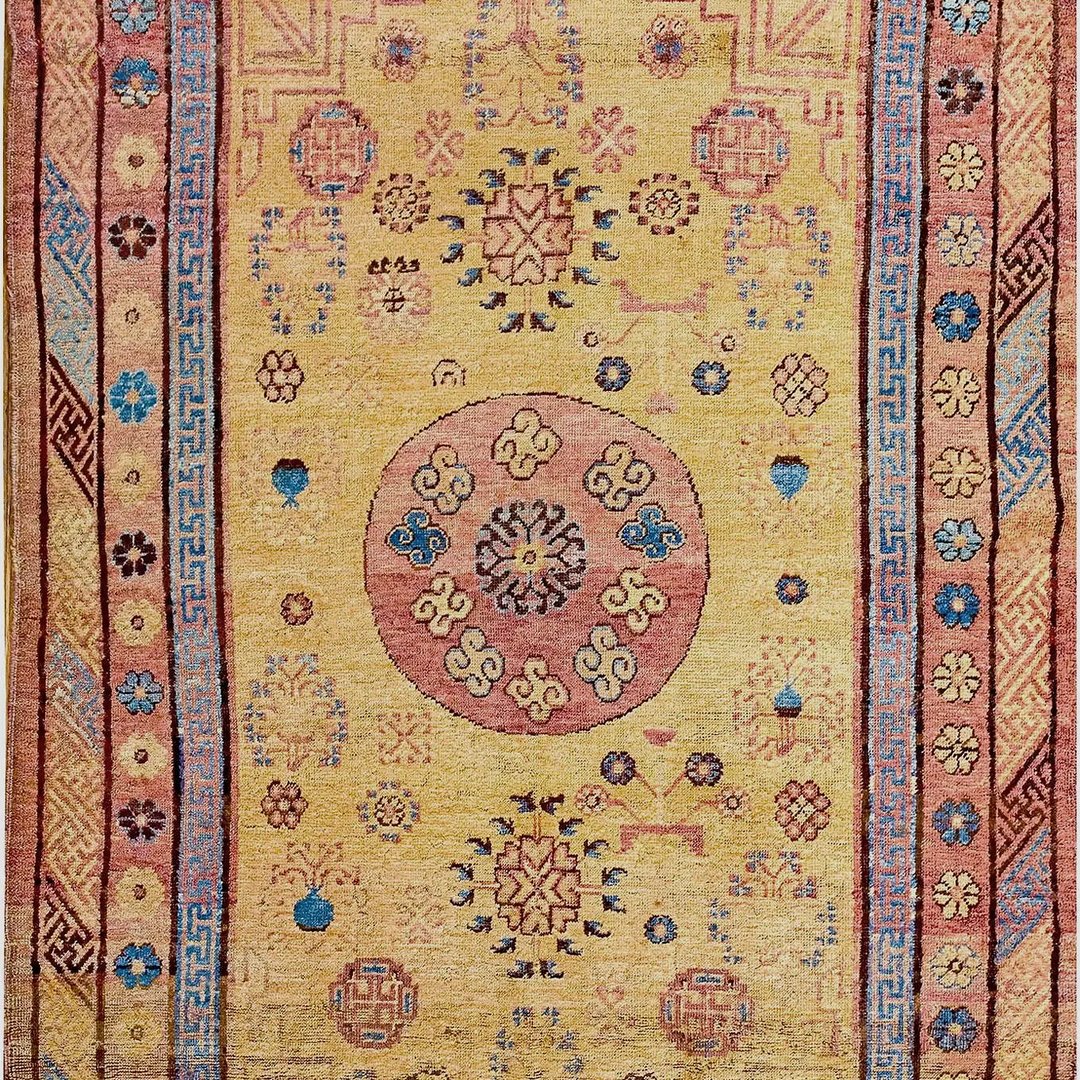 East Turkestan Rugs |  Ecuador |  English |  French |  Indian |  Irish |
 Israel |  Japan |  Mexico |  Middle East Rugs |  Moldova |  Mongolia |  Morocco |  Native American |
 Nepalese |  Pakistan |  Iranian Persian |  Portugal |  Romania |  Spain |  Sweden |  Tunisia |
 Turkish |  Turkmenistan |  Ukraine |  Uzbekistan |
Where Did Rugs Originate?
The exact birth of the hand-knotted rug is a subject of historical wonder. While various nomadic cultures developed weaving independently for warmth and protection, the oldest surviving proof is the Pazyryk Carpet, discovered in a frozen Siberian tomb and dating back to the 5th Century BC.
Though found in Russia, its sophisticated knotting and “Griffin” motifs suggest it was a masterpiece of the Ancient Persian (Achaemenid) Empire. From this “Cradle of Weaving” in Central Asia and Persia, the art form spread along the Silk Road, evolving into the distinct regional styles we see today in Turkey, India, and China.
How Geography Shapes a Rug’s Quality
Most people don’t realize that the altitude and climate of the origin determine the rug’s durability.
- High-Altitude Origins (e.g., Northwest Iran, Caucasus): Sheep in cold, mountainous regions produce wool with high lanolin content. This makes the rug naturally stain-resistant and gives it a “lustrous” sheen.
- Desert / Arid Origins (e.g., Central Persia, North Africa): These rugs often use “dryer” wool, which is better suited for very fine, tight knotting and intricate detail.
Distinguishing Rug Origins, Styles and Design Influences
| Feature to Check | Persian (Iranian) Origin | Turkish / Caucasian Origin |
|---|---|---|
| Knot Structure | Asymmetrical (Senneh): Allows for fine, “curvy” floral details. | Symmetrical (Ghiordes): Creates “blocky,” geometric patterns. |
| Typical Palette | Deep Reds, Indigos, Ivory, and Moss Greens. | Saffron Yellows, Terracotta, and Sky Blues. |
| Foundation / Fringe | Usually fine Cotton (white and thin). | Often Wool (dark, thick, or braided). |
| Overall Design | Flowing medallions, hunting scenes, and vines. | Stars, animals, and bold architectural shapes. |
Rug origins vs. style must be clearly separated. Style refers to the shared aesthetic vocabulary of a region, period, or school of weaving—such as the Safavid Persian court style of the 16th century or the geometric styles of Caucasian tribes. Design influence, in turn, describes the motifs or layouts that may have been borrowed across borders through trade, conquest, or migration.
A rug might carry Anatolian star motifs yet still be authentically of Tabriz rug origins if woven there. Authenticate rug origins therefore requires verification pathways that look beyond surface pattern: researchers assess workshop techniques, structural traits, and historical documentation.
The Science of Origin: Knots and Color Chemistry
To truly know where a rug is from, an expert looks past the pattern and examines the structural anatomy and dye composition. These elements are the “fingerprints” of the local weaver and the local land.
Regional Knotting Anatomy
The way a rug is constructed on the loom varies by region.
It isn’t just about the knot type, but the foundation chemistry:
- Persian (Iranian) Structure: Primarily uses the Asymmetrical knot. In “City” origins like Tabriz, you will see a “double-warped” foundation where one warp sits deeper than the other, creating a ribbed back.
- Turkish & Caucasian Structure: Exclusively uses the Symmetrical (Ghiordes) knot. Because these are often woven on smaller, local looms, the “tension” of the weave and the way the weft (the horizontal thread) is packed down creates a flatter, more “grainy” texture on the back.
- Tribal Variations: Nomadic groups often use a “single-wefted” structure, which allows the rug to be more flexible, while village weavers (like those in Heriz) use a heavy, thick double-weft that creates a “rock-solid” foundation.
Local Dyes: The “Color of the Land”
Before the invention of synthetic dyes, every rug origin had a unique “color signature”.
This “tell” was based on the local plants and minerals available:
The DNA of Origin: Local Plants & Minerals
A rug’s origin is often proven by its “Chemical Signature”—the unique interaction between local flora, mineral-rich water, and indigenous minerals that cannot be replicated elsewhere.
The “Copper Red” of Bakshaish
Source: Madder Root + Aji Chay River Water.
The Secret: The extreme salinity and iron content of the Aji Chay river in Northwest Iran reacts with the Alizarin in madder root to create a specific “Terracotta” or “Copper” red unique to this single district.
The “Imperial Purple” of the Levant
Source: Murex Sea Snail (Bolinus brandaris).
The Secret: Historically exclusive to the Mediterranean coasts, this animal-based dye produced a light-fast plum purple so expensive it was reserved for Roman and Byzantine royalty and the most prestigious early weavings.
The “Golden Weld” of Anatolia
Source: Wild Weld + Volcanic Alum.
The Secret: Central Turkish weavers used weld plants grown in volcanic soil, fixed with local potash. This results in the glowing, “Apricot-Gold” tones found in antique Oushak rugs that distinguish them from Persian yellows.
| Mineral/Plant Ingredient | Regional Use | Unique Identifying Result |
|---|---|---|
| Iron-Rich Mud | The Caucasus | Acidic “Sunken” Black/Brown pile in antique pieces. |
| Cochineal (Insect) | Kerman & South Iran | Vibrant “Cool” Pinks and Crimsons (Raspberry tones). |
| Pomegranate Rind | Afghanistan / Central Asia | Deep, leathery “Liver-Reds” and dark brick tones. |
The “Expert Identification” Comparison Table
| Origin Group | Knotting & Structure | Dye & Color Profile |
|---|---|---|
| Persian City | Asymmetrical knot; Double-warped (ribbed back); Cotton foundation. | Jewel tones; Cochineal reds; complex shading (Abrash) is minimal. |
| Persian Tribal | Asymmetrical knot; Single or heavy double-wefted; Wool foundation. | Earthy Terracottas; Madder reds; significant natural color abrash. |
| Turkish/Caucasian | Symmetrical knot; Flatter back profile; Wool or Goat hair foundations. | Saturated primary colors; Sky blues; Chrome-yellow and Gold highlights. |
Naming Conventions by Region, City, and Tribe
Rug names signal origin through layered references:
- Workshop rugs (e.g., Nain, Isfahan) often indicate highly controlled designs from urban centers.
- Village rugs (e.g., Heriz, Hamadan) usually reveal more rustic execution but identifiable local traditions.
- Tribal rugs (e.g., Qashqai, Turkmen) emphasize nomadic identities and portable looms.
These naming conventions define expectations in weave density, material quality, and aesthetic range. The hierarchy of workshop vs. village rugs influences both scholarly classification and market value, since each naming layer situates a rug within its cultural and production context.
Authentication Signals
Authenticating rug origins depends on converging lines of evidence:
- Technical structure: knot type (Turkish / Ghiordes vs. Persian / Senneh), warp and weft materials, selvedge finishes. — Why: Structural fingerprints often remain consistent within regions.
- Dyes: natural vs. synthetic colorants, chrome vs. vegetable dyes. — Why: Dye profiles can signal time periods and regional resources.
- Provenance in rugs: invoices, customs stamps, dealer labels, or ownership history. — Why: Documentary proof strengthens attribution when physical analysis is ambiguous.
- Comparative motifs: alignment with known regional patterns (see Rug patterns explained). — Why: While not decisive alone, motifs support structural and documentary evidence.
No single clue is conclusive. Because documentation gaps are common, experts triangulate across these signals to authenticate rug origins with authority.
Comparison Framework
| Concept | What It Is | Typical Evidence | Pitfalls |
|---|---|---|---|
| Origin | Geographic place of weaving | Structure, fibers, dyes, workshop/village/tribe names | Confusing motif influence with place of make |
| Style | Shared aesthetic school of a period/region | Design layouts, historical parallels, rug weaving types | Overlap across regions leads to mislabeling |
| Design Influence | Motifs adopted via trade/migration | Comparative patterns, cross-cultural parallels | Motifs travel more easily than weavers |
| Provenance | Ownership chain and documentation | Invoices, labels, stamps, estate records | Records can be lost or falsified |
Rug Origins and Their Impact on Authenticity and Value
For collectors and historians, the rug origins of any hand-knotted rug directly influences authenticity and market value. A rug firmly linked to a specific workshop or tribal group carries cultural weight and scholarly authority. Proven rug origins establish trust in transactions, strengthen insurance appraisals, and situate the rug within its historical narrative.
Conversely, uncertainty in rug origins diminishes value, since misattribution undermines both scholarship and market confidence. Ultimately, rug origins are not about superficial motifs but about the verifiable geographic context of weaving—a distinction that safeguards authenticity, enriches collecting, and honors the communities that produced these works.
Timeline: From Prehistory to the Iron Age
Prehistoric mats and felts
The earliest rugs timeline begins with perishable floor coverings that rarely survive in the archaeological record. Plant-fiber mats and felt sheets—compressed wool without weaving—likely provided basic insulation on earthen floors long before true woven textiles.
Because these materials decay quickly, few direct specimens remain; this survival bias hides much of early practice and leaves only indirect traces. Ethnographic analogies and later steppe burials suggest felts were widespread among pastoral groups, functioning as ground covers, tent linings, and bedding. These functions set the stage for later flatweaves and, eventually, pile carpets.
Neolithic loom evidence and fiber use
Neolithic weaving evidence is firm by the 7th millennium BC: loom weights from settlements across West Asia demonstrate warp–weft construction on fixed frames. At the same time, the domestication of sheep supplied a steady source of wool—a springy, crimped fiber ideal for thick fabrics.
With looms and wool available, communities produced flatwoven cloth and mats; technical capacity existed for heavy floor coverings even if those objects have not survived. The path from flatweave to pile required one more step: inserting and cutting supplementary yarns to build a surface nap.
Iron Age maturity of pile weaving
By the Iron Age, Iron Age carpets show the knotted-pile technique at full sophistication. Structural regularity, refined knotting (both symmetric and asymmetric types), and complex border-and-field programs appear in surviving specimens.
As developed later, the Iron Age evidence proves that pile weaving was neither experimental nor isolated by this time; it was an accomplished craft with regional variants, workshop specialization, and stable material choices (wool pile on wool or mixed wool/animal-hair foundations).
Key dated finds
- Pazyryk carpet (5th–4th century BC) — Why: The best-preserved early pile carpet; its frozen burial context in the Altai Mountains (Siberia) anchors the Pazyryk carpet date securely and demonstrates high technical refinement (dense knots, complex iconography).
- Bashadar fragments (Altai, Iron Age) — Why: Extremely fine pile with asymmetric knots confirms parallel technical mastery; complements Pazyryk and widens the early corpus.
- Early felts from steppe burials (various Iron Age contexts) — Why: Preserve non-woven floor coverings and decorative panels, showing felt’s prominence before and alongside woven pile.
- Neolithic loom-weight assemblages (7th millennium BC, West Asia) — Why: Indirect but decisive proof of weaving infrastructure millennia before surviving carpets; establishes the technological base for later rugs.
Chronology schema
| Period | Evidence | Significance |
|---|---|---|
| Neolithic (c. 7000–4000 BC) | Loom weights; spindle whorls; domesticated sheep | Weaving infrastructure established; wool supply enables thick textiles; floor mats and flatweaves likely but rarely preserved. |
| Bronze Age (c. 3000–1200 BC) | Textiles and impressions; expanded trade networks | Diffusion of weaving knowledge; flatweaves and felts predominated as practical floor insulation; pile technique not yet attested by secure finds. |
| Iron Age (c. 1200–300 BC) | Pazyryk carpet; Bashadar pile fragments; richly decorated felts | Knotted-pile achieves maturity: dense knotting, complex borders, dyed wools; felt remains common; regional workshops likely operating. |
| Early CE (1st–3rd centuries) | Continued textile finds (fragmentary); dye analyses | Persistence of sophisticated weaving; technical lineages bridge into later historic traditions documented in classical and post-classical sources. |
Where the earliest known carpet originated historically
The earliest securely dated surviving carpet is the Pazyryk piece, excavated by Sergei Rudenko from a Scythian kurgan in the Altai Mountains of southern Siberia. While its findspot is Siberian, scholars note iconography and technique consistent with Achaemenid-period influences; manufacture has been argued for a high-level workshop within the Persian sphere or closely connected regions.
In short: the oldest known carpet comes to us from the Altai (find context), with probable Achaemenid-era design connections.
Synthesis and sources
Taken together, the record shows: weaving is Neolithic, felts and flatweaves precede knotted-pile, and pile carpets mature by the Iron Age. Because few early textiles survive, the chronology rests on rare exemplars and triangulation among structure, context, and dye/technical analysis.
Foundational references include Rudenko’s reports on the Pazyryk barrows, Stein’s investigations of Central Asian antiquities, and Encyclopaedia Iranica entries on Central Asian carpets—each reinforcing a timeline built from scattered but decisive evidence.
Materials and Tools of Early Rug-Making
Primary fibers: wool dominance; plant fibers’ limits
- Wool in ancient rugs provided elasticity, resilience, and excellent dye uptake. — Why: Its crimped fibers rebound under foot traffic, and its protein structure binds natural dyes securely, making it the most durable and colorful material for pile.
- Goat and camel hair reinforced warp and weft, often in foundations or utilitarian tent mats. — Why: These coarse fibers resisted tension and abrasion better than wool alone, extending the life of structural elements.
- Silk appeared only in elite textiles, extremely rare in antiquity. — Why: While capable of extraordinary sheen and detail, silk was costly and tied to limited production centers, so it was used sparingly in rugs.
- Plant fibers (flax, hemp, reeds) were available but limited. — Why: They lacked elasticity and absorbed dyes poorly, restricting them mainly to mats or coarse foundations rather than pile rugs.
Looms: warp-weighted vs. horizontal ground
The warp-weighted loom anchored against walls, with hanging weights keeping tension on vertical warps. It suited settled weavers who had permanent workshops and could manage larger pieces.
In contrast, the horizontal ground loom was portable, staked into the earth, and ideal for nomads who needed to weave during seasonal migrations.
Portability defined the scale and mobility of early weaving: village looms produced larger, more stable rugs, while tribal looms created narrower, rollable strips easily carried between encampments.
Dyes, spinning, and finishing
Natural dyes in rugs were drawn from the environment:
- Madder root produced a spectrum of reds, from orange to deep crimson.
- Indigo gave shades of blue, achieved by oxidation during dyeing.
- Weld and other yellows balanced palettes and mixed into greens.
- Kermes, a scale insect from Mediterranean oaks, yielded a costly crimson later echoed by cochineal in carpets from the New World centuries afterward.
Even spinning of fibers allowed for high knot counts, while comb beaters packed weft threads tightly. Knives and shears trimmed the pile to an even height, giving finished carpets their uniform surface—tools that foreshadow the advanced refinements of pile weaving.
Specialized cutting/trim tools
Early pile rugs required sharp implements to slice supplementary yarns and keep nap even. Short, hooked knives and shears were developed to trim pile uniformly, a technical leap beyond flatweaves.
These tools were essential for defining motifs crisply, ensuring patterns appeared as intended rather than blurred by uneven pile. Their presence signals that rug-making had already become a specialized craft with distinct toolkits.
Dye-stuff procurement via trade
| Dye | Source | Route/Trade Network |
|---|---|---|
| Madder | Root of Rubia tinctorum | Cultivated across West Asia; traded locally for reds |
| Indigo | Leaves of Indigofera plants | Imported from India and Central Asia; distributed via overland Silk Road |
| Weld (Reseda luteola) | Herbaceous plants | Grown in Mediterranean zones; regional exchange |
| Kermes | Scale insects on oak trees | Mediterranean to Near East; prestige trade good |
These dye-stuffs illuminate Silk Road trade in materials: indigo and fine dyestuffs moved along caravan routes, linking Central Asia, India, and Persia. The circulation of pigments tied rug production to broader economic networks, ensuring that even remote workshops accessed a shared color vocabulary.
How the Silk Road shaped materials and dyes availability
The Silk Road was decisive in supplying both fibers and pigments for early rug-making. Wool and goat hair came from pastoral zones, but luxury materials—silk for elite rugs, indigo from India, and insect dyes like kermes—circulated along these trade corridors.
This flow of resources explains why similar color palettes appear across distant regions: rug weavers tapped into long-distance exchange networks, embedding their craft within the economic fabric of antiquity.
Synthesis
The toolkit of early rug-making centered on wool dominance, loom choice shaped by mobility, and natural dyes in rugs that reflected global trade. Though plant fibers and silks played supporting roles, it was wool, portable or fixed looms, and the procurement of dyestuffs through routes later called the Silk Road that forged the technical foundation of ancient carpets.
From Flatweave to Pile: The Technical Leap
Flatweave, soumak, and loop-pile precursors
- Kilim flatweaves interlace warp and weft without supplementary yarns. — Why: These textiles are strong and lightweight, but lack surface texture or pile for warmth.
- Soumak vs kilim: soumak introduces extra wefts wrapped around warps, creating raised outlines and a more rugged surface. — Why: This technique gave relief and durability, bridging the gap between flatweave and pile.
- Loop-pile rug origins: loops formed over rods or sticks created tufted surfaces, which could later be cut. — Why: This method foreshadowed the true cut-pile aesthetic, demonstrating experimentation with texture before full pile carpets emerged.
These precursors prove that pile carpet invention was not sudden but the result of gradual technical layering.
Invention theories: nomadic vs. urban workshops
Scholars debate whether pile weaving arose among nomadic herders or in urban courts.
- Nomadic theory: pile simulated animal furs, serving as portable bedding and insulation in harsh climates. This aligns with the functional needs of mobile communities.
- Urban theory: pile developed in wealthy workshops where experimentation with luxury forms was encouraged, refining textiles into status goods.
Both paths may have coexisted, with nomadic pile fulfilling practical roles while courts elevated it into symbols of refinement.
Knot types defined
The technical heart of pile weaving lies in knotting. Two principal knots were already anciently established:
| Knot | Diagram | Regions | Diagnostics | Pros/Cons |
|---|---|---|---|---|
| Turkish (Ghiordes) | Symmetrical knot around two warps | Anatolia, Caucasus, Central Asia | Square back appearance; more bulk; even wear | Strong, durable; less fine for curves |
| Persian (Senneh) | Asymmetrical knot around one warp | Persia, India, later China | Off-center knot collar; allows higher knot counts | Enables delicate detail; slightly less robust |
The Turkish knot vs Persian knot distinction remains the primary structural marker for attribution and authenticity.
Structural diagnostics
Identifying rug origins depends less on motif and more on structure. Specialists examine:
- Warp materials: wool, cotton, or goat hair cores.
- Weft count per row: some regions insert one, two, or even multiple wefts between knots.
- Selvedge binding and end finishes: localized traditions provide key evidence.
Such diagnostic details often reveal weaving provenance more reliably than patterns, which can travel across borders.
Functional drivers: warmth and insulation
Pile weaving was not merely decorative. The soft, insulating nap trapped air and mimicked the warmth of pelts. This fulfilled the bedding and seating needs of nomads and the comfort expectations of elites alike.
The functional drivers of warmth, portability, and floor insulation explain why pile rugs quickly spread across diverse climates and social classes.
How Persian and Turkish knot structures differ
The Persian (Senneh) knot loops around a single warp and leaves the other warp exposed, producing an asymmetrical structure that supports high knot density and intricate curvilinear designs.
The Turkish (Ghiordes) knot, in contrast, loops around two adjacent warps symmetrically, creating a more compact, durable structure suited to bold geometric motifs. These diagnostic differences not only define weaving schools but also underpin attribution to specific regions.
Synthesis
The evolution from flatweave to pile reflects technical ingenuity: soumak and loop-pile experiments paved the way, while two knot systems—Turkish and Persian—emerged as enduring pillars of rug-making.
Ultimately, structure often reveals rug origins better than motifs, anchoring rug history in the tangible craft of the loom rather than the borrowed language of design.
The Pazyryk Carpet and Altai Context
Discovery, dating, preservation in ice
The Altai rug discovery that transformed rug history occurred in 1949, when Sergei Rudenko excavated a Scythian burial mound (kurgan) in the Pazyryk Valley of the Altai Mountains. Frozen permafrost preserved a nearly intact knotted-pile carpet alongside other grave goods.
Radiocarbon dating fixed its age to the 5th–4th century BC, placing it securely within the Iron Age. This frozen environment created unique preservation conditions, allowing scholars to analyze dyes, knotting, and fibers with a level of clarity unmatched among ancient textiles.
Technical specs: size and knot density
The Pazyryk carpet origin is defined not only by its context but also by its extraordinary specifications. Measuring approximately 283 × 200 cm, it is a full-scale floor piece rather than a fragment.
Its knot density reaches about 36 knots/cm² (≈232 per in²), a level of technical refinement rivaling many later Persian and Anatolian masterpieces. Such density required even spinning, fine wool, and highly disciplined loom work, proving that the earliest knotted carpet represents a mature craft rather than an experimental prototype.
Iconography and cross-cultural motifs
The carpet’s central field shows a repeating lotus motif, while its borders depict griffins, deer, and horsemen in procession.
These motifs reveal a cross-cultural blend: griffins tie into Achaemenid Persian artistic vocabulary, while deer and mounted warriors reflect Scythian carpet steppe iconography.
This hybrid design demonstrates how cultural exchange on the Eurasian frontier shaped textile art, merging nomadic and imperial elements into a single masterpiece.
Associated felts and textiles
The kurgan also yielded elaborately decorated felts, saddlecloths, and appliquéd panels. These finds highlight that the Pazyryk community valued both woven and non-woven textile traditions.
The felts, with their layered appliqué and figural designs, show advanced artistry that complemented the pile carpet. Together, they confirm a spectrum of textile use in burial and daily life, bridging functional needs and symbolic display.
Interpretations and debates
- Persian rug origins hypothesis — Why: The sophistication of the knotting, dye palette, and motifs suggests production in an Achaemenid Persian workshop and later transport to the Altai through trade or tribute.
- Scythian rug origins hypothesis — Why: The carpet was buried with Scythian elites, and the horsemen in procession reflect local steppe iconography; some argue it may represent indigenous weaving skill.
- Hybrid model — Why: Cross-cultural motifs and the location of discovery support the idea that Persian-trained artisans may have produced the piece for Scythian patrons, embodying a frontier exchange.
Where the earliest known carpet originated historically
The earliest known carpet, the Pazyryk, was discovered in the Altai Mountains of Siberia. While its findspot is Siberian, stylistic and technical parallels suggest links to Persian workshops of the Achaemenid Empire.
Scholars therefore locate the rug origins in the cultural crossroads between Scythian elites and Persian textile traditions.
Synthesis
The Pazyryk carpet proves mature pile weaving by the Iron Age: its scale, density, and design place it far beyond a primitive experiment. Its design blends steppe and Persian motifs, reflecting both local Scythian and imperial Achaemenid influences.
Thanks to preservation in ice, it remains the most important single artifact for understanding early carpet history, offering unparalleled technical insight into the dawn of knotted-pile weaving for its placement in the broader chronology of circa-dated carpets).
Early Fragments Across Asia
Bashadar (Altai) asymmetric-knot fragments
Beyond the Pazyryk carpet, additional early rug fragments from the Bashadar kurgans in the Altai confirm pile weaving’s technical range. These textiles, preserved in frozen burials, exhibit asymmetric knots of extreme fineness.
Their high knot counts and precise execution demonstrate that both principal knotting systems were in use, and that regional artisans already mastered techniques enabling detailed imagery.
Dura-Europos and At-Tar Near Eastern bits
In the Near East, pile weaving is attested through fragmentary remains at Dura-Europos (on the Euphrates, dated to the 1st–3rd centuries AD). These small pieces, though incomplete, prove that Dura-Europos carpet traditions included pile rugs alongside flatwoven furnishings.
Similarly, fragments from the At-Tar caves reinforce the presence of early pile in desert contexts. Together, these finds extend the distribution of pile weaving into settled urban centers of the Roman and Parthian frontier.
Loulan and Turfan Xinjiang textiles
The Loulan rug fragments and related textiles from Turfan in Xinjiang illustrate pile weaving on the eastern Silk Road. Excavations show rugs with symmetric knots, often with multiple weft shots per row, a diagnostic that suggests localized structural habits.
These finds demonstrate that pile knowledge had traveled deep into Central Asia by the first centuries CE, aligning with caravan routes that also transmitted dyes, motifs, and weaving tools.
Samangan Afghanistan fragments with stag/griffin
In Afghanistan, fragments from Samangan depict rows of stags and griffins, echoing motifs also found in Achaemenid art.
These Samangan pile carpet remains suggest a blending of Iranian iconography with regional weaving, reinforcing Afghanistan’s role as a cultural corridor between Persia, Central Asia, and the Indian subcontinent.
Synthesis timeline
| Site | Date | Knot Type | Notes |
|---|---|---|---|
| Bashadar (Altai) | Iron Age | Asymmetric | Extremely fine knots; high technical level |
| Pazyryk (Altai) | 5th–4th c. BC | Symmetric | Large complete carpet; Persian–Scythian motifs |
| Dura-Europos (Syria) | 1st–3rd c. AD | Fragmentary | Confirms pile in Near East frontier zones |
| At-Tar caves (Near East) | Early CE | Fragmentary | Reinforces local pile weaving traditions |
| Loulan/Turfan (Xinjiang) | 1st–4th c. AD | Symmetric; multiple wefts | Evidence of pile weaving on Silk Road routes |
| Samangan (Afghanistan) | Early CE | Mixed evidence | Stag/griffin motifs suggest Achaemenid influence |
When did Persian rug weaving first emerge historically?
The evidence from Samangan and earlier Achaemenid-linked designs indicates that Persian rug weaving first emerged during the Iron Age under the Achaemenid Empire (6th–4th centuries BC).
By this period, Persian workshops were producing advanced pile carpets, some of which likely influenced or supplied the Altai elite, as seen in the Pazyryk context. Archaeological fragments from the early centuries CE show that by then, pile weaving was widespread across Asia, but Persia’s Iron Age workshops mark its historical emergence.
Synthesis
By the first centuries CE, multiple regions practiced pile weaving, from the Altai steppes to the Near East and Silk Road oases. Both Turkish and Persian knot types are confirmed archaeologically, establishing a technical diversity that matched cultural exchange.
Though the record remains fragmentary, the accumulated finds—from Bashadar to Loulan—enable a robust mapping of early carpet history, showing that pile weaving had become a shared tradition across Asia well before the medieval flowering of rug-making.
Nomadic Steppe Traditions
Scythian felt and pile arts ecosystem
The Scythian felt tradition reveals how steppe societies developed a dual textile economy: thick felts for insulation and nomadic rug origins in pile for bedding, warmth, and prestige.
Burials from the Altai and sites like Yingpan preserve both forms side by side, demonstrating a balanced ecosystem of non-woven and knotted textiles. Felts lined tent walls, while pile rugs signaled elite identity in ritual or burial contexts.
Early Turkic diffusion into West Asia
As Turkic groups migrated westward from Inner Asia, they carried both technical knowledge and motifs. The spread of Turkmen guls—geometric medallions symbolizing tribal affiliations—illustrates how steppe visual language embedded itself into the weaving traditions of Anatolia, Iran, and the Caucasus.
These migrations did not only transmit patterns but also structural habits, contributing to the long-term interaction between steppe looms and urban workshop innovations.
Portable looms shaping scale and format
- Ground looms staked into the earth defined the practical scope of nomadic weaving. — Why: They were easily assembled and dismantled, crucial for mobile households.
- Size limitations favored long, narrow strips or transportable mats. — Why: Rugs had to be rolled, loaded, and re-erected in new encampments.
- Format aligned with tent interiors, producing carpets scaled for central floors or bedding. — Why: Function followed the structure of domestic nomadic life, where textiles substituted for fixed furniture.
Thus, why did nomadic looms shape tribal rug patterns? The portability of looms constrained dimensions, while repetitive weaving across strips encouraged bold, modular motifs rather than intricate curvilinear designs.
Tribal iconography: animals, guls, horns
Steppe rugs carried deep symbolic meaning. Animal figures—stags, horses, birds of prey—evoked cosmological beliefs and clan identity. The widespread Turkmen gul emerged as a standardized tribal emblem woven repeatedly across fields, functioning like heraldic devices.
Horn motifs, spirals, and abstracted animal forms linked rugs to the nomads’ worldview, where textiles encoded not only decoration but also lineage, status, and protection.
Steppe-to-oasis trade
Nomadic groups were not isolated producers. Their rugs entered wider circulation through steppe-to-oasis trade, connecting tent communities to Silk Road nodes. Sites such as Yingpan show elite burials furnished with imported and locally produced carpets, reflecting both cultural blending and economic integration.
Nomadic rugs became commodities in exchange for grain, metals, and luxury goods, ensuring that steppe motifs influenced—and were influenced by—urban textile traditions.
Synthesis
Nomadic needs drove format and durability, producing portable, warm, and functional rugs tailored for tent life. Motifs encoded identity and cosmology, preserving tribal symbolism in repeatable forms like animal rows and guls.
And through migration and exchange, steppe traditions diffused structures and aesthetics into Persia, Anatolia, and beyond, shaping the long arc of Eurasian rug-making.
Persia and the Ancient Near East
Bronze and Iron Age records: Mari and Hittites
Textual records from the Bronze and Iron Ages provide the earliest secure references to rugs in the Near East. The Mari letters (c. 18th century BC) mention textiles and carpets supplied by specialist weavers, signaling an organized production economy.
Later, Hittite inventories catalogued rugs among state furnishings, confirming their role as valued commodities in Anatolian and Mesopotamian courts. These sources, while not describing structure in detail, prove that rugs were already integral to palace and temple settings centuries before surviving fragments appear.
Greek and Roman testimonies
Classical authors shed light on the perception of Persian rug origins. Arrian and Pliny the Elder remarked on the luxury and ceremonial deployment of Achaemenid carpets, noting their beauty and expense.
Greeks admired Persian banqueting customs, in which rugs covered dining couches and palace floors, establishing carpets as markers of refinement. Roman adoption of Eastern textiles reinforced their prestige, embedding rugs into Mediterranean elite culture as exotic luxuries tied to Persia’s reputation for splendor.
Achaemenid court textiles and practices
Under the Achaemenid Empire (6th–4th c. BC), carpets became diplomatic and ceremonial tools. Inventories suggest they were used as gifts and tribute, reinforcing imperial authority.
The Achaemenid carpets likely combined nomadic durability with urban refinement, a fusion that defined Persian weaving identity. Carpets covered thrones, walkways, and audience halls, demonstrating not just utility but political symbolism. This era represents the emergence of Persian rug weaving historically, with the court serving as both consumer and patron of technical innovation.
Sasanian technical and artistic heights
By the Sasanian dynasty (224–651 CE), carpet production reached legendary refinement. The most famous artifact, the “Spring of Khosrow”, was a monumental carpet said to represent a paradisiacal garden with woven streams, blossoms, and precious stones. Though lost, medieval chroniclers described it as a marvel of global textile history.
Surviving Sasanian carpet history also includes fragments from Afghanistan that show advanced knotting, dyeing, and design consistent with Sasanian workshops. These achievements laid the foundation for later Islamic weaving traditions, where Persia remained a central hub of innovation.
Funerary evidence: Cyrus’s tomb textiles
Sources also mention carpets used in funerary contexts. At the tomb of Cyrus the Great, early chroniclers recorded the presence of rugs draped within the chamber. Though none survive, such accounts reinforce the ceremonial role of carpets in royal ideology, extending their function from daily luxury to eternal commemoration.
Who were the major court patrons of carpet weaving?
Two dynasties stand out. The Achaemenid kings, including Cyrus and Darius, established the earliest known royal carpet traditions, integrating rugs into court ceremony and diplomacy.
Centuries later, the Sasanian monarchs, especially Khosrow I Anushirvan, became the greatest patrons of antiquity, commissioning monumental works like the “Spring of Khosrow.” Both courts transformed rugs into symbols of empire, setting precedents that influenced Byzantine, Islamic, and Central Asian successors.
Synthesis
Persia fused nomadic and urban textile expertise, elevating rugs from practical bedding to imperial insignia. Although actual textiles are scarce, written sources supplement the fragmentary archaeological record, attesting to the centrality of carpets in Persian and Near Eastern culture.
The Sasanian carpets influenced later Islamic traditions, ensuring that Persian models of weaving, dyeing, and iconography remained benchmarks of luxury for centuries.
Anatolia as Crossroads Before the Seljuks
Gordion textiles and implications for rugs
The earliest glimpse of Anatolian rug origins comes from charred wool textiles excavated at Gordion, capital of the Phrygian kingdom. Though not preserved as complete carpets, these patterned fragments confirm that Anatolia hosted sophisticated textile traditions by the early first millennium BC.
Their presence indicates that loom technology, dye mastery, and decorative weaving were already established—laying a foundation for pile carpets that would later flourish under the Seljuks.
Hellenistic and Roman demand for Eastern origin rugs
During the Hellenistic and Roman eras, Anatolia functioned as both a conduit and a consumer region. Classical authors note that Roman tapetes—Eastern carpets imported into elite households—were prized for their luxury and exotic appeal.
Anatolia’s strategic location allowed it to absorb Persian, Caucasian, and Central Asian influences, ensuring that regional weaving vocabularies reflected both steppe symbolism and Near Eastern refinement. This Roman demand sustained the continuous traffic of luxury textiles through Anatolia, shaping local traditions even before knotted pile carpets are fully documented.
Transmission toward medieval Anatolian weaving
By late antiquity, Anatolia had become a meeting ground for technical knowledge. The textile infrastructure established by earlier cultures—Phrygians, Greeks, Romans, and Persians—enabled the pre-Seljuk carpets that would emerge centuries later.
The Seljuks did not invent weaving traditions anew; rather, they drew upon this accumulated base of fibers, dyes, loom expertise, and design exchange. Thus, medieval Anatolian carpet weaving represented both continuity and innovation, rooted in deep pre-Islamic traditions.
Trade nodes: Sardis and Tarsus
- Sardis — Why: As a Lydian and later Roman city, it handled East–West textile flows, facilitating the adaptation of Eastern carpets into Mediterranean markets.
- Tarsus — Why: Positioned on Cilician trade routes, it linked Anatolia to Syria and the Levant, ensuring carpets and patterned textiles circulated across imperial frontiers.
These cities exemplify how Anatolia’s urban hubs acted as funnels for luxury textile diffusion, embedding rugs into networks of commerce and cultural exchange.
Cultural confluence
Anatolia’s position meant that its weaving traditions were never isolated. Persian dyeing techniques, steppe nomadic motifs, and Roman luxury consumption converged in this region.
This cultural confluence made Anatolia a vital mediator of East–West flows, long before Ottoman courts transformed carpets into global symbols of prestige.
Did Topkapi Palace collections shape Ottoman carpet aesthetics?
Centuries later, the Ottoman court drew inspiration from inherited textile traditions, with the Topkapi Palace collections preserving both local and imported carpets.
While these collections postdate the pre-Seljuk era, they illustrate how Anatolia’s long-standing role as a crossroads prepared the aesthetic and technical groundwork for Ottoman carpet identity.
Synthesis
Anatolia mediated East–West textile flows, serving as a corridor for luxury carpets from Persia and Central Asia into Roman markets. Pre-Seljuk weaving prepared the ground for later Seljuk and Ottoman florescence, proving that Anatolia’s carpet history is a story of absorption, adaptation, and transmission across cultures.
Roman demand ensured the continuity of this traffic, keeping Anatolia central to the unfolding history of carpets.
East Asia and Silk Road Interfaces
Imports to China before local pile production
In early dynasties, China favored reed mats, felt, and silk textiles, not knotted pile. Chinese pile rugs entered the cultural landscape through Silk Road carpets, imported from Persia and Central Asia.
By the Tang era, records describe foreign pile rugs in tribute exchanges and palace inventories. These goods embodied exotic luxury, associated with Western courts and nomadic prestige, before China developed its own weaving centers.
Khotan oasis carpets and Buddhist art
The oasis kingdom of Khotan in Xinjiang became a pivotal producer and broker. Khotan carpets history is closely tied to Buddhist art: murals in cave temples show rugs beneath thrones and altars, affirming their role in ritual and sacred display.
Tang sources praised Khotan carpets for quality and color, situating them at the crossroads of Chinese, Indian, and Iranian cultural spheres. Through Khotan, pile weaving entered the religious and artistic vocabulary of East Asia.
Yingpan Man lion carpet as hybrid
One of the most striking finds is the Yingpan lion carpet, buried with a richly adorned figure in Xinjiang. Its iconography combines Western motifs—lions, floral medallions—with local stylistic preferences, reflecting hybrid production.
Likely woven in Western or Central Asia, it nonetheless circulated and functioned in Chinese-controlled regions. This artifact epitomizes how Silk Road carpets carried cross-cultural imagery, reshaped by local contexts.
Court and monastic uses
- Imperial courts valued rugs as status furnishings, using them under thrones, for processions, or as diplomatic gifts. — Why: They reinforced authority and cosmopolitan reach.
- Monasteries deployed rugs in ritual settings, layering pile beneath statues and altars. — Why: They enhanced sacred space and reflected the integration of weaving into Buddhist practice.
- Burials included imported carpets. — Why: They emphasized elite identity and cosmopolitan connections even in death.
Thus, rugs served both courtly and monastic uses, marking prestige in worldly and spiritual realms alike.
Later Chinese production
By the Ming and Qing dynasties, China had developed its own pile-weaving traditions under steppe influence. Ningxia rugs origins lie in workshops that supplied monasteries and palaces with soft-wool, pale-hued carpets, distinct from Persian workshop models.
Unlike the intricate curvilinear designs of Persian weaving, Ningxia favored restrained palettes, geometric medallions, and symbolic motifs adapted to Chinese taste and Buddhist needs. This evolution demonstrates how China first imported, then adapted pile carpet traditions, creating a uniquely local idiom.
How did the Silk Road shape carpet traditions and trade?
The Silk Road linked oases like Khotan and Loulan to Persia, India, and China. Along these routes, carpets circulated as tribute, trade goods, and ritual objects.
They carried not just materials but also imagery—animal motifs, floral borders, and medallions—which were absorbed into Buddhist art and imperial iconography. By sustaining the flow of dyes, wool, and woven forms, the Silk Road made pile carpets a pan-Eurasian medium of cultural exchange.
Is Chinese Ningxia pile distinct from Persian workshop weaves?
Yes. Ningxia rugs differ structurally and aesthetically from Persian carpets. They typically use softer wool, lighter palettes, and symmetrical motifs suited to Buddhist monasteries and Chinese interiors.
Persian workshop weaves, by contrast, emphasize curvilinear arabesques, dense knot counts, and luxury display for Islamic courts. These differences underscore independent development, even as both traditions drew on a shared Silk Road heritage.
Synthesis
Silk Road carpets established a dialogue between East and West: imported rugs first dazzled Chinese courts, Khotan carpets linked Buddhist ritual with rug culture, and finds like the Yingpan lion carpet prove hybrid crossovers.
Over time, China adapted pile weaving into Ningxia rug origins, crafting a distinctive tradition that diverged from Persian workshops while remaining rooted in Eurasian exchange.
Trade Routes and Cross-Cultural Transfer
Overland Silk Road caravans
Silk Road carpets trade thrived because pile rugs were compact, durable, and valuable relative to their bulk. Caravans crossing Central Asia carried rugs from Persian and Turkic looms into Chinese markets, while returning with silks and dyestuffs.
These movements explain why motifs and technical habits appear across distant regions, binding the Eurasian interior into a continuous “rug belt.”
Maritime Persian Gulf and Red Sea
The sea lanes were equally important. The maritime textile trade through the Persian Gulf and Red Sea connected India, Persia, and the Mediterranean. Carpets, dyes, and weaving tools passed alongside spices and incense.
Maritime trade enabled faster delivery of luxury goods, allowing Persian and Indian carpets to appear in Roman and Byzantine markets. Ports like Siraf, Aden, and Alexandria acted as switching points between overland and sea routes, embedding rugs in global circuits of exchange.
Dye, motif, and tool diffusion
- Cochineal in Eurasia: Insect-derived crimson was valued long before New World cochineal; Mediterranean kermes and Armenian cochineal traveled widely. — Why: Their distribution shows how dyes signaled status and required long-distance procurement.
- Indigo: Cultivated in India, diffused to Persia and Central Asia. — Why: Provided stable blues foundational to rug palettes.
- Motifs: Griffins, vine scrolls, and lotus blossoms crossed regions. — Why: These images migrated with merchants, artisans, and religious ideas, embedding cross-cultural symbolism.
- Tools: Combs, knives, and loom types spread with migrating weavers and war captives. — Why: Technical know-how traveled along the same routes as goods, standardizing pile methods while allowing local variation.
Intermediaries: Sogdians and steppe traders
Sogdian merchants rugs played a pivotal role. As Central Asian traders, they controlled caravan traffic and transmitted motifs, dyes, and even artisans between Persia, India, and China.
Steppe nomads likewise linked frontier economies, carrying rugs into oases such as Khotan and Loulan. Their networks ensured that carpets circulated as both trade items and cultural ambassadors.
Synthesis map
A schematic of the carpet trade highlights sources and flows:
- Cochineal/kermes: Mediterranean and Armenian highlands → Persia, Central Asia → China.
- Indigo: India → Persia → Mediterranean and Central Asia.
- Wool and camel hair: Steppe and Iranian plateau → workshop and tribal looms.
- Carpet motifs: Achaemenid griffins, Buddhist lotus, and Scythian deer diffused along overlapping caravan and maritime tracks.
How did the Silk Road shape carpet traditions and trade?
The Silk Road transformed carpets into trans-regional artifacts. It carried not only finished pieces but also the raw materials, dyes, and iconography that shaped their production. As merchants and weavers moved, materials and imagery traveled with them, creating hybrids like the Yingpan lion carpet and spreading techniques across Eurasia.
The Silk Road thus forged a shared rug-making vocabulary that was simultaneously standardized and localized, anchoring carpets as emblems of global exchange.
Synthesis
Trade knitted a trans-regional “rug belt.” Carpets circulated along both caravans and sea lanes, connecting steppe encampments, Persian workshops, Indian dye fields, and Chinese courts.
Through the agency of Sogdian and nomadic traders, rugs became markers of wealth and cultural fusion. Materials and imagery moved with merchants, ensuring that while techniques became standardized, each region adapted them to its own context.
Functions of Rugs in Antiquity
Domestic: insulation, seating, bedding
Domestic rug functions in antiquity were rooted in practicality. In households across Persia, Anatolia, and Central Asia, rugs insulated earthen floors, provided soft bedding, and replaced chairs in dining customs, where people reclined on carpets during meals.
Their portability allowed them to serve multiple functions—floor coverings by day, bedding by night—making them indispensable for both nomadic and settled families.
Courtly: ceremony, tribute, status
Persian court carpets were central to imperial display. Classical texts describe carpets spread in audience halls and banquets, where they signaled hierarchy and refinement.
As tribute goods, carpets conveyed loyalty from vassals to overlords, embodying both wealth and political submission. At court, rugs became more than furnishings: they were emblems of power, woven into ceremonies of statecraft and diplomacy.
This context aligns with the major patrons of weaving—Achaemenid and Sasanian monarchs—who elevated carpets into imperial insignia.
Spiritual: altars, funerary, sacred space
- Altars and sanctuaries used ritual carpets antiquity to mark sacred zones. — Why: Textiles signified sanctity, separating ordinary from divine space.
- Burial carpets accompanied elites into tombs. — Why: Finds such as the Pazyryk and Yingpan examples show rugs as both protective coverings and symbolic vehicles into the afterlife.
- Monastic use in Buddhist and Zoroastrian contexts placed rugs beneath icons or statues. — Why: This created a sanctified textile ground that elevated religious practice.
Social economy: dowries, taxes, heirlooms
Rugs functioned as a form of portable wealth. They entered dowries as durable, prestigious gifts passed between families, served as tax payments to empires, and circulated as heirlooms across generations. Because they combined artistry with utility, rugs were uniquely suited to embodying social status while remaining fungible trade goods. This economic versatility made them one of antiquity’s most flexible prestige items.
Gendered labor and transmission
Weaving was predominantly women’s work in both nomadic and village contexts. Through weaving, women transmitted skills, motifs, and tribal symbols across generations.
The nomadic rug origins depended on women’s ground-loom production, embedding identity and continuity into the fabric itself. This gendered labor not only sustained domestic life but also preserved the symbolic lexicon of tribal and courtly textiles.
Who were the major court patrons of carpet weaving?
The Achaemenid kings, including Cyrus and Darius, and the Sasanian monarchs, particularly Khosrow I Anushirvan, were the great court patrons of antiquity. They institutionalized weaving in workshops, commissioned monumental carpets, and used textiles to symbolize dynastic authority.
Their patronage transformed carpets from household necessities into global symbols of imperial grandeur.
Synthesis
In antiquity, rugs were practical, prestigious, and sacred simultaneously. They provided warmth and bedding, framed the authority of kings, sanctified religious and funerary spaces, and circulated as tribute, taxes, and dowries.
Social roles and identity were literally woven into their patterns, especially through women’s transmission of motifs. Because they were portable, carpets became ideal prestige trade items, bridging the worlds of daily life, empire, and the sacred.
Regional Signatures: Motifs, Structures, Centers
Caucasian geometrics vs. Persian florals
The contrast between Caucasian vs Persian motifs remains one of the most reliable markers of origin. Caucasian rugs favor bold geometric forms—diamonds, hooked medallions, and stepped polygons—outlined with strong color contrast. Their structures often employ symmetric knots, thick wool warps, and limited but saturated palettes.
By contrast, Persian rugs emphasize curvilinear florals, central medallions, and scrolling vines, enabled by the asymmetric (Senneh) knot and finer foundations of cotton or silk. This structural and aesthetic pairing provides the clearest diagnostic line between two great traditions.
| Region | Motifs | Knot / Structure | Palette |
|---|---|---|---|
| Caucasus | Geometrics, bold medallions, tribal guls | Symmetric knots; wool warps | Strong contrast, reds, blues, ivory |
| Persia | Curvilinear florals, arabesques, central medallions | Asymmetric knots; cotton/silk foundations | Subtle gradations, madder reds, indigo blues |
Major Persian centers: Tabriz, Kashan, Kerman, Isfahan
- Tabriz rug origins — Northwestern Iran (Azerbaijan region); a historic workshop city producing large-scale carpets since at least the 15th century.
- Kashan carpet city — Central Iran; renowned for silk pile and fine weaving, historically serving court patrons and wealthy elites.
- Kerman rug province — Southeastern Iran; distinguished by masterful dyeing traditions and a long lineage of durable wool pile rugs.
- Isfahan — The Safavid capital, home to workshop carpets with highly refined floral and medallion designs. Isfahan’s tiles and carpets echoed one another, with mosque mosaics providing the visual grammar for woven medallion layouts.
These centers reflect how workshop economies anchored Persian weaving, each specializing in distinctive technical and artistic outputs.
Anatolian Oushak; Moroccan Beni Ourain
- Oushak Uşak rug origins — In western Anatolia (Turkey’s Uşak province), Oushak rugs historically emphasized large medallions, soft pastel palettes, and spacious fields. — Why: Their workshop production catered to Ottoman courts and European patrons, blending Anatolian geometry with Persian-inspired medallions.
- Beni Ourain rug origins — In Morocco’s Middle Atlas, the Beni Ourain tribes produced rugs of undyed wool, typically with ivory grounds and black or brown geometric linework. — Why: These tribal weavings reflect nomadic domestic use, prized today for their minimalist aesthetic but rooted in deep Berber symbolism.
Both cases underscore how diverse regions translated local needs and aesthetics into distinctive rug forms that remain identifiable centuries later.
Echoes between architecture and carpets
Isfahan mosque tiles and Safavid medallion carpets share a common design grammar. Architects and weavers drew from the same repertoire of central medallions, quartered spandrels, and rhythmic floral scrolls.
Carpets effectively brought the monumental vocabulary of domes and tiled walls onto the floor, creating a total environment of geometry and ornament in both palace and mosque.
Workshop vs. tribal diagnostics
Structural diagnostics distinguish weaving contexts. Workshops in Tabriz, Kashan, Kerman, and Isfahan emphasized uniform knotting, cotton or silk warps, and planned curvilinear layouts.
By contrast, tribal and village rugs employed wool warps, bolder geometrics, and more improvisational composition. Recognizing whether a rug stems from a workshop or tribal loom is often as decisive for attribution as identifying motifs.
Synthesis
Motifs plus structure improve regional attribution, allowing scholars to distinguish Caucasian geometrics from Persian florals, workshop refinement from tribal spontaneity. Centers like Tabriz, Kashan, Kerman, and Isfahan align with known workshop economies, while Oushak in Turkey and Beni Ourain in Morocco exemplify regional distinctiveness.
Ultimately, architecture and textiles interwove—Isfahan tiles influencing medallion carpet designs—cementing the idea that rugs were not only utilitarian but also reflections of broader artistic ecologies.
Authenticity, Provenance, and Collecting
Provenance tools: labels, archives, science
Rug provenance verification begins with documentation. Receipts, customs and export stamps, dealer or exhibition labels, and archival references form the paper trail of a carpet’s history. Where records are absent, scientific aids supplement: dye analysis in carpets can establish whether natural or synthetic dyes were used, radiocarbon dating may apply to foundations, and microscopy clarifies fiber identity and knotting structure.
These combined methods allow scholars to authenticate tribal rugs and workshop pieces alike with greater certainty.
Conditions vs. rug origins in valuation
- Condition matters because holes, reweaving, and dye corrosion diminish structural integrity and display appeal. — Why: Even a rug from a renowned origin loses value if its wear undermines utility or aesthetic impact.
- Rug origins provides cultural and historical prestige. — Why: Rugs from famous centers or tribes command higher recognition, but their worth is contingent on how well they survive.
- Balance must be struck. — Why: Collectors often overemphasize rug origins, but professional valuation recognizes that condition vs origin is inseparable—each factor strengthens or weakens the other.
Tribal vs. workshop attribution pitfalls
Attribution is frequently complicated by overlap between tribal improvisation and workshop planning. Tribal rugs may adopt workshop-inspired motifs, while workshops can mimic tribal aesthetics for commercial markets.
Since motifs travel easily, relying on design alone risks misclassification. Structure trumps motif for credible attribution, as knot type, warp material, and weft configuration anchor a rug more securely to a region or community.
Museum and scholarly benchmarks
Museums serve as Comparanda, setting benchmarks for authenticity and quality. Published catalogues, peer-reviewed analyses, and curated exhibitions provide reference examples for attributions.
Collectors, dealers, and conservators depend on these authoritative standards, ensuring that private market identifications align with scholarly consensus. These museum traditions converge with East Asian collecting practices to form the modern global framework for rug study.
Buyer checklists
| Evidence Type | Strength | Risk if Alone |
|---|---|---|
| Receipts, export stamps, exhibition labels | High | Can be falsified or incomplete |
| Dye and fiber analysis | Medium–High | Requires expert labs; context still needed |
| Radiocarbon dating | Medium | Expensive, limited to certain materials |
| Knot/structure analysis | High | Needs skilled interpretation |
| Motif comparison | Low | Motifs easily borrowed or forged |
| Museum comparanda | High | Must be carefully matched by experts |
How can provenance be verified for antique tribal rugs?
Provenance for antique tribal rugs is best verified through a convergence of evidence: surviving documentation, dye analysis carpets that confirm historical palettes, structural diagnostics characteristic of the tribe, and comparison with museum-housed exemplars. No single signal suffices; authenticity rests on triangulation.
Should rug origins outweigh condition when buying vintage rugs?
No. While rug origins are crucial for cultural and historical identity, condition and integrity strongly influence value. A poorly preserved rug from a famous center may be worth less than a well-preserved piece of lesser origin.
Collectors are advised to weigh both factors equally, since durability ensures usability and display, while rug origins secure historical significance.
Synthesis
To collect responsibly, buyers must verify with converging evidence, avoiding motif-only attributions. Condition vs origin must be evaluated together, since both determine value.
Finally, Museum Comparanda anchor authentic identifications, grounding the market in scholarly consensus and safeguarding cultural heritage.
Court Patrons, Masterpieces, and Continuities
Ardabil Carpet and shrine connection
The Ardabil Carpet shrine remains the most celebrated masterpiece of Islamic carpet history. Woven in 1539–1540 and bearing a dated inscription, it was created for the Ardabil Shrine of Shaykh Safi al-Din in northwestern Iran.
The carpet’s monumental size, exquisite knotting, and intricate medallion design anchor it within the Safavid court’s patronage system, while the inscription ties it to a sacred commemorative context. As both an artistic triumph and a devotional object, it epitomizes how courtly carpets could merge luxury with piety.
Topkapi Palace collections’ curatorial influence
The Topkapi carpets assembled by the Ottoman court in Istanbul served as both a treasury and a design canon. Palace inventories reveal an intentional collection of Persian, Anatolian, and imported carpets, curated to shape Ottoman taste.
These holdings influenced the motifs, color schemes, and layouts of Ottoman weaving workshops, ensuring continuity between palace preference and commercial output. The Topkapi thus functioned as both museum and model, directly shaping the visual identity of Ottoman carpets for centuries.
Mughal vs. Safavid distinctions
While both traditions emerged from courtly patronage, Safavid vs Mughal carpets diverged in aesthetic and structure:
| School | Motifs | Structure | Palette |
|---|---|---|---|
| Safavid (Persia) | Curvilinear arabesques, scrolling vines, central medallions | Asymmetric (Senneh) knots; cotton/silk warps | Deep indigo blues, madder reds, gold highlights |
| Mughal (India) | Naturalistic flora, lattice-garden layouts, hunting scenes | Asymmetric knots; finely spun pashmina | Softer greens, ivory, pinks; Indo-Persian blend |
Mughal carpets adapted Persian techniques but infused them with subcontinental botanical naturalism, distinguishing them from Safavid abstractions of vegetal forms. Both traditions embody elite patronage but reveal contrasting cultural imaginations.
Ningxia vs. Persian workshop contrasts
The comparison of Ningxia vs Persian rugs underscores distinct regional idioms. Ningxia weaving, produced in China’s northern provinces, favored dense local wool, muted palettes, and Buddhist symbols framed by unique key-fret borders.
By contrast, Persian workshops prioritized asymmetric knots, finely differentiated warps/wefts, and complex curvilinear designs. Ningxia rugs were devotional and monastic in focus, while Persian pieces emphasized palace grandeur and aesthetic sophistication.
These contrasts prove how different regions absorbed shared techniques yet pursued divergent artistic goals.
Legacy into modern connoisseurship
The legacies of these traditions endure in today’s collecting and scholarship. The Ardabil Carpet shrine inscription provides a benchmark for dating, while the Topkapi Palace collections anchor Ottoman design history.
Museums now compare Safavid, Mughal, and Ningxia masterpieces to establish technical and stylistic taxonomies, continuing the regional diagnostics. Connoisseurship today thus rests on the careful study of courtly exemplars, their provenance, and their continuity into modern textile appreciation.
Synthesis
Ardabil’s shrine inscription anchors its sacred date and context, making it the touchstone for Islamic carpet chronology. Topkapi’s curated collections shaped Ottoman weaving identity, while comparisons of Safavid vs Mughal carpets and Ningxia vs Persian rugs reveal the regional signatures of great courts.
Together, these masterpieces and patronage systems cement the continuities that link ancient traditions to modern connoisseurship.
FAQ
-
When a tag says “Persian-style” or “Moroccan-style,” what does that mean for rug origins?
It denotes design inspiration, not the country of manufacture. The origin must still read the actual nation (e.g., “Made in India”) regardless of the style referenced.
-
Are there U.S. restrictions tied to rug origins?
Yes—imports from Iran have faced shifting sanctions since 2018, and wildlife materials like ivory are tightly regulated. Check OFAC, CBP, and FWS before purchasing.
-
Do rug origins affect value?
Strongly—region, age, and provenance matter. For instance, an 18th-century Cuenca (Spain) royal carpet carried a valuation around €700,000, reflecting rarity and history.
-
Where do Mamluk/Cairene pieces fit in rug origins?
Cairo produced kaleidoscopic Mamluk carpets in the late 15th–16th centuries, later shifting to Ottoman “Cairene” florals. Colors often include insect-dyed reds, greens, and blues.
-
How can I verify Navajo rug origins legally in the U.S.?
The Indian Arts and Crafts Act bans falsely marketing items as Native-made; penalties can reach \$250,000. Ask for tribal or reputable documentation and learn structural hallmarks.
-
Do materials point to rug origins?
Yes—Afghan pieces often tout hand-spun Ghazni wool with high lanolin and lively abrash; Tibetan-style rugs today frequently use New Zealand wool. Material choices track regional supply.
-
How are rug origins shown on labels?
U.S. rules require the specific country of origin on textile labels, not just a region. Look for “Made in \(Country)” and fiber content alongside care info.
-
How do dyes reveal rug origins in historical terms?
Natural dyes dominated until synthetic anilines appeared in 1856, creating brighter magentas and purples. Pre-1860 village rugs typically show vegetal palettes and abrash.
-
How do knot types signal rug origins within rug origins?
Turkish/Anatolian pieces usually use symmetric (Ghiordes) knots; many Persian use asymmetric (Senneh) knots. Check the back—symmetry and diagonal slanting give clues.
-
Do Bokhara rug origins point to Uzbekistan, Turkmenistan, or Pakistan?
The design originates with Turkmen Tekke guls around Bukhara, but many “Bokhara” rugs today are woven in Pakistan. Expect rows of repeating guls and deep reds.
-
What are the origins of hooked rugs in American rug origins?
Hooked rugs developed in 19th-century New England and Eastern Canada, peaking around 1840–1860. Designs often feature florals or pictorial folk art made from scrap textiles.
-
What are the origins of braided rugs in American rug origins?
Braided rugs became a New England staple in the early 1800s, repurposing wool and fabric scraps. Their oval forms suited farmhouse floors and cold climates.
-
What are the origins of English Axminster in rug origins?
Axminster carpets began in 1755 when Thomas Whitty replicated Oriental qualities in Devon. The brand furnished royal and aristocratic houses across Britain.
-
What are the origins of French Aubusson and Savonnerie in rug origins?
Aubusson flatweaves flourished from the 17th century, while Savonnerie gained a royal monopoly in 1627 for knotted-pile “façon de Turquie.” Louis XIV commissions set the style.
-
What are the origins of Khotan/Samarkand rugs in rug origins?
Khotan (Xinjiang) rugs reflect Silk Road fusion—Chinese symbols with Persian borders—often 18th–19th century. Common motifs include pomegranates and medallions on sandy grounds.
-
What are the origins of Chinese Art Deco within rug origins?
In the 1920s–30s, Walter Nichols’ Tianjin factories popularized plush “Chinese Deco” rugs. Open fields, saturated dyes, and asymmetrical motifs defined the look.
-
What are the origins of Indian/Mughal rugs in rug origins?
Mughal emperors established imperial workshops from the 16th century, blending Persian layouts with Indian florals. Lahore, Agra, and Kashmir produced fine, botanically rich carpets.
-
What are the origins of Tibetan rugs in rug origins?
Tibetan rugs historically served as khaden (sleeping mats) and seat covers, using the distinct Tibetan knot. Modern production shifted to Nepal/India, often with New Zealand wool.
-
What are the origins of Navajo rugs in U.S. rug origins?
Navajo weaving grew after Pueblo influence in the 17th century and expanded via 19th-century trading posts. Hallmarks include vertical looms, wool warps, lazy lines, and no fringe.
-
What are the origins of Moroccan Berber rugs in rug origins?
Berber weavings trace to the Atlas Mountains, with thick-pile pieces for cold highlands and lighter flatweaves for desert heat. Beni Ourain examples are often undyed, high-pile wool.
-
What are the origins of Caucasian rugs in rug origins?
-
What are the origins of Turkish/Anatolian rugs in rug origins?
Anatolian rugs evolved through Seljuk and Ottoman eras, using the symmetric “Turkish” knot. By the 15th–16th centuries, motifs appear in European paintings and Hereke became a court manufactory.
-
What are the origins of Persian rugs within rug origins?
Persian weaving spans over 2,500 years, with a golden age under the Safavids (16th–17th centuries) in centers like Isfahan, Kashan, and Tabriz. Court workshops standardized intricate curvilinear designs.
-
Are flatweaves older in rug origins than pile rugs?
Likely yes, but evidence is scarce; securely dated pile appears by the 5th century BCE while early kilims are inferred from fragments and depictions. Scholars debate claims as early as Çatalhöyük.
-
What are the earliest rug origins we know of?
The oldest surviving pile piece is the Pazyryk carpet from the 5th century BCE, found in a Scythian burial and now in the Hermitage. Its fine symmetric knots imply an even older tradition.