
Dining Room Rugs: What You’re Really Buying (Performance Platform, Not Decor)
Dining room rugs look effortless—until the chairs start moving. Scale, clearance, and daily use matter more here than almost anywhere. These two references help keep decisions practical and intentional.
Helpful next steps: how to place rugs correctly in any room and a full guide to choosing the right rug.
Explore the other room guides: Study, Living Room, Family Room, Bedroom, Foyer / Entry, Library, Kids Rooms.
The Dining Room Rug Buying Quest Begins
When buying dining room rugs, you are not simply selecting a decorative backdrop for your meals. You are purchasing a performance platform. A **durable dining Area Rug is essentially an under-table textile engineered specifically to handle repeated abrasion, mechanical stress, and inevitable liquid spills.
The selection process must prioritize structural integrity over pattern or color alone. Unlike a living room rug that holds stationary furniture, dining room rugs must support dynamic movement.
How do I choose a dining room rug?
You choose one that is not only beautiful, but also acts like a foundation that protects the floor and withstands the unique demands of a dining chairs moving across it.
Why Dining is a Toughest-Use-Case Room
The dining room represents one of the harshest environments for home Textiles. The primary stressor in this space is “chair drag.” Every time a person sits down or stands up, the chair legs compress the pile, slide backward, and abrade the yarn tips.
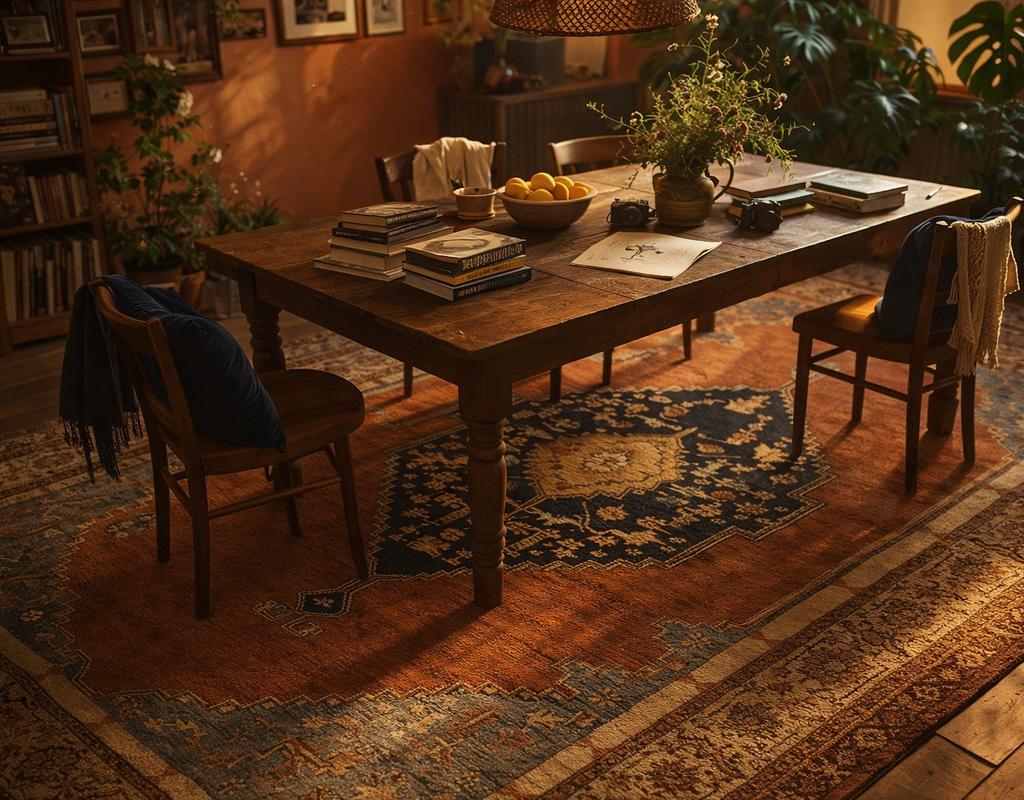
This repetitive friction creates significant stress on the fibers. Consequently, dining room rugs fail at edges and pile tips first, meaning you must choose structure before style to avoid premature wear.
In addition to mechanical wear, dining rooms face complex chemical challenges. Food soils introduce oils, pigments, and sugars that drop directly onto the fiber. These contaminants demand fast spot response and excellent colorfastness to prevent permanent staining. Thick textures exacerbate these issues.
Curated for durability, scale, and design.
Why do dining chairs snag on thick rugs?
Deep piles create physical resistance against chair legs. Instead of gliding over the surface, the chair feet catch on the fibers, pulling yarns loose and eventually destabilizing the rug’s weave.
Performance-First “Best Bets”
To ensure longevity and ease of use, specific constructions function better than others. A low pile dining room rug or a tightly woven flatweave is generally the best rug for under dining table setups.
Does a low-pile rug work better for chairs?
Yes, because the reduced surface friction allows furniture to move freely without damaging the rug’s foundation or tipping the chair.
- Flatweave Rugs: They have no pile to crush or compress, allowing chairs to slide easily without resistance or snagging.
- **Low-Pile Wool Rugs**: Dense, short wool fibers naturally repel liquids and spring back after compression from heavy furniture legs.
- Solution-Dyed Synthetic Rugs: The color is locked into the fiber during manufacturing, making them highly resistant to bleaching from harsh cleaning agents used on food stains.
- Tight Loop Pile: Compact loops resist matting and traffic patterns better than cut piles, provided the loops are low enough to avoid catching on chair glides.
The Physics of “Chair Shear”
Why do some rugs shred under dining tables while others last 50 years? It comes down to Shear Resistance.
| Construction | Shear Rating | Dining Performance |
|---|---|---|
| Flatweave (Kilim/Soumak) | ⭐⭐⭐⭐⭐ | Zero pile friction. Chairs glide perfectly. |
| Low-Pile Hand-Knotted Wool | ⭐⭐⭐⭐ | The “Gold Standard.” Durable and spill-resistant. |
| Hand-Tufted (Latex Back) | ⭐⭐ | Avoid. Friction causes the glue to turn to dust. |
| Silk / Viscose | ⭐ | Visual luxury only. Fails instantly on spills. |
What to Avoid for Most Homes
Certain styles are functional failures in a dining setting regardless of their aesthetic appeal. A dining table rug for chairs needs to facilitate movement, not hinder it.
- **Shag or High-Pile Rugs**: Chair legs get trapped in the long fibers, causing severe snagging and making crumb removal nearly impossible.
- **Viscose or Silk Rugs**: These fibers are extremely absorbent and often suffer permanent damage from water-based spills or vigorous scrubbing.
- Loosely Tufted Rugs: The adhesive backing can break down under the pressure of shifting chairs, leading to excessive shedding and buckling.
- Unbound or Raw Edges: Without strong selvages or secured ends, the constant friction of chairs sliding off the edge will cause the rug to unravel quickly.
What Success Looks Like After Years
A successful installation retains its shape and appearance long-term. Success looks like a rug that maintains flatness without rippling under the table legs. The edges should remain intact, with stable corners that do not curl up despite constant foot traffic. Edge engineering matters; strong selvages and secured ends prevent the unraveling often caused by chairs sliding off the perimeter.
It is important to remember that “stain-proof” is a system: fiber + construction + prompt care. No fiber is magic on its own, but a tight construction combined with the right material allows for easy cleaning. A low profile improves chair glide and reduces snagging, ensuring the rug acts as a seamless extension of the floor rather than an obstacle.
What is the most important feature of a dining room rug?
While the center medallion is often the focal point of a rug in a showroom, the dining room environment demands a different perspective. In this space, the center of your rug is a ‘Shadow Zone’—a beautiful field of art that will spend 90% of its life obscured by the footprint of your table and the legs of your chairs. To choose your beautiful dining room rugs effectively, you must adopt a Border-First mindset.
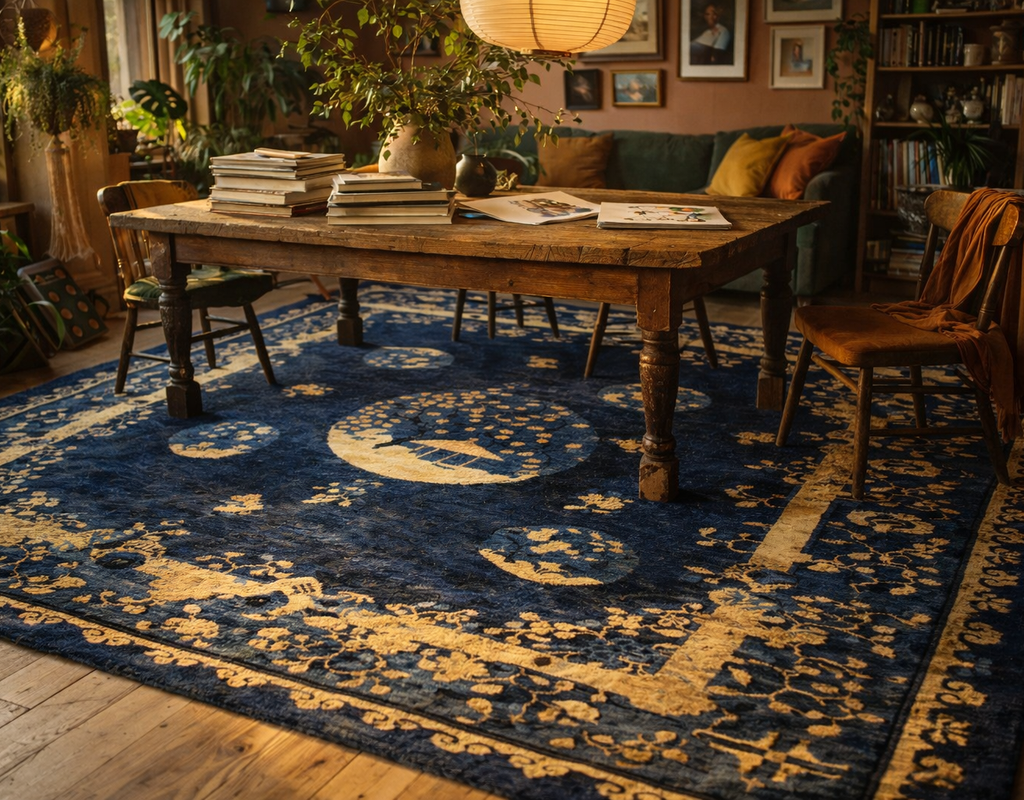
The perimeter of the rug is your true ‘Hero’; it is the frame that defines your dining area and the primary visual element that your guests will actually see. Understanding how to prioritize border scale, guard bands, and corner spandrels is the secret to selecting a rug that looks as grand in your home as it does in a gallery.
The “Hidden Field” Reality: Why the Border is Your Hero
In a living room, the center of the rug is the star. In a dining room, the center is a “Shadow Zone”—permanently obscured by the table’s footprint. When buying a dining room rug, you are primarily buying a Border.
1. The Perimeter Visual
The “visible real estate” of dining room rugs is the 24 to 30 inches that extend beyond the chairs. This is where the Main Guard and Secondary Borders do their work. A rug with a weak or thin border will look “lost” in a large dining room, while a complex, wide border acts as a frame that elevates the entire furniture set.
2. Pattern Scale & Visibility
Avoid rugs with small, intricate center medallions if you have a heavy pedestal table; the table will “suffocate” the art. Instead, look for All-Over patterns or Herati designs where the motif continues into the visible border, ensuring the rug feels cohesive even when the table is fully set.
Designer Tip: When viewing rugs online, crop the image in your mind. If you take away the middle 50% of the rug, do you still love what’s left? If the answer is no, it’s not the right rug for your dining room.
Breaking down the rug border
The Anatomy of a Dining Frame
When analyzing the border of potential dining room rugs, look for these three components:
- 1. Main Guard: The widest, most decorative band of the border. In a dining room, this should ideally sit entirely outside the “chair-pull” zone to remain visible at all times.
- 2. Secondary/Minor Borders: The thinner stripes flanking the main guard. These provide the “color bridge” between your rug and your flooring.
- 3. Spandrels (Corners): The design in the four corners of the central field. In dining rooms, the spandrels often “peek out” from under the table corners, providing a crucial visual link between the hidden center and the visible border.
Do You Need a Rug Under the Dining Table?
Practical Benefits
When asking do you need a rug under dining table setups, the answer depends on your performance requirements for the room. While not structurally mandatory, a rug provides critical functional advantages that bare floors cannot match. First, it offers essential floor protection. Without a buffer, the repetitive scraping of chair legs scratches hardwood and wears down finishes, leading to costly refinishing work.
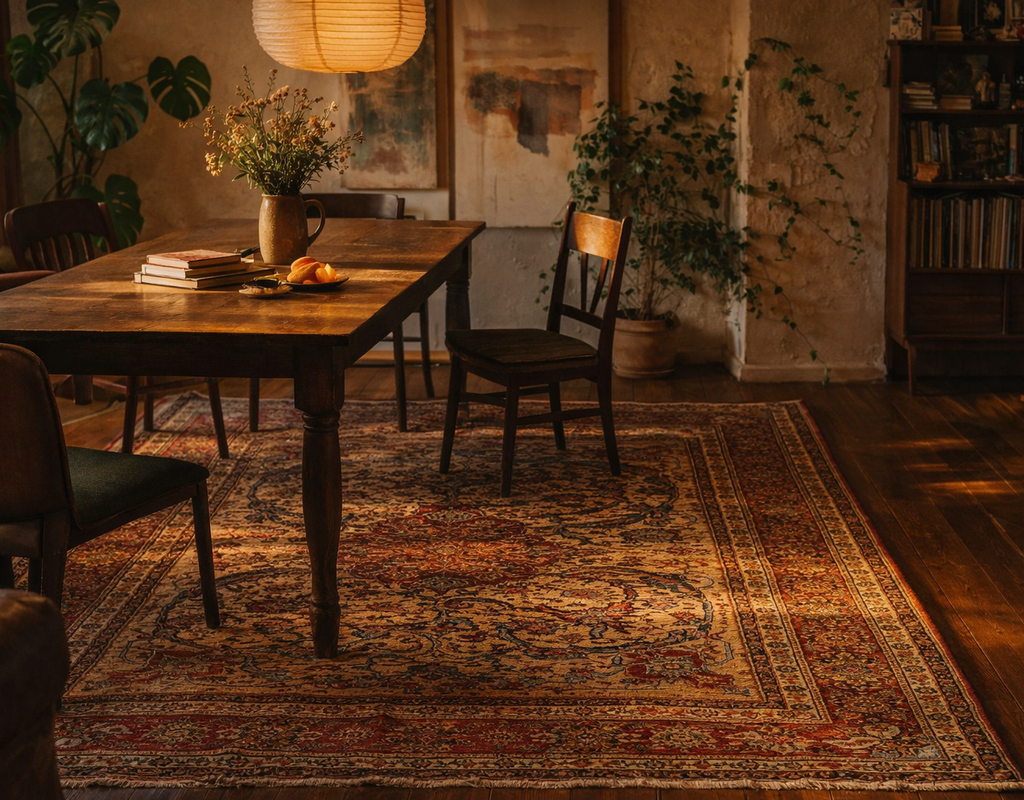
Second, dining room rugs, or any rug for that matter, significantly softens acoustics. Dining rooms are often filled with hard surfaces—tables, chairs, sideboards—that reflect sound. A rug absorbs the clatter of silverware, moving chairs, and conversation, making the space quieter and more intimate.
Finally, dining room rugs are a powerful visual tool. In open-concept homes, a rug acts as a boundary, creating a distinct zone for eating without the need for physical walls.
The Rare Instances Where Skipping the Rug is Smarter
There are specific scenarios where omitting the rug is the superior design choice. A rug under table worth it calculation fails if the room lacks adequate dimensions. If you cannot fit a rug large enough to accommodate fully extended chairs, you should skip it entirely. If the rear legs of a chair drop off the edge of the rug when a guest sits down, the rug becomes a tripping hazard and a nuisance.
Mobility is another factor; for households using walkers or wheelchairs, a bare floor offers safer, unimpeded movement. Additionally, in homes with high spill frequency—such as those with young children—the maintenance burden of scrubbing food soils out of fibers may outweigh the aesthetic benefits.
Is a rug under the dining table necessary?
No. It is optional, and your specific constraints regarding chair clearance and cleaning reality must decide the outcome.
Dining Room Rugs as “Room-Within-a-Room” Frame
Dining room rugs function as a “room-within-a-room,” visually anchoring the furniture to the floor. This concept relates closely to visual framing principles, where the textile provides a graphical border that organizes the space.
Does a too-Small Rug make rooms look smaller?
Yes. “Postage-stamp” small scatter size rugs that sit totally underneath the table make the dining set look cramped and shrink the perceived volume of the room. If you can’t keep chairs on the rug, you’ll hate it; the constant catching of chair legs on the rug binding destroys the user experience.
Collector vs Daily-Use Priorities
Dining room rugs are judged by cleaning and aging, not just their first impression. For this reason, the priorities for a dining space differ vastly from a low-traffic library or bedroom (a distinction further explored in. Dining rooms accelerate localized wear patterns because feet and chairs rub the exact same spots repeatedly.
While collectors may prioritize provenance and handwork, placing a delicate antique or high-value investment piece under a dining table is risky. The mechanical stress and soil load will degrade the value of a fragile textile quickly.
Most homeowners should reserve delicate pieces for lower-risk rooms and choose robust weaves for dining. Understanding the dining room rug pros and cons means accepting that this rug is a workhorse, not just an art piece.
5 Point Buyers Check list
Finalizing The Options
Check these 5 points before finalizing your selection.
Have you added at least 24 inches (ideally 30) to every side of your table dimensions? Ensure the back legs of your chairs stay on the rug when someone is seated.
Does the rug have a strong, wide border? Remember that the center will be obscured by the table; ensure the perimeter design is the “Hero” of the room.
Is the pile height 0.5 inches or less? Higher piles create “drag” that damages the rug’s foundation and makes chairs difficult to move.
Is the rug made of high-grade Wool or a solution-dyed synthetic? Avoid Viscose or “Art Silk” in dining areas, as they are permanently damaged by moisture/spills.
Does the rug have a reinforced edge or strong binding? Dining room rugss fail at the edges first due to feet and chairs stepping on and off the perimeter.
SHOP THE DINING ROOM COLLECTION
Curated for durability, scale, and design.
The Rugs On Net Advantage
Expertise you can visit. Convenience you can click.
The Digital Showroom
High-Resolution Transparency: Unlike standard retailers, we provide ultra-detailed photography of the back of the rug and the selvage (edges), allowing you to verify weave density and structural integrity from home.
Curated Selection, Lower Overheads: By streamlining our digital inventory, we offer gallery-grade Persian and Oriental rugs at prices that big-box showrooms simply cannot match.
Safe-Arrival Guarantee: Every dining room rug is professionally rolled, moisture-sealed, and double-wrapped to ensure it arrives in pristine, “ready-to-lay” condition.
The In-Person Expertise
The “Touch & Feel” Confidence: Visit our gallery to feel the lanolin-rich wool and check the “drape” of the rug in person. Seeing the abrash (natural color variation) under true lighting ensures zero surprises.
Consultative Sizing: Bring your dining table dimensions and floor plan. Our specialists will help you map out the “Chair-Drop” zone to ensure you never buy a rug that’s an inch too small.
Zero-Pressure Heritage: We are a second-generation family business. Our goal isn’t a one-time sale; it’s helping you find an investment piece that survives three decades of family dinners.
Not sure which direction to go? Speak with a rug specialist today for a personalized dining room recommendation.
Consult a Specialist
Dining Room Rugs Stress Test: Chairs, Compression, Shear, and Spills
Chair Movement vs Pile Physics
In a dining room, every meal involves mechanical stress. When a chair slides out from the table, it does not float; it drags. This creates a physics problem for the rug known as “chair shear.”
Why do dining chairs snag on thick rugs?
Thick or plush piles create resistance. The yarn stands up vertically, and when a chair leg pushes horizontally against it, the leg “grabs” the fiber. This action pulls at the yarn tips and strains the knot or backing, eventually shearing the fiber or unraveling the structure.
Chair shear is the hidden killer—pile height matters more than you think. A low-pile rug for dining chairs drastically reduces this friction. Low, dense structures allow the leg to glide over the top of the yarn rather than plowing through it, protecting the rug’s structural integrity.
Compression and Abrasion Zones
Dining rooms suffer from highly localized wear patterns. Unlike a long and narrow size space, such as a hallway, where traffic moves in a line, dining room rugs endure concentrated compression in specific zones. The area directly behind each chair suffers the most damage.
As sitters shift their weight or scoot closer to the table, the chair legs grind into the same small patch of rug repeatedly. This creates “chair tracks”—visible depressions where the pile is permanently crushed or abraded. Perimeter wear is also common, as guests step on and off the rug’s edge to access their seats.
Does a low-pile rug work better for chairs?
Absolutely. Denser, shorter piles resist crushing better than airy, high-pile textures, maintaining a uniform appearance despite the heavy compression load.
Spill Categories and Stain Behavior
Dining room spills fall into complex chemical categories: oils (salad dressing, butter), pigments (wine, turmeric, berries), and sugars (juice, soda). Each behaves differently when it hits a fiber. Oils cling to synthetics like Polyester, while pigments can dye natural fibers like wool if not treated immediately. Sugars are particularly insidious because they dry into a sticky residue that attracts dirt.
The best material for dining room rugs as far as spills is that they balance liquid repellency with cleanability, such as high-quality wool or solution-dyed performance fibers. A stain resistant dining room rug is not magic; it simply buys you time to react before the liquid bonds with the fiber dye sites.
The “Stain Trinity” Protocol
If you spill during a meal, follow these three steps immediately—in this order:
- Blot, Never Scrub: Scrubbing pushes pigments deeper into the Warp and Weft (the foundation).
- The White Towel Test: Use only undyed white towels. Paper towels with patterns can bleed ink onto your rug.
- Dilution over Chemicals: Most food stains are “dilute-able.” Use lukewarm water before reaching for harsh detergents.
Soiling Dynamics + Deep Cleaning Reality
The reality is that your dining room rugs will get dirty. Food particles, even microscopic ones, settle into the weave. Sticky dining soils turn into gray “traffic haze” without routine maintenance because sugars and oils act as a magnet for dust and shoe grime. The best dining room rugs hide “reality” and clean without drama.
- Prompt Spot Removal: Immediate action prevents liquid spills from oxidizing or penetrating the fiber shaft, which makes permanent staining less likely.
- Periodic Extraction Cleaning: Vacuuming only removes dry soil; hot water extraction is necessary to dissolve and flush out the sticky oils and sugar residues that vacuuming misses.
- Correct Chemistry Selection: Avoid household detergents on wool; high-alkaline soaps damage the fiber cuticle and leave a soapy residue that causes rapid re-soiling.
- Routine Vacuuming Schedule: Frequent vacuuming prevents dry grit from grinding against the fibers during chair movement, which accelerates abrasive wear.
Rug Construction Choices That Work Under Chairs
Flatweaves: Kilim/Dhurrie/Soumak/Tapestry
Should I choose wool, synthetic, or flatweave rugs?
If your priority is effortless chair movement, the answer is a flatweave.
Flatweave rugs are the functional gold standard for dining spaces. By design, they lack a pile, which eliminates the primary source of friction for moving furniture.
- Kilim: Reversible and lightweight, flatwoven kilims offer a tight weave that resists chair leg compression, though a rug pad is mandatory to prevent slipping.
- Dhurrie: Typically made of durable Cotton or wool, Dhurries provide a thick, sturdy foundation that withstands heavy foot traffic without bunching.
- Soumak: A specialized brocading technique creates a thicker, more substantial flatweave with a textured surface that is incredibly durable against abrasion.
- Tapestry Weaves: While often finer, tapestry weaves offer detailed patterns without the bulk of a pile, making them suitable for formal dining areas where aesthetics and clearance both matter.
Low, Dense Pile Dining Room Rugs
While flatwoven dining room rugs are the pragmatic choice, many homeowners prefer the softness of pile. A low pile rug for dining chairs can be luxurious without being “chair-hostile” if it is engineered correctly. The key is density. A rug with a low, tightly packed pile supports the weight of a chair leg on the tips of the fibers rather than letting it sink into the base.
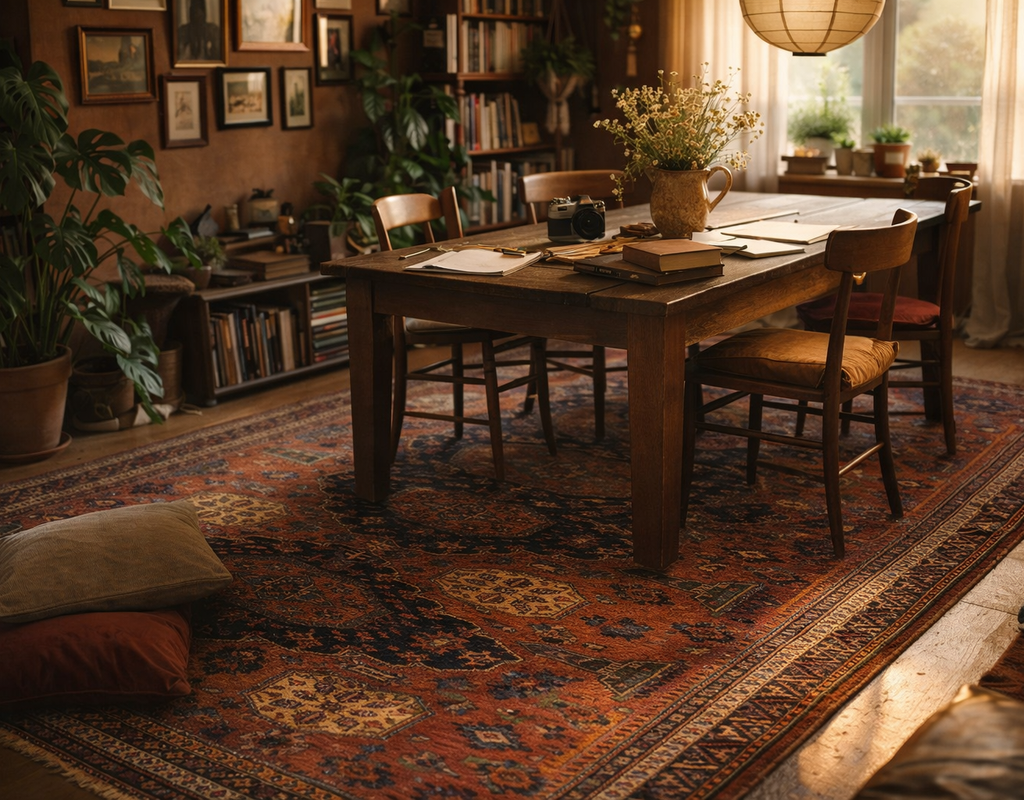
This firm structure ensures the chair glides across the surface. A quality low-pile rug also features a stable foundation, meaning the backing is stiff enough to prevent the rug from wrinkling or shifting as guests scoot their chairs in and out.
Identifying Construction from the Back
You cannot judge a rug’s durability by looking at its face alone. To understand how it will perform under a table, you must inspect the reverse side. A hand knotted rug for dining room use will show the pattern clearly on the back, mirroring the front. You should see individual knots tied around the warp threads, indicating a structural integrity where the pile is physically integrated into the foundation.
In contrast, a flatweave will display the interlaced wefts and warps directly. Avoid rugs where you see a fabric backing glued over the structure; this usually indicates a tufted rug. Tufted rugs rely on latex adhesive to hold the fibers in place, which can break down and delaminate under the pressure of shifting chairs.
Edge Engineering and Why It Matters
Edges are stress points for your dining room rugs—inspect finishing carefully. As chairs slide off the rug, they exert significant shear force on the perimeter. If the edge binding is weak, it will fray, unravel, or detach. Look for strong, reinforced selvages (the finished sides of the rug) that are wrapped tightly and securely.
The ends should be properly finished with a secure fringe or a folded hem. Stable corners are also critical; if they curl, they become a tripping hazard for anyone walking around the table with food or drink.
Comparison Matrix
| Construction Type | Chair Glide | Spill Practicality | Wear Pattern | Edge Risk | Best For |
|---|---|---|---|---|---|
| Flatweave | Excellent (Best) | High (Liquid sits on surface briefly) | Even surface wear; reversible | High (requires strong selvage) | High-traffic, casual, or modern spaces |
| Low-Pile Knot | Good | Moderate (Absorbs slower than plush) | Compression tracks can form | Moderate | Formal dining, acoustic dampening |
| Tufted | Fair | Poor (Difficult to deep clean backing) | Delamination / Shedding | Low (edges often glued) | Budget-conscious, short-term use |
| High-Pile / Shag | Poor (Worst) | Very Poor (Traps crumbs deep) | Matting and crushing | High (snagging) | Avoid for dining rooms |
Does a low-pile rug work better for chairs?
Yes, significantly better than high-pile options, but flatweaves remain the safest performance bet for chair movement overall. A kilim under dining table setups ensures that furniture never gets stuck, keeping the dining experience smooth and frustration-free.
Materials for Dining Rooms: Wool, Cotton, Silk, Synthetics/Blends
Wool: Resilient Crimp and Recovery
Wool remains the premier fiber for dining spaces primarily due to its physical structure. The fiber possesses a natural “crimp”—a spring-like shape—that allows it to compress under the weight of a chair leg and recover its loft once the pressure is removed.
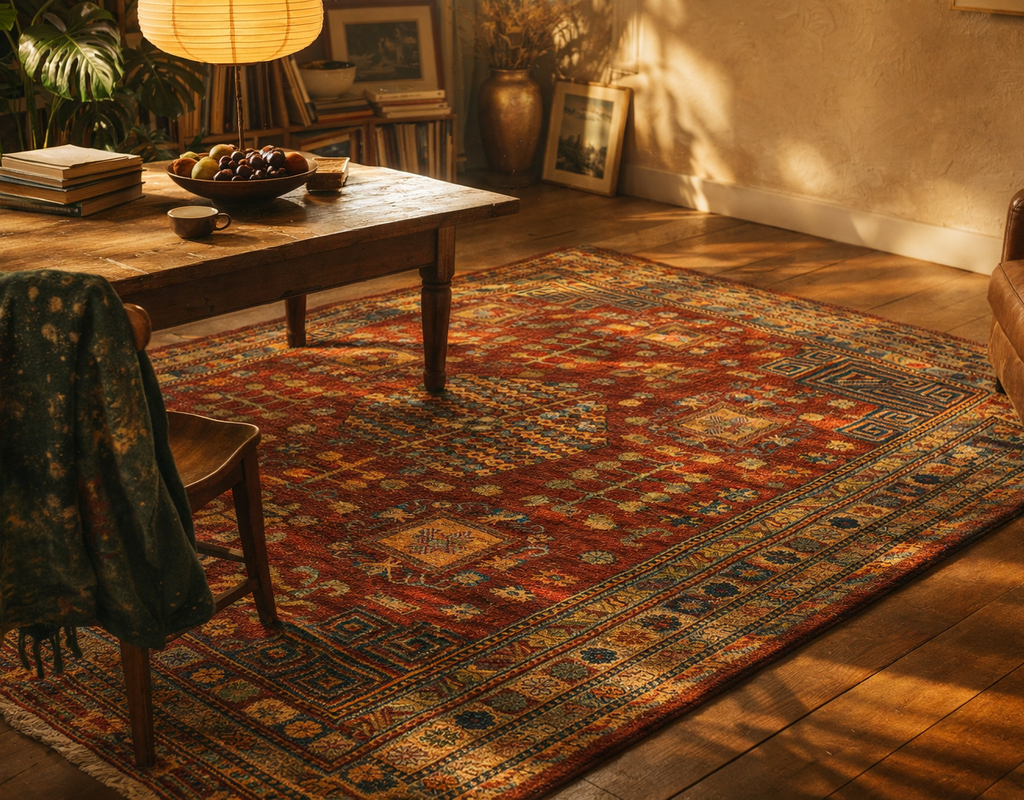
This makes wool exceptionally resistant to the permanent crushing that plagues other materials. However, wool dining room rug care requires specific chemistry. You must avoid generic household detergents; high-alkaline soaps strip the fiber’s protective cuticle and leave a sticky residue that accelerates rapid re-soiling.
Should I choose wool, synthetic, or flatweave rugs?
If you prioritize long-term appearance retention and textural warmth, wool is the superior choice, provided you commit to correct cleaning protocols. Wool is durable, but only if you clean it correctly.
Cotton: Foundations and Surface Behavior
Cotton is frequently used as the foundation warp and weft in flatweaves, providing a stable, non-stretchy base that keeps the rug flat on the floor. While mechanically strong, cotton is highly absorbent and lacks the stain-repelling oils found naturally in wool.
This makes it unforgiving in a dining environment. Light-colored cotton rugs will showcase every drop of wine or oil that misses the table. Consequently, cotton works best in dining rooms when used in darker, patterned flatweaves where the design can camouflage inevitable accidents.
Silk: Beauty vs Dining Risk
Silk rugs offer unmatched luster and color clarity, but these truly luxurious types of area rugs present a severe functional risk in a dining room. Silk fibers are easily damaged by abrasion and, more critically, by moisture. A simple water spill can alter the texture of silk permanently, causing the fibers to lay flat and lose their sheen.
Silk and high-use dining rarely mix well. This material should be reserved for strictly controlled environments—formal dining rooms used infrequently by adults only—where the risk of spills and heavy chair traffic is negligible.
Synthetics/Blends: Convenience and Emissions
For households where spills are a daily reality, synthetics like Polypropylene (olefin) and solution-dyed acrylics offer a pragmatic alternative. These are often the best rug material for spills because the plastic-based fibers have almost zero absorption rate; liquids sit on the surface rather than penetrating the dye sites. This makes synthetic dining room rugs easy clean and highly practical for families with young children.
When is an indoor-outdoor rug best for dining? An indoor-outdoor synthetic rug is the best choice for high-traffic, high-mess homes where ease of maintenance outweighs the need for plush texture. If spills are constant, prioritize cleanability over romance.
However, because these are petroleum-based products, buyers sensitive to chemical off-gassing should look for low emission rug options certified by credible programs like Green Label Plus or Oeko-Tex.
What rug materials handle food spills easiest?
Synthetics win this category decisively, as they can often be cleaned with more aggressive solutions that would ruin natural fibers.
Decision Table
| Material | Compression Recovery | Spill Tolerance | Cleaning Sensitivity | Best Dining Use Case |
|---|---|---|---|---|
| Wool | Excellent (Springs back) | Moderate (Repels naturally if addressed fast) | High (Needs neutral pH) | Daily use, long-term durability |
| Synthetics (Polypropylene) | Poor (Crushes easily) | Excellent (Non-absorbent) | Low (Can handle bleach solutions) | High-spill zones, families with kids |
| Cotton | Moderate | Low (Highly absorbent) | Moderate (Washable but shrinks) | Casual spaces, flatweaves |
| Silk / Viscose | Very Poor (Flattens permanently) | Very Poor (Water damages texture) | Extreme (Professional only) | Visual only; rarely for dining |
Size, Overhang, and Chair Clearance: The Non-Negotiables
How Big Should a Rug Be Under the Table?
The rug must be large enough to accommodate the table and the chairs when they are pushed back for someone to sit or stand. If a guest slides their chair out and the rear legs drop off the edge onto the bare floor, the rug is too small.
This creates a tipping hazard and damages the rug binding through constant friction. Therefore, function dictates that the rug must fully contain the dining set during use, not just when the chairs are tucked in.
The most critical error in dining room rug size guide logic is sizing the rug to the table rather than the activity.
Overhang Past Dining Chairs
To ensure stability and safety, specific measurements must be applied to the perimeter of the table.
How much rug should extend past dining chairs?
The industry standard is a minimum of 24 inches (60 cm) on all sides, though 30 inches is safer for relaxed dining.
- Minimum 24-Inch Extension: This covers the typical distance a chair travels when a person slides back to stand up, keeping all four legs on the textile.
- Ideal 30-Inch Extension: This provides a buffer zone for larger guests or more relaxed seating postures, ensuring no accidental “drop-offs” occur.
- 36-Inch Extension for Head Chairs: Armchairs at the head of the table often require more depth to maneuver than side chairs, necessitating extra length at the rug ends.
Balancing Rug Size with Room Clearance
While the table dictates the minimum size, the room boundaries set the maximum.
How do I balance rug size with room clearance?
You must leave a strip of exposed flooring around the perimeter of the room to frame the space and prevent it from looking like wall-to-wall carpeting.
Where should rug edges sit relative to walls?
Ideally, leave 12 to 18 inches of bare floor between the rug edge and the wall or sideboard. You must also account for your dining room rugs clearance rules regarding architectural features; ensure they do not obstruct door swings or encroach into high-traffic walkways where the edge could become a tripping hazard.
Should the Rug Fit the Table or the Room?
The rug must fit the table first. If you compromise on the 24-inch overhang rule to fit a small room, the dining experience will suffer. If chair legs hit bare floor, your rug is too small, regardless of how nice the pattern looks.
Size mistakes cause more regret than color mistakes because they impact usability every single day. If the room is too narrow to support the proper overhang, it is better to skip the rug entirely than to force a dysfunctional fit.
The “Chair-Drop” Safety Audit
A rug that fits the table but fails the chair is a safety hazard. Perform this “Stress Test” before finalizing your rug dimensions:
Pull your dining chair out to the exact distance needed for a guest to sit down. Measure from the table edge to the back legs of the chair. If it’s more than your planned rug edge, your guests will “drop off” and tip the chair.
When a chair is half-on and half-off a rug, it puts uneven pressure on the chair joints and the rug’s binding. This is the #1 cause of “binding blowout”—the premature unraveling of the rug’s edge.
Common Table Sizes
| Table Seats | Typical Rug Size Range | Notes/Constraints |
|---|---|---|
| **4 Seats (Round/Square)** | 8’ x 8′ Round or 8’x10’ | Ensure corners of a square rug don’t block walkways. |
| **6 Seats (Rectangular)** | 8’x10’ or 9’x12’ | What rug size works for six-seat tables? An 8×10 is the minimum, but a 9×12 is often required if the chairs are bulky. |
| 8 Seats (Rectangular) | 9’x12’ or 10’x14’ | A rug size for 6 seat dining table will rarely fit an 8-seater; do not downsize. |
| 10+ Seats | 10’x14’ or Oversized / Custom | Oversized tables often require custom-cut broadloom or oversized Vintage Rugs. |
Shape Matching: Rectangle, Round, Oval, and “Break the Rules” Cases
What rug shape suits my dining table best?
Generally, the shape of the area rug should mirror the table shape to create a harmonious visual frame. A rectangular table pairs naturally with a rectangular rug, while a round table sits best on a round or square rug. This mirroring ensures that the clearance distance remains consistent on all sides, allowing guests to push back their chairs without dropping off the edge unexpectedly.
While shape is important for aesthetics, it is secondary to function; chair clearance is primary. If a stylishly shaped rug fails to keep the chair legs on the pile, it is the wrong choice.
The primary goal of selecting a dining room rug shape is to ensure symmetry with the chair paths.
Can I use a round rug with rectangle table?
The answer is yes, but with significant caveats. This “rule-breaking” configuration works only when the round rug is exceptionally large—large enough that the corners of the rectangular table do not visually pierce the circle’s boundary, and the chairs remain fully on the rug even when pulled out from the table’s corners.
Breaking the rules works when function still works. If the geometry forces corner-seated guests to balance their chairs on the rug’s edge, the design has failed. Often, a round rug under rectangular table setups requires a custom size that is difficult to find in standard retail options.
Extendable Tables: How to Measure
Tables with leaves present a unique challenge for extendable table rug sizing. You must always size the rug for the table’s fully extended state, not its daily compacted size.
- Measure Max Length: If you size for the closed table, deploying the leaves will push the end chairs off the rug, creating a tripping hazard during large gatherings.
- Add 48-60 Inches Total: To accommodate the 24-30 inches of pull-out space required at both ends of the fully extended table.
- Check Room Clearance: Verify that this maximum rug size still leaves the required 12-18 inches of bare floor around the room perimeter.
Avoiding Room-Shrinking Visuals
A common visual error is selecting a rug that is too small for the room’s volume, which paradoxically makes the space feel cramped. Rectangle vs round dining room rugs options will impact perceived scale.
A rug that barely contains the table creates a “floating island” effect that disconnects the dining set from the rest of the room. By extending the rug boundaries generously, you anchor the furniture and expand the perceived floor area. Proper margins—balancing the rug size against the walls—ensure the room feels spacious and intentional rather than cluttered.
Pattern, Color, and “Dining Clutter”: Choosing What Hides Real Life
Pattern Scale That Camouflages Crumbs and Lint
A dining room is a working environment, and the floor will inevitably collect debris. The best pattern for dining room rug selection is one that offers effective camouflage. Camouflage is a feature, not a compromise.
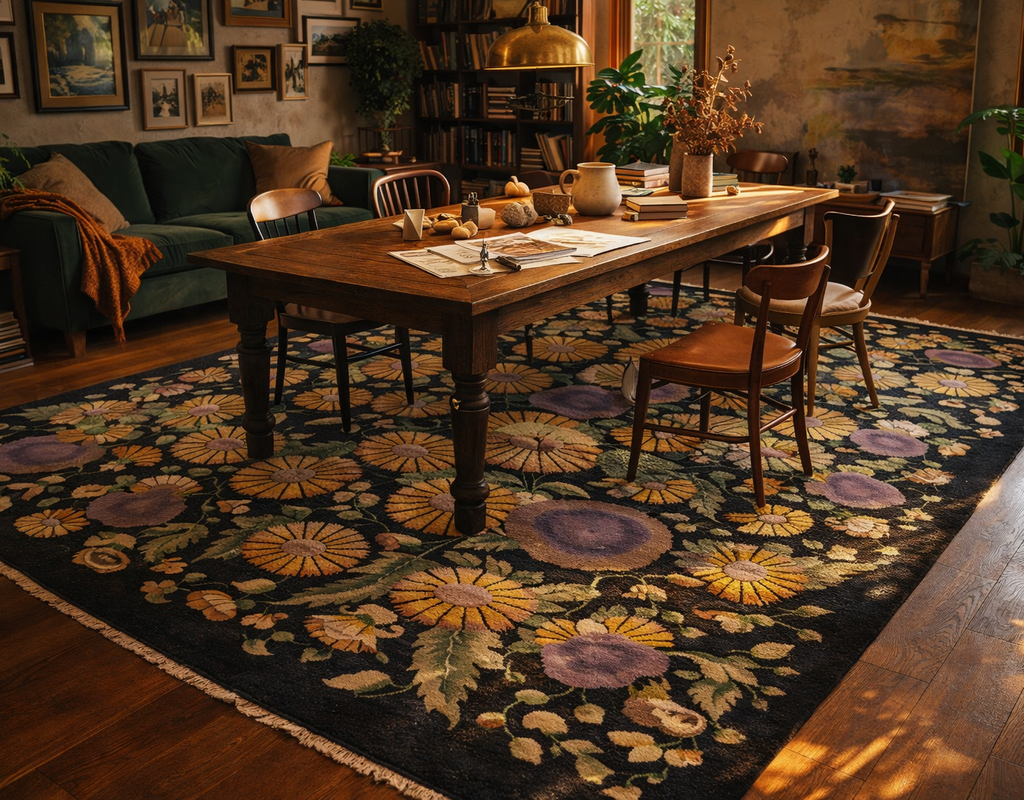
Mottled grounds, intricate abrashes (color variations), and small-scale repeats are visually dense enough to absorb the appearance of breadcrumbs, lint, and pet hair between vacuuming sessions. In contrast, large-scale geometrics with vast fields of open color act as a spotlight for every speck of dirt.
How do rug patterns affect dining room clutter?
Busy, tight patterns reduce the visual noise of daily mess, making the room look cleaner than it actually is, whereas sparse patterns amplify the clutter by providing a high-contrast background for debris.
Color Palette for Stains and Fading
When selecting a color palette, prioritize multi-tonal designs over flat, pale fields. Dining room rugs that hide stains typically utilize mid-range tones—think terracotta colors, olives, navies, or complex neutrals—interwoven with accent colors.
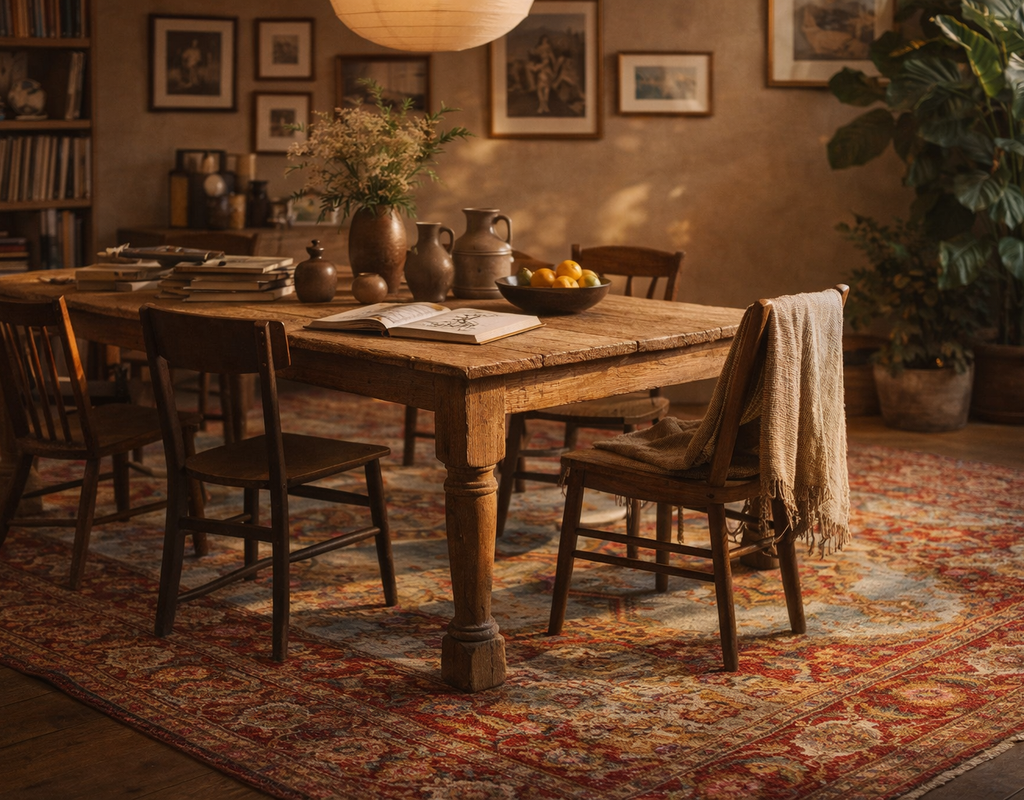
This complexity means that if a spill occurs and leaves a faint residue, it blends into the design rather than standing out as a blemish. Flat, solid colors, especially light pastels or dark navies, are unforgiving; light solids show liquids, while dark solids show dust and crumbs instantly.
Border Logic: Containing Footprint and Disguising Edges
Borders serve a dual purpose: aesthetic framing and functional masking. A rug border for dining room setups acts as a visual container for the table and chairs, grounding the furniture arrangement. More importantly, borders can make wear zones look intentional.
The perimeter of dining room rugs suffer the most foot traffic and chair drag. A rug with a distinct, patterned border (the “guard border”) can disguise the inevitable abrasion and crushing that occurs at the rug’s edge, keeping the central field looking pristine for longer.
Quick Selection Recipes
To choose a patterned rug under dining table setups that forgive daily life, follow these proven recipes:
- **Traditional Heriz or Serapi**: Their Geometric medallions and heavily patterned fields are historic champions at hiding wear and spills.
- **Small-Scale All-Over Floral**: The lack of a central focal point means chair legs won’t obscure the design, and the busy pattern hides dropped food effectively.
- Heathered or Striated Solids: If you prefer a modern look without pattern, heathered yarns (mixed colors spun together) provide enough texture to mask lint that flat solids cannot.
- Darker Borders with Lighter Centers: This frames the table dramatically while placing the most forgiving, stain-hiding colors at the perimeter where foot traffic is heaviest.
Value, Longevity, and When Dining Use Hurts Collectibility
How Dining Use Impacts Value
Placing a textile under a dining table is a value decision, not just a style decision. Dining rooms are unique environments where wear is not distributed evenly; instead, it is highly concentrated.
How dining room rugs wear under dining chairs follows a predictable, destructive pattern: localized compression tracks form behind the chairs, spills oxidize into the foundation, and edges fray from constant friction.
For collectible or investment-grade rugs, this environment can rapidly depreciate market value. Condition issues in dining are predictable—plan for them. If a rug loses its pile in specific spots or suffers permanent staining from food oils, its resale potential plummets, regardless of its initial pedigree.
“Looks Expensive Longer” Principle
The “looks expensive longer” principle dictates that a rug’s long-term beauty is defined by its condition, not its price tag. A modest, Durable Rug that remains flat and clean looks far more luxurious than a five-figure antique that is wrinkled, stained, and threadbare.
To achieve **dining room Rug Durability, the rug must remain flat, stable, and cleanable over time. This relates directly to the material and construction choices.
When asking should I choose wool, synthetic, or flatweave rugs?
The answer for value retention is simple: choose the material that can withstand the specific abrasion of your household without degrading. Robust structure preserves beauty longer than delicate luxury.
Placement Strategy for Antiques/Vintage
If you wish to protect antique rug from dining wear, you must be strategic. Not every vintage piece can survive the mechanical stress of a dining room.
- **Select “Village” or “Tribal rugs“**: These rugs (like Heriz or Bidjar) were originally woven with thicker, sturdier wool and bolder patterns that naturally mask wear and repair better than finely woven rugs from city workshops.
- Avoid High-Contrast Open Fields: An antique with a large, open field of pale ivory or solid red will highlight every drop of wine or wear pattern, ruining its aesthetic value immediately.
- Rotate the Rug Annually: Rotating the rug 180 degrees ensures that the traffic patterns and sun exposure are distributed evenly, preventing one side from disintegrating while the other remains new.
- Use a Felt-Rubber Pad: A high-quality pad absorbs the crushing weight of the table and chairs, reducing the shear force exerted directly on the delicate knots of the antique.
Authenticity and Provenance as Value Multipliers
For true collectors, authenticity and provenance are massive value multipliers, but they are fragile. Provenance adds credibility and historical weight to a piece, but that history is compromised if the rug is abused. A rug with a prestigious lineage loses that status if it is heavily restored due to dining room damage.
The best rug construction for heavy use dining is one that balances aesthetic appreciation with structural reality. Misunderstanding this balance is a frequent error. Ultimately, if you cannot tolerate the inevitable depreciation caused by food and friction, the rug belongs in a living room or library, not under a dining table.
Rug Pads, Grip, and Setup: Keeping Everything Flat and Safe
What Rug Pad Is Best for Dining Rooms?
The setup of a dining room rug is incomplete without the correct underlayment. The question of what rug pad is best for dining rooms centers on a critical balance: you need maximum grip to prevent the rug from shifting, but you must avoid excessive cushion that hinders chair movement. A thick, pillowy pad feels nice underfoot but causes chair legs to sink, creating drag and resistance when guests try to scoot closer to the table.
Therefore, the best rug pad for dining room use is a low-profile felt and rubber hybrid. The rubber bottom locks the pad to the floor, while the dense felt top grabs the rug’s backing to prevent rippling, all without adding squishy height that compromises stability.
Preventing Shifting and Bunching
Chair movement creates significant shear forces. Every time a chair slides back, it pushes the rug with it. To keep dining room rugs from sliding and bunching up, you must address the physics of friction.
- Select a Felt-Rubber Hybrid: The rubber side prevents the pad from sliding on the floor, while the rough felt texture “velcros” to the rug backing to stop the textile itself from creeping.
- Size the Pad Correctly: The pad should be cut 1 inch shorter than the rug on all sides; this allows the rug edges to taper down to the floor, reducing the tripping hazard at the perimeter.
- Tape for Flatweaves: Lightweight flatweaves often need double-sided rug tape at the corners in addition to a pad to prevent the lightweight edges from curling up under foot traffic.
Edge Placement Relative to Walls
Proper setup extends beyond the pad itself to the rug’s position in the room. Ensuring the rug edges are parallel to the walls and furniture creates a sense of order. More importantly, keeping the rug flat prevents edge damage. If a rug is not anchored securely, the edges will curl or ripple, becoming “snag zones” for moving feet and furniture.
A non slip rug pad ensures the entire assembly stays planar, protecting the vulnerable binding from premature abrasion. Setup details are cheap insurance; a $100 pad can double the lifespan of a $3,000 rug.
Comparison Table
| Pad Type | Grip | Cushion | Chair Glide | Floor Safety Notes |
|---|---|---|---|---|
| Felt + Rubber (Low Profile) | Excellent | Low (Firm) | Excellent | Safe for all floors; best rug pad for chair movement |
| Pure Rubber Mesh | Good | None | Good | Can stick to or stain older finishes; provides no structure |
| Thick Felt (No Rubber) | Poor | High | Poor (Sinks) | Best for heavy furniture that doesn’t move (not dining) |
| Memory Foam | Poor | Very High | Very Poor | Avoid; chairs will wobble and drag heavily |
Care Plan for dining room rugs: Spot Response + Deep Cleaning
Fast Spot Response and Why Timing Matters
When a spill occurs, the clock starts ticking. The first 5–15 minutes after a spill matter most because liquids begin to oxidize or bond with the fiber’s dye sites immediately. On wool rugs, the natural lanolin coating offers a brief window of repellency, but once that barrier is breached, the stain can become permanent.
For natural dyes, acidic liquids like wine or vinegar can destabilize the color if not neutralized quickly. How to clean dining room rug emergencies begins with blotting, never rubbing. Rubbing drives the liquid deeper into the pile and can distort the yarn’s twist, leaving a fuzzy patch even if the stain is removed.
Routine Maintenance Plan
A simple maintenance routine preserves color and texture, preventing the “graying out” caused by sticky food soils attracting dust.
Some routine maintenance suggestions:
- Vacuum Weekly (Canister Mode): Use suction only or a high-pile setting to remove dry grit without shredding the fiber tips with a beater bar.
- Blot Spills Immediately: Removing the bulk of the liquid prevents it from soaking into the cotton foundation, where it can cause dry rot or mildew.
- Rotate Every 6-12 Months: This distributes the mechanical wear of chair drag and foot traffic evenly, preventing one side from balding prematurely.
- Annual Professional Wash: Professional Rug cleaning dining room services remove the sticky residues and deep-set oils that vacuuming cannot reach.
Professional Cleaning and Certification
Not all cleaners are created equal. For handmade rugs, in-plant washing is superior to on-location steam cleaning. In-plant cleaning involves dusting (removing dry soil), submersion washing, and controlled drying, which flushes out contaminants completely.
On-location cleaning often leaves detergent residue behind, which attracts dirt rapidly. Always seek certified technicians (like those with IICRC or ARCS credentials) who understand fiber-specific chemistry.
What rug materials handle food spills easiest?
Synthetics are easier to clean with standard solutions, but wool requires pH-neutral cleaners handled by professionals to avoid damaging the fiber cuticle.
Misconceptions That Ruin Rugs
Many homeowners inadvertently destroy dining room rugs by following bad advice.
Some bad advice you should not follow:
- “Scrub Hard to Remove Stains”: Aggressive scrubbing permanently damages the pile texture, often leaving a fuzzy, distorted spot that looks worse than the stain itself.
- “Use Dish Soap on Everything”: High-alkaline dish soaps can cause color bleeding in natural dyes and leave a sticky residue that accelerates re-soiling.
- “Soft and Thick is Best”: As emphasized throughout this guide, plush piles trap crumbs deep in the weave and fight against chair movement, making them a functional failure for dining.
- “Club Soda Removes Wine”: While it can dilute the stain, the carbonation does nothing chemically to break down the pigment; plain water and blotting are often just as effective without the risk of setting the stain with incorrect pH.
By selecting a durable construction initially and then committing to this care plan, you ensure your investment survives the daily rigors of dining use. Wrong cleaners can make rugs look dirty faster over time, so sticking to a “less is more” approach with chemistry is often the safest path.
Special Situations and Final Buying Checklist
Indoor-Outdoor Rugs for Dining
It is the superior choice when stain frequency is high and maintenance time is low. These types of area rugs are typically made from solution-dyed synthetics like polypropylene, which means they are non-absorbent and can often be taken outside and hosed down. The trade-off is texture; they lack the warmth of wool, but they offer unmatched resilience against spills that would ruin a natural fiber rug.
Layering Over Wall-to-Wall Carpet
Yes, but stability is the primary challenge. Without a firm foundation, dining room rugs will “creep” and wrinkle as chairs move, creating dangerous tripping hazards.
To succeed, you must use a specialized “carpet-to-rug” pad that is stiff enough to lock the top rug in place. Additionally, dining room rugs must be flatweave or very low pile; adding a thick rug on top of a thick carpet creates an unstable, squishy surface that makes chairs wobble.
Adding a rug over existing carpet requires careful engineering to prevent buckling.
Flammability Compliance Contexts
While less critical for single-family homes, flammability standards are vital for multi-family units and commercial spaces. Rugs placed in egress paths or dining halls must often meet specific fire codes (like DOC FF 1-70 in the US).
Wool is naturally flame-retardant and self-extinguishing, making it the safest choice for areas near kitchens or fireplaces. Synthetics melt, which can be a hazard in commercial dining environments. Ignoring flammability frameworks can carry liability risks in regulated building contexts.
Final Buying Checklist
Use this dining room rug buying checklist to ensure your purchase meets every functional requirement:
- Correct Size (24″+ Overhang): Ensure all chair legs stay on the rug when guests are seated to prevent tipping and edge damage.
- Low Profile Pile or Flatweave: A low pile allows chairs to glide smoothly and prevents deep soil entrapment.
- Strong, Secure Edges: The perimeter endures constant friction; weak binding will unravel quickly under chair legs.
- Forgiving Pattern / Color: Mottled designs and mid-tones hide crumbs and minor spills better than solid blocks of color.
- Appropriate Material: Choose wool for longevity and crush resistance, or synthetics for the best rug for messy dining area scenarios where bleaching spills is necessary.
Biggest Mistakes and Quick Fixes
Avoiding these common pitfalls ensures your dining room remains functional and safe:
- Buying Too Small: If chairs drop off the edge, the rug is a failure.— Fix: Upsize to the next standard dimension (e.g., 8×10 to 9×12).
- Selecting High Pile / Shag: Chairs get stuck and crumbs disappear forever.— Fix: Replace with a dense low-pile or flatweave immediately.
- Skipping the Rug Pad: The rug will slide and bunch, causing accidents.— Fix: Install a felt-rubber hybrid pad cut 1 inch shorter than the rug.
- Assuming “Stain-Proof” Means Zero Care: All rugs get dirty; neglecting vacuuming ruins the fiber.— Fix: Implement a weekly vacuuming routine and blot spills instantly.
By prioritizing mechanics over aesthetics. The best dining room rugs are boringly functional—they lay flat, clean easily and allow furniture to move without resistance—and because of that, they stay beautiful for years.
Rugs On Net – Your Best Option For Buying Dining Room Rugs
Why Your Dining Room Rugs Starts Here
The dining room is the most “technical” rug placement in your home. It isn’t just decor; it’s a structural component of your floor. Whether you are shopping our digital gallery or visiting us in person, we treat the quest for beautiful dining room rugs as a performance investment.
1. The “Performance Audit”
Every rug in our dining collection is pre-vetted for “Chair-Shear” resistance. We don’t just sell high-pile shags—we curate low-profile, high-density weaves that handle the mechanical stress of daily meals.
2. Honest Material Disclosure
We provide full transparency on fiber behavior. We’ll tell you exactly how a wool rug will handle a red wine spill versus a synthetic alternative, so you buy with the reality of your household in mind.
3. Precision Sizing Expertise
Buying online often leads to “size anxiety.” Our specialists provide custom measurement consultations to ensure your dining room rugs respect your room’s clearance—guaranteeing no chair-leg-drop-offs.
Curated for durability, scale, and design.
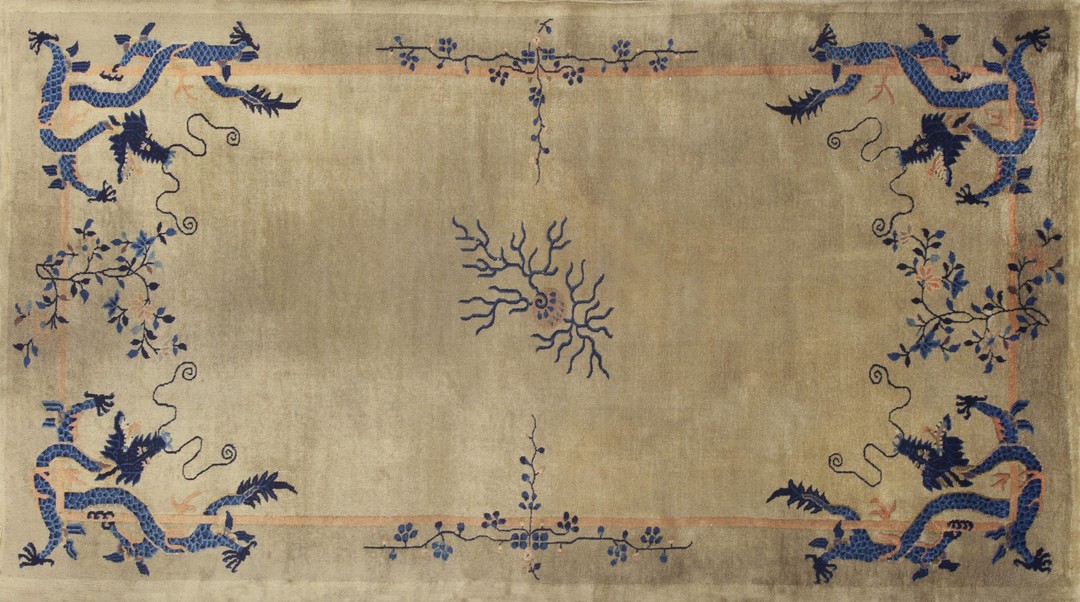
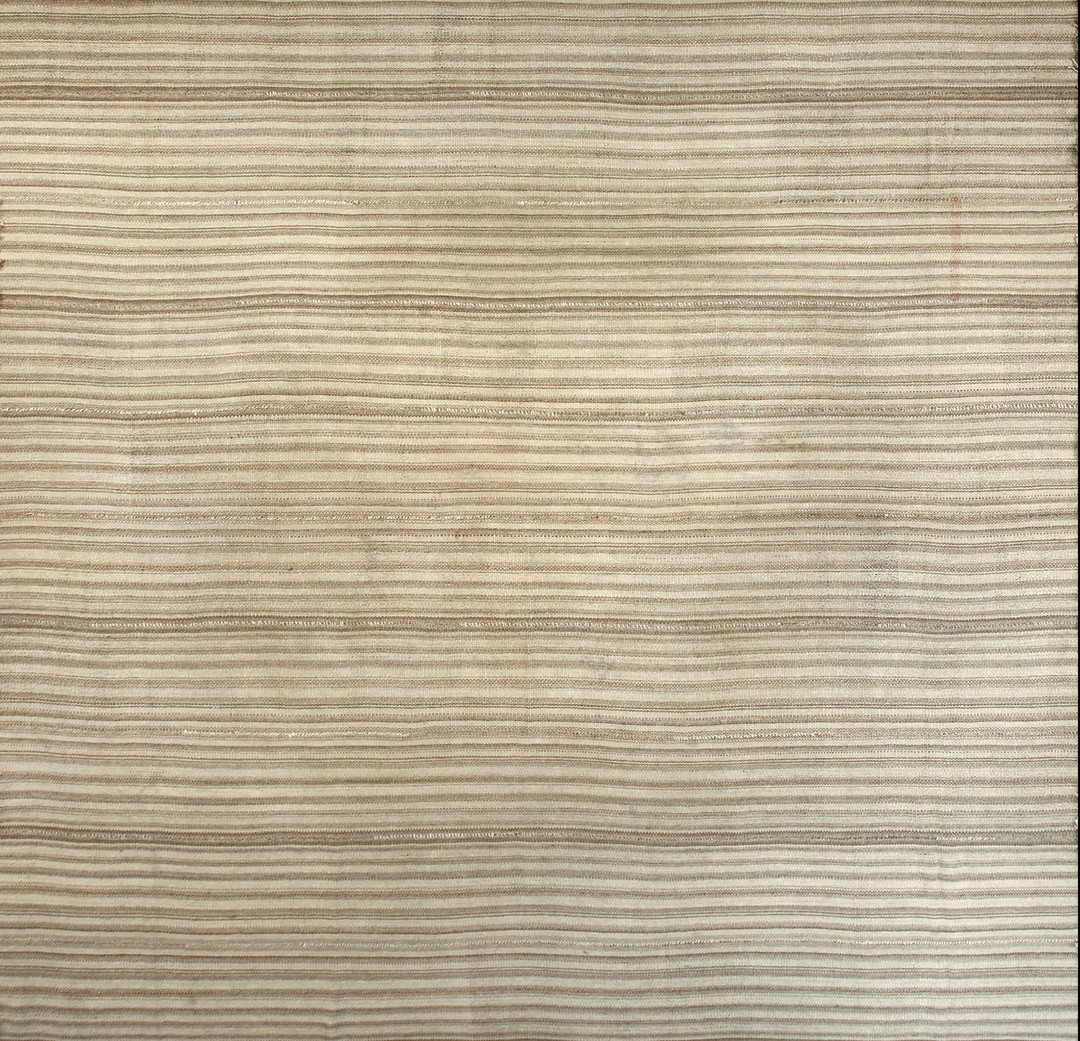
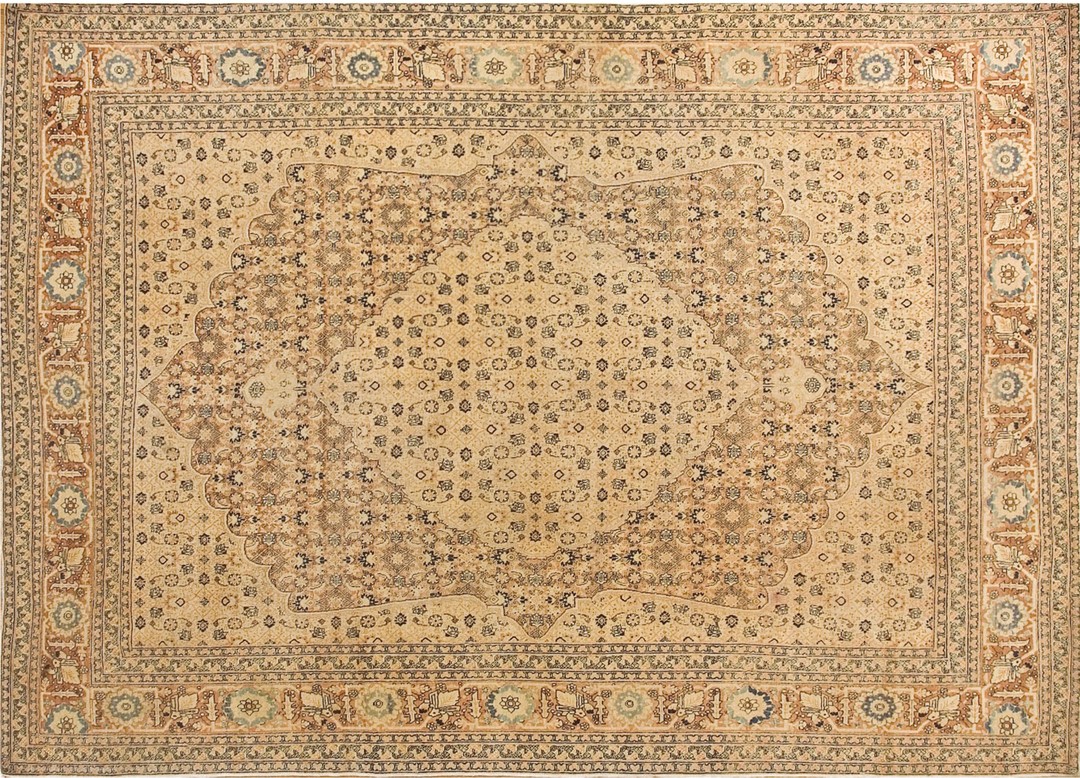
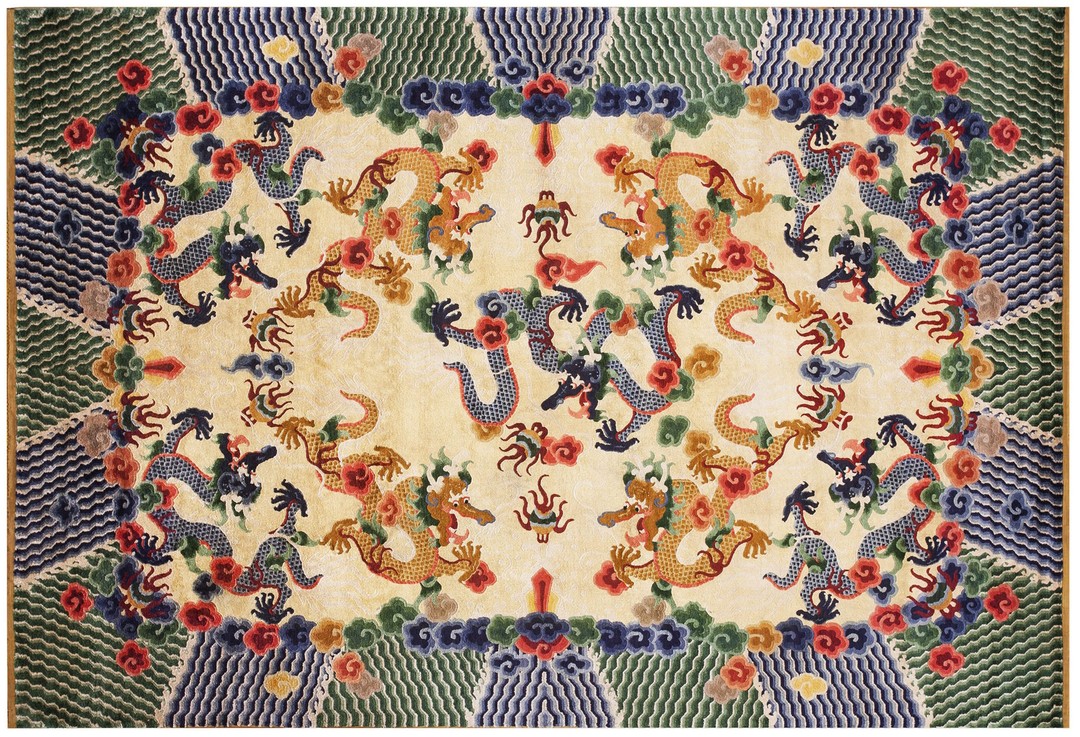
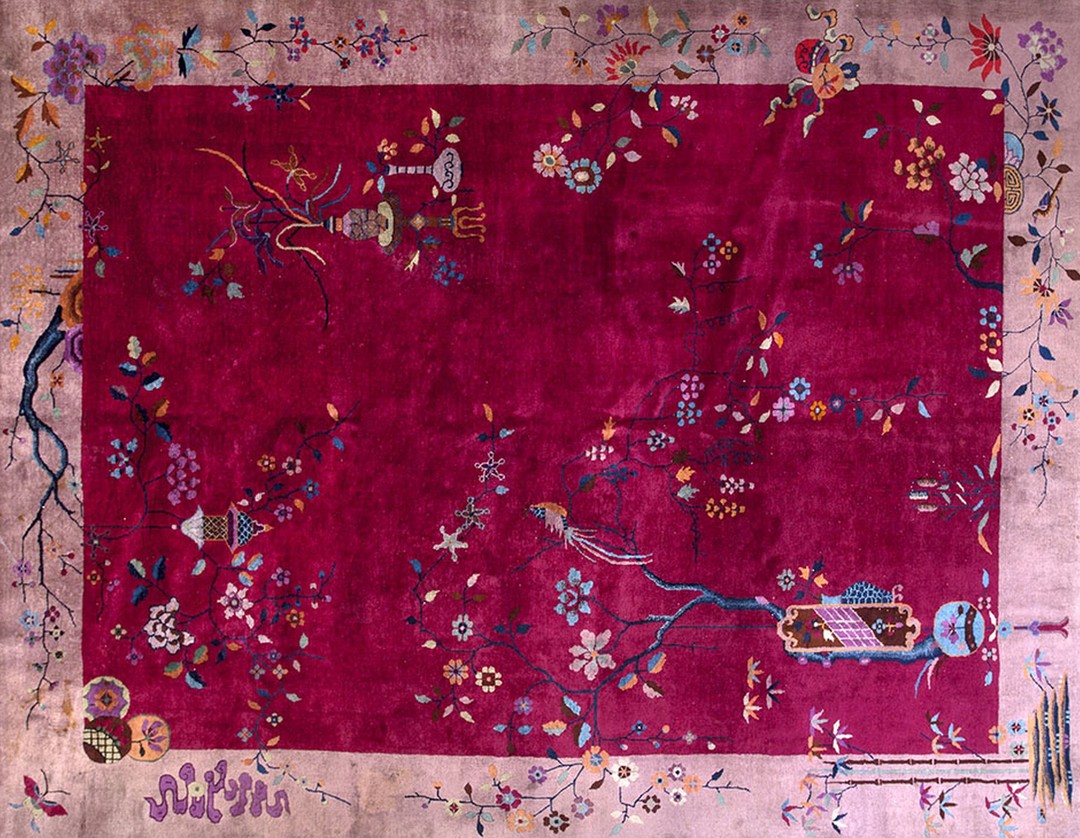
Explore a Few of Our Favorite Dining Room Rugs
FAQ
- What’s the biggest mistake when buying dining room rugs?
The biggest mistake when buying dining room rugs is choosing one that’s too small. Chairs should never slip off the rug when pulled back.
- Is it okay if dining room rugs extend into walkways?
Dining room rugs can extend into walkways if they’re flat and secured. Avoid thick edges that may cause tripping.
- Can dining room rugs make a small space feel larger?
The right dining room rug can visually anchor the table and define the space. Choosing the correct size prevents the room from feeling cramped.
- How often should dining room rugs be cleaned?
Dining room rugs should be vacuumed weekly and deep-cleaned every 12–18 months. High-use homes may need more frequent care.
- Are jute or sisal rugs good for dining rooms?
Jute and sisal dining room rugs offer texture but stain easily. They’re better for low-spill households or formal dining rooms.
- Do dining room rugs protect floors?
Dining room rugs help protect floors from chair scratches and spills. A rug pad adds extra protection against wear.
- How thick should a dining room rug be?
Dining room rugs should be thin enough for chairs to move easily. Thick or plush rugs often cause wobbling or catching.
- Can dining room rugs be layered?
Layering dining room rugs is possible, but the top rug should be flat and secure. Slipping layers can create safety issues.
- Should dining room rugs be centered under the table?
Yes, dining room rugs should be centered under the table, not the room. This keeps chairs evenly placed on all sides.
- Are synthetic rugs practical for dining rooms?
Synthetic dining room rugs are practical for easy cleaning and lower cost. Many resist stains well but may show wear faster than wool.
- What colors work best for dining room rugs?
Mid-tone or darker dining room rugs hide stains better than very light shades. Warm colors often complement wood tables and floors.
- Can I use an antique rug as a dining room rug?
Antique dining room rugs can be used, but they require careful maintenance. Lower-traffic dining areas are safer for older, delicate rugs.
- How much clearance should dining room rugs have from walls?
Dining room rugs usually look best with 8–24 inches of floor showing around the edges. This keeps the room balanced and open.
- Are patterned dining room rugs better than solid ones?
Patterned dining room rugs hide stains and crumbs better than solid colors. Small-scale patterns are especially forgiving in high-use spaces.
- What rug shape works best for dining rooms?
Rectangular dining room rugs suit most tables, while round rugs pair well with round tables. The rug shape should echo the table shape.
- Can dining room rugs work with rolling chairs?
Dining room rugs can work with rolling chairs if the rug is low-pile or flatweave. Thicker rugs may make rolling difficult.
- Do dining room rugs need a rug pad?
Yes, a rug pad helps dining room rugs stay in place and reduces wear. A thin, firm pad works best under dining tables.
- How do I clean spills on dining room rugs?
Blot spills immediately with a clean cloth when cleaning dining room rugs. Avoid rubbing, and use mild soap and water for most food accidents.
- Are flatweave rugs better for dining rooms?
Flatweave dining room rugs are popular since they sit flat and allow smooth chair movement. They’re also easier to clean after meals.
- Are wool rugs good for dining rooms?
Wool dining room rugs work well because they’re durable and naturally stain-resistant. They also recover better from chair pressure than many synthetic fibers.
- What pile height is ideal for dining room rugs?
Low-pile dining room rugs are ideal because chairs slide easily and crumbs don’t get trapped. Flatweaves and low-cut piles are common choices.
- Should dining room rugs go under the chairs?
Yes, dining room rugs should extend under all chairs, even when they’re pulled back. This prevents chair legs from catching on rug edges during use.
- What size rug is best for a dining room table?
The best dining room rug size allows chairs to stay on the rug when pulled out. For most tables, this means adding 4 feet to both the length and width.
- What should I consider first when buying dining room rugs?
Size and placement come first when buying dining room rugs, ensuring all chairs fit on the rug. Most dining rooms need at least 24 inches of rug beyond the table edges.