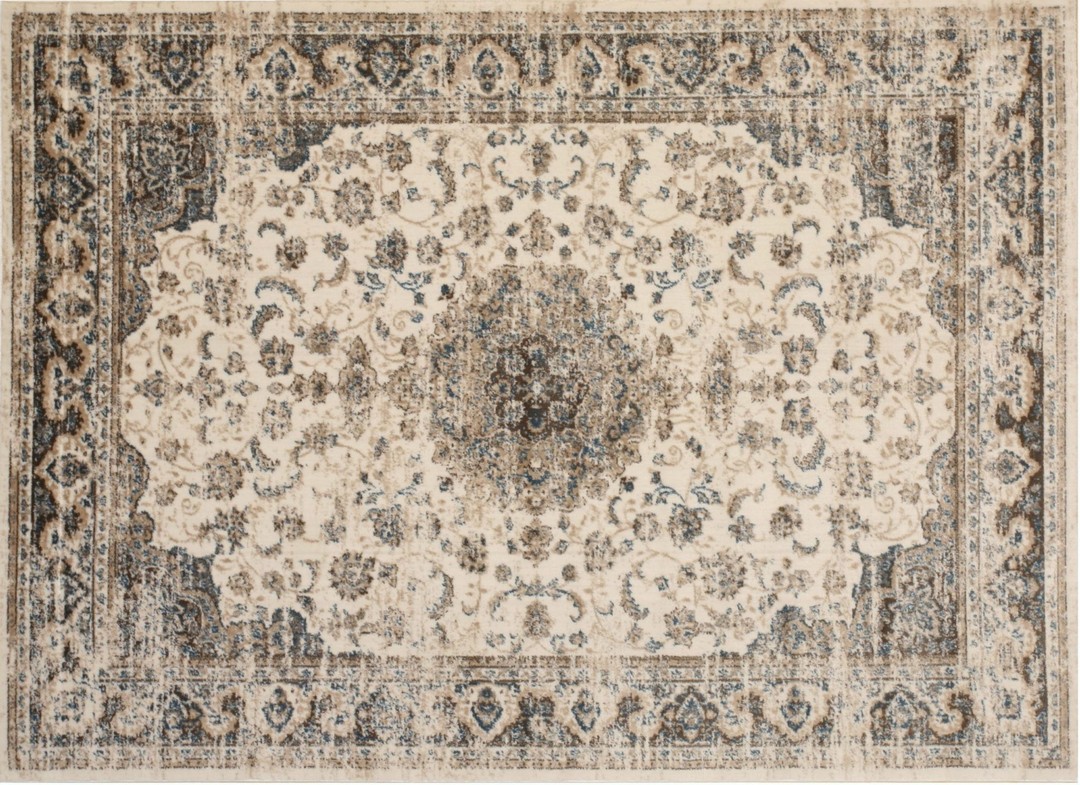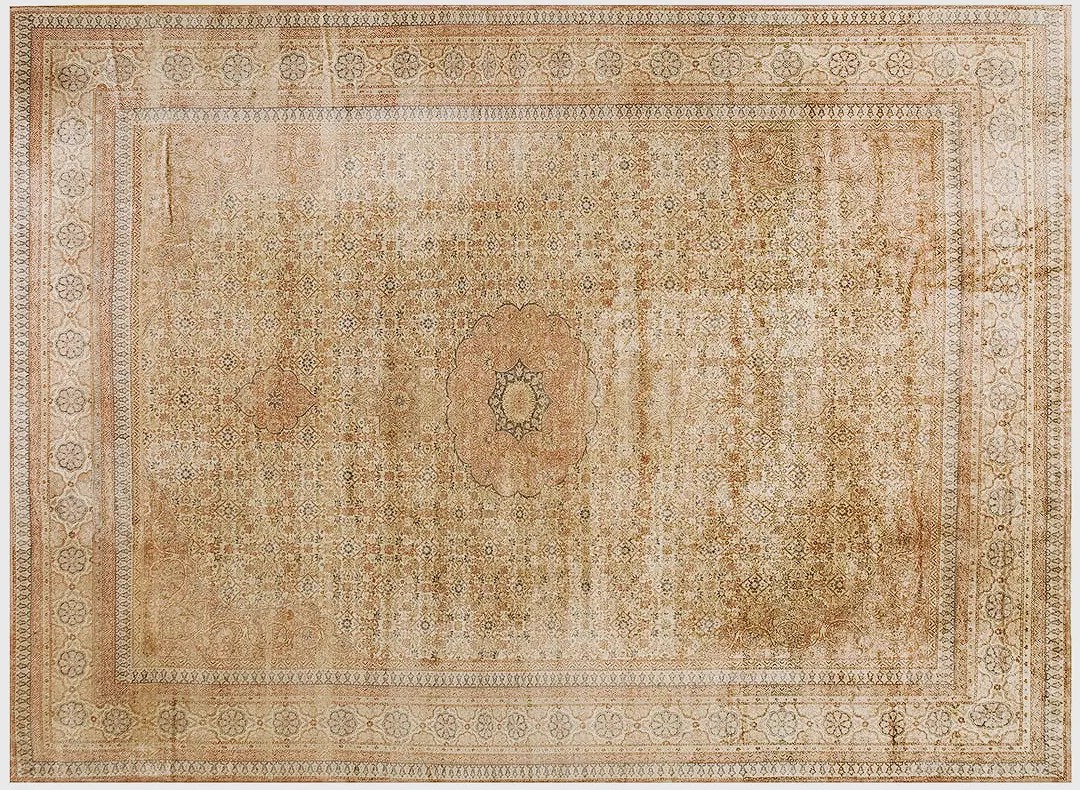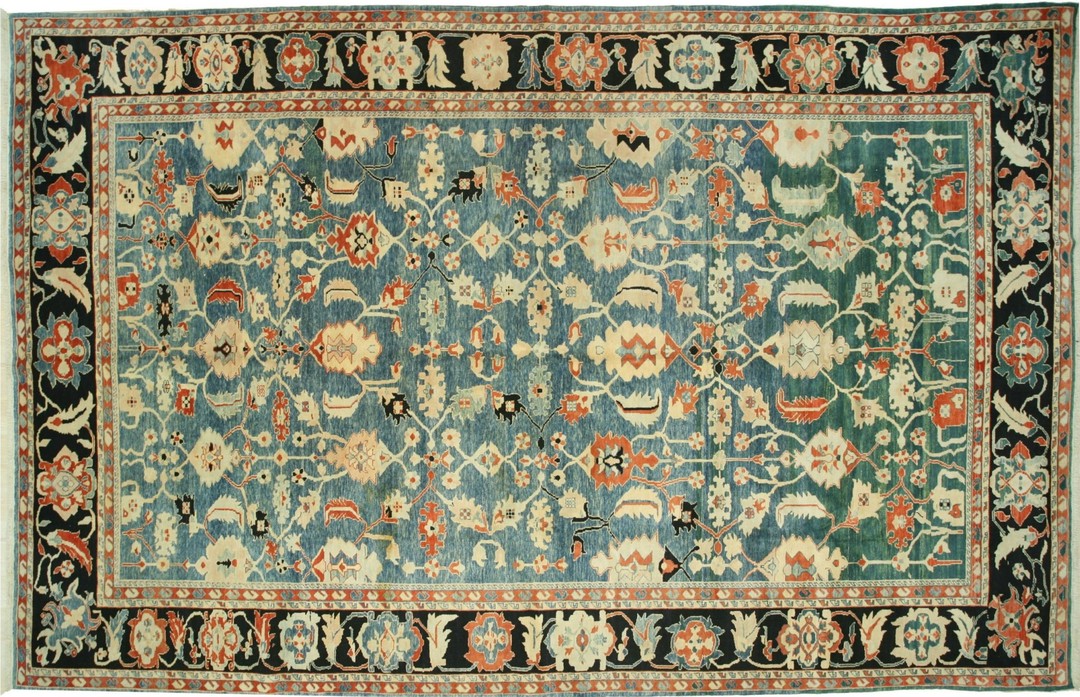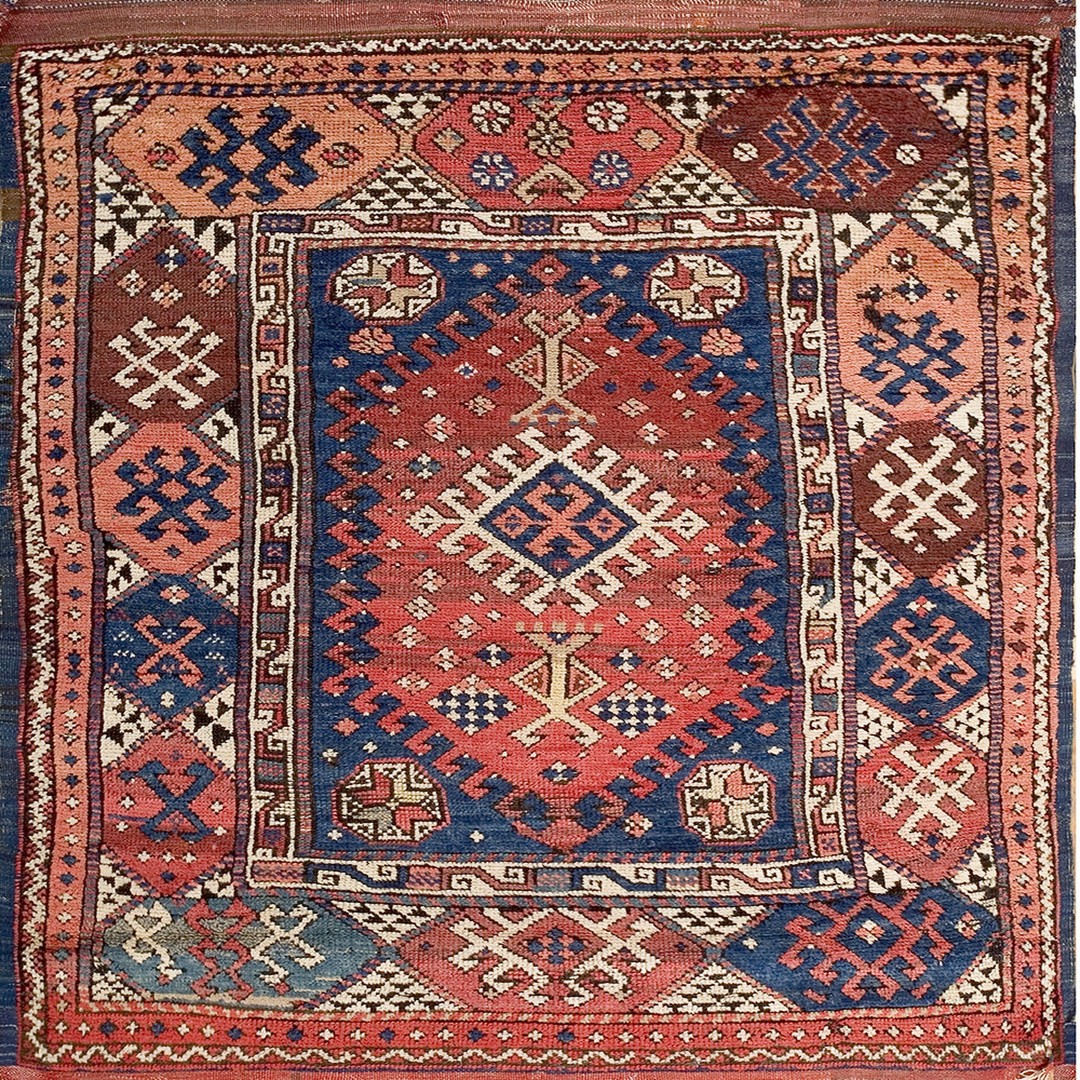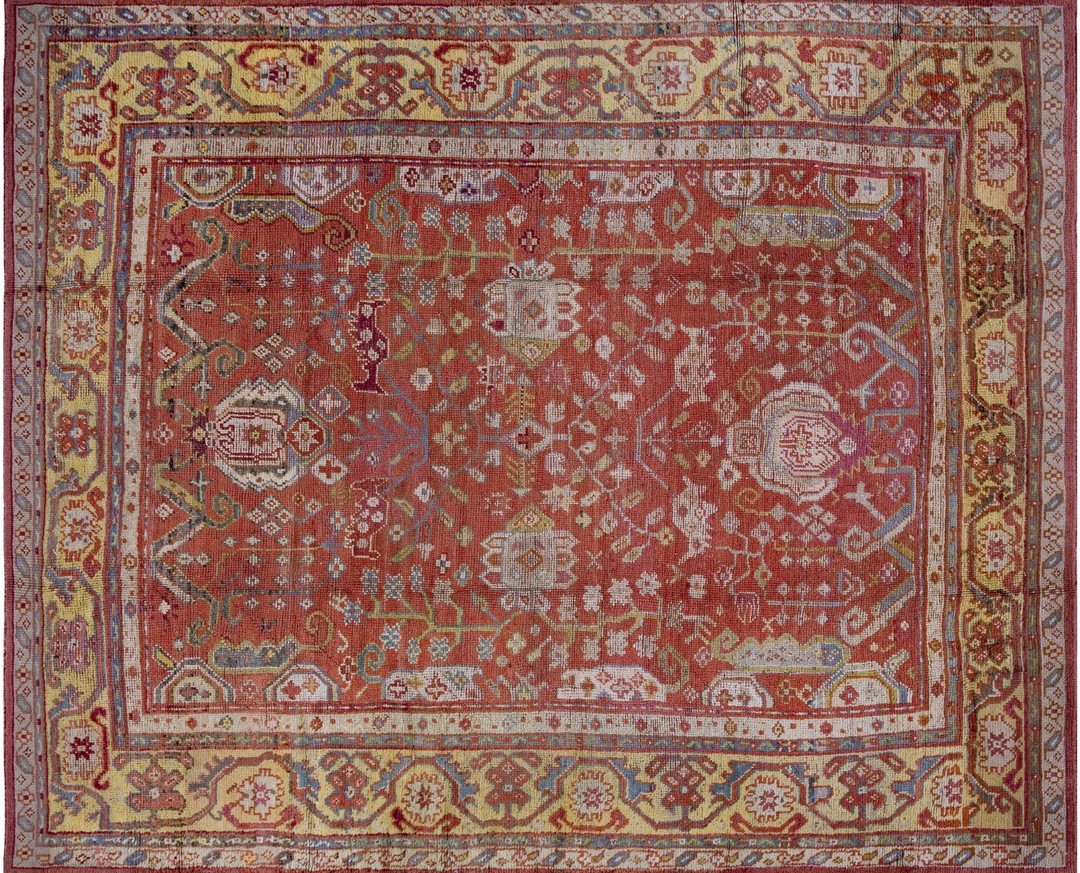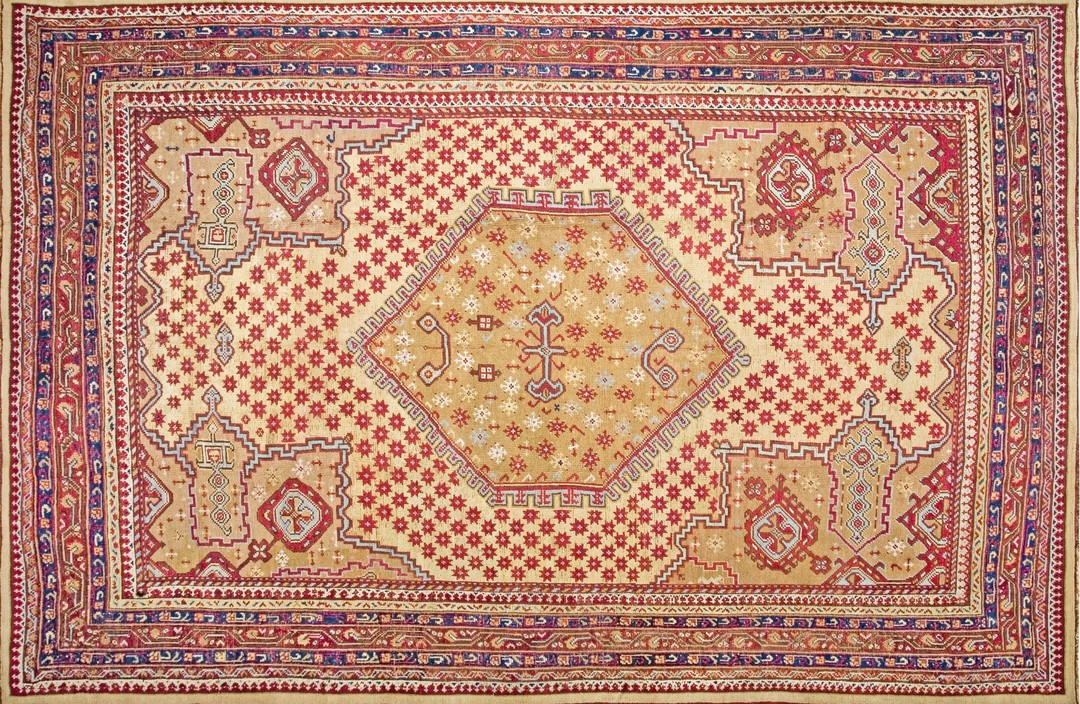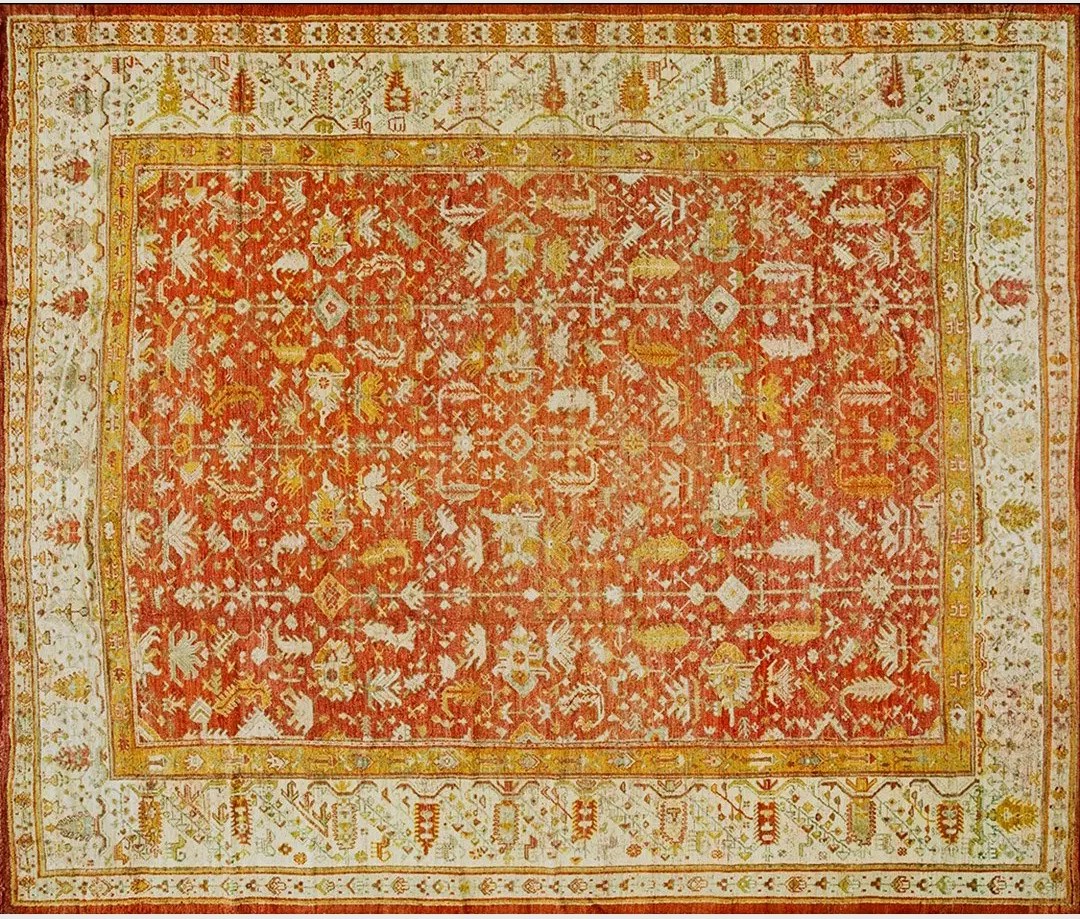
Welcome To The Fascinating World Turkish Anatolian Rugs
Turkish rugs, often referred to by the broader geographical term Anatolian rugs, represent one of the most complex intersections of art, utility, and trade in human history. To understand them as material culture is to look beyond their aesthetic appeal and see them as physical manifestations of the socio-political and economic environments that produced them.
Defining Anatolian Rugs within Islamic Art
Within the canon of Islamic art, Turkish rugs are distinguished by their geometric abstraction and the structural integrity of the Ghiordes (symmetrical) knot. Unlike the flowing, floral scrolls often found in Persian traditions, Anatolian weaving frequently emphasizes bold, angular motifs and a sophisticated use of primary colors.
- Aniconism and Symbolism: Adhering to Islamic artistic principles that avoid the representation of sentient beings, these rugs utilize a complex language of symbols—such as the mihrab (prayer niche) or the elibelinde (hands on hips)—to convey spiritual and protective meanings.
- The Prayer Rug: As a central object in Islamic praxis, the prayer rug (sejjade) serves as a portable sacred space, illustrating how material objects facilitate religious ritual across both nomadic and urban settings.
Woven with heritage, artistry, and timeless Anatolian soul.
Shop Our Collection of Turkish Rugs.Nomadic vs. Settled Production
The tension and synergy between nomadic tribes and settled urban centers have historically dictated the diversity of Turkish rug production.
| Production Type | Context & Characteristics |
| Nomadic (Yörük) | Produced for personal use or local barter. These rugs often feature spontaneous designs, goat hair or wool foundations, and “tribal” markers. They reflect the immediate environment and the seasonal migrations of the weavers. |
| Settled / Village | Often produced in fixed locations with access to standardized looms. While still maintaining traditional motifs, village rugs often show more regularity in size and color, bridging the gap between tribal art and commercial products. |
| Urban / Court | Sponsored by the Ottoman elite, these were produced in workshops (such as those in Hereke or Ushak). They utilized professional designers and expensive materials like silk and metallic threads to project the power and prestige of the Empire. |
Global Commodity History
Turkish rugs were among the first “global brands,” moving through trade routes that linked the East to the West long before modern globalization.
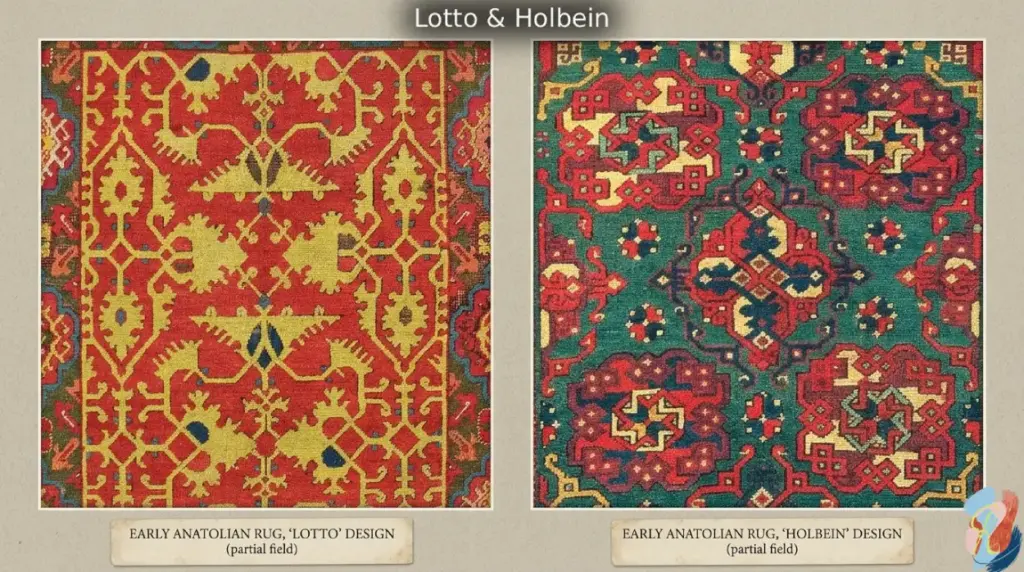
- The “Holbein” and “Lotto” Rugs: During the Renaissance, Turkish rugs were so highly prized in Europe that they appeared frequently in the paintings of Old Masters. These rugs were often renamed after the artists who depicted them, signaling their status as luxury imports and symbols of wealth among the European merchant class.
- The 19th Century Shift: As the Ottoman Empire integrated into the global capitalist market, rug production shifted toward mass exportation. This era saw the standardization of designs to meet Western tastes, transforming a localized craft into a massive industrial engine.
The Duality of the Turkish Rug
Turkish rugs function as both cultural artifacts and global commodities, shaped by shifting political economies, gendered labor systems, and cross-cultural exchange.
This thesis suggests that a rug is never “just a rug.” It is a record of the gendered labor of the women who wove their personal histories into the knots, a byproduct of the political economy of the Ottoman and Republican eras, and a survivor of centuries of cross-cultural exchange between the Turkic tribes of Central Asia and the markets of the Mediterranean and beyond.
Continuing the article, this section addresses the linguistic and academic frameworks used to categorize these textiles, highlighting the friction between Western scholarship and local realities.
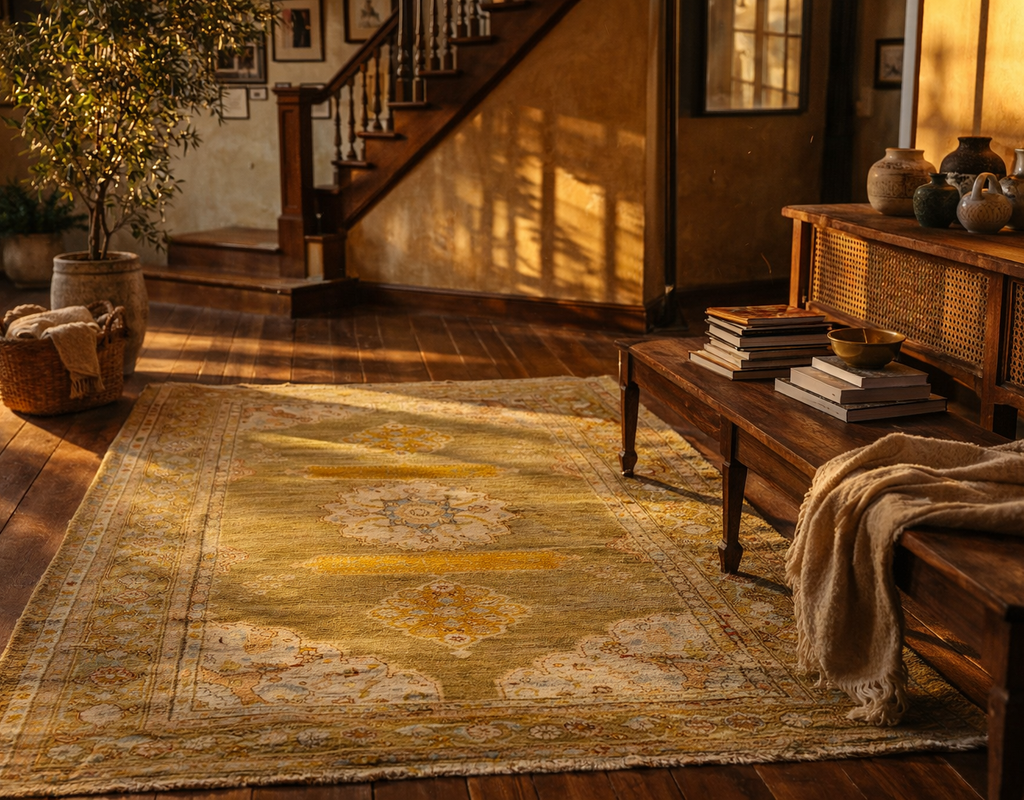
Historiography & Terminology
Defining the Labels: “Turkish” vs. “Anatolian” vs. “Oriental”
The terms used to describe these rugs are rarely neutral; they reflect the era and the perspective of the person speaking.
- Oriental: A broad, colonial-era umbrella term that grouped textiles from North Africa to China. In modern historiography, “Oriental Rug” is often viewed as an outdated, Eurocentric construct that obscures the distinct cultural identities of the weaving groups.
- Turkish: Specifically refers to rugs produced within the cultural or political boundaries of Turkic peoples. While accurate for many pieces, it can be reductive, as it may overlook the diverse ethnic contributions (Greek, Armenian, Kurdish) within the region.
- Anatolian: Currently the preferred scholarly term. It is geographically inclusive, referring to the peninsula (Asia Minor) where the weaving occurred. This label acknowledges the land’s multi-layered history—Hittite, Byzantine, and Islamic—which all inform the local aesthetic.
Scholarly Debates: Orientalist Classification
The study of Turkish rugs was long dominated by Western collectors and curators
This lead to a “top-down” classification system:
- The Eiland / Denny Framework: Scholars like Murray Eiland Jr. and Walter Denny moved the field toward a more scientific approach, focusing on structural analysis (knot density, spin of the wool) rather than just patterns. However, debates persist regarding how much weight should be given to “purity” of design versus the reality of commercial influence.
- Museum vs. Market: A “Museum” approach prioritizes provenance, age, and historical rarity (e.g., a 15th-century Seljuk fragment). The “Market” terminology often uses catchy, sometimes fabricated names to denote a certain “look” or “decorator friendly” palette, often ignoring the rug’s actual origin.
The Problem of Western Naming: “Artist Carpets”
One of the most significant historiographical issues is the practice of naming rugs after European painters rather than their place of origin or the people who created them.
For Exmple:
- “Holbein,” “Lotto,” and “Ghirlandaio” Carpets: These are 15th and 16th-century Anatolian rugs (often from Ushak) that appeared in the paintings of these Old Masters.
- The Erasure of Local Identity: By labeling a rug a “Small-Pattern Holbein,” the Western canon centers the European consumer as the primary point of reference. This effectively silences the local identity of the weavers—typically women in Western Anatolian villages—who had their own names and symbolic meanings for these patterns.
Just a quick note about the terminology: Transitioning from “Oriental” to “Anatolian” isn’t just about political correctness; it’s about academic precision. It shifts the focus from how the West consumed the rug to how the weaver constructed it.
Origins and Early Textile Traditions
Archaeological Evidence: The “Çatalhöyük” Debate
When discussing the deep history of rugs from Turkey and Anatolian textiles, the Neolithic site of Çatalhöyük (c. 7500 BCE) is often cited as a foundational point.
However, modern scholarship urges a more nuanced interpretation:
- Evidence of Textiles: Carbonized fragments and wall paintings at Çatalhöyük prove that the inhabitants were skilled in weaving complex patterns. Some wall murals bear a striking resemblance to the geometric layouts of later Turkish kilims.
- The Myth of Direct Continuity: While it is tempting to claim an unbroken 9,000-year lineage of rug weaving, there is no direct archaeological evidence linking these Neolithic fiber fragments to the knotted-pile or flat-weave traditions of the Turkic era.
- The “Mother Goddess” Conflict: Some 20th-century theories popularized the idea that motifs like the elibelinde were direct carry-overs from Neolithic fertility cults. Most contemporary historians view this as speculative “romanticism,” noting that while the aesthetic spirit remains, the cultural and technical context has shifted entirely.
Nomadic Weaving Traditions
The true technical ancestor of the Turkish rug as we know it today arrived with the migration of Turkic tribes from Central Asia into Anatolia during the 11th century.
The Function of the Rug in Nomadic Life
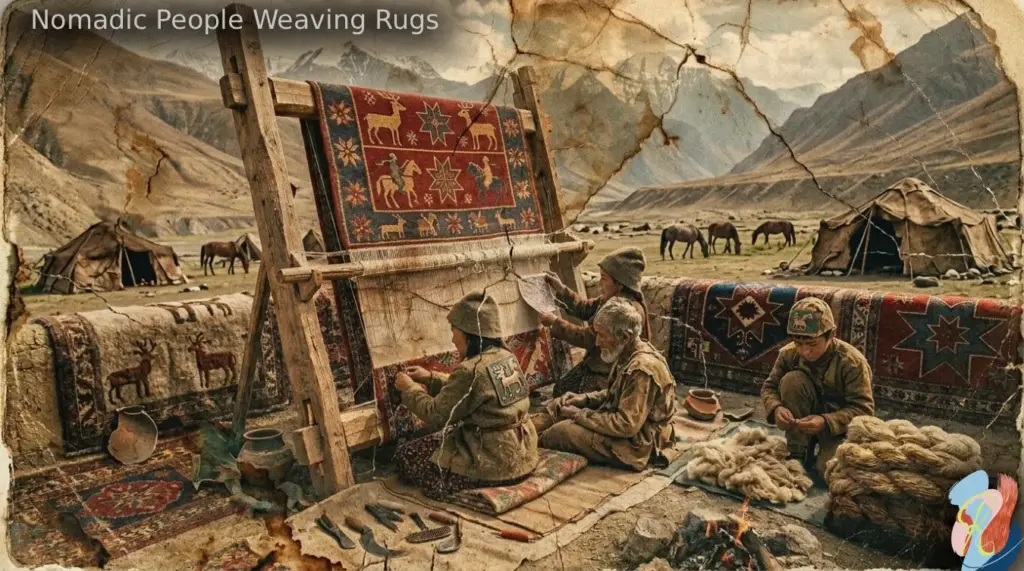
For the Yörük (nomadic) and semi-nomadic tribes, textiles were not decorative “floor coverings”—they were the primary architecture of the home.
For example:
- Tent Furnishings (Alaçık): Area Rugs and kilims provided essential insulation against the cold Anatolian plateau. Beyond the floor, weavers produced heybe (saddlebags), çuval (storage sacks), and even cradle covers.
- Mobility and Wealth: In a culture on the move, rugs represented portable wealth. They were easier to transport than furniture and held their value as a currency of exchange.
- The Dowry System (Çeyiz): Weaving was the primary social and economic contribution of women to a new marriage. A bride’s dowry—often consisting of her finest hand-knotted rugs—served as a public display of her skill, her family’s status, and her own future financial security.
Technical Tribal Markers
Early nomadic production relied on the horizontal ground loom, which was easily dismantled and packed onto a camel or donkey.
This influenced the physical characteristics of early rugs:
- Narrow Widths: Restricted by the portability of the loom.
- Abash (Color Variation): Since wool was dyed in small batches during migration, “abrash”—subtle, horizontal shifts in color—became a hallmark of authentic nomadic weaving.
Seljuk and Early Islamic Period (11th–14th c.)
The Konya Finds: The Genesis of the Turkish Rug
The “birth” of the Turkish rug in the archaeological record is most famously represented by the antique Konya rug fragments. Discovered in 1905 in the Alâeddin Mosque, these 13th-century pieces are the oldest surviving examples of Anatolian knotted-pile carpets.
They provided vital insight into:
- Physical Characteristics: These rugs were massive in scale, often featuring a deep red or blue field. They utilized the symmetrical (Ghiordes) knot, which provides the structural durability that became a hallmark of the Turkish tradition.
- Geometric Design Abstraction: Unlike the later floral Ottoman rugs, Seljuk designs were strictly geometric. They featured repeating patterns of lozenges, stars, and hooked motifs (the wolf’s mouth or dragon) that suggest a bridge between ancient Central Asian tribal totems and Islamic aesthetics.
Kufic Borders and the “Language” of the Edge
A defining feature of the Seljuk period is the Kufic pattern border. This involves the stylization of Arabic script (specifically the angular Kufic design calligraphy) into a decorative border.
Kufic approach:
- From Text to Textile: Over time, the legibility of the script faded into abstraction, evolving into interlaced patterns that symbolized the “Word of God” surrounding the central field, even if the weavers themselves were no longer “writing” specific words.
- Pseudo-Kufic: In later centuries, this became a purely ornamental device, demonstrating how religious calligraphy was absorbed into the vernacular of material culture.
Religious and Artistic Constraints: The Aniconism Debate
The Seljuk period solidified the relationship between Islamic law and artistic output. The theological preference for aniconism—the avoidance of representing sentient beings—directed the creative energy of weavers toward mathematical precision.
The approach to this was:
- Infinite Patterns: The use of repeating, “infinite” patterns (all-over designs) served a dual purpose: it avoided the “idolatry” of a single focal image and reflected the Islamic concept of the infinite nature of the Divine.
- Symbolic Geometry: Since weavers couldn’t weave faces, they wove ideas. A “tree of life” was abstracted into a vertical line with angled branches; a “universe” became a central medallion.
Trade Routes and Silk Road Influence
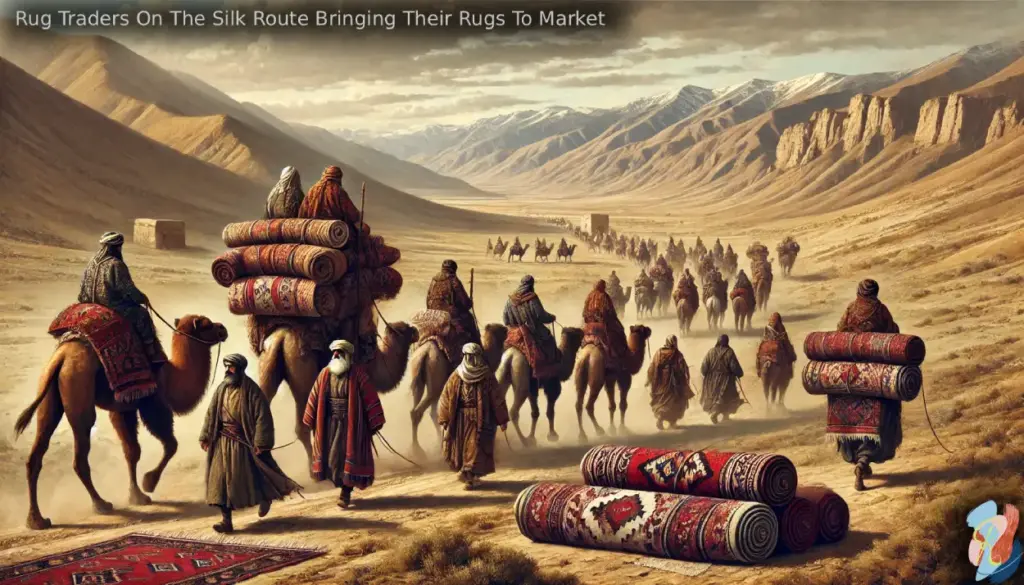
Anatolia under the Seljuks was not an isolated plateau; it was the western terminus of the Silk Road.
The Seljuks trade significance:
- The Caravanserai System: The Seljuks built a massive network of fortified inns (hans) that allowed merchants to transport luxury goods safely. This infrastructure turned rugs from a local necessity into a standardized trade commodity.
- Cross-Cultural Synthesis: The “Seljuk style” was a melting pot. It combined the weaving techniques of Turkic nomads, the dyeing traditions of local Armenian and Greek artisans, and the design sensibilities of the broader Islamic world (Persia and Baghdad).
- Marco Polo’s Testimony: In the 13th century, Marco Polo traveled through “Turcomania” (Anatolia) and famously wrote that the world’s “best and handsomest carpets” were made there, specifically noting the beauty of the reds and the skill of the Greek and Armenian weavers under Seljuk rule.
Ottoman Period: Court vs. Village Production
The Ottoman era represents the pinnacle of Anatolian textile history, defined by a dual-track production system: the refined, centralized “High Art” of the Imperial court and the robust, traditional “Folk Art” of the provinces.
Court Workshops (The Imperial System)
Beginning in the 15th century and reaching its zenith in the 16th and 17th centuries, the Ottoman court established state-sponsored atelier.
The court productions were meant to supply the Empire’s palaces and mosques:
- State-Controlled Aesthetics: Unlike the spontaneous designs of the village, court carpets were designed by the Nakkashane (the Imperial painting atelier). Designers created “cartoons” (patterns on paper) that weavers were required to follow with mathematical precision.
- Hereke and Palace Ateliers: Locations like Hereke (established later) and the early court workshops in Bursa and Istanbul utilized the finest materials—often silk and wool enriched with gold and silver threads.
- Diplomatic Gifting: Rugs became a vital instrument of Ottoman soft power. Large-scale carpets were commissioned as diplomatic gifts for European monarchs, Venetian doges, and Safavid rivals, serving as woven ambassadors of the Sultan’s wealth and technical superiority.
Regional and Village Production
While the court pursued floral refinement, regional centers maintained the “Anatolian heart” of geometric and stylized floral patterns.
3 main production hubs / approaches:
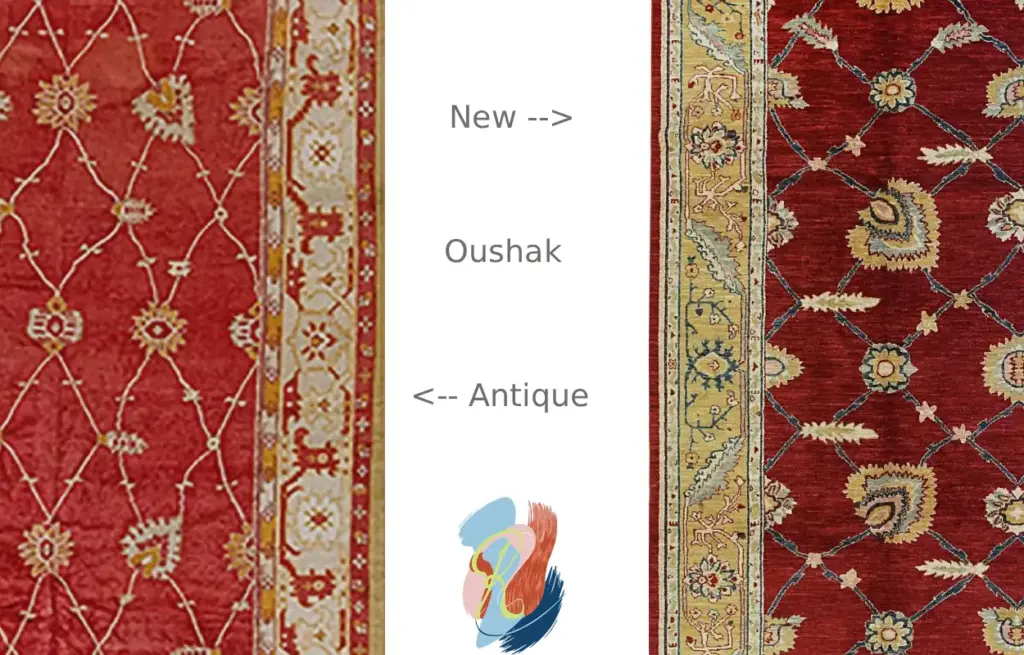
- Uşak (Oushak): Perhaps the most famous commercial center. Uşak specialized in large-scale carpets like the “Star Uşak” and “Medallion Uşak.” These were the first rugs to be produced in a semi-industrialized fashion to meet the massive demand from the West.
- Bergama and Konya: These regions remained closer to their nomadic roots. Their production often featured “large-pattern” designs with bold, saturated dyes (madder reds and indigo blues).
- Domestic vs. Export: * Commercial Export: Standardized sizes and palettes designed to fit European living rooms and townhouses.
- Domestic Use: Included items like yastık (pillow covers), çentik (small bags), and local prayer rugs that retained idiosyncratic, “irregular” charms that commercial exports lacked.
European Reception: The “Oriental” Status Symbol
In the 17th and even the 16th centuries, Turkish rugs were so rare and expensive in Europe that they were rarely used on the floor. Instead, they were draped over tables, displayed on walls, or placed under the feet of royalty.
- The Painter’s Archive: As discussed in terminology, rugs became so synonymous with wealth that Renaissance artists used them as “props” to signal the status of their subjects.
- “Holbein” Carpets: Characterized by small-scale geometric interlaced patterns.
- “Lotto” Carpets: Featuring a distinctive yellow arabesque grid on a red field.
- The Rug as “Still Life”: In Dutch and Italian paintings, the presence of a Turkish rug signified that the household was part of the burgeoning global trade network. They were treated as high-value “material culture” that transcended their utilitarian origins.
Global Trade and Orientalism (16th–19th c.)
Integration into Mediterranean Trade Networks
By the 16th century, the Ottoman Empire held a virtual monopoly on the “Oriental” rug trade in Europe.
This was facilitated through established Capitulations—trade agreements with European powers:
- Venice and Genoa: These maritime republics acted as the primary conduits. The “Venetian trade” was so robust that specific Anatolian patterns were tailored specifically for the tastes of the Venetian merchant class.
- The Levant Company: In the late 16th century, the English Levant Company began bypassing Mediterranean middlemen, shipping rugs directly from Izmir (Smyrna) to London. This broadened the consumer base from the hyper-elite to the emerging upper-middle class.
The Rug in European Interiors: From Table to Floor
The function of the Turkish rug in the West underwent a slow but significant evolution.
This took place over three centuries:
- 16th–17th Century (The Table Carpet): Due to their immense cost, rugs were treated as “textile jewelry.” They were draped over tables (table carpets) or chests to prevent wear. Stepping on a rug was considered a display of extreme, almost scandalous, wealth.
- 18th–19th Century (The Floor Carpet): As production increased and trade routes became more efficient, rugs finally moved to the floor. This shift necessitated a change in production; rugs became larger, and borders became more pronounced to frame the furniture of Victorian and Georgian rooms.
Orientalism: Rugs as Symbols of the “East”
In the 19th century, the “Orientalist” movement in art and literature used the Turkish rug as a primary visual shorthand for a romanticized, exotic “East.”
- The “Exotic” Prop: In the paintings of Jean-Léon Gérôme and others, rugs were used to create a sense of opulence, mystery, and stagnation. They were often depicted in harem scenes or “bazaar” settings, reinforcing Western stereotypes of a “timeless” and “sensual” Orient.
- The “Magic Carpet” Mythos: During this era, the rug transitioned from a functional object to a folkloric one. Western literature (often through translations of The Arabian Nights) imbued the textile with supernatural qualities, further distancing the object from the actual labor and lives of the Anatolian weavers.
Standardization for Export Markets
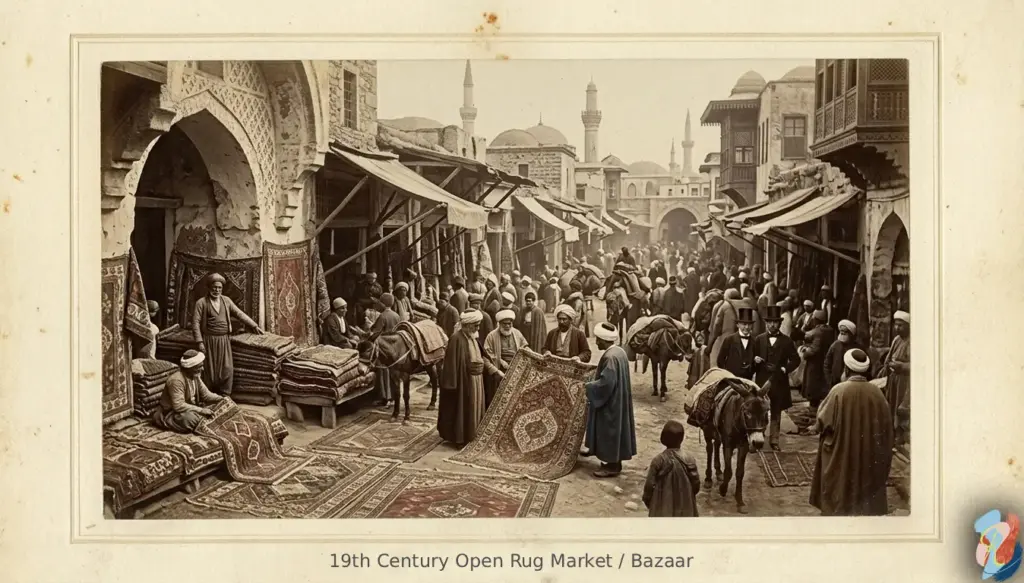
The 19th century saw the “commercialization of the loom.” To compete with industrial European carpets and meet specific Victorian aesthetic demands, production became increasingly standardized.
The dawn of commercial rug production:
- The Rise of “Smyrna” Rugs: Izmir (Smyrna) became the central hub for rugs specifically designed for the American and European markets. These featured:
- Standardized Rug Sizes: Fitting the dimensions of Western architecture.
- The “Chemical Dye” Revolution: The introduction of synthetic dyes (aniline) in the mid-19th century allowed for brighter, more consistent colors, though often at the cost of the subtle tonal shifts (abrash) found in natural dyes.
- Design Modification: Weavers were often encouraged to simplify traditional motifs to make them more “readable” and less “busy” for Western buyers.
Industrialization and Transformation (19th–20th c.)
The 19th and 20th centuries represent a period of “creative destruction” for Anatolian weaving. As the Ottoman Empire integrated into the global capitalist economy, the ancestral methods of the village and the tribe faced the pressures of industrial efficiency and shifting Western tastes.
Decline of Traditional Systems
The traditional ecosystem of Turkish weaving—where wool was harvested, spun, and dyed within a single community or household—began to fragment under the pressure of the Industrial Revolution.
The decline could be seen in:
- The Erosion of Local Guilds: For centuries, urban production was governed by strict guilds (esnaf) that maintained quality and ethical standards. As the Empire opened its borders to European manufactured goods, these local protections crumbled, leading to a “race to the bottom” in terms of production speed and material quality.
- Loss of the “Slow” Process: The labor-intensive steps of hand-carding and hand-spinning wool were increasingly replaced by machine-spun yarns, which lacked the structural irregularities and tensile strength that gave antique rugs their unique texture and longevity.
The Rise of Factory Production
To satisfy a burgeoning middle class in London, Paris, and New York, the scale of production shifted from the domestic loom to the factory floor.
The dawn of mass producing rugs:
- The Smyrna (Izmir) Hub: Large European-owned firms, such as the Oriental Carpet Manufacturers (OCM), began to centralize production. They provided weavers with pre-dyed wool and specific “cartoons” (patterns) to ensure every rug was a predictable, reproducible commodity.
- Standardization: Rugs were now woven in standard sizes (e.g., 9×12, 10×14) to fit the rectangular floor plans of Western townhouses, moving away from the idiosyncratic dimensions of nomadic “tent-fit” or “long-and-narrow” village formats.
Synthetic Dyes: The Critical Turning Point
Perhaps the most significant disruption in textile history was the introduction of synthetic (aniline) dyes in the mid-to-late 19th century.
The effects could be seen in:
- Technical Shift: These chemical dyes offered a spectrum of colors—purples, harsh greens, and bright oranges—that were impossible to achieve with madder root or indigo.
- The “Fading” Crisis: Early synthetics were notoriously unstable; they were prone to “bleeding” into adjacent fibers and fading rapidly when exposed to sunlight. This created a visual divide between the soft, harmonious aging of naturally dyed antique pieces and the often harsh, “brittle” appearance of early industrial rugs.
- Economic Impact: Chemical dyes drastically reduced the cost and time of production, effectively ending the centuries-old profession of the master dyer in many regions.
Western Demand Reshaping Designs
As the market shifted toward exportation, the “Anatolian aesthetic” was curated by Western importers to suit foreign interior design trends.
Enter the “decorative rug” approach:
- The “Decorator” Palette: To accommodate the muted tones of Victorian and Edwardian homes, traditional bold reds and deep blues were often replaced by “pastel” versions or “distressed” finishes.
- Simplification of Symbolism: Complex tribal motifs that once held deep spiritual or communal meanings were often simplified or “smoothed out” to make them more aesthetically “readable” to a consumer who viewed the rug as a background element rather than a narrative piece.
- The Birth of the “Antique Revival” Sentiment: Paradoxically, the decline in quality during this era led to the first wave of serious collecting. As connoisseurs noticed the loss of traditional beauty, they began to fetishize “pre-industrial” rugs, establishing the high-value antique market we see today.
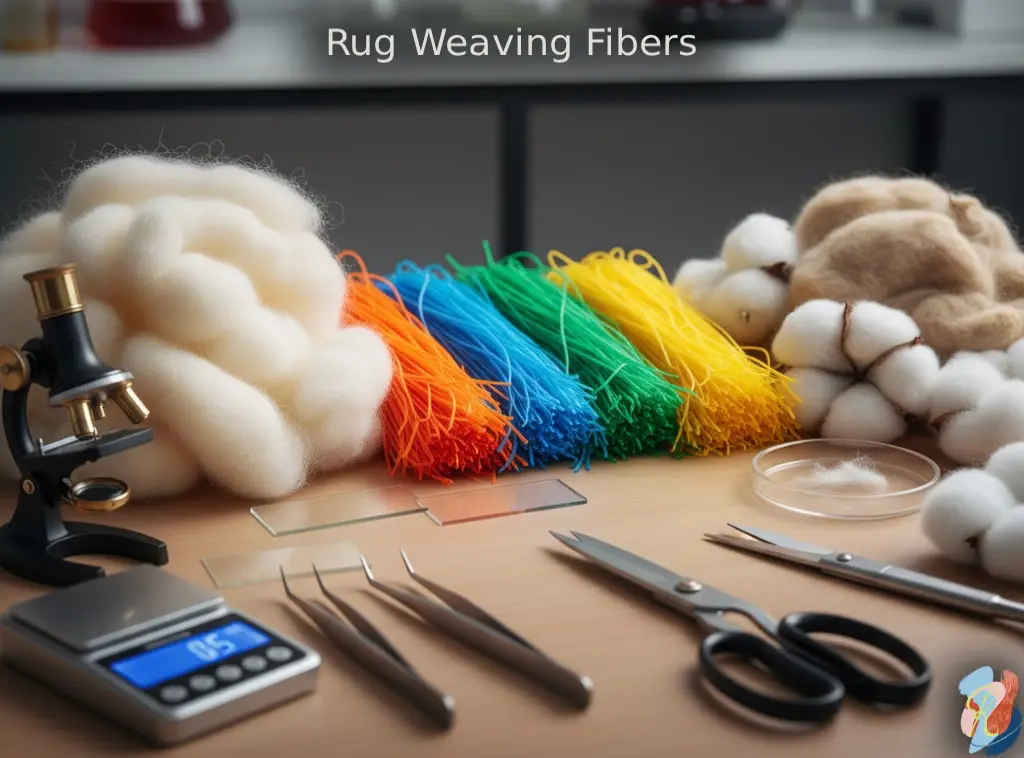
Materials: The Foundation and the Pile
The choice of rug weaving materials is often dictated by the local environment and the intended use of the textile.
The 4 most used fibers in Turkish rug weaving:
- Wool: The backbone of Anatolian weaving. High-altitude “fatty” wool (rich in lanolin) is prized for its luster and ability to absorb dyes. In nomadic production, even the foundations (warps and wefts) are wool, providing the rug with a “supple” handle that allows it to be folded for transport.
- Angora (Mohair): Sourced from the Angora goats native to the Central Anatolian plains (specifically the Ankara region), this fiber is prized for its exceptional silk-like luster and durability. In many antique tribal village rugs, Angora is used to highlight specific motifs or even as the entire pile, creating a distinctive “shimmer” and a soft, ethereal texture that distinguishes it from standard sheep’s wool.
- Silk: Silk was reserved for the highest levels of rug production, such as in Hereke. Silk allows for an incredibly fine diameter, enabling weavers to reach knot densities exceeding $100$ knots per square centimeter (or over $600$ per square inch).
- Cotton: Increasingly used in the 19th and 20th centuries for warps and wefts in village and workshop production. Because cotton does not stretch as much as wool, it allows the rug to lay flatter and remain more dimensionally stable on a rigid floor.
Dye Technologies: The Chemistry of Color
The transition between dye types is the single most important factor in the scientific and market valuation of Turkish rugs.
Natural vs Synthetic Dyes:
- Natural Dyes: Derived from plants (madder root for reds, indigo for blues, chamomile or weld for yellows) and insects (cochineal). These dyes are polychromatic, meaning a single dye bath contains multiple color molecules. As they age, they “mellow” in harmony, creating a depth of color that synthetic dyes cannot replicate.
- Synthetic Dyes: Introduced in the mid-19th century, these “aniline” and later “chrome” dyes offered convenience but lacked the lightfastness and aesthetic nuance of their predecessors. They often resulted in “tip-fading,” where the surface of the pile loses color while the base remains dark.
The DOBAG Project: A Scientific Renaissance
The DOBAG Project (Doğal Boya Araştırma ve Geliştirme Projesi), launched in the 1980s by Dr. Harald Böhmer, is a critical turning point in contemporary textile history.
The aim of DOBAG was:
- Restoring the Tradition: The project scientifically re-identified the chemical components of traditional Anatolian plant dyes and reintroduced them to village cooperatives.
- Economic Impact: By returning to natural dyes and hand-spun wool, DOBAG proved that traditional methods could be economically viable in a modern market, sparking a global “Antique Revival” movement that continues to influence high-end production today.
The Rug as a Living Document
The Rugs of Turkey are more than decorative objects; they are a synthesis of technical rigor and artistic heritage. From the durable symmetry of the Ghiordes knot to the chemical complexity of the madder root, these textiles serve as a material record of a culture that has navigated the transition from the nomadic tent to the global digital marketplace.
By analyzing the materials and techniques, we move past the “Orientalist” myth and begin to see the rug as the weaver saw it: a meticulous construction of wool, color, and labor.
Symbolism and Semiotics
Motifs as Cultural Language
In the absence of written text in many weaving communities, the rug functioned as a semiotic system—a way to communicate identity, status, and spiritual desires through a visual code.
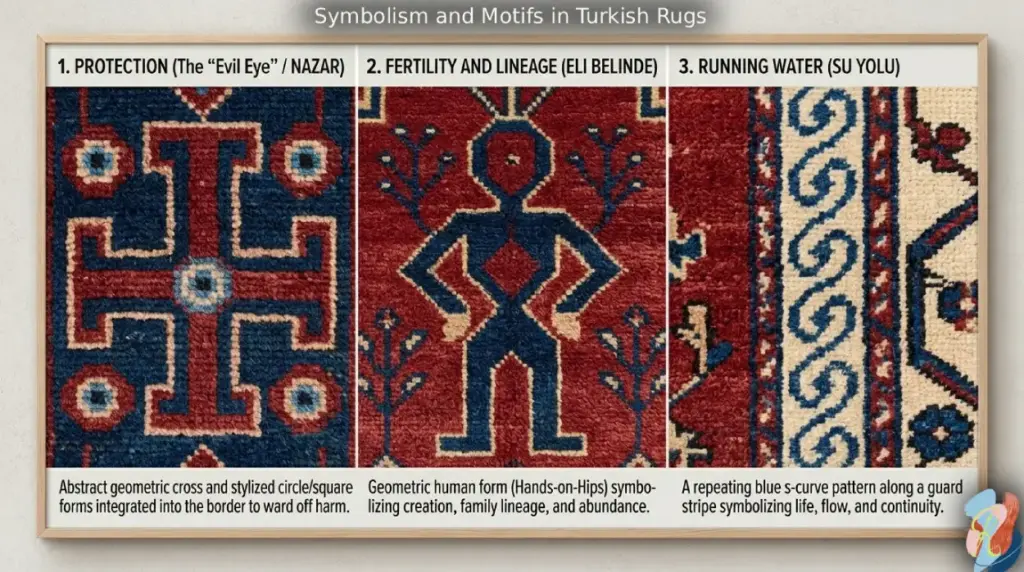
- Protection (The “Evil Eye” / Nazar): One of the most pervasive themes in Anatolian culture. To protect the household from envy or bad luck, weavers integrated geometric “eye” motifs (göz) or the cross (çengel), which was believed to divide the evil eye into four and neutralize its power.
- Fertility and Lineage (Eli Belinde): The “hands-on-hips” motif is a stylized female figure. It is the quintessential symbol of motherhood, fertility, and the continuation of the family line. It is often found in rugs intended for a dowry (çeyiz).
- The Wolf’s Mouth (Kurt Aǧzi): Representing protection for the flocks. By weaving the jaws of a wolf into the rug, nomadic weavers expressed a symbolic “binding” of the predator, hoping to keep their livestock safe.
- The Running Water (Su Yolu): Usually found in the borders, this meandering line signifies the importance of water in an arid landscape, representing life, cleanliness, and the flow of time.
The “Grammar” of the Rug
Symbolism is not just found in individual icons but in the spatial relationship between them:
- The Center vs. The Border: The central field often represents the “self” or the “inner world,” while the borders act as a protective barrier, separating the sacred space of the rug from the mundane world.
- Color as Signifier: Colors were rarely chosen at random. Red often symbolized wealth and joy, while blue (indigo) represented the celestial or the spiritual.
Caution: The Debate Over-Symbolism
While it is tempting to “read” a rug like a book, contemporary scholars (such as Walter Denny) warn against over-symbolism—the tendency to assign a deep, ancient meaning to every single knot.
Example of debatable symbolism motifs:
- The “Mother Goddess” Critique: As mentioned in the origins section, 20th-century theories often claimed motifs were direct links to Neolithic cults. Modern historians point out that many designs are simply the result of technical constraints of the loom—certain geometric shapes are simply easier to weave with a square knot.
- Aesthetic Evolution: Often, a motif is chosen because it is beautiful or because it was passed down through generations, and its original “meaning” may have been lost or transformed over centuries.
- Market Invention: Collectors should be wary of “marketing semiotics,” where rug dealers invent elaborate stories for motifs to increase the “exotic” appeal of a piece.
A balanced view treats motifs as a living language—one that is fluid, capable of change, and a mixture of both intentional symbolism and inherited aesthetic tradition.
Regional Typologies: A Structural & Economic Analysis
To understand Turkish rugs, it is helpful to look at why they were made. Instead of just listing cities, we can group them by their purpose. The reason a rug was created—whether for a Sultan, a merchant, or a family—changed everything about how it was built, what it looked like, and who eventually owned it.
We can break these down by looking at three things:
Court Production: Hereke
- Structure: Turkish Hereke rugs represent the pinnacle of technical precision. They utilize a silk or very fine cotton foundation with an incredibly high knot density. The structure is thin, supple, and “tight,” allowing for a level of detail that mimics fine painting.
- Design Systems: This is a top-down, centralized system. Designs originated in the Nakkashane (Imperial painting atelier). Because the fine silk foundation allows for minuscule knots, the design system is curvilinear, featuring the “Saz” style of long, serrated leaves and complex floral arabesques that ignore the “stepped” geometric constraints of the loom.
- Market Orientation: Originally non-commercial. These were produced as luxury commissions for Ottoman palaces or as “soft power” diplomatic gifts for foreign heads of state. Their value was derived from their association with the Sultan’s prestige rather than market commodity pricing.
Commercial Export Centers: Uşak (Oushak)
- Structure: Designed for the grand interiors of the West, the Turkish Oushak / Uşak rugs often feature a heavier, more robust pile and, from the 19th century onward, a cotton foundation to ensure the rug lays flat and maintains a standardized rectangular shape.
- Design Systems: A hybridized system that modified traditional motifs for the “global gaze.” The famous “Star” and “Medallion” Uşak designs were scaled up to provide “open” fields that felt less cluttered to Western consumers. This was the birth of the “Decorator” rug, where the design system was edited by merchants to match European upholstery and wallpaper trends.
- Market Orientation: Industrial Export. Uşak was the engine of the Ottoman rug trade. Production was dictated by seasonal catalogs and foreign orders, leading to the first instances of mass-standardization and “workshop” (rather than home) production.
Tribal / Nomadic: Yağcıbedir & Bergama
- Structure: Characterized by an all-wool construction (wool warps, wefts, and pile). This makes the rugs flexible and “supple,” suitable for nomadic life. They often feature high-fatty wool with a natural luster. The structure is often idiosyncratic; a Bergama rug may be slightly wider at one end due to the variable tension of a portable ground loom.
- Design Systems: An oral and mnemonic system. Designs were memorized and passed down through generations. The visual language is strictly geometric, utilizing deep indigo and madder reds. In Yağcıbedir rugs, for example, the “four-star” or “bird” motifs are woven from memory, allowing for spontaneous variations (abrash) that reflect the weaver’s immediate environment.
- Market Orientation: Autarkic / Domestic. Originally woven for the dowry (çeyiz) or personal use. When these entered the market, they were sold as “authentic” tribal artifacts. Unlike Uşak, these regions resisted Western design influence for centuries, preserving a “purer” Anatolian aesthetic.
Religious Production: Gördes & Konya
Many of the rugs were produced as waqf (pious endowments) for specific mosques. By the 18th century, Turkish Gördes /Ghiordes rugs became highly sought after by European collectors as “exotic” spiritual objects, leading to a niche market for high-end prayer rugs that were never actually used for prayer.
Structure: These centers specialized in the small-to-medium format (sejjade). The structure is refined, often using a “depressed” warp technique that creates a ridged back, providing a firm “grip” on the mosque floor to prevent sliding during prayer.
Design Systems: Architectural and Mimetic. The design is a literal representation of the Mihrab (prayer niche). In Gördes rugs, the niche is often stepped and elegant, while Konya pieces may be bolder and more “archaic.” This system is highly conservative; the “niche” layout remained consistent across centuries to facilitate specific religious praxis.
| Category | Primary Center | Foundation | Design Logic | Market Intent |
| Court | Hereke | Silk/Fine Cotton | Curvilinear / Atelier | Imperial Prestige |
| Commercial | Uşak | Cotton/Heavy Wool | Scaled / Standardized | Global Export |
| Tribal | Bergama | All-Wool | Mnemonic / Geometric | Domestic / Identity |
| Religious | Gördes | Wool/Cotton | Architectural / Ritual | Votive / Collection |
Deconstructing The Prayer Design
All Muslim prayer design Islamic rugs have the same basic design patterns. Each region and country had their own way of creating them, but, at the end of the day it came down to following a certain design path.
The Turkish Muslim Prayer Rug Example:
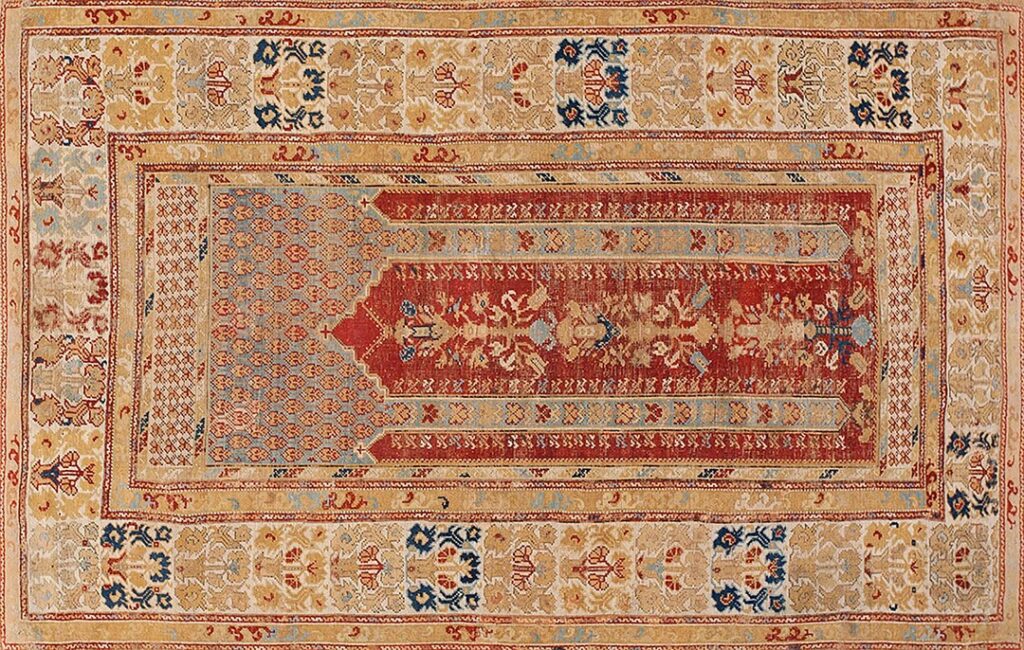
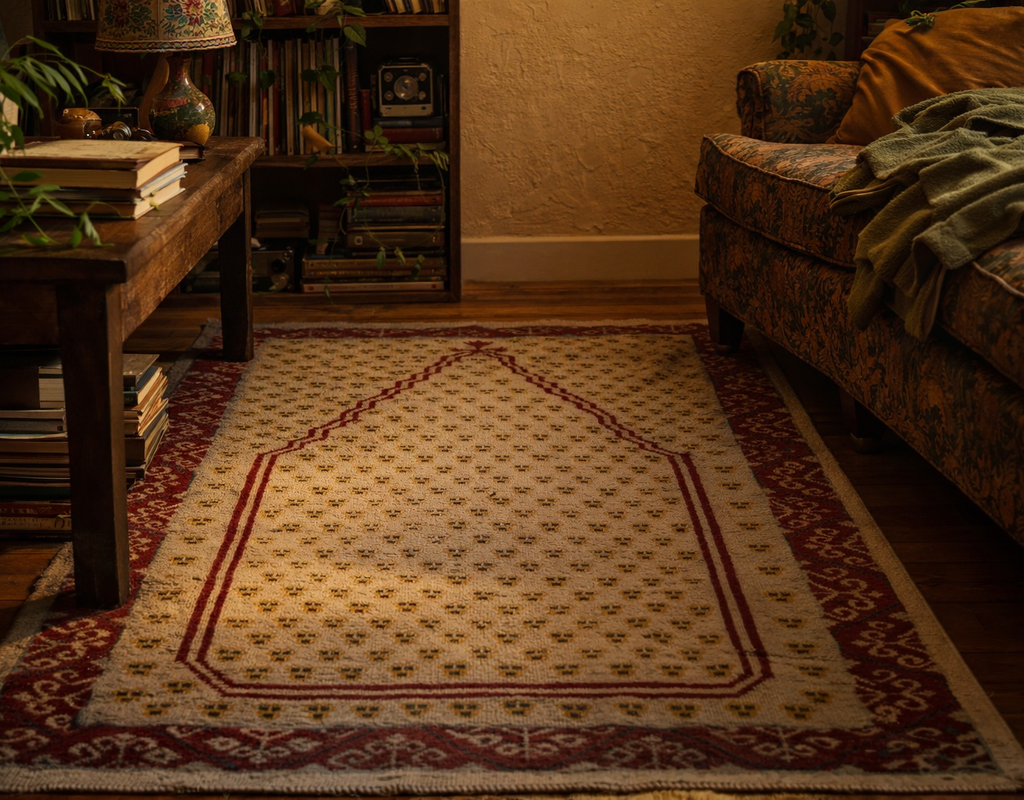
Using the image above, we can see the classic anatomy of a Turkish prayer rug. While tribal in its execution, this piece follows a specific “architectural” logic designed to facilitate the act of prayer (Salat).
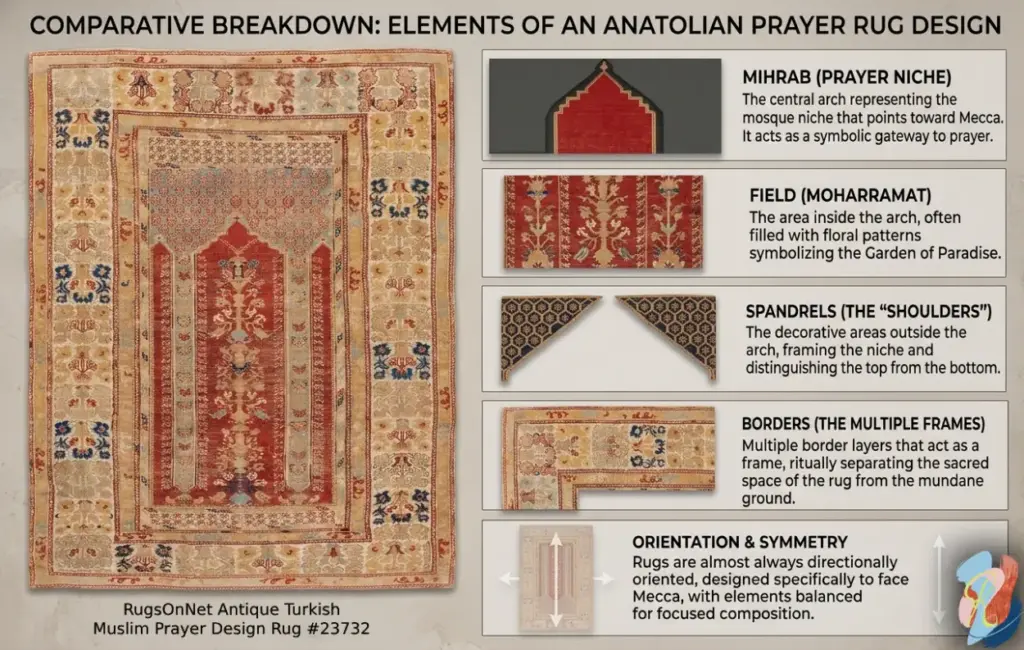
Here is a breakdown of the core elements found in this design:
The Mihrab (Prayer Niche)
The most striking feature is the central archway, known as the Mihrab. This is a direct reference to the arched niche in the wall of a mosque that indicates the direction of Mecca (Qibla).
- The Point: During prayer, the rug is placed with this point facing Mecca.
- Symbolism: It acts as a visual “doorway” or portal, separating the person praying from the distractions of the outside world.
The Field (Moharramat)
The red area inside the arch is called the field.
- Floral Motifs: In this rug, the field is filled with stylized, vertical floral stems. In Islamic art, these often represent the “Garden of Paradise.”
- Aniconism: Notice there are no people or animals. Following Islamic artistic tradition, the weaver used geometric abstraction and plants to create beauty without depicting living beings.
Spandrels (The Shoulders)
The patterned areas just outside the top of the arch are called the spandrels.
- Contrast: In this rug, the spandrels feature a repeating “honeycomb” or small geometric pattern. This helps the central arch stand out, making the “gateway” look more prominent.
The Borders
A prayer rug usually has multiple borders that act as a frame for the sacred space inside.
- Main Border: The wide, cream-colored outer band contains larger floral and geometric patterns.
- Guardian Borders: The thin stripes on either side of the main border are called “guards.” They symbolically protect the inner sanctity of the rug.
Symmetry and Orientation
Prayer rugs are almost always directionally oriented. Unlike a standard decorative rug that looks the same from both ends, a prayer rug has a clear “top” (the point of the arch) and “bottom.”
- Function: This ensures the user always knows which way to face.
- Composition: Even though the motifs are complex, the rug is balanced along a central vertical axis, reflecting the order and balance central to Islamic faith.
| Element | Visual in your Rug | Meaning/Purpose |
| Mihrab | The red pointed arch | Points toward Mecca; the “gateway.” |
| Field | Red center with floral stems | Represents the Garden of Paradise. |
| Spandrels | Blue/tan geometric top corners | Frames the arch to make it pop. |
| Borders | Multi-layered outer frames | Separates the sacred space from the floor. |
| Colors | Red, Cream, and Blue | Traditional Anatolian palette using natural dyes. |
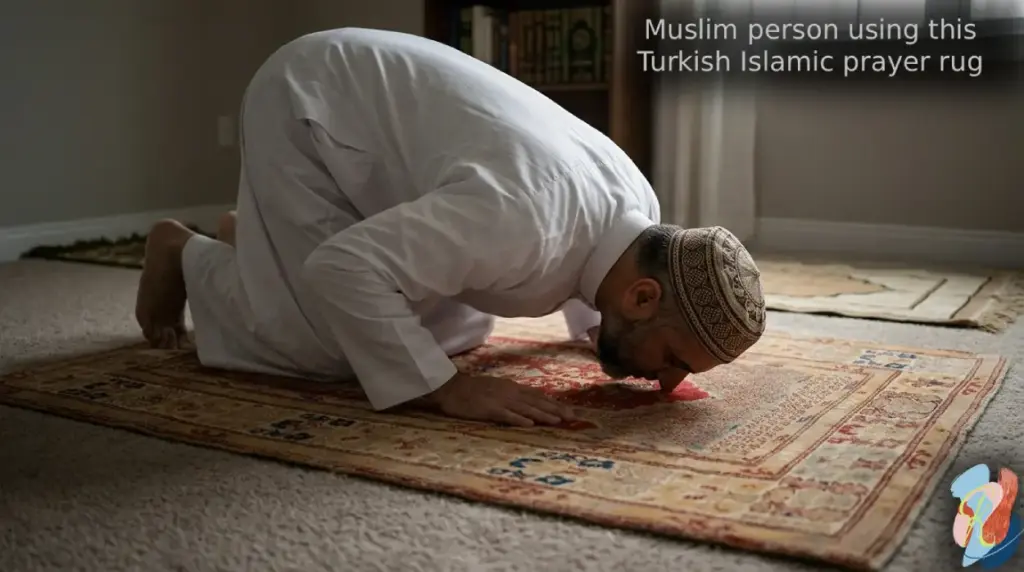
How a Prayer Rug Is Actually Used
While often admired for their complex artistry, the primary function of a prayer rug (sejjade) is profoundly practical and ritualistic. To appreciate the design of an Anatolian prayer rug, it is necessary to understand how a worshiper interacts with it during prayer.
Orientation and Ritual Purity
The single most critical action in utilizing a prayer rug is establishing orientation. Before beginning prayer (Salat), the worshiper aligns the rug so that its directional element—almost always the Mihrab (archway)—points precisely toward Mecca (the Qibla). The peak of the arch effectively serves as a visual compass, directing the mind and body. Furthermore, the rug itself must be clean. A core function is creating a designated ritually pure space, separating the worshiper from potential impurities on the ground.
Movement and Physical Interaction
The unique rectangular composition of the prayer rug is dictacted by the sequence of standardized movements (Rak’at) that make up Islamic prayer.
- Standing (Qiyam): The worshiper begins standing at the “base” of the rug (opposite the archway), facing Mecca.
- Prostration (Sujud): The most profound moment in prayer is the prostration. The worshiper lowers themselves, placing their hands and face upon the ground. A prayer rug’s narrow field and specific central space are dimensioned precisely for this action. When prostrating, the worshiper’s forehead should ideally touch the central red field within the arch (as seen in the detailed breakdown in image_1.png).
- Technical Feedback: In many traditional regions (like Konya), rugs were woven with specific structural properties, such as a raised warp or a “ridged back.” These features are not just acoustic or aesthetic; they provide subtle sensory feedback, allowing the worshiper to know their hands and face are positioned correctly on the rug’s central, sanctioned space without breaking their spiritual focus (Khushu’).
By understanding this active physical and spiritual dialogue between the weaver’s intent and the worshiper’s praxis, the Anatolian prayer rug moves from a museum object to a living architectural device for facilitating communion with the divine.
The Art of the Turkish Kilim: Geometry in Flat-Weave
While hand knotted pile rugs provide a lush, three-dimensional surface, the Turkish Kilim offers a masterclass in two-dimensional geometry. Unlike knotted carpets, the kilims are flat-weave rugs using a “slit-weave” technique. This structural necessity—where the weaver turns the colored weft yarn back around the warp—creates the characteristic small vertical gaps and the crisp, stepped geometric patterns that define the Anatolian aesthetic.
Tribal Identity and the Weaver’s Voice
Historically, flat woven kilims were the primary creative outlet for nomadic and village women across the Taurus Mountains and the Anatolian plateau. Because they were lighter and easier to transport than heavy pile rugs, they were essential to the nomadic lifestyle.
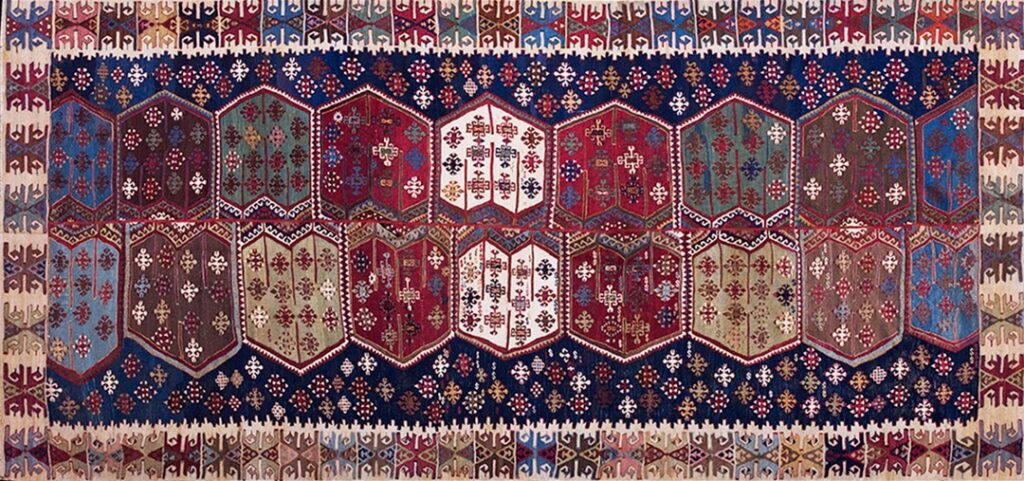
In these weaves, the “erudite” storytelling is found in the motifs. While a court-manufactured Hereke rug might follow a pre-planned artist’s cartoon, a Kilim is often woven “from the heart.” Symbols like the Eli Belinde (hands-on-hips) or the Kurt Izi (wolf’s track) were not just decorative; they were a coded language conveying the weaver’s hopes for fertility, protection, and family lineage.
The Palette of the Plateau
The color theory in Turkish Kilims is famously bold. Because they were historically intended for personal use rather than the 19th-century export market, the dyes remain incredibly saturated.
You will often find:
- Deep Madder Reds: Derived from the root of the Rubia tinctorum.
- Indigo Blues: Providing the necessary contrast for geometric clarity.
- Saffron and Chamomile Yellows: Reflecting the sun-drenched landscapes of the interior.
Modern Utility and Endurance
In contemporary rugs and design, the Anatolian Kilim is prized for its versatility. Its lack of pile makes it an ideal “layering” piece, providing a hit of ancient history and bold texture without the bulk. For the collector, a 19th-century Kilim represents a pure, unadulterated link to the tribal traditions that predated the commercialization of the rug trade.
Gender, Labor, and Social Organization
Women as Primary Weavers
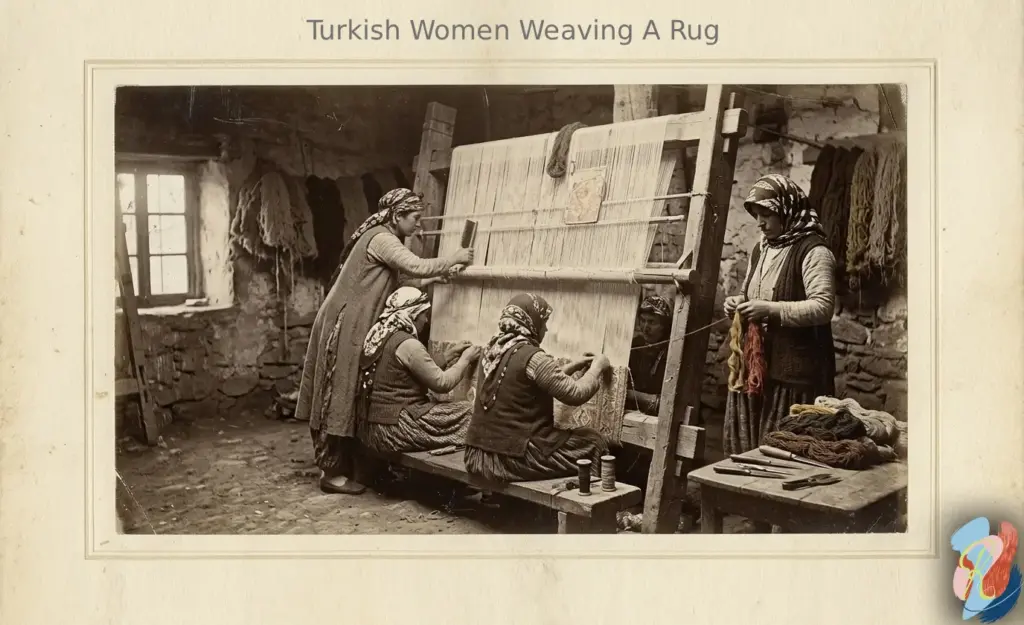
While the rug trade was historically managed by men (merchants and brokers), the creation of the rug was almost exclusively a female domain.
This gendered division of labor transformed the home into a site of artistic production:
- Knowledge Transfer: Weaving was a matrilineal craft. Techniques, dye recipes, and mnemonic patterns were passed from mother to daughter. This “silent education” ensured that even in the absence of formal schooling, a woman held a significant technical and artistic vocabulary.
- The “Silent” Narrative: Because women were often excluded from formal political or religious leadership, the rug became their primary medium for self-expression. A weaver’s choice of a “protection” symbol or a specific “fertility” motif was a rare form of female agency within a patriarchal structure.
Household Economies and the Dowry
In the village and nomadic context, a rug was rarely a “product” in the modern sense; it was a form of stored labor and capital.
- The Çeyiz (Dowry) System: A girl would begin weaving her dowry rugs in early adolescence. These textiles were a public testament to her skill, patience, and economic value to her future household. Upon marriage, these rugs remained her personal property—a crucial “insurance policy” in rural life.
- Supplementary Income: In settled village life, weaving acted as a vital counter-cyclical economy. When the harvest failed or the winter was long, the sale of a household rug provided the liquidity needed for survival.
Cooperative Systems
Weaving was seldom a solitary act. The physical scale of many rugs required a collective effort, fostering unique social bonds.
- The Imece Tradition: This is the Anatolian tradition of collective labor. Neighbors would gather at one house to help “throw the weft” or finish a large carpet. This made the loom a social hub—a place for storytelling, oral history, and communal problem-solving.
- Modern Cooperatives: In the late 20th century, projects like the DOBAG initiative formalized these ancient social bonds into legal cooperatives. This allowed women to bypass predatory middlemen, gain direct access to global markets, and achieve financial independence while remaining in their villages.
Modern Labor Decline and the “Vanishing Loom”
The 21st century has brought a sharp decline in hand-weaving, driven by a fundamental shift in the social fabric of Turkey.
3 of the main the factors are:
- Urbanization and Education: As younger generations of women move to cities for university and professional careers, the matrilineal chain of knowledge is breaking. Weaving is an incredibly slow, physically demanding task; for many young women, it represents a “backwardness” they wish to leave behind.
- The Opportunity Cost of Labor: In a globalized economy, the hundreds of hours required to hand-knot a rug often result in a “wage” that is lower than working in a modern factory or service job.
- The Machine-Made Threat: The rise of high-quality, computer-generated machine made rugs (often produced in Turkey’s industrial hubs like Gaziantep) has flooded the domestic market, making hand-woven rugs a niche luxury rather than a household staple.
| Labor Aspect | Traditional Context | Modern Reality |
| Primary Weaver | Matrilineal (Mother to Daughter) | Diminishing interest among youth |
| Economic Role | Household “Insurance” / Dowry | Specialized Artisan / Cooperative |
| Social Context | Communal (Imece) | Individual / Workshop-based |
| Value Basis | Stored Labor & Skill | Luxury Commodity & Heritage |
Authenticity, Heritage, and Revival
The DOBAG Project: A Scientific Restoration
As discussed in the technical analysis, the DOBAG Project (Natural Dye Research and Development Project) launched in 1981 remains the most significant modern intervention in Anatolian weaving.
- Reclaiming the “Pre-Industrial”: By reintroducing traditional vegetable dyes and hand-spun wool, DOBAG shifted the focus from quantity back to quality.
- The Economic Model: It was the first to return the right of signature to the weaver. Each rug was tagged with the weaver’s name and village, transforming the “anonymous” oriental rug into a traceable work of art. This provided a blueprint for ethical “fair trade” long before the term became a global standard.
Geographical Indication (GI) and Protections
To combat the influx of mass-produced replicas from other countries, Turkey has increasingly utilized Geographical Indication (GI) status.
- Protecting the “Brand”: Specific regions like Hereke, Uşak, and Döşemealtı have secured legal protections that stipulate a rug can only carry these names if it is produced within the specific geographic boundary using traditional methods.
- The Fight Against Counterfeits: GI status serves as a tool against “market confusion,” where machine-made rugs or rugs from distant industrial hubs are often marketed with Anatolian regional names to capitalize on their prestige.
UNESCO Narratives: Intangible Cultural Heritage
In 2010, the “Traditional Craftsmanship of the Turkish Carpet” was inscribed on the UNESCO Representative List of the Intangible Cultural Heritage of Humanity.
- From Object to Knowledge: This move shifted the focus from the physical rug to the knowledge system (the songs, the communal weaving, the dye secrets).
- Heritage as Diplomacy: UNESCO status allows the Turkish state to frame the rug not just as an export commodity, but as a vital part of the global human story, securing international funding for its preservation and promotion.
The “Invented Tradition” Debate
Using the framework of Eric Hobsbawm, scholars have analyzed the modern revival of Turkish rugs as a potential “Invented Tradition.”
- Hobsbawm’s Concept: The idea that many “ancient” traditions are actually relatively recent constructions that use a semi-fictional past to establish a sense of continuity and national identity.
- Application to Rugs: Critics argue that the “purity” sought by projects like DOBAG or the strict “heritage” branding by the state ignores the reality that Anatolian rugs have always been in a state of flux—influenced by Persian, Greek, Armenian, and Western tastes.
- The Paradox: By defining a “traditional” rug as only one that uses 18th-century methods, we may be “freezing” a living art form. The debate asks: Is a rug more “authentic” if it mimics the past perfectly, or if it evolves to reflect the contemporary life of the modern Anatolian woman?
Contemporary Industry and Globalization
Machine vs. Handmade: The Great Divergence
The most significant shift in the 21st century and new rug weaving is the technological chasm between machine-made “floor coverings” and hand-knotted “textile art.”
The 3 most significant aspects are:
- The Speed Gap: A high-end machine loom can produce a rug in minutes that would take a human weaver six to nine months to complete.
- The Aesthetic Difference: Machine rugs utilize computer-generated perfection, often lacking the “soul” of the weave—the subtle irregularities (abrash) and the structural “life” found in hand-knotted pieces.
- Market Perception: The industry has bifurcated. Machine rugs dominate the affordable, high-turnover “fast furniture” market, while hand-knotted rugs have moved into the realm of fine art and luxury investment.
Export Economy: Gaziantep vs. Village Weaving
The geography of production has shifted from the rural village to the industrial center.
- Gaziantep (The Industrial Giant): This city in southeastern Turkey has become the world capital of machine-made carpets, exporting billions of dollars worth of product annually. It represents Turkey’s dominance in the global industrial textile market.
- The Village Decline: Conversely, traditional centers (like those discussed in Section 10) are struggling to compete. The “export economy” for handmade rugs has shrunk in volume but increased in price-point, focusing on a diminishing number of high-quality, naturally dyed pieces for a global elite.
Tourism Influence: The “Bazaar” Effect
Tourism has acted as both a lifeline and a distorting lens for the Turkish rug industry.
- Demand for Portability: To accommodate the “souvenir” market, production in many regions shifted toward smaller formats—runners, pillows, and small scatter size mats—that can fit into modern luggage.
- Aesthetic Flattening: In many tourist hubs, weavers were encouraged to move away from idiosyncratic tribal designs toward “safe,” recognizable patterns that fit a generic Western idea of an “Oriental” rug.
- The Education Gap: The rise of tourism created a market for “instant antiques,” where new rugs are chemically treated or distressed to look old, complicating the relationship between the buyer and the authentic heritage of the piece.
Ethical Consumption and the Future
As global consumers become more conscious of supply chains, the “story” of the rug has become as important as its knot density.
- The “Slow” Movement: Much like the slow-food movement, the rug industry is seeing a niche revival where consumers are willing to wait months for a custom-commissioned, hand-woven piece, viewing the rug as a sustainable, lifelong companion rather than a disposable asset.
- Transparency and Fair Trade: Organizations like GoodWeave and the DOBAG cooperatives have set standards to ensure rugs are produced without child labor and that women receive a fair, living wage.
- Environmental Impact: There is a growing movement back toward natural dyes and local wool as a “green” alternative to the petroleum-based fibers (polypropylene) used in mass-market machine rugs.
| Feature | Industrial (Gaziantep) | Heritage (Village/Cooperative) |
| Production Speed | Minutes | Months |
| Material | Synthetic (Polypropylene / Polyester) | Organic (Wool /Silk / Natural Dyes) |
| Target Market | Mass Retail / High Turnover | Luxury / Collectors / Ethical Consumers |
| Economic Value | Low per-unit / High volume | High per-unit / Low volume |
The Loom of the Future
The story of the Turkish rug is one of resilience. It has survived the collapse of empires, the shock of the Industrial Revolution, and the threat of synthetic digitization. Today, the rug exists in a dual reality: as a global commodity traded in high-end galleries and as a cultural anchor for the communities that continue to throw the shuttle.
Whether it is a centuries-old “Holbein” fragment in a museum or a modern, naturally dyed village weave, the Anatolian rug remains a “material document”—a silent, knotted history of the people who shaped the geography of the East.
Turkish Rugs in the Global Cultural Imagination
The Museum: Institutionalizing the Textile
The transition of the rug from the floor to the museum gallery marked its acceptance as “High Art.” This institutionalization has shaped how the public values these objects today.
- Canonization: Institutions like the Metropolitan Museum of Art in New York, the Victoria and Albert Museum in London, and the Museum of Turkish and Islamic Arts (TIEM) in Istanbul have established the “standards” of beauty and rarity.
- The Fragment as Art: Museums have taught us to appreciate the beauty of the fragment. A 15th-century Seljuk scrap is often more valued than a pristine 20th-century rug, shifting the focus from utility to historical and archaeological significance.
- Curatorial Narrative: Modern museum exhibitions are moving away from purely aesthetic displays toward “Contextualizing the Loom,” highlighting the lives of the weavers and the political history of the Ottoman Empire.
Interior Design Trends: The “Bohemian” vs. “Minimalist” Anchor
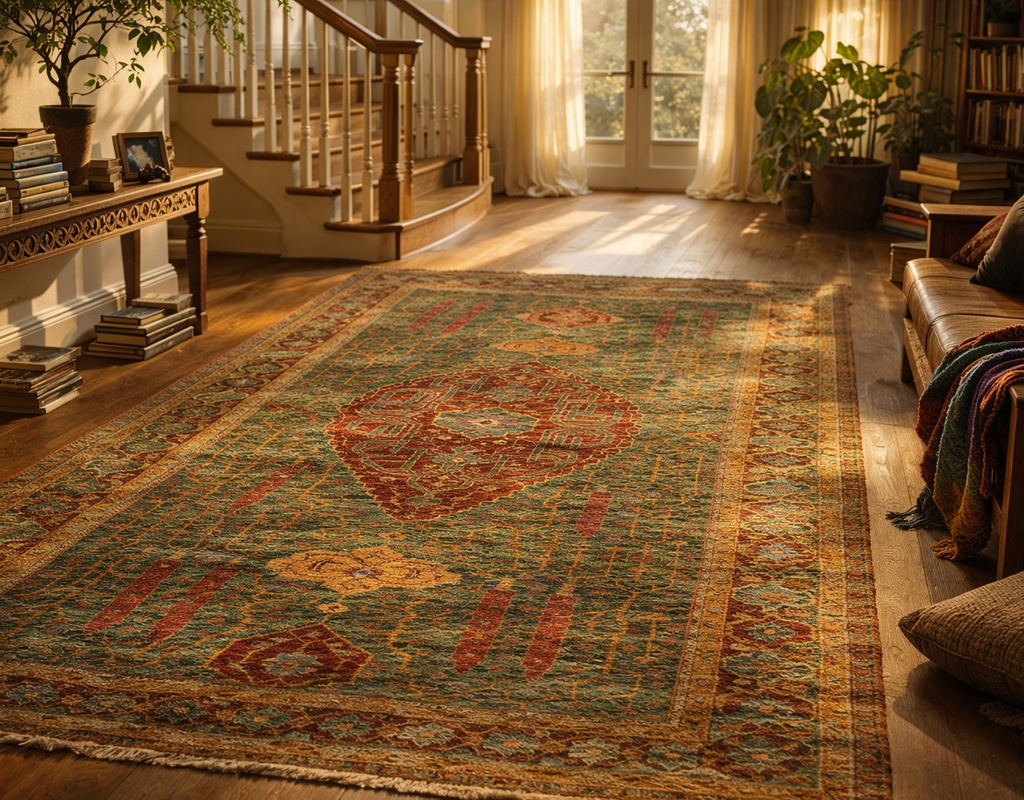
The Turkish rug has been a staple of Western interior design for centuries, but its role has shifted with changing tastes.
- The Victorian Clutter: In the 19th century, rugs were part of a “more-is-more” aesthetic, often layered over one another to signal global traveler status.
- The Mid-Century Modern Anchor: In the 20th century, the bold, geometric lines of Anatolian kilims became the perfect foil for the clean, industrial lines of modern furniture.
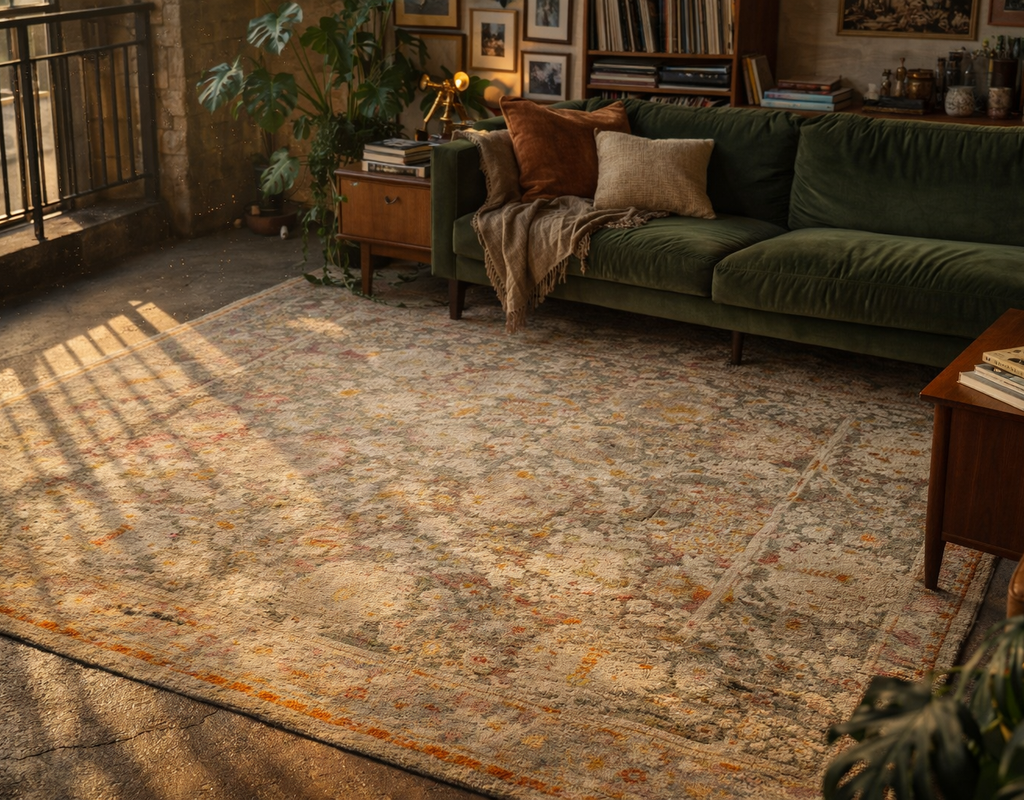
- The “Worn” Aesthetic: Current trends favor the “distressed” or “shaved” look. This has led to the controversial practice of “neutralizing” rugs—stripping them of their original vibrant colors with chemicals to fit the “Greige” and minimalist palettes of modern apartments.
Cultural Appropriation vs. Appreciation
As Turkish motifs are digitized and mass-produced, a complex debate has emerged regarding the ownership of these designs.
- Mass-Market Mimicry: Large-scale Western retailers often sell rugs with traditional Anatolian symbols (elibelinde, mihrab) without acknowledging their cultural or religious origins.
- Appropriation: When a sacred prayer rug design is used as a generic “boho” bathmat, the symbol is stripped of its ritual meaning and reduced to a trend.
- Appreciation: True appreciation involves transparency in the supply chain, acknowledging the regional origins (e.g., naming a rug “Uşak style” rather than just “Vintage”), and supporting the original weaving communities.
- The Intellectual Property Gap: Unlike a patent for a piece of software, a 500-year-old tribal motif belongs to the “commons.” This makes it difficult for traditional weaving communities to protect their intellectual property from global corporations that can replicate their labor in minutes.
The Turkish Rug Paradox Summary
The Turkish rug is a material paradox: it is a luxury item and a utilitarian tool; a sacred object and a global commodity; a record of the past and a victim of modern industrialization. To look at a rug in a museum, a home, or a shop is to look at a thousand years of human interaction, gendered labor, and artistic resilience.
Evolution over Stasis
The history of the Anatolian rug is not a story of an unchanging “ancient tradition,” but rather one of constant adaptation. From the Seljuk migration and the Ottoman court’s imperial ambitions to the 19th-century export boom and the current digital age, the rug has functioned as a remarkably fluid cultural and economic artifact.
- Cultural Artifact: It remains a record of human migration, religious praxis, and gendered labor.
- Economic Artifact: It continues to be a primary vehicle for Turkey’s participation in global markets, whether through the high-end antique trade or the industrial power of Gaziantep.
Emphasizing Discontinuity: A Break from the “Timeless” Myth
A critical takeaway for any serious study of Turkish textiles is the acknowledgment of discontinuity. The romanticized Western view of an “unbroken lineage” from Neolithic caves to modern living rooms obscures the reality of historical rupture.
- Technological Ruptures: The introduction of synthetic dyes and the move from the domestic loom to the factory floor represent fundamental breaks in the chain of knowledge.
- Demographic Shifts: The transition from a nomadic to a settled, urbanized society has fundamentally changed why and for whom these rugs are made.
- Heritage as Choice: Modern “revivals” (like the DOBAG project) are not simply continuations of the past; they are conscious, scholarly choices to reconstruct specific methods in response to the perceived failures of industrialization.
Global Entanglement: The Rug as a Nexus
The Turkish rug is perhaps the ultimate symbol of global entanglement. It has never existed in a vacuum.
Its design, material, and survival have been shaped by:
- Cross-Cultural Trade: Silk Road influences and European merchant demands.
- Intellectual Exchange: Western scholarly classifications meeting local oral traditions.
- Economic Interdependence: The tension between rural artisans and global mass-market retailers.
The Unfinished Loom
The “Rugs of Turkey” are not fossils to be studied only in museums; they are active participants in a global conversation about authenticity, labor, and art. As long as there is a human desire to walk upon a story, the Anatolian loom—whether made of wood in a mountain village or steel in a high-tech factory—will continue to weave the complex identity of the region into the fabric of the world.
A Living Legacy for the Modern Home
The journey of the Turkish rug—from the nomadic tents of the Anatolian plateau to the grand libraries of Europe—is a testament to the enduring power of human artistry. These are not merely floor coverings; they are woven chronicles of history, faith, and the technical mastery of generations. Whether it is the scholarly geometry of a Holbein design, the vibrant storytelling of a tribal Kilim, or the quiet sanctuary of a prayer rug, each piece carries a soul that transcends time.
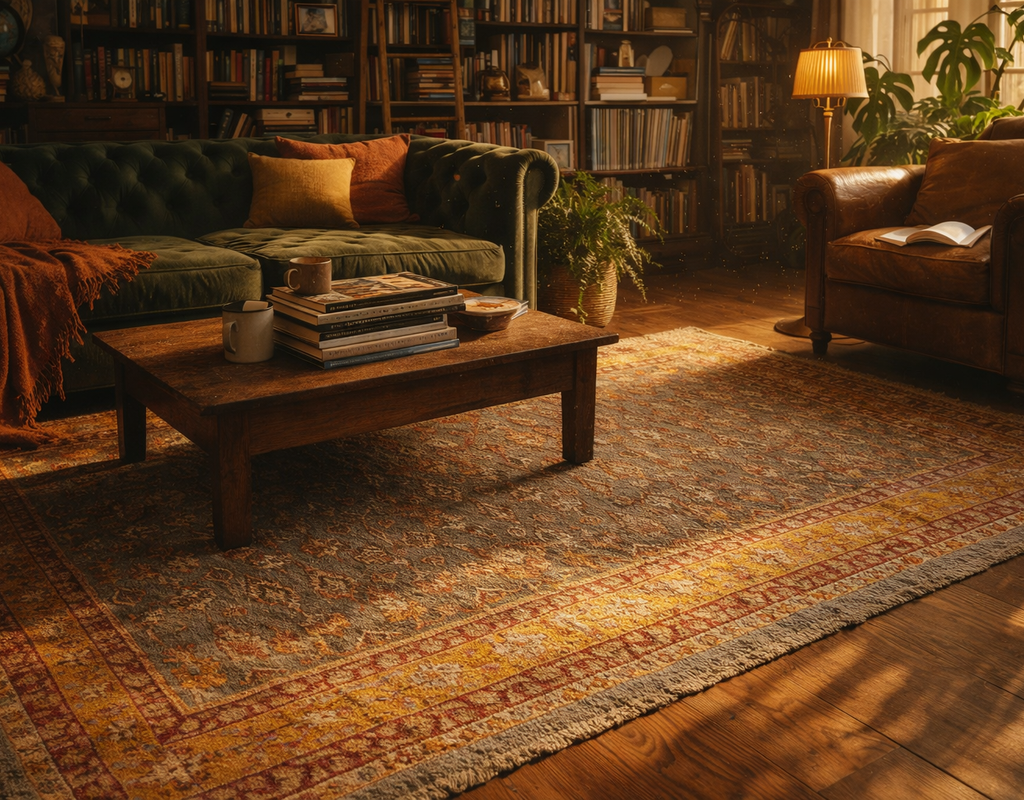
As you look to bring this heritage into your own space, remember that an authentic rug is an investment in both beauty and endurance. It is a piece of history that evolves with your home, gaining character and depth with every passing decade.
Discover Your Own Piece of History
At RugsonNet, we take immense pride in our curated selection of authentic Turkish and Anatolian textiles. Our collection is hand-selected for its superior quality, artistic integrity, and the unique stories each weave has to tell.
We invite you to explore our gallery and find the perfect balance of comfort and erudition for your collection.
Woven with heritage, artistry, and timeless Anatolian soul.
Shop Our Collection of Turkish Rugs.Explore a Few of Our Favorite Turkish Rugs