
Sarouk Rugs
Key takeaways: Sarouk rugs
- What they are: hand knotted Persian rugs from Sarouk, a village near Arak in west central Persia, and the Farahan plain to its north.
- One name, two rugs: Sarouk covers both the fine 19th century weaving of the Farahan plain and the heavier rose ground carpets woven for American department stores between the wars.
- How to tell them apart: ivory or deep indigo grounds and allover designs point earlier; rose, salmon and raspberry grounds with detached floral sprays point to the American period.
- Sarouk Farahan: the trade's way of saying a rug has the earlier, finer character, and the single most useful phrase in the category.
- Our collection: 42 antique Persian Sarouk rugs, 13 of them from the 19th century, plus vintage Sarouks from the 1940s and 1950s.
- Buying with confidence: every listing states origin, approximate age, materials and measured size, shipping is free within the continental United States, and there is a 4 day in home trial. See buying with confidence.
Antique Sarouk rugs are a celebrated type of Persian hand‑knotted carpet that originated in and around the village of Sarouk near Arak in central Iran, gaining international acclaim in the late 19th and early 20th centuries for their luxurious wool, dense pile, and elegant floral designs. These carpets are distinct for their all‑over floral sprays, vine scrolls, and occasionally small central medallions, arranged in harmonious compositions that blend traditional Persian artistry with refined village weaving techniques.
Classic Sarouks are typically woven with high‑quality wool on a cotton foundation, producing a soft, velvety surface that wears beautifully over time and stands up well in high‑traffic areas. Their rich color palettes often include deep reds, navy blues, ivories, and earth tones, with some historic examples exhibiting the renowned salmon‑pink “dughi” hue prized by collectors. During the early 20th century, Sarouk carpets became especially popular in the United States, inspiring variations like the American Sarouk — rugs tailored to Western tastes while preserving the classic Persian aesthetic.
Today, authentic Sarouk rugs are valued for their timeless beauty, outstanding craftsmanship, and enduring cultural heritage, making them cherished centerpieces in both traditional and contemporary interiors.
Antique Persian Sarouk rugs are treasured worldwide for their exceptional quality, densely knotted construction, and distinct floral spray motifs that create a lavish, heirloom feel. These classic Persian carpets, famous for their rich reds and resilient foundations, stand as a testament to Iran’s masterful weaving centers. Discover more about the history of Persian and Iranian rug making, and compare the distinct characteristics of Sarouks with neighboring weaving centers like Kashan and Kerman. Sarouk covers two distinct periods of weaving at very different prices. For the current price bands, how to tell an earlier Sarouk Farahan from a 1920s American-market carpet, and what to check before buying one, read our antique Sarouk rug buying and identification guide.
Sarouk rugs at a glance
The table below summarizes the main facts about Sarouk rugs, drawn from our antique Sarouk rugs guide and from the in-stock Sarouk rugs on this page on November 22, 2026. Counts and prices change as rugs sell.
| Feature | Sarouk rugs |
|---|---|
| Where they were woven | Sarouk and the Farahan plain, near Arak (the old Sultanabad) in west central Persia |
| Other spellings | Saruk, Sarough; for the earlier group, Farahan, Feraghan and Ferahan |
| Construction | Hand knotted wool pile. Farahan weaving is generally thinner and tighter in the hand; the American period Sarouks are heavier, with a deeper pile. |
| Ages in our collection | 13 antique Sarouks from the 19th century, 6 from about 1900 and 23 from the 1910s to the 1930s; 3 vintage Sarouks from the 1940s and 1950s |
| Typical palettes | Ivory and blue lead among our 19th century pieces; blue, coral and salmon, and red among the later ones |
| Signature designs | Allover designs, very often the Herati (fish) pattern, in the earlier group; detached floral sprays, sometimes around a small medallion, in the later group |
| Sizes in stock | From 4 x 6 scatter rugs and runners to 8 x 10 and 10 x 14 room size carpets and 11 carpets 12 feet wide or larger, such as 12 x 18 and 15 x 17 |
| Price range, antique | From $1,200 to $97,500; the median is about $14,000, and half are priced between about $5,500 and $19,500 |
| Price range, vintage | From $4,600 to $24,000 |
| New Sarouk style rugs | 24 new rugs in Sarouk designs, mostly 8 x 10 and 9 x 12; each listing states its origin and how it was made |
| In stock | 69 Sarouk rugs: 42 antique, 3 vintage and 24 new |
Prefer to see a rug in person?
-
Fiona Oriental Gray Hand Knotted Wool Rug
$2,261.00 New RugsSKU: KC42007GY9X12Rug sizes: 9 ft x 12 ft (2.74 m x 3.66 m) -
Antique Sarouk – Farahan Rug
$15,000.00 Antique RugsSKU: 2036Rug sizes: 7 ft x 10 ft 2 in (2.13 m x 3.10 m) -
1900s Blue Navy Floral Antique Persian Sarouk Farahan Rug 4’2″ X 6’8″ Handknotted Wool Carpet
$6,400.00 Antique RugsSKU: 40-1069Rug sizes: 4 ft 2 in x 6 ft 8 in (1.27 m x 2.03 m) -
1920s Black Geometric Antique Persian Sarouk Runner 2′ 7” X 19′ 0” Handknotted Wool Carpet
$9,000.00 Antique RugsSKU: 40-5140Rug sizes: 2 ft 7 in x 19 ft (0.79 m x 5.79 m) -
1940s Red Medallion Vintage Persian Sarouk Rug Handknotted Wool Carpet
$9,800.00 Vintage RugsSKU: 40-5066Rug sizes: 7 ft 9 in x 10 ft 6 in (2.36 m x 3.20 m) -
1900s Red Medallion Antique Persian Sarouk Rug 6’10” X 10’0″ Handknotted Wool Carpet
$8,300.00 Antique RugsSKU: 40-5064Rug sizes: 6 ft 10 in x 10 ft (2.08 m x 3.05 m) -
1900s Red Medallion Antique Persian Sarouk Square Handknotted Wool Carpet
$15,000.00 Antique RugsSKU: 40-805Rug sizes: 10 ft 8 in x 11 ft (3.25 m x 3.35 m) -
1940s Multicolor Field Diamond Antique Knotted Wool Sarouk Farahan Long Carpet
$24,000.00 Vintage RugsSKU: 40-5420Rug sizes: 10 ft x 20 ft (3.05 m x 6.10 m) -
Mid 20th Century Persian Sarouk Carpet, Hand-Knotted Wool
$4,600.00 Vintage RugsSKU: 25936Rug sizes: 2 ft 10 in x 9 ft 8 in (0.86 m x 2.95 m) -
Antique Persian Sarouk Carpet, Red Floral, Hand-Knotted Wool, 1930s
$12,000.00 Antique RugsSKU: 4372Rug sizes: 11 ft 4 in x 17 ft 9 in (3.45 m x 5.41 m) -
Antique Persian Seraband Long Carpet, 6’1″×12’4″ Red & Blue, Early 20th Century
$6,500.00 Antique RugsSKU: 20-1001Rug sizes: 6 ft 1 in x 12 ft 4 in (1.85 m x 3.76 m) -
Fine Allover Floral Cypress Tree Design Antique Late 19th Century Ivory Persian Sarouk Farahan Carpet
$58,500.00 Antique RugsSKU: 23530Rug sizes: 11 ft 10 in x 15 ft 10 in (3.61 m x 4.83 m) -
Small Size Ivory Background Antique Late 19th Century Fine Floral Persian Sarouk Rug
$19,500.00 Antique RugsSKU: 18240Rug sizes: 4 ft 6 in x 6 ft 8 in (1.37 m x 2.03 m) -
Antique Late 19th Century Classic Traditional Floral Medallion Design Persian Sarouk Rug
$19,500.00 Antique RugsSKU: 19463Rug sizes: 7 ft 2 in x 10 ft 6 in (2.18 m x 3.20 m) -
Classic Antique Late 19th Century Red Floral Medallion Pattern Oversized Persian Sarouk Farahan Carpet
$97,500.00 Antique RugsSKU: 18654Rug sizes: 14 ft x 23 ft 10 in (4.27 m x 7.26 m) -
Magnificent Fine Weave Antique Ivory Persian Sarouk Farahan Rug
$7,200.00 Antique RugsSKU: 21769Rug sizes: 4 ft 6 in x 7 ft (1.37 m x 2.13 m) -
Magnificent Navy Blue Color Fine Weave Floral Design Antique Persian Sarouk Rug
$11,700.00 Antique RugsSKU: 21894Rug sizes: 10 ft 10 in x 13 ft 9 in (3.30 m x 4.19 m) -
Antique Sarouk Small Scatter Size Wool Ivory Rug
$2,600.00 Antique RugsSKU: 6742Rug sizes: 4 ft 2 in x 6 ft 3 in (1.27 m x 1.91 m) -
Antique Sarouk – Farahan Small Scatter Size Wool Coral Rug
$4,600.00 Antique RugsSKU: 6633Rug sizes: 4 ft 7 in x 6 ft 5 in (1.40 m x 1.96 m) -
Antique Sarouk Persian Coral 1920s Rug
$7,800.00 Antique RugsSKU: 5975Rug sizes: 8 ft 10 in x 11 ft 9 in (2.69 m x 3.58 m) -
Allover Floral Hand Knotted Pile 1920s Rectangle Antique Wool Blue Large Rug
$23,400.00 Antique RugsSKU: 25831Rug sizes: 12 ft x 18 ft (3.66 m x 5.49 m) -
Antique Sarouk Hallway Runner Wool Rug
$2,000.00 Antique RugsSKU: 25574Rug sizes: 2 ft 7 in x 8 ft (0.79 m x 2.44 m) -
Antique Coral Sarouk Small Scatter Size Wool Rug
$1,200.00 Antique RugsSKU: 2545Rug sizes: 3 ft x 5 ft (0.91 m x 1.52 m) -
Antique Persian Sarouk Room Size Square Rug – Red Floral
$16,300.00 Antique RugsSKU: 23038Rug sizes: 13 ft 8 in x 14 ft (4.17 m x 4.27 m) -
1880s Blue Hand Knotted Pile Rectangle Antique Wool Allover Floral Rug
$22,800.00 Antique RugsSKU: 22780Rug sizes: 10 ft 6 in x 13 ft 6 in (3.20 m x 4.11 m) -
Cream Field Intricate Floral Pattern Antique Luxurious Wool Persian Sarouk Farahan Rug
$16,300.00 Antique RugsSKU: 22068Rug sizes: 10 ft x 13 ft 4 in (3.05 m x 4.06 m) -
Antique Joshaqan Persian Knotted Rug
$19,500.00 Antique RugsSKU: 21516Rug sizes: 5 ft 8 in x 11 ft 9 in (1.73 m x 3.58 m) -
Antique Sarouk Wool Coral Rug
$4,300.00 Antique RugsSKU: 21165Rug sizes: 4 ft 7 in x 10 ft (1.40 m x 3.05 m) -
Ivory Antique Floral Medallion Design Small Persian Sarouk Farahan Rug
$4,900.00 Antique RugsSKU: 20764Rug sizes: 4 ft 4 in x 6 ft 6 in (1.32 m x 1.98 m) -
Antique Sarouk Large Room Size Wool Multicolor Rug
$27,300.00 Antique RugsSKU: 20424Rug sizes: 8 ft 10 in x 19 ft (2.69 m x 5.79 m) -
Antique Large Sarouk – Farahan Persian Knotted Rug
$52,000.00 Antique RugsSKU: 20282Rug sizes: 14 ft 3 in x 17 ft 2 in (4.34 m x 5.23 m) -
Antique Sarouk Persian Knotted Rug
$2,300.00 Antique RugsSKU: 20095Rug sizes: 3 ft 10 in x 6 ft 4 in (1.17 m x 1.93 m) -
Antique Sarouk Large Room Size Wool Blue Rug
$13,000.00 Antique RugsSKU: 19861Rug sizes: 10 ft 2 in x 19 ft 8 in (3.10 m x 5.99 m) -
Coral Antique Samarghand Persian Knotted Square Rug
$5,200.00 Antique RugsSKU: 19756Rug sizes: 5 ft 6 in x 14 ft 3 in (1.68 m x 4.34 m) -
Antique Sarouk Oversized Large Oversized Big Rug Wool Coral
$16,300.00 Antique RugsSKU: 19315Rug sizes: 12 ft 8 in x 22 ft 8 in (3.86 m x 6.91 m) -
Antique Coral Square Lilihan Persian Knotted Rug
$1,200.00 Antique RugsSKU: 18048Rug sizes: 3 ft 5 in x 4 ft 2 in (1.04 m x 1.27 m)
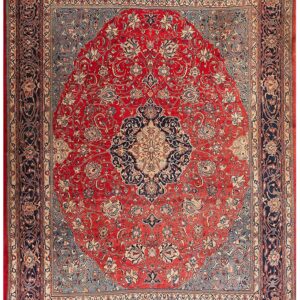
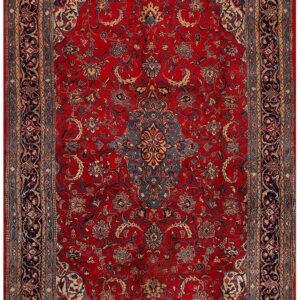
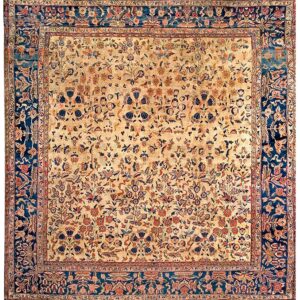
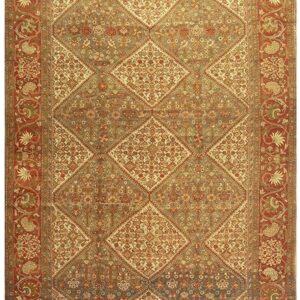
Sarouk or Sarouk Farahan: what is the difference?
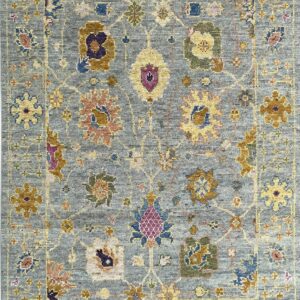
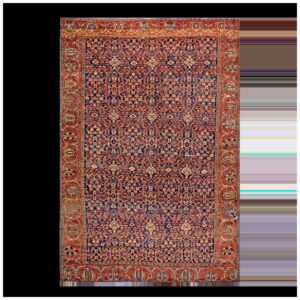
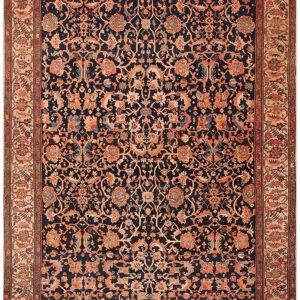
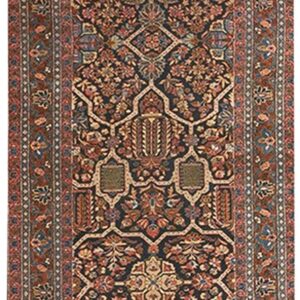
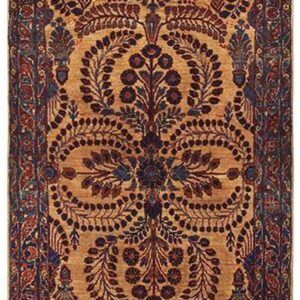
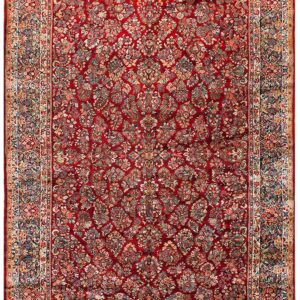
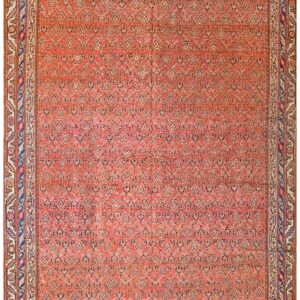
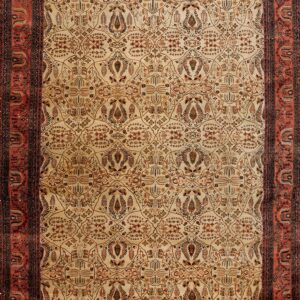
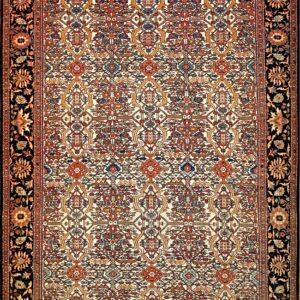
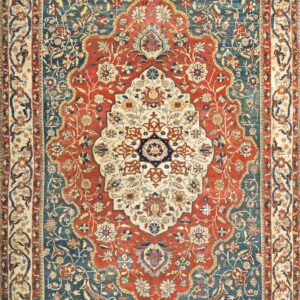
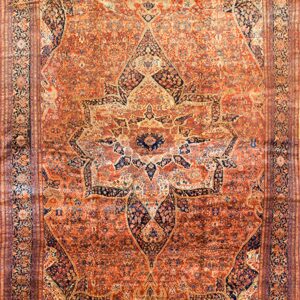
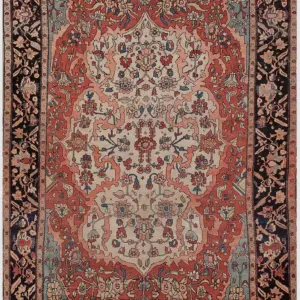
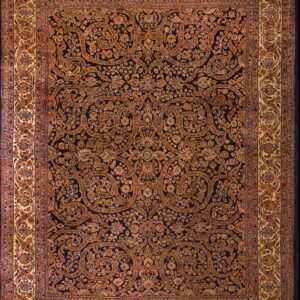
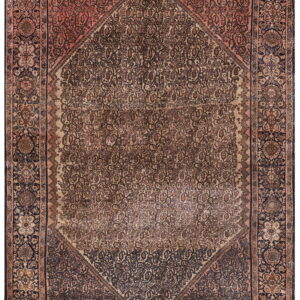
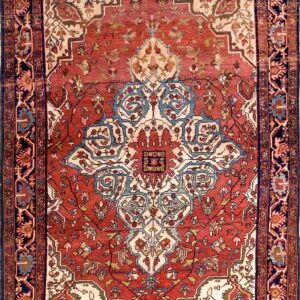
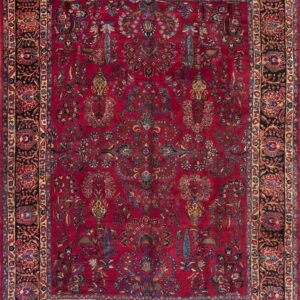
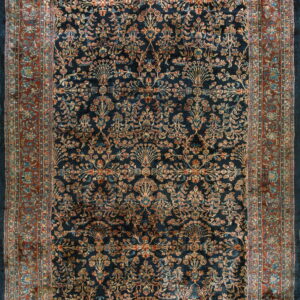
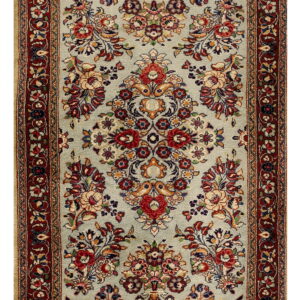
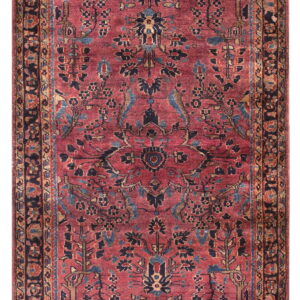
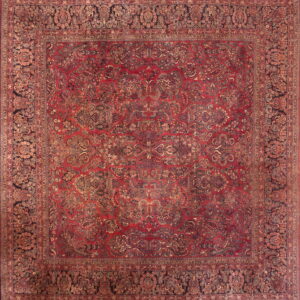
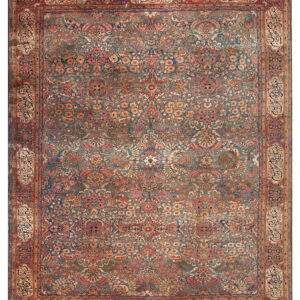
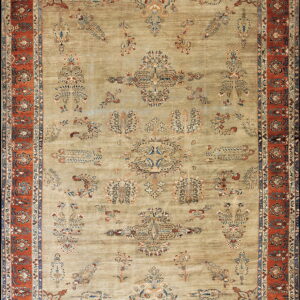
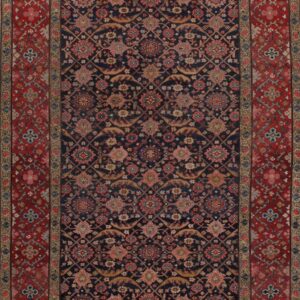
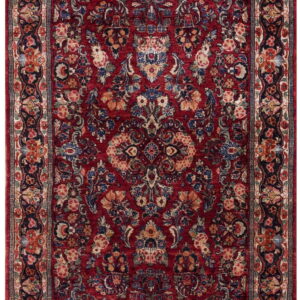
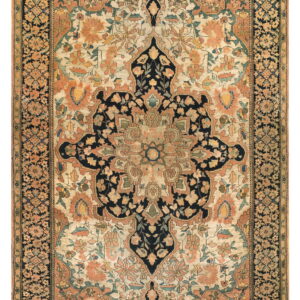
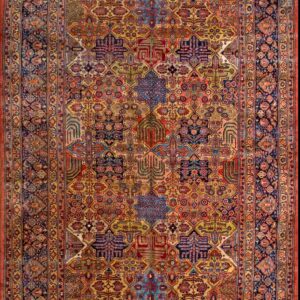
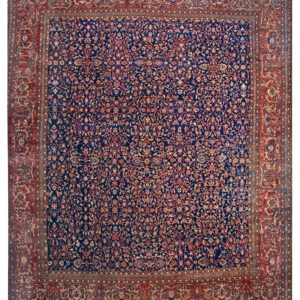
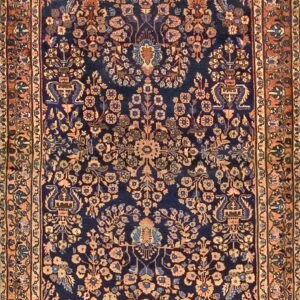
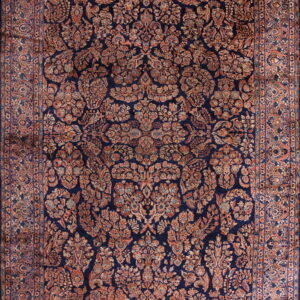
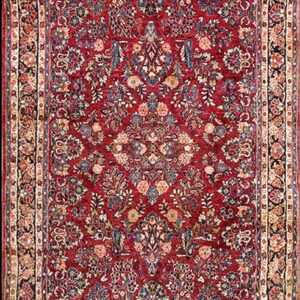
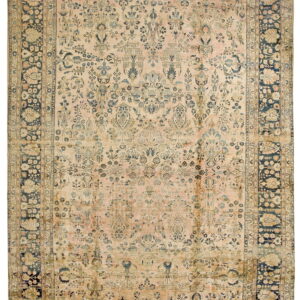
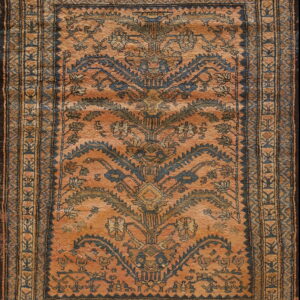
Sarouk is a village near Arak, the city 19th century carpet catalogues called Sultanabad. North of it lies the Farahan plain, a weaving district that produced some of the most admired Persian carpets of the 19th century. The two names have been used loosely and interchangeably for well over a century, but they describe two traditions about forty years apart:
- Farahan lineage. Made for a domestic and European luxury market, mostly in the 19th century. Ivory and deep indigo grounds, allover designs, and a thinner, tighter handle.
- American period Sarouk. Made to order for American department stores, mostly between about 1910 and 1940, when Sarouk was the highest volume Persian carpet arriving in the United States. Rose, salmon and coral grounds, detached floral sprays and a heavier, deeper pile.
When a title says Sarouk Farahan, the trade means a rug with the earlier, finer character. Several of the Sarouks on this page carry both names; see also our Farahan rugs.
How can you tell an early Sarouk from a later one?
None of these signs is decisive alone; together they are reliable.
- Ground color. Ivory, cream or deep indigo points earlier. Rose, salmon or raspberry points to the American period.
- Pattern. Earlier pieces favor an allover repeat, very often the Herati or fish design. Later Sarouks favor detached floral sprays with space between them.
- Handle and thickness. Farahan weaving is thinner and tighter; the export Sarouks are noticeably heavier.
- Drawing. Earlier work draws a vine scroll smoothly; later commercial work steps it. Our guide to rug knots and KPSI explains why.
- Age on the label. Every listing on this site states the approximate age; see antique vs vintage vs new rugs.
What is a painted Sarouk?
American Sarouks came off the loom with a light salmon or rose field. American taste of the time wanted a deeper raspberry or burgundy, so importers routinely chemically washed the carpets and then tinted or painted the field after weaving. It was ordinary retail practice of the period, not deception, and a painted Sarouk can be a perfectly good rug, but it affects value and how the rug ages. Three checks you can do in daylight:
- Part the pile. If the base of the knots is markedly lighter than the tip across the whole field, color was added after weaving.
- Compare front and back. Applied color sits on the face, so a clearly lighter back is a strong signal.
- Test a hidden corner with a damp white cloth before you buy; surface color can transfer.
Our antique Sarouk rugs guide covers this in more detail.
What makes an antique Sarouk valuable?
- Lineage. Size for size, the Farahan lineage pieces in our stock are priced well above the later plain Sarouks.
- Size. Room size and oversize carpets cost more than scatter rugs, so compare Sarouks of the same size.
- Color. Original, saturated natural color.
- Condition. Even pile and original ends and sides.
- Drawing. Smooth, well resolved curves. See how much is an antique Persian rug worth.
How do you decorate with a Sarouk rug?
- Traditional rooms. The floral sprays and warm rose grounds of a Sarouk suit traditional and classic interiors.
- Calmer rooms. An ivory or indigo Farahan with an allover design suits neutral and transitional rooms.
- Measure first. Our rug size guide explains how to measure, and our guides to antique 8 x 10 rugs and antique 9 x 12 rugs show which rooms each size suits.
How do you care for a Sarouk rug?
- Pad and rotation. Use a quality pad and rotate the rug once or twice a year.
- Vacuuming. Vacuum without a beater bar.
- Light and spills. Keep it out of prolonged direct sun and blot spills at once with plain water.
- Washing. Have it hand washed by a rug specialist rather than a carpet cleaning service. Our rug cleaning service in Manhattan washes hand knotted rugs.
- Moths. Wool rugs under furniture attract moth larvae; our moth proofing service treats the fibers after washing.
Glossary of Sarouk rug terms
- Sarouk (Saruk, Sarough)
- A village near Arak in west central Persia that gives its name to a family of Persian rugs.
- Farahan (Feraghan, Ferahan)
- The weaving plain north of Sarouk, known for fine 19th century carpets.
- Sultanabad
- The old name of Arak, used in 19th century carpet catalogues.
- Herati (fish design)
- A small rosette inside a diamond with curved leaves around it, repeated across the field.
- Painted field
- A Sarouk whose field was tinted after weaving to deepen its color, a common American import practice.
Sarouk Rugs: Frequently Asked Questions
What is a Sarouk rug?
A Sarouk rug is a hand knotted Persian rug from Sarouk, a village near Arak in west central Persia, or the Farahan plain to its north. The name covers both fine 19th century Farahan weaving and the heavier rose ground carpets woven for the American market between about 1910 and 1940.
What does Sarouk Farahan mean?
It is the trade's way of saying a Sarouk has the earlier, finer Farahan character: usually ivory or indigo grounds, an allover design and a thinner, tighter weave.
How old are the antique Sarouk rugs on this page?
We have 42 antique Sarouks: 13 from the 19th century, 6 from about 1900 and 23 from the 1910s to the 1930s, plus 3 vintage Sarouks from the 1940s and 1950s. Every listing states the approximate age.
How much is an antique Sarouk rug worth?
Our antique Sarouks range from about $1,200 to $97,500, with a median of about $14,000, and half are priced between about $5,500 and $19,500. Size moves the price most, and at the same size the Farahan lineage pieces are priced well above the later plain Sarouks.
Why do some Sarouk rugs have painted fields?
American buyers between the wars wanted a deeper raspberry or burgundy than the light rose the carpets came off the loom with, so importers chemically washed many Sarouks and then tinted the field. It was ordinary practice at the time; it affects value and how the rug wears.
Do you have new Sarouk rugs?
Yes. We have 24 new rugs in Sarouk designs, mostly in 8 x 10 and 9 x 12. Each listing states its origin and how it was made.
Can I try a Sarouk rug at home?
Yes. Shipping is free within the continental United States, and every rug comes with a 4 day in home trial starting the day it is delivered. You can also see the rugs by appointment at our showroom at 36 East 31st Street, 9th floor, New York, where Rugs On Net has been since 1979. Interior designers can join our trade program.