
Peking Rugs
Key takeaways: antique Peking rugs
- What they are: hand-knotted wool rugs woven in and around Beijing, whose older Western name was Peking, from the late 19th century into the 1930s. They are the classic blue and ivory branch of our antique Chinese rugs collection.
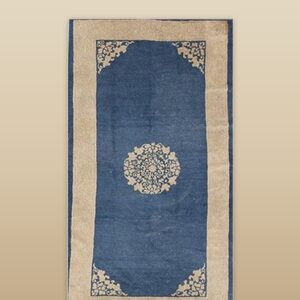
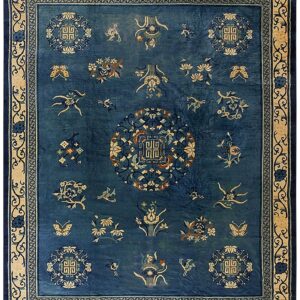
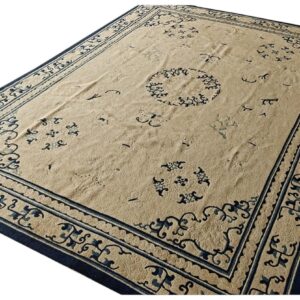
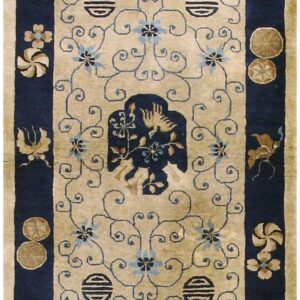
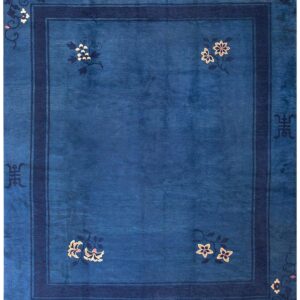
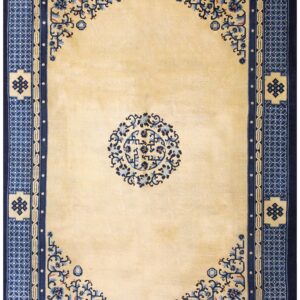
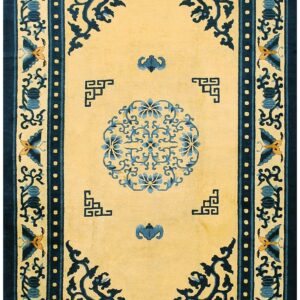
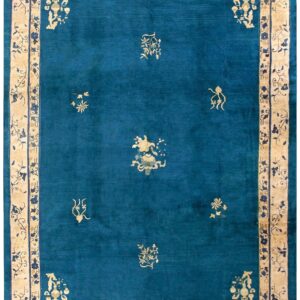
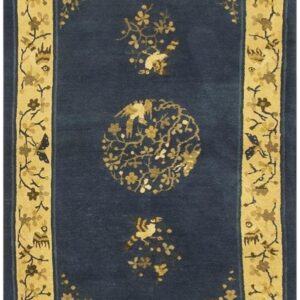
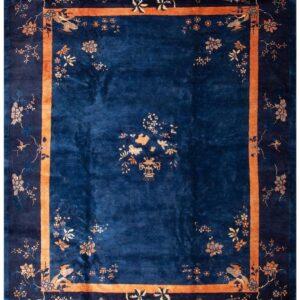
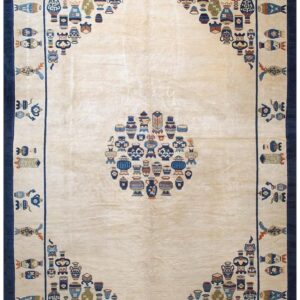
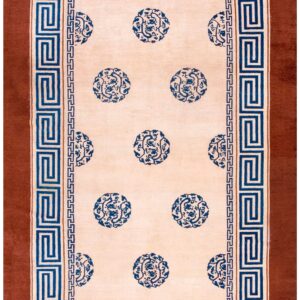
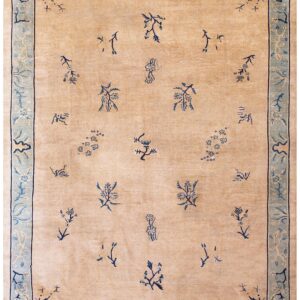
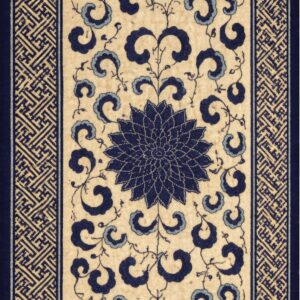
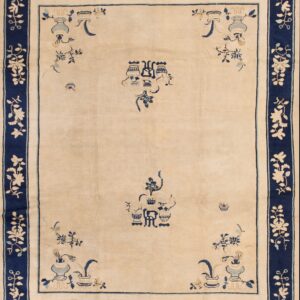
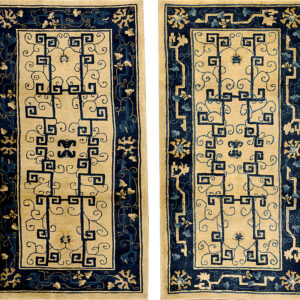
- How to spot one: a calm field, usually ivory or indigo, holding a central medallion or a few well spaced symbols, inside a quiet fret, cloud or floral border that frames the field instead of competing with it.
- How it feels: Peking rugs are more densely knotted than Ningxia rugs, and many have a stiff, heavy "closed back" handle with the pile carved around the motifs so the design stands in relief.
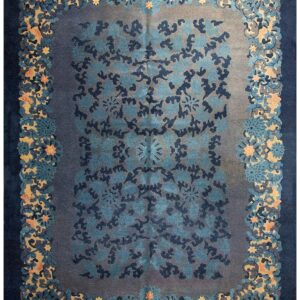
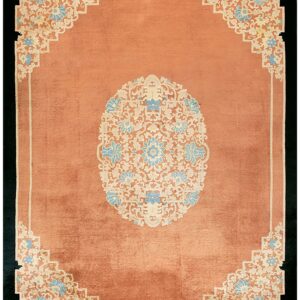
- Two moods under one name: traditional pieces keep to blues on ivory, while many rugs woven for export in the 1920s added rose, teal, gold and lavender for American homes.
- Our collection: more than 800 Peking rugs in stock in New York, the biggest single type in our Chinese collection. Circa 1920 is the most common date, followed by 19th century pieces and rugs from around 1900.
- Buying with confidence: every rug is inspected before it is listed, shipping is free within the continental United States, and there is a 4-day in-home trial. See buying with confidence.
Antique Peking rugs are a distinctive and elegant category of Chinese hand‑knotted carpets that emerged in the late 19th and early 20th centuries, taking their name from the old Western spelling of Beijing, the cultural and political heart of China. These rugs are recognized for their balanced compositions, open‑field layouts, and symbolic motifs drawn from Chinese artistic traditions, making them stand apart from the denser ornamentation of many Persian and Oriental styles.
Traditionally woven with high‑quality wool on a cotton foundation, Peking rugs often feature a central medallion or elegant field of auspicious symbols such as dragons, lotuses, and classical floral elements, set within restrained borders that emphasize simplicity and harmony. The color palettes tend toward soft ivories, blues, warm neutrals, and occasional muted accents, lending these carpets a serene, timeless aesthetic that works beautifully in both traditional and contemporary interiors.
While early examples were closely tied to Chinese artistic heritage and palace or elite use, export‑era Peking rugs also adapted to Western tastes in the early 20th century, blending classic motifs with simplified designs suited to modern décor. Collectors and design enthusiasts prize authentic Peking rugs not only for their cultural richness but also for their versatility, enduring craftsmanship, and understated refinement.
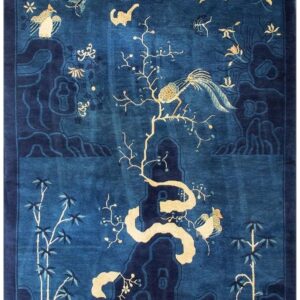
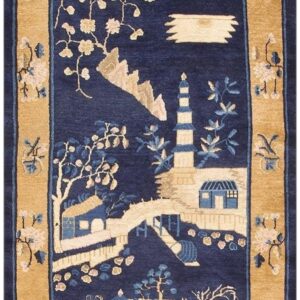
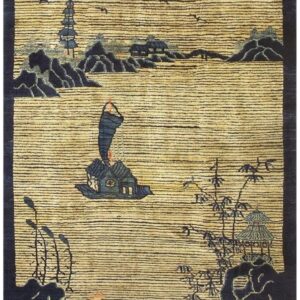
Peking rugs embody the luxurious artistry of Northern Chinese weaving, characterized by their lush, thick pile and striking, stylized scenic and floral motifs. These highly decorative pieces often feature bold outlines and sophisticated palettes of ivory, blue, and gold, offering an elegant focal point for any interior; discover more about the distinct history and characteristics of Peking rugs.
Peking rugs are one chapter of our antique Chinese rugs collection, more than 1,850 antique Chinese rugs in stock in New York.
Peking carpets are the largest single group in our collection. Our peking buying and identification guide covers current price bands, what to look for and what moves the value.
Antique Peking rugs at a glance
The table sums up what defines a Peking rug and what is on this page right now. Counts and prices come from our in-stock Peking rugs on September 27, 2026 and change as rugs sell.
| Feature | Antique Peking rugs |
|---|---|
| Where woven | Beijing (Peking) and the surrounding region of North China. Wool from Hebei province gave the best pieces their softness and sheen. In the 1920s export production also grew in the nearby port of Tianjin. |
| When woven | Late 19th century into the 1930s for most rugs on the market. Imperial palace workshops wove for the court until the fall of the Qing dynasty in 1912. |
| Dates in our collection | More than 600 dated circa 1900 to 1935, led by circa 1920; more than 160 from the 19th century, mostly circa 1880 and circa 1890; plus a small group of later vintage pieces |
| Materials | Wool pile on a cotton foundation. Every Peking rug on this page is hand-knotted wool pile. |
| Construction | Hand-knotted and double wefted, often with depressed warps that give a firm, flat, "closed back" rug. The pile is often carved around the motifs after weaving. |
| Palettes | Several blues on ivory or champagne grounds, with gold, tan or apricot accents; 1920s export pieces add rose, teal and lavender. In stock: blue, more than 350; ivory and cream, more than 350; coral and pink, more than 30; yellow and gold, more than 20. |
| Layouts | Floral designs lead (more than 600), then medallion layouts (more than 450) and allover designs (more than 200) |
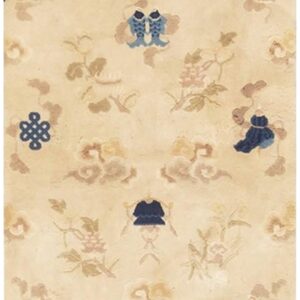
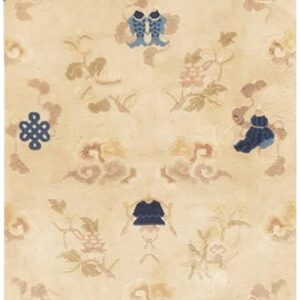
| Signature motifs | Vases and flowering sprays (more than 150 rugs), fret borders (more than 150), birds (more than 100), cloud bands (more than 100) and dragons (more than 90), with peonies, lotus, bats and shou medallions throughout. See antique Chinese rug symbols and meanings. |
| Shapes | Mostly rectangles (more than 700), plus more than 40 runners, more than 30 squares, 16 ovals and 11 rounds |
| Sizes in stock | 9 x 12, more than 200; 8 x 10, more than 100; 6 x 9, more than 80; 10 x 14, more than 50; 3 x 5, more than 40; 4 x 6, more than 40; 5 x 7, more than 30; 2 x 3, more than 30; 12 x 18, more than 30; 12 x 15, about 30 |
| Price range (in stock) | From $450 to about $187,000. The median is about $11,700, and half of our Peking rugs are priced between $7,100 and $19,500. Prices are in US dollars. |
| In stock now | More than 800 Peking rugs, held at our New York showroom |
Prefer to see a rug in person?
-
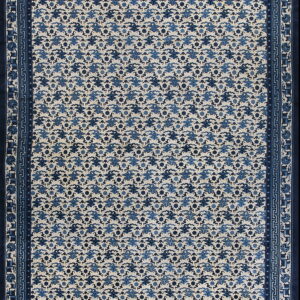
Rectangle Antique 1920s Chinese – Peking Wool Blue Knotted Room Size Rug
$19,500.00 Antique RugsSKU: 25652Rug sizes: 10 ft x 13 ft 2 in (3.05 m x 4.01 m) -
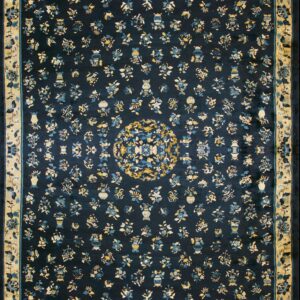
Chinese Wool – Peking 1890s Knotted Large Oversized Big Rectangle Blue Antique Rug
$70,200.00 Antique RugsSKU: 25483Rug sizes: 12 ft x 23 ft (3.66 m x 7.01 m) -
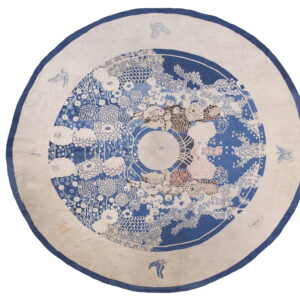
Unique Artistic Antique Chinese Peking Soft Blue Round Peking Pile Rug
$22,500.00 Antique RugsSKU: 21269Rug sizes: 10 ft x 10 ft 6 in (3.05 m x 3.20 m) -
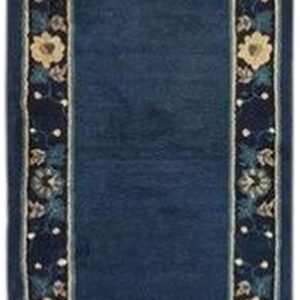
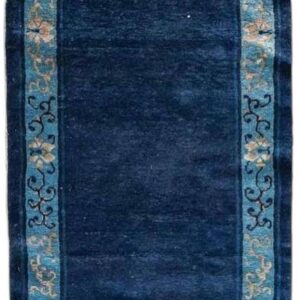
1920s Blue Deep Field Traditional East Asian Chinese Peking Hallway Gallery Rug
$7,800.00 Antique RugsSKU: 26030Rug sizes: 2 ft 3 in x 13 ft (0.69 m x 3.96 m) -
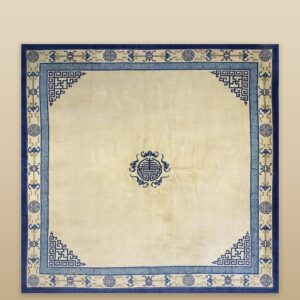
1880s Beige Field Shou Symbols Medallion Antique Chinese Peking Square Rug
$39,000.00 Antique RugsSKU: 25911Rug sizes: 12 ft 10 in x 13 ft 2 in (3.91 m x 4.01 m) -
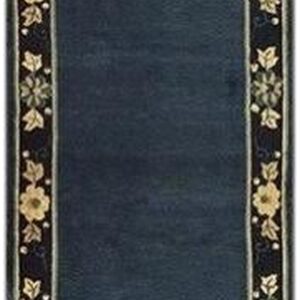
1920s Navy Blue Solid Minimalist Deco Antique Chinese Peking Runner Rug
$7,800.00 Antique RugsSKU: 26028Rug sizes: 3 ft 3 in x 18 ft 1 in (0.99 m x 5.51 m) -
1920s Beige Field Traditional Symbols Art Antique Chinese Peking Small Rug
$800.00 Antique RugsSKU: 7215Rug sizes: 2 ft x 4 ft 2 in (0.61 m x 1.27 m) -
1920s Beige Field Traditional Symbols Art Antique Chinese Peking Small Rug
$800.00 Antique RugsSKU: 7214Rug sizes: 2 ft x 4 ft 2 in (0.61 m x 1.27 m) -
1890s Classic Blue Ground Medallion Traditional Antique Chinese Peking Rug
$3,000.00 Antique RugsSKU: 40-4976Rug sizes: 3 ft x 5 ft 8 in (0.91 m x 1.73 m) -
1920s Blue Field Floral Traditional Medallion Antique Chinese Peking Knotted Rug
$13,000.00 Antique RugsSKU: 25664Rug sizes: 11 ft 10 in x 14 ft 6 in (3.61 m x 4.42 m) -
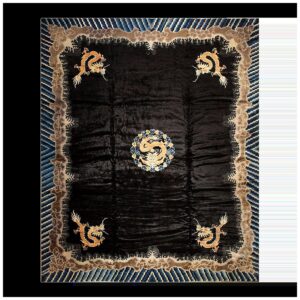
1920s Black Dragon Antique Chinese Peking Rug Handknotted Wool Carpet
$40,500.00 Antique RugsSKU: 9254Rug sizes: 6 ft x 8 ft 6 in (1.83 m x 2.59 m) -
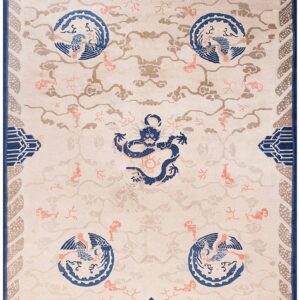
1880s Ivory Blue Coral Antique Traditional Chinese Peking Dragon Rug Wool Carpet
$39,000.00 Antique RugsSKU: 23386Rug sizes: 9 ft 2 in x 11 ft 8 in (2.79 m x 3.56 m) -
1920s Traditional Navy Blue Open Field Antique Chinese Peking Runner Rug
$5,200.00 Antique RugsSKU: 25518Rug sizes: 2 ft 6 in x 8 ft 6 in (0.76 m x 2.59 m) -
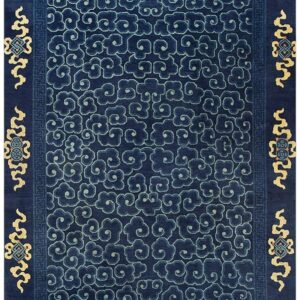
1920s Traditional Geometric Cloud Bands Patterns Antique Chinese Peking Wool Rug
$13,000.00 Antique RugsSKU: 7083Rug sizes: 6 ft 1 in x 8 ft 10 in (1.85 m x 2.69 m) -
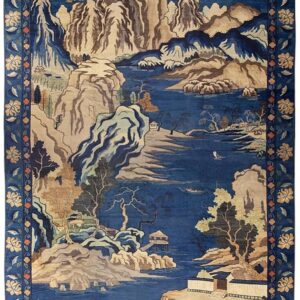
1920s Blue Grand Scale Antique Chinese Peking Scenic Pictorial Wool Gallery Rug
$142,500.00 Antique RugsSKU: 40-5303Rug sizes: 17 ft x 26 ft (5.18 m x 7.92 m) -
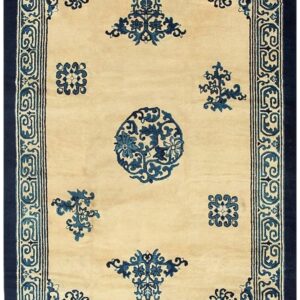
1920s Cream Medallion Geometric Knotted Wool Antique Chinese Peking Carpet Rug
$9,800.00 Antique RugsSKU: 6843Rug sizes: 6 ft x 8 ft (1.83 m x 2.44 m) -
1920s Beige Ground Medallion Traditional Motif Antique Chinese Peking Wool Rug
$3,400.00 Antique RugsSKU: 6829Rug sizes: 6 ft x 9 ft (1.83 m x 2.74 m) -
1930s Beige Floral Shou Antique Chinese Peking Rug 3′ 0”x 4′ 10” Handknotted Wool Carpet
$2,400.00 Vintage RugsSKU: 40-2437Rug sizes: 3 ft x 4 ft 10 in (0.91 m x 1.47 m) -
1910s Blue Open Field Shou Symbol Antique Chinese Peking Rug 8’x9’8″ Handknotted Wool Carpet
$9,000.00 Antique RugsSKU: 40-3122Rug sizes: 8 ft x 9 ft 8 in (2.44 m x 2.95 m) -
1920s Blue Foliate Antique Chinese Peking Rug 9’x11′ 11″ Handknotted Wool Carpet
$13,500.00 Antique RugsSKU: 40-5372Rug sizes: 9 ft x 11 ft 11 in (2.74 m x 3.63 m) -
1890s Beige Medallion Antique Chinese Peking Rug 8’10” X 11’8″ Handknotted Wool Carpet
$6,800.00 Antique RugsSKU: 40-2518Rug sizes: 8 ft 10 in x 11 ft 8 in (2.69 m x 3.56 m) -
1920s Beige Medallion Antique Chinese Peking Rug 6′ X 8’7″ Handknotted Wool Carpet
$5,800.00 Antique RugsSKU: 40-2444Rug sizes: 6 ft x 8 ft 7 in (1.83 m x 2.62 m) -
Early 20th Century Chinese Peking Carpet
$13,000.00 Antique RugsSKU: 40-3120Rug sizes: 9 ft 1 in x 11 ft 3 in (2.77 m x 3.43 m) -
1920s Antique Deep Blue Field Pictorial “Shan Shui” Knotted Chinese Peking Rug
$11,700.00 Antique RugsSKU: 6918Rug sizes: 6 ft x 8 ft (1.83 m x 2.44 m) -
1920s Small Navy Scenic Pictorial Vase Antique Chinese Peking Knotted Wool Rug
$2,600.00 Antique RugsSKU: 6828Rug sizes: 4 ft x 6 ft (1.22 m x 1.83 m) -
1920s Beige Neutral Field Traditional Chinese Symbolic Motifs Antique Peking Rug
$10,400.00 Antique RugsSKU: 6891Rug sizes: 7 ft x 9 ft (2.13 m x 2.74 m) -
1920s Soft Yellow Antique Floral Minimalist Knotted Wool Chinese Peking Rug
$23,400.00 Antique RugsSKU: 7019Rug sizes: 12 ft x 17 ft (3.66 m x 5.18 m) -
1920s Navy Floral Birds Medallion Antique Chinese Peking Knotted Wool Carpet Rug
$2,400.00 Antique RugsSKU: 6863Rug sizes: 3 ft x 4 ft (0.91 m x 1.22 m) -
Antique Chinese Peking Carpet 8’2″×9’10” Blue Open Field, Floral Bird Design, 1920s
$15,600.00 Antique RugsSKU: 6882Rug sizes: 8 ft 2 in x 9 ft 10 in (2.49 m x 3.00 m) -
Antique Chinese Peking Carpet Beige Field, Vase Medallion Design, 1920s
$15,600.00 Antique RugsSKU: 6867Rug sizes: 7 ft 5 in x 9 ft 11 in (2.26 m x 3.02 m) -
Antique Chinese Peking Carpet 8’×13’6″ Ivory Field, Fox Brown Border, Notable Kangxi Style, 19th Century
$45,000.00 Antique RugsSKU: 19436Rug sizes: 8 ft x 13 ft 6 in (2.44 m x 4.11 m) -
Early 20th Century Chinese Peking Carpet Hand-Knotted Wool
$10,430.00 Antique RugsSKU: 25678Rug sizes: 9 ft x 11 ft 8 in (2.74 m x 3.56 m) -
Antique Chinese Peking Carpet, Beige Floral, Hand-Knotted Wool, 1930s
$7,100.00 Vintage RugsSKU: 20-8002Rug sizes: 9 ft x 11 ft 3 in (2.74 m x 3.43 m) -
Small Scatter Size Antique Floral Chinese Ivory and Blue Color Peking Rug
$9,400.00 Antique RugsSKU: 23244Rug sizes: 4 ft x 6 ft 8 in (1.22 m x 2.03 m) -
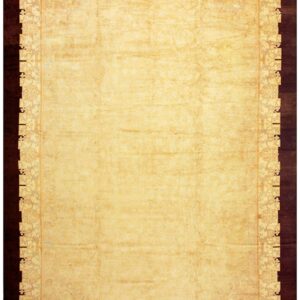
Open Solid Cream Ivory Color Field Antique Floral Chinese Room Size Peking Rug
$5,000.00 Antique RugsSKU: 23114Rug sizes: 7 ft 9 in x 9 ft 4 in (2.36 m x 2.84 m) -
Pair Of Antique Antique Small Scatter Size Ivory Wool Pile Chinese Dragons Peking Rugs
$9,400.00 Antique RugsSKU: 24614Rug sizes: 3 ft x 5 ft 10 in (0.91 m x 1.78 m)
What is a Peking rug?
A Peking rug is a hand-knotted Chinese carpet woven in or near Beijing, known for a restrained blue and ivory palette, an open field and a small number of auspicious symbols. "Peking" is simply the older Western spelling of Beijing, so a Peking rug and a Beijing rug are the same tradition, and the name still carries the prestige of the old imperial capital.
The earliest Peking carpets were made for the court, for temples and for the households of the nobility. When imperial patronage ended with the fall of the Qing dynasty in 1912, workshops kept weaving for a growing export market, and most antique Peking rugs you will meet today date from roughly 1880 to 1930. That is also the shape of our own collection: the great majority of the rugs on this page date from circa 1880 to circa 1930.
Be careful with the word in modern listings. "Peking design" rugs are still made today, including in India. A true antique Peking rug is Chinese, and each listing on this page states its origin, approximate age, materials and measured size.
How do you identify an antique Peking rug?
Start with the composition and the palette, then turn the rug over. A genuine antique Peking rug combines an uncluttered field, a disciplined color scheme and a firm, hand-knotted construction that a reproduction rarely matches.
- The field breathes. Look for a central medallion or a few scattered motifs set against plain ground. Borders are thin frames of fret, cloud scrolls or floral vines, not wide panels that fight the field.
- Blues do the work. The classic Peking scheme uses two or three shades of blue on ivory or champagne. The look echoes the blue and white porcelain of the Qing dynasty.
- It feels firm. Pick up a corner. Many Peking rugs have a "closed back" construction with depressed warps, so the rug is stiff, heavy and lies flat without bubbling. It should feel closer to heavy canvas than to a soft textile.
- The motifs stand up. Run a hand over the design. Finishers cut the pile at an angle around lotus petals, peonies and dragon scales, so the outlines sit in low relief. Cheaper copies often skip this slow step.
- The back tells the truth. You should see individual knots, a pattern that mirrors the front, and a fringe that is the end of the warp threads rather than a strip sewn on.
Symbols help too, but only when they cohere. Our guide to antique Chinese rug symbols explains how to read them, and our comparison of Peking vs Ningxia vs Art Deco rugs shows how a Peking rug differs from its two neighbors.
What are the main periods of Peking rugs?
Peking rugs fall into three broad groups: imperial palace carpets, late Qing rugs in the traditional style, and export rugs of the 1920s and early 1930s. Each group has its own look and its own buyers.
| Period | What to expect | In our collection |
|---|---|---|
| Imperial palace carpets, before 1912 | Woven in court workshops for palaces, throne halls and temples, with dragons, shou symbols and lotus overseen for correct imperial meaning. Very rare, and the most sought after. | Palace pieces are rarely available; ask us about any specific request |
| Late Qing traditional, about 1880 to 1910 | The classic blue and ivory rug: medallions, fret borders, peony and vase sprays, strong drawing and softly aged color. | More than 160 rugs from the 19th century, plus more than 160 circa 1900 |
| Export era, 1920s to early 1930s | Larger formats for American homes, simplified medallions and florals, and new colors such as rose, teal, gold and lavender alongside the traditional blues. | Circa 1920 is our largest group, more than 340 rugs, with more than 90 circa 1930 |
The export years also produced the bolder Tianjin rugs that became Chinese Art Deco rugs, including the work of Walter Nichols. If you love Peking drawing but want more color, those pages are the natural next step. For the full history of the type, read our Peking rug guide.
How do you decorate with a Peking rug?
Use a Peking rug where you want calm rather than drama: its quiet palette and open field sit easily in traditional, transitional and even fairly modern rooms. The practical choices come down to layout, color and size.
- Build on the blues. A blue and ivory Peking rug pairs naturally with blue and white porcelain, navy or slate upholstery, and warm wood. Gold or apricot accents in the rug can pick up brass lamps or picture frames.
- Dining rooms. A central medallion disappears under a table, so consider an allover, vase or corner-spray design instead. Choose a size that reaches at least 24 inches past the table edge on every side, so chairs stay on the rug when they are pulled out.
- Living rooms. A 9 x 12 or 10 x 14 Peking rug anchors a full seating group, and those are among our deepest sizes.
- Halls and stairs. We keep more than 40 long, narrow Peking runners, a good way to carry the same palette through an entry or corridor.
- Foyers and small rooms. Squares, ovals and rounds, plus scatter sizes such as 2 x 3 and 3 x 5, work well in entries, beside a bed or layered over a larger neutral rug.
Our rug size guide explains how to measure, and our trade program helps interior designers source Peking rugs for client projects.
How do you care for an antique Peking rug?
Treat a Peking rug like any antique wool rug, with two extra points of attention: its deep wool pile invites moths, and its saturated blues should never be cleaned by guesswork. Gentle, regular care keeps the colors crisp and the pile healthy.
- Watch for moths in the pile. The cotton foundation does not attract moths, but the wool pile does, and larvae can graze the pile down to the foundation in dark spots under sofas and beds before anyone notices. Vacuum those areas and lift furniture now and then. Our moth-proofing service washes the rug first and then treats the fibers.
- Test before you touch a stain. Some older or strongly saturated blues can run. Blot spills with a white cloth, test any cleaner on a hidden spot, and stop if color transfers.
- Wash with a specialist. Our rug cleaning service in Manhattan washes hand-knotted rugs with a pH-balanced process after checking for old repairs and fragile areas.
- Roll, never fold. A firm, closed back rug does not like sharp creases. Roll it pile side in around a tube and wrap it in breathable cotton for storage.
Glossary of Peking rug terms
- Closed back
- A dense construction in which the back of the rug shows tightly packed knots with little foundation visible. It gives many Peking rugs their firm, heavy handle.
- Depressed warps
- Warp threads held on two different levels during weaving. The result is a stiff, stable rug that rarely bubbles or loses its shape on the floor.
- Double wefted
- Two passes of weft thread after each row of knots, which adds strength and helps the rug stay flat under heavy use.
- Hebei wool
- Wool from the province around Beijing, whose cold, dry climate produced long, strong fleece. It gave Peking rugs their softness and sheen.
- Palace carpet
- A rug woven in an imperial workshop for the court, such as a throne carpet. Production under direct imperial authority ended with the Qing dynasty in 1912.
- Imperial yellow
- The yellow historically reserved for the emperor and the high court. A true yellow ground on an 18th or 19th century Chinese rug points to court use.
- Export Peking
- A Peking rug woven for Western buyers, especially in the 1920s, usually larger, with simplified motifs and a wider palette.
- Spandrels
- The corner areas of the field outside a central medallion, often filled with a quarter medallion, flowers or small emblems.
- Peony spray
- A branch of peony blossoms, the "king of flowers" and a wish for wealth and honor. It is the flower you meet most on Peking rugs.
Peking Rugs: Frequently Asked Questions
Are Peking rugs and Beijing rugs the same thing?
Yes. Peking is the older Western spelling of Beijing, so both names describe the same tradition of hand-knotted rugs woven in and around the Chinese capital. Dealers and collectors still use "Peking" for antique pieces, while "Peking design" on a modern rug describes a style, not an origin.
How old are the Peking rugs in your collection?
Most date from circa 1880 to circa 1930. Circa 1920 is our largest group, followed by 19th century rugs and rugs from around 1900, and there is a small group of later vintage pieces. Every listing states the approximate age.
What sizes of Peking rugs do you have?
We keep more than 200 Peking rugs in 9 x 12, more than 100 in 8 x 10, and more than 50 in 10 x 14, along with oversized 12 x 15 and 12 x 18 pieces, runners, squares, ovals, rounds and small scatter sizes. Every listing gives the measured size, and our rug size guide helps you choose.
Is a Peking rug a good choice for a dining room?
Yes, if you pick the layout carefully. A central medallion is hidden by the table, so an allover, vase or corner design often works better. Size the rug to extend at least 24 inches beyond the table on every side so chairs stay on the rug.
Do you ship Peking rugs, and can I return one?
Shipping is free within the continental United States. International orders ship for a flat $495 per order ($350 to Canada, $395 to Mexico), with customs fees, duties and taxes paid by the buyer on delivery. Orders ship in 1 to 3 business days, and US buyers get a 4-day in-home trial; see our shipping policy and returns policy.
Can I sell my Peking rug or have it appraised?
Yes. We buy antique rugs outright: send photographs and measurements, and Kevin Rahmanan reviews the photos and decides. Consignment is also offered. For a value, we give a free Quick Opinion by phone or email from photographs, and a free In-Depth Appraisal Report for insurance and estates. See what is my antique Chinese rug worth or contact us.