
Walter Nichols Rugs
Key takeaways: Walter Nichols rugs
- What they are: hand-knotted Chinese Art Deco rugs from the Tianjin (Tientsin) workshops of Walter Nichols, an American wool grader who founded Nichols Super Yarn and Carpets in 1924. Production ended in 1939, so the supply is finite. They are the most collected maker in our antique Chinese rugs collection.
- How to spot one: a heavy, stiff rug with a lustrous, almost silky wool pile, deep carving around the motifs, and saturated color that has not faded.
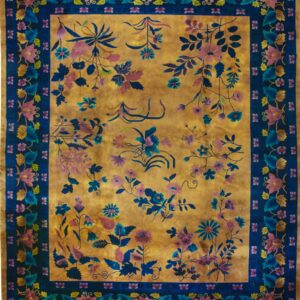
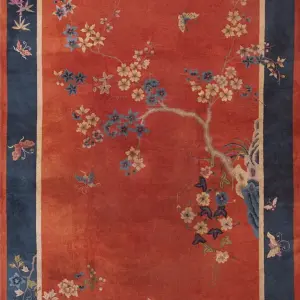
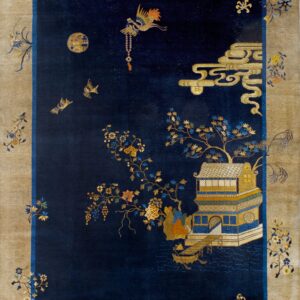
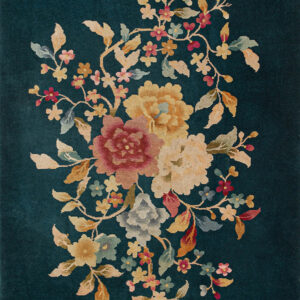
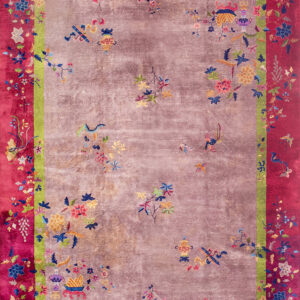
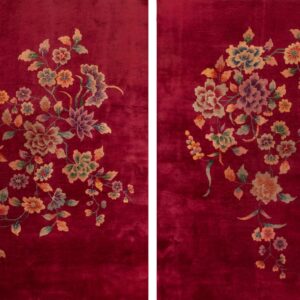
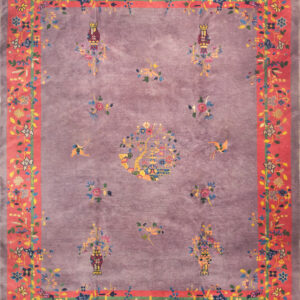
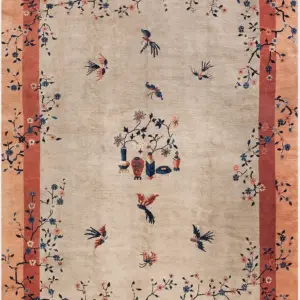
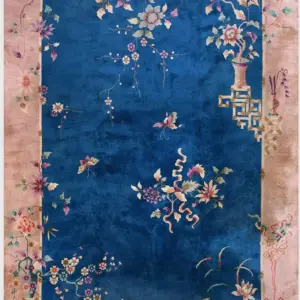
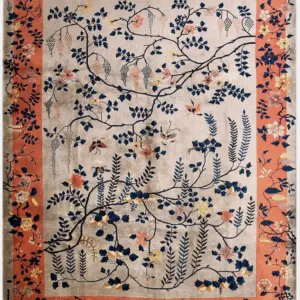
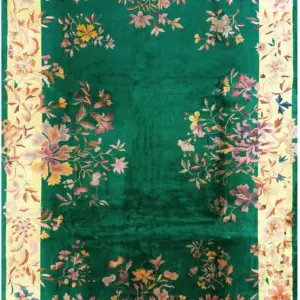
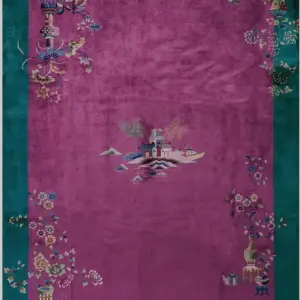
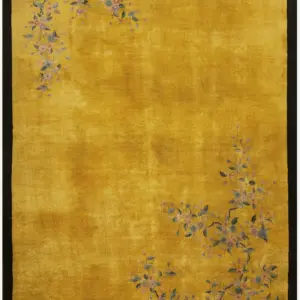
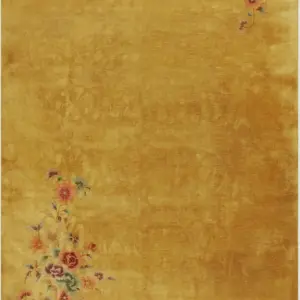
- The design: usually no central medallion. Flowers "fall" from the corners into a wide open field, with vases, birds and lucky symbols placed with plenty of space around them.
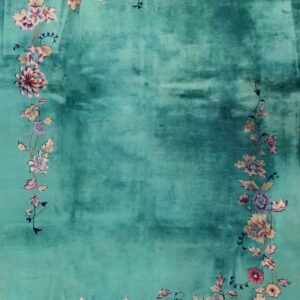
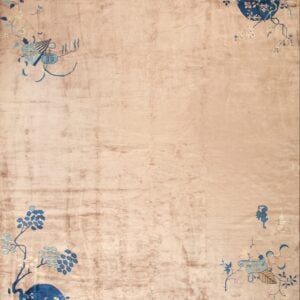
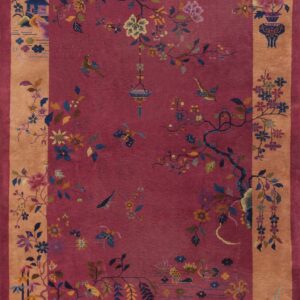
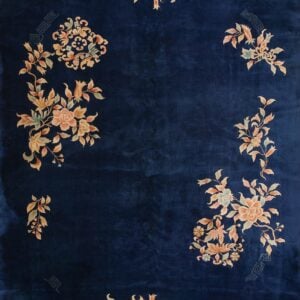
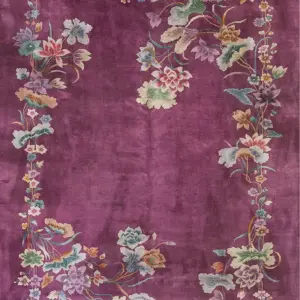
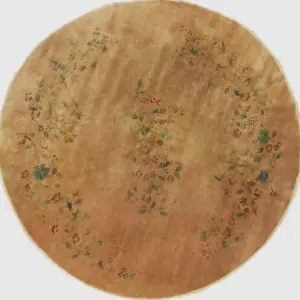
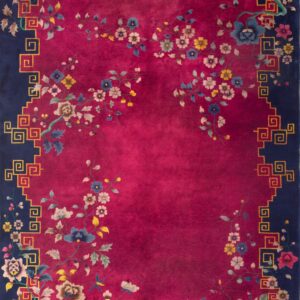
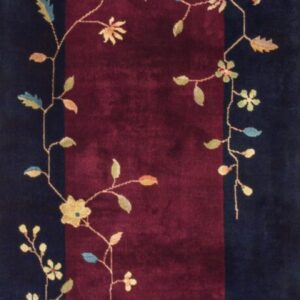
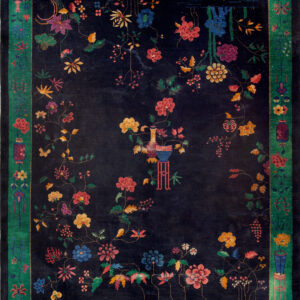
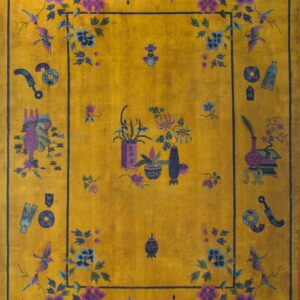
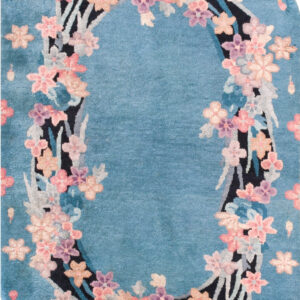
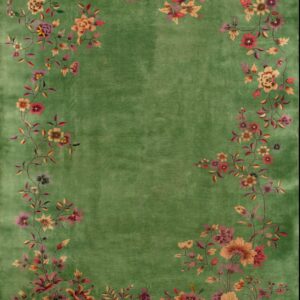
- Three palette families: the deep navy "Nichols Blue", the saturated Jazz Age mixes such as magenta and coral on turquoise or emerald, and the rarer minimalist "Nude" rugs in camel, champagne and taupe.
- Proof of origin: look for a "Made in China by Nichols" stamp on the fringe, a sewn label or its stitch marks, and on worn pieces, faint red ink on the exposed warps.
- Our collection: more than 400 Walter Nichols rugs in stock in New York, every one also part of our Chinese Art Deco collection. Free shipping within the continental United States and a 4-day in-home trial; see buying with confidence.
Welcome to the Definitive Gallery of Walter Nichols “Super Rugs”
Step into the 1920s and experience the revolution that redefined the Art Deco landscape. RugsOnNet is proud to maintain one of the largest collections of authentic Walter Nichols originals. This gallery is dedicated exclusively to the genius of the American visionary who transformed Tientsin weaving into a global art form. These are not merely rugs; they are finite, hand-carved masterpieces known to the market as “Super Rugs.”
Because the era of Nichols’ production was brief and ended abruptly in 1939, finding a collector-grade piece in a specific colorway is a years-long search. Our collection offers a wide view of this 100-year-old legacy, from the rare, minimalist “Nude” Series in taupe and champagne to the saturated complexity of “Jazz Age” palettes and the legendary “Nichols Blue.”
At RugsOnNet, we take authentication seriously. Every rug in our extensive collection is physically verified for its vertical integration, its “Red Ink Trace” blueprint hidden deep in the foundation, and its unique “Mule System” fiber content. You are not just selecting a colorway; you are acquiring a piece of design history from Rugs On Net.
Explore the Folklore, browse our world-class reserves, and discover why a Walter Nichols original remains a natural anchor for a well designed room.
Learn More About Walter Nichols and His Rugs | Shop All Chinese Art Deco Rugs
Walter Nichols rugs sit at the top of our antique Chinese rugs collection, more than 1,850 antique Chinese rugs in stock in New York.
Walter Nichols rugs at a glance
The table sums up what defines a Walter Nichols rug and what is on this page right now. Counts and prices come from our in-stock Walter Nichols rugs on September 27, 2026 and change as rugs sell.
| Feature | Walter Nichols rugs |
|---|---|
| Where woven | Tianjin (Tientsin), in Nichols's own workshops, with a flagship weaving establishment and showroom in Beijing (Peking) set in the former palace of a Manchu prince |
| When woven | 1924 to 1939 |
| Dates in our collection | More than 350 catalogued circa 1920 (the 1920s), more than 40 circa 1930, and smaller groups circa 1925 and circa 1935 |
| Materials | "Super Yarn": long-staple wool spun on the Mule System, on a cotton foundation. Every Nichols rug on this page is wool pile. |
| Construction | Hand-knotted to a 90-line standard on a rigid cotton foundation, pile hand-carved at an angle around the motifs, then given a strong chemical luster wash |
| Palettes | Spread across the whole spectrum rather than dominated by blue and ivory. In stock: red and rust, more than 60; yellow and gold, more than 60; blue, more than 60; coral and pink, more than 55; purple and lavender, more than 55; green, more than 45; ivory and cream, more than 45 |
| Signature designs | Solid and open fields (more than 180 rugs), vase designs (more than 130), modernist designs (more than 45) and birds (more than 45), plus pagodas, bridges, cranes, deer, bats and flowering branches |
| Shapes | Mostly rectangles (more than 380), plus 19 ovals, 10 runners, 8 squares and 4 rounds |
| Sizes in stock | 9 x 12, more than 130; 8 x 10, more than 100; 10 x 14, more than 35; 6 x 9, more than 25; 3 x 5, more than 20; 2 x 3, more than 20; 12 x 18, more than 20; 4 x 6, 14; 12 x 15, 8 |
| Price range (in stock) | From $800 to $66,000. The median is about $10,200, and half of our Walter Nichols rugs are priced between $7,500 and $14,100. Prices are in US dollars. |
| In stock now | More than 400 Walter Nichols rugs, held at our New York showroom |
Prefer to see a rug in person?
-
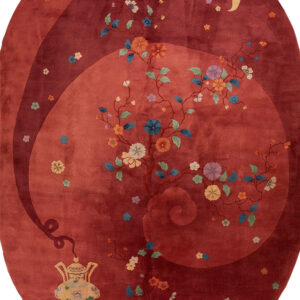
Antique Art Deco Chinese Oval Rug with Artistic Swirl Pattern in Red
$22,500.00 Antique RugsSKU: 24046Rug sizes: 7 ft 9 in x 11 ft (2.36 m x 3.35 m) -
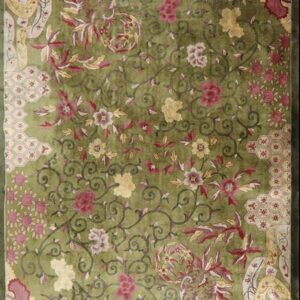
Stunning Antique Chinese Art Deco Carpet by Nichols Workshop Green Hand Knotted Pile Rug
$33,500.00 Antique RugsSKU: 23817Rug sizes: 11 ft 10 in x 17 ft 2 in (3.61 m x 5.23 m) -
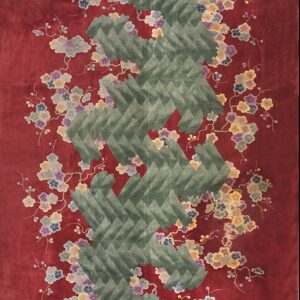
Antique Walter Nichols Art Deco Large Room Size Red Allover Rug
$38,000.00 Antique RugsSKU: 23745Rug sizes: 10 ft x 17 ft 6 in (3.05 m x 5.33 m) -
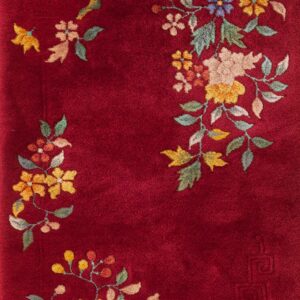
Vibrant Red Open Field Antique Small Scatter Size Chinese Walter Nichols Art Deco Rug
$2,000.00 Antique RugsSKU: 21668Rug sizes: 2 ft x 3 ft 10 in (0.61 m x 1.17 m) -
Minimalist Open Solid Turquoise Color Field Antique Room Size Floral Chinese Art Deco Rug
$5,850.00 Antique RugsSKU: 19864Rug sizes: 9 ft x 11 ft 10 in (2.74 m x 3.61 m) -
Early 20th Century Light Color Open Field Chinese Art Deco Room Size Rug
$7,150.00 Antique RugsSKU: 22170Rug sizes: 10 ft 10 in x 13 ft 3 in (3.30 m x 4.04 m) -
Antique Small Size Purple Color Floral Chinese Walter Nichols Art Deco Carpet
$6,300.00 Antique RugsSKU: 23534Rug sizes: 6 ft x 8 ft 8 in (1.83 m x 2.64 m) -
Navy Blue Open Field Antique Room Size Floral Chinese Walter Nichols Art Deco Rug
$7,500.00 Antique RugsSKU: 24064Rug sizes: 8 ft 10 in x 11 ft 9 in (2.69 m x 3.58 m) -
Antique Yellow Color Floral Room Size Chinese Art Deco Carpet
$14,900.00 Antique RugsSKU: 24486Rug sizes: 11 ft 10 in x 14 ft 7 in (3.61 m x 4.44 m) -
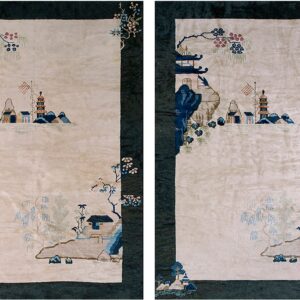
Pair of Scenic Pictorial Antique Ivory Chinese Art Deco Carpets
$18,800.00 Antique RugsSKU: 25417Rug sizes: 6 ft x 8 ft 6 in (1.83 m x 2.59 m) -
Small Light Ivory Color Scenic Chinese Art Deco Scatter Size Wool Pile Area Rug
$2,550.00 Antique RugsSKU: 25856Rug sizes: 2 ft 6 in x 5 ft (0.76 m x 1.52 m) -
Small Scatter Size Ivory Antique Minimalist Scenic Pattern Chinese Art Deco Rug
$3,000.00 Antique RugsSKU: 25855Rug sizes: 3 ft x 6 ft (0.91 m x 1.83 m) -
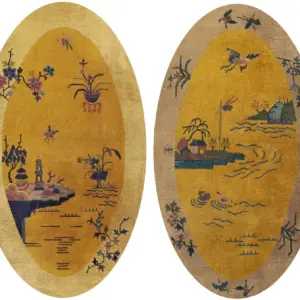
Pair of Antique Chinese Art Deco Yellow Scenic Oval Rugs
$6,300.00 Antique RugsSKU: 23900Rug sizes: 3 ft x 5 ft (0.91 m x 1.52 m) -
Warm Coral Antique Floral Chinese Room Size Art Deco Rug
$8,600.00 Antique RugsSKU: 23432Rug sizes: 8 ft 10 in x 11 ft 8 in (2.69 m x 3.56 m) -
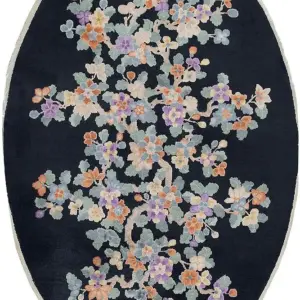
Antique Floral Black Chinese Art Deco Oval Rug
$4,500.00 Antique RugsSKU: 25978Rug sizes: 5 ft x 7 ft 9 in (1.52 m x 2.36 m) -
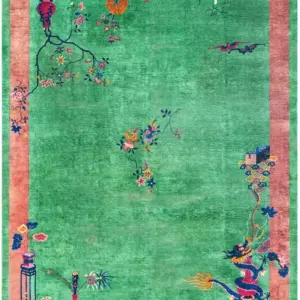
Vibrant Green Antique Floral Dragon Design Chinese Art Deco Rug
$9,750.00 Antique RugsSKU: 25541Rug sizes: 8 ft 8 in x 11 ft 6 in (2.64 m x 3.51 m) -
Solid Open Purple Color Field Antique Floral Chinese Art Deco Room Size Area Rug
$7,500.00 Antique RugsSKU: 23521Rug sizes: 8 ft 6 in x 11 ft 4 in (2.59 m x 3.45 m) -
Antique Floral Chinese Art Deco Round Rug in Soft Coral
$9,400.00 Antique RugsSKU: 26073Rug sizes: 9 ft 6 in x 9 ft 6 in (2.90 m x 2.90 m) -
Floral Open Field Antique Chinese Walter Nichols Art Deco Room Size Purple Wool Pile Rug
$18,000.00 Antique RugsSKU: 26079Rug sizes: 10 ft x 13 ft 7 in (3.05 m x 4.14 m) -
Antique Chinese Art Deco Deep Red Wool Hallway Runner Rug
$6,000.00 Antique RugsSKU: 26077Rug sizes: 3 ft x 16 ft (0.91 m x 4.88 m) -
Vintage Mid Century Blue Bird of Paradise Scenic Pictorial Chinese Deco Rug
$16,500.00 Vintage RugsSKU: 26070Rug sizes: 10 ft x 13 ft 6 in (3.05 m x 4.11 m) -
Green Color Large Floral Pattern Antique Small Scatter Size Chinese Walter Nichols Art Deco Wool Rug
$1,500.00 Antique RugsSKU: 26052Rug sizes: 3 ft 9 in x 5 ft 6 in (1.14 m x 1.68 m) -
Navy Blue Antique Wool Pile Hand Knotted Chinese Art Deco Area Rug
$14,100.00 Antique RugsSKU: 26034Rug sizes: 7 ft 9 in x 9 ft 6 in (2.36 m x 2.90 m) -
Yellow Color Antique Wool Pile Chinese Art Deco Room Size Rug
$27,000.00 Antique RugsSKU: 26040Rug sizes: 11 ft 3 in x 14 ft 5 in (3.43 m x 4.39 m) -
Light Purple Color Antique Floral Room Size Chinese Art Deco Wool Rug
$800.00 Antique RugsSKU: 26024Rug sizes: 9 ft 2 in x 11 ft 8 in (2.79 m x 3.56 m) -
Small Light Blue Antique Walter Nichols Art Deco Chinese Oval Rug
$800.00 Antique RugsSKU: 22606Rug sizes: 2 ft 8 in x 4 ft 6 in (0.81 m x 1.37 m) -
Pair Of Small Antique Purple Floral Chinese Walter Nichols Art Deco Scatter Wool Area Rugs
$3,000.00 Antique RugsSKU: 24443Rug sizes: 4 ft 4 in x 6 ft 1 in (1.32 m x 1.85 m) -
Green Color Solid Open Field Antique Floral Art Deco Chinese Room Size Wool Rug
$14,100.00 Antique RugsSKU: 24294Rug sizes: 9 ft x 14 ft 2 in (2.74 m x 4.32 m) -
Purple Antique Wool Room Size Scenic Pictorial Medallion Deco Chinese Rug
$10,500.00 Antique RugsSKU: 26084Rug sizes: 8 ft x 9 ft 10 in (2.44 m x 3.00 m) -
Ivory Room Size Antique Chinese Wool Pile Art Deco Floral Bird Rug
$11,000.00 Antique RugsSKU: 22810Rug sizes: 9 ft 2 in x 11 ft 6 in (2.79 m x 3.51 m) -
Light Blue Open Field Antique Chinese Room Size Art Deco Rug
$8,300.00 Antique RugsSKU: 22691Rug sizes: 9 ft x 11 ft 8 in (2.74 m x 3.56 m) -
Ivory Cream Color Artistic Flowing Floral Branches Antique Chinese Art Deco Carpet
$11,700.00 Antique RugsSKU: 22685Rug sizes: 9 ft x 11 ft 8 in (2.74 m x 3.56 m) -
Open Solid Green Color Field Antique Floral Room Size Deco Chinese Rug
$11,000.00 Antique RugsSKU: 22260Rug sizes: 9 ft x 11 ft 9 in (2.74 m x 3.58 m) -
Open Purple Color Field Scenic Pictorial Medallion Antique Chinese Art Deco Rug
$10,000.00 Antique RugsSKU: 19347Rug sizes: 8 ft 10 in x 11 ft 4 in (2.69 m x 3.45 m) -
Open Solid Yellow Field Antique Chinese Floral Art Deco Rug
$7,000.00 Antique RugsSKU: 24299Rug sizes: 5 ft 10 in x 8 ft 8 in (1.78 m x 2.64 m) -
Antique Open Solid Yellow Color Chinese Art Deco Rug
$7,500.00 Antique RugsSKU: 24589Rug sizes: 9 ft x 11 ft 4 in (2.74 m x 3.45 m)
What is a Walter Nichols rug?
A Walter Nichols rug is a hand-knotted Chinese Art Deco carpet made between 1924 and 1939 in the Tianjin workshops of Walter Nichols, known for heavy, lustrous "Super Yarn" wool, deep hand carving and bold, asymmetric designs. Collectors and dealers often call them "Super Rugs", and "Nichols" has become shorthand for the finest Chinese Art Deco rugs.
Nichols was an American who moved to China in the early 20th century and worked as a wool grader, sorting raw fleece by fineness, length, strength and color. That trade explains his rugs. Instead of the coarse carpet wool most workshops used, he chose long, strong, white fleece that could take clean, deep dyes and be woven densely without breaking or shedding.
In 1924 he founded Nichols Super Yarn and Carpets and kept every stage under his own control: scouring, spinning, dyeing, weaving and washing. He described owning every building, loom and tool, and even every rice bowl, in his factories. Production ended in 1939, so no new Nichols rugs have been made since. For the full story, read the Walter Nichols story.
How do you identify an authentic Walter Nichols rug?
Check five things: the weight and stiffness, the luster of the wool, the depth of the carving, the color, and any marks the factory left behind. No single sign proves a rug is a Nichols, but together they separate a genuine piece from a "Nichols-style" rug made by another workshop.
- The "plank" handle. Lift a corner. A Nichols rug is famously heavy and stiff, thanks to its dense construction and machine-spun wool. A rug that feels floppy or folds like fabric is more likely a Fette rug or a later piece.
- A silk-like sheen. The Super Yarn reflects light with a shimmer that can look almost like silk, especially after washing.
- Deep carving. Run a hand along the flowers and motifs. You should feel a clear channel cut into the pile, giving the design a molded, three-dimensional look.
- Color that did not fade. Nichols used chrome dyes, so hot pink, acid green and lapis blue stay as saturated today as when they were woven, instead of mellowing to peach and tan.
- The fringe stamp. Turn the rug over and look along the back of the cotton fringe for "Made in China by Nichols", often in blue ink. A faded or partial stamp still counts.
- The label. Some rugs keep a cotton or fabric label on the back reading "Walter Nichols, Tientsin". Many were removed over the years, but stitch marks where one sat are also a good sign.
- Red ink on the warps. Designs were traced onto the white cotton warps in red ink before weaving. On a worn rug where the foundation shows, faint red or pink traces can be read as a fingerprint of the Nichols method.
Our listings state origin, approximate age and materials for every rug, and you can ask for close-ups of the back and fringe or a condition report before you buy.
What palettes and series did Walter Nichols make?
Nichols was a colorist first, and his rugs fall into a few recognizable palette families. Working with chemists, he developed a very large range of chrome-dyed colors, and our current collection spreads almost evenly across reds, golds, blues, corals, purples and greens.
| Palette family | What it looks like | Where it works |
|---|---|---|
| Nichols Blue | A deep, even navy field, "dyed in the wool" so it never streaks, often with gold, ivory and red flowers | Classic and transitional rooms; the easiest Nichols to live with |
| Jazz Age | Saturated mixes such as magenta and coral sprays on turquoise or emerald, and purple, gold or tangerine fields | Statement rooms, Deco revival, eclectic and maximalist interiors |
| "Nude" rugs | Minimalist camel, champagne and taupe with tonal or quiet accents, where the carving does most of the work | Calm bedrooms, minimalist and contemporary spaces |
The designs carry Chinese meaning. Nichols used a botanical calendar of seasonal flowers, peach blossom for spring, lotus for summer, chrysanthemum for autumn and narcissus for winter, alongside dragons, phoenixes, cranes, deer, bats, pagodas, bridges and boats. Our guide to antique Chinese rug symbols explains what many of these mean.
How do you decorate with a Walter Nichols rug?
Use a Nichols rug as the foundation of the room: its open field and corner flowers give modern furniture room to breathe while supplying all the color the space needs. The rugs were designed for Western homes of the 1920s and 1930s, and they sit just as well in today's.
- Mid-century furniture. Clean-lined pieces from the Eames, Knoll or Saarinen tradition stand out against the organic, trailing flowers.
- Dining rooms. Because the flowers sit in the corners and along the sides, they stay visible around the table, and the dense, rigid construction lets chairs slide easily without bunching.
- Entries and halls. The dense, long-staple wool handles foot traffic and hides soil well, and a Nichols Blue or emerald rug makes a strong first impression.
- Bedrooms. Under soft lamplight the luster of the wool glows. Place the rug so the corner flowers show at the foot of the bed.
- Maximalist rooms. A jewel-toned Nichols can anchor bold wallpaper, brass and mixed textures without the room feeling cluttered.
Designers sourcing Nichols rugs for a client can use our trade program.
How do you care for a Walter Nichols rug?
Nichols built his rugs to last and said so: his own care advice encouraged strong vacuuming and simple cleaning. A century later, gentle routine care and a specialist wash keep the luster and carving at their best.
- Vacuum regularly. Routine vacuuming keeps the pile aerated and clean and is the best everyday defense against moths. Keep the fringe away from the brush roll.
- Fringes and cornmeal. Nichols recommended brushing cotton fringes with dry cornmeal, which lifts soil and oils and is then brushed or vacuumed away without wetting the rug.
- Spot cleaning. Blot spills at once. Nichols rugs went through a strong chemical wash at the factory and tolerate water well, but test any cleaner on a hidden spot first.
- Professional washing. Our rug cleaning service in Manhattan washes hand-knotted rugs with a pH-balanced process after checking for old repairs and fragile areas.
- Moth protection. The factory wash was promoted as a moth repellent, but a century later that is not protection enough, especially under furniture. Our moth-proofing service washes the rug first and then treats the fibers.
- Keep the evidence. Never trim a stamped fringe or remove a label, and keep your purchase records. They support future appraisals.
Glossary of Walter Nichols rug terms
- Super Rug
- The collector's name for a Walter Nichols rug, taken from Nichols Super Yarn and Carpets, the company he founded in 1924.
- Wool grader
- A specialist who sorts raw fleece by fineness, length, strength and color. It was Nichols's original trade and the root of his rugs' quality.
- Nichols Blue
- His signature deep indigo navy, dyed in the wool for an even color with no streaks.
- "Nude" rugs
- A rarer minimalist group in camel, champagne and taupe, with tonal accents and carving in place of strong color.
- Falling flowers
- Sprays of blossoms or lucky symbols that trail from the corners into an open field, in place of a central medallion.
- Red ink trace
- The red ink used to draw each design onto the cotton warps before weaving. Faint traces on worn areas are read as a sign of a Nichols workshop piece.
- Luster wash
- The strong chemical wash every rug received at the factory. It brought up the silky sheen, and Nichols treated it as a test that colors and pile had to pass.
- Vertical integration
- Nichols's policy of controlling every step, from scouring and spinning to dyeing, weaving and washing, under one roof for a consistent standard.
- Palace Factory
- Nichols's Beijing weaving establishment in the former palace of a Manchu prince, whose old audience hall served as his showroom.
Walter Nichols Rugs: Frequently Asked Questions
Who was Walter Nichols?
Walter Nichols was an American wool grader who settled in Tianjin, China, and founded Nichols Super Yarn and Carpets in 1924. His hand-knotted Art Deco rugs, made until production ended in 1939, set the standard for Chinese Art Deco rugs.
How can I tell if my rug is a real Walter Nichols?
Look for a heavy, stiff rug with a silky wool sheen, deep carving around the motifs and unfaded chrome-dyed color. Then check the back of the fringe for a "Made in China by Nichols" stamp, look for a sewn label or its stitch marks, and on worn areas look for faint red ink on the warps. An expert can confirm the rest in hand.
Are Walter Nichols rugs Chinese Art Deco rugs?
Yes. Every Nichols rug is a Chinese Art Deco rug, but not every Chinese Art Deco rug is a Nichols. All of our more than 400 Nichols rugs also appear in our Chinese Art Deco collection, alongside Fette-Li and other workshops.
How much do Walter Nichols rugs cost?
Our in-stock Walter Nichols rugs range from $800 to $66,000, with a median of about $10,200. Size, palette, condition and design all move the price, and room sizes such as 9 x 12 and 8 x 10 are the most in demand. Prices are in US dollars.
Do you ship Walter Nichols rugs, and can I return one?
Shipping is free within the continental United States. International orders ship for a flat $495 per order ($350 to Canada, $395 to Mexico), with customs fees, duties and taxes paid by the buyer on delivery. Orders ship in 1 to 3 business days, and US buyers get a 4-day in-home trial; see our shipping policy and returns policy.
Can I sell my Walter Nichols rug or have it appraised?
Yes. We buy antique rugs outright: send photographs and measurements, and Kevin Rahmanan reviews the photos and decides. Consignment is also offered. For a value, we give a free Quick Opinion by phone or email from photographs, and a free In-Depth Appraisal Report for insurance and estates. See what is my antique Chinese rug worth or contact us.