Chinese Art Deco Rugs
Key takeaways: antique Chinese Art Deco rugs
- What they are: hand-knotted wool rugs woven in China in the 1920s and 1930s, mostly in Tianjin and Beijing and mostly for export to the United States, that pair Chinese symbols with the modern design of the Jazz Age. They are the boldest branch of our antique Chinese rugs collection.
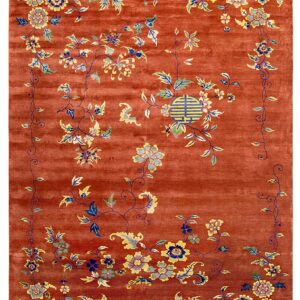
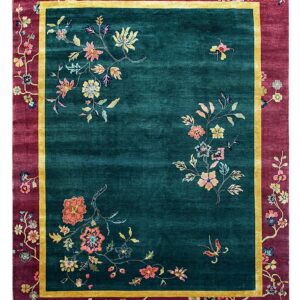
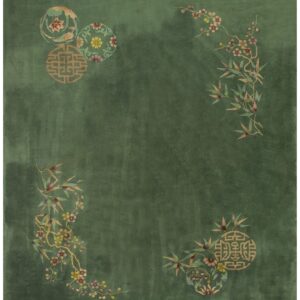
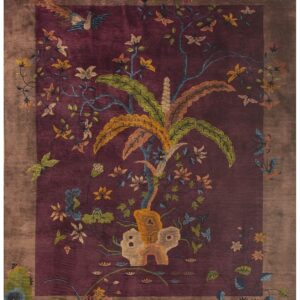
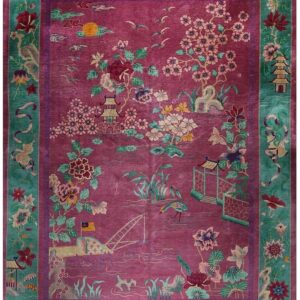
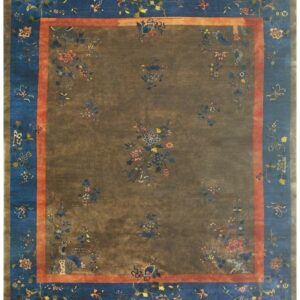
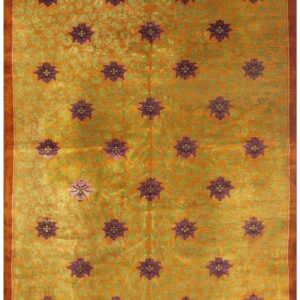
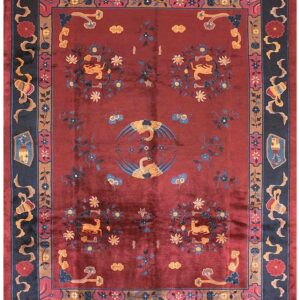
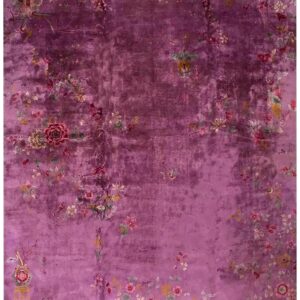
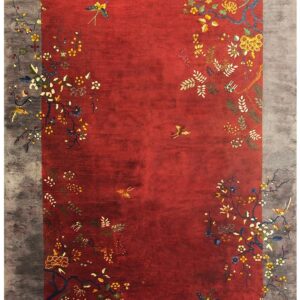
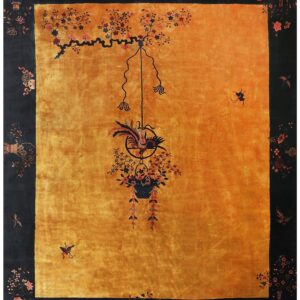
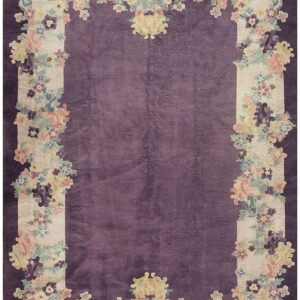
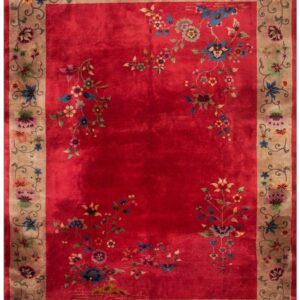
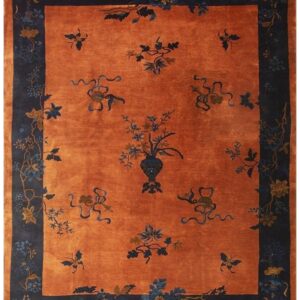
- How to spot one: an open or borderless field of strong color, with flowering branches, vases, birds or a stylized dragon placed off center or trailing in from the corners, instead of a central medallion.
- Color that lasts: imported chrome and aniline dyes gave magenta, emerald, teal, purple and electric blue that stay saturated after a century, unlike the mellowed vegetable colors of older Chinese rugs.
- Thick, carved wool: a plush pile of about one pound per square foot, cut away around the motifs so they stand in relief.
- Several makers: Walter Nichols set the standard, Helen Fette and Li Meng Shu offered a softer alternative, and other Tianjin workshops such as Tavshanjian, Jen-Li and Elbrook followed the look with varying quality.
- Our collection: more than 700 Chinese Art Deco rugs in stock in New York, of which more than 400 are Walter Nichols rugs. Free shipping within the continental United States and a 4-day in-home trial; see buying with confidence.
Chinese Art Deco rugs are a distinctive fusion of Eastern artistic tradition and early 20th‑century modern design, emerging during the Art Deco era as Chinese weavers began creating carpets that harmonized classical motifs with streamlined, contemporary aesthetics. These hand‑knotted rugs blend the graceful symbolism of Chinese art, such as stylized florals, clouds, and auspicious emblems, with the clean lines, geometric forms, and bold color contrasts characteristic of the Art Deco movement.
Often woven with high‑quality wool and natural dyes, Chinese Art Deco carpets typically feature balanced open fields, repeating motifs, and striking palettes that range from soft neutrals to vibrant blues, reds, and golds. The result is a rug style that bridges cultural heritage and modern sensibility, offering both visual drama and an understated elegance that suits a wide range of interior styles, from classic to contemporary.
Celebrated for their artistic innovation and enduring craftsmanship, Chinese Deco rugs remain popular among collectors and design enthusiasts seeking pieces that capture the spirit of an era while bringing a unique cultural voice to today’s homes.
Deco Chinese rugs represent a unique fusion of traditional Eastern motifs and the bold, geometric sensibilities of 1920s modernism. Defined by their striking use of negative space, stylized florals, and vibrant color palettes, these captivating pieces bring historical drama and sophisticated flair to contemporary interiors; read more about the history and design of Chinese Art Deco textiles in our detailed guide.
Learn More About Walter Nichols | Shop All Walter Nichols Super Rugs
Shop hundreds of antique Chinese Art Deco rugs and carpets
Chinese Art Deco rugs are one of the largest groups within our antique Chinese rugs collection, more than 1,850 antique Chinese rugs held in New York.
Chinese Art Deco rugs at a glance
The table sums up what defines a Chinese Art Deco rug and what is on this page right now. Counts and prices come from our in-stock Chinese Art Deco rugs on September 27, 2026 and change as rugs sell.
| Feature | Chinese Art Deco rugs |
|---|---|
| Where woven | Mainly Tianjin (Tientsin), the northern port that led export production, and Beijing, where pieces tended to be finer and softer in color |
| When woven | Late 1910s to the 1930s, with full-scale production under way by 1924 |
| Dates in our collection | More than 550 circa 1920 and more than 80 circa 1930, with smaller groups circa 1925 and circa 1935, and a few later pieces |
| Makers | Walter Nichols (more than 400 of our rugs, about six in ten), Fette-Li, and other Tianjin workshops. More than 270 of our Art Deco rugs are by makers other than Nichols. |
| Materials | Lustrous wool pile on a cotton foundation for almost all pieces; a few have silk |
| Construction | Hand-knotted on vertical looms, thick pile of about one pound per square foot, carved around the motifs after weaving |
| Palettes | Our most varied Chinese color range. In stock: blue, more than 110; ivory and cream, about 110; red and rust, more than 90; yellow and gold, more than 90; coral and pink, more than 90; purple and lavender, more than 70; green, more than 60; black, more than 25 |
| Signature designs | Solid and open fields (more than 240 rugs), vase designs (more than 170), modernist designs (more than 80) and birds (more than 60), with peonies, lotus, bats, pagodas, cloud swirls and stylized dragons |
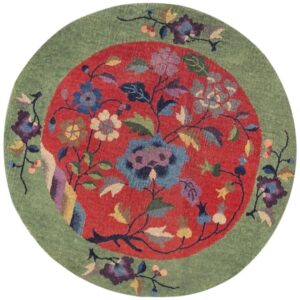
| Shapes | Mostly rectangles (more than 600), plus 29 ovals, 25 runners, 17 squares and 9 rounds. Ovals and rounds are unusual in Chinese weaving and prized by collectors. |
| Sizes in stock | 9 x 12, more than 200; 8 x 10, more than 150; 10 x 14, more than 50; 6 x 9, more than 45; 3 x 5, more than 40; 2 x 3, more than 35; 12 x 18, more than 25; 4 x 6, 18; 12 x 15, 16; 5 x 7, 16 |
| Price range (in stock) | From about $560 to $98,000. The median is about $9,750, and half of our Chinese Art Deco rugs are priced between $6,700 and $13,500. Prices are in US dollars. |
| In stock now | More than 700 Chinese Art Deco rugs, held at our New York showroom |
Prefer to see a rug in person?
-
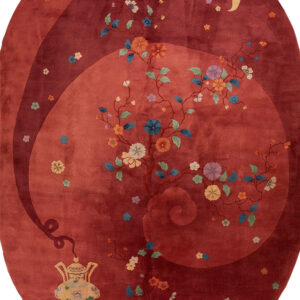
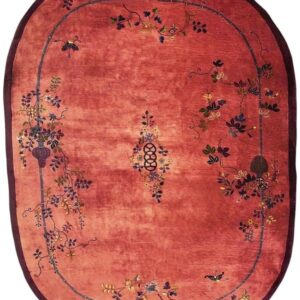
Antique Art Deco Chinese Oval Rug with Artistic Swirl Pattern in Red
$22,500.00 Antique RugsSKU: 24046Rug sizes: 7 ft 9 in x 11 ft (2.36 m x 3.35 m) -
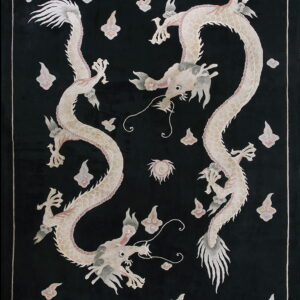
Vintage Black Double Five Claw Chinese Dragons Design Rug
$9,000.00 Vintage RugsSKU: 25692Rug sizes: 9 ft x 12 ft (2.74 m x 3.66 m) -
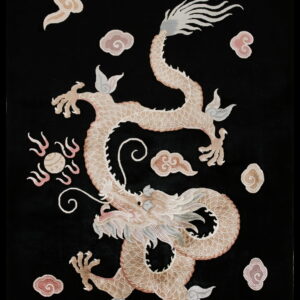
Vintage Benevolent 5 Claw Dragon Design Chinese Deco Rug
$9,800.00 Vintage RugsSKU: 25506Rug sizes: 5 ft 7 in x 8 ft 7 in (1.70 m x 2.62 m) -
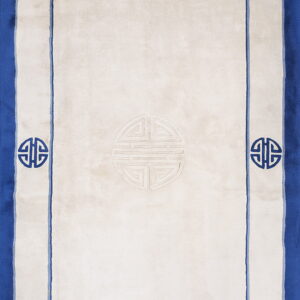
Minimalist Vintage Light Blue and Ivory White Color Open Field Chinese Rug
$4,300.00 Vintage RugsSKU: 21865Rug sizes: 6 ft 2 in x 9 ft 2 in (1.88 m x 2.79 m) -
Stunning Antique Chinese Art Deco Carpet by Nichols Workshop Green Hand Knotted Pile Rug
$33,500.00 Antique RugsSKU: 23817Rug sizes: 11 ft 10 in x 17 ft 2 in (3.61 m x 5.23 m) -
Antique Art Deco Large Room Size Red Allover Rug
$38,000.00 Antique RugsSKU: 23745Rug sizes: 10 ft x 17 ft 6 in (3.05 m x 5.33 m) -
Antique Art Deco Chinese Allover Geometric Knotted Rug
$55,000.00 Antique RugsSKU: 24747Rug sizes: 9 ft 11 in x 13 ft 1 in (3.02 m x 3.99 m) -
Contemporary Chinese Art Deco Style Rug, Design C18018
Contact us for price New RugsSKU: NEC-C18018Rug sizes: 8 ft x 10 ft (2.44 m x 3.05 m) -
Contemporary Chinese Art Deco Style Rug, Design C18017
Contact us for price New RugsSKU: NEC-C18017Rug sizes: 8 ft x 10 ft (2.44 m x 3.05 m) -
Contemporary Chinese Art Deco Style Rug, Design C18016
Contact us for price New RugsSKU: NEC-C18016Rug sizes: 9 ft x 12 ft (2.74 m x 3.66 m) -
Contemporary Chinese Art Deco Style Rug, Design C18015
Contact us for price New RugsSKU: NEC-C18015Rug sizes: 8 ft 9 in x 12 ft 5 in (2.67 m x 3.78 m) -
Contemporary Chinese Art Deco Style Rug, Design C18014
Contact us for price New RugsSKU: NEC-C18014Rug sizes: 8 ft 7 in x 11 ft 10 in (2.62 m x 3.61 m) -
Contemporary Chinese Art Deco Style Rug, Design C18013
Contact us for price New RugsSKU: NEC-C18013Rug sizes: 8 ft 9 in x 12 ft 2 in (2.67 m x 3.71 m) -
Contemporary Chinese Art Deco Style Rug, Design C18011
Contact us for price New RugsSKU: NEC-C18011Rug sizes: 2 ft x 3 ft (0.61 m x 0.91 m), 7 ft 11 in x 10 ft 1 in (2.41 m x 3.07 m), 8 ft 10 in x 12 ft 1 in (2.69 m x 3.68 m) -
Contemporary Chinese Art Deco Style Rug, Design C18010
Contact us for price New RugsSKU: NEC-C18010Rug sizes: 9 ft x 12 ft (2.74 m x 3.66 m) -
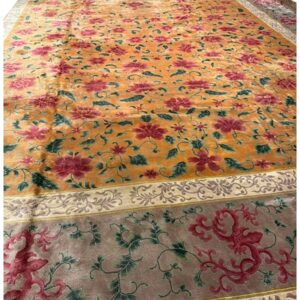
1920s Gold Field Floral Antique Chinese Art Deco Knotted Wool Wide Gallery Rug
$97,500.00 Antique RugsSKU: 6999Rug sizes: 18 ft x 31 ft (5.49 m x 9.45 m) -
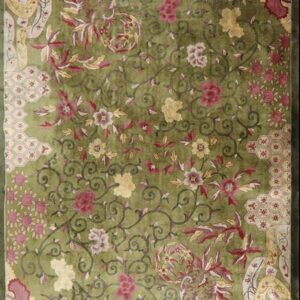
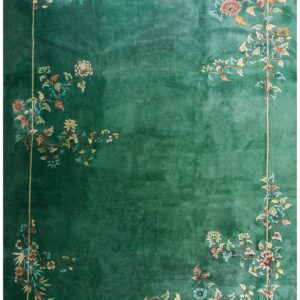
1930s Solid Green Field Floral Antique Chinese Art Deco Carpet Rug
$18,200.00 Vintage RugsSKU: 25804Rug sizes: 12 ft 10 in x 15 ft 9 in (3.91 m x 4.80 m) -
1920s Antique Pink Rose Modernist Floral Knotted Wool Chinese Art Deco Rug
$10,400.00 Antique RugsSKU: 7009Rug sizes: 8 ft x 11 ft (2.44 m x 3.35 m) -
1920s Antique Yellow Field Flowers Border Knotted Chinese Art Deco Carpet Rug
$10,400.00 Antique RugsSKU: 6994Rug sizes: 8 ft x 11 ft (2.44 m x 3.35 m) -
1920s Antique Bold Green Field Handknotted Wool Chinese Art Deco Carpet Rug
$6,500.00 Antique RugsSKU: 6983Rug sizes: 8 ft x 9 ft (2.44 m x 2.74 m) -
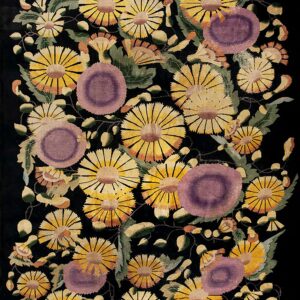
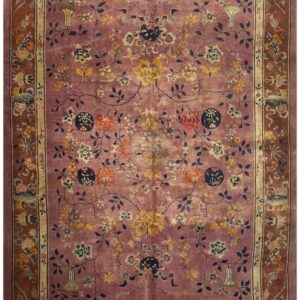
1920s Antique Purple Field Modern Handknotted Wool Chinese Art Deco Carpet Rug
$7,800.00 Antique RugsSKU: 6972Rug sizes: 8 ft x 9 ft (2.44 m x 2.74 m) -
1920s Antique Pink Open Field Pictorial Room Size Knotted Chinese Art Deco Rug
$7,800.00 Antique RugsSKU: 6839Rug sizes: 8 ft x 11 ft (2.44 m x 3.35 m) -
1920s Brown Field Modern Floral Antique Chinese Art Deco Rug
$10,400.00 Antique RugsSKU: 6916Rug sizes: 10 ft x 11 ft (3.05 m x 3.35 m) -
1920s Orange Branches Sprays Modern Floral Antique Chinese Knotted Art Deco Rug
$14,000.00 Antique RugsSKU: 7046Rug sizes: 9 ft x 13 ft (2.74 m x 3.96 m) -
1900s Ruby Red Floral Medallion Antique Chinese Art Deco Rug 9’4″ X 11’6″ Handknotted Wool Carpet
$14,100.00 Antique RugsSKU: 40-4517Rug sizes: 9 ft 4 in x 11 ft 6 in (2.84 m x 3.51 m) -
Magnificent Purple Ground Color With Delicate Detail Floral Chinese Art Deco Rug
$22,000.00 Vintage RugsSKU: 40-1891Rug sizes: 14 ft x 15 ft 4 in (4.27 m x 4.67 m) -
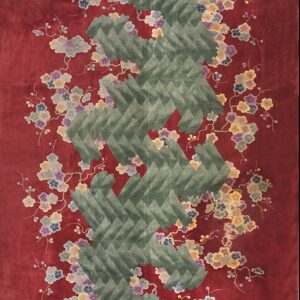
1920s Antique Vibrante Red Field Spray Floral Knotted Wool Chinese Art Deco Rug
$10,400.00 Antique RugsSKU: 7063Rug sizes: 9 ft x 14 ft 4 in (2.74 m x 4.37 m) -
1920s Gold Field Vase Spray Flowers Shou Symbols Antique Chinese Art Deco Rug
$14,300.00 Antique RugsSKU: 7071Rug sizes: 12 ft 7 in x 14 ft 5 in (3.84 m x 4.39 m) -
1920s Antique Purple Open Field Chinese Handknotted Art Deco Wool Room Size Rug
$6,500.00 Antique RugsSKU: 7062Rug sizes: 7 ft x 11 ft (2.13 m x 3.35 m) -
1920s Antique Red Scarlett Floral Haute Modern Knotted Wool Chinese Art Deco Rug
$9,100.00 Antique RugsSKU: 7025Rug sizes: 8 ft x 11 ft (2.44 m x 3.35 m) -
1920s Antique Red Floral Green Border Chinese Knotted Art Deco Wool Round Rug
$1,040.00 Antique RugsSKU: 7002Rug sizes: 2 ft x 2 ft (0.61 m x 0.61 m) -
1920s Rose Field Floral Antique Chinese Knotted Wool Art Deco Room Size Oval Rug
$16,250.00 Antique RugsSKU: 6961Rug sizes: 9 ft x 11 ft (2.74 m x 3.35 m) -
1920s Red Open Field 6Star Room Size Antique Chinese Knotted Wool Art Deco Rug
$7,800.00 Antique RugsSKU: 6973Rug sizes: 8 ft x 11 ft (2.44 m x 3.35 m) -
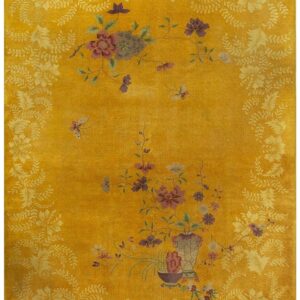
1920s Antique Warm Gold Ground Floral Modern Knotted Chinese Art Deco Carpet Rug
$9,100.00 Antique RugsSKU: 7024Rug sizes: 8 ft x 11 ft (2.44 m x 3.35 m) -
1920s Antique Caramel Field Floral Handknotted Wool Chinese Art Deco Carpet Rug
$19,500.00 Antique RugsSKU: 6987Rug sizes: 12 ft x 19 ft (3.66 m x 5.79 m) -
1920s Antique Orange Vase Floral Butterfly Chinese Handknotted Art Deco Wool Rug
$7,800.00 Antique RugsSKU: 7033Rug sizes: 9 ft x 12 ft (2.74 m x 3.66 m)
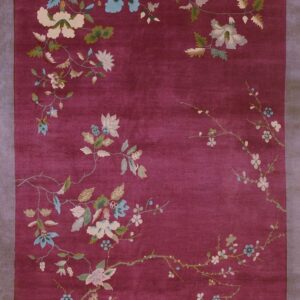
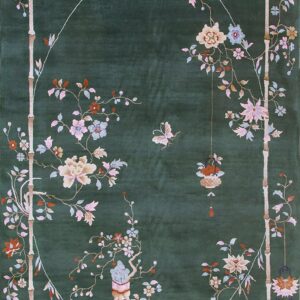
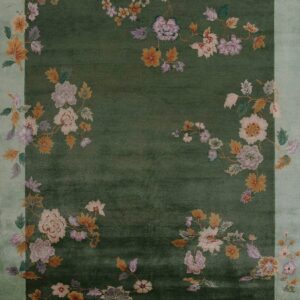
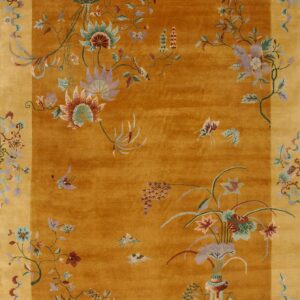
What is a Chinese Art Deco rug?
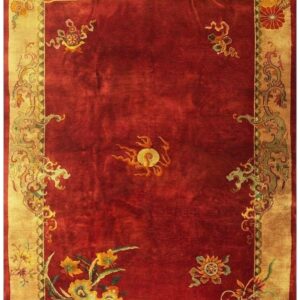
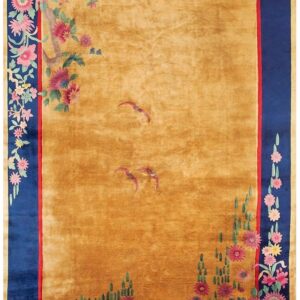
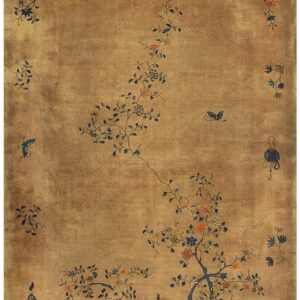
A Chinese Art Deco rug is a hand-knotted wool carpet woven in China in the 1920s and 1930s that recasts traditional Chinese symbols in the language of Art Deco: open fields, asymmetry, simplified forms and saturated color. Most were made in Tianjin and Beijing for Western buyers, above all in the United States.
The style grew out of a specific moment. After the fall of the Qing dynasty in 1912, China opened more fully to foreign trade, and entrepreneurs in the treaty port of Tianjin saw that skilled Chinese weavers could make rugs for the modern homes of New York and London. Weaving in the new style began in the late 1910s, and by 1924 full-scale production was under way. The result was a genuinely new genre: Chinese in its imagery, modern in its composition.
In the West, the most famous examples are known simply as "Nichols rugs", after Walter Nichols. That shorthand is useful but incomplete. The Fette-Li workshops and several other Tianjin firms also made Chinese Art Deco rugs, and more than 270 rugs on this page come from makers other than Nichols.
How do you identify an antique Chinese Art Deco rug?
Look for strong, clear color, a composition that breaks the medallion-and-border rule, and a thick, heavy, carved wool pile on a cotton foundation. Then check the back and the fringe for signs of a period workshop.
- The border bends or disappears. Classical Chinese rugs keep a strict frame around the field. Deco weavers let motifs float to the edge, reduced the border to a thin line, or dropped it entirely.
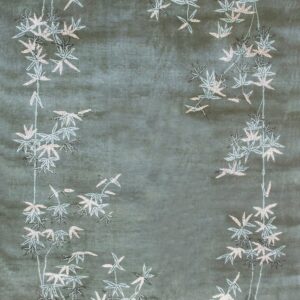
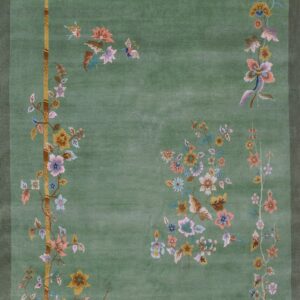
- The motifs sit off center. Flowering branches trail in from one or two corners, a vase stands to one side, or a few birds cross an empty ground, leaving wide expanses of plain color.
- The symbols are modernized. Dragons become lean and serpentine, the lotus shrinks to a few geometric petals, and cloud bands turn into stylized swirls.
- The colors did not fade. A 1920s Persian rug has usually mellowed; a 1920s Chinese Art Deco rug often still looks vivid, because chrome dyes are fast to light and washing.
- It is heavy and deep. Expect a plush pile of about one pound per square foot, with channels cut into the wool around the design.
- The workshop left clues. Some rugs carry a maker's stamp on the fringe, a sewn label or the stitch marks where one was removed. A cotton foundation and cotton fringe are standard on original pieces.
Modern "Chinese Art Deco style" rugs are still woven today in China and India. They can be handsome, but they lack the weight, patina and value of a period piece, and our listings state origin and approximate age so you know which you are looking at.
Who made Chinese Art Deco rugs?
Walter Nichols is the best known maker, but the style was shaped by a group of competing Tianjin and Beijing workshops, each with its own feel. Knowing them helps you judge a rug and compare prices.
| Maker | Look and feel | What to check |
|---|---|---|
| Walter Nichols, Tianjin | Heavy, stiff and deeply carved, with lustrous machine-spun wool and saturated color, often in open fields with corner sprays | "Made in China by Nichols" fringe stamp, sewn label, a rigid "plank" handle. See our Walter Nichols collection. |
| Fette-Li, Beijing and Tianjin | Softer, more painterly drawing, often in pastels, sometimes in oval or round shapes | A supple handle from thinner cotton warps; the rug folds almost like heavy fabric |
| Other Tianjin workshops, such as Tavshanjian, Jen-Li and Elbrook | Often followed the Nichols look, with quality that ranges from excellent to commercial | Judge each rug on its own wool, color and condition rather than the label |
| Beijing workshops | Often finer, with softer dyes, silk highlights and more delicate motifs than Tianjin rugs | A lighter, more refined drawing and palette |
For the longer story of the movement, read our Chinese Art Deco rug guide, and to see where Deco fits among the older families, read Peking vs Ningxia vs Art Deco rugs.
How do you decorate with a Chinese Art Deco rug?
Let the rug set the color story of the room: pick one hue from its palette for upholstery or walls, and keep the furniture lines clean so the open field and trailing flowers can be read. These rugs were designed for modern Western rooms, and they still work best in them.
- Choose by palette. Our Art Deco rugs span blues and ivories, reds, golds, corals, purples and greens. Blue and ivory pieces bridge easily into traditional rooms; purple, emerald and coral pieces are statement rugs.
- Mid-century and modern furniture. The empty field acts as a backdrop that lets sculptural chairs and tables stand out, which is why designers often pair these rugs with mid-century pieces.
- Glamour and Deco revival. Brass, lacquer, velvet, marble and mirror all suit the Jazz Age mood the rugs were made for.
- Unusual shapes. Ovals and rounds, rare in Chinese weaving, suit breakfast tables, round entry halls and curved bays. We currently have 29 ovals and 9 rounds.
- Big rooms. With more than 200 rugs in 9 x 12 and oversized 12 x 15, 12 x 18 and larger pieces, Art Deco is one of the easiest Chinese types to find in room sizes.
Interior designers can source Chinese Art Deco rugs for clients through our trade program.
How do you care for an antique Chinese Art Deco rug?
Chinese Art Deco rugs are among the sturdier antiques you can own, thanks to their thick wool and fast dyes, but the deep carved pile needs specific attention. Keep grit out of the channels, keep moths out of the pile, and leave washing to a specialist.
- Clean the carving. Dirt settles in the channels cut around the motifs. Vacuum along them gently, with the beater bar off, so the relief stays crisp.
- Mind the fringe. Brush cotton fringes by hand rather than vacuuming them, and keep them clear of the brush roll.
- Stop moths early. A thick wool pile gives larvae plenty to feed on under furniture. Our moth-proofing service washes the rug first and then treats the fibers.
- Wash professionally. Our rug cleaning service in Manhattan washes hand-knotted rugs with a pH-balanced process, which protects the luster of the wool.
- Keep the labels. Leave any maker's stamp, tag or label in place, and keep your purchase records. They support future appraisals.
Glossary of Chinese Art Deco rug terms
- Chrome dyes
- Synthetic dyes fixed with chrome mordants, imported from Germany in the 1920s. They made vivid colors that resist fading and washing.
- Aniline dyes
- Early synthetic dyes that widened the palette of Chinese workshops to magenta, emerald, teal and purple.
- Asymmetrical open field
- A layout with no central medallion, where a few motifs sit off center and most of the field is plain color.
- Borderless design
- A rug with no conventional border, or only a thin line, so motifs appear to float off the edges. It was one of the most radical breaks of the Deco period.
- Corner sprays
- Flowering branches that trail into the field from one or more corners, a signature Deco arrangement that stays visible around furniture.
- Vase motif (ping)
- The word for vase sounds like the word for peace, so a vase, often filled with flowers, is a wish for peace and harmony.
- Chinoiserie
- The long European fashion for Chinese-inspired design. Chinese Art Deco rugs revived it with modern, geometric drawing.
- Nichols-style
- A rug by another workshop that follows the Walter Nichols look. Some are excellent, but they should not be sold or priced as authentic Nichols pieces.
Chinese Art Deco Rugs: Frequently Asked Questions
Are all Chinese Art Deco rugs made by Walter Nichols?
No. Nichols was the most celebrated maker, and more than 400 of our Chinese Art Deco rugs are his work, but Fette-Li and other Tianjin workshops such as Tavshanjian, Jen-Li and Elbrook also made them. More than 270 rugs on this page are by makers other than Nichols.
When were Chinese Art Deco rugs made?
Mainly in the 1920s and 1930s. Weaving in the new style began in the late 1910s, and full-scale production was under way by 1924. In our collection, circa 1920 is by far the biggest group, followed by circa 1930.
Why are the colors on Chinese Art Deco rugs so bright?
Because Chinese workshops of the 1920s used imported chrome and aniline dyes. Unlike the vegetable dyes of older Chinese rugs, which mellow over time, these colors were fast to light and washing, so many rugs still show strong magenta, emerald, purple and blue.
Do Chinese Art Deco rugs work in modern interiors?
Yes, they were designed for them. Open fields, asymmetric layouts and clear color make them a natural fit for mid-century, contemporary and eclectic rooms, while blue and ivory examples also suit transitional spaces.
Do you ship Chinese Art Deco rugs, and can I return one?
Shipping is free within the continental United States. International orders ship for a flat $495 per order ($350 to Canada, $395 to Mexico), with customs fees, duties and taxes paid by the buyer on delivery. Orders ship in 1 to 3 business days, and US buyers get a 4-day in-home trial; see our shipping policy and returns policy.
Can I sell my Chinese Art Deco rug or have it appraised?
Yes. We buy antique rugs outright: send photographs and measurements, and Kevin Rahmanan reviews the photos and decides. Consignment is also offered. For a value, we give a free Quick Opinion by phone or email from photographs, and a free In-Depth Appraisal Report for insurance and estates. See what is my antique Chinese rug worth or contact us.