
What Rug “Durability” Really Means
Structural vs. Visual Durability
The rug durability definition extends beyond a single measurement. It divides into two distinct but connected dimensions: structural durability and visual durability. Structural durability refers to the physical survival of the rug, determined by fiber quality, weave strength, and foundation integrity. A tightly hand-knotted wool rug on a strong cotton or wool foundation can resist decades of foot traffic.
Visual durability, by contrast, addresses how the rug looks over time: the stability of dyes, resistance to ultraviolet light, and whether colors fade evenly or blotch. A rug may remain physically intact while appearing tired or washed-out if dye stability is weak.
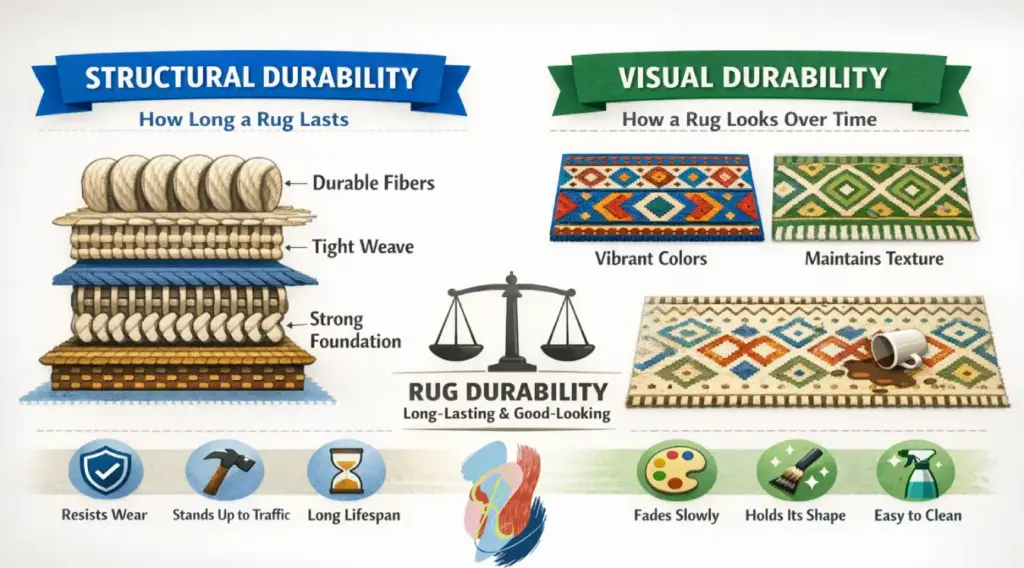
Both dimensions together dictate the rug’s perceived and actual lifespan.
 Durable High Traffic Rugs |  Low Traffic Rugs |
Use-Intent: Everyday vs. Display
The purpose for which a rug is created plays a decisive role in how rug durability should be understood. Durable rugs for everyday use—such as those woven by tribal communities—were built to endure constant pressure from foot traffic, grit, and exposure.
By contrast, palace or court carpets, though sometimes technically sophisticated, were often intended for ceremonial display rather than daily wear. In these cases, visual brilliance was prioritized over structural toughness.
Understanding the maker’s intent explains why some antique display area rugs appear pristine despite centuries of age, while utilitarian village rugs may show wear after decades of hard use.
Care and Environment Multipliers
Environmental conditions and maintenance habits act as multipliers that can double or halve the lifespan of rugs:
- Humidity: Excess moisture encourages mold and weakens fibers.
- UV exposure: Direct sunlight accelerates dye fading and fiber brittleness.
- Grit and soil: Particles grind into fibers like sandpaper, eroding pile.
- Traffic patterns: Concentrated wear in entryways or hallways shortens usable life.
- Cleaning practices: Proper, gentle washing extends visual and structural integrity, while harsh chemicals reduce it.
These multipliers mean two rugs of identical build may have drastically different lifespans depending on their environments.
Lifespan Ranges by Build
The lifespan of rugs depends most heavily on construction type. Paying more often correlates with higher rug durability, but only when the added cost reflects stronger materials and superior craftsmanship rather than marketing.
| Build Type | Typical Lifespan Range | Assumptions |
|---|---|---|
| Hand-knotted wool | 50–200+ years | Quality wool, balanced knot density, cared for properly. |
| Hand-knotted silk | 30–100 years | Silk is strong but sensitive to abrasion and light; best in low-traffic use. |
| Flatweave (kilim, soumak) | 20–70 years | No pile; wears evenly; thrives if kept clean. |
| Hand-tufted with latex | 3–10 years | Latex backings deteriorate; not designed for long-term heavy use. |
| Machine-made synthetic | 5–20 years | Durability depends on fiber type and traffic exposure. |
This comparison shows why hand-knotted rugs are generally more durable than machine-made rugs: their structure and natural fibers give them the potential to outlast generations, whereas synthetic or tufted pieces are often designed for shorter lifespans.
Key Takeaways
Rug durability is not a fixed number but a multi-factor equation shaped by structure, dyes, intent, and environment. A well-built wool rug can last a century or more, while a tufted piece may degrade in less than a decade.
Paying more can secure a longer-lasting rug if the premium reflects authentic materials and workmanship. Ultimately, build type sets the ceiling for longevity, and care and environment determine whether a rug reaches it.
(See also: Rug weaving materials)
Fiber & Material Durability Ladder
Wool Resilience Mechanics
Among the most durable rug materials, wool holds the crown for traffic-heavy environments. Its unique physical structure explains why. Wool fibers are naturally crimped, meaning they have a spring-like curl that lets the pile compress and rebound without permanent crushing. This elasticity ensures that patterns and textures retain their shape even after years of pressure.
Wool also contains lanolin, a natural waxy coating that repels water and resists soiling. Combined with microscopic cuticle scales, this surface structure prevents dirt from embedding deeply and makes stains easier to remove. These mechanics explain why a high-quality wool rug not only survives heavy wear but also maintains its visual appeal far longer than synthetics. Highland Tibetan wool, with its long fibers and high lanolin content, is especially renowned for exceptional toughness.
Silk Limitations in Use
Silk rugs brings luster, detail, and prestige, but its role in rug durability is limited. While silk has remarkable tensile strength—stronger than wool when pulled lengthwise—it suffers from abrasion risk. Under high foot traffic these luxurious area rugs can quickly fray. Silk pile fibers that has been worn down, flattens its sheen and exposes its vulnerability.
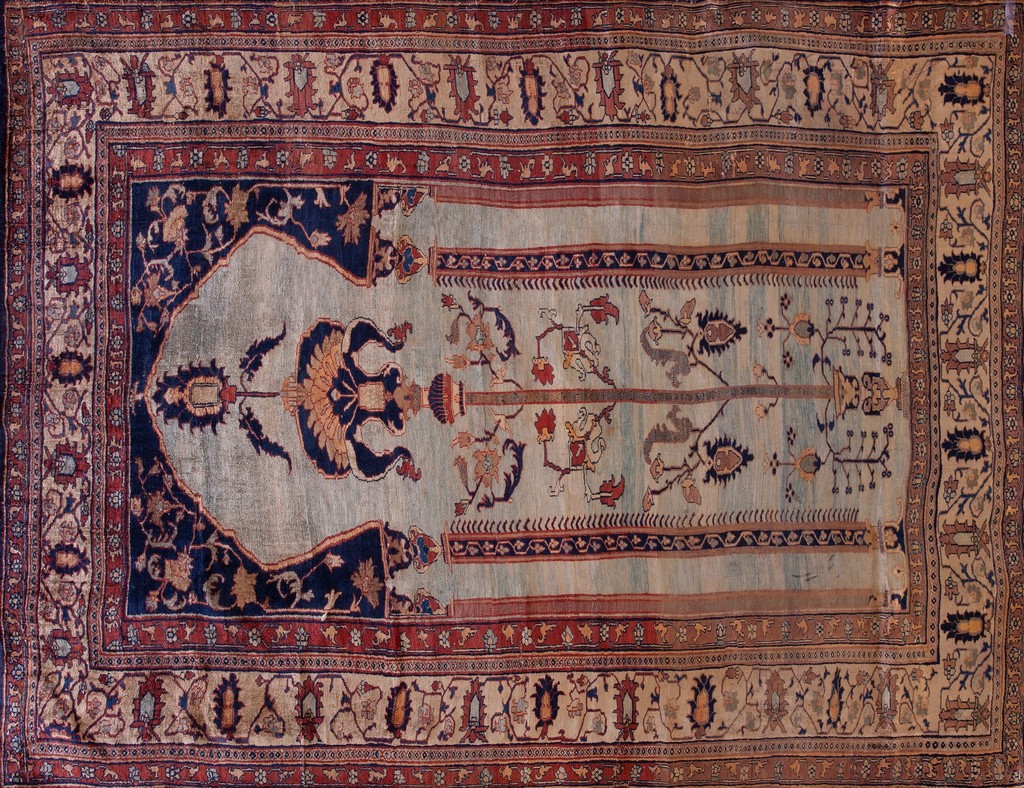
Thus, in a finely woven rug made of silk the wear becomes apparent when placed in hallways or living rooms. The material excels in wall-hangings, display rugs, or accent pieces in low-use areas where its brilliance can shine without being worn away.
Cotton as Foundation vs. Pile
Cotton plays a dual role in rug construction. As a foundation fiber—warp and weft threads—it excels due to its strength, uniformity, and ability to hold tight knots, contributing to structural rug durability.
However, when used as pile, cotton shows weaknesses: it lacks elasticity, crushes under weight, and abrades more quickly than wool. This is why most traditional rugs use cotton for their base and wool for their pile.
Synthetics: Nylon, Polypropylene, Polyester
Synthetic fibers dominate the machine-made market, but their performance varies.
| Fiber | Pros | Cons |
|---|---|---|
| Nylon | High abrasion resistance, resilient under traffic | Can fade with UV, may lose luster, less natural feel. |
| Polypropylene (PP) | Excellent stain resistance, affordable, lightweight | Crushes easily, limited rebound, wool vs polypropylene durability favors wool in long-term appearance retention. |
| Polyester | Good stain and fade resistance, bright colors | Lacks resilience; prone to matting in high-traffic zones. |
When choosing between wool or polypropylene for rug durability, wool consistently outperforms in maintaining its look under heavy use. Polypropylene offers affordability and stain resistance but flattens quickly in traffic.
Viscose / Bamboo-Silk Warnings
Viscose rugs durability is notoriously poor.
Despite being marketed as “bamboo-silk” or “art silk,” viscose and rayon fibers are chemically processed cellulose with inherent weaknesses:
- Weak fiber strength: The reconstituted cellulose breaks easily.
- Water sensitivity: Fibers lose up to 70% of their strength when wet.
- Abrasion failure: Smooth surfaces crush and fray almost immediately underfoot.
These properties mean viscose or bamboo-silk rugs cannot handle foot traffic and quickly degrade, making them best avoided for practical use.
WARNING: Viscose is a chemically reconstituted cellulose fiber. It is structurally “disposable” in high-traffic zones. If your space involves moisture, pets, or consistent footfall, a viscose rug is a liability, not an asset.
Key Takeaways
For traffic-heavy zones, wool is the premier choice, offering resilience that keeps rugs attractive for decades. Silk provides beauty but should remain in decorative or low-use spaces. Cotton thrives in foundations but fails as pile. Synthetics fill budget-friendly niches, with nylon the most abrasion-resistant but none matching wool for long-term performance.
Viscose and bamboo-silk should be treated as decorative-only fibers due to their fragility. In the hierarchy of materials, wool remains the benchmark against which all others are measured for rug durability.
| Material | Traffic Rating | The “Failure Mode” |
|---|---|---|
| High-Mountain Wool | High / Industrial | Slow, even thinning over decades (Patina). |
| Pure Silk | Low / Decorative | Abrasion “fuzzing” and loss of sheen underfoot. |
| Polypropylene | Medium | Fiber crushing/matting; “Plastic” look after 2-3 years. |
| Viscose (Art Silk) | Zero / Avoid | Fiber collapse when wet; immediate shedding. |
Weave, Knots, and Structure
Knot Types: Turkish vs. Persian
The core of rug durability begins with how each knot is tied. Turkish knots (symmetric) encircle two warp threads, locking the pile more securely and producing a sturdier, slightly bulkier surface. This makes Turkish vs. Persian knot durability favor the former in terms of security, especially in rugs meant for heavy wear.
Persian knots (asymmetric), by looping around only one warp, allow weavers to achieve higher fineness and intricate detail. While Persian knots enable delicate patterns, their looser grip on the foundation can create a less rigid pile. Both knot types can yield durable rugs if combined with proper packing density, but their structural differences reflect priorities: strength versus refinement.
Knot Density vs. Durability
Collectors often ask whether a higher knot density automatically means a more durable rug. The answer is nuanced. Higher knots-per-square-inch (KPSI) can improve definition and distribute wear more evenly. Yet, beyond a certain point, extra density does not translate into better longevity. Overly fine rugs with very short piles, despite their artistry, can wear down quickly under traffic.
Knot density and wear are best balanced at a medium-high range, where the structure is compact enough for endurance but not so delicate that surface fibers vanish with abrasion. Rug durability depends more on knot quality and the tightness of packing than on sheer KPSI numbers.
Pile Height Sweet Spot
Pile height and rug durability interact closely. Too tall, and fibers bend, trap grit, and crush; too short, and surface patterns may erode quickly. The most durable rugs usually strike a balance with medium to low pile heights, tightly packed to resist flattening.
- High pile: Plush but prone to matting and soil retention.
- Medium pile: Comfortable underfoot with resilience against wear.
- Low pile : Crisp patterns, less cushioning, may wear through faster if too short.
This sweet spot ensures both comfort and longevity, especially in high-use living rooms where appearance retention matters.
Foundations, Wefts, Finishes
Cotton excels as a foundation fiber, providing strength and uniformity for warps and wefts. Double-wefted structures add rigidity, resisting sagging or buckling. The finishing edges—selvedges and end knots—are equally critical.
Weak or fraying edges allow unraveling, drastically shortening a rug’s lifespan. Properly bound edges and reinforced ends safeguard the entire weave, preserving both structural and visual durability.
Hand-Knotted vs. Tufted vs. Machine
Construction method sets the ceiling for longevity.
| Type | Typical Lifespan Range | Notes |
|---|---|---|
| Hand-knotted | 50–200+ years | Superior structure; knots tied individually; repairable. |
| Hand-tufted | 3–10 years | Pile inserted with gun into backing; latex glue weakens over time. |
| Machine-made | 5–20 years | Synthetic fibers vary; efficient but less enduring than true knots. |
In the debate of hand-knotted vs. tufted lifespan, the difference is dramatic: tufted rugs cannot compete with the structural resilience of true knots. For busy spaces, hand-tufted rugs are not recommended if rug durability is the priority.
Key Takeaways
Rug durability is determined by knot security, packing density, pile balance, and finishing integrity. A thick rug does not automatically mean a stronger rug—rug thickness in living rooms adds comfort but not always resilience if fibers or knots are weak.
What truly matters are dense, well-packed knots, balanced pile height, and reinforced edges. In this structural hierarchy, hand-knotted rugs stand at the top, combining craftsmanship with longevity unmatched by tufted or machine alternatives.
(See also: Rug weaving types comparison for knot diagrams and structural detail.)
Rug Durability Matrix & Use Cases
Rug durability and longevity can be predicted by considering four interacting factors: fiber, weave, traffic, and sun exposure. The following lifespan matrix for rugs illustrates how these elements combine, along with padding and care cadence, to set realistic expectations.
| Fiber | Weave | Traffic Level | Sun Exposure | Pad Used | Care Cadence | Expected Lifespan |
|---|---|---|---|---|---|---|
| Wool | Hand-knotted | High | Controlled | Yes | Vacuum weekly, rotate 6–12 mo., wash 3–5 yrs | 30–100+ years |
| Wool | Flatweave | Medium–High | Moderate | Yes | Vacuum weekly, rotate/flip 6–12 mo., wash 3–5 yrs | 20–70 years |
| Silk | Hand-knotted | Low | Controlled | Yes | Light vacuum, avoid sun, wash 5–7 yrs | 30–100 years (display use) |
| Polypropylene | Machine-made | High | Strong sun | Optional | Vacuum weekly, rotate yearly | 3–8 years (appearance) |
| Polyester | Machine-made | Medium | Moderate | Optional | Vacuum weekly, wash 5 yrs | 5–15 years |
| Nylon | Machine-made | High | Controlled | Yes | Vacuum weekly, rotate yearly | 10–20 years |
This grid shows why wool rugs remain the longest-lasting choice for high-traffic areas, provided light and soil are managed. By contrast, synthetic options like polypropylene flatten quickly under heavy wear and sunlight.
Room-by-Room Picks
Different rooms demand different solutions. Matching rugs to room realities avoids disappointment.
- Living / Family Room: Hand-knotted wool with medium pile balances comfort and longevity; centerpiece rug durability is vital.
- Hallways : Hallway runner rug durability favors flatweaves or kilims; reversible construction allows flipping, doubling lifespan.
- Dining Room: Wool or nylon, low pile for easy cleaning of spills and chairs sliding.
- Bedrooms: Softer pile wool or wool blends provide comfort; lighter wear means broader options.
- Outdoor/Patio: Polypropylene resists moisture and mildew; lifespan is shorter but tolerable in open-air use.
These recommendations prevent overuse of delicate fibers in busy zones and highlight where budget-friendly synthetics make sense.
Care Cadence Benchmarks
Proper maintenance multiplies durability.
These benchmarks apply across materials:
- Vacuum weekly: Prevents grit from cutting fibers.
- Rotate every 6–12 months: Distributes wear, especially in sunny or high-traffic zones.
- Professional wash every 3–5 years: Removes embedded soil, refreshes appearance, and stabilizes dyes.
For decorative silk or delicate rugs, vacuuming should be lighter, and professional cleaning less frequent but highly specialized.
Lifespan Expectations by Scenario
Expectation-setting ensures rugs are neither under- nor over-valued.
- Quality hand-knotted wool: 30–100+ years depending on use and care.
- Flatweave wool in a hallway: 20–50 years with rotation and flipping.
- Machine-made polypropylene in sun-heavy foyer or entryway: 3–8 years before appearance degradation.
- Silk in display use: Can last centuries, but only if kept away from foot traffic and direct light.
Key Takeaways
The rug durability matrix proves that build, room, and care together set outcomes. Pads and regular rotation are baseline multipliers that extend performance across every fiber type.
Wool remains the standard for durable rugs by room, while flatweaves excel in hallways and synthetics fill outdoor or short-term roles. Above all, clear lifespan expectations prevent misuse and disappointment, ensuring each rug fulfills its intended role.
(See also: General Rug Sizes guide for aligning the rug durability with room dimensions.)
Environment & Placement Factors
Humidity and Moisture Control
Humidity and rugs have a delicate relationship. Natural fibers such as wool and cotton absorb ambient moisture, which can swell fibers, promote mold, and weaken foundations.
To safeguard the rug durability:
- Keep relative humidity stable (40–60%): Fluctuations cause fibers to expand and contract, stressing structure.
- Avoid damp basements or direct concrete floors: Concrete wicks ground moisture, leading to mildew and rot in rug backings.
- Use vapor barriers or breathable pads: Prevents upward moisture from seeping into rug foundations. Natural fiber rugs can last in humid environments only with careful climate control; unmanaged dampness accelerates decay.
Sunlight and UV Mitigation
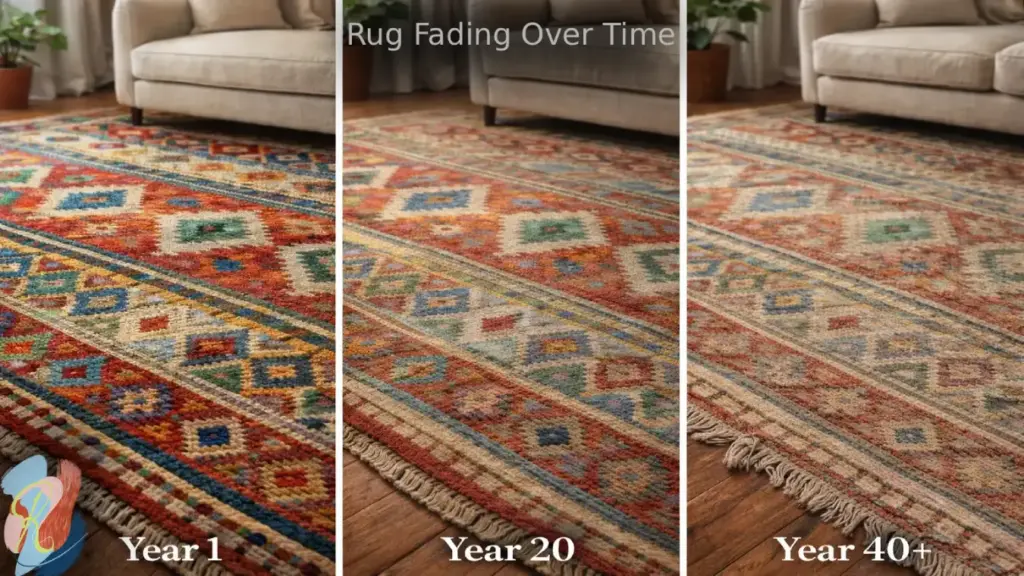
UV fading rugs is one of the most common, silent killers of rug durability. Both wool and silk dyes lose vibrancy under intense sun, and fibers may become brittle over time which affects the rug durability.
Preventative measures include:
- Install UV films on windows: Blocks most damaging rays without reducing visible light.
- Use blinds or shades during peak hours: Prevents concentrated glare spots.
- Rotate rugs 6–12 months: Evens out fading and wear from uneven sun exposure.
- Layer with sheer drapes or place under furniture: Provides partial protection where full shading isn’t possible.
Traffic Patterns and Pads
Entryways, hallways, and living rooms concentrate the heaviest wear. Rug pads directly address these rug durably stress points.
Rug pad benefits include:
- Shock absorption: Reduces fiber compaction and edge stress from footsteps.
- Slippage prevention: Keeps rug from shifting, avoiding frayed corners.
- Foundation protection: Creates a buffer between rug and abrasive floors. Multiply rug life expectancy, especially in busy areas.
Furniture Dents and Rotation
Heavy furniture compresses pile and leaves visible dents.
Practical solutions include:
- Use wide coasters or protectors: Distributes weight, reducing deep impressions.
- Rotate rugs every 6–12 months: Balances traffic wear, UV exposure, and furniture placement.
- Steam gently to lift pile dents: Moist heat reactivates fiber elasticity, helping wool rebound.
Placement Challenges: Basements, Concrete, and Window Glare
Basements with poor ventilation are risky placements. Rugs laid directly on concrete floors without pads are highly vulnerable to wicking moisture, mildew and reducing odors / smelly rugs.
In contrast, bright rooms with strong window glare pose fading risks unless UV mitigation is in place. Placement decisions—choosing controlled environments and adding protective measures—can double the service life of rugs, regardless of fiber or weave.
Key Takeaways
UV and humidity are silent rug killers, slowly undermining both structural and visual rug durability. Simple, high-ROI actions like pads and regular rotation significantly extend lifespan.
For best results, manage moisture, filter sunlight, and distribute wear evenly. Addressing these environmental and placement factors is as important as fiber or weave choice in determining a rug’s long-term survival.
Care & Maintenance That Extends Life
Vacuuming Protocols
Proper vacuuming is the first defense in rug preservation. For vacuuming hand-knotted rugs, always use suction-only attachments, never beater bars or rotating brushes. Beater bars pull at knots and weaken pile tips, accelerating fiber loss.
Vacuum in the direction of the pile to lift soil without stressing the foundation. Weekly vacuuming prevents grit from cutting fibers, extending both structural and visual rug durability.
Cleaning Schedules and Tests
A consistent wool rug cleaning schedule is essential for long-term survival.
- Traffic-dependent washing: In family rooms, rugs may need professional washing every 3–5 years; in lightly used bedrooms, every 7–10 years may suffice.
- Spot soil tests: Rub a damp white cloth gently on the pile; if dirt transfers, it’s time for a wash.
- Dye fastness checks: Before cleaning, test dyes with a damp cloth; unstable colors require expert handling.
These benchmarks ensure rugs are cleaned before soil buildup causes fiber abrasion and fading.
Stain Response Playbook
Immediate action saves fibers and colors.
- Blot, don’t scrub: Scrubbing pushes stains deeper and frays pile tips.
- Neutralize pet urine quickly: Acidity degrades wool and leaves permanent discoloration.
- Use neutral pH cleaners sparingly: Harsh detergents strip natural lanolin, weakening fibers.
- Rinse thoroughly Residues attract dirt and accelerate re-soiling.
Following this playbook ensures that stains don’t become permanent damage.
Storage, Handling, and Pests
Improper storage can undo decades of care.
| Risk | Prevention |
|---|---|
| Folding creases | Roll rugs around a tube, not folded; prevents fiber and foundation breakage. |
| Moisture/mildew | Use breathable wraps; avoid attics and damp basements. |
| Moth damage | Keep rugs clean and in active use; inspect fringes and edges where moth larvae hide. |
| Rodents/insects | Store off floors and away from cardboard; use cedar or lavender deterrents. |
Moth prevention in rugs hinges on cleanliness and airflow; larvae thrive on dirt and hidden pile areas.
Professional Washing Guidance
Professional cleaning refreshes colors and structure, but it must be done with care. Always test dyes for stability before immersion. The safest approach uses neutral pH solutions, thorough rinsing, and controlled drying.
Aggressive chemical cleaners or surface-only shampoos can shorten rug lifespan. Trusted professionals also correct edge frays or minor tears during washing, preventing greater structural loss.
Key Takeaways
Gentle, regular care preserves fibers and colors. Weekly suction-only vacuuming, timely stain responses, and traffic-based cleaning extend life.
Early action prevents permanent damage, while storage precautions and moth vigilance guard against hidden risks. Rug pads and regular rotation (every 6–12 months) remain baseline practices that amplify results, ensuring that rugs fulfill their full lifespan potential.
(See also: Age Circa Dates conservation context for cleaning relevance.)
Regional Traditions & Intended Use
Persian vs. Anatolian Durability Cues
Rug durability often mirrors the weaving traditions of each region. In Anatolia, symmetric Turkish knots combined with wool foundations yield rugs that excel under traffic, balancing strength with flexibility.
In contrast, Persian city workshops—known for their asymmetrical knots and high fineness—produced rugs for formal display and ceremonial use. While these Persian rugs demonstrate artistic mastery, their intended use was not heavy wear.
This contrast illustrates Turkish rugs vs. the rugs of Persia durability: security and strength in Anatolia, refinement and detail in Persian cities.
| Region/Tradition | Build Traits | Durability Profile |
|---|---|---|
| Anatolian | Symmetric knots, wool foundation | Excellent for traffic; resilient under daily use. |
| Persian City | Asymmetric knots, cotton foundation | Suited for formal or decorative settings; less robust in traffic. |
| Bidjar | Compacted wefts, dense wool | “Iron rugs” with legendary toughness; heavy and long-wearing. |
| Heriz | Sturdy cotton foundation, bold design | Thick, balanced builds; strong traffic resistance. |
Tibetan Wool and Knotting
Tibetan wool rugs stand apart thanks to highland sheep fibers rich in lanolin and long-staple strength. These rugs use the unique Tibetan knot, creating dense, plush surfaces that resist crushing while maintaining softness. Highland wool’s resilience, combined with this knotting method, makes Tibetan rugs both luxurious and durable rugs—rarely sacrificing comfort for strength.
Afghan, Baluch, and Caucasian Robustness
Rural weaving traditions often prioritized longevity for nomadic and village use.
- Afghan rugs: Dense wool, sturdy symmetric knots, and earthy palettes make them naturally resistant to wear.
- Baluch rugs: Compact, utilitarian builds were designed for portable, hard use in tents and tribal settings.
- Durable Caucasian rugs: Bold geometric patterns woven with symmetric knots on wool foundations; even aging and strong traffic resistance.
These traditions prove that some of the toughest rugs come from weavers who wove primarily for survival and daily function rather than courtly display.
City Workshop vs. Tribal Intent
A rug’s intended use is key to its longevity. City workshops often chased fineness and visual brilliance, crafting masterpieces suited for palaces and salons. Tribal and village rugs, by contrast, were built for everyday family use, prioritizing structure and resilience.
This explains why antique tribal pieces often remain serviceable in modern homes, while many delicate city carpets survive only as decorative heirlooms.
Bidjar and Heriz Strength
Two Persian regional exceptions prove that not all city-linked weaving prioritized delicacy. The rug durability of Persian Bidjar rugs is unmatched: weavers pounded wefts so tightly that rugs became famously heavy and resistant to folding, earning the name “iron rugs.”
Persian Heriz Serapi rugs, though woven for export markets, combined cotton foundations with thick wool piles and simplified designs, resulting in hardy constructions well-suited for family living spaces.
Key Takeaways
Regional traditions reflect intended use and material choices. Certain builds—like Bidjar, Heriz, Tibetan wool, and Anatolian weaves—are proven traffic champions, demonstrating that “fineness” does not always equal strength.
For buyers, this means antique rugs can indeed be durable enough for daily family use, particularly when sourced from robust traditions. In terms of affordability, village and tribal constructions often deliver the best ratio of toughness to cost, making them accessible options for households seeking long-lasting performance.
(See also: Rug origins overview for the historical context of these rugs and weaving traditions.)
Dyes, Colorfastness, and Aging
Natural Dyes and Abrash
Traditional plant- and mineral-based colorants are central to the story of rug aging. Natural vs. synthetic dyes in rugs shows why many older pieces retain visual harmony. Natural dyes tend to fade evenly, softening into balanced tones rather than blotching.
This evenness gives rise to abrash, the subtle striation or shade variation that occurs when different batches of hand-dyed yarns age together. Far from a flaw, abrash meaning lies in its authenticity and beauty: it adds depth while leaving the structural rug durability intact.
Early Anilines: Damage Risks
The introduction of synthetic aniline dyes in the late 19th century brought both vivid colors and serious problems.
- Rapid fading: Many anilines lacked lightfastness, so reds and purples dulled to brown or gray.
- Bleeding during washing: Poor bonding meant colors ran, blurring designs.
- Wool damage: Some chemical formulations chemically weakened fibers, reducing lifespan.
These risks explain why early aniline-dyed rugs often appear unbalanced or prematurely aged compared to natural-dyed peers.
Chrome and Modern Acid Dyes
By the 20th century, chemical innovations improved dye performance dramatically. Chrome dye stability transformed rug making by offering both “washfastness” and “lightfastness”.
Modern acid dyes similarly bond well to wool, resisting routine washing and controlled sunlight exposure. Not all synthetics are problematic—unlike early anilines, chrome dyes allow rugs to maintain their colors for decades, provided UV exposure is moderated.
Mordants and Fiber Brittleness
Mordants fix dyes to fibers, but their chemistry can affect long-term rug durability.
| Mordant | Effect on Fibers and Colors |
|---|---|
| Alum | Stable, preserves wool strength; most common traditional choice. |
| Tin | Produces bright colors but can make fibers brittle. |
| Iron | Darkens shades but often embrittles fibers, causing recessed blacks and browns. |
| Copper | Enhances greens and blues but may stiffen wool over time. |
Localized brittleness or color weakness in vintage rugs often traces to mordant chemistry rather than poor weaving.
Over-Dyed Treatments
In recent years, over-dyed rugs have grown popular in contemporary décor. These are older or plain rugs that have been stripped of original color and saturated with bold synthetic tones.
While visually striking, they present risks: colors may bleed unpredictably during cleaning, and fibers weakened by stripping are more prone to wear. Over-dyed treatments require cautious care and tempered expectations.
Key Takeaways
Dyes directly shape colorfastness in rugs, determining not only their beauty but also their care tolerance. Natural dyes fade into harmony, early anilines risk fading and fiber loss, and chrome or modern acid dyes deliver stable, long-lasting colors. Mordant choices explain why some areas—especially dark browns and blacks—age poorly.
Sunlight still poses a threat, since UV fading in rugs can both dull colors and weaken fibers, making placement and protection critical. A stable wool rug cleaning schedule paired with dye-aware care ensures that both structural and visual rug durability are preserved over decades.
Misconceptions, Treatments, and Market Spin
Antique, Luster, and Tea Washes
Many rugs marketed as “antique” or “luster-washed” have been chemically treated to soften tones and create a patina.
These treatments can be deceptive:
- Antique wash: Harsh chemicals strip the wool’s protective cuticle and lanolin, leaving fibers brittle and prone to shedding. (Antique wash rug risks should always be weighed before purchase.)
- Luster wash: Creates a glossy surface but thins the pile, reducing resilience. (Luster wash damage is often irreversible.)
- Tea wash: Adds a temporary sepia tint, but it is superficial and may wash out unevenly during cleaning, leaving blotchy results.
Such finishes enhance short-term appeal but undermine long-term strength.
Distressing and Over-Dye Pitfalls
Distressed rugs are often sanded or abraded to mimic antique wear. While trendy, this process starts the rug’s lifespan at a disadvantage, since fibers are deliberately weakened from day one.
Similarly, over-dyed rugs—created by stripping original colors and saturating the textile with new area rug dyes—often involve harsh chemical baths that reduce fiber integrity. Their longevity is typically far shorter than untreated hand-knotted pieces, making distressed rug longevity a major concern for buyers seeking durable use.
Hand-Tufted Labeled “Handmade”
A persistent misconception is equating tufted rugs with knotted rugs. Though often labeled as “handmade,” tufted rugs are constructed by punching yarn into a fabric base and securing it with latex glue. This latex backing degrades over 3–10 years, leading to cracking and shedding.
By contrast, knotted rugs involve individually tied knots that can last generations. In the debate of tufted vs knotted rug durability, the difference is stark; tufted rugs are unsuitable for busy spaces if longevity is the goal.
“Silk” vs. Viscose Mislabeling
Viscose, bamboo-silk, and art silk are frequently marketed as “silk,” but their performance is drastically different.
| Test | Genuine Silk Outcome | Viscose Outcome |
|---|---|---|
| Wet test | Retains strength; dries intact | Loses up to 70% strength; fibers collapse |
| Abrasion test | Smooth, resilient, resists flattening | Rapid pile crushing; fraying edges |
| Sheen retention | Natural luster ages gracefully | Artificial shine dulls quickly under traffic |
Informed buyers should always verify fiber content. Viscose vs silk rugs is not merely a semantic difference but one that determines practical lifespan.
The “100-Year Rug” Sales Trope
A common marketing promise is that a rug will “last 100 years.” The reality depends entirely on construction, fiber, and care. A high-quality hand-knotted wool or Bidjar may indeed endure a century, while a tufted or chemically distressed rug will not.
Without evidence of structural build and fiber quality, exaggerated claims are misleading. Paying more does not automatically secure longevity—does paying more actually get a longer-lasting rug? Only if the premium reflects authentic craftsmanship, strong fibers, and proven construction.
Key Takeaways
Fashion finishes and sales tactics often prioritize immediate appearance over endurance. Fashion finishes trade looks for lifespan, tufted rugs are not equal to knotted rugs, and viscose marketed as silk rarely holds up in daily use.
Buyers should request photos of the back, confirm weave type, and evaluate fiber claims before investing. Setting realistic expectations and cutting through market spin ensures that rug durability is judged by structure, not slogans.
| Marketing Term | The Reality | Audit Verdict |
|---|---|---|
| “Luster Washed” | Chemically thinned for shine. | Reduces lifespan. |
| “Hand-Tufted” | Glued, not knotted. | Short-term only (3-10 years). |
| “Abrash” | Natural dye variations. | Sign of quality/durability. |
Conservation & Repair That Actually Works
Stabilization vs. Restoration
The first principle of rug conservation vs restoration is recognizing that stabilization comes before full-scale repair.
- Stabilization: Securing edges, halting unraveling, and supporting weak zones prevents further loss while retaining authenticity. These interventions are minimal, designed to buy time and preserve integrity.
- Restoration: More invasive techniques such as reweaving or color retouching aim to return a rug to its original state. Restoration may improve appearance but can introduce non-original materials or irreversible changes if not done carefully.
Timely stabilization ensures small issues never cascade into large, costly repairs.
Reweaving, Edges, and Fringes
When structural loss has occurred, reweaving becomes necessary. True conservation reweaving matches fiber, twist, dye, and knot type to the original.
Reweaving edges and fringes is especially critical: secure selvages prevent unraveling, and new end-stops or rewrapped fringes restore stability without distorting the original weave. Above all, these methods should remain reversible, allowing future conservators to retreat or redo interventions if needed.
Support Backings and Hanging
Large or fragile rugs often require secondary supports to carry weight.
| Method | When to Use |
|---|---|
| Velcro hanging system | For wall display of large or heavy rugs; distributes weight evenly and prevents stress tears. |
| Canvas backing | To support weakened foundations in floor use; prevents distortion. |
| Sheer overlay textiles | For fragile antiques in storage or display; adds stability while remaining removable. |
These solutions ensure that large or weakened textiles remain functional or displayable without overstressing the original structure.
Ethics and Documentation
Dyes and mordants influence how fibers age. Ethical conservation requires documenting every step, including fiber tests, dye assessments, and the exact location of repairs.
Reversible textile conservation is always preferred, ensuring future caretakers can distinguish original from restored sections. Proper documentation preserves both historical and financial value.
Professional Selection
Not all rug repair services are equal. Skilled work requires textile conservators trained in museum-level practices, not just commercial restorers. Specialists know when to stop at stabilization and how to match original materials without compromising authenticity.
Selecting qualified professionals is essential to ensure that conservation work actually extends lifespan rather than diminishing value.
Key Takeaways
Timely minor repairs prevent major losses. Proper reweaving of edges and fringes, careful stabilization, and reversible methods preserve authenticity and value. Large rugs should be displayed or reinforced with safe systems such as Velcro hangings to distribute stress.
Antique rugs, especially those built from robust traditions like Bidjar, Heriz, or Tibetan wool, can indeed remain durable enough for daily family use—but only when supported by correct conservation practices and ongoing care.
Pets, Kids, Spills, and Real-Life Use
Pet-Friendly Fibers and Constructions
The most pet-friendly rugs are those that balance strength with easy cleaning. Dense, hand-knotted wool rugs with medium-low pile consistently outperform alternatives. Wool’s natural lanolin repels spills, its elasticity resists crushing, and its fibers recover well from clawing or rough play.
Flatweaves are also strong candidates in homes with pets, since their lack of pile reduces the ability of stains and dirt to penetrate. What to avoid: viscose or bamboo-silk rugs, which collapse under moisture and abrasion, and tufted rugs, whose latex backings can trap odors.
Hallways and Entries: Kilim vs. Pile
For corridors, hallway kilim rug durability is unmatched. Flatwoven kilims and other flat weave rugs are reversible, allowing owners to flip and rotate them when one side shows wear. This rotation not only doubles lifespan but also balances fading in sunlit entries.
Pile rugs can also serve hallways but will wear faster on high-traffic runners unless dense and low-piled. For longevity in narrow spaces, kilims and flatweaves are the clear leaders.
Sunny Rooms: Indoor vs. Outdoor Polypropylene
Outdoor polypropylene indoors is sometimes marketed as a sun-safe option for bright rooms. Polypropylene does tolerate moisture and UV better than most fibers, making it useful in sunrooms.
However, caveats remain: indoors, polypropylene mats and crushes easily, lacks the resilience of wool, and can feel plasticky underfoot. For sunny rooms that still see family use, wool remains preferable if paired with UV films or shading, while outdoor PP suits spaces where practicality outweighs comfort.
Pads and Odor / Stain Control
A rug pad for pets provides key multipliers in family environments:
- Absorbs shock and reduces wear: Pads cushion traffic, slowing pile flattening.
- Prevents slippage: Important for kids running or pets playing.
- Improves cleaning and odor management: Pads allow airflow, reduce moisture trapping, and keep rugs from sealing tightly against floors.
Combined with prompt stain response—especially blotting and neutralizing pet urine before it causes dye burn—pads help protect both fibers and flooring.
Scenarios, Best Options, and Avoidances
| Scenario | Best Options | Avoid | Rationale |
|---|---|---|---|
| Family living room | Dense hand-knotted wool, medium-low pile | Viscose, tufted | Wool resists stains and traffic; tufted backings and viscose collapse fast. |
| Hallways/entries | Flatweave kilims, reversible rugs | Plush high-pile rugs | Flatweaves flip/rotate for longevity; plush pile traps grit in traffic. |
| Sunroom | Outdoor polypropylene, or wool with UV film | Silk, viscose | PP tolerates UV but flattens; silk fades quickly under sunlight. |
| Kids’ rooms | Low-pile wool, washable flatweaves | Delicate antique rugs | Durable and forgiving to spills; antiques risk irreparable wear. |
| Pet households | Hand-knotted wool, flatweaves with pads | Bamboo-silk, tufted rugs | Wool repels moisture, pads control odor; fragile fibers fail under pets. |
Key Takeaways
The best rugs for kids and pets, dense hand-knotted wool remains the gold standard, combining resilience, stain resistance, and recovery from dents. Flatweaves excel in hallways, where flipping and rotating stretch their service life.
Outdoor polypropylene indoors can work for sunny rooms, but owners must manage expectations about comfort and long-term rug durability. Rug pads multiply all these benefits, ensuring that daily life with pets and children is manageable without sacrificing rug lifespan.
(See also: Rug shapes guide for hallway runner recommendations.)
Buying for Durability, Value, and Sustainability
Price vs. Lifespan Curves
When evaluating rug durability, it’s useful to compare spend against expected years of service.
| Budget/Spend | Construction | Expected Life | Care Load | Notes |
|---|---|---|---|---|
| Low ($100–$500) | Machine-made PP/polyester | 3–8 years | Light; rotate/vacuum | Inexpensive upfront, but limited appearance retention. |
| Mid ($500–$2,000) | Hand-tufted wool/latex | 3–10 years | Moderate; latex ages | Often labeled “handmade” but not built for longevity. |
| Upper-mid ($1,500–$4,000) | Hand-knotted wool | 30–100+ years | Regular rotation/cleaning | Best value durable rugs; quality construction pays off. |
| High ($4,000+) | Fine Persian, silk blends | 30–80 years (decorative use) | Specialized care | Exceptional beauty; not always designed for traffic. |
| Antique (varies) | Surviving tribal or Bidjar | Already 80–150+ yrs | Condition-dependent | Survivors prove their toughness; inspect repairs before daily use. |
This curve shows why paying more only extends lifespan when cost reflects build quality, not just marketing or fineness.
Where Rug Durability Is Affordable
Rug durability doesn’t always mean high price.
Affordable hand-knotted wool rugs from certain regions offer exceptional value:
- Heriz rugs: Sturdy cotton foundations and thick wool pile; long service life at moderate prices.
- Bidjar rugs: Known as “iron rugs” for their compacted wefts; among the hardest-wearing Persian weaves.
- Afghan and Caucasian tribal rugs: Durable wool and symmetric knots; built for utilitarian use, often more affordable than city carpets.
These clusters demonstrate that construction-focused traditions produce durable rugs most affordable by construction.
Antique Rugs for Daily Use
When buying area rugs, some people hesitate to place antiques in family settings. In reality, the fact that an antique rug survives is itself a survivor bias: only the durable examples made it to the present.
Tribal rugs with dense wool, Bidjar compactions, or Heriz foundations can still serve as antique rugs for everyday use, provided their condition and prior repairs are sound. Antique city rugs made for display, however, may not withstand heavy family wear.
Sustainability Tradeoffs
Sustainable durable rugs often align with traditional materials. Natural fibers like wool and cotton typically outlast synthetics in real-world use and shed fewer microplastics into the environment.
In contrast, polypropylene and polyester may resist stains but degrade more quickly under traffic, creating replacement cycles that increase long-term waste. Choosing wool means higher initial cost but better alignment of sustainability and longevity. As discussed earlier, wool’s natural resilience makes it both environmentally and practically superior.
Budget Room Strategies
Rug durability can be tailored to room needs without overspending:
- Living Rooms: Invest in hand-knotted wool; centerpiece rugs endure decades of traffic.
- Hallways / Entries: Flatweave kilims; affordable, reversible, strong under concentrated wear.
- Kids’ Rooms: Washable flatweaves or budget synthetics; easy replacement as needs change.
- Outdoor / Patio: Polypropylene suits moisture and UV, but manage expectations for lifespan.
These strategies allow buyers to prioritize investment where it matters most while using affordable alternatives in low-stakes zones.
Key Takeaways
Pay for construction, not just fineness. The best value durable rugs cluster in robust hand-knotted wool traditions like Heriz, Bidjar, and Caucasian village weaves. Rug durability and affordability align in these constructions, offering decades of service without luxury pricing.
Antique rugs that have survived can indeed be durable enough for family use if structurally sound. Finally, sustainability and rug durability often overlap: wool rugs deliver both long lifespan and lower environmental costs compared to synthetics.
(See also: Rug types and styles for regional rug durability cues.)
FAQ
- Will a rug over carpet impact rug durability or cause slipping?
It can creep and wrinkle, stressing seams. Use a carpet-to-rug pad made for layering and choose low-profile rugs to reduce movement.
- How do I prevent moths from undermining wool rug durability?
Vacuum top and underside regularly, clean food spots promptly, and professionally clean every 1–3 years. Inspect dark, undisturbed areas and rotate rugs.
- Does a higher price guarantee better rug durability?
No—fiber, density, and construction matter more. Assess weave (hand-knotted vs tufted), face weight/knot density, and backing quality before price.
- What lifespan should I expect if I prioritize rug durability?
Rough guide: hand-knotted wool—decades; quality machine-made—\~5–20 years; hand-tufted—\~5–10; outdoor synthetics—\~1–5 depending on sun and weather.
- Is diluted bleach ever safe for outdoor rugs, or does it hurt rug durability?
Only on labeled bleach-cleanable synthetics (often solution-dyed polypropylene) and with proper dilution/rinsing. Never use bleach on wool, cotton, or viscose.
- How do heavy furniture dents affect rug durability, and what prevents damage?
Constant compression crushes pile and weakens fibers. Use wide furniture cups, rotate layouts seasonally, and lift—don’t drag—when moving pieces.
- Do darker patterns really improve perceived rug durability in high traffic?
Yes—medium-to-dark, patterned designs hide soil and wear better than solids. Low-to-medium pile also cleans faster and shows less crushing.
- Is underfloor heating a risk to rug durability or backing adhesives?
It can be if rugs trap heat. Avoid thick shags and rubber/latex backs, keep total tog ≤2.5, limit coverage to \~50%, and use heat-rated felt/rubber pads.
- Does sunlight exposure reduce rug durability over time?
Yes—UV fades dyes and weakens fibers. Rotate rugs every 3–6 months and consider UV-blocking window film that can block up to 99% of UV.
- Can robot vacuums harm rug durability or fringes?
They can catch fringe and edges. Tuck fringes under, set no-go zones, or use suction-only modes on delicate piles.
- How often should I clean to protect rug durability?
Vacuum weekly (daily in high-traffic or pet areas) and schedule a professional clean every 12–18 months. Blot spills immediately—don’t scrub.
- Do rug pads actually improve rug durability, and which type helps most?
Absolutely—pads reduce fiber abrasion and slippage. Use felt for cushioning, rubber for grip, or a felt-rubber combo trimmed 1–2 inches smaller than the rug.
- Does loop pile vs cut pile affect rug durability with pets’ claws?
Yes—loops can snag and unravel; cut pile is safer. If you love loops, keep nails trimmed and use runners where pets sprint.
- What makes a rug durable for homes with pets and kids without sacrificing rug durability?
Choose wool, nylon, or polypropylene with medium-low pile and busy patterns. Cut pile resists snagging; avoid loops that claws can pull.
- Are washable rugs a smart bet for long-term rug durability?
Convenient, but thin builds can curl or wear faster; overwashing shortens life. Best for smaller sizes and mess-prone zones you can launder easily.
- Do braided constructions provide real rug durability for entryways?
Yes—wool or polypropylene braided rugs are dense, reversible, and handle grit well. Shake out sand often and use a thin non-slip pad.
- How does construction affect rug durability—hand-knotted vs hand-tufted vs machine-made?
Hand-knotted can last generations; hand-tufted typically 5–10 years as latex backings age; machine-made varies \~5–20 years by fiber and density.
- Are flatweave and kilim designs strong on rug durability in busy areas?
Yes—flatweaves’ low profile resists crushing and they’re often reversible for longer life. Use a pad to prevent slipping and curling.
- For natural fibers, how do jute and sisal compare in rug durability?
Sisal is tougher and better for high-traffic; jute is softer and wears faster. Neither loves moisture—avoid bathrooms and damp entryways.
- Are viscose or bamboo-silk rugs known for rug durability?
No—viscose/bamboo-silk fibers weaken with moisture, show water marks, and wear quickly. Reserve them for low-traffic, dry spaces if chosen at all.
- Is nylon a top pick for rug durability versus polyester?
Yes—nylon resists crushing and wear better; polyester is softer and colorfast but mats sooner in hallways. For busiest zones, pick nylon or dense wool.
- How does polypropylene (olefin) rug durability compare to nylon and wool?
Polypropylene is stain- and moisture-resistant and fade-tough, ideal indoors/outdoors. It’s less resilient than wool/nylon, so heavy furniture or constant traffic can cause matting over time.
- Are wool rugs a good choice for rug durability in high-traffic rooms?
Yes—wool’s springy fibers and natural stain resistance help it last decades with care. Vacuum weekly and deep-clean every 12–18 months to maintain performance.
- Which materials give the best rug durability—wool, nylon, polypropylene, or polyester?
Wool and nylon offer top resilience; polypropylene excels at stain and moisture resistance but can crush; polyester keeps color yet mats faster. Choose based on traffic, moisture, and cleaning needs.
- What does rug durability actually mean, and what factors matter most for rug durability?
It’s the rug’s ability to resist wear, crushing, stains, and fading. Fiber (wool/nylon), construction (hand-knotted > machine), pile density, pad use, and care (vacuum weekly, rotate every 3–6 months) drive outcomes.