
Understanding “People” Rugs
Explore our curated collection of artistic human figures and people design rugs available for immediate purchase.
What “People” Means in Rugs
The term people rugs carries a dual meaning that is essential to grasp before delving into this category. On one level, it refers to rugs named after the ethnic or tribal communities who create them—such as Turkmen rugs, Navajo rugs, or Berber rugs. These are not just decorative objects but cultural signatures, each reflecting the traditions, aesthetics, and history of the people behind the loom.
In this sense, “people” functions as shorthand for identity: the makers’ techniques, dyes, motifs, and weaving practices passed down through generations. On another level, “people” can describe rugs that literally depict human figures. These are less about tribal naming and more about imagery woven into the textile itself.
Such examples are often found in figurative carpets or pictorial rugs, where humans appear in scenes of daily life, mythology, or ceremony. While far less common in Islamic contexts due to religious restrictions on figural imagery, human depictions do appear in Persian hunting carpets, certain Caucasian rugs, and various folk traditions where storytelling through weaving is central.
The dual meaning—ethnic identity versus figural presence—is what makes the label “people rugs” unique, but also occasionally confusing. Recognizing which meaning is being used is vital for collectors, researchers, and anyone searching for authentic pieces.
Ethnic “People” Rugs vs. Pictorial/Figurative Rugs
A critical distinction must be drawn between ethnic area rugs made by identifiable groups and figurative carpets where humans are represented visually. Tribal rug styles—like those of the Qashqai, Navajo, or Turkmen—are about community identity and heritage. They don’t necessarily depict people, yet they are inseparable from the people who weave them.
In contrast, pictorial rugs use design itself to tell human-centered stories: kings on thrones, dancers in festivals, or ancestors honored in textile form. Confusing these categories can lead to misattribution.
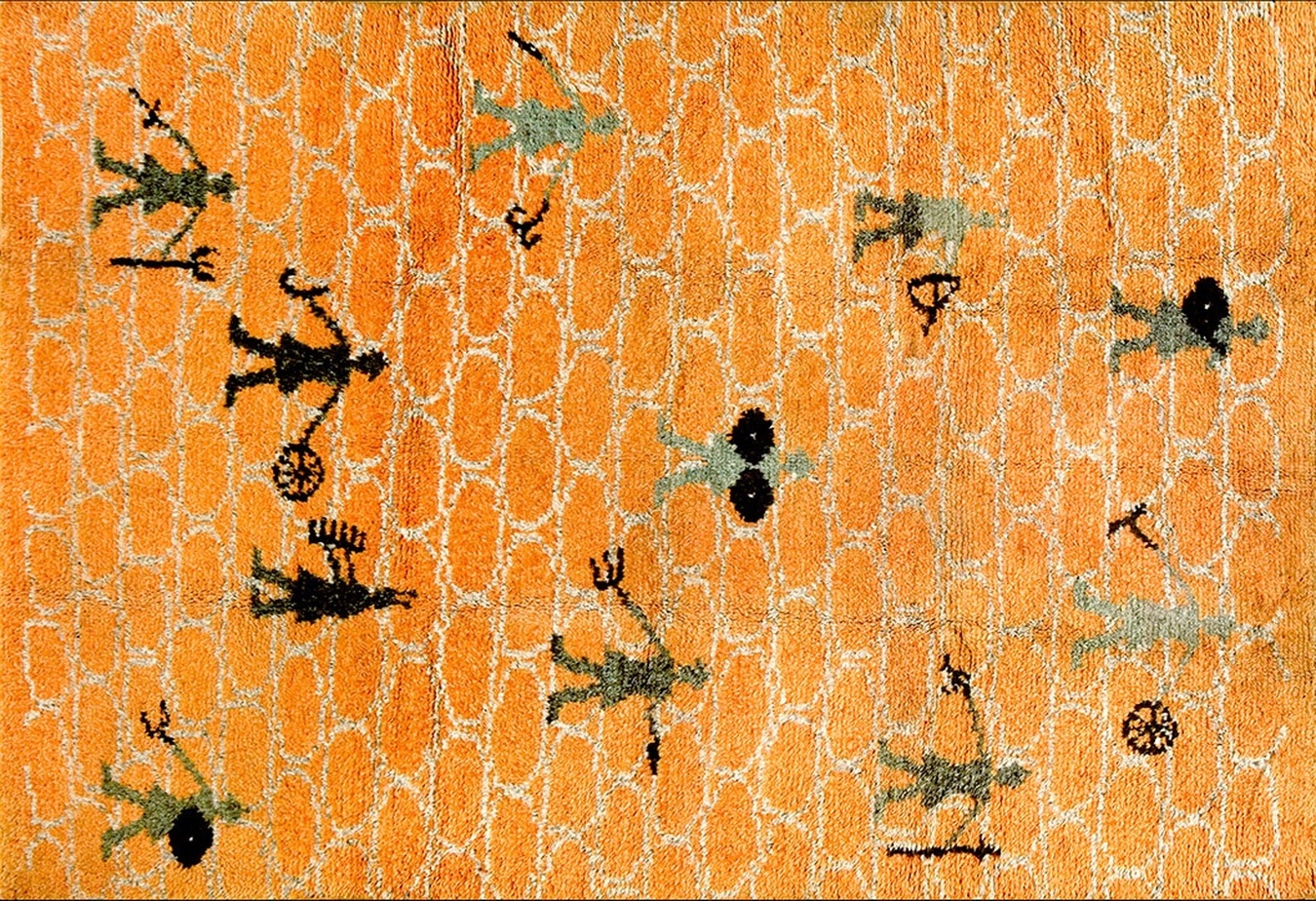
A “Turkmen rug” is not a rug with Turkmen people woven into it—it is a rug woven by Turkmen. Likewise, a “pictorial Persian carpet” with hunting scenes is not “tribal” in the sense of identity, but “figurative” in design. Understanding this divide protects cultural accuracy and ensures that descriptions used in collections, sales, or scholarship are both precise and respectful.
What Are People Motifs in Rug Design?
People motifs in rug design typically refer to woven human figures incorporated as decorative or symbolic elements. These may be stylized stick-like forms in village rugs, elaborate courtly portraits in Persian pictorial carpets, or narrative scenes showing daily life. In tribal contexts, they often carry spiritual or cultural significance, representing fertility, ancestors, or protective figures.
Are Rugs with Human Figures Culturally Significant?
Yes. Rugs that feature human figures often hold deep cultural and symbolic value. In many traditions, they serve as historical records, storytelling devices, or spiritual talismans. A Persian hunting carpet showing riders and prey reflects royal power and leisure. A Caucasian rug with stylized dancers may represent communal celebration.
Even when simplified, these motifs preserve collective memory and identity, making such figurative carpets far more than decorative textiles. By appreciating both senses of “people rugs”—ethnic origin and figurative imagery—collectors and scholars can approach these textiles with clarity, avoiding conflation and honoring both the communities and the stories they represent.
Origins and History of Human Imagery in Rugs
Earliest Known Human Motifs
The roots of ancient figure rugs stretch back thousands of years, with one of the most striking early examples being the Pazyryk Carpet, discovered in a Scythian burial mound in Siberia and dated to the 5th century BCE. This remarkably preserved textile shows mounted horsemen and human attendants in procession, proof that some of the very first known pile rugs were, in fact, people rugs.
Beyond Pazyryk, archaeological fragments and tribal textiles suggest that human imagery often appeared in small, symbolic forms before evolving into more elaborate narrative rug art. These figures were not purely ornamental; they carried ritual, social, and cultural meanings tied to the communities that wove them.
How Human Figures First Appeared in Rugs
Human figures first appeared in rugs through a combination of secular storytelling, folk traditions, and export demand. Unlike the geometric or floral motifs that dominated sacred and courtly carpets, figural imagery emerged in contexts where weavers had greater freedom—village workshops, nomadic tribes, or markets producing for foreign buyers.
In many cultures with religious prohibitions against representational art, people motifs entered more naturally through everyday objects, where weaving became a medium to record local scenes, myths, and family life. Over time, these images expanded from symbolic stick figures to detailed portraits in pictorial Persian carpets.
Playful People Scenes in Gabbeh Rugs
Gabbeh rugs, woven by nomadic tribes in southern Iran, are especially famous for their whimsical people motifs. Unlike formal courtly carpets, Gabbehs are personal, often created for domestic use rather than trade. Weavers, often women, expressed their daily life, humor, and dreams in simple, childlike designs: children playing, couples, families alongside animals, or abstracted stick figures.
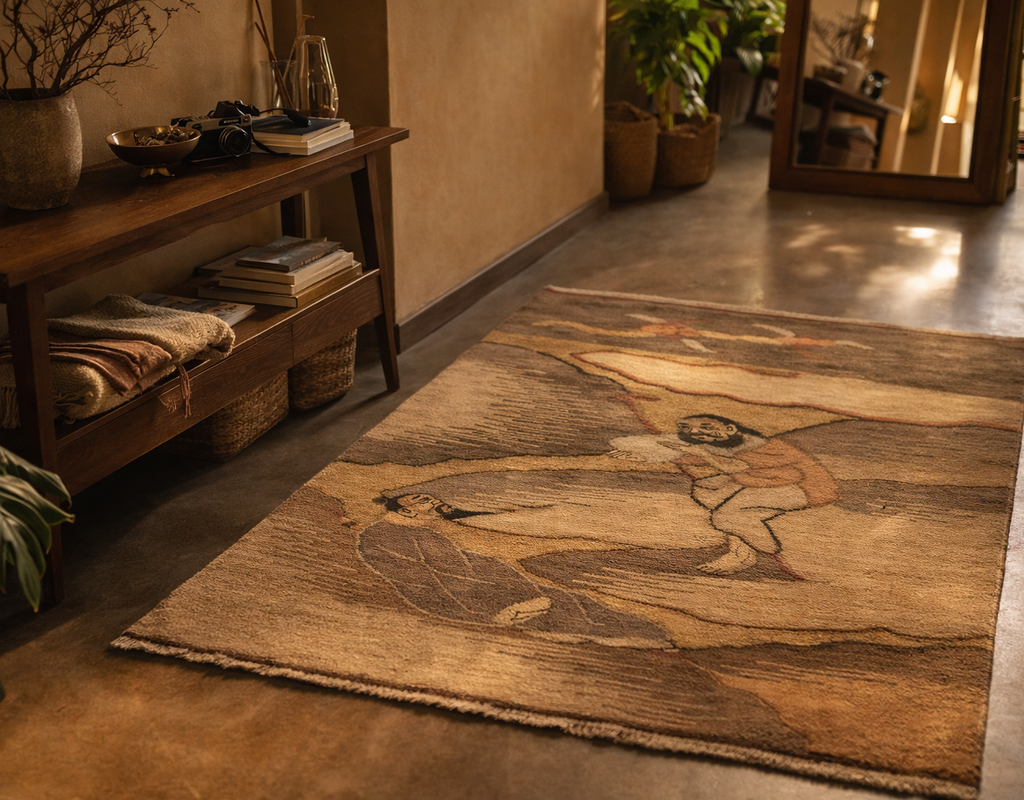
A striking rug with evocative design anchors this warmly lit entryway with natural wood and earthen tones.
These Gabbeh people motifs blur the line between art and autobiography, transforming rugs into visual diaries that preserve the laughter, relationships, and imagination of their makers. This sense of authenticity is why collectors cherish Gabbehs as some of the most soulful examples of narrative rug art.
Where Are Pictorial Persian Rugs Commonly Woven?
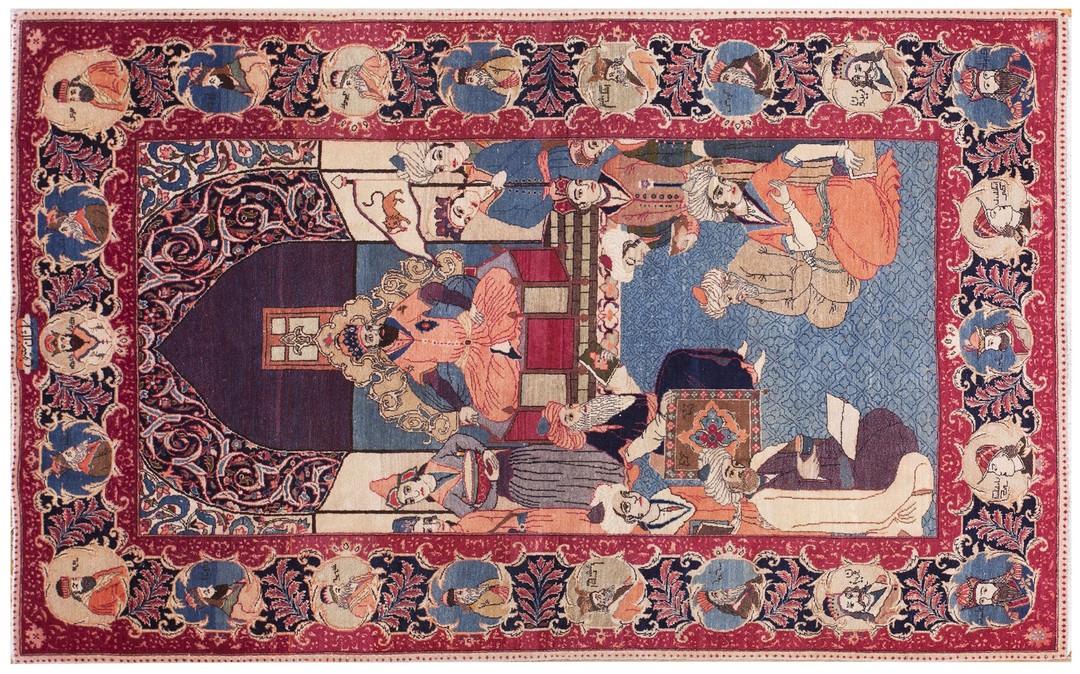
The heartlands of pictorial Persian carpets are tied closely to specific weaving centers that specialized in figural and narrative design. Cities like Kerman, Tabriz, Isfahan, Kashan, and Qum became hotbeds for such production, often driven by elite patronage and international export markets. In Kerman, finely detailed pictorials depicted landscapes, portraits, and historical events, while Tabriz produced museum-worthy masterpieces filled with lifelike figures.
Isfahan and Kashan were renowned for weaving poetic and literary scenes into carpets, while Qum became known in the 20th century for exquisitely detailed silk pictorials sought after by collectors worldwide. These centers ensured that figural weaving was not just a folk expression but also a celebrated part of Persian artistic heritage.
By tracing the story from the Pazyryk carpet’s ancient horsemen to the playful Gabbeh motifs and the refined artistry of Persian weaving centers, it becomes clear that human imagery in rugs has always served as more than decoration—it is a cultural record of identity, humor, memory, and patronage woven directly into the fabric.
Design Characteristics of People Motifs
Defining People Motifs
People motifs in rugs are visual representations of the human form woven into the textile structure. They can appear in many forms: rudimentary stick figures in village weavings, stylized Yei figures in Navajo rugs, or elaborate tableau portraits in Persian workshops. Sometimes they are static, representing ancestors or saints; other times they are dynamic, such as dancers in celebratory scenes or riders in hunting carpets.
Unlike geometric or floral designs, which repeat as patterns, people motifs introduce individuality—figures that carry symbolic, narrative, or portrait-like qualities.
Regional Styles of Human Depiction
- Islamic regions – Human figures are often stylized, minimized, or avoided altogether due to religious traditions discouraging figural imagery. Where they appear, abstraction dominates: schematic bodies, mask-like faces, or figures reduced to symbols. — Why: This approach balances cultural norms with artistic expression.
- Persian centers like Kerman and Tabriz – Known for high-knot pictorial rugs, these areas produced narrative carpets with near-photorealistic faces and finely detailed costumes. — Why: Wealthy patrons and export markets demanded lifelike artistry.
- Navajo weaving – Features Yei figures, stylized spirit beings, elongated and geometric, blending sacred symbolism with design. — Why: These abstractions carry deep spiritual meaning rather than literal realism.
- Gabbeh and tribal rugs – Depictions are naïve, playful, and often childlike, showing families, animals, or daily life in bright, simple forms. — Why: These carpets reflect personal expression rather than formalized art traditions.
Signature Techniques: Symbolism vs. Realism
The range of abstract figure carpets to highly realistic portraits reflects two diverging design philosophies. Symbolic approaches use simplified lines, angular proportions, and repetition to convey spiritual or communal meaning.
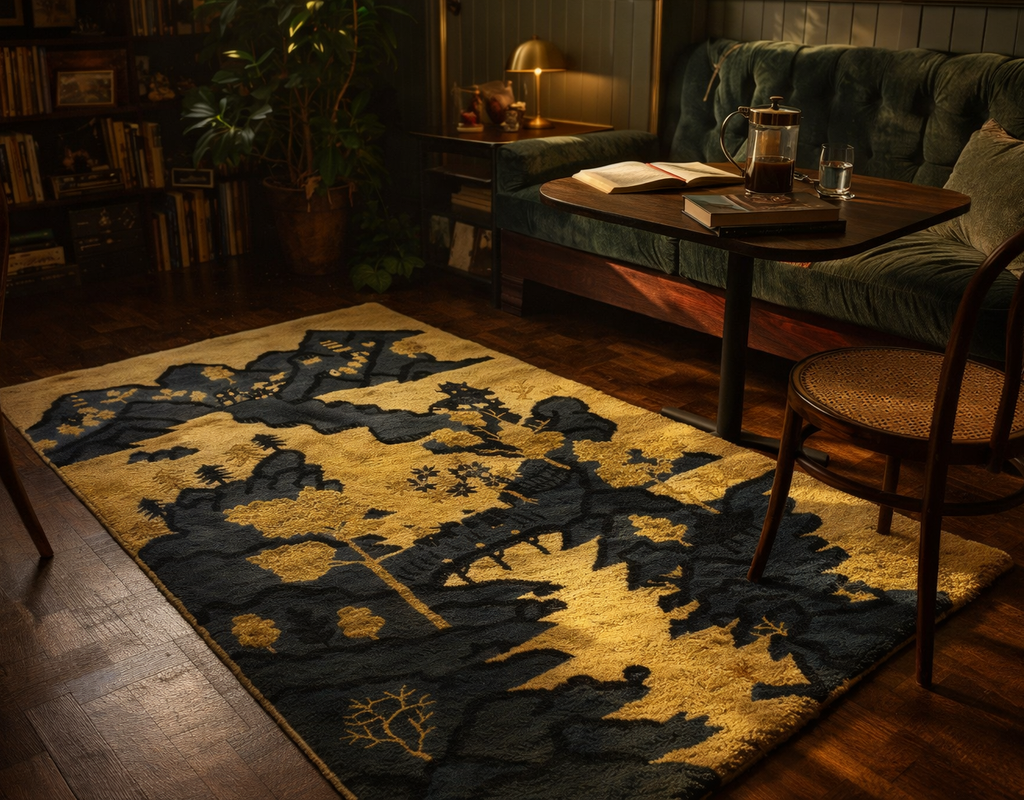
An eye-catching rug featuring a mountainous Asian motif defines this moody, comfortable reading corner.
Antique Kashan Small Scatter Size Wool Blue Rug – by Rugs On Net
By contrast, realism depends on advanced workshop skill, careful drawing, and high knot density to achieve naturalistic anatomy and expressive faces.
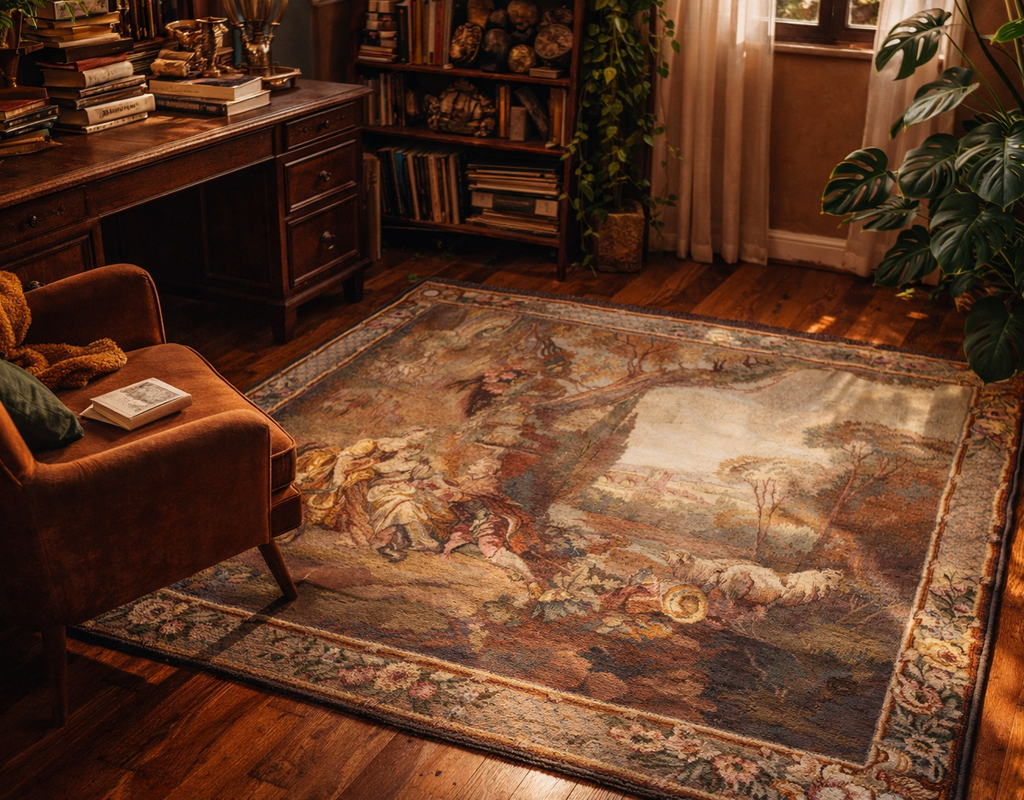
An ornate, tapestry-style area rug anchors the seating area in this cozy, book-lined home office.
Both approaches carry cultural weight: symbolism preserves myth and ritual, while realism documents individuals and events in woven form.
Storytelling & Narrative Rugs
Narrative rugs differ fundamentally from pattern-only rugs. While a pattern repeats motifs like medallions, vines, or diamonds, a narrative rug unfolds like a picture book. Scenes of rulers hunting, mythological battles, or villagers dancing are laid out across the field, often without repeating units.
These compositions transform area rugs into woven canvases where histories, stories, or community events can be preserved. In tribal rugs, storytelling appears in simple vignettes; in Persian pictorials, it expands into full-blown woven paintings.
Knot Density & Detail
Knot density is the technical foundation that determines how much detail a weaver can achieve in a rug with human imagery. Low-knot tribal or village rugs render people as simplified forms—stick figures, geometric faces, or abstract bodies. By contrast, a high-knot pictorial rug from Tabriz or Isfahan can depict lifelike faces, hands, and even the folds of clothing.
Just as pixels define resolution in digital art, knots define clarity in carpets: the more knots per square inch, the sharper and more nuanced the representation of people motifs. From the playful abstraction of Gabbeh figures to the photorealism of Persian tableaus, people motifs in rugs are defined by culture, purpose, and technical mastery—woven testimonies to how societies chose to see and remember themselves.
Materials, Techniques, and Weave Quality
Materials Used in Figurative Rugs
The foundation of most wool pictorial carpets is, unsurprisingly, wool. Wool’s elasticity and durability make it the standard choice for pile, while cotton is often employed for the warp and weft to provide structural stability. In finer city workshop rugs—especially hand-knotted portraits from Isfahan, Kashan, or Qum—silk is introduced, either in highlights or as the primary fiber, to allow for extraordinary detail and sheen.
By contrast, modern tufted rugs often use synthetic yarns, chosen for cost-effectiveness and ease of production, but they lack the richness and longevity of traditional handwoven fibers.
Natural Dyes and Skin Tone Rendering
The mastery of natural dye rugs is perhaps most visible in the rendering of human figures. Traditional weavers used carefully blended plant, insect, and mineral dyes to create subtle gradations of tone—allowing faces, hands, and clothing to appear lifelike. Achieving skin tones was a particular challenge, requiring multiple dye baths and delicate weaving transitions.
This organic palette gave portraits a warmth and authenticity that synthetic dyes struggle to replicate. By contrast, modern chemical dyes can produce a broader spectrum but often lack the depth and nuanced shading that makes antique pictorials so compelling.
Knotting, Weaving, and Tufting Methods
- Hand-knotting – Each knot is tied individually, allowing for precision and high resolution in figure rugs. — Why: Greater knot density enables detailed rendering of faces, gestures, and clothing.
- Flatweaving – Found in kilims and Navajo textiles, this technique produces abstract human motifs with bold, geometric outlines. — Why: The absence of pile lends itself to stylization rather than realism.
- Tufting – Yarn is punched into a backing fabric, often with glue applied for stability. Common in modern portrait rugs. — Why: Faster and cheaper than knotting, but significantly less durable and less collectible.
Hand-Knotted vs. Modern Tufted
When comparing hand-knotted portraits to tufted rug durability, the differences are stark. Hand-knotted pictorials, whether in wool or silk, can last for centuries with proper care. Their density and craftsmanship mean they retain both structural integrity and artistic clarity over generations. Tufted rugs, however, are inherently short-lived: the glue holding the pile to its foundation eventually degrades, leading to shedding and breakdown.
While tufted portrait rugs may capture likeness affordably, they cannot rival the resilience or collectible value of hand-knotted pictorials. In short, traditional wool pictorial carpets and silk tableaus stand apart for their use of natural fibers, organic dyes, and painstaking knotting methods—each element contributing to longevity, artistic depth, and enduring cultural worth. Modern tufted alternatives may replicate the look, but they cannot replicate the soul.
Regional & Tribal Variations in Human Imagery
Persian Tableau, Kerman, Tabriz, Gabbeh
The most renowned regional pictorial rugs come from the Persian tradition. Workshops in Kerman, Tabriz, and Isfahan perfected the art of lifelike portraiture, producing carpets that could rival miniature paintings in detail. These workshop masterpieces often featured rulers, poets, or elaborate courtly and hunting scenes.
By contrast, the Gabbeh people scene represents the other end of the spectrum: simple stick figures, playful families, and imaginative vignettes woven by Qashqai and Luri nomads.
These Gabbeh motifs were deeply personal—woven for home use rather than export—capturing humor, daily life, and dreamlike imaginings in a direct, childlike style. Together, the refinement of urban tableaus and the naïve charm of Gabbehs reveal the broad spectrum of how Persian culture interpreted the human form in textiles.
Turkmen Symbolism & Depiction
Unlike Persian workshops, Turkmen tribal rugs rarely depict human figures literally. Instead, their identity is expressed through symbolic motifs, especially the famous guls—repeated medallion-like designs unique to each tribe. These guls serve as abstract “signatures,” representing lineage, group affiliation, and collective identity.
In this sense, a Turkmen rug is still a people rug, but the “people” appear through symbols rather than faces. This abstraction aligns with Islamic artistic traditions while also functioning as a visual code of belonging, allowing each tribe to weave its presence into every carpet.
Caucasian, Anatolian, Berber, Navajo Examples
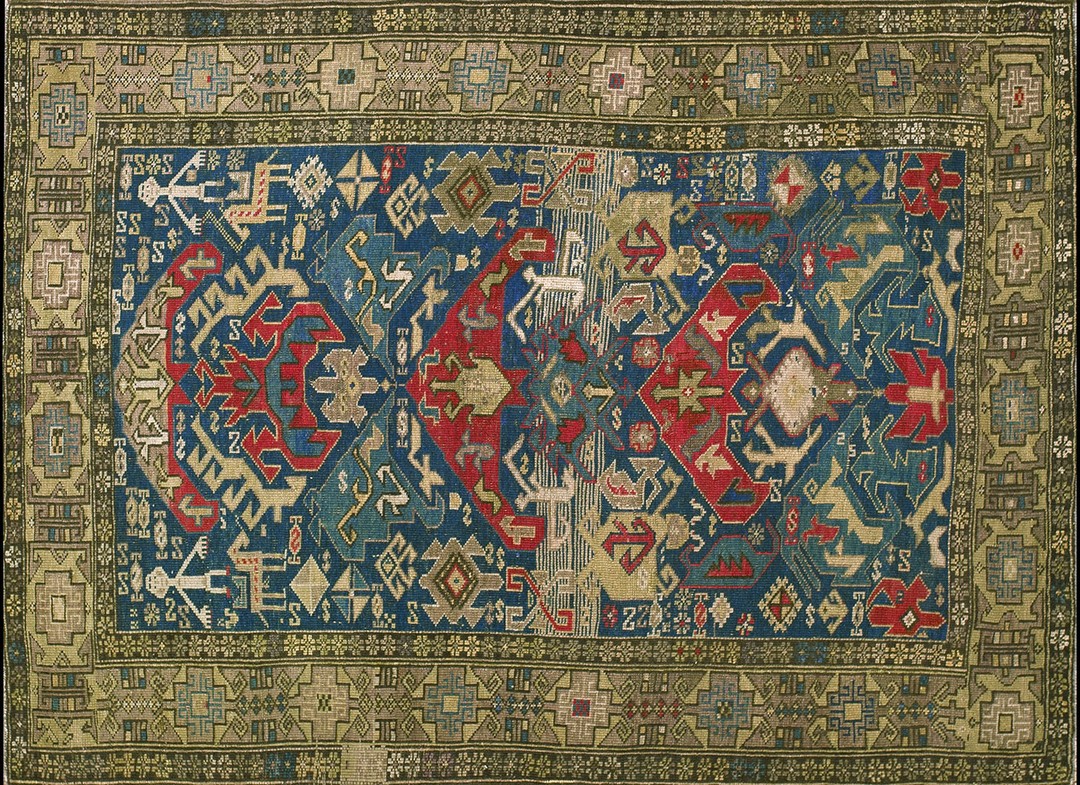
Other weaving traditions bring their own interpretations of human imagery. Caucasian rugs often feature angular stick figures, sometimes arranged in dancing scenes or as guardians within geometric fields.
Anatolian weavers incorporated the elibelinde motif—hands-on-hips female forms symbolizing the mother goddess, fertility, and protection. Berber rugs from North Africa occasionally embed schematic human figures alongside tribal symbols, maintaining a balance between abstraction and storytelling.
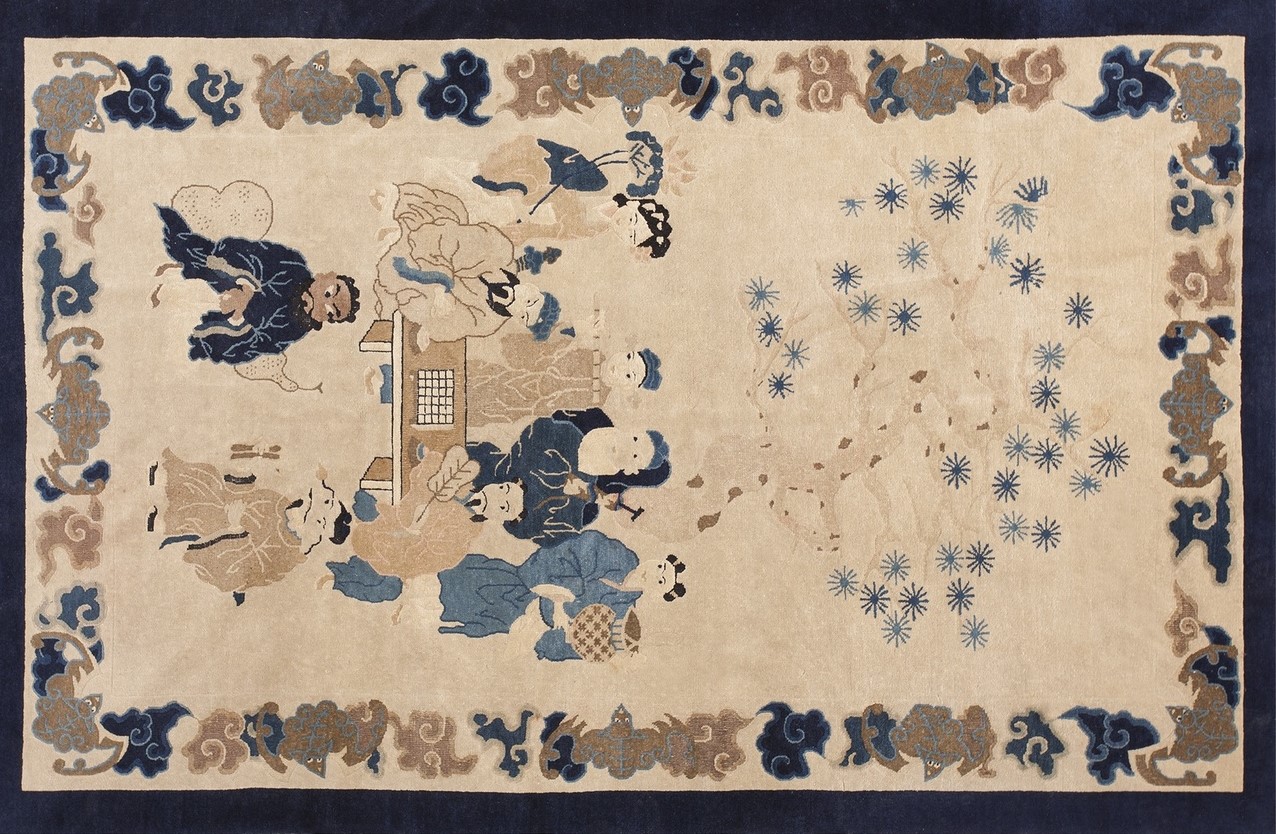
In the Americas, Navajo Yei textiles depict sacred spiritual beings with elongated, geometric forms, while Yeibichai rugs present ceremonial dancers, stylized yet deeply tied to ritual significance. Each tradition reflects not just artistry but also the spiritual and social frameworks of its community.
Regional Influence on Style
The style of human imagery in rugs is always determined by regional priorities and cultural values. Persian urban centers leaned toward realism and narrative, serving elite patrons who prized portraiture. Tribal and nomadic groups—Turkmen, Berber, Navajo—favored abstraction, using symbolism to encode spiritual beliefs or community identity.
Anatolian and Caucasian weavers struck a balance, embedding figures within protective or celebratory motifs. The result is a global spectrum: from lifelike faces in silk pictorials to abstract forms that stand in for gods, ancestors, or entire tribes. Whether through a Gabbeh people scene, a Turkmen tribal rug with symbolic guls, or a Navajo Yei textile, the depiction of people in rugs reflects not only artistry but the worldview of the community at the loom—what could be shown, what must be hidden, and what was most worth remembering.
Identifying and Authenticating People Rugs
How to Spot a Pictorial Rug
To identify a pictorial carpet at a glance, look for the following markers:
- Human and animal scenes – Hunting parties, dancers, rulers on thrones, or village families. — Why: Figurative elements are the hallmark of pictorial design.
- Facial features and gestures – Even in abstract forms, the presence of eyes, hands, or posture signals a human motif. — Why: Pattern-only rugs rarely attempt representational detail.
- Tableau panels or narrative scenes – Rugs divided into framed vignettes resembling paintings. — Why: This structure differentiates pictorials from repeating geometric fields.
- Texture and relief – Hand-knotted pictorials display pile depth and subtle shading absent in flat modern prints. — Why: The tactile element proves authenticity and craft.
These traits, when combined, help distinguish an authentic figure rug from ordinary decorative carpets.
Vintage Tableau vs. Modern Print
The difference between a vintage tableau and a modern printed rug lies in both artistry and substance. Vintage pictorials, whether woven in Tabriz or Isfahan, exhibit hand-tied knots, nuanced shading through natural dyes, and a rich tactile surface. They may even bear the weaver’s signature or a workshop cartouche.
By contrast, modern machine-printed rugs attempt to mimic imagery but lack pile variation, texture, and the fine gradations of natural dye. Under close inspection, prints often appear flat, pixelated, or uniform, while handwoven tableaus reveal layered depth and individuality in every knot.
Knot Density, Material, and Provenance Checklist
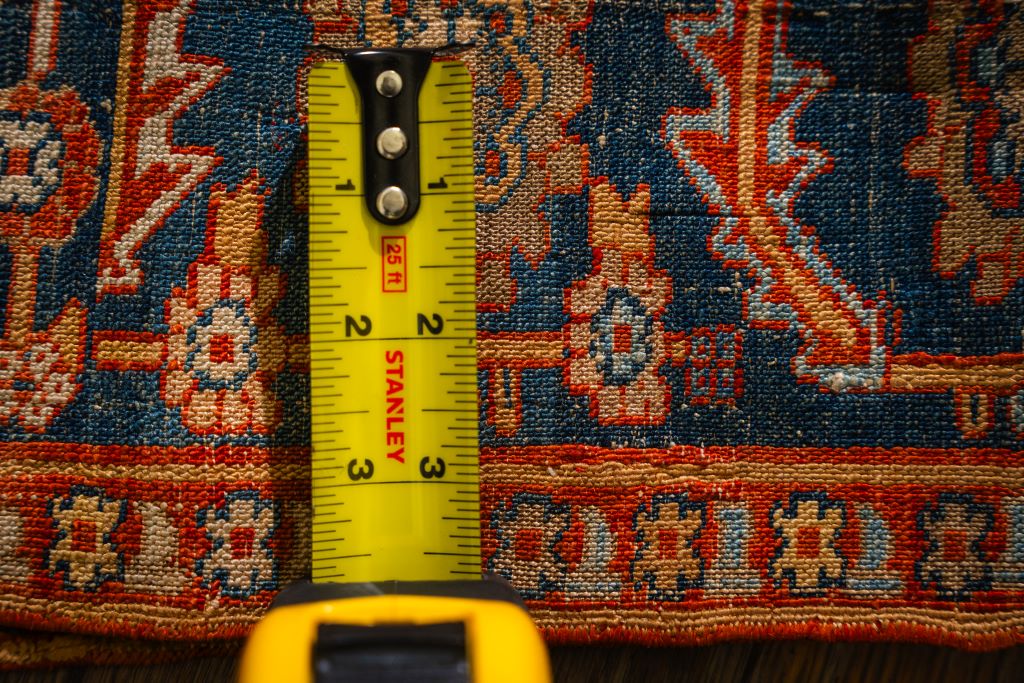
A detailed inspection of a richly colored oriental rug pattern while measuring its dimensions.
Authenticating an authentic figure rug requires a methodical checklist:
- Knot density – High counts enable detailed faces and realistic anatomy.
- Materials – Wool for durability, silk in finer tableaus; cotton warps in city rugs.
- Dyes – Natural dyes produce warmth and subtle transitions, synthetic tones may appear harsh or uniform.
- Signatures/cartouches – Common in Persian city workshops, confirming origin and authenticity.
- Provenance – Documentation of ownership or workshop history greatly strengthens authenticity and value.
Auction & Value Factors
At auction, provenance can make or break the price of a pictorial carpet. A rug attributed to a named workshop in Tabriz or Kashan, especially one with a signature, commands far more than an unsigned village piece. Condition is equally vital: reweaving or fading of faces can reduce auction value significantly. While light restoration may stabilize a rug, overpainting or heavy re-knotting of people motifs often diminishes both authenticity and worth.
Can restoring a faded people motif rug reduce its value? Yes—when restoration alters original artistry, particularly facial or figural details, collectors often view the piece as compromised. The best-preserved examples, even with natural wear, tend to outperform heavily restored rugs at auction. In short, the keys to authentication are texture, material, knot density, and provenance.
For serious collectors, the difference between a vintage tableau with verified history and a flat modern print is the difference between art and imitation—and the auction value reflects it.
Cultural Significance & Ethical Considerations
Cultural and Spiritual Importance
Rugs with human figures are culturally significant because they function as more than household textiles—they are woven texts of memory, identity, and belief. In many traditions, figures in carpets represent ancestors, protective spirits, or episodes from community life. Persian pictorials might depict poets, kings, or historical narratives, while sacred motif carpets such as Navajo Yei rugs embody spiritual beings central to ceremony.
Even simple stick figures in Gabbeh rugs can record the daily life of the weaver’s family, encoding personal stories in wool. In this sense, every people rug is a woven archive, where cultural symbolism in rugs is both intimate and communal.
Symbolic Motifs and Protection
Human imagery often carried protective intent. In Caucasian rugs, angular dancing figures could serve as talismans against evil. In Anatolian weaving, the elibelinde (hands-on-hips mother figure) symbolized fertility and divine guardianship.
Even when highly abstract, these motifs were believed to shield families and households, infusing everyday objects with spiritual power. Thus, people motifs in textiles weren’t always portraits—they were also guardians woven into the very fabric of domestic life.
Ethical Concerns in Representation
There are indeed ethical concerns in rug representation. Some motifs are sacred and not originally meant for commercial sale. For example, Navajo Yei textiles carry ceremonial meaning, but their adaptation into tourist or export rugs risks misappropriation and loss of context. Similarly, in Islamic cultures where figural imagery is restricted, many figurative rugs were woven for export markets, not for domestic ritual use.
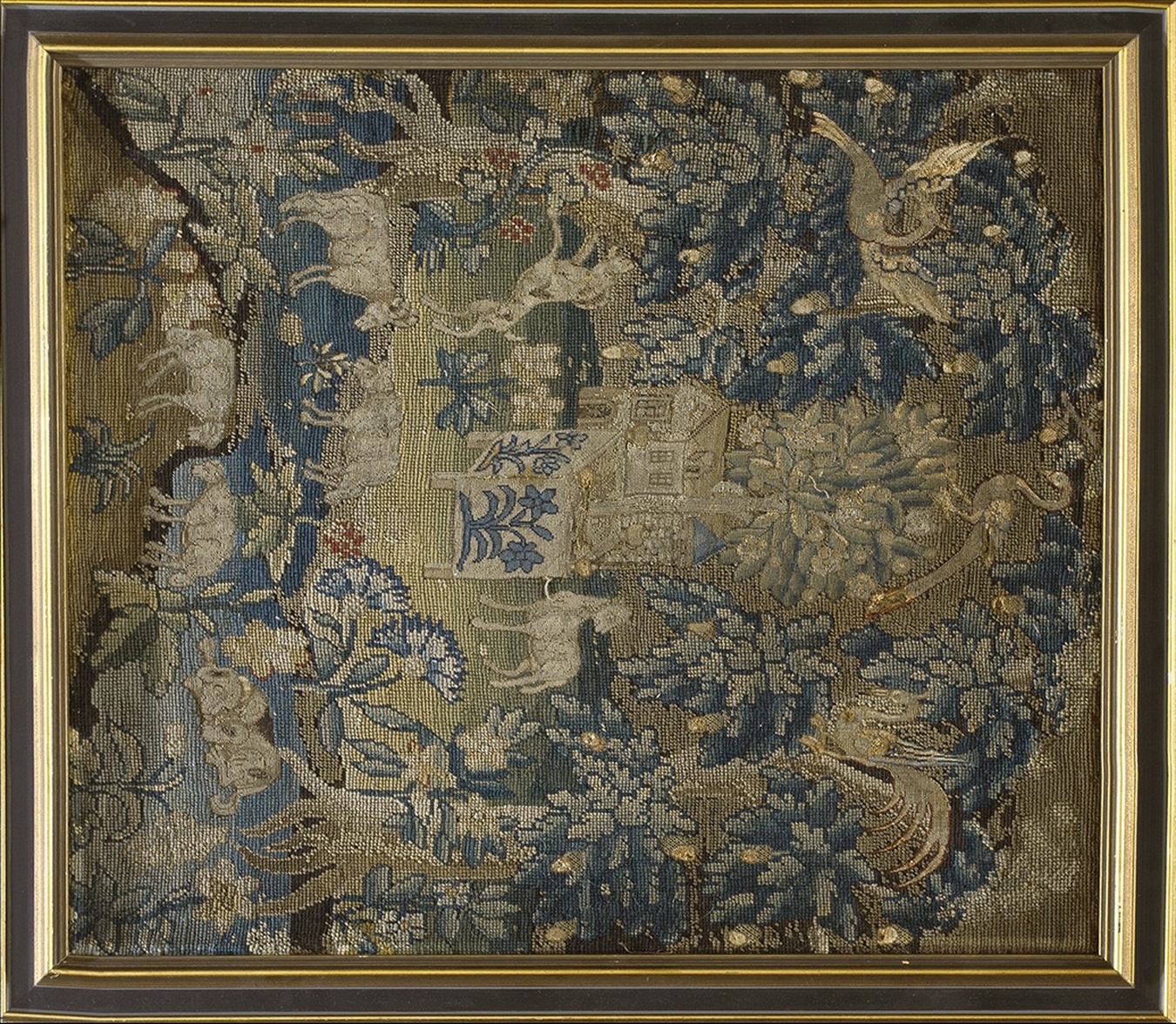
Modern collectors must be mindful: the commodification of sacred imagery without cultural understanding risks reducing a living tradition to mere décor. Respect for origin, function, and meaning is essential in collecting sacred motif carpets.
Gender, Storytelling, and Social Role
The making of people rugs has also been deeply tied to gender. In many societies, women were the transmitters of motifs, passing designs from mother to daughter. Weavers often embedded subtle narratives—stories of migration, marriage, or hardship—sometimes even weaving intentional “flaws” as spiritual acknowledgments of human imperfection.
Through this, rugs became vehicles of storytelling and cultural resilience, reflecting the gender in weaving dynamic where women shaped collective memory from behind the loom. Ultimately, the cultural weight of people motifs lies not just in their visual appeal but in the layers of meaning they carry: protection, identity, storytelling, and spirituality.
Yet with that significance comes responsibility—understanding and honoring the ethics of representation ensures that these woven voices are preserved with respect, not appropriated without context.
Market, Collectibility, and Contemporary Trends
Artist-Collab Portrait Rugs
Are contemporary artist-collab portrait rugs collectible? Yes—these collaborations occupy the high end of the market. Visionary designers like Faig Ahmed and Jan Kath have transformed the rug into a contemporary art medium, creating surreal or deconstructed portraits that sell as gallery pieces rather than floor coverings. These collectible portrait carpets command premium prices because they merge traditional weaving with avant-garde design, often in limited editions. As with any art, rarity, innovation, and name recognition drive their value, making them blue-chip acquisitions for collectors.
Where to Find Affordable Pictorial Rugs
For buyers seeking an affordable pictorial rug, options exist outside the high-art sphere. Workshop rugs from Iran, India, and Nepal often feature accessible tableau or narrative scenes. Online galleries, reputable dealers, and rug auctions also provide opportunities to purchase authentic but less expensive pictorials, especially mid-20th-century examples.
Verification of authenticity is key, as machine-made or printed imitations flood the market. Affordable doesn’t mean low quality—many workshop pictorials are well-crafted heirlooms with enduring charm.
Are Antique Pictorial Carpets Good Investments?
Should I invest in antique pictorial carpets for long-term value? For many collectors, yes. Antique pictorials—whether Persian tableaus from Kerman, Caucasian village rugs with figural scenes, or Navajo Yei textiles—can appreciate over time, particularly when rare, well-preserved, and tied to clear provenance.
Unlike mass-produced rugs, each antique carries uniqueness, making it attractive for long-term holding. However, the investment value hinges on originality, authenticity, and condition. Worn or heavily restored pieces may stagnate in price, while untouched or lightly conserved examples often see strong appreciation.
Restoration & Value
Can restoring a faded people motif rug reduce its value? Absolutely. Conservation that stabilizes a rug without altering original imagery can preserve worth, but over-restoration—such as re-dyeing faces, repainting details, or replacing large sections—can drastically lower desirability.
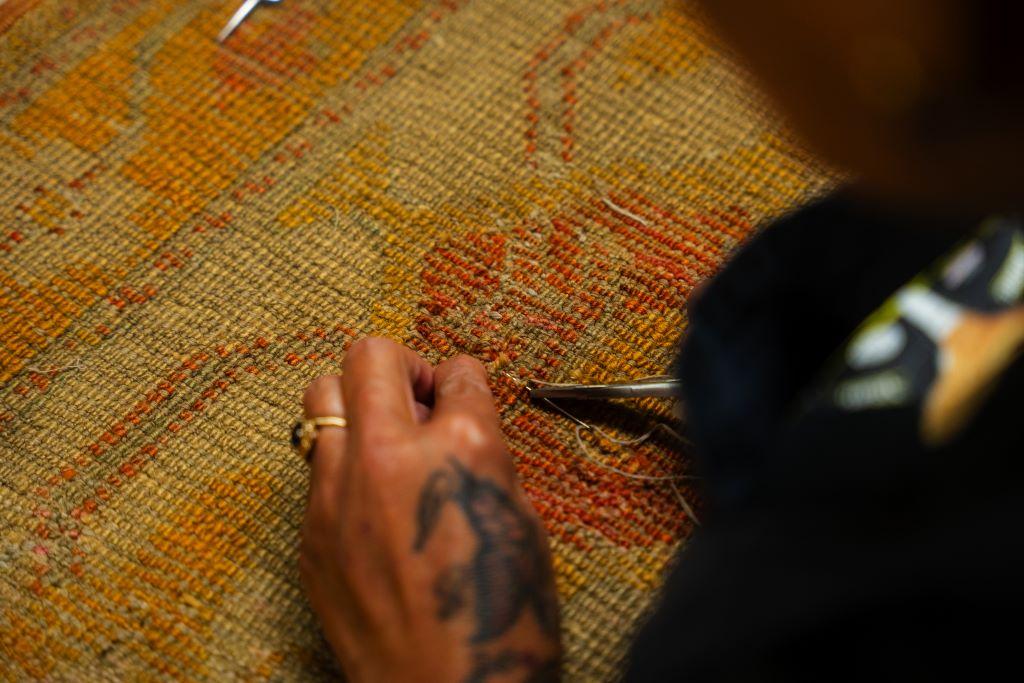
Detail of hands mending a rustic, richly colored woven rug.
Collectors prize authenticity over perfection; a faded but original rug is often more valuable than a “like new” but tampered piece. In auctions, restoration quality is scrutinized, with careful conservation viewed favorably and heavy-handed repairs penalized.
Commissioning Custom Portrait Rugs
Is commissioning a custom portrait rug cost-effective? Yes—if the goal is a personal heirloom rather than resale. Custom portrait rugs woven in wool or silk can immortalize a loved one, family, or even a pet.
While they carry high sentimental value, resale potential is limited, as their appeal is personal rather than universal. The cost depends on knot density, size, and material, with hand-knotted customs commanding higher prices but vastly outlasting tufted versions.
Hand-Knotted vs. Tufted: Cost and Durability
How do modern tufted portrait rugs compare in durability to hand-knots? Tufted rugs, made with synthetic or wool yarns glued to a backing, are quicker and cheaper to produce. However, they lack the longevity of a hand-knotted rug, often wearing out in a decade or less as adhesives break down. In contrast, a hand-knotted portrait in wool or silk can endure for generations, retaining both structural strength and artistic value.
While tufted pieces may be appealing for cost-conscious buyers, serious collectors and investors gravitate toward the resilience and collectible status of hand-knots. In today’s market, the spectrum spans from artist-collab collectible portrait carpets to affordable pictorial rugs and custom portrait commissions. The golden thread tying them together is authenticity, provenance, and respect for artistry—factors that continue to determine both cultural and financial value.
Actionable Tips for Buyers and Collectors
What to Look For
- Material authenticity – Always confirm whether the rug is woven in wool, silk, or cotton. Synthetic fibers often indicate a modern reproduction with lower durability. — Why: True collectible pictorial carpets and authentic figure rugs are almost always made with natural fibers.
- Weave and technique – Check for hand-knotted construction, visible knot backs, and proper pile depth. Machine-made or tufted pieces may mimic the look but lack longevity. — Why: Construction determines both durability and collectible value.
- Regional style – Study motifs to see if they align with expected traditions: Persian tableaus with lifelike portraits, Gabbeh rugs with playful stick figures, or Turkmen rugs with symbolic guls. — Why: Regional authenticity anchors a rug in cultural and artistic history.
- Cultural restrictions – Be mindful of motifs like Navajo Yei figures or Anatolian mother goddess symbols. Some designs carry sacred meaning and require respect. — Why: Responsible collecting avoids misappropriation and honors tradition.
- Provenance and restoration – Look for workshop signatures, documented ownership, or auction records. Also, inspect whether restoration is minimal conservation or heavy repainting. — Why: Provenance increases value, while over-restoration can reduce it.
- Dealer credibility – Work with established dealers, galleries, or auction houses that provide guarantees of authenticity. — Why: Trustworthy sources safeguard your investment when you buy area rugs for collection or display.
See a Few of Our Human Figure Design Rugs
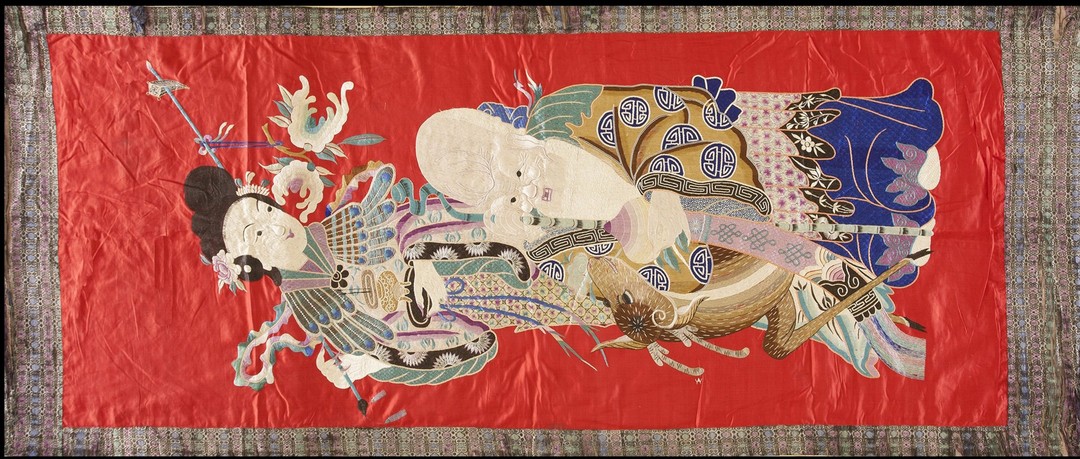
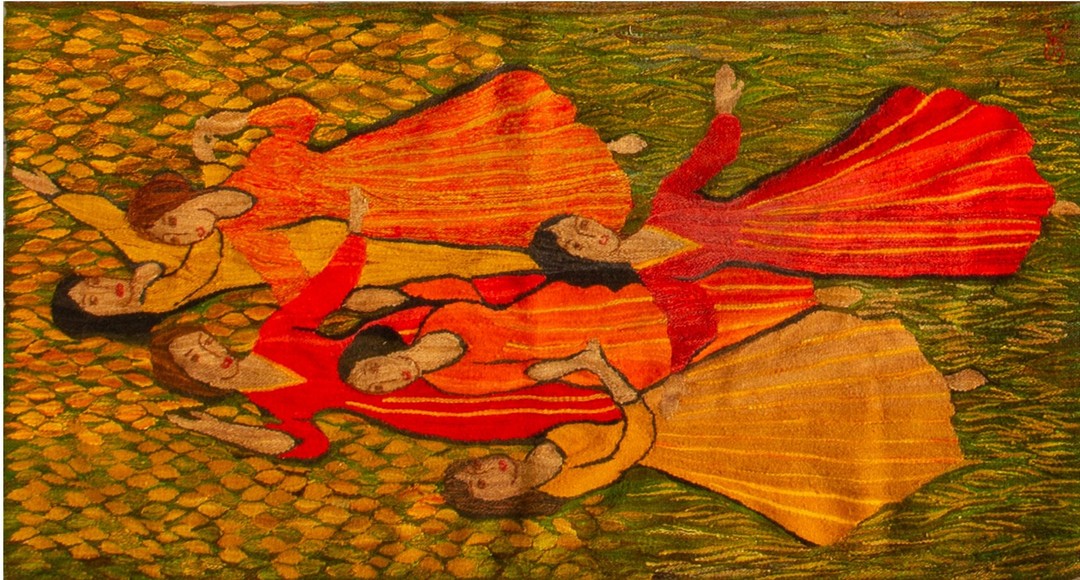
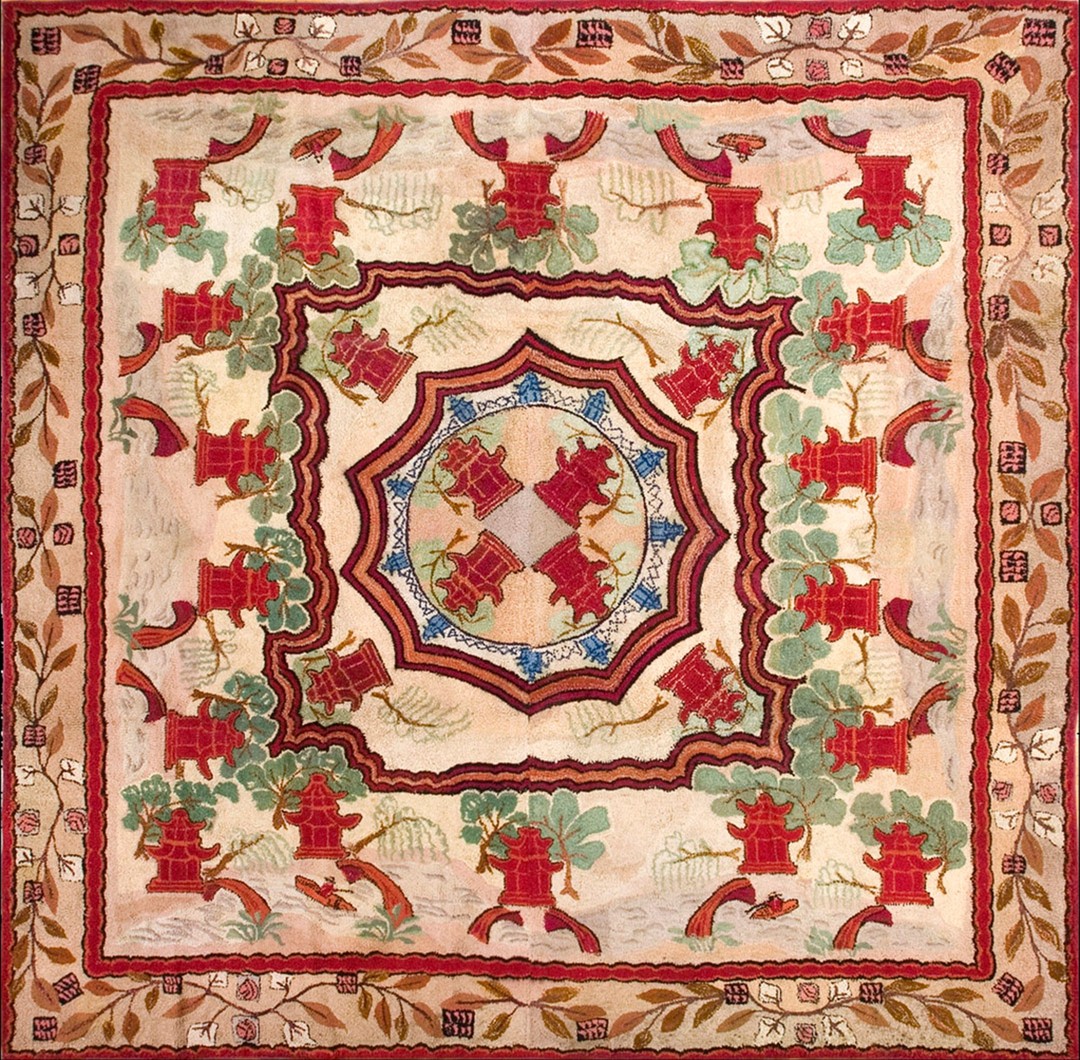
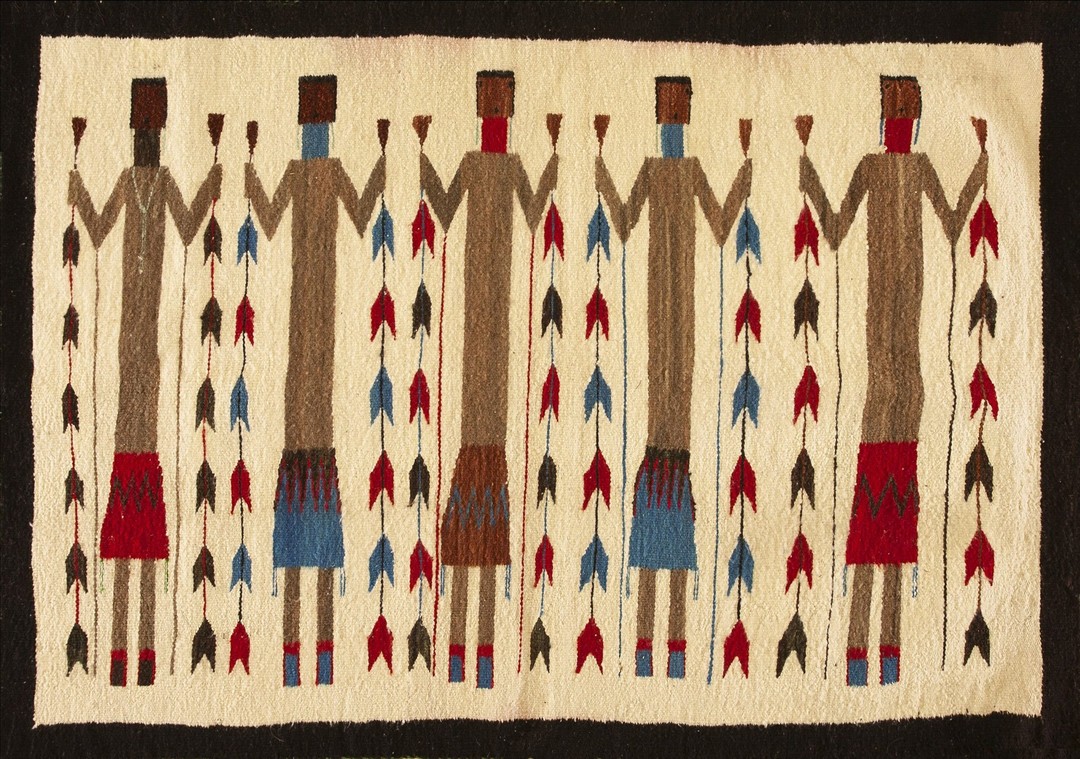
FAQ
- What’s the history behind people motif rugs?
Figural carpets flourished under Safavid Persia and Mughal India, later echoed in Turkish Hereke and Chinese pictorial pieces. Kerman Ravar pictorials often portray historical leaders.
- How do I style color with people motif rugs?
Pull one clothing color and one background tone from the figures into pillows or curtains. Keep surrounding patterns minimal so the scene stays the hero.
- Are people motif rugs culturally sensitive?
Context matters—some traditions avoid depicting people in sacred spaces. When in doubt, choose non-figural rugs for religious areas or consult community guidance.
- What motifs are common in people design rugs?
Court portraits, hunting scenes, village life, religious stories, and pastoral landscapes recur. Gabbeh often shows charming stick-figure people with animals.
- How do people motif rugs compare to abstract rugs in busy rooms?
Figural scenes command attention; use them where you want a focal point. In small spaces, simpler portraits or wall display keep things balanced.
- Can people motif rugs go over radiant floor heating?
Generally yes—wool and cotton breathe well. Avoid thick, heat-blocking pads and follow the rug and pad manufacturer’s guidance.
- Do people motif rugs need a rug pad?
Absolutely—felt or felt-rubber pads reduce slip and cushion fibers. Trim the pad about 1–2 inches smaller than the rug on all sides.
- Are people motif rugs good for dining rooms?
Use low-pile or flatweave people rugs so chairs glide and crumbs don’t embed. Position key figures where the table base won’t hide them.
- Can I commission custom people motif rugs or portraits?
Yes—tufted portraits often deliver in 3–5 weeks; hand-knotted customs typically take 8–22+ weeks. Request a strike-off sample before full production.
- How do I authenticate people motif rugs?
Check materials, knot density, dyes, and origin; Kerman pictorials may include a signature cartouche. Get a written appraisal from a qualified expert.
- Do people motif rugs hold value?
Fine antique figural rugs with good provenance and condition can appreciate. Signed Kerman/Lavar pictorials and high knot counts are sought after.
- How much do people motif rugs cost?
Small tufted portrait rugs can start under \$200, while antique silk Hereke or Kerman pictorials often reach five figures. Hand-knotted customs price by square foot.
- Can robot vacuums handle people motif rugs with fringe?
Often not—fringe tangles in brushes. Tuck or protect fringes, or set a virtual “no-go” zone to keep bots off the rug.
- What’s the right way to hang people motif rugs?
Hand-stitch Velcro loop tape to a fabric strip on the back and mount to a hooked strip on a slat. Avoid hanging fragile silk without professional guidance.
- How can I prevent fading on people motif rugs?
Keep out of direct sun, use UV-filter window film, and rotate every 6 months. Low light levels dramatically reduce dye loss over time.
- How do I clean people motif rugs safely?
Vacuum with suction only (no beater bar) and blot spills with cool water and mild soap. For silk pictorials or set stains, call a specialist.
- Are people motif rugs kid- and pet-friendly?
Choose wool or flatweaves and use a quality pad. Avoid delicate silk pictorials in play zones; reserve them for adult spaces or walls.
- What size should people motif rugs be so the scene is readable?
Larger fields or fewer figures help at a distance; small tableau rugs excel on walls. For floors, a minimum 5×7 keeps portraits legible.
- Do people design rugs fit modern interiors?
Yes—treat them like statement art and simplify nearby patterns. Pull two accent colors from the figures to tie the room together.
- What materials are best for people motif rugs?
Wool is durable and forgiving; silk highlights faces and fine outlines. Many pictorials blend wool pile with silk details for contrast and sheen.
- Are people motif rugs better as wall art or floor rugs?
Both work, but detailed portraits read best on walls or low-traffic floors. For display, use a Velcro hanging system with a supportive wooden slat.
- How can I tell if people motif rugs are hand-knotted versus printed?
Flip the rug—hand-knotted backs mirror the front pattern with distinct knots; printed or machine backs look uniform. Woven (not sewn-on) fringe is another tell.
- Which regions are known for people motif rugs?
Persian Kerman Ravar, Isfahan and Tabriz, Turkish Hereke, Mughal/Agra from India, Chinese Ningxia/Peking, and tribal Gabbeh often feature people and narrative scenes.
- Are people motif rugs acceptable in prayer spaces?
Typically no—many Islamic traditions avoid figural imagery in sacred areas. Use non-figural prayer rugs and keep people motif rugs in secular rooms.
- What are people motif rugs (also called figural or pictorial rugs)?
People motif rugs depict human figures or scenes as the main design. Many are made to hang as “pictorials,” and fine silk examples show exceptional detail.