
Introduction to Floral Rugs
Browse our curated selection of stunning floral rugs to bring natural elegance into your space.
Definition and Enduring Appeal
Floral-patterned rugs are carpets whose designs center on flowers, plants, and botanical motifs, ranging from stylized lotus buds to richly detailed roses, tulips, or peonies. These flower rugs have appeared across cultures for thousands of years, and their endurance comes from both their visual beauty and their symbolic power.
A floral rug brings the essence of the garden indoors, transforming woven textiles into a canvas of life, renewal, and paradise. The appeal is not bound to one region or one time period—whether hand-knotted in Persia, woven in China, or machine-made in Europe, botanical carpets speak to a universal human love of nature. They soften architectural lines, add warmth and grace to interiors, and serve as constant reminders of seasonal cycles and natural abundance.
The popularity of floral designs in rugs has never waned because they balance versatility and meaning. A single blossom can stand for beauty, fertility, or eternity, while a full garden scene evokes paradise itself. From aristocratic palaces to humble homes, floral rugs have retained their place because they offer both comfort underfoot and a timeless decorative vocabulary that adapts seamlessly to changing tastes.
Etymology & First Emergence
The term “floral” originates from the Latin floralis, meaning “of flowers.” In English and other European languages, “floral” gained popularity as a descriptive word in the early modern period, particularly during the Renaissance, when artists, designers, and weavers embraced naturalistic ornament. As trade expanded between East and West, the word began to be applied to textiles imported from Persia, Turkey, and India that featured lush botanical motifs.
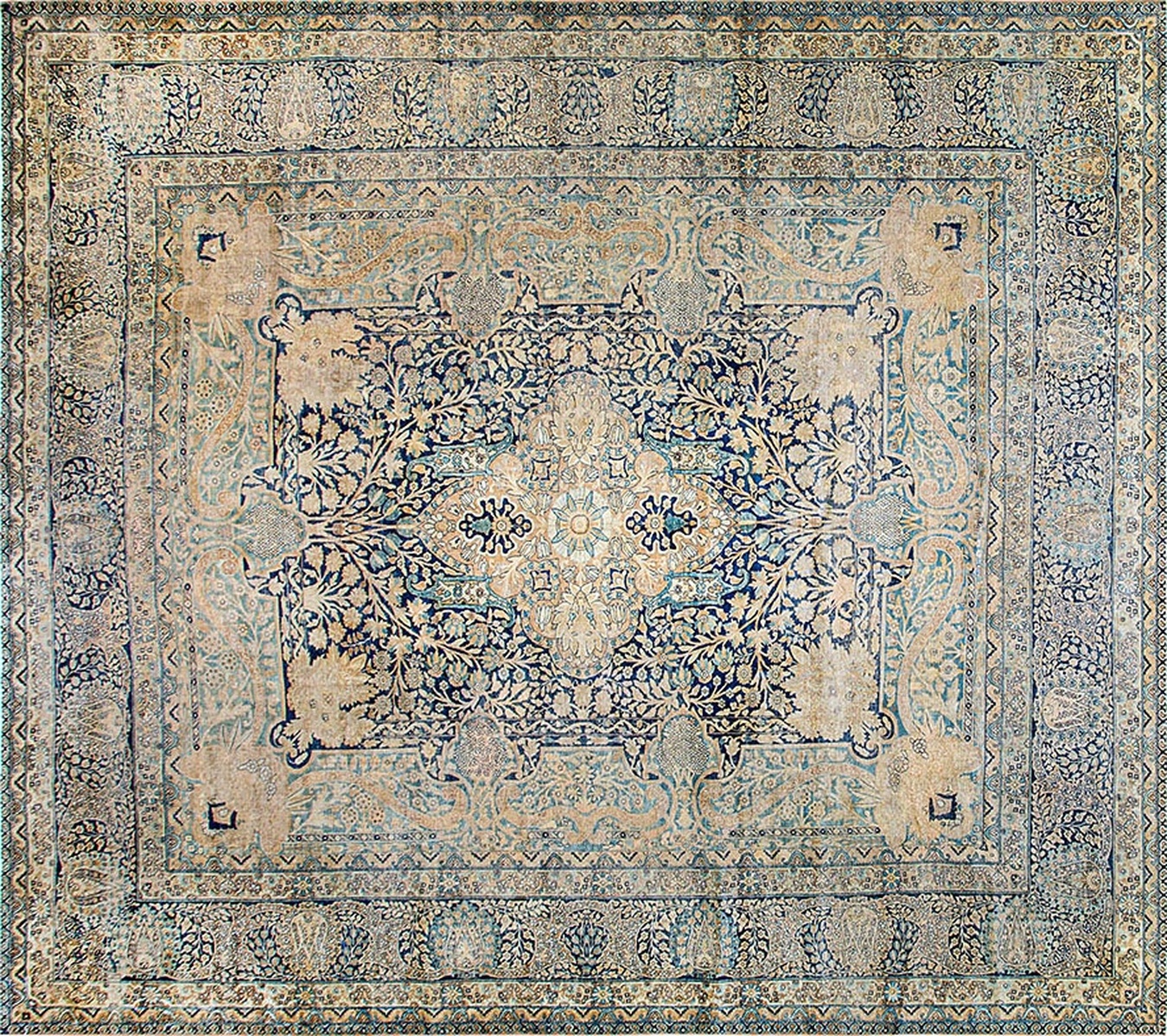
By the 17th century, European patrons specifically sought out floral-patterned rugs, and “floral” as a design descriptor firmly entered the vocabulary of art and interior decoration. Yet the concept of floral design in carpets long predates the term. The earliest known evidence of floral motif history in rugs comes from Central Asia.
The Pazyryk carpet, discovered in a Scythian burial mound in Siberia and dated to the 5th century BCE, contains stylized lotus bud motifs. This ancient masterpiece proves that flowers were among the very first decorative symbols woven into pile carpets, already associated with beauty and cosmic life forces.
Where Did Floral Rug Motifs First Emerge Historically?
The oldest floral rug motifs emerged in ancient Persia and Central Asia, with the Pazyryk carpet serving as the clearest early example. Its lotus-inspired designs reflect a cross-cultural symbolism that reached from the steppes of Central Asia to the gardens of Persia and even into Indian religious traditions.
As Persian weaving developed during the Achaemenid and later dynasties, floral ornament became central to carpet design. Lotus, palmette, and vine-scroll motifs began to dominate, and by late antiquity and the medieval Islamic period, these patterns symbolized paradise gardens described in sacred texts.
In short, floral motifs in rugs first appeared in the earliest pile weavings of Central Asia, then flourished in ancient Persia, where they became deeply tied to both aesthetics and spirituality. From these roots, the tradition spread along trade routes, carried into China, India, the Ottoman Empire, and eventually Europe, shaping what we now understand as floral-patterned rugs. Floral rugs thus embody an ancient and enduring design language.
They unite etymology, artistry, and history, from the lotus buds of the Pazyryk carpet to the richly detailed Persian gardens of later centuries. Their continued appeal lies in their ability to represent beauty, life, and paradise across cultures and eras—making flower rugs one of the most timeless expressions in textile art.
Historical Origins and Evolution of Floral Motifs
Ancient Beginnings: Pazyryk and Early Civilizations
The earliest ancient floral rugs reveal how humans used plant imagery to express life, order, and the divine. The Pazyryk carpet, discovered in a frozen tomb in Siberia and dated to the 5th century BCE, remains the oldest known surviving pile carpet. Its borders display stylized lotus buds, a motif that would travel across continents as both an ornamental and sacred symbol.
The lotus, linked to immortality and spiritual rebirth, was not confined to one culture; it resonated in Persia, India, and China alike. These ancient societies saw flowers not as mere decoration but as carriers of meaning—bridges between earthly life and cosmic ideals. From the very start, floral motifs in carpets served two purposes: as embellishment to delight the eye, and as spiritual or symbolic imagery tied to religious traditions.
In both Central Asia and the ancient Near East, flowers evoked renewal, prosperity, and protection, establishing a visual language that would become fundamental to carpet weaving for centuries.
Lotus, Peony & Iconic Motifs
What civilizations popularized lotus and peony motifs in carpets? The lotus motif was adopted and spread widely by Persia, Mughal India, and China, each culture layering new meaning onto the flower. In Persia, the lotus stood for purity and eternity, mirroring themes in Zoroastrian cosmology. In India, under the Mughals, it symbolized divine beauty and spiritual awakening, often tied to Hindu and Buddhist iconography.
In China, the lotus carried Buddhist associations of enlightenment and renewal, making it a favorite in both carpets and broader textile design. The peony, meanwhile, became another iconic symbol, especially in Persia and China. In Persian art, peony carpets conveyed luxury, fertility, and rank—an emblem of abundance in courtly life.
In China, the peony was revered as the “king of flowers,” representing wealth, honor, and imperial grandeur. Together, the lotus and peony created a shared design vocabulary across these civilizations, shaping the look and meaning of early lotus motif rugs and other botanical carpets. Their cross-cultural popularity demonstrates how motifs could travel along trade routes while retaining powerful symbolic resonance in distinct contexts.
Persian Influence and the “Garden Carpet”
Persia became the great synthesizer of floral imagery in rugs, elevating plant motifs into full narrative landscapes. By the medieval Islamic period, Persian weavers had developed the famous Persian garden carpet tradition. These designs replicated the layout of formal walled gardens, divided into quadrants with flower beds, trees, and flowing water channels.
In Islamic culture, gardens symbolized paradise, and carpets designed in this way brought the idea of eternal bliss directly into homes, mosques, and palaces. This genre marked a conceptual and technical milestone: instead of repeating a single blossom or border, the carpet became a woven vision of paradise itself. Persian mastery ensured that floral motifs were no longer confined to ornamental flourishes but could serve as complex, symbolic landscapes.
This innovation would set the stage for the monumental flowering of floral carpet design in Safavid Persia—a subject that connects directly to the next phase of rug history. Through the lotus and the peony, through the ancient floral rugs of Persia, India, and China, and through the visionary development of the garden carpet, floral motifs became both timeless symbols and artistic breakthroughs. These traditions ensured that flowers in rugs were not fleeting decoration but enduring metaphors of beauty, life, and paradise.
Major Traditions in Floral Rug Weaving
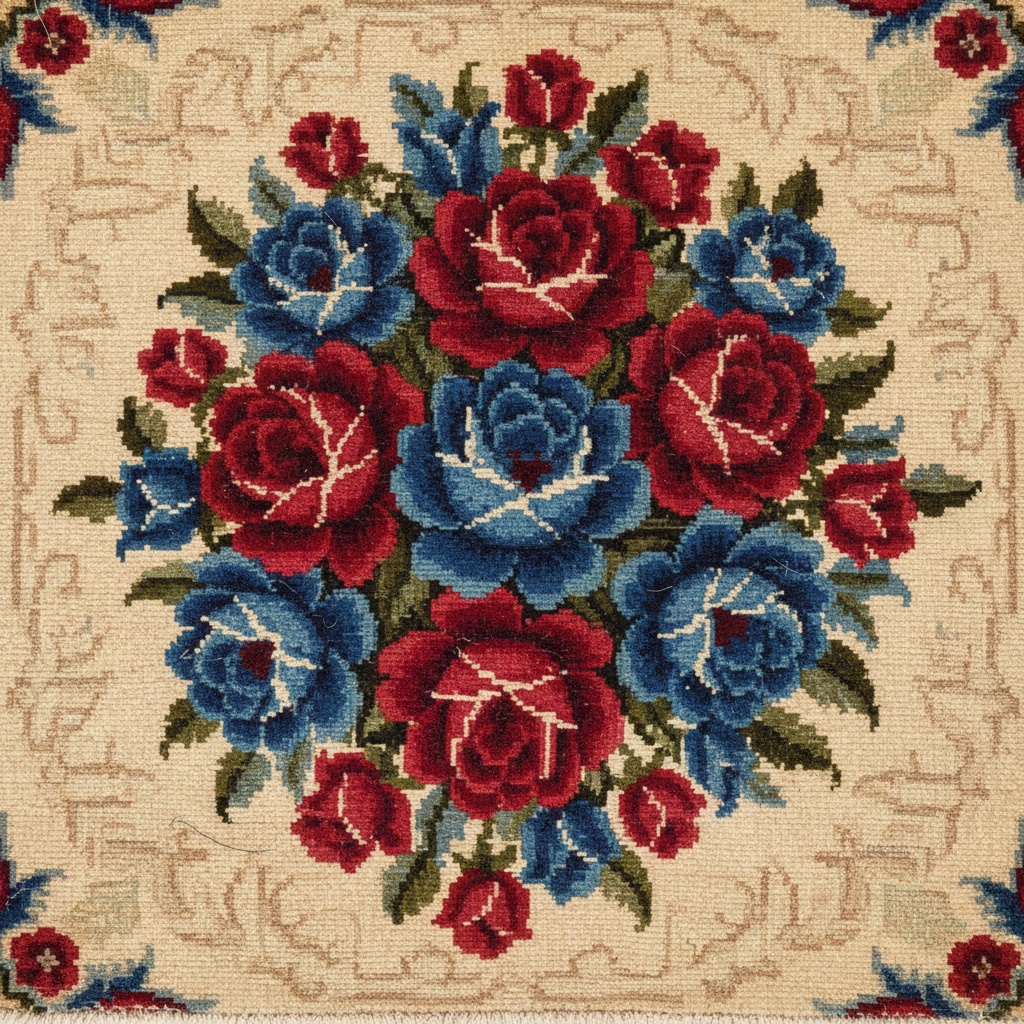
Needlepoint rendering of a dense floral bouquet.
Persian Floral Carpets: Techniques, Motifs & Symbolism
Persia stands at the heart of floral rug design, with its court workshops producing some of the most refined and symbolically rich carpets in history. Persian floral carpets masterfully balanced artistry with meaning: blossoms symbolized paradise, eternal renewal, and royal power. Court weavers under dynasties like the Safavids developed technical brilliance, from silk foundations to intricate knotting, allowing for lifelike depictions of vines, palmettes, and blossoms.
These carpets weren’t merely decorative—they were cosmological visions woven into wool and silk, often intended for royal palaces, mosques, and gifts to foreign courts. Persian culture influenced floral rug designs globally, with motifs and weaving techniques adopted in Mughal India, Ottoman Turkey, and even inspiring European workshops.
Medallion vs. Allover Blossom Fields
How do floral medallion rugs differ from allover blossom fields? In Persian weaving, the medallion format features a centralized motif—often a rosette or sunburst—anchoring the composition, with blossoms radiating outward in symmetry. This design draws the eye to a focal point, symbolizing order and cosmic unity.
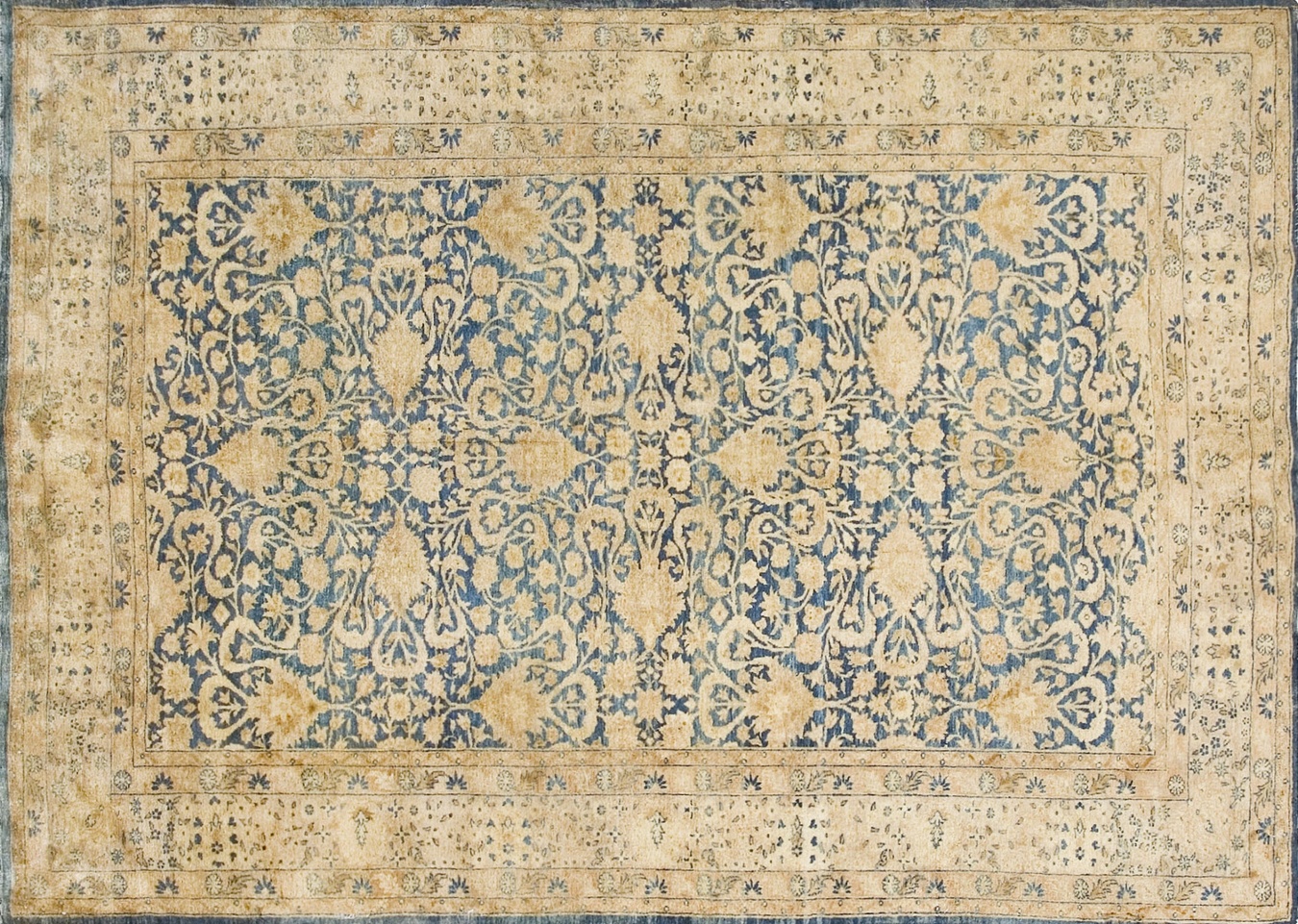
Antique Allover Floral Wool Hand Knotted Pile Blue 1920s Rug – by Rugs On Net
By contrast, allover blossom fields eliminate a central axis, covering the surface with a uniform spread of flowers and vines. These fields evoke abundance and endless growth, creating a “garden without boundaries” effect. Both approaches reflect Persian mastery of floral design, but they carry different moods—medallion rugs are formal and structured, while allover fields feel lush and immersive.
Boteh / Paisley Elements
How can you spot boteh floral elements in rugs? The boteh paisley motif is one of the most enduring Persian contributions to textile design. It resembles a teardrop or bent bud, often curling at the tip like a flame or sprouting seed. Though abstract, the boteh originates in floral imagery—sometimes read as a bent cypress tree, sometimes as a bud heavy with life.
In Persian floral carpets, boteh patterns can appear singly, in repeated rows, or integrated into medallion and border designs. Spotting a boteh requires looking for these curved, almond-like shapes, often arranged in rhythmic repetition.
Sarouk Rose Bouquets
What distinguishes a Sarouk’s rose bouquet from other florals? Sarouk rugs from central Persia became famous in the late 19th and early 20th centuries for their distinctive rose motifs. A Sarouk rose rug features rounded, plush bouquets of clustered roses, denser and more compact than the open garlands of European designs.
The roses are often painted in deep reds or blues against a soft field, forming focal clusters that stand out from the surrounding floral scrollwork. Unlike European bouquets, which may appear pastel and romantic, Sarouk roses feel weightier, more tactile, and unmistakably Persian in character.
Turkish & Ottoman Florals: Saz, Tulip, Carnation
In the Ottoman Empire, floral motifs took on bold, stylized forms. The saz leaf—long, serrated, and curved—was a signature design, often paired with tulips and carnations. The Turkish tulip rug became iconic, symbolizing perfection and divine beauty. Tall and vertical, the tulip was depicted with elegant restraint, contrasting with the more sprawling Persian blossoms.
Carnations added rhythmic bursts of color, reinforcing the Ottoman preference for dramatic, stylized florals. These motifs often adorned prayer rugs, court carpets, and textiles exported across the Mediterranean, shaping the floral vocabulary of Islamic art.
Mughal Indian Florals: Millefleurs & Garden Layouts
Mughal India transformed Persian models into highly naturalistic designs. Mughal millefleurs rugs featured countless small, discrete flowers scattered across a field, each rendered with botanical accuracy. Other Mughal carpets adopted trellis or grid layouts, with each panel containing a unique bloom—tulips, irises, narcissus, or roses—like a formal garden translated into textile.
Unlike the stylized saz leaves of the Ottomans or the abstract boteh of Persia, Mughal florals leaned toward realism, reflecting the empire’s fascination with botanical studies and miniature painting. These naturalistic garden carpets embodied the Mughal vision of earthly paradise.
European Floral Rugs: Savonnerie, Aubusson, Axminster
- Savonnerie (France): Rich central bouquets framed by scrolling acanthus leaves, designed for Versailles and royal palaces. — Why: Reflected French court taste for grandeur.
- Aubusson (France): Flatwoven tapestries with delicate garlands and pastel bouquets. — Why: Popular for wall hangings and salons, emphasizing elegance.
- Axminster (England): Plush, pile-woven carpets with floral medallions and border garlands. — Why: Brought continental floral aesthetics into English country houses.
European floral tapestries borrowed from Persian and Ottoman imports but tailored designs toward romance, pastel tones, and Rococo softness. Roses, peonies, and daisies appeared in central clusters, with garlands forming elaborate frames. Unlike Sarouk’s dense bouquets or Mughal’s botanical grids, European florals emphasized lightness, romance, and harmony with furniture and décor.
Design Layouts and Motif Iconography
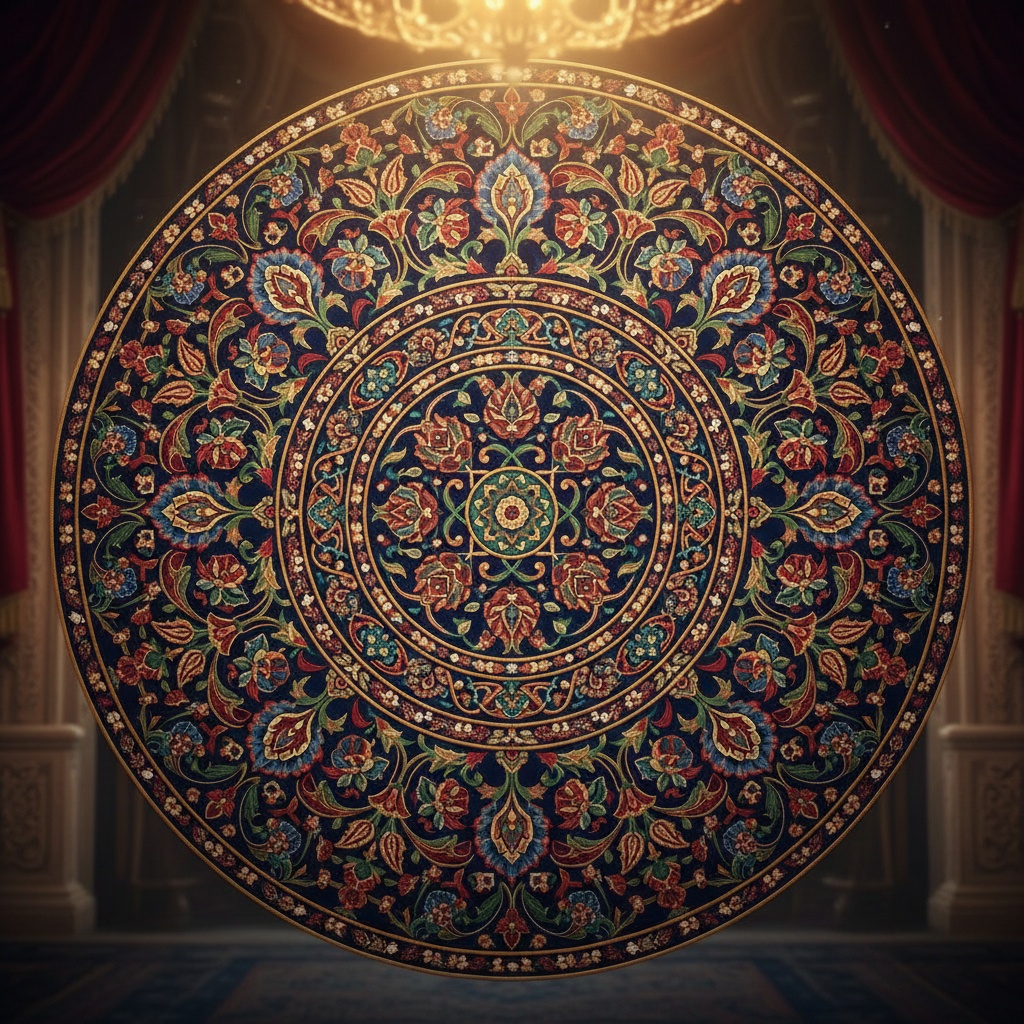
Symmetrical medallion layout with dense floral iconography.
Centralized (Medallion) vs. Allover (Field) Schemes
Floral rug layouts generally fall into two dominant categories: the floral medallion rug and the allover blossom field. A medallion scheme places a centralized motif—often a rosette or blossom sunburst—at the heart of the carpet, with supporting vines and blossoms radiating outward. This creates a sense of formality and grandeur, much like a chandelier commanding attention in a room.
Medallion designs lend themselves to symmetry and order, making them staples in traditional Persian and Ottoman weaving. By contrast, an allover field distributes blossoms evenly across the surface without a central anchor. This pattern produces an immersive “garden without borders” effect, ideal for creating a relaxed, versatile atmosphere.
In contemporary interiors, allover fields are favored for their flexibility, blending easily with both modern and traditional furniture arrangements. In short, medallions feel formal and ceremonial, while allover layouts offer informality, movement, and abundance.
Key Floral Motifs & Their Meanings
- Lotus – Immortality & Rebirth — Why: The lotus rises unstained from water, symbolizing purity and eternal renewal, especially in Persian, Indian, and Chinese contexts.
- Rose – Love & Beauty — Why: Roses are universally linked to romance, divine love, and fleeting beauty, often clustered in Sarouk rose rugs.
- Tulip – Perfection & Divine Order — Why: In Ottoman art, the tulip’s symmetry symbolized paradise and divine balance, giving rise to the famous Turkish tulip rug.
- Peony – Wealth & Rank — Why: Regarded as the “king of flowers” in China and honored in Persian courts, the peony embodied abundance and high social standing.
- Carnation – Health & Vitality — Why: Favored in Ottoman design, the carnation symbolized energy, protection, and wellbeing.
- Vine – Unity & Growth — Why: Endless scrolling vines in Persian floral carpets symbolized connection, continuity, and the binding force of creation.
- Cypress – Eternity & Endurance — Why: The cypress tree, often stylized in botanical carpets, symbolized resilience and eternal life.
These meanings ensured that floral rugs were never just decorative. Every blossom carried layers of symbolism, making a carpet a woven text of beauty, life, and cosmic ideals.
Negative Space & Minimalist Florals
How does negative space amplify florals in Scandinavian rya rugs? Unlike the dense surfaces of Persian or Mughal examples, Scandinavian rya floral carpets often employ large swathes of open ground, where empty space becomes as important as the motif itself. This negative space sharpens contrast, making each flower, bud, or sprig appear bold and intentional.
The restraint creates a minimalist aesthetic, transforming the rug into a study of balance rather than abundance. In modern design, this principle carries forward into the minimalist floral rug—a style where a single bloom or sparse arrangement becomes the focal point against a calm background. By reducing clutter and emphasizing space, Scandinavian and contemporary floral rugs achieve serenity, clarity, and timeless elegance, showing that sometimes less truly means more.
Materials, Construction, and Technical Aspects
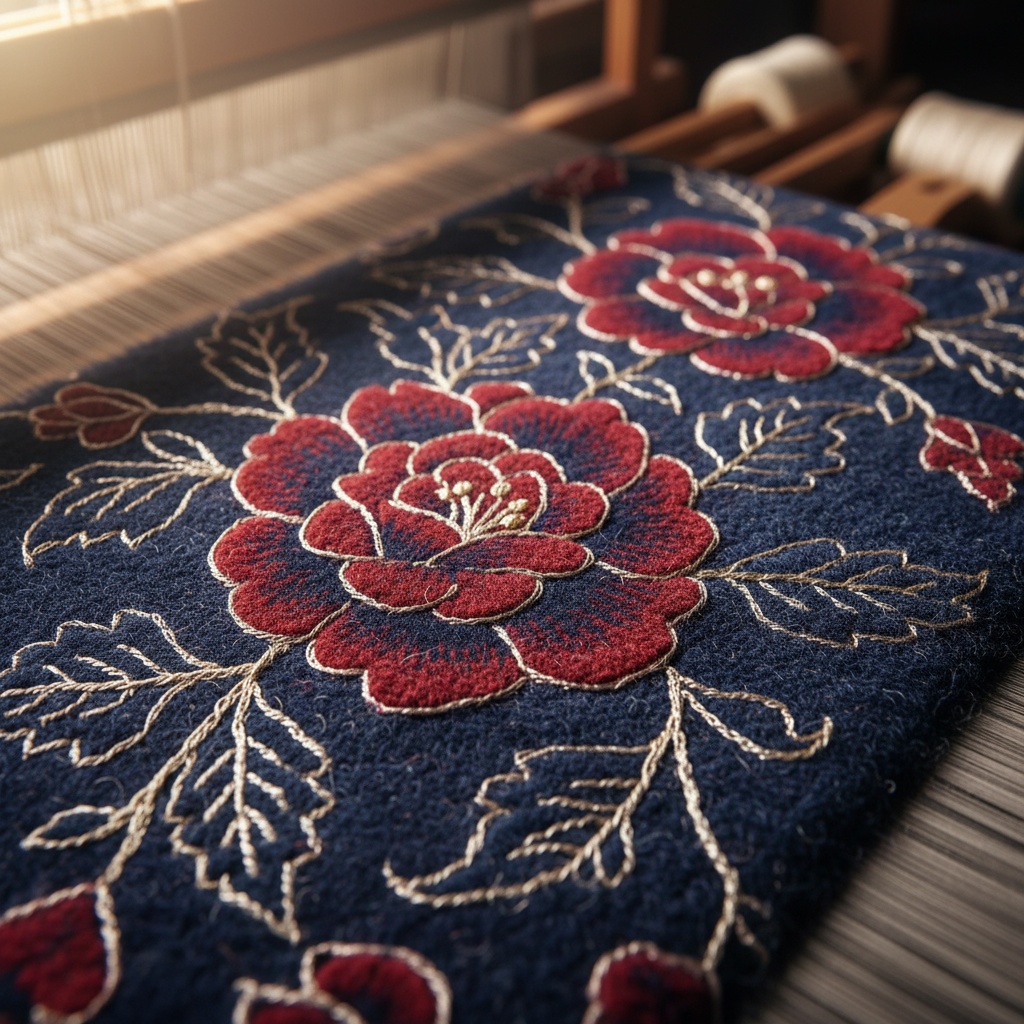
Woven textile featuring raised floral motifs and detailed stitching.
Wool, Silk, and Blends: Pile & Flatweave
The choice of material shapes how a floral rug feels, performs, and looks. A wool floral rug is plush, resilient, and naturally soil-resistant, making it ideal for everyday use while still offering depth of color in floral designs. By contrast, a silk floral rug dazzles with luster and delicacy.
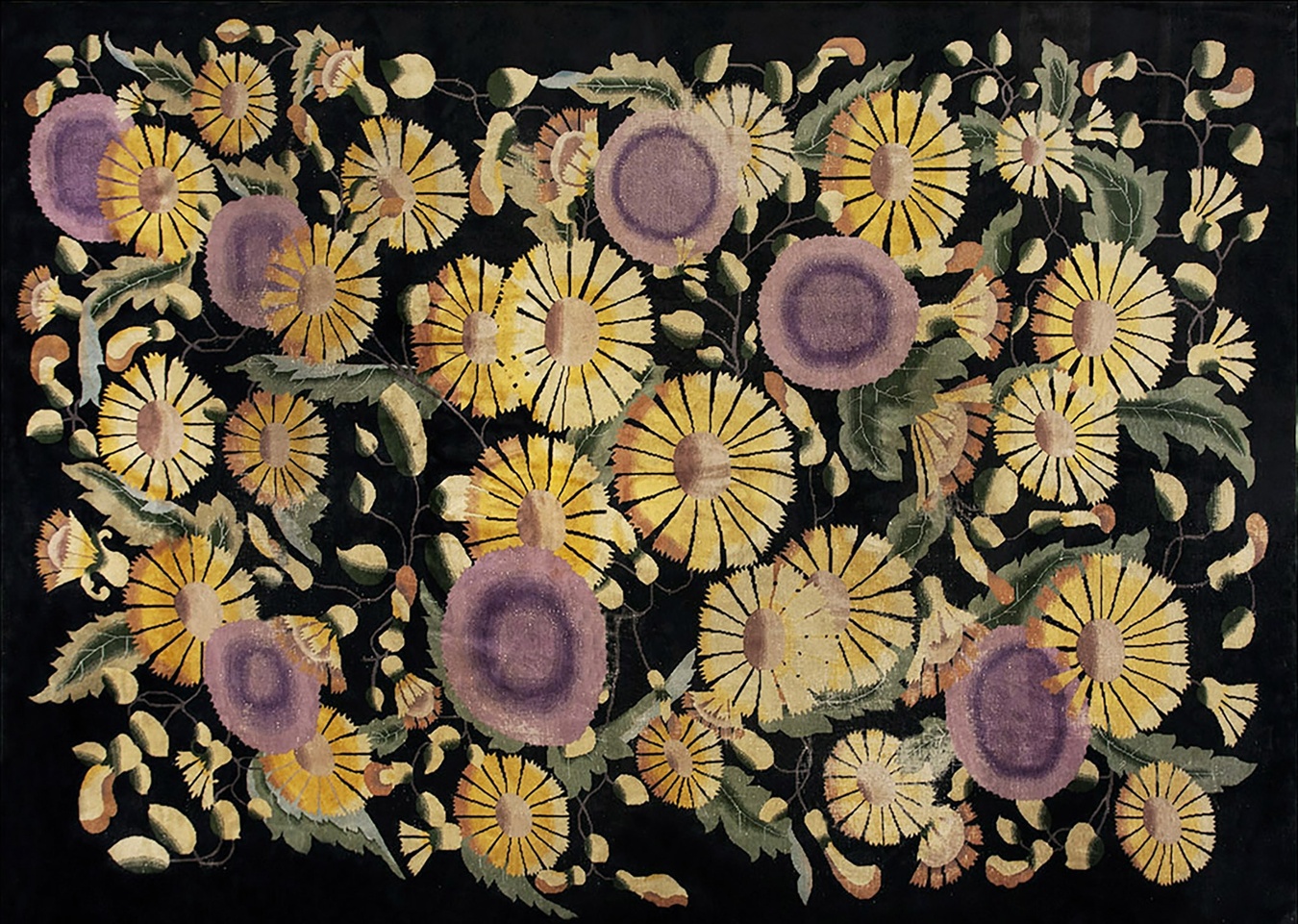
Antique Art Deco Chinese Allover Geometric Knotted Rug – by Rugs On Net
Silk threads reflect light, giving blossoms a jewel-like sheen, but they are less suited for heavy traffic, performing best in display settings or low-use rooms. Wool-silk blends strike a balance: wool provides structure and durability, while silk highlights petals, vines, and medallions with shimmering accents. Flatweave bases, meanwhile, emphasize geometry and graphic floral shapes rather than soft tactility.
Kilim Florals: Structure and Technique
Are floral kilims woven differently from pile counterparts? Yes. A floral kilim is a flatweave, created through a tapestry-like interlacing of weft and warp threads. Unlike pile carpets, which build motifs knot by knot, kilims form flowers through angular blocks of color.
This technique means blossoms appear geometric and stylized, rather than fluid and curvilinear. The absence of pile makes kilim florals lightweight, reversible, and durable, but the structural constraint prevents the painterly detail achievable in knotted pile rugs.
Knot Types, Pile Height, and Design Clarity
Does pile height affect how floral motifs read? Absolutely. In pile rugs, knot density and pile length determine clarity. Short pile allows blossoms to appear crisp, each petal and leaf sharply defined. High pile, while soft and luxurious underfoot, can blur outlines, giving floral motifs a hazier, more impressionistic quality.

A detailed focus on the intricate, vivid colors and geometric weave of a traditional textile rug.
Knot type matters, too: asymmetrical Persian knots allow finer detail, while symmetrical Turkish knots emphasize balance and durability. For collectors who value crisp floral iconography, shorter pile and higher knot counts are essential.
Silk Foundations: Durability & Care
Should silk warps be avoided in high-traffic floral rugs? Yes. While silk foundations provide extraordinary flexibility and allow for ultra-fine detail in motifs, they are also delicate. A silk floral rug used under constant foot traffic risks weakening at its core, leading to distortion or breakage over time. For practical use, silk is best reserved for accents or decorative display pieces, where its sheen and fineness can shine without compromising durability.
Dye Technologies: Natural, Aniline, and Eco-Dyes
How are eco-dyes shaping modern floral rug production? Dyes are as critical as fiber in determining the life of a floral carpet. Historically, natural dyes from plants and minerals gave florals their depth and variation. The 19th century introduced synthetic aniline dyes, which offered broader palettes but sometimes lacked stability, causing colors to fade or bleed.
Today, eco-dyed floral rugs revive natural processes with modern sustainability standards. These environmentally conscious dyes reduce chemical runoff, enhance artisanal credibility, and appeal to buyers seeking rugs that are both beautiful and ethically produced. They allow makers to celebrate tradition while meeting contemporary environmental demands.
Hand-Knotted vs. Hand-Tufted vs. Digital Print
Can hand-tufted florals mimic luxury at budget prices? Yes. Hand-tufted vs. hand-knotted floral rugs reveals a balance of cost and craftsmanship. Hand-knotted rugs, laboriously tied knot by knot, are prized for longevity and exquisite floral detail. Hand-tufted rugs, made by punching yarn into a canvas, can replicate the appearance of knotted florals but at a fraction of the price.
The trade-off lies in durability; tufted rugs last fewer decades but serve as affordable ways to enjoy floral motifs.
Can digital printing achieve crisp detailing on floral motifs? Digital printing on synthetic bases produces extremely sharp patterns, making a digital print flower rug capable of showcasing lifelike petals and intricate arrangements.
While the tactile depth of pile is absent, these rugs excel in customizability and precision, especially for contemporary interiors that prioritize design over tradition.
Cultural and Symbolic Significance
Paradise Gardens & Spiritual Meaning
Floral rugs have long carried meanings beyond decoration, embodying the idea of paradise underfoot. In Islamic and Sufi traditions, the woven paradise garden carpet was more than a textile—it was a symbolic recreation of the Qur’anic garden of eternal bliss. Divided quadrants filled with blossoms, vines, and water channels echoed the imagery of heaven, making the rug a spiritual landscape.
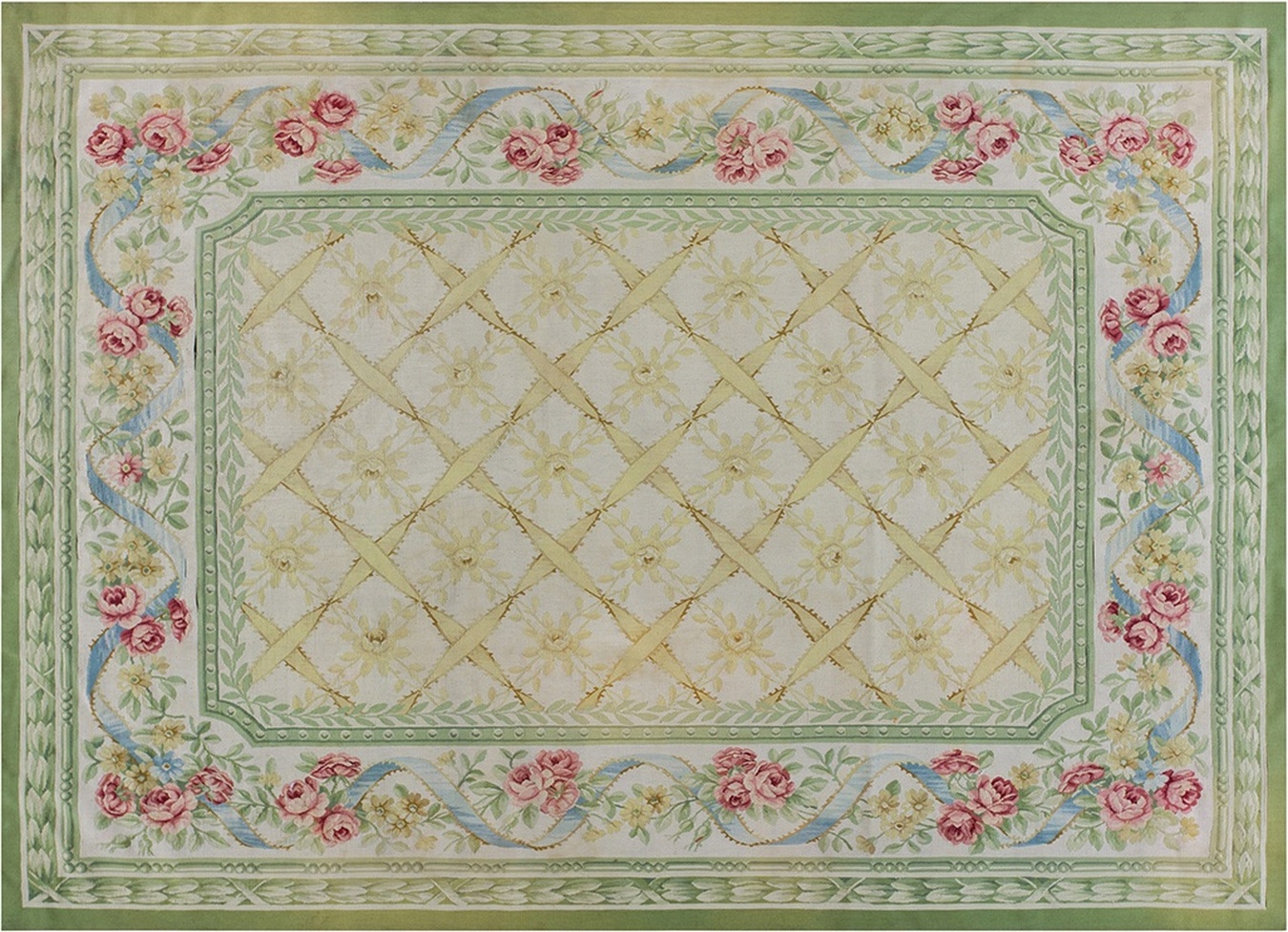
Antique Aubusson Hallway Runner Wool Ivory Rug – by Rugs On Net
Persian poets such as Hafez and Rumi reinforced this vision, equating the rose with divine love and the garden with the soul’s eternal home. To walk upon a floral carpet was, in essence, to tread across an earthly mirror of paradise. This spiritual resonance elevated floral rug symbolism into a realm of profound cultural power.
Status, Storytelling & East–West Exchange
Beyond spiritual meaning, floral rugs were markers of wealth, refinement, and cultural prestige. Rulers commissioned monumental vintage flower carpets for palaces, mosques, and diplomatic gifts. A single rug woven with roses or peonies could broadcast imperial grandeur, while a millefleurs field of blossoms might symbolize the ruler’s role as a cultivator of order and abundance.
As these rugs traveled along trade routes, they became storytelling devices, carrying Persian roses, Ottoman tulips, or Mughal irises into European palaces. In France and England, imported floral carpets inspired Savonnerie, Aubusson, and Axminster weaving, cementing florals as a universal language of status and taste.
Patina and Vintage Appeal
Does patina enhance vintage floral palettes over time? Yes—patina is one of the most prized qualities in antique and vintage carpets. A patina rug develops when decades of natural wear soften pile and mellow once-vivid dyes into subtle harmonies. Crimson roses may fade into dusty rose, cobalt tulips into pale blue, transforming the rug into a work of living history.
Far from being seen as a defect, patina enhances value, authenticity, and aesthetic depth, making vintage flower carpets especially desirable among collectors. The softened colors also harmonize more easily with modern interiors, where bold tones may overwhelm.
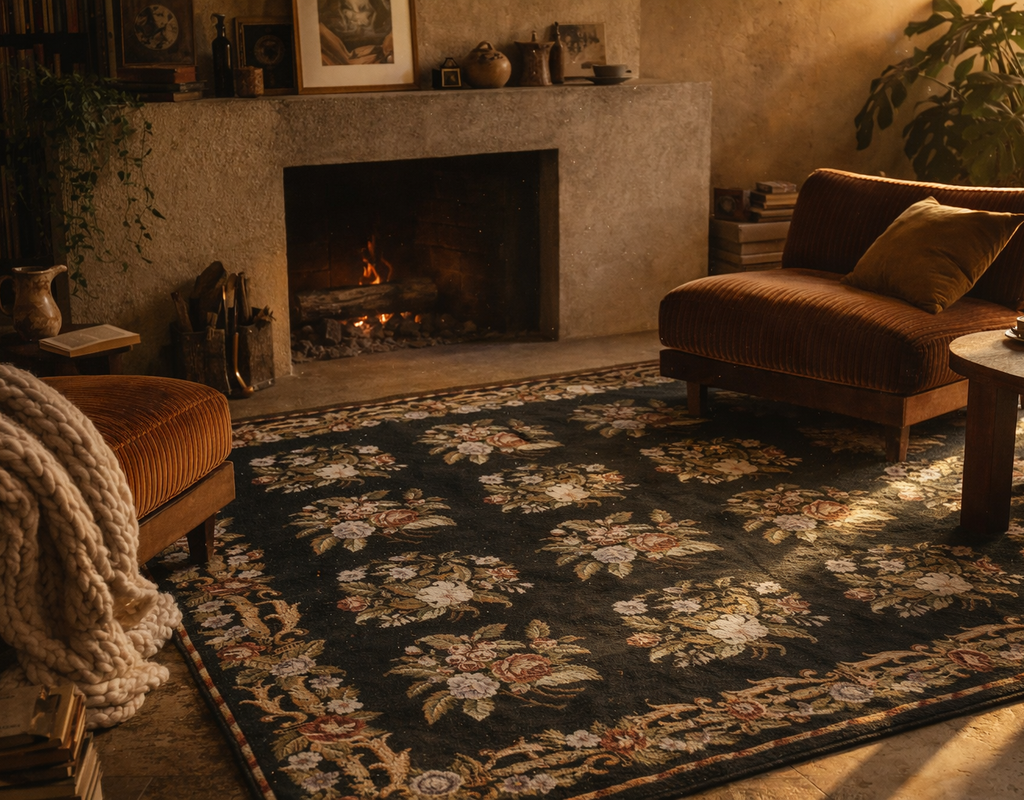
A dark floral tapestry rug adds warmth and traditional elegance to this intimate, fire-lit reading nook.
Florals in Monochrome & Contemporary Spaces
Are muted floral rugs suitable for contemporary monochrome interiors? Absolutely. In today’s design world, muted floral rugs provide a bridge between tradition and minimalism. Their faded tones—cream, charcoal, and soft gray—allow historic motifs to exist within modern monochrome palettes. Instead of overwhelming a sleek interior, these subdued florals add subtle texture and depth, balancing clean lines with a whisper of ornament.
Scandinavian and urban designers alike rely on these understated floral rugs to inject warmth and heritage into spaces defined by simplicity. From paradise symbolism to imperial status, from the softening beauty of patina to their place in contemporary interiors, floral rugs have always carried meanings that transcend time. Whether vibrant or muted, historic or modern, they remain one of the most powerful symbols of continuity between nature, culture, and design.
Modern Market: Sourcing, Trends, and Values
Where to Source Affordable Vintage Floral Rugs Online
Where can affordable vintage floral rugs be sourced online? For buyers on a budget, digital marketplaces provide access to a wide range of vintage floral rugs. Platforms like Etsy and eBay offer global selections from small dealers, often including distressed or patina-rich pieces at approachable prices. Higher-end online galleries such as 1stDibs feature carefully curated collections with authentication, though pricing reflects their prestige.
Emerging platforms like Revival Rugs and regional auction websites also specialize in refurbished or directly sourced vintage carpets, giving buyers a middle ground between affordability and quality assurance. By comparing across these sources, buyers can align taste, budget, and authenticity.
Auction Premiums for Antique Silk Florals
Why do antique floral silk rugs command auction premiums? Antique silk carpets stand apart in both material and artistry. A silk floral auction price often far exceeds that of wool counterparts due to silk’s rarity, its luminous sheen, and the extraordinary labor required to knot such fine threads. These rugs, frequently commissioned for royal courts or elite patrons, embody not only material luxury but also historic significance.
Collectors prize them for their fragility and rarity, which has limited surviving examples. When antique silk florals appear at major auctions like Christie’s or Sotheby’s, competitive bidding drives prices into the tens or even hundreds of thousands, reflecting their dual value as textile art and cultural artifact.
Why Vintage Oushak Florals Trend in Minimalist Décor
Why are vintage floral Oushaks trending with minimalist decor? The Oushak floral rug, woven in western Anatolia, has become a design-world favorite, especially in minimalist and Scandinavian interiors. Unlike the dense, jewel-toned fields of Persian carpets, Oushaks typically feature soft palettes—pale terracotta, ivory, faded blues—and overscale floral motifs.
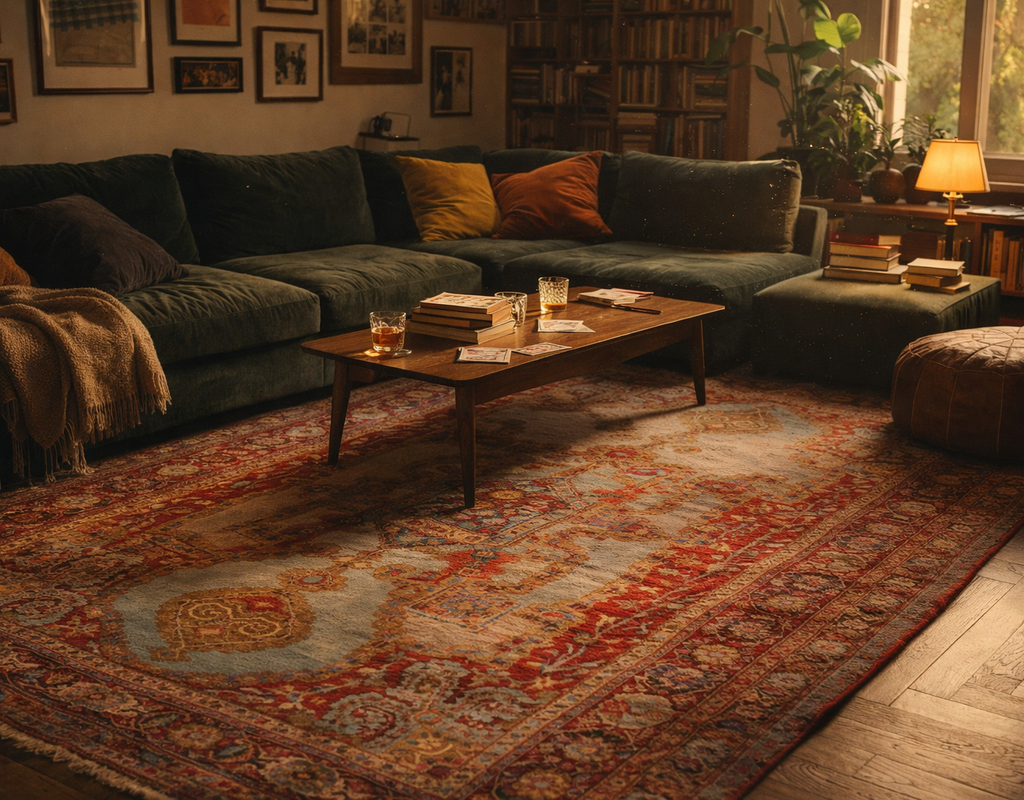
An inviting interior design showcasing comfortable seating anchored by a vibrant, yet faded, vintage-style Persian rug.
Their loosened drawing style, large blossoms, and muted tones harmonize effortlessly with pared-down spaces, providing warmth without visual clutter. Designers value Oushaks because they soften modern interiors, lending character and history while maintaining a calm, neutral aesthetic. Their rising demand reflects how florals adapt to contemporary design sensibilities.
Price Comparison: Hand-Knotted Florals vs. Geometrics
Are hand-knotted floral rugs pricier than geometric ones? In most cases, yes. A hand-knotted vs. geometric rug comparison reveals why florals generally command higher prices. Floral motifs often require finer knotting and higher densities to capture curves, petals, and organic detail. Geometric rugs, while equally historic and culturally meaningful, can be woven with lower knot counts and simpler layouts, reducing production time. As a result, hand-knotted florals are considered more labor-intensive and luxurious, reflected in their market value.
That said, geometric rugs dominate in affordability and durability, while florals lead in intricacy and prestige. Today’s market for floral rugs reflects a blend of tradition, rarity, and trend. Affordable options can be sourced online, while antique silk florals continue to set records at auction.
Meanwhile, the understated elegance of Oushak floral rugs secures their place in minimalist interiors, and hand-knotted florals consistently outprice geometrics due to their detail and craftsmanship. Together, these trends show that florals remain not just a timeless motif but also a dynamic investment in both design and value.
Contemporary Interpretations & Artistic Innovation
How Today’s Artists Reimagine Floral Motifs
How do contemporary artists reinterpret classic floral rug patterns? In the modern era, the contemporary floral rug is less about strict tradition and more about experimentation. Designers and artists take cues from historic Persian, Turkish, and Mughal florals but push them into new territory—magnifying a single blossom until it dominates the entire field, dissolving vines into painterly brushstrokes, or recoloring roses in neon or monochrome.
Some rugs reduce the motif to an abstract floral pattern, where petals are hinted at through geometry and texture rather than literal depiction. Others revive archival designs but render them on unusual materials such as recycled synthetics or digital print bases. These reinterpretations honor heritage while deliberately breaking the rules of scale, palette, and proportion.
Color, Scale, and Abstraction in Modern Florals
Where classic rugs often used balanced symmetry and traditional plant palettes—deep reds, indigo blues, and soft ivories—contemporary makers flip expectations. Scale is exaggerated: oversized tulips or peonies sprawl across minimal grounds, creating bold, graphic statements. Palettes also shift; instead of jewel tones, designers experiment with stark black-and-white or pastel washes, allowing florals to coexist with modern interiors.
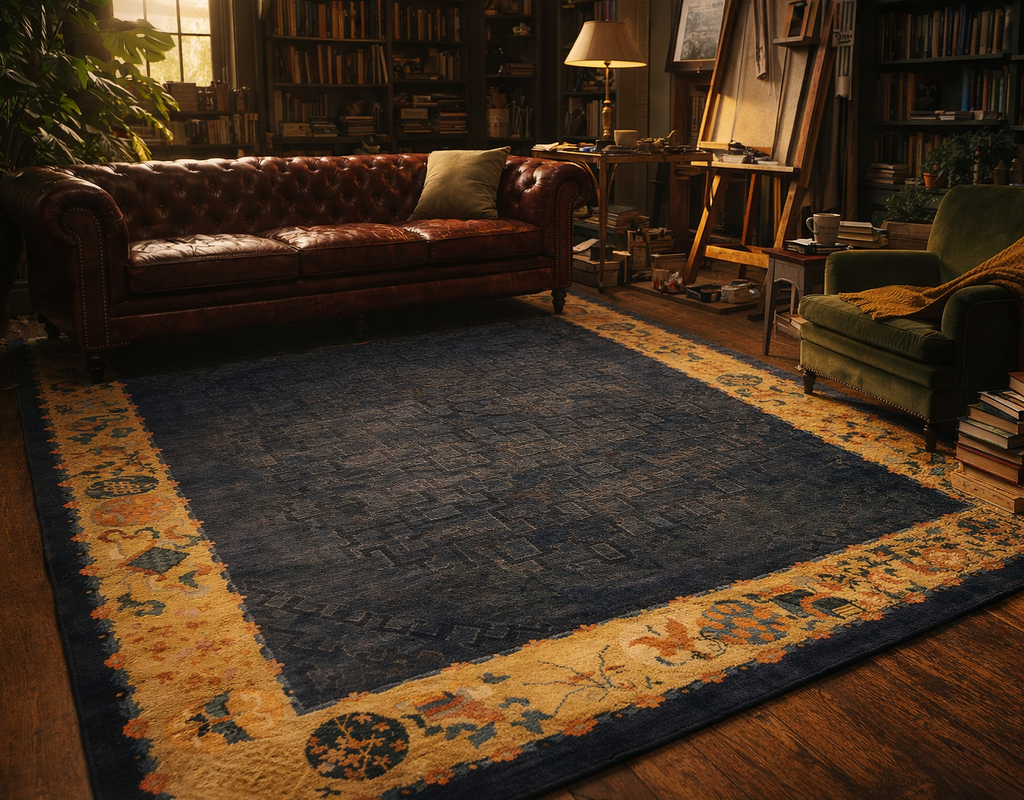
A richly colored, traditional area rug defines the seating area in this warmly lit, book-lined study.
Abstraction is another hallmark: blurred edges, fragmented petals, and layered transparencies turn the rug into an art piece rather than a direct garden representation. These innovations make the floral rug adaptable to lofts, galleries, and minimalist homes while retaining its botanical DNA.
Biophilic Design & Personalization
- Biophilic connection: Biophilic design carpets bring the natural world indoors, aligning with wellness trends. — Why: Florals soften modern environments, reduce stress, and create a sense of harmony with nature.
- Customization: Bespoke floral rugs let clients select specific blooms, colors, or even personal motifs. — Why: A custom carpet transforms a rug into a deeply personal expression, marrying tradition with individuality.
- Personal scale: Some designers create “micro-garden” rugs, where a single flower stands alone against negative space. — Why: This minimalism blends the intimacy of floral symbolism with modern restraint.
Together, these directions show how florals evolve into both personalized décor and therapeutic design tools, resonating with individual meaning and lifestyle choices.
Sustainable and Ethical Production: The Future of Florals
Modern innovation is not only aesthetic but ethical. Sustainable rug production is shaping the future of florals, with workshops returning to natural dye traditions through eco-dyes, reviving historical palettes while reducing chemical waste. Recycled fibers, organic wool, and low-impact silk alternatives allow for eco-conscious floral carpets that honor the environment as much as design.
Revival workshops in India, Turkey, and Iran preserve heritage weaving while ensuring fair labor practices, keeping traditional skills alive for the next generation. This merging of past and future ensures that floral rugs remain relevant: they can be luxurious, bespoke, and sustainable all at once. By uniting abstract floral motifs with biophilic philosophies and eco-friendly production, today’s artists prove that the floral rug is not a relic of history but a living, evolving art form.
Conclusion
Timelessness and Enduring Value
- Floral rug timeless — Why: Across millennia, from the Pazyryk carpet to contemporary digital prints, flower motifs have never fallen from fashion. Their symbolic weight and natural beauty ensure they remain universally appealing.
- Adaptability across styles — Why: Whether in a minimalist loft, a traditional parlor, or a monochrome Scandinavian home, decorating with flower rugs works seamlessly because florals can be bold, subtle, formal, or playful.
- Symbolism and depth — Why: Every blossom carries meaning—roses for love, tulips for perfection, lotus for rebirth—adding cultural and emotional resonance beyond decoration.
- Enduring value rugs — Why: Well-crafted floral carpets, especially hand-knotted pieces, hold or even increase in value, making them not just décor but also long-term investments.
Actionable Takeaways for Buyers & Decorators
- Assess materials and technique — Why: Wool offers durability, silk provides luxury sheen, and blends give balance. Knowing knot type and pile height helps in buying floral carpets that match both budget and lifestyle.
- Consider origin and tradition — Why: A Sarouk rose bouquet, an Oushak overscale floral, or a Mughal millefleurs each tells a different story and sets a different tone in décor. Origin shapes both quality and cultural meaning.
- Match florals to the space — Why: Medallion rugs suit formal dining or living rooms, while allover fields or minimalist Scandinavian florals are ideal for casual, flexible spaces. Choosing layout impacts how a room feels.
- Support artisans and sustainable practices — Why: Investing in handwoven or eco-dyed floral rugs sustains cultural heritage, supports communities, and aligns with modern ethical values.
Floral rugs endure because they embody nature, history, and artistry in a single woven canvas. They are adaptable enough to bridge old and new, luxury and casual, symbolism and style.
For homeowners, collectors, and designers alike, floral rugs are a smart, expressive choice—woven proof that beauty rooted in nature never goes out of fashion.
Explore a Few of Our Favorite Floral Rugs
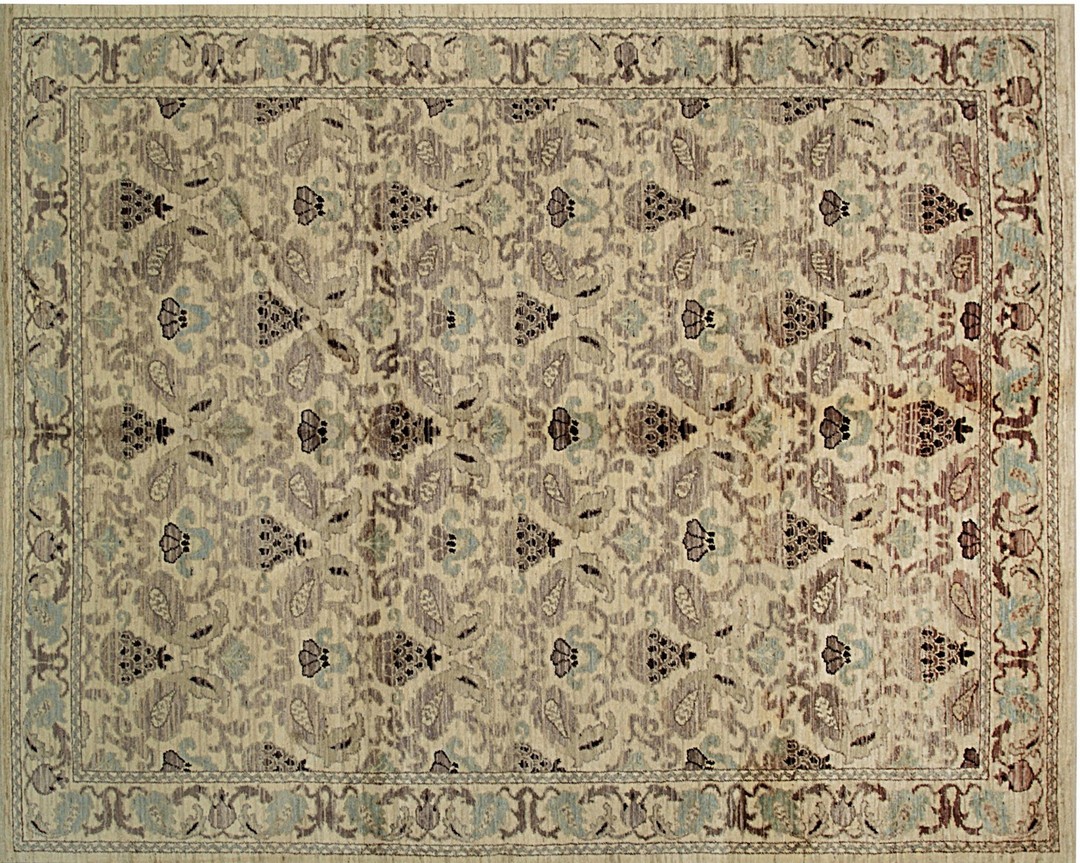
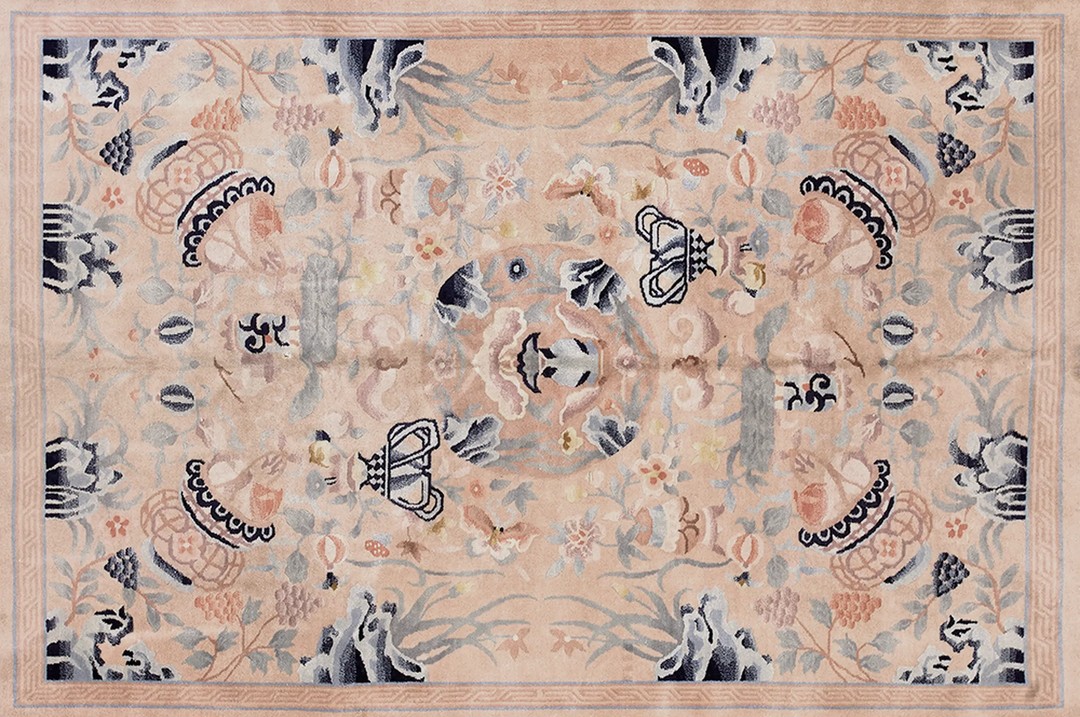
FAQ
- How much do floral rugs cost?
Machine-made floral rugs often start around \$50 and can stay under \$800 in larger sizes. Hand-knotted floral rugs commonly range from about \$1,000 to \$25,000+.
- Are floral rugs too busy for small rooms?
Not if you manage scale and palette. Use small-scale or muted floral rugs to open the space, or one large-scale floral to create a cozy focal point.
- Should I use a rug pad under a floral rug?
Yes—a quality pad reduces slipping, adds cushioning, protects floors, and extends rug life. Size it slightly smaller than the rug to stay hidden.
- Do outdoor floral rugs exist and are they practical?
Yes—polypropylene floral outdoor rugs resist moisture and can be hosed off. Let them dry fully after rain to prevent mildew.
- Are vintage or antique floral rugs worth it?
Often—hand-knotted floral antiques are durable and collectible. Prices vary widely by age, region, and condition; inspect for repairs, moth activity, and even wear.
- How can I tell a hand-knotted floral rug from printed or tufted?
Flip it: hand-knotted florals show individual knots and woven fringe; printed florals look surface-applied on a pale base; tufted florals have canvas/latex backings.
- How do I make floral rugs feel modern?
Choose oversized, simplified blossoms or monochrome/duotone botanicals. Pair a contemporary floral rug with clean-lined furniture and minimal accessories.
- How do I mix floral rugs with other patterns?
Vary scale and type: pair a large-scale floral rug with smaller stripes or geometrics sharing two or three colors. Keep at least one solid anchor textile.
- Are floral rugs robot-vac friendly?
Usually—pick low-pile floral rugs without long fringe. Fringes can tangle robot brushes; tuck or protect edges if needed.
- Can I place a floral rug over radiant floor heating?
Yes—keep total thermal resistance low. Aim for a combined carpet+pad tog rating at or under about 2–2.5 for efficient heat transfer.
- Will sunlight fade floral rugs?
Yes—UV light gradually lightens dyes. Rotate the floral rug periodically and use UV-filtering shades or films to cut fading.
- How do I clean a wool floral rug at home?
Vacuum thoroughly, then spot-clean with cold water and a wool-safe detergent; blot, don’t scrub. For a full wash, use low-moisture methods or hire a professional yearly.
- Do wool floral rugs shed?
New wool floral rugs often shed initially; this tapers off. Vacuum twice weekly at first using a beater-bar or appropriate setting.
- Which materials are best for floral rugs?
Wool floral rugs are durable and resilient; polypropylene floral rugs are budget-friendly and stain-resistant. Avoid viscose florals in spill-prone rooms since water can yellow the fibers.
- Are floral rugs good for homes with pets or kids?
Yes—patterned floral rugs camouflage stains and wear better than solids. Pick low-pile wool or polypropylene for easier cleaning and durability.
- What size floral rug should go under a dining table?
Choose a floral rug that extends at least 24 inches beyond the table on all sides so chairs stay on the rug when pulled out. An 8×10 often fits a 6-seat table.
- What size floral rug works best in a living room?
Most living rooms suit 8×10 or 9×12 floral rugs. Aim for the rug to extend \~6–8 inches beyond the sofa on both sides for balanced proportions.
- What does “Islimi” vinework mean on floral rugs?
Islimi (arabesque) describes flowing, spiraling vines connecting floral motifs. It’s common in Persian floral rugs and frames major elements with rhythmic scrollwork.
- What is the Shah Abbas (palmette) in floral rugs?
It’s a layered, fan-shaped floral emblem used across Persian designs like Kashan and Isfahan. Look for complex leaves and blossoms repeating in fields, borders, and medallions.
- What are Chinese Art Deco floral rugs?
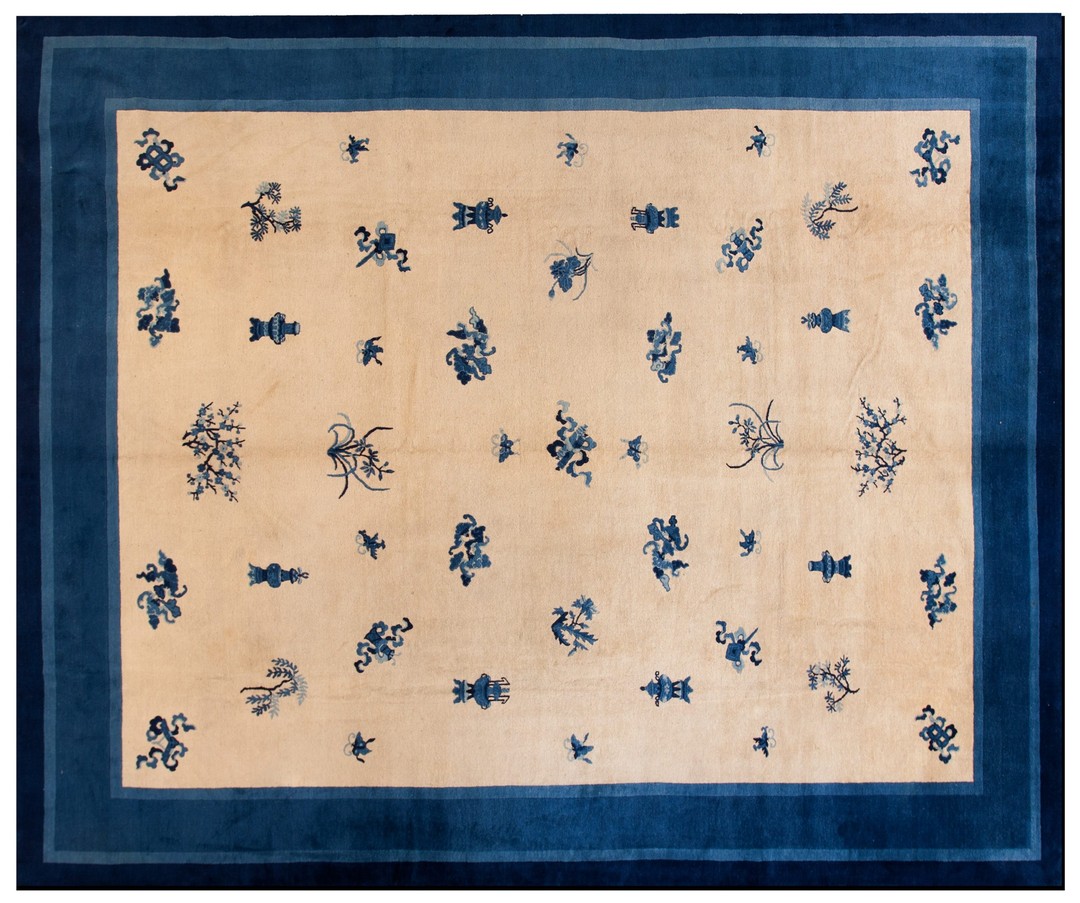
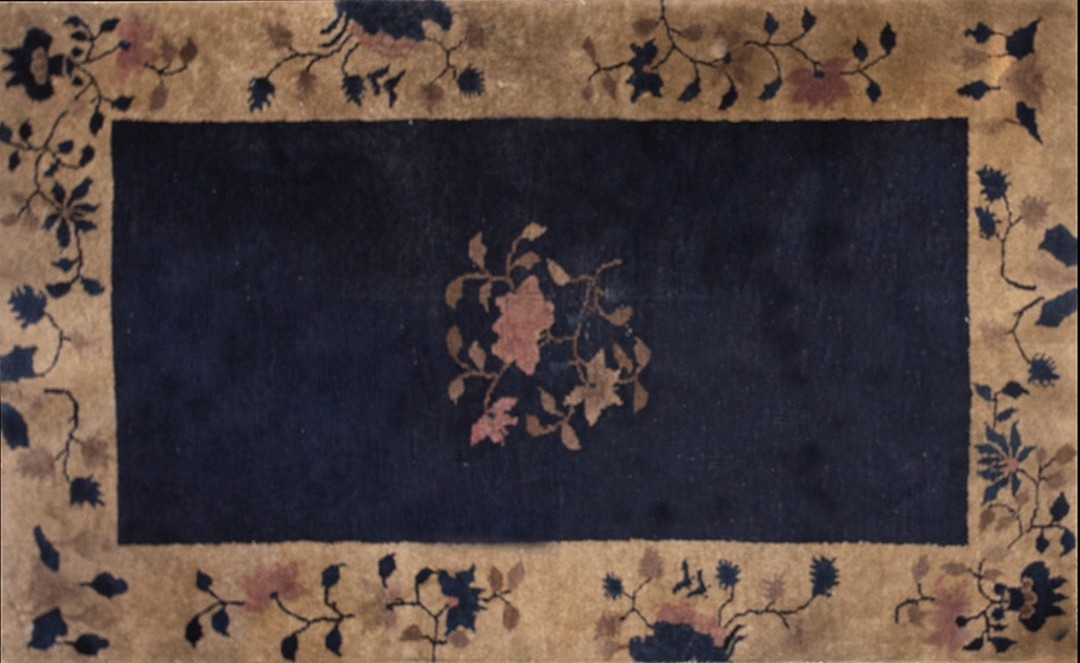
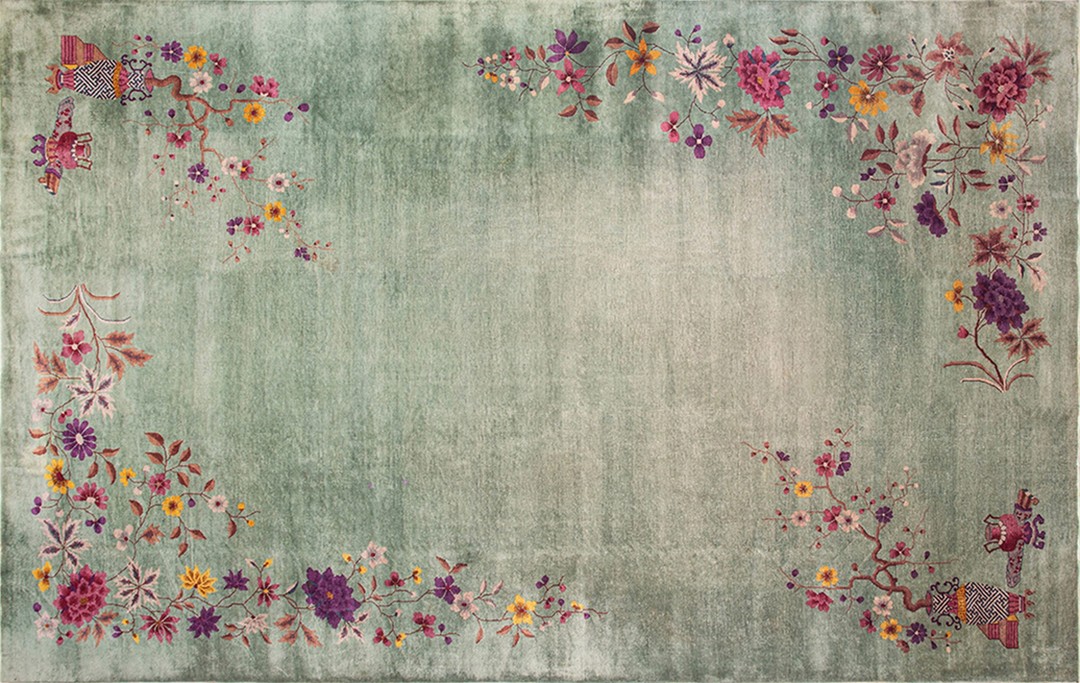
Art Deco floral rugs from 1920s–30s China pair bold, asymmetrical blossoms with saturated grounds and open negative space. Expect peonies, lotus, and vines floating on jewel-toned fields.
- What’s the difference between Persian floral rugs and Aubusson floral rugs?
Persian floral rugs use curvilinear vines, palmettes, and medallions; Aubusson floral rugs are flatwoven, pastel, and often medallion-centered with tapestry-like bouquets. Aubusson typically has hemmed edges rather than fringe.
- How do floral rugs differ from damask rugs?
Floral rugs depict pictorial blooms and vines; damask rugs use symmetrical, often two-tone, woven-style scrolls inspired by historical damask textiles. Damask reads flatter and more uniform than naturalistic florals.
- Are floral rugs outdated or on-trend right now?
Floral rugs are firmly back, boosted by “pattern layering” and maximalist interiors. Large-scale florals or tone-on-tone botanicals feel current in 2025.
- Which flowers show up most on floral rugs and what do they mean?
Common flowers include peonies (status/wealth), lotus (rebirth), tulips and carnations (beauty/harmony). These motifs are standard in Persian-style floral rugs and many Asian and European traditions.
- What exactly defines floral rugs as a motif?
Floral rugs feature stylized blossoms, leaves, and vines as the primary pattern, from allover fields to medallions and borders. Think peonies, lotus, tulips, carnations, and palmettes appearing repeatedly across the design.