
Introduction to Green Rug Colors
Discover our curated selection of stunning green color rugs and find the perfect shade for your home today.
Visual Characteristics & Appeal
Green rug colors are distinguished by their wide spectrum of tones, ranging from earthy olive and pistachio to soft sage, luminous emerald, and deep forest green. This palette allows green rugs to shift seamlessly between subtle accents and statement pieces. In antique examples, the beauty lies in the natural dyeing process: traditional double-dyeing methods create flecked, variegated hues that shift as light changes.
Collectors and designers often prize this effect, known as abrash, where gentle striations and tonal variations emerge naturally through hand-dyeing and aging. Unlike synthetic dyes, which often yield flat and uniform surfaces, these traditional methods produce a living surface that evolves over time. A unique patina also defines older green rugs, as vegetable-based dyes oxidize and soften, resulting in layers of character and depth.
The surface of a green area rug may carry traces of its history in subtle transitions from bright to muted tones, making no two antique examples identical.
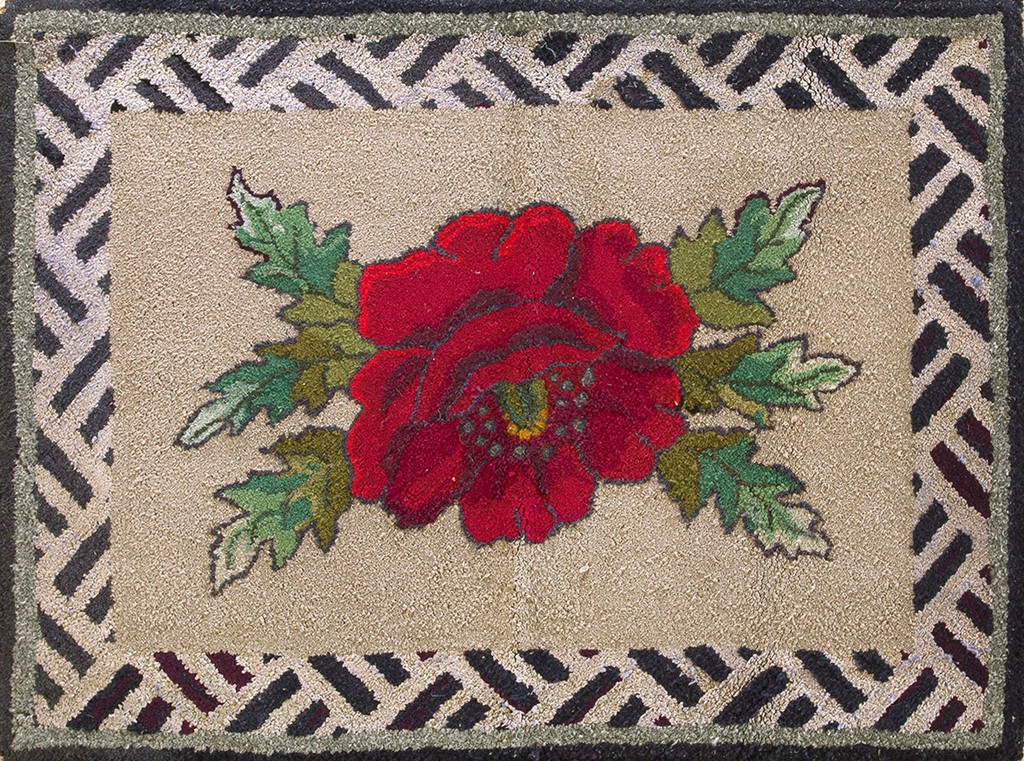
Wool 1930s Ivory Beige Cream White Antique American Hooked Rug by Rugs On Net
This evolving coloration is part of their charm, lending authenticity and richness that machine-made pieces rarely capture. Whether it’s a sage green rug with gentle fade or a vibrant emerald rug with bold streaks, the interplay of tones creates a dynamic presence that adds personality to interiors.
Green in Contemporary Design
- Versatility as a Neutral — Why: Green rugs often serve as an adaptable base for modern interiors. A muted olive green carpet or a soft sage green rug can function almost like a neutral, harmonizing with wood, stone, and natural textiles common in contemporary spaces.
- Psychological Impact — Why: Green is strongly associated with tranquility, renewal, and balance. Incorporating modern green rugs into living areas fosters a calming atmosphere while introducing subtle vibrancy. Designers often use emerald or forest tones in bedrooms and lounges to create serene environments.
- Contrast in Minimalist Settings — Why: In neutral Scandinavian interiors, a sage green rug or olive-toned piece introduces warmth and subtle grounding without overpowering the pale woods and whites. The natural abrash effect adds quiet visual texture, which keeps minimal spaces from feeling sterile.
- Anchoring Open-Plan Layouts — Why: Large green rugs are particularly effective in open-plan homes, where a single piece can define and anchor a living area. Emerald rugs provide bold distinction, while softer pistachio or sage tones can unify multiple seating arrangements into one cohesive zone.
Green rug colors embody both boldness and subtlety, making them uniquely adaptable across aesthetics. Their ability to bridge natural inspiration with modern functionality ensures they remain relevant, whether chosen for a historic home layered with antiques or a sleek, contemporary loft defined by glass and steel.
Can green rugs work with neutral Scandinavian interiors? Yes. A sage green rug or olive green carpet softens stark white and pale wood finishes, introducing warmth, texture, and a natural accent without overwhelming the minimalist palette.
Should I buy a green rug to anchor open-plan spaces? Yes. Large green area rugs, especially in deeper tones like emerald or forest, create clear visual boundaries and cohesion in open layouts while balancing vibrancy and calmness.
Origins & Dye Techniques for Green Rug Colors
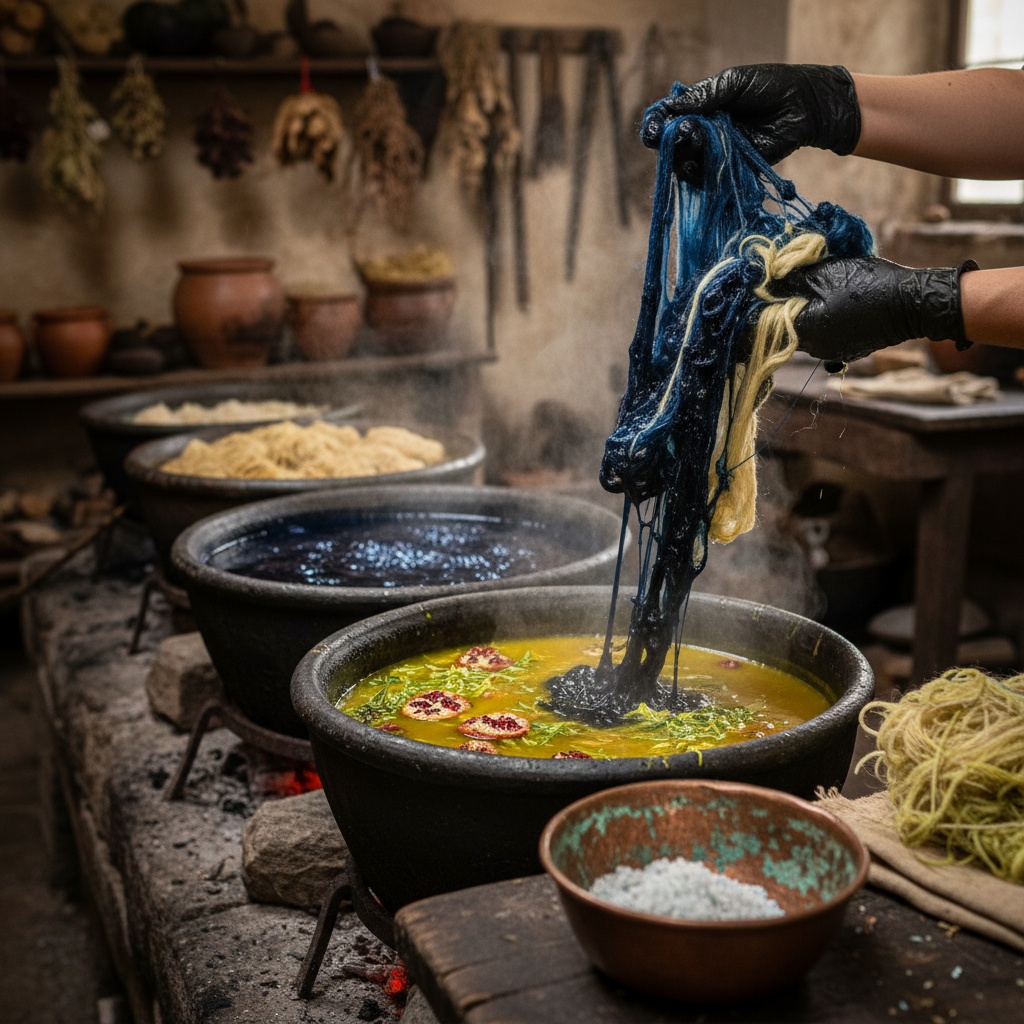
Natural dyeing process using large cauldrons.
Natural vs. Synthetic Green Rug Colors / Dyes
Historically, creating green rug colors required remarkable skill, as no single plant yielded a true green dye. Instead, artisans relied on double-dyeing, layering natural hues to produce lasting tones. The traditional method involved dyeing wool first in indigo, a stable and deep blue, before overdyeing it with a plant-derived yellow such as weld, pomegranate rind, buckthorn berries, or vine leaves.
This careful combination created the soft olive, sage, or pistachio tones seen in antique vegetable-dyed green rugs. For more vivid shades, particularly the emerald green rug tones admired in Persian Feraghan carpets, dyers introduced copper salts into the dye bath. While this produced dazzling brilliance, it often weakened the wool fibers, leading to long-term corrosion.
During the 19th century, Western influence introduced Paris green, a synthetic arsenic-based dye, which produced bright colors but posed severe toxicity risks.
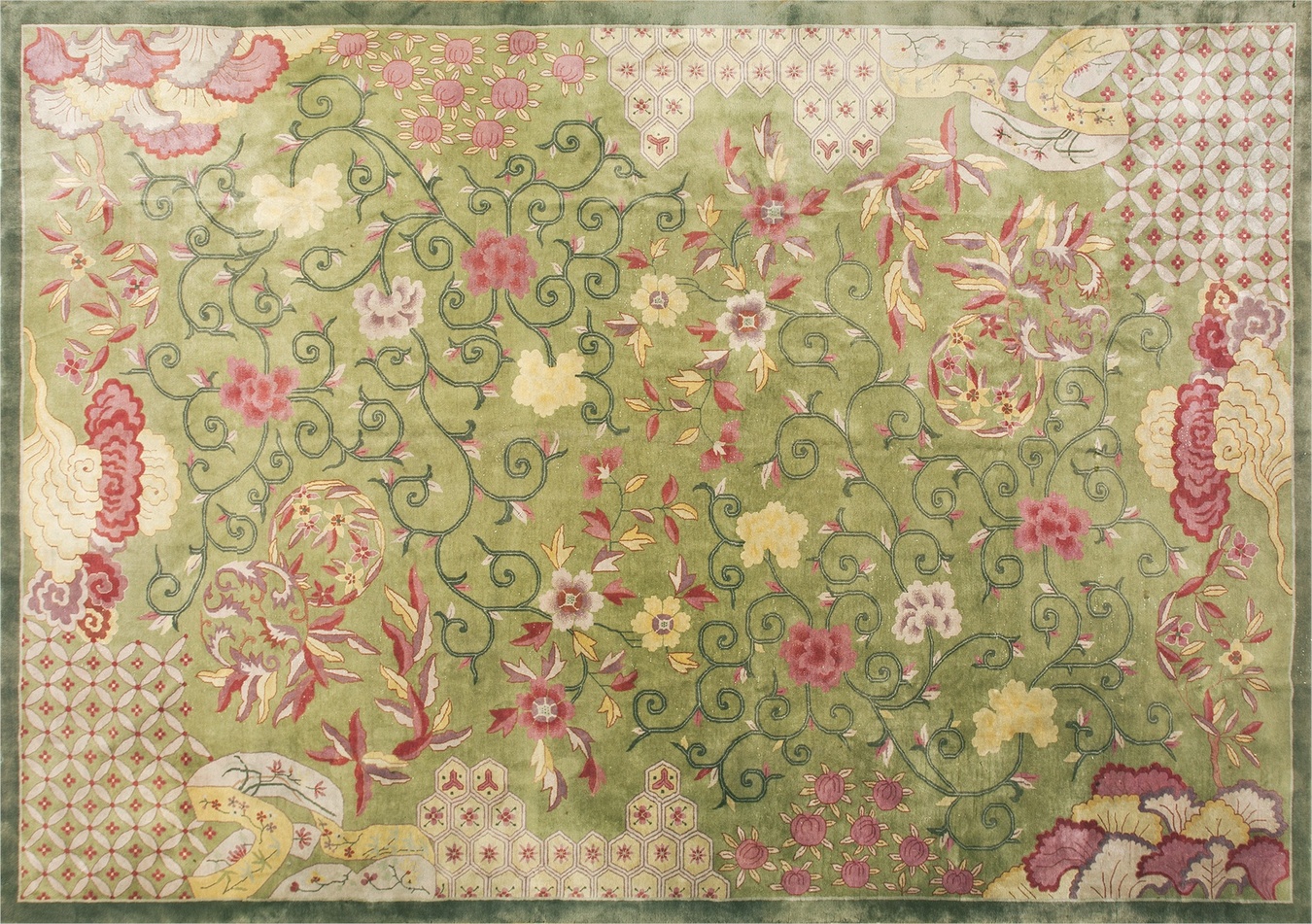
Antique Large Wool Green Hand Knotted Pile Rug – by Rugs On Net
By the early 20th century, the invention of chrome dyes transformed the rug world: these synthetic green carpet dyes offered unprecedented stability, consistency, and resistance to fading.
Today, synthetic methods can replicate any shade of green with ease, but they lack the depth, abrash, and living patina that collectors prize in natural green rug dyes.
Double-Dyeing Process Explained
The art of achieving green rug colors through double-dyeing remains one of the most labor-intensive and revered techniques in rug making. Artisans begin by immersing wool in a deep indigo bath, ensuring the fibers are evenly saturated with rich blue. Once dried, the wool is dyed again using a yellow solution extracted from plants such as weld or pomegranate rind.
The overlapping of blue and yellow creates an optical and chemical fusion, yielding subtle variations of green. The slightest change in mordant, mineral content, or dye concentration could shift the result from sage green rugs with gentle softness to bold emerald rugs with striking intensity. Because this process required careful monitoring and repetition, green was among the most costly and time-consuming hues to produce, which explains why antique double-dyed pieces are relatively rare and highly valued.
Emerald Green & Sage Green Rug Colors: Achieving the Perfect Hue
Crafting the perfect emerald green rug colors demanded not just double-dyeing but often the risky addition of copper salts. In Persian weaving centers like Feraghan, this produced the glowing emerald tones admired in 19th-century carpets, though at the expense of fiber integrity over centuries. By contrast, artisans seeking more restrained and timeless results favored the plant-based overdyeing of indigo with yellow, producing sage green rugs that aged into elegant, muted shades.
The secret lay in balance: too much yellow could muddy the tone, while too much indigo would overwhelm the vibrancy. The true mastery was not in achieving uniformity but in embracing the subtle striations—abrash—that gave vegetable-dyed green rugs their depth and authenticity. Modern synthetic systems can now deliver perfect emerald or sage tones at scale, but connoisseurs recognize the difference. Vegetable-dyed green rugs reveal a nuanced surface that shifts under changing light, while synthetic carpets tend to appear flat and static.
This interplay of depth and imperfection explains why antique examples remain so sought after. How do artisans achieve emerald green using natural dyes? By double-dyeing wool with indigo blue, then overdyeing with yellow plant extracts, and in some traditions adding copper salts for brilliance, though this risked damaging the wool.
What plant-based dyes create durable green rug colors in wool rugs? Weld, pomegranate rind, buckthorn berries, and vine leaves were common sources of yellow used over indigo to yield long-lasting greens.
Are synthetic green dyes more colorfast than natural options? Yes. Chrome-based synthetic dyes introduced in the 20th century are far more stable and resistant to fading than vegetable dyes, but they lack the patina and abrash that make natural-dyed green rugs desirable.
Where can I find sustainably dyed green flatweave kilims? Many artisan cooperatives in Turkey, Iran, and Morocco continue to weave sustainable green kilims using vegetable-dyed wools, often sold through fair-trade galleries, heritage rug markets, and ethical online platforms specializing in handmade textiles.
Symbolism & Meaning of Green Rug Colors
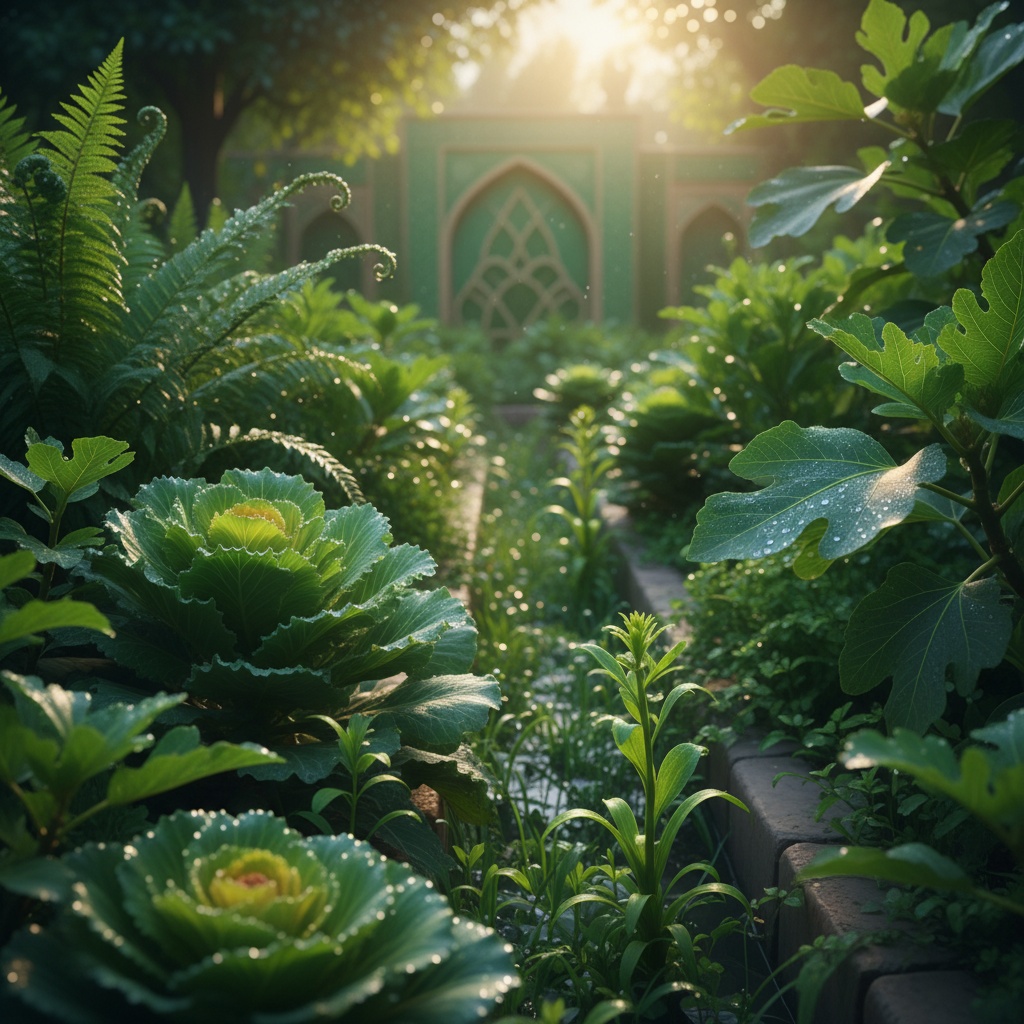
Lush greens symbolizing nature and renewal.
Green in Persian & Islamic Traditions
The green rug colors hold deep cultural and spiritual significance in rug weaving traditions, particularly within Persian and Islamic contexts. In Persian carpets, green is a sacred hue that symbolizes Paradise, eternal life, renewal, and divine abundance. It is strongly tied to imagery of spring and rebirth, reflecting the cycle of agricultural renewal that defined Persian society for centuries.
Because green was difficult and costly to produce through natural dyeing, its presence in carpets often carried an added sense of reverence and prestige. In Islamic culture, green is profoundly revered as the Prophet Muhammad’s color, associated with the gardens of Paradise described in the Qur’an. This sacred status meant that green was used sparingly in rugs. To avoid disrespect, weavers often refrained from using green in the main field of a carpet, instead reserving it for borders, motifs, or symbolic highlights.
When it did appear, its placement carried great weight, marking the rug as an object of both artistic and spiritual importance. This tradition established the foundation for what is often referred to as Islamic green rug colors meaning, where the shade transcends decoration and becomes a marker of holiness.
Nature, Status, and Renewal Symbolism
- Connection to Nature — Why: Green has always represented fertile fields, gardens, and agricultural prosperity. In green and nature in carpets, the color reflects human dependence on renewal, harvest, and the life-giving qualities of the land.
- Symbol of Spring and Nowruz — Why: In Persian culture, green is linked to Nowruz, the Persian New Year, which celebrates spring and rebirth. Green rugs thus carry connotations of hope, fresh beginnings, and seasonal renewal.
- Status and Luxury — Why: Because achieving lasting green rug colors required labor-intensive double-dyeing with indigo and plant-based yellows, the color was expensive and rare. In antique green textiles, its use could signal elite or courtly status, setting such pieces apart as luxury objects.
- Positive Associations Across Cultures — Why: Whether through the symbolism of Paradise in Islamic tradition or the vitality of spring in agricultural societies, green remains cherished for its life-affirming and hopeful qualities. This enduring positivity explains why green symbolism in rugs continues to resonate with modern collectors and designers alike.
What does green symbolize in Persian area rugs? Green in Persian carpets symbolizes Paradise, eternal life, spring, renewal, agricultural abundance, and elevated social status, making it one of the most meaningful colors in traditional weaving.
Why is green revered in Islamic-inspired rug motifs? Green is revered in Islamic rug design because it is considered the Prophet Muhammad’s sacred color and a representation of Paradise in the Qur’an, leading artisans to use it sparingly and respectfully in motifs rather than as dominant fields.
Green in Rug Styles, Motifs & Regional Traditions
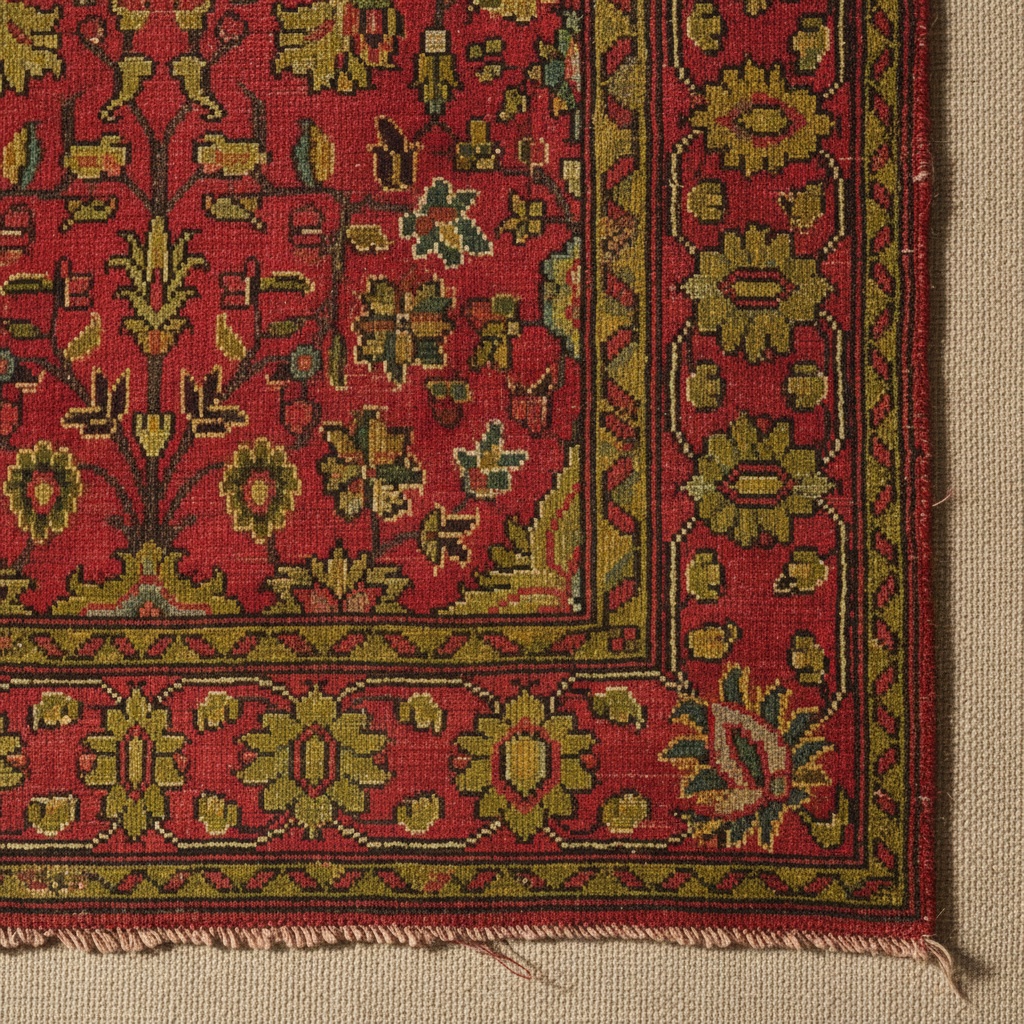
Olive green accents in traditional rug motifs.
Persian Court and Workshop Rugs
Within green Persian rug styles, city workshops such as Tabriz, Kashan, Feraghan, and Sarouk developed some of the most sophisticated uses of green rug colors. In these finely woven rugs, green rarely dominates the central field; instead, it appears in borders, medallions, foliage, or floral scrollwork. This placement reflects cultural reverence for green rug colors while also maximizing its decorative impact.
Among the most famous examples are Feraghan Sarouk rugs, which feature striking pistachio or lime green shades achieved with copper-salt dyes. Though brilliant at the time of weaving, these dyes sometimes weakened wool fibers, making surviving examples both rare and collectible. In contrast, Kashan and Tabriz often employed softer sage tones, used as highlights in garden and tree-of-life motifs. The restrained but deliberate use of green underscores its value as both a luxury accent and a spiritual symbol in Persian workshops.
Tribal & Village Rugs
In tribal and village rugs, the symbolism of green rug colors connects directly to hope, fertility, and nature. While city workshops favored technical mastery, nomadic and village weavers embraced green as a meaningful accent, often tied to agricultural renewal. For instance, village Sarouk and Hamadan rugs might include small green leaves or vines that reference spring growth.
Because producing stable green rug colors and hues through vegetable dyes required extensive labor, these appearances signal not only cultural meaning but also a degree of prestige for the weaver’s household. In tribal traditions, green was less about courtly display and more about honoring cycles of nature and expressing optimism through color.
Caucasian & Anatolian Rugs
Among Caucasian and Anatolian rugs, green sometimes moves beyond a supporting role to dominate entire compositions. The Karachop Kazak carpet is particularly notable for its rare use of green as a main field color, instantly increasing its collectible value due to the difficulty of achieving such saturation.
Similarly, Talish rugs occasionally feature emerald or pistachio fields with geometric medallions, while Shirvan examples integrate green in borders and latticework. In Anatolia, green often highlighted prayer rugs, where its sacred associations with Paradise aligned with the rug’s function. The rarity of green Kazak carpets and field-dominant greens in Caucasian weaving makes them some of the most sought-after pieces for collectors.
Motif Use: Borders, Leaves, Medallions
- Borders — Why: Green borders frame a design with symbolic vitality and create balance against dominant reds or blues.
- Leaves and Vines — Why: Green in foliage reinforces its role as the color of life, spring, and renewal within tree-of-life motifs.
- Medallions — Why: A touch of green in central medallions adds depth, signaling prestige while avoiding overuse of the sacred hue.
- Geometric Patterns — Why: In tribal weaving, small green elements enliven sharp motifs, emphasizing harmony with nature.
Common Color Pairings with Green Rugs
- Green and Red Rug Pairing — Why: Complementary on the color wheel, red and green create striking contrast, common in Persian and Caucasian carpets.
- Green and Blue — Why: Both natural tones, often used together in borders to suggest sky and earth balance.
- Green and Gold — Why: Adds richness and warmth, elevating the sense of luxury in court and workshop rugs.
- Green and Ivory — Why: Offers lightness and clarity, allowing green highlights to stand out without overwhelming the design.
Which vintage rug styles most commonly feature deep green? Deep greens are most often seen in Feraghan Sarouk rugs, Kashan workshop carpets, and rare Karachop Kazak or Talish rugs, with tribal Shirvans also using green in highlights.
How does pile density influence green rug color saturation? High-pile rugs tend to produce deeper, richer saturation because the pile reflects more light, enhancing the intensity of emerald and pistachio tones. Low-pile or worn rugs soften green rug colors into muted sage or olive, increasing patina and subtlety.
Should designers mix green rugs with patterned upholstery fabrics? Yes, but selectively. A green area rug pairs well with neutral or geometric upholstery, while overly complex patterns risk visual competition. To avoid clashing, balance a green rug’s vibrancy with simpler fabric designs.
What wall colors pair best with a green area rug? Walls in soft neutrals (ivory, beige, greige) highlight green without distraction, while warm terracotta or muted gold create complementary warmth. For bolder interiors, navy or charcoal can frame emerald or olive rugs dramatically.
Historical Evolution of Green in Rugs
Rarity in Antique Rugs
Before the mid-19th century, antique green rugs were rare and highly valued because of the challenges of producing stable natural-dyed green rug colors. The traditional double-dyeing process—layering indigo blue with yellow plant dyes such as weld or pomegranate rind—was labor-intensive and costly. Even when achieved, the results were often uneven, leading to the prized striations of abrash that collectors admire today.
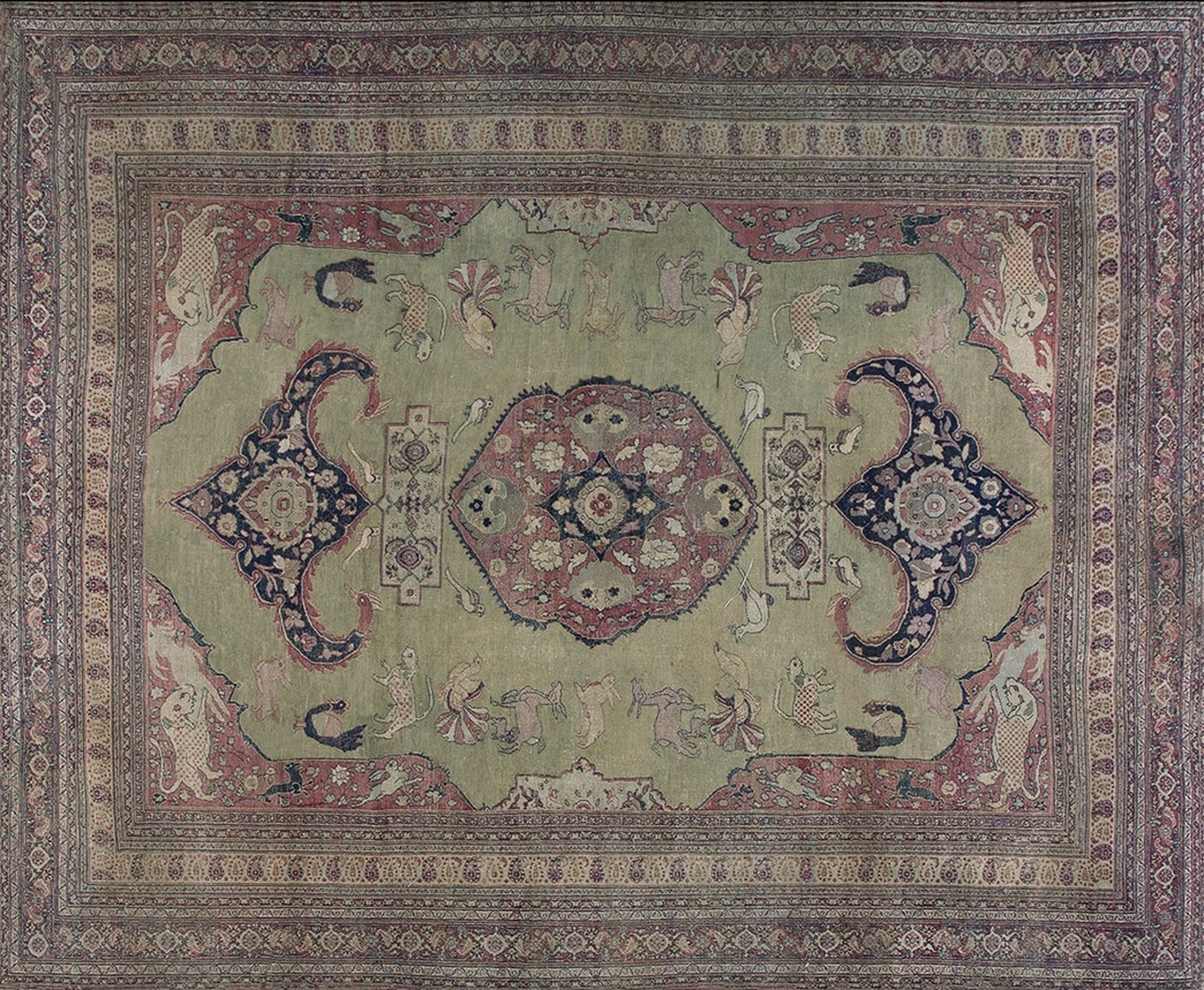
Antique Moud Persian Medallion Knotted Rug – by Rugs On Net
These subtle variations created what are now referred to as sage green or moss green tones, especially sought after in 18th- and early 19th-century Persian and Caucasian carpets. Because of their scarcity, green bands, motifs, or borders in antique examples often signal reverence, status, and skilled craftsmanship.
Impact of Synthetic Dyes
The introduction of aniline dyes in the 1860s marked a turning point. For the first time, weavers could access brilliant jade and emerald hues with less effort. However, these early synthetics lacked stability: many vintage green area rugs from this period show fading, bleeding, or discoloration due to unstable chemical compounds.
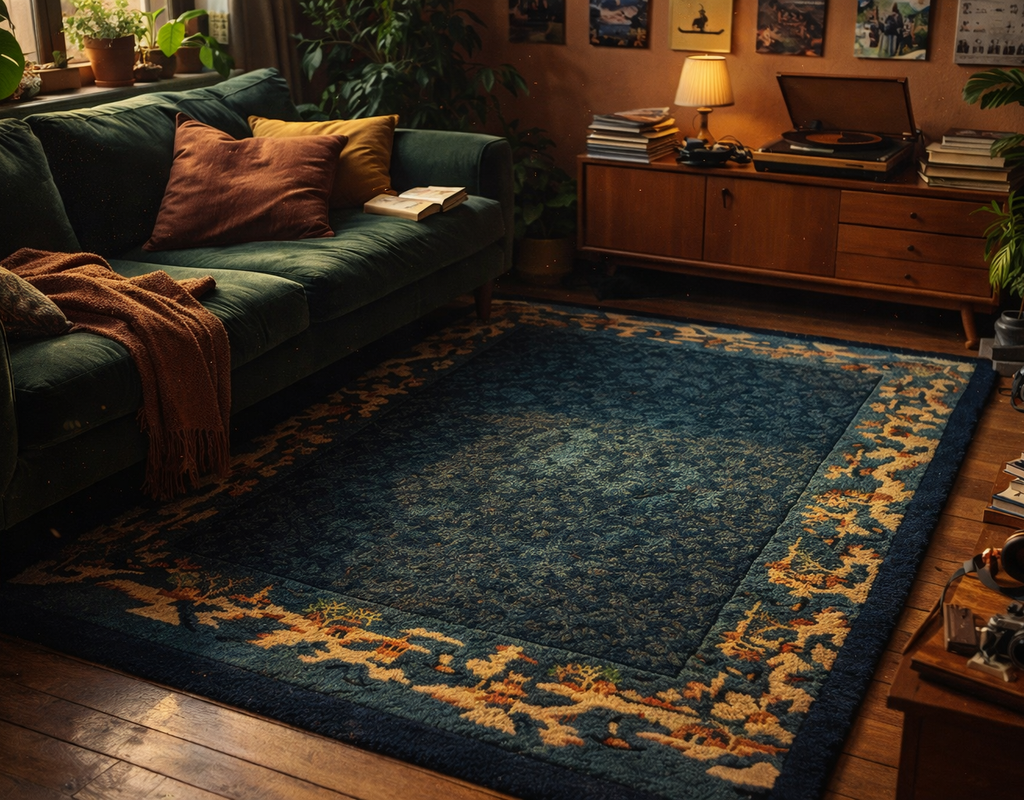
A richly textured, dark blue area rug grounds this intimate and vintage-inspired living room.
By the early 20th century, the development of chrome dyes solved these issues, offering bold and reliable greens that retained their vibrancy over decades. While this democratized color access and expanded the palette of modern workshops, it also diminished the rarity that had once made natural-dyed green carpets so esteemed.
Collectors often distinguish between the ephemeral intensity of aniline-dyed rugs and the enduring subtlety of natural-dyed green rug colors from earlier centuries.
Modern Revivals of Natural Green Rug Colors
In the late 20th century, collector interest spurred a revival of traditional dye methods. Projects like DOBAG (in Turkey) and Sayahi workshops (in Iran) reintroduced vegetable-dyeing, preserving recipes for authentic green rug colors that had nearly vanished. These artisan revival movements emphasized sustainability, authenticity, and historical continuity.
Today, many contemporary workshops blend both traditions, using chrome dyes for consistency but turning to vegetable dyeing for high-end commissions where nuanced abrash and cultural resonance are prized. This green revival weaving movement has reinvigorated appreciation for subtle, organic shades in contrast to the flat uniformity of synthetic tones.
The historical journey of green in rugs reflects a cycle of scarcity, chemical abundance, and renewed reverence. Antique examples remain the most valuable, but modern natural-dye revivals ensure that the artistry of achieving true green endures for future generations.
Are hand-knotted green Oushak rugs appreciating in value currently? Yes. The value of green Oushak rugs has risen steadily, particularly for hand-knotted antique or vintage examples, as collectors prize their subtle sage tones and rarity in large sizes.
When is a bold jade rug worth professional appraisal costs? A jade rug should be appraised if it is hand-knotted, antique, or displays original natural-dye coloration. The combination of rarity and bold coloration can significantly increase its market value.
How do emerald rugs affect resale value of home decor? An emerald rug can enhance resale appeal by adding a statement piece that conveys vibrancy and luxury. In staging and interior design, bold green rug colors often serve as anchors, elevating the perceived sophistication of a space and contributing to higher buyer interest.
Modern Trends & Decor with Green Rug Colors
Popular Green Rug Colors and Tones: Sage, Olive, Emerald, Jade
- Sage Green Rug Trend — Why: Sage green rug colors is currently one of the most popular tones in modern green carpets, loved for its calming, earthy effect. It blends effortlessly with neutral palettes, making it ideal for minimalist and Scandinavian spaces.
- Olive Green — Why: Olive green rug colors offers warmth and grounding, working especially well in rustic, bohemian, and transitional interiors. It pairs beautifully with natural wood and leather furnishings.
- Emerald — Why: Emerald green rug colors serve as bold statement pieces, lending vibrancy and luxury to modern living rooms or eclectic settings. This tone thrives in glamorous or maximalist interiors.
- Jade — Why: Jade green rug colors balance freshness and sophistication, often appearing in contemporary designs where a jewel-like accent enlivens otherwise subdued spaces.
Overdyed & Contemporary Green Rugs
One of the strongest trends in recent years is the rise of overdyed green rugs. By re-dyeing vintage carpets in bold emerald or jade tones, designers create pieces that feel both sustainable and fashion-forward.
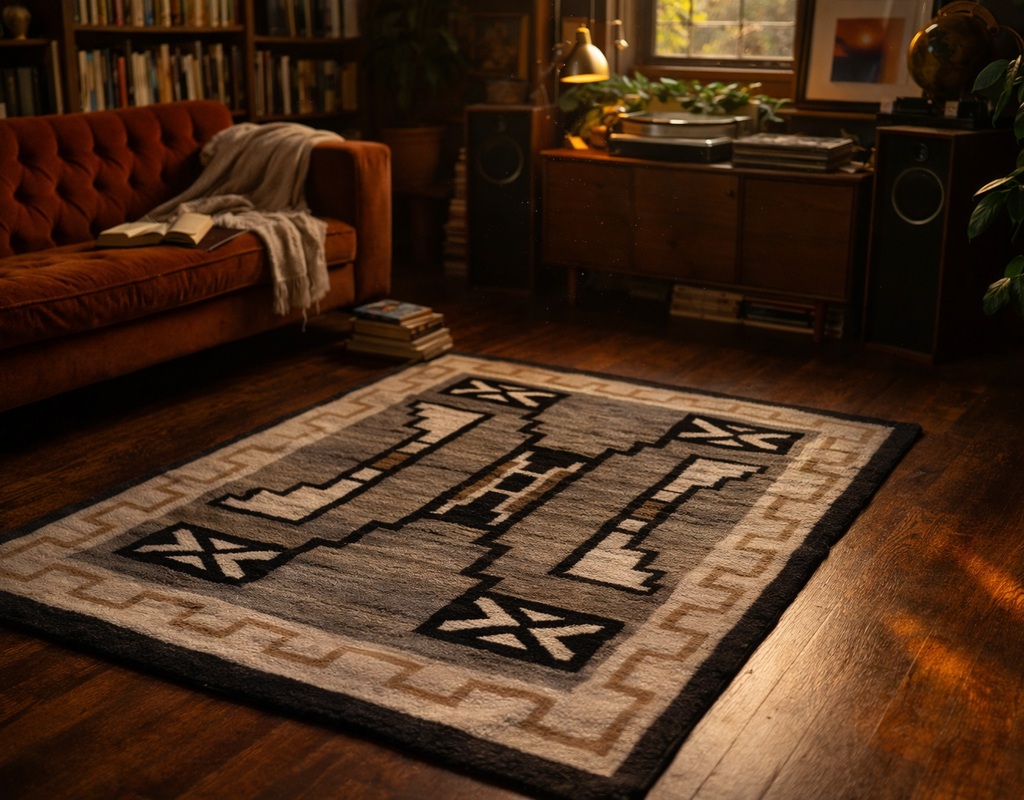
A geometric area rug anchors the seating area in this dimly lit, book-lined study.
These rugs appeal to eco-conscious buyers who appreciate upcycling, while also attracting younger homeowners seeking high-impact modern decor. Their bold coloration means they often function as artwork for the floor, especially in lofts, open-plan apartments, and industrial settings.
Overdyed designs are not only stylish but also hold strong resale value, as they bridge the gap between traditional craftsmanship and modern aesthetics.
Best Wall Colors & Interior Styles with Green Rugs
- White Walls — Why: Crisp white allows green rug colors to shine as focal points, ideal for minimalist or contemporary interiors.
- Gray Walls — Why: Gray and green rug colors create a cool, calming palette that works well in modern living rooms and offices.
- Blush or Pink Accents — Why: These tones balance green’s natural grounding with warmth and playfulness, popular in eclectic or boho design.
- Deep Blue Walls — Why: Bold blue backdrops highlight emerald and jade tones, creating a jewel-toned, dramatic atmosphere.
Green rugs easily adapt across styles, from Scandinavian calm to bohemian eclecticism, classic elegance, or modern minimalism, making them some of the most versatile flooring options in today’s interiors.
Green Rug Colors in Open-Plan & Scandinavian Spaces
- Scandinavian Decor — Why: A green rug for Scandinavian decor introduces softness and warmth into pale wood and white settings, serving as a natural anchor without overpowering simplicity.
- Open-Plan Homes — Why: Large green rugs, especially in sage or emerald tones, help define zones in open layouts. They create cohesion across seating areas while maintaining a natural, grounding flow.
Pattern Pairing: Mixing Green Rug Colors with Upholstery
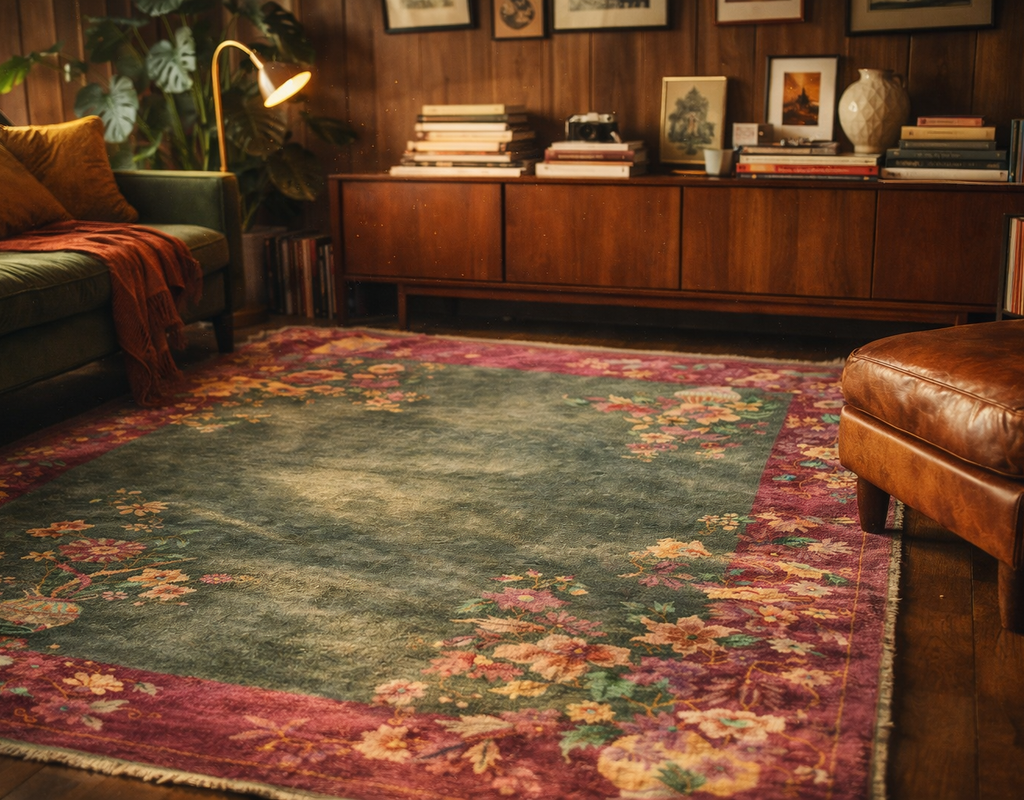
A richly colored floral rug defines the intimate and warmly lit atmosphere of this retro-inspired living area.
- As a Bridge Color — Why: Green rug colors often work as a mediator between bold upholstery prints and neutral backdrops.
- Pairing with Stripes or Geometric Upholstery — Why: The natural stability of green grounds busy patterns, preventing visual chaos.
- Floral Upholstery Pairings — Why: Green rugs echo leaf tones, tying bold floral fabrics into the overall room design.
- Avoiding Competition — Why: Balance is key—when the rug is richly patterned, upholstery should remain simple, and vice versa.
What modern rug trends highlight sage green colorways? Sage tones are central to the sage green rug trend, appearing in minimalist, Scandinavian, and wellness-inspired interiors for their calming and timeless qualities.
Can green rugs work with neutral Scandinavian interiors? Yes. A soft sage or olive green rug brings warmth, grounding, and texture to Scandinavian spaces dominated by pale woods and whites, ensuring the room feels inviting rather than stark.
Should designers mix green rug colors with patterned upholstery fabrics? Yes, but strategically. A green rug works best as a bridge color, grounding bold patterns and preventing them from overwhelming a space. Pairing is most effective when the rug is simpler in design and complements rather than competes with upholstery prints.
Buying, Care & Conservation of Green Colored Rugs
Light Sensitivity & Preventing Sun Fade
- Rotate the Rug — Why: Direct sunlight fades the yellow components of green rug colors / dyes first, shifting tones toward blue or gray. Regularly rotating a rug helps prevent uneven fading.
- Use Window Treatments — Why: Sheer curtains, blinds, or UV-filtering glass reduce exposure, protecting both antique and modern green rugs.
- Avoid South-Facing Windows — Why: These receive the strongest light; placing a green carpet here without protection accelerates fading.
Cleaning & Vacuuming Green Colored Area Rugs
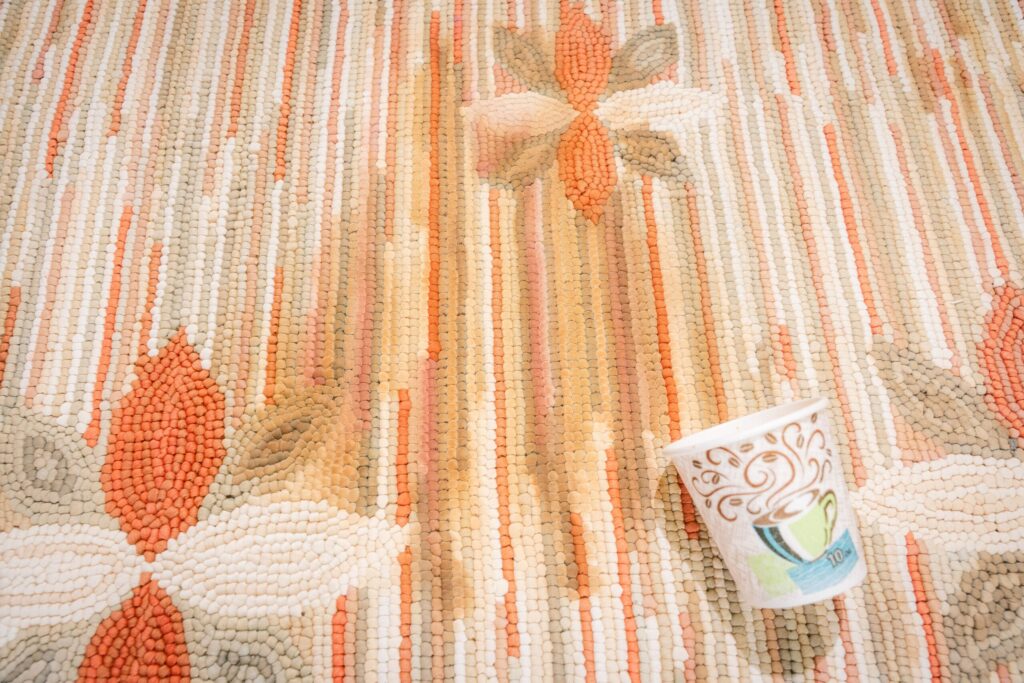
Close-up view of a tipped paper coffee cup resting on a handwoven wool rug, highlighting the rug’s dense pile, subtle color variations, and traditional geometric motifs in warm neutral and terracotta tones.
- Vacuum Gently — Why: Green rug vacuuming should preserve pile integrity. For antique or silk pieces, vacuuming once every 2–3 weeks is safer than weekly to avoid fiber stress.
- Spot Clean Carefully — Why: Use blotting and mild soap solutions for spills; harsh cleaners risk stripping vegetable-dyed greens.
- Professional Cleaning — Why: Antique green silk rugs and vegetable-dyed carpets benefit from occasional expert care, ensuring both fibers and colors remain stable.
Effects of Humidity & Pile Density on Green Rugs
- Humidity Control — Why: High humidity accelerates fading in vegetable-dyed green rug colors, weakening dye bonds. A dehumidifier helps stabilize conditions.
- Pile Density — Why: High pile intensifies green rug colors and saturation, creating bold emerald effects, while worn or low pile rugs soften into sage or olive. Understanding pile density helps buyers match visual impact to their space.
Sustainability: Where to Find Ethically Dyed Green Kilims
- DOBAG Cooperative (Turkey) — Why: Renowned for reviving natural dyeing, including sustainable green rug colors kilim production.
- Afghan Artisan Projects — Why: Many weaving initiatives in Afghanistan focus on vegetable-dyed wool and fair-trade principles.
- Local & Online Fair-Trade Galleries — Why: These sources support artisans directly and ensure environmentally conscious dyeing processes.
When Appraisal Makes Sense for Green Rugs
- Antique Green Oushak Rugs — Why: Their rarity and scale justify professional appraisal for insurance and resale purposes.
- Boldly Colored Kazak Carpets — Why: Green-dominant fields in tribal rugs are unusual, making them highly collectible.
- Emerald or Jade Rugs — Why: Bright tones achieved through early dyes or unusual field usage may significantly affect long-term value.
Green Rug Colors & Resale Value
- Anchor in Home Design — Why: Emerald or olive green rugs act as statement pieces, increasing perceived luxury in staged interiors.
- Vintage Appreciation — Why: Collectors value natural-dyed sage or moss tones, driving steady appreciation in antique green rugs.
- Practical Appeal — Why: A green rug hides everyday dirt better than beige, balancing functionality with beauty, which adds to its market desirability.
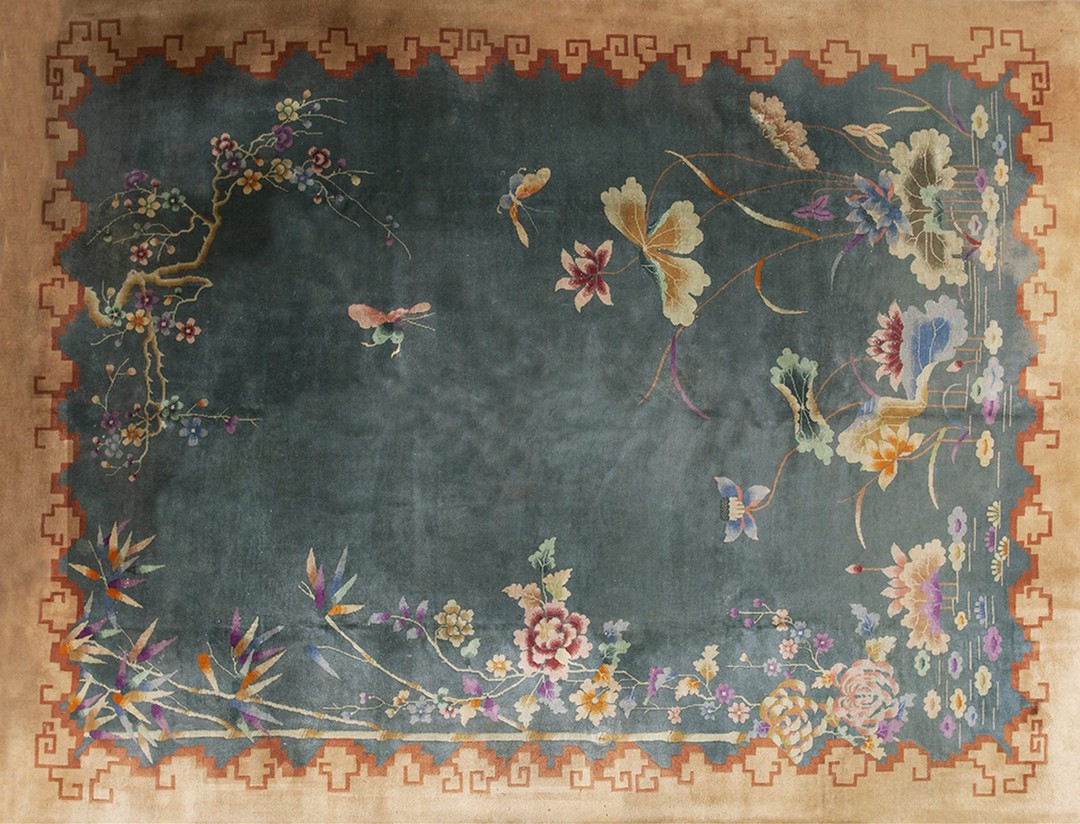
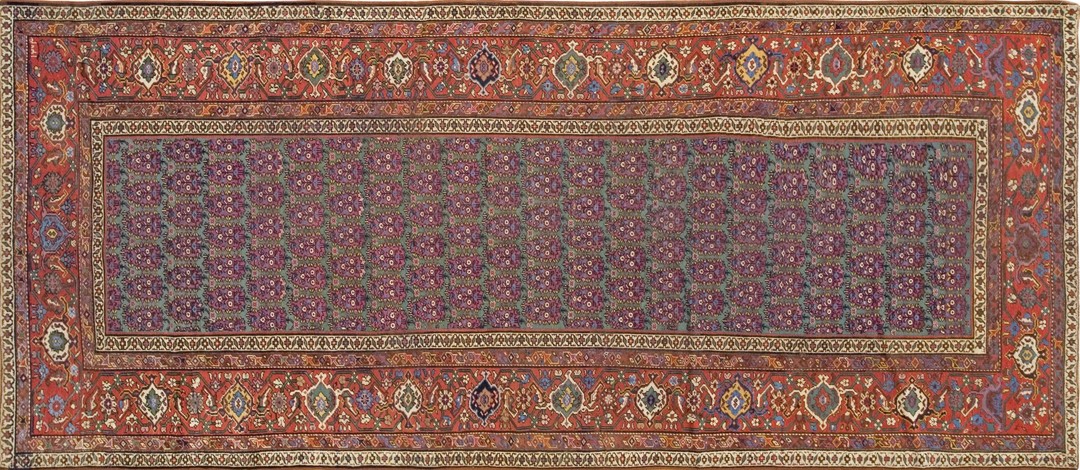
Explore a Few of Our Favorite Green Rugs
FAQ
- How do I reduce shedding on green wool rugs?
Vacuum with a suction-only head weekly and avoid beater bars. Shedding typically subsides within a few months; rotate to balance wear.
- What green rug works in a hallway?
Choose green runners leaving 3–5 inches of floor visible on each side. Standard widths are 2–3 feet; use a low-profile non-slip pad.
- Are green viscose rugs a good idea?
They’re silky but delicate—water can spot or yellow viscose. Reserve green viscose rugs for low-traffic, dry areas and rely on professional cleaning.
- What curtains go with green rugs?
White, oatmeal, or flax curtains keep green rugs fresh. For drama, try indigo or rust panels and repeat the accent color in pillows.
- Will a green rug make a small room feel larger?
Light sage green rugs visually expand space, especially in larger sizes that tuck under seating. Darker greens cozy rooms and hide wear.
- What patterns complement solid green rugs?
Stripes, geometrics, or subtle florals in cream, taupe, navy, or blush pair well. Mix textures—linen curtains, boucle throws—for depth.
- Should I layer a green rug over carpet?
Yes—use a carpet-to-carpet pad (felt/rubber) to prevent ripples. Keep the top green rug smaller so at least 4–6 inches of the base shows.
- How much do green rugs cost?
Expect roughly \$50–\$300 for 5×8 synthetics, \$300–\$900 for 8×10 hand-tufted wool, and \$1,000+ for hand-knotted green rugs depending on origin and knot density.
- Are green rugs good for outdoor spaces?
Use polypropylene green rugs with UV stabilization; they hose clean easily. Avoid rubber backs on composite decks to prevent staining.
- Can I use green rugs with underfloor heating?
Yes—pick flatweave or low-pile green rugs and a thin pad. Avoid dense foam backings that trap heat; follow your floor’s temperature limits.
- Are green rugs safe for pets and kids?
Choose low-pile wool or performance synthetics; avoid delicate viscose. Look for third-party labels like OEKO-TEX® Standard 100 or Green Label Plus.
- Can robot vacuums handle green rugs?
Most handle low-pile green rugs fine. High-pile or shag (around ¾ inch or more) can tangle brushes—set no-go zones if needed.
- What rug pad should I use under green rugs on hardwood?
A felt-and-natural-rubber pad prevents slips and adds cushion. Thickness around ¼–⅜ inch is comfortable without raising thresholds.
- Will green rugs fade in sunlight?
Yes—direct UV can lighten dyes. Use window coverings or UV film and rotate the rug periodically to even exposure.
- How do I prevent color bleeding on green rugs?
Test colorfastness first by dabbing a damp white cloth on a hidden area. Use cool water, avoid oversaturation, and dry quickly to reduce dye migration.
- How do I clean a spill on a green wool rug?
Blot immediately—don’t rub. Spot-clean with a mild solution (e.g., ¼ cup white vinegar to 2 cups water), then blot dry and elevate airflow.
- Are green jute or sisal rugs good near moisture?
Use caution—natural-fiber green rugs can absorb water and stain. Save them for dry zones; choose polypropylene or PET for kitchens or entries.
- Are green wool rugs durable for high-traffic areas?
Green wool rugs are resilient and naturally stain-resistant. Expect some shedding for 3–6 months; regular vacuuming on low suction helps.
- Will dark green rugs hide dirt better than light green rugs?
Yes—olive, forest, and deep emerald green rugs mask everyday soil better than pale sage. Patterns also disguise spots between cleanings.
- Do green rugs work with gray sofas?
Absolutely—green rugs add warmth to gray sofas. Use sage with light gray or forest green with charcoal plus brass or black accents.
- Which wall colors pair best with green rugs?
Green rugs love crisp whites, soft grays, taupes, and blush accents. For contrast, try navy or mustard on a single wall.
- How big should a dining room green rug be?
Choose a green rug that extends 24–30 inches past the table edges so chairs stay fully on the rug when pulled out.
- What size green rug should go under a queen bed?
An 8×10 green rug typically fits a queen, giving 18–24 inches of rug beyond the sides and foot so your feet land on soft pile.
- What size green rug works best in a living room?
Aim for 8×10 or 9×12 green rugs so the rug extends at least 6–8 inches past the sofa on each side, grounding all front furniture legs.
- Are green rugs in style right now?
Yes—soft sage and deeper emerald green rugs are trending as “new neutrals” and jewel tones. Designers pair them with taupe, warm woods, and brass for balance.