
Medallion Rugs: What Defines the Style?
Anchor your room’s aesthetic and explore our exquisite range of Central Medallion Rugs available at Rugs On Net.
Simple Definition
A medallion rug is best understood in simple terms as a carpet with a large, often symmetrical motif placed at its center, acting as the visual anchor of the entire design. This central element—sometimes called the “Toranj” in Persian—resembles a decorative medal or emblem and may take the form of a circle, oval, star, or more intricate geometric shape. Unlike all-over rugs where patterns spread evenly across the field, a central medallion rug highlights one bold motif and organizes the rest of the design around it.
Essential Visual Features
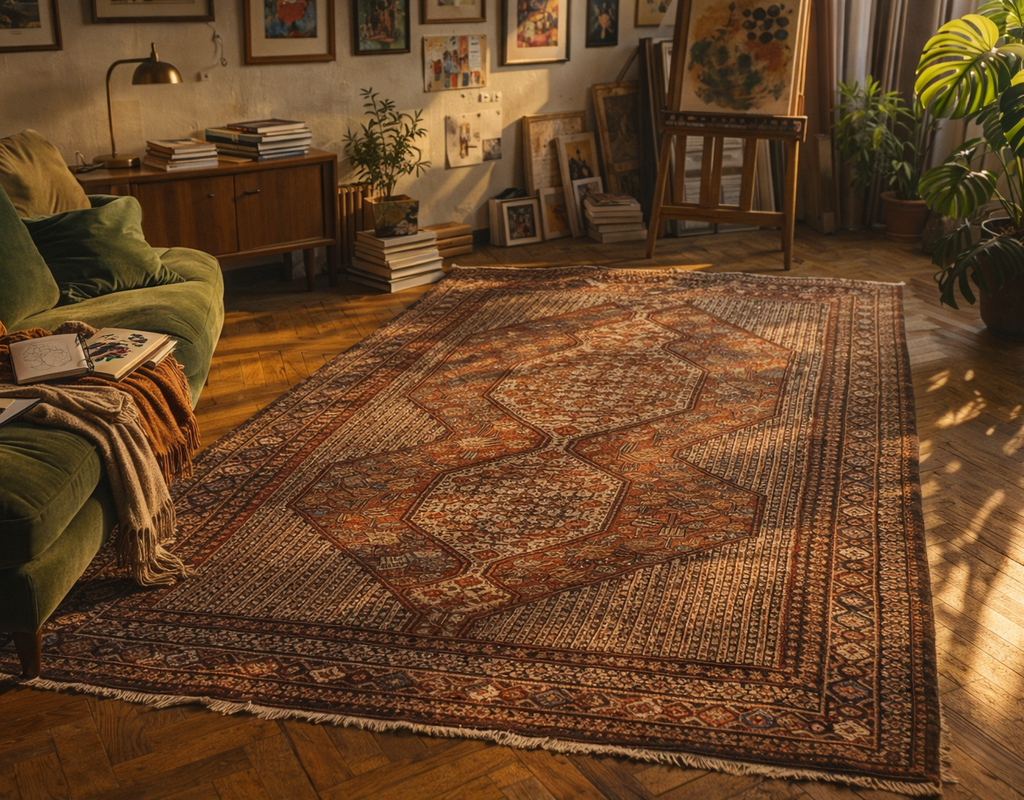
A richly colored, traditional rug defines the living space in this sun-drenched, art-filled room.
The defining characteristic of a medallion design carpet is the central medallion, but it does not stand alone. Several visual features consistently appear in this rug type:
- Medallion at the center: The motif can be simple and round, or complex with star-like or lobed edges, but it always dominates the eye.
- Spandrels or quarter-medallions: Often, smaller motifs echo the main medallion in each corner of the rug, creating balance and reinforcing symmetry.
- Symmetry and order: Most medallion pattern rugs are meticulously designed so that every side mirrors the other, producing a sense of harmony.
- Framing borders: Multiple bands or borders typically enclose the field, acting as a frame around the central medallion and its supporting elements.
These visual structures combine to ensure that the medallion remains the primary focus while the rest of the rug complements rather than competes with it.
Why the Style Stands Apart
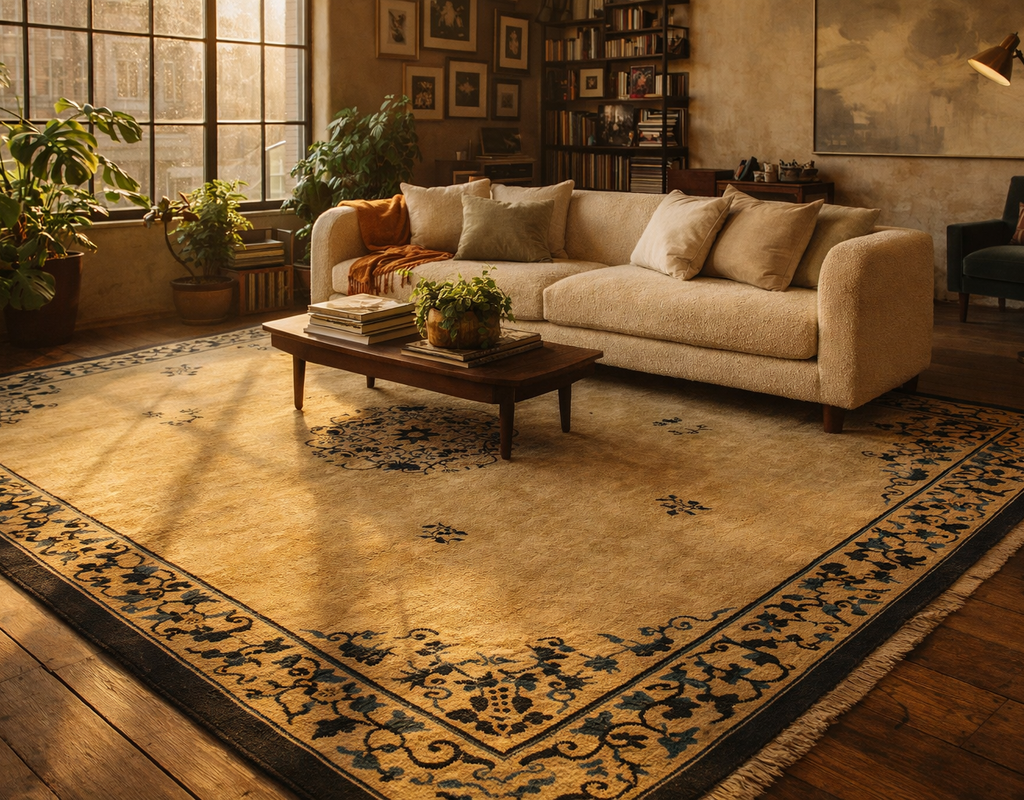
A beautiful traditional-style rug anchors this inviting living area filled with natural light and greenery.
A medallion rug is distinct because its design directs attention inward. Where other rug types might emphasize repeating motifs, narrative scenes, or abstract all-over patterns, the medallion format isolates one central feature and surrounds it with careful symmetry. The effect is bold, balanced, and timeless—an aesthetic that has made central medallion rugs one of the most recognizable and enduring categories of carpets. In short, what defines a medallion rug is its visual focus on a central motif, reinforced by symmetry, framed by borders, and often echoed by corner spandrels. This combination creates an unmistakable style that has captivated collectors and designers for centuries.
Origins and Historical Evolution of Medallion Rugs
Roots in Persia and Anatolia
The classical medallion layout first crystallized in Safavid Persia during the 16th century, when royal weaving ateliers revolutionized carpet design. Inspired by book illumination, Sassanian silk textiles, and architectural ornament, Safavid designers placed a large, symmetrical medallion at the center of the field, often surrounded by pendants and corner spandrels. These Persian medallion rugs became symbols of courtly refinement, with masterpieces woven in Tabriz, Isfahan, and Kashan. At the same time, the Ottoman Empire adapted the format. In western Anatolia, the workshops of Ushak became renowned for their monumental Ushak medallion carpets, which translated the Safavid idea into bold, geometric forms with warm, glowing colors. This parallel development in Anatolia established the medallion as one of the dominant design systems of Oriental carpets.
Key Moments in Development
The spread of the medallion design reflects both cultural exchange and imperial patronage:
- Safavid revolution (16th century): Medallion rugs emerge as prestige objects in Persian royal courts.
- Ottoman adaptation (16th–17th centuries): Ushak looms translate the design into Anatolian aesthetics.
- Mamluk Egypt and beyond: Parallel medallion motifs appeared in Cairo, showing a shared Islamic artistic vocabulary.
- Mughal India (16th–17th centuries): Imported Persian designers brought the classical medallion layout into imperial Mughal carpets.
- China (17th century): Through Persian and Mughal connections, medallion motifs entered Chinese carpet weaving, often blended with Buddhist symbols.
Over time, the medallion became synonymous with royal taste and technical mastery, a format reserved for the most ambitious commissions.
Timeline: From Origins to Modern Adaptations
- th century: Proto-medallion concepts visible in Islamic manuscripts and textiles.
- th century: Safavid Persia perfects the design; Ushak workshops popularize it across Ottoman Turkey.
- th century: Mughal and Chinese carpets incorporate medallion structures.
- th–19th centuries: European manufacturers, particularly Savonnerie and Aubusson, adapt the medallion motif into grand court carpets for palaces and aristocratic interiors.
- Modern period: The medallion remains one of the most enduring rug patterns, reproduced in both handmade and machine-made carpets worldwide.
Courtly Prestige and Lasting Influence
To answer directly: Safavid Persia first popularized medallion layouts in Oriental rugs, supported by royal workshops that elevated the motif into a symbol of sophistication. Later, European designers adapted medallion motifs in the 18th and 19th centuries, blending them into French neoclassical interiors. The history of the medallion rug demonstrates how a single design concept—anchored in symmetry, balance, and grandeur—could travel across empires, evolve in multiple cultural contexts, and remain central to rug design up to the present day.
Symbolism and Cultural Meaning of the Medallion Motif
Why the Central Medallion Matters
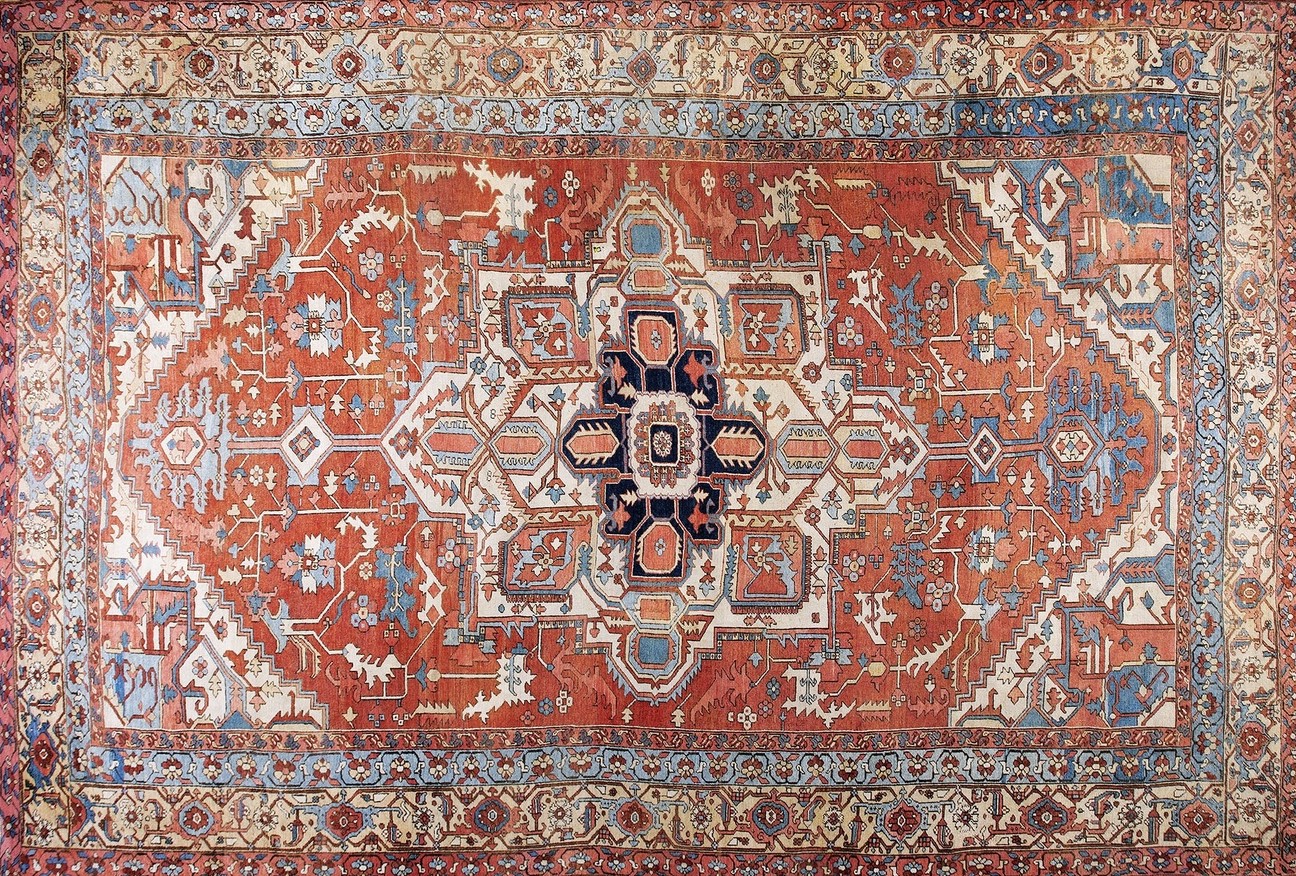
Antique Large Serapi Persian Medallion Knotted Rug – by Rugs On Net
In Persian carpets, the central medallion is far more than a decorative device—it is a symbol of harmony, balance, and divine order. Rooted in Islamic art and cosmology, the medallion often represents the cosmic center or axis mundi, the point where heaven and earth meet. This is why central medallions are significant in Persian carpets: they provide not just visual focus, but also a spiritual anchor, transforming the rug into a symbolic map of the universe. Historically, the orientation of a medallion rug in a room reinforced status, architectural symmetry, or even religious focus, making the motif both practical and profound.
Spiritual and Cosmic Symbolism
The medallion rug symbolism draws on deep spiritual traditions. The circular or star-like form of the medallion often echoes the sun (shamsa), radiating light and guidance. Its symmetry reflects unity and divine order, suggesting paradise gardens with their perfectly arranged quadrants. Within this framework, the central motif meaning expands: flowers can symbolize love or paradise, animals may denote protection or power, and Quranic verses or poetry add layers of moral and spiritual reflection. A spiritual medallion carpet, therefore, is both a work of art and a vessel of cultural meaning, where the design mirrors universal order and human aspiration.
Common Medallion Shapes and Their Meanings
- Circle — Eternity and wholeness. — Why: The unbroken line symbolizes infinity and the eternal nature of the divine.
- Star — Guidance and light. — Why: Often linked to the heavens, stars convey spiritual direction and illumination.
- Diamond — Strength and stability. — Why: The sharp, balanced geometry suggests resilience and clarity.
- Hexagon — Interconnectedness. — Why: With its tessellating form, it reflects harmony and the unity of all parts within the whole.
Symbolic Centerpiece in Culture
Together, these shapes and their internal motifs give the medallion its rich cultural voice. Whether woven with flowers representing paradise, verses affirming faith, or animals offering protection, each medallion design carpet becomes a symbolic universe in miniature. By centering the eye and spirit on the motif, medallion rugs unify decoration with meaning, making them both visually striking and culturally profound.
Regional Styles and Variations
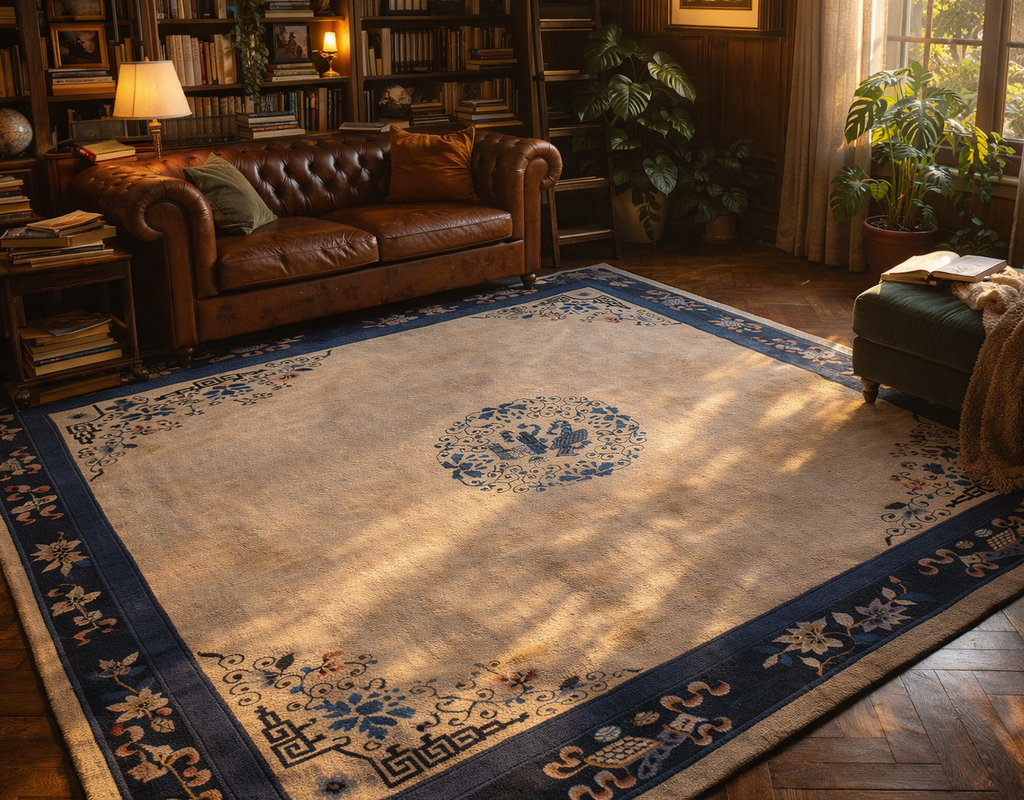
Sunlight streams across a traditional library showcasing a striking blue and beige Oriental rug.
Persian City Rugs
Among the most refined examples of medallion carpets are those produced in Persian city workshops. Tabriz medallion rugs, as well as those from Kashan and Isfahan, are known for their curvilinear floral medallions, executed with extraordinary precision and a high knot count. These designs often feature finely drawn palmettes, scrolling vines, and layered medallions with pendant extensions, all rendered in a delicate, painterly style. Such rugs exemplify the classical Persian taste for balance, detail, and naturalistic ornament.
Turkish and Ottoman Traditions
In Anatolia, the Ottomans adapted the medallion concept to suit their own aesthetics. The celebrated Ushak medallions of western Turkey, woven on a monumental scale, are characterized by large, rounded forms with a looser, more relaxed drawing style. These medallions often appear in golden yellows, warm reds, and soft pastels, producing a luminous quality suited for mosques and palaces. Later Ottoman weaving centers such as Hereke refined the medallion tradition with finely woven silk rugs, integrating floral motifs with Ottoman imperial grandeur.
Tribal and Nomadic Interpretations
Away from urban workshops, tribal groups transformed the medallion into bold, geometric symbols. The Heriz medallion carpet of northwest Persia, for example, reimagines the central motif as a massive diamond or star rendered in angular lines and robust colors. In the Caucasus, Kazak weavers employed sharp-edged medallions filled with abstract motifs, while Turkmen tribes favored serial guls—small, repeating medallion-like forms that created rhythmic fields. These tribal medallion designs emphasize strength, clarity, and graphic impact, standing in contrast to the delicate floral medallions of city looms.
Floral vs. Geometric Medallions
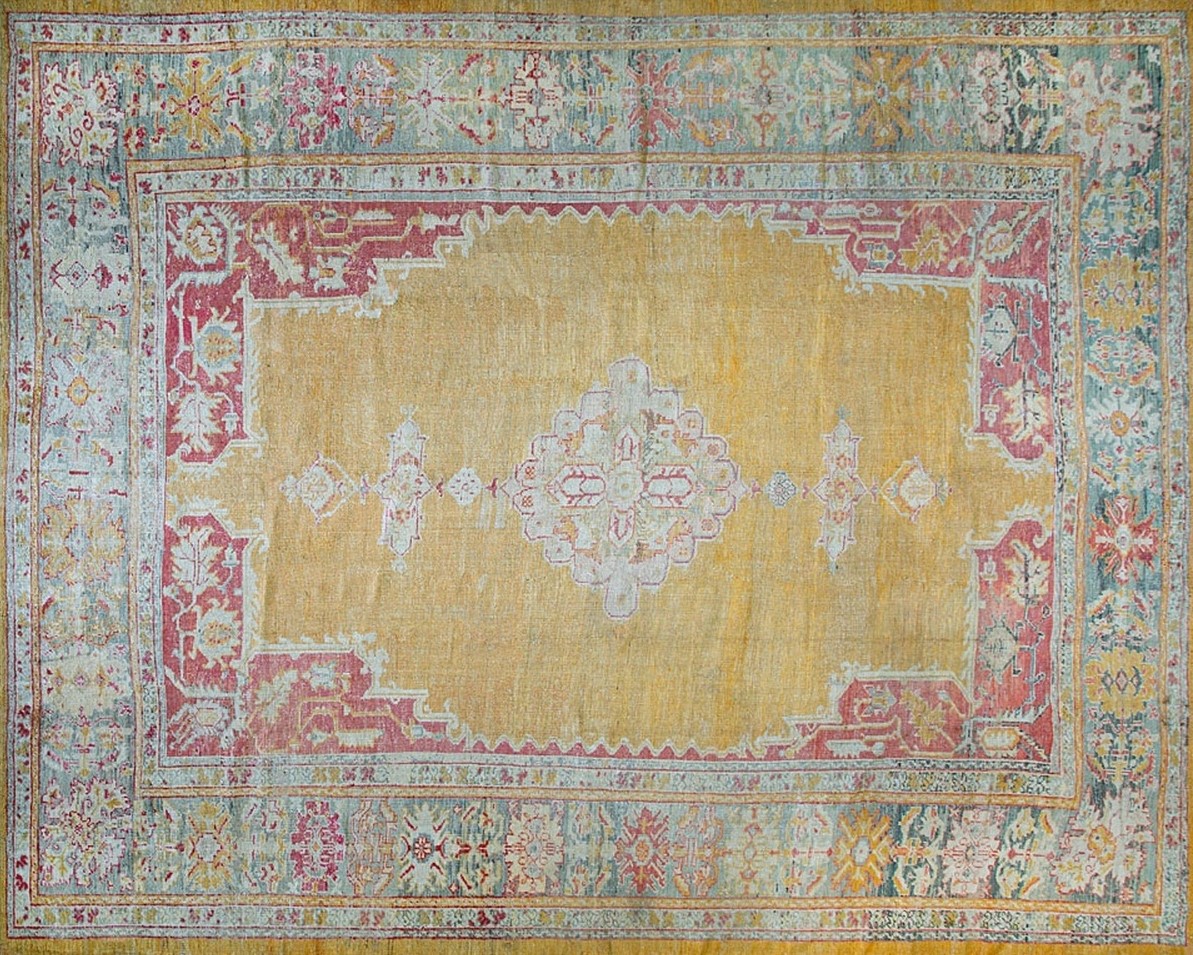
To answer directly: floral medallions dominate in urban Persian rugs such as Tabriz, Kashan, and Isfahan, where high knot counts allowed intricate, curvilinear drawing. By contrast, geometric medallions are most common in tribal and Anatolian traditions such as Heriz, Kazak, and Turkmen, where weavers employed angular, stylized forms suited to bold, graphic expression.
Notable Examples by Region
Tabriz (Persia): Fine floral medallions with detailed curvilinear motifs. — Why: Represents the classical refinement of Persian city weaving. Kashan/Isfahan (Persia): High-knot-count carpets with elegant, symmetrical medallion layouts. — Why: Hallmarks of Safavid and later revival periods, admired for courtly taste. Ushak (Turkey): Monumental medallions in glowing colors and simplified drawing. — Why: Iconic Ottoman carpets prized in both Eastern and European collections. Heriz (Persia): Angular diamond medallions in strong colors. — Why: Quintessential tribal reinterpretation of the medallion, famous for durability. Kazak (Caucasus): Bold, geometric star or cross-shaped medallions. — Why: Tribal expression with strong symbolic resonance. Turkmen (Central Asia): Serial gul medallions repeated across the field. — Why: Creates rhythm and identity, often linked to clan symbols. Regional variation thus determines not only the form of the medallion—floral or geometric—but also the scale, density, and spirit of the design, making medallion rugs some of the most diverse yet cohesive expressions in the weaving world.
Design Anatomy: Structure, Motifs, and Colors
Medallion and Corner Spandrels
A defining feature of many medallion rugs is the combination of the central motif with spandrels—quarter medallions set in each corner of the field. These spandrels mirror the medallion’s shape, creating a structural frame that directs the eye inward toward the centerpiece. To answer directly: corner spandrels complement a medallion centerpiece by reinforcing symmetry and completing the sense of balance, ensuring that the rug reads as a unified, harmonious whole rather than a floating central design.
Medallion Shapes and Their Purpose
- Circle — Symbol of eternity and wholeness. — Why: Represents unity and the eternal nature of the divine.
- Oval — Grace and flow. — Why: Offers a softer, elongated balance that complements floral ornament.
- Star — Guidance and illumination. — Why: Associated with celestial order and directional meaning.
- Diamond — Strength and clarity. — Why: The sharp geometry conveys firmness and stability.
- Hexagon — Interconnectedness. — Why: Evokes harmony between multiple elements, often used in repeating medallion formats.
These forms give the medallion flexibility, allowing it to adapt to courtly, urban, or tribal traditions while maintaining its identity as the focal motif.
Symmetry in Medallion Rugs
Hand-knotted medallion rugs are almost always built around a symmetrical rug design, balanced along both vertical and horizontal axes. This symmetry is essential for the medallion format: it ensures that the eye experiences harmony and order, no matter which angle the rug is viewed from. Yes, medallion designs in hand-knotted rugs are typically symmetrical, though minor variations may occur in village or tribal examples due to hand-weaving spontaneity.
Use of Color for Contrast
The drama of a medallion carpet is heightened by carefully chosen colors. Contrasts such as deep indigo and ivory, or crimson red against navy blue, allow the medallion to leap out from the field. Subtle shading within the medallion itself emphasizes its layered structure, while lighter corner spandrels and darker borders work together to create a three-tiered visual hierarchy: center first, field second, and frame last. These medallion carpet colors underscore the motif’s dominance and lend vibrancy to the design.
Medallion vs. All-Over vs. Pictorial Layouts
In structure, the medallion format differs sharply from other rug designs. All-over rugs distribute repeating patterns evenly, with no single focal point, creating a continuous surface. Pictorial rugs, by contrast, present narrative or landscape scenes, often without symmetry or central hierarchy. The medallion with spandrels layout falls in between: while decorative, it imposes a clear order—center, corners, and borders—making it instantly recognizable as one of the most architectural rug types. Together, these structural devices, symmetrical construction, and bold use of color explain why the medallion remains one of the most enduring and universally admired rug formats.
Materials and Weaving Techniques
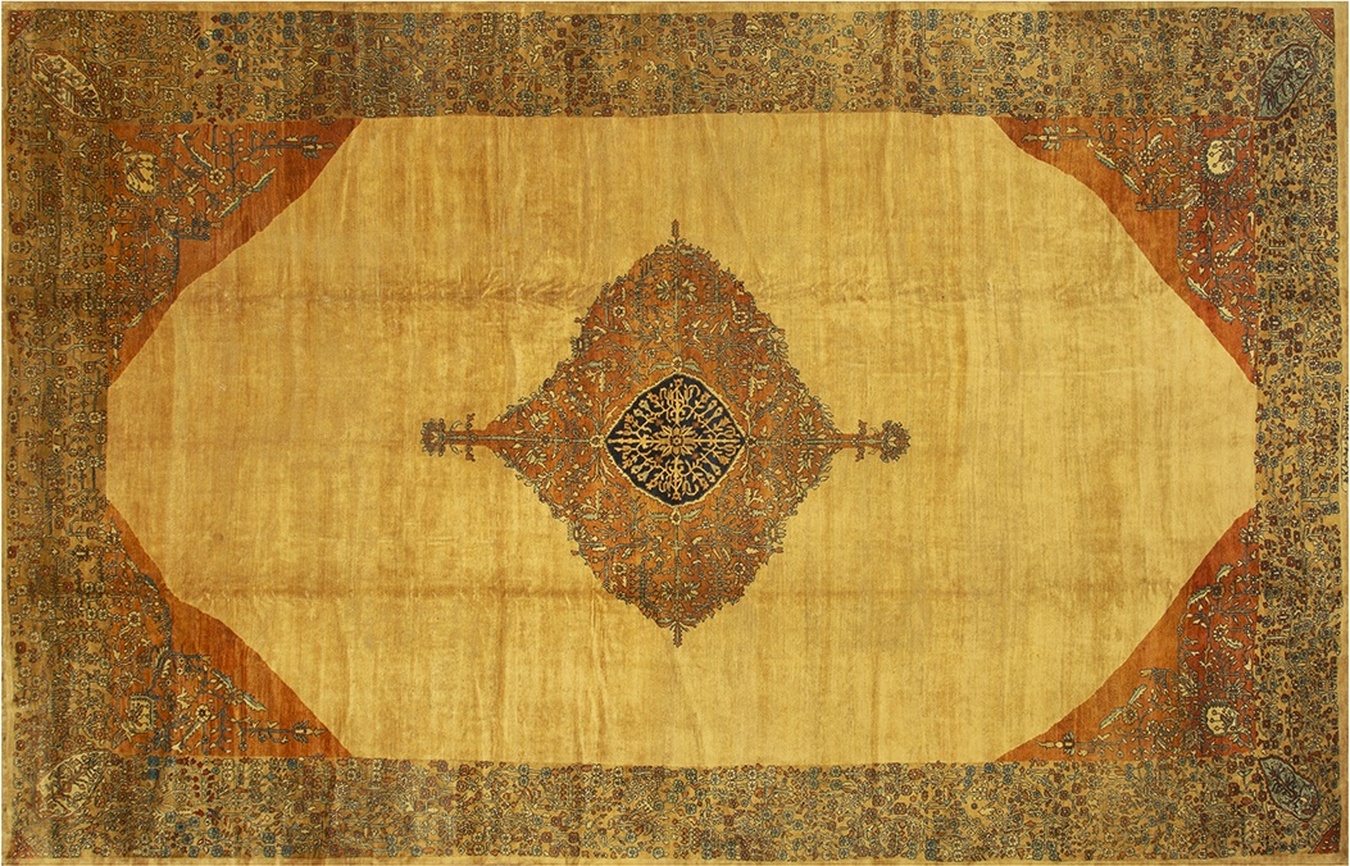
Wool, Silk, and Cotton: Fiber Roles
The choice of fiber directly shapes the sharpness and brilliance of a medallion rug. Wool remains the most common material, valued for its warmth, durability, and ability to take rich dyes. Cotton is typically used for warps and wefts, giving the rug a stable foundation that keeps the medallion’s geometry aligned. Silk, however, is the material most closely tied to clarity: its fine, lustrous fibers allow weavers to render the smallest floral curls or geometric edges with jewel-like precision. To answer directly: yes, silk enhances the clarity of medallion patterns, making a silk medallion rug the pinnacle of refinement in classical weaving.
Knot Types and Density for Crisp Medallions
Knot density is the single most important factor in how sharp a medallion appears. Higher knot density equals greater detail. A fine knot medallion carpet from Tabriz or Isfahan may contain hundreds of knots per square inch, producing clear outlines and delicate curves in the medallion. By contrast, lower-density tribal rugs such as Heriz emphasize bold, angular medallions with less intricacy. Knot type also plays a role: the asymmetrical Persian knot allows curvilinear, floral medallions, while the symmetrical Turkish knot supports robust geometric motifs.
Techniques for Large Medallions
Large-scale medallions require careful planning and technical skill. To answer directly: the best weaving techniques for large central medallions include high knot counts for precision, the use of silk highlights to accentuate edges, and precise loom control to keep proportions symmetrical across the rug’s field. In monumental carpets such as those from Kashan or Ushak, the medallion is often drafted in full-scale cartoons (design templates), ensuring consistency across the loom.
Machine-Made vs. Hand-Knotted Medallion Rugs
Modern technology has enabled the rise of the machine made medallion rug, which can reproduce medallion layouts at a fraction of the cost. However, machine-made rugs cannot fully replicate the precision and depth of hand-knotted medallion rugs. While the patterns may look similar from afar, they lack the subtle variations in pile, the brilliance of natural dyes, and the tactile relief that give handmade rugs their soul. A hand-knotted medallion rug carries both artistic intention and structural longevity, qualities that no automated loom can truly match.
Modern Construction Approaches
Today, rug makers often employ hybrid techniques, blending traditional hand-knotting with modern tools. Digital design software may guide proportions, while selective use of silk highlights or mercerized cotton substitutes refine detail. These innovations ensure that even in contemporary workshops, the medallion format remains adaptable, maintaining its reputation as one of the most technically demanding and visually rewarding structures in rug weaving. In sum, whether expressed in wool, cotton, or silk, the medallion rug’s clarity and brilliance depend on the marriage of fine materials, dense knotting, and skilled craftsmanship—qualities that set the finest examples apart from machine-made imitations.
Modern Interpretations and Trends
Oversized, Distressed, and Abstract Medallion Motifs
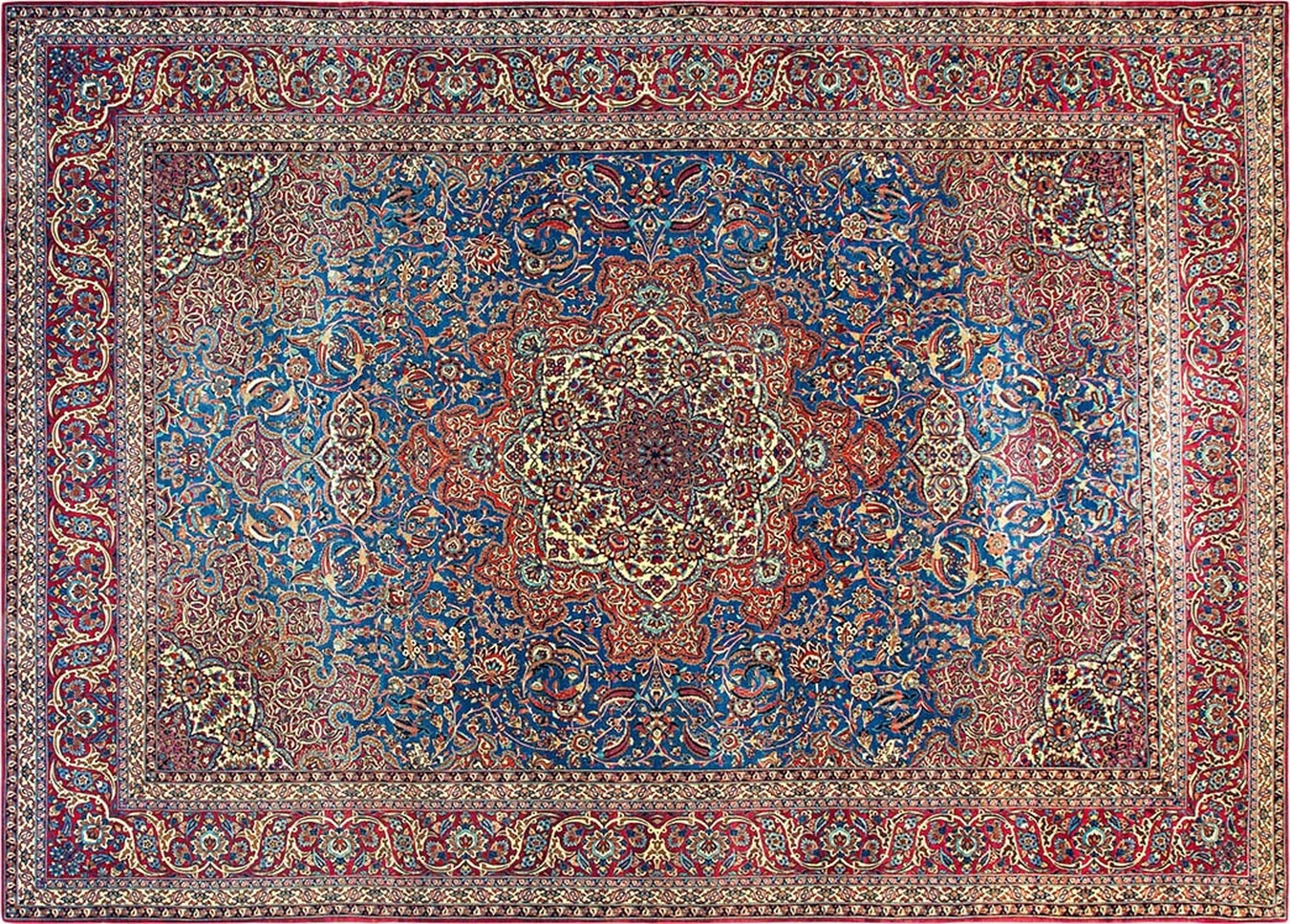
Antique Esfahan Persian Allover Geometric Knotted Rug – by Rugs On Net
- Oversized medallions — Enlarged to dominate nearly the entire rug. — Why: Creates a bold, contemporary statement and shifts the rug into the role of modern artwork for the floor.
- Distressed finishes — Washed, faded, or eroded effects. — Why: Evokes age and authenticity, allowing a new rug to carry the charm of a vintage style medallion rug while blending seamlessly into shabby-chic or bohemian interiors.
- Abstract medallions — Broken, blurred, or partially visible outlines. — Why: Offers a minimalist or artful twist on tradition, making the rug adaptable to modern interiors without losing its medallion identity.
Together, these approaches ensure that the modern medallion rug remains flexible and relevant, capable of complementing both classic and contemporary design schemes.
Contemporary Reinterpretations of Classic Motifs
To answer directly: contemporary weavers update classic medallion motifs by enlarging, simplifying, or fragmenting them, often pairing the designs with washed-out palettes or neutral tones. In some cases, the medallion may appear as a ghostlike trace, softly suggested rather than sharply defined, blending tradition with modern minimalism. Others push the opposite direction, exaggerating scale and contrast so that the oversized medallion rug becomes the central artistic feature of a room.
Suitability for Today’s Interiors
The enduring strength of the medallion design lies in its adaptability. Distressed surfaces allow medallion rugs to integrate into vintage-inspired or boho settings, while abstracted motifs suit minimalist lofts and contemporary apartments. In luxury interiors, finely woven modern medallion rugs with silk highlights remain a symbol of sophistication. This adaptability explains why medallion rugs have never fallen out of fashion despite centuries of shifting decorative trends.
Why Distressed Finishes Work
To answer directly: distressed finishes suit vintage-style medallion rugs because they soften sharp contrasts, fade colors into harmony, and mimic the gentle wear of antiques. This effect lends instant character to a room, creating a sense of history even in newly woven pieces. The distressed medallion carpet thus bridges the gap between tradition and modernity, offering both charm and versatility.
Oversized as a Modern Innovation
Yes—oversized medallions are a modern design innovation, not commonly found in classical carpets where proportions were more restrained. In today’s reinterpretations, enlarging the medallion transforms the rug into a dramatic, almost sculptural element, showing how a centuries-old format continues to evolve with the needs of modern interiors.
Medallion Rugs in the Market: Value, Investment, and Shopping Guide
Vintage vs. New Medallion Rugs for Investment
For collectors, the question often arises: should I choose vintage or new for investment value? The answer depends on intent. Antique and vintage medallion rugs generally provide the safest appreciation potential because they are finite in number and prized for their age, artistry, and rarity. However, new hand-knotted medallion rugs—especially those made with fine silk and high knot density—can also hold value, particularly if they come from respected weaving centers. While antiques appeal to connoisseurs and museums, new pieces may suit those seeking both utility and long-term quality.
Antique Pricing Factors
- Age — Older rugs carry historical prestige. — Why: Carpets from the Safavid, Ottoman, or Mughal periods are museum-worthy and command premium prices.
- Region — Place of origin impacts value. — Why: Tabriz, Kashan, and Ushak rugs are especially prized for artistry and heritage.
- Materials — Wool, silk, or cotton foundation. — Why: A silk medallion carpet is considered the pinnacle of luxury.
- Condition — Integrity of pile, dyes, and structure. — Why: Well-preserved examples are significantly more valuable than heavily restored pieces.
- Provenance — Documentation of origin. — Why: A rug tied to a famous workshop or historical owner carries exceptional prestige.
- Knot density — Fineness of weave. — Why: A high-knot fine medallion rug displays greater detail and commands higher prices.
- Design rarity — Unique motifs or unusual medallion forms. — Why: Collectors prize distinctiveness over repetition.
Provenance and Value
To answer directly: provenance strongly influences medallion carpet valuation. A rug from a known weaving family, a royal workshop, or with documented history can command multiples of a similar but undocumented piece. Provenance assures authenticity, provides historical context, and elevates the rug from decorative art to cultural artifact.
Shopping Sources: Authentic, Reproduction, and Budget
Not every buyer seeks museum-grade carpets. For those entering the market, there are three main categories of sources:
- Authentic antiques — Found at specialized auction houses, galleries, and reputable dealers. Best for serious collectors.
- Reproductions and mid-range hand-knotted rugs — Woven in India, Pakistan, or Nepal, often marketed as “Persian design” medallion rugs. Offer strong value with good craftsmanship.
- Budget options — For shoppers asking where can budget seekers find affordable medallion looks? the answer is simple: major home retailers carry machine-made medallion rugs that mimic the style at accessible price points. These affordable medallion rugs allow wider audiences to enjoy the look without the cost.
Appreciation Potential
Can medallion design rugs appreciate over time? Yes—particularly antiques and rare vintage medallion rugs, which continue to rise in value as supply diminishes and demand from collectors increases. Even select new hand-knotted medallion investments can appreciate, especially when woven with high-grade materials. While machine-made rugs prioritize affordability over long-term value, they ensure that the medallion motif remains present in every price range. Ultimately, medallion rug value is shaped by authenticity, provenance, craftsmanship, and rarity. Whether buying for investment, heritage, or simple decoration, the medallion format offers options across the spectrum—from priceless antique medallion carpet prices at auctions to affordable medallion rugs for everyday homes—ensuring its continued role as one of the world’s most enduring and versatile rug styles.
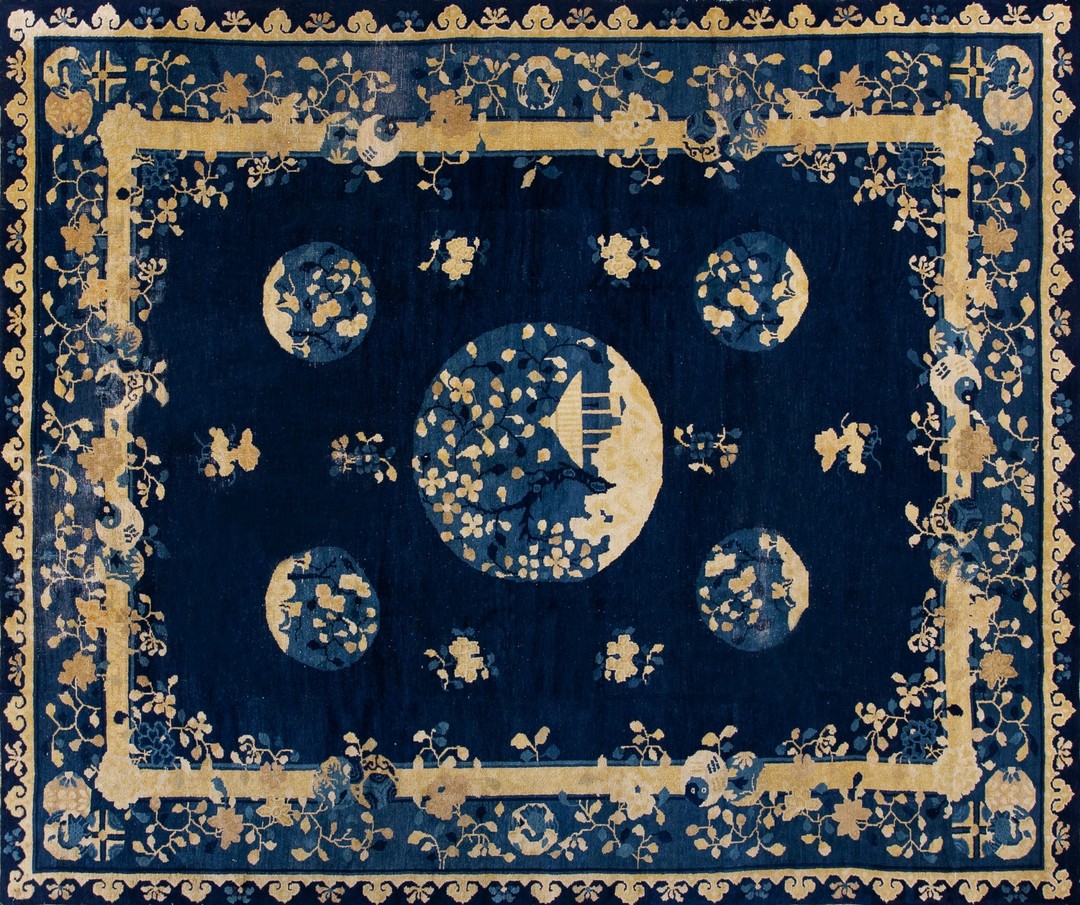
Explore a Few of Our Favorite Central Medallion Rugs
FAQ
- Are distressed or overdyed medallion rugs a smart choice?
They give the medallion a softer, vintage look and hide wear well. Low-pile, washable or stain-resistant options simplify maintenance in busy homes.
- How do I judge quality in hand-knotted medallion rugs?
Look for clear motif definition, even edges, sturdy fringe, and balanced colors. Knot density helps, but wool quality and dye work matter as much.
- What sizes of medallion rugs fit common rooms?
Typical picks: 8×10 feet for a standard living area, 9×12 feet for larger seating, and 5×8 feet for bedrooms or offices. Verify furniture legs land on the rug.
- Do medallion rugs work with round tables or rooms?
Yes—choose a round medallion rug or one with a compact center so edges remain visible. Ensure the rug extends beyond chair legs when pulled out (about 24 inches).
- How can I stop medallion rugs from sliding or curling?
Use a quality pad, rotate quarterly, and consider corner grippers if needed. Humidity swings cause curl; gentle reverse-roll edges for a few hours to relax.
- How often should medallion rugs be professionally cleaned?
Plan every 2–5 years, sooner for high-traffic areas or visible soiling. Ask a specialist experienced with hand-knotted or dyed rugs.
- How do I clean medallion rugs day-to-day?
Vacuum weekly with the beater bar off and avoid the fringe. Blot spills immediately with a white cloth; test cleaners in an inconspicuous spot.
- Are medallion rugs safe over radiant/underfloor heating?
Generally yes with low-pile rugs and heat-rated pads that don’t insulate excessively. Follow your floor system’s guidelines; recommendations vary by manufacturer.
- What rug pad should I use under medallion rugs?
A felt-and-rubber combo pad (about 1/8–1/4 inch thick) adds grip and cushioning. Trim pads 1–2 inches smaller than the rug on all sides to avoid show.
- Can robot vacuums be used on medallion rugs with fringe?
Use caution—fringe can tangle. Disable beater bars and block fringe ends, or manually vacuum edges to protect tassels.
- Are medallion rugs kid- and pet-friendly?
Yes—choose low-pile wool or performance synthetics, and busy or distressed medallion patterns to hide messes. Use a washable entry mat nearby to capture grit.
- Are antique or vintage medallion rugs a good investment?
Quality antique medallion rugs can hold or appreciate in value, but condition and authenticity matter. Request documentation and a condition report before purchase.
- How much do medallion rugs typically cost?
Machine-made medallion rugs often run \$50–\$600 in common sizes. Hand-knotted medallion rugs range from \~\$800 into the tens of thousands for large, vintage, or rare pieces.
- Hand-knotted vs. machine-made medallion rugs—what’s the difference?
Hand-knotted medallion rugs feature individually tied knots for decades of wear and fine detail. Machine-made versions cost less, with uniform pile and quicker production.
- What materials are best for medallion rugs?
Wool medallion rugs are durable and naturally soil-resistant; synthetics offer value and easy care. Avoid rayon/viscose in spill-prone rooms due to water sensitivity.
- How do I coordinate medallion rugs with patterned upholstery?
Balance scale and contrast: big medallion rugs pair well with small, tight fabric patterns. Stick to a shared palette (e.g., pick 2–3 repeating colors).
- Do medallion rugs make small rooms look busier?
Large, high-contrast centers can feel busy in tight rooms. Use lighter colors, lower contrast, or a smaller-scale medallion to keep the space airy.
- Should medallion rugs go under a dining table?
They can, but the table may obscure the center. Choose a larger size (extend 24–36 inches beyond the table) or pick a small-scale or faded medallion that reads through.
- How should medallion rugs be placed in a living room?
Center the medallion under the coffee table and anchor sofas with front legs on the rug. A glass or open-base table preserves visibility of the motif.
- Where do medallion rugs work best in a home?
Medallion rugs excel in living rooms, bedrooms, and entries where a focal point helps. In open plans, one large medallion rug can visually “zone” a seating area.
- What does the central motif in medallion rugs symbolize?
In Persian design, the medallion can echo a sun or garden pool with harmonizing corner pieces. This “medallion-and-corner” (lachak-toranj) layout emphasizes balance and symmetry.
- Which origins are most associated with medallion rugs?
Persian medallion rugs (Kashan, Tabriz, Isfahan, Heriz) and Turkish/Anatolian Oushak are classics. Expect floral curvilinear centers in Kashan and bolder geometric medallions in Heriz or Oushak.
- Are medallion rugs traditional only, or can they look modern?
Medallion rugs span both—classic Persian layouts or minimalist, distressed, and tone-on-tone interpretations. Pairing a simplified medallion with neutral palettes keeps them contemporary.
- How do medallion rugs differ from allover-pattern rugs?
Medallion rugs focus the eye on a single center, while allover rugs distribute motifs evenly. Medallions create a focal point; allover designs read calmer and can make rooms feel larger.
- What are medallion rugs, exactly?
Medallion rugs feature a centered motif (often with corner echoes) that anchors the field. Common shapes include diamonds, octagons, or roundels, typically framed by a contrasting border.