
Introduction: From Persia to Iran – The Dual Identity of Persian Rugs
Explore and shop our curated selection of authentic Iranian Persian rugs to bring timeless heritage into your home today.
Persia vs. Iran: A Timeline of Names
Synonymous with luxury and high style, the rugs of Persia / Iran are some of the most sought after styles and appreciated types of area rugs. But what about the name? Is it Iranian Rugs? Or Persian Rugs? Does it make a difference?
Well, for centuries, the Western world referred to the country as Persia, a name derived from the ancient province of Fars (Parsa), home of the Achaemenid Empire. Inside the country, however, people always called their homeland Iran, meaning “land of the Aryans.” The duality lasted until 1935, when Reza Shah Pahlavi formally requested that foreign governments use “Iran” in official communication.
This decision was part of his modernizing vision and an effort to emphasize national identity rooted in ancient heritage rather than a single region. The renaming signaled continuity with Iran’s deep cultural past, but it also created a linguistic divide between local self-definition and international recognition.
Persian vs. Oriental Rugs: What’s the Real Difference?
A common question we hear is: “Is this an Oriental rug or a Persian rug?”
The simplest way to understand the difference is this: All Persian rugs are Oriental rugs, but not all Oriental rugs are Persian rugs.
The Geographic Umbrella
“Oriental Rugs” is a broad, umbrella term used to describe any hand-knotted carpet produced in the “Orient”—traditionally defined as the vast region of Asia stretching from Turkey and the Caucasus through Iran, India, Afghanistan, and China.
A Persian Rug, however, must specifically be made in Iran (formerly Persia). If a rug features a Persian design but was woven in India or Pakistan, it is technically an “Indo-Persian” or “Pak-Persian” Oriental rug—not a true Persian.
Think of it like Champagne. To be called “Champagne,” it must come from the Champagne region of France. Similarly, to be a Persian Rug, it must be hand-knotted within the borders of Iran. Any rug made elsewhere using similar patterns is considered an “Oriental” or “Persian-design” rug.
Persian vs. Oriental: A Technical Comparison
| Feature | Persian Rugs | Other Oriental Rugs |
|---|---|---|
| Origin | Exclusively Iran (Persia). | Turkey, India, Pakistan, China, etc. |
| Knot Type | Primarily the Asymmetrical (Senneh) Knot. | Often use the Symmetrical (Ghiordes) Knot. |
| Design Style | Mostly Curvilinear; famous for floral medallions and “painterly” shading. | Often more Geometric or bold (Turkish/Caucasian styles). |
| Materials | High-lanolin wool, often on cotton or silk foundations. | Varies widely; can include goat hair, jute, or local wools. |
Why the Distinction Matters for Value
The reason collectors prioritize the “Persian” label is provenance. Persian rugs are widely considered the gold standard of the industry because of their 2,500-year unbroken weaving tradition.
While a high-quality Oriental rug from Turkey or India can be beautiful and durable, a genuine Iranian Persian rug typically holds its investment and resale value far better over time.
Why the World Still Says “Persian Rugs”
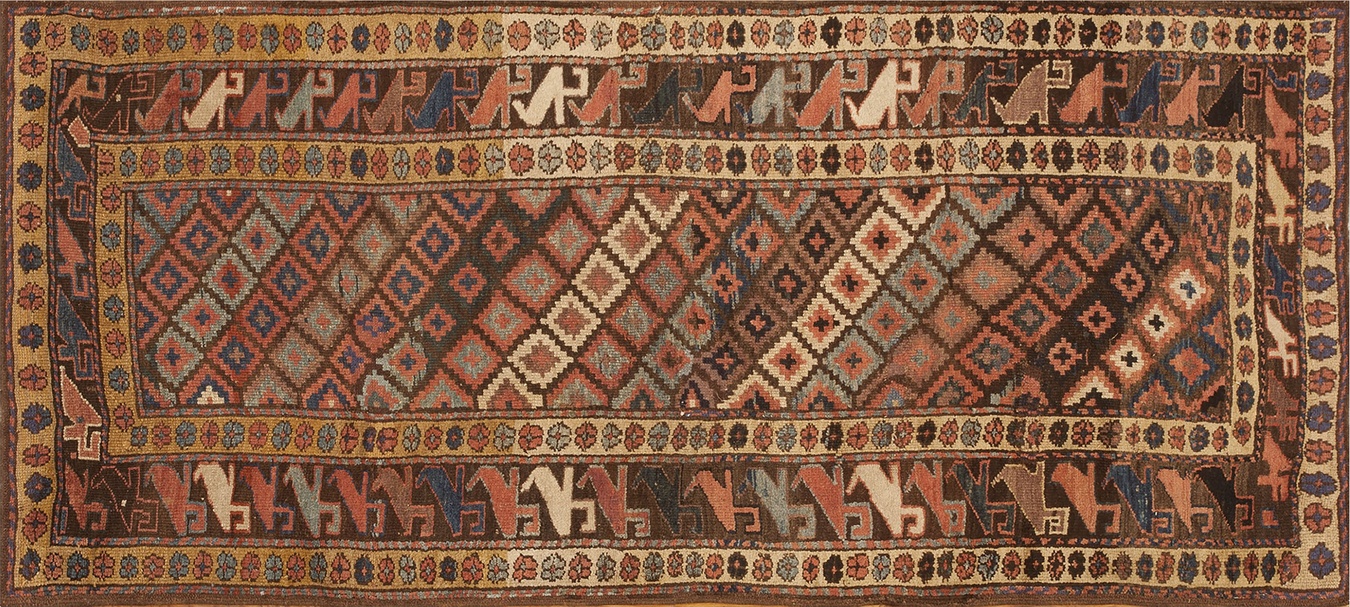
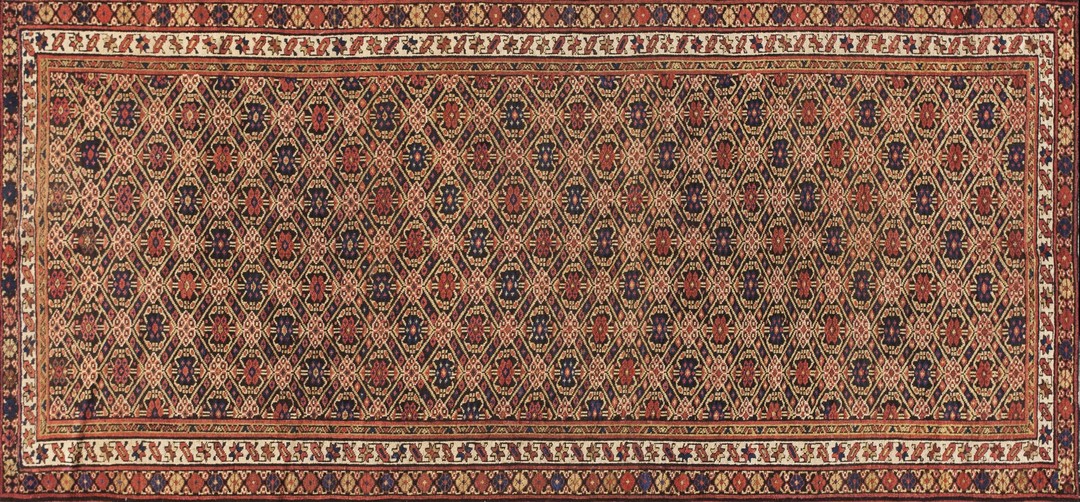
Antique Kurdish Persian Geometric Design Knotted Rug – by Rugs On Net
While the country’s international name shifted, the terminology surrounding rugs did not. Hand woven Persian rugs had already become synonymous with luxury, craftsmanship, and timeless beauty across centuries of trade. The phrase carried immense cultural weight, functioning as both a brand and a tradition.
To global rug buyers, “Persian rug” evokes artistry, intricate knotting techniques, and an unbroken heritage of weaving. Saying “Iranian rugs” may be accurate, but it lacks the resonance, history, and prestige embedded in the word “Persian.” For this reason, international markets, collectors, and museums continue to use “Persian rugs” almost exclusively, even while acknowledging Iran as the nation of origin.
The Expert’s Eye: Quick Identification
Use this guide to distinguish the five primary weaving “personalities” of Persia.
Northwest (The Bold)
Cities: Heriz, Tabriz, Bakshaish
“If the design looks like a shattered diamond and the rug feels like a brick, it’s a Northwest geometric.”
Central (The Royal)
Cities: Isfahan, Nain, Kashan
“If it has silk highlights, ivory foundations, and looks like it belongs in a palace, it’s Central Persian.”
West (The Rugged)
Cities: Bijar, Hamadan, Sarouk
“If the red is deep like wine and the rug is nearly an inch thick/heavy, it’s a Western village weave.”
South (The Tribal)
Tribes: Qashqai, Shiraz, Gabbeh
“If the wool is shiny/soft and the pattern is full of birds, dogs, and tiny people, it’s a Southern Tribal rug.”
East (The Intricate)
Cities: Mashhad, Mud, Birjand
“If the rug has a cochineal (purple-red) hue and a tiny ‘fish’ pattern that repeats, it’s from the East.”
The Role of Hand Woven Persian Rugs in Historical and Modern Iran
Whether under the banner of Persia or Iran, carpet weaving has remained the country’s most celebrated cultural export. Since the early dynasties, rugs have symbolized wealth, royal patronage, and artistic refinement, often commissioned for palaces and gifted as diplomatic treasures. Over time, this tradition extended into households, where rugs became part of daily life and family pride.
In modern Iran, carpets remain central to cultural identity and the economy, with entire cities—such as Tabriz, Isfahan, Kashan, and Qum—renowned for distinct weaving schools. The persistence of the craft highlights continuity: while the country’s name officially changed, the artistry, symbolism, and reputation of handwoven Persian rugs endured unchanged, linking Iran’s past and present in every woven thread.
The story of Persia vs. Iran is not merely political—it illustrates how history, identity, and branding coexist. The name change in 1935 did nothing to alter the global perception of these masterpieces: the world still treasures them as Persian rugs, a title that carries centuries of cultural memory and prestige.
The History of Carpet Weaving in Persia/Iran
Ancient Origins and Evidence
The history of Iranian rugs stretches back to antiquity, with roots deep in the Achaemenid Empire (c. 550–330 BCE). Classical writers such as Xenophon referenced the luxurious carpets that adorned Persian halls, describing them as symbols of refinement and power. The most tangible evidence, however, comes from the Pazyryk Carpet (c. 400–500 BCE), discovered in a frozen Scythian tomb in Siberia.
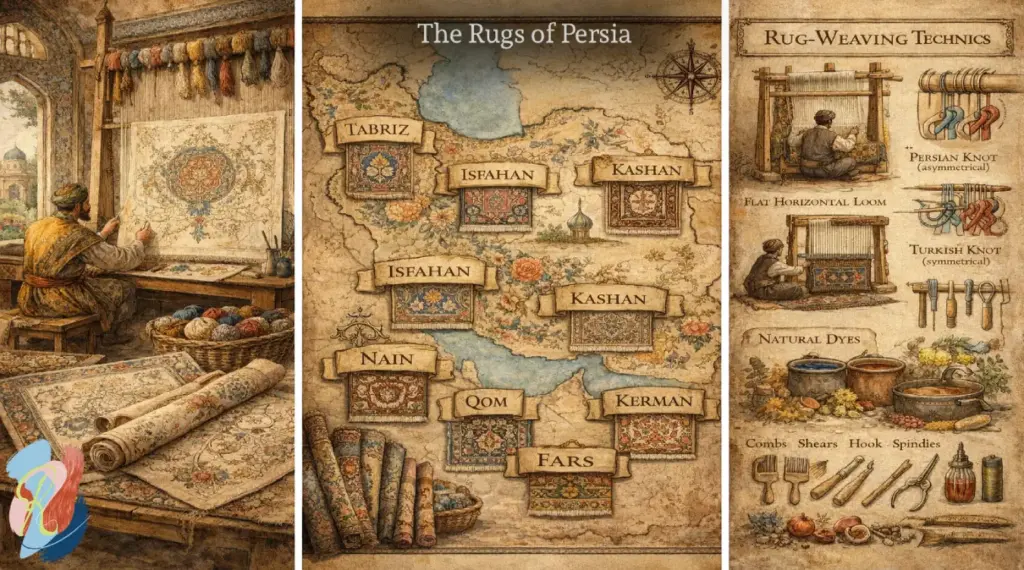
Though not woven in Persia itself, its sophisticated design, high knot density, and motifs linked to Achaemenid influence demonstrate that the tradition of ancient Persian carpets was already fully developed.
By the Sasanian period (224–651 CE), carpets had become imperial treasures, including the legendary “Spring of Khosrow,” a vast garden-themed carpet said to have dazzled the Byzantine court. These early examples confirm that weaving was not a craft of utility alone, but one of prestige, symbolism, and imperial grandeur.
The Safavid “Golden Age”
The Safavid carpet tradition of the 16th / 17th century marks the pinnacle of Persian area rug weaving and making. Under Shah Tahmasp and Shah Abbas I, the court centralized production in royal workshops, particularly in Isfahan, Kashan, and Tabriz.
For the first time, motifs were standardized: the iconic central medallion, arabesques, floral scrolls, and intricate garden designs. Natural dyes produced luminous reds, blues, and greens, while silk foundations allowed for unprecedented fineness.
These innovations positioned Safavid carpets as both artworks and cultural diplomacy, gifted to European rulers and showcased in mosques and palaces. The era’s workshop system professionalized the craft, creating masterpieces that remain benchmarks for collectors and historians. The Safavid period did not merely refine rug design—it revolutionized the aesthetic language of Persian weaving, establishing patterns that endure to this day.
Qajar Revival and Export Era
By the 19th century, under the Qajar dynasty, carpets entered a new phase shaped by global trade. Growing Western demand transformed the evolution of Persian weaving, with exports to Europe and the United States becoming a vital source of revenue. Workshop output expanded, often catering to foreign tastes with altered palettes and sizes.
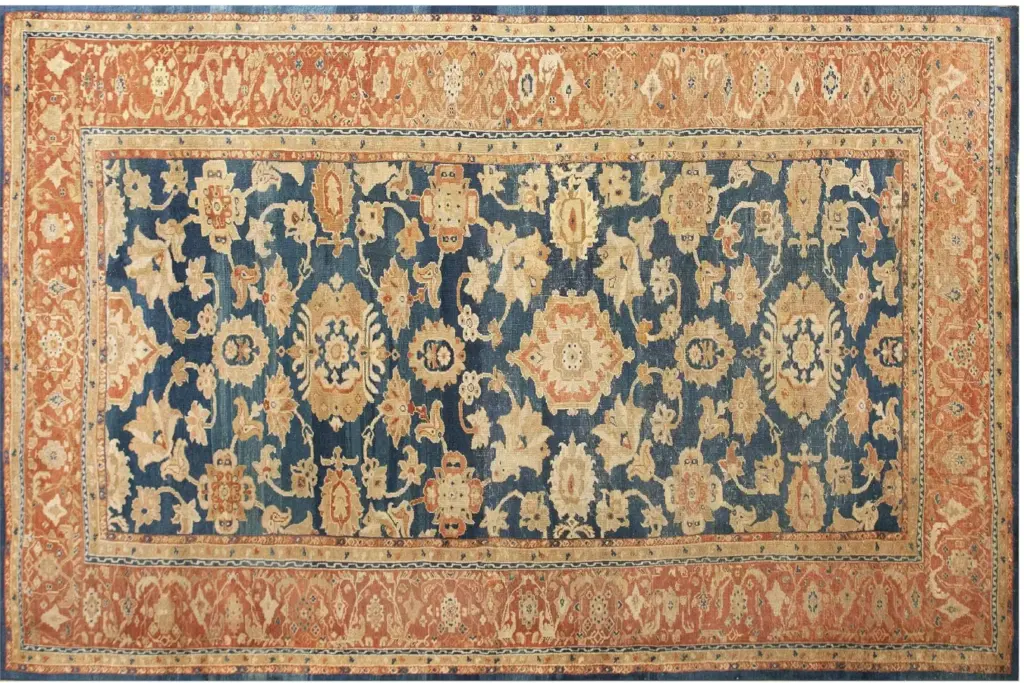
The introduction of aniline dyes in the late 1800s, while vibrant, sometimes compromised traditional quality, producing harsher tones compared to natural dyes. Yet this period also secured Persian carpets as staples of Western décor, embedding them into the global imagination. The Qajar revival illustrates how Persian rugs adapted to international markets while retaining their essential identity.
Pahlavi Reforms and Post-1979 Developments
In the 20th century, the Pahlavi dynasty introduced reforms aimed at preserving authenticity while modernizing production. State organizations enforced quality control, promoted Iranian branding, and sought to revive tribal weaving.
However, industrial changes and political upheavals disrupted some traditional practices. After the 1979 Islamic Revolution, sanctions and shifting global trade led to cycles of boom and bust in exports.
At the same time, there was renewed appreciation for tribal aesthetics and natural dyes, spurred by both collectors and Iranian artisans seeking to reconnect with heritage. The modern era reflects a tension between preserving the historic soul of Persian carpets and navigating the pressures of a globalized economy.
Timeline Summary
- c. 550–330 BCE (Achaemenid Empire): Early references to carpets in royal courts. — Why: Establishes antiquity and cultural prestige.
- c. 400–500 BCE (Pazyryk Carpet): Oldest surviving knotted carpet, linked to Persian influence. — Why: Provides material evidence of advanced weaving.
- th–17th c. (Safavid Golden Age): Court workshops, standardized motifs, flourishing exports. — Why: Set the artistic standard for all later carpets.
- th c. (Qajar Era): Export boom, synthetic dyes, adaptation to Western tastes. — Why: Globalized Persian rugs as household staples.
- th c. (Pahlavi Period): Regulation, branding, partial decline of tribal weaving. — Why: Showed state-driven modernization of the craft.
- –Present (Islamic Republic): Sanctions, revival of natural dyes, shifting markets. — Why: Demonstrates resilience and renewal in rug culture.
The history of area rugs from Iran is one of unbroken continuity shaped by empire, trade, and cultural pride. From the ancient Persian carpets of Achaemenid courts to the Safavid golden age and modern revivals, each era left its imprint, ensuring that Persian rugs remain both timeless heirlooms and living symbols of Iran’s identity.
What Makes a Rug “Persian”? Defining Authenticity and Core Characteristics
Authenticity Factors
An authentic rugs ff Persia are defined by four key elements: material, knot, origin, and design. Genuine examples are always hand-knotted, most often using high-quality wool, silk, or cotton foundations.
The finest silk carpets, produced in cities such as Qum and Kashan, are prized for their luminous sheen, while wool rugs from regions like Tabriz, Isfahan, and Kerman emphasize durability and softness.
Natural dyes—madder for red, indigo for blue, pomegranate rind for yellow—remain the traditional standard, though carefully applied synthetic dyes are sometimes used in modern production. The origin is equally crucial: while “Persian-design” carpets are woven in India, Pakistan, or China, only those knotted within Iran itself carry the full authenticity and cultural lineage of the genuine Iranian carpet.
Defining Features of Genuine Persian Hand-Knots
At the technical core lies the asymmetrical Persian knot, also called the Senneh knot. This distinct structure allows weavers to achieve high knot densities, producing detailed motifs and smooth curvilinear patterns that define the hand-knotted Persian tradition.
Region-specific designs further mark authenticity: medallion-and-corner layouts in Isfahan, pictorial hunting scenes in Tabriz, or floral latticework in Kashan. Many workshop rugs include a woven cartouche signature, often displaying the master weaver’s or workshop’s name, reinforcing provenance and prestige. Together, these details form the DNA of a genuine Persian rug, tying craftsmanship to geography and history.
How to Spot Fakes or Imitations
Distinguishing a real Persian vs imitation rug requires close inspection. Authentic Persian rugs have slight irregularities on the back due to hand-knotting, while machine-made versions show perfect uniformity. The back of a genuine carpet reveals the design clearly, with knots visible, unlike power-loomed rugs where the pattern is less distinct.
True Persian rugs use natural fibers—wool, silk, or cotton—whereas imitations may substitute polyester or blends. Another indicator is origin labeling: area rugs labeled “Persian-design” but made outside Iran mimic surface motifs without the knotting, materials, or heritage that define authenticity.
Ultimately, the combination of Iranian rug origin, hand-knotted technique, and natural materials sets real Persian carpets apart from copies produced elsewhere.
To qualify as an authentic Persian rug, a piece must be hand-knotted in Iran using traditional fibers, dyes, and knotting techniques. Regional motifs, knot structure, and even the presence of a weaver’s signature distinguish a genuine Iranian carpet from mass-produced imitations, preserving the prestige and cultural legacy that the term “Persian rug” commands worldwide.
The Language of Symbols: Reading Your Persian Rug
In the traditional weaving villages of Iran, rugs were rarely “just patterns.” They were woven as protective talismans or visual prayers. When you look at an authentic Persian rug, you are looking at a vocabulary of symbols that have remained unchanged for centuries.
| Symbol | Visual Form | Meaning & Significance |
|---|---|---|
| Boteh | A teardrop or “paisley” shape. | Eternity. Represents a cypress tree bending in the wind or a sacred flame. |
| Tree of Life | A central tree reaching upward. | The Path to Heaven. Symbolizes the connection between earth and the divine. |
| Mahi (Fish) | Small “fish-like” leaves circling a rosette. | Good Luck & Rebirth. A classic pattern found in Bidjar and Tabriz town weaves. |
| Star / Octagon | Eight-pointed geometric star. | Spirituality. Common in tribal village weaves; represents the light of wisdom. |
| Peacock | A stylized, colorful bird. | Immortality & Beauty. Often seen in pictorial rugs and royal workshop designs. |
| Crab | A geometric “X” shape with outward legs. | Protection. Woven into the borders to ward off the “evil eye.” |
Learn More About These Persian Rugs Patterns:
- Paisley Boteh Rug Design
- The Tree Of Life Rug Pattern
- The Mahi Herati Fish Design Rug Motif
- The 8 pointed Star Design Motif
- The Peacock Rug Design Pattern
- Crab / Harshang Rug Design
The Story of the Central Rug Medallion
The most famous Persian layout—the Central Medallion—isn’t just a focal point. It is often designed to mirror the ceiling of a grand mosque or the “eye” of a garden pool.
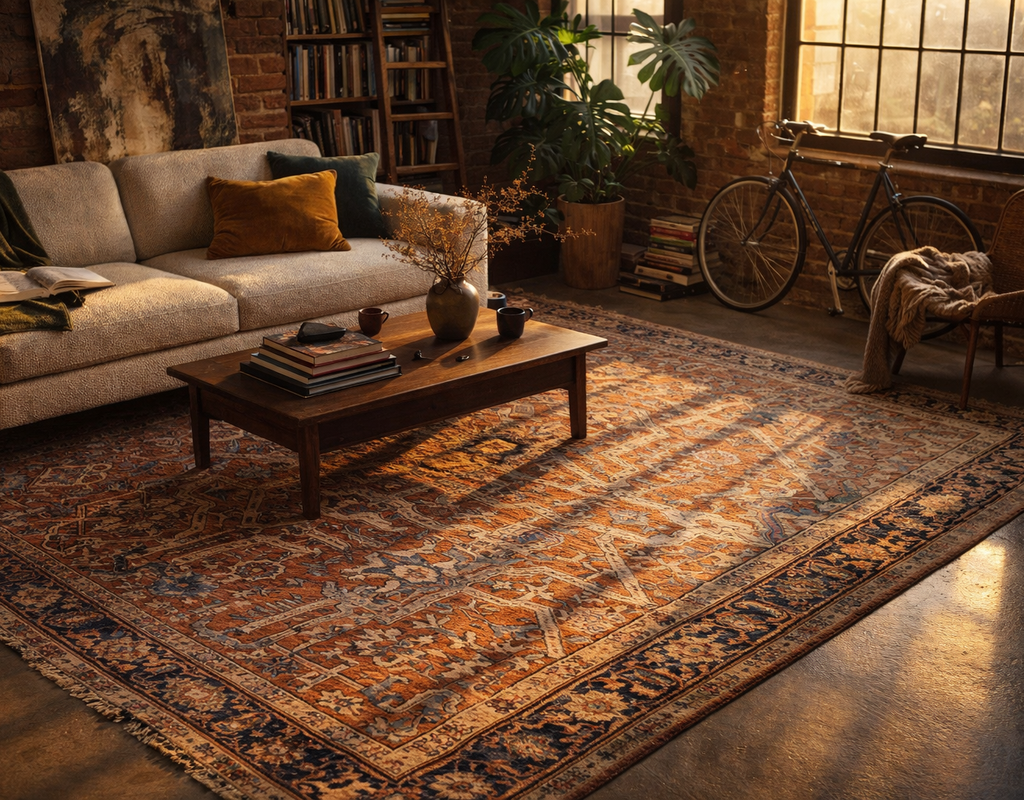
In many “Medallion and Corner” (Lechak-Toranj) designs, the corners represent the four quarters of the universe, with the center representing the divine sun.
Color as Language
Even the Persian rug colors chosen by the weaver tell a story:
- Indigo (Blue) Color Rugs: Symbolizes solitude, peace, and the afterlife.
- Madder (Red / Rust) Color Rugs: Represents fire, courage, and the “spark of life.”
- Pistachio (Green) Color Rugs: The most sacred color in Islamic culture, representing the Prophet and paradise.
- Gold / Yellow Color Rugs: Represents the sun and the joy of living.
Rugs Of Persia as Investment Pieces
Why Persian Rugs Hold Value
- Scarcity and Rarity — Why: Hand-knotted rugs require months or years of labor, and antique examples from historic workshops or tribal groups cannot be reproduced, making them scarce cultural assets.
- Artistry and Craftsmanship — Why: Each rug represents generations of perfected weaving skills, intricate motifs, and region-specific designs, elevating them from floor coverings to collectible artworks.
- Durability and Materials — Why: Made from resilient wool, lustrous silk, and natural dyes, authentic rugs often outlast centuries, preserving both beauty and function.
- Provenance and History — Why: Rugs tied to specific weavers, dynasties, or famous regions such as Isfahan, Tabriz, or Kashan command higher recognition and prestige.
- Cultural Status — Why: Owning a Persian rug signifies refinement and connoisseurship; for many collectors, these carpets embody both cultural heritage and social standing.
- Global Demand — Why: The term “Persian rug” has become synonymous with luxury worldwide, ensuring steady international collector and auction interest.
What Drives Appreciation and Market Demand
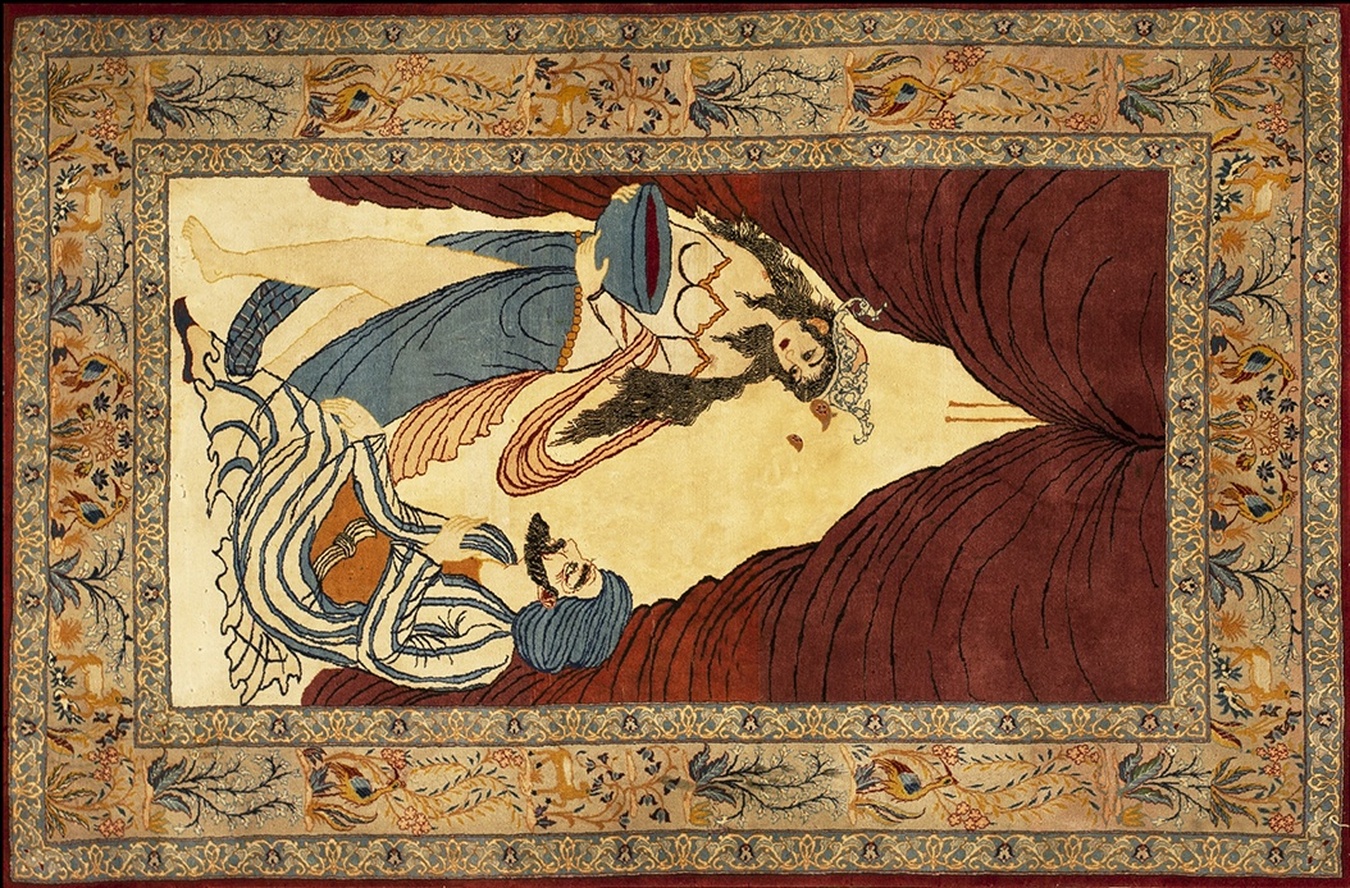
Vintage Isfahan Persian Rug – by Rugs On Net
The value of the rugs of Persia often appreciates because of a combination of artistry, history, and limited supply. Antique Isfahan silk carpets or rare tribal Gabbeh weavings can climb steeply in auction markets due to their rarity and cultural cachet. Shifts in collector trends—such as a growing preference for natural dyes and tribal aesthetics—also affect demand. Economic conditions and sanctions on Iran can limit exports, further tightening global availability and driving up prices. In this way, Persian carpets function not only as decorative items but as investment assets influenced by both cultural and economic currents.
Resale Value Factors
When considering carpet investment or future Persian rug appraisal, three elements dominate:
- Age and Condition: Antique rugs in excellent preservation fetch far higher values than similar pieces with repairs or wear.
- Rarity and Region: Rugs from renowned weaving centers like Kashan, Tabriz, or Isfahan, or rare tribal traditions like Bakhtiari and Qashqai, are especially prized. For example, vintage Bakhtiari rugs with unique garden-panel motifs and intact natural dyes hold significant resale appeal.
- Craftsmanship and Knot Count: Higher knot density often equates to finer detail and greater collector interest, especially when paired with natural materials.
Persian carpets are considered investment pieces because they combine artistry, rarity, and durability with centuries of cultural prestige. Yet, not every rug holds equal value: the true carpet investment lies in pieces that demonstrate authenticity, fine condition, and regional distinction.
For collectors evaluating vintage Persian resale, careful attention to provenance, dye quality, and craftsmanship is essential to unlock the enduring worth of these masterpieces.
Design Mastery: Decorating with Persian Rugs
A Persian rug is often called “the soul of the room.” Because of their intricate patterns and balanced palettes, they can either act as a quiet anchor or a bold statement piece.
Here is how top interior designers utilize the different Persian styles today:
The “Grandmillennial” & Traditional Look
If you are aiming for a classic, timeless interior, look toward Kashan or Isfahan rugs.
- The Strategy: Pair these highly detailed, floral medallion rugs with dark wood furniture (mahogany or walnut) and velvet upholstery.
- Design Tip: Pick one minor color from the rug’s border (like a soft sage green or a dusty rose) and use that for your throw pillows or drapes to create a cohesive “designer” flow.
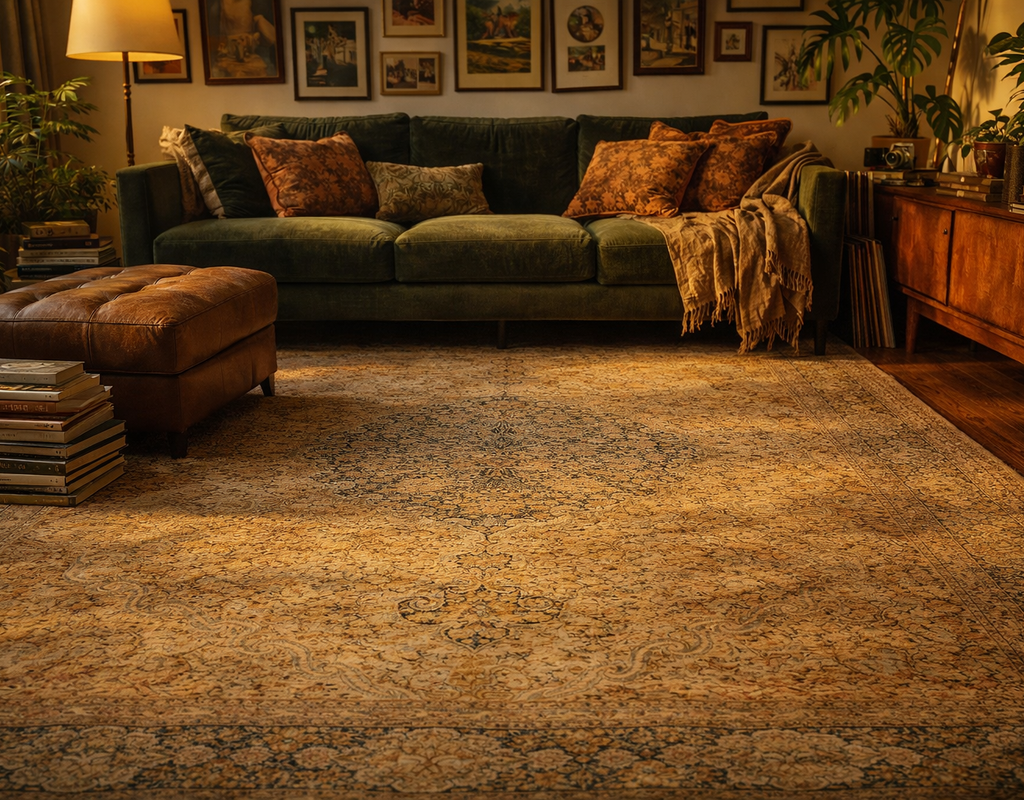
Modern Minimalist & Transitional Spaces
Tribal geometric rugs like Persian Heriz or Serapi rugs or the antique more primitive looking Persian Bakshaish carpets are the secret weapon for modern homes.
- The Strategy: Use a geometric rug to add “organic warmth” to a room with clean-lined, neutral furniture.
- Design Tip: The bold, large-scale motifs of a Bakshaish prevent a minimalist room from feeling too sterile. The rug provides the “texture” that a flat-painted room often lacks.
The “Bohemian” Layered Approach
Tribal rugs like Qashqai or Shiraz are perfect for a relaxed, global vibe.
- The Strategy: Don’t be afraid to layer. Place a smaller, vibrant tribal Persian rug on top of a larger, neutral Jute or Sisal rug.
- Design Tip: This is ideal for libraries or dens where you want a “collected over time” feeling.
Defining Open-Concept Areas
In modern homes with open floor plans, rugs are the “walls.”
- The Strategy: Use a large Tabriz or Kerman to define the seating area, ensuring at least the front legs of all furniture sit on the rug.
- Design Tip: If the living and dining areas are connected, use two different Persian rugs from the same color family but with different patterns (e.g., one geometric, one floral) to create a sophisticated, curated look.
The “Iron Rug” for High-Traffic Entryways
For hallways or foyers, the Bidjar is the gold standard.
- The Strategy: Because of its “Iron Rug” density, it can handle heavy foot traffic without the pattern wearing down or the edges curling.
If You Need Some Decorating Tips The Read Our Guide To Positioning and Placing Rugs In Rooms
Regions & Cities: Iran’s Rug-Weaving Hotspots
Tabriz: Revival Center and Export Leader
The Tabriz Persian rug has long stood at the forefront of innovation. Situated in East Azerbaijan, Tabriz was instrumental in the 19th-century revival of Persian weaving, becoming both a production hub and an export powerhouse. Renowned for exceptionally high knot density, Tabriz rugs showcase the celebrated Mahi (fish) pattern, alongside elaborate medallions and finely balanced color palettes.
This combination of technical mastery and creative adaptation made Tabriz one of the most globally recognized centers of Persian weaving, ensuring its status as both a commercial leader and a benchmark of artistry.
Isfahan & Kashan: Safavid Legacy and Distinctive Signatures
The Isfahan carpet embodies elegance, defined by delicate floral arabesques, Shah Abbas motifs, and balanced symmetry that reflect its Safavid courtly heritage. By contrast, Kashan rug weaving combines equally fine knotting with distinctive red and indigo fields, creating bold contrasts and saturated hues.
Kashan’s legacy is deeply communal, with historical records showing that one in three residents once participated in weaving. While both cities share Safavid prestige, their output diverges in tone: Isfahan carpets exude refinement and airy design, while Kashan rugs carry dramatic richness. UNESCO recognition of Isfahan’s craft further cements its reputation as a cultural treasure.
Kerman: Lavar Medallion and Vase Carpets
Southern Iran’s Kerman weaving is distinguished by lush floral schemes and soft pastel tones. The region is especially famous for its Lavar medallion designs and the celebrated vase carpets, masterpieces of Safavid-era innovation.
The local wool is prized for its softness and resilience, enabling both vibrant dyes and fine execution. Kerman’s distinct artistic voice ensures its place among Iran’s most historically important rug centers.
Fars and Tribal Weaving
The province of Fars represents the nomadic heart of Persian rug heritage. Here, tribes such as the Qashqai and Luri produce geometric designs, bold colors, and the celebrated Gabbeh rugs, known for their abstract minimalism and thick pile.
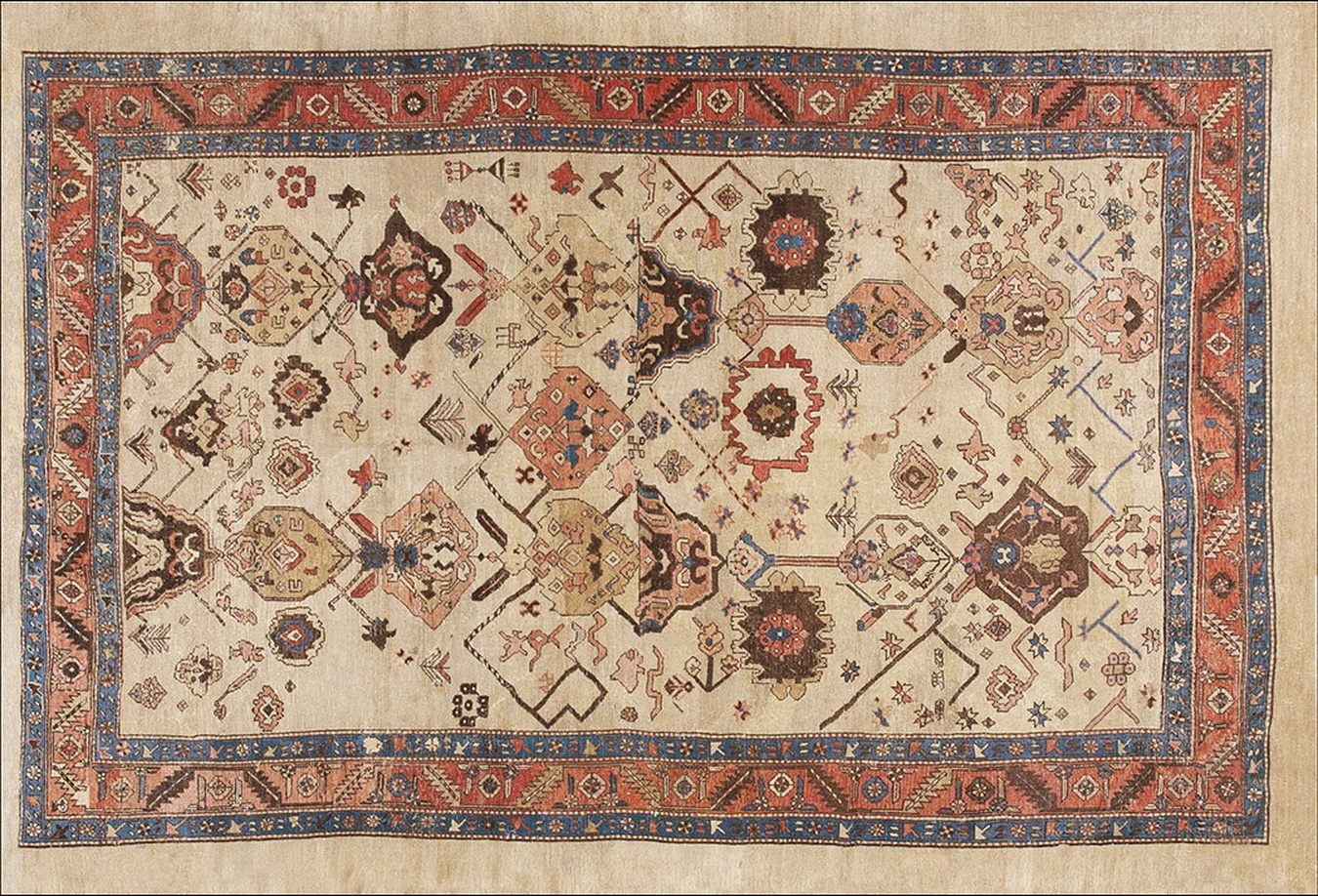
These pieces emphasize personal expression, often woven for household use rather than commercial sale. Today, Fars Gabbeh rugs are collected worldwide, and contemporary weavers continue to recreate antique Gabbeh designs, blending tradition with renewed market appreciation.
The “Iron Rug”: Why Bidjar is Unique
In the mountainous region of Kurdistan lies the town of Bidjar, producer of the world’s most durable textile: the Bidjar Persian Rug. Known as the “Iron Rug of the East,” the antique Persian Bidjar rugs are woven using a unique technique where the weaver introduces a third “heavy” weft and beats it down with a metal comb until the wool is nearly as dense as wood.
Because of this density, Bidjar rugs should never be folded—they must be rolled to avoid snapping the foundation. For high-traffic areas like hallways and entryways, there is no better investment in the world.
The Heriz Mystery: Copper-Rich Wool
Why do Heriz rugs look better with age while others look worn? The secret lies in the geography. The sheep in the Heriz district of Northwest Iran graze on land rich in copper deposits.
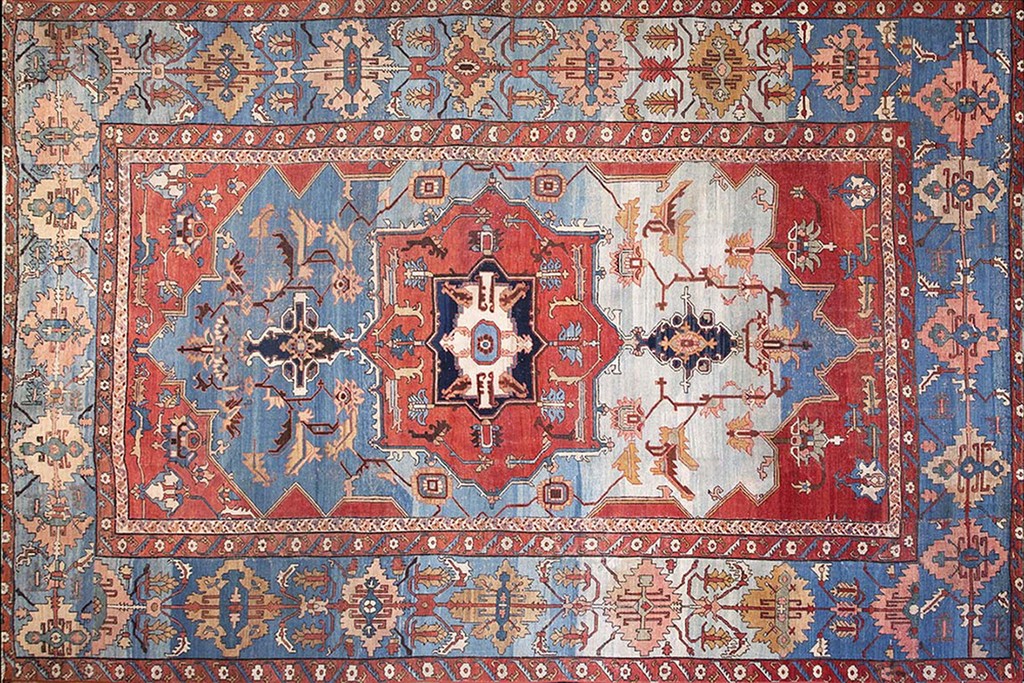
This trace copper makes their wool exceptionally resilient and allows it to absorb vegetable dyes with a depth that other regions cannot match. It’s why an antique Heriz is the “Designer’s Choice”—it provides a bold, geometric look that can withstand decades of family life.
Quick check list for Understanding Persian Heriz vs Serapi vs Bakshaish Rugs
| Type | Aesthetic & Feel | Key Technical Identifier |
|---|---|---|
| Bakshaish | The “Artist’s Rug.” Primitive, bold, and spacious. | Large-scale patterns with “room to breathe.” Often features undyed camel hair fields. |
| Serapi | The “Boutique Rug.” Refined, architectural, and elegant. | Finely knotted and thin-handled (folds easily). Features crisp, multi-layered geometry. |
| Heriz | The “Workhorse.” Robust, vibrant, and stiff. | Thick pile and a rigid foundation. Woven in the 20th century with saturated “copper” tones. |
Why Collectors Search for “Camel” Bakshaish
The most coveted antique Bakshaish rugs feature a field made from natural, undyed camel hair. Unlike sheep’s wool, which is easily dyed, weavers used camel hair in its raw state to create the “ground” of the rug.
- The Look: It produces a warm, earthy range of tones from light biscuit to deep chocolate.
- The “Abrash”: Because the hair varies by the animal, you will see horizontal waves of different shades (called abrash). To a collector, this is not a flaw—it is a “fingerprint” of genuine 19th-century tribal masterpiece rugs.
Expert Design Tips for Bakshaish – The “Minimalist’s Persian”
While many Persian rugs are “busy,” the Bakshaish is famous for its negative space.
- Modern Lofts: The oversized, primitive motifs (like the “Tree of Life”) act as abstract art. They are the perfect anchor for a room with floor-to-ceiling windows and minimal furniture.
- Grandmillennial Interiors: Pair a camel-hair Bakshaish with floral fabrics to ground the room. The geometric nature of the rug prevents the room from feeling “too sweet.”
Other Key Centers
- Mashhad: Known for deep crimson fields and high-pile prayer rugs, woven from fine Mashhad wool sourced in Khorasan Province. — Why: Combines local raw material with spiritual artistry.
- Fine Persian / Iranian Nain Rugs: Features exceptionally high knot density, pastel palettes, and silk highlights. — Why: Represents refinement even beyond Isfahan’s standards.
- Fine Persian Iranian Silk Qum Rugs: Produces the finest Qum silk rugs, often pictorial and commanding the highest prices at auction. — Why: Combines rarity, luxury, and investment potential.
- Heriz: Woven in East Azerbaijan, Heriz rugs are robust and highly suitable for heavy-traffic areas due to their coarse but resilient structure. — Why: Balances decorative appeal with everyday function.
- Bakhtiari: Celebrated for distinctive garden-panel motifs, valued by collectors and strong in resale markets. — Why: Tribal artistry with investment credibility.
- Afshar: A tribal tradition from Kerman producing bold Afshar tribal carpets, now gaining renewed attention among collectors for their unique blend of tribal authenticity and regional influence. — Why: Rising recognition enhancs both cultural and financial value.
Iran’s weaving geography is unrivaled, from Tabriz Persian rugs that revolutionized exports to Qum silk rugs that embody ultimate luxury, and from Fars Gabbeh rugs born of tribal looms to the enduring Heriz rug durability of East Azerbaijan.
Each region, whether urban or nomadic, contributes its own hallmark, ensuring that the diversity of Persian vs Iranian rugs continues to define the world standard for artistry, function, and cultural legacy.
Northwest Persian Hierarchy
Weaving Techniques, Materials, and Dye Traditions
Knotting Types and Density
The hallmark of an authentic Persian rug lies in its knotting. The asymmetrical Persian knot (Senneh) is the most common, producing finer curves and higher detail than the Ghiordes (Turkish) knot, which is symmetrical and bulkier. Knot density varies across regions and styles: Nain vs. Isfahan is a classic comparison.
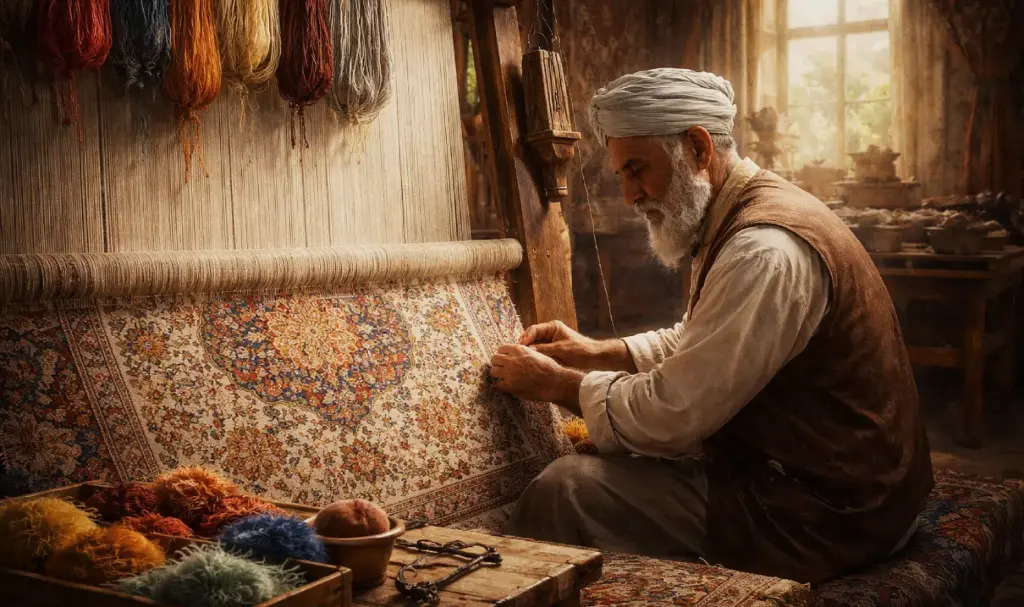
Both cities weave with exceptionally fine detail, but Nain often exceeds Isfahan in density, sometimes reaching over one million knots per square meter, producing rugs of unmatched delicacy. By contrast, tribal styles such as Heriz or Gabbeh intentionally maintain lower knot density to highlight bold geometry or deep pile texture, showing that value lies not only in count but in purpose and style.
Looms: Vertical, Horizontal, and Workshop Systems
Urban centers and workshops typically rely on vertical looms, enabling large, uniform rugs with refined symmetry. In contrast, horizontal looms are favored by nomadic tribes in Fars, Qashqai, or Bakhtiari groups, offering portability and spontaneity in design.
Factory or semi-industrial looms appeared during the Qajar and Pahlavi eras, ensuring consistent sizes for export. Each loom type imprints character on the finished piece: the structured balance of Isfahan or Kashan contrasts with the organic irregularities of tribal Gabbeh weavings.
Fibers: Wool, Silk, and Cotton Sources
Material choice defines both the tactile and visual essence of a rug. Wool vs silk Persian carpets mark the spectrum from durable utility to luminous artistry. Mashhad wool, sourced from Khorasan’s long-staple sheep, produces deep-pile prayer rugs known for softness and resilience. The Persian Kerman rugs rely on supple, high-quality local wool ideal for pastel dyes and the classic Kerman central medallion rug design tradition.
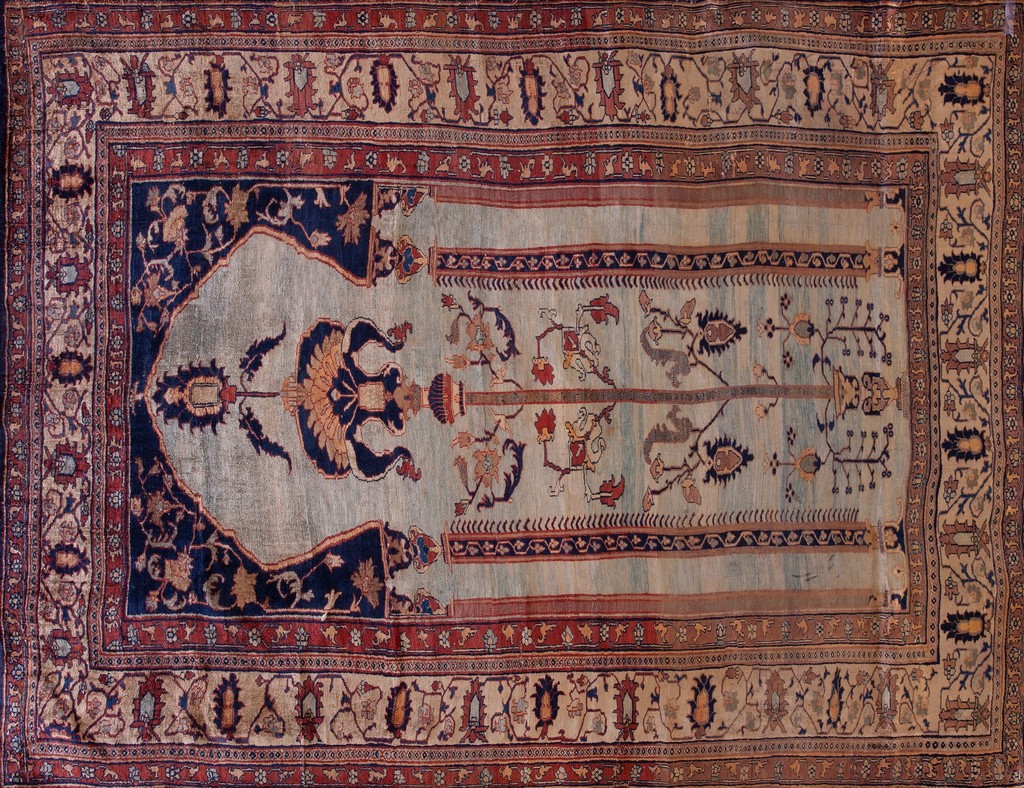
At the luxury rug end, Qum silk rugs feature full-silk construction, renowned for shimmering clarity and record-breaking auction prices. Cotton is frequently used as the warp and weft foundation, ensuring stability for both wool and silk piles. Climatic variations across provinces also shape fiber quality: colder highland regions yield denser, oil-rich wool prized for durability, while warmer zones offer softer but less compact fibers.
Dyeing Traditions: Natural vs. Synthetic
The color the rugs of Persia is as important as its weave. Historically, natural dye carpets relied on walnut husks for browns, indigo for blues, madder root for reds, and pomegranate rind for yellows. Certain provinces, such as Kurdistan, are still revered for their mastery of plant-based dyeing, creating hues that are both colorfast and luminous.
Collectors often favor these Kurdistan natural dye traditions, seeing them as more authentic and sustainable compared to synthetic dyes, which entered Persian rugs in the late 19th century. Although synthetic dyes expanded the palette, poorly applied anilines sometimes diminished longevity and prestige. Today, natural dye revival efforts reconnect modern rugs with their historic brilliance.
Durability and Artistry
Every element—fiber, dye, loom, and knot—dictates the character of a Persian rug. The high knot density of Nain vs. Isfahan produces refined courtly carpets; the robust construction of Heriz ensures durability in heavy traffic; the lush wool of Mashhad and delicate silk of Qum define regional excellence.
Identifying a Kerman Lavar medallion rug, for example, requires recognition of its precise medallion design, pastel palette, and supple wool base. Collectors who prioritize natural dyes, especially from workshops in Kurdistan and Fars, not only acquire vibrant pieces but also support sustainable artistry.
The Persian rug knot density, fiber source, and dye tradition together determine a rug’s look, feel, and longevity. From Nain’s precision to Heriz’s durability, Kerman’s medallion elegance to Qum’s silk luxury, Persian carpets embody an unbroken legacy where technique and material unite into artistry that endures for centuries.
Signature Styles and How to Distinguish Them
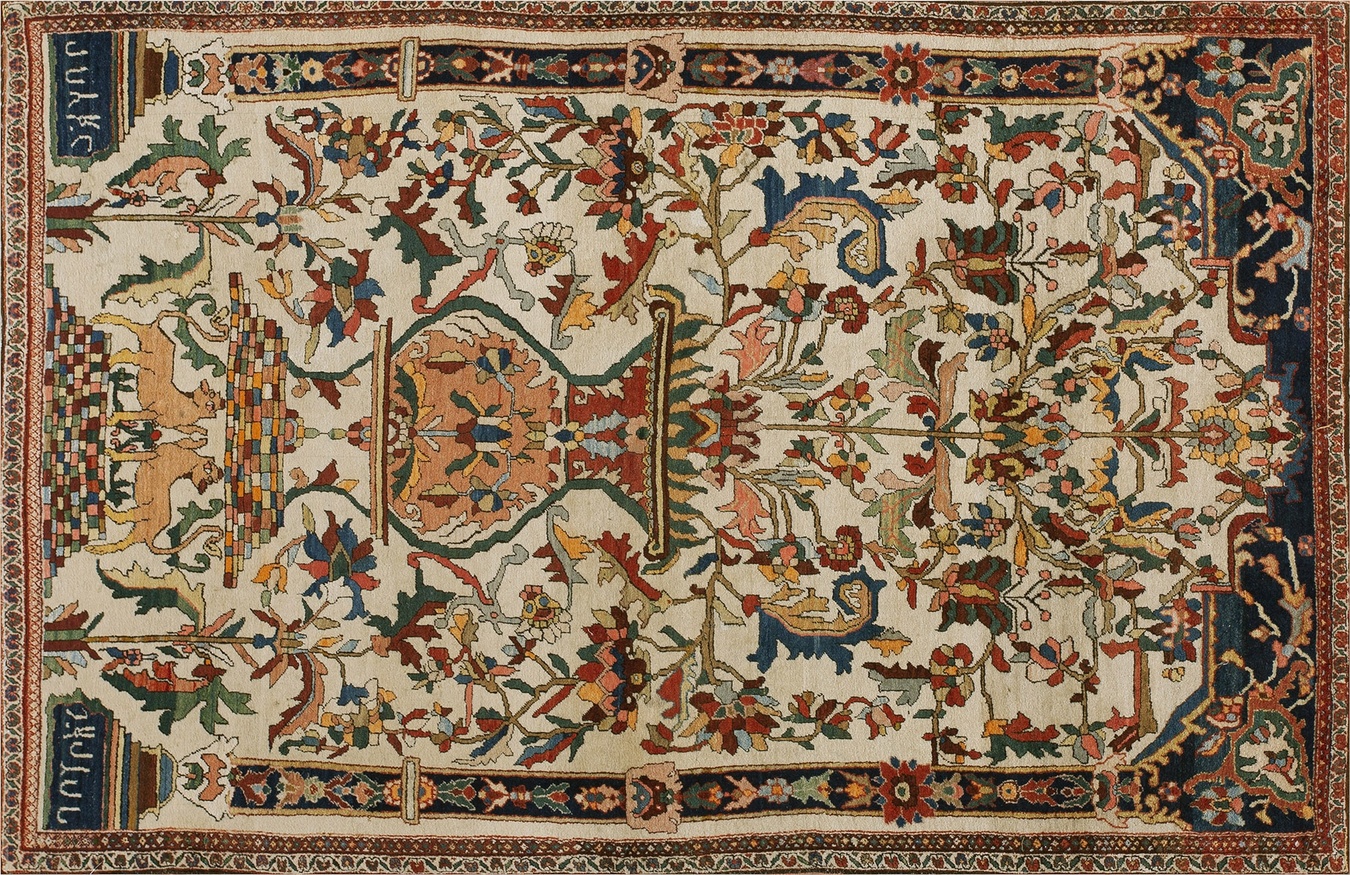
Antique SARABAND Persian Allover Floral Knotted Rug – by Rugs On Net
Tabriz vs. Kashan
- Tabriz Rugs — Fine knotting, curvilinear designs, and the iconic Mahi (fish) pattern set these apart. Their palettes balance elegance with innovation, making them leaders in export markets. — Why: The precision and versatility of Tabriz vs Kashan rugs highlight how regional schools adapted to global demand.
- Kashan Rugs — Known for intense red and deep indigo fields, tight weaving, and lush floral motifs, Kashan carpets radiate drama and richness. — Why: Their saturated colors and bold contrasts distinguish Kashan weaving from Tabriz’s more subdued balance.
Isfahan vs. Nain
- Isfahan Carpets — Defined by sophisticated arabesques, intricate medallions, and the famous Shah Abbas floral motifs. These rugs embody courtly refinement with symmetrical layouts. — Why: Isfahan represents Safavid elegance and intellectual artistry.
- Nain Carpets — Even finer than Isfahan, with extremely high knot counts, pastel palettes, and frequent silk inlays for luminous highlights. — Why: The refinement of Nain elevates Persian weaving into near-microscopic detail, appealing to connoisseurs seeking technical perfection.
Qum Silk Rugs
The Qum silk rug price consistently ranks among the highest in the Persian market. Pure silk construction produces radiant colors and crisp motifs, often pictorial, depicting gardens, animals, or religious scenes.
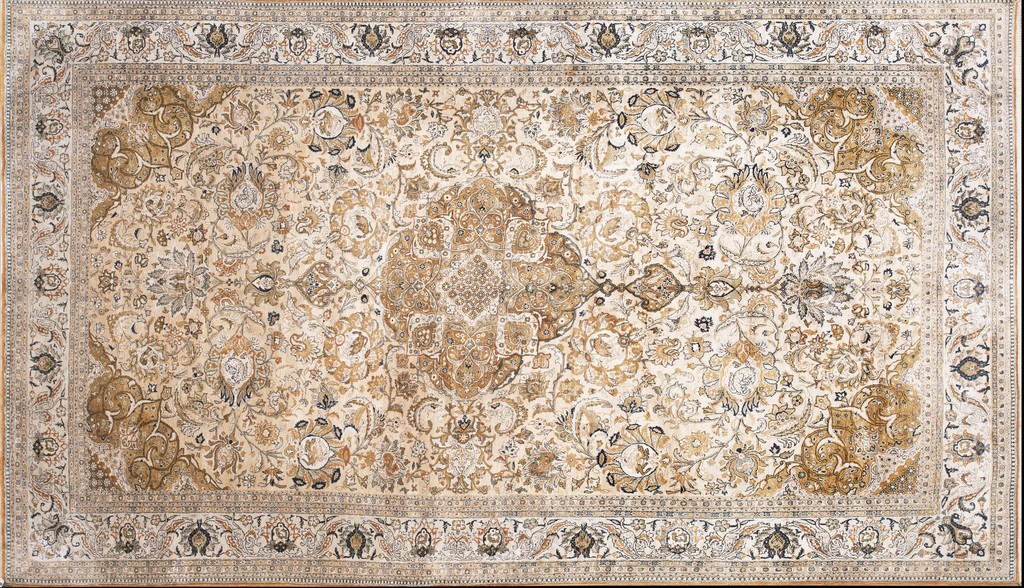
Their rarity, delicacy, and artistry make them highly collectible, with some examples achieving record-breaking auction values. — Why: Qum silk rugs embody the pinnacle of Persian luxury, valued for both their material and cultural symbolism.
Gabbeh, Heriz, Kerman Lavar, Bakhtiari, Afshar
- Gabbeh Tribal Carpet — Thick pile, minimalistic or abstract designs, and vibrant colors created by nomadic tribes in Fars. — Why: Their rustic simplicity appeals to modern décor while preserving tribal identity.
- Heriz Rugs — Bold geometric medallions, coarse but robust weave, and natural resilience. Heriz durability makes them perfect for heavy-traffic areas. — Why: They combine decorative appeal with long-lasting strength.
- Kerman Lavar Medallion — Recognized by delicate central medallions, fine pastel tones, and sometimes “vase carpet” motifs. — Why: Spotting a genuine Kerman Lavar medallion involves attention to its refined floral precision and wool softness unique to Kerman.
- Bakhtiari Garden Rug — Famous for their “garden panel” designs with compartmentalized floral or geometric motifs. — Why: These tribal yet structured rugs balance collectibility with strong resale value.
- Afshar Tribal Carpet — Compact sizes, bold tribal motifs, and rich colors characterize Afshar weaving from Kerman. Rising collector interest is tied to authenticity, portability, and vibrant design. — Why: Afshar rugs are gaining attention as overlooked tribal pieces now recognized for their cultural and artistic depth.
From the elegance of Tabriz vs Kashan, to the refinement of Isfahan and Nain, to the luxury of Qum silk rugs, and the strength of Heriz durability or the bold tribal identity of Gabbeh and Afshar, each Persian style offers clear visual cues and distinct functions.
Collectors and buyers can identify and value these carpets by knotting style, regional palette, and motif—ensuring the enduring prestige of Iran’s diverse weaving heritage.
The Modern Industry: Production, Exports, and Social Impact
Industry Stats: Production, Exports, Employment
The hand-knotted rug production sector in Iran remains one of the country’s most significant non-oil industries. In the 2020s, annual output averaged 3.5–3.9 million square meters of handwoven carpets.
Around 2 million Iranians are directly employed in weaving, with as many as 10 million people relying on the sector through related trades like dyeing, wool production, and sales. This makes the Persian carpet industry both a cultural hallmark and a lifeline for rural economies across provinces such as Isfahan, Kerman, and Fars.
Role of Women, Family, and Rural Economy
The majority of women weavers in Iran form the backbone of this tradition. Rugs are often woven in family homes or small rural workshops, where multiple generations contribute.
For many villages, carpet weaving is both an artistic legacy and the main source of income. Beyond its economic role, weaving provides social stability: women gain financial independence, and families preserve centuries-old techniques while participating in the modern economy.
Sanctions, Market Access, and Export Shifts
Sanctions have severely disrupted Persian rug exports. The U.S. market—historically the largest destination—was closed after 2010, briefly reopened in 2016 under the JCPOA, and banned again in 2018. This led to a collapse in exports from $426 million in 2017 to about $40 million in 2023.
While sanctions on Iranian carpets crippled U.S. access, producers redirected trade toward China, the Gulf states, and Europe. Yet, without the U.S. market, the livelihoods of countless artisans remain precarious, showing how geopolitics directly impacts craft traditions.
Machine-Made vs. Hand-Knotted
- Machine-Made Carpets: Fast to produce, cheaper, and widely accessible. — Why: They serve mass-market demand but lack individuality and artistry.
- Handwoven Carpets: Require months or years to complete; even a mid-sized rug may take 6–12 months, while large masterpieces can take several years. — Why: Each piece is unique, tied to the weaver’s skill, regional identity, and cultural continuity.
Social and Economic Challenges
Despite its prestige, the carpet sector faces challenges: fluctuating export access, competition from machine-made rugs, and younger generations leaving weaving behind.
NGOs and government programs attempt to provide training, protect artisan incomes, and revive natural dyeing traditions to increase global appeal. Sustainability initiatives also aim to ensure that weaving remains viable, with efforts to certify fair wages and preserve traditional techniques in the face of industrialization.
The Persian rug industry employs millions and sustains rural Iran, with women weavers at its core. Yet, sanctions on Iranian carpets have devastated exports, underscoring the vulnerability of this heritage craft.
While machine-made vs. handwoven options differ dramatically in speed and price, only authentic hand-knotted rugs carry the cultural, artistic, and investment value that define Iran’s global legacy.
Cultural Experiences: Where to See, Buy, and Learn
Exploring Isfahan’s Historic Carpet Bazaar
The Isfahan carpet bazaar, nestled within the city’s Grand Bazaar near Naqsh-e Jahan Square, remains the beating heart of Iran’s rug trade. Visitors encounter centuries-old vaulted halls where merchants display everything from intricate Isfahan silk rugs to robust Heriz pieces brought in from neighboring provinces.
Many shops stage live weaving demonstrations, allowing tourists to witness knotting firsthand. Bargaining is not only expected but considered part of the cultural exchange, creating a vibrant marketplace where artistry meets tradition. For those seeking to buy a Persian rug in Iran, Isfahan’s bazaar offers both access to masterpieces and immersion in the rituals of trade.
Tehran’s Carpet Museum
The Tehran Carpet Museum, established in 1976, provides one of the most comprehensive introductions to the art of Persian weaving. Its collection spans regional rug exhibitions from Tabriz medallion carpets to Qashqai tribal pieces and Qum silks. For connoisseurs, the museum illustrates the evolution of designs, knot densities, and dye palettes across centuries.
For newcomers, it offers a guided entry into the complexity of Persian weaving traditions. Above all, the museum’s mission is educational: it ensures that the diversity of Iran’s weaving heritage is preserved and made accessible to both Iranians and international visitors.
Other Major Markets and Festivals
- Kashan Bazaar: Specializes in finely knotted Kashan weaving with signature indigo-and-red palettes. — Why: Ideal for collectors seeking classical city carpets.
- Tabriz Market: Known for innovation and export leadership; visitors often find Mahi-pattern rugs here. — Why: A center for both historical and contemporary Tabriz designs.
- Kerman Bazaar: Offers pastel-toned Kerman medallion rugs and access to Lavar workshop traditions. — Why: Highlights regional distinctiveness.
- Shiraz Market: Famous for tribal rugs such as Gabbeh and Qashqai weavings. — Why: Provides a direct link to nomadic traditions.
- Persian Rug Festivals and International Exhibitions: Hosted in Iran and abroad, these events showcase regional mastery, promote sustainability, and connect artisans with global buyers. — Why: They encourage cultural exchange and investment in weaving communities.
Touristic, Educational, and Collector Experiences
For travelers, Iran’s rug culture is an experience that transcends shopping. Bazaars function as living museums, where the art is seen in daily use rather than behind glass.
Museums like Tehran’s serve as formal educational centers, while local festivals offer opportunities to interact with weavers and even purchase directly from artisans. For collectors, the chance to evaluate rugs at their source, compare regional styles side by side, and gain provenance through direct purchase adds tremendous value.
From the bustling stalls of the Isfahan carpet bazaar to the curated displays of the Tehran Carpet Museum, Iran offers countless opportunities to see, buy, and learn.
Whether wandering historic markets, attending a Persian rug festival, or exploring a regional rug exhibition, each encounter deepens appreciation for the artistry and cultural heritage woven into every Persian carpet.
Sustainability, Challenges & Future Outlook
Revival of Natural Dyeing and Eco-Friendly Movements
A central trend in Persian rug sustainability is the return to natural dye revival. Workshops across Kurdistan, Fars, and other weaving regions are reintroducing plant-based dyes such as walnut husk, madder, and pomegranate rind.
These eco-friendly methods not only preserve historical authenticity but also appeal strongly to modern buyers seeking eco-friendly Persian rugs. Collectors increasingly prefer pieces woven with natural dyes from Kurdistan workshops, recognizing both their cultural integrity and environmental benefits.
This revival aligns heritage craft with contemporary sustainability demands, turning tradition into a marketable asset.
Geographic Indications and Regional Protection
Another development shaping the future is the use of Geographic Indications (GI) for Persian carpets. By certifying origin—such as Isfahan, Tabriz, or Kashan—GI status protects authenticity, prevents counterfeiting, and enhances market trust.
UNESCO recognition of Iranian carpet weaving further validates its cultural significance, ensuring that international buyers understand both provenance and artistry. Such measures safeguard local weavers while positioning Persian rugs as a protected cultural product on the global stage.
Apprenticeship and Generational Skill Transmission
Traditionally, weaving skills have been passed down through apprenticeship weaving in Iran, often from mother to daughter or within workshop guilds. This oral and practical transmission preserves knotting methods, dye recipes, and symbolic motifs.
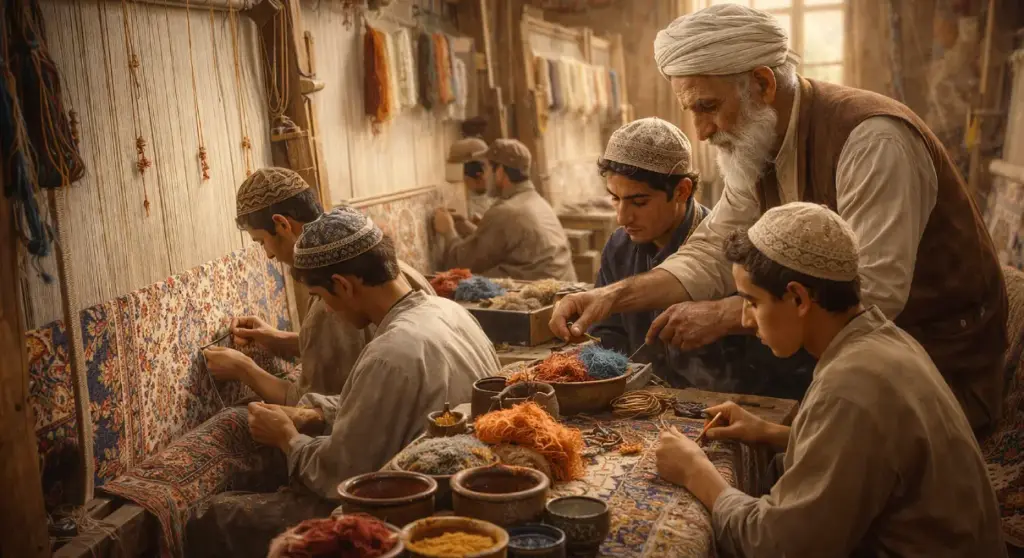
Yet, with younger generations less inclined to continue weaving, the sustainability of this chain is under threat. Maintaining apprenticeships and creating incentives for youth engagement is vital to ensure the continuity of Iran’s most enduring artistic tradition.
Youth Engagement and Industry Future
- Cultural Pride: Encouraging young Iranians to see weaving as cultural stewardship. — Why: Strengthens identity while preserving heritage.
- Economic Incentives: Fair wages and international demand make weaving viable. — Why: Financial stability is key to retaining younger artisans.
- Education & Innovation: Programs that teach weaving alongside design adaptation. — Why: Allows artisans to respond to changing consumer tastes.
- Digital Platforms: Marketing rugs online and telling artisan stories globally. — Why: Expands markets beyond traditional bazaars.
Adapting to Changing Market and Design Demands
The future of Persian weaving depends on responsiveness to modern lifestyles while honoring tradition. Contemporary weavers in Fars have successfully recreated antique Gabbeh designs, blending minimal tribal aesthetics with modern interior trends. Similarly, the industry must adapt to shifting consumer preferences for lighter palettes, smaller sizes, and certified sustainability.
Even factors such as climate influence wool quality across provinces: highland sheep in Khorasan and Kurdistan produce denser, oil-rich wool ideal for durability, while warmer regions yield softer but less compact fibers. Aligning these natural advantages with modern design demands ensures continuity.
The outlook for Persian carpets rests on uniting eco-friendly practices, natural dye revival, GI protection, and youth apprenticeship. By engaging younger generations and adapting to modern consumer expectations, Iran can sustain its weaving traditions.
The path forward ensures that Persian rug sustainability is not just about preserving the past, but about securing a future where artistry, ecology, and cultural pride remain tightly interwoven.
Quick Facts: Persian / Iranian Rugs & Country Insights
Essential Country and Rug Facts
- Persian Rug Quick Facts: Iran produces millions of square meters of hand-knotted carpets each year, with Tabriz, Isfahan, Kashan, Kerman, and Qum as leading centers. — Why: Helps buyers recognize where the most famous styles originate.
- “Farsh” and “Qāli”: In Persian, Farsh means carpet or floor covering, while Qāli specifically refers to a knotted rug. — Why: Knowing the local Farsh meaning gives buyers cultural and linguistic confidence when shopping.
- Iran Travel Rug Buying: Bargaining is part of the tradition in bazaars; provenance and dye quality should always be checked before purchase. — Why: Enhances both the experience and assurance of authenticity.
Language, Currency, Time Zone, and Airports
- Language: Persian (Farsi) is the national tongue, though many dialects and regional languages (Kurdish, Azeri, Luri, Baluchi) are also spoken. — Why: Buyers and travelers gain cultural depth by understanding that Persian carpet language reflects diverse identities.
- Currency: The official unit is the Iranian Rial, but everyday transactions are quoted in Toman (1 Toman = 10 Rials). — Why: Knowing this distinction prevents confusion in markets.
- Time Zone: Iran Standard Time (IRST), UTC +3:30, with no daylight savings observed. — Why: Practical for coordinating travel or trade appointments.
- Airports: Major international gateways include Tehran Imam Khomeini (IKA), Mashhad (MHD), Shiraz (SYZ), Isfahan (IFN), and Tabriz (TBZ). — Why: These hubs provide direct access to rug-weaving centers and markets.
Cultural Notes for Rug Buyers
The rugs of Persia are deeply tied to Iran’s cultural and social identity. The act of weaving connects households, tribes, and urban workshops in a shared tradition.
Visitors who understand local terminology (Farsh, Qāli), respect bargaining etiquette, and recognize regional rug distinctions will find greater confidence in buying and collecting. For international enthusiasts, these cultural insights help link the Persian carpet language of motifs, dyes, and knots with the broader experience of traveling in Iran.
From the Farsh meaning in everyday Persian speech to knowing that prices are quoted in Toman, these Persian rug quick facts provide practical guidance. Whether navigating Iran travel rug buying in Isfahan’s bazaar or planning a trip through Tehran’s airport, such details deepen both appreciation and confidence when engaging with the world of Persian carpets.
From Persia to Iran: Why the Name Change Matters
1935 Name Change Details
In 1935, Reza Shah Pahlavi formally requested that foreign governments adopt the name “Iran” in place of “Persia.” While the people of the country had always referred to their homeland as Iran—the “land of the Aryans”—Persia was a Western exonym derived from the province of Fars (Parsa), the cradle of the Achaemenid Empire.
The change marked a shift toward asserting national identity and moving away from colonial or Eurocentric labels. This Persia to Iran name change was not intended to erase cultural heritage but to align global usage with local authenticity.
Reza Shah’s Motivations and the International Response
Reza Shah’s decision stemmed from his broader modernization project, which sought to position Iran as a sovereign and unified nation rather than a collection of regions tied to the “Persian” label. While many countries complied, the international community continued using “Persia” in cultural contexts, especially regarding carpets, poetry, and art.
By 1959, the government clarified that both “Persia” and “Iran” were acceptable, with context determining usage. This diplomatic nuance allowed the state to assert modernity while maintaining recognition of Persia’s historic resonance.
Modern Dual Usage and Impact on Rug Branding
In the world of carpets, Reza Shah rug naming reforms had little effect. The term “Persian rug” had already become a universal symbol of luxury, artistry, and craftsmanship. Even today, collectors and traders overwhelmingly prefer “Persian” to “Iranian” because it carries centuries of recognition and brand equity.
In contrast, “Iranian carpet” is used in political, diplomatic, or legal contexts. This dual usage reflects a balance between national identity and global branding, where Persian vs Iranian carpet name choices depend on audience and purpose.
The Legacy of “Persian” in Culture and Commerce
The persistence of “Persian” reflects continuity in Iran / Persia rug history. In culture and commerce, “Persian” evokes refinement, heritage, and artistry, ensuring carpets remain tied to their millennia-old legacy.
For buyers and enthusiasts, “Persian” is not merely a geographic term but a cultural brand synonymous with authenticity and prestige. In this sense, both names are correct—Iran for national identity, Persia for cultural heritage—but the enduring legacy of “Persian” guarantees its dominance in the global rug market.
The Persia to Iran name change was a political and cultural milestone, yet in the realm of carpets, “Persian” remains the defining term. Context decides usage: Iran asserts sovereignty, while Persian signals continuity, quality, and the centuries-old prestige that keeps these rugs at the center of global admiration.
Understanding the Value: How Much Does a Persian Rug Cost?
The price of a Persian rug is determined by a combination of artistry, rarity, and the sheer amount of time required to weave it.
Here are the primary factors that influence the cost:
Knot Density (KPSI)
The “resolution” of a rug is measured in Knots Per Square Inch (KPSI).
- Village/Tribal ($): Usually 60–120 KPSI. These are more affordable but prized for their bold, geometric character.
- Fine Workshop ($$$): 300–600+ KPSI. A fine Isfahan or Tabriz can take a master weaver years to complete, driving the price into the tens of thousands.
Materials: Wool vs. Silk
- Wool ($ – $$): High-quality highland wool is durable and beautiful.
- Silk ($$$$): Pure silk rugs (like those from Qom) use much more expensive raw materials and require extreme skill to weave, making them the most expensive category.
Age and Provenance
- New / Vintage: Generally priced based on size and decorative appeal.
- Antique (100+ years): These are “blue chip” investments. A 19th-century Serapi or Bakshaish in good condition is a finite resource; as they become rarer, their value increases.
The Price of Art: Understanding Persian Rug Value
One of the most common questions we hear is: “Why does this rug cost $2,000 while that one costs $200,000?” In the world of Persian weaving, you aren’t just paying for size; you are paying for rarity, age, and the mastery of the weave.
The Three Tiers of Value:
The “Decorative” Tier (Village & Vintage)
- These are the “workhorses” of the Persian world. They are beautiful, hand-knotted, and designed for daily life.
- Common Types: Vintage Heriz, Hamadan, or Tribal Shiraz.
- Value Factor: These are priced primarily on their condition and decorative appeal. They offer the best “bang for your buck” for high-traffic living rooms.
The “Collector” Tier (Fine City & Antique)
These rugs are woven in professional workshops or are 80-100+ year old antiques.
- Common Types: Tabriz, Kashan, or fine 19th-century tribal pieces.
- Value Factor: Priced on Knot Density (KPSI) and Material. A rug with 400 KPSI took four times longer to weave than one with 100 KPSI, and the price reflects that labor.
The “Investment” Tier (Masterpieces & Rare Antiques)
These are the “Blue Chip” assets of the rug world.
- Common Types: Antique Serapi, Sultanabad, Tabriz, Kashan, Bakshaish and very fine pure Silk rugs or very old are rare examples.
- Value Factor: Rarity and Provenance. Because the supply of 19th-century Serapis is finite and global demand from designers is high, these pieces hold and often appreciate in value.
A Note on Pricing:
At Rugs On Net, we avoid the “50% Off” gimmicks common in the industry. Instead, we offer direct-to-consumer pricing based on the current market value of the wool, the complexity of the weave, and the rarity of the piece. Because we source directly and maintain a low-overhead online model, we can offer 19th-century antiques and fine workshop rugs at a fraction of traditional gallery prices.
Why Rugs On Net is the Premier Destination for Persian Rugs
Buying a Persian rug is an investment in art, history, and your home’s legacy. Whether you are shopping online or visiting us in person, Rugs On Net offers an experience rooted in transparency, expertise, and a curated selection that mass-market retailers cannot match.
Curated Authenticity (No Mass-Produced Imitations)
Unlike big-box stores that sell “Persian-style” machine-made rugs, every piece in our collection is an authentic, hand-knotted masterpiece. We specialize in sourcing pieces with “soul”—from rare 19th-century Bakshaish and Serapi antiques to robust, vegetable-dyed Heriz rugs.
Expert Knowledge & Guidance
With decades of experience in the rug industry, we don’t just sell rugs; we help you curate your space. We understand the technical differences between a “City” weave and a “Tribal” weave and can guide you toward the perfect piece based on your lifestyle, foot traffic, and design aesthetic.
Transparent Pricing & Value
We believe that luxury should be accessible. By maintaining deep relationships with weavers and collectors globally, we are able to offer wholesale-to-public pricing. You are getting gallery-quality rugs without the traditional gallery markup.
A “Risk-Free” Online Shopping Experience
We know that seeing a rug in your own light is crucial. That’s why we offer:
- High-Definition Imagery: Multiple angles and close-ups so you can see every knot and color variation.
- Expert Consultation: Have a question about a specific piece? Our experts are available to discuss the history, condition, and “feel” of any rug in our inventory.
- Easy Returns: We want you to love your rug for a lifetime. If it isn’t perfect in your space, our return process is straightforward and fair.
Personalized Service (In-Person or Virtual)
If you are local, we invite you to experience the texture and “shimmer” of our collection in person. Not local? We offer virtual “walk-throughs” and personalized recommendations based on photos of your room.
Experience the Rugs On Net Difference
✓ Guaranteed Authenticity: Every rug is a hand-knotted original with a documented heritage.
✓ Heritage Expertise: We provide the history and technical details of every piece in our collection.
✓ Unbeatable Value: Gallery-level Persian rugs at direct-to-consumer prices.
✓ Designer’s Choice: We are the go-to source for top interior designers seeking unique, high-end pieces.
Sources and Further Education
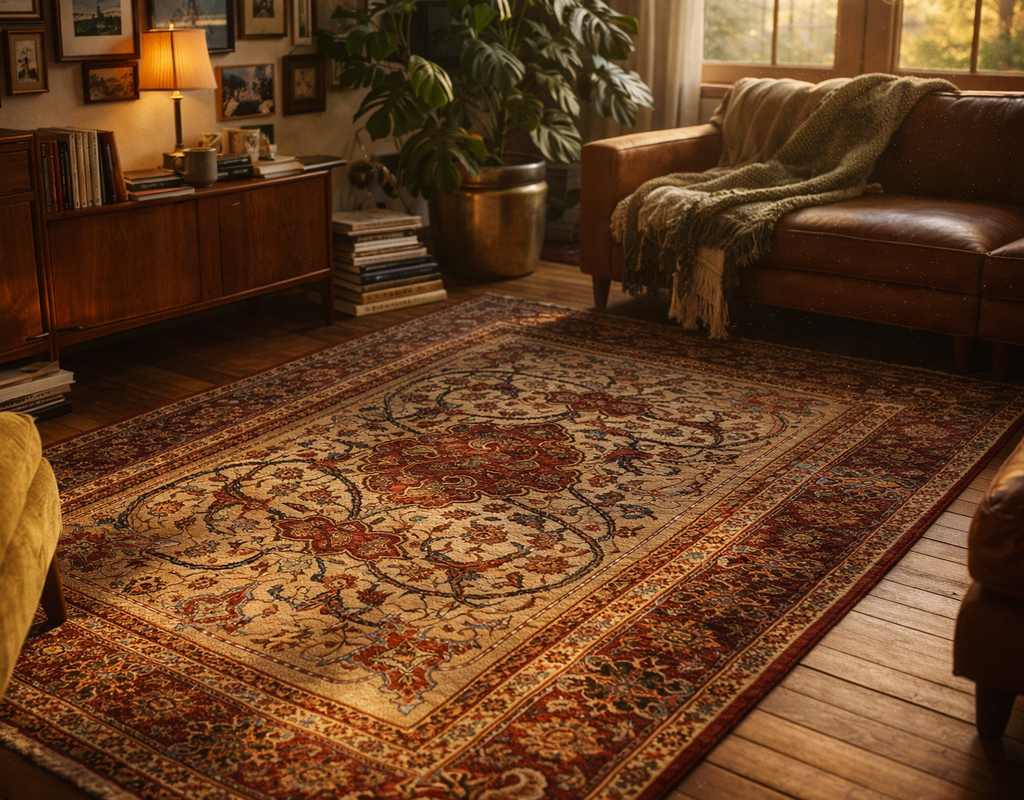
A richly atmospheric interior scene highlighted by a unique, historically inspired rug.
For readers who want to deepen their understanding of Persian and Iranian rugs, the following references and resources provide authoritative insights into history, technique, and collecting.
- Tehran Carpet Museum – A central resource for viewing regional variations and historic masterpieces, ideal for travelers and researchers.
- UNESCO Intangible Cultural Heritage Database – Recognition of Persian carpet weaving as a living cultural tradition.
- Academic Studies on Iran/Persia Rug History – Works exploring the Safavid golden age, tribal traditions, and the evolution of dyeing practices.
- Auction House Catalogues (Sotheby’s, Christie’s, Bonhams) – Documentation of antique rug sales, provenance notes, and price benchmarks.
- NGO Reports (GoodWeave, Iranian Carpet Export Associations) – Coverage of sustainability efforts, labor practices, and international trade conditions.
For collectors, scholars, or first-time buyers, exploring these resources provides both academic depth and practical guidance.
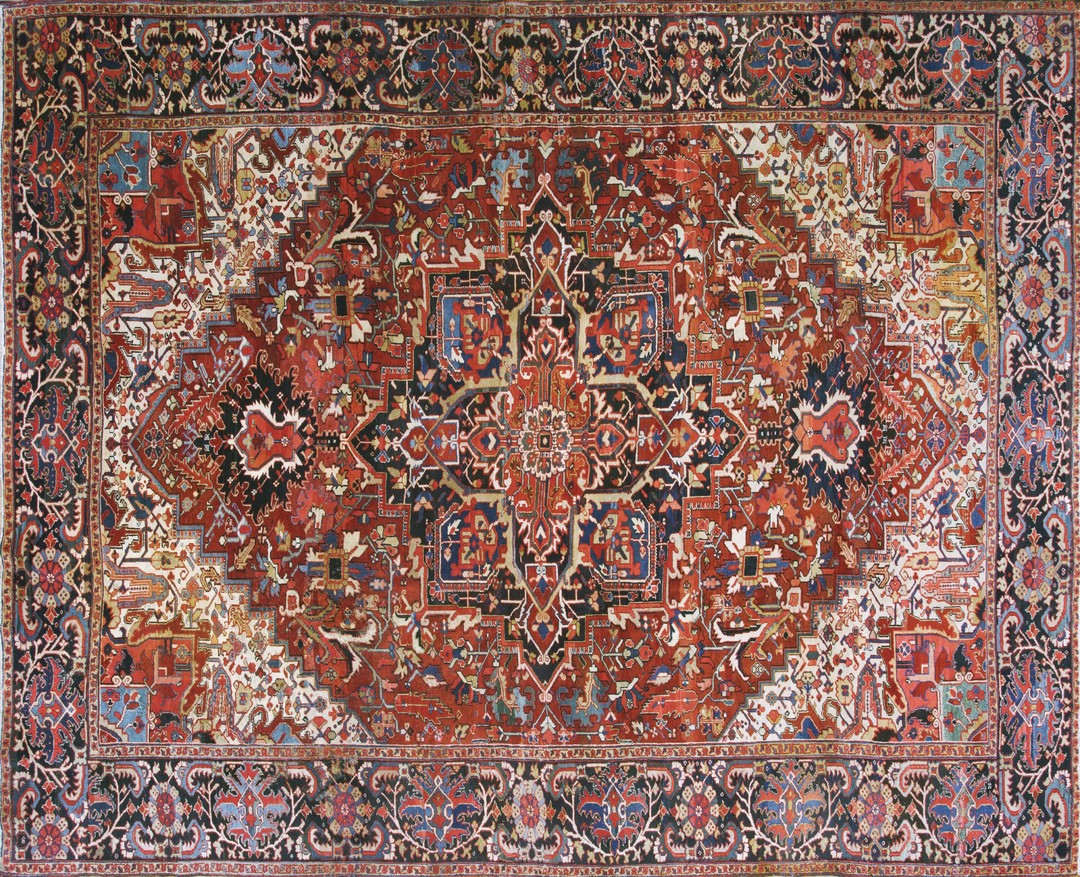
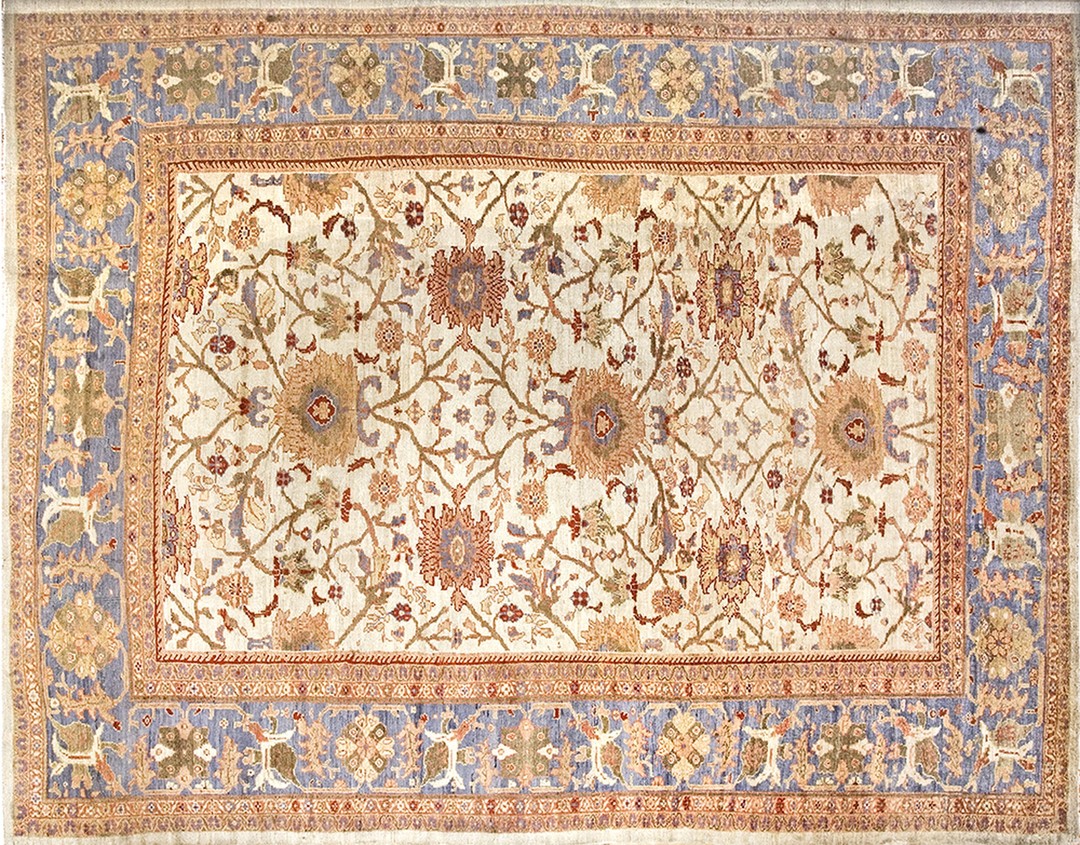
Explore a Few of Our Favorite Persian Rugs
FAQ
- What’s the safest way to treat spills on a Persian rug?
Blot immediately with cool water and a white cloth—don’t scrub. If color transfers or it’s a large spill, call a qualified rug cleaner.
- Are “Persian-style” machine-made rugs the same as Persian rugs?
No. “Persian-style” denotes the pattern only; true Persian rugs are hand-knotted in Iran. Machine-made pieces are usually polypropylene, polyester, or wool blends.
- What’s the difference between Persian and Turkish knots?
Persian (Senneh) is asymmetrical; Turkish (Ghiordes) is symmetrical. The knot type influences curves and detail but doesn’t alone determine quality.
- Can U.S. buyers import new rugs from Iran?
Generally no—U.S. sanctions reimposed in 2018 prohibit importing Iranian-origin carpets without specific authorization. Consult OFAC/CBP before attempting.
- How do I limit fading from sunlight?
Rotate every 6–12 months and use window UV protection or sheers. Avoid placing delicate silk in direct sun.
- Are Persian rugs a good investment?
Some antiques appreciate, but most buys should be for beauty and use. Condition, provenance, and rarity drive value.
- How much do authentic Persian rugs cost?
Hand-knotted pieces vary widely: small village rugs can start around hundreds; 8×10 town rugs often run several thousand; fine silk or antique pieces can be five figures.
- What runner size works for a hallway?
Common runners are 2–3 feet wide and 6–14 feet long. Leave about 4–6 inches of floor exposed on each side.
- Is a Persian rug okay under a dining table?
Yes—choose low to medium pile and size so chairs stay on the rug when pulled out. Aim for about 24″ extra around the table.
- Can I place a Persian rug over radiant floor heating?
Usually yes—natural fibers like wool work well. Keep piles moderate and use a breathable pad to let heat pass through.
- What steps should I take to keep moths away from my items?
Keep rugs clean, rotate, and vacuum the back occasionally. For storage, wrap properly and avoid damp areas; inspect quarterly.
- What rug pad should I use under a Persian rug?
A felt-and-natural-rubber pad protects floors and prevents slips. Trim the pad about 1″ shorter on all sides.
- Can I use a robot vacuum on Persian rugs?
Carefully. They’re fine on low-pile areas but can chew fringes and edges—set no-go zones and lift the rug’s fringe before runs.
- How often should a Persian rug be professionally cleaned?
Every 1–3 years depending on traffic, pets, and soil. High-use family rooms and entry rugs benefit from annual washes.
- How often should I vacuum a Persian wool rug?
Vacuum weekly in traffic areas and avoid the fringe. Use suction only (beater bar off) for delicate or older pieces.
- Are Persian rugs good for homes with pets and kids?
Often yes—wool naturally resists staining due to lanolin. Clean accidents quickly; pet urine can cause dye loss if left, especially on silk.
- How can I tell if a Persian rug is hand-knotted?
Flip it: the design should mirror on the back and the fringe should be warp ends, not sewn on. Minor irregularities are a good sign.
- Does a higher KPSI always mean a better rug?
No. KPSI affects detail but not everything—wool quality, dyes, condition, and design matter too. A robust Heriz might be 85–120 KPSI yet extremely durable.
- What does knot count (KPSI) mean?
KPSI measures knots per square inch and indicates detail capacity. Many good Persian rugs range roughly from 80–250 KPSI; fine silk pieces can be far higher.
- What is the Herati (mahi) pattern?
It’s a repeating diamond with a rosette center and “fish-like” leaves around it. You’ll see it frequently in Bidjar and many town weaves.
- What are popular Persian rug types by region?
Heriz (geometric), Tabriz (fine floral), Kashan (medallion), Qom (silk), Nain (cream/blue), Isfahan (refined), Gabbeh (tribal). Bidjar is dubbed the “Iron Rug” for density.
- How do Persian rugs differ from other Oriental rugs?
“Oriental” is a broad region term; “Persian” means made in Iran. Persian pieces often feature curvilinear floral medallions and traditional motifs like boteh and Herati.
- What materials are most Persian rugs made from?
Wool pile on a cotton foundation is most common; silk is used for finer pieces. Tribal weavers may also use camel or goat hair in accents.
- Are Persian and Iranian rugs the same thing?
Yes—“Persian” refers to rugs made in Iran. The country’s official name changed in 1935, but the craft and term “Persian rug” remain widely used.
- What is a Persian rug?
A Persian rug is a hand-knotted carpet made in Iran (historically Persia), known for intricate designs and durable wool or silk piles. Towns like Tabriz, Kashan, and Isfahan are classic sources.
Related guide: Antique Kurdish Rugs: Buying & Identification Guide. Kurdish weaving spans both structural extremes of Persian carpet making, from the iron hard Bijar to the thin, finely woven Senneh, and the guide covers how to identify it, what the tribal groups produced, and what these rugs are worth.
Baluch weaving from Khorasan is the most accessible antique Persian tribal category we carry. Our antique Baluch rug buying and identification guide sets out the current price bands, why the small formats dominate, and how to recognise the dark aubergine and indigo palette.