
Introduction to Cypress Trees Motifs in Rugs
Discover the natural elegance of these iconic designs when you browse our exclusive collection of Cypress Tree motif rugs today.
History & Symbolism
The cypress trees design motif is among the most enduring and meaningful symbols in oriental rug weaving. Its origins can be traced back to ancient Persia, where it was closely associated with Zoroastrian beliefs and the vision of a divine paradise. In Zoroastrianism, the cypress was a sacred tree symbolizing eternal life and resilience, standing tall and evergreen through all seasons.
This religious and cultural connection helped solidify the cypress as not only a decorative element but also a spiritual emblem. Within Persian gardens—designed as earthly reflections of paradise—the cypress trees occupied a central role. Its upright form, often planted along pathways or beside flowing water, became a living metaphor for balance, protection, and divine order. When translated into textiles, particularly rugs, the motif carried forward this layered symbolism.
For weavers across Persia, Anatolia, Central Asia, and India, the tree represented both a sacred symbol of immortality and a marker of aesthetic refinement. Thus, when asking “What do the cypress trees symbolize in Persian rugs?”, the answer lies in its dual essence: it evokes the promise of paradise and conveys resilience against the passage of time. This meaning has endured for centuries, reinforcing the motif’s role as one of the most recognizable and beloved in the entire tradition of oriental carpet weaving.
As for its antiquity, the cypress motif in rug weaving is over a thousand years old, embedded in designs since the early days of Islamic and pre-Islamic Persia. Its continued use across dynasties and regions testifies to the motif’s timeless relevance, both visually and spiritually.
Overview of Design and Appeal
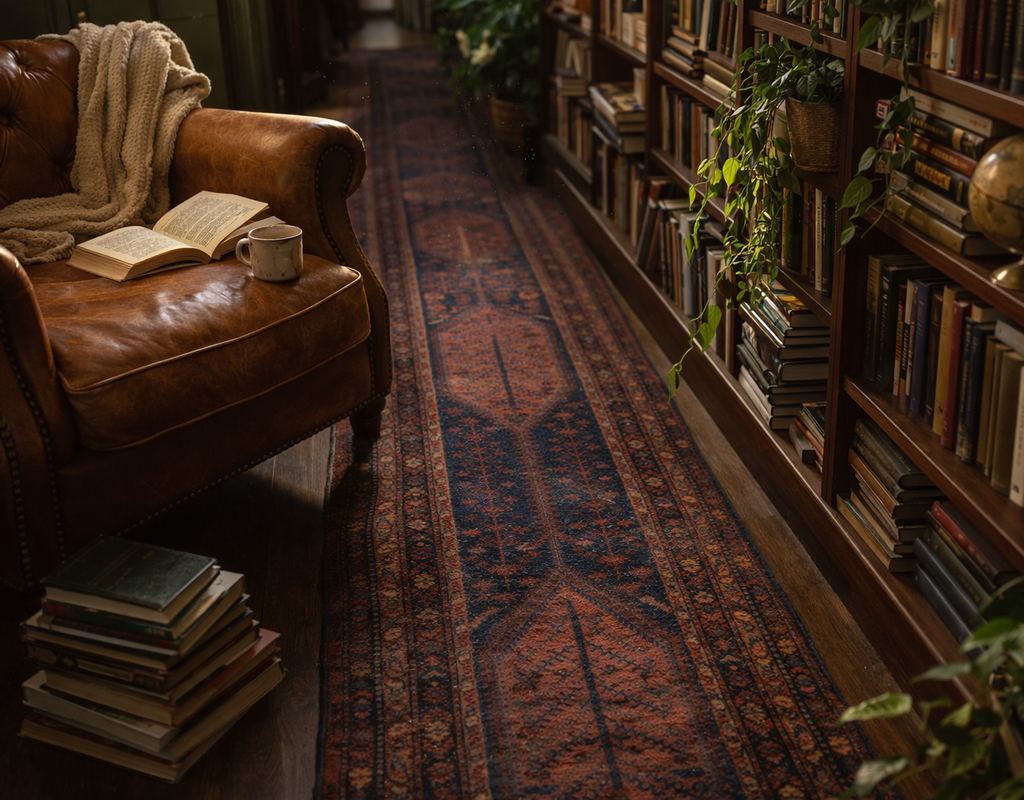
An inviting reading corner is established over a richly patterned vintage runner rug, perfectly complemented by leather and literature.
- Striking Silhouette — The tall, flame-like form of the cypress trees lend rugs a distinctive and immediately recognizable design element. — Why: Its graceful verticality breaks the field of a rug with elegance and balance, guiding the eye upward.
- Balance of Symbolism and Beauty — The cypress combines religious, cultural, and philosophical meaning with artistic charm. — Why: Collectors and homeowners are drawn to rugs that offer both visual richness and deeper symbolic narratives.
- Versatility Across Styles — Found in Persian, Anatolian, Indian, and Central Asian traditions, the motif adapts easily to varying color schemes and layouts. — Why: Its flexibility ensures it remains relevant in diverse weaving centers, from classical court carpets to village and tribal productions.
- Enduring Popularity — The motif’s continued presence reflects its ability to transcend trends. — Why: Whether appreciated for meaning of cypress trees in rugs or its role as an ancient Persian rug motif, it continues to appeal to modern audiences while retaining historic prestige.
The symbolism of cypress in carpets thus unites spiritual significance with decorative elegance. Its role as both ornament and emblem ensures that cypress motifs are not just design choices but storied traditions—threads linking the past to the present.
Cypress Trees Origins and Historical Development

Ancient garden design featuring a towering cypress.
Ancient Persian Beginnings
The origin of the cypress motif in rugs lies deep within ancient Persia, where the tree was sacred in Zoroastrian tradition. One of the most celebrated examples is the Sarv-e Kashmar, a legendary cypress tree said to have been planted by the prophet Zoroaster himself in the city of Kashmar. This tree became a symbol of divine life and immortality, representing the cosmic connection between earth and heaven.
In Persian art and mythology, the cypress—evergreen and enduring—stood as a counterpart to mortality, promising continuity and paradise beyond death. It is within this context that the first cypress trees patterned area rugs were produced, carrying forward a design that was both decorative and profoundly spiritual.
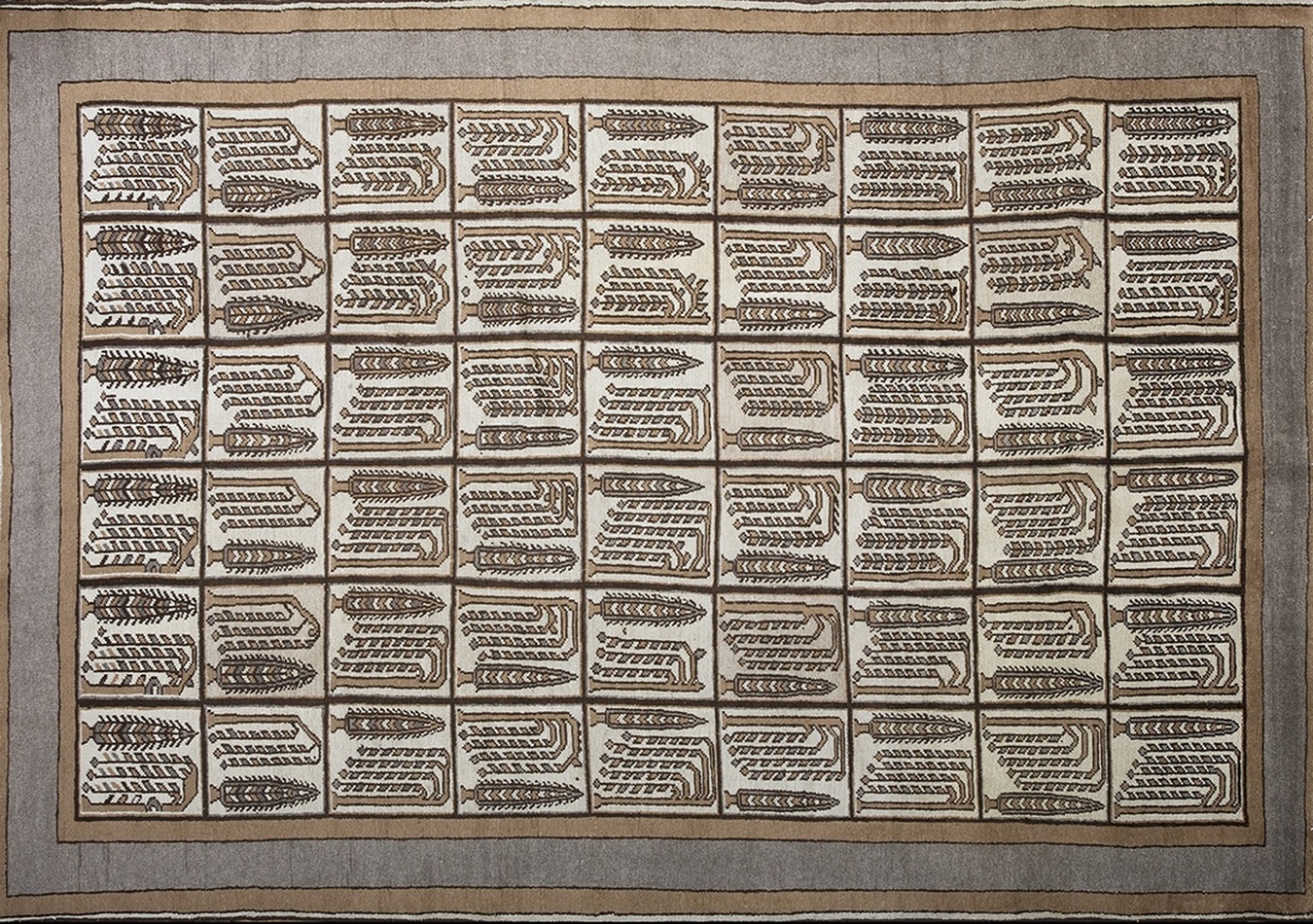
Early Persian weavers incorporated the motif into textiles as part of a larger symbolic language tied to gardens, paradise, and eternal life. This establishes the motif as more than two millennia old, confirming its antiquity and central role in Zoroastrian rug symbols.
Spread to Anatolia, Mughal India, Central Asia
From its Persian heartland, the cypress motif expanded across empires through trade routes, conquests, and cultural exchange. In Anatolia, Ottoman weavers adapted the design into courtly carpets, blending the upright form of the tree with geometric and floral embellishments that suited the aesthetics of Turkish palaces.
In Mughal India, the motif appeared in both textiles and architecture, often tied to the imagery of paradise gardens that defined Mughal art. Central Asian weaving centers—Turkmen, Uzbek, and other tribes—absorbed and reinterpreted the design, often simplifying it into stylized forms suited to nomadic production. This spread underscores the history of cypress in carpet design as a story of continuity across civilizations.
Each culture preserved the spiritual essence of the tree—resilience, immortality, paradise—while reshaping it into a style suited to local artistic traditions. The motif’s 2500-year legacy demonstrates its adaptability and its enduring cultural power across regions.
Etymology of “Cypress” & Regional Names
The English word “cypress” comes from the Latin cypressus and Greek kyparissos, ultimately linked to the island of Cyprus, where the tree was abundant in antiquity. However, in the Persian tradition, the native word sarv carries far deeper meaning. More than a botanical term, sarv signifies the sacred tree of paradise, the upright form of immortality, and the emblem woven into Persian gardens and carpets.
Regional variations of the name followed the motif’s spread: in Turkish, Indian, and Central Asian contexts, the design was often referred to through loanwords derived from Persian, maintaining its symbolic connection to its Zoroastrian origins. This linguistic continuity underscores how the motif’s spiritual and cultural weight carried intact even as it crossed borders.
Thus, when asking “How old is the cypress motif in oriental carpet weaving?”, the answer reaches back over two and a half millennia, beginning in the sacred gardens of Persia and flowering across the Ottoman, Mughal, and Central Asian worlds. Its survival through centuries of exchange confirms its place as one of the foundational motifs in the history of carpet design.
Symbolism of the Cypress Trees in Rug Design
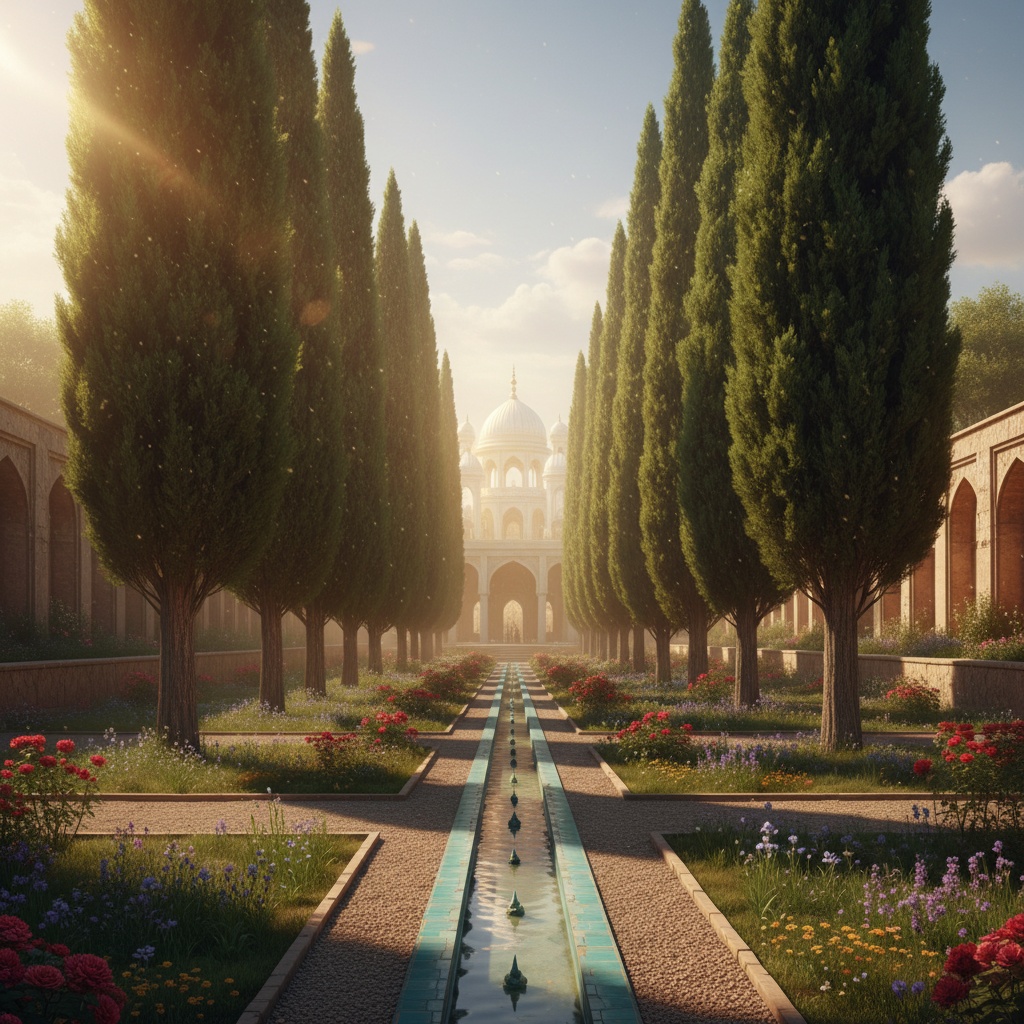
Formal garden showing cypress trees symmetry.
Immortality, Life After Death, and the Divine
The cypress trees meaning in Persian culture is inseparable from ideas of eternity and the afterlife. As an evergreen, the cypress became the perfect emblem of immortality and resilience, remaining vibrant when other trees shed their leaves. In both Zoroastrian and later Islamic traditions, it acquired strong funerary associations.
Planted near tombs or depicted in burial art, the tree served as a promise of life after death and a guide toward paradise. Persian gardens, themselves designed as earthly reflections of the divine garden, often featured rows of cypress trees. When woven into textiles, this motif carried the same weight: it transformed a carpet into a portable vision of paradise. In this sense, the tree of life carpet meaning is not abstract but deeply spiritual—an assurance of continuity, protection, and divine blessing.
This explains why the cypress often appears on prayer rugs, reinforcing the link between daily devotion and the eternal realm. Thus, when asked “What do the cypress trees symbolize in Persian rugs?”, the most direct answer is that it signifies eternal life, paradise, and divine guardianship—a visual anchor of the sacred woven into fabric.
Spiritual Protection & Poetic Allusions
- Guardian Presence — The cypress was thought to protect the soul and the home. — Why: Its frequent use in prayer rugs and tomb designs offered reassurance of divine shelter.
- Poetic Symbol of Beauty — In Persian poetry, the beloved is compared to the upright cypress, a figure of elegance and dignity. — Why: Woven rugs absorbed this metaphor, layering romantic and spiritual meanings into the same design.
- Bridge Between Worlds — Standing tall and unyielding, the cypress links earthly existence with the eternal. — Why: This poetic resonance deepened its role as a motif that is both decorative and sacred.
These associations made the cypress more than an ornamental figure; it became a living metaphor in wool and silk, celebrated as much in verse as in design.
Pairing with Other Motifs
The eternal life rug symbolism of the cypress grew even more powerful when paired with complementary motifs. Depictions of fruit trees, flowering branches, or blooming vines often appeared alongside the cypress. Together, these motifs created a layered message: the cypress stood for eternity and permanence, while fruit-bearing plants suggested renewal, fertility, and rebirth.
This duality enriched carpets with a spiritual balance—immortality combined with cyclical renewal—mirroring the rhythm of human life and the hope of paradise. In Persian art, such symbolic pairings created a visual theology that resonated with both courtly audiences and village households, ensuring the motif’s survival across centuries.
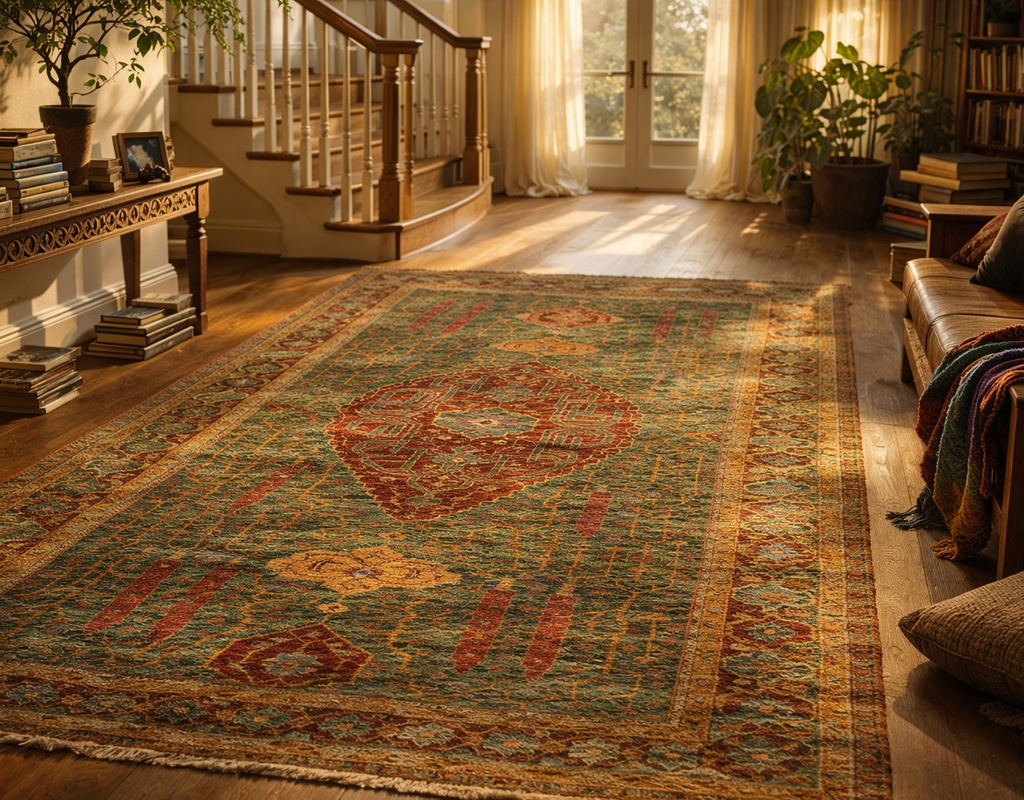
A richly colored, traditional runner rug defines the space near a sun-drenched entryway and staircase.
In rug design, the cypress trees meaning in Persian culture thus transcends ornament. It speaks of eternal life, divine protection, and poetic beauty, making it one of the most profound and enduring symbols in the entire tradition of oriental weaving.
Identifying Cypress Trees Motifs: Design Characteristics
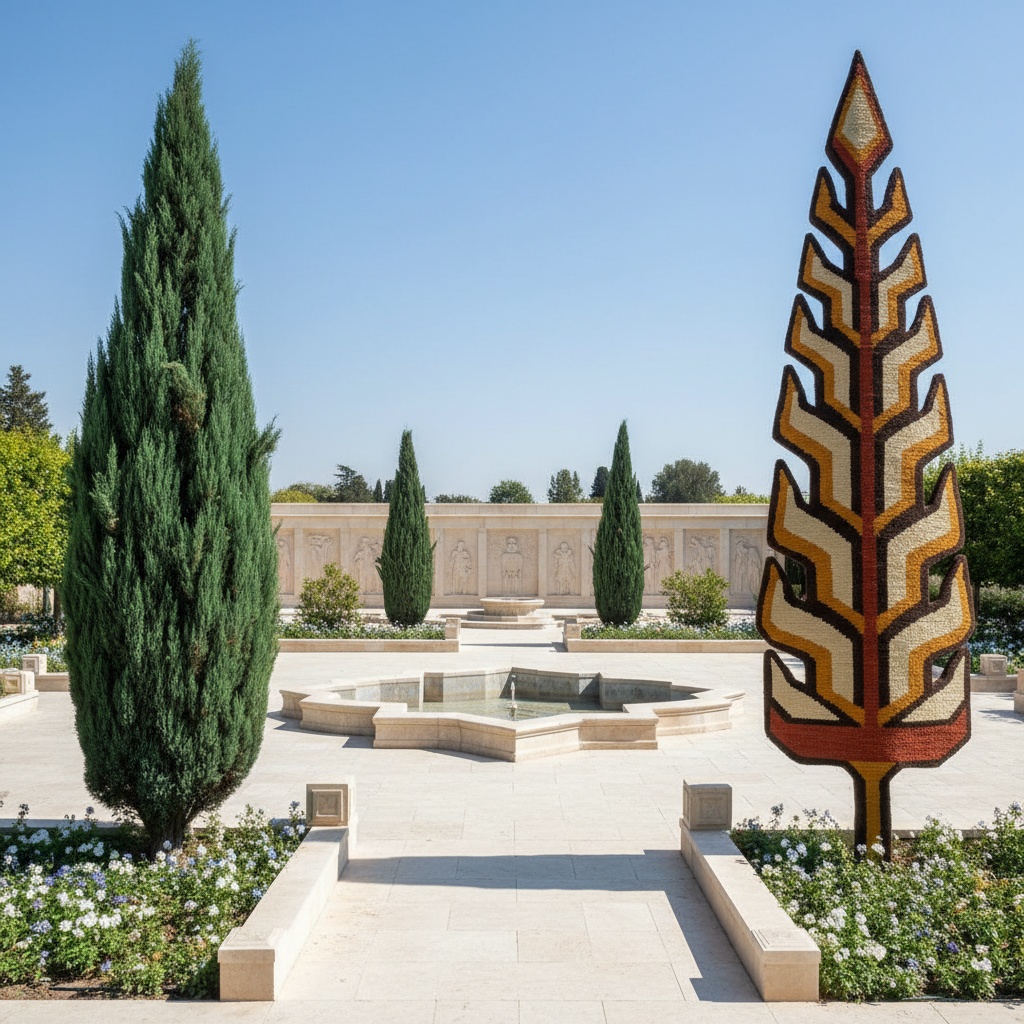
Stylized textile motif next to natural cypress trees forms
Naturalistic vs. Geometric Styles Of Cypress Trees
When it comes to identifying cypress trees in rugs, the first clue lies in the overall style of the motif. In Persian city rugs, especially those woven in centers like Kashan or Isfahan, the cypress appears in a naturalistic form—slender, tapering, and graceful, resembling the living tree found in Persian gardens.
In contrast, tribal and Anatolian rugs often render the cypress trees pattern more geometrically, with angular outlines and simplified flame-like shapes. Both approaches preserve the tree’s essential verticality and symmetry, but the degree of realism varies by region and weaving tradition.
Pattern Layouts: Panel, Central, Scattered, Paired Motifs
The rug design recognition tips for cypress trees motifs also include paying attention to layout.
The cypress trees may be placed as:
- A central axis motif, standing upright at the heart of the rug, symbolizing order and eternity.
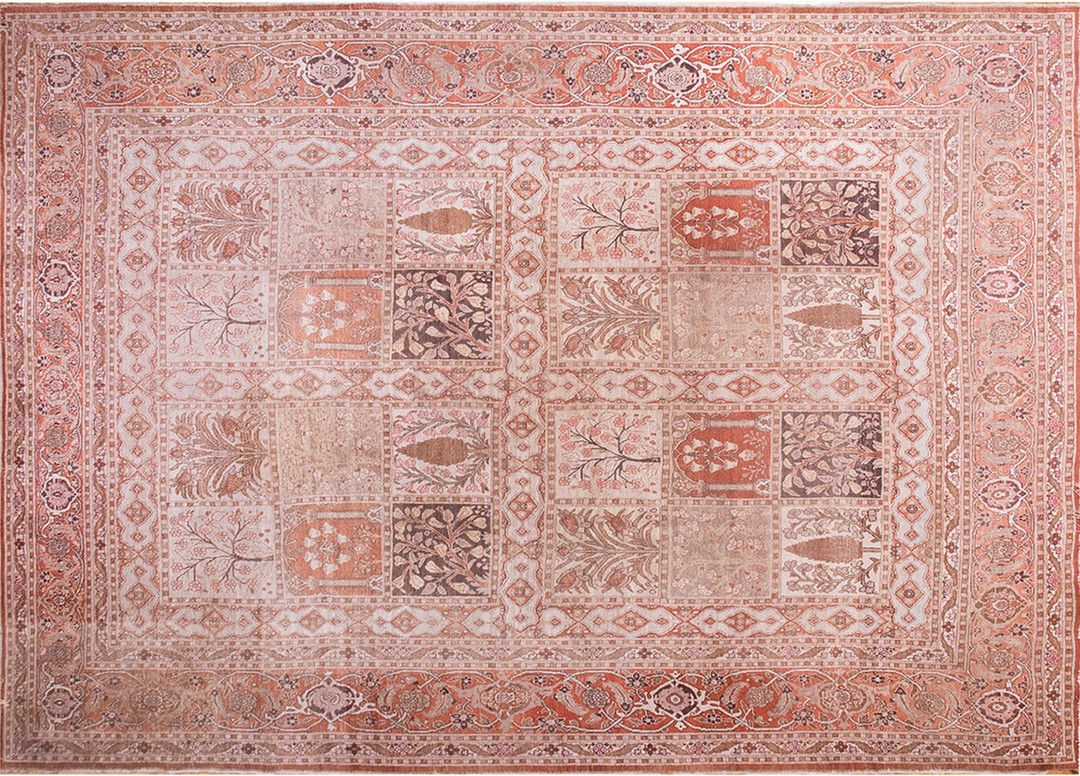
- Part of a panel design, repeated in garden-style layouts to suggest paradise.
- A scattered repeat, where multiple cypresses fill the field in rhythmic balance.
- A paired motif, often flanking a medallion or central floral tree, reinforcing symmetry and harmony.
These layouts echo the role of cypress trees in Persian gardens, where rows of trees structured space and guided the eye toward fountains or central features.
Colors Commonly Used
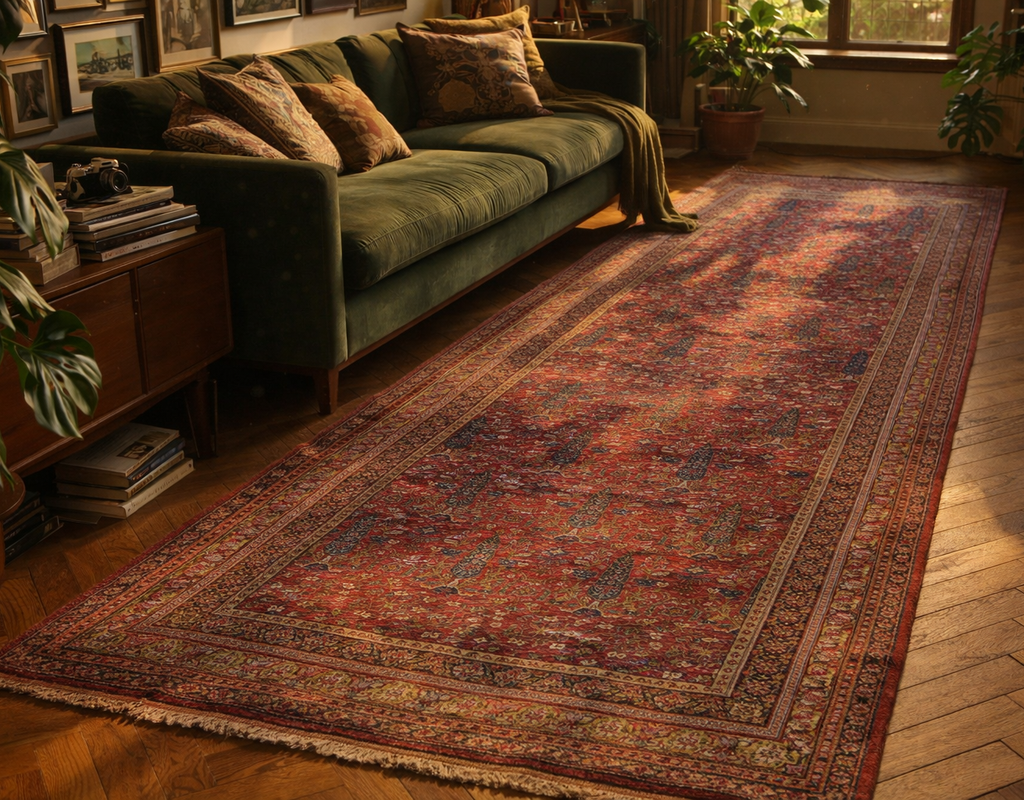
The deep jewel tones of the vintage runner complement the lush green sofa in this richly layered living space.
- Blue-Green and Emerald — These shades emphasize the vitality and paradise associations of the cypress trees. — Why: The tree’s natural hue directly ties it to life, renewal, and resilience.
- Turquoise — A favored Persian color that links the cypress trees motif to sky and water. — Why: Reinforces paradise imagery, where trees, rivers, and skies converge.
- Ivory and White Accents — Used for highlights or background contrast. — Why: Creates visual clarity and elevates the sacred symbolism of purity.
- Brown or Dark Outlines — Common in tribal weaving to define the tree’s flame-like form. — Why: Ensures the motif remains legible in more geometric, stylized rugs.
Thus, when asking “What colors commonly highlight cypress trees design motifs in rugs?” the answer centers on shades of green, turquoise, ivory, and brown, chosen for their resonance with nature and symbolism.
How to Spot Cypress Trees vs. Paisley / Boteh
A frequent challenge in rug design recognition is distinguishing between the cypress and the paisley (boteh) motif.
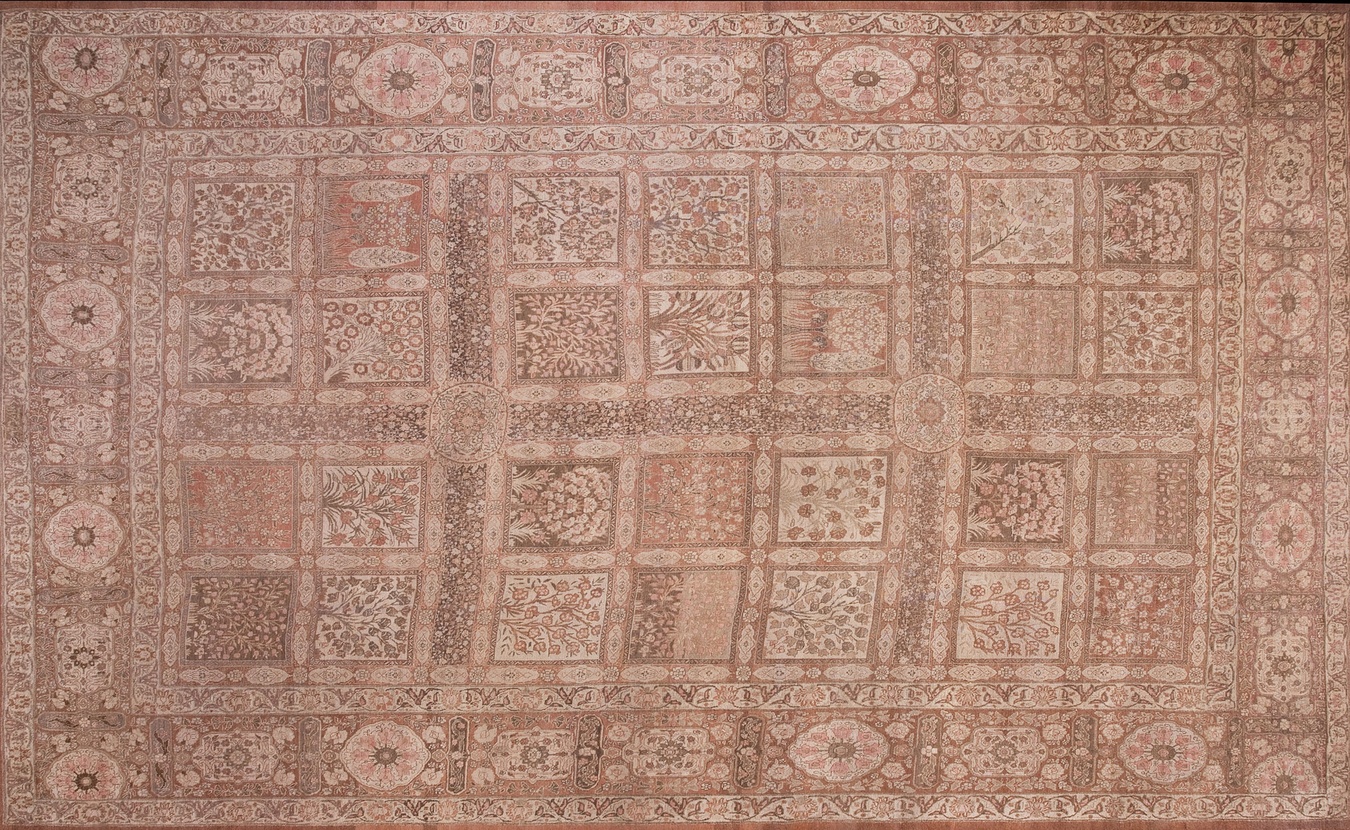
While both share flame-like qualities, their shapes differ significantly:
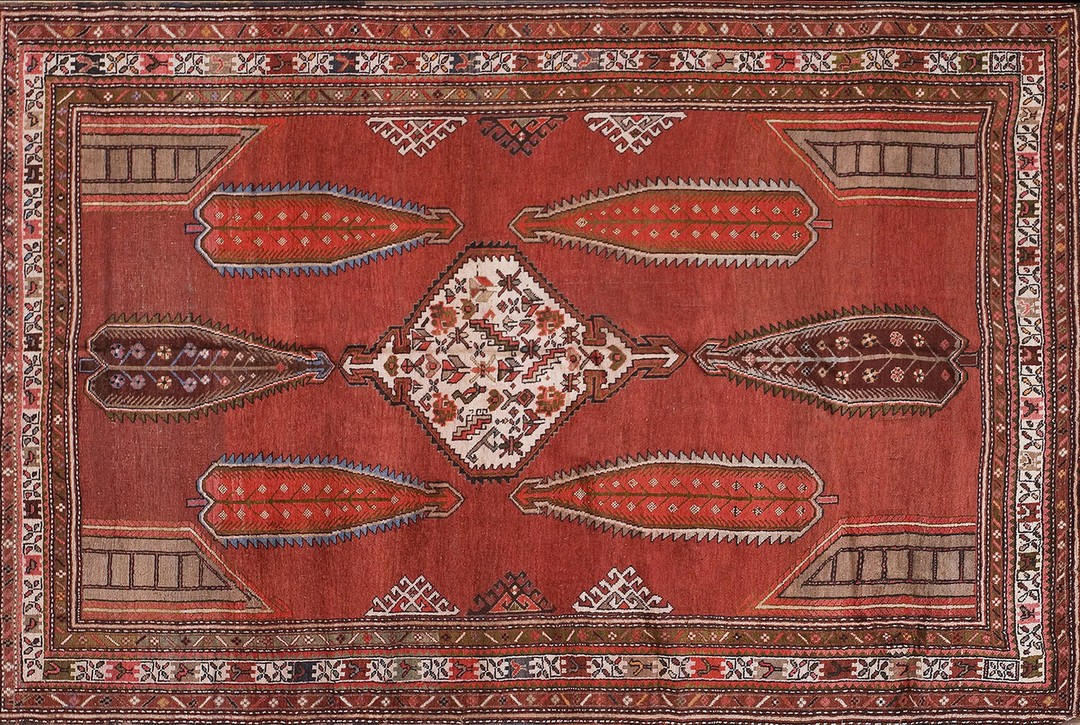
- The cypress trees are upright, vertical, and symmetrical, tapering smoothly to a point, much like a flame or spear. It conveys stillness, balance, and immortality.
- The boteh, by contrast, is curved and teardrop-shaped, with a distinctive bent tip that leans or curls. It symbolizes fertility, seeds, or fire but lacks the strict verticality of the cypress.
In short, the cypress stands tall and resolute, while the boteh bends and flows. This distinction is essential for collectors and enthusiasts interested in identifying cypress rugs accurately.
Ultimately, the cypress motif colors in carpets and its unmistakable upright form make it one of the easiest motifs to recognize once the key features are understood: slender flame-like shape, vertical orientation, and symbolic hues of paradise.
Regional Variations and Notable Styles
Persian (Iranian) Interpretations
The Persian cypress rug style is perhaps the most naturalistic and elegant. Persian weavers often depict cypress trees as slender, tapering tree placed within garden or tree-of-life layouts, echoing the architecture of Persian paradise gardens.
In Kashan, Isfahan, and Kerman, cypress trees may appear alongside flowing water channels, flowers, and pavilions—miniature universes of order and paradise woven into carpets. Their delicate realism underscores the spiritual dimension of cypress trees as a symbol of eternal life and divine blessing.
Anatolian (Turkish) Styles
In contrast, Turkish tree of life rugs tend toward geometric abstraction. In Anatolia, the cypress trees pattern motif often takes shape as bold, flame-like figures within prayer rugs framed by mihrab arches. The vertical orientation of the tree resonates with the upward focus of Islamic prayer, transforming the motif into both a visual and spiritual guide.
Though less naturalistic than Persian examples, the Anatolian style emphasizes spiritual protection and stylized clarity, making it a staple of Ottoman-era weaving.
Indian (Mughal) Adaptations
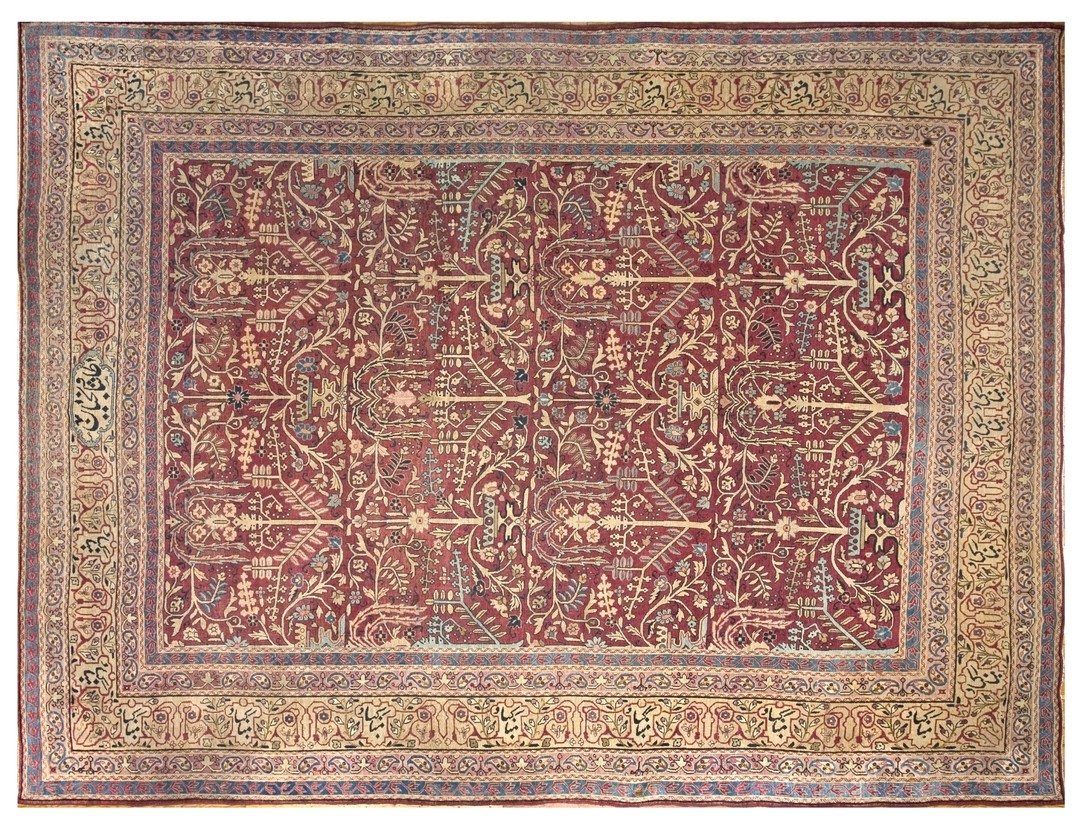
The Mughal garden carpets of India carried the cypress into a courtly context. Here, the tree is often paired with urns or vases, set in pastel tones and highly symmetrical compositions. These rugs reflect Mughal architecture and landscape design, where gardens were conceived as representations of paradise.
The Mughal approach to the cypress was highly formalized, reinforcing both elegance and eternal life, while integrating Persian influence into the broader South Asian artistic vocabulary.
Central Asian & Caucasian Adaptations
In Central Asian weaving traditions, the cypress trees appear less as a naturalistic tree and more through geometric abstraction, often blending with the boteh (paisley) motif. These rugs emphasize rhythm and repetition, with cypress-like forms scattered across the field. Similarly, Caucasian weavings often adapted the tree into bold geometric patterns, giving it a strong, stylized presence.
Among Afghan weavers, the continued use of cypress patterns speaks to the motif’s enduring spiritual and cultural resonance—a way of expressing resilience and paradise imagery even in modern tribal contexts. This answers the question: Afghan weavers use cypress trees patterns today because the motif remains a symbol of protection, continuity, and eternal life, values that remain deeply meaningful in their cultural identity.
Contemporary/Global Interpretations
In today’s rug world, the cypress trees motif has been revived and reimagined for modern interiors. Contemporary designers may enlarge the tree into bold, minimal statements, strip it down into sleek geometric outlines, or play with unexpected color schemes beyond the traditional greens and blues. These modern reworkings honor the past while aligning with current aesthetic trends.
Thus, when asking “How has the cypress motif evolved in contemporary rug design?”, the answer is that it has shifted from highly symbolic, intricate representations into simplified, stylized, or oversized forms, appealing to global tastes while retaining its original meaning. Across all these traditions—Persian, Anatolian, Mughal, Central Asian, and modern—the shared meaning of the cypress as a symbol of eternity and paradise unites diverse executions.
Each region made the tree its own, but the core resilience and spiritual symbolism remain intact, ensuring the motif’s continuity from antiquity to the present.
Techniques & Materials
Hand-Knotted vs. Machine-Made
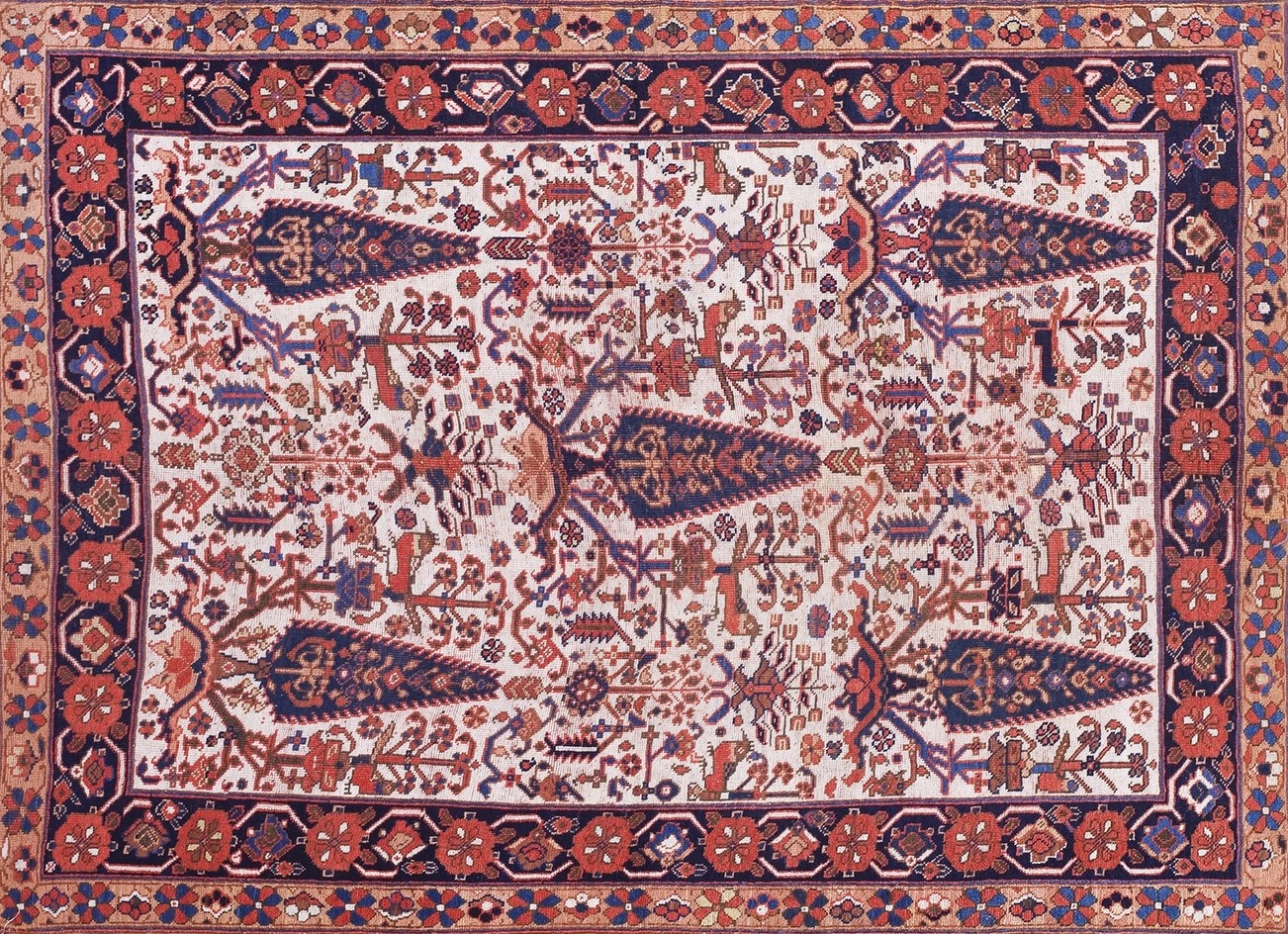
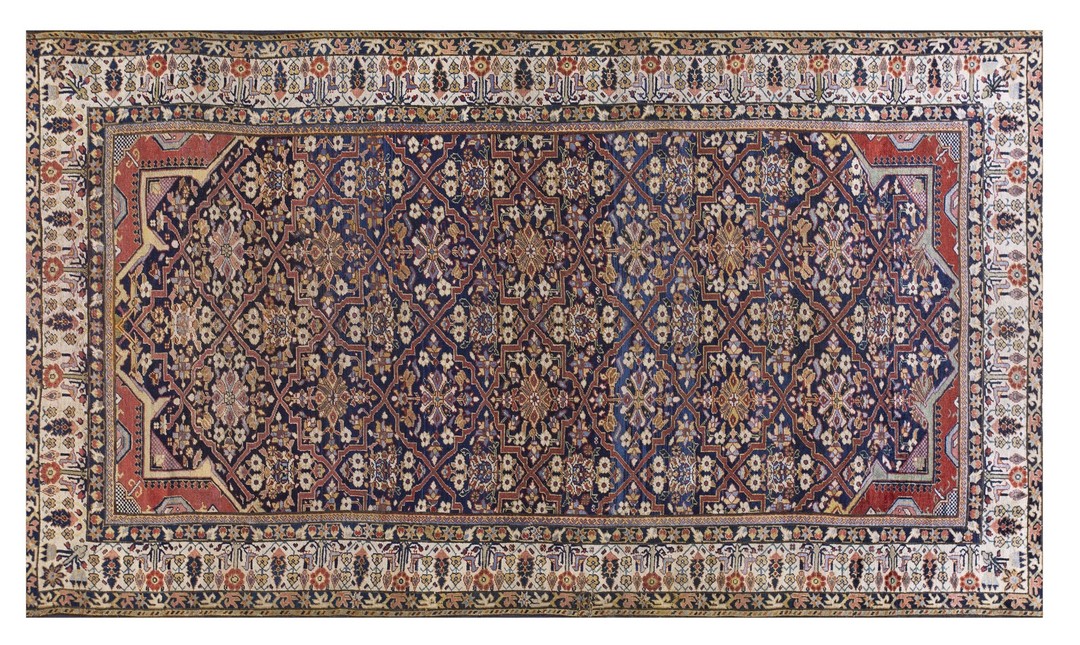
Antique Allover Floral Ivory Cypress Trees Patterns 1880s Rug – by Rugs On Net
- Hand-Knotted Cypress Carpet — Traditionally, authentic cypress trees motifs are woven by hand. — Why: This method allows artisans to preserve the motif’s spiritual symbolism and produce highly durable rugs prized by collectors.
- Machine-Made Rugs — Today, cypress designs also appear in printed or machine-woven carpets. — Why: While more affordable, they lack the depth, longevity, and artistry of hand-knotted works, making them less desirable for long-term value.
Thus, when asking “Are cypress motif rugs usually hand-knotted or machine-made?”, the answer is that they are overwhelmingly hand-knotted, with machine-made examples existing only as modern reproductions.
Wool, Silk, and Mixed Fibers
- Wool — The most common foundation for rugs featuring cypress trees. — Why: Wool offers warmth, durability, and affordability, making it the backbone of both village and workshop weaving.
- Silk — Used for luxury cypress rugs. — Why: Silk enhances clarity, sheen, and lifelike detail, allowing weavers to render the cypress motif with extraordinary precision. This addresses the question: “Does silk enhance the detail in cypress motif rugs?”—yes, silk elevates both visual quality and value.
- Wool-Silk Blends or Cotton Foundations — Blends add sheen or improve durability. — Why: Cotton often provides a stable warp for Persian city rugs, while mixed fibers balance luxury with practicality.
In short, the wool vs. silk cypress rug debate is often one of accessibility versus refinement, with wool serving daily needs and silk elevating the motif into collectible art.
Knot Density & Detail: Why It Matters
The knot density in rug quality plays a crucial role in how clearly the cypress trees appear. A high knot count allows artisans to weave the tree in lifelike, naturalistic detail, with tapering curves and precise outlines. Low-density rugs, by contrast, produce more abstract or geometric versions of the tree.
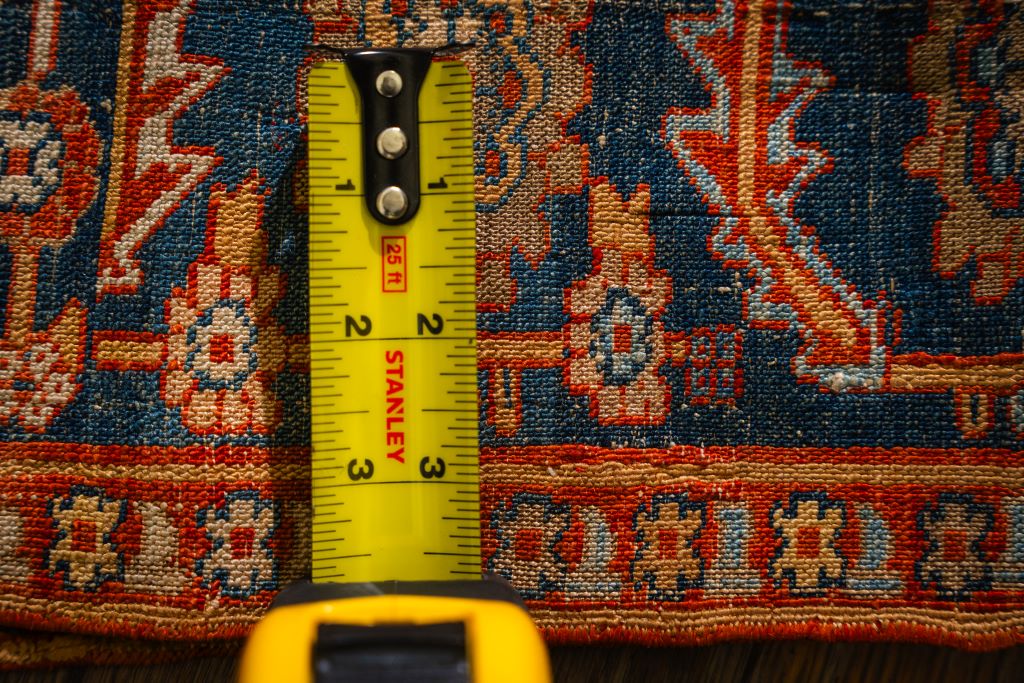
A detailed inspection of a richly colored oriental rug pattern while measuring its dimensions.
This answers the question: “How does knot density affect cypress motif clarity?”—it directly determines whether the design appears delicate and realistic or bold and simplified.
Flatweave, Kilim, Sumak, and Embroidery
Not all cypress trees design rugs are pile-woven. In flatweaves like kilims or sumak rugs, the cypress appears in angular, geometric forms, with sharp tapering lines rather than flowing curves.
Embroidered textiles sometimes carry the motif as well, stitched in contrasting colors to highlight its upright silhouette. While less intricate than pile rugs, these techniques showcase the motif’s adaptability and ensure its presence across many weaving traditions.
Modern Printed Rugs
Finally, modern technologies allow the cypress trees motif to appear in printed rugs. While they can reproduce the shape and color effectively, they lack the tactile depth, sheen, and spiritual aura of handwoven textiles. This addresses the question: “Can modern printed rugs capture cypress motifs well?”—yes, in appearance, but not in craftsmanship or cultural value.
Ultimately, the choice of materials, knot density, and weaving technique determines not only how the cypress is represented but also how it is valued. Silk and high knot counts elevate clarity and price, while wool and flatweaves offer durability and stylization. Across all mediums, however, the cypress motif endures as one of the most powerful and collectible symbols in rug art.
Safavid Court Carpets and Rise of Cypress Trees Motifs
Why the Cypress Trees Motif Was Favored at Court
During the Safavid dynasty (1501–1736), Persian weaving reached new artistic heights, and the cypress trees motif rose to prominence as a hallmark of court-sponsored design. The Safavid cypress carpet was favored because the tree symbolized both immortality and paradise, ideals that resonated with the dynasty’s cultural vision.
Court patrons saw the cypress as a poetic emblem of dignity and resilience, and its association with Persian gardens—designed as earthly reflections of paradise— made it the perfect subject for palace carpets. These royal commissions elevated the motif beyond village tradition, transforming it into a luxury emblem of power, refinement, and divine blessing.
Thus, to answer the question “Why were cypress trees favored in Safavid court carpets?”, the reason lies in their layered meaning: they embodied the eternal paradise of Islamic art, the poetic elegance of Persian culture, and the grandeur expected of royal patronage.
Iconic Carpets: Garden, Vase, and Panel Designs
The most celebrated court carpet designs of the Safavid period—garden, vase, and panel rugs—frequently included the cypress tree.
- Paradise garden rugs arranged cypresses in orderly rows divided by water channels, evoking the Quranic vision of paradise with flowing rivers and eternal trees.
- Vase carpets combined stylized cypresses with blossoming shrubs and elaborate vases, symbolizing the union of eternity (cypress) with renewal and fertility (flowers).
- Panel rugs used compartmentalized layouts, each panel containing a tree, flower, or symbolic form, with the cypress serving as an anchor of order and immortality.
These innovations marked a golden age of design, introducing new levels of color variation, symmetry, and naturalism that distinguished Safavid weaving from earlier traditions.
Influence on Mughal and Ottoman Workshop Rugs
The prestige of Safavid designs extended far beyond Iran. Their cypress-rich garden carpets set the template for Mughal India, where emperors commissioned similar garden carpets filled with cypress trees paired with flowering plants and vases. In the Ottoman Empire, Anatolian workshops absorbed the Safavid influence, reinterpreting the motif in more geometric forms suited to Turkish aesthetics and prayer rug traditions.
This cross-cultural adoption reflects the unifying power of the Safavid vision: the court’s innovation turned the cypress into a global luxury motif, shaping weaving traditions across empires. In the end, the Safavid cypress carpet represents more than a design choice.
It is a statement of paradise on earth, a poetic and spiritual emblem woven into the very fabric of royal identity. The Safavid legacy ensured that cypress motifs would remain a cornerstone of luxury carpet design for centuries to come.
Modern and Contemporary Cypress Trees Rugs
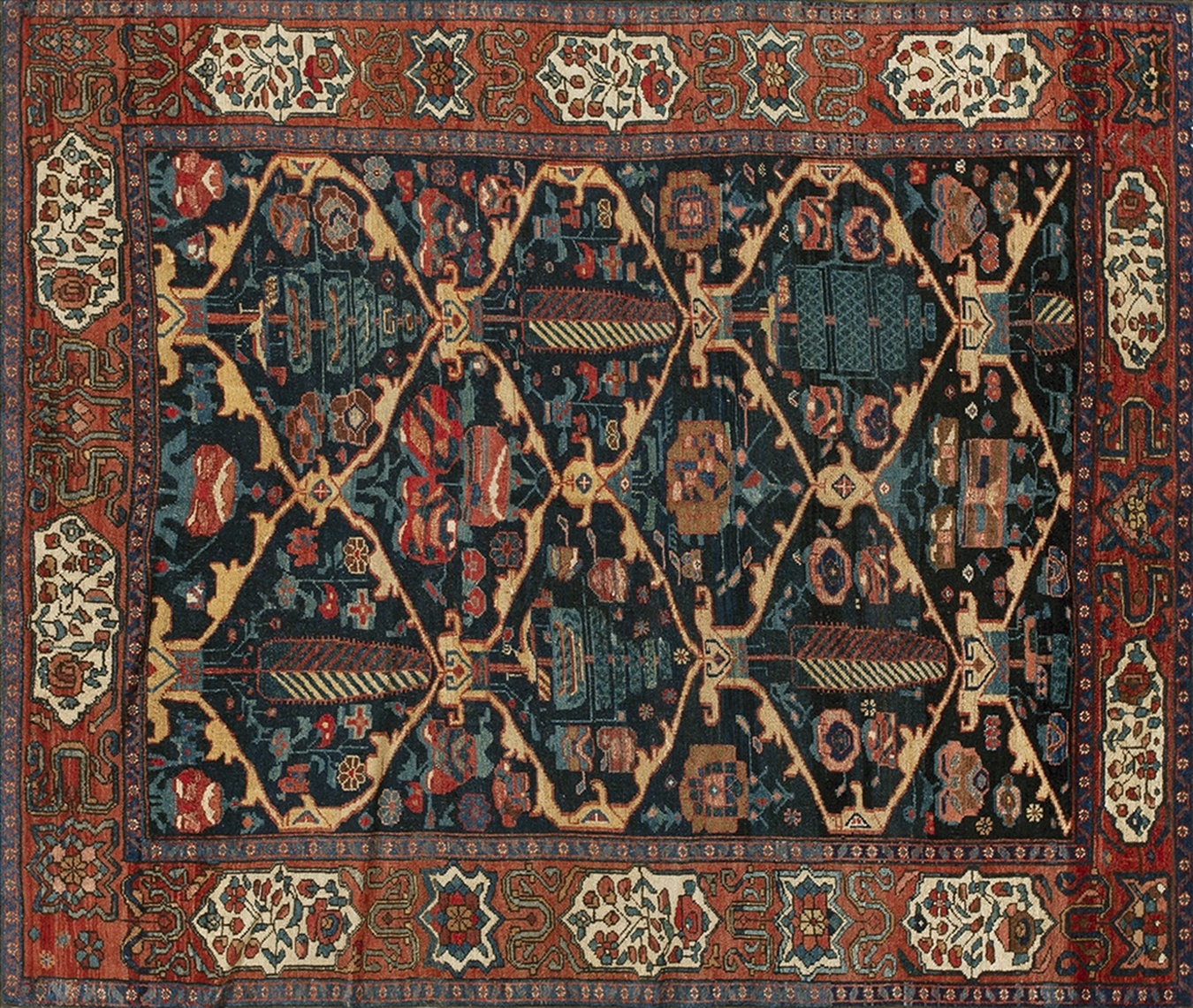
Antique Bakhtiari Small Scatter Size Wool Blue Rug – by Rugs On Net
Artistic and Designer Interpretations
The cypress motif has proven remarkably adaptable to the 21st century. Modern cypress rug trends often take inspiration from heritage designs but reimagine them with minimalist outlines, oversized scales, and bold or muted contemporary palettes.
Some designers reduce the tree to its essential flame-like silhouette, while others reinterpret it in abstract or geometric compositions. High-end brands produce designer tree of life rugs that honor the motif’s spiritual origins while ensuring it resonates with modern interiors. This ability to evolve while maintaining symbolic depth has kept the cypress a timeless element of rug design.
Printed Rugs: Pros & Cons
With the rise of modern technology, the cypress motif also appears in digitally printed rugs. These rugs provide affordable access to the design and allow experimentation with scale and color.
However, they lack the texture, depth, and tactile beauty of hand-knotted or flatwoven pieces. This answers the question “Can modern printed rugs capture cypress motifs well?”—they can reproduce the image but not the craftsmanship or spiritual aura that defines traditional rugs.
Investment Value & Collectibility
- Antique and Vintage Rugs — Cypress motifs from the 19th century and earlier are highly collectible. — Why: They showcase superior craftsmanship, natural dyes, and carry historical weight, making them investment-grade pieces.
- Workshop and Court-Quality Rugs — Safavid, Mughal, or Ottoman-inspired works remain valuable. — Why: Their artistry and cultural importance elevate them beyond decorative use.
- Contemporary Designer Rugs — Some modern interpretations achieve high market recognition. — Why: Limited editions or artist collaborations can become future collectibles.
This directly addresses “Are cypress motif rugs considered investment pieces today?”—yes, particularly antique and fine workshop examples, which hold enduring value.
Vintage cypress carpet value surpasses new rugs in most cases, though innovative designer editions can attract serious collectors.
How the Motif Has Evolved
The evolution of the cypress motif in contemporary rug design highlights both continuity and reinvention.
Traditional weavers still produce naturalistic versions in wool and silk, but many contemporary workshops experiment with:
- Minimalism — Simplifying the cypress into bold, abstract outlines.
- Color Changes — Moving beyond greens and blues to include neutrals, monochromes, and high-contrast palettes.
- Scale — Enlarging the motif into dramatic single-tree compositions, or shrinking it into subtle, repeated patterns.
This adaptability ensures the cypress remains relevant in both heritage-inspired interiors and cutting-edge design spaces. In sum, the cypress motif has moved seamlessly from paradise garden rugs of the Safavid court to modern cypress rug trends in today’s homes. Its symbolism of eternal life and resilience continues to inspire collectors, designers, and homeowners alike—whether in antique treasures, handwoven masterpieces, or fresh contemporary reimagining.
Buying Guide: Choosing and Valuing Cypress Trees Rugs
Authenticity: How to Spot a Hand-Knotted Cypress Rug
To buy cypress motif rugs with confidence, authenticity is key. A hand-knotted cypress carpet shows its knots clearly when flipped over—each knot visible on the back as tiny, uneven rows. Slight irregularities in design or weave are also signs of genuine craftsmanship, while machine-made rugs tend to look overly perfect and uniform.
Natural dyes produce subtle variations in color, whereas synthetic dyes may appear flat or overly bright. For serious collectors, an authentic Persian tree of life rug with a cypress motif should show this blend of artistry, irregularity, and natural dye nuance.
Where to Buy Authentic Pieces
The best way to secure authenticity is to buy from trusted dealers, galleries, or specialized auction houses. Reputable rug merchants, established antique dealers, and heritage weaving cooperatives provide provenance and often certification of origin.
Online marketplaces should be approached with caution unless the seller is well-reviewed and transparent about rug details. In short, authenticity is best guaranteed through trusted, knowledgeable sources.
Factors Influencing Price & Value
- Age and Condition — Antique and vintage rugs often command higher prices. — Why: Older rugs carry history and rarity, provided they are well-preserved.
- Origin and Provenance — Rugs from celebrated Persian, Mughal, or Ottoman workshops are especially valued. — Why: Region and lineage elevate prestige.
- Materials Used — Wool is durable; silk adds brilliance and detail. — Why: Material directly impacts both artistry and market price.
- Knot Density and Clarity — High knot counts allow more lifelike cypress detail. — Why: Greater precision translates into higher rug investment value.
- Design and Motif Rarity — Detailed or unique cypress compositions fetch premiums. — Why: Collectors prize both clarity and distinctive variations of the tree.
These elements together answer “What factors influence the price of cypress motif rugs?”—age, materials, knot density, provenance, and motif execution are the core determinants.
Wool vs. Wool-and-Silk: Which to Choose?
- Wool Rugs — More practical and durable for everyday use. — Why: Resistant to wear and easier to maintain, making them ideal for high-traffic spaces.
- Wool-and-Silk Rugs — Offer unmatched refinement and detail. — Why: Silk highlights the tapering cypress silhouette with clarity and sheen, elevating artistry and investment value.
Thus, in deciding “Should I choose wool or wool-and-silk for a cypress rug?”, the answer depends on use: wool for durability, silk blends for collectible luxury.
Resale & Investment Potential
- Antique Cypress Rugs — Highly collectible, often appreciating in value. — Why: Age, rarity, and artistry make them sought-after investments.
- Workshop/City Rugs — Retain strong market value when in good condition. — Why: Knot density and material quality appeal to collectors and resellers.
- Modern Designer Rugs — Can hold value if limited edition or artist-signed. — Why: Scarcity and branding influence resale appeal.
To answer “Does the cypress motif affect resale value of a rug?”—yes, significantly. The motif’s spiritual symbolism and historic prestige ensure that authentic cypress rugs remain attractive to buyers, reinforcing both cultural significance and financial potential.
Ultimately, those who buy cypress motif rugs should consider authenticity, materials, and provenance not only for beauty but also for rug investment value, ensuring the piece endures as both a work of art and a lasting asset.
Cultural Relevance & Enduring Appeal
Legacy in Persian and Islamic Art
The cultural meaning of cypress rugs cannot be separated from their deep roots in Persian and Islamic art. For over 2,500 years, the cypress has symbolized eternity, paradise, and spiritual resilience, appearing not only in textiles but also in manuscript painting, garden design, and funerary architecture.
Its presence in prayer rugs and mosque décor reinforced its role as a bridge between the earthly and the divine. Even today, museum collections worldwide highlight cypress motif carpets as masterpieces of heritage, ensuring their role as living symbols of Persian and Islamic identity.
Influence on Global Décor and Fashion
The motif has also crossed boundaries of geography and medium. The tree of life in modern carpets remains a staple of global décor, from Persian-inspired interior design to contemporary minimalist homes.
Fashion, too, absorbed the motif through the evolution of paisley patterns, which trace their origins back to stylized cypress and boteh forms. This translation into fabric and clothing illustrates how the motif’s heritage rug motifs moved beyond carpets to shape global visual culture.
The Cypress Trees as a Modern Symbol
- Eternity and Heritage — Still seen as a reminder of cultural continuity. — Why: Afghan weavers continue to include cypress motifs as a way of honoring tradition and expressing resilience in the face of change.
- Nature and Balance — Represents harmony with the natural world. — Why: Designers use it in contemporary collections as a timeless emblem of ecological and spiritual grounding.
- Identity and Revival — Embodies pride in heritage and cultural transmission. — Why: As rug markets globalize, the cypress helps artisans connect modern buyers with centuries of tradition.
This addresses “Why do Afghan weavers use cypress trees patterns today?”—because the motif stands as both a symbol of resilience and a marker of cultural heritage, ensuring their weaving continues to reflect history while appealing to modern audiences.
Preservation and Transmission in Weaving Traditions
Despite modernization, the cultural meaning of cypress trees in rugs endures because artisans deliberately preserve the motif in teaching and practice. Apprentices learn not only technical weaving but also the symbolic weight of motifs like the cypress. Organizations, museums, and cultural heritage projects ensure that the design continues to be studied, exhibited, and passed on.
This living transmission keeps the cypress motif vibrant, allowing it to evolve in contemporary rug design while retaining its timeless essence. Thus, when asking “Are cypress motif rugs considered investment pieces today?”, the answer is yes—not only in terms of market value but also as investments in cultural continuity and identity.
From ancient gardens of Persia to the global décor of today, the cypress has remained an enduring emblem. Its heritage rug motifs embody both tradition and modernity, ensuring the tree of life in modern carpets will continue to stand tall—evergreen in meaning, artistry, and cultural legacy.
Explore a Few of Our Favorite Cypress Tree Rugs
FAQ
- Are cypress tree rugs appropriate for prayer spaces?
Yes—Tabriz and other prayer cypress tree rugs exist in small formats. Ensure a clean area, appropriate orientation, and avoid harsh cleaners on delicate fibers.
- Can I commission a custom cypress tree rug?
Many workshops offer bespoke cypress tree rugs in chosen size, palette, and density. Provide reference photos and approve a strike-off to confirm the tree’s drawing.
- Where can I find cypress tree rugs in the U.S.?
Look to established antique rug dealers, major auction houses, and reputable online galleries. Request condition reports, return windows, and washing histories.
- Are there hallway runners of cypress tree rugs?
Yes—gallery runners with repeating cypresses are common, often around 3×10 to 4×14. They visually lengthen corridors with the motif’s vertical rhythm.
- Are cypress tree rugs connected to the paisley (boteh) motif?
Many scholars link boteh to a stylized cypress with a floral spray. You’ll see boteh in borders on cypress tree rugs, reinforcing themes of life and continuity.
- How do Persian and Turkish cypress tree rugs differ?
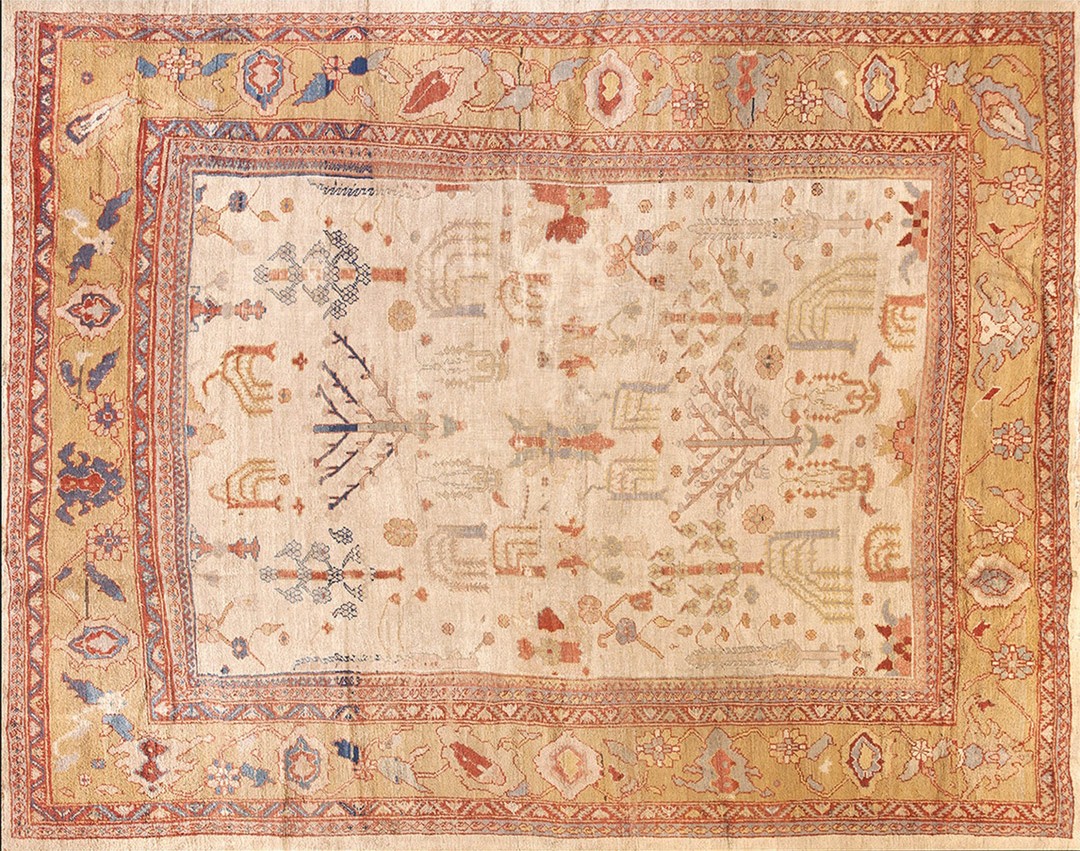
Persian cypress tree rugs (Tabriz/Kerman) tend toward finer, curvilinear drawing; Turkish Oushak versions favor bigger scales and softer, sandy palettes.
- How can I date cypress tree rugs?
Check weave, dyes (natural vs. synthetic), wear, and drawing. Late-19th/early-20th-century Kerman/Tabriz cypress tree rugs often show nuanced natural-dye abrash; get expert verification.
- What rug pad is best under cypress tree rugs?
A felt-plus-natural-rubber pad, cut about 1–2 inches smaller than the rug, prevents sliding, cushions fibers, and protects floors.
- Are robot vacuums safe on cypress tree rugs with fringe?
Fringes can tangle. Use no-go zones, fold fringe under temporarily, or run suction-only passes. For antiques, a manual canister vacuum is safer.
- Will sunlight fade a cypress tree rug?
UV light fades dyes, so rotate cypress tree rugs every 6–12 months and use shades or UV film. If possible, keep them out of direct, prolonged sun.
- Can cypress tree rugs go over radiant/underfloor heating?
Yes—prefer wool flatweaves or low-pile cypress tree rugs with breathable pads. Avoid thick shag; ensure overall thermal resistance stays low for efficient heat transfer.
- How do I clean cypress tree rugs at home?
Vacuum cypress tree rugs with suction only (no beater bar), in pile direction, and avoid fringes. Schedule a professional wash every 3–5 years, sooner for heavy traffic.
- Are cypress tree rugs pet-friendly?
Wool cypress tree rugs repel soiling and hide dirt; avoid delicate silk. Use a felt-and-rubber pad, trim pets’ nails, and blot accidents promptly with water and mild soap.
- Are cypress tree rugs suitable for dining rooms?
Choose low-pile wool cypress tree rugs and size up so chairs stay on the rug when pulled out—typically 8×10 or 9×12 for a six-to-eight-chair table.
- Do cypress tree rugs work in modern interiors?
Yes—pair a cypress tree rug’s verticals with clean-lined furniture and neutral walls. Muted Oushak palettes or soft Kerman tones integrate easily with contemporary spaces.
- Are antique cypress tree rugs a good investment?
Potentially—value hinges on age, rarity, condition, dyes, and provenance. Exceptional Oushak or Kerman cypress tree rugs have fetched five figures at auction; consult a qualified appraiser.
- How much do cypress tree rugs cost?
New hand-knotted cypress tree rugs in 8×10 often run \$1,500–\$10,000; antique examples range from \~\$5,000 to \$50,000+. Machine-woven prints can be under \$400.
- What sizes are common for cypress tree rugs?
You’ll find cypress tree rugs from small prayer sizes (\~3×5) to large rooms (8×10, 9×12, 10×14). Gallery runners (e.g., \~5×12) also exist for halls.
- What layouts do cypress tree rugs come in?
Expect single-tree medallions, repeating rows, prayer-niche (mihrab) scenes flanked by cypresses, or garden-panel grids (“kheshti”). Borders may echo small boteh or cypress sprigs.
- What materials are typical in cypress tree rugs?
Most cypress tree rugs use wool pile on cotton warps/wefts; silk appears in finer city pieces. Modern Afghan-made versions often feature hand-spun Ghazni wool and natural dyes.
- How can I identify hand-knotted cypress tree rugs versus machine-made?
Hand-knotted cypress tree rugs show the design mirrored on the back, slight knot irregularities, and fringe that’s part of the warp. Machine-made pieces usually have uniform backs and sewn-on fringe.
- Which weaving regions most feature cypress tree rugs?
Cypress tree rugs are common in Persian Tabriz, Kerman, and Bakhtiari, Turkish Oushak, and some Khotan/Samarkand pieces. Each area interprets the tree’s shape and palette differently.
- Are cypress tree rugs the same as Tree-of-Life rugs?
Tree-of-Life is a broader category; cypress tree rugs focus on the evergreen form within it. Many garden-panel carpets include cypress panels alongside willows, pomegranates, and vases.
- What do cypress tree rugs symbolize?
In Persian iconography, cypress tree rugs signify everlasting life, resilience, and serenity. You’ll often see the motif paired with blossoms or birds to underscore renewal and youth.
- What are cypress tree rugs as a motif on a rug?
Cypress tree rugs depict stylized evergreen trees—often upright, repeating, or panelled—woven into Persian, Turkish, or Central Asian designs. They appear in garden layouts, prayer niches, or as a single central tree.