
Introduction to Boteh (Paisley) Rugs
Discover our exquisite collection of Boteh Paisley rugs to elevate your home décor.
What is the boteh paisley design in rugs?
The boteh motif is one of the most enduring and recognizable designs in the world of textiles, especially within Persian carpets. Visually, it is defined by its curved teardrop or almond-shaped form, often curling at the tip in a flame-like gesture. This shape can vary in scale and complexity—sometimes simple and singular, other times repeated in dense fields or woven into intricate patterns that fill an entire rug.
To Western eyes, the motif became widely known as the paisley pattern, named after the Scottish town of Paisley, where 19th-century textile workshops mass-produced shawls and fabrics featuring this Persian design. In its original context, however, the boteh is far more than a decorative flourish. Its stylized form has long been tied to deep cultural and spiritual symbolism.
In Persian tradition, the boteh could represent the cypress tree, a symbol of eternity; a flowering plant, signifying bounty and growth; or a sacred flame, embodying divine spirituality. This layered symbolism ensured the motif’s universal appeal across centuries, allowing it to transcend geography and remain relevant in both traditional and modern rug design.
In the context of Persian carpets, the boteh design in carpets is not merely ornamental—it carries with it the essence of life, resilience, and continuity, themes that resonate across cultures and eras.
Why is the paisley motif called “boteh” in Persian carpets?
The term “boteh” comes from the Persian word meaning “shrub,” “bush,” or “floral spray.” In a broader sense, it evokes the image of a small cluster of leaves or a blossoming plant. This etymology underscores the motif’s botanical origins and its connection to growth, fertility, and renewal.
When applied to carpets, the Persian boteh embodied the notion of a seedling or sprout, a symbol of new beginnings and vitality woven into the very structure of the rug. Western terminology diverged significantly when the motif crossed into Europe.
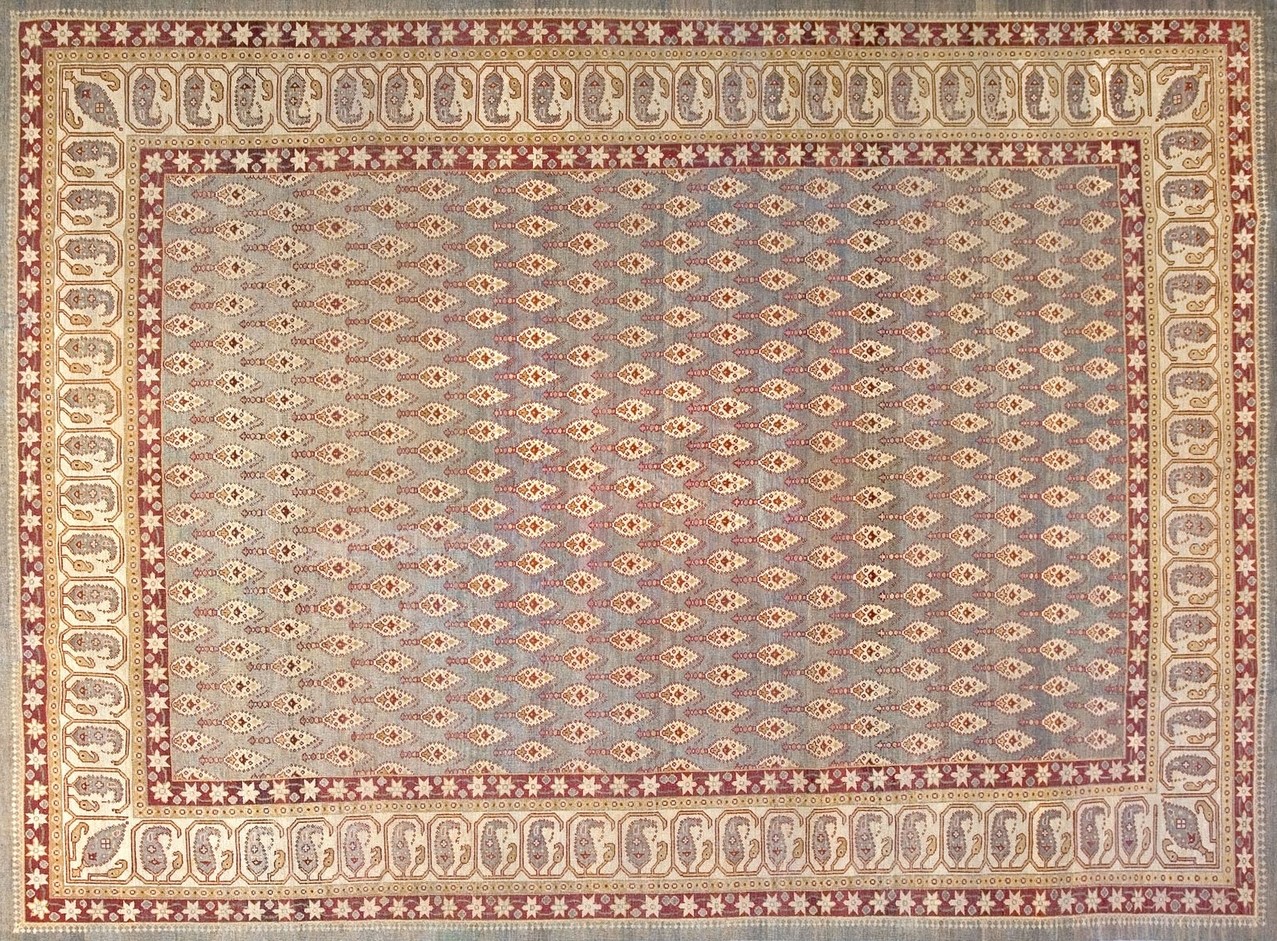
Scottish weavers in the town of Paisley became renowned in the 19th century for producing patterned textiles—especially shawls—featuring this exotic Persian design. As a result, the Western world began referring to the boteh motif as the “paisley pattern.” This name stuck in popular usage, even though its origins were distinctly Persian. Thus, while most English speakers know the form as paisley rugs, within the Persian artistic tradition it is still recognized as boteh, a word rooted in both natural imagery and spiritual meaning.
The paisley carpet meaning today still draws from both its linguistic and symbolic roots: a hybrid of Persian artistry and European industrial history. Whether viewed as a cypress tree of eternity, a seed of life, or a sacred flame, the boteh design remains a powerful emblem woven into rugs that are both decorative and deeply meaningful.
Historical Origins and Symbolism
Early appearances in textile weaving
The boteh origin can be traced to some of the earliest flowering of Persian decorative arts. Archaeological and artistic evidence suggests the motif was present as early as the Sassanid era (3rd–7th century CE), where silks carried stylized botanical and flame-like designs that resemble the later boteh. By the 9th century, carved reliefs at the Noh Gumbad mosque in Balkh featured curving, almond-shaped motifs that scholars identify as proto-boteh forms. These appearances mark its transition from sacred architectural ornament to woven textile design.
By the early Islamic period, boteh designs were being integrated into carpets and fabrics, embedding both artistry and symbolism in everyday life. The motif’s importance grew steadily, appearing in court silks, luxury goods, and devotional art. Later, it flourished in the Kashmir shawl tradition of the 15th century, where weavers translated the boteh into endless variations. Kashmir’s mastery of fine wool weaving gave the motif a global stage, setting the path for its eventual adoption by European markets.
Evolution across cultures: Persia, India, Europe
The paisley weaving history follows a long arc of cultural transmission. In Persia, the boteh was a spiritual and botanical emblem, tightly tied to Zoroastrian flame symbolism and the cypress tree’s association with eternity. With the expansion of trade routes, the motif spread eastward to India, where Kashmiri artisans in the 1400s refined it into the hallmark of their celebrated shawls.
These shawls were so prized that they became symbols of wealth and sophistication across Asia and the Middle East. By the 18th and 19th centuries, European merchants imported Kashmir shawls into France and Britain, creating a craze among aristocracy and fashionable elites. Scottish weavers in Paisley capitalized on the demand, mass-producing shawls patterned with boteh, and in doing so, gave the motif its Western name: the paisley pattern.
The design’s journey from Persian boteh to Kashmir shawl boteh and ultimately to industrial looms in Paisley, Scotland, demonstrates how trade networks transformed a sacred symbol into a global design icon.
Symbolic meanings: eternal life, fertility, spirituality
- Cypress symbolism – Eternity The boteh’s curved form recalls the cypress tree, an enduring symbol in Persian art. Cypress trees, often planted in sacred spaces, represented immortality and eternal life. — Why: In rug design, this reference assured continuity and resilience, themes central to Persian worldview.
- Zoroastrian flame motif – Spirituality The curling tip of the boteh resembles a flame, tied to the fire altars of ancient Zoroastrian worship. The sacred flame was considered the divine presence itself. — Why: Woven into carpets, this flame boteh embodied a link to the spiritual and eternal, beyond material existence.
- Seed or embryo – Fertility Another interpretation of the boteh is that of a seed pod, embryo, or budding shoot, rich with life-giving potential. — Why: This association made the boteh a fertility symbol, promising abundance, continuity of lineage, and the renewal of nature.
- Turban plume – Nobility In royal settings, the boteh was also viewed as a plume of feathers adorning turbans, signifying status, sovereignty, and refinement. — Why: This regal meaning reinforced the boteh’s place as a motif of honor and high culture in Persian courts.
Important Things to Note
- The boteh’s ancient, sacred, and multi-regional origins.
- Transmission from Persia → Kashmir → Europe, carried by trade and fashion.
- The motif as a visual language of eternity, spirituality, fertility, and nobility.
Identifying Boteh Paisley Patterns in Rugs
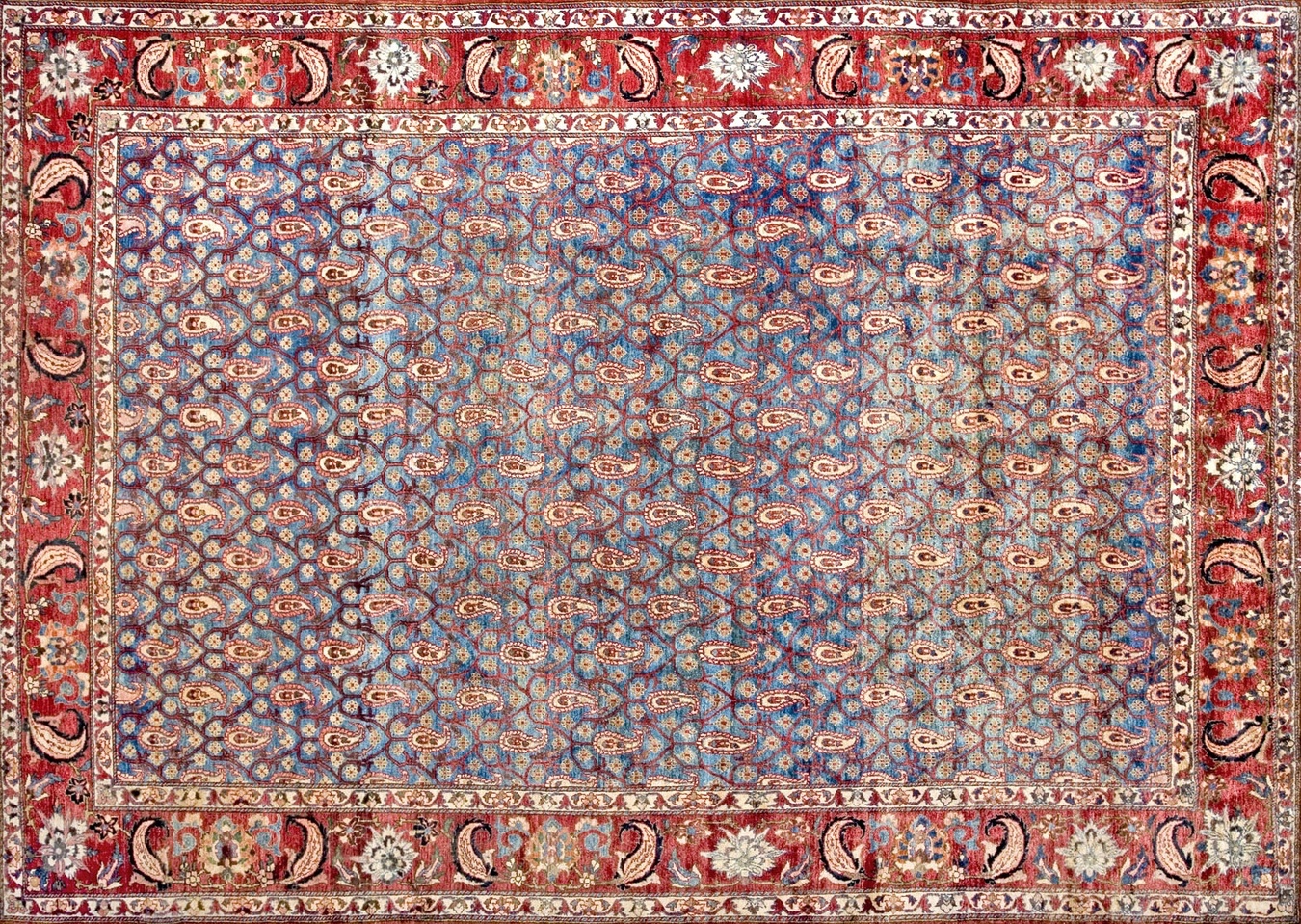
Antique Bakhtiari Room Size Wool Blue Rug – by Rugs On Net
How to spot genuine paisley patterns on antique rugs
To identify boteh in rugs, begin by looking for the signature curved seedling or flame shape. Genuine boteh motifs are rarely plain; instead, their interiors are filled with delicate floral sprays, fine lines, or geometric embellishments that distinguish them from simple decorative teardrops. On antique examples, these botehs usually repeat in orderly arrays or flow in staggered rows across the rug’s field.
Other hallmarks of authenticity include the use of hand-knotted wool and a palette derived from natural dyes. Such dyes fade gracefully, producing the earthy reds, indigos, and soft browns that mark true paisley pattern antique rugs.
When these features align—curved motifs, detailed interior work, natural tones, and traditional weaving—you can confidently recognize an authentic antique boteh rug. — Why: These combined traits separate genuine historical weavings from modern reproductions or printed imitations.
Key features: outline, interior, scale, layout
- Outline Shape – The boteh is defined by its comma-like or flame-tipped curve, a feature consistent across regions. — Why: Without this hook-like curl, the motif loses its symbolic essence.
- Interior Detail – Authentic botehs often contain tiny blossoms, serrated lines, or miniature geometric fills. — Why: The interior decoration helps identify regional origin and weaving tradition.
- Scale – In some rugs, botehs appear large and bold, while others scatter hundreds of small botehs across the field. — Why: Scale influences both the visual rhythm and dating of the carpet.
- Layout – Antique Persian boteh carpets often align motifs in neat rows, while Indian examples cluster botehs into lush, colorful sprays. — Why: Layout patterns are crucial clues to both geography and age.
How Afghan, Persian, and Indian paisley rugs differ
- Afghan Boteh Rugs – Typically darker, more geometric, and often resemble pine-cone or flame-like hooks. Their botehs are sharply defined with bold contrast. — Why: This sharper treatment reflects Afghan weaving traditions and distinguishes them from more fluid Persian forms.
- Persian Paisley Carpets – Characterized by orderly rows or arrays of boteh, often with rich interior detail and muted natural dyes. They emphasize refinement and continuity. — Why: Persian boteh rugs represent the classical standard and serve as the archetype for later traditions.
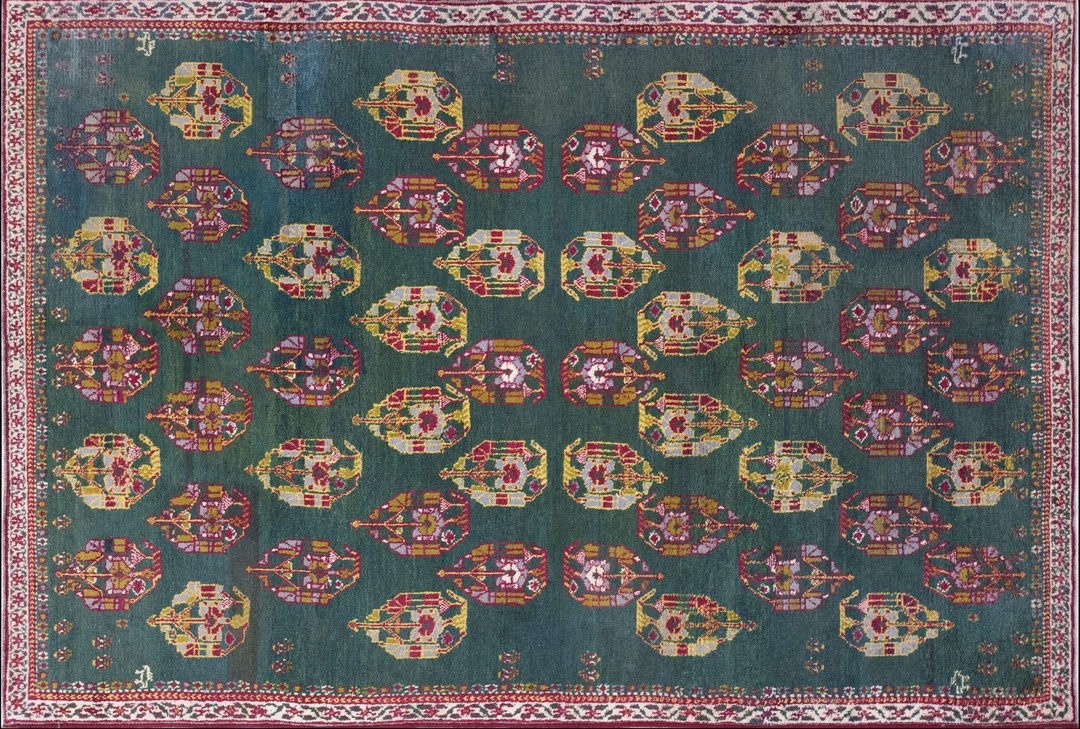
- Indian Paisley Rugs – Often more clustered or scattered, with lush coloration and sometimes oversized motifs. Their designs recall the Kashmiri shawl heritage. — Why: The vivid palette and free-flowing arrangement set them apart from the Persian discipline or Afghan geometry.
Are vintage paisley rugs more muted than modern versions?
Yes. Vintage boteh rug features are marked by the use of natural vegetable dyes, which soften over time into earthy, organic tones. Reds mellow into brick shades, indigo weaves become smoky blue, and greens fade to olive or sage. This subtle aging produces the muted, understated beauty for which antique paisley carpets are prized.
In contrast, modern paisley rugs often employ synthetic dyes that deliver brighter and more saturated colors—turquoise, magenta, and bold black outlines. These synthetic hues resist fading but lack the natural patina of older weavings. Thus, muted palettes often signal vintage authenticity, while sharper tones typically point to contemporary manufacture.
Weaving Techniques, Materials, and Quality
Close-up of dense weave structure and metallic thread quality.
What materials best showcase paisley motifs in hand-knotted rugs?
The elegance of a hand-knotted paisley rug depends greatly on the materials used. Fine wool provides durability and a soft luster, making it ideal for highlighting the boteh’s graceful curves. Even more refined are silk boteh carpets, whose glossy fibers capture light and bring out every contour of the paisley pattern with jewel-like precision.
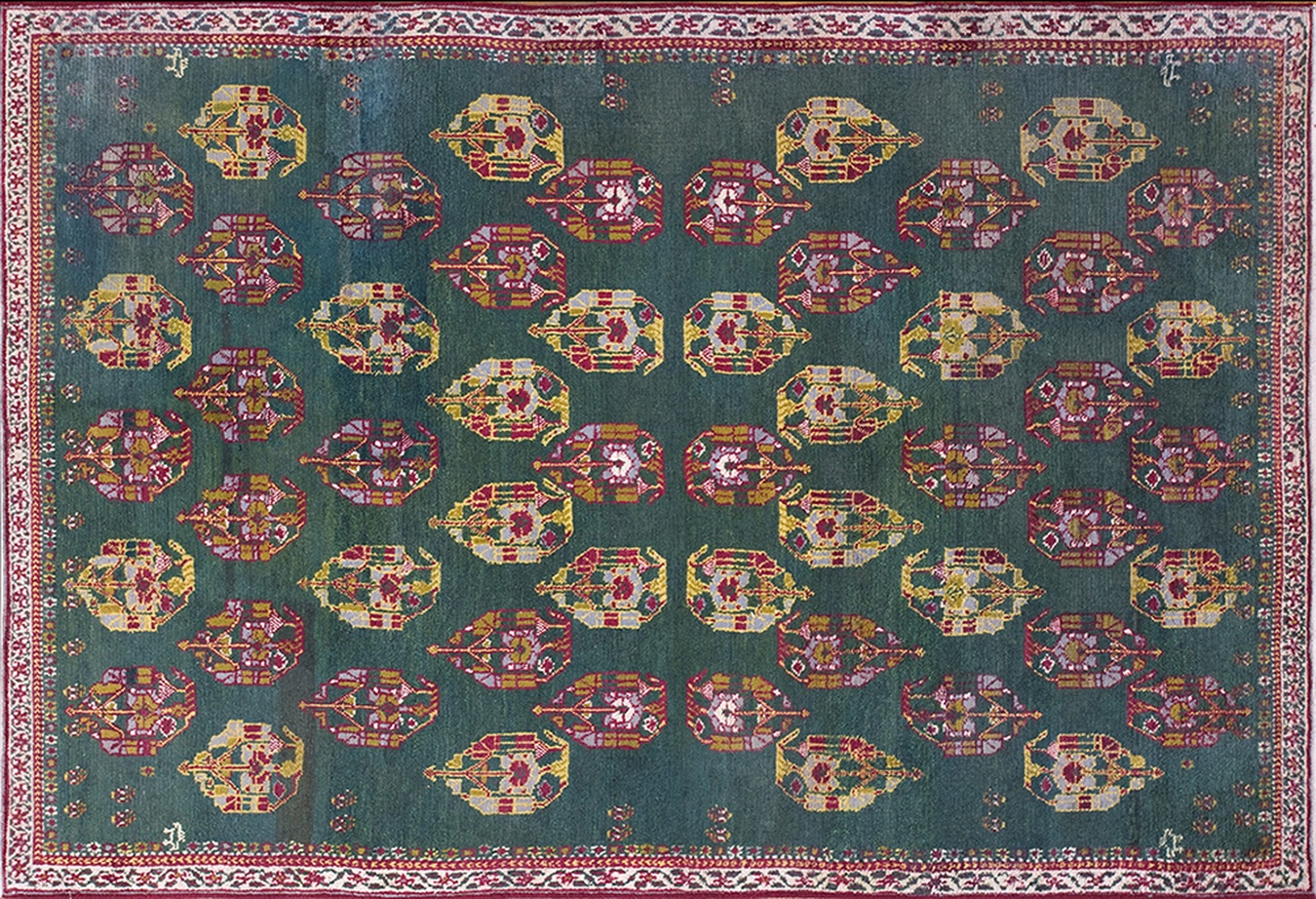
Historical examples also include pashmina shawls from Kashmir and silk brocades, both renowned for their ability to display the boteh motif in extraordinary clarity. For flatwoven versions, Senneh kilims woven in fine wool offer crisp outlines and delicate interior detailing. These materials allow the boteh to appear “alive,” shimmering with depth and fluidity that coarser fibers cannot replicate.
How does weave density affect paisley detail in rugs?
Weave density—measured in knot count—is critical for rendering boteh motifs with clarity. A higher knot count enables artisans to create sharper outlines and more elaborate interior fills, ensuring each paisley curve looks refined rather than blocky. In contrast, rugs with a low knot count can only approximate the boteh’s hook shape, often sacrificing detail.
Collectors and connoisseurs value dense weaves because they preserve the delicate artistry of the motif while also signaling superior craftsmanship. Thus, the rug knot count value directly correlates with how precisely a paisley design is expressed.
Does machine-made production capture boteh curves accurately?
Machine made paisley carpets can replicate the overall shape of the boteh, but they rarely achieve the same vitality as handwoven pieces. The mechanized process produces uniform piles that often lack the subtle taper and fluidity seen in hand-tied knots. As a result, the boteh may appear stiff or overly symmetrical.
In contrast, hand-knotted examples carry a unique dynamism: slight variations in knots, natural dye shifts, and fiber sheen combine to give the motif a living quality. While machine production makes paisley designs more accessible, it cannot fully capture the nuanced curves and textures of authentic weaving.
Impact of knot count and dye on rug value
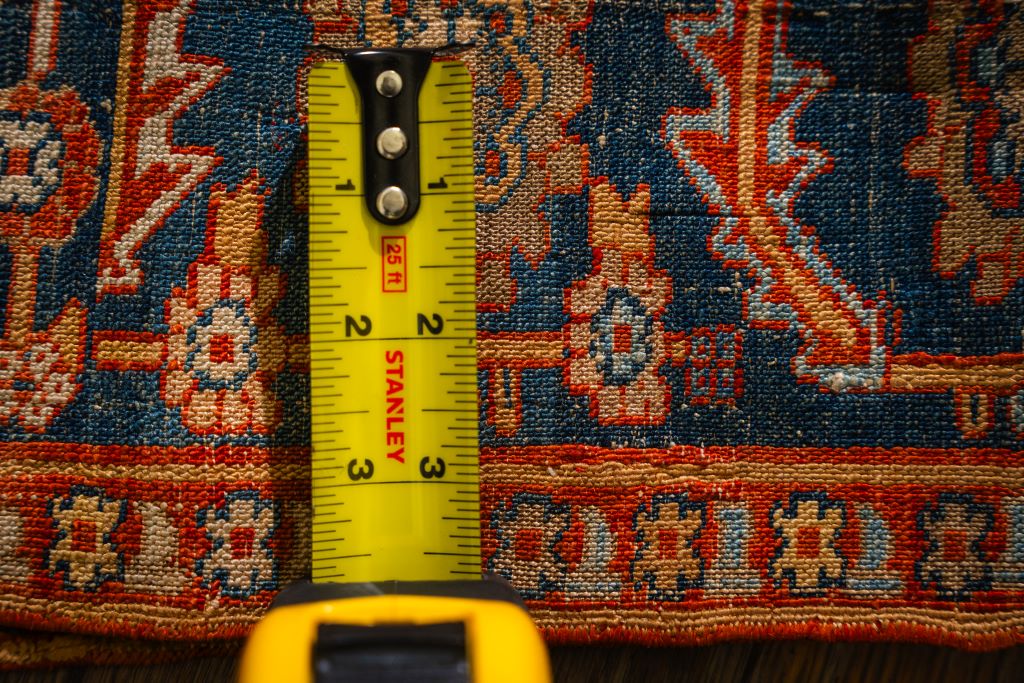
A detailed inspection of a richly colored oriental rug pattern while measuring its dimensions.
- High Knot Count – Rugs with fine knot density preserve paisley detail and display superior craftsmanship. — Why: More knots per inch means sharper boteh outlines and higher overall value.
- Low Knot Count – Simpler and less costly, but the boteh curves appear less refined. — Why: Reduced definition lowers both aesthetic appeal and market worth.
- Natural Dye Paisley Rugs – Natural vegetable and mineral dyes age beautifully, creating soft abrash (subtle tonal shifts) while retaining vibrancy. — Why: They are more colorfast and less prone to harsh fading compared to synthetics, increasing long-term value.
- Synthetic Dyes – Provide vivid color initially, but may fade unevenly over time. — Why: Though cheaper, they lower the prestige and durability of a paisley rug.
Boteh Paisley Rugs in Modern Interiors
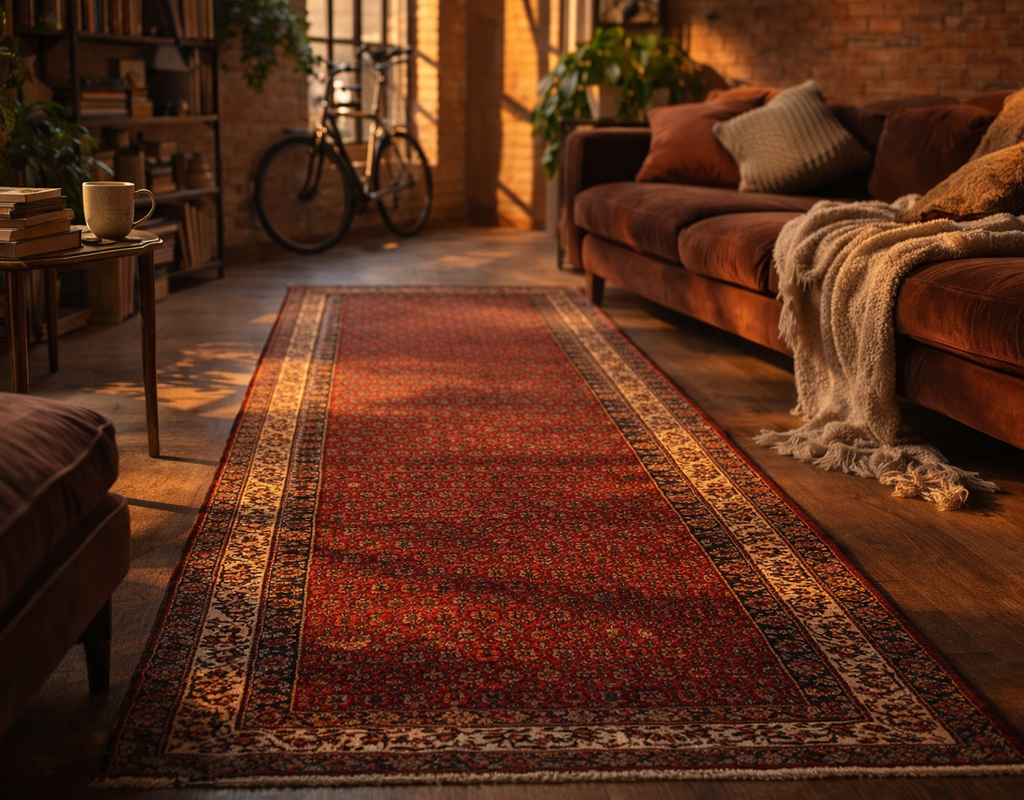
Warm sunlight highlights the detailed pattern of a traditional red runner rug in a rustic, inviting living space.
Can paisley runners work in minimalist interiors?
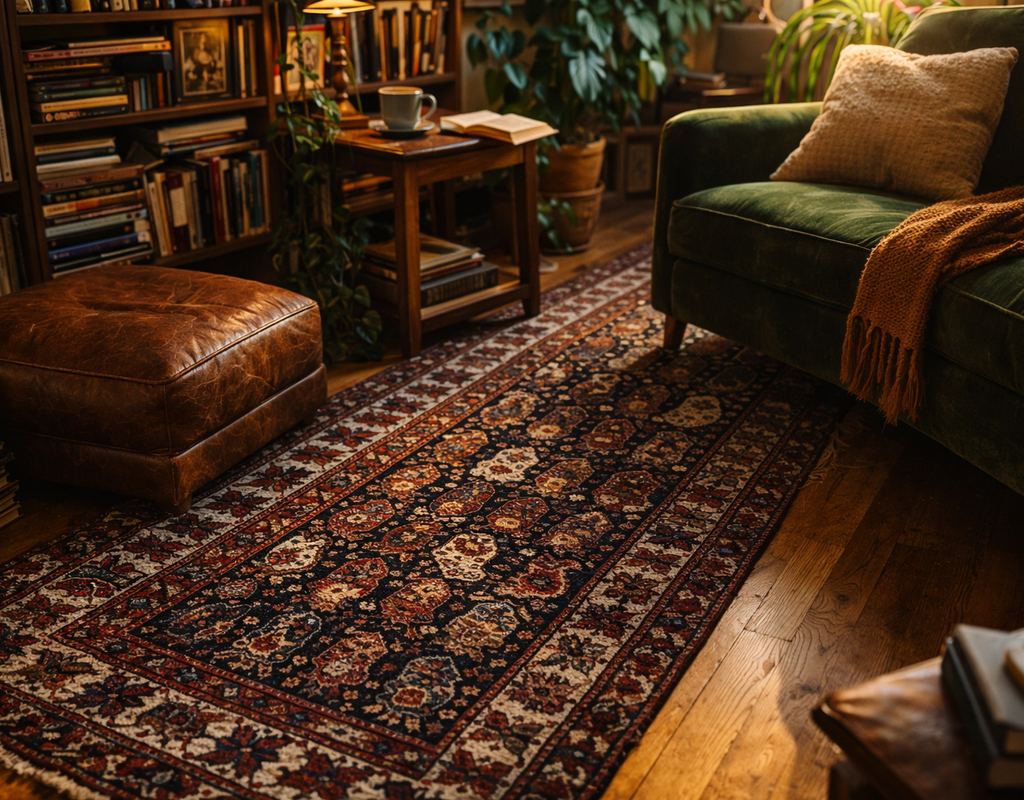
The deep colors of the antique-style runner complement the rich textures of velvet and leather in this inviting corner.
Antique N.W. Persian Knotted Rug – by Rugs On Net
A paisley rug for minimalist rooms may seem unexpected, but the motif’s curved form and rhythmic flow can complement simplicity rather than overwhelm it. In a pared-down space, a custom paisley runner introduces movement and artistry, breaking up rigid lines without adding clutter.
Narrow hallways or entryways especially benefit, as the boteh design creates a sense of visual flow. For truly minimal settings, choosing a runner in muted neutrals, monochrome palettes, or subtle tone-on-tone designs allows the paisley to act as a quiet accent rather than a bold centerpiece.
Contemporary uses: scale, color, and room placement
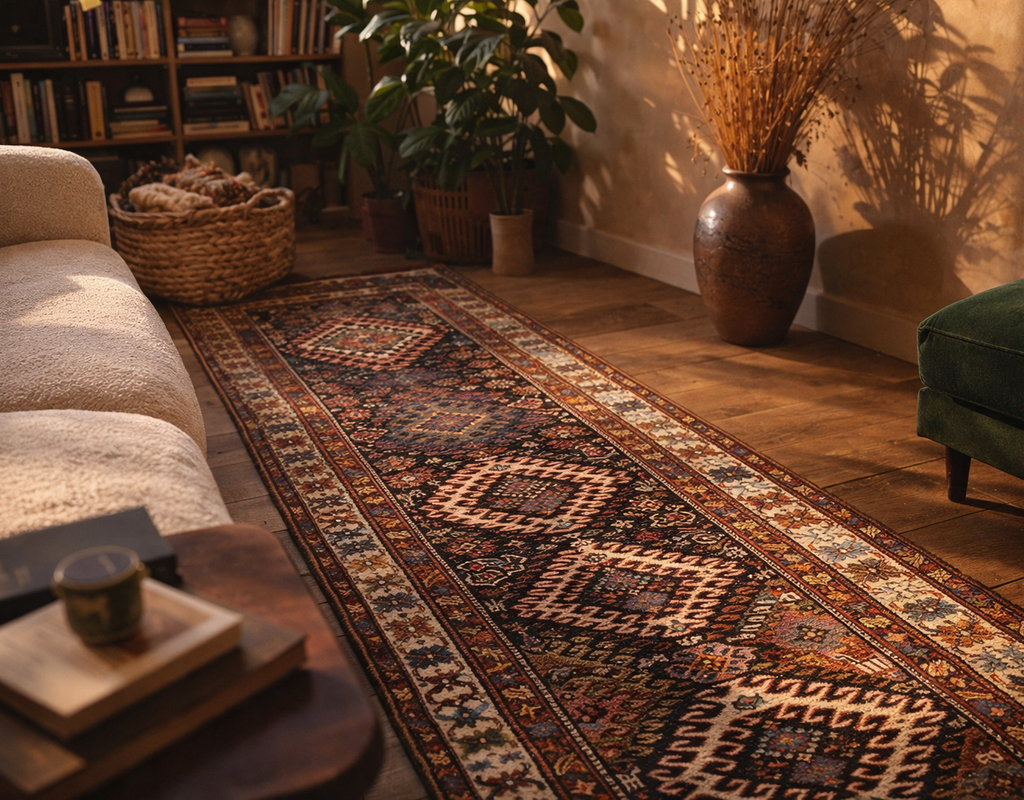
The deep tones of the traditional runner rug bring warmth and pattern to this sun-drenched, eclectic living space.
- Oversized Motifs – Contemporary hand-tufted rugs often use large, singular botehs as statement pieces. — Why: A single paisley form becomes modern “art for the floor,” ideal in living rooms or open-plan lofts.
- Monochrome & Metallics – Current modern paisley rug designs experiment with black, white, silver, or gold. — Why: These sleek palettes make paisley motifs compatible with urban or minimalist décor.
- Color Pops – Bright paisleys work well in bohemian or eclectic interiors. — Why: Vivid hues revive the motif’s traditional energy while appealing to contemporary tastes.
- Runners in Narrow Spaces – Custom paisley runners bring personality to hallways and transitional zones. — Why: They add dynamic design where larger rugs cannot fit.
Is the paisley motif trending in current rug design collections?
Yes. The trending paisley carpet is making a return in both luxury and accessible rug collections. Designers are reinterpreting the boteh with oversized motifs, experimental color palettes, and simplified outlines that suit modern homes.
Monochrome paisley, metallic accents, and tone-on-tone textures are especially sought after, bringing the centuries-old symbol into sleek, contemporary interiors. While not constantly dominant, paisley resurfaces regularly as a design trend due to its timeless versatility and instantly recognizable form.
Can paisley patterns be custom-woven to specific room sizes?
Absolutely. Artisans and rug manufacturers frequently offer custom paisley rugs, allowing homeowners and designers to specify not only the size and shape but also the color scheme, material, and motif scale.
Whether it’s an oversized boteh for a living room centerpiece or a slim custom paisley runner for a hallway, the motif adapts seamlessly to any requirement. This flexibility ensures that paisley remains a versatile choice for both traditional and ultra-modern interiors.
Collecting, Buying, and Investing in Boteh Rugs
Should I invest in antique paisley rugs or new reproductions?
Choosing between an antique paisley rug and a new reproduction depends on your goals. For collectors, antiques—particularly those with hand-knotted construction, natural dyes, and clear provenance—hold the highest investment value.
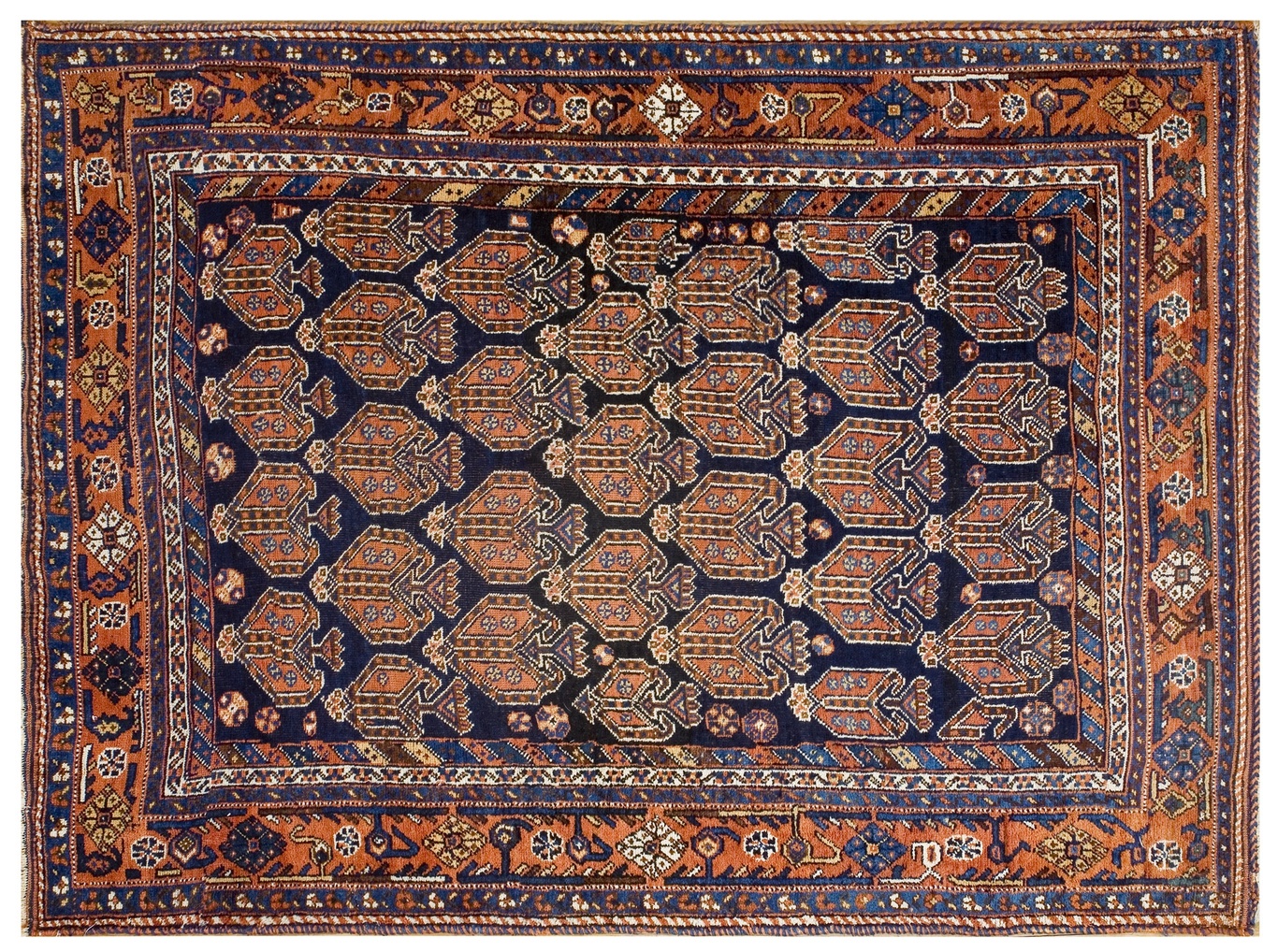
These pieces not only retain but often increase in worth due to rarity and historical importance. For decorators or casual buyers, new reproductions provide affordability, broader size options, and creative flexibility without the price tag of a centuries-old heirloom. In short: antique rugs are investments; new rugs are lifestyle purchases.
What price range reflects museum-grade antique boteh carpets?
A true museum grade boteh carpet falls in the upper tier of the market. Depending on condition, region, and age, such examples typically range from $5,000 to $50,000+. The highest prices are reserved for rare Persian or Kashmiri pieces with exceptional knot density, intact natural dyes, and documented provenance.
Rugs that exhibit intricate boteh arrays or unique historical contexts (such as royal commissions) can command prices well above this range, comparable to fine art.
Where can I buy sustainable paisley rugs online in 2025?
- Specialized Antique Rug Dealers – Offer authenticated vintage and antique paisley carpets, often with provenance. — Why: These dealers cater to collectors seeking investment-grade pieces.
- Artisanal Brands – Small workshops and cooperatives producing fair-trade, hand-knotted rugs in natural fibers. — Why: Buyers gain both authenticity and ethical assurance.
- Sustainable Marketplaces – Online platforms curating sustainable paisley rugs, emphasizing organic wool, natural dyes, and transparent sourcing. — Why: They align with eco-conscious consumer values while offering contemporary design choices.
Does provenance documentation boost resale value of paisley rugs?
Yes. Provenance in rug collecting is a key factor in determining resale value. Documentation of origin, age, maker, and ownership history assures buyers of authenticity and reduces the risk of forgery.
A boteh carpet with provenance tied to a known weaving region or historic collection can command a significantly higher price at auction or resale. For serious collectors, provenance can be the difference between a standard rug and a museum-worthy investment.
Are naturally dyed paisley rugs less prone to fading?
Absolutely. A natural dye paisley rug ages gracefully compared to its synthetic counterpart. Vegetable and mineral dyes penetrate wool deeply, creating colors that mellow into rich, earthy tones over time rather than fading unevenly.
This aging process—often producing subtle abrash (tonal variation)—is prized by collectors as a hallmark of authenticity. Synthetic dyes, though initially bright, are more prone to harsh fading and color instability, which lowers both aesthetic and financial value.
Regional Variations & Case Studies
Persian (Iranian) boteh rugs: Saraband, Kerman, Qashqai
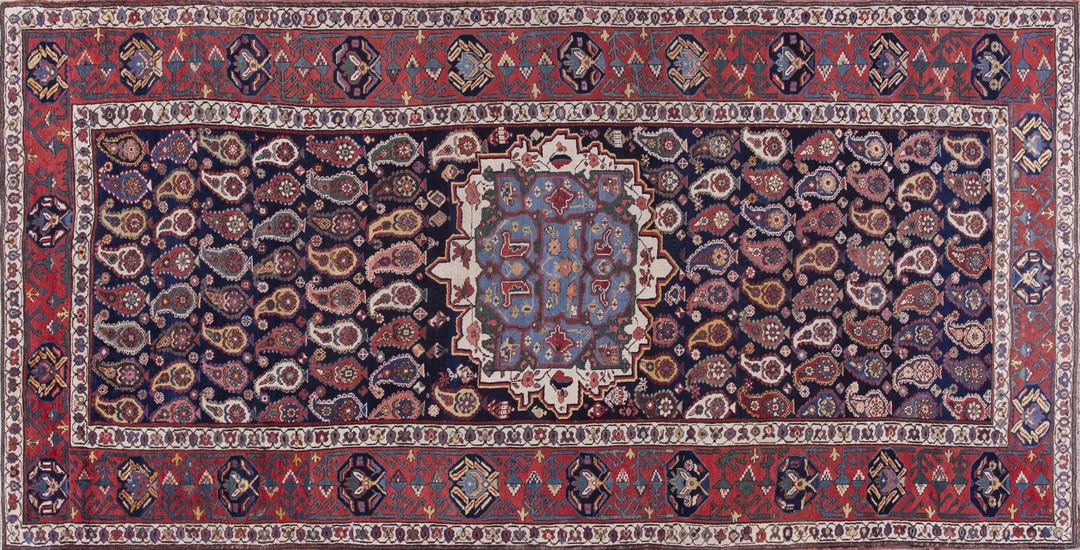
The Persian boteh rug is widely regarded as the classical expression of the motif. In Saraband (also called Mir) carpets, botehs appear in precise, orderly rows, each curved flame carefully aligned across the field. These often feature a repeating seedling form filled with fine hatching or miniature blossoms, making them among the most recognizable antique boteh carpets.
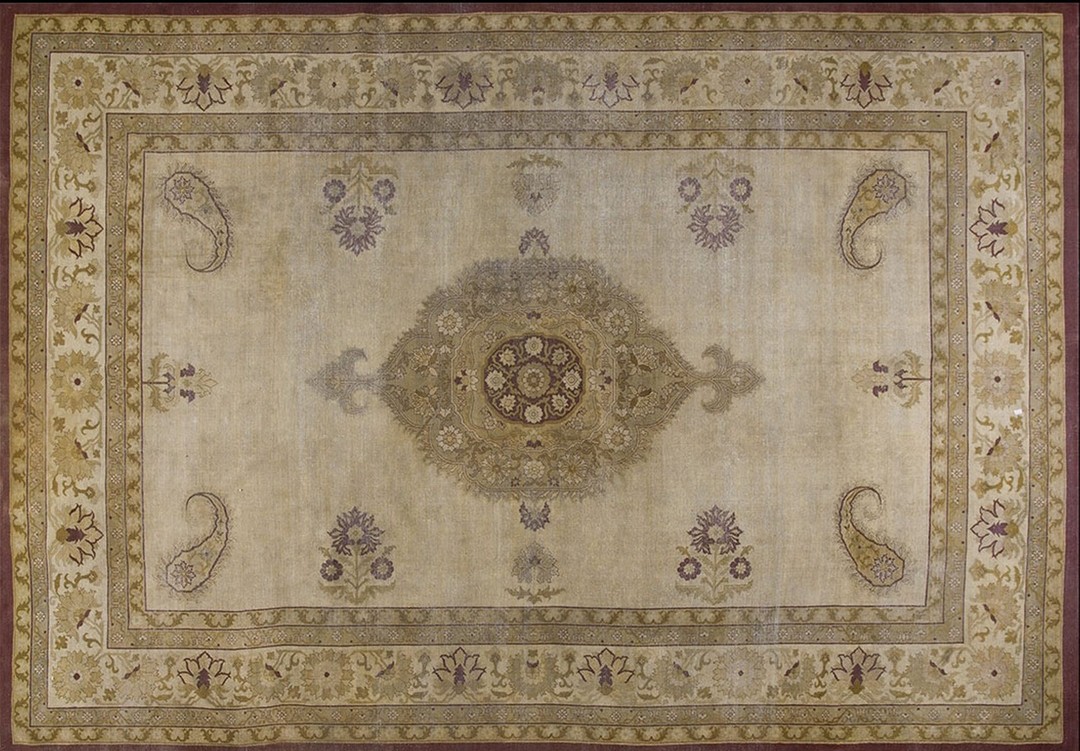
In Kerman rugs, botehs can be larger, with softer pastel palettes, arranged in medallion-centered layouts or woven across entire fields. The Qashqai, a nomadic tribe, tend to favor freer arrangements, often scattering botehs irregularly alongside other tribal motifs, giving their rugs a vibrant, storytelling quality. Collectors note Persian examples for their meticulous execution, symmetry, and elegance in both shape and color.
Afghan and Central Asian boteh rugs
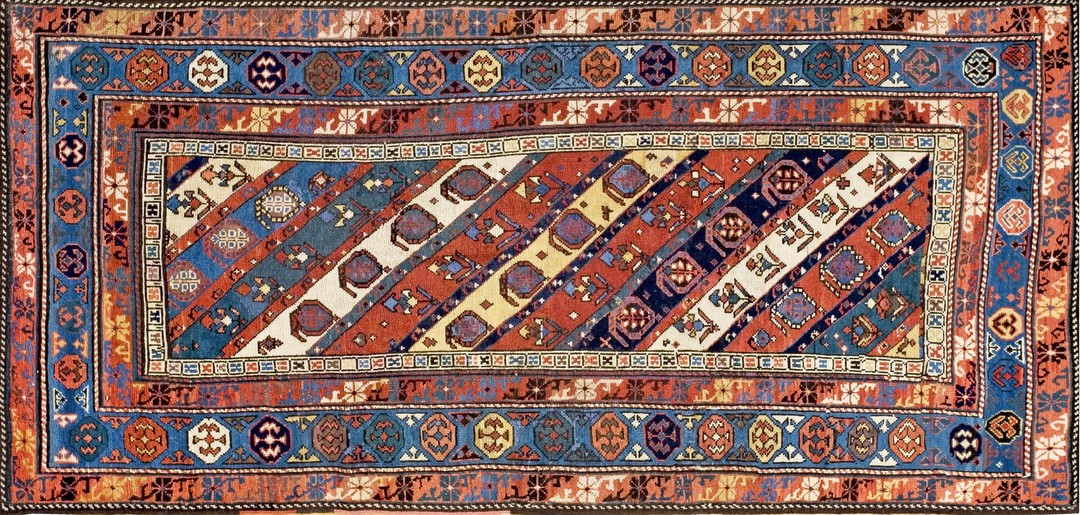
The Afghan paisley carpet and those from nearby Central Asian regions present a sharper, more geometric interpretation of the motif. Baluch rugs often use botehs that resemble pinecones or stylized flames, woven in earthy browns, midnight blues, and deep reds. Uzbek weavings may feature botehs elongated into spear-like forms, while Azerbaijani carpets balance flame-like botehs with geometric border systems.
Compared to the refined order of Persian rugs, Afghan and Central Asian versions are darker in palette, less regular in layout, and more dramatic in presence—qualities that make them instantly distinguishable.
Indian (Kashmir) and Western paisley adaptations
- Kashmir Buta Shawls – Known for their lush, intricate interiors and jewel-toned color schemes. — Why: Kashmir artisans expanded the boteh into intricate allover fields, turning the motif into a symbol of luxury across the world.
- Western Adaptations – Jacquard-woven fabrics and rugs from the 19th century onward simplified botehs into repeating multicolor patterns. — Why: These adaptations made the boteh (now called the paisley pattern) widely accessible, though often more stylized and industrialized.
Anatolian and Turkish paisley rugs
- Turkish Paisley Border Carpets – In Anatolia, botehs are often confined to borders rather than dominating the field. — Why: Their geometric style and soft pastel palettes distinguish them from the bold central boteh fields of Persian and Indian designs.
- Regional Anatolian Variants – Some Turkish tribal weavings place botehs alongside stars or diamond medallions. — Why: These combinations reveal local weaving traditions and emphasize boteh as part of a larger symbolic vocabulary.
Modern case studies: notable examples in design
Contemporary designers continue to experiment with the boteh, creating the contemporary paisley rug in striking new ways. Some hand-tufted rugs feature a single oversized boteh stretched across the entire field, transforming the motif into abstract floor art. Others reinterpret botehs in monochrome palettes—black and white, silver, or gold—for sleek minimalist interiors.
Designers in Europe and the Middle East also experiment with fragmented or layered boteh fields, blending tradition with modern abstraction. These case studies highlight the boteh’s enduring adaptability: whether rendered in tribal geometry, Persian elegance, or avant-garde minimalism, the motif remains a living design language.
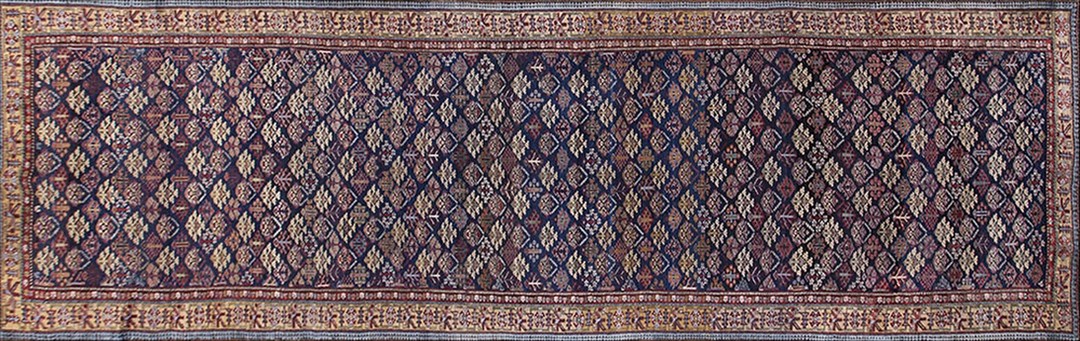
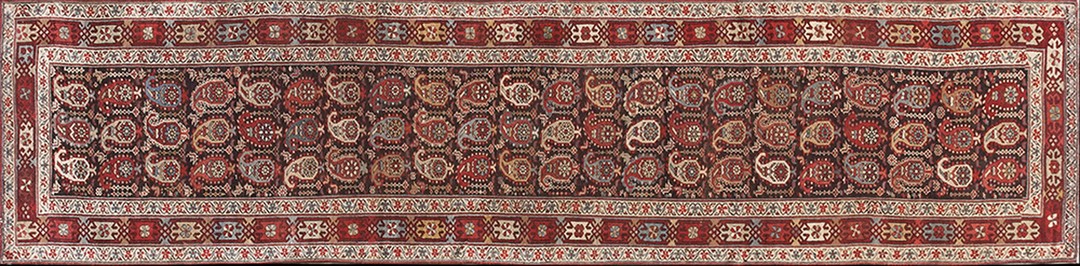
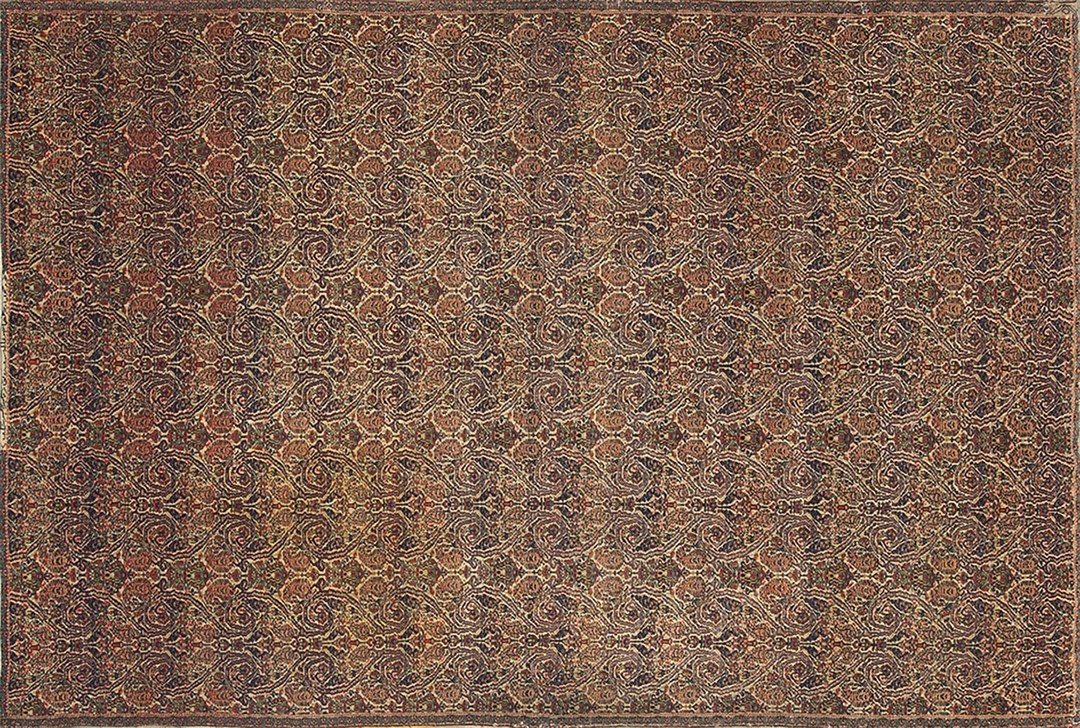
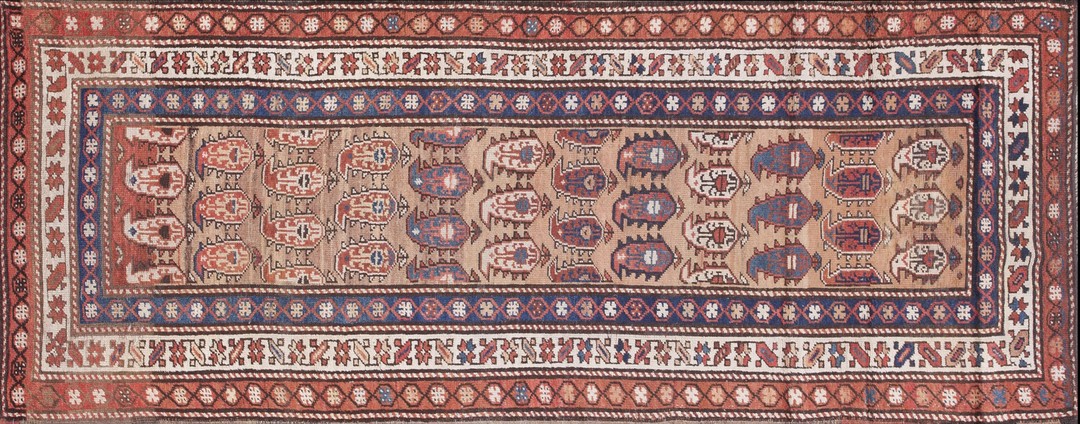
Explore a Few of Our Boteh Paisley Rugs
FAQ
- Any quick styling tips for Boteh Paisley rugs?
Balance scale: pair a small-scale Boteh Paisley rug with larger-scale stripes or solids. In living rooms, anchor furniture with front legs on the rug for cohesion.
- Do Boteh Paisley rugs only use allover fields?
No—botehs can appear in borders, corner spandrels, or medallions. That said, the allover mir-i-boteh layout is the most widely recognized.
- What does “boteh jegheh” mean on Boteh Paisley rugs?
It’s the Iranian term for the boteh/paisley motif used across traditional arts. Regional versions (e.g., Kerman, Qashqai, Sarouk) vary in scale, curve, and drawing.
- What colors are common in Mir/Saraband Boteh Paisley rugs?
Madder-red fields with navy, cream, or rose accents are classic, though blues and greens appear. The botehs often march diagonally in alternating directions.
- How can I tell if a Boteh Paisley rug is hand-knotted or printed?
Flip it—hand-knotted rugs show individual knots and a mirror image of the design on the back. Printed rugs look flat behind, and sewn-on fringes indicate machine finishing.
- How much do vintage Boteh Paisley rugs cost?
Prices vary widely by age, size, and condition. Expect roughly a few hundred dollars for machine-made pieces to \$2,000–\$10,000+ for hand-knotted vintage examples; exceptional antiques command more.
- Are Boteh Paisley rugs pet-friendly?
Wool Boteh Paisley rugs naturally resist soiling, and dense small botehs hide minor stains. Choose darker grounds and blot accidents promptly with mild detergent and water.
- Can Boteh Paisley rugs sit over radiant floor heating?
Usually yes—keep heat low and even, and use a breathable pad. Follow your floor installer’s temperature guidance and avoid trapping heat with non-breathable backings.
- How do Boteh Paisley rugs compare to floral Persian rugs?
Boteh Paisley rugs feel more geometric and rhythmic; florals feel more flowing and pictorial. The small-scale mir boteh pairs easily with patterned upholstery without clashing.
- What materials are common in Boteh Paisley rugs?
Most Boteh Paisley rugs use wool pile with cotton foundations; silk appears in finer city weaves. Machine-made versions often use polypropylene or polyester.
- Are Boteh Paisley runner rugs good for hallways?
They’re great—small botehs disguise traffic patterns. Common runner sizes are about 2’6″–3′ wide by 8’–12′ long, fitting typical corridors.
- Should I use a rug pad under Boteh Paisley area rugs?
Yes—pads prevent slipping, reduce wear, and add cushioning. A felt-and-rubber pad trimmed about 1–2 inches smaller than the rug works well on hard floors.
- Do Boteh Paisley rugs fade in sunlight?
Yes—UV light can lighten natural and synthetic dyes. Rotate the rug a few times per year and use window coverings or films to minimize uneven fading.
- How should I clean Boteh Paisley rugs at home?
Vacuum with suction only (no beater bar) and avoid fringe; blot, don’t rub, spills. Antique pieces should be professionally washed periodically, typically every 3–5 years depending on use.
- How durable are Boteh Paisley rugs for high-traffic areas?
Hand-knotted wool Boteh Paisley rugs are robust; Mir/Saraband pieces are known for everyday wear resistance. Add a quality rug pad to reduce movement and extend life.
- Do Boteh Paisley rugs work in modern interiors?
Absolutely—the repeating boteh reads like graphic texture. An 8×10 mir-i-boteh under a sofa anchors a living room without overwhelming contemporary furniture.
- What makes Kerman Boteh Paisley rugs distinctive?
Many Kerman rugs use fine curvilinear drawing and large, flowing botehs, sometimes filling the entire field. Early-20th-century Persian Kerman examples are especially admired.
- What’s the difference between Boteh Paisley rugs and Herati-pattern rugs?
Boteh Paisley rugs center on a single teardrop motif; Herati features a diamond (rosette) with “fish” leaves around it. Herati reads more symmetrical; boteh feels directional and seed-like.
- How can I identify antique Boteh Paisley rugs?
Look for hand-knotted construction, visible knots on the back, natural-dye abrash, and wool pile (often on cotton foundations). Wear that’s even, not printed, and fringes integral to the warp are good signs.
- What is a Mir (mir-i-boteh) pattern in Boteh Paisley rugs?
It’s an allover field of small botehs arranged in neat diagonal rows, often on madder-red or deep-blue grounds. Mir/Saraband runners and room sizes are widely available.
- Which regions are best known for Boteh Paisley rugs?
Seraband/Mir weavings from Iran’s Arak region, Kerman’s large-scale boteh designs, and pieces from Hamadan, Fars, Qashqai, and Kurdistan frequently showcase boteh motifs.
- What does the boteh symbolize in Boteh Paisley rugs?
Common readings include the cypress tree (life/eternity), a flame, or a seed/fruit (fertility). Meaning varies by region and era, so treat symbolism as interpretive rather than fixed.
- Are boteh rugs and paisley rugs the same thing?
Yes—“boteh” is the Persian motif; “paisley” is the Western name for it. In rugs, both terms describe the same curved teardrop element arranged in repeats or medallions.
- Where did the boteh motif in paisley rugs originate?
Boteh Paisley rugs trace to Iranian/Persian design, later popularized via Kashmir shawls; the English name comes from Paisley, Scotland. You’ll see the motif widely across Middle Eastern and South Asian textiles.
- What are Boteh Paisley rugs?
Boteh Paisley rugs feature a teardrop motif with a bent tip (boteh) repeated across the field or borders. The pattern reads as lively texture and dates back centuries in Persian weaving traditions.