
Introduction to Allover Design in Rugs
Explore our extensive collection of luxurious Allover Design rugs and find the perfect statement piece today.
What Are Allover Designs in Rug Patterns?
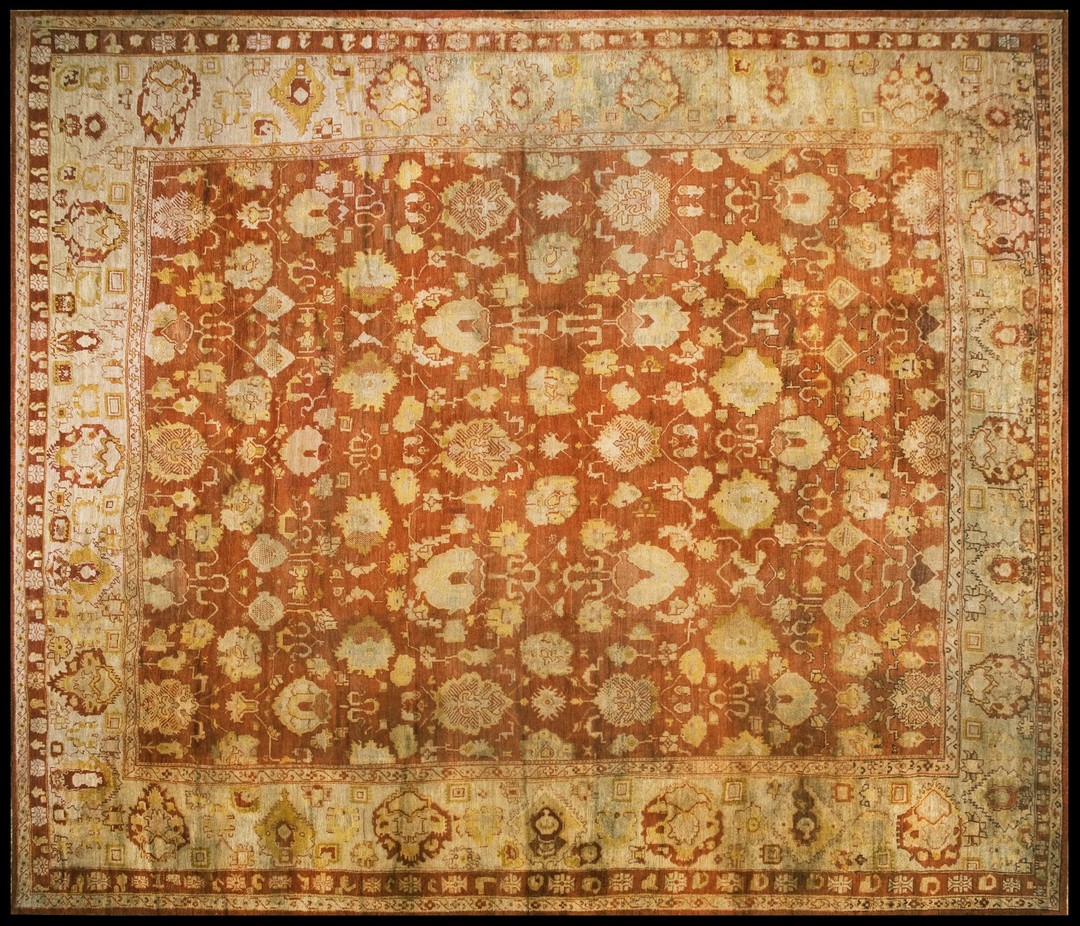
Allover designs in rugs is a pattern in which motifs are repeated evenly across the entire surface of the rug without a central medallion or dominant focal point. Instead of directing attention to the middle, the motifs—whether floral, geometric, or abstract—form a continuous field motif that could theoretically extend beyond the edges of the rug.
This quality is often described as an infinite repeat rug pattern, giving the impression that any section of the rug could be part of a much larger whole. The result is a design with no beginning or end, no strict “top” or “bottom,” and no need for orientation. Historically, allover designs predate medallion styles.
The world’s oldest known pile carpet, the Pazyryk carpet (5th century BCE), is a prime example of the early use of this approach. Its repeating motifs already show the qualities that continue to define the style today: balance, symmetry, and harmony without reliance on a centralized anchor.
Allover Designs vs. Medallion Patterns
For many rug enthusiasts and new buyers, understanding the distinction between allover pattern vs. medallion rugs can clarify why these styles feel so different in a room.
A medallion rug is structured around a strong central emblem, often accompanied by elaborate corner pieces, borders, and contrasting fields. This design creates hierarchy: the eye is drawn immediately to the center, with secondary emphasis on the corners.
By contrast, an allover rug design disperses visual energy evenly across the rug. Every part of the field contributes equally to the whole, with no dominant centerpiece. This structural difference makes rugs with allover designs highly adaptable.
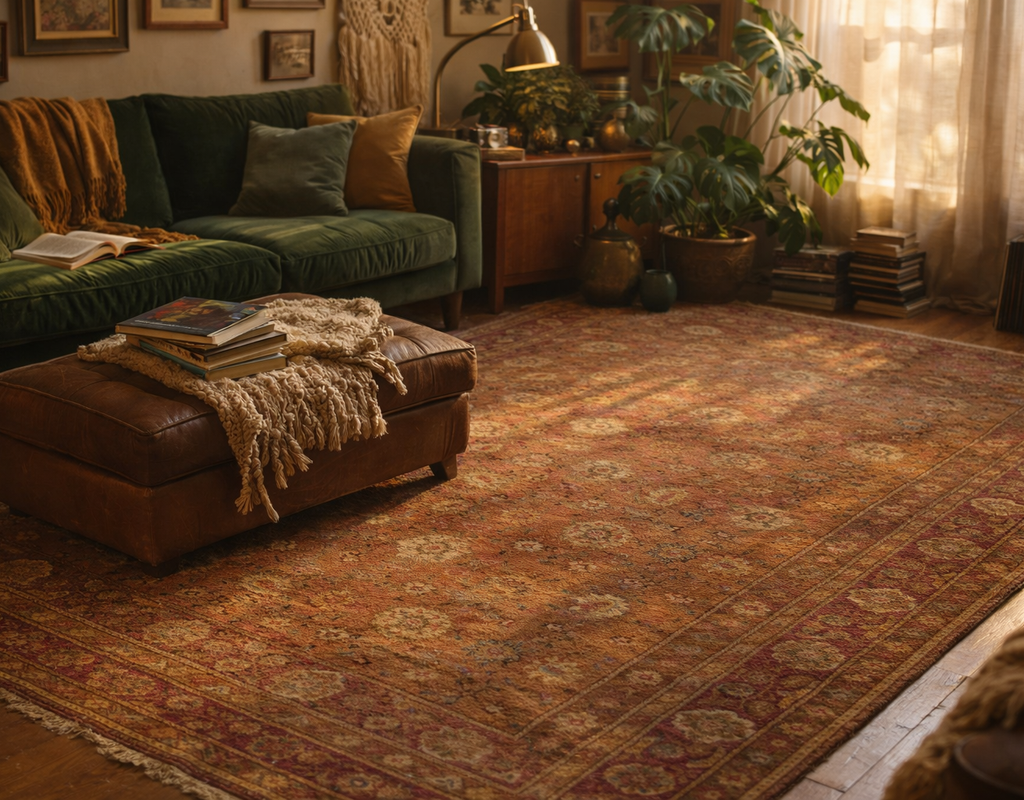
Sunlight streams across the distressed, traditional area rug, enhancing the rich, eclectic decor of this intimate reading nook.
Antique Tabriz Oversized Room Size Wool Blue Rug – by Rugs On Net
Unlike medallion rugs, which can sometimes clash with the placement of a central table or sofa, allover patterns work seamlessly under furniture because the layout does not rely on a visible focal medallion. For deeper exploration of the medallion style, see our [Medallion Rugs Category].
Why Rugs With Allover Designs Feel Visually Balanced
The balanced rug layout of an allover pattern comes from its underlying design psychology. Because motifs are spaced symmetrically and repeated rhythmically, the eye perceives harmony across the surface.
This design method eliminates hierarchy, encouraging viewers to appreciate the rug as a unified whole rather than as a composition with a dominant center. This quality of equilibrium is what makes area rugs with allover designs particularly effective in interior design.
A sofa can be placed at one end, a dining table in the center, or a bed across the top without disrupting the rug’s intended composition. In fact, the absence of directional emphasis makes allover rugs easier to place than medallion rugs, especially in multi-functional or open-plan rooms where furniture is shifted frequently.
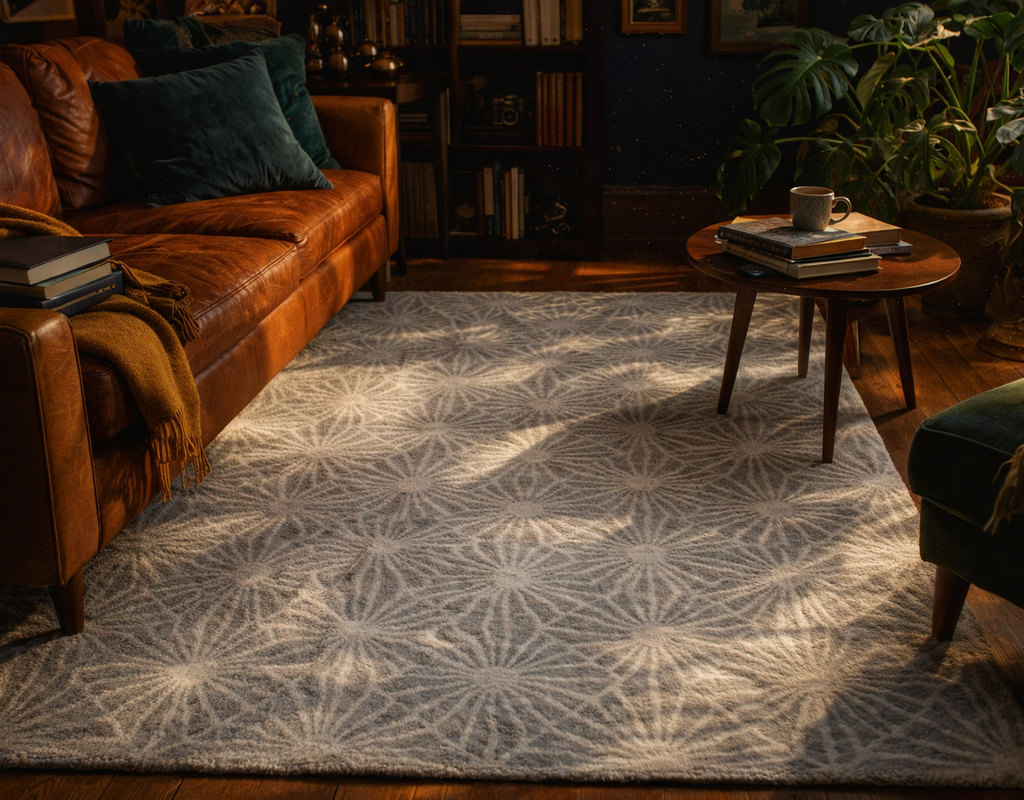
The geometric patterned rug provides a soft, light contrast to the rich, dark tones of the cozy reading nook.
From a psychological perspective, the endless repeat creates a sense of continuity and stability, qualities that enhance the feeling of balance within a space. This is one reason the style has endured across centuries, from ancient nomadic weavings to modern production.
Both historic and contemporary examples demonstrate how universal the appeal of the allover rug design has become.
A Layout for Every Setting
The enduring popularity of allover designs lies in its versatility. Whether anchoring a formal living room, lying beneath a dining table, or defining a modern minimalist interior, these rugs remain universally adaptable.
Their structure eliminates the challenge of alignment, their motifs create a soothing symmetry, and their history connects them to one of the oldest traditions in rug weaving.
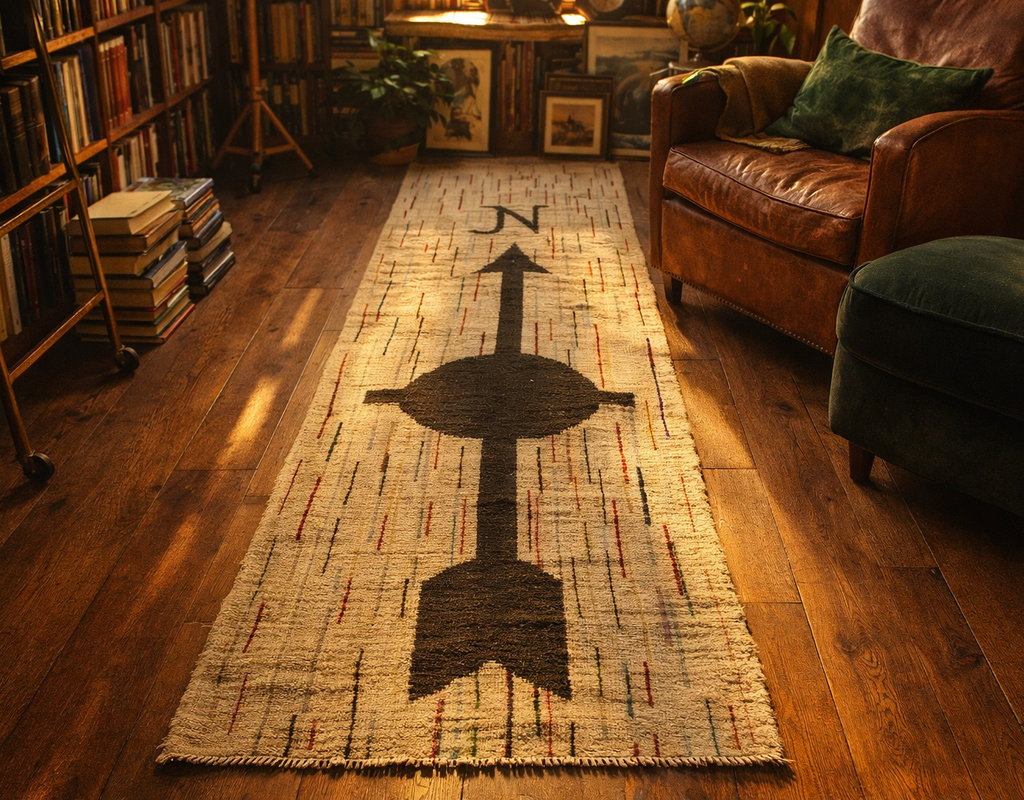
A striking compass-themed runner rug anchors the seating area in this richly decorated, sunlit study.
In essence, an allover rug design pattern represents timeless design logic: balance without dominance, repetition without monotony, and harmony that works in any orientation.
Origins & Historical Evolution of Rugs With Allover Designs
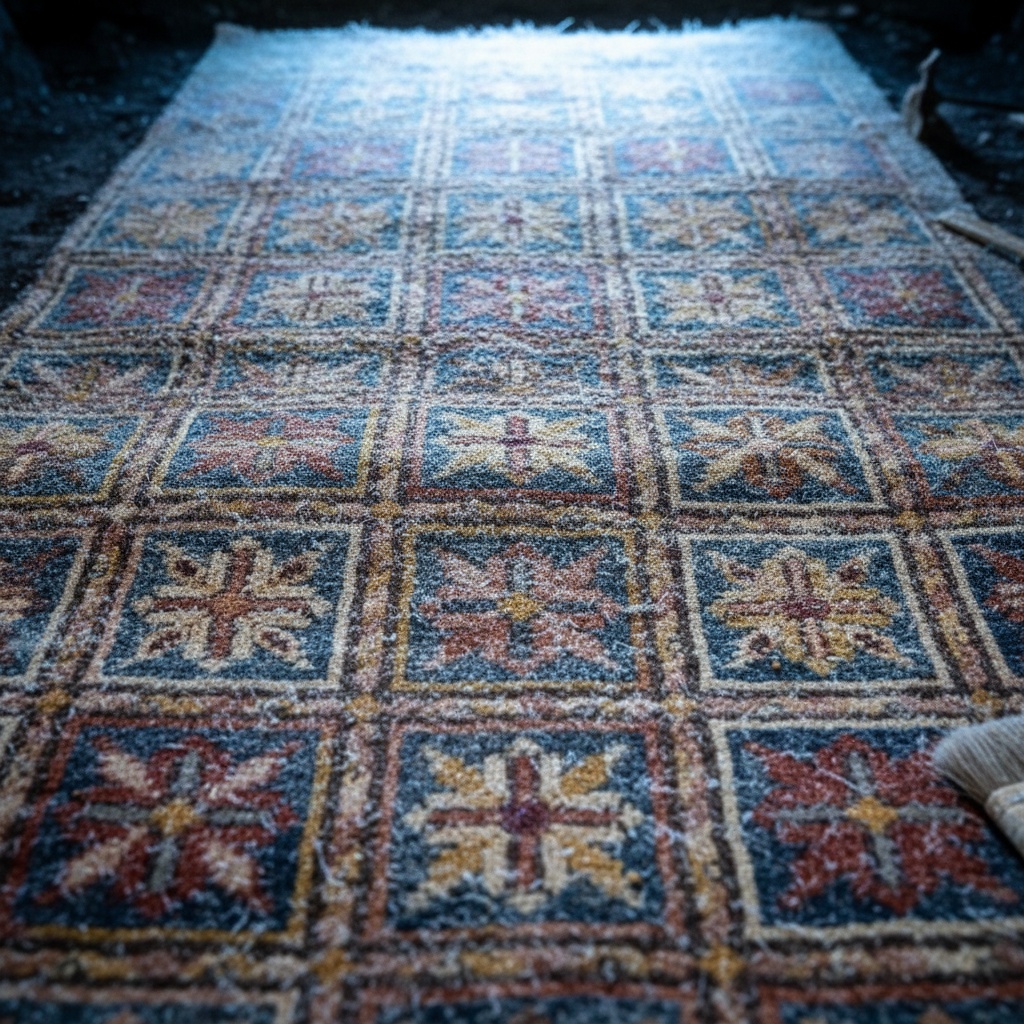
Geometric medallion pattern repeating across the textile.
Early History: Pazyryk Carpet & Pre-Islamic Roots
The history of allover rug patterns reaches back to the very beginnings of carpet weaving. The earliest known surviving example, the Pazyryk carpet (5th century BCE), discovered in a frozen Scythian tomb in Siberia, already demonstrates the principles of allover designs in rugs. Its field is filled with repeated geometric and floral motifs, arranged in balanced symmetry with no central medallion.
This makes the Pazyryk both a technical marvel and evidence that the allover pattern origins are as ancient as the craft itself. Throughout pre-Islamic weaving traditions, similar motifs appeared in nomadic textiles, tribal flatweaves, and early pile rugs.
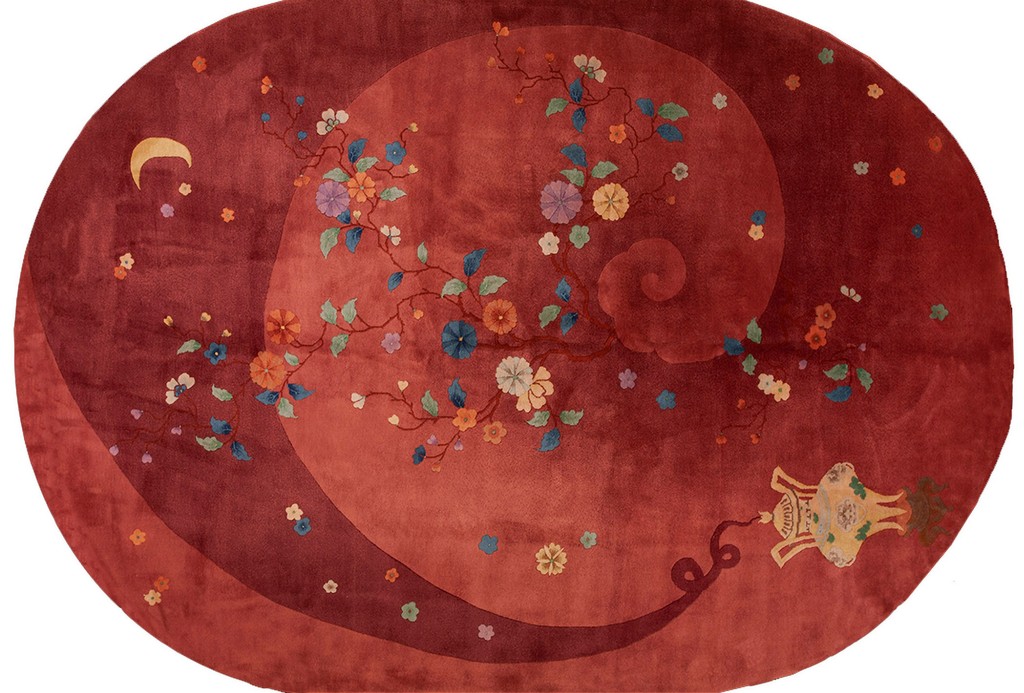
Oval Shape Antique Artistic Swirl Pattern Rustic Red Siena Color Art Deco Chinese Rug by Rugs On Net
These designs emphasized repetition, continuity, and balance, laying the groundwork for later innovations in Persian, Anatolian, and Central Asian traditions. Importantly, the allover layout dominated centuries before the medallion became prominent in rug design during the 16th century.
Allover Designs Through Empires: Safavid, Ottoman, Mughal
The great weaving empires of the Islamic world—Safavid Persia, the Ottoman Empire, and the Mughal court in India—each developed distinct variations of allover designs in the field. During the Safavid period, the introduction of finely knotted silk and wool carpets allowed for more elaborate Safavid rug layouts, often featuring the Herati pattern (a flower flanked by leaves, framed by diamonds), the Mina Khani lattice, and the famous vase carpets with scrolling arabesques.
These designs emphasized harmony through repeated floral and geometric fields. In the Ottoman world, the Lotto carpet became iconic for its golden latticework set against bold red fields, a striking example of the empire’s preference for geometric allover designs.
Meanwhile, the Mughal courts in India perfected the millefleurs style, where countless small blossoms filled the rug’s field, creating a dense garden-like atmosphere. Each empire tailored the infinite repeat rug pattern to its aesthetic ideals, but all shared the emphasis on balance and repetition across the surface.
European Adoption: When Did Looms Pick Up the Allover Designs?
The question of when European looms adopted the allover pattern can be traced to the late 18th and early 19th centuries. As trade with the East flourished, European tastes increasingly favored rugs with continuous field motifs, which integrated more easily into symmetrical drawing rooms and parlors.
Manufacturers in England, such as Axminster and Wilton, began incorporating Persian-inspired allover designs into their machine-woven carpets.
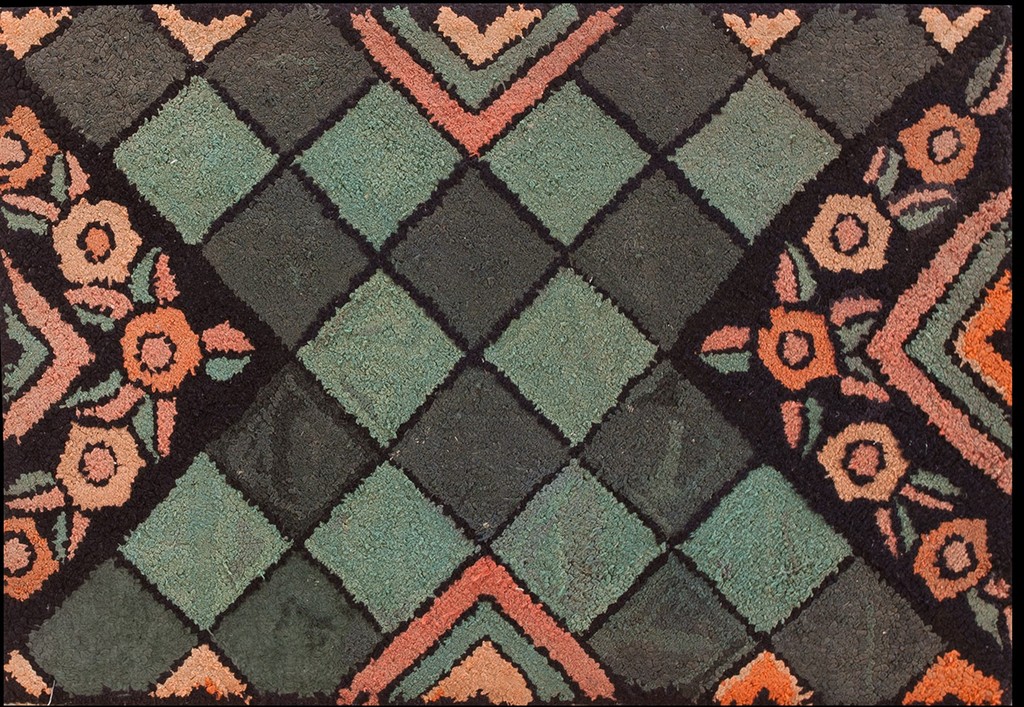
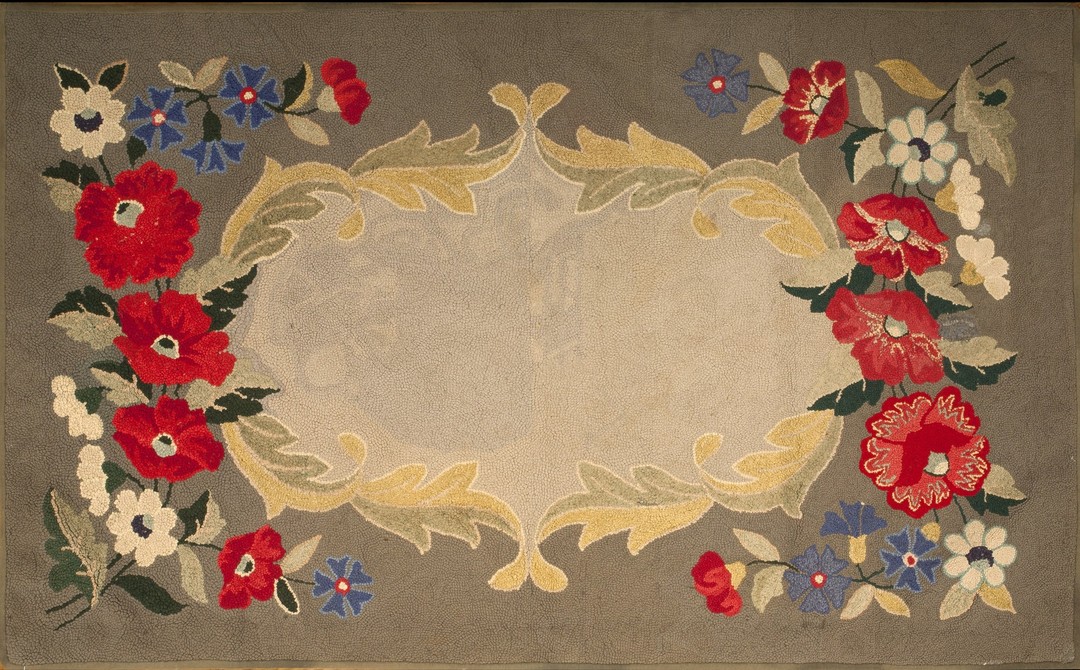
Antique American Hooked America Multicolor 1920s Rug by Rugs On Net
By the Victorian period, rugs with allover designs were a staple of European and American interiors. Unlike medallion carpets, which sometimes conflicted with centrally placed tables or hearths, allover designs were adaptable and easier to align with furniture.
This practical quality helped cement their popularity in Western décor, where they were prized for both function and beauty. For a deeper dive into the Persian legacy behind these patterns, see our Persian Rug History Pillar.
Key Historical Motifs in Allover Designs / Layouts
- Herati — A diamond with rosettes and curled leaves. — Why: Became the defining Safavid rug layout motif, widely imitated across Persia and Central Asia.
- Mina Khani — Interlaced floral lattice. — Why: Symbolized gardens and abundance, prized in Persian allover carpets.
- Lotto Lattice — Geometric, interlaced grid with golden highlights. — Why: Distinguished Ottoman Lotto carpets, highly exported to Europe.
- Millefleurs — Dense fields of tiny blossoms. — Why: Signature of Mughal design, emphasizing delicacy and richness.
- Guls — Octagonal medallion-like motifs in repetition. — Why: Essential to Turkoman and Central Asian tribal carpets, representing lineage and identity.
Enduring Legacy
The allover designs in an area rug is not a modern innovation but a tradition rooted in the very beginnings of weaving. From the Pazyryk carpet design to Ottoman Lotto carpets and Safavid masterpieces, the concept of an infinite repeat rug pattern has remained central across cultures and centuries.
When European and American interiors embraced the look, the demand only grew, ensuring that these designs continue to be woven, admired, and collected worldwide.
Regional Variations & Key Motifs
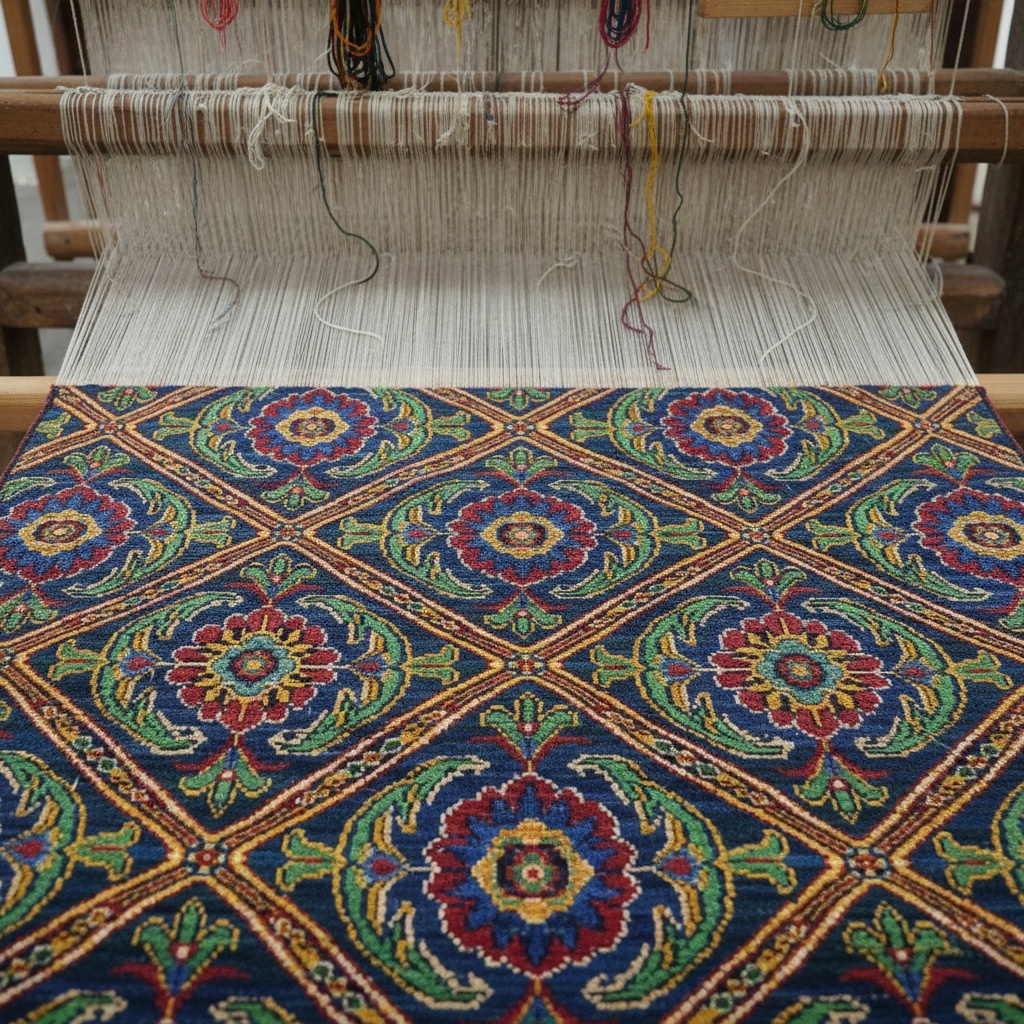
Detailed allover pattern visible on a carpet in progress.
Persian Allover Designs in Carpets: Common Motifs
Persian weaving traditions gave rise to some of the most iconic Persian allover designs, many of which remain central to rug design worldwide.
Among the most significant are:
- Herati pattern — A central flower framed by a diamond and surrounded by curling leaves. — Why: One of the most enduring field patterns, it balances geometry with fluidity and became synonymous with Persian allover designs.
- Mina Khani — Interlaced lattice of flowers connected by tendrils. — Why: Symbolizes abundance and gardens, producing a rhythmic and harmonious Mina Khani pattern field.
- Boteh (paisley) — Teardrop-shaped flame motif. — Why: Precursor to the modern paisley, it often repeats in staggered rows to form flowing allover fields.
- Shah Abbasi palmettes — Stylized floral forms used in repeating sequences. — Why: Introduced during the Safavid era, they convey elegance and courtly refinement.
- Floral vine scrolls — Flowing tendrils linking blossoms across the field. — Why: Offer softness and fluid motion, contrasting with geometric latticework.
Together, these motifs demonstrate the Persian mastery of the infinite repeat rug pattern, where repetition creates balance without sacrificing complexity.
Anatolian, Caucasian, Central Asian, Indian, and Chinese Allover Designs
Every weaving region adapted the allover designs origin to its own culture, materials, and symbolism:
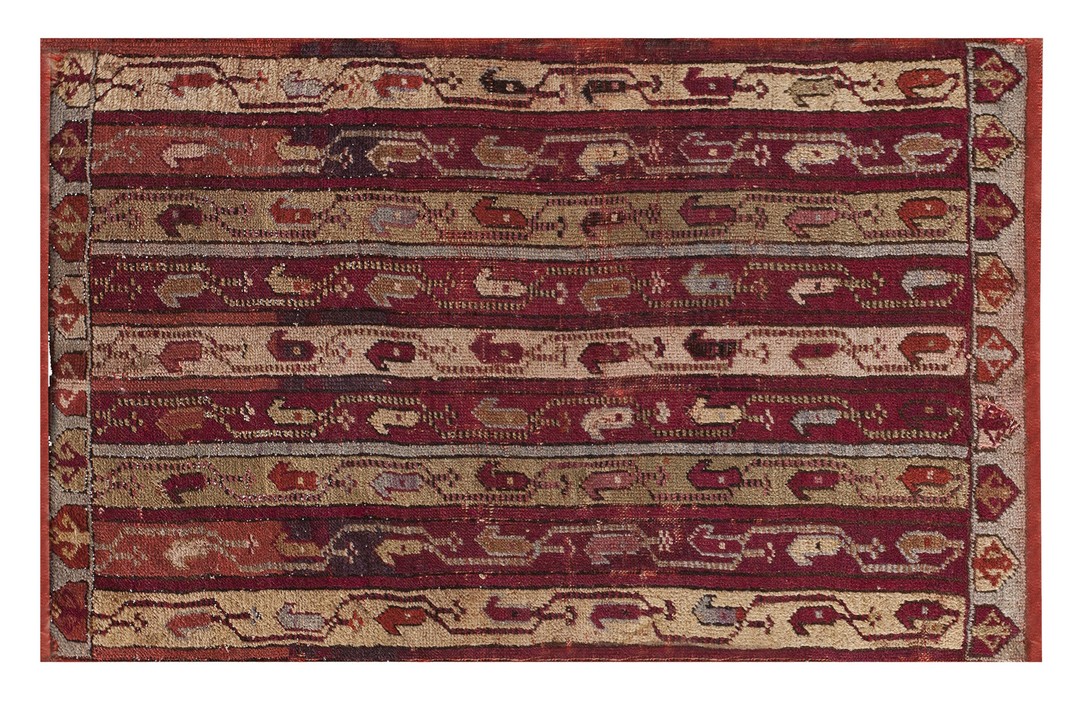
- Anatolian Rugs (Turkey): Bold Lotto and Holbein carpets, as well as Yörük tribal pieces with strong geometric repeats. — Why: Their angular grids and saturated reds/yellows made them export favorites to Europe.
- Caucasian Rugs: The Afshan lattice, paradise gardens, and repeating star grids. — Why: Known for sharp lines and high contrast, these layouts highlight the region’s geometric clarity.
- Central Asian Rugs: Rows of Turkmen guls, octagonal motifs symbolizing clan identity. — Why: The gul allover repeat defined Turkmen rugs for centuries and served as tribal markers.
- Indian Rugs: Mughal floral allovers and Kashmiri paisley repeats. — Why: The Mughal millefleurs and Kashmir boteh fields became symbols of luxury textiles.
- Chinese Rugs: Patterns of fretwork, cloud bands, and Shou symbols. — Why: These emphasized auspicious meaning, with allover grids representing harmony and long life.
Each style demonstrates how the allover rug design transcends borders while retaining distinct regional identities.
Flatweave Rugs With Allover Designs: Kilim, Soumakh, Dhurrie, Ingrain
While pile carpets dominate historic collections, flatweave allover designs are among the boldest examples of the style. Kilim allover rugs with diamond, chevron, and stripe fields create strong visual rhythm, while Soumak flatweaves add texture with their weft-wrapping techniques.
Indian dhurries often use striped or checked repeats in cotton, making them durable and highly versatile.
In Europe, ingrain carpets employed flatweave looms to produce repeating two-tone fields ideal for domestic interiors. Yes, flatweave rugs can feature bold allover designs, often more striking than pile rugs due to their use of sharp geometric contrasts and large-scale repeats. Their structure allows clear motifs without the variation caused by pile direction.
How Motif, Material & Technique Interact
The motif clarity in rugs depends directly on knot density, fiber, and regional technique. Fine Persian city rugs with high knot counts can render delicate Herati or Mina Khani patterns in crisp detail.
By contrast, tribal rugs with coarser knots emphasize bold geometrics, where clarity comes from scale rather than precision. Material also shapes durability: wool provides warmth and resilience, silk offers sheen and definition, and cotton warps enhance structural stability. In flatweaves, tight warp-and-weft construction yields durability while showcasing bold patterning.
Knot density does affect allover design pattern clarity—the higher the knot count, the sharper and more detailed the motifs appear. Lower densities, however, favor striking graphic simplicity, especially in tribal or nomadic interpretations.
A Universal Concept with Local Character
Whether defined by the floral Herati and Mina Khani pattern, the tribal repetition of guls, or the geometric punch of a kilim allover rug, each weaving tradition found unique expression in the allover design.
These rugs prove that a single concept—motifs repeated across a continuous field—can be endlessly varied depending on cultural context, weaving technique, and material choice.
Construction & Materials of Rugs With Allover Designs
Knot Density and Pattern Clarity
In traditional allover rug construction, the sharpness of motifs is directly tied to knot count and clarity. A higher knot density allows weavers to render intricate patterns such as the Herati or Mina Khani with crisp detail, much like pixels in a digital image.
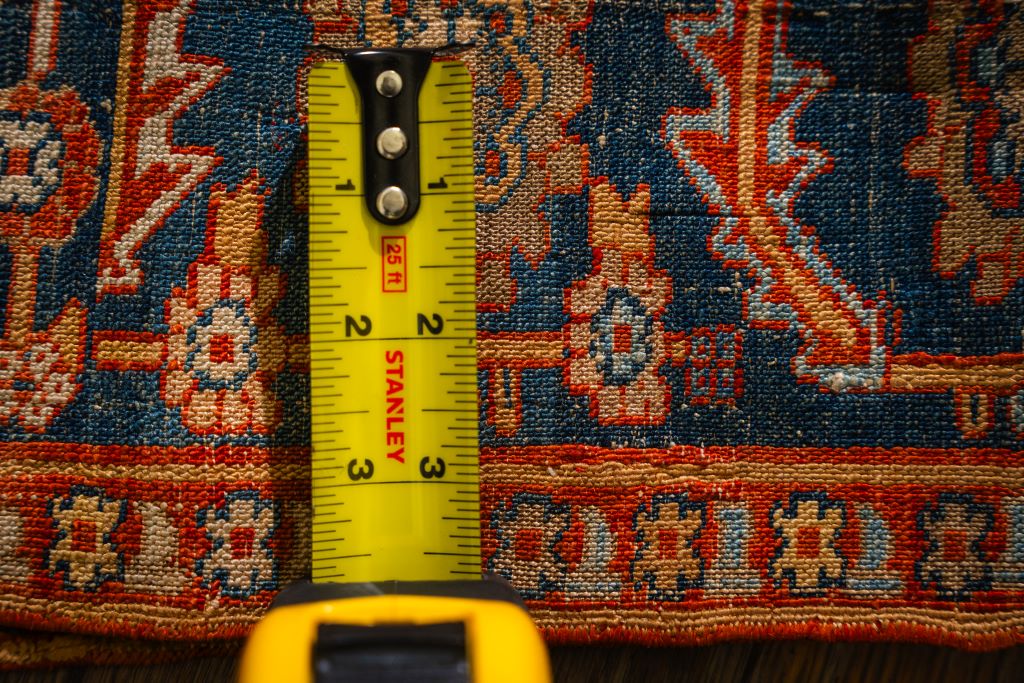
A detailed inspection of a richly colored oriental rug pattern while measuring its dimensions.
Conversely, coarser weaves with fewer knots per square inch favor bold, large-scale motifs, where clarity is achieved through strong geometry rather than fine detailing.
This balance between knot density and design scale explains why tribal and nomadic allover rugs often feel graphic and bold, while city-made Persian carpets can appear delicate and highly refined.
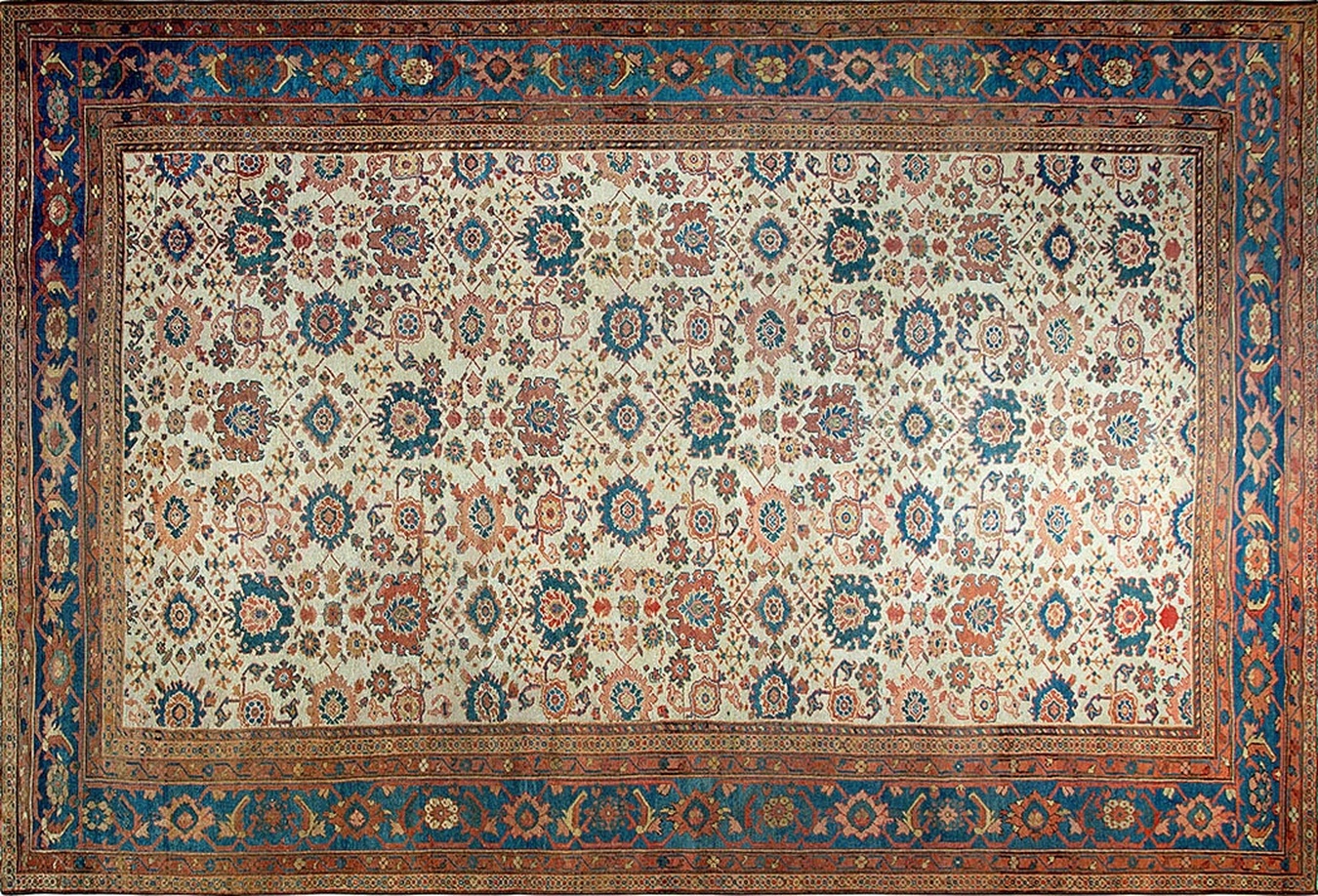
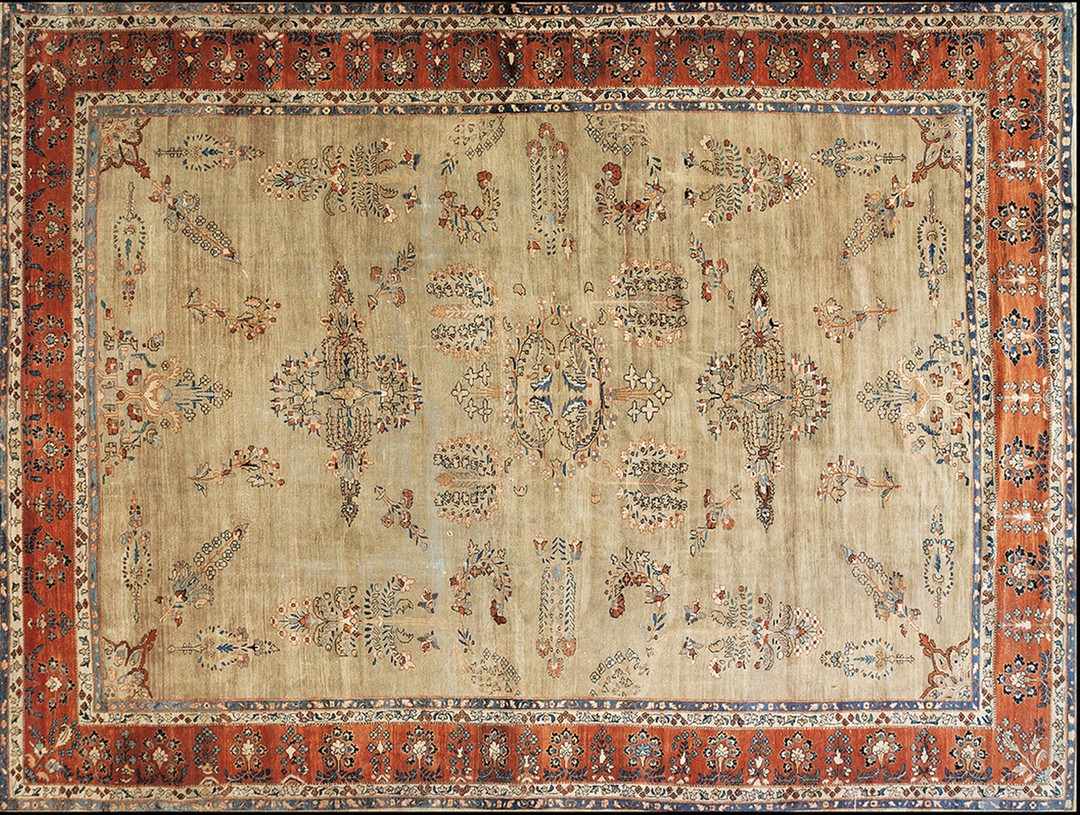
Antique Sultanabad Persian Large Wool Ivory Beige Cream White Hand Knotted Pile Rug – by Rugs On Net
Yes, knot density absolutely affects clarity of allover designs. Fine knotting enhances detail, while lower counts emphasize dramatic, simplified designs.
How Allover Designs Are Woven in Hand-Knotted Rugs
Hand-knotted rugs with allover designs follow time-honored methods that blend discipline with creativity. Weavers may work with or without “cartoons” (detailed design blueprints).
Each technique shapes how the infinite repeat is realized:
- With cartoons — — Why: Ensures precision in repeating motifs, making it possible to weave highly complex floral or geometric layouts.
- Without cartoons — — Why: Allows tribal and village weavers to improvise, producing lively variations within the continuous field motif.
- Symmetrical repetition — — Why: Motifs are mirrored and repeated across the warp and weft, reinforcing the sense of balance and harmony.
- Border integration — — Why: Borders frame the field without interrupting the flow of the allover design, maintaining unity.
This versatility is a hallmark of traditional allover rug construction, enabling everything from Mughal millefleurs to Anatolian tribal grids.
Allover designs in hand-knotted rugs are woven by repeating motifs systematically across the field, either by following a drawn plan or through skilled improvisation, ensuring symmetry and balance without a central medallion.
Materials: Wool, Cotton, Silk, Synthetic Fibers
The material composition of a rug not only impacts durability but also how clearly motifs are expressed.
- Wool — The most common material, prized for strength, warmth, and natural softness. It also softens further with age, making wool allover rugs highly valued.
- Cotton — Often used for the warp and weft foundation, offering stability and keeping patterns aligned with clarity.
- Silk — Adds brilliance and detail, often highlighting floral or vine motifs with a reflective sheen.
- Synthetic fibers — Replicate traditional allover designs at scale for modern production. However, while they can mimic appearance, they often lack the depth of texture, resilience, and natural vintage rug softness that wool and silk provide.
Synthetic fibers can replicate traditional allover motifs to some extent, but they rarely achieve the same clarity, durability, or tactile appeal as natural materials like wool and silk.
Are Vintage Allover Designs in Rugs Softer than Modern Versions?
A key question for collectors and buyers is whether older rugs feel different underfoot. The answer lies in materials and finishing. Vintage allover rugs often feel softer than their modern counterparts because the lanolin-rich wool has naturally aged and broken in over decades of use. Hand-finishing techniques, including natural washing and hand-spinning, also contributed to a supple feel.
By contrast, many modern machine-made or synthetic rugs lack this evolving texture, feeling stiffer or more uniform even after years of wear. Yes, vintage allover rugs tend to be softer due to the natural aging of wool and traditional hand-finishing, qualities that newer synthetic versions cannot fully replicate.
The Interplay of Craft and Material
Ultimately, the artistry of hand-knotted allover rugs depends on both construction and materials. Fine knotting sharpens motifs, natural fibers bring warmth and durability, and hand-weaving techniques allow for patterns of extraordinary complexity.
Whether in a finely detailed Persian silk rug or a bold tribal kilim, every choice in knot density and fiber transforms how the allover rug design looks, feels, and lasts.
Color, Texture, and Pattern in Rugs With Allover Designs
Distinguishing Vintage from Modern Allover Palettes
The most immediate way to differentiate old from new is through vintage allover rug colors versus modern palettes.
- Vintage allover rugs — Rich, saturated hues derived from natural dyes such as madder red, indigo blue, and pomegranate yellow. These colors often show abrash, the subtle tonal shifts created by hand-dyeing wool in small batches. — Why: Natural dyes give vintage rugs depth and complexity, creating warmth and character impossible to replicate with uniform synthetic tones.
- Modern allover rugs — Softer neutrals, gentle pastels, and bold machine-dyed contrasts dominate. Contemporary dyeing techniques produce even, consistent tones. — Why: Neutral and adaptable shades fit easily into a wide variety of interior styles, from minimalist lofts to transitional homes, while bold contrasts cater to modern statement décor.
Vintage allover palettes are defined by natural dyes and subtle abrash, while modern allover rug palettes rely on consistent synthetic tones, softer neutrals, and trend-driven contrasts. For more context, see our Vintage Rugs Category.
What Color Trends Dominate Modern Allover Rug Collections?
In today’s interiors, the modern allover rug palette leans toward versatility. Popular choices include earthy neutrals like beige, ivory, and taupe; muted blues and greens for calming atmospheres; and pale grays that align with contemporary minimalist design. Designers also experiment with bold contrasts, such as black-and-white geometric fields or jewel-tone accents, for striking visual statements. The dominant color trend in rugs today emphasizes soft, adaptable palettes—neutrals and pastels—balanced with occasional bold contrasts that make the allover rug design feel fresh and modern.
Flatweave Rugs With Allover Designs: Texture and Visual Impact
Texture plays a powerful role in how color reads across an allover design. Flatweave textures, such as kilims and dhurries, emphasize strong blocks of color in stripes, diamonds, or chevrons. Without pile to absorb or diffuse light, the hues appear sharper and more graphic. By contrast, pile rugs have a softer sheen, with color shifting as the pile direction changes. The flatweave texture also accentuates geometry, making motifs feel bolder even when using muted tones. This is why kilim allover rugs and dhurries remain popular for modern interiors: their crisp visual punch contrasts beautifully with clean-lined furniture.
Pattern and Color Interaction
The interaction of pattern and color determines whether allover designs feel subtle or dramatic. Dark motifs on a light ground make repeats highly visible, while tone-on-tone combinations create understated fields that blend seamlessly into a room. In vintage rugs, natural abrash adds movement to otherwise uniform designs, creating rhythm and depth. In modern pieces, carefully placed color blocking can either calm or energize the space.
Ultimately, both vintage allover rug colors and modern palettes demonstrate how pattern and color are inseparable. The dye source, the placement of motifs, and the choice of texture together shape the atmosphere a rug brings into a room—whether timelessly warm, softly neutral, or boldly contemporary.
Functionality, Placement & Styling
Are Allover Designs Easier to Place than Medallion Rugs?
One of the greatest advantages of the allover rug design is its flexibility in placement. Unlike medallion rugs, which rely on a central focal point, allover layouts use a continuous field motif with no defined top, bottom, or center.
This makes them significantly easier to position beneath sofas, beds, or dining tables without worrying about cutting off or obscuring a dominant medallion. Yes, allover designs are much easier to place than medallion rugs, especially in rooms where furniture arrangements are off-center or frequently moved.
Should I Choose Rugs With Allover Designs for Open-Plan Spaces?
For open layouts, an allover rug for open plan interiors is often the most practical choice. The repeating design creates visual unity across multiple seating or dining zones, grounding the space without competing with architectural elements.
Since there’s no focal point, the rug adapts seamlessly whether the room is divided into conversational clusters or left wide and open. Yes, allover rugs are particularly well-suited for open-plan rooms because their infinite repeat unifies the layout and avoids clashing with multiple focal points.
Are Allover Designs Suitable for Small Rooms?
A small room rug pattern benefits from the qualities of an allover layout. Because motifs are evenly spread, they give the impression of continuity beyond the rug’s edges, making compact rooms feel more expansive. Medallion rugs, by contrast, can sometimes overwhelm small spaces by concentrating too much emphasis in the center.
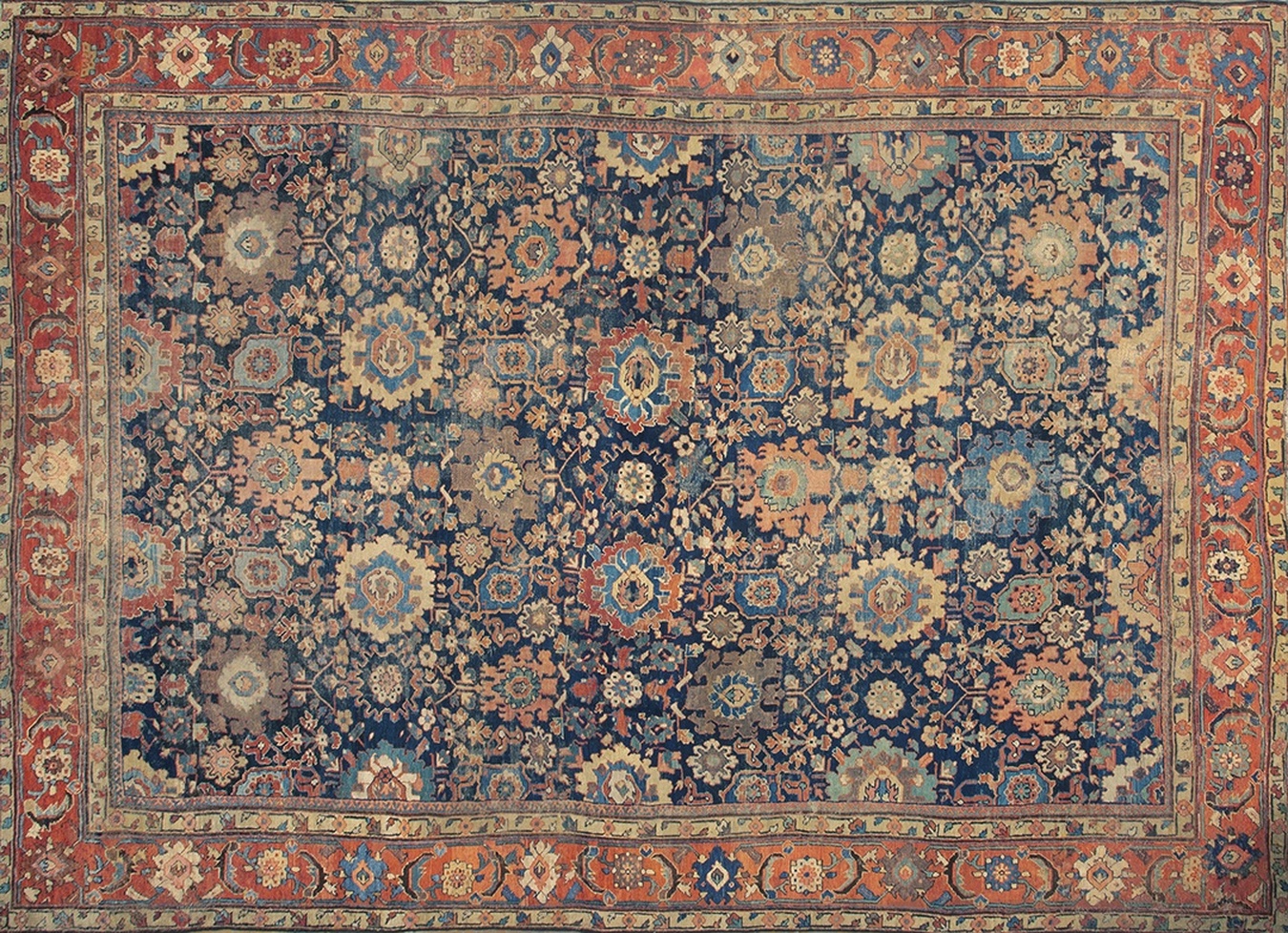
Yes, allover designs are ideal for small rooms, as they create the illusion of expanded space and avoid the crowding effect of central medallions.
How Do Allover Rugs Hide Furniture Placement Marks?
The continuous field motif of an allover rug naturally helps with hiding marks with allover rug layouts. Furniture indentations, wear from foot traffic, or even minor stains blend into the rhythm of repeated motifs, making them far less noticeable. By dispersing attention evenly across the field, allover rugs minimize the visibility of disruptions that would stand out on a solid-colored or medallion rug. Allover rugs disguise furniture placement marks and daily wear more effectively than medallion designs because the repeating pattern camouflages irregularities.
How Do Designers Style Rooms Around Rugs With Allover Designs?
Interior designers frequently recommend styling allover rugs as grounding elements in both modern and traditional spaces. Common approaches include:
- Layering under furniture — — Why: Works well beneath beds, dining tables, and sectional sofas without disturbing the design flow.
- Unifying mixed décor — — Why: Continuous motifs tie together diverse furniture styles or varied color palettes.
- Expanding compact layouts — — Why: Repetition gives small rooms a sense of openness.
- Balancing bold interiors — — Why: Allover designs provide stability in rooms with strong architectural or decorative features.
- Highlighting texture — — Why: In flatweaves, the geometric patterns and crisp color blocks add graphic impact to minimalist schemes.
Designers style rooms around rugs with allover designs by using them to unify space, balance visual weight, and create flexibility in furniture arrangements.
A Rug for Every Layout
From sprawling open-plan living areas to intimate studies, the allover rug design adapts to any environment. Its balanced rug layout maximizes flexibility, disguises wear, and grounds interiors with timeless harmony—qualities that make it a designer favorite across both traditional and contemporary homes.
For practical guidance on choosing the right size for your space, visit our [Rug Size Guide].
Value, Resale & Collecting
Why Do Antique Allover Carpets Command Higher Prices?
The antique allover carpet value lies in a combination of rarity, craftsmanship, and adaptability. Woven generations ago, these rugs were often created with handspun wool, natural dyes, and knotting techniques that give them both durability and a richness of character. Their infinite repeat rug pattern makes them incredibly versatile for placement in any interior, a quality that continues to resonate with modern buyers and collectors.
Because they are not tied to a single stylistic focal point, antique allover rugs transcend shifting design trends, which fuels their enduring demand in the market. Antique allover carpets command higher prices due to their rarity, timeless versatility, and the extraordinary craftsmanship that makes them both collectible and highly functional.
Do Allover Designs Increase a Rug’s Resale Value?
Yes, the resale value of allover rugs is often higher compared to other styles. Their universal adaptability makes them appealing to both designers and homeowners, ensuring consistent demand. Unlike medallion carpets, which can be challenging to place under furniture or in small rooms, allover rugs offer layout flexibility that broadens their buyer base. Collectors also appreciate their balanced designs, which work seamlessly in both traditional and modern interiors. Allover design generally increases a rug’s resale value because its balance and flexibility appeal to a wider range of buyers.
Where Can I Buy Affordable Allover Wool Rugs?
While antiques and fine Persian examples can reach high prices, there are many opportunities to find affordable allover wool rugs that still showcase durability and beauty.
- Auctions — — Why: Estate sales and regional auction houses often feature antique or vintage rugs at lower prices than galleries.
- Reputable online retailers — — Why: Trusted sellers provide verified wool content and transparent return policies, making online shopping reliable.
- Vintage markets & flea markets — — Why: These venues can yield unique, character-rich wool rugs at affordable entry-level prices, especially for buyers comfortable with minor signs of wear.
Affordable allover wool rugs can be found at auctions, through reputable online retailers, and in vintage or flea markets where timeless designs are often available at approachable price points. For more shopping guidance, see our [How to Buy Rugs Page].
Collecting with Purpose
For collectors, the appeal of allover designs is twofold: historic value and practical function. Antique pieces showcase traditional allover rug construction and naturally softened wool, while modern iterations carry forward the style’s adaptability for contemporary interiors.
Whether pursued for investment or everyday use, the antique allover carpet value remains strong, underscoring why these rugs continue to command attention in both the marketplace and design world.
Modern Market & Legacy
Continued Production and Current Trends
The modern allover rug trends show that this layout remains one of the most adaptable in the carpet industry.
- Handmade production continues globally — — Why: Skilled workshops in Iran, Turkey, India, and Afghanistan still produce wool and silk allover rugs that emphasize craftsmanship and natural dyes.
- Machine-made carpets embrace the style — — Why: The repeating, non-directional layout translates perfectly into broadloom rolls and affordable synthetic options, ensuring accessibility for everyday interiors.
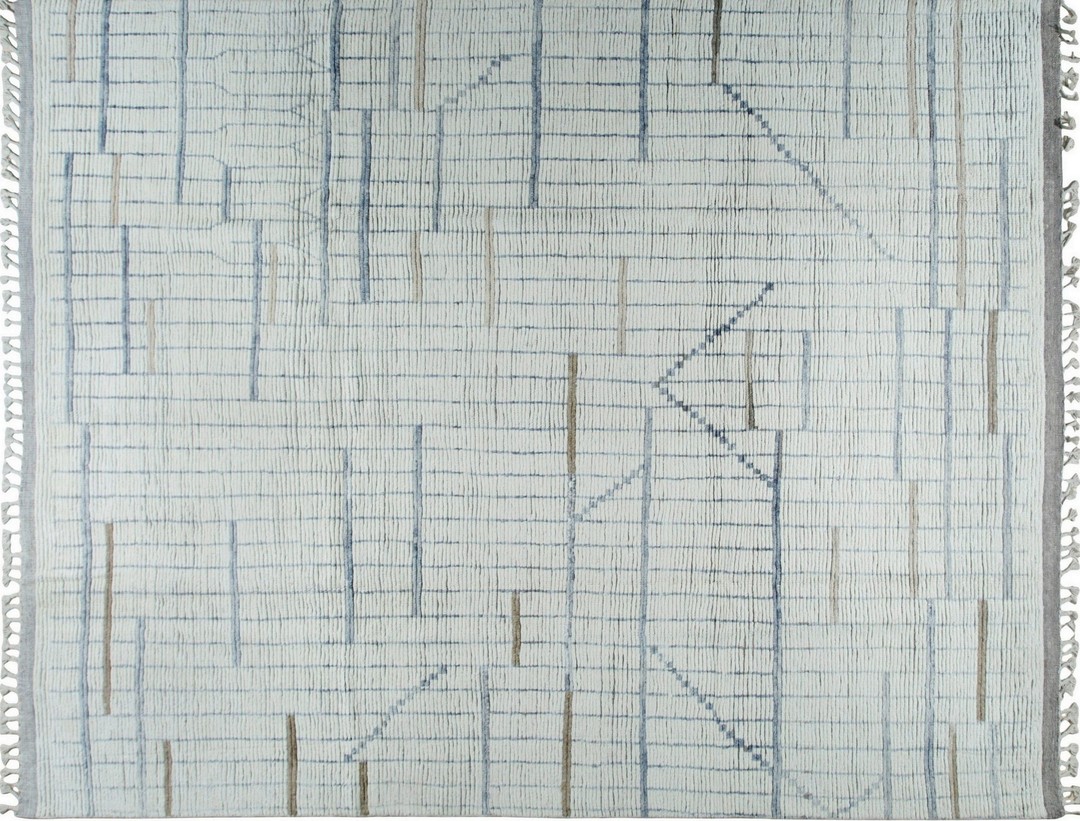
- Neutral palettes dominate contemporary collections — — Why: Designers and homeowners gravitate toward gray, ivory, and beige fields with soft geometric repeats, which fit seamlessly into minimalist and transitional spaces.
- Bold reissues for statement décor — — Why: Oversized lattice or graphic contrasts reinterpret the timeless rug patterns for clients who want traditional structure with modern flair.
Allover Designs Influence in Machine-Made & Fashion Textiles
The adaptability of the allover design legacy extends beyond handmade carpets. In the machine-made sector, machine-made allover carpets use continuous repeats to cover entire floors without interruption, an option that works especially well in commercial or large residential spaces. Beyond rugs, the concept of repetition and symmetry has shaped global textile and fashion design.
Paisley prints, damask weaves, and lattice-inspired fabrics are direct descendants of allover rug motifs. These patterns echo the rhythm and balance of traditional rug layouts, demonstrating how the aesthetic logic of the allover rug design continues to influence clothing, upholstery, and decorative arts.
Summary: The Timeless Appeal and Adaptability of Allover Rugs
The legacy of allover designs is defined by endurance and adaptability. From the ancient Pazyryk carpet to contemporary kilims and broadloom carpets, the structure of infinite repetition continues to meet the needs of both tradition and modernity. Luxury antiques showcase depth, craftsmanship, and cultural history, while affordable modern interpretations deliver everyday practicality.
What unites them is the universal appeal of timeless rug patterns based on rhythm, repetition, and harmony. An allover rug design has no fixed beginning or end, making it endlessly versatile—equally at home in a minimalist apartment, a formal dining room, or a centuries-old palace. Its continued presence in both handwoven masterpieces and machine-made textiles confirms its place as one of the most enduring design strategies in the history of decorative arts.
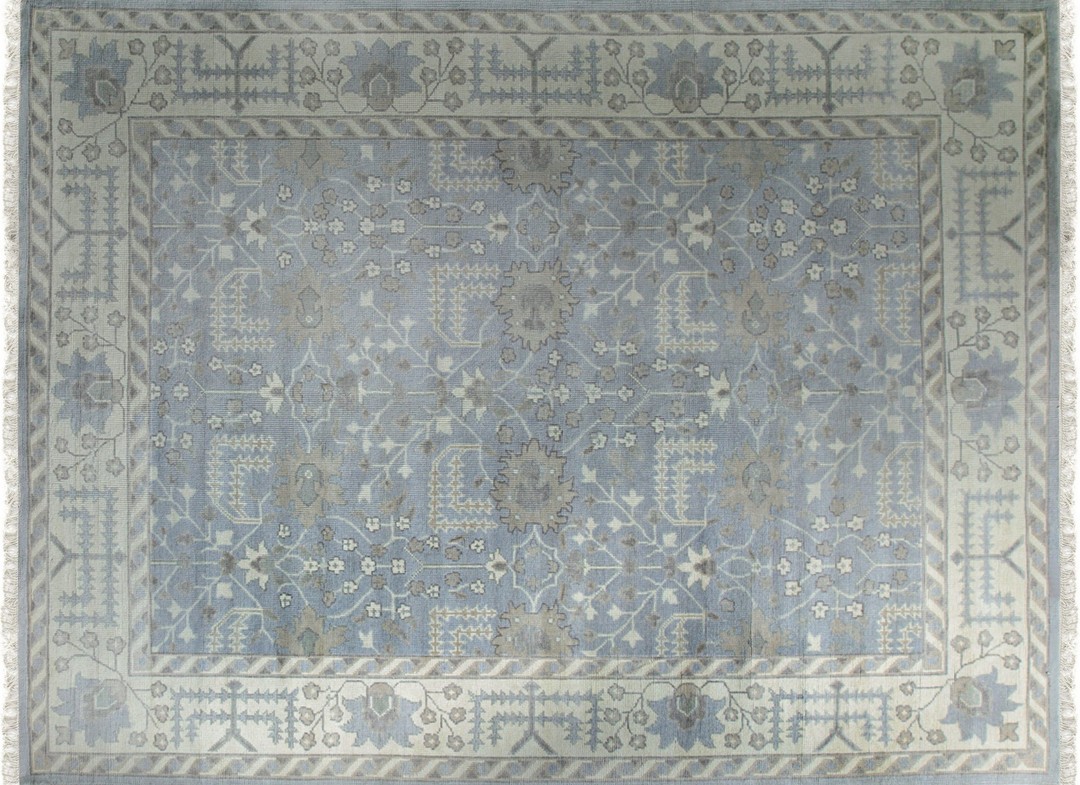
Explore a Few of Our Favorite Allover Pattern Rugs

FAQ
- Where do allover design rugs come from historically?
Many roots are Persian, Anatolian, and Caucasian. Classic allover design rugs include Herati/mahi and Mina Khani repeats, plus boteh fields and lattice layouts.
- Are allover design rugs good for open-plan spaces?
Yes. Allover design rugs define zones without a dominant center, so multiple areas feel cohesive. A 9×12 can ground a conversation area.
- Can I layer allover design rugs over carpet?
You can. Use a carpet-to-rug pad (felt with grippers) and choose a slightly smaller allover design rug over a neutral base for stability.
- Do allover design rugs shed?
New wool allover design rugs may shed initially; it typically lessens over months. Vacuum gently with suction-only and avoid aggressive brush bars.
- Are allover design rugs safe on hardwood floors?
Yes—with the right pad. Use felt + natural rubber; avoid cheap PVC pads that can discolor finishes, especially on newly refinished floors.
- Are outdoor allover design rugs a good idea?
Yes—outdoor polypropylene allover design rugs resist UV and moisture and can be hosed off. Many are under \~0.25″ pile for quick drying.
- Do allover design rugs suit minimalist interiors?
Yes—choose a tone-on-tone or low-contrast allover design rug to add texture without visual clutter. Subtle geometric repeats work well.
- How do I check quality in hand-knotted allover design rugs?
Look for clear pattern on the back, even tension, and good wool. Many quality pieces fall around \~80–150 KPSI; very fine rugs can be higher.
- What do allover design rugs typically cost?
Expect wide ranges: machine-made often \~\$1–\$5 per sq ft, hand-tufted \~\$8–\$20, and hand-knotted \~\$30–\$200+ depending on materials, knot density, and origin.
- How durable are allover design rugs by construction?
Hand-knotted allover design rugs generally last decades; hand-tufted offer mid-term durability; machine-made options are budget-friendly but shorter-lived. Fiber and pile height also matter.
- Are allover design rugs modern or traditional?
Both. Traditional Persian and Anatolian pieces use allover repeats, while modern allover design rugs reinterpret trellises, geometrics, or abstract textures.
- Will allover design rugs clash with patterned sofas or curtains?
Balance scale. Pair bold patterned upholstery with tone-on-tone or smaller-scale allover design rugs; with solid sofas, you can go larger-scale.
- What rug pad works best under allover design rugs?
Use a felt + natural rubber pad for grip and cushion. A 1/4″ pad cut about 1″ smaller than the rug per side prevents curl and sliding.
- Can you use allover design rugs on underfloor heating?
Yes—choose breathable natural fibers and thinner pieces. Keep combined rug + pad thermal resistance low (often under \~2–2.5 tog) to avoid “hot spots.”
- Are allover design rugs robot-vacuum friendly?
Low-pile allover design rugs (about 0.25–0.5″) work best. Note that very dark/black patterns can confuse some cliff sensors on certain robots.
- How do you clean allover design rugs?
Clean them like any rug: vacuum with suction only (no beater bar) and rotate 180° every 6–12 months. Professional washing every 1–3 years helps longevity.
- Do allover design rugs hide stains and wear?
Generally yes. Multi-color, small-scale allover design rugs camouflage crumbs and traffic better than solids or large high-contrast prints.
- How should an allover design runner fit a hallway?
Center the allover design runner with 4–6 inches of exposed floor on each side. Leave 6–12 inches at each end for door clearance.
- How do I size allover design rugs for a living room?
Anchor front legs of seating on the rug. Common picks are 8×10 for compact layouts or 9×12 for larger rooms, leaving 12–24 inches of floor as a border.
- What materials suit allover design rugs in busy homes?
Durable wool or polypropylene allover design rugs handle traffic well; avoid viscose/rayon in spill-prone areas. Wool’s natural lanolin helps resist soiling.
- Are allover design rugs good for small rooms?
Yes. Borderless or small-scale allover design rugs let the eye “flow,” making tight spaces feel larger. A 5×8 often suits small living rooms.
- Which motifs are common in allover design rugs?
Popular allover design rugs feature Herati (mahi/fish), Mina Khani rosettes, boteh (paisley), trellis, and small palmettes. These repeat evenly for a uniform look.
- Do allover design rugs work under dining tables?
Yes—prefer low-pile or flatweave allover design rugs so chairs slide easily. Size the rug 24–30 inches beyond the tabletop on all sides to keep chairs on the rug.
- Why choose allover design rugs over medallion styles?
Allover design rugs don’t rely on a center motif, so furniture can sit anywhere without “cutting off” a focal point. They’re forgiving in asymmetric layouts and open plans.
- What are allover design rugs?
Allover design rugs use a repeating motif across the field with no central medallion. The pattern often continues to the edges, creating an “infinite repeat” effect that’s easy to place.