
The Gold Standard of Chinese Art Deco: The “Super Rugs” By Walter Nichols
In the world of antique area rugs, few names carry as much weight as Walter Nichols. Often credited with inventing the “Chinese Deco Rugs” aesthetic, Nichols transformed the rug industry in the 1920s and 30s. By blending the bold, experimental spirit of the Roaring Twenties with the peerless craftsmanship of Chinese rug weavers, he created a style that remains one of the most sought-after categories for interior designers and collectors today.
Shop All Walter Nichols Deco Chinese Super Rugs | Shop All Chinese Art Deco Rugs
Who Was Walter Nichols?
Walter Nichols was an American businessman whose name became synonymous with a specific revolution in rug making. Unlike many figures in the rug world who were born into the trade, Nichols’ path was one of opportunity and vision.
Originally a wool grader from the United States, Nichols moved to China in the early 20th century. While living in Tientsin (Tianjin), he recognized that the traditional Chinese rugs—typically featuring muted rug colors and formal, scholarly motifs—could be reimagined for the vibrant, modern homes of the West.
The Wool Grader’s Eye: The Secret to the “Super Rug”
To understand the quality of a Nichols rug, you must understand Walter Nichols’ original trade as a wool grader. In the early 20th century, a wool grader was a highly specialized technician responsible for sorting raw fleece by diameter, length, strength, and color.
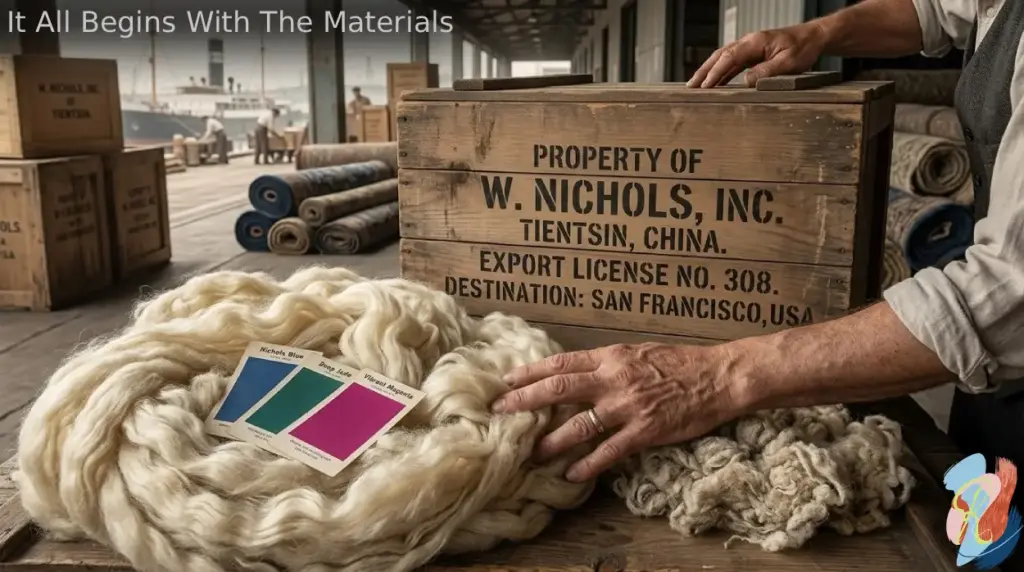
Most rug manufacturers in China at the time used “carpet wool”—a coarse, often brittle fiber from local fat-tailed sheep. Nichols used his grader’s expertise to reject these standard materials. He understood that to achieve a “silk-like” finish without using expensive silk, he needed long-staple, high-luster wool.
How this expertise translated to the rug:
- Color Purity: As a grader, Nichols was obsessed with “purity of white.” By selecting only the whitest fleeces, he ensured his chrome dyes would never look “muddy” or dull.
- Structural Strength: He selected fibers with the highest tensile strength, allowing the rug to be woven at a dense 90-line count without the wool breaking or shedding.
- The “Lustre” Secret: He knew which fibers would react best to the “Mule System” of spinning. By choosing specific “fleecy” wools, he ensured that once the rug was washed, it would have a reflective, metallic sheen that became the hallmark of the brand.
- The “Rice Bowl” Policy: A New Standard of Quality
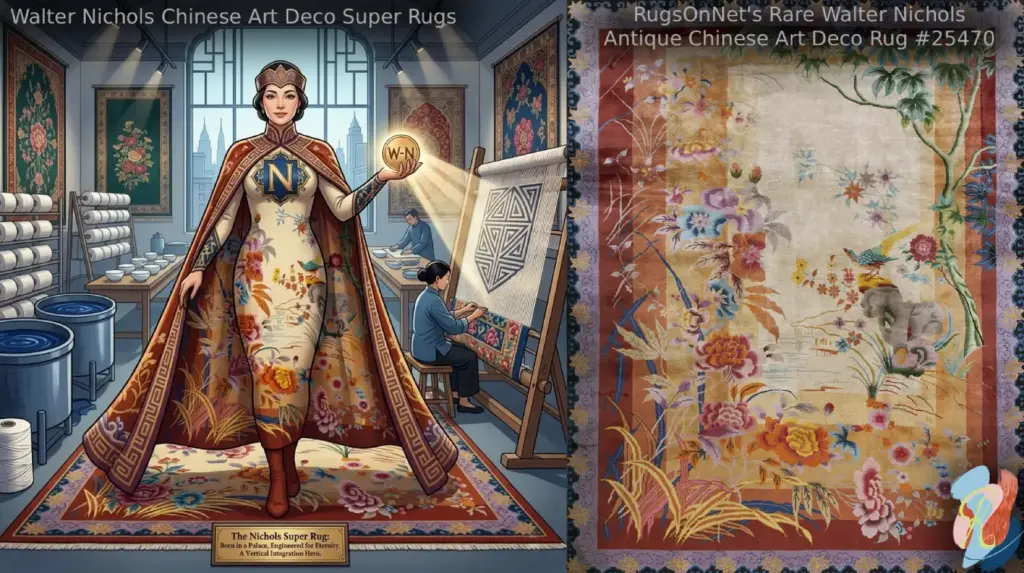
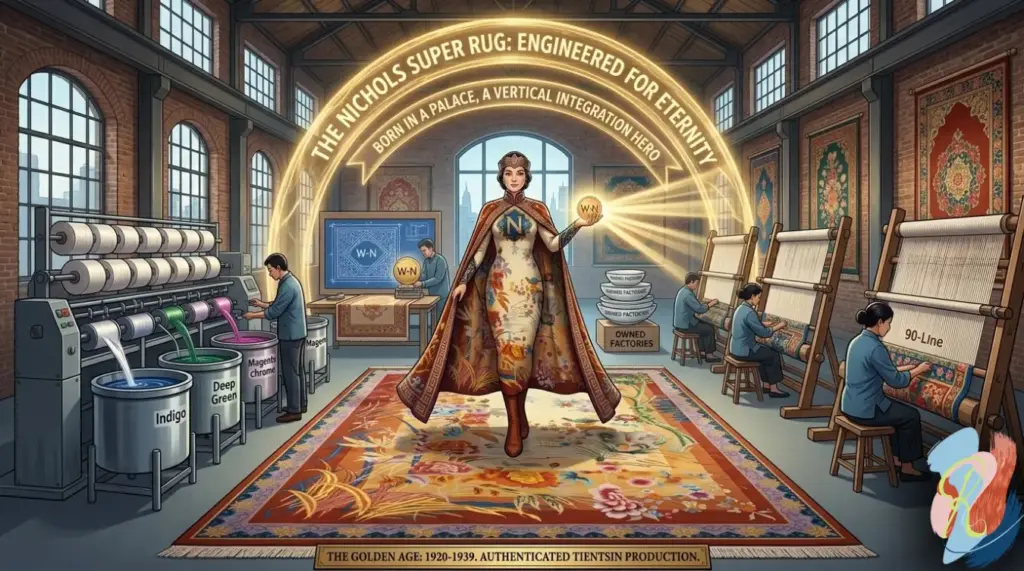
Nichols didn’t just want to sell rugs; he wanted to innovate through total control. In 1924, he established Nichols Super Yarn and Carpets. Unlike his competitors who “farmed out” their yarn to be woven in various cottage industries, Nichols implemented a policy of total vertical integration.
He famously stated that he owned “every building, every loom, every tool, and every rice bowl” used in his factories. By keeping the scouring, spinning, dyeing, weaving, and washing under one roof, he ensured that every “Super Rug” met a singular, rigorous standard. This “closed-loop” manufacturing prevented the common issues of inconsistent dyes or “sheepy” odors found in lesser Chinese carpets of the era.
The Anatomy of a Nichols Rug: The Five Pillars of the “Super Rug”
To understand why a Nichols rug is “Super,” one must look at the five major departments that coordinated under his management.
The Five Super Rug Pillars Are:
- The “Super Yarn” Innovation: Nichols pioneered the use of “Super Yarn”—a high-quality, machine-spun, long-staple wool that was incredibly durable. By using the “Mule System” of spinning, he created a uniform, high-luster woolen yarn that reacted to light with a silk-like shimmer. This allowed the rugs to take on more saturated, vibrant, and deep dyes than traditional hand-spun wool.
- Radical Asymmetrical Design: Traditionally, rugs were symmetrical with rigid central medallions. Nichols broke these rules. His radical layouts often featured “Falling” Flowers—large sprays of blossoms trailing organically from the corners into a vast, open field of solid color. This allowed the floor to “breathe,” fitting the emerging minimalist aesthetic of the period.
- The “Chrome” Palette and “Nichols Blue”: Working with expert chemists, Nichols developed over 800 different colors using high-quality chrome dyes. His signature was the “Indigo Blue”—China’s national color—which he insisted be “Dyed in the Wool” to ensure a deep, uniform shade that would never show streaks.
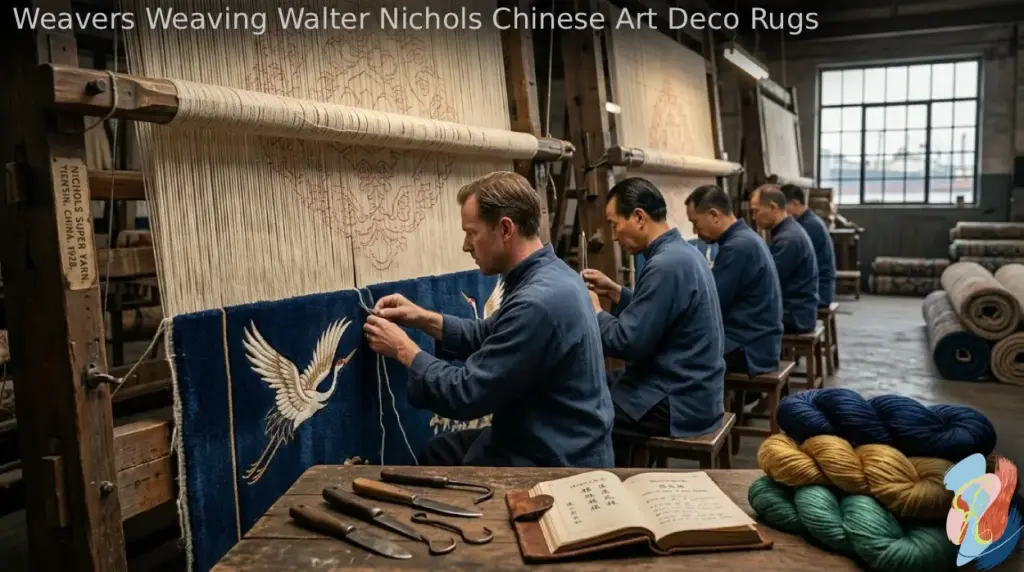
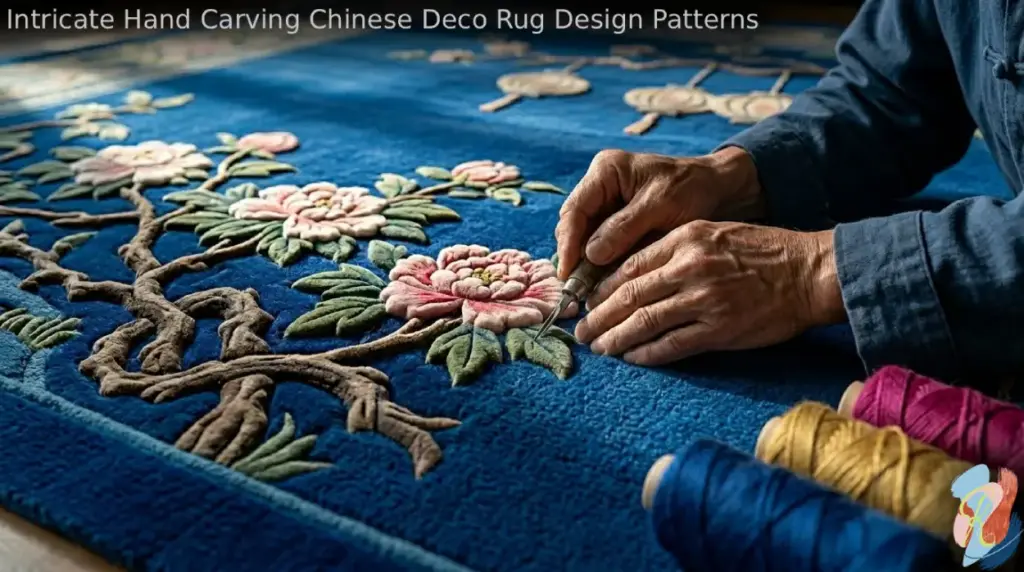
- The 4-Weaver System & Hand-Carving: In his Tientsin workshops, Nichols employed the finest weavers from the Northern provinces. For a standard 9×12 rug, a team of four master weavers worked in unison for an entire month.
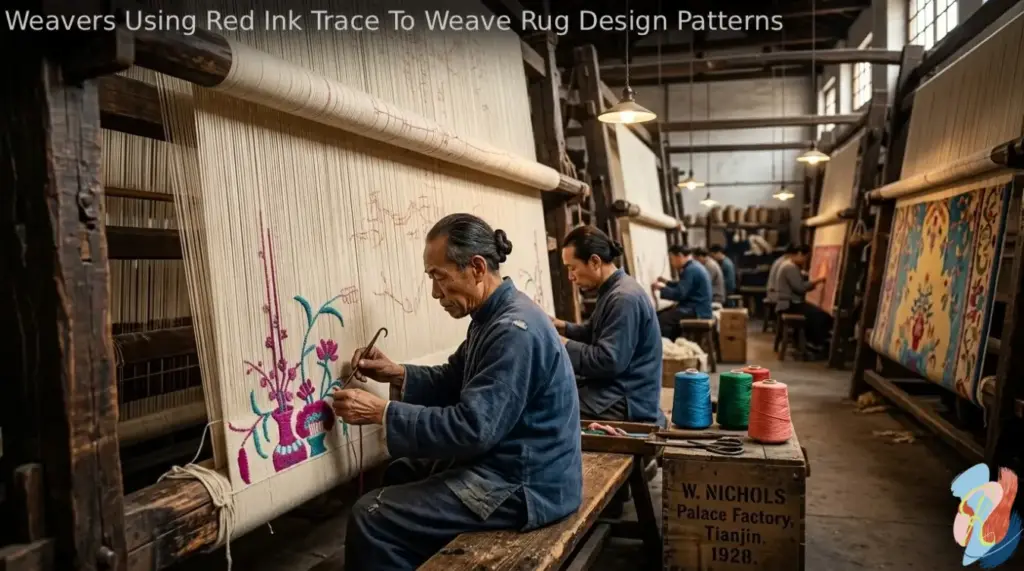
- The Red Ink Trace: Before weaving began, the design was traced directly onto the cotton warp threads with a specialized red ink.
- 3D Incising: After weaving, the pile was meticulously hand-cut at an angle around the motifs—a technique called beveling. This created a “molded” effect that made the flowers and dragons visually “pop” off the background.
- The Chemical “Stress Test”: Every Nichols rug underwent a severe chemical wash. While this added a silky sheen, Nichols viewed it as a stress test. He believed that if a rug could survive the saturation and chemical reaction without its colors bleeding or its pile degrading, it was “proven” for eternity. This process also acted as a natural moth repellent, a feature Nichols promoted heavily to international rug buyers.
The Aesthetic Revolution: Breaking the Rules of Design
- “Falling” Flowers: Large sprays of blossoms or “lucky symbols” trailing organically from the corners into the open field.
- Vast Open Fields: Massive expanses of solid, vibrant color that let the floor “breathe,” perfect for the emerging minimalist aesthetic of the period.
- No Center Medallion: By removing the central medallion, Nichols allowed the beauty of the “Super Yarn” color to be the focus.
The Botanical Calendar and Folklore
Into these rugs, Nichols wove the culture and heritage of China, utilizing a “Botanical Calendar” where flowers represented the seasons: the Peach Blossom for Spring, the Lotus for Summer, the Chrysanthemum for Autumn, and the Narcissus for Winter. He also integrated royal iconography, such as the Dragon (symbolizing royalty) and the Phoenix, whose appearance in a design heralded happy events and good fortune.
A Concise Guide to the “Nichols Palette”
Walter Nichols was a master colorist who understood that vibrant, chrome-based dyes could revolutionize the Western interior. When you shop for Chinese Art Deco rugs, look for these iconic color stories:
- Imperial Jewel Tones: Deep, royal navy blue fields (the signature “Nichols Blue”) paired with gold, ivory, and imperial yellow color accents. This palette is the perfect sophisticated foundation.
- The Jazz Age Spectrum: Daring, saturated combinations like magenta and coral floral sprays set against a field of turquoise or emerald green.
- The “Nude” Rugs (Minimalist): Rarrer designs in camel, champagne, and taupe with tonal or subtle contrasting accents. These minimalist rugs are currently trending in high-end modern interiors.
The “Palace Factory” Narrative
While Tientsin was his industrial hub, Nichols maintained a legendary flagship in Peking (Beijing). He converted the former palace of a Manchu Prince into a weaving establishment. The “Old Audience Hall,” seventy-five feet long, served as his grand showroom, while the original living quarters of the Prince’s family housed over 200 weavers. This “Palace Factory” became a tourist destination, allowing Nichols to market his rugs as literally “Fit for a King,” a narrative that remains a major selling point for collectors today.
Buying and Identification: What is a “Nichols-Style” Rug?
While Walter Nichols’ Tientsin workshops set the gold standard, he wasn’t alone. Other quality manufacturers, most notably Helen Fette and Liberty of London, also produced exceptional Chinese Art Deco carpets.
It is crucial for a collector to differentiate an authentic Nichols from a “Nichols-style” piece.
Here Are Some Tips:
Identification of an Authentic Walter Nichols
The Substantial Weight: Authentic Nichols are famously heavy. The thick, hand-knotted pile on a rigid cotton foundation means the rug will feel significantly more substantial than other Deco rugs.
- Lustrous Pile: The “Super Yarn” gives the rug a distinctive, high-sheen reflection that can almost look like silk.
- The Signature Stamping: While many labels are lost, look for a stamped “Made in China” mark in the warp of the fringe, or a durable cotton label on the reverse that reads “Walter Nichols – Tientsin.”
Nichols vs. Fette: A Subtle Distinction:
Walter Nichols and Helen Fette were the dual “Titans” of Chinese Deco.
While they both produced high-quality pieces in Tientsin, their aesthetic differs slightly.
Here Are A Couple Of Examples:
- Nichols: Known for defined, crisp lines, deep 3D incising, and maximalist color saturation.
- Fette: Tended to produce rugs with a softer, more “painterly” feel and slightly more traditional (but still asymmetrical) floral patterns.
The “Foundation” Test: The Ghost of the Blueprint
For the high-end collector, there is one final “Easter Egg” hidden within the very bones of the rug. If you encounter a Nichols piece with significant wear—where the wool pile has thinned enough to reveal the cotton foundation—look closely at the white warp threads.
Because of the “Red Ink Trace” method used exclusively in the Nichols Tientsin factory, you will often find faint red or pink stains deep on the cotton warp. To the untrained eye, this might look like a historical wine spill or a dye defect. In reality, it is the ghost of the original 1920s artist’s blueprint. This ink was applied before weaving to guide the master artisans, and its presence is a definitive “DNA match” for an authentic, vertically-integrated Nichols workshop piece.
The World’s Premier Gallery for Walter Nichols and Chinese Art Deco
While the golden era of Tientsin production lasted less than two decades, its legacy lives on through the few surviving “Super Rugs” that remain in collector-grade condition. As the leading authority on this niche 20th-century movement, RugsOnNet is proud to maintain the largest and most diverse selection of authentic Chinese Art Deco rugs globally.
A Curated Archive of Walter Nichols “Super Rugs”
Because Walter Nichols production was finite—ending abruptly in 1939—finding an authentic, stamped “90-Line” piece in a specific colorway can be a years-long search. Our gallery specializes in sourcing the “holy grail” of Nichols production
Some of these include:
- Signature “Nichols Blue” Masterpieces: Heavily incised, deep navy fields that have retained their 1920s luster.
- The Rare “Nude” and Neoclassic Series: Minimalist champagne and taupe designs that are nearly impossible to find in the open market.
- Oversized Palace Commissions: Grand-scale carpets originally destined for the “Audience Hall” showrooms of Peking.
Beyond Nichols: The Full Spectrum of Tientsin Artistry
Our collection extends beyond the Nichols workshop to include the complete “Titans of Tientsin” era.
We at RugsOnNet offer an unparalleled inventory of:
Helen Fette (The Fette-Li Company): For those seeking the softer, “painterly” floral aesthetic and more pliable foundations.
Whether you are a designer seeking a singular “bridge” rug for a Mid-Century Modern interior or a dedicated collector hunting for a stamped Walter
Nichols original: our gallery offers the world’s most significant window into this 100-year-old “Super Yarn” legacy.
The Language of Luxury: Decoding Nichols Iconography
A Walter Nichols rug is never just a floor covering; it is a “coded” message of fortune. Every hand-carved shape is a deliberate wish for the homeowner.
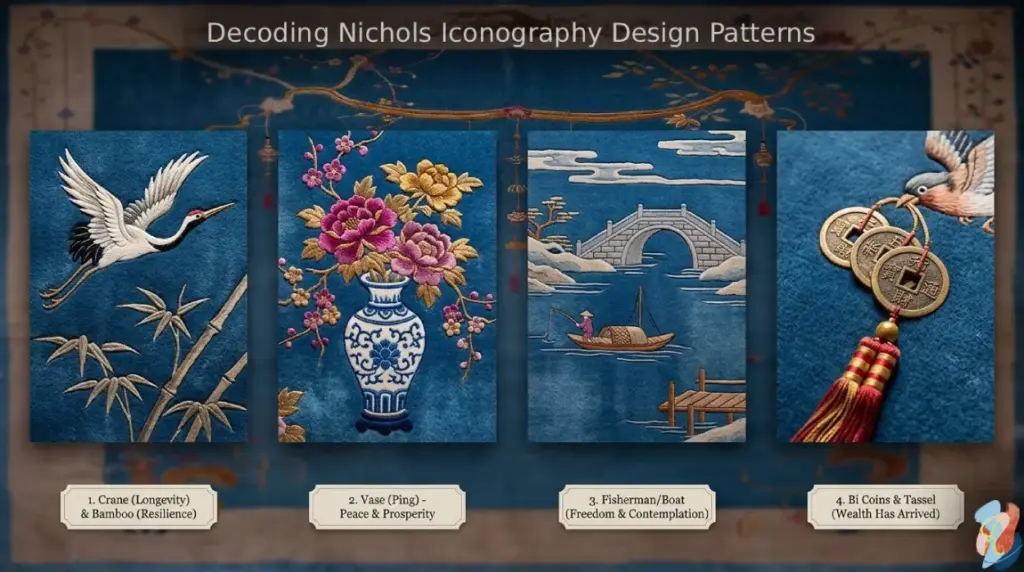
The Language of the Loom: A Collector’s Field Guide To Motifs, Iconography and Design Patterns
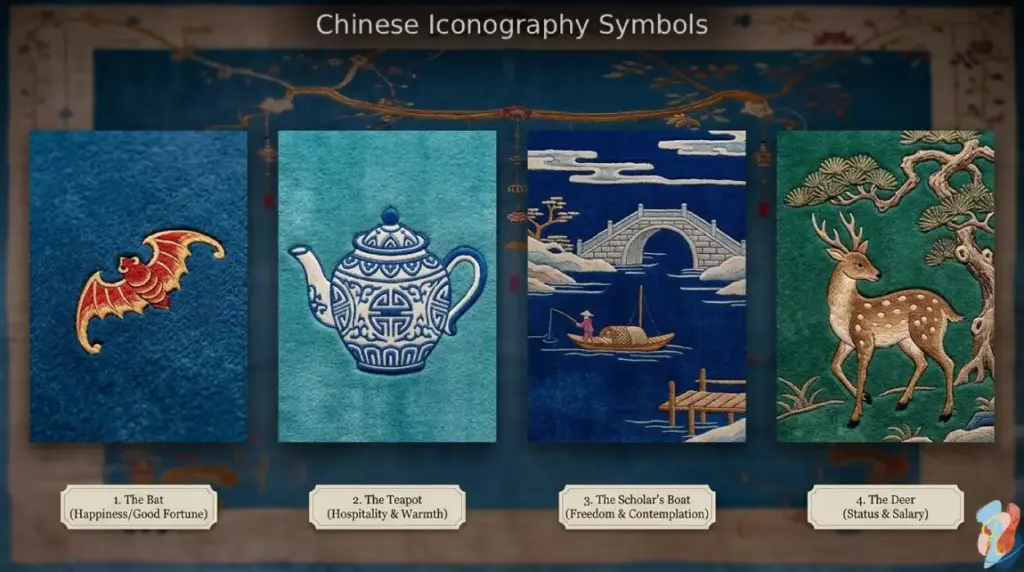
I. Fortune & High Status
- The Bat (Fu): A direct homophone for “Happiness.” In Nichols’ work, a bat is a joyous omen of luck.
- The Dragon: A benevolent force of nature, representing strength and imperial nobility.
- Deer: A wish for professional success and “Lu” (official salary).
- Chinese Coins (Bi): Circular with square centers; signifies “Wealth has arrived.”
- Pendants & Windchimes: “Precious Objects” that ring in good news.
- Dragonflies: An Art Deco favorite representing focus and swift change.
- Lanterns & Tassels: Symbolizing a bright future and the “binding” of good luck to the home.
- Cranes: The ultimate symbol of longevity and high official status.
II. The Scholar’s Retreat (Peace & Freedom)
- The Fisherman & Boat: Represents “freedom from worldly cares” and a quiet, contemplative life.
- The Poling Oar: Symbolizes steady, calm navigation through life’s challenges.
- Wooden Piers & Stone Bridges: The transition from the busy world into a private sanctuary.
- Temples, Pagodas & Pavilions: Symbols of wisdom, spiritual grounding, and elevated “points of view.”
- Cityscapes: Representing heritage, safety, and a successful, settled community.
- Scrolls & Scholarly Chests: Representing a home dedicated to culture, incense, and learning.
- Simple Benches: An invitation to hospitality, rest, and contemplative leisure.
- Greek Key (Meander): An adaptation of “Cloudbands,” representing eternal life and never-ending fortune.
- Bamboo: Resilience—the ability to “bend but never break.”

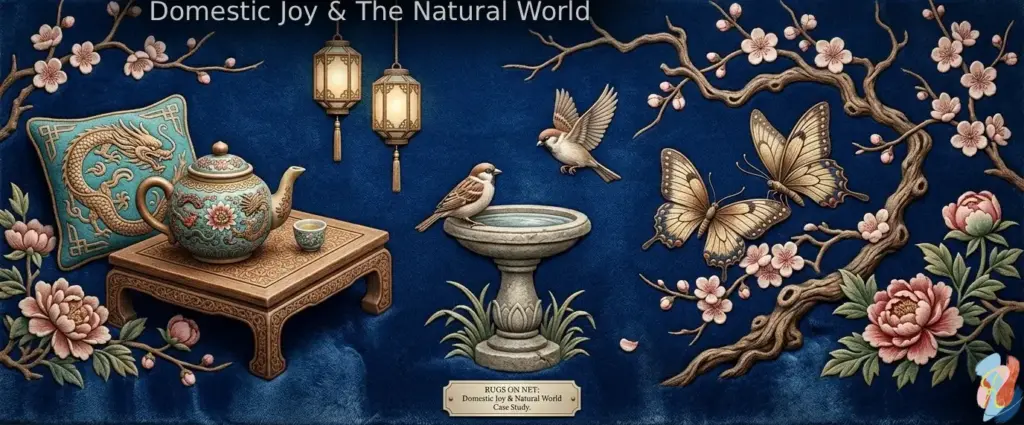
III. Domestic Joy & The Natural World
- Vase (Ping) & Flower Pots: A visual pun for “Peace” (Ping’an). A flower-filled vase brings harmony.
- Teapots: A rare export motif representing hospitality and the warmth of a home.
- Pillows: A unique symbol for deep physical rest and intimate happiness.
- Bird Bath with Birds: A happy household that naturally attracts good company and energy.
- Butterflies & Small Bird (Sparrows): Symbols of romance, marital bliss, and a bustling family life.
- Prunus (Plum) & Peonies: Courage (blooming in snow) and feminine grace.
- Cloud bands: Swirling shapes representing the heavens and the breath of the universe (Qi).
Room-by-Room: How to Style a Walter Nichols Rug in a Modern Interior
Many buyers worry that a 100-year-old rug will look “dated” or prove too delicate for an active home. However, a Nichols “Super Rug” is a master-level “bridge” piece. Because Walter Nichols engineered these rugs for 20th-century Western living, they possess a unique format and a “Mule System” luster that ties contemporary furniture to historical rugs and craftsmanship.
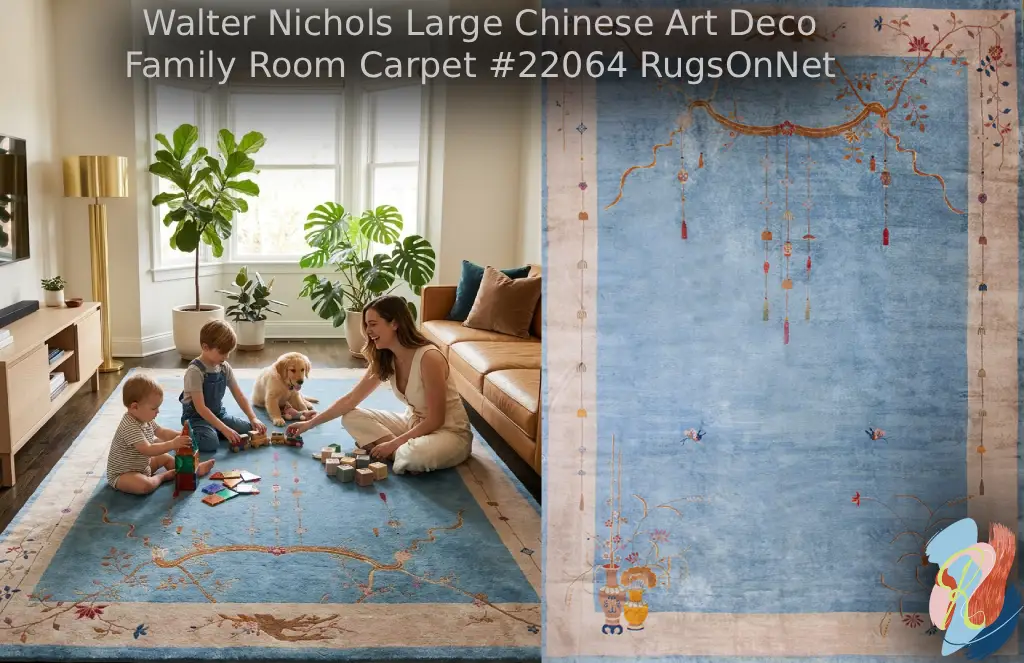
The Living Room: Deco, Mid-Century & Minimalist Foundations
The clean, architectural lines of Eames, Knoll, or Saarinen furniture pop dramatically against the organic, trailing florals of a Nichols. Especial in a living room setting.
- The “Breathing” Room: Because Nichols moved away from busy, all-over rug patterns, his area rugs feature vast open color fields. These create a sophisticated visual “void” that allows the iconic silhouettes of modern furniture to shine without competing for attention.
- Defining Open-Concept Spaces: In large, open-concept homes, a Nichols rug’s daring composition can instantly anchor a specific area—like a reading nook or a formal conversation spot—defining the space without the repetitive “boxed-in” feel of a traditional bordered carpet.
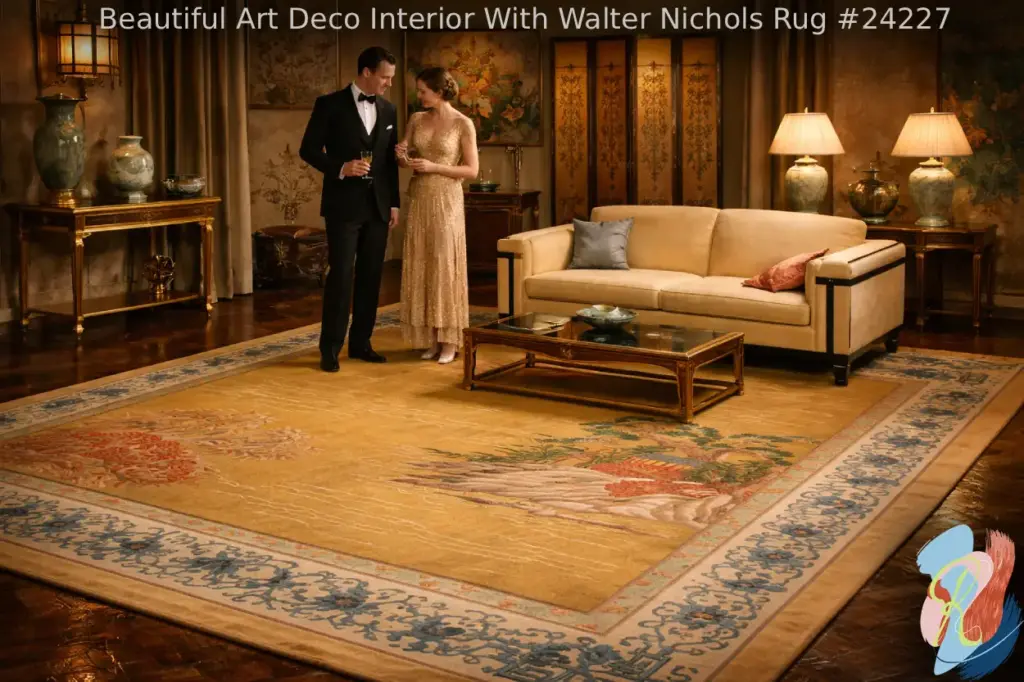
The Dining Room Secret: Visibility & Practicality
The Walter Nichols rug is the “ultimate dining room secret” for one reason: Asymmetry.
- Perimeter Beauty: In a traditional rug, the most beautiful detail—the central medallion—is completely obscured by the dining table. With a Nichols, the key rug patterns are concentrated in the corners or trail from the sides. This ensures that the vibrant floral sprays and 3D “Hsi-Hsiang” incising remain fully visible around the perimeter of your table, where guests can actually see them.
- Durability Underfoot: The high-density 90-line weave and rigid cotton foundation prevent “furniture marks” (dents from heavy table legs) and allow chairs to glide easily across the surface.
The Grand Entryway: A Statement of Arrival
The foyer entryway is the highest-traffic area of any home, and a Nichols rug is one of the few antiques that can actually handle it.
- The “Super Yarn” Defense: Because the long-staple wool was chemically “proven” in a lustre wash, it resists the “crush” of daily foot traffic. It hides soil remarkably well and maintains its silk-like sheen even after years of use.
- The Visual Hook: A saturated “Nichols Blue” or Emerald Green foyer rug provides an immediate sense of curated luxury the moment a guest steps through the door.
The Master Bedroom: A Sanctuary of Luster
In the bedroom, the light-reflective quality of the “Super Yarn” truly shines. Under soft bedside lighting, the rug takes on a metallic, glowing quality that hand-spun wool cannot replicate.
- The “Nude” Trend: For a serene, spa-like atmosphere, many designers choose the rare “Nude” series—champagne, taupe, or camel tones. These offer a sophisticated, tonal look that pairs beautifully with silk linens and velvet headboards.
- Rug Placement Tip: Position the rug so the “Falling” Floral sprays peek out from the foot of the bed, ensuring the most intricate hand-carving is the first thing you see each morning.
The Designer Kid’s Room: Whimsy Meets Resilience
A Nichols rug is perhaps the only antique investment that thrives in a high-energy environment like a kids room, nursery or playroom.
- Stain Resistance: Every Nichols rug survived a “Stress Test” of harsh saturation during production. This makes them remarkably water-tolerant and easier to spot-clean than modern synthetic alternatives.
- Storytelling Design: Children are naturally drawn to the Folklore and Iconography woven into the pile. The “lucky” Phoenix, the friendly Dragons, and the “Botanical Calendar” turn the floor into a landscape for the imagination.
The Maximalist Masterclass: Layering & Texture
Modern Maximalism relies on “more is more,” but it requires a strong foundation to avoid looking cluttered.
- Foundational Color: Use a jewel-toned Nichols rug as the “anchor” for your room’s color story. Its deep saturation allows you to layer bold Art Deco design wallpaper, brass accents, and mixed textures like marble and mohair without the room feeling disjointed.
The Legacy of Durability: Care and Maintenance
Because Walter Nichols engineered his “Super Rugs” to be “Fit for a King,” they are among the most durable area rugs in existence. In his original 1920s manuals, Nichols was so confident in the strength of the “Super Yarn” that he specifically encouraged the use of “the strongest vacuum cleaners” available—a bold claim for an era of delicate hand-knotted pile carpets. Therefore with a little care the rugs would last far longer than other carpets.
To maintain the investment value of your Nichols rug, follow these historically-backed care tips:
- The Cornmeal Trick: For cleaning the cotton fringes without using harsh liquids, Nichols recommended brushing them with dry cornmeal. The cornmeal lifts surface soil and oils from the cotton fibers and can be easily brushed or vacuumed away, keeping the fringes bright without risking dye bleed.
- The “Soap and Water” Standard: Because of the rigorous chemical “Stress Test” every rug underwent, Nichols rugs are remarkably water-tolerant. For surface spills, a mixture of tepid water with a small portion of alcohol or ammonia was his preferred method for restoring the original “Super Yarn” luster.
- Moth Resistance: The original chemical washing process acted as a natural moth repellent. Nichols noted that his rugs could be left in storage for years without naphthalene (mothballs) and still open up in “perfect condition.” However, for modern collectors, routine vacuuming remains the best defense to keep the wool fibers aerated and clean.
- Moth-Proofing: “Nichols specifically noted that his rugs were so thoroughly treated that they could be purchased ‘in bond’ and left packed in storage for over two years without any protective naphthalene, opening in perfect condition.
The RugsOnNet Room-by-Room Styling Guide
A Walter Nichols “Super Rug” is a master-level “bridge” piece, engineered to tie 20th-century modernism to 100-year-old craftsmanship. Use this guide to find the perfect placement for your investment.
Modern Contemporary
The Strategy: Contemporary spaces often feature “hard” materials like polished concrete, glass, and steel. A Nichols rug introduces organic warmth and a 3D “sculptural” element that softens the room without looking traditional.
Pro Tip: Choose a rug with a high-contrast palette (e.g., Deep Navy with Ivory). The “Hsi-Hsiang” hand-carving creates shadows that mimic architectural moldings, making the rug feel like a piece of “floor-art.”
The Minimalist Aesthetic
The Strategy: Nichols rugs are famous for “Vast Open Fields.” In a minimalist home, the rug provides one singular, powerful statement of color without the “noise” of traditional, busy patterns.
Pro Tip: Opt for the “Nude” Series (Champagne or Taupe). The tonal hand-carving adds textural depth to a room without breaking the clean, monochromatic flow.
The Modern Boho Interior
The Strategy: Bohemian style thrives on organic shapes. The asymmetrical “Falling Florals” of a Nichols rug provide the perfect high-end anchor for a room filled with plants, rattan, and mixed textiles.
Pro Tip: Look for vibrant “Jazz Age” palettes like turquoise or magenta. These jewel tones harmonize beautifully with natural wood and layered textures.
The Living Room & MCM
The Look: Clean-lined Mid-Century Modern furniture (Eames/Knoll) pops against the organic sprays of a Nichols.
Pro Tip: Use the open field to create a visual “void” that lets your furniture’s architectural silhouette be the star of the room.
The Dining Room
The Secret: Asymmetry. Unlike traditional rugs, a Nichols keeps its patterns in the corners, meaning your table won’t hide the most beautiful parts of the design.
Pro Tip: The 90-line density means chairs glide easily and the heavy foundation prevents the rug from “bunching” under the table legs.
The Grand Entryway
Durability: The “Super Yarn” and 90-line density handle the “crush” of high-traffic foyers with ease while resisting soil better than modern synthetics.
Pro Tip: A saturated “Nichols Blue” foyer rug provides an immediate sense of curated luxury the moment a guest arrives.
The Master Bedroom
The Luster: The “Mule-spun” wool glows under bedside lighting, providing a metallic, silk-like sheen that feels incredible underfoot.
Pro Tip: Position the rug so the “Falling” Floral sprays peek out from the foot of the bed for maximum visual impact.
Designer Kids’ Rooms
Resilience: Proven by the “Lustre Wash” stress test, these rugs are remarkably stain-resistant and easy to spot-clean for high-energy playrooms.
Pro Tip: Use the “Botanical Calendar” and “Lucky Symbols” as a storytelling landscape for a child’s imagination.
Technical Breakdown: Traditional vs. Nichols-Style
A quick reference guide for skimmers to understand the market value of a RugsOnNet piece:
| Feature | Traditional Chinese Rug | Walter Nichols “Super Rug” | Nichols-Style (Fette/Liberty) |
|---|---|---|---|
| Knot Density | Variable (often 60-70 line) | Strict 90-Line Standard | Variable (often 70-80 line) |
| Foundation | Cotton warp/weft | Heavy, knotless cotton (Rigid) | Medium weight cotton (Pliable) |
| Material | Hand-spun, matte wool | Machine-spun, “Mule System” Super Yarn | Hand-spun, medium-luster wool |
| Design | Symmetrical, Central Medallion | Asymmetrical, “Falling” Florals | Asymmetrical, Painterly Florals |
| Color | Muted, Vegetable Dyes | Saturated “Chrome” Jewel Tones | Tonal, Muted Chrome Dyes |
| Texture | Uniform, Flat Pile | Deep 3D “Hsi-Hsiang” Incising | Softer, Tapered Pile |
| Trace Mark | None / Chalk | Permanent Red Ink Blueprint | Variable / Ink Trace |
Why Shop for Walter Nichols at RugsOnNet?
When shopping for a genuine Walter Nichols “Super Rug,” you are acquiring a finite piece of history. Because authentic production ended in 1939, these rugs are a disappearing resource. We have positioned ourselves as the global primary source for Nichols rugs, offering a secure, expert-led rug buying experience.
The RugsOnNet Advantage for Nichols Collectors: Inventory Dominance: We house the largest physical inventory of stamped Walter Nichols originals in the world. Whether you are seeking a signature “Nichols Blue” or an elusive “Nude” minimalist design, your search begins and ends here.
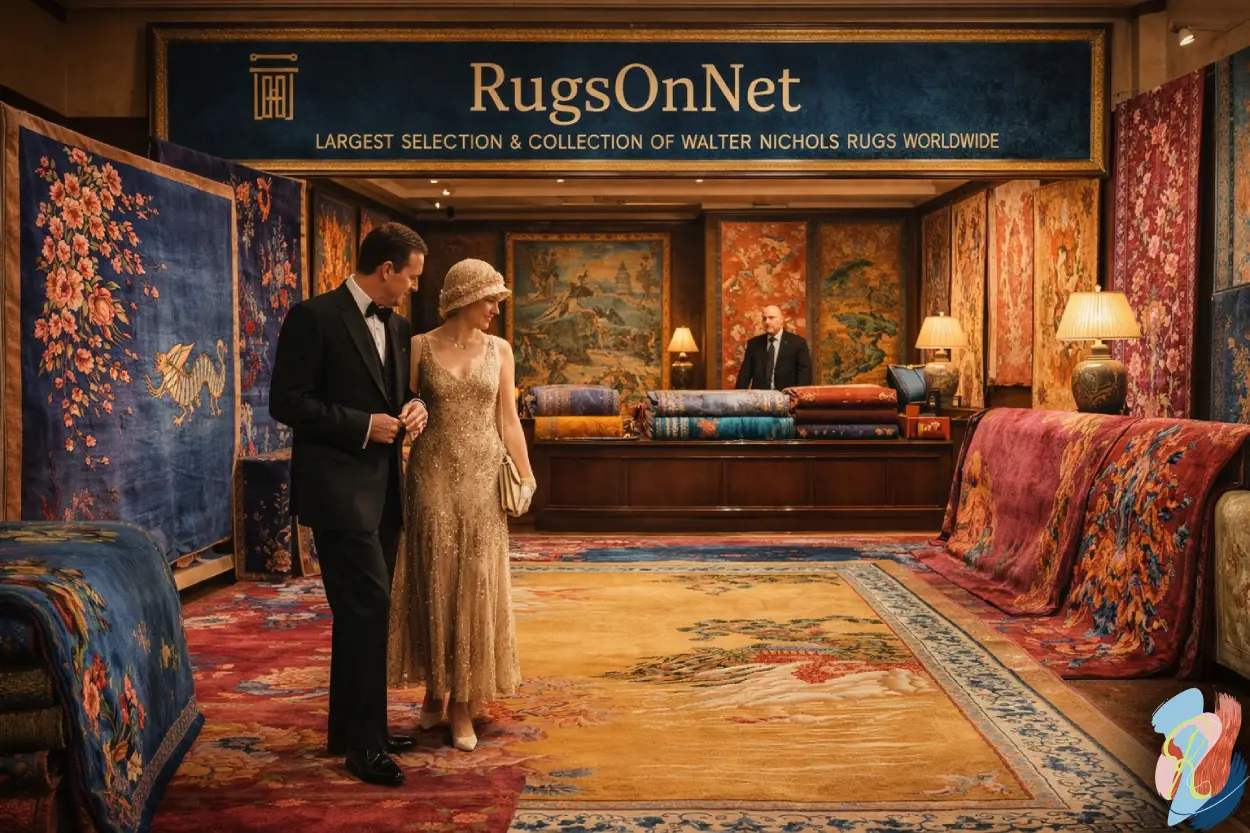
The “90-Line” Guarantee: We take the guesswork out of shopping. Every Nichols rug we sell is physically verified for its 90-line knot density and high-luster “Super Yarn” content. You aren’t just buying a “style”—you are buying the technical specification.
Authentication & The “Red Ink” Test: We know what is under the pile. Our experts inspect every rug for the signature Red Ink Trace in the foundation—the “DNA” of the Nichols workshop—ensuring you never buy a later reproduction.
“Palace-Ready” Delivery: A Nichols rug is a heavy, structural investment. Our in-house specialists understand the unique chemistry of 1920s chrome dyes and the needs of these rigid foundations, ensuring your rug arrives clean, preserved, and ready for a century of use.
Expert Rug Shopping Consultation: Are you a designer looking for a specific “Falling Floral” pattern? Or a collector trying to verify a “Nichols” found elsewhere?
Bespoke Sourcing: Access our private reserves for specific colorways or rug sizes not in our area rug gallery / store.
Verification Services: Let our experts help you identify your rug’s legacy through high-resolution photo analysis.
FAQ
- Are Walter Nichols rugs naturally moth-resistant?
Yes, the original chemical washing process acted as a natural moth repellent. Nichols claimed his rugs could be stored for years without mothballs and still open in perfect condition, though routine vacuuming is currently recommended for modern maintenance.
- How do I clean surface spills on a Nichols rug?
Nichols rugs are very water-tolerant. For surface spills, a mixture of tepid water with a small portion of alcohol or ammonia was his historically preferred method for cleaning while restoring the original luster.
- How should I clean the fringes of an antique Nichols rug?
To clean the cotton fringes without harsh liquids, Nichols originally recommended brushing them with dry cornmeal. The cornmeal lifts surface soil and oils from the fibers and can be easily vacuumed away without risking dye bleed.
- What is the standard knot density of a Walter Nichols Super Rug?
An authentic Walter Nichols Super Rug adheres to a strict 90-line standard, whereas traditional Chinese rugs or Nichols-style reproductions often vary between 60 to 80 lines.
- Can I use an antique Nichols rug in a child's playroom?
Absolutely. Because every Nichols rug survived a harsh saturation stress test during production, they are remarkably water-tolerant, stain-resistant, and easier to spot-clean than many modern synthetic alternatives.
- Are Walter Nichols rugs durable enough for a grand entryway?
Yes. The dense 90-line weave and the chemically proven Super Yarn resist the crush of daily high foot traffic. They hide soil remarkably well and maintain their silk-like sheen even after years of use in a busy foyer.
- Why is a Nichols rug considered the ultimate dining room secret?
Because of their asymmetrical design, the key floral patterns are concentrated in the corners or trail from the sides. This ensures the most beautiful details remain visible around the perimeter of a dining table rather than being hidden underneath it.
- Why do Nichols rugs work so well in modern, minimalist interiors?
Nichols moved away from busy, all-over patterns in favor of vast open color fields. This creates a sophisticated visual void that allows the clean, architectural lines of modern furniture to shine without competing for attention.
- What is the meaning of a vase or flower pot in Chinese Deco design?
A vase is a visual pun for peace. A flower-filled vase woven into a rug represents domestic harmony and brings peaceful energy to the household.
- What do Scholar's Retreat motifs like bridges and pavilions represent?
These motifs symbolize peace and freedom. Stone bridges represent the transition from the busy world into a private sanctuary, while pavilions and temples signify wisdom, spiritual grounding, and elevated points of view.
- What do bats and dragons symbolize in a Nichols rug?
In Chinese iconography, the bat is a direct homophone for happiness and acts as a joyous omen of luck. The dragon is a benevolent force of nature that represents strength and imperial nobility.
- What is the "Red Ink Trace" foundation test?
In the Nichols Tientsin factory, designs were traced directly onto the cotton warp threads with specialized red ink before weaving. If a rug has wear revealing the foundation, faint red or pink stains serve as a definitive DNA match for an authentic Nichols piece.
- What is the difference between a Nichols rug and a Helen Fette rug?
While both were titans of Chinese Deco, Nichols rugs are known for crisp lines, deep 3D incising, and maximalist color saturation on a rigid foundation. Fette rugs tend to have a softer, more pliable foundation with a more painterly feel and slightly more traditional floral patterns.
- How can I identify an authentic Walter Nichols rug?
Authentic Nichols rugs are famously heavy with a thick, hand-knotted pile on a rigid cotton foundation. They feature a highly lustrous pile, deep 3D incising, and sometimes carry a stamped “Made in China” mark in the warp fringe or a durable cotton label on the reverse.
- What was the Palace Factory?
The Palace Factory was Nichols’ legendary flagship establishment in Peking. He converted the former palace of a Manchu Prince into a grand showroom and weaving facility, allowing him to market his rugs as being literally fit for a king.
- What are the "Nude" minimalist Nichols rugs?
The Nude series refers to rarer, highly sought-after minimalist Nichols designs featuring solid fields of camel, champagne, and taupe with tonal or subtle contrasting accents.
- What is the Botanical Calendar in Chinese Deco rugs?
Nichols incorporated a Botanical Calendar into his designs where specific flowers represented the seasons: the Peach Blossom for Spring, the Lotus for Summer, the Chrysanthemum for Autumn, and the Narcissus for Winter.
- Why did Nichols put his rugs through a severe chemical wash?
Nichols viewed the harsh chemical wash as a stress test. He believed that if a rug’s pile and colors could survive the saturation and chemical reaction without bleeding or degrading, it was proven to last for eternity.
- How were Nichols rugs woven and carved?
A standard 9×12 Nichols rug took a team of four master weavers an entire month to complete. After weaving, the pile was meticulously hand-cut at an angle around the motifs, a technique called beveling or 3D incising, making the designs pop visually.
- What is "Nichols Blue"?
Nichols Blue is the signature, deeply saturated indigo blue used in many of his rugs. Nichols insisted this color be dyed in the wool to ensure a uniform shade that would never show streaks.
- How did Nichols change traditional rug design?
Nichols broke the rules of traditional symmetrical rug design by removing rigid central medallions. Instead, he featured radical layouts with falling flowers trailing organically from the corners into vast, open fields of solid color.
- What is "Super Yarn"?
“Super Yarn” was a high-quality, machine-spun, long-staple wool pioneered by Nichols. It was incredibly durable and reacted to light with a silk-like shimmer, allowing it to take on more saturated and deep dyes than traditional hand-spun wool.
- What was Walter Nichols' "Rice Bowl" policy?
The “Rice Bowl” policy referred to Nichols’ insistence on total vertical integration. He owned every building, loom, tool, and “rice bowl” in his factories, allowing him to control every step from spinning to dyeing to ensure a singular, rigorous quality standard.
- What is the "Mule System" of spinning used in these rugs?
The Mule System is a specific spinning technique Nichols used on his carefully selected fleecy wools. Once washed, this spun yarn developed a highly reflective, metallic sheen that became the hallmark of his brand.
- Why are the colors in Nichols rugs so pure and vibrant?
Nichols was obsessed with the purity of white wool. By selecting only the whitest fleeces, he ensured that his high-quality chrome dyes would always look deep, vibrant, and never muddy.
- How did Nichols' background as a wool grader influence his rugs?
As a specialized wool grading technician, Nichols knew how to sort raw fleece by diameter, length, strength, and color. He rejected coarse local wool in favor of long-staple, high-luster fleeces to achieve a silk-like finish without using expensive silk.
- Who was Walter Nichols?
Walter Nichols was an American businessman and former wool grader who moved to Tientsin, China, in the early 20th century. He revolutionized the rug industry by reimagining traditional Chinese rugs for vibrant, modern Western homes.
- What is a Walter Nichols "Super Rug"?
A Walter Nichols “Super Rug” is a highly sought-after style of Chinese Art Deco area rug created in the 1920s and 30s. It blends the bold, experimental spirit of the Roaring Twenties with peerless Chinese rug-weaving craftsmanship.