
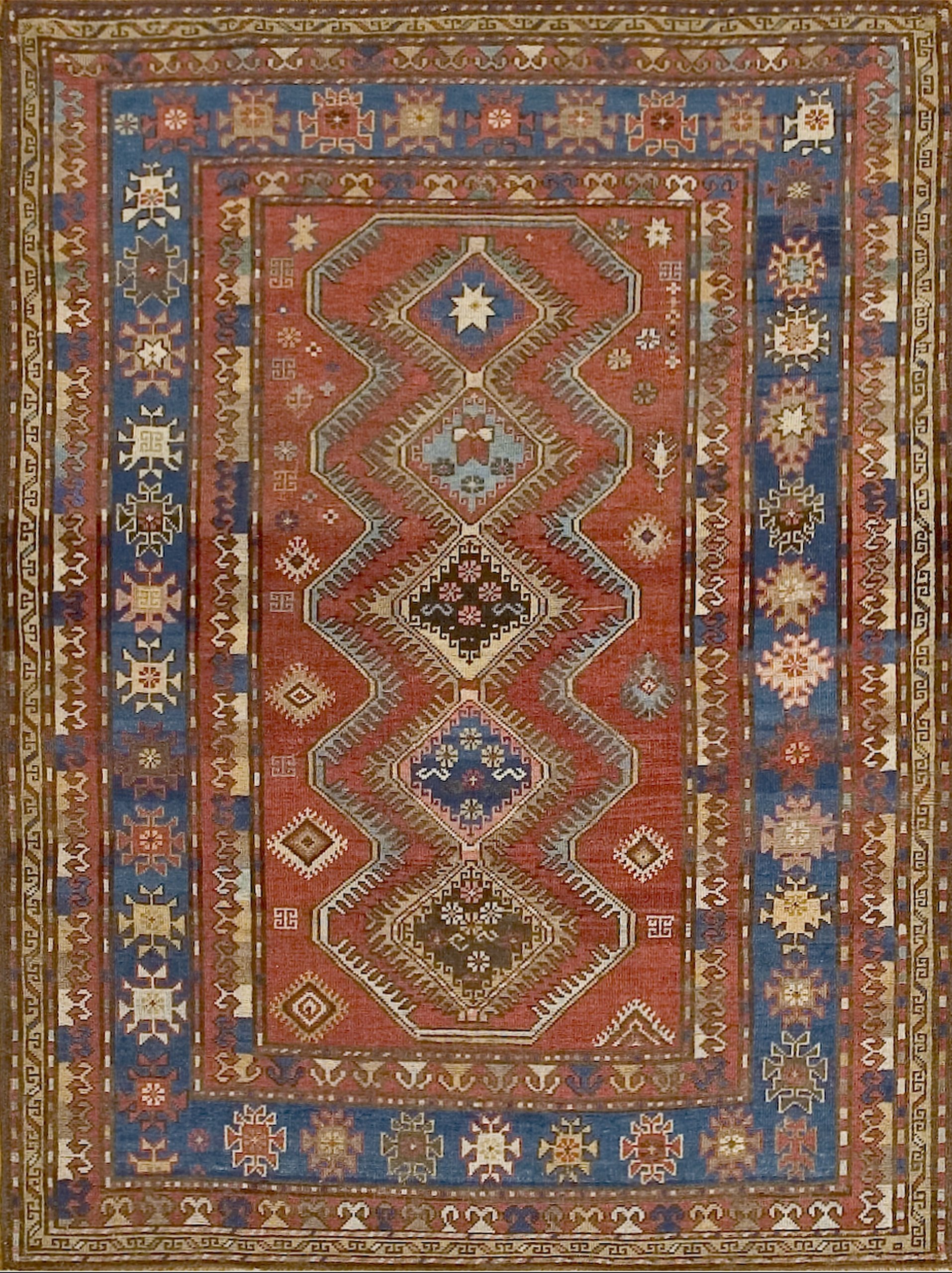
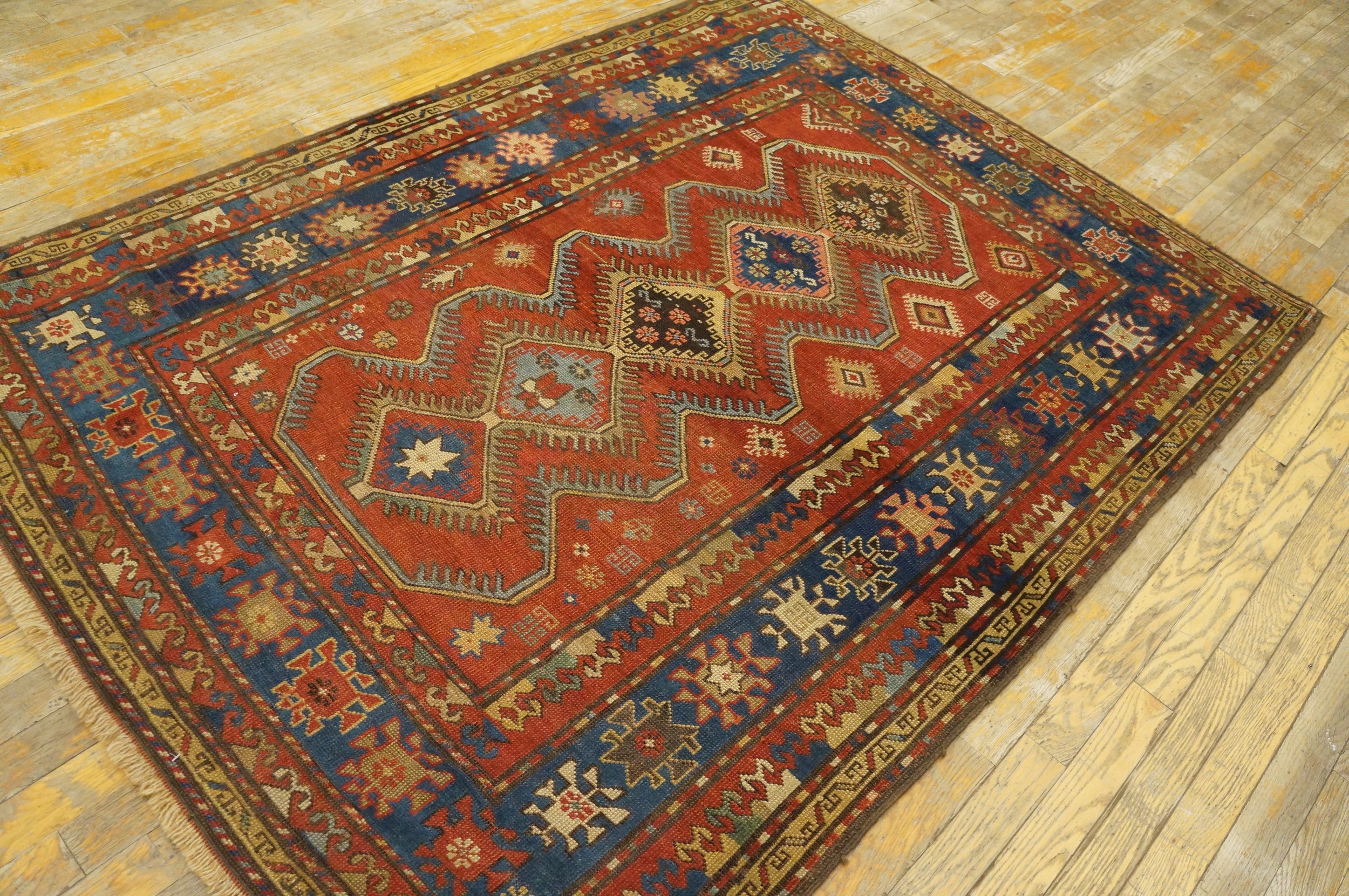
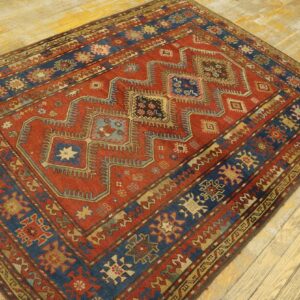
This late 19th-century Caucasian Kazak rug is a “powerhouse” of tribal art, epitomizing the raw, soulful energy that has made the Kazak district one of the most legendary rug weaving centers of the South Caucasus. While the city woven Persian rugs of the era prioritized floral delicacy, this small scatter-size specimen celebrates the “heroic” scale of nomadic life—distilling ancient ancestral totems into a bold, architectural statement.
The composition is centered upon a highly geometric tribal rug design, likely featuring massive, hooked medallions or “stepped” polygons that command the field. These motifs are not merely decorative; they are “latch-hook” symbols designed to guard the home and trap evil spirits. The drawing is characterized by its “primitive” honesty—the slight asymmetries and hand-drawn quality are hallmarks of authentic tribal origin, reflecting a weaver working from memory rather than a rigid blueprint.
The palette is anchored by a saturated Red. This warm tone color is the signature of the high-altitude Kazak weaver, achieved through natural vegetable dyes. Because the wool was dyed in small batches and hand-spun, the field possesses a magnificent abrash (tonal variation). This shimmering, “watercolor” effect provides a dramatic, high-contrast stage for the geometric patterns to appear to “pop” with three-dimensional intensity.
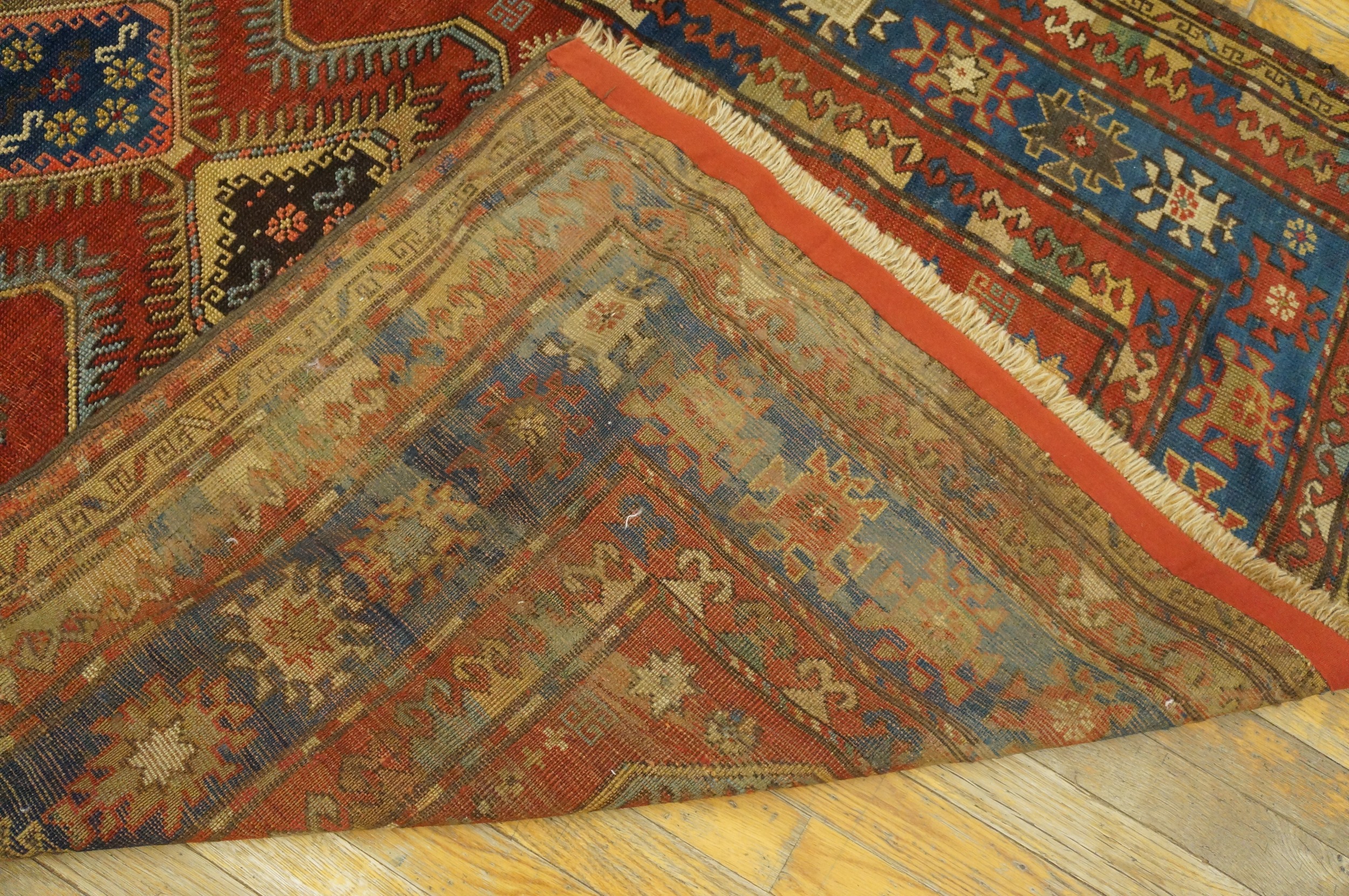
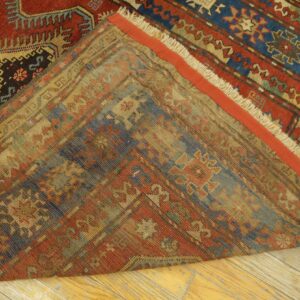
Technically, this Kazak is prized for its substantial, “fleshy” pile and its heavy, “leather-like” handle. Woven from the resilient, lanolin-rich wool of high-mountain sheep, the fibers possess a soft, matte luster that has only grown more beautiful with a century of use. The small size makes it an incredibly versatile textile, capable of anchoring a library nook, an entryway, or being displayed as a wall-hanging work of art.
The borders act as a disciplined, rhythmic frame, often featuring the iconic “Wine Glass” or “Leaf and Calyx” patterns. This architectural containment serves to “lock in” the explosive energy of the central field, providing a sense of historical permanence. To possess this antique Red Kazak is to hold a monument to a vanishing nomadic heritage—a work of historical gravity and soulful power that transforms any interior into a gallery of Caucasian brilliance.