
Introduction to Pictorial Rugs
Discover our luxurious range of scenic pictorial rugs and find the perfect piece to tell your home’s unique story.
What is a Pictorial Rug Design?
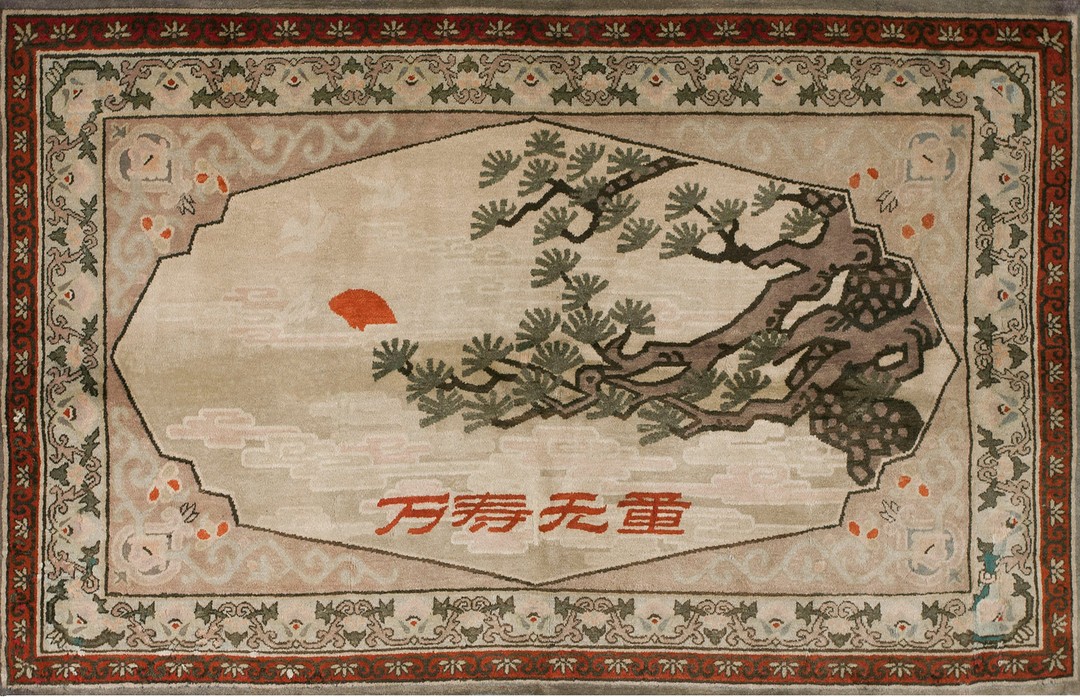
Pictorial rugs are handwoven textiles distinguished by its use of representational imagery rather than purely ornamental motifs. Instead of repeating geometric or floral patterns, these works depict identifiable subjects such as people, animals, architectural landmarks, mythological tales, or historical scenes.
In the Persian tradition, they are often referred to as tablō farsh, meaning picture rugs, a term that underscores their function as woven paintings. In English, collectors and scholars interchangeably use terms like picture carpet, scenic rug, figurative carpet, or portrait rug.
The defining characteristic of a pictorial rug is not its size or material, but its narrative quality—it tells a story, preserves a memory, or captures a moment, transforming the rug from a household furnishing into a medium of fine art. Historically, pictorial rugs have been admired for their ability to merge artistry with craftsmanship.
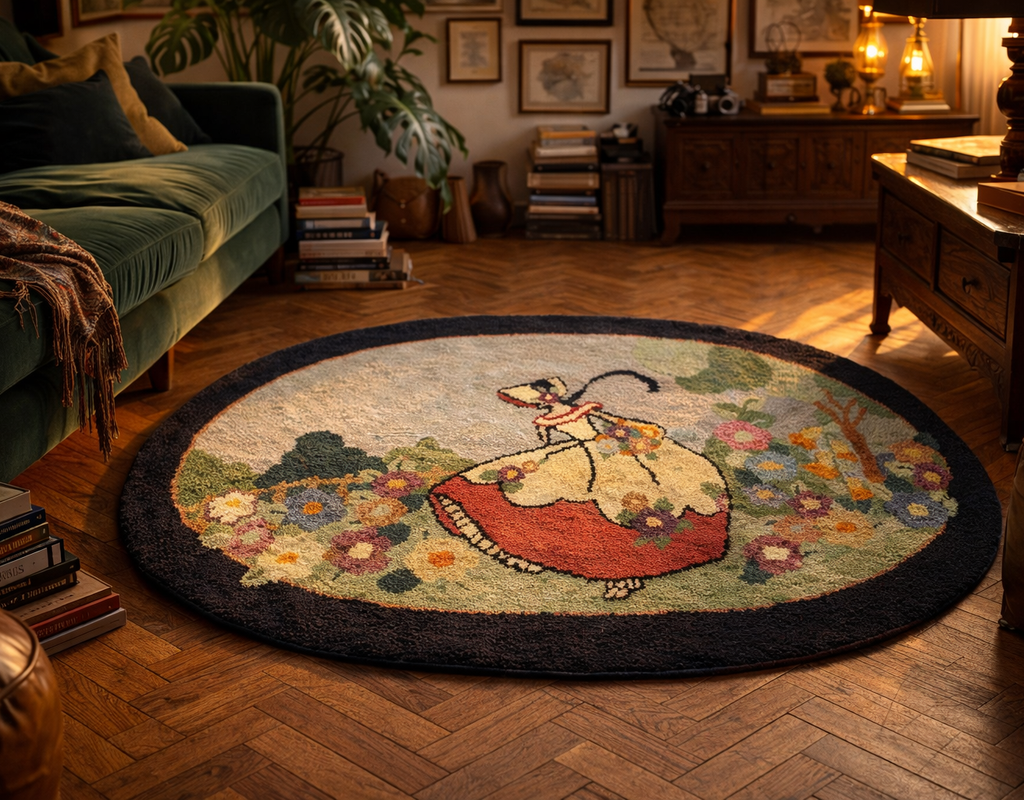
The unique oval rug serves as a charming focal point against the dark wood flooring and vintage decor.
Unlike traditional decorative rugs designed primarily for floors, many pictorial rugs were intended to be displayed on walls, much like paintings. They served as visual testaments to culture and history, often woven to commemorate events, honor rulers, or immortalize beloved landscapes and portraits.
Their representational imagery positions them at the intersection of utilitarian textile and symbolic artifact.
Difference Between Pictorial and Landscape Carpets
While all landscape carpets fall under the broader category of pictorial rugs, not all pictorial rugs depict landscapes. The distinction lies in subject matter:
- A landscape carpet focuses specifically on natural settings—mountains, rivers, gardens, or pastoral views. These compositions prioritize the depiction of the natural environment, often inspired by Persian garden design or European painting traditions.
- A pictorial rug, however, encompasses any representational scene. It may portray a historical battle, a king’s portrait, hunting scenes, scenes from literature, or even religious iconography.
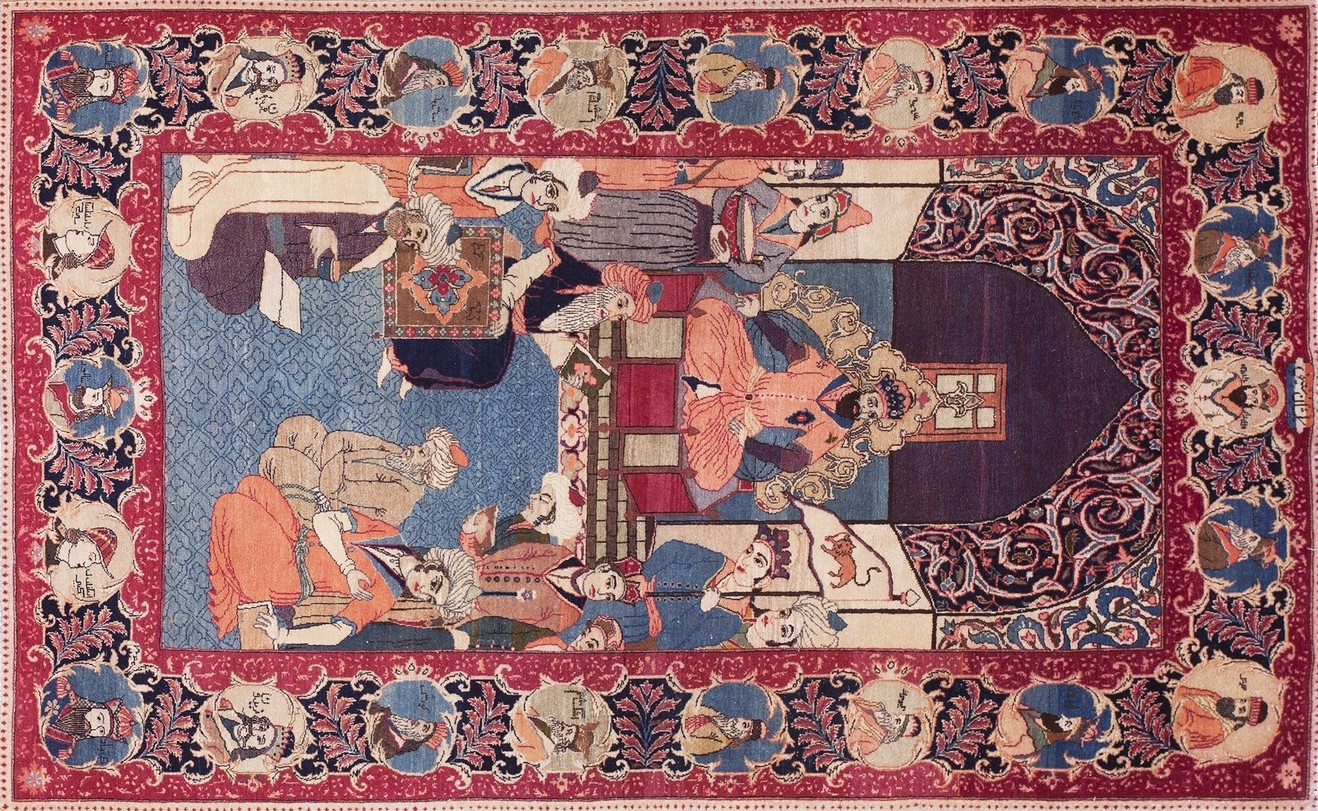
Antique Kashan Small Scatter Size Wool Blue Rug – by Rugs On Net
In other words, a landscape carpet is a subset of pictorial rugs. The broader pictorial category places emphasis on narrative or figural imagery, whereas landscapes isolate setting as the central theme.
This difference is key for collectors and historians: a landscape carpet communicates the beauty of place, while a general pictorial rug can encapsulate people, events, or symbolism alongside or apart from scenery.
Why Some Persian Rugs Are Called Pictorial
The term “pictorial rugs” in the Persian context arises from the word tablō, meaning “picture” or “painting.” When Persian weavers began creating rugs that went beyond decorative patterns and instead reproduced scenes with figures, animals, and storytelling elements, these pieces came to be known as tablō farsh or picture carpets.
Unlike standard floor coverings, they were often designed for appreciation as visual art, hung on walls in homes or displayed in private collections. These Persian pictorial rugs served as cultural documents. They captured rulers’ portraits, celebrated significant events, or reflected beloved themes from literature and poetry.
Their representational quality placed them alongside miniature painting and manuscript illumination, both of which were central to Persian artistic tradition. Calling them pictorial emphasized their function not merely as woven objects but as enduring images worthy of contemplation.
Key Terms in Pictorial Rugs
- Tableau Rug — Why: Derived from the Persian tablō farsh, literally “picture carpet,” this emphasizes the rug’s role as a woven painting.
- Picture Carpet — Why: Highlights the representational nature, making it understandable for English-speaking collectors.
- Figurative Rug — Why: Refers to rugs featuring human or animal figures, distinguishing them from abstract or geometric designs.
- Scenic Rug — Why: Used when the subject is a broad scene, whether natural or cultural, akin to a woven landscape or tableau.
- Portrait Rug — Why: Indicates a rug that features a specific individual, whether historical, political, or familial.
Each of these terms reinforces the defining trait of pictorial rugs: they are narrative, representational, and image-based, standing apart from the repeating decorative styles of other carpets. Their dual purpose—as textile and art—cements their enduring value in rug history.
Origins and Historical Development
When Did Weavers First Include Human Figures in Rugs?
The inclusion of human figures in rug art is not a modern development but one that reaches back more than two millennia. The oldest known example is the Pazyryk Carpet, discovered in a Scythian burial mound in Siberia and dated to the 5th century BCE.
This extraordinary piece features detailed images of horsemen, griffins, and stylized deer, making it the earliest surviving ancient picture rug to combine both human and animal figures in a coherent narrative design. The Pazyryk reveals that even in antiquity, carpets were more than utilitarian floor coverings—they served as cultural expressions, merging artistry with symbolic storytelling. Other early instances reinforce this continuity.
The legendary “Spring of Khosrow” from the Sasanian dynasty (6th century CE), though no longer extant, was described in medieval chronicles as a vast rug woven to depict a blooming garden. This early historic pictorial carpet functioned almost as a woven tapestry, celebrating both royal power and the symbolic renewal of nature.
These examples confirm that figural representation in rugs has deep roots, linking textiles to narrative and ceremonial art long before the rise of later Islamic and European traditions.
Safavid Persia and Mughal India: The Golden Age of Pictorial Rugs
The true flourishing of pictorial rugs emerged during the Safavid dynasty of Persia in the 16th and 17th centuries. This period is often described as the cradle of the pictorial rug tradition, when royal workshops in cities like Isfahan and Kashan began producing Safavid figural carpets of unprecedented beauty. These weavings included courtly hunting scenes, portraits of rulers, and episodes from Persian epics such as the Shahnameh.
Their artistry paralleled the Persian miniature painting tradition, with weavers translating the painter’s brush into the knot of the loom. At the same time, the Safavid style influenced Mughal India, where pictorial rugs reached new heights under emperors like Akbar and Shah Jahan. Mughal artisans combined Persian motifs with Indian aesthetics, creating rugs filled with floral tableaux, courtly portraits, and sacred imagery.
Both Safavid and Mughal courts used these historic pictorial rugs as displays of prestige, reinforcing political authority while cultivating textile art as a vehicle for narrative expression.
Regional Innovations: China, Europe, Caucasus, Navajo
- China — Why: Chinese weavers integrated dragon panels and mythological motifs into carpets, adapting pictorial weaving to long-standing traditions of silk painting and imperial symbolism.
- Europe — Why: European tapestry history merged with carpet-making, with Renaissance and Baroque workshops producing woven scenes of biblical events, mythological episodes, and pastoral landscapes. These blurred the line between tapestry history and rug art.
- Caucasus — Why: In the Caucasus, pictorial elements entered village and tribal rugs, often showing stylized human figures, animals, and localized folklore themes. These offered a rustic counterpart to courtly Persian examples.
- Navajo — Why: In the 19th century, Navajo weavers incorporated modern subjects such as train scenes into their textiles, demonstrating how pictorial weaving could evolve in response to cultural contact, trade, and new technologies.
These regional innovations illustrate how the origins of pictorial rugs branched outward, with each culture adapting the form to its own stories and aesthetics.
From ancient picture rugs like the Pazyryk, to Safavid figural carpets in Persia, to Navajo textiles depicting modern life, the tradition reveals a global pattern: whenever weaving intersected with narrative, the result was a pictorial rug that captured the imagination of its time.
Where Are Most Historic Pictorial Rugs Made?
While figural weavings appear across many regions, the majority of historic pictorial rugs are associated with Persia during the Safavid era. Persian workshops refined the practice to an artistic height that influenced both neighboring regions and distant courts.
Later contributions from Mughal India, China, Europe, and indigenous American traditions enriched the tapestry of global pictorial weaving, but the Safavid legacy remains the touchstone for the development of narrative rug art.
Design Characteristics and Motifs
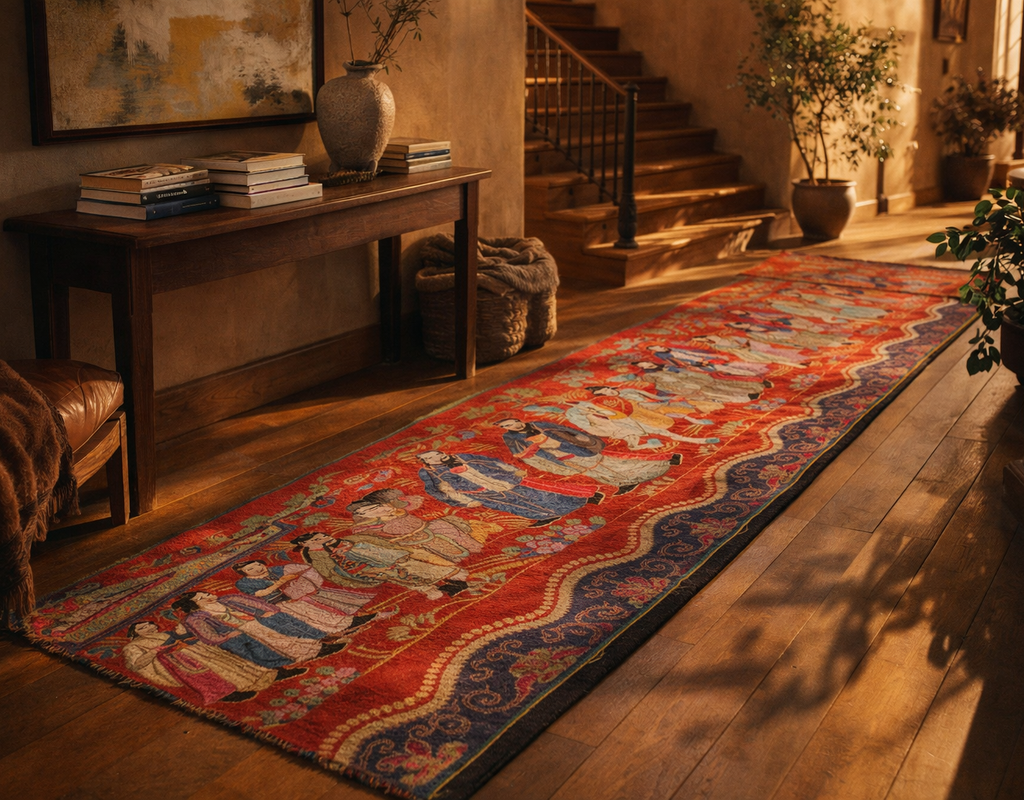
A boldly patterned, narrative runner rug introduces intense color and cultural narrative into a warmly lit, rustic entryway.
Antique Kirman – Lavar Small Scatter Size Wool Coral Rug – by Rugs On Net
What is a Genuine Pictorial Carpet Motif?
A genuine pictorial motif in rug weaving is defined by its representational imagery rather than by repetition of abstract or decorative designs. Unlike traditional pattern-based rugs, which rely on symmetry and recurring motifs, pictorial rugs presents a single, coherent image. These motifs can include portraits of rulers, depictions of hunting parties, mythological tales, architectural landmarks, or pastoral settings.
The key factor is recognizability—figures, animals, and scenes must be clearly rendered so that the rug functions as a narrative rug design, not as an abstract composition. In this sense, each authentic picture rug acts like a woven canvas, intended to be read as much as admired.
Major Pictorial Themes
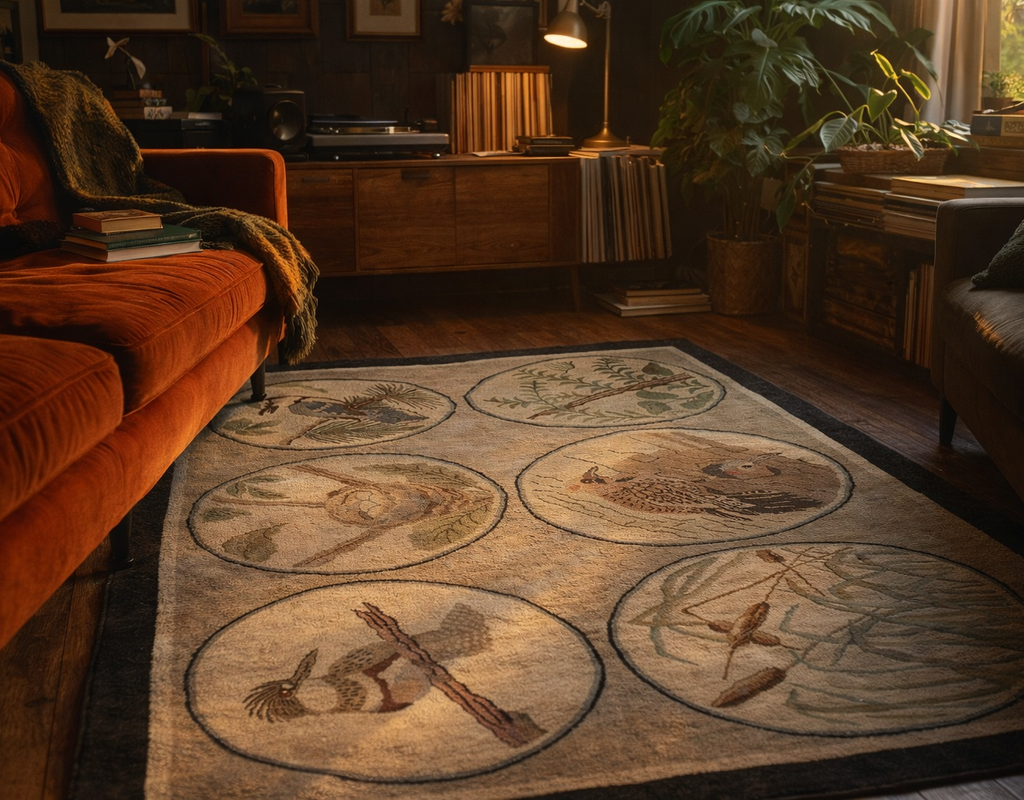
The unique, nature-themed area rug anchors the warm, moody atmosphere of this dimly lit reading or listening space.
- Human Figures — Why: Portraits of rulers, poets, or family members assert identity and honor memory, transforming rugs into visual records of lineage or leadership.
- Animals — Why: Lions, horses, deer, and birds symbolize power, protection, and natural harmony, while also serving as dynamic storytelling elements.
- Mythological and Religious Scenes — Why: Tales from Persian epics, classical mythology, or sacred texts are translated into textile form, merging art with spiritual and cultural narrative.
- Landscapes — Why: Representations of gardens, mountains, rivers, and hunting grounds emphasize harmony with nature, often influenced by Persian garden design or European painting.
- Architecture — Why: Depictions of mosques, palaces, or famous monuments ground the rug in cultural pride and commemorate achievements in stone and space.
These themes reveal the breadth of the pictorial motif, each category serving a commemorative or symbolic function that distinguishes the rug from decorative floor coverings.
How to Identify Authentic Pictorial Rugs
An authentic picture rug can be recognized by qualities that mark it as narrative rather than ornamental. First, it presents a single, unified scene rather than a repeated design. The composition often follows painterly conventions—foreground, background, perspective—creating depth and realism not common in patterned carpets.
Figures and animals are distinct, with identifiable expressions or poses that anchor the story. In some cases, inscriptions, signatures, or dates are woven directly into the field, underscoring the rug’s status as a deliberate work of art.
Collectors should look for clarity of image, realism of depiction, and absence of pattern repetition. These qualities ensure the piece functions as a scenic carpet—a textile intended to narrate or commemorate, not just to decorate.
Difference from Pattern-Based Rugs
As established in the introduction, the distinction between pictorial and pattern-based weaving lies in narrative clarity. A traditional decorative carpet, no matter how complex, is defined by repeating motifs—geometric, floral, or abstract—that cover the field evenly.
By contrast, a representational rug disrupts repetition in favor of imagery. It portrays a unique event, character, or setting that can be “read” visually. Whereas a medallion or floral design might evoke timeless elegance, the narrative rug design captures a specific moment or subject.
This makes the pictorial rug not only an object of beauty but also a vessel of memory, history, and identity. It is this break from decorative convention—the move toward realism, storytelling, and singularity—that defines the true authentic picture rug.
Techniques, Materials & Construction
Typical Knot Density in Fine Pictorial Rugs
The precision of a fine pictorial carpet depends heavily on its rug knot count. Whereas ordinary decorative rugs may average 100–250 knots per square inch, pictorial masterpieces often far exceed this standard.
In Persian tableau rugs, knot densities commonly range from 400 to over 1,200 knots per square inch. This extreme fineness enables artisans to capture minute details—facial expressions, architectural lines, or delicate foliage—making the woven scene appear painterly.
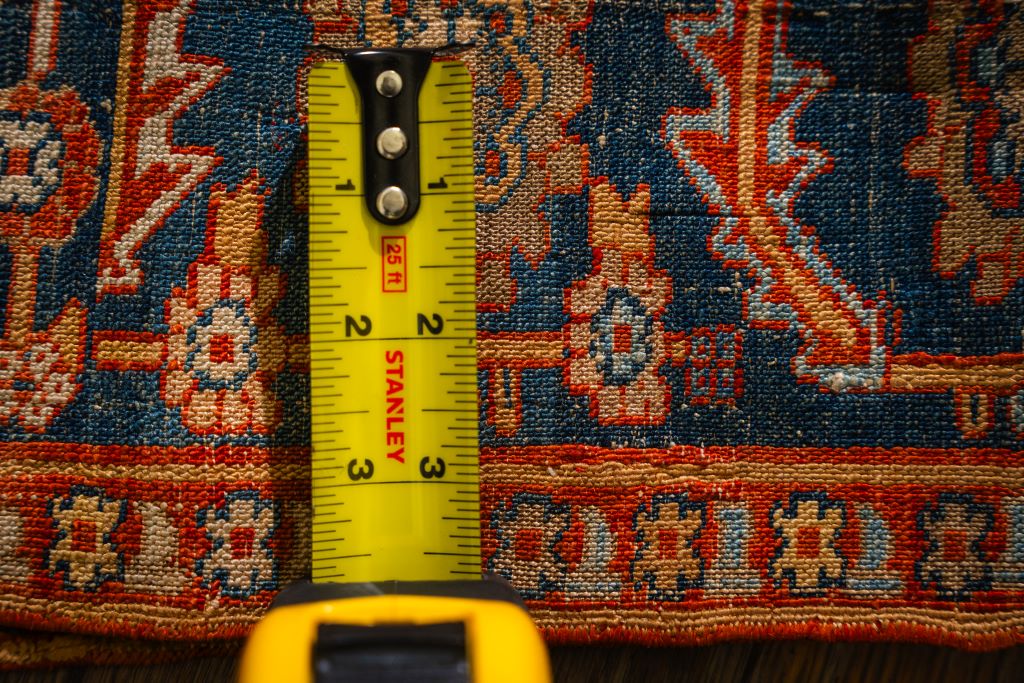
A detailed inspection of a richly colored oriental rug pattern while measuring its dimensions.
The higher the knot count, the more lifelike the imagery becomes, much like the resolution of a digital photograph. For this reason, knot density is considered a primary factor in the value and authenticity of pictorial weaving.
Does Silk Enhance Color Clarity in Pictorial Scenes?
Silk is the preferred material for many pictorial weavings, and its impact is twofold. First, its natural sheen reflects light differently than wool or cotton, creating a luminous quality that highlights the subtleties of design.
Second, silk’s fine fibers allow for an exceptionally tight weave, increasing the possible knot density.
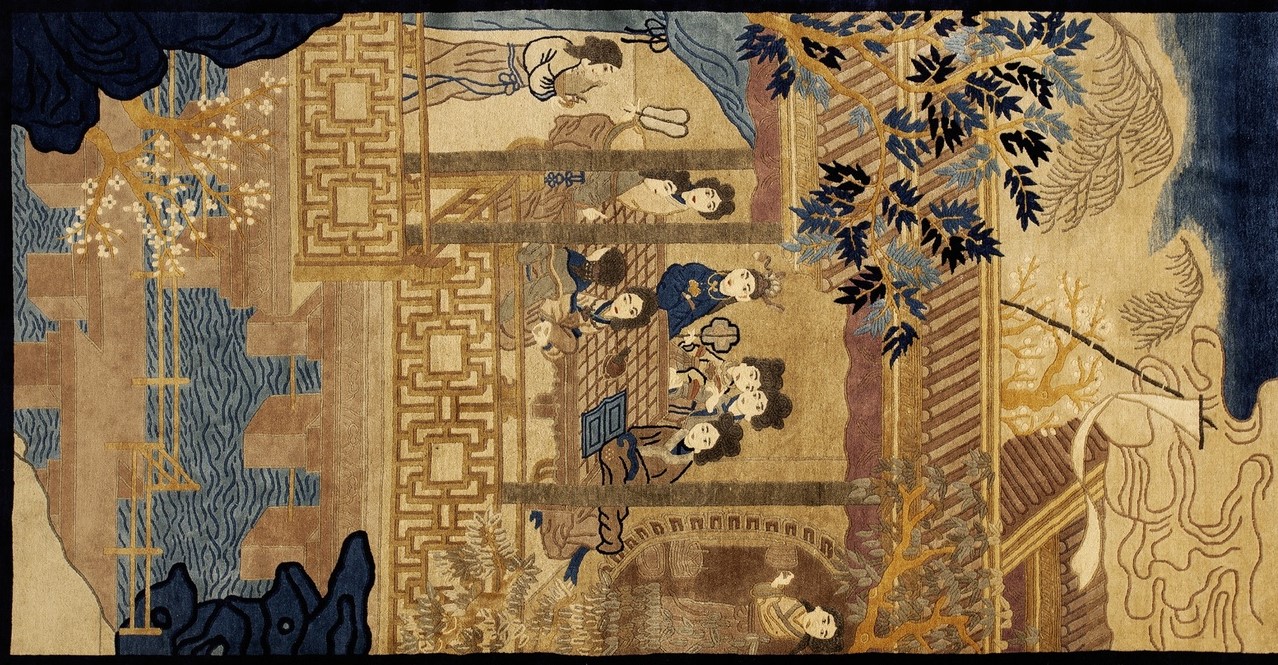
A silk-on-silk rug, with both warp and pile made entirely of silk, produces the highest definition of image and the most vivid color contrasts. This combination enables pictorial rugs to achieve a near-painting effect, with gradients, contours, and vibrant hues rendered with clarity unmatched by other fibers.
Thus, silk not only enhances color clarity but also elevates the rug’s prestige and collectible value.
East vs. West: Hand-Knotted, Tapestry, Needlepoint Techniques
Techniques for creating pictorial rugs have varied across regions, reflecting both material availability and artistic traditions. In the East, especially in Persia, pictorials were executed through hand-knotted construction, where each knot is tied individually to replicate complex scenes. This labor-intensive method allowed Persian and Mughal workshops to rival the detail of miniature painting.
In Europe, pictorial textiles often emerged through tapestry weaving, where images were woven weft by weft, producing intricate scenic panels suited for wall display. This technique paralleled the rise of Flemish and French tapestry traditions.
Meanwhile, needlepoint became a popular Western domestic art form, enabling smaller-scale scenic carpets and seat covers with pictorial detail achieved through stitched canvases. Each technique—hand-knotted, tapestry, or needlepoint—served the same purpose: to make textiles capable of carrying imagery, blurring the line between woven furnishing and fine art.
Dyeing: Natural, Synthetic, Eco-Friendly Options
Color has always been central to pictorial weaving, as nuanced imagery requires a wide palette. Traditionally, natural dyes derived from plants (madder, indigo, saffron), insects (cochineal), and minerals provided deep, enduring tones.
In the 19th century, synthetic dyes expanded options, though sometimes at the cost of authenticity or stability. Today, advances in dye technology have led to eco-friendly rug dyes, offering sustainable alternatives without sacrificing vibrancy.
These modern dyes reduce environmental impact while allowing weavers to achieve the subtle shading necessary for lifelike pictorial detail. Whether traditional or contemporary, dye choice directly influences the realism and longevity of a pictorial scene.
Cartoons and Templates in Pictorial Weaving
- Full-Scale Drawings — Why: Known as weaving cartoons, these provide weavers with a precise map of the intended design, essential for complex figurative scenes.
- Scene Accuracy — Why: Cartoons ensure accurate proportions, helping maintain perspective and realism across hundreds of knots.
- Artistic Collaboration — Why: Often drawn by professional artists, cartoons allowed master painters and skilled weavers to collaborate, elevating pictorial rugs to the level of fine art.
- Narrative Clarity — Why: Unlike abstract pattern rugs, pictorials require adherence to a single scene; cartoons prevent distortion or loss of detail during execution.
The use of cartoons is what sets a fine authentic picture rug apart from ordinary patterned weavings. Just as an artist sketches before painting, the cartoon ensures the woven composition retains narrative integrity, allowing the rug to function as both textile and visual story.
Regional Styles & Notable Examples
Persian Tableau Rugs: Tabriz, Qum, Isfahan
Among all traditions, Persian tableau rugs hold the highest esteem in the market. Cities such as Tabriz, Qum, and Isfahan are renowned for producing finely detailed pictorials, often woven in silk or silk-on-silk.
These works resemble miniature paintings, with extraordinary knot density, painterly perspective, and a mastery of shading. Many are signed by individual weavers or workshops, further enhancing their value. Should you invest in a 19th-century Tabriz pictorial rug? The answer is yes—provided authenticity and condition are verified. A Tabriz pictorial rug from the 19th century, with confirmed provenance and intact structure, represents both cultural heritage and market stability.
Such pieces are highly sought by collectors for their artistry and historical significance. However, like any high-value textile, they require due diligence: expert authentication, examination of dyes and materials, and review of restoration history. With proper documentation, these rugs stand as both aesthetic treasures and secure long-term investments.
Indian, Chinese, Caucasian, Navajo, European Pictorials
- Indian — Why: Under Mughal patronage, Indian workshops developed collectable pictorial rugs with hunting scenes, courtly gatherings, and storytelling motifs drawn from Persian and local traditions.
- Chinese — Why: Chinese pictorials often depict dragons, mythological symbols, or serene landscapes, executed in panel-like compositions influenced by scroll painting.
- Caucasian — Why: Regions like Karabagh produced Armenian story rugs, featuring Christian iconography, village tales, and stylized human figures, reflecting local identity.
- Navajo — Why: From the late 19th century onward, Navajo pictorial weaving incorporated new imagery such as trains, livestock, or regional landmarks, illustrating the adaptability of weaving traditions to modern life.
- European — Why: Renaissance and Baroque Europe produced tapestry-like scenic carpets, often biblical or mythological, paralleling the region’s rich woven arts in Flemish and French tapestry.
These regional expressions confirm that while Persia is the acknowledged cradle of pictorial weaving, the impulse to turn rugs into narrative surfaces appeared across cultures worldwide.
Folk vs. Museum-Quality Pictorial Rugs
Not all pictorial rugs carry equal weight in artistry or market value. Folk pictorials, often woven in village or tribal contexts, may feature simple human and animal figures rendered in bold but less refined form. These are valued for their charm, cultural authenticity, and collectability but typically fetch lower prices.
By contrast, museum-quality rugs are distinguished by fine materials (often silk), extreme knot density, sophisticated design, and documented provenance. They were frequently commissioned for elite patrons or royal courts. The gulf between a rustic folk piece and a signed Persian tableau rug illustrates the spectrum of artistry within the pictorial category.
Collector Sources for Museum-Quality Pieces
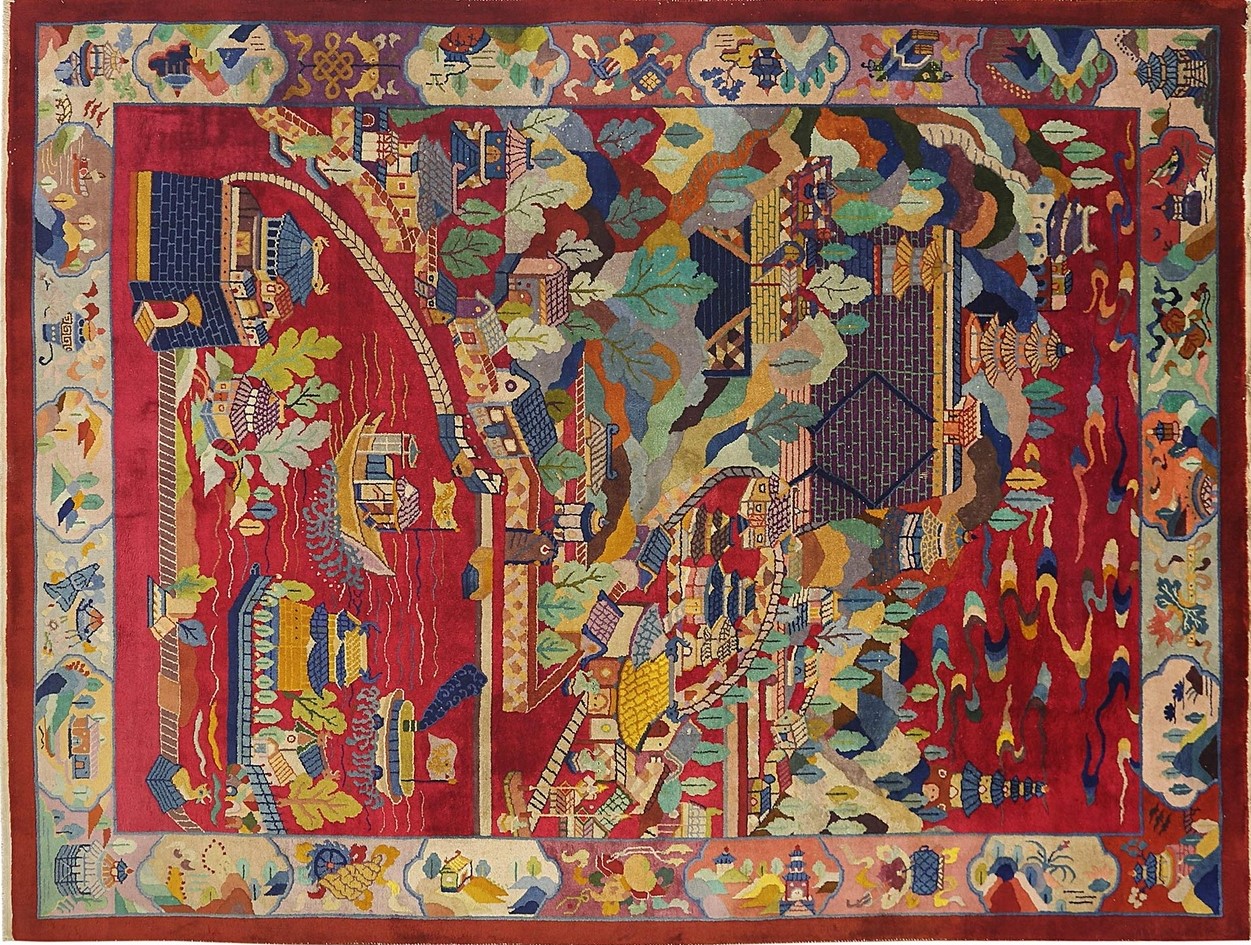
Where do serious collectors source museum-quality pictorial rugs? The most reliable avenues include:
- Major Auction Houses (Christie’s, Sotheby’s, Bonhams) — Why: Offer vetted, high-value examples with transparent provenance.
- Specialist Dealers — Why: Experts in pictorial rugs can authenticate pieces and provide access to rare works outside the public market.
- Direct Provenance Sales — Why: Families or estates with historic collections occasionally release important rugs with intact documentation.
- Museum Deaccessions — Why: Institutions sometimes release duplicate or non-core holdings, presenting rare opportunities to acquire museum-quality rugs.
These channels ensure that collectors secure authentic, collectable pictorial rugs with both artistic merit and market credibility. Ultimately, while Persian tableau rugs from Tabriz, Qum, and Isfahan dominate the field, regional weavings—from Mughal India to Navajo America—contribute to the diverse legacy of pictorial rug art worldwide.
Cultural, Symbolic, and Narrative Roles
Courtly Status, Storytelling, Political and Social Commentary
From their earliest appearances, pictorial rugs functioned as more than decorative objects—they were instruments of prestige, diplomacy, and narrative art. In Safavid Persia, finely woven hunting scenes and royal portraits were commissioned for palaces, serving as both status symbols and visual affirmations of dynastic power.
Similarly, in Mughal India, pictorials illustrated courtly life and epic literature, reinforcing imperial authority while delighting audiences with visual storytelling. Beyond courtly use, pictorial rugs also carried political and social commentary. Armenian story rugs from the Caucasus embedded Christian iconography and village scenes, asserting identity under foreign rule.
In 19th-century Navajo weaving, the depiction of trains and livestock reflected indigenous responses to cultural and economic change. These examples demonstrate how narrative rugs could encode messages, histories, and social realities in textile form, ensuring that the carpet became a voice as well as an artifact.
Symbolism in Pictorial Themes
- Hunting Scenes — Why: Embodied royal power, valor, and mastery over nature, symbolizing sovereignty.
- Animal Motifs — Why: Lions represented courage, birds conveyed blessings, and deer suggested grace—each transforming the rug into a symbolic carpet charged with virtue.
- Biblical and Mythological Imagery — Why: Woven allegories reinforced moral lessons, spiritual devotion, or cultural pride, linking textiles to broader traditions of sacred art.
- Architectural Landmarks — Why: Depictions of mosques, palaces, or monuments served as woven homages to cultural and national identity.
- Portraits — Why: Immortalized rulers, poets, and heroes, ensuring their legacy endured within both textile art and cultural memory.
Through these motifs, pictorial rug symbolism transformed the carpet into a visual language—communicating values, history, and identity across generations.
Auction Price Drivers: What Makes Pictorials Valuable
Why do some pictorial rugs fetch higher auction prices? Their value rests on a combination of artistry and history. First, rarity and uniqueness elevate demand, since no two authentic pictorials are identical. Second, fine materials such as silk or silk-on-silk construction contribute to luxury appeal and detail. Third, exceptional knot density and lifelike imagery demonstrate technical mastery, placing a rug on par with painting or sculpture.
Finally, the prestige of a renowned weaver, royal commission, or cultural significance often drives competition among collectors. Together, these elements explain why auction value pictorial rugs can climb into the hundreds of thousands, or even millions, at international sales.
Provenance Documentation and Its Effect
How can provenance documents affect pictorial rug value? Provenance—the recorded history of ownership—is one of the strongest determinants of market confidence. A pictorial rug with signed weaver’s marks, dated inscriptions, or a paper trail through prominent collections gains legitimacy that cannot be replicated.
When museum records or published catalog entries accompany a piece, its credibility increases dramatically, reassuring collectors that the rug is genuine and historically important. In fact, rugs with robust provenance documentation often command multiples of similar examples without such records.
For the highest-tier museum-quality pictorial rugs, provenance transforms a symbolic or narrative object into a secure cultural investment, ensuring that its legacy of artistry and storytelling is preserved both in market value and historical record.
Modern Pictorial Rugs & Market Trends
Are Modern Machine-Made Pictorial Rugs Worth Buying?
Modern technology has made the machine-made tableau rug widely available, offering buyers the chance to enjoy scenic and representational designs at affordable prices. However, while these modern pictorial rugs provide decorative appeal, they lack the artisanal value, knot density, and cultural weight of handwoven examples.
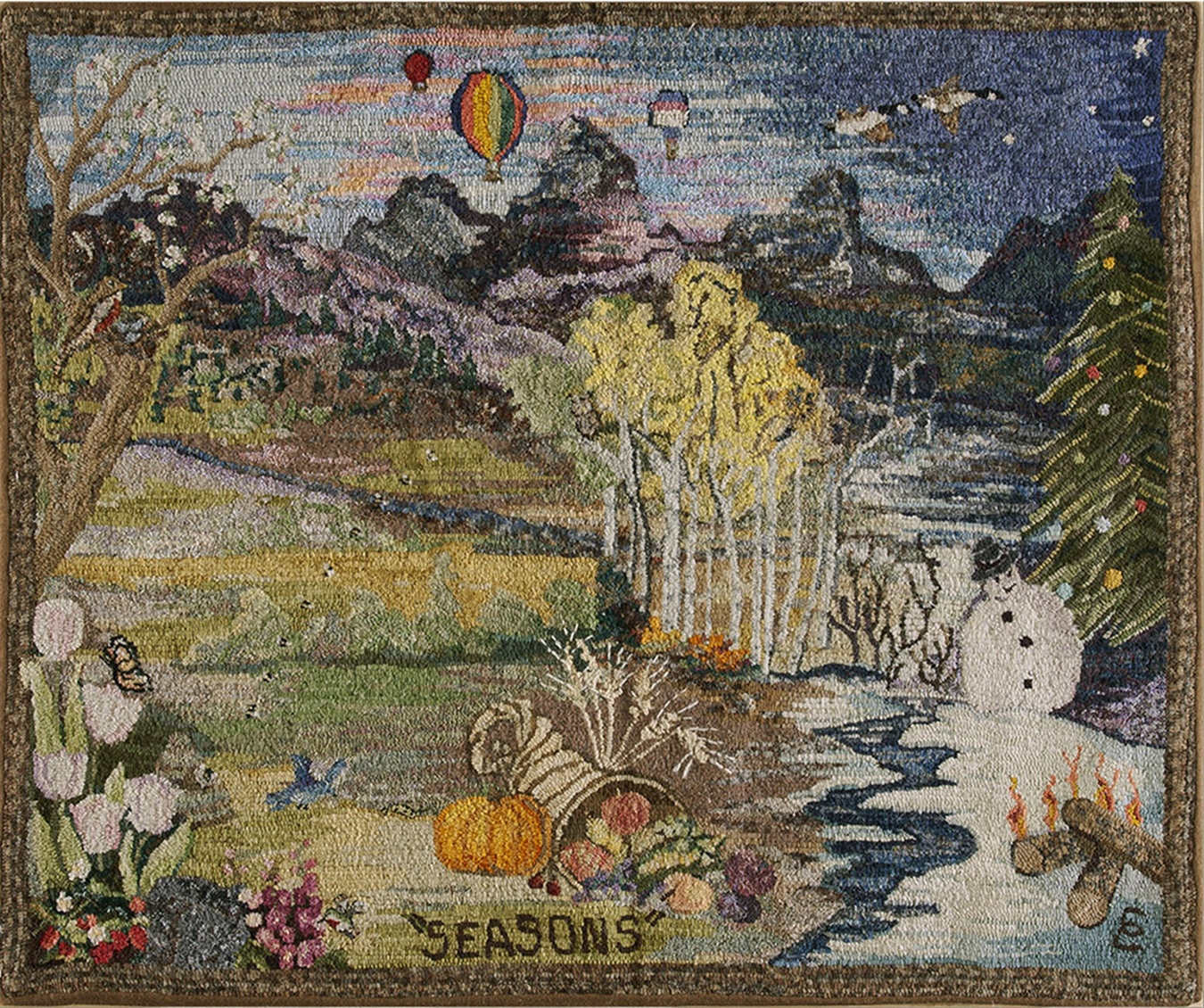
Collectors and investors generally do not consider them serious acquisitions, as they carry little long-term appreciation. For those seeking accessible décor—especially as wall art or casual accents—they serve a purpose. But for art or investment, hand-knotted pictorials remain unmatched.
Popular Contemporary Pictorial Themes
What themes are popular in contemporary pictorial designs? Modern weaving continues to broaden the scope of pictorial subject matter.
Today’s contemporary pictorial rugs may feature:
- Classical Art Replicas — Why: Reproductions of famous paintings keep timeless masterpieces alive in woven form.
- Personal Portraits — Why: Custom commissions allow families to immortalize loved ones in textile, continuing traditions of portrait rugs.
- Wildlife and Nature — Why: Popular for their visual impact, these highlight environmental awareness while echoing earlier hunting and animal themes.
- Cityscapes and Architecture — Why: Modern urban skylines or monuments give pictorial weaving contemporary relevance.
- War Rugs and Political Commentary — Why: Especially in Afghanistan, these narrate modern struggles and conflicts, turning carpets into chronicles of contemporary life.
- Pop Culture and Modern Icons — Why: Some experimental workshops weave celebrities, cultural symbols, or even abstracted graphic art, pushing the boundaries of tradition.
This diversity reflects how the pictorial rug remains a living medium for storytelling, adapting to each generation’s interests.
Modern Eco-Friendly and Alternative Materials
As explored in earlier sections, material choice shapes the clarity and sustainability of pictorial rugs. Alongside traditional wool and silk, modern artisans increasingly employ eco-friendly rug dyes and fibers to reduce environmental impact.
Bamboo silk, hemp, and organic cotton have joined the palette, offering sustainable options while maintaining detailed imagery. These align with broader global movements toward ethical production and ensure that modern pictorial rugs can be both artistic and environmentally responsible.
Value and Desirability of Silk-on-Silk Pictorial Isfahan Rugs
Does a silk-on-silk pictorial Isfahan hold its value better than wool? Yes. Among modern creations, the silk pictorial Isfahan remains one of the most desirable types on the market. Silk-on-silk construction permits extremely fine knot density, producing painterly precision and luminous color that wool cannot match.
Authentic examples from Isfahan, particularly those signed by master weavers, maintain or even appreciate in value if kept in excellent condition. In contrast, wool pictorials, though beautiful, typically do not command the same level of recognition or long-term investment strength.
Market, Interior Design, and Art Trends
- Textile-as-Art — Why: Designers increasingly treat pictorial rugs as framed artworks for walls, positioning them alongside paintings.
- Statement Pieces — Why: Scenic carpets serve as focal points in interiors, anchoring rooms with cultural gravitas.
- Cross-Cultural Fusion — Why: Contemporary workshops mix traditional narratives with modern aesthetics, appealing to global buyers.
- Collectible Demand — Why: While folk pictorials remain accessible, museum-quality and silk-on-silk pieces attract international auction attention.
- Sustainability Trend — Why: Eco-conscious buyers are pushing for natural fibers and eco-friendly dyes, aligning with broader design movements.
Together, these trends confirm that while the modern pictorial rug has diversified in form and subject, authenticity, fine craftsmanship, and material quality—especially silk—continue to drive desirability and long-term value.
Practical Guidance: Display, Care & Investment
Hanging Pictorial Rugs as Wall Art
Can a pictorial rug be hung as wall art without damage? Yes—if mounted with proper support. Pictorial rugs are often treated as woven paintings, and hanging them preserves their visual impact. However, hanging must be done with conservation-grade methods.
The safest approach is to attach a cotton sleeve or Velcro strip along the back, distributing weight evenly and preventing stress on the weave. Nails, pins, or clamps should never be used, as they can tear fibers and distort the fabric. With the correct system, a wall art carpet can be displayed safely for generations.
Conservation: Fading and Best Practices
How do conservationists preserve faded pictorial rugs? Specialists focus on protection rather than alteration. To combat fading, they recommend placing pictorial rugs away from direct sunlight and using UV-filtering glass or shades in display rooms. Minimal cleaning with appropriate materials prevents abrasion of fragile fibers.
When needed, professional conservators may perform minor stabilizations, but always with reversible methods. The goal of rug conservation is preservation of the original material, ensuring that the rug’s story and artistry remain intact.
Restoration: When Is It Advisable or Risky?
Is restoration of worn pictorial scenes advisable or risky? Both. Minor, sensitive repairs—such as reinforcing edges or stabilizing loose knots—are advisable to prevent further deterioration.
However, rug restoration risk is high when dealing with large-scale reweaving or color replacement. Over-restoration can erase original artistry and reduce value dramatically. Collectors and conservators generally advise retaining original material whenever possible, accepting some wear as part of the rug’s historical authenticity. Restoration should only be undertaken by experts, with the goal of conservation rather than reinvention.
Pictorials in Minimalist Interiors
Can pictorial designs work in minimalist interiors? Absolutely. A single display pictorial rug can become the focal point in a pared-down environment. In minimalist décor, where surfaces are clean and ornament is restrained, the narrative richness of a pictorial rug creates contrast and depth.
However, careful balance is essential: neutral walls and understated furnishings allow the minimalist décor pictorial rug to shine without overwhelming the space. In this context, pictorials act as bold statement pieces, merging history with modern design.
Investment Factors, Red Flags, and Care Checklist
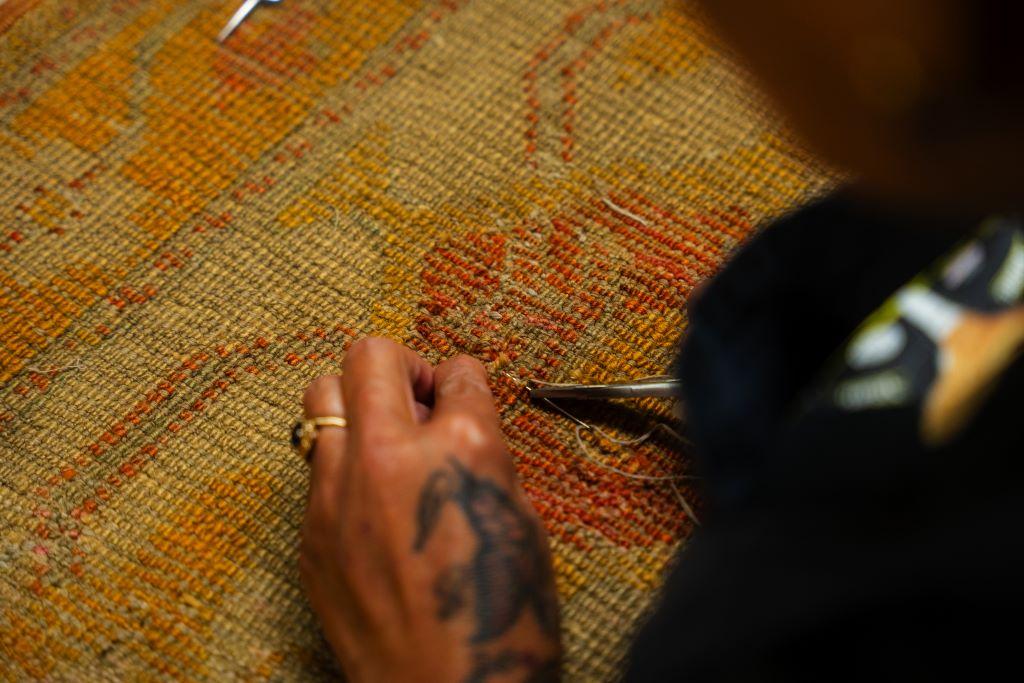
Detail of hands mending a rustic, richly colored woven rug.
- Authenticity — Why: Genuine hand-knotted pictorials, especially with signatures or inscriptions, hold lasting value.
- Provenance — Why: Documented ownership and museum references elevate a rug from collectible to investment-grade.
- Condition — Why: Well-preserved fibers and dyes ensure durability and market confidence.
- Artistic Merit — Why: Lifelike imagery, balanced composition, and fine detailing distinguish masterworks from lesser examples.
- Rarity — Why: Unique or regionally significant themes increase desirability among collectors.
- Red Flags — Why: Over-restored surfaces, synthetic materials misrepresented as silk, and lack of provenance are signals of caution.
Proper display, careful conservation, and mindful investment preserve both cultural and financial value.
By approaching these textiles as narrative rugs and art objects, collectors can safeguard them against damage while allowing their woven stories to continue resonating across generations.
Explore a Few of Our Favorite Pictorial Rugs
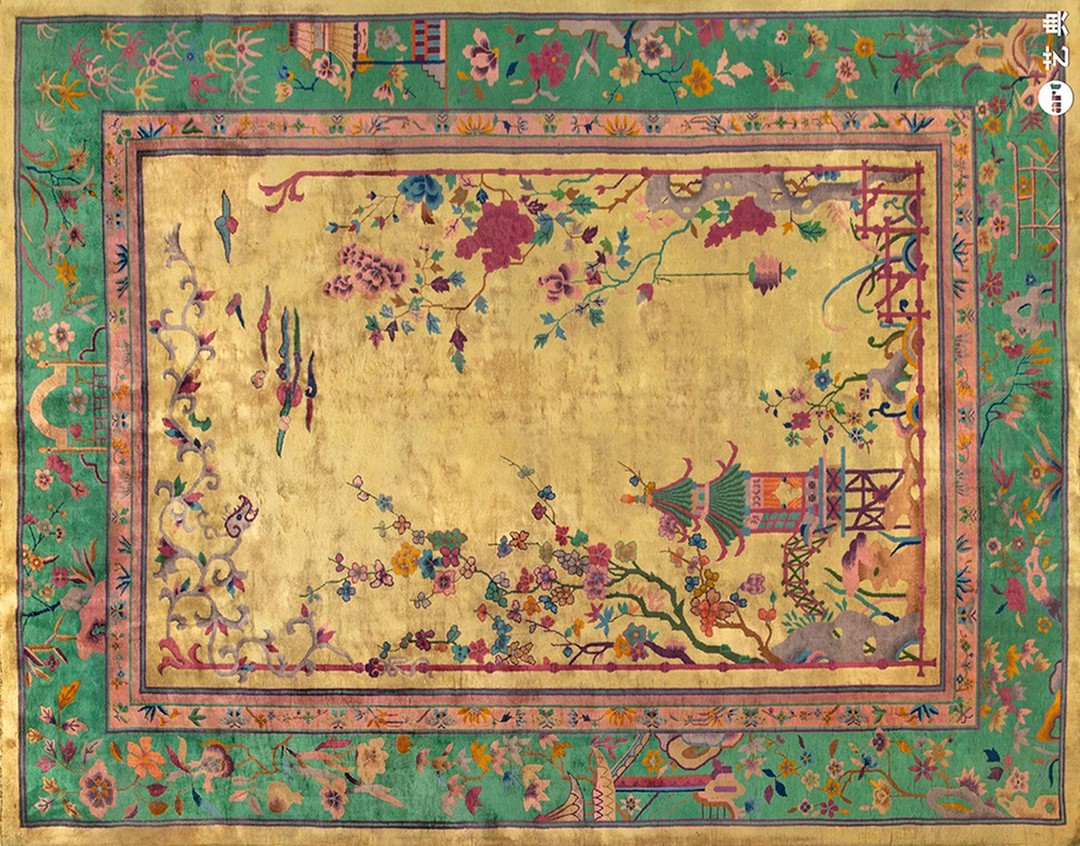
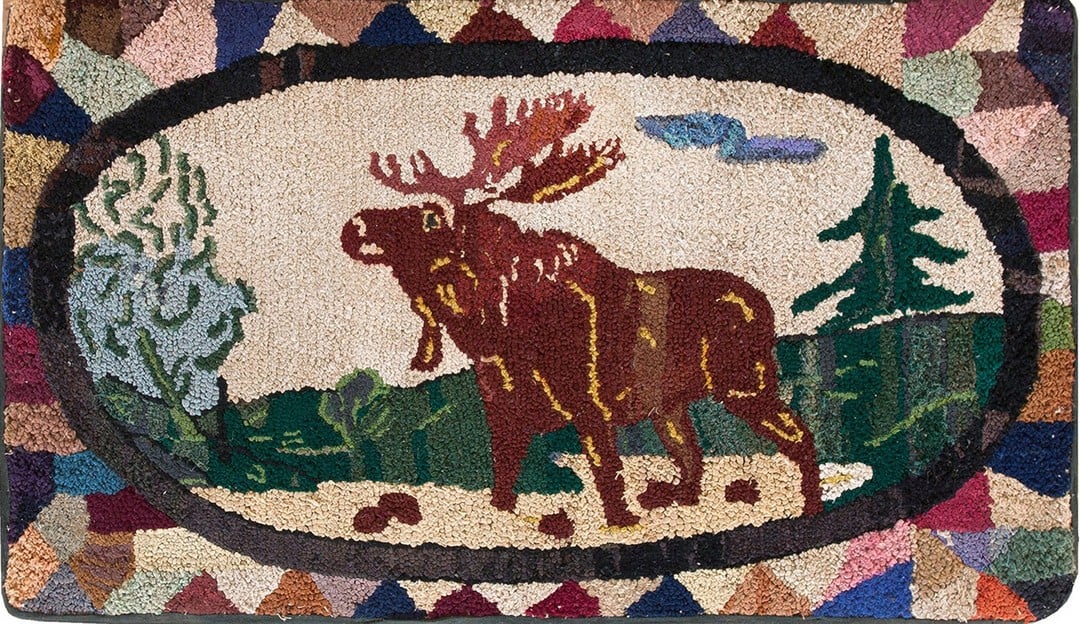
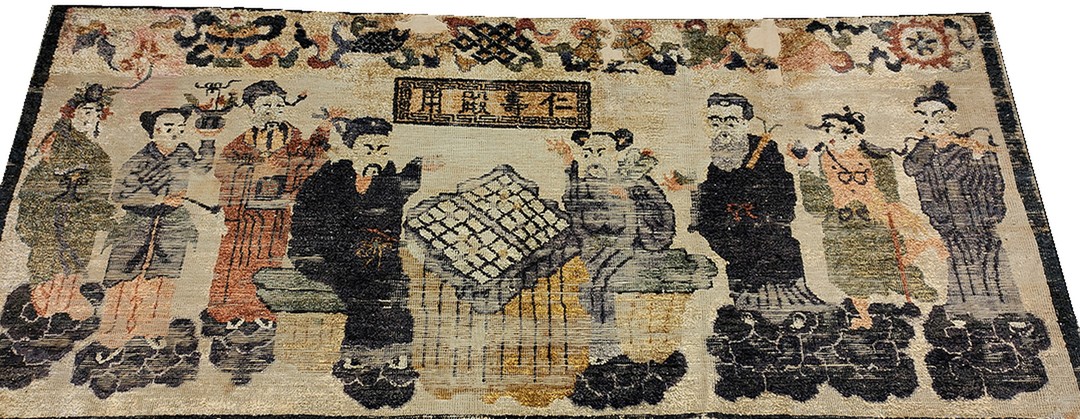
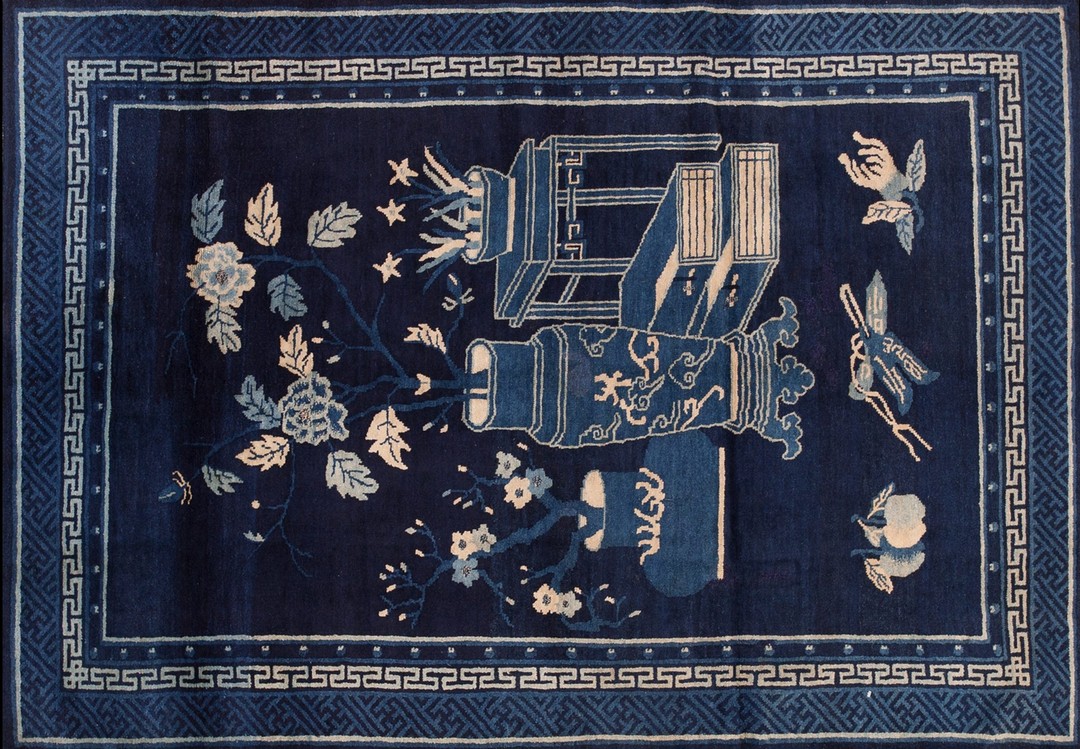
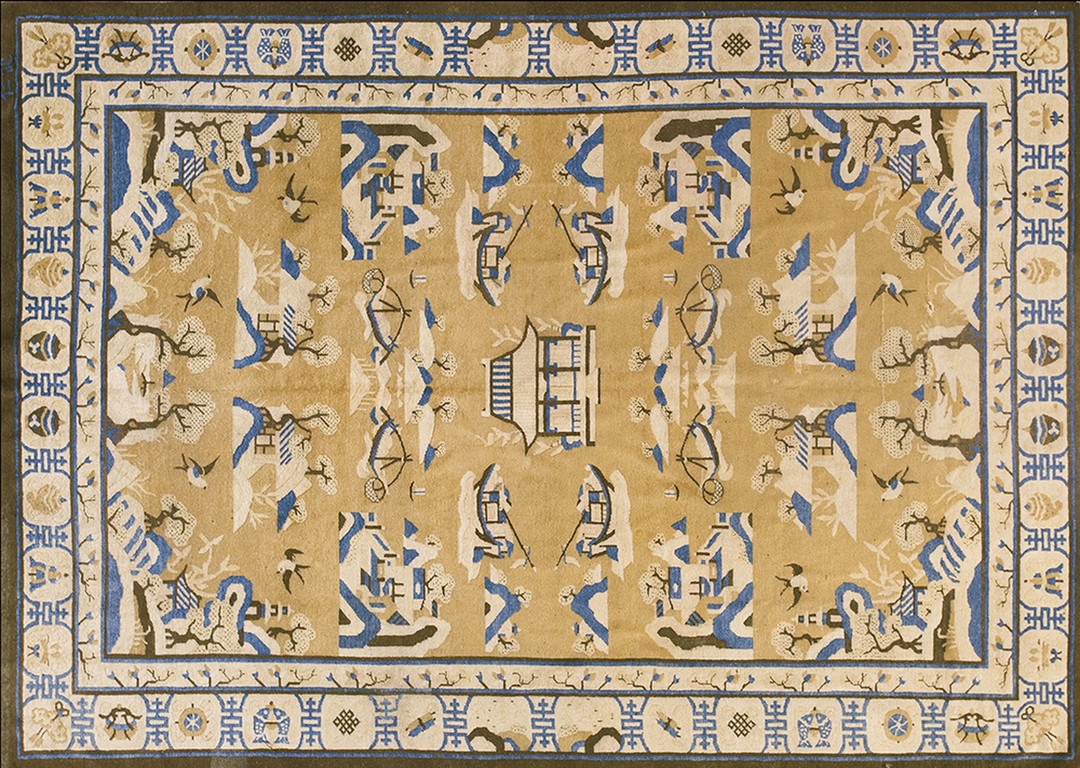
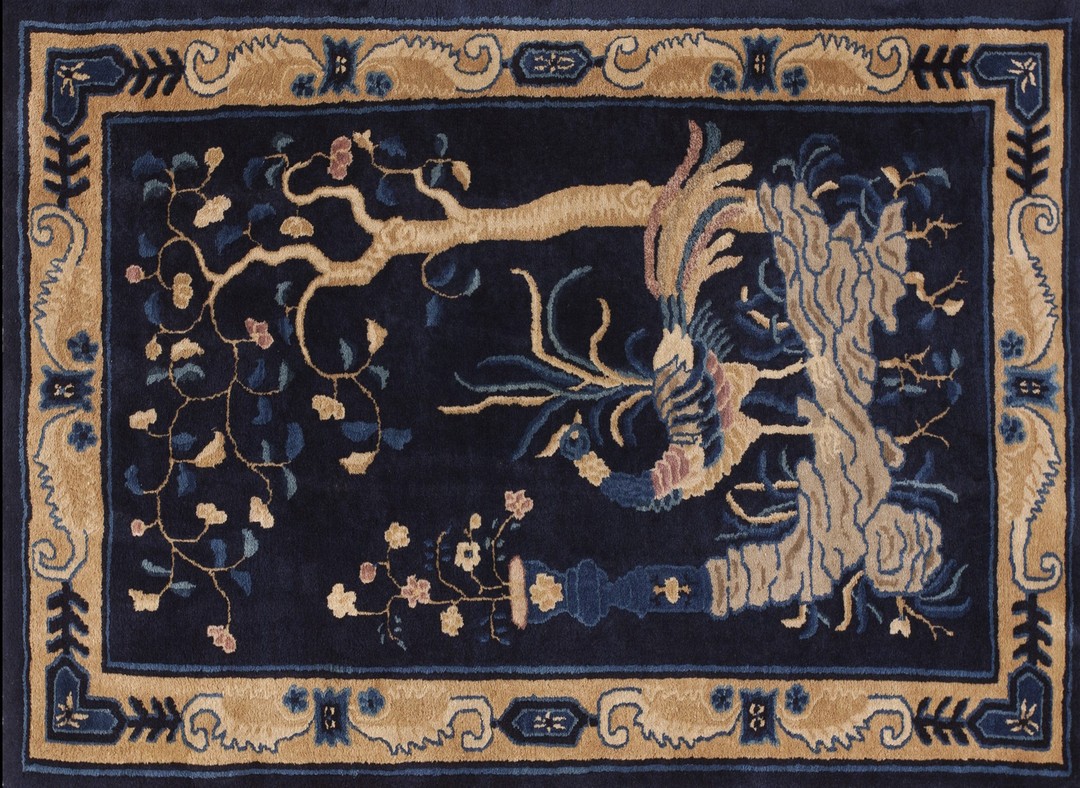
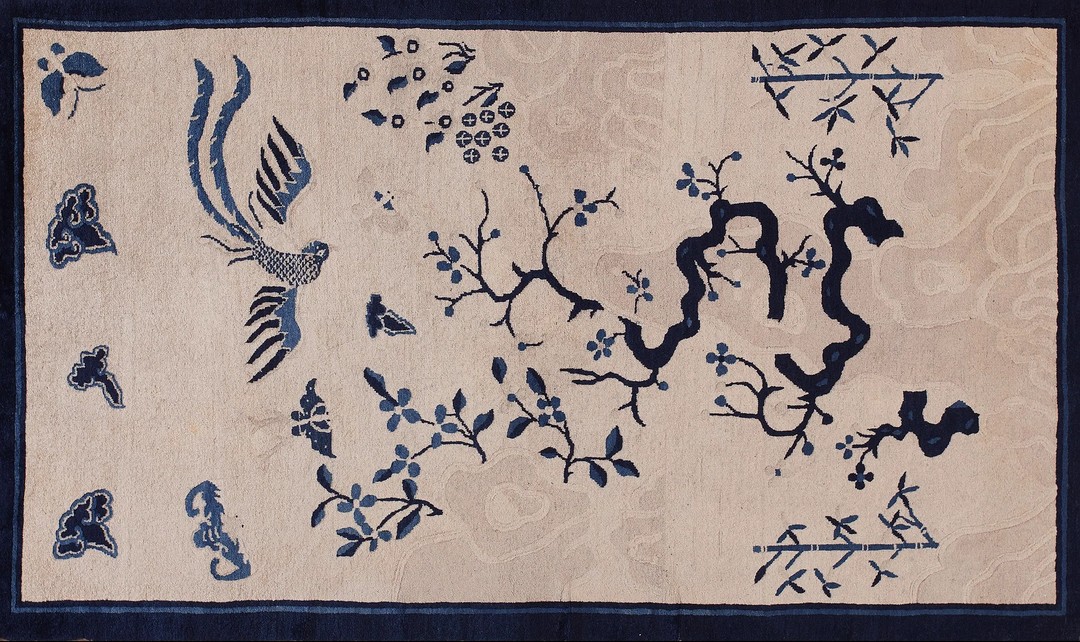
FAQ
- What’s the difference between pictorial rugs and pictorial prayer rugs?
Prayer rugs emphasize a mihrab niche, while pictorial rugs present narrative scenes. For religious use, many prefer non-figurative designs in keeping with aniconic traditions.
- Can I commission custom pictorial rugs from photos?
Yes—many workshops translate images into rugs; lead times run months. Higher KPSI and larger sizes increase detail, cost, and weaving time.
- What pad works under floor-laid pictorial rugs?
Use a dense felt pad (about 1/8–1/4 inch) sized slightly smaller than the rug. Avoid sticky rubber pads that can damage finishes.
- Can creases in pictorial rugs be removed?
Reverse-roll gently and give it time; never hot-steam silk. Persistent creases or buckling warrant a professional conservator.
- How should I store pictorial rugs?
Roll face-in with acid-free tissue, wrap in breathable cotton, and elevate off the floor. Avoid plastic wrapping and damp areas.
- Do pictorial rugs appreciate in value?
Some signed, antique, or rare pictorial rugs can appreciate, but markets fluctuate. Buy for quality and love first; provenance and condition strongly influence resale.
- Are pictorial rugs okay in high-traffic areas?
Prefer sturdy wool pictorial rugs with medium pile and tight knots for traffic. Reserve fine silk tableaus for walls, bedrooms, or formal spaces.
- Will a robot vacuum damage pictorial rugs?
It can catch fringe and pull delicate pile, especially on silk pictorial rugs. Set a no-go zone or pick the rug up before cleaning.
- Are pictorial rugs kid- or pet-friendly?
Wool pictorial rugs resist wear and clean better; silk is delicate and stains easily. For busy homes, consider hanging pictorial rugs or placing them in low-traffic rooms.
- Are there flatweave pictorial rugs?
Yes, pictorial kilims exist and depict scenes using tapestry-style wefts. They’re thin, often reversible, with crisp outlines ideal for wall display.
- How do I check pictorial rugs for dye bleeding risk?
Dab a damp white cloth on an inconspicuous area; if color transfers, avoid water-based cleaning and call a rug professional. Always blot, never rub, spills.
- What’s the right way to vacuum silk pictorial rugs?
Vacuum with suction only—no beater bar—and follow the pile direction. Fold fringe back before cleaning to prevent snagging.
- How do I protect pictorial rugs from fading?
Limit direct sunlight, use UV shades, and rotate display every 3–6 months. Silk and certain reds/blues are particularly light-sensitive.
- Can I frame pictorial rugs behind glass?
Use a shadow-style frame with breathing room and UV-filter glazing; avoid pressing the textile against glass. Acrylic is lighter and safer for larger pictorial rugs.
- How should I hang pictorial rugs safely on a wall?
Sew a cotton sleeve or hook-and-loop (Velcro) strip to a fabric header and mount it on a batten to distribute weight. Avoid clips, nails, or punctures through the rug.
- Do pictorial rugs have signatures?
Many city-made pictorial rugs include a cartouche with a workshop or weaver name, sometimes stylized. A signature alone doesn’t guarantee higher value—overall quality and condition matter more.
- How can I tell if a pictorial rug is hand-knotted?
Flip it—hand-knotted pictorial rugs show the design on the back with slight irregularities, and fringe is part of the warp. Machine-made pieces look uniform and often have sewn-on fringe.
- What is KPSI on pictorial rugs, and why does it matter?
KPSI (knots per square inch) measures knot density; higher counts allow finer imagery. Silk Qum pictorial rugs often exceed 400 KPSI, with exceptional pieces approaching 900 KPSI.
- How much do pictorial rugs cost?
Prices vary by size, material, and origin. Small framed pictorial rugs can start around a few hundred dollars, while fine silk or antique examples reach several thousand or more.
- What sizes are typical for pictorial rugs?
Many pictorial rugs come in small tableau sizes for framing, roughly 2×3 to 4×6 feet. Larger floor pieces exist but are rarer and pricier.
- Are silk pictorial rugs durable enough for floors?
Silk pictorial rugs show crushing and tracking, so they’re best in low-traffic spaces or on walls. Choose wool pictorial rugs for everyday floor use.
- What motifs do pictorial rugs often feature?
Common themes include hunting scenes, royal portraits, literary tales, cityscapes, gardens, and animal studies. “Leili and Majnun” scenes and Great Wall panoramas are well-known examples.
- Which regions are best known for pictorial rugs?
Persian centers like Kerman, Tabriz, and Qum, plus Chinese Peking and some Caucasian workshops, are renowned. Qajar-era Kerman pieces and modern Qum silk tableaus are classic examples.
- Are pictorial rugs the same as tapestries?
No—pictorial rugs are usually knotted-pile, while tapestries are weft-faced flat weaves. Rugs show knots and pile; tapestries hide warps and build the image with packed wefts.
- What are pictorial rugs?
Pictorial rugs are hand-woven carpets that depict scenes, figures, or landscapes instead of repeating motifs. Many are made as small “tableau” pieces intended for wall display rather than floor use.