
Introduction to Greek Key and Running Dog Motifs in Rugs
Discover our curated selection of Greek Key Running Dog motif rugs and bring classic elegance into your space.
What is a Greek Key Border in Area Rugs?
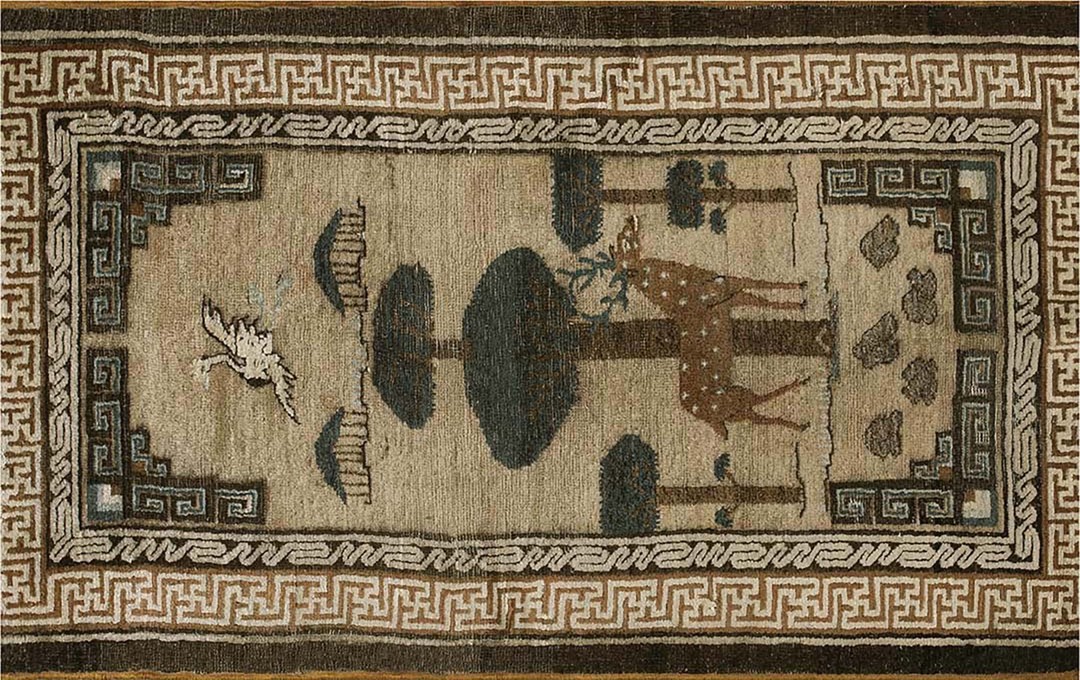
A Greek key border in area rugs is a continuous geometric design made up of right-angled, interlocking spirals that flow seamlessly around the edges of the rug. Often serving as a main border or as a smaller guard border, this motif creates a structured frame that contains and balances the central field of the carpet.
The Greek key, also known as the meander border or running dog motif, works as both ornament and symbol. Its unbroken, winding line is traditionally understood to represent eternity, unity, and the endless cycle of life.
In rug weaving, this motif is admired not only for its striking symmetry but also for its versatility, appearing in both classical reproductions and modern decorative carpets.
Origins and Etymology
The terminology surrounding this design highlights its layered history. The term “meander” comes from the winding path of the ancient Meander River (modern Menderes) in Anatolia, whose twists and turns inspired the association with continuous spirals.
The phrase “Greek key” underscores its iconic role in Hellenic art and architecture, particularly between the 9th and 3rd centuries BCE, when it was used in temples, pottery, and mosaics.
The expression “running dog” refers to the motif’s frequent use as a border, where its rhythmic, wave-like movement suggests the motion of a coursing animal encircling the composition. In more technical terms, the design is also called Greek fretwork, emphasizing its angular, fret-like structure.
Each name—meander, Greek key, running dog—captures a different aspect of the motif: its flowing continuity, its cultural identity, and its function in design.
Where Did the Greek Key Rug Pattern Originally Come From?
The Greek key pattern origin is most closely associated with Classical Greece, where it became a defining element of decorative vocabulary. Yet the story of this motif extends further back and across cultures. Variants of interlocking spirals appeared in ancient Egypt, China, and even the pre-Columbian Americas, reflecting the universal human impulse to create continuous, repeating forms.
In Greece, however, the motif reached its most recognizable form, symbolically tied to concepts of infinity, order, and civilization. From there, the design spread widely through cultural diffusion—adopted into Roman mosaics, later into Islamic geometric art, and ultimately into rug weaving traditions of Anatolia, Persia, the Caucasus, and China.
By the time it entered textile art, the Greek key was already a global language of design, adapted seamlessly into carpets as both a framing device and a cultural emblem.
The Enduring Symbolism
The enduring power of the Greek key rug motif lies in its perfect balance of simplicity and depth. On the surface, it is a neat repetition of angular turns. On a deeper level, it embodies eternity, unity, and continuity—a single line without beginning or end.
As a meander border in rugs, it links today’s interiors to thousands of years of decorative history, bridging the temples of Athens, the villas of Rome, the courts of Persia, and the looms of Anatolian weavers. Whether called Greek key, meander, running dog, or fretwork, this motif demonstrates how a simple geometric idea became one of the world’s most enduring decorative patterns.
Design Characteristics and Symbolism
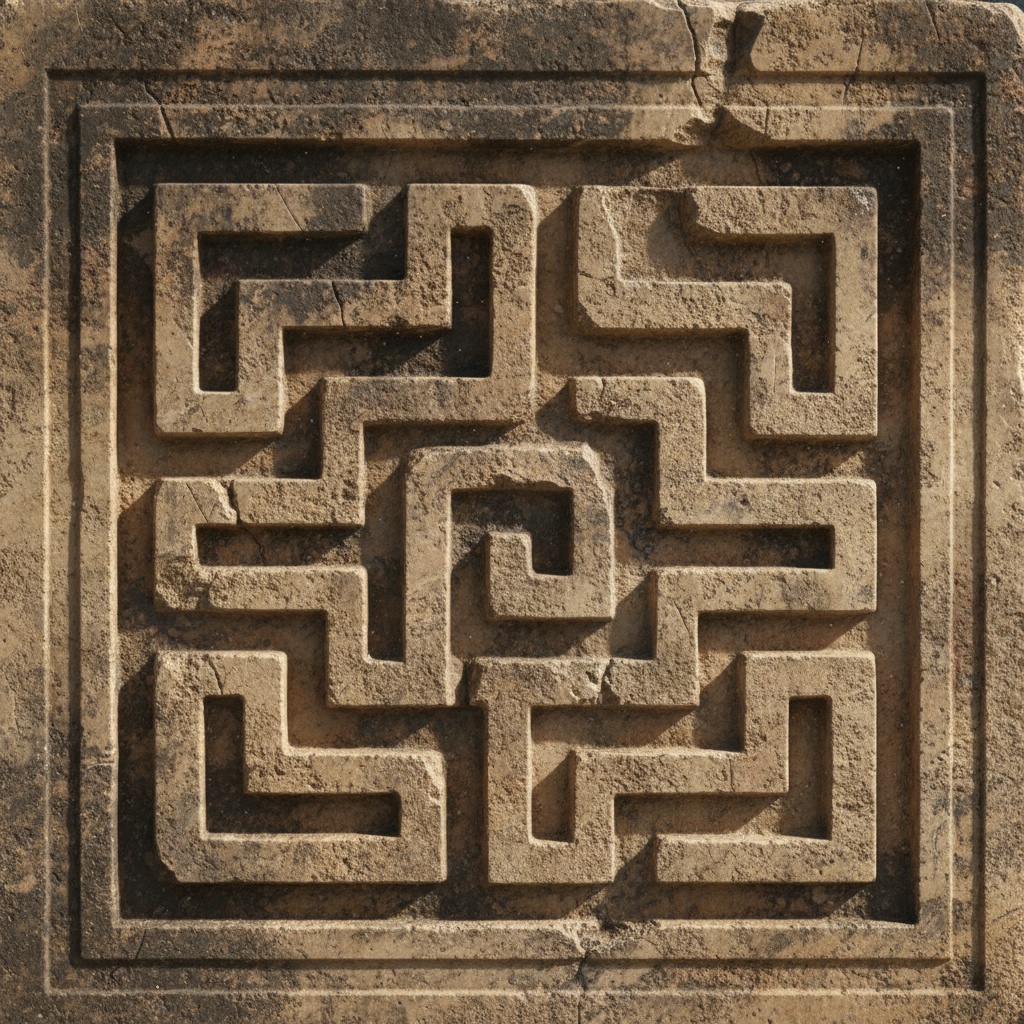
Geometric interlocking pattern carved in stone.
Defining Features
The Greek key motif is defined by its continuous angular line that doubles back on itself in a sequence of right-angled turns. In rug design, this structure almost always appears as a border element, encircling the field of the carpet like a frame. Its repetition reinforces a sense of closure and completeness, keeping the central medallion, motifs, or open space firmly contained.
While the pattern can occasionally be adapted for use within the field of a rug, this is rare; its true strength lies in its role as a running dog border, where its rhythm creates both movement and order. By offering such a strong framework, the motif gives balance to even the most complex interior designs.
Symbolism Across Cultures
- The Greek key symbolism has taken on different layers of meaning as it traveled across cultures.
- In ancient Greece, it evoked eternity and continuity—an unbroken path symbolizing the cyclical nature of life, as well as the labyrinthine mysteries of myth.
- To the Romans, it represented order, civilization, and the structured discipline of empire.
- In Chinese art, the same motif was often read as the “thunder pattern,” tied to prosperity and divine power, with some associations to water’s life-giving flow.
- In Islamic and Anatolian weaving traditions, the meander border often carried protective value, surrounding the rug like a barrier against harm while maintaining a rhythmic harmony.
Despite these varied interpretations, the motif’s universal message of unity, flow, and infinity remains consistent, making it one of the most adaptable designs in world ornamentation.
Why is the Running Dog Motif Popular in Oriental Rugs?
The running dog border meaning in oriental rugs reflects both practicality and symbolism. Weavers favored the motif because its geometric form is relatively simple to construct on a loom, yet it produces a strikingly sophisticated effect.
As a border, it creates instant symmetry and strength, serving as a visual boundary that protects and “finishes” the rug. Symbolically, its flowing line resonates with deeply human themes: the meandering river as the flow of life, the endless path as a sign of eternity, and the enclosing spiral as a form of protection around the woven world at the rug’s center.
These qualities made the motif especially popular in oriental carpets, where borders often carry meanings of guardianship and continuity.
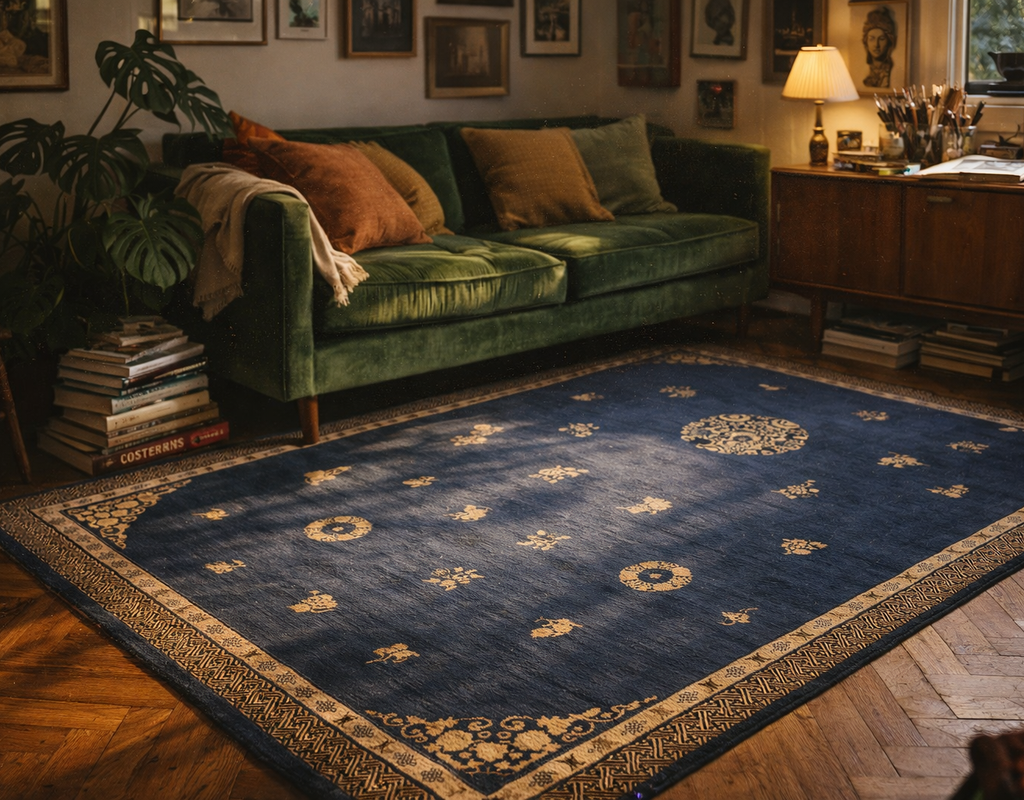
A vibrant blue and gold patterned rug enhances the moody, layered look of this eclectic living area.
By combining ease of execution with layered cultural associations, the Greek key rug border has remained a favorite across weaving traditions from Anatolia to Persia and beyond.
The Appeal of Symmetry and Balance
At its core, the popularity of the Greek key rug lies in its ability to harmonize structure and symbolism. Its repetitive turns offer visual stability while its continuous flow connects a rug to ideas of unity and eternity.
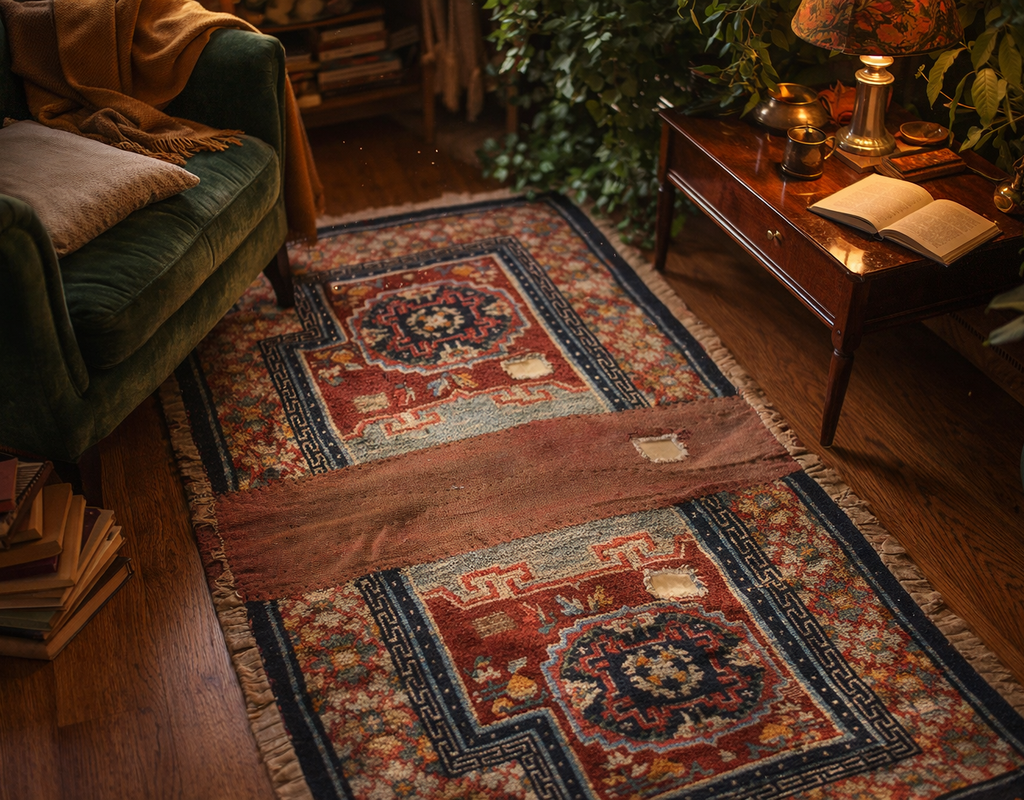
A patchwork vintage rug defines a warm and inviting reading space bathed in soft lamplight.
Rarely used as a field design, it shines as a border, embodying the perfect “finishing touch.” Across cultures and centuries, the unity motif has endured not only for its practical beauty but also for the enduring sense of balance it lends to every rug it frames.
Geographic Spread & Regional Variations

Rugged, tiered terrain suggesting varied geographic formations.
Anatolian Rugs
- Greek key Anatolian rugs often feature a local interpretation known as su yolu, or “water path.” — Why: The bold, simplified lines symbolize flowing water and life, tying the motif directly to nature and agricultural abundance.
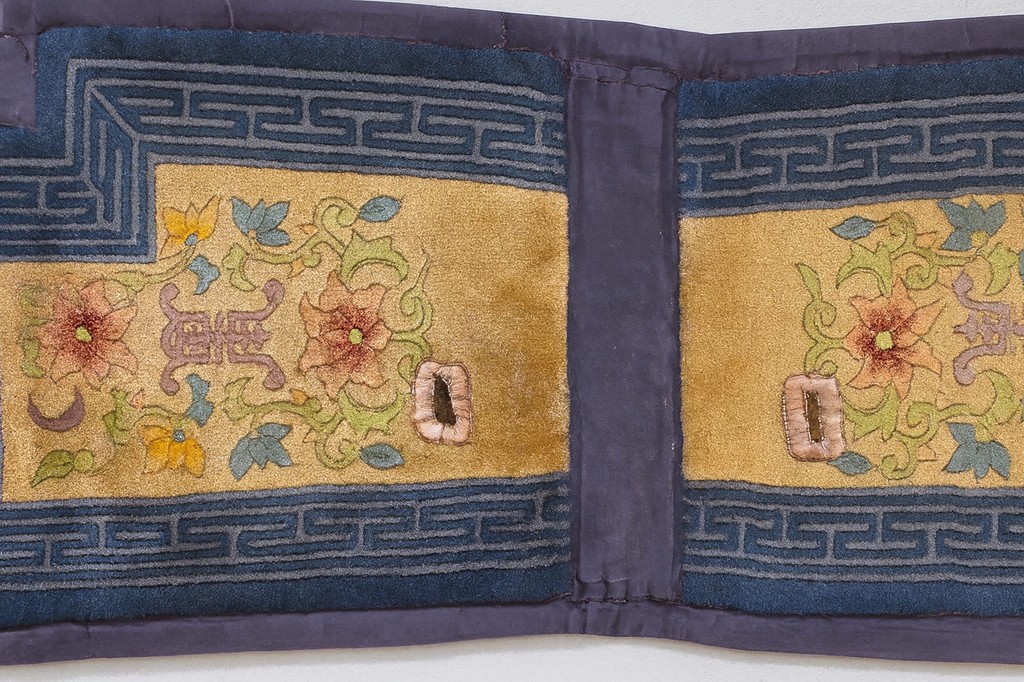
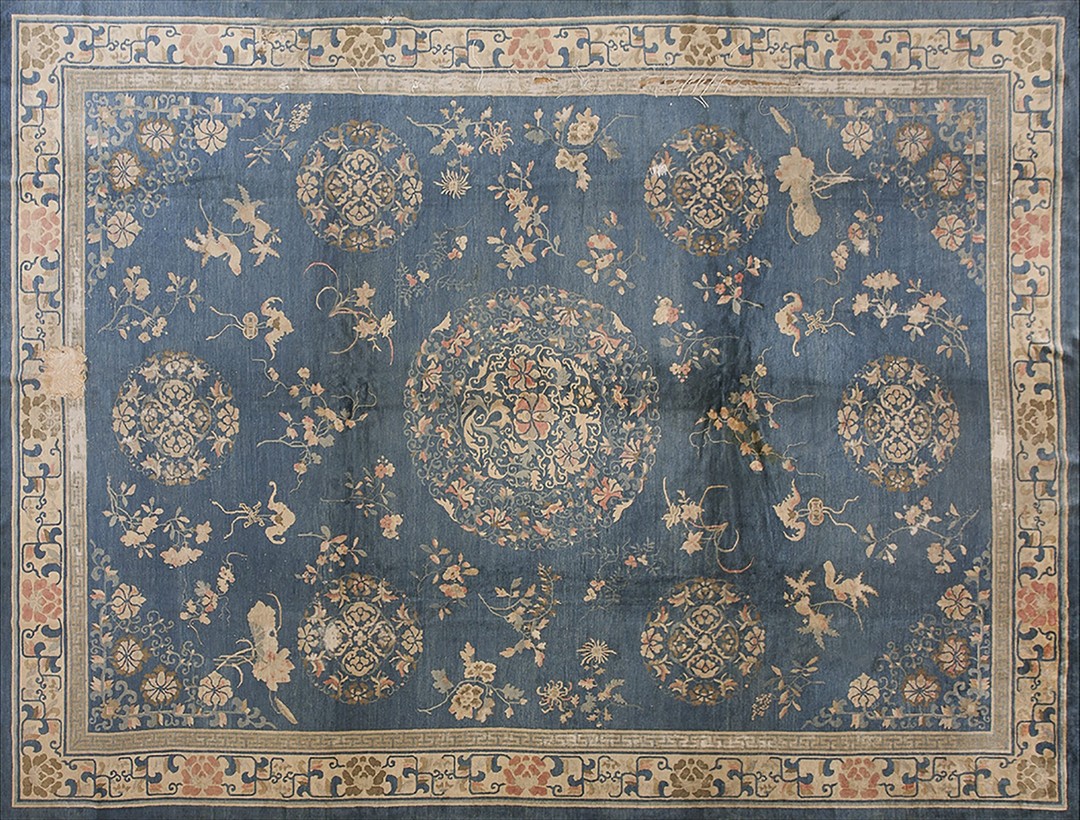
Antique Chinese Allover Scatter Sized Knotted Horse Cover Saddle Rug by Rugs On Net
Persian Carpets
- The Persian meander border is less common, appearing mainly as a secondary border device. It entered Persian weaving in the late 19th century, influenced by neoclassical tastes. — Why: Its adoption in this period reflects cross-cultural exchange, showing how Persian workshops responded to European and Ottoman decorative trends while retaining their own floral and curvilinear preferences.
Caucasian Weavings
- The running dog Caucasian variation is a hallmark of rugs from the Caucasus, where high-contrast color palettes and stepped diagonals gave the design a dynamic energy. — Why: In this region, the motif symbolized the flow of water and the continuity of life, while also serving as a protective framing device around central medallions or bold geometric fields.
Chinese Carpets
- In China, the motif appears as the leiwen, or thunder pattern, square and precise in execution. It symbolizes thunder, rain, and prosperity. — Why: The Chinese interpretation shows how a shared motif was given a distinctly local meaning, resonating with themes of cosmic energy, weather, and abundance in Chinese philosophy and textile art.
Modern Flatweaves
- Contemporary flatweave Greek key designs reinterpret the motif on a larger scale with bold contrasts and inventive color palettes. Instead of the subtlety of antique versions, modern pieces lean into graphic impact. — Why: These updates make the motif versatile for today’s interiors, where scale and color blocking are favored for modern, minimalist, or eclectic décor.
When Did Greek Key Borders First Appear in Persian Carpets?
The Greek key border first appeared in Persian carpets in the late 19th century, during a period of neoclassical influence.
Earlier Persian rugs prioritized curvilinear arabesques and floral motifs, but exposure to European tastes and the popularity of neoclassical ornament encouraged the integration of this angular border as a framing device.
How Can I Identify a Genuine Running Dog Design Quickly?
To spot a genuine running dog border, look for an unbroken, continuous line that moves in sharp right-angled turns. The design should create a rhythmic interplay of positive and negative space, usually placed along the border rather than in the field.
Its continuous flow, without breaks or loose ends, is the clearest indicator of authenticity.
How Do Modern Flatweaves Showcase Greek Key Differently Than Antiques?
Modern flatweaves treat the Greek key rug motif as a bold statement. While antique versions were often smaller in scale and worked into subtle border systems, contemporary designers amplify the motif with oversized proportions, strong contrasts, and vibrant, sometimes unexpected palettes.
This shift from delicate framing to graphic centerpiece highlights how a timeless motif adapts to modern design sensibilities.
A Motif of Many Identities
Each region reinterpreted the meander according to its own artistic vocabulary: Anatolia’s flowing water path, Persia’s late adoption, the Caucasus’s high-contrast borders, China’s thunder pattern, and today’s flatweaves with graphic punch.
These variations underline the motif’s enduring appeal and its ability to shift meaning while preserving its unbroken essence.
Construction, Materials & Technical Aspects
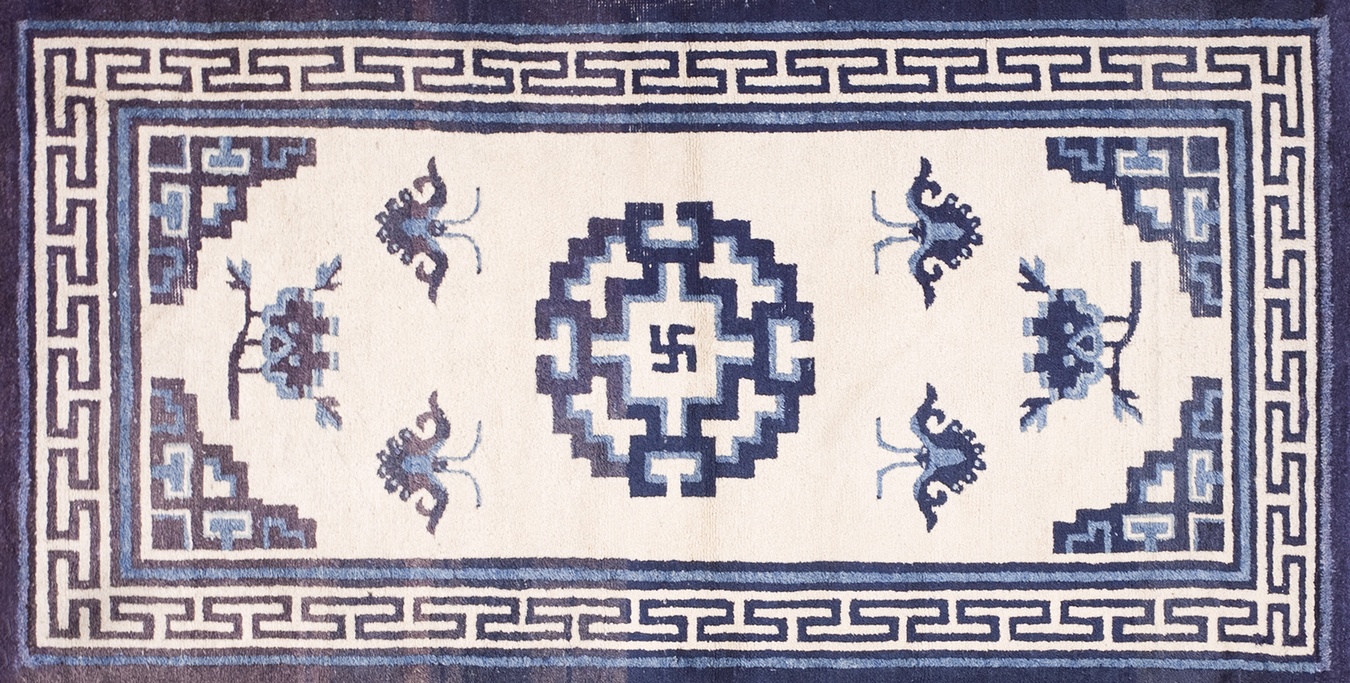
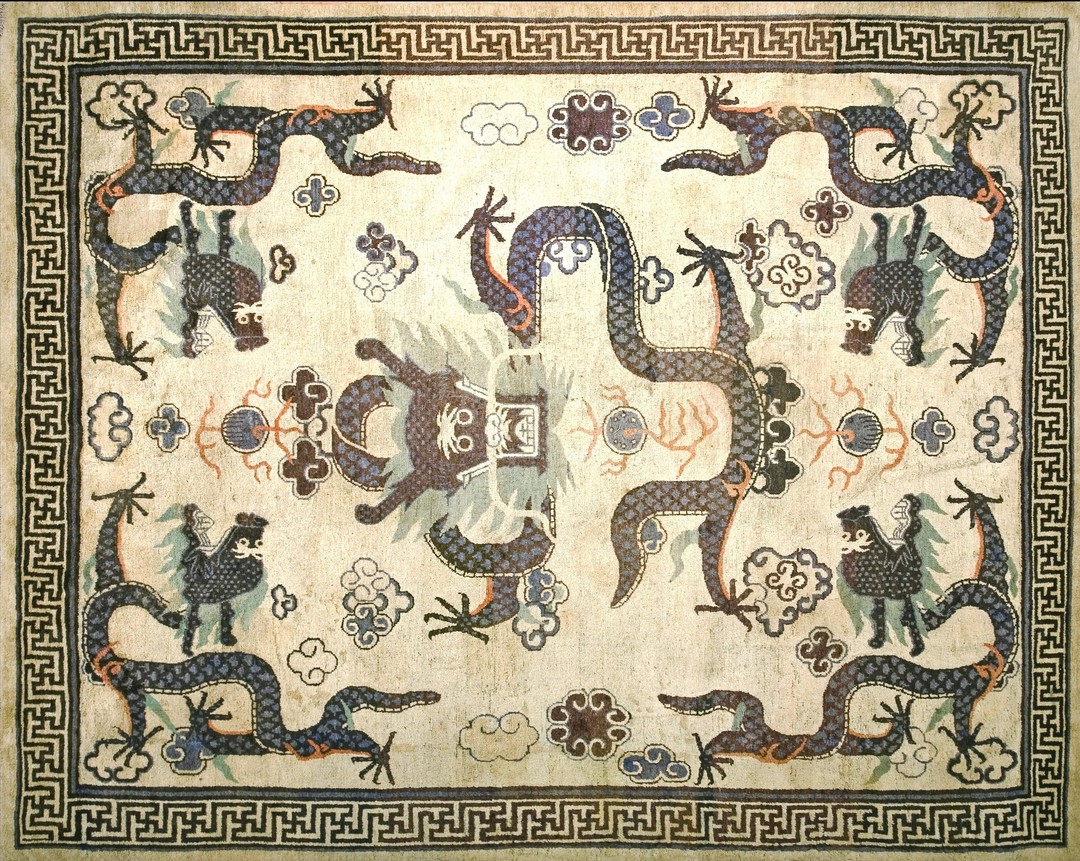
Antique Chinese – Mongolian Chinese Ivory 1900s Rug – by Rugs On Net
Techniques: Knotted, Flatweave, Embroidery
- Knotted pile rugs — Why: Their vertical knot structure produces crisp, dimensional lines that make the angular turns of the Greek key rug construction stand out with clarity.
- Flatweave or kilim rugs — Why: Without pile, these textiles emphasize sharp, graphic edges, ideal for showcasing a running dog border with minimal distortion.
- Embroidered rugs and textiles — Why: The motif can be delicately stitched, allowing fine borders with a lightweight, decorative finish suited for tapestries or accent pieces.
The adaptability of the Greek key to multiple weaving methods reflects its compatibility with the textile grid. Whether scaled large or reduced to a narrow guard border, the continuous line translates naturally into woven form.
What Materials Best Highlight Greek Key Lines in Rugs?
The clarity of the Greek key pattern depends heavily on material choice. Wool running dog borders are bold and resilient, with wool’s durability and excellent dye absorption providing strong contrasts and long-lasting definition.
Silk Greek key rugs, by contrast, excel in sharpness and luster, making their angular lines shimmer with precision—though this luxury comes at the cost of increased delicacy. Cotton is also frequently used, particularly in flatweaves, where its firmness supports clean geometric articulation.
Does the Greek Key Pattern Affect a Rug’s Knot Density?
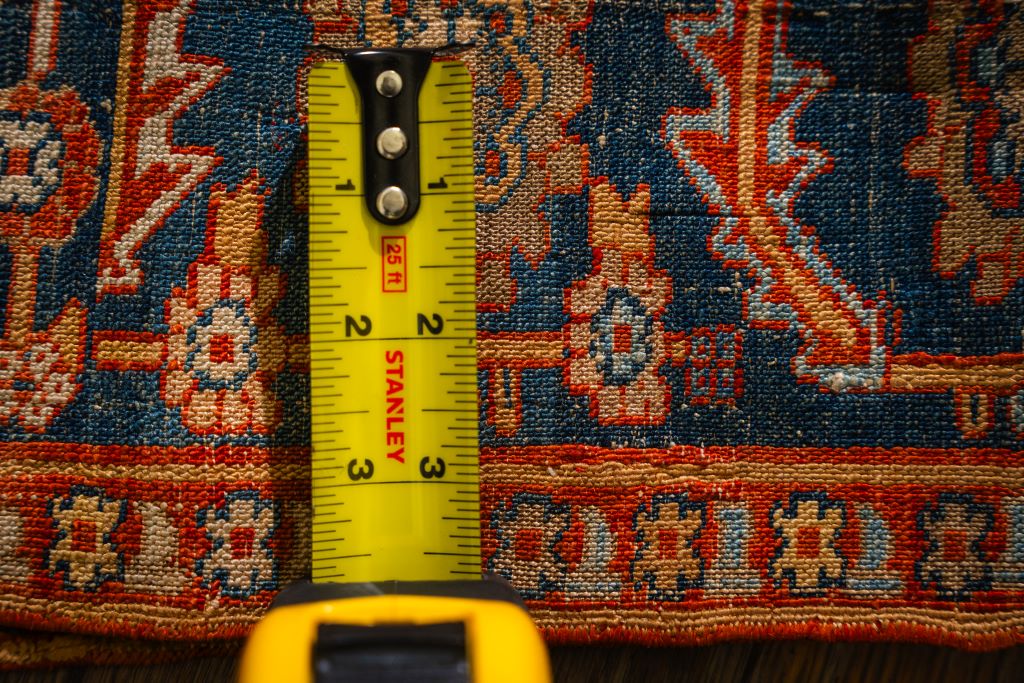
A detailed inspection of a richly colored oriental rug pattern while measuring its dimensions.
The motif itself does not impose restrictions on knot density. The Greek key rug construction adapts to both coarser tribal pieces with low density and refined city carpets with high density.
In lower knot counts, the design appears bolder and more abstract; in higher densities, the turns and spacing are rendered with fine detail. Ultimately, knot density determines the sharpness of execution, not the feasibility of weaving the motif.
Are Silk Greek Key Rugs More Prone to Visible Wear?
Yes. While silk Greek key rugs are prized for their lustrous precision and ability to highlight crisp geometric lines, they are more vulnerable to visible wear than wool counterparts.
The raised areas of the pattern—the “highs” of the pile—tend to show abrasion more quickly. This means silk rugs are often best suited for low-traffic areas, display purposes, or as collectors’ pieces rather than everyday floor coverings.
Are Hand-Loomed Greek Key Carpets Cheaper Than Hand-Knotted Versions?
Hand-loomed vs. hand-knotted construction creates a clear price and quality distinction. Hand-loomed (including tufted or woven without knots) Greek key carpets are generally cheaper to produce, making them more accessible but less durable over time.
In contrast, hand-knotted Greek key rugs carry greater value, prestige, and longevity, with tightly tied knots ensuring both structural integrity and crisp execution of the meander border. Collectors and connoisseurs typically favor hand-knotted versions for their durability and artistic merit.
The Technical Strength of the Motif
Because of its grid-friendly geometry, the Greek key is one of the few motifs equally at home in tribal flatweaves, urban workshop carpets, and modern tufted textiles. Wool emphasizes strength and boldness, silk emphasizes elegance and precision, and knot density simply determines the refinement of the final image.
Whether woven by hand on a traditional loom or adapted for machine production, the motif’s endless line retains its visual strength and symbolic depth.
Market Value, Collecting & Modern Design
How Should I Assess Price Premiums for Antique Greek Key Rugs?
The Greek key rug value of antiques depends on a mix of age, condition, rarity, regional origin, and the clarity of the border execution. Well-preserved examples with strong dyes and intact borders can command significant premiums.
Rugs from regions like the Caucasus or Anatolia that showcase the running dog motif in authentic 19th-century weaving often attract the highest bids at auctions.
Collectors should also consider provenance and workmanship: a finely knotted rug with a precise meander border will always hold more value than a loosely woven or worn example.
Should Black-and-White Greek Key Raise Future Resale Value?
The popularity of black-and-white Greek key rugs stems from their bold, graphic contrast, which aligns well with modern interior design. While these pieces may enjoy high demand among trend-driven buyers, their long-term resale value depends less on color and more on authenticity, quality, and craftsmanship.
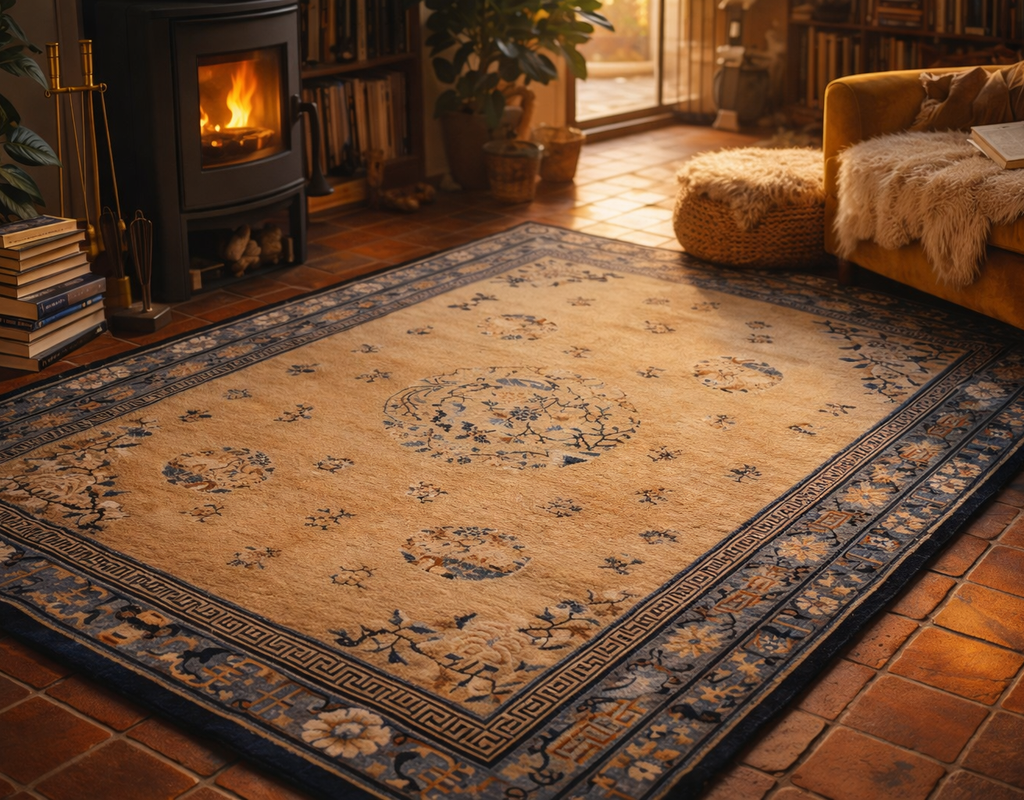
The rich texture and warm tones of the Oriental-style rug enhance the inviting atmosphere of this reading nook by the fire.
Antique rugs in classic palettes hold steadier value over time, whereas contemporary black-and-white versions may rise or fall with fashion cycles. For investors, the safe bet lies in genuine antique examples, while bold modern colorways appeal primarily to style-conscious decorators.
Does a Double Greek Key Border Increase a Rug’s Appraisal?
Yes. A double Greek key border (or double meander) increases both the visual complexity and the technical challenge of weaving, often enhancing a rug’s appraisal. The added symmetry and depth can set a piece apart, particularly in antique examples where dual borders are less common.
For collectors, these details signify both greater artistic intent and a higher degree of craftsmanship, often justifying a premium over single-bordered rugs.
Where Can Collectors Find Rare Running Dog Caucasian Runners Today?
Authentic running dog antique runners from the Caucasus are highly sought after and increasingly rare. Collectors can find them at specialty rug auctions, through reputable dealers, or at vintage rug fairs that cater to serious buyers.
Occasionally, rare examples surface in estate sales or private collections, but most reliable acquisitions occur through trusted sources with clear provenance. The rarity of long runners with intact Caucasian borders makes them especially prized among connoisseurs.
When Is the Best Time to Buy Greek Key Rugs?
Timing can influence both availability and price. The best time to buy Greek key rugs is often late summer, when market demand tends to dip and dealers are more flexible in pricing.
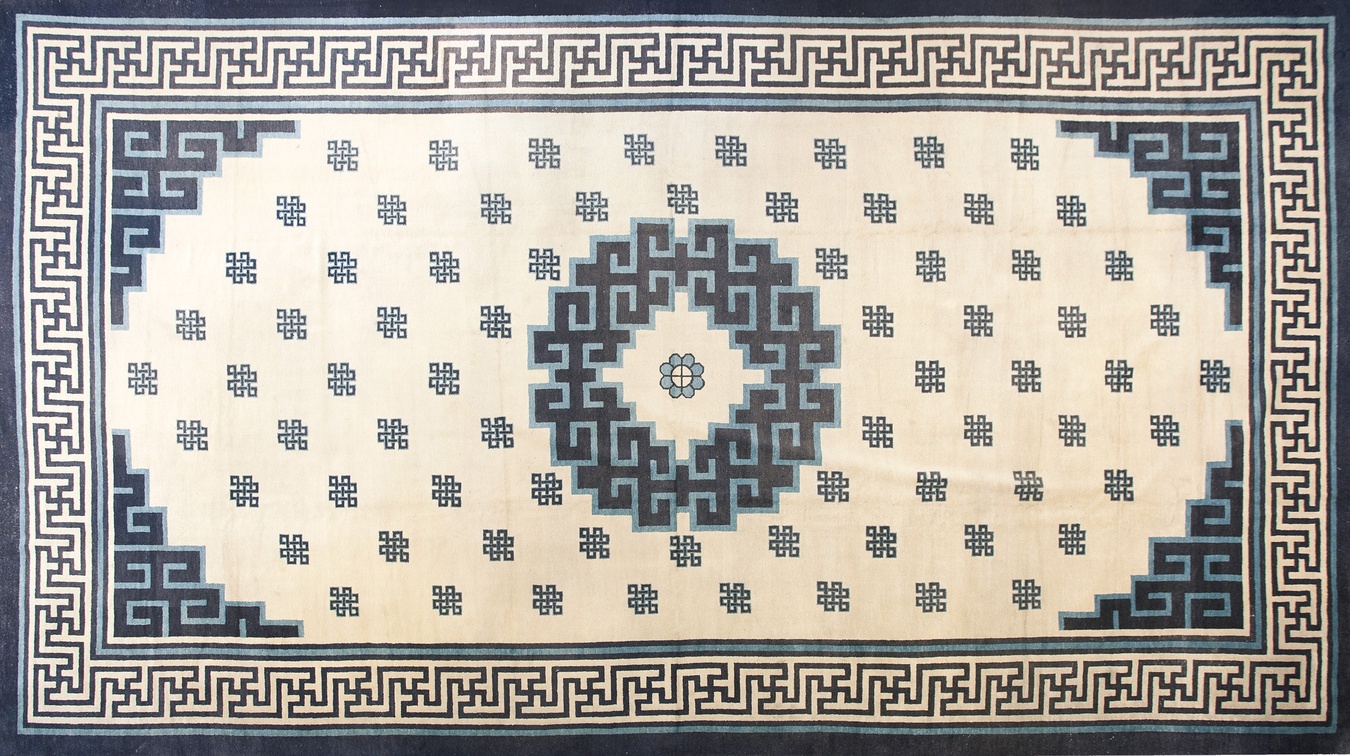
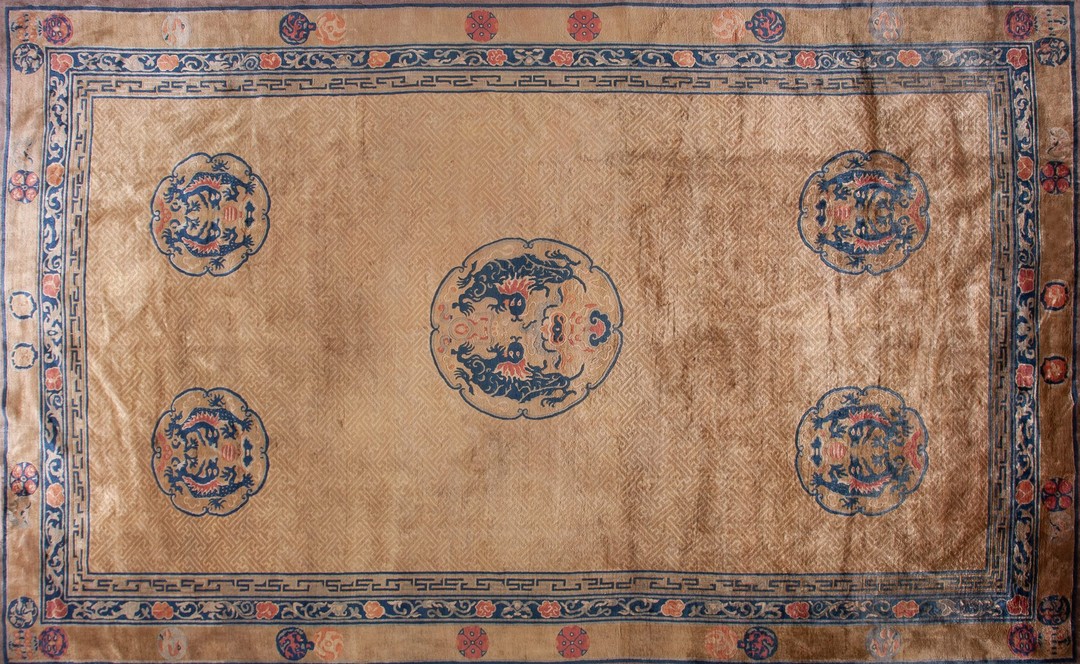
Antique Oversized Chinese – Mongolian Knotted Rug – by Rugs On Net
Another ideal moment is when new shipments arrive at dealers or importers, as early buyers have first access to fresh inventory. For antique collectors, auctions scheduled outside peak holiday seasons may also offer opportunities to secure rare pieces at more favorable prices.
Balancing Collectibility and Modern Appeal
For today’s market, antique and rare runners with strong provenance command the highest premiums. Unique features—such as black-and-white palettes or a double Greek key border—may raise a rug’s collectibility, but their true value lies in authenticity and craftsmanship.
Meanwhile, modern versions remain popular for their bold design, with resale value tied more to décor trends than investment longevity. Whether buying for heritage or style, collectors benefit most by choosing the right source at the right time.
Styling and Interior Applications
Can Running Dog Borders Pair Well with Minimalist Contemporary Interiors?
Yes. The minimalist Greek key design is especially effective in modern spaces because of its repetitive geometry and clean, linear structure. The running dog border frames open fields with order and balance, making it an excellent fit for uncluttered interiors. In neutral palettes, it provides subtle sophistication; in bold contrasts, it becomes a striking graphic accent.
Designers often favor the motif because it bridges classical heritage and modern geometry, allowing a room to feel both timeless and fresh. A modern Greek key rug can harmonize with pared-down furniture, serving as the structured anchor that grounds a minimalist space.
Why Do Designers Favor Oversized Greek Key Motifs in Large Rooms?
In expansive interiors, a large-scale or oversized running dog rug creates visual impact that smaller motifs would lose in proportion. By enlarging the meander, designers establish a bold focal point that helps define zones within open-plan layouts.
Oversized motifs also recall the grandeur of neoclassical architecture and the drama of modernist graphic design, making them ideal for entry halls, great rooms, or dining spaces. The rhythm of the pattern both anchors the floor and echoes the scale of the room, ensuring the décor feels balanced rather than dwarfed by empty space.
Can Machine-Washable Rugs Replicate Traditional Greek Key Fretwork Successfully?
Machine-washable rugs can indeed reproduce the washable Greek key pattern using digital printing or jacquard weaving. Success depends on the clarity of the lines: a well-executed washable rug will maintain the crisp right-angled turns that define the motif.
However, while durable synthetics can achieve the look, they lack the depth, texture, and luster of traditional wool or silk rugs. For households prioritizing practicality, washable Greek key designs allow everyday use without sacrificing classical style. For collectors and design purists, however, they remain functional imitations rather than heirloom-quality pieces.
Bridging Heritage and Modern Living
The Greek key motif adapts to interiors with remarkable flexibility. As a minimalist Greek key border, it integrates seamlessly into contemporary spaces. As an oversized running dog rug, it transforms large rooms into statements of grandeur.
And in washable versions, it combines ancient symbolism with modern convenience. Whether in silk, wool, or synthetic blends, the enduring geometry of the meander continues to inspire designers who seek both structure and style.
Care, Patina & Maintenance
What Cleaning Methods Prevent Fading of Indigo Greek Key Borders?
Indigo border care requires particular attention, as indigo dyes—especially in older rugs—are prone to fading if treated harshly. For routine upkeep, gentle vacuuming is best, avoiding beater bars that can pull at fibers or weaken the pile.
When spills occur, blot with a clean cloth rather than rubbing, and use only a pH-neutral soap diluted in water. Strong detergents, bleach, or alkaline cleaners will strip the vibrancy from indigo, leading to uneven tones.
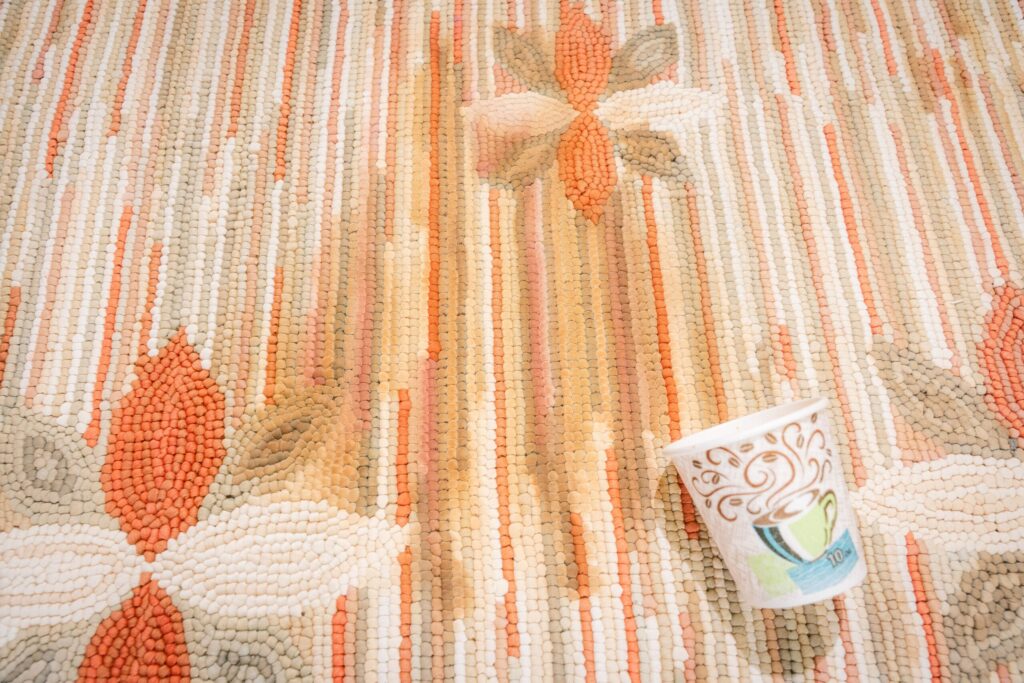
Close-up view of a tipped paper coffee cup resting on a handwoven wool rug, highlighting the rug’s dense pile, subtle color variations, and traditional geometric motifs in warm neutral and terracotta tones.
Keeping the rug out of direct sunlight also helps prevent gradual fading. For antique or vintage rugs with indigo Greek key rug borders, professional cleaning by specialists is strongly recommended, as they can stabilize dyes and handle fragile fibers without damaging the intricate meander design.
How Does Dye Source Influence Patina in Vintage Greek Key Rugs?
The rug patina of a Greek key motif depends heavily on whether the dye is natural or synthetic. Natural indigo, derived from plant sources, develops a rich, layered patina over decades. Its tones often deepen, showing subtle shifts of blue that are highly prized by collectors.
Synthetic indigo, introduced in the late 19th century, lacks the same depth and tends to fade more uniformly or even lose vibrancy altogether, which can diminish a rug’s value. This distinction is crucial in appraising vintage Greek key rugs: pieces woven with natural indigo not only display more character as they age but also command higher esteem in the market.
The Value of Aging Gracefully
Patina is not considered damage but rather a sign of authenticity and life. The way an indigo meander border matures—whether glowing with natural depth or fading under synthetic dyes—affects both aesthetics and collectibility.
Proper Greek key rug cleaning preserves this evolution, allowing the border to retain its symbolic strength and visual clarity for generations. In the world of textiles, patina is part of the story, a reminder that the continuous line of the meander reflects not just eternity but the passage of time itself.
Quick Reference: Identifying and Buying Greek Key Rugs
Visual ID Checklist
- Unbroken line with right-angled turns — Why: The essence of the Greek key is its continuous, angular spiral; breaks or irregular turns usually indicate poor weaving or imitation.
- Border placement — Why: Genuine running dog borders typically frame the rug rather than fill the field, serving as a structured “finish.”
- Symmetry and proportion — Why: Authentic designs maintain balance, with each meander echoing the next; uneven spacing signals lower craftsmanship.
- Positive and negative space clarity — Why: In true Greek key rug designs, the light and dark areas alternate cleanly, emphasizing the rhythm of the motif.
- Antique vs. modern execution — Why: Antique versions often have subtler dyes and finer line work, while modern rugs may use oversized scales, bold contrasts, or digital reproduction techniques.
Actionable Buyer Tips
- Buy from reputable dealers or auctions — Why: Established sellers provide provenance and reduce the risk of misrepresented pieces.
- Check knot density and materials — Why: Higher knot counts and premium fibers (wool, silk) add value and ensure longevity.
- Assess dye sources — Why: Natural dyes, particularly indigo, age gracefully and enhance rug patina, while synthetics may fade more quickly.
- Compare regional variations — Why: Understanding distinctions—such as Caucasian running dog borders versus Chinese thunder patterns—helps determine authenticity and fair value.
- Inspect design clarity — Why: The sharpness of the meander line directly reflects both weaving quality and long-term desirability.
The Takeaway
A quick Greek key rug checklist—unbroken spirals, border placement, symmetry, and clean positive/negative space—offers instant guidance for spotting genuine designs.
Combined with informed buying practices like verifying materials, dyes, and provenance, these running dog border tips help collectors and homeowners alike invest wisely, ensuring both satisfaction and enduring value.
Explore a Few of Our Favorite Greek Key Rugs
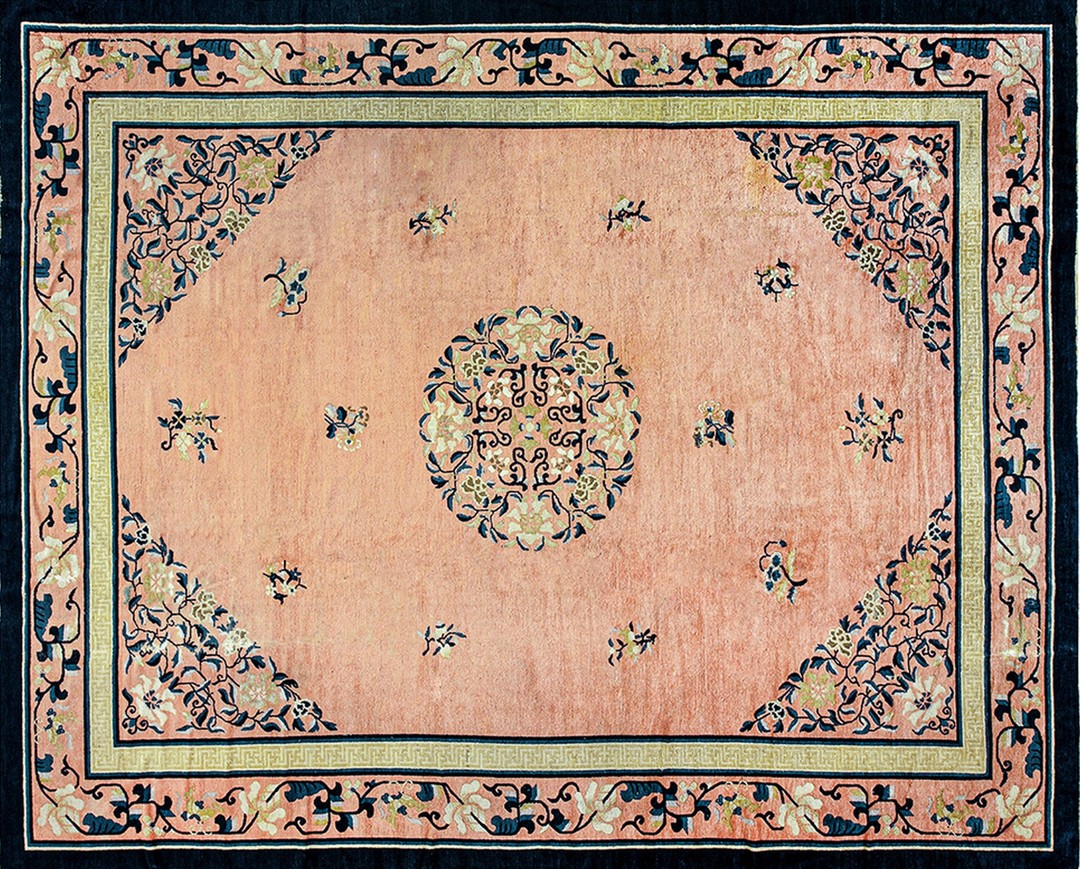
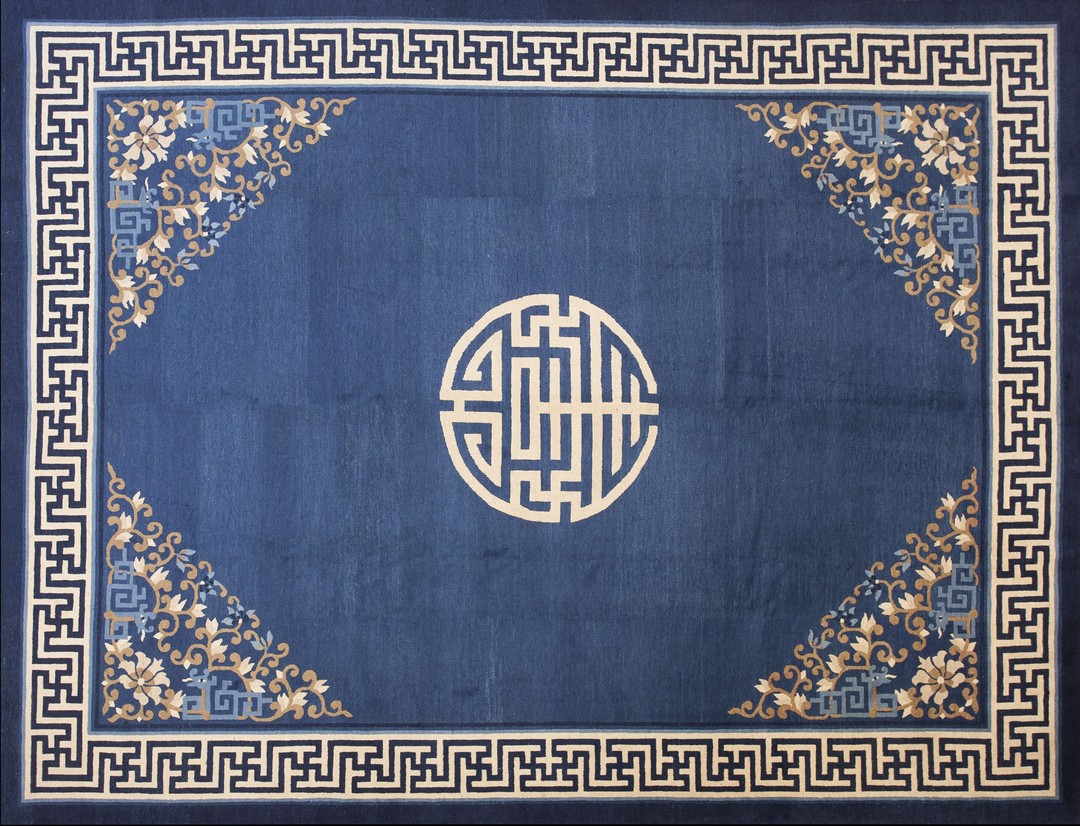
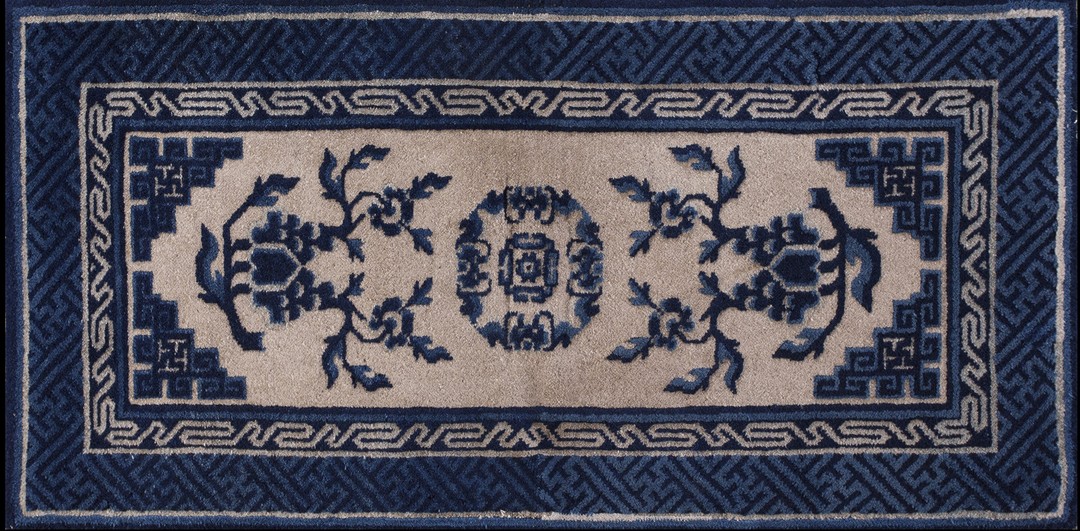
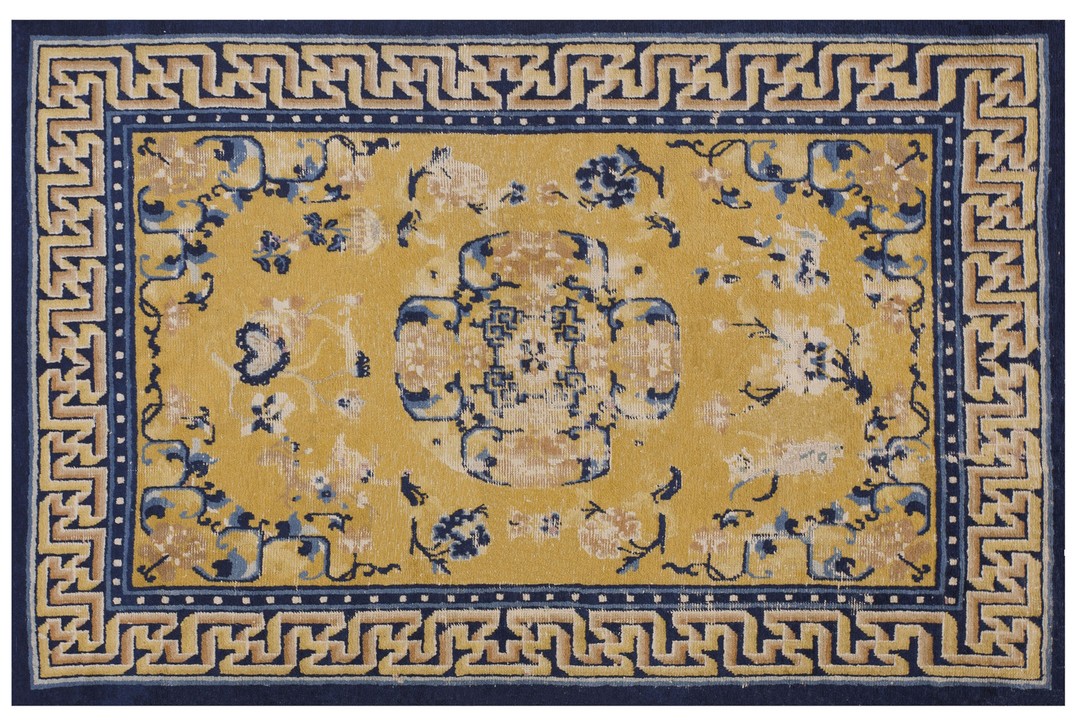
FAQ
- How do I assess quality in a Greek key rug?
Check that meander corners meet cleanly at 90° and repeats are consistent. On hand-knotted Greek key rugs, crisp outlines and balanced guard stripes indicate careful weaving.
- Can I customize a Greek key or running dog rug?
Many makers offer custom Greek key rugs—choose field color, border width, and size. Common lead times are 6–14 weeks for hand-tufted and longer for hand-knotted.
- What rug pad works best under a Greek key flatweave?
Use a 1/8–1/4 inch felt-and-rubber pad to prevent slippage and telegraphing. It keeps Greek key borders lying flat and reduces corner curl on kilims.
- Are there eco-friendly Greek key rugs?
Yes—undeyed wool Greek key rugs, recycled-PET flatweaves, and natural-rubber pads reduce synthetics. A wool kilim with a meander border offers durability with minimal shedding.
- Will robot vacuums snag on Greek key rugs?
The motif won’t; fringe might. For Greek key rugs with fringe, tuck or use a no-fringe edge bind, and set a “no-go” zone if your robot supports mapping.
- Are Greek key rugs trendy or timeless?
Timeless. Greek key rugs cycle through popularity but persist across centuries. A neutral meander border stays relevant even as furniture styles change.
- Why do some Khotan or Chinese Art Deco rugs use Greek key borders?
These traditions adopted classical motifs through trade and revival styles. You’ll see Greek key borders around open fields or lotus medallions in 1920s Chinese Art Deco and Central Asian Khotans.
- What’s the history behind running dog borders on rugs?
Running dog rug borders descend from classical architecture’s wave scrolls. They traveled into textiles via Greco-Roman decorative arts and re-surfaced strongly in Neoclassical and Art Deco carpets.
- Which colors are classic for Greek key rugs?
Black/white, navy/ivory, and gold/blue are enduring Greek key combinations. For softer rooms, beige/ivory meanders frame the space without stark contrast.
- Are outdoor Greek key rugs a good idea?
Yes—outdoor Greek key rugs in polypropylene handle moisture and UV. Hose off to clean; many dry within a day when elevated for airflow.
- How do I mix Greek key rugs with other patterns?
Pair Greek key rugs (large-scale geometry) with small-scale stripes or fine florals. Keep one palette anchor—e.g., navy/cream—in both rug and textiles to avoid clashing.
- Can I use a Greek key runner on stairs or hallways?
Absolutely—Greek key runners add direction and rhythm. Common hallway sizes are 2’6”x8’–12’; ensure the meander aligns straight to walls for the cleanest look.
- Will a Greek key rug make a small room feel busy?
Not if scaled right. Choose a narrow Greek key border and low-contrast colors; a light field with gray meander keeps the perimeter defined without overpowering a 10×12 ft room.
- What size Greek key border rug works under a sofa?
For Greek key rugs, aim for 8×10 so front sofa legs sit on the field and the border remains visible. In compact rooms, a 6×9 can frame a loveseat plus coffee table.
- How much do Greek key rugs typically cost?
Machine-made Greek key rugs can start under \$200 for 5×7; hand-knotted wool 8x10s often run \$1,500–\$5,000+. Vintage Khotan or Chinese Art Deco pieces can reach five figures depending on condition.
- Are Greek key rugs good for homes with pets or kids?
Yes—choose low-to-medium pile and speckled or mid-tone Greek key borders to disguise mess. Solution-dyed polypropylene versions resist stains; wool naturally repels moisture for easier blotting.
- How do I clean a wool Greek key rug safely?
Vacuum with suction only (no beater bar) and blot spills with water plus mild detergent. Professional wash every 12–18 months helps preserve the meander lines and border contrast.
- Are Greek key rugs durable for high-traffic spaces?
Wool Greek key rugs handle foot traffic well thanks to natural resiliency. For busy entryways, look for dense pile (e.g., \~90–150 knots per square inch or tight flatweave) and a sturdy rug pad.
- Which materials show Greek key or running dog motifs most crisply?
Hand-knotted wool Greek key rugs render sharp corners best; flatweave kilims also keep edges crisp. Hand-tufted works are bolder but slightly softer at turns; printed synthetics look sharp yet feel thinner.
- Do Greek key border rugs fit modern interiors?
Yes—Greek key rugs add crisp geometry to minimal rooms. A tone-on-tone meander in gray or beige keeps it subtle, while black-and-white borders create graphic contrast around a sofa grouping.
- Which rug traditions feature Greek key borders most?
Greek key rugs appear in Khotan/Samarkand, Chinese Art Deco, Turkish Oushak, and modern kilims. Look for meander borders framing open fields; Khotan pieces often mix meanders with pomegranate or medallion motifs.
- What does the Greek key motif on rugs symbolize?
Greek key rugs commonly symbolize continuity and unity, echoing a labyrinth’s unbroken path. Many designers use it to “ground” a room, visually tying furniture together around the border.
- Are Greek key rugs and running dog rugs the same?
No—Greek key rugs use angular meanders; running dog rugs use curved wave scrolls. They’re related classical borders and sometimes appear together, e.g., a meander main border with running dog guard stripes.
- What is the running dog (Vitruvian wave) pattern on rugs?
The running dog rug motif is a scrolling wave border of repeating S-curves. Think rhythmic crests; you’ll often see it as a guard stripe flanking a wider border on classical and Art Deco rugs.
- What is the Greek key (meander) rug motif?
A Greek key rug motif is a continuous right-angled line forming a repeated “key” border. It’s often used to frame fields; even on 8×10 rugs, the meander typically runs around all four edges.