
What “Rug Size” Means and Why It Matters
Definitions: Size, Aspect Ratio, Orientation
In rug scholarship, rug sizes are more than simple width and length. It is a compound of dimensions, aspect ratio in rugs, and the assumed orientation. A 6 × 9 foot carpet, for example, may be oriented either lengthwise or sideways, but the design often dictates which direction was intended.
In weaving terminology, size is tied to the loom’s capacity: warp threads establish length, while the weaver sets the width.
Interior terminology, by contrast, measures size in terms of floor coverage and fit within architectural spaces. Rug dimensions defined in catalogues always list width first, then length, yet many collectors note that weavers historically conceived rugs with length as the dominant measure.
Aspect ratio—whether a rug is nearly square, elongated like a runner, or somewhere in between—affects the entire rug design. A broad rectangle allows for medallions and balanced borders, while a narrow runner stretches motifs into linear repeats.
Orientation is therefore not arbitrary; it governs how a composition reads and how patterns scale across the surface.
 Wide Gallery Rugs |  Hallway Runner Rugs |  Small Scatter Rugs |  Large Oversized Rugs |  Room Size Rugs |
The “Wabi-Sabi” of Hand-Knotted Sizes
One of the most important things to understand about luxury rugs is that they are rarely perfectly symmetrical. Due to the varying tension of the weaver’s hands and the natural “draw” of the warp threads, a rug may vary in width by an inch or two from one end to the other.
This “imperfection” is actually a certificate of hand-made authenticity. If you are planning a built-in floor “well” for a rug, always wait until the rug arrives and measure its widest point before finishing the flooring.
Rug Market Size Rarity
| Rug Format | Region | Approx. Dimensions | Market Rarity / Value Marker |
|---|---|---|---|
| Dozar | Persia | 4’6″ x 6’6″ | Common (The “standard” versatile accent rug) |
| Square | Global | 8’x8′ / 10’x10′ | High (Specialized looms; Designer premium) |
| Kelleh (Gallery) | Persia | 6′ x 18′ | High (Sought after for loft & hallway transitions) |
| Oversized Ghali | City Workshops | 12′ x 18’+ | Very High (Requires multi-weaver teams; Investment tier) |
| Yastik | Turkey | 1’6″ x 3′ | Common (Excellent entry-level collectible) |
Historical vs. Modern Naming
Pre-modern weaving cultures rarely used inches or feet. Instead, they relied on traditional rug sizes names that encoded both measurement and function. In Persian practice, a dozar referred to a rug roughly two “zar” long, a unit close to 105 centimeters, producing a piece about 4½ × 6½ feet.
Larger carpets were called ghali, while elongated formats like kelleh (gallery carpets) could stretch up to 20 feet. These terms conveyed more than raw dimensions: they suggested where a rug was placed in a household or mosque, and how it was used.
By contrast, today’s market operates on modern rug sizes standards expressed in feet and inches (e.g., 8 × 10, 9 × 12). These numerical labels prioritize consumer clarity but obscure the cultural layers embedded in older names. The shift from zar-based systems to standardized Western measures mirrors the broader global integration of rug commerce.
Functional Effects: Use, Aesthetics, Value
- Use in space: Larger rugs can visually anchor a seating area, while small mats emphasize intimacy or serve ritual functions. — Why: Size dictates how a rug interacts with furniture and circulation paths.
- Aesthetics: A big surface allows intricate borders and complex central medallions, while small pieces highlight clarity and directness of pattern. — Why: Scale governs how rug patterns are perceived and whether details are legible.
- Value and cost: Bigger rugs consume more material and time, driving up price, while small weavings may be equally prized for fineness or portability. — Why: Labor intensity and wool or silk quantity rise in direct proportion to area.
- Display feasibility: Museums like the Victoria and Albert Museum use specialized rigs for monumental carpets such as the Ardabil, whose 34 × 17 foot size requires strict display protocols. — Why: Oversized rugs present logistical challenges in mounting, lighting, and conservation.
The Economics of Rug Sizes: Why Dimensions Drive Value
While it is easy to assume a 9×12 size area rug costs more than an 8×10 simply because of “more wool,” the value of a rug is often tied to the logistical difficulty of its size.
Examples:
- The “Loom Width” Premium: In traditional village weaving, looms were rarely wider than 10 or 12 feet. Any antique rug exceeding these dimensions required a specialized “City Workshop” setup, which involved professional designers and a team of multiple weavers. This transition from a “home craft” to a “commissioned masterpiece” is why oversized rugs (12×15 size area rugs and up) carry a much higher price per square foot.
- The Rarity of the Square: True square rugs (e.g., 11×11 size rugs) are significantly rarer than rectangles. Because weavers naturally work in a vertical orientation, a square rug requires an exceptionally wide loom that remains underutilized for length. This inefficiency in the workshop makes square formats a “designer luxury” with a typical price premium of 15-20%.
- The “Kelleh” (Gallery) Value: Historically, the Kelleh (long, wide gallery rug) was the centerpiece of a wealthy Persian home. Today, these are the “secret weapon” for modern lofts. Because they don’t fit standard 8×10 size rugs or the 9×12 retail molds, they are highly sought after by decorators for transition spaces, often holding their resale value better than standard “room sizes.”
Conservation Implications by Size
Size is not neutral in preservation. Large carpets are difficult to move, clean, or store without stress to their structure, while small textiles are more easily handled but prone to distortion if over-mounted. Size interacts with fiber resilience: heavier rugs strain under their own weight, while smaller ones may suffer from curling or edge wear.
Conservation specialists must therefore tailor their methods—rolling, suspending, or sectionally displaying—according to the rug’s footprint.
Cultural Meanings Attached to Size
In many traditions, rug dimensions carried symbolic meaning. A small prayer mat, sized to fit a kneeling body, was inseparable from devotional practice. Monumental carpets in Safavid Iran proclaimed royal power by their sheer scale. Square or circular pieces often marked ceremonial spaces or echoed architectural geometry.
These associations underscore that rug size is both technical and cultural: it encodes not only weaving constraints but also societal values. Dimensions often defined whether a rug was domestic, tribal, or ceremonial.
Practical Design Questions
When buying rugs, people often ask if a large rug can make a small room feel bigger. The answer is yes: an expansive rug that runs wall-to-wall creates a unified field, reducing visual fragmentation.
Conversely, too small a rug can make furniture appear awkwardly placed. For round rugs, placement is guided by orientation of use. A circular carpet typically sits centered under a coffee table, with at least some portion extending beyond to anchor surrounding chairs—aligning with principles discussed earlier on in the section on rug origins and spatial roles.
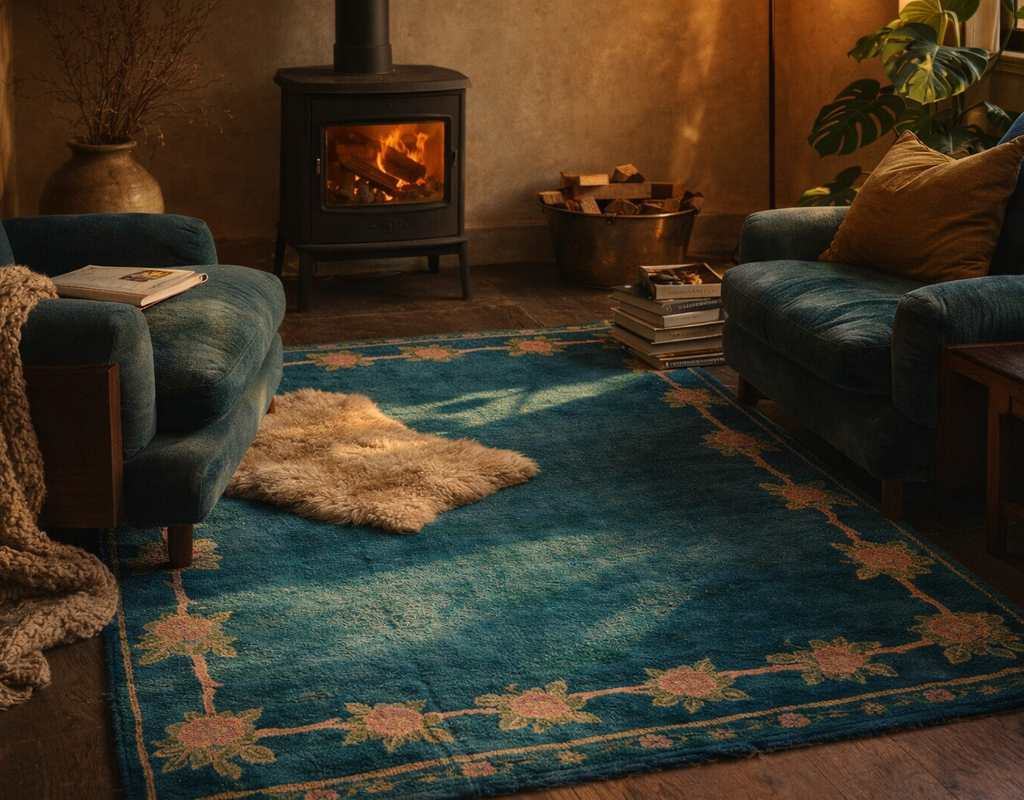
Key Insight: Rug sizes encompass dimensions, aspect ratio, orientation, and cultural meaning. From traditional rug size names like dozar to modern rug size standards in feet and inches, these measures shape design, function, conservation, and value.
Don’t Forget the “Fringe Factor”
When measuring your room, remember that the industry standard for rug size (e.g., 8′ x 10′) almost always refers to the piled area only. It does not include the fringe (tassels). A traditional hand-knotted rug can have 3 to 6 inches of fringe on each end.
If you are placing a rug in a doorway or between two pieces of heavy furniture, add at least 10 inches to your length measurement to ensure the fringe doesn’t get caught or curled against the wall.
Traditional Size Systems by Region
Persian Rug Size Names
Persian weavers developed a precise vocabulary of rug size names based on the unit zar (≈105 cm):
- A dozar size rug measured roughly 130–140 × 200–210 cm, the standard family room carpet.
- A zaronim (“one and a half zar”) was about 105 × 157 cm, a more compact piece often used in smaller interiors.
- The sedjadeh (≈125–130 × 200–300 cm) carried strong associations with prayer use and private devotion.
- At the monumental end, the ghali (about 190 × 280 cm or larger) designated full carpets, while a kelleh or gallery carpet extended to 150–200 × 300–600 cm, intended for palace corridors and long reception halls.
- Narrow kenareh runners, usually 80–120 × 250–600 cm, flanked the sides of a room or mosque, echoing architectural proportions.
These terms remind us that Persian rug dimensions defined more than numbers: they encoded household functions, ceremonial contexts, and architectural fit.
Anatolian and Turkish Formats
In Anatolia, rug size terminology reflected daily religious and domestic needs. A Turkish seccade measured about 120–140 × 160–175 cm. This was the classic prayer carpet, sized to fit an individual worshipper with an architectural mihrab motif woven at the head.
A yastik, by contrast, was a small cushion rug, 40–60 × 70–110 cm, placed beneath pillows or used as covers in homes. Turkish seccade yastik sizes emphasize that rugs were not just for floors but also integral to furniture and ritual practice.
Central Asian Traditions
Turkmen weaving cultures employed distinctive formats tied to nomadic dwellings. A main carpet typically measured 6 × 8–10 ft, forming the centerpiece of a yurt’s floor. The ensi, about 4 × 6 ft rug size, was designed as a door hanging, woven with symbolic motifs marking thresholds.
Storage and transport textiles like the torba and chuval were smaller panels or bags, serving functional roles within the portable household economy. These formats reveal how rug dimensions mirrored the requirements of mobile life and tent architecture.
Chinese Carpets
Chinese weaving followed different architectural logics. Kang carpet dimensions—roughly 6½ × 11½ ft—were designed for raised brick platforms (kang) used for seating and sleeping. Pillar rugs were woven as long, narrow strips to be wrapped around architectural columns in temples and palaces.
These pieces embody how rug sizes corresponded to architectural elements rather than open floor space. Such specialized dimensions reflect the unique relationship between Chinese interior design and textile function.
Moroccan Berber Household Sizes
Moroccan Berber carpet weavers produced household area rugs in sizes generally ranging 5–7 × 10–13 ft.
- Generous length suited them to long rooms in mud-brick houses. — Why: Their scale harmonized with elongated floor plans.
- Intermediate width allowed flexibility for communal seating. — Why: Rugs doubled as bedding or gathering spaces.
- Consistent proportions anchored domestic rituals such as eating and storytelling. — Why: The rug formed both a practical covering and a symbolic hearth.
Unified Considerations: Borders and Proportions
Regardless of tradition, rug sizes were conceived in dialogue with architecture. Narrow formats like runners and galleries answered the needs of elongated corridors and mosques. Kang mats and Turkmen ensi rugs embodied responses to distinct dwelling structures.
This practical link also guides modern interior design: leaving a floor border around a rug is recommended, typically 12–24 inches in a large room or 6–12 inches in smaller rooms. The border creates visual balance, much as historic terms once tied carpets to the rhythm of walls, platforms, or doorways.
Reference Table: Traditional Size Systems
| Term | Region | Typical Dimensions | Usage/Function |
|---|---|---|---|
| Dozar | Persia | 130–140 × 200–210 cm | Standard household carpet |
| Zaronim | Persia | 105 × 157 cm | Small rug; compact interiors |
| Sedjadeh | Persia | 125–130 × 200–300 cm | Prayer and private devotion |
| Ghalī | Persia | ≈190 × 280 cm or larger | Full carpets; palatial settings |
| Kelleh | Persia | 150–200 × 300–600 cm | Gallery corridors, long halls |
| Kenareh | Persia | 80–120 × 250–600 cm | Runners for room sides, mosques |
| Seccade | Turkey | 120–140 × 160–175 cm | Prayer rug with mihrab |
| Yastik | Turkey | 40–60 × 70–110 cm | Cushion or pillow rug |
| Main Carpet | Turkmen | 6 × 8–10 ft | Floor centerpiece in yurts |
| Ensi | Turkmen | 4 × 5 ft | Door hanging with symbolic motifs |
| Torba | Turkmen | Variable; bag face | Storage and decoration |
| Chuval | Turkmen | Variable; larger bag panel | Transport/storage textile |
| Kang Mat | China | ≈6½ × 11½ ft | Platform covering for seating/sleeping |
| Pillar Rug | China | Long, narrow strip | Wrapped around temple or palace columns |
| Berber Room Rug | Morocco | 5–7 × 10–13 ft | Communal household covering |
Key Insight: Regional systems of rug sizes—whether dozar size, Turkish seccade yastik sizes, kang carpet dimensions, or Berber room formats—were rooted in local units and daily life. Runners, galleries, kang mats, and ensi rugs all demonstrate how architecture and culture shaped the vocabulary of rug dimensions.
Loom Technology and Mobility Constraints
Horizontal Ground Looms and Nomadic Width Limits
Among nomadic weavers, the horizontal ground loom was the most practical tool. Staked directly into the earth, it could be dismantled and reassembled during seasonal migrations. Yet these looms imposed strict dimensional restrictions.
The width of the rug was determined by the maximum span a weaver could comfortably reach across the warp. This constraint meant that horizontal ground loom limits kept rugs relatively narrow, while length could be extended by advancing the weft in strips. Such rugs often evolved into runners or elongated mats, ideal for tent floors and portable dwellings.
Vertical Workshop Looms and Scalability
By contrast, vertical loom scalability allowed for monumental carpets in settled urban workshops. With the warp stretched between top and bottom beams, weavers could roll the finished section around the lower beam, exposing new areas to continue weaving. This rolling warp system meant that rug length was theoretically unlimited.
Width expanded with larger beams and teams of weavers working side by side, enabling the production of oversized carpets like the Safavid masterpieces. These workshop looms marked a leap in both artistic ambition and technical possibility, freeing weavers from the reach-based restrictions of nomadic practice.
Panel and Strip Weaving with Seamed Joins
When cultural or architectural needs exceeded loom capacity, weavers turned to panel-woven rugs. Rugs were woven in halves or long strips and then joined with careful stitching. This method is documented in Persia, Anatolia, and Central Asia, producing carpets that appear seamless when completed.
| Method | Regions | Pros | Cons |
|---|---|---|---|
| Half-weaving and seaming | Persia, Anatolia | Allowed wider rugs beyond loom limits | Joins may weaken under stress; requires skillful stitching |
| Strip weaving | Morocco, Central Asia | Flexible for portable looms; modular scale | Visible seams; design continuity harder to maintain |
| Whole-cloth weaving | Urban workshops | Stronger, unified structure; continuous design | Requires fixed, immobile loom and more space |
Seaming solved structural problems but left faint lines in design continuity, a compromise between technical limits and cultural demand for larger textiles.
Portability Versus Scale
Portability dictated dimensions as much as aesthetics. Nomadic tribes needed looms that could be carried on pack animals, forcing narrow and elongated formats.
Conversely, urban centers built permanent looms capable of producing broad, palace-sized carpets. This balance between mobility and scale reflects how social structure—migratory or settled—directly influenced rug dimensions.
Loom Setup and Workspace Limits
- Staked ground area: The physical space available to drive stakes or mount a frame constrained maximum rug size. — Why: Nomadic camps had limited flat ground for large looms.
- Weaver reach: Width was capped by the distance hands could cross the warp. — Why: Reaching beyond arm span reduced precision and increased strain.
- Beam length: Urban looms could be constructed as wide as available timber allowed. — Why: Stronger beams supported greater warp tension and broader carpets.
- Team coordination: Larger looms required multiple weavers. — Why: Synchronization ensured even tension and consistent knotting.
- Ceiling height: Workshop ceilings restricted the maximum vertical stretch. — Why: Taller ceilings permitted larger warp setups and longer rugs.
Practical Alignment in Interiors
Modern owners often ask if rugs should be rotated to align with the longest wall. The principle holds true: orienting a rug lengthwise with the longest axis of a room enhances proportion and flow, echoing the architectural harmony sought by historic weavers. Orientation affects not only visual balance but also the legibility of the design.
Key Insight: The type of loom—horizontal or vertical—sets the maximum practical rug size. Mobility demanded compromises, while urban stability encouraged scale. Where limits arose, seamed halves and panel weaving offered ingenious solutions, ensuring that cultural demands for dimension were met despite structural constraints.
Architecture and Intended Use Shape Dimensions
Room Ensembles in Persian Interiors
In Qajar and earlier Persian interiors, carpets were not placed randomly but arranged as ensembles tailored to room architecture. The farsh kenareh kelleh layout defined a canonical plan: a large farsh or head carpet covered the principal zone, while kenareh runners lined the sides of the room, and a kelleh or gallery carpet anchored the head of the chamber.
This arrangement mirrored the rectangular proportions of Persian domestic and ceremonial halls. By harmonizing carpet proportions with wall lines, architects and weavers created integrated interiors where textiles acted as both decoration and spatial definition.
Nomadic Tents and Yurts
Among nomadic groups, rug dimensions were adapted to the portable geometry of tents and yurts. The central main carpet, often about 6–7 feet square, served as the anchor of the dwelling.
Around it, smaller storage weavings such as torba and chuval filled in edges and complemented the core textile. Here, architecture dictated that rugs be compact, modular, and easily rolled, reflecting the mobility requirements of pastoral life.
Worship Formats
Religious practice further standardized carpet dimensions. A prayer rug was woven to fit a single worshiper, often about 120–140 × 160–175 cm, with a mihrab niche marking the head.
For communal devotion, the saf prayer carpet size expanded this idea into a horizontal format, featuring multiple niches arranged in a row. Safs allowed groups of worshipers to align side by side while maintaining individualized spaces. The repetition of niches illustrates how religious ritual translated directly into standardized rug proportions.
Chinese Palaces and Pillars
Chinese weaving developed unique dimensions that responded to imperial architecture. Gallery carpet dimensions in palatial halls were designed to cover vast spaces, while pillar rugs were specially woven as elongated strips to wrap around the bases of massive wooden columns.
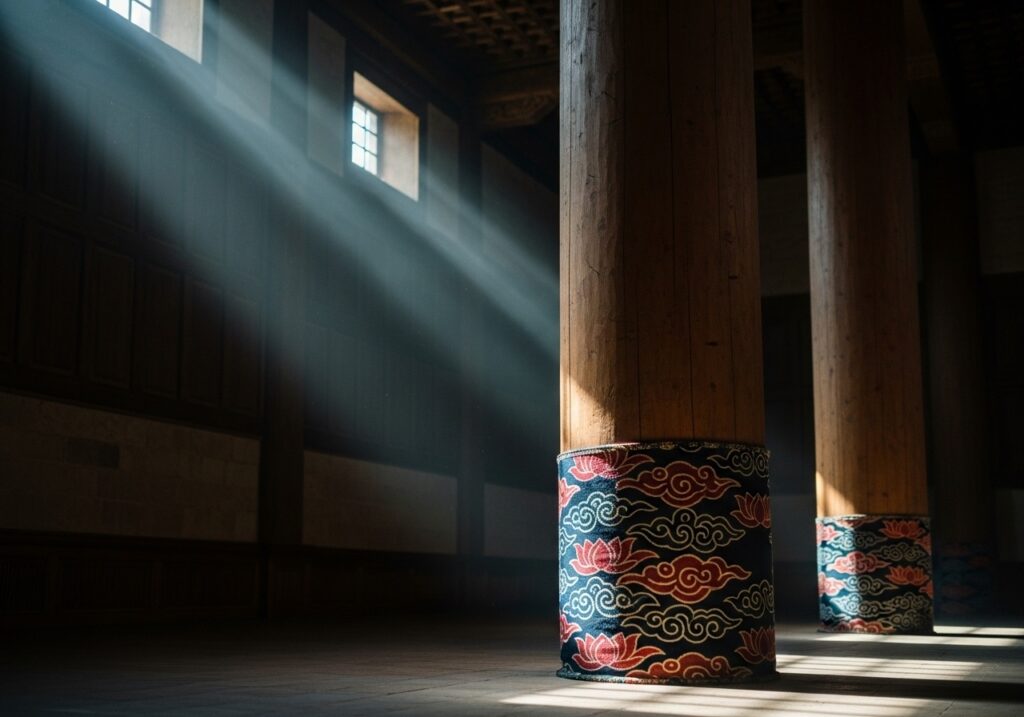
This adaptation underscores how Chinese rugs were conceived not as stand-alone furnishings but as structural complements to the palace interior, binding textile to architecture in form and function.
Museum-Scale Palace Carpets
Monumental carpets demanded by royal and sacred spaces reached extraordinary scales.
- Ardabil Carpet: At 34 × 17½ feet, this shrine commission demonstrates how weaving could match monumental architecture. — Why: Its size unified an entire prayer hall and required innovative display protocols.
- Safavid and Mughal palace carpets: Designed for vast halls, sometimes stretching over 50 feet in length. — Why: These reinforced royal prestige through sheer scale and intricacy.
- Ottoman Topkapi examples: Long carpets woven for audience chambers. — Why: Their dimensions aligned perfectly with ceremonial architecture.
These carpets are now conserved under stringent museum conditions, often displayed horizontally or on inclined platforms due to their immense weight and fragility.
Unified Considerations of Placement
A common question arises: is it better to use one oversized rug or multiple smaller rugs in a room? Oversized carpets can create unity, making a space feel expansive and coherent. Multiple smaller rugs, however, allow for flexible zoning but risk fragmenting the visual field. Historically, both strategies coexisted: ensembles of farsh, kenareh, and kelleh created cohesion through coordination, while monumental palace carpets relied on single-piece dominance.
Key Insight: Architecture dictates formats and proportions. From the farsh kenareh kelleh layout of Persian rooms to saf prayer carpet sizes, from nomadic yurts to Chinese palaces, rug dimensions were inseparable from the spaces they were designed to serve. Monumental palace carpets, like the Ardabil, demonstrate how weaving scaled to meet architectural grandeur.
How Size Dictates Layout and Composition
Motif Scaling for Small vs. Large Fields
Designing a rug always begins with scale. Motif scaling in rugs must match the available field; otherwise, designs appear truncated or disproportionate. In small rugs, the field usually accommodates a single focal point—such as a central medallion, a boteh repeat, or a mihrab niche.
By contrast, large carpets can sustain multiple medallions, extended lattices, or true allover patterns where motifs repeat without truncation. Museums such as the V&A emphasize that faithful scaling preserves both legibility and harmony across the textile surface.
Border Planning and Corner Resolution
Borders are not neutral frames—they consume valuable real estate. On smaller rugs, weavers often reduced the number of guard stripes to preserve field space. Larger rugs allowed a full suite of outer, main, and inner borders without overwhelming the design. Border corner resolution—the alignment of motifs at right angles—also varies with size.
In finely woven urban carpets, planned cartoons ensured smooth corner turns; in village pieces, improvisation often led to mismatched or cut-off elements. Higher knot counts gave artisans more flexibility to negotiate these junctions, underscoring how size and structure intersected with design precision.
Aspect Ratio Impacts: Runners, Squares, Galleries
- Runners: Elongated aspect ratios required a runner layout strategy, often repeating floral sprays, botehs, or geometric meanders along the length. — Why: Continuous motifs emphasized directional flow and prevented visual gaps.
- Square rugs: Balanced ratios lent themselves to medallion-and-corner compositions or simple lattices. — Why: Centrality worked best in nearly equal dimensions.
- Gallery carpets (kelleh): Wide, elongated formats showcased sequential medallions or longitudinal allovers. — Why: Their dimensions were designed to fill long reception halls without leaving empty stretches.
Workshop Cartoons vs. Village Improvisation
Large workshop rugs were often woven to detailed cartoons (design plans). Cartoons allowed weavers to maintain proportionality across vast surfaces, ensuring motifs scaled coherently and borders turned correctly.
By contrast, village and nomadic weavers relied more on memory and improvisation, particularly in smaller formats. This often produced charming irregularities but also limited the complexity achievable in expansive rugs. Size thus dictated whether design execution leaned toward structured planning or creative spontaneity.
Allover vs. Medallion Strategies
Size also determined layout families. Small rugs gravitated toward single medallions or prayer niches, while large carpets favored allover repeats or multiple medallion chains. Aspect ratio in area rugs interacts with these choices: a long runner practically demands linear allover strategies, while a broad rectangular carpet supports central medallion dominance. These strategies underscore the principle that composition is inseparable from size.
Practical Mistakes in Interior Placement
Owners often wonder why a rug looks “too small” or seems to float in a room. This happens when motifs or borders are scaled down inappropriately for the space. A rug with heavy borders and little central field can appear shrunken, while a rug placed without adequate furniture overlap can float visually. Ensuring motifs scale with field size and allowing proper border proportion in the room avoids this common mistake.
Key Insight: Scale motifs to field size, adjust border counts, and align aspect ratios with layout families. From runner layout strategies to border corner resolution, every element of rug composition responds to dimensions, proving that size is the silent architect of design.
Urban Workshops vs. Nomadic/Village Rugs
City Standardization and Export Targets
From the late nineteenth century onward, urban weaving centers increasingly catered to international buyers. Backed by merchant capital and fixed looms, city workshops produced rugs in precise, standardized dimensions—especially export-size rugs like 8 × 10 and 9 × 12 feet.
These formats aligned with Western room proportions, ensuring carpets could be marketed as ready-made fits for parlors and dining rooms. Urban looms also accommodated greater width and length, so large-scale commissions became feasible. This system cemented the divide between city vs tribal rug sizes, where cities pursued uniformity and commercial precision.
Tribal Variability and Improvisation
By contrast, tribal and nomadic rugs often present village “odd” dimensions. Portable looms constrained width, and weaving was typically done by individuals or small family groups without the aid of cartoons. Rugs were stopped and finished when materials ran out, or when the weaver judged the field complete, producing non-even sizes like 4′7″ × 6′2″. Such pieces reflect practical realities rather than export-driven formulas. Their irregularity is now valued as evidence of authenticity and spontaneity.
Strip-Woven Panels and Stitched Widths
When nomadic or village weavers needed rugs larger than their looms allowed, they used strip-weaving techniques. Kurdish and Shahsavan examples often show strip-woven panels stitched side by side to create broader textiles. This solution allowed communities with small looms to achieve room-sized coverage. However, seams could weaken over time, and design continuity across panels demanded careful planning. Still, the practice reveals the ingenuity of rural weavers in stretching beyond technical limits.
Team Weaving vs. Individual Production
- Urban workshops: Teams of multiple weavers worked simultaneously on wide looms. — Why: Collaborative knotting sped production and kept tension even across broad warps.
- Village and nomadic contexts: Rugs were woven by one or two family members. — Why: Limited labor restricted rug width and length, producing smaller, more personal pieces.
- Capital investment: City producers could fund materials and pay wages. — Why: This financial structure sustained large-scale, consistent production.
- Household orientation: Tribal rugs were made for family use, not commercial uniformity. — Why: Dimensions were shaped by need, not by market expectation.
Market Orientation Versus Household Use
Production goals shaped size as much as loom type. Export-size rugs from cities were intended for sale abroad, their dimensions matching foreign interiors. By contrast, household-oriented tribal rugs fit the domestic spaces of tents, mud-brick rooms, or yurts. This divide highlights how size reflects not only technical capacity but also economic intent.
Unified Consideration: Accent Rug Placement
A frequent modern question is whether a small rug under a coffee table is acceptable. The answer is yes, but with caution. Small accent rugs can work if they overlap surrounding furniture legs to avoid the “floating” look. Historically, village weavings of modest size were placed under functional furniture, while large city carpets dominated entire rooms. The same principles of proportion and anchoring apply today.
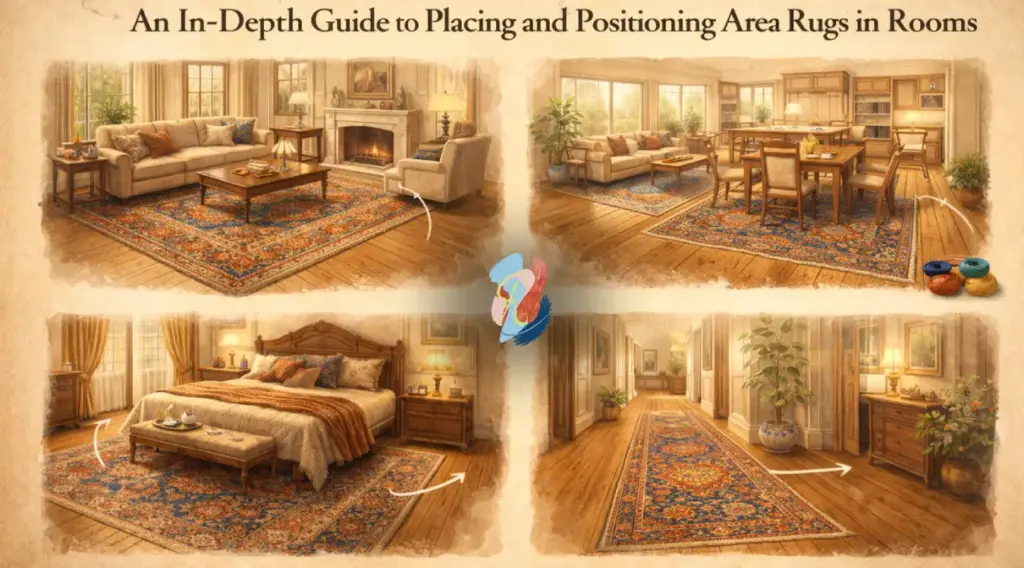
Key Insight: Urban workshops produced standardized, large export-size rugs, while tribal and village weavers generated varied, smaller, sometimes odd dimensions shaped by mobility and household use. Whether stitched panels or team-woven city carpets, production structure determined rug size as much as cultural context.
Modern Standard Sizes and Typical Uses
Core Sizes in Today’s Market
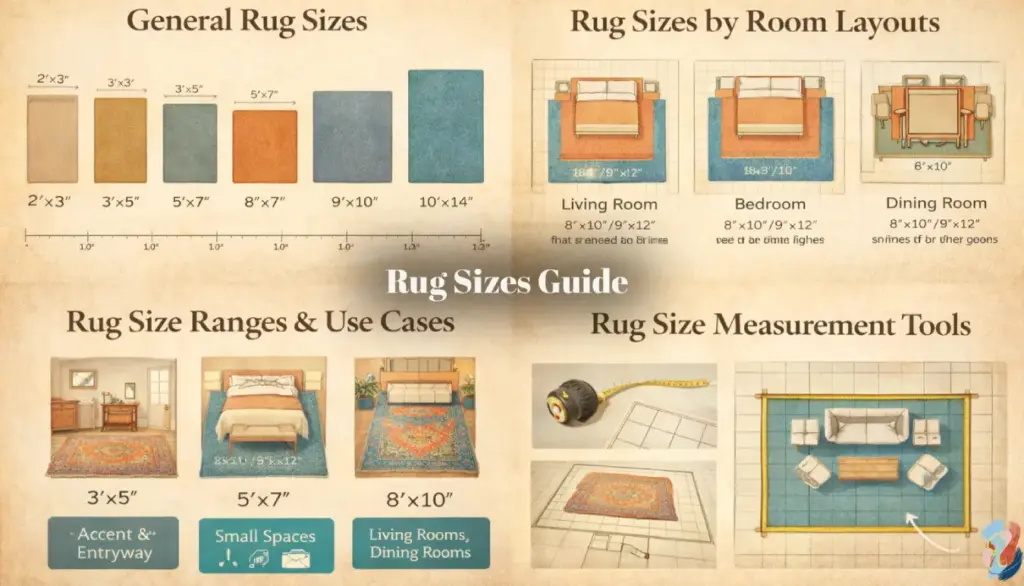
The rug industry today revolves around a set of modern rug size standards that cover most domestic layouts.
Typical offerings include:
- × 3 ft: Door mats, kitchen or bath accents. — Why: Small, portable, and easy to clean.
- × 5 ft: Entryways, bedside, or small offices. — Why: Provides functional coverage without overwhelming compact areas.
- × 6 ft: Under coffee tables in tight spaces. — Why: A balance between accent and anchoring size.
- × 8 ft: Starter living room or bedroom rug. — Why: Large enough to define a space, but affordable.
- × 9 ft: Medium bedrooms, dining areas for 4–6 chairs. — Why: Offers proportional fit in standard builder homes.
- × 10 ft: Versatile choice for most living rooms and dining rooms. — Why: A go-to size for anchoring sectionals and full dining sets.
- × 12 ft: Formal living and dining layouts. — Why: Provides extra extension under sofas or tables, preventing furniture “float.”
- × 14 ft / 12 × 15 ft: Oversize category. — Why: Fits open-plan layouts or great rooms, offering museum-scale presence.
Why 8×10 and 9×12 Dominate
When comparing an 8×10 vs 9×12 rug, both are industry favorites because they align with standard furniture footprints. An 8×10 usually accommodates a sofa and coffee table, with front legs of armchairs included. A 9×12 extends further, allowing all furniture legs to sit fully on the rug, creating a unified grouping.
For dining rooms, these sizes leave adequate border space around chairs when pulled out. Early export workshops targeted these “American sizes” to align with modular room dimensions in builder homes, which explains their ongoing dominance.
Oversize and Custom Categories
Beyond 10 × 14 and 12 × 15, oversize rugs are either custom-made or produced in limited runs. They suit open-plan lofts, ballrooms, and expansive great rooms. While costly, they eliminate the need for multiple smaller rugs, creating a seamless field. Custom ordering allows precise tailoring to unique spaces or unusual furniture arrangements, a practice echoing palace commissions of the past.
Rounds and Runners in Modern Planning
Round rugs serve specialized but crucial functions. Round rug placement works best beneath circular dining tables, in foyers, or under statement chandeliers, where geometry aligns. Runners remain essential for circulation spaces. Typical runner sizes for hallways are 2½–3 feet wide and 8–14 feet long. They efficiently cover corridors, galley kitchens, and stairways, directing flow while protecting flooring. Both rounds and runners adapt traditional elongated or circular concepts to modern design planning.
Reference Table: Modern Sizes and Uses
| Size (ft) | Metric (approx.) | Best Rooms/Layouts |
|---|---|---|
| 2 × 3 | 60 × 90 cm | Doorways, kitchens, bathrooms |
| 3 × 5 | 90 × 150 cm | Entry, bedside, compact offices |
| 4 × 6 | 120 × 180 cm | Coffee tables, layered arrangements |
| 5 × 8 | 150 × 240 cm | Living starter rug, small dining tables |
| 6 × 9 | 180 × 270 cm | Bedrooms, mid-size dining |
| 8 × 10 | 240 × 300 cm | Most living rooms, sectionals, dining for 6–8 |
| 9 × 12 | 270 × 365 cm | Formal living/dining, open layouts |
| 10 × 14 | 305 × 425 cm | Oversize living rooms, open-plan spaces |
| 12 × 15 | 365 × 455 cm | Great rooms, ballrooms, large dining halls |
| Runners | 75–90 × 240–425 cm | Hallways, kitchens, stairs |
| Round rugs | Ø 180–240 cm | Circular tables, foyers, centered vignettes |
Unified Consideration: Sectional Sofas
A common question is whether an 8 × 10 rug is big enough for a sectional. In most cases, yes, provided the front legs of the sofa rest on the rug and the coffee table is fully contained. A 9 × 12, however, offers better coverage, ensuring the sectional doesn’t dominate the space visually. Geometry and furniture anchoring dictate whether a rug feels integrated or undersized.
Key Insight: Modern rug size standards balance flexibility with function. The dominance of 8×10 and 9×12 rugs reflects their ability to solve most layout challenges, while runner sizes for hallways and round rug placement show how specialized shapes adapt to circulation and symmetry.
Room-by-Room Sizing Rules and Formulas
Living Rooms: Front-Legs and Two-Thirds Rule
The most reliable living room rug size formulas are the front-legs rule and the two-thirds rule. In the front-legs approach, the rug extends under the front legs of sofas and chairs, unifying the seating group without demanding oversized dimensions. The two-thirds rule suggests that the rug should cover about two-thirds of the seating area, anchoring the furniture ensemble without overwhelming the room.
For small living rooms, a 5 × 8 ft or 6 × 9 ft rug often suffices, provided it overlaps at least the front furniture legs. If the rug stops short of these contact points, the room feels disjointed and the rug risks looking too small or “floating.”
Dining Rooms: Clearance Beyond the Table
Dining room rug clearance is one of the most critical rules. Always add 24–30 inches beyond the table edges on all sides so that chairs can slide out without catching or snagging on the rug edge. For a 40 × 72 inch table, this means a minimum rug of 8 × 10 ft; larger dining tables often require 9 × 12 ft.
Undersized rugs not only look disproportionate but also create daily frustrations when chair legs tip at the border. The dominance of 8 × 10 and 9 × 12 sizes reflects their ability to handle typical dining layouts effectively.
Bedrooms: Queen and King Guidelines
- Queen bed rug size: Place a 6 × 9 ft rug horizontally so that it extends at least 18–24 inches beyond each side. For more generous coverage, an 8 × 10 ft rug allows nightstands to sit partially on the rug. — Why: Adequate extension creates comfort when stepping out of bed.
- King bed with nightstands: The minimum is an 8 × 10 ft rug, but a 9 × 12 ft provides the best fit, ensuring the rug extends fully under nightstands and the bed frame. — Why: Anything smaller risks looking underscaled for the large footprint of a king bed.
Borders and Walkways
The 18 inch rug border rule frames a room effectively. Leave about 18–24 inches of visible flooring between rug edge and wall in average-sized rooms. In tighter spaces, reduce this to 6–12 inches, but always preserve a visual frame.
For circulation paths, maintain 30–36 inches of clear walkway where possible to prevent tripping and to allow free movement. Borders are not wasted space—they act as a matting effect, showcasing the rug as a deliberate centerpiece rather than a wall-to-wall carpet substitute.
Testing with Floor Tape
Before committing, test proportions with painter’s tape on the floor. Outline the intended rug dimensions and walk around the space. This validates that the rug size complements furniture, allows proper clearance, and maintains the recommended borders. As was earlier emphasized, standard rug sizes exist to match common room modules, but each household should confirm fit through mock-up.
Unified Considerations: Common Questions Answered
- What size rug works for a small living room? Typically a 5 × 8 ft rug size or 6 × 9 ft, provided it overlaps furniture legs.
- What rug size fits under a queen bed best? A 6 × 9 rug size for basics; 8 × 10 for fuller coverage with nightstands.
- What rug size for king bed with nightstands? Minimum 8 × 10, ideally 9 × 12.
- How big should a dining rug be beyond the table? Add 24–30 inches clearance on all sides.
- Should sofa legs sit fully on the rug? Not necessary—front legs on the rug suffice to unify the group.
- How much floor border should I leave around rugs? About 18–24 inches in average rooms.
- How do I use the 18 inch rug border rule? Treat it as a visual frame; avoid crowding walls.
- How do I apply the two-thirds sofa-to-rug rule? Ensure the rug covers at least two-thirds of the seating footprint for proportional balance.
Key Insight: Correct sizing formulas prevent rugs from looking underscaled, floating, or impractical. From living room rug size guides to dining room rug clearance and queen bed rug size standards, proportions and borders govern comfort, aesthetics, and daily use.
Runners, Kitchens, Halls, Stairs, and Round Rugs
Hallway and Stair Runners
The standard hallway runner size ranges from 2½ to 3 feet wide, with lengths typically between 8 and 14 feet. Runners should never cover the entire width of the corridor; instead, leave 3–6 inches of exposed flooring on each side to frame the path.
For stairs, runners are custom-cut to match tread depth and riser height, then secured with padding and optional rods. Because stairs see some of the heaviest foot traffic, professional installation is essential to prevent slipping and uneven wear.
Galley Kitchens and Runner Maintenance
In narrow kitchens, a kitchen runner length of 6–12 feet often suits the space. These rugs provide comfort underfoot during cooking and protect high-traffic flooring. Anti-slip pads are non-negotiable, especially where spills or water may occur. Runners in kitchens should be easy to clean and resilient. Maintenance is as important as placement: washable weaves or low-pile constructions help keep the space sanitary.
Bedside Runner Strategies
Instead of a large rug under the bed, many choose bedside runners. Placed along each side of the bed, these create soft landings without requiring a full-room rug. For queen beds, 2 × 6 ft runners on either side work well; for king beds, 2½ × 7 ft options create balance. This approach reduces cost and allows more flexibility while still adding comfort.
Round Rugs in Foyers and Under Tables
- Round rug under table: Place a round rug directly beneath a circular dining or coffee table, ensuring the rug radius extends at least 24 inches beyond the tabletop to accommodate chair movement. — Why: Prevents chairs from catching edges while maintaining symmetry.
- Foyers: Round rugs serve as welcoming centers in entry halls. — Why: Their geometry softens rectangular architecture and highlights chandeliers or central décor.
- Living layouts: Round rugs under coffee tables provide visual interest in otherwise rectilinear seating plans. — Why: They break linear monotony while anchoring the furniture group.
Sectionals and Chaise Layouts
For sectional sofas, sectional rug size is a frequent concern. A 9 × 12 rug usually provides the best coverage, extending under both arms of the sectional and unifying the arrangement. An 8 × 10 rug may suffice in smaller rooms, provided at least the front legs of the sectional sit on the rug. Rugs that fall short of the seating footprint appear underscaled and disconnected.
Unified Considerations: Function and Flow
Runners, kitchen strips, and stair carpets all serve circulation needs. Their dimensions protect flooring and guide movement, but proportions matter: visible margins keep them elegant, and installation safeguards make them functional.
Round rugs, by contrast, emphasize centering and symmetry, whether in dining rooms, foyers, or lounges. Sectionals require generous rug dimensions to avoid the “floating” effect. Across all these cases, dimensions are as much about visual anchoring as they are about coverage.
Key Insight: Runners must reveal floor margins, stairs require professional fitting, and round rugs must align with table radius. Whether choosing a hallway runner size, a kitchen runner length, or a sectional rug size, proper proportions ensure both beauty and safety.
Size, Time, Materials, and Economics
Knot Density and Weaving-Days Math
The economics of rug size begin with rug knot density time calculations. A rug woven at 100 knots per square inch (kpsi) contains roughly 14,400 knots per square foot. A skilled weaver can tie 7,000–10,000 knots per day, which means completing just one square foot of 100 kpsi carpet can take multiple days.
At higher densities, production slows dramatically, and even a modest 8 × 10 rug may represent many months of sustained effort. This time investment explains why finer pieces are prized not only for clarity but also for the labor embedded in every square inch.
Team Weaving and Production Timelines
Large carpets demand collective effort. In historic workshops, teams of weavers worked side by side on broad vertical looms, synchronizing knotting row by row. The Ardabil Carpets, for instance, were reportedly woven by ten artisans over approximately four years.
Coordinated labor reduced timelines, but planning, design cartoons, and consistent tension across wide beams added logistical complexity. Large rugs were thus monumental undertakings in both artistry and time.
Material Scaling: Wool, Silk, Dye
Raw material costs scale directly with size. More square footage requires more wool, silk, and dyestuffs. Yet while fiber and dye usage increase linearly, labor grows faster.
A 9 × 12 silk rug consumes a great volume of material, but its true cost reflects the months or years of knotting required. Even pile height plays a role: denser and taller piles absorb more fiber, raising material budgets.
Market Demand and Pricing Quirks
- Mid-size dominance: Rugs in the 8 × 10 and 9 × 12 range sell fastest in today’s markets. — Why: These sizes align with standard living and dining room layouts.
- Oversized rug market demand: Extremely large carpets often sell for less per square foot. — Why: Few homes can accommodate them, limiting demand despite their monumental labor.
- Per square foot rug pricing: While material cost scales linearly, labor does not. — Why: More weavers, extended timelines, and complex planning make large projects disproportionately expensive to produce, even if resale values lag.
- Small pieces: Accent and collector’s rugs may command high per-foot values. — Why: They are portable, accessible, and often showcase fineness more clearly than sprawling fields.
Unified Consideration: Practical Function
One of the reasons dining chairs snag on undersized rugs is directly tied to dimensions and market use. A rug that does not extend 24–30 inches beyond the table edge leaves chair legs caught at the border.
This everyday frustration highlights how economic “fit” is as much about function as about value: a rug that does not meet its spatial purpose loses both practical and monetary worth.
Key Insight: Rug size drives economics in non-linear ways. While material scales predictably, labor and planning dominate large projects, making monumental rugs disproportionately costly to produce. Yet market fit determines realized value, explaining why mid-size pieces outperform in sales while oversized rug market demand remains limited.
Museums, Collecting, and Display Logistics
Display Rarity of Monumental Carpets
Monumental rugs are seldom exhibited due to their fragility and sheer size. The Ardabil Carpet at the Victoria and Albert Museum is displayed only under strict museum rug display protocol, with illumination cycles carefully limited to reduce dye fading.
Its twin at LACMA has been shown only a few times in decades, emphasizing how size and conservation risks keep such pieces largely in storage. Low light levels, limited exposure durations, and climate control are essential, since oversized rugs cannot be easily rotated or replaced like smaller textiles.
Mounting Methods
Professional mounting of large or fragile rugs uses systems designed to distribute weight evenly. Velcro strips sewn to cotton headers allow the textile to be affixed to walls without piercing its structure.
In more advanced setups, rigid honeycomb panels provide full-surface support, minimizing stress on weakened foundations. Such mounting large carpets ensures stability during display, preventing sagging or tears that might occur under their own weight.
Storage Solutions
When not on view, large carpets are carefully rolled rather than folded. Folding creates permanent creases and fiber breaks, while rolling on wide, padded archival tubes distributes pressure evenly. Proper rolling requires interleaving acid-free tissue layers to protect pile and dyes.
Pest control protocols are also critical: routine inspection, sticky traps, and occasional freezing of infested objects ensure moths or beetles do not cause irreparable loss. These methods exemplify the principle that rolling rugs for storage preserves structure far more effectively than folding.
Best Practice Table: Museum Storage and Display
| Issue | Best Practice |
|---|---|
| Illumination | Limit light cycles; low-lux exposure only |
| Mounting | Velcro headers or rigid honeycomb panel supports |
| Storage | Roll on wide tubes with tissue layers; never fold |
| Pest Management | Inspection, sticky traps, freezing when needed |
| Rotation | Restrict display time to minimize stress and fading |
Private Collecting and Size Practicality
For private collectors, monumental rugs are often impractical.
- Space limitations: Few homes can accommodate carpets exceeding 12 × 15 feet. — Why: Oversized pieces overwhelm residential proportions.
- Mounting complexity: Specialized rigging is required. — Why: Improper hanging can cause structural damage.
- Storage burdens: Large archival tubes and climate-controlled environments are costly. — Why: Long-term preservation requires institutional resources.
- Market value: Smaller or mid-size rugs are easier to resell. — Why: Buyer demand focuses on standard interior sizes.
Unified Consideration: Home Display Nuance
Collectors often ask if a rug should be rotated to align with the longest wall of a room. The same principle used in museums applies: alignment enhances proportion and readability of design. Orienting a rug lengthwise with the dominant axis of the space provides visual flow and prevents a “floating” look, even in private interiors.
Key Insight: Monumental rugs challenge institutions and collectors alike. Size complicates display and rotation, requiring specialized supports and strict light limits. Proper mounting prevents stress tears, and rolling rugs for storage ensures long-term survival—making large-scale carpets both marvels and burdens of the textile world.
Conservation by Size and Contemporary Trends
Stress, Light, and Humidity in Large Rugs
The larger the rug, the greater the conservation challenge. Oversized wool carpets can weigh hundreds of pounds, requiring teams to move them safely. Sharp folds must be avoided, as creasing under such weight breaks fibers irreversibly.
Exposure to light and humidity compounds these stresses: broad surfaces capture more illumination, accelerating dye fading, while uneven moisture can ripple or buckle foundations. Effective care means scaling protocols with size—using multiple handlers, broad rollers, and climate monitoring to prevent cumulative damage.
Layering vs. Single Oversized Rug
The debate between oversized rug vs layering is central in contemporary open-plan interiors. A single massive rug can visually expand a room when correctly proportioned, unifying the space under one continuous field. Yet layering—placing two or more medium-sized rugs—solves practical issues: it defines zones, eases cleaning, and allows rotation.
Layering also reduces replacement costs, since one section can be updated without re-furnishing the entire room. For open kitchens and living spaces, layering often achieves better flow than committing to a single oversized piece.
Custom Sizes for Sectionals and Chaises
Custom production is increasingly used to resolve proportion challenges.
- Sectionals: Commission rugs slightly larger than standard 9 × 12 to ensure all sectional legs rest securely on the field. — Why: Prevents underscaled appearance and creates cohesion.
- Chaises: Extend rug width to capture both the sofa base and chaise projection. — Why: Avoids awkward “floating” chaise ends that break the grouping.
- Irregular rooms: Custom cuts allow rugs to follow alcoves or built-ins. — Why: Tailoring solves architectural quirks standard sizes cannot.
Common Mistakes and Modern Fixes
Several recurring placement errors undermine interiors:
- Floating rugs: Choosing rugs too small for the furniture footprint. — Fix: Use custom size rugs open-plan or apply the front-legs/two-thirds rule.
- Wall-to-wall look: Oversized rugs flush to walls. — Fix: Maintain 18–24 inch floor borders to frame the space.
- Dining snags: Rugs stopping short of chair clearance. — Fix: Add 24–30 inches around table edges.
- Ignoring furniture geometry: Circular tables on square rugs. — Fix: Use rounds or ovals to echo shape.
Unified Consideration: Contemporary Questions
- Is oversized rug placement better than multiple smaller rugs? In formal or great rooms, yes—a single oversized piece unifies space. In open-plan layouts, layering smaller rugs often proves more functional.
- Are layered rugs still in style this year? Yes. Layering remains a strong trend, especially with natural textures (jute base, patterned accent), offering flexibility and modern character.
- What mistakes make rugs look too small or floating? Rugs that fail to overlap furniture legs or leave unframed negative space shrink a room visually. Proportions must anchor furniture to the rug.
Key Insight: Care and design choices scale with size. Oversized rugs demand rigorous handling, while layering solves open-plan challenges. Ultimately, custom size rugs in open-plan layouts prevent mistakes like the floating rug look, ensuring both longevity and aesthetic balance.
FAQ
- What are the most common mistakes people make with rug sizes?
Choosing too small is #1. Follow the 18-inch border guideline, keep front furniture legs on the rug, and avoid entry rugs so thick they impede doors.
- Are round living room rug sizes a good idea for small conversation nooks?
Yes—6- or 8-foot rounds neatly center chairs around a small table. Keep at least the front legs of seating on the rug.
- How do I use rug sizes to define zones in open-concept spaces?
Size each rug to its zone—e.g., 9×12 for seating, 8×10 for dining—while keeping 12–18-inch walkways clear between areas.
- For a home office, what rug sizes work under a rolling chair?
A 5×8 or 6×9 typically fits desk and chair fully on the rug. Leave 18–24 inches from walls and choose low pile for easy rolling.
- What kids’ room rug sizes balance play space and furniture?
A 5×8 or 6×9 usually covers a play zone and bed edge. Leave some floor perimeter (12 inches or so) for toy bins and pathways.
- Do rug sizes change cleaning costs much?
Yes—pros often charge by area, about \$2–\$8 per square foot. An 8×10 could run roughly \$160–\$640; ask local cleaners for precise quotes.
- What stair runner rug sizes should I consider for standard stairs?
Common runner widths are about 26–33 inches. On \~36–42-inch stairs, that leaves attractive reveals on both sides.
- What bathroom rug sizes are most common?
Typical bath rugs are 2×3 at the sink, 3×5 for larger zones, and 2×6 runners along vanities. Always use a non-slip backing.
- What coffee table layout works with living room rug sizes?
Use a rug wider than the coffee table and place front sofa/chair legs on it. In many setups, an 8×10 hits both goals comfortably.
- Do larger rug sizes actually make rooms look bigger?
Yes—bigger rugs visually expand and unify a room. Undersized pieces shrink the space; sizing up to 8×10 or 9×12 often fixes this instantly.
- Should rug pad sizes match the rug exactly?
No—choose a pad 1–2 inches smaller on all sides (up to 3 inches for thick rugs). That prevents curling and keeps the pad invisible.
- Which outdoor rug sizes work for patios and balconies?
For small bistro sets, try 3×5 or 5×7; for seating groups, 8×10 or 9×12. At minimum, keep front furniture legs on the rug and about 12 inches to edges.
- What kitchen runner rug sizes fit between cabinets and an island?
Leave roughly 6 inches of bare floor along cabinet edges. Popular runner lengths are 6–8 feet, extending slightly past the island length.
- How do I size hallway runner rug sizes for a typical 3-foot-wide hall?
Pick a runner 2–3 feet wide, leaving about 4–6 inches of floor on each side. Lengths of 6–12 feet are common, stopping 6–12 inches before doorways.
- What entryway rug sizes work without blocking doors?
A 2×3 works for single doors; a 3×5 suits larger foyers. Choose low pile and confirm door clearance (often about 1/2–3/4 inch).
- For a sectional, what living room rug sizes keep the layout proportional?
Aim for 9×12 for most sectionals and ensure at least the front legs sit on the rug. A two-thirds sofa-to-rug proportion helps avoid a “shrunk” look.
- For twin and full beds, what bedroom rug sizes make sense?
Use a 5×8 for a twin and a 6×9 for a full. Tuck the rug under the lower two-thirds of the bed for balanced coverage.
- What rug size fits a king bed, given typical bedroom rug sizes?
A 9×12 is the go-to for a king bed. In smaller rooms, 8×10 is the minimum to keep walk-off area on both sides.
- What rug size is best under a queen bed, considering bedroom rug sizes?
An 8×10 usually fits a queen bed with nightstands. In tighter rooms, a 6×9 can work if placed two-thirds under the bed.
- Which round rug sizes fit common round dining tables?
Keep 24 inches beyond the tabletop. A 48-inch table typically needs an 8-foot round; a 60-inch table often calls for a 9–10 foot round.
- What dining room rug size should I choose so chairs don’t catch?
Add at least 24 inches beyond the tabletop on all sides so chairs slide freely. For six chairs, 8×10 is common; for eight chairs, consider 9×12.
- How much visible floor should I leave around area rug sizes in closed rooms?
Follow the “18-inch rule”: leave about 18 inches of floor around the rug. In tight rooms, 12 inches can still look balanced.
- What rug sizes work best for small living rooms without crowding the space?
A 5×8 or 6×9 usually anchors a sofa-and-coffee-table layout. Keep front furniture legs on the rug and maintain a 12–18 inch border if possible.
- How do I pick a living room rug size that actually fits my furniture and avoids “floating” rug sizes?
Choose a rug large enough for at least the front legs of all seating; most living rooms use 8×10 or 9×12. Leave roughly 12–18 inches of floor at the walls.
- What are the standard area rug sizes most people start with when comparing rug sizes?
Typical area rug sizes are 2×3, 3×5, 4×6, 5×8 (or 5×7), 6×9, 8×10, 9×12, and 10×14; runners are usually 2–3 feet wide and 6–14 feet long.