
Chinese Art Deco rugs are hand-knotted wool carpets woven in Tianjin and Beijing in the 1920s and 1930s, mostly for export to the United States. They are known for bold purple, magenta, teal, blue and green grounds, open fields, and asymmetrical Chinese motifs such as vases and flowering sprays. The finest came from Walter Nichols’s workshops in Tianjin. Rugs On Net holds more than 700 antique Chinese Art Deco rugs, including over 400 Nichols pieces, in New York.
Introduction to Chinese Art Deco Rugs
Explore our stunning selection of luxury Chinese Art Deco rugs and Walter Nichols’ iconic Chinese Art Deco rugs to find the perfect piece for your design vision.
What are Chinese Art Deco Rugs?
Chinese Art Deco rugs are hand-knotted carpets woven in China during the 1920s and 1930s. This period was defined by the Jazz Age’s modernist energy and China’s deep artistic traditions. These pieces marry modern Art Deco design of European origins with centuries-old Chinese imagery, creating a bold new genre of floor art.
Unlike classical Chinese carpets, which often carried symmetrical medallions and restrained color palettes, these rugs introduced open fields, vibrant jewel tones, and asymmetrical motifs.
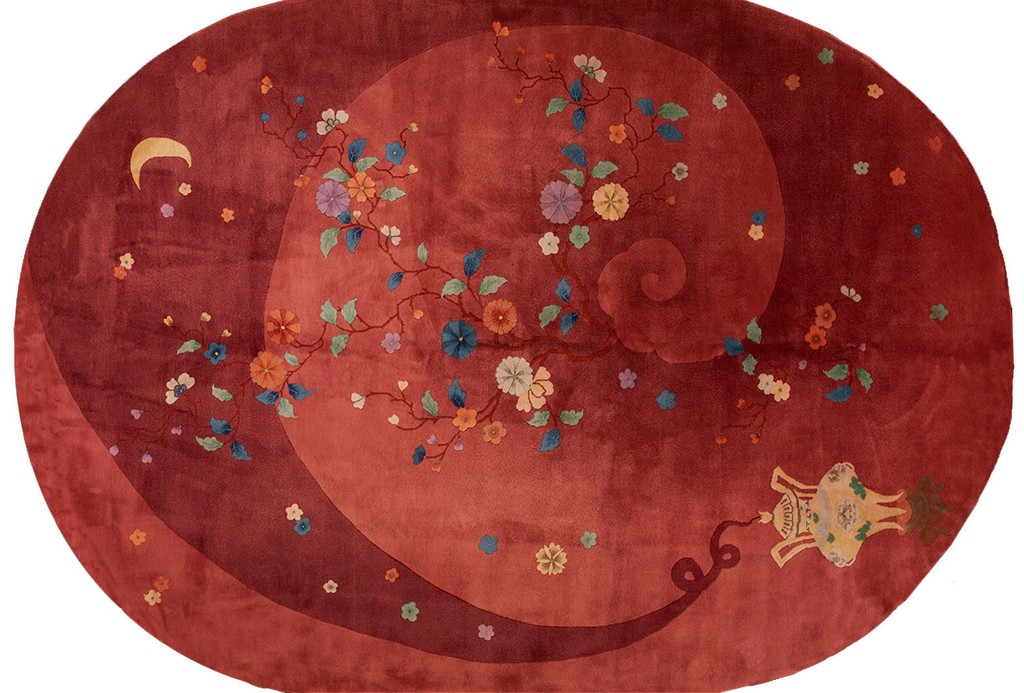
Oval Shape Antique Artistic Swirl Pattern Rustic Red Siena Color Art Deco Chinese Rug by Rugs On Net
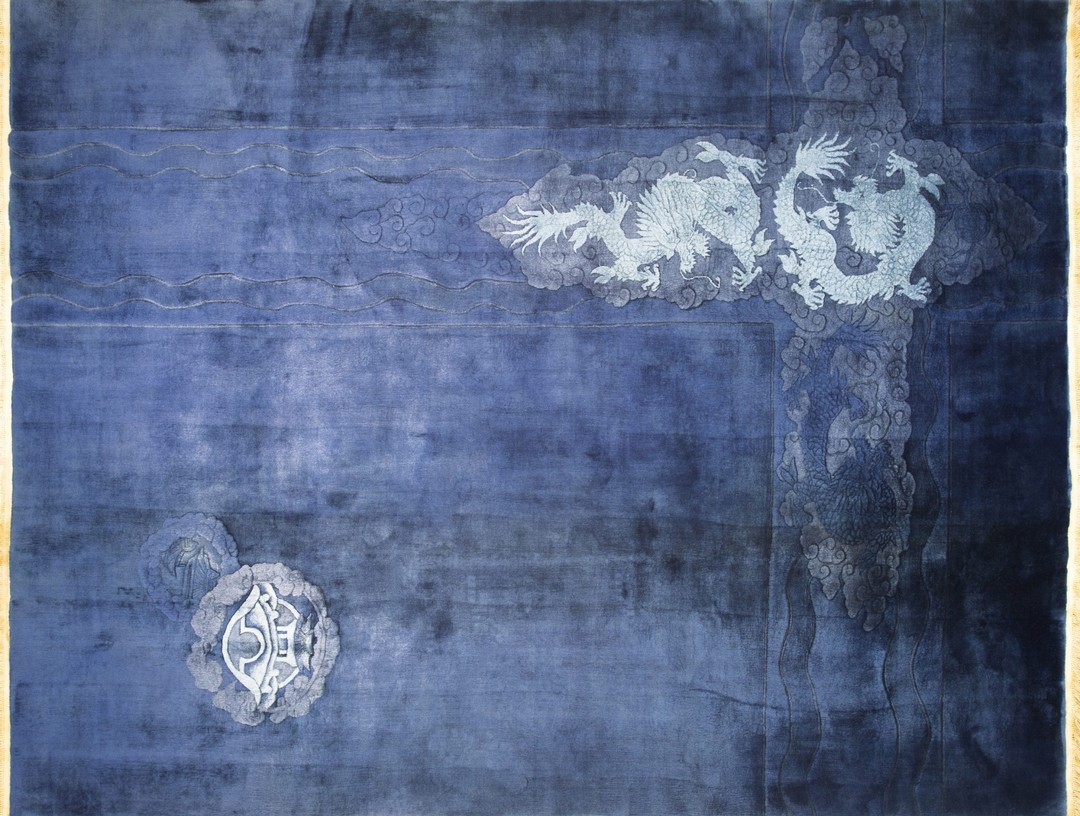
Dragons might curl around a field of empty space, pagodas would appear beside stylized peonies, and geometric borders framed compositions that felt distinctly modern while remaining rooted in symbolism. They were made primarily for Western export markets, especially in the United States, with production centered in Tianjin and Beijing.
This made them both commercial products for an international audience and authentic cultural objects carrying Chinese iconography. The fusion of East and West is their signature, making them instantly recognizable as Chinese Art Deco carpets.
Executive Snapshot
- Fusion of Cultures — These rugs blend Western Art Deco geometry and modernist aesthetics with Chinese dragons, lotus blossoms, pagodas, and Buddhist symbols. — Why: This hybrid made them visually unique, setting them apart from Persian or European Art Deco carpets of the same period.
- Color Revolution — Bright indigos, magentas, golds, emeralds, and even daring contrasts like purple and teal dominate the palette. — Why: Earlier Chinese rugs favored earthier tones, but these vibrant dyes resonated with the Jazz Age taste for drama and luxury.
- Open, Asymmetrical Designs — Fields are often uncluttered, with motifs scattered across wide expanses rather than filling every inch with pattern. — Why: This gave them a modernist clarity and boldness aligned with Art Deco interior design.
- Nichols Rugs — Many of the finest examples came from the American entrepreneur Walter Nichols, whose Tianjin workshops produced rugs of exceptional quality. — Why: His name became synonymous with the style, and today “Nichols rugs” are shorthand for high-grade Chinese Art Deco pieces.
- Export-Driven but Culturally Rooted — While designed with Western buyers in mind, the motifs carried deep Chinese symbolism: dragons for power, peonies for wealth, bats for longevity. — Why: Buyers got exotic appeal and cultural authenticity, making the rugs fashionable conversation pieces in 1920s drawing rooms.
- Significance in Design History — Chinese Art Deco design area rugs occupy a unique position in global decorative arts. They reflect the cosmopolitanism of interwar China, the hunger for modernist design in the West, and the enduring adaptability of traditional Chinese weaving. — Why: Their legacy is not just about floor coverings but about cultural exchange, modernity, and the way design adapts to global taste.
Chinese Art Deco rugs are thus more than decorative objects. They are artifacts of a historical moment when design innovation, global trade, and cultural symbolism converged.
Their bold aesthetics and East–West synthesis continue to influence modern rug production and interior design, securing their place as icons of both Chinese heritage and Art Deco glamour.
Origins and Historical Context
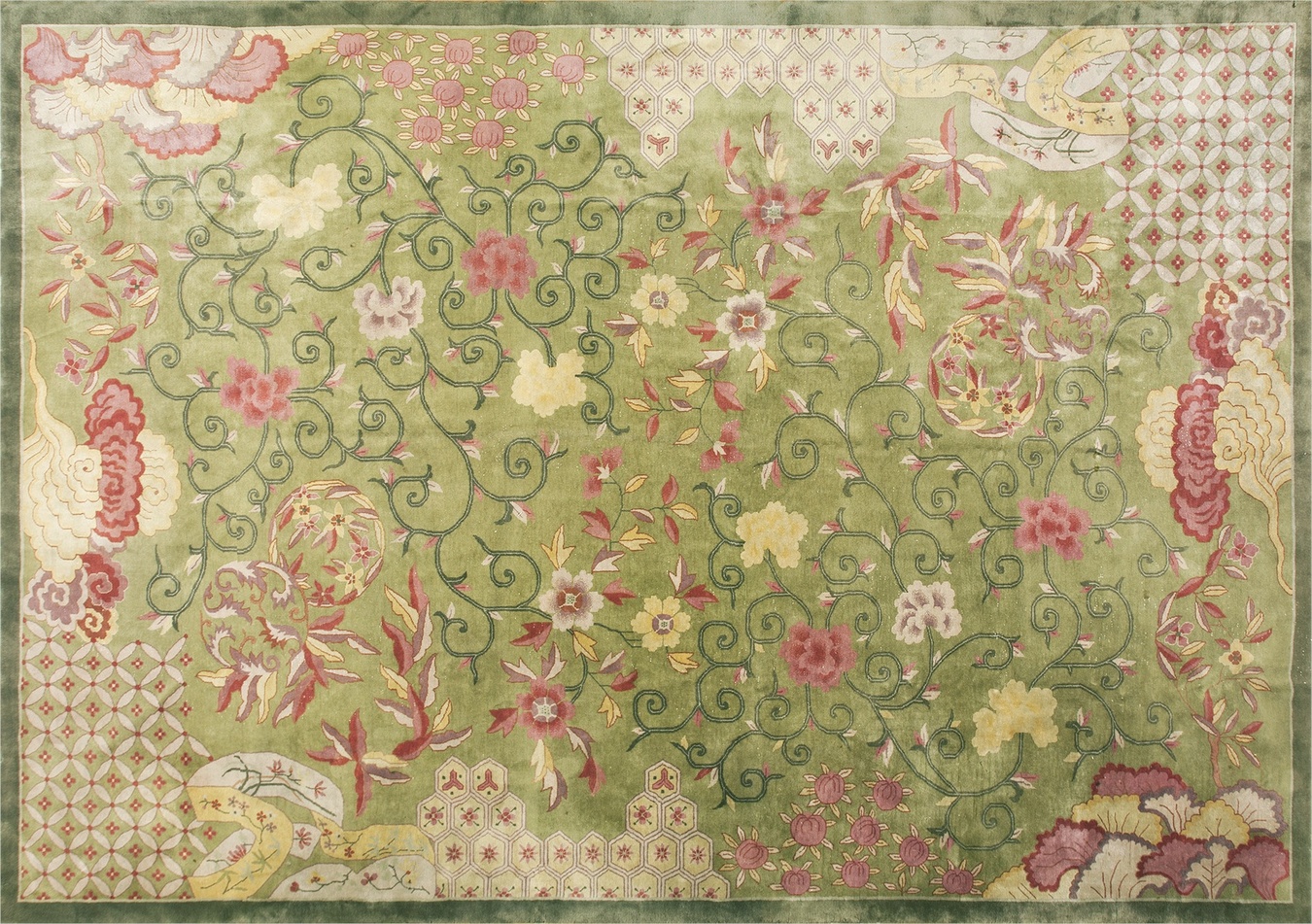
Antique Large Wool Green Hand Knotted Pile Rug – by Rugs On Net
When Did Chinese Art Deco Rug Weaving Begin?
The weaving of Chinese Art Deco rugs began in the late 1910s to early 1920s, during the early years of Republican China. By 1924, full-scale production was underway in workshops managed by foreign entrepreneurs in Tianjin and Beijing.
This moment marked a turning point in Art Deco area rug history, as China entered the modern era while retaining centuries of weaving expertise. The rugs emerged at the intersection of a global design revolution and a local industry seeking to adapt to new markets.
Why Did Chinese Art Deco Design Emerge in 1920s China?
The rise of this rug style was a direct response to the cosmopolitan modernization of 1920s China. After the fall of the Qing dynasty in 1912, China opened more fully to foreign trade and cultural exchange. Western demand for exotic yet fashionable goods created a fertile market for 1920s Chinese export rugs.
The Art Deco movement in China grew out of this context: designers and entrepreneurs recognized that bold, modernist styles could be paired with traditional Chinese motifs to appeal to Western tastes. The shift reflected both China’s embrace of modern commerce and the global appetite for glamorous, decorative objects that embodied the Jazz Age spirit.
Who Popularized Chinese Art Deco Rugs Internationally?
Two figures stand out in spreading these rugs beyond China:
- Walter Nichols — An American entrepreneur who established the famous Nichols factory in Tianjin. Nichols capitalized on skilled Chinese weavers and modern dyeing techniques to create vibrant, durable rugs. His name became synonymous with the genre, and “Nichols rugs” are still shorthand for the highest-quality Chinese Art Deco carpets.
- Helen Fette — Another American who, alongside her Chinese partner Li Meng Shu, ran the Fette-Li workshops in Beijing and Tianjin. Fette-Li rugs were equally admired for their craftsmanship and artistry, contributing to the style’s global recognition.
Together, Nichols and Fette built an international reputation for these rugs, ensuring their presence in U.S. and European interiors during the interwar years.
Where Were Most Chinese Art Deco Rugs Produced Historically?
Production was concentrated in Tianjin and Beijing, two northern Chinese cities with established weaving traditions and access to wool, dyes, and foreign investment. Tianjin carpet production in particular thrived because of its port location, which made exporting rugs to America efficient.
Beijing, with its cultural prestige and skilled artisans, provided both talent and symbolic weight. Smaller centers existed elsewhere, but Tianjin and Beijing dominated the Art Deco Chinese rug industry.
Name, Etymology & Key Makers
The term “Nichols rug” became a catch-all label for Chinese Art Deco carpets due to Walter Nichols’ dominance in the trade. However, it oversimplifies the reality: Fette-Li rugs, as well as those from other entrepreneurial ventures, shaped the market just as strongly. Collectors today differentiate between makers based on design nuances, dye quality, and provenance.
While the Nichols factory produced the bulk of exported pieces, the diversity of workshops reflects the vibrant, competitive spirit of 1920s Chinese rug weaving. Chinese Art Deco rugs thus originated in a moment of political transformation, artistic experimentation, and commercial ambition. Their history reveals how East–West collaboration and the Art Deco movement in China created one of the most distinctive and enduring rug styles of the 20th century.
Design Characteristics of Chinese Art Deco Rugs
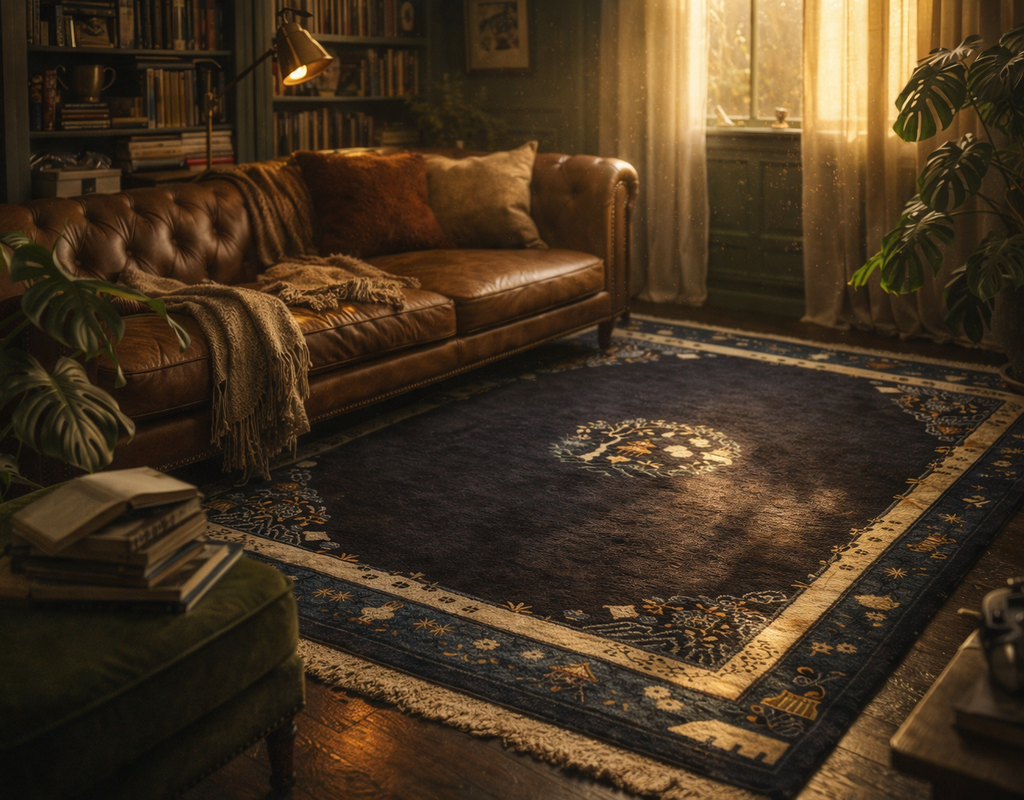
A rich, traditional area rug anchors a reading nook featuring a leather sofa and warm, dappled sunlight.
Stylized dragon art echoes bold graphic motifs.
Key Motifs & Patterns
- Dragons — Symbolizing imperial power, protection, and good fortune, dragons dominate many Chinese Art Deco motifs. — Why: They tied Western buyers to exotic Chinese mythology while preserving cultural meaning.
- Phoenix — Representing renewal and harmony, often paired with dragons in dynamic compositions. — Why: The phoenix brought balance and femininity, appealing to both symbolic tradition and Deco aesthetics.
- Peonies — Flowers of wealth and honor, their large blooms added lush, decorative flair. — Why: They resonated as both auspicious emblems and bold pictorial flourishes within modern Chinese rug patterns.
- Bats & Shou Symbols — The bat (“fu”) sounds like “fortune” in Chinese, while the shou emblem meant longevity. — Why: These signs infused everyday interiors with good luck, making rugs not just art but talismans.
- Vases, Pagodas, Floral Sprays — Classic imagery placed in innovative settings, often floating across wide-open fields. — Why: Their placement echoed Chinese painting traditions, yet their stylization reflected Deco abstraction.
- Geometric Borders — Frames with Greek keys, zigzags, and Deco lines. — Why: They connected the area rugs directly to the international Art Deco design vocabulary.
Together, these motifs created carpets that were at once decorative, symbolic, and cosmopolitan.
Symbolism 2.0: The Deco Re-interpretation
In the Art Deco era, traditional Chinese symbols were “modernized.” The Dragon became more serpentine and abstract; the Lotus was often reduced to a few geometric petals; and the Cloud Band became a stylized swirl. These weren’t just decorations; they were a cultural bridge designed to make “exotic” Eastern symbols feel at home in a New York penthouse or a London flat.
The “Borderless” Revolution
One of the most radical changes in the Deco period was the elimination of the border. For centuries, Oriental rugs followed a strict “frame” (the border) and “field” (the center) logic. Chinese Deco artists were among the first to break this rule, allowing motifs to “float” off the edges of the rug. This “asymmetrical open field” gave the rugs a sense of movement and infinite space, making them the perfect companions for the sleek, minimalist furniture of the 1930s.
Asymmetry vs. Medallion: Layout Innovations
Unlike traditional Peking Chinese carpets that centered on large medallions or filled every space with ornament, Chinese Art Deco rugs often embraced asymmetrical rug layouts. Pictorial elements might drift into corners, scatter across an empty field, or cluster at edges, leaving expanses of negative space.
When medallions did appear, they were stylized or simplified to suit modern taste. Borders were sometimes minimized or omitted entirely, giving the rugs a freer, less constrained composition. This break from symmetry became a hallmark of the style, reflecting both Chinese ink-painting aesthetics and the modernist push for innovation.
Color Palettes: Traditional vs. Deco
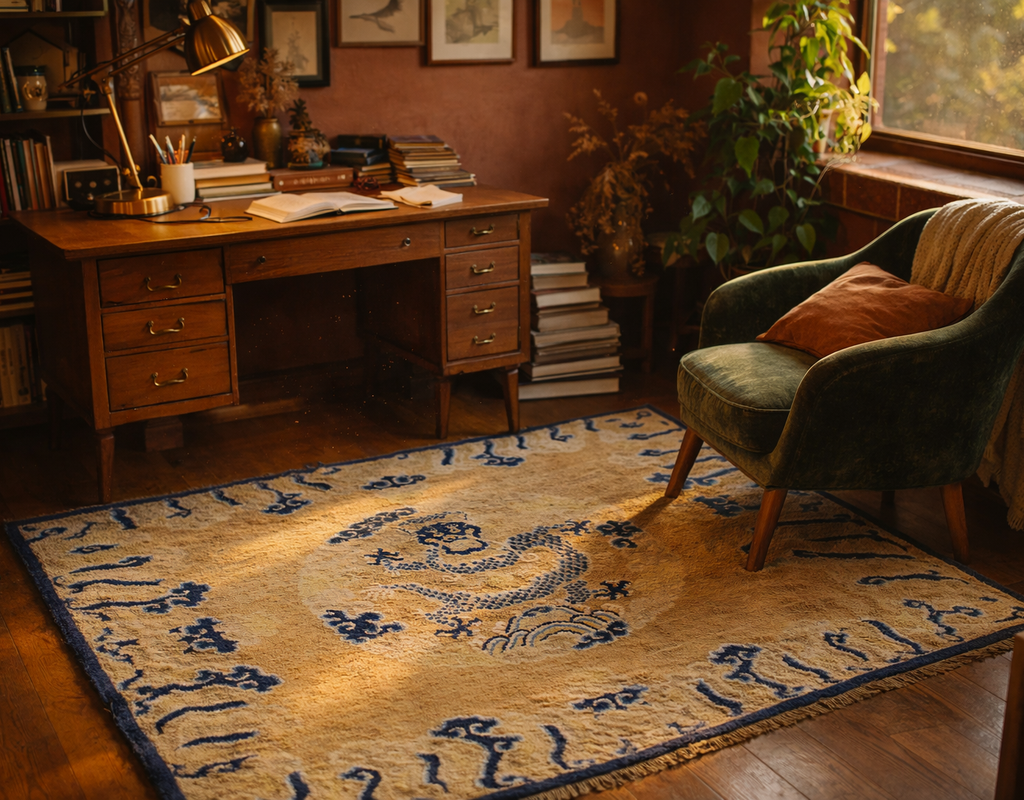
Sunlight bathes a vintage-inspired study where a striking blue and gold dragon rug complements the dark wood furniture and rich wall color.
Earlier Chinese carpets relied on muted earth tones, blues, and golds. By contrast, Art Deco rug colors introduced daring vibrancy: magenta, teal, electric blue, emerald green, deep black, royal purple, and jade. This spectrum was made possible by German aniline dyes, which offered intensity and stability previously unavailable.
The bold palette matched the glamorous interiors of the Jazz Age, where rich contrasts and luxurious finishes defined the look. The juxtaposition of bright tones with traditional motifs gave these rugs a striking, avant-garde presence unlike anything in classical weaving.
The Chemical Revolution: Why the Colors Don’t Fade
If you look at a Persian rug from 1920, the colors have often “mellowed.” If you look at a Chinese Art Deco rug from the same year, the colors often look neon. This is due to the 1920s adoption of German chrome dyes. These were the high-tech dyes of the era—vibrant, saturated, and chemically bonded to the wool. They allowed weavers to move away from the “scholarly” blues and ivories of the past into a world of emerald greens, purples, and deep burgundies that could withstand decades of direct sunlight.
East–West Fusion in Design
The genius of fusion design in Chinese Art Deco rugs lay in how traditional symbols were recast in modernist form. A dragon might be rendered with clean Deco lines, its coils stretching across a field of negative space. A vase of flowers might float off-center, echoing both Chinese scroll painting and the Art Deco principle of asymmetry.
Borders borrowed Western geometric abstraction while still enclosing Chinese emblems. The rugs therefore became visual dialogues: ancient cultural symbols filtered through a modernist lens, equally at home in Shanghai salons and Manhattan apartments. The iconic features of Chinese Art Deco rugs—asymmetrical layouts, symbolic motifs, and bold colors—established them as one of the most innovative and enduring rug styles of the twentieth century.
Materials, Construction, and Craftsmanship
Authentic Materials: Wool, Silk, Cotton Foundation
Authentic Chinese Art Deco rug materials were chosen for both beauty and durability. The pile was almost always woven from lustrous Chinese wool, prized for its softness and sheen. Foundations were built on cotton warps and wefts, which gave the rugs stability and allowed for higher knot density. This cotton foundation is a key hallmark of original 1920s–30s pieces and helps distinguish them from later reproductions.
In some cases, Chinese Art Deco silk pile carpets were produced, either entirely in silk or with silk accents highlighting motifs like dragons or peonies, offering a shimmering, luxurious effect aimed at elite rug buyers.
Pile Thickness & Texture
One of the most notable physical qualities of these rugs is their rug pile thickness. On average, a Chinese Art Deco rug weighs about one pound per square foot, achieved through dense knotting and the use of long-fiber wool.
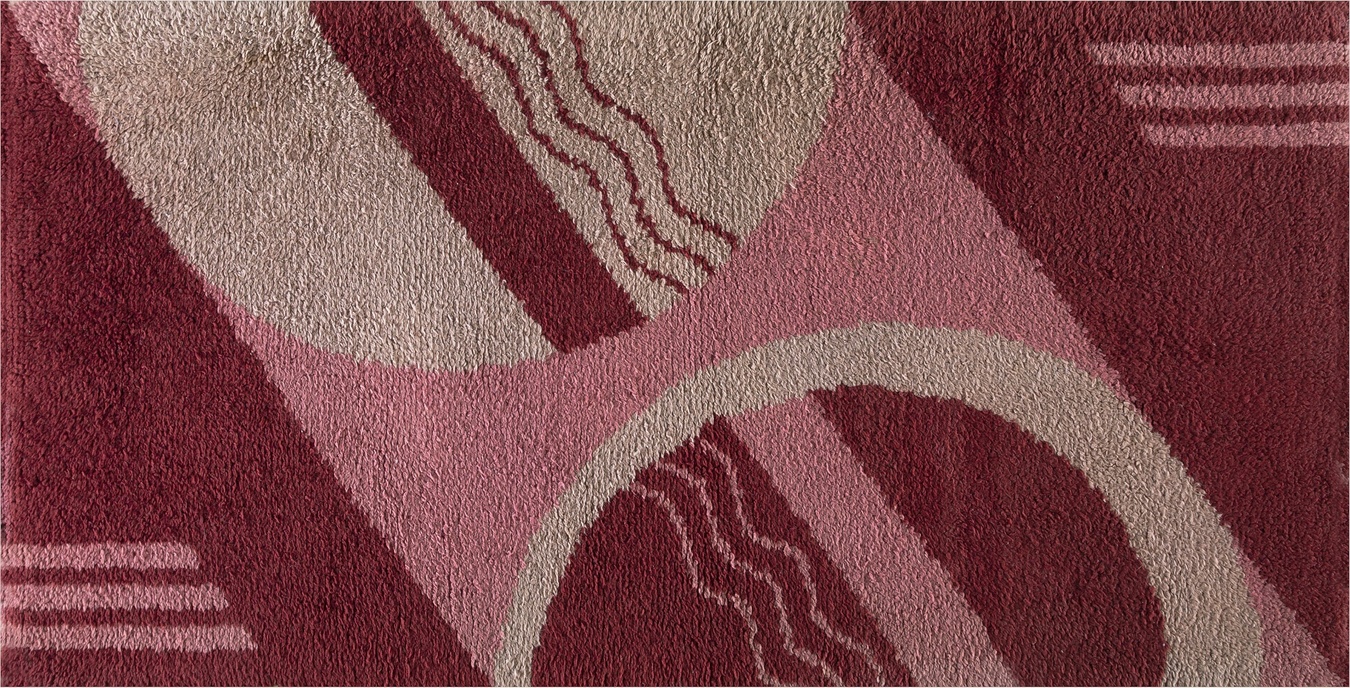
Antique Art Deco – European English Knotted Rug – by Rugs On Net
The result is a plush, velvety surface with both visual depth and tactile luxury. This thickness made the rugs exceptionally durable for everyday use while also creating a soft, cushioned texture that appealed to Western interiors during the Jazz Age.
Weaving Techniques: Hand-Knotting vs. Machine-Made
The finest rugs were hand-knotted Chinese rugs crafted on vertical looms using the asymmetrical Persian knot (Senneh knot). This technique allowed for detailed motifs and smooth curves, essential for dragons, florals, and geometric borders. Each rug was a product of skilled craftsmanship, often taking months to complete.
By the mid-20th century, some machine-made Chinese rugs appeared in Deco-inspired styles, but these lack the nuanced detail, weight, and value of hand-knotted originals. For collectors, only hand-knotted examples carry the authenticity and artistry associated with the movement.
Dye Technology & Color Longevity
A revolution in color distinguished aniline dye rugs of the period. Chinese workshops imported German chrome and aniline dyes, which offered a brilliance and range unmatched by traditional vegetal dyes. These hues—magenta, emerald, teal, purple, electric blue—defined the Art Deco rug colors of the era.
Importantly, chrome mordants made the dyes washable and lightfast, ensuring that the vibrancy endured even under heavy use. Unlike some earlier vegetable-dyed rugs that softened or faded over time, authentic Deco pieces retained their striking palettes for decades.
Labels, Finishing, and Quality Markers
- “Made in China by Nichols” Stencils — Sometimes inked directly on the fringe, these labels identify rugs from the celebrated Nichols factory. — Why: They are rare surviving markers of provenance, highly sought after by collectors.
- Original Paper Tags — Attached to the back or fringe at export, few remain intact today. — Why: An original tag can dramatically increase value and verify authenticity.
- Cotton Fringe & Strong Selvedges — Quality finishing details ensured durability in Western homes. — Why: Reinforced edges and cotton-based finishing were practical signs of careful construction.
- Wool Luster & Density — Even wear across a dense, soft pile is a hallmark of authentic weaving. — Why: It reflects the superior quality of Chinese wool used in the 1920s–30s.
Authentic wool and cotton rugs from this era are defined by their thick pile, brilliant dyes, and careful finishing. These traits—along with provenance clues like Nichols labels—set true hand-knotted Chinese Art Deco rugs apart from later machine-made or synthetic-blend imitations, ensuring their lasting status as both artistic and collectible works.
Regional and Workshop Variations
Nichols vs. Fette vs. Others
- Nichols Chinese Art Deco — Rugs woven in Walter Nichols’ Tianjin workshops became the standard for the style. They are known for bold, saturated colors, open asymmetrical layouts, and a thick, luxurious pile. Nichols emphasized durability and modern appeal, making his rugs the most recognizable examples of the movement. — Why: Nichols’ name became synonymous with quality, and his rugs set the benchmark for Art Deco Chinese carpets.
- Fette-Li Rugs — Founded by Helen Fette and Li Meng Shu, these workshops produced rugs in both Beijing and Tianjin. Fette-Li carpets often featured softer pastel palettes, delicate motifs, and sometimes oval or round shapes unusual in traditional rug production. They were frequently marketed for bedrooms and refined interiors. — Why: Their subtler palettes and elegant motifs offered an alternative to Nichols’ bold style, appealing to a different segment of Western buyers.
- Other Workshops (Tavshanjian, Jen-Li, Elbrook) — These manufacturers often imitated Nichols’ look but varied in quality. Some produced excellent work with strong colors and patterns, while others created commercial-grade rugs for a broader market. — Why: They reflect the competitive environment of 1920s–30s Tianjin rug production, broadening the range of Chinese Art Deco rugs available today.
The “Floppy” Test: Identifying a Fette Rug
While Walter Nichols produced “Super Yarn” rugs that were thick and rigid, his main competitor, Helen Fette, specialized in a “softer” luxury. A Fette rug is easily identified by its “handle”—it is remarkably flexible and can be folded almost like a heavy fabric. This lighter construction was achieved by using thinner cotton warps. If you find a 1920s rug with delicate, “watercolor” floral sprays and a supple, limber feel, you are likely looking at a Fette-Li masterpiece.
Tianjin vs. Beijing Production Differences
Tianjin rug production dominated the export trade, driven by foreign-managed factories like Nichols and Fette-Li. Tianjin rugs tended toward bolder palettes and thicker construction, aligning with Western preferences for durability and statement design.
By contrast, Beijing Deco carpets were often finer, sometimes incorporating softer dyes, silk highlights, and more delicate motifs influenced by the city’s long-standing artistic traditions. Collectors often distinguish Tianjin’s boldness from Beijing’s refinement when evaluating a rug’s origin.
Sub-Styles and Rarity Factors
A collectible Chinese rug is defined not only by its workshop but by several rarity factors:
- Original Labels & Provenance — Rugs with intact Nichols stencils or Fette-Li paper tags are significantly more valuable. — Why: Labels provide authenticity and connect the rug directly to its workshop.
- Early Production Pieces — Rugs from the mid-1920s often show the strongest dyes and most innovative layouts. — Why: Early examples capture the peak of creativity and quality.
- Rare Colors & Formats — Unusual palettes (lavender, coral, emerald) or non-rectangular shapes like ovals or rounds are highly prized. — Why: Their scarcity increases desirability among collectors.
- Condition & Dye Vibrancy — Rugs with unrestored, original dyes and even wear are more valuable than those with fading or heavy repairs. — Why: Authentic vibrancy showcases the strength of early aniline and chrome dyes.
- Unique Motif Combinations — Rugs that combine traditional symbols (dragons, bats, shou) with daring Deco abstraction stand out. — Why: They represent the most successful examples of East–West fusion.
A rare Chinese Art Deco rug is therefore not just about age but about workshop, palette, condition, and provenance. Collectors carefully study these differences to distinguish Nichols, Fette, and other producers, ensuring authenticity and long-term value.
The Walter Nichols Authentication Checklist
Evaluating a rug suspected to be a genuine Nichols?
Look for these five specific “markers” of his Tientsin (Tianjin) workshop:
- The “Blue Ink” Fringe Stamp: Flip the rug over and examine the back of the cotton fringe. Many original Nichols rugs were stamped with “MADE IN CHINA BY NICHOLS” in blue ink. Even if the stamp is faded or partial, it is a definitive “smoking gun” for authenticity.
- The Fabric Tag: Unlike earlier nomadic rugs, Nichols pieces were commercial exports. Check the corners for a small original fabric label sewn into the underside. While many were removed by owners, the presence of a tag (or even the stitch-marks where one used to be) is a strong indicator.
- The “Plank” Handle: Pick up a corner of the rug. A genuine Nichols is famously heavy and stiff due to its “closed-back” construction and machine-spun wool. If the rug feels flexible or “floppy,” it is likely a Fette rug (Nichols’ main rival) or a later, lower-quality reproduction.
- Deep Manual Carving: Run your hand over the outlines of the flowers or motifs. Nichols pioneered the “sculpted” look. You should feel a deep, physical relief channel hand-cut into the wool around the designs, giving the rug a three-dimensional appearance.
- The “Electric” Color Test: Look for colors that shouldn’t technically exist in 1920s vegetable-dyed rugs: Hot Pink, Acid Green, and Lapis Blue. Because Nichols used high-tech German chrome dyes, his colors do not “mellow” or fade into “peach” like older Chinese rugs; they remain as saturated today as the day they were woven.
Symbolism and Cultural Significance
Chinese Symbolism in Motifs
- Dragon — Represents power, protection, and prosperity. — Why: As the ultimate imperial emblem, its presence on Chinese Art Deco rugs symbolized strength and success for the household.
- Phoenix — Symbol of harmony, rebirth, and renewal. — Why: Paired with the dragon, it conveyed balance between masculine and feminine forces, appealing to traditional cosmology.
- Peony — Known as the “king of flowers,” signifying wealth and high honor. — Why: Its lush blooms reinforced wishes for luxury and prosperity.
- Lotus — Associated with purity and spiritual enlightenment. — Why: The lotus’s growth from mud into a pure blossom reflected resilience and moral clarity.
- Bat (Fu) — Homophone for “fortune” in Chinese. — Why: Scattered bats symbolized luck and blessings, especially when paired with other auspicious motifs.
- Shou Symbol — The stylized character for longevity. — Why: A direct wish for long life, often repeated as a decorative lattice.
- Crane — Embodied wisdom and a life of scholarly refinement. — Why: As a companion of immortals in Chinese lore, cranes reinforced spiritual blessings.
- Fish — Symbolized abundance and wealth. — Why: Carp and paired fish designs represented prosperity and marital harmony.
Each motif carried more than visual appeal; they encoded rug blessings into daily décor.
East–West Meaning: Chinoiserie, Modernism, and Export Appeal
These rugs are remarkable because they combine Chinese art motifs with Western modernism. For centuries, European markets admired Chinese-inspired design, a trend known as Chinoiserie. The Chinese Art Deco symbolism of the 1920s revitalized this tradition: motifs rooted in Chinese cosmology were arranged with bold negative space, asymmetry, and geometric abstraction.
To Western buyers, this fusion looked exotic yet modern, perfectly suited to Jazz Age interiors. To Chinese makers, it was a way of exporting blessings, encoded in motifs, to foreign homes. The result was an export Chinoiserie that carried deep meaning in China while also resonating with international style trends.
Common Wishes Encoded in Design
- Wealth and Luxury — Peonies, fish, and lavish florals. — Why: These motifs expressed aspirations for prosperity in both Chinese and Western contexts.
- Longevity and Health — Shou symbols, cranes, and bats. — Why: Encoded prayers for a long, fortunate life, woven directly into the textile.
- Harmony and Renewal — Phoenixes and lotuses. — Why: Motifs signified rebirth, peace, and moral strength in times of change.
- Power and Success — Dragons, bold borders, and strong geometric framing. — Why: Designs carried authority and confidence, echoing both imperial tradition and modernist energy.
The symbolism in Chinese rugs reveals that these were never just decorative textiles. Each modern Chinese rug pattern doubled as a bearer of good wishes, blending cultural meaning with striking Chinese Art Deco design.
Their enduring appeal lies in this duality: objects of beauty and carriers of encoded blessings, bridging East and West in one woven canvas.
Collecting, Value, and Investment
Vintage Chinese Art Deco Rug Pricing
The Chinese Art Deco rug value in today’s market reflects both their collectible status and relative accessibility compared to other antiques. At auction, a good-quality 9×12 ft vintage Deco rug typically sells between $2,000 and $5,000, depending on condition and provenance. Smaller rugs are more affordable, while unusual colors or formats can command much higher prices.
Collectors pay premiums for rare shapes like ovals or rounds, or for unconventional palettes such as lavender, coral, or emerald. These details make them standout pieces in the collectible rug market.
How Vintage Wear Affects Value
Antique rug pricing depends heavily on condition. Rugs with original vibrant dyes, even wear, and minimal repairs are the most desirable. By contrast, fading, heavy restoration, or uneven pile can significantly lower value. Collectors often prefer “honest wear” that shows age but does not compromise the rug’s integrity.
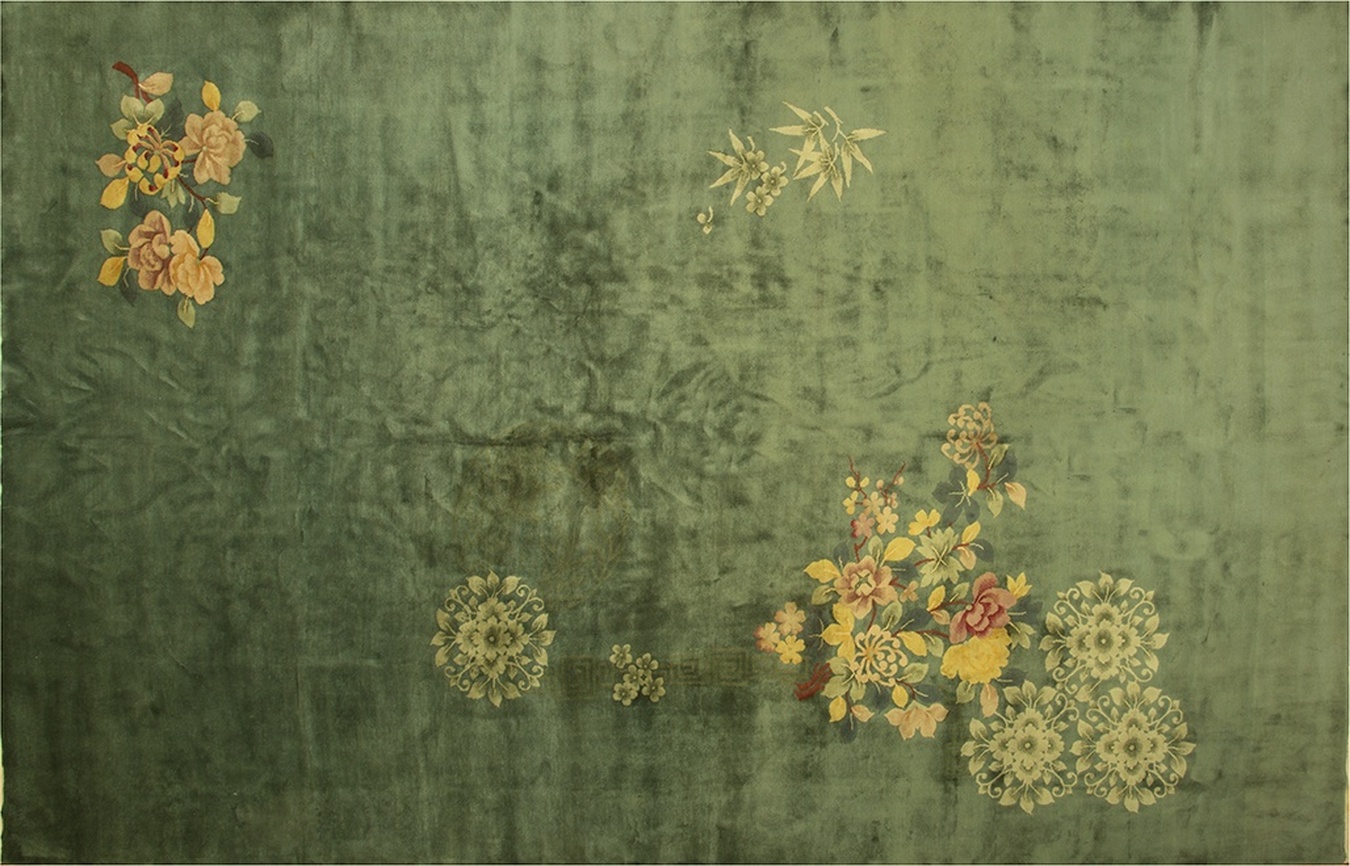
For Chinese Deco pieces, retaining their brilliant Chinese Art Deco rug patina—that deep, glowing look created by decades of careful use—can even enhance desirability. Excessive restoration, however, diminishes both authenticity and price.
Can New Rugs Replicate Vintage Patina?
Some modern rug makers attempt to imitate the look of vintage through washed or dulled finishes. While these new rugs may carry a Deco-inspired design, they cannot fully capture the tactile richness and natural fading of an authentic 1920s–30s piece.
Collectors recognize that only decades of real use can produce the soft sheen, muted edges, and mellow color transitions that define genuine Chinese Art Deco rug patina. As a result, replicas rarely achieve the same market value as authentic examples.
Investment: Is It a Good Idea?
A vintage rug investment in Chinese Art Deco pieces can be a smart entry point for collectors. Prices are trending upward as awareness grows, yet they remain more attainable than antique Persian or Caucasian rugs of similar quality.
Their combination of strong design, rich symbolism, and durability makes them not only functional décor but also appreciating assets. For first-time collectors, they represent an accessible way to build a collection with both beauty and financial potential.
Chinese Art Deco vs. Persian for Value Retention
When comparing Chinese Art Deco rugs to Persian carpets, Persians generally hold a stronger long-term reputation in the global market. They have centuries of established prestige and often achieve higher price ceilings.
However, Chinese Deco rugs are carving out their own space. Their distinctive East–West modernism attracts design-oriented buyers who value them as unique artistic statements. While Persian rugs may dominate in traditional investment terms, Deco pieces offer a balance of affordability and growth potential.
Are Chinese Art Deco Rugs Likely to Appreciate?
Market experts agree that collectible Chinese Art Deco rugs are poised for further appreciation in the coming decade. As mid-century and Art Deco design continue to rise in popularity, these rugs fit seamlessly into both vintage and contemporary interiors. The finite supply of authentic 1920s–30s pieces ensures that demand will likely outpace availability.
Collectors seeking rare colors, original condition, and early Nichols or Fette production can expect continued gains in both aesthetic and financial value. In short, Chinese Art Deco rugs are collectible, accessible, and increasingly valued. Their appeal lies in a combination of rarity, cultural significance, and visual drama—qualities that secure their place in the expanding vintage rug investment market.
Contemporary Market & Reproductions
Are Contemporary Weavers Still Making Chinese Art Deco–Inspired Rugs?
Yes—contemporary Chinese Art Deco carpets are still being woven, with both hand-knotted and machine-made versions available. Many are produced in China and India, where weaving traditions remain strong.
These reproduction Chinese Deco rugs often reinterpret classic Nichols or Fette designs, sometimes staying faithful to 1920s palettes and layouts, while other times updating motifs or proportions to fit modern interiors. The style is therefore alive not only as a vintage collectible but also as a modern Chinese Art Deco rug category in its own right.
Do Modern Dyes Change the Palette?
Advances in dye technology have affected how colors are expressed. Today’s eco-friendly synthetic dyes are stable, consistent, and less prone to bleeding or fading than early aniline and chrome dyes.
While this ensures long-term durability, some purists feel the hues lack the depth and glow of vintage originals. Still, skilled dyers can closely match the jewel tones—magenta, teal, jade, purple—that defined the 1920s. At the same time, modern producers often expand the palette with softer neutrals or muted tones to align with contemporary décor trends, broadening the appeal of contemporary Chinese Art Deco carpets.
Where to Buy Online
Collectors and decorators can buy Chinese Art Deco rugs online through both auction platforms and specialized dealers:
- Christie’s and Sotheby’s — Major auction houses offering rare vintage Chinese Deco rugs with provenance. — Why: They provide authenticity guarantees and access to the highest-end collectible market.
- Invaluable and LiveAuctioneers — Online platforms aggregating sales from smaller auction houses. — Why: They expand the buyer’s reach globally, often at more accessible price points.
- Nazmiyal Antique Rugs (New York) — A leading dealer with a strong collection of vintage Nichols and Fette-Li rugs. — Why: Trusted expertise and curated quality make them a prime source for serious buyers.
- Antique Rug Studio (New York) — Offers a range of Chinese Deco pieces, including less common shapes and colors. — Why: Their selection often includes rugs that appeal to both collectors and designers.
- French Accents — A brand producing new reproduction Chinese Deco rugs. — Why: Their hand-knotted work faithfully captures the Art Deco aesthetic while suiting modern interiors.
Hand-Knotted vs. Machine-Made Today
Just as in the 1920s, the distinction between hand-knotted vs machine-made rugs remains crucial. Hand-knotted contemporary versions use wool or silk on cotton foundations and are considered the closest in spirit to original Nichols or Fette rugs. They carry more long-term value, though they are also more expensive. Machine-made options, while affordable and widely available, lack the depth, durability, and individuality of hand-knotted weaving. For design purposes they may suffice, but for collectors, only hand-knotted reproductions or authentic vintage pieces hold enduring significance.
Today, the market for Chinese Art Deco rugs thrives in two streams: the collectible vintage segment and the reproduction market that keeps the aesthetic alive for new buyers. Whether one seeks a genuine 1920s rug or a modern interpretation, online platforms have made these Chinese Art Deco carpets accessible worldwide—provided buyers do their due diligence on authenticity, quality, and provenance.
Care, Display, and Preservation
Display Tips for Chinese Art Deco Rugs
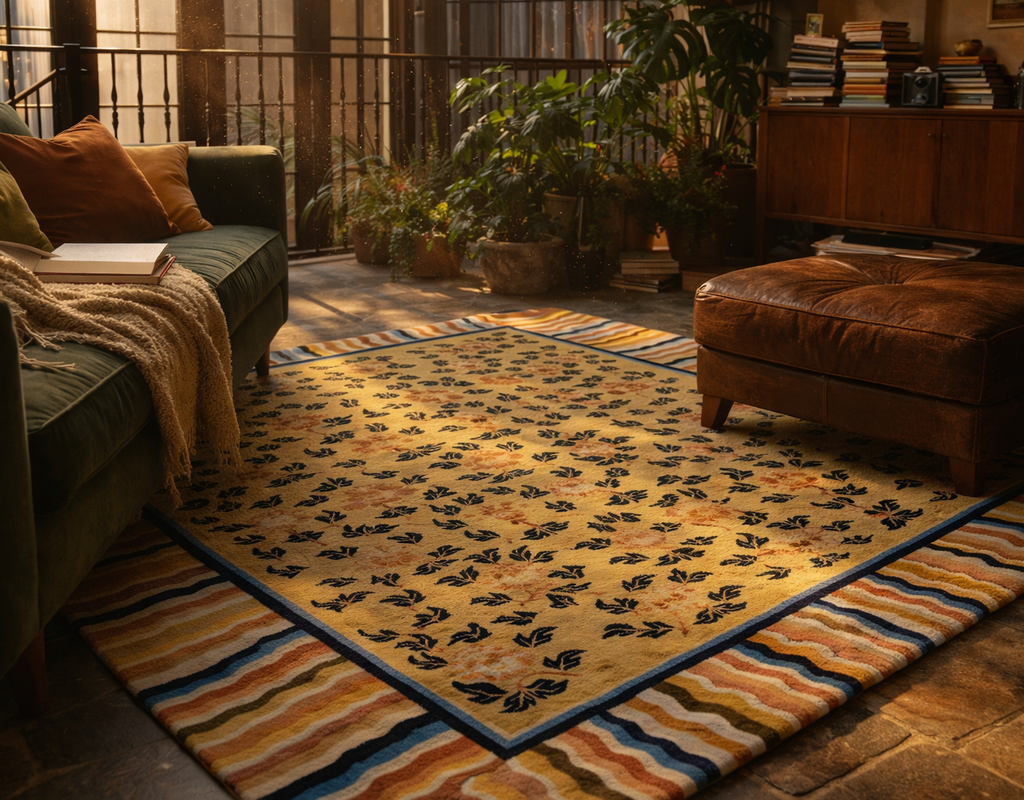
A vibrant patterned rug anchors this richly textured and plant-filled, sun-drenched living area.
- Use Natural Light Wisely — Place rugs in rooms with good ambient light to showcase their bold palettes, but avoid prolonged exposure to direct sunlight. — Why: Excessive UV fades the brilliant dyes that make these rugs iconic.
- Choose Low-Traffic Areas — Position vintage Deco rugs in living rooms, bedrooms, or under coffee tables rather than busy hallways. — Why: Limiting wear protects pile thickness and preserves original color vibrancy.
- Pair with Complementary Décor — Surround rugs with Art Deco or modern furnishings that echo their geometry and motifs. — Why: Thoughtful placement enhances both the rug’s visual presence and the room’s harmony.
Cleaning, Repair, and Longevity Advice
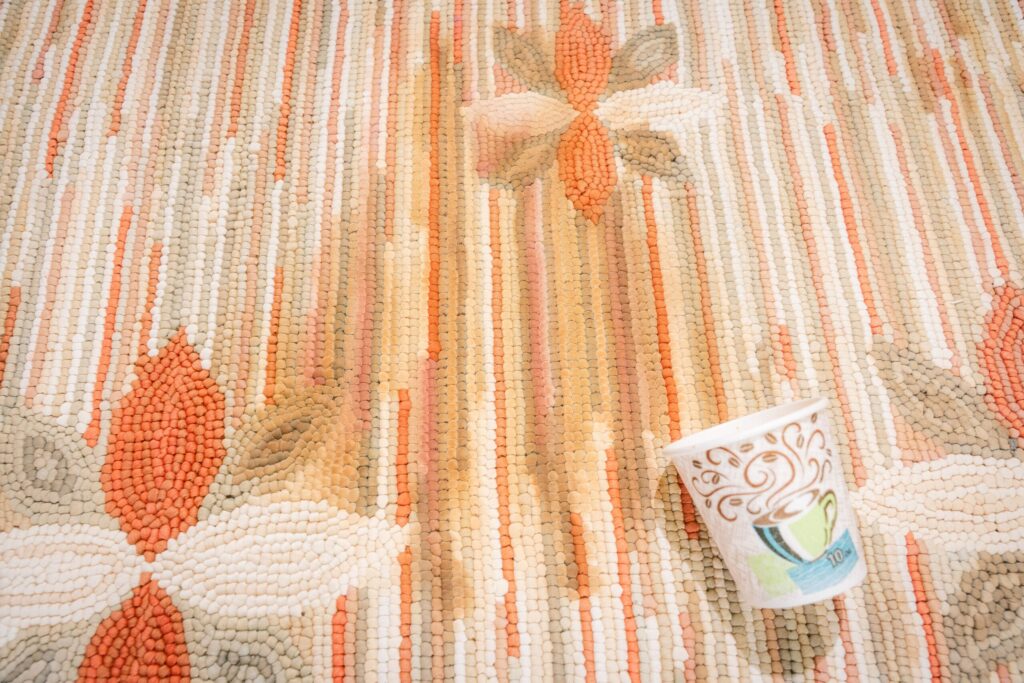
Close-up view of a tipped paper coffee cup resting on a handwoven wool rug, highlighting the rug’s dense pile, subtle color variations, and traditional geometric motifs in warm neutral and terracotta tones.
- Professional Cleaning Only — Have Chinese Deco rugs cleaned by specialists familiar with Chinese Art Deco rug care. — Why: Harsh detergents or machine washes can damage wool or silk fibers and strip dyes.
- Gentle Maintenance — Vacuum lightly with a brushless head to prevent pile damage. — Why: Regular light care reduces dirt buildup without pulling delicate fibers.
- Expert Repairs — Use skilled weavers for patching or re-knotting. — Why: Poorly done repairs reduce both structural integrity and resale value.
- Rotate Periodically — Shift rug placement once or twice a year. — Why: Rotation prevents uneven fading and wear.
Preserving Value & Documentation
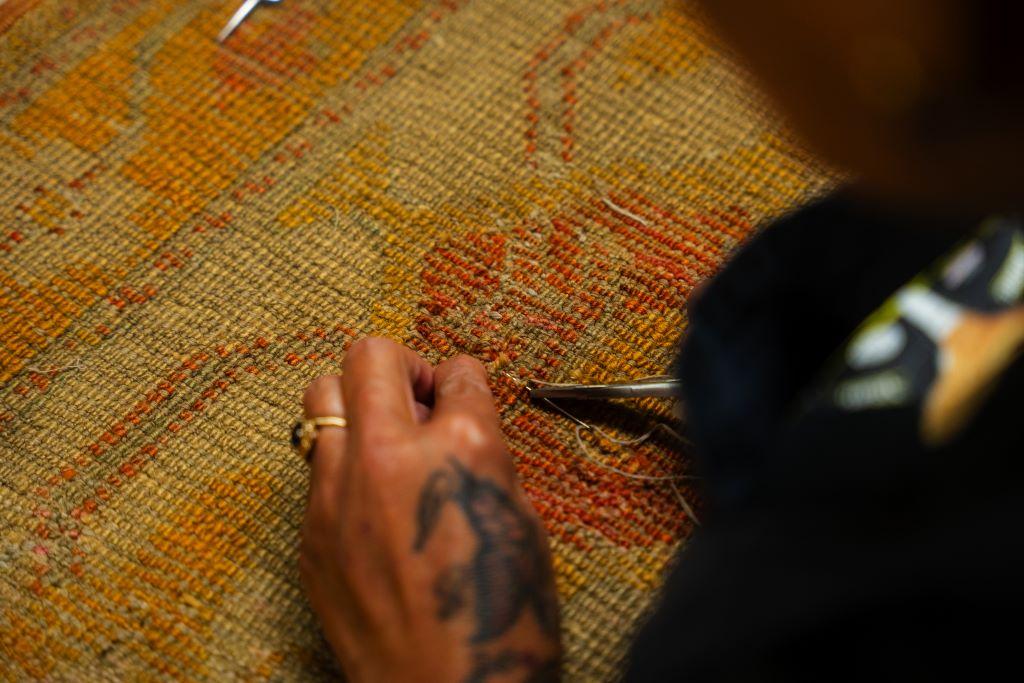
Detail of hands mending a rustic, richly colored woven rug.
- Keep Original Labels & Tags — Nichols stencils, Fette-Li tags, or dealer marks should be left intact. — Why: These provenance markers are rare and greatly enhance collectible value.
- Maintain Purchase Records — Store receipts, auction catalogs, or gallery certificates. — Why: Strong paper trails help prove authenticity when reselling or insuring.
- Photograph Condition — Document the rug in detail upon purchase. — Why: Visual records help track changes over time and support future appraisals.
- Use Proper Padding — Place archival-quality rug pads underneath. — Why: Pads prevent slipping, cushion wear, and stabilize textiles.
Proper rug preservation ensures that Chinese Art Deco pieces retain both their beauty and their financial worth.
From rug display tips that protect against fading to vintage rug documentation that secures provenance, careful stewardship allows these iconic carpets to serve as both functional décor and enduring investments.
Explore some of our Chinese Art Deco rugs
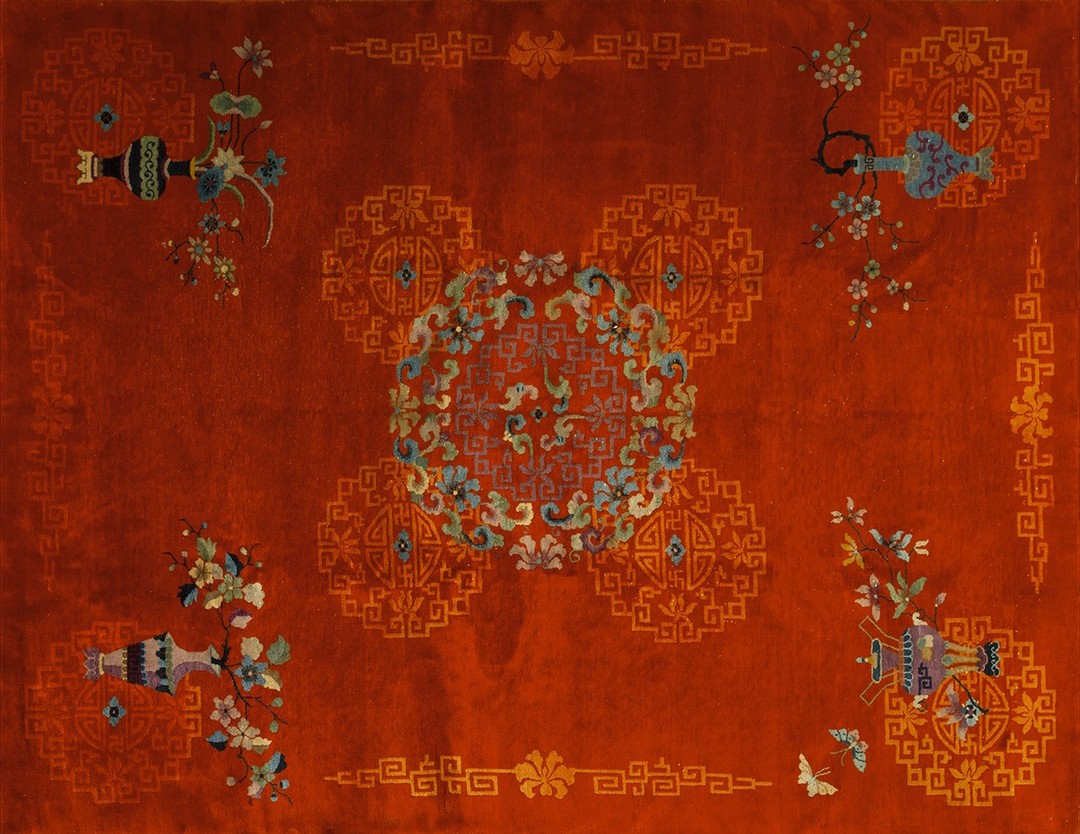
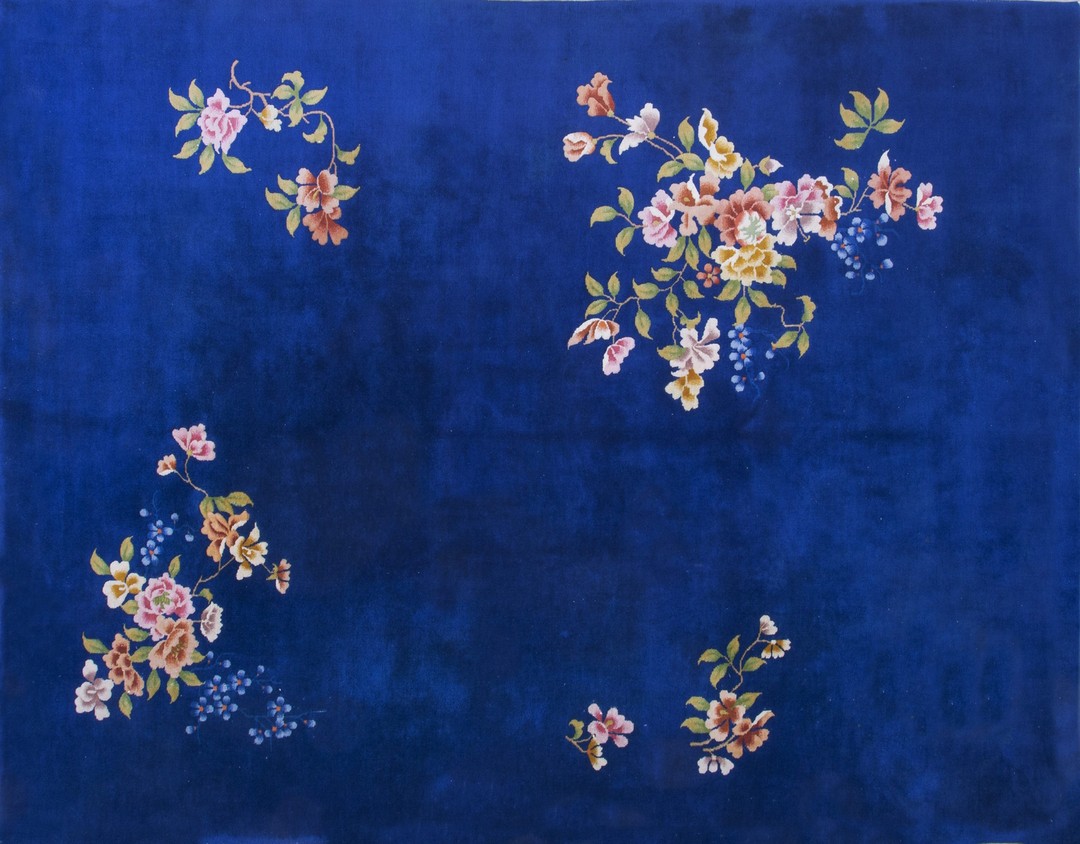
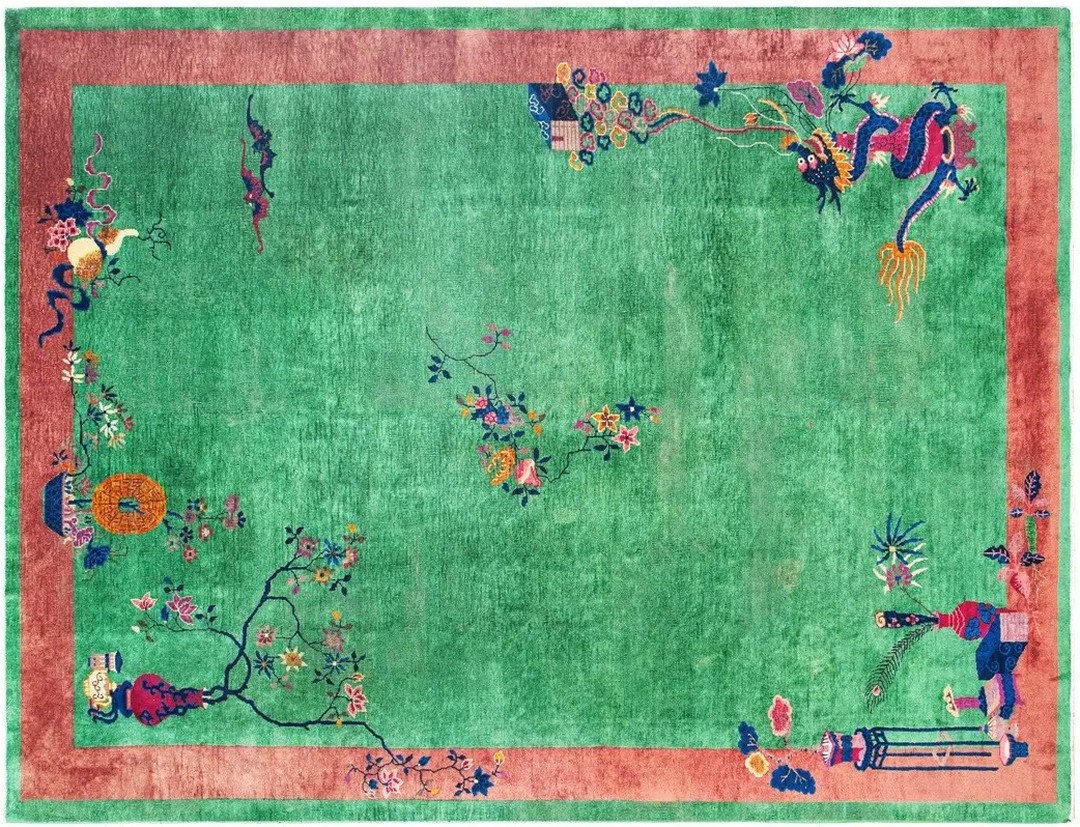
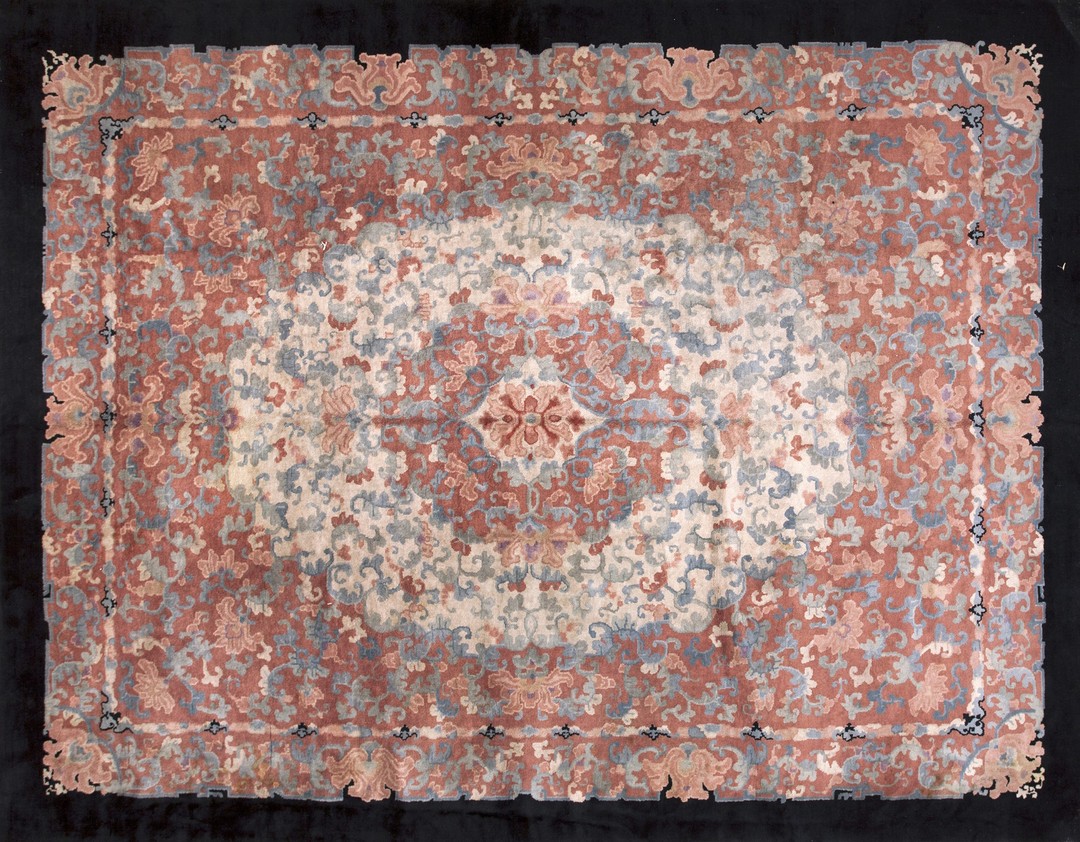
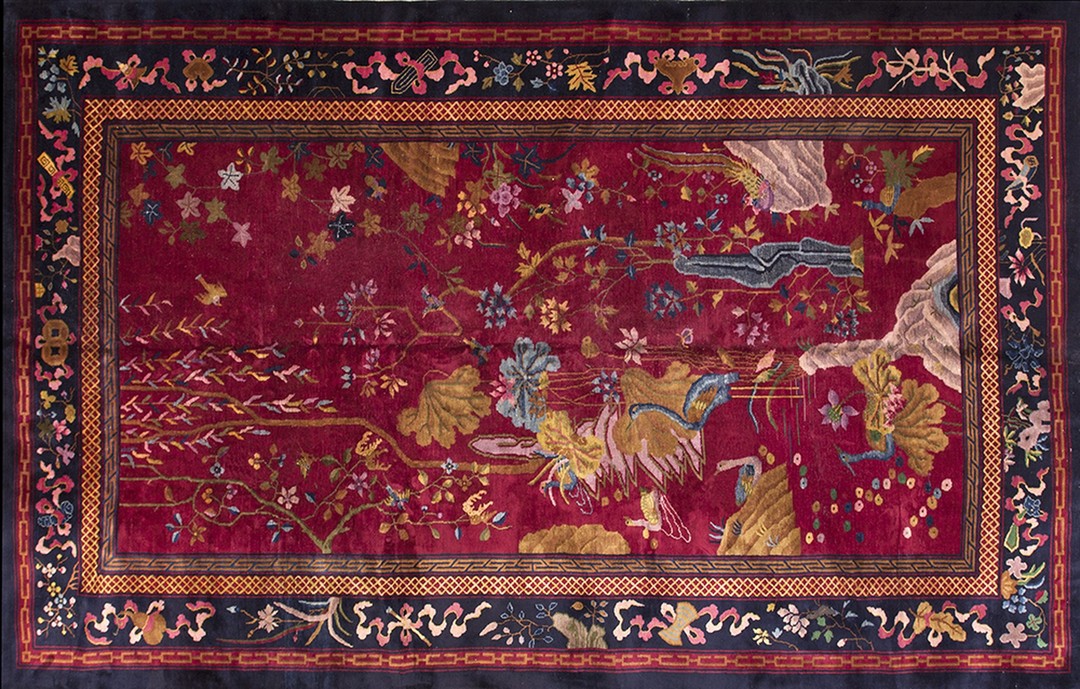
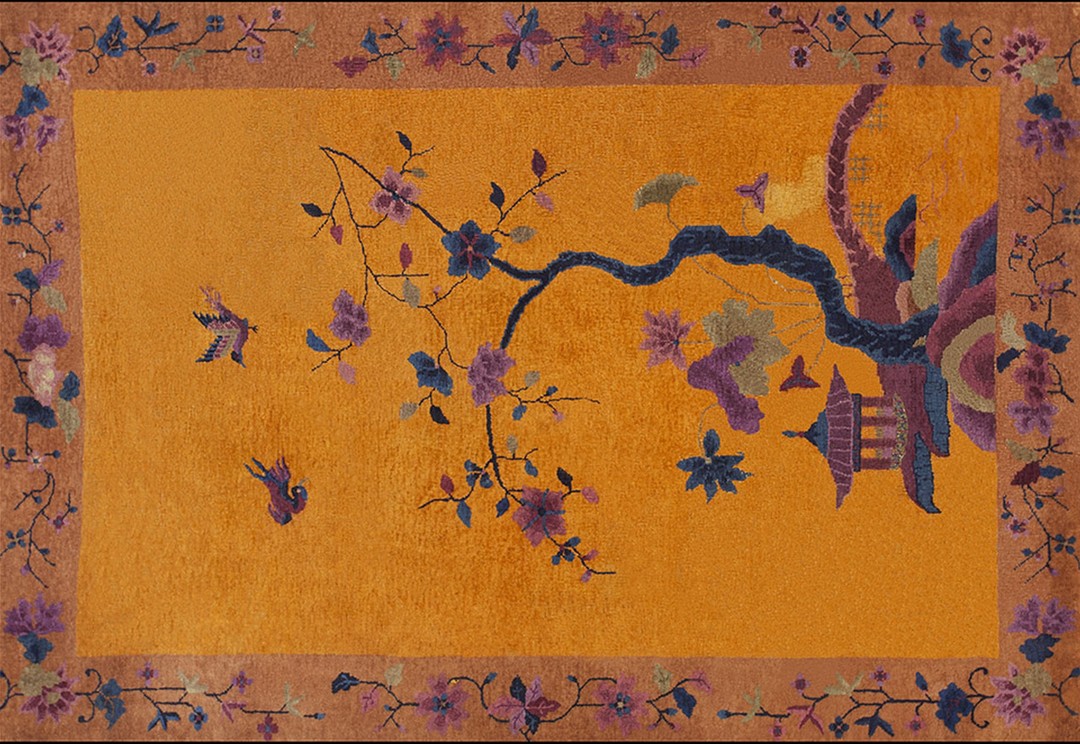
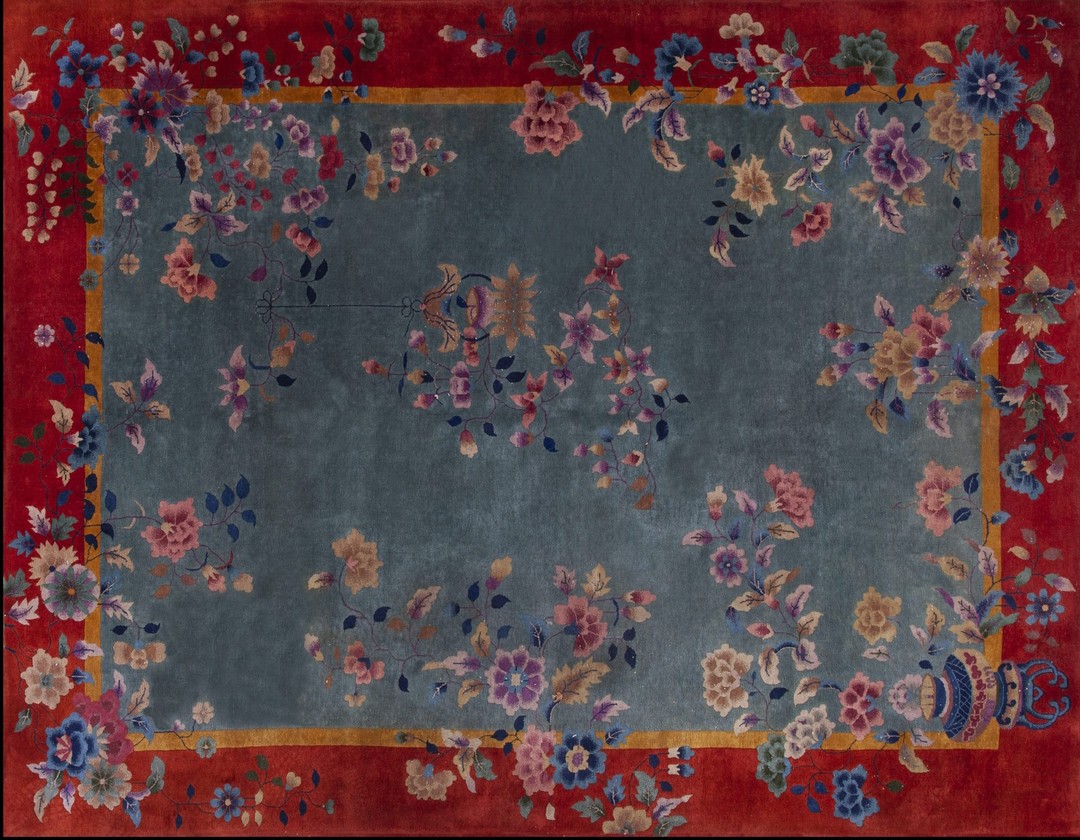
FAQ
- How can I date Chinese Art Deco rugs by features?
Period Chinese Art Deco rugs (c. 1920s–30s) show carved relief, asymmetric motifs, cotton foundations, and sometimes Nichols/Fette tags; mid-century “Hong Kong” labels signal later production.
Watch: from our New York gallery
Walter Nichols Chinese Art Deco Rugs: Why We Sell Chinese Rugs Back to China
In the 1920s Walter Nichols made some of the finest Art Deco rugs in China. Most came to America, and today many are going back.Art Deco Meets Art Nouveau: 1920s Chinese Carpet
Art Deco stunner with an Art Nouveau edge!Black and White Chinese Art Deco Carpet, circa 1930
Black and white. Dramatic and impactful. Always ready to make a statement.Spirals Are the Best: Chinese Art Deco Carpet
Spirals are the best, aren’t they?Anyone Up for a Walk? Chinese Art Deco Carpet
Anyone up for a walk?More on our YouTube channel.
- Are Chinese Art Deco rugs a good investment?
They can hold value, especially uncommon colors, larger sizes, and labeled Nichols pieces. Buy condition first, document provenance, and seek an independent appraisal.
- What rug pad works best under Chinese Art Deco rugs?
Use a felt-and-natural-rubber combo pad trimmed 1–2 inches smaller than the rug for grip and cushioning. Avoid cheap waffle pads that can mark floors.
- Where can I buy Chinese Art Deco rugs in the U.S.?
Look to reputable antique rug dealers and design galleries in cities like New York, Los Angeles, and Boston, plus established auction platforms. Verify return policies and provenance.
- What are “white knots” on Chinese Art Deco rugs?
They’re cotton foundation tie-knots that surface as pile wears, appearing as small white specks. Skilled restorers can tone them; it’s a common, fixable age trait.
- How should I store Chinese Art Deco rugs long-term?
Professionally clean, roll pile-in, wrap in breathable cotton/Tyvek (not plastic), elevate off the floor, and use moth deterrents. Freezing infested items for 72 hours can help.
- Do Chinese Art Deco rugs shed or have odors?
Antique Chinese Art Deco rugs usually shed minimally once settled. Any storage odors typically air out; persistent smells may need professional washing.
- What’s special about Nichols Chinese Art Deco rugs versus others?
Nichols Chinese Art Deco rugs are prized for dense wool, colorfast dyes, and luxe feel, often labeled “HAND MADE IN CHINA BY NICHOLS.” They command premium prices.
- How do I spot reproductions of Chinese Art Deco rugs?
Watch for modern tufted backs, latex coatings, or “Made in Hong Kong”/new tags; true 1920s–30s Chinese Art Deco rugs are hand-knotted on cotton with period labels or none.
- Are Chinese Art Deco rugs good for homes with pets and kids?
Wool is resilient and naturally stain-resistant, but use a quality pad, blot spills fast, and rotate seasonally. Consider darker fields or patterned borders to mask wear.
- Are Chinese Art Deco rugs safe over radiant/underfloor heating?
Generally yes for wool rugs with a breathable pad; avoid overly thick or rubbery pads that trap heat. Aim for low thermal resistance (≈≤0.17 m²·K/W).
- Can robot vacuums be used on Chinese Art Deco rugs?
Yes, with care. Disable beater bars, tuck or protect fringe, and set “no-go” zones; fringe and carved pile edges can snag brushrolls.
- Do Chinese Art Deco rugs bleed dye?
Some can, especially with improper pH, over-wetting, or heat. Always spot-test with a white cloth and avoid harsh chemicals; consult a qualified rug cleaner if uncertain.
- How should I clean Chinese Art Deco rugs at home?
Blot spills quickly, test cleaners for colorfastness, and use a mild, pH-neutral solution sparingly—never soak. For deep cleaning or bleeding risk, use a specialist.
- Are Chinese Art Deco rugs hand-knotted or machine-made?
Authentic Chinese Art Deco rugs are hand-knotted. Flip the rug—an identical pattern on the back with visible knots (not a latex/mesh backing) indicates hand-knotted construction.
- How much do Chinese Art Deco rugs cost today?
In the U.S., room-size Chinese Art Deco rugs commonly list from about \$2,000–\$10,000+, with rare colors, larger sizes, or fine Nichols examples fetching considerably more.
- What sizes are common for Chinese Art Deco rugs?
Room sizes dominate, especially around 9’×12′ (e.g., 8’10″×11’6″ to 9’×11’6″), plus 8’×10′ and larger 10’×14′. Scatter sizes and runners also exist.
- What materials and build do Chinese Art Deco rugs use?
Most Chinese Art Deco rugs use wool pile on sturdy cotton foundations, tightly packed and dense. Nichols examples are notably heavy—roughly about a pound per square foot.
- Do Chinese Art Deco rugs have carved or sculpted pile?
Yes. Many Chinese Art Deco rugs are “carved,” with outlines cut into relief to emphasize flowers, vines, and symbols—one hallmark of the style.
- What colors define Chinese Art Deco rugs?
Expect saturated jewel tones—magenta, turquoise, emerald, ruby, violet—often on solid or softly abrashed fields, contrasted with pictorial corners or borders.
- What motifs appear on Chinese Art Deco rugs—and what do they mean?
Common motifs include bats (good fortune), peonies (wealth), cranes (longevity), clouds, pagodas, and butterflies. Asymmetric placement on open grounds is typical.
- How can I identify authentic Chinese Art Deco rugs?
Look for hand-knotted construction, cotton foundation, heavy handle, carved pile, and Deco motifs. Nichols Chinese Art Deco rugs may retain paper/cloth labels or fringe stamps on originals.
- Who was behind many Chinese Art Deco rugs?
Walter A.B. Nichols popularized Chinese Art Deco rugs, founding Nichols Super Yarn & Carpets in Tientsin in 1924. His “Nichols Chinese” pieces are especially sought after.
- How are Chinese Art Deco rugs different from Peking rugs?
Peking rugs favor two-tone indigo/ivory and symmetry; Chinese Art Deco rugs use bold magenta, turquoise, emerald, and asymmetric corner or pictorial motifs. Deco pieces also often feature carved outlines.
- What are Chinese Art Deco rugs?
Chinese Art Deco rugs are 1920s–1930s hand-knotted carpets blending Chinese symbols with modern asymmetry, open fields, and jewel-tone palettes. Many were woven in Tianjin (Tientsin) for export to the U.S.