
The Carpets of China: Hybrid Material Culture
The Silent Scholar: An Introduction to the Chinese Rug
For centuries, the Chinese carpet has occupied a unique position in the world of antique textiles. Unlike the high-energy, tribal narratives of the Anatolian steppe or the dense, floral complexities of the Persian court, the Chinese rug speaks in a language of deliberate restraint, profound symbolism, and scholarly calm. To walk upon a classical Ningxia or a deco-era Chinese rug is to step into a visual philosophical treatise—a medium where the nomadic traditions of Central Asia were refined by the thousands of years of imperial history and Taoist thought.
At RugsonNet, we view these pieces as “horizontal paintings.” They are the only textiles in the world that successfully bridge the gap between the rugged utility of the loom and the sophisticated “high art” of ink-wash scrolls and imperial porcelain.
Woven with wisdom, scholarship, and the timeless luster of the Mandarin tradition.
Shop Our Collection of Chinese RugsWhy the World is Fascinated by the Rugs of China
The enduring fascination with Chinese rugs isn’t just a matter of interior design.
It is a response to three unique qualities that no other weaving tradition possesses:
The Power of “Negative Space” (Liubai)
While many Oriental rugs suffer from horror vacui (the fear of empty spaces), the Chinese rug embraces the “breath” of the field. This concept, known as Liubai in Chinese painting, allows the motifs—a solitary crane, a floating cloud, or a scholar’s book—to “reside” in the rug rather than clutter it. This minimalist aesthetic is why Chinese rugs feel as modern in a 21st-century penthouse as they did in an 18th-century palace.
A Living “Visual Rebus”
Fascinated collectors often treat these rugs like puzzles. In Chinese culture, art is rarely just decorative; it is a “coded blessing.” Because the Chinese language is tonal, many objects are chosen because their names sound like lucky words. A rug featuring a Bat and a Vase isn’t just a nature scene; it is a phonetic pun for “May you have a peaceful and happy life.” This “Language of Auspiciousness” gives the owner a narrative to share that goes far beyond the wool and silk.
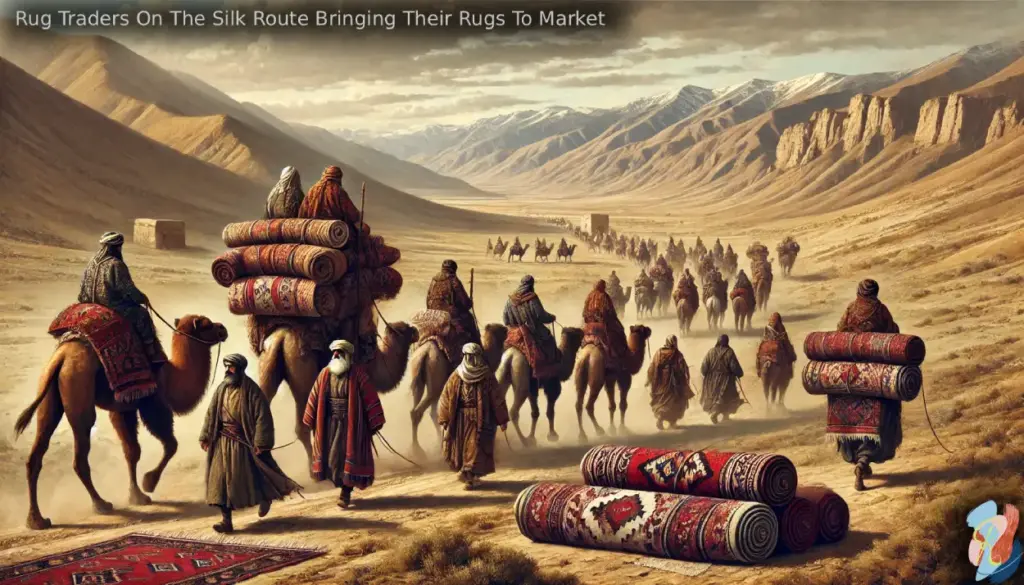
The “Silk Rout” Hybridity
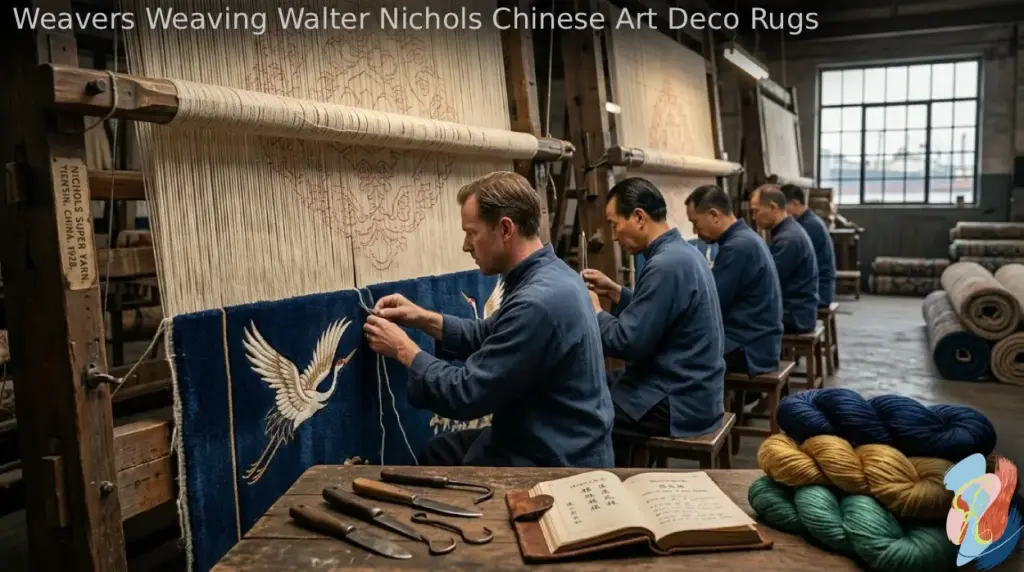
People are drawn to the Chinese rug because it is the ultimate “cosmopolitan” textile. It represents a 2,000-year dialogue between the nomadic weavers of the North and the literati scholars of the South. In the 20th century, this dialogue expanded to include the West, as names like Nichols and Fette brought American Art Deco sensibilities to the ancient looms of Tianjin. This ability to reinvent itself while maintaining its “Mandarin” soul makes the Chinese rug a timeless investment.
Material Luster
Finally, there is the physical fascination. Antique rugs from China, particularly those from Ningxia, utilize a specific type of high-altitude “fatty” wool that possesses a natural, wax-like luster. This wool doesn’t just hold color; it reflects light in a way that mimics the sheen of silk, giving the rugs a tactile “glow” that grows more beautiful as the piece patinas over decades.
Defining the Traditions: Geographic and Stylistic Diversity
To speak of “Chinese rugs” is to navigate a complex map of production centers.
Each weaving center has its own technical and cultural fingerprint:
- Ningxia: The spiritual heart of the tradition. Ningxia carpets are characterized by their “open” knotting, supple handle, and a sophisticated palette (often featuring imperial yellows and soft reds). These were the primary rugs of the Ming and Qing courts.
- Xinjiang (East Turkestan): Produced in oasis towns like Khotan, Yarkand, and Kashgar. These are the true “hybrids,” blending Persian floral motifs and pomegranate designs with Chinese structural techniques.
- Tibetan: Rugs characterized by a unique “looped” knotting technique and a distinct iconography rooted in Himalayan Buddhism, often featuring tigers, dragons, and highly stylized clouds.
- Beijing and Tianjin: These centers rose to prominence in the late 19th and early 20th centuries, adapting traditional designs for the global export market, often utilizing “deco” palettes and heavier, more durable piles.
The Inner Asian Exchange
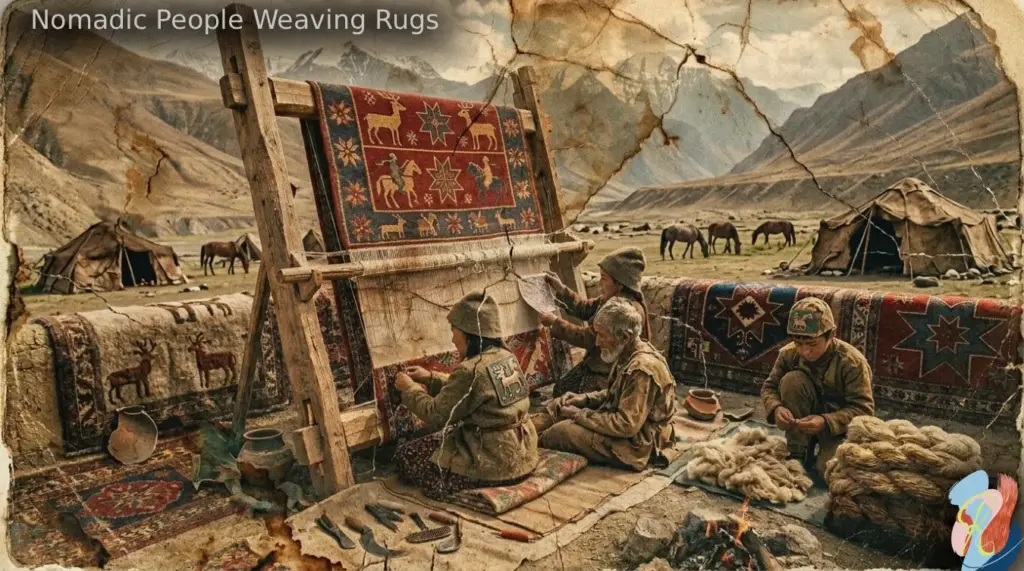
The technical foundation of the Chinese rug—the hand-knotted pile—was not native to the Han Chinese heartland. It was an imported technology from the Inner Asian steppe nomads. However, once adopted, the Chinese transformed the medium. Instead of the repetitive, geometric lattices found in Western Asia, they applied the aesthetics of ink-wash painting and silk embroidery to the loom.
Art Tradition and Imperial Patronage
Under the patronage of the Qing Dynasty, the carpet became an extension of the Emperor’s visual program. The rug was treated as a “horizontal painting.” The spacious fields allowed for the depiction of the Five Blessings, the Eight Buddhist Treasures, and the Celestial Dragon. Unlike the Turkish / Anatolian rug weaver who might weave “from the heart,” the imperial Chinese weaver often followed strict, scholarly templates designed to harmonize with the architecture of the Forbidden City.
Chinese carpets emerged as hybrid cultural artifacts shaped by imperial patronage, transregional exchange, and modern global markets, representing a synthesis of nomadic utility and high-art philosophy.
Historiography and Terminology: Deconstructing the “Chinese” Category
In the study of textile arts, the term “Chinese Rug” is often treated as a monolith. However, from a scholarly perspective, this is a modern convenience that obscures a fragmented and diverse history of production. To understand these carpets, one must first dismantle the Western “Oriental rug” classification system that has dominated the field since the 19th century.
The Categorical Divide: Imperial, Folk, and Frontier
Rather than a single tradition, Chinese weaving should be viewed through three distinct lenses:
- Imperial Production (The Scholarly Tradition): These are the refined works of the Ningxia and Beijing workshops. They are characterized by their adherence to courtly symbolism and a “spacious” aesthetic. These were not mere floor coverings but were integrated into the architectural and ritual life of the palace.
- Folk and Village Weaving: Often overlooked in early scholarship, these rugs were produced for local use in northern provinces. They often feature more rugged construction and idiosyncratic versions of classical motifs, reflecting the daily life and regional beliefs of the weavers.
- Frontier and Tibetan Production: Tibetan and East Turkestan (Xinjiang) rugs represent “frontier” cultures that, while under Chinese political influence, maintained distinct technical identities. The Tibetan “snub-knot” and the Khotan pomegranate motifs belong to a separate, albeit related, aesthetic lineage.
The Problem of Western Scholarship Bias
Much of the early 20th-century historiography regarding Chinese rugs was written by Western collectors who applied a “Persian-centric” framework to East Asian textiles.
This bias led to several scholarly “blind spots”:
- The “Primitive” Fallacy: Because Chinese rugs often have a lower knot count than fine Persian Isfahans, early Western scholars incorrectly labeled them as “technically simpler.” In reality, the lower knot count was a deliberate choice to accommodate the thick, soft wool of the region and to create a more “painterly” feel.
- Classification by “Period”: Westerners tried to categorize Chinese rugs by dynastic eras (e.g., “Ming” or “Kangxi”) in the same way they categorized porcelain. However, carpet designs remained conservative for centuries, making precise dating based on pattern alone notoriously difficult.
- The “Orientalist” Lens: By grouping Chinese rugs under the broad umbrella of “Oriental Carpets,” scholars often ignored the fundamental link between rug motifs and other Chinese arts like bronze work, silk brocades, and lacquerware.
Toward a New Taxonomy
Modern historiography now emphasizes Material Culture over mere geography. We no longer look at a rug as just “Chinese”; we look at it as a hybrid of nomadic technology and sedentary art—a textile that exists at the intersection of the Silk Road’s utility and the Forbidden City’s philosophy.
Early Origins and Silk Road Context (Pre-Imperial to Tang)
The narrative of the Chinese rug does not begin in the imperial workshops of Beijing, but in the shifting sands of the Tarim Basin. To understand the origins of these rugs, one must look at it not as a sedentary art, but as a “vehicle” of exchange—both literally, as a portable luxury item, and figuratively, as a carrier of cross-cultural iconography.
Archaeological Evidence: The Tarim Basin and Taklamakan
The dry, saline environment of the Tarim Basin (modern-day Xinjiang) has preserved some of the world’s oldest pile-woven fragments. These discoveries, particularly in burial sites at Loulan and Niya, provide the missing link between the earliest nomadic weavings and the established Chinese tradition.
- The Taklamakan Textiles: Discoveries dating back to the late 1st millennium BCE show a sophisticated mastery of the knotted pile. These fragments reveal that the technology of hand-knotting arrived in what is now Western China via the nomadic tribes of the Eurasian steppe.
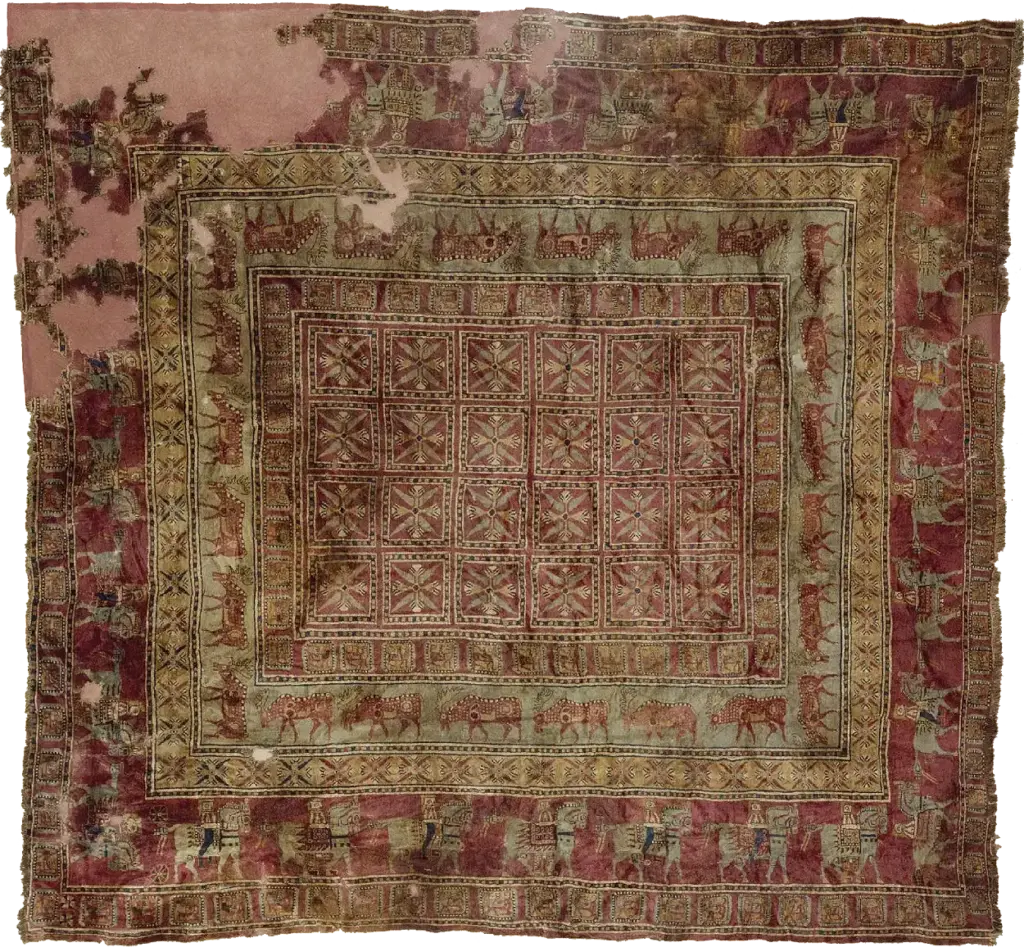
- The Pazyryk Connection: The technical DNA of these early fragments—utilizing symmetrical knots and varied wool qualities—echoes the famous Pazyryk Carpet (found in the Altai Mountains). This confirms that the “proto-Chinese” rug was part of a pan-Central Asian weaving culture long before it was adopted by the Han Chinese.
Cultural Exchange: The Silk Road as a Loom
During the Han and Tang dynasties, the Silk Road functioned as a global conveyor belt for artistic innovation.
The Chinese carpet emerged from this period as a profound synthesis of three distinct influences:
- Persian (Sasanian) Influence: The high-prestige textiles of the Sasanian Empire introduced the concept of formal, symmetrical compositions and specific motifs, such as the “pearl-border” and the hunt scene, which would eventually be “Sinicized” by Chinese artisans.
- Central Asian Nomads: The practical expertise of the Scythian and Sogdian peoples provided the durable structures required for life on the move. Their use of vibrant, locally sourced vegetable dyes established the foundational color palette of the region.
- Ideological Exchange: Carpets were more than decor; they were diplomatic gifts and ritual objects. As Buddhism traveled from India through Central Asia into China, the motifs of the lotus, the lion, and the mandala were translated into the medium of wool, transforming the carpet into a sacred space.
The Tang Dynasty: The “International” Style
By the Tang Dynasty (618–907 CE), the Chinese rug had reached its first “International Style.” The imperial courts in Chang’an were melting pots of culture. Here, the carpet began to shift from a purely nomadic utility to an aristocratic luxury item. While few Tang hand-knotted pile rugs survive today, the Shoso-in Repository in Japan preserves felt and woven rugs from this era, showcasing a preference for the “floral medallion” and the stylized “vining” patterns that remain pillars of East Asian design to this day.
It is a common misconception that the Chinese rug “evolved” in isolation. In reality, the Tang-era rugs were the world’s most sophisticated “hybrid” objects, blending the animal-style energy of the steppe with the refined floral geometry of the Silk Road oases.
Imperial Period Development (Yuan–Qing Dynasties)
Yuan Dynasty: The Mongol Pivot
The Yuan Dynasty (1271–1368) represents the most critical turning point in the history of the area rugs from China. Because the ruling Mongols were descendants of the Central Asian steppe, they brought with them a profound “textile-centric” culture.
- Imperial Adoption: Under Mongol rule, pile-woven carpets were formally introduced into the Chinese court. Unlike previous dynasties that prioritized woven silk floor coverings or mats, the Yuan emperors demanded the warmth and durability of the hand-knotted pile.
- Central Asian Influence: This era saw a mass migration of weavers from the Silk Road oases (like Kashgar and Khotan) into the Chinese interior. This “forced” cultural exchange injected Persian and Islamic geometric sensibilities into the nascent Chinese rug industry, establishing the early blueprints for what would become the Ningxia style.
Ming Dynasty: The Era of Silk
During the Ming Dynasty (1368–1344), the carpet’s role was paradoxically diminished and refined. As Han Chinese rule returned, the focus shifted back to silk textiles and lacquerware.
- Limited Production: While carpet weaving continued, it was less central to court life than silk brocades. Large-scale pile production was rare; however, the area rugs that were produced began to shed their heavy Central Asian influence, adopting the “sparse” and elegant aesthetics seen in Ming furniture and painting.
- Aesthetic Restraint: The Ming aesthetic prioritized “negative space”—a concept known as liubai. This led to rugs with simple, elegant borders and a central field that remained largely unadorned, save for a few symbolic motifs.
Qing Dynasty: Peak Development and the Imperial Workshops
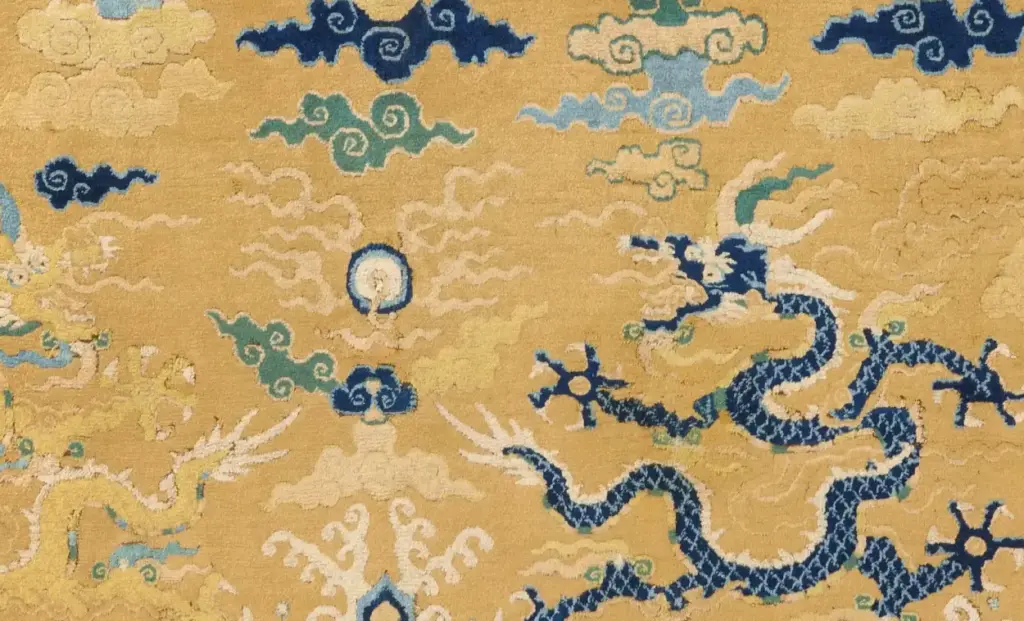
The Qing Dynasty (1644–1912), under the Manchu emperors, saw the absolute zenith of Chinese carpet production. The emperors (particularly Kangxi and Qianlong) were prolific patrons who established and expanded imperial workshops.
- Production Hubs:
- Ningxia: Designated as the premier workshop for the court. Ningxia rugs were known for their supple “open” backs and the use of the highest quality “fatty” wool, creating a finish that felt more like velvet than a standard rug.
- Beijing: Established to handle the massive demand for palace furnishings. These workshops focused on larger, more formal pieces with rigid geometric layouts and heavy symbolic loads.
- Context of Use:
- The Forbidden City: Rugs were used to define “zones of power” within the massive palace halls. Long, narrow rugs were draped over benches and thrones, while massive square carpets were used as “column rugs” (wrapped around structural pillars in temples).
- Buddhist Temples: Many of the most significant Qing-era rugs were commissioned for Tibetan Buddhist monasteries, featuring heavy mandalas and tantric symbolism.
The Synthesis of Symbolism and Cosmology
Under the Qing, the carpet became a Cosmological Map.
Every design choice was a reference to the Emperor’s mandate:
- Court Symbolism: The Chinese Five-Clawed Dragon design (reserved exclusively for the Emperor), the Phoenix (the Empress), and the Crane (longevity) became standard motifs.
- Color as Status: The use of “Imperial Yellow” (imperial gold) was strictly regulated.
- The Five Elements: Rug compositions often reflected the Chinese concept of Wuxing, aligning the rug with the cardinal directions and the elements of Wood, Fire, Earth, Metal, and Water.
Symbolism and Cosmology in Chinese Rugs
In the Chinese tradition, a rug is never merely decorative; it is a literary text woven in wool. The transition from the “tribal” to the “imperial” means moving from a language of protection to a language of aspiration and order.
The Systematized Lexicon
The Chinese weaver operated within a rigid symbolic hierarchy. Unlike the “free-form” tribal motifs of the West, Chinese motifs are highly standardized across all media—from porcelain to silk and carpets.
Chinese symbolism hierarchy examples:
- The Dragon (Imperial Authority): The most potent symbol in the Chinese repertoire. In the Qing era, the number of claws was a strictly enforced indicator of rank: the five-clawed dragon was reserved for the Emperor, while four-clawed “serpents” (mang) were for lower-ranking officials.
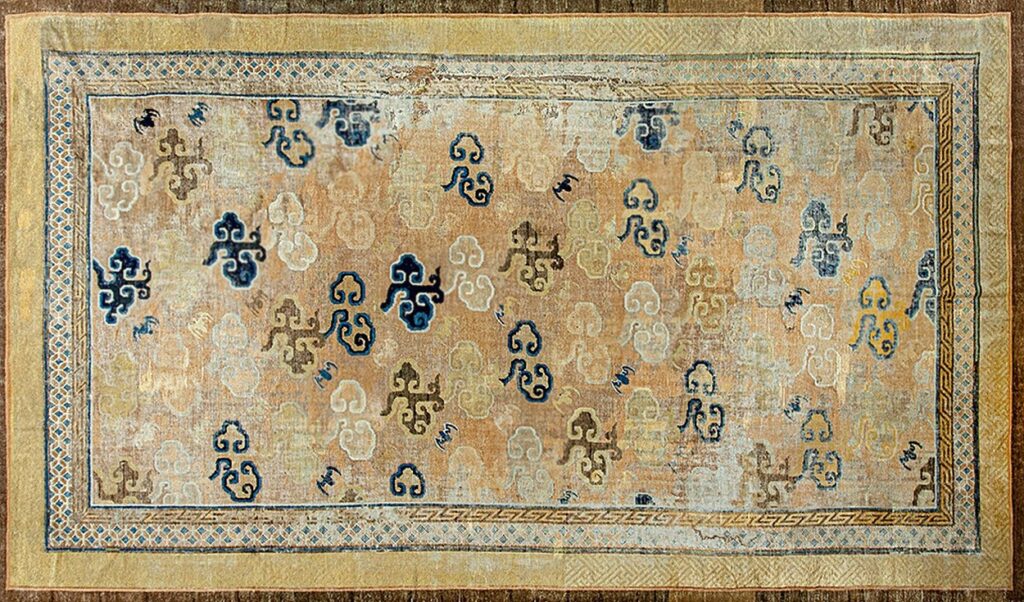
- Clouds (Cosmic Order): Often depicted as “ruyi” or “ribbon” clouds, these represent the celestial realm. They are frequently used as “fill” motifs to create a sense of depth and spiritual space.
- The Lotus (Buddhist Purity): One of the “Eight Auspicious Symbols” (Ashtamangala). It represents the ability to remain pure and untainted, rising from the “mud” of the material world.
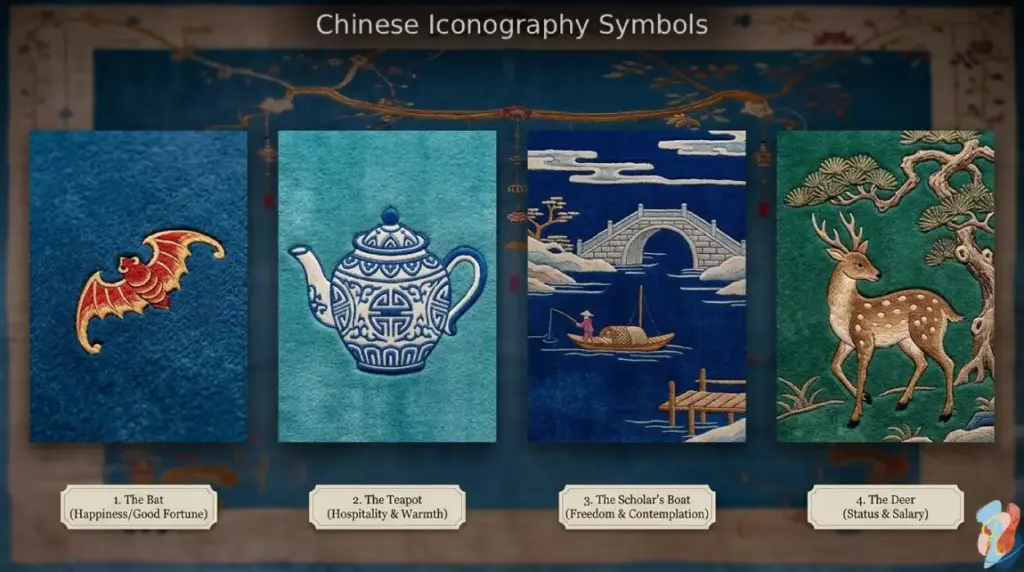
- Bats (Phonetic Symbolism): A unique feature of Chinese art is the use of rebus (phonetic puns). The word for bat (fu) sounds identical to the word for happiness/prosperity (fu). Thus, a rug featuring five bats represents the “Five Blessings”: longevity, wealth, health, love of virtue, and a peaceful death.
The Spatial Philosophy: “Empty” and “Full”
A defining characteristic of the Chinese carpet is its use of negative space.
For example:
- The Medallion Layout: Unlike the “all-over” dense patterns of Persia, Chinese rugs often feature a central medallion surrounded by a vast, unadorned field. This creates a sense of “quietness” and allows the quality of the wool to speak for itself.
- The Border Logic: Borders often utilize the Meander (Key) pattern or the “Running Water” motif, symbolizing continuity and the eternal flow of the Tao.
Philosophical & Mathematical Motifs (The Core)
Geometric Patterns & Cosmology:
- Yin-Yang (Taiji): Represents the harmony of opposites. In rug design, this is often found in the center of a medallion, signaling that the home is a place of balance.
- Bagua (Eight Trigrams): These eight sets of three lines represent the fundamental principles of reality (Heaven, Earth, Fire, Water, etc.). When found on a rug, it functions as a protective map, aligning the room with the natural laws of the universe.
- Chinese Knot (Pan Chang): Also known as the Endless Knot (one of the Eight Auspicious Symbols). Because it has no beginning and no end, it represents Eternity and the Buddhist concept of the interconnectedness of all beings.
The Danger of Over-Interpretation
While it is tempting to assign a fixed “meaning” to every knot, the erudite student must maintain a degree of skepticism.
It is important to note that the design meaning in Chinese textiles is often context-dependent. A dragon on a rug intended for a Buddhist temple carries a different spiritual weight than a dragon on a rug in the Emperor’s private study.
Modern scholarship warns against “The Dictionary Approach” to rug studies—the idea that you can simply “look up” a symbol to understand a piece. Many late-19th-century rugs used traditional motifs purely for their aesthetic value or because they were required by Western export contracts, regardless of their historical philosophical depth.
Expanded Lexicon of Symbols and Rebus Puns
The Animal Kingdom (Expanded)
- The Butterfly (Die): A pun for “seventy years of age.” It represents a wish for a long, vibrant life. When paired with a cat, it represents the “Mao-Die” blessing for extreme longevity.
- The Cat (Mao): Often used in pictorial Baotou rugs to symbolize the protection of the home (and the grain) from pests; also a pun for “eighty years of age.”
- The Fish (Yu): A pun for “abundance” or “surplus.” A Pair of Fish represents domestic harmony and fertility.
- The Elephant (Da Xiang): A pun for “Great Sign” or “Good Omen.” An elephant carrying a vase (Ping) on its back is a rebus for “Peaceful times” (Taiping Youxiang).
- The Toad (Three-Legged): Represents the unattainable; specifically the moon and the lure of wealth and immortality.
The Botanical and Fruit (Expanded)
- The Peach (Tao): The primary symbol of immortality, derived from the “Peaches of Immortality” in the garden of the Queen Mother of the West.
- The Citron (Buddha’s Hand): A fruit with finger-like protrusions. It represents divine protection, blessings, and wealth (the “hand” that grasps fortune).
- The Fungus (Lingzhi): The “Mushroom of Immortality.” Its shape inspired the Ruyi (wish-granting) scepter.
- The Orchid: Represents the “Perfect Man” or the scholar—humble, refined, and possessed of a subtle, hidden fragrance.
- Plum Blossom: The “First Flower of the Year.” Because it blooms while there is still snow on the ground, it is the ultimate symbol of Resilience and the promise that spring (and prosperity) is coming.
- Bamboo: The “Scholar’s Tree.” It is hollow (representing a mind open to learning) and flexible (representing the ability to bend without breaking under political or social pressure).
The Scholarly “Rebus” Patterns
- The Eight Immortals’ Weapons: Sometimes the Immortals themselves aren’t shown, only their “attributes” (e.g., the flute, the fan, the sword). This creates a “hidden” spiritual presence.
- The Vase (Ping): A pun for “Peace” or “Tranquility.”
- The Coral: One of the Eight Precious Things, symbolizing official rank and longevity.
The Semiotics of Color in Chinese Culture
In Chinese weaving, color is not a decorative choice; it is a directional and elemental force. The “Five Elements” (Wuxing) correspond to specific colors and cardinal directions.
The Five Primary Colors
| Color | Element | Direction | Significance |
| Yellow / Gold | Earth | Center | The “Imperial” color. Represents the Emperor, the sun, and the center of the universe. |
| Red | Fire | South | Represents joy, success, and celebration. Used in “wedding rugs” to ensure a flourishing lineage. |
| Blue | Wood | East | Represents immortality and advancement. Deep “Peking Blue” symbolizes the sky and scholarly depth. |
| White | Metal | West | Represents purity, but also mourning. In rugs, it is often used as a ground to symbolize the clarity of the mind. |
| Black | Water | North | Represents the unknown, the primordial, and deep wisdom. Often used in borders to “contain” the energy of the rug. |
Color Modification (The White Crane vs. The Yellow Crane)
The “meaning” of a motif can shift based on the color it is dyed.
This is where the erudite collector finds the hidden “subtext” of a piece:
- The White Crane: This is the “Crane of the Immortals.” It focuses on purity, spiritual transcendence, and a long life of integrity. A white crane flying toward the sun is the highest symbol of a scholar’s ascent.
- The Yellow / Golden Crane: This often refers to the “Yellow Crane Tower” legend—a symbol of earthly fame, high official rank, and bureaucratic success. While the white crane is spiritual, the yellow/gold crane is professional and social.
- The Red Dragon vs. The Blue Dragon:
- Red Dragon: Associated with the sun and festive energy; often used in celebratory contexts.
- Blue Dragon: Represents the “Azure Dragon of the East,” the bringer of rain and the guardian of the spring season. It is a symbol of regrowth and vitality.
- The White Lotus vs. The Pink / Red Lotus:
- White Lotus: Represents mental and spiritual purity (Buddhist focus).
- Pink/Red Lotus: Represents the person of the Buddha himself or a state of high celebration and “enlightenment in the physical world.”
Also, if you see a rug with a Brown / Cinnamon ground, it often indicates a “Monastic” origin. These muted tones were favored by Buddhist monks as they represented the “earthy” detachment from the vibrant “vanity” of imperial reds and golds.
Color as a Semantic Modifier: An Expanded Guide
The Dragon (Long)
- Gold / Yellow Dragon: The “True Dragon.” Represents the Emperor’s person, the center of the universe, and the absolute peak of earthly authority.
- Blue / Azure Dragon: The “Scholar’s Dragon.” It represents the East, Spring, and Renewal. It is associated with the growth of knowledge and the coming of life-giving rain.
- Red Dragon: The “Festive Dragon.” Symbolizes vitality, energy, and the driving out of evil spirits. Frequently found on rugs intended for celebratory hall displays.
- Black / Dark Indigo Dragon: The “Mystic Dragon.” Associated with Water and the North. It represents deep, hidden power and the winter season of reflection.
The Lotus (Lianhua)
- White Lotus: The “Buddha’s Mind.” Represents absolute purity and detachment from the material world. It is the most common color for monastic or temple settings.
- Pink / Red Lotus: The “Lotus of the Heart.” It represents compassion and love. While the white lotus is intellectual/spiritual, the red lotus is emotional/devotional.
- Blue Lotus: The “Victory of Spirit.” Represents intelligence and wisdom over the senses. It is often depicted as partially open to signify the ongoing search for truth.
The Crane (He)
- White Crane: The “Immortal’s Steed.” Represents purity and a long life of spiritual integrity. It is the bird that carries the soul to the Western Paradise.
- Yellow / Golden Crane: The “Secular Success.” Represents bureaucratic promotion and earthly honors. It is a wish for a prestigious career within the social hierarchy.
- Black Crane: In mythology, a crane is said to turn black after its 600th year. Thus, a black crane symbolizes extreme, miraculous longevity—often used on gifts for the very elderly.
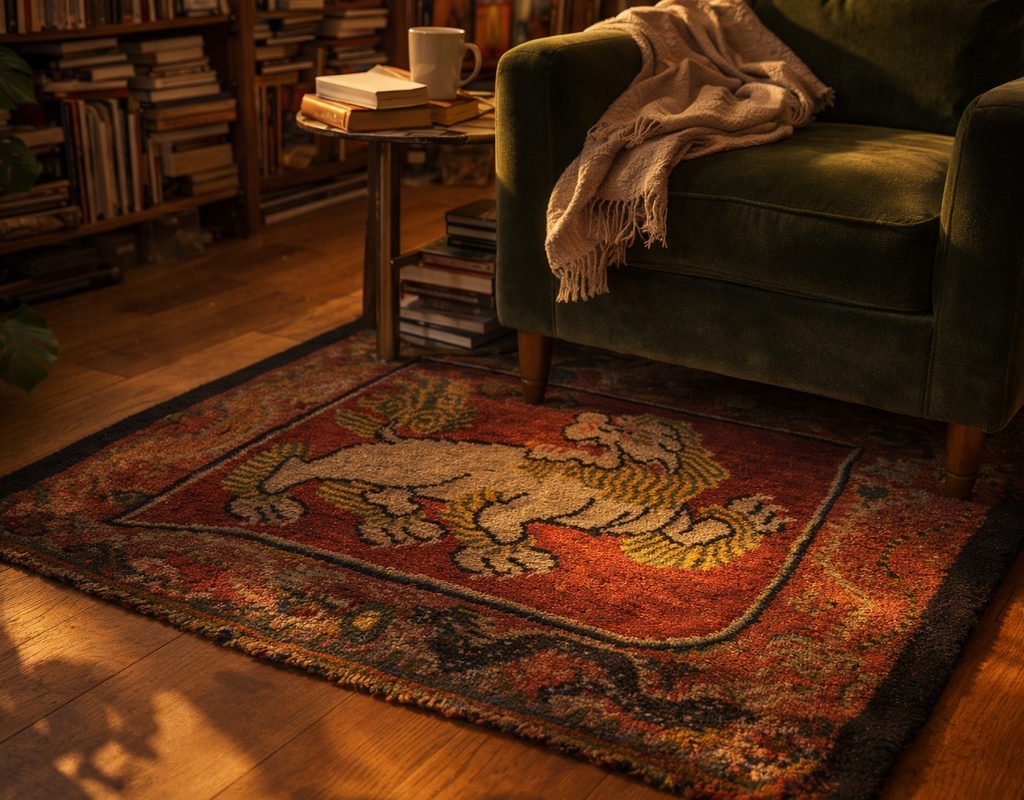
The Lion (Foo Dog)
- Gold / Yellow Lion: Represents Imperial protection. These are the “Guardians of the State” and symbolize the strength of the government.
- Green / Blue Lion: Represents Nature and Spiritual Protection. These are often seen in more domestic or garden-style rugs, protecting the household from “bad chi” (negative energy).
The Phoenix (Fenghuang)
- Five-Colored (Rainbow) Phoenix: The “Original Phoenix.” It represents the five cardinal virtues (Ren, Yi, Li, Zhi, Xin). It is the ultimate symbol of a harmonious universe.
- Red Phoenix: Often specifically used to represent South and the Summer sun. It is a symbol of warmth and the peak of Yang energy.
The “Ground” Color: The Context of the Field
In Chinese weaving, the color of the rug field (the background) dictates the “environment” in which the symbols live.
Field color significance:
- Imperial Gold Field: The rug is a Throne Space. It transforms the room into a center of power.
- Deep Indigo Field: The rug is a Night Sky. It provides a “cosmic” backdrop, making the floating motifs (clouds, stars, scholars’ objects) feel like they are suspended in the heavens.
- Cinnamon / Came l/ Tan Field: The rug is Earthed. These natural, undyed wool tones represent humility and are preferred for scholarly studies and libraries where focus is required.
- Apricot / Salmon Field: These “fruit-skin” colors were popular in Ningxia production. They represent warmth and hospitality, intended for living areas and guest reception halls.
Summary Table: The “Modifier” Cheat Sheet
| Motif | Color | Shifted Meaning |
| Fish | Red | Success and “Passing the exams” (The Leaping Carp). |
| Fish | Gold | Wealth and “Gold in the hand.” |
| Clouds | Multi-colored | The “Five-Color Clouds” (Auspicious omens/miracles). |
| Clouds | Blue/White | The “Standard Heavens” (Routine peace and order). |
| Peony | Red/Pink | Love, Romance, and High Status. |
| Peony | White | Refined Beauty and the “Quiet Dignity” of an official’s wife. |
Erudite Observation: When you encounter a white-on-blue rug (common in Baotou and Peking styles), you are looking at a “Calligraphic” aesthetic. It is meant to mimic the intellectual clarity of blue-and-white porcelain and ink on paper, prioritizing rationality and scholarly calm over the emotional heat of a red or gold rug.
The Scholarly & Taoist Tools: An Identification Guide
In many Chinese rugs, you will see “floating” objects that aren’t animals or flowers. These are usually the attributes of the scholarly elite or the Taoist Immortals.
The Eight Precious Things (Ba Bao)
Found frequently in the borders or fields of Peking and Baotou rugs, these represent the aspirations of the “literati” (the scholar-officials).
- The Pearl: Represents the “Pearl of Wisdom” or the “Flaming Pearl” of the dragon. It signifies pure intention and spiritual energy.
- The Lozenge (Diamond): A symbol of victory and successful business/political endeavors.
- The Stone Chime: A pun for “Blessing.” It represents a life of harmony and celebratory music.
- The Rhinoceros Horns: A symbol of happiness and a protection against poison/evil.
- The Coin: Represents wealth and prosperity in the material world.
- The Mirror: Represents self-reflection and the ability to see the truth.
- The Books: Represent learning, wisdom, and the success of the scholar in the imperial exams.
- The Artemisia Leaf: A symbol of healing and the prevention of disease.
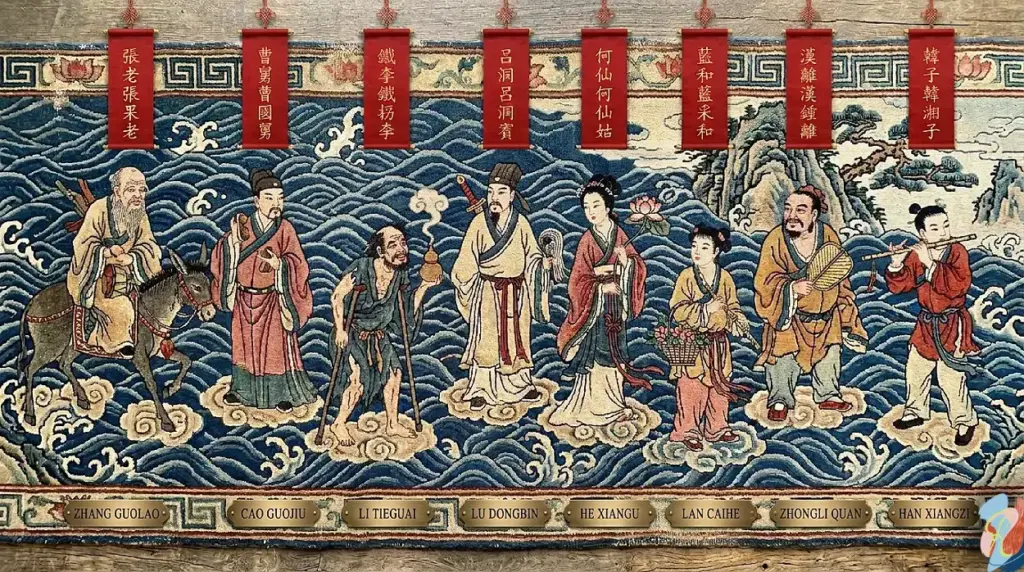
The Eight Immortals’ Weapons (An Ba Xian)
When you see these items, the rug is invoking the protection and specific powers of the Eight Taoist Immortals. These are “hidden” symbols—the figures themselves aren’t shown, only their tools.
- The Fan (Zhongli Quan): Used to revive the dead. Represents Resurrection and Authority.
- The Sword (Lu Dongbin): Used to dispel evil spirits. Represents Protection and Valor.
- The Gourd and Crutch (Li Tieguai): Represents Healing and Medicine for the sick and needy.
- The Castanets (Cao Guojiu): Represents Music and High Social Rank.
- The Flower Basket (Lan Caihe): Represents Abundance and the Spirit of Nature.
- The Bamboo Tube & Rods (Zhang Guolao): A musical drum representing Longevity and Vitality.
- The Flute (Han Xiangzi): Represents Harmonious Living and the Power of Music.
- The Lotus (He Xiangu): The only female immortal; represents Health and Domestic Purity.
The “Hundred Antiques” (Bo Gu Tu)
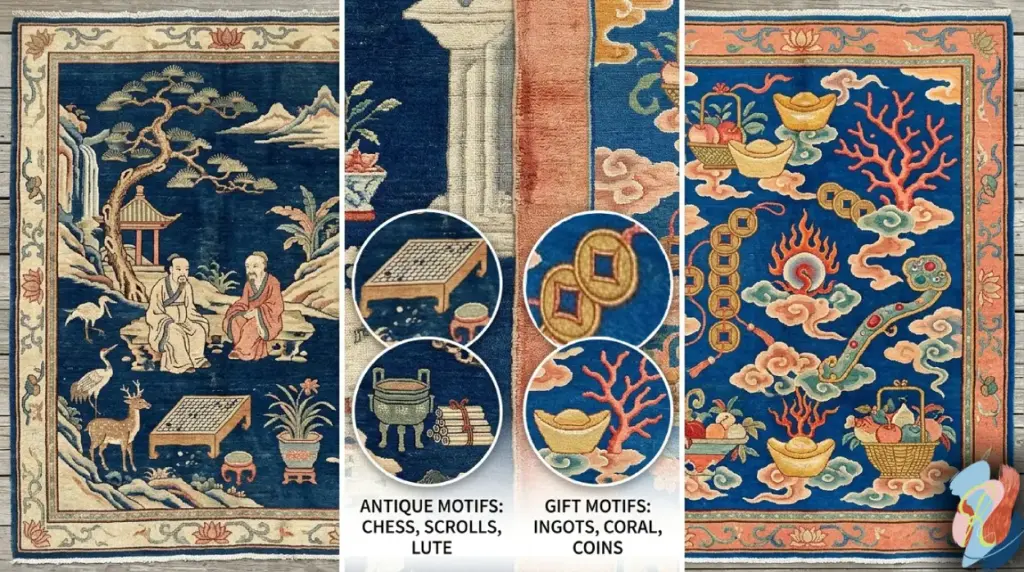
In some extremely “erudite” Peking and Nichols rugs, the field is filled with an assortment of vases, bronzes, and chessboards. This is the “Hundred Antiques” motif.
- Meaning: It signifies a home of profound culture and antiquity. It suggests the owner is a “Connoisseur” (Guwen) who values history over mere wealth.
- Common Items:
- The Qin (Lute): A musical instrument representing harmony, self-cultivation, and the suppression of lust.
- The Go Board (Weiqi): Often depicted as a chessboard with black and white stones, representing intellect and strategy.
- The Calligraphy Scrolls: Usually shown in tied bundles, representing a respect for history, truth, and the written word.
- Go (Weiqi) Board: Usually depicted as a low, thick wooden table with a grid on top, often accompanied by two small jars or bowls containing black and white stones.
The “Hundred Gifts” (Ba Jiao)
While the Bo Gu Tu focuses on the scholar’s library, the Ba Jiao—often referred to as the “Eight Treasures” or “Hundred Gifts”—represents the physical manifestation of luck, wealth, and social success. While they are often mixed with “Antiques,” their energy is distinctly more celebratory and festive.
- Meaning: It signifies a life of abundance and “Many Treasures.” If the Antiques rug says “I am learned,” the Gifts rug says “I am blessed with prosperity and rank.”
- Common Items: * The Gold Ingot (Yuanbao): Shaped like a small boat, representing literal wealth.
- The Branch of Coral: A symbol of official promotion and high social standing.
- The Flaming Pearl: Representing the attainment of wisdom and the granting of wishes.
- The Coin: Often tied with a ribbon, symbolizing a continuous flow of wealth.
- The Rhinoceros Horns: A rare and precious material signifying protection and victory.
The Comparison: Hundred Gifts (Ba Jiao) vs. Hundred Antiques (Bo Gu Tu)
How to Tell the Difference on a Rug
If you are looking at a field of floating objects, here is the “Cheat Sheet”:
| Feature | Hundred Antiques | Hundred Gifts |
| Primary Object | A Ding (Bronze Tripod) or a Scroll. | A Gold Ingot or a Jeweled Box. |
| Floral Accents | Scholarly flowers: Orchids or Bamboo. | Wealthy flowers: Huge, lush Peonies. |
| Atmosphere | Feels like a Library or a Temple. | Feels like a Wedding Feast or a Treasury. |
| Core Message | “Knowledge is the greatest treasure.” | “Prosperity is the greatest blessing.” |
The Hundred Gifts (Ba Jiao) and Hundred Antiques (Bo Gu Tu) Confusion
The confusion happens because weavers often “mixed their metaphors.” A rug made for a wealthy merchant’s home might feature the Books (Antiques) to show he was educated, but surround them with Ingots and Coins (Gifts) to show he was successful in business.
In the trade, “Hundred Antiques” is often used as a catch-all term for any rug with floating objects, but a true connoisseur—like those who shop at RugsOnNet—knows that a rug filled with “Gifts” is a much more vibrant, secular wish for success than the more quiet “Antique” rug.
The Art of the Character
Calligraphic Characters (The Written Blessing)
While many rugs use symbols, some use literal script to “speak” their intent:
- Fu (福): The most common character, often seen in the center of a medallion or repeated in the borders. It is a direct invocation of Good Fortune.
- Shuangxi (囍 – Double Happiness): You will see this almost exclusively on Wedding Rugs. It is formed by doubling the character for “joy,” representing the union of two people and two families.
- Shou (寿): Though not on your list, this is the third of the “Great Three” characters. It represents Longevity and is often stylized into a circular, labyrinthine pattern.
The Pantheon of the Loom: Figures and Deities
When a Chinese rug moves from pattern to portraiture, it is almost always invoking a specific moral or spiritual narrative.
Here are the figures you will encounter most frequently:
The Eight Immortals: Identifying the Archetypes
In high-end Pictorial Baotou or Silk Imperial rugs, these eight figures represent the Taoist belief that divinity is accessible to everyone, regardless of their station in life.
The Taoist Approach to the Eight Immortals:
- Zhongli Quan (The Leader/The Rich): Usually depicted as a robust man with a bare belly, holding a large fan that can revive the dead. He represents Wealth and military authority.
- Li Tieguai (The Outcast/The Cripple): A ragged man with an iron crutch and a gourd that emits a cloud of spirit-vapor. He represents the Outcast and the power of healing.
- Zhang Guolao (The Old): An elderly man often seen riding a donkey backwards and carrying a bamboo drum with two rods. He represents Longevity and the wisdom of age.
- Lan Caihe (The Young): Often depicted as a youth of ambiguous gender carrying a flower basket. They represent Youth and the spirit of nature.
- He Xiangu (The Female): The only woman in the group, usually carrying a lotus flower or a peach. She represents Feminine Virtue and domestic purity.
- Lu Dongbin (The Male/The Scholar): A handsome man dressed as a scholar with a magic sword slung across his back. He represents Intellect and the vanquishing of ignorance.
- Cao Guojiu (The Aristocrat): Dressed in formal court robes and holding a pair of castanets (official tablets). He represents the Elite/Nobility and high social rank.
- Han Xiangzi (The Philosopher/The Poor): Often seen playing a flute. He was a wandering soul who refused a government career to study nature. He represents Simplicity and the beauty of music.
The Three Stars (Fu, Lu, Shou)
These are the three most popular “Gods of Happiness” in Chinese culture.
They are often seen together in the center of pictorial rugs:
- Fu (God of Fortune): Often dressed as a scholar-official carrying a scroll or a child.
- Lu (God of Prosperity): Usually depicted in the dress of a high-ranking mandarin, symbolizing career success and wealth.
- Shou (God of Longevity): Easily identified by his high, domed forehead, carrying a peach and a traveler’s staff.
- Significance: This “Holy Trinity” of Chinese folk religion represents the complete life—wealth, status, and long life.
The Queen Mother of the West (Xi Wangmu)
In high-end silk or imperial-style rugs, you may see a noble woman riding a phoenix or sitting in a lush palace garden surrounded by female attendants.
- Significance: She is the guardian of the Peaches of Immortality. A rug featuring her is the ultimate “Birthday Gift” for a matriarch, representing grace, power, and eternal life.
Magu (The Hemp Maiden)
A beautiful young woman often accompanied by a deer and carrying a basket of lingzhi mushrooms or a flask of wine.
- Significance: She is a goddess of longevity associated with the beauty of spring. Rugs featuring Magu were traditionally gifted to young women to bless them with enduring beauty and a long, healthy life.
Children at Play (Baizi Tu)
You will often see rugs filled with “One Hundred Boys” playing games, flying kites, or riding hobby-horses.
- Significance: This is a powerful symbol of lineage and fertility. It represents the “Continuity of the Hearth” and the wish for many successful sons to carry on the family name.
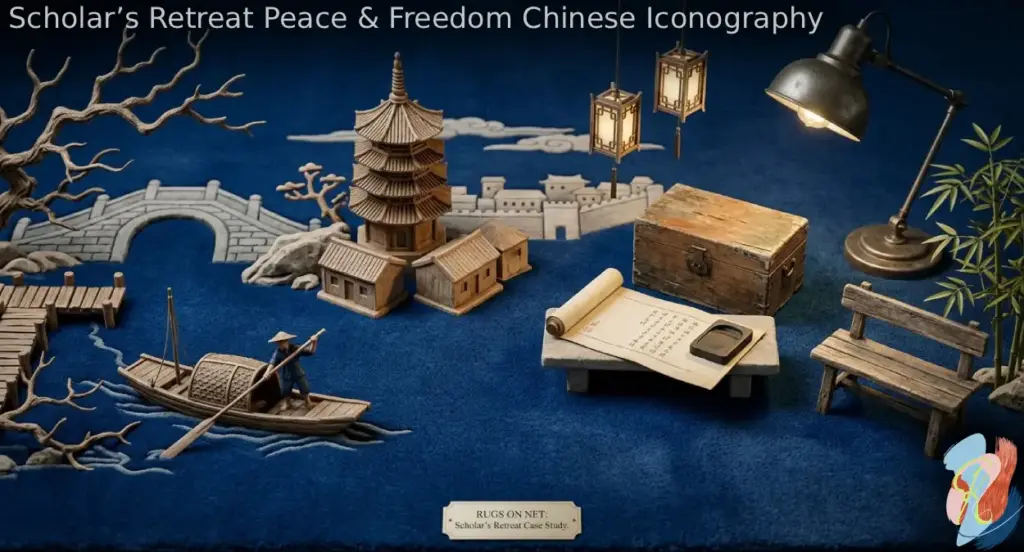
The Scholar under the Pine
A solitary figure sitting by a stream or under a gnarled pine tree, often with a lute (Qin) or a book.
- Significance: This represents the Idealized Life. It is a “Refuge Rug,” intended for a study or library to remind the owner of the importance of contemplation, nature, and intellectual pursuit over the chaos of the outside world.
The Art of the Saddle: Horse Covers and Trappings
In the Qing Dynasty and the Tibetan highlands, a horse was not merely transport; it was a mobile stage for displaying the owner’s status. Unlike floor rugs, saddle covers were designed with a specific human-animal architecture in mind.
Structure of the “Butterfly” Saddle
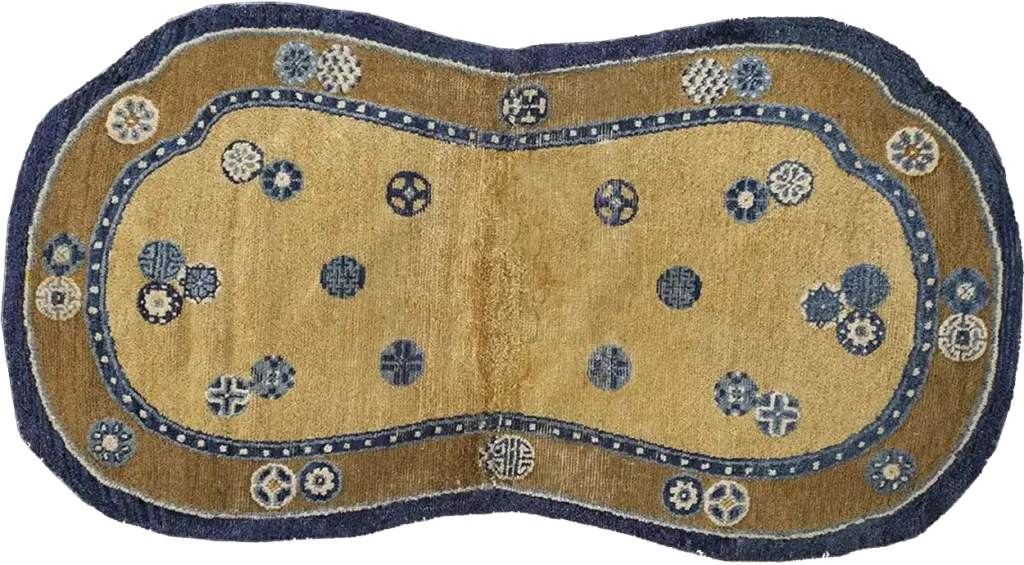
A classic Chinese saddle rug is usually composed of two pieces:
- The Upper Cover (Ma’an-dian): Often shaped like a butterfly or a notched rectangle, this sat directly under the rider.
- The Under-Saddle: A larger, more utilitarian piece meant to protect the horse’s flanks.
Why are there so many?
The prevalence of these rugs is tied to two historical factors:
- The Imperial Post & Military: The Qing Empire maintained a massive network of relay stations. High-ranking officials and military officers required specific trappings that denoted their rank.
- Tibetan Monastic Processions: In Tibet, high-ranking lamas and officials traveled by horse during religious festivals. These “Monastic Saddles” are often the most vibrant, featuring “Tiger” patterns or deep ritual reds.
Key Motifs on Saddle Rugs
Because these were seen from a distance as the horse moved, the designs are often bolder and more graphic than those found on floor rugs.
The 4 main Chinese horse cover motifs:
- The Dragon & Phoenix: Reserved for the highest imperial ranks or wedding processions.
- The “Four Coins”: Often found at the corners of the saddle, symbolizing a wish for a “prosperous journey.”
- The Tiger Skin: Particularly common in Tibetan saddles. The tiger motif was believed to imbue the rider with the animal’s strength and to protect the horse from evil spirits.
- Snow Lions: Symbols of the Himalayan peaks, representing fearlessness and joy.
Technical Distinctions
Saddle rugs were built for friction. They often feature:
- Harder Wool: To withstand the constant rubbing of the rider’s legs.
- Leather Edging: Many surviving antique saddles still have the original red or black leather “binding” around the edges to prevent fraying.
- Slotted Centers: You will often see two holes or slits in the middle of the rug; these were designed to allow the wooden pommels of the saddle to pass through.
Explore the functional artistry of the Silk Road—where equestrian tradition meets Imperial weaving.
Shop Chinese Saddle Rugs & Horse CoversThe Imperial Inscriptions: “Signed” Forbidden City Rugs
In the world of Chinese weaving, a signature is a rare and prestigious marker. Unlike Persian rugs, which are often signed by a master weaver or workshop (e.g., Habibian), antique Chinese carpets were almost never signed by individuals. When they are “signed,” it is usually an official inscription indicating they were property of the Imperial Palace.
The most sought-after pieces in the “erudite” market are those bearing inscriptions that mark them as part of the Qing Dynasty Imperial Household. These are not signatures of artists, but stamps of institutional ownership.
The “Hall” Inscriptions (Lidian)
The most common “signature” on a Forbidden City carpet is a five or six-character inscription woven into the upper border.
These typically read:
- “Prepared for the Use of…” followed by the name of a specific hall within the Forbidden City.
- Common Locations: You might see inscriptions for the Taihe Dian (Hall of Supreme Harmony) or the Baohe Dian (Hall of Preserving Harmony).
The “Nian Zhi” (Date) Marks
Some rugs carry a reign mark, such as “Made during the Qianlong Reign of the Great Qing” (Da Qing Qianlong Nian Zhi).
Buyer beware:
While these Forbidden City inscriptions denote the style of the reign, many were woven in the late 19th century using the earlier Emperor’s name as a mark of respect or to indicate a specific “classic” design template. An authentic, period-correct Qianlong rug is a museum-grade rarity.
“Silk and Metal” Carpets
The most famous “signed” Forbidden City rugs are the Silk and Metal carpets.
These utilized silk pile wrapped in gold or silver foil (metal strips):
- The Signature: These often feature the characters “Wan Shou Wu Jiang” (Ten Thousand Years of Long Life without End) woven into the borders. This was a specific birthday greeting for the Emperor.
- Function: These were not meant for walking; they were “throne covers” or wall hangings that created a shimmering, celestial environment around the Imperial person.
How to Spot an Authentic Inscription:
- The Script: The characters are always in Kaitishu (Standard Script), rendered with the precision of a calligrapher.
- Placement: The signature is usually at the very top edge, intended to be read by someone approaching the throne or entering the room.
- The “Knot-In”: On authentic Forbidden City pieces, the signature is integral—it is woven into the structure of the rug, not embroidered on later.
Why these are the “Holy Grail” of Chinese Rugs:
A “signed” Forbidden City rug is a direct link to the Forbidden City’s daily rituals. They represent the peak of the Workshop Production system we discussed in Section 8—where the weaver’s identity was subsumed by the glory of the State.
For the modern collector, finding a piece with a verifiable “Hall” inscription is the equivalent of owning a piece of the Emperor’s own furniture. It is the ultimate “erudite” acquisition.
Small tip:
Be wary of rugs where the inscription looks “fuzzy” or the characters are simplified. The Imperial workshops employed the finest craftsmen in the world; their “typography” in wool was as sharp as ink on silk.
Techniques and Material Culture: The Sculptural Loom
The technical profile of the Chinese rug is a departure from the “fineness-at-all-costs” philosophy of the Middle East. Instead, Chinese material culture emphasizes the tactile quality of the fiber and the boldness of the silhouette.
Knotting Systems: The Asymmetrical Choice
Despite their geographic distance from Isfahan or Tabriz, Chinese weavers primarily utilized the asymmetrical (Persian-type) knot.
This means:
- The “Open” Structure: Unlike the compressed, rigid knotting found in many Persian city rugs, Chinese knots are often “spaced” or “open.” This allows the pile to lay in a way that feels more like a heavy velvet or a thick blanket.
- Coarser vs. Finer: In terms of pure “points per square inch,” Chinese carpets are generally coarser than Persian court carpets. However, this is not a lack of skill; it is a structural choice. A coarser weave allows for the use of thicker, more lustrous wool that would be impossible to knot into a fine-gauge rug.
Materials: The Luster of the North
The choice of rug making materials in China was dictated by both geography and the strict hierarchy of the court.
The main Chinese rug making materials were:
- Wool (The Northern Staple): The vast majority of Chinese carpets are wool-on-cotton or wool-on-wool. The finest wool came from the sheep of Inner Mongolia and Kansu. Known as “fatty wool” for its high lanolin content, it produces a high-gloss finish that gains a “silky” patina over decades of use.
- Silk (The Imperial Rarity): Silk pile was reserved for the most prestigious commissions, such as throne covers or diplomatic gifts. These pieces often utilized a silk pile on a silk foundation, sometimes incorporating metal-wrapped threads (gold or silver) to create the “metal-ground” rugs seen in the Forbidden City.
Structural Characteristics: Boldness over Detail
If the Persian rug is a “miniature painting,” the Chinese rug is a monumental calligraphy.
This basically means:
- Lower Knot Density: By maintaining a lower knot count (typically between $30$ and $80$ knots per square inch), weavers could create designs with bold, fluid lines. This technical limitation actually aided the “painterly” look of the carpets, as it prevented the designs from becoming too busy or cluttered.
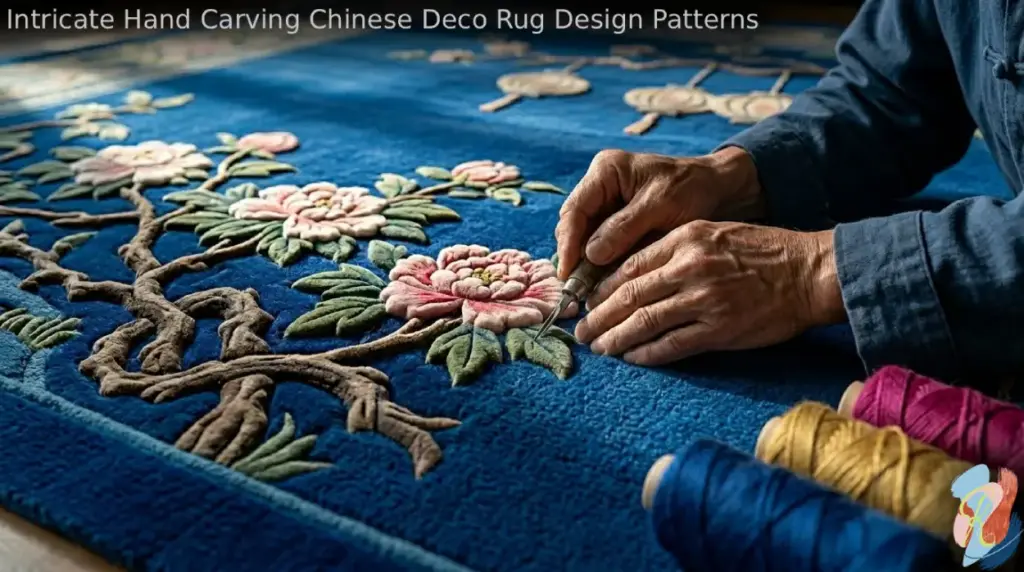
- The “Carving” Technique (Incising): A unique characteristic of late Qing and early 20th-century Chinese rugs is the hand-carving of the pile. After weaving, a specialist would use scissors to “clip” around the contours of the motifs. This created a three-dimensional, embossed effect that made dragons and flowers appear to “float” above the field.
The “Supple” Handle
Because of the open knotting and the quality of the wool, older Chinese rugs possess a very “soft” or “supple” handle. Unlike a stiff, heavily-plied rug, a Ningxia carpet can often be folded like a heavy piece of fabric. This tactile softness is one of the primary indicators of age and quality for the “erudite” collector.
Regional Production Systems
To understand Chinese carpets, one must move beyond the “Made in China” label and look at the specific regional “schools” that developed their own technical and aesthetic languages.
Ningxia: The Spiritual and Imperial Heart
Ningxia is historically the most significant center for antique Chinese carpets. Located on the edge of the Gobi Desert, it served as the primary supplier for the Imperial Court and the great Buddhist monasteries of the North.
The Ningxia rug:
- Aesthetic: Known for a “spacious” layout with a central medallion and “open” corners. The palette is famously soft, utilizing “imperial yellow,” “cinnamon,” and “fruit-skin” reds.
- Symbolism: Deeply rooted in Buddhist and Taoist iconography. You will frequently see the “Eight Auspicious Symbols” (the Endless Knot, the Lotus, the Pair of Fish, etc.) and the “Three Abundances” (peach, pomegranate, and citron).
- Patronage: These were the rugs of the Qing Emperors. Their supple structure and light weight were designed for the drafty, expansive halls of the Forbidden City and the ritual platforms of temples.
Discover the ethereal luster and Imperial heritage of high-altitude Ningxia wool.
Shop Ningxia RugsBeijing and the “Peking” Style (1900–1930s)
The term “Peking Rug” refers to a specific stylistic evolution that occurred as the city transitioned from imperial workshops to a global trade hub.
The Beijing / Peking rug:
- The Aesthetic: Unlike the sparse, scholarly rugs of the Ming era, Peking rugs are known for their Art Deco sensibilities. They often feature a deep navy or “royal blue” field with white or cream borders, decorated with scattered floral sprays, scholar’s objects (the “Hundred Antiques”), and birds.
- The Technical Shift: This is where the “carving” or “incised” technique reached its peak. Weavers used heavy, lustrous wool and then clipped around the designs to give the floral motifs a three-dimensional, embossed appearance.
- Designers of the Era: This category was heavily defined by the influence of Walter Nichols and Helen Fette, who standardized the Peking look for the American and European markets.
The classic indigo field and scholarly motifs of the urban Chinese elite.
Shop Beijing & Peking RugsXinjiang / East Turkestan: The Silk Road Hybrid
The rugs of Khotan, Yarkand, and Kashgar are the great “hybrids” of the textile world. Located in the oases of the Tarim Basin, these weavers sat at the crossroads of China, India, and Persia.
The Xinjiang / East Turkestan rug:
- The Hybrid Motif: You will see a fascinating blend of cultures. A Xinjiang rug might feature a Persian-style “Pomegranate” tree, but the tree will be rendered in a stylized, geometric Chinese fashion.
- Structure: They often use a “triple medallion” format (the “Gul” motif) and are frequently woven on a cotton foundation with a silk or fine wool pile. The colors are often more saturated—using “lac” reds and vibrant indigos—compared to the muted tones of the interior.
Where the Silk Road meets the loom—featuring the iconic Samarkand designs.
Shop East TurkestanA unique oasis aesthetic blending Buddhist, Persian, and Chinese traditions.
Shop Khotan RugsTibetan Carpets: The Ritual Outlier
While often grouped with Chinese rugs due to political and trade history, Tibetan carpets are technically and culturally distinct.
The Tibetan rug:
- The Tibetan Knot: Unlike the asymmetrical knot used in China, Tibetans used a unique “looped” or “wrapped” knot over a gauge rod. This creates a dense, ribbed texture that is incredibly durable.
- Monastic Function: These were primarily “sitting rugs” (khaden) for monks or “pillar rugs” for monasteries.
- Iconography: The symbolism is visceral and tantric. The Tiger Rug is a classic Tibetan archetype, representing the transformation of anger into wisdom. You also see the “flaming jewel” and highly stylized Himalayan clouds.
Baotou Rugs: The “Blue and White” Tradition
Produced in the Inner Mongolian trading center of Baotou, these rugs represent a highly specific regional aesthetic that is often sought after by collectors for its “painterly” quality.
The Baotou rug:
- The Color Palette: Baotou rugs are famously associated with a “blue and white” palette, mirroring the aesthetics of Ming and Qing dynasty porcelain. They often utilize varying shades of indigo against a white or cream ground.
- Pictorial Landscapes: While Ningxia rugs are often symbolic and abstract, Baotou rugs are frequently pictorial. They depict literal landscapes, including deer, cranes, pine trees, and mountainous vistas, executed with a charming, folk-art sensibility.
- Material: They typically use a very soft, “silky” wool on a cotton foundation, resulting in a piece that feels remarkably delicate despite its durability.
Renowned for their “soulful” blues and masterfully rendered pictorial scenes.
Shop Baotou RugsLabor, Craft Organization, and Social Structure
From the Household to the Workshop
Historically, Chinese weaving existed in two parallel worlds: the domestic and the imperial.
Home use vs imperial:
- The Household Craft: In nomadic and rural contexts, weaving was an extension of the family unit. Often led by women, this production was non-commercial, intended for dowries, local bartering, or temple donations. The “erudite” value here lies in the oral transmission of patterns—designs were not drawn but remembered.
- The Imperial Workshop (Gongfang): Under the Qing Dynasty, weaving became a highly regulated state activity.
- The imperial workshops in Ningxia and Beijing functioned like small cities.
- Here, labor was specialized:
- The Master Designer: Created the “cartoons” or paper templates.
- The Dyer: A high-status role responsible for the secret recipes of mineral and vegetable dyes.
- The Weaver: Skilled artisans who worked under strict supervision to ensure every “imperial” dragon met court standards.
- Here, labor was specialized:
- The imperial workshops in Ningxia and Beijing functioned like small cities.
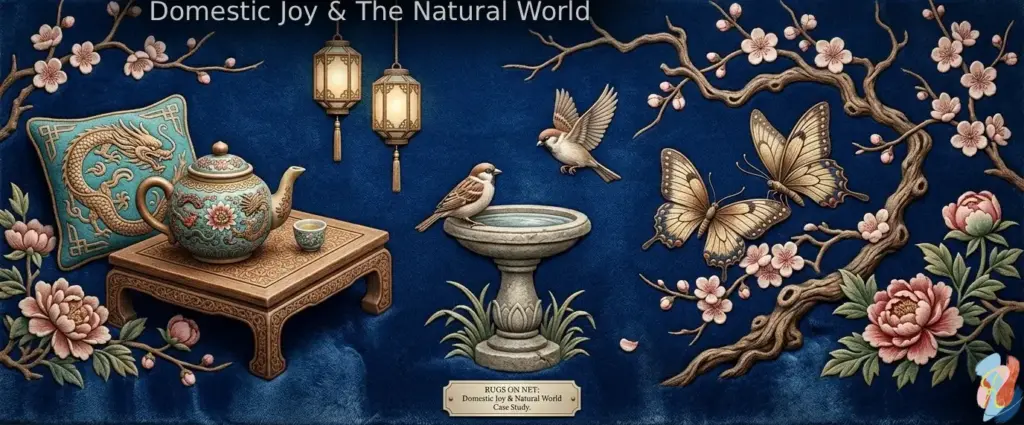
The Republican Era: The Rise of the Wage Laborer
With the fall of the Qing Dynasty in 1912 and the rise of the Republic of China, the social structure of weaving underwent a seismic shift.
The collapse of imperial patronage meant workshops had to pivot to the Western export market to survive:
- Labor Commodification: Weaving transitioned from a state-sponsored art form into a commercial industry. Massive factories were established in Tianjin and Beijing to meet the American “Art Deco” demand of the 1920s.
- The Shift in Identity: The artisan—who previously might have spent a year on a single silk rug for a temple—was replaced by the wage laborer. Efficiency became the primary metric. This led to a standardization of designs and the introduction of chemical dyes to speed up production.
Artisan vs. Wage Laborer
The knowledgeable buyer can often see this social shift in the rugs themselves:
- Artisanal Work: Characterized by “abrash” (natural variations in dye color) and slight irregularities in the motif that give the piece a “human” pulse.
- Industrial Work: Characterized by perfect symmetry, uniform “chemical” colors, and a heavier, more rigid structure intended for high-traffic Western homes.
During this transition, the “carving” technique (clipping the pile around motifs) became more prevalent. This was a labor-intensive way to add “value” and “luxury” appeal to export pieces, even as the symbolic depth of the designs began to simplify for foreign tastes.
Global Trade and Reinvention (19th–20th c.)
Treaty Ports and the Birth of the Export Category
The mid-19th century saw the opening of Treaty Ports like Tianjin and Shanghai. These cities became the primary gateways through which Western demand reshaped Chinese supply.
- Tianjin as a Hub: By the 1920s, Tianjin had become the most important center for “Modern Chinese” rugs. Production moved away from the rural interior (Ningxia/Kansu) to massive coastal factories.
- The “Export” Label: For the first time, the “Chinese Rug” was marketed as a specific category of luxury decor. This was the era of the Nichols and Fette rugs—commercial brands founded by Americans in China that blended Chinese labor with Western marketing and design sensibilities.
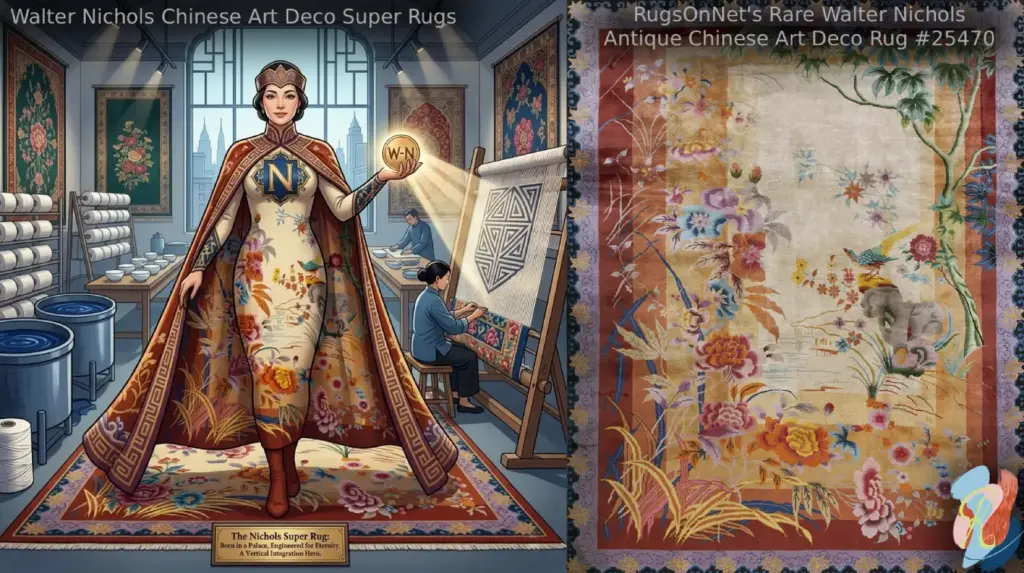
The “Big Two” of the Tianjin era
The Pioneers of the “Modern” Chinese Rug
While the workshops were Chinese, the marketing and color direction were often led by Western entrepreneurs who understood the “Art Deco” appetite of the 1920s.
A bold fusion of 1920s glamour and ancient Oriental symbolism.
Shop Chinese Art DecoThe 2 icons of Chinese Deco rugs:
- Walter Nichols: Perhaps the most famous name in 20th-century Chinese weaving. Walter Nichols was an American who established “Nichols Super Yarn Carpets” in Tianjin. He is credited with introducing the thick, heavy pile and the vibrant, “machine-spun” wool that defined the high-end export market.
- Helen Fette: A former missionary who partnered with Li Meng-shu to form the Fette-Li Company. Fette rugs are prized for their “supple” handle and more traditional, painterly aesthetic compared to the rigid density of Nichols rugs. Her work often retained a more delicate, “scholarly” feel that appealed to collectors who found Nichols rugs too industrial.
Explore the lush, saturated colors and heavy pile of the original Tientsin “Nichols” masterpieces.
Shop Walter Nichols RugsWestern Influence: Standardizing the Aesthetic
To satisfy the Western consumer, the idiosyncratic designs of the Imperial era were standardized into a more predictable visual language.
The approach to standing the Chinese rug productions:
- Standardized Rug Sizes: Rugs were no longer woven as ritual “pillar wraps” or throne covers; they were sized to fit the American suburban living room (e.g., $9 \times 12$ feet).
- Synthetic / Chemical Dyes: The soft, mineral, and vegetable “Imperial” palette was replaced by vibrant chrome dyes. This introduced deep navies, purples, and “Art Deco” greens that had never existed in the traditional Chinese repertoire.
- Hybrid Designs: The “Art Deco” Chinese rug emerged. These featured traditional motifs like the phoenix or floral sprays, but they were placed in asymmetrical, minimalist compositions that appealed to the “Modernist” tastes of New York and London.
The “Traditional” Invention
A key insight for buyers is that the heavy, deep-piled, highly-carved rug commonly sold as “Traditional Chinese” is, in fact, a modern commercial invention.
Here is why:
- The Pile Shift: While antique Ningxia rugs were thin and supple, Western buyers associated “quality” with weight. Consequently, factories began producing much thicker, heavier rugs with a dense “closed” back to mimic the feel of a Persian Sarouk or Kerman.
- The Carving (Incising): As production speeds increased, deep hand-carving became a way to differentiate Chinese rugs in the global market, giving them a “3D” look that became a trademark of the export era.
Much of what the modern market identifies as the “Traditional Chinese Rug” style—the thick pile, the deep navy borders, and the embossed floral sprays—is actually a hybrid product developed specifically for the early 20th-century international market.
Industrialization and Decline of Traditional Weaving
The collapse of the Qing Dynasty in 1912 did more than change the government; it dismantled the entire ecosystem of imperial patronage that had sustained high-level weaving for centuries. This led to a rapid industrialization of the craft, prioritizing economic survival over ritual significance.
The Collapse of the Court Workshops
With no Emperor to commission “Throne Rugs” or “Five-Clawed Dragon” carpets, the elite workshops of Beijing and Ningxia lost their primary purpose.
This meant:
- Loss of Standards: The strict sumptuary laws that governed color (like Imperial Yellow) and motifs (the number of dragon claws) vanished.
- Dispersal of Talent: Master weavers, once state-supported artisans, were forced to find work in the emerging commercial factories of the coastal cities, where their skills were adapted to suit foreign tastes rather than courtly protocols.
The Rise of Factory Production
The Tianjin and Shanghai production models represented a total break from the past.
Weaving moved out of the master-apprentice atelier and into the industrial factory:
- Export-Oriented Manufacturing: By the 1920s and 30s, the “erudite” symbolism of the past was simplified into decorative “floral sprays” and “bird-and-flower” designs that Westerners found “exotic” but not “alien.”
- The Chrome Dye Revolution: The introduction of synthetic dyes allowed factories to produce thousands of rugs in exactly the same shade of “Peking Blue” or “Art Deco Green.” While efficient, this eliminated the abrash (natural color variation) that gave antique rugs their depth and soul.
The Decline of Ritual Use
As China modernized and secularized, the role of the carpet in spiritual life dwindled.
As China modernized and secularized, the role of the carpet in spiritual life dwindled:
- The End of Temple Commissions: The massive “Pillar Rugs” and “Mandala” carpets commissioned for Buddhist monasteries became rare.
- From Sacred to Secular: The carpet was no longer a “platform for prayer” or a “zone of power” in a palace; it became a piece of furniture designed to match curtains and upholstery.
The Legacy of the “Deco” Era
While this period saw a decline in traditional scholarly weaving, it produced a new, unique category of art: the Chinese Art Deco Rug. These pieces—while commercial in origin—are now highly collectible in their own right. They represent the final, vibrant gasp of a hybrid culture that was attempting to bridge the gap between ancient Eastern symbolism and the modern Western machine age.
Authenticity, Heritage, and Modern Revival
As we move into the 21st century, the story of the Chinese rug has entered a phase of conscious restoration. After decades of industrial dominance, there is a burgeoning movement to reclaim the “painterly” and “scholarly” roots of the craft, though this revival faces the modern challenges of commodification.
The Tibetan Revival: A Technical Renaissance
Perhaps the most successful modern revival has occurred within the Tibetan tradition. Following the mid-20th-century diaspora, weaving centers in Nepal and India—and later a return to workshops in Lhasa—began to re-emphasize traditional methods.
2 key features of their approach:
- The Return to Natural Dyes: High-end revival projects have moved away from the harsh chrome dyes of the 20th century, returning to indigenous plants and minerals to achieve the “living” colors of antique pieces.
- Preserving the “Snub-Knot”: By maintaining the unique looped-warp technique, these workshops ensure that modern Tibetan rugs retain the specific “ribbed” handle and durability that define the heritage of the Himalayas.
Heritage Crafts and the “New Ningxia”
In mainland China, there is a growing interest in preserving “Intangible Cultural Heritage.” This has led to the establishment of boutique workshops dedicated to recreating the Ningxia and Khotan rugs / masterpieces of the 17th and 18th centuries.
The modern productions:
- Scholarly Reproductions: These are not mere “fakes” but rigorous attempts to match the wool quality and “open” knotting systems of the Qing imperial workshops.
- The Challenge of “Fatty” Wool: One of the greatest hurdles in these revivals is sourcing the specific high-altitude, lanolin-rich wool that gave antique rugs their signature luster—a material that is increasingly rare in a modernized agricultural economy.
The Tourism-Driven Market: The Authenticity Gap
The modern traveler to regions like Xinjiang or Tibet will encounter a vast “tourism-driven” production line.
This creates a complex environment for the Chinese rug buyer:
- Authenticity vs. Reproduction: Many rugs sold as “antique” are actually “distressed” modern pieces, chemically treated or sun-bleached to mimic the patina of age.
- The “Souvenir” Aesthetic: Much of the current production prioritizes portability and immediate visual impact over technical integrity. This often results in higher knot counts (to appeal to the “finer is better” Western bias) but with less attention to the traditional fluidity of the motifs.
The Enduring Thread
The “traditional” Chinese rug has always been an evolving concept—a hybrid of nomadic grit and imperial refinement. While the age of the great Court workshops has passed, the revival of heritage weaving ensures that the cosmological language of the dragon, the cloud, and the lotus continues to be spoken in wool.
For the modern collector, the search is no longer just for a rug, but for a piece that retains the “Scholar’s Spirit”—the balance of negative space, lustrous material, and symbolic depth that defines the true Chinese textile tradition.
Chinese Rugs in Global Cultural Context
The legacy of the Chinese rug extends far beyond the borders of the Middle Kingdom. Its journey into the Western consciousness has fundamentally altered the trajectory of modern interior design and forced a scholarly reframing of how we value “textile art” on the global stage.
The Art Deco Influence: A Modernist Symbiosis
In the 1920s and 1930s, the Chinese rug became the “secret weapon” of the Art Deco movement. Designers in Paris, London, and New York were captivated by the minimalist “negative space” of the Ming and Qing traditions.
- Minimalism and Saturated Color: The bold, monochromatic fields of “Peking” rugs—often in deep indigo, emerald green, or rich maroon—provided the perfect anchor for the streamlined, geometric furniture of the era.
- Asymmetry: Western designers embraced the Chinese concept of asymmetrical floral sprays (the bird-and-flower motif), using them to break up the rigid symmetry of traditional European interiors.
- The “Nichols” Aesthetic: Brands like Nichols and Fette created a hybrid look that is now iconic: thick, lustrous piles with deeply embossed (carved) designs that provided a tactile luxury essential to the “high-style” apartments of the roaring twenties.
The Paul Poiret Effect
Paul Poiret and the Orientalist Avant-Garde The influence of Chinese aesthetics extended into the highest echelons of European design fashion. The legendary couturier Paul Poiret, known for liberating women from the corset, was a profound “Orientalist.” Poiret didn’t just design dresses; through his interior design atelier, Martine, he popularized the use of bold, “Chinese-style” carpets to ground his avant-garde interiors.
Poiret’s use of the Chinese rug as a tool of “Modernist Exoticism” helped transition the medium from a dusty antique into a vibrant, essential element of the 1920s Parisian salon.
Chinese Carpets in Museum Collections: From Floor to Wall
For decades, Chinese rugs were the “poor cousins” of antique Persian carpets in major museums.
However, the late 20th century saw a major shift in institutional valuation:
- The Metropolitan Museum of Art (New York): Houses a world-class collection of early Ningxia and “Silk and Metal” imperial rugs, treating them with the same scholarly rigor as Ming Dynasty paintings.
- The Palace Museum (Beijing): Maintains original Qing Dynasty rugs in their intended architectural context, showing how they functioned as “throne platforms” and ritual markers within the Forbidden City.
- The Textile Museum (Washington D.C.): Has led the way in technical analysis, helping scholars distinguish between true “imperial” production and the high-quality village weavings of the frontier.
Reframing: Beyond the “Orientalist” Framework
Modern art history is finally moving away from the “Oriental Rug” umbrella.
Instead, the Chinese carpet is being reframed as:
- A Mirror of Chinese Painting: Scholars now analyze rug compositions using the same vocabulary as Chinese ink-wash painting (Shanshui), focusing on balance, “breath” (qi), and the relationship between empty and full space.
- A Technical Hybrid: Rather than seeing the Chinese rug as “coarse” compared to Persian weaving, it is now celebrated for its material integrity—its use of the highest quality wool and silk to achieve a textural depth that Persian “fineness” often misses.
- A Cross-Cultural Vehicle: The Chinese rug is now studied as a vital link in the Silk Road exchange, proving that ideas (and the textiles that carried them) moved as freely from East to West as they did from West to East.
To walk upon a Chinese rug is to walk upon a landscape of philosophy. It is a medium where the nomadic technology of the steppe met the scholarly refinement of the imperial court, creating a legacy that continues to define the height of luxury and intellectual design today.
Comparative Perspective: The Anatolian vs. The Imperial Loom
To understand the Chinese rug, one must see it in contrast to the Anatolian and Persian traditions. This comparison highlights why the Chinese aesthetic appeals to the “scholarly” minimalist, while the Turkish rug appeals to those seeking tribal energy and historical continuity.
Analytical Comparison Table
| Feature | Chinese Rugs | Turkish Rugs |
| Primary Symbolism | Cosmological & State-Driven: Pictorial rebuses, imperial rank (dragons), and Buddhist/Taoist philosophy. | Tribal & Personal: Abstract totems, protective symbols (amulets), and village-specific “family” signatures. |
| Production Context | Imperial & Workshop: Developed within a highly regulated system of court patronage and specialized city ateliers. | Village & Nomadic: Rooted in the household; often woven from memory without formal “cartoons” or patterns. |
| Design Philosophy | Spaciousness (Liubai): Emphasis on negative space and “painterly” compositions that resemble ink-wash scrolls. | Geometric Density: High-energy, repetitive patterns that fill the entire field with symbolic protective lattices. |
| Structure & Feel | Coarse & Supple: Lower knot density focused on bold silhouettes and a soft, “blanket-like” handle. | Dense & Durable: Higher tension and often more rigid structures intended for rugged, high-traffic nomadic use. |
| Cultural Identity | Hybrid & Constructed: A synthesis of nomadic technology and sedentary high-art; heavily influenced by 20th-century global trade. | Continuous Tradition: A direct, largely uninterrupted evolution of the Central Asian steppe’s tribal weaving identity. |
The “Language” of the Loom
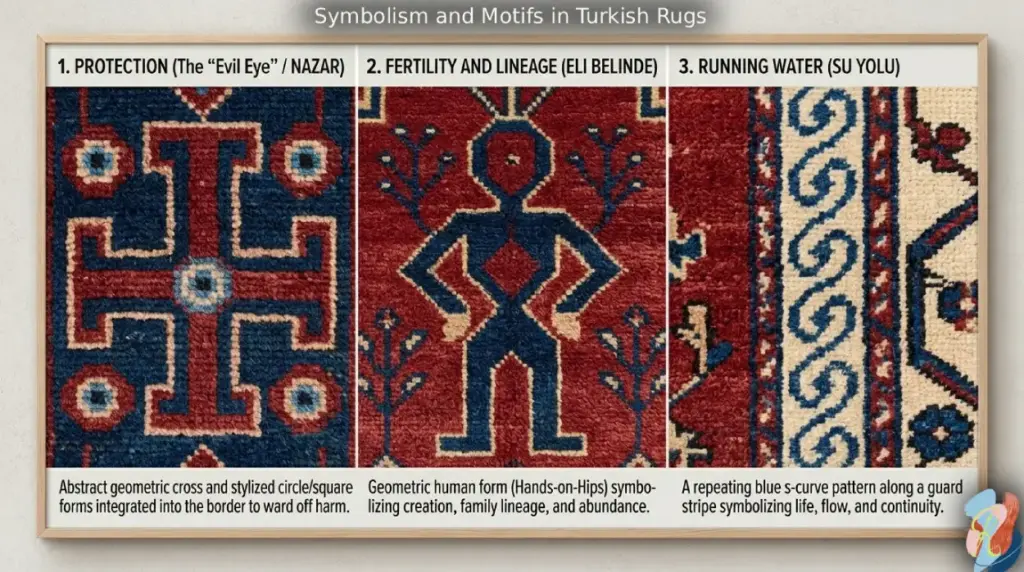
The most striking difference lies in the intent of the motifs. A Turkish weaver uses symbols like the Elibelinde (hands on hips) as a personal or tribal “prayer” for fertility or protection. In contrast, a Chinese weaver uses the Dragon or the Phoenix as a precise statement of cosmic and social order. One is an emotional expression; the other is a scholarly dissertation.
Structure as Destiny
The technical “coarseness” of the Chinese rug (typically $30$–$80$ knots per square inch) is often misinterpreted as inferior to the dense, high-knot-count Persian or Turkish village rugs. However, the erudite collector understands that this lower density is what allows the Chinese rug to achieve its painterly fluidity.
Because the Chinese rug is less “tightly packed,” the wool fibers have more room to bloom, creating that characteristic velvet-like luster that defines the imperial style.
The Role of History: Evolution vs. Invention
While the Turkish rugs represent a continuous thread of tribal identity that has survived for millennia, the “Traditional Chinese Rug” we recognize today is a fascinating commercial hybrid. It was the 19th-century interaction between the Qing court’s decline and Western market demand that “invented” the thick, deep-blue, floral-bordered rug. The Turkish rug, conversely, has fought to remain a “pure” expression of its nomadic ancestors, even in a modern commercial world.
This concluding section provides the final “erudite” synthesis of the Chinese rug’s history. It challenges the romanticized notion of an “ancient, unchanging tradition” and instead frames the craft as a dynamic, resilient product of global forces.
Conclusion: The Loom of Empire and Exchange
To look upon a Chinese carpet is to see the physical manifestation of the Silk Road. Our exploration reveals that the “Chinese rug” is not a static relic of an isolated culture, but a vibrant, evolving medium defined by its ability to absorb, adapt, and reinvent.
Reimagining the Origins: A Hybrid Identity
We must move beyond the simplified view of the Chinese rug as a purely indigenous art. Instead, we recognize it as a hybrid material culture. It was born from the tension between the practical, knotted-pile technology of the Inner Asian nomads and the sophisticated, scholarly aesthetics of the Han Chinese heartland. This synthesis—the “Steppe meets the Study”—is what gives the Chinese carpet its unique painterly soul and structural fluidity.
The Architect of the Aesthetic: Empire and Globalization
The development of the craft was never accidental; it was a byproduct of two massive forces:
- Imperial Patronage: Under the Yuan, Ming, and Qing dynasties, the carpet was transformed into a tool of statecraft and cosmology. The imperial workshops in Ningxia and Beijing didn’t just weave rugs; they wove “horizontal maps” of the Emperor’s mandate.
- Global Trade: The 19th and 20th centuries proved that the Chinese rug was a chameleon. Through the treaty ports of Tianjin, the tradition reinvented itself to meet the “Art Deco” tastes of the West, proving that its commercial survival was linked to its ability to bridge Eastern symbolism with Western modernism.
The Myth of Continuity
A critical takeaway for the serious collector is the recognition of discontinuity. Unlike some textile traditions that claim a linear, “ancient” path, the history of the Chinese rug is a series of sharp pivots. The collapse of the Qing court, the rise of the treaty-port factories, and the modern heritage revivals are distinct chapters that often broke with the past to create something entirely new.
Cultural Exchange as the Core Driver
Ultimately, the Chinese rug serves as a reminder that cultural exchange is the true engine of artistic innovation. Whether it was the Buddhist lotus traveling from India, the pomegranate motif arriving from Persia, or the “Peking Blue” dyes developed for New York apartments, the Chinese carpet has always been a “vehicle” for international dialogue.
In the modern home, these pieces continue to perform that same function—bringing a sense of scholarly balance, historical depth, and global heritage to the spaces we inhabit today.
A Final Note for the Chinese rug buyer
Understanding the hybrid nature of these textiles allows us to appreciate them not just as beautiful objects, but as intellectual ones. At RugsonNet, we invite you to view our collection through this erudite lens—where every piece is a chapter in the great story of global exchange.
Woven with wisdom, scholarship, and the timeless luster of the Mandarin tradition.
Shop Our Collection of Chinese Rugs