
Introduction to Camel-Related Rugs
Explore our luxury range of camel design rugs to bring desert majesty into your home.
Definition & Scope
Camel-related rugs fall into two distinct but interwoven categories: those woven with camel hair as the primary material and those that feature the camel as a design motif. Camel hair rugs are valued for their natural fibers, which produce a soft yet durable textile with a muted palette of tans, browns, and sandy neutrals. The hair, taken from the undercoat of camels reared in nomadic societies, brings warmth and a silky luster that sets these pieces apart from ordinary sheep wool rugs.
By contrast, camel motif rugs use the animal as an artistic subject. These designs often depict solitary camels, camel caravans crossing desert landscapes, or camels adorned with tribal trappings. The motif reflects the camel’s central role in the cultures that produced them, symbolizing survival, wealth, and long-distance trade.
Some camel design carpets may also include accompanying figures—herdsmen, tents, or other desert animals—but the camel always holds the spotlight. Together, camel hair rugs and camel motif rugs embody both the material heritage of nomadic weaving and the visual storytelling of camel iconography, offering a dual meaning that gives them lasting cultural and artistic significance.
Distinctive Features & Appeal
The distinctive appeal of camel rugs lies in both their look and meaning. Camel hair rugs stand out for their natural earth tones—a soft tan or sandy background that cannot be replicated with dyed sheep wool. This muted yet glowing palette makes them highly versatile for designers seeking understated elegance or organic warmth in interiors.
Collectors often prize these pieces for their authentic ties to nomadic weaving traditions, as well as for their rarity compared to more common Persian or Anatolian wool carpets. On the other hand, camel motif rugs draw attention through narrative and symbolism. The camel is not just an animal but a cultural icon of resilience, journey, and desert life.
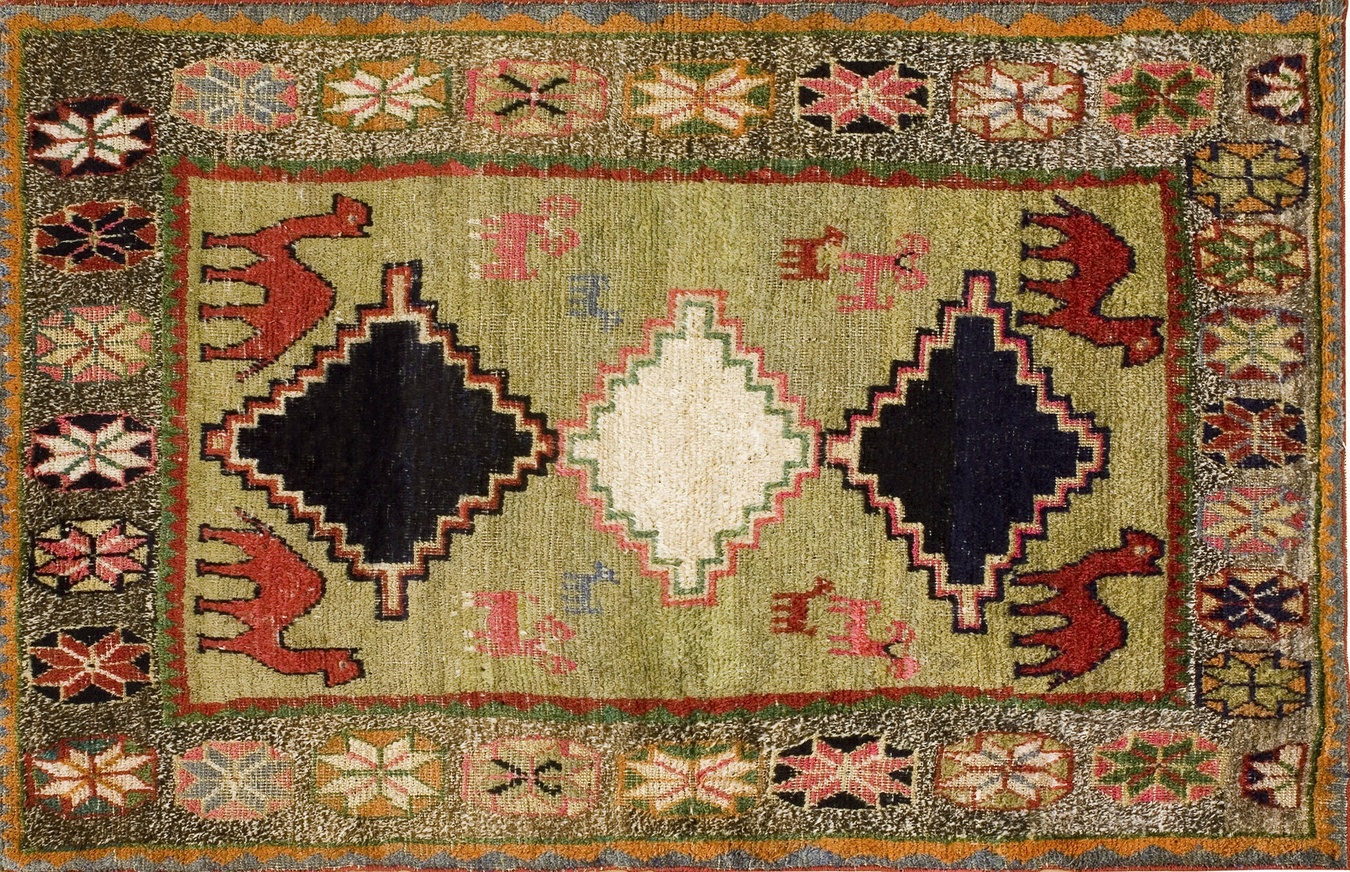
Antique Gabbeh Small Scatter Size Wool Green Rug – by Rugs On Net
Woven into the fabric of these rugs, the camel scene becomes a storytelling device: a caravan moving across endless horizons, a solitary camel resting at an oasis, or decorated animals representing tribal pride. Such imagery connects the rug to the history of Silk Road trade and nomadic migration, giving each piece a sense of movement and purpose.
For collectors and designers, this combination of material uniqueness and visual storytelling makes camel rugs particularly desirable. Interior decorators use camel design carpets to create focal points in rooms, while connoisseurs seek out nomadic camel rugs for their cultural resonance and collectible value. Whether chosen for their understated luster or for their rich camel caravan scenes, these rugs offer something distinct that ordinary wool rugs or generic Persian styles cannot replicate.
Ultimately, the dual identity of camel rugs—camel hair for substance, camel motifs for symbol—is what elevates them in the eyes of both artisans and buyers. They are practical, beautiful, and steeped in nomadic tradition, bridging the line between everyday use and cultural storytelling. Camel motif rugs primarily depict camels, either solitary or in caravans. Occasionally, they may include humans or other desert animals, but the camel remains the central figure.
Historical & Geographic Origins
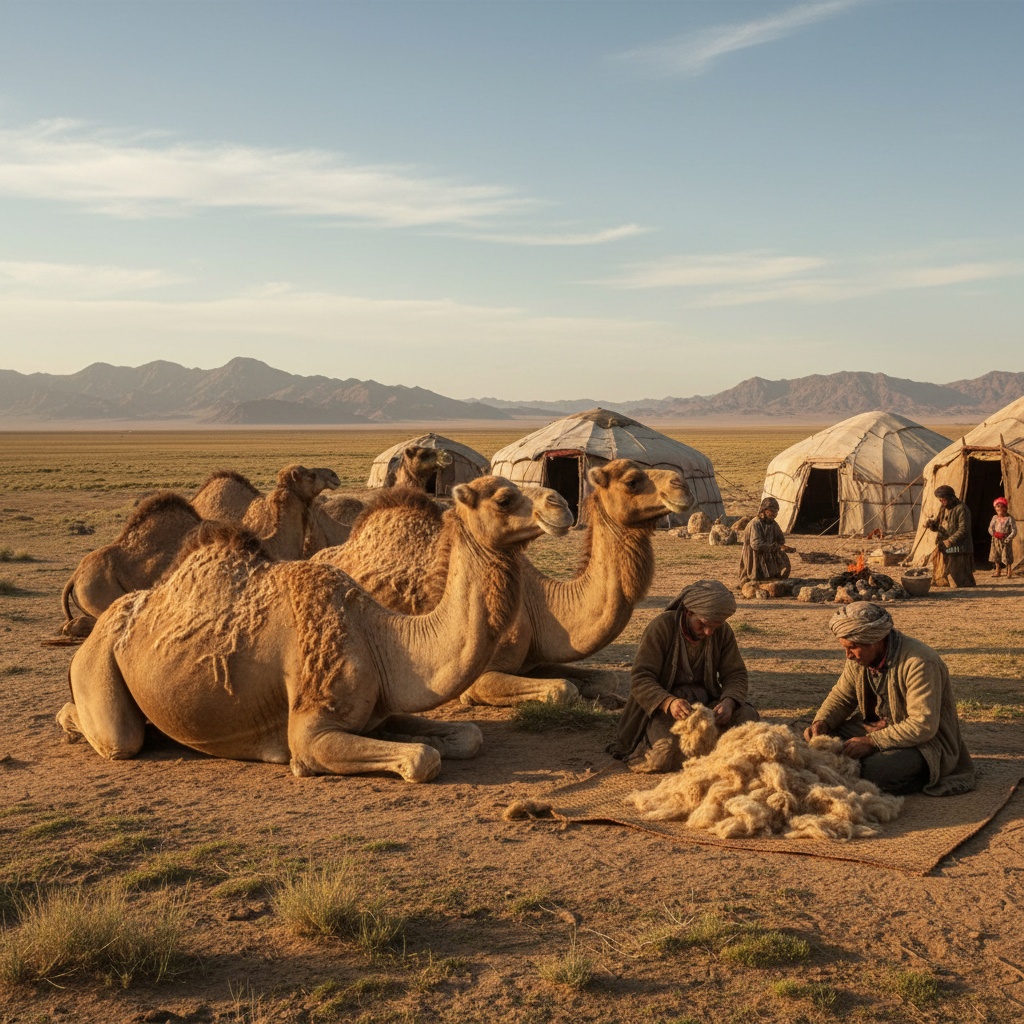
Bactrian camels and nomadic dwellings in their native environment.
Early Development Among Nomadic Tribes
The origins of camel hair rugs are deeply tied to nomadic life across Central Asia, Persia, and the Arabian deserts. Tribes such as the Baluch, Turkmen, and Bedouin relied on camels not only for transport and survival but also for textile resources.
Camel hair, softer and warmer than sheep wool, was collected during seasonal shedding and spun into yarn for weaving. These early Baluch camel rugs were woven for practical purposes—floor coverings, tent dividers, and blankets—serving daily needs while reflecting tribal aesthetics.
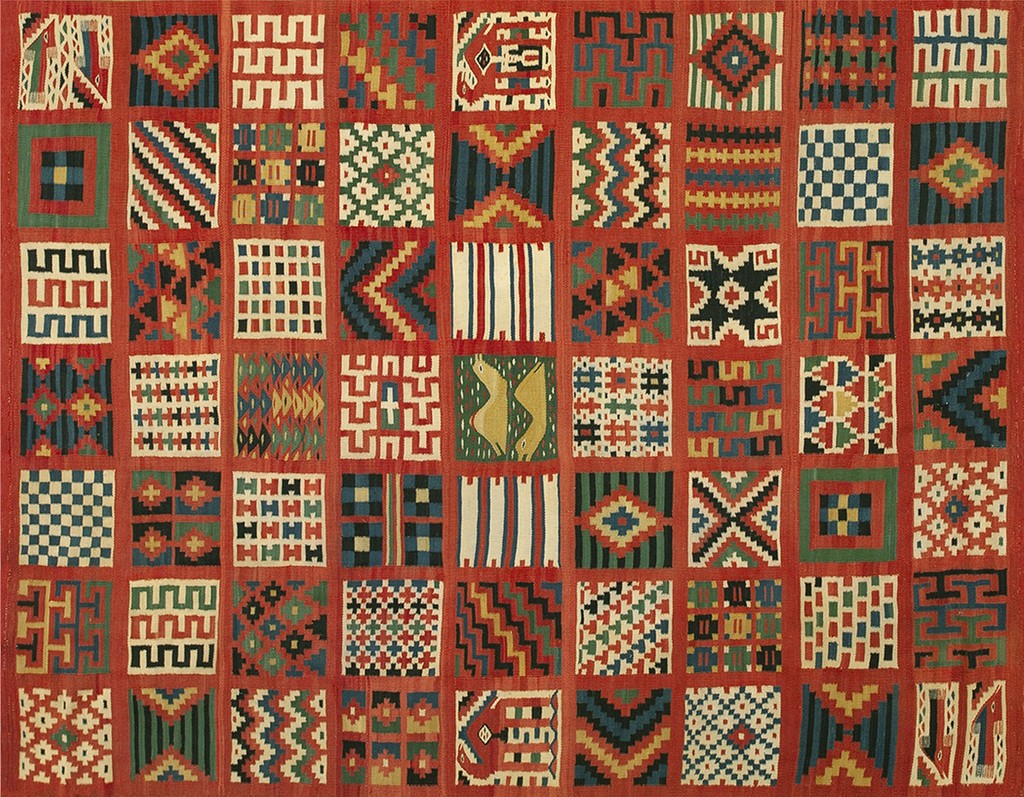
Antique Gafsa Tunisia Knotted Rug by Rugs On Net
The camel’s central role in nomadic pastoralism made it natural that its hair became a prized material, embodying both functionality and symbolism. While rug weaving traditions in wool stretch back millennia, camel hair pieces stand out for their earth-tone hues and silky resilience, distinct markers of nomadic ingenuity. By the 18th and 19th centuries, these textiles began to enter trade networks, and many antique camel hair rugs circulating in markets today come from this period.
Spread Across Asia, Middle East, and North Africa
The camel motif rug, by contrast, has roots in artistic storytelling. Although the practice began with tribal weavers depicting camels in stylized or symbolic form, the rise of urban workshops in Persia and Central Asia gave these motifs a more refined expression. Here, camel imagery shifted from utilitarian decoration to deliberate artistry—woven into carpets for courts, mosques, and eventually, foreign buyers. The transition marked a blending of nomadic tradition with urban craftsmanship. The Silk Road camel carpets played a central role in this diffusion.
Caravans carried not only goods but also weaving techniques, motifs, and dyes, linking the looms of Central Asia with those of the Middle East and North Africa. As caravans passed through Persia, Anatolia, and the Levant, camel design carpets entered wider markets, often tailored to Western tastes by the late 19th century. This period saw the rise of antique camel motif rugs produced for export, many of which survive as collector’s items today.
The story of camel rugs, therefore, reflects two forces: the practical needs of nomadic tribes, who wove camel hair into everyday textiles, and the urbanization and cultural exchange that transformed camel imagery into a refined, symbolic motif. Both strands remain inseparable from the camel’s enduring role in desert and steppe societies.
Cultural & Symbolic Importance
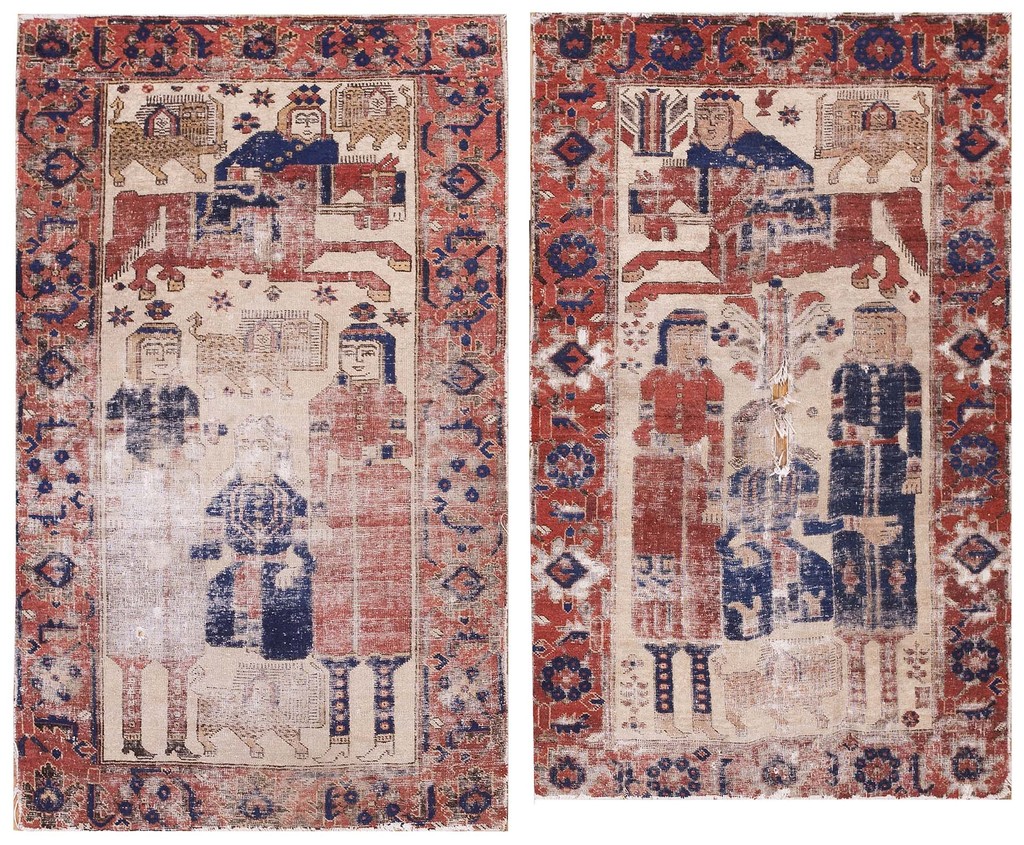
Antique Baluch Small Scatter Size Wool Ivory Rug by Rugs On Net
The Camel as Icon: Meaning Across Cultures
The camel occupies a place of extraordinary reverence in the cultures that wove camel symbolism in rugs. To nomadic peoples of Central Asia, Persia, and Arabia, the camel was not simply an animal of burden but the very foundation of survival in harsh desert and steppe environments. As a partner in nomadic life, the camel provided transport, milk, and hair, enabling both sustenance and trade.
In rugs, this role translated into motifs that embody endurance, long journeys, prosperity, and spiritual pilgrimage. In tribal traditions, the camel was associated with wealth and status, often serving as a dowry gift or centerpiece in ceremonial processions. Among the Turkmen, for instance, decorated camels laden with ornate trappings symbolized new beginnings in marriage rituals.
In broader Islamic contexts, while figural art was often limited by aniconic traditions, the camel’s fiber itself carried spiritual weight: weaving with camel hair was a way to honor its sacred, life-sustaining contribution. In this sense, camel rugs convey meaning even when no literal animal image appears.
Symbolism in Tribal and Village Weaving
- Endurance and Survival — Camels were vital to enduring arid landscapes, and so tribal camel motifs in rugs became emblems of resilience. — Why: Nomads wove the animal into their art to express their dependence on its strength and stamina.
- Journey and Trade — Caravan scenes in nomadic camel icons often depict camels moving across vast horizons. — Why: This imagery reflects the vital role of camels in sustaining Silk Road commerce and pilgrimage routes.
- Wealth and Status — Camels represented prosperity, particularly in dowries and tribal displays. — Why: Including camel motifs signified abundance and social standing within the community.
- Spiritual Connection — The camel, tied to journeys of faith such as the hajj, symbolized sacred passage. — Why: Weaving camel hair into rugs created an object imbued with spiritual resonance, beyond practical use.
- Continuity and Tradition — Passing down rugs with camel meaning in Persian rugs reinforced cultural memory. — Why: These motifs kept the story of survival, trade, and family lineage alive across generations.
Camel symbolism goes beyond imagery—it is embedded in both the fiber of camel hair rugs and the narrative of camel motif carpets. Whether represented by a caravan across woven fields or hidden in the natural hair of the material itself, the camel remains a constant reminder of the endurance, prosperity, and sacred journeys that defined nomadic life. Camels are symbolized in tribal rugs as essential partners in nomadic life, trade, and spiritual journey, and as enduring emblems of resilience and prosperity.
Materials & Construction
Camel Hair: Fiber Qualities & Sourcing
The defining feature of an authentic camel hair carpet lies in its fiber. Unlike sheep wool, camel hair is softer, silkier, and less oily, producing a matte yet lustrous finish that feels distinct to the touch. It is usually harvested from the undercoat during seasonal shedding, a natural process that avoids harm to the animal. The resulting yarn is both insulating and breathable, making it ideal for rugs meant to withstand desert climates while providing warmth indoors.
Camel hair is typically left undyed, its natural palette of sandy beige, golden tan, and earthy brown forming the hallmark look of a camel hair rug texture. Because of its rarity and the labor required to process it, genuine camel hair is highly prized. Many so-called “camel hair rugs” on the market actually use sheep wool dyed in camel-like colors, but true examples can be identified by their smooth patina and characteristic drape.
Blending & Weaving Techniques
While camel hair can stand alone as a pile material, many traditional weavers found it more practical to blend camel hair with sheep wool. Sheep wool contributes elasticity and strength, balancing camel hair’s longer, straighter fibers that lack natural crimp. This blend allowed nomadic artisans to produce rugs that were both durable and luxuriously soft.
In terms of construction, camel hair may appear in the pile, weft, or decorative details of a rug. Hand-spinning requires particular care, as the long fibers demand skill to twist evenly. Though hand-knotted camel hair rugs use the same knots as wool pieces, the feel and sheen of the finished textile differ markedly.
Nomadic tribes often relied on horizontal ground looms for portability, while village or urban workshops employed vertical looms to achieve greater precision in pile design. Camel hair does not require special knots or unique weaving methods, but spinners and weavers often make adaptations in technique to account for the fiber’s length and silky texture.
Construction Features Unique to Camel-Related Rugs
Camel-related rugs carry construction features that distinguish them from standard wool carpets. The camel hair vs sheep wool comparison is most visible in the texture: camel fibers produce a smoother, slightly flatter pile with a natural glow, lacking the oily resilience of lanolin-rich wool. Over time, genuine camel hair develops a patina that enhances its warmth and elegance, a quality collectors recognize instantly.
Designs woven in camel hair also lean toward simplicity, allowing the material’s natural tones to shine through. When camel motifs are included, the hair often forms the background field, setting off the pictorial imagery in dyed wool or silk. This interplay of natural fiber and symbolic design underscores the dual identity of camel rugs as both material artifacts and cultural storytellers.
Design & Motifs
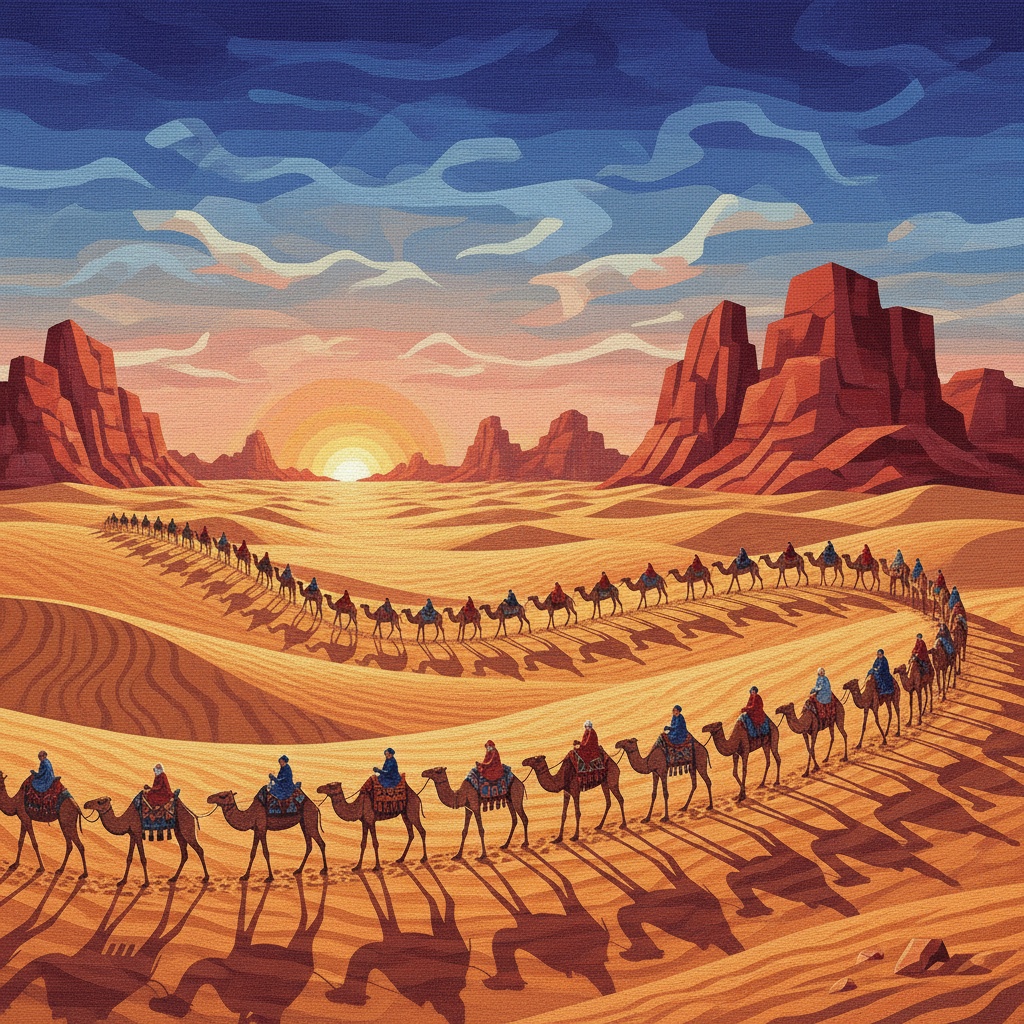
Caravan motif illustrating desert travel design.
Typical Layouts: Plain Fields, Medallions, and Borders
The artistry of camel rugs reflects two distinct traditions: the camel-hair rug, which emphasizes the material itself, and the camel-motif rug, which highlights the animal as subject. Camel-hair rugs are often woven with plain fields—broad expanses of warm tan or camel-brown that showcase the natural fiber’s glow. These simple grounds may be accented with geometric borders, medallions, or repeating tribal symbols, but their strength lies in the understated elegance of the fiber.
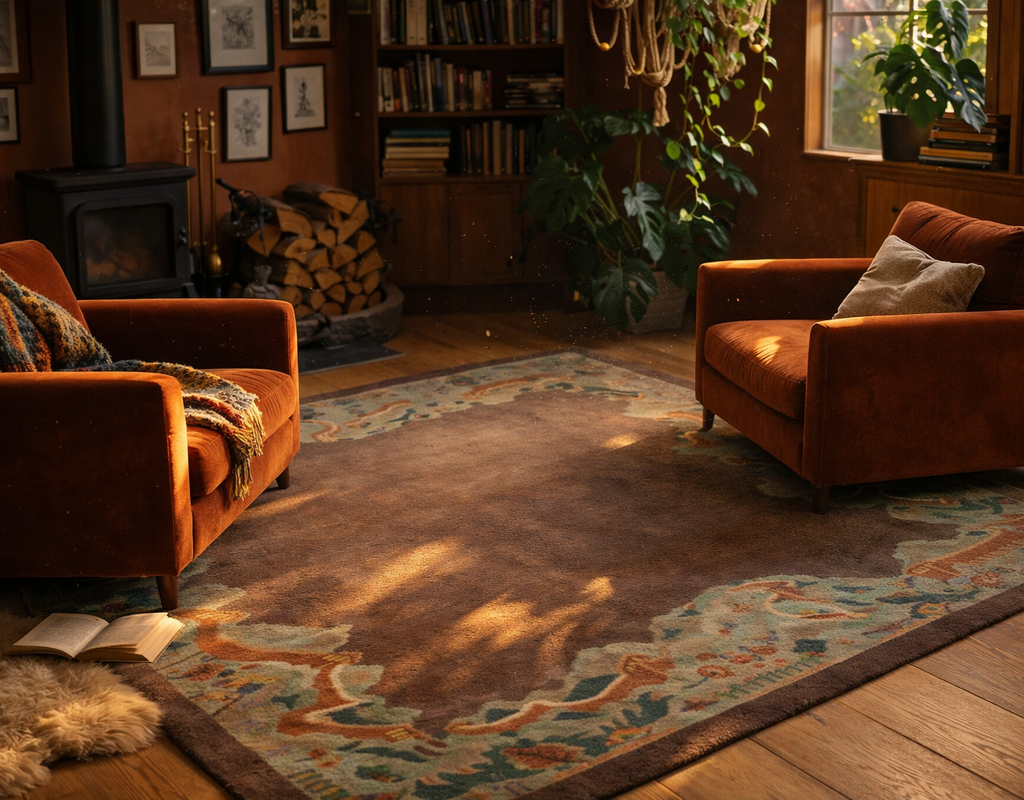
Sunlight bathes the reading nook, illuminating the rich colors of the plush seating and patterned area rug.
By contrast, camel-motif rugs rely heavily on design. Borders frame elaborate scenes, sometimes echoing tribal emblems, water symbols, or star motifs that enrich the narrative. Medallions or compartmentalized panels may house individual camels, while broader fields carry entire caravan processions. The contrast between minimalist camel-hair backgrounds and pictorial camel carpets illustrates the artistic range of this tradition.
Depiction of Camels: Motif Types & Arrangements
- Solitary Camels — A single camel often appears at the center or within a medallion. — Why: Represents endurance and individuality, reflecting the animal’s symbolic power.
- Repeated Icons — Stylized camel motifs woven in multiples, often geometric in form. — Why: Suggests abundance, tribal prosperity, and cultural continuity.
- Caravans — Multiple camels arranged in procession across the rug’s field. — Why: Evokes trade, migration, and the collective journey of nomadic life.
In nomadic kilims, camel motifs are arranged as repeated stylized figures, often woven in horizontal bands or incorporated into geometric frameworks.
Panel, Caravan, and Pictorial Designs
- Panel Designs — Rugs divided into compartments, each containing a camel or symbolic icon. — Why: Creates order and rhythm, suitable for storytelling and ritual use.
- Caravan Rugs — Rows of camels stretching across the rug’s surface, sometimes flanked by attendants. — Why: Symbolizes trade networks, pilgrimage routes, and shared cultural identity.
- Pictorial Camel Carpets — Full narrative scenes, including camels, riders, tents, and desert landscapes. — Why: Transform the rug into a woven canvas, often produced in urban workshops for export or display.
Color Palettes: Earth Tones & Contrasts
- Camel-Brown Grounds — Natural camel fiber creates sandy beige or golden tan fields. — Why: Provides warmth and authenticity, forming the base of many Persian camel rugs.
- Madder Red — Adds richness and depth, pairing naturally with camel’s subdued tones. — Why: Symbolizes vitality and creates contrast.
- Indigo Blue — Cool counterpoint to camel browns. — Why: Represents water and stability, balancing the palette.
- Ivory Accents — Brightens darker backgrounds. — Why: Highlights motifs and lends clarity.
- Green and Yellow Highlights — Used sparingly for detail. — Why: Infuse energy and mark symbolic elements.
In Persian rugs, earth tones such as madder red, indigo blue, ivory, and subtle greens and yellows complement camel backgrounds.
Arrangement in Nomadic Kilims
In camel caravan rugs and kilims, motifs are usually highly stylized and repeated. Nomadic weavers simplified camel shapes into angular, geometric figures arranged in rows, bands, or lattice structures. This repetition mirrored the steady rhythm of migration and the caravan’s long procession across the desert. The arrangement served both an aesthetic and symbolic role: it created visual unity while embedding the camel as a cultural emblem.
Kazak camel rugs are bold and graphic, with large, simplified camel motifs in vivid primary colors, while Shirvan camel rugs feature smaller, repeated camel images integrated into intricate geometric frameworks. Together, these design traditions showcase the artistic flexibility of camel rugs: from the quiet sophistication of plain camel-hair fields to the richly woven narratives of caravan and pictorial scenes.
Regional & Tribal Variations
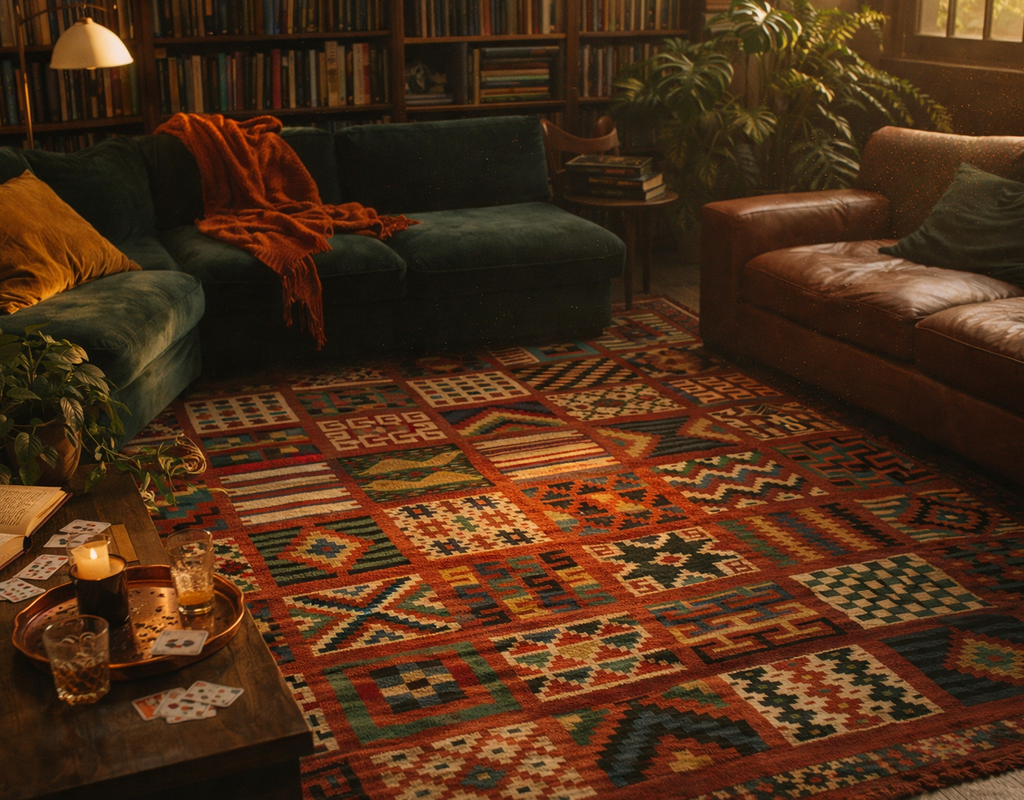
A warm, inviting reading nook anchored by a colorful, textured patchwork rug.
Baluch, Persian, Turkoman, North African, and Arabian Traditions
- Baluch Camel Rugs — Baluch weavers produced prayer rugs with camel-brown fields, favoring geometric motifs over pictorial scenes. Camel imagery itself became more common in the late 19th to early 20th century, when prayer rugs often highlighted camels as symbols of endurance and faith. — Why: The camel’s role in survival and spirituality resonated with Baluch nomadic identity, and camel hair provided warm, muted backgrounds.
- Persian Camel Motif Rugs — In weaving centers such as Hamadan, Malayer, and among Qashqai tribes, camel hair was often used for rug fields or accents. Some rugs feature naïve depictions of camels alongside tribal and floral designs. — Why: Persian workshops embraced camel hair for its distinctive color and texture, blending material authenticity with regional artistic traditions.
- Turkmen Camel Asmalyks — Among Turkmen tribes, camel hair appeared in ceremonial asmalyks (bridal trappings hung on camels). While literal camel motifs were rare, symbolic animal figures carried meaning in dowry rituals. — Why: The camel symbolized new beginnings and wealth, making it central to marriage ceremonies and decorative weavings.
- North African & Arabian Camel Hair Flatweaves — In desert regions, camel hair was primarily used for flatwoven strips that formed tent coverings or utilitarian textiles. Motifs were minimal or absent, with camel symbolism expressed through the use of the fiber itself rather than imagery. — Why: Here, function outweighed pictorial design, reflecting the camel’s presence in daily nomadic shelter and survival.
Unique Features and Motif Approaches by Region
Regional identity in camel rug styles emerges through both construction and imagery. Baluch pieces highlight spiritual use in prayer, while Persian rugs experiment with decorative motifs and colorful contrasts on camel-hair fields.
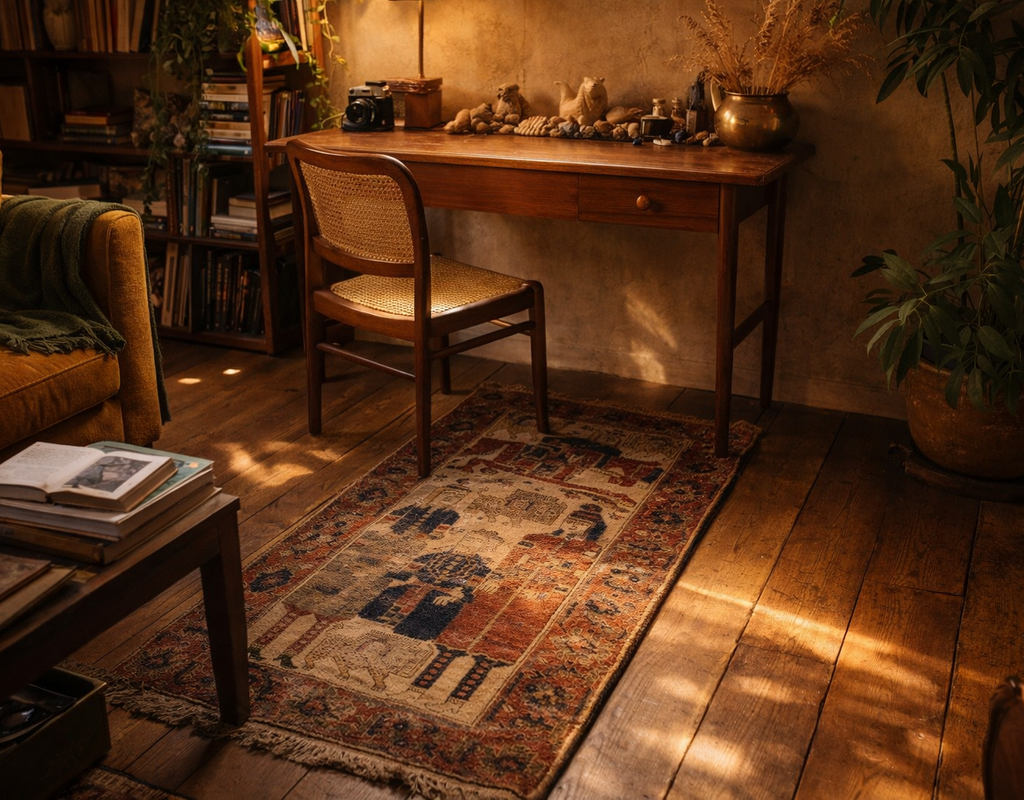
Golden hour light warmly bathes this intimate reading nook featuring a characterful antique rug.
Turkmen examples emphasize ceremonial function, embedding camel symbolism in wedding traditions rather than floor coverings. North African and Arabian weaving underscores the camel’s utilitarian role, weaving its hair into tents rather than storytelling carpets. This variation demonstrates how camel rugs can be utilitarian, ceremonial, or artistic, with meaning shifting according to cultural context.
Camel Motif Kazak vs. Shirvan Rugs
Two Caucasian traditions illustrate the diversity of camel imagery:
- Kazak Camel Rugs — Known for bold, oversized camel figures woven in vivid reds, blues, and ivory. These motifs dominate the rug field and are rendered in graphic simplicity. — Why: Kazak weaving emphasized visual impact, turning camel motifs into statement icons within geometric frameworks.
- Shirvan Camel Rugs — In contrast, Shirvan rugs incorporate smaller, finely detailed camels arranged repetitively within complex borders or lattice patterns. — Why: Shirvan design favored intricacy, weaving camel figures into broader geometric compositions that rewarded close viewing.
Camel imagery peaked in Baluch rugs in the late 19th to early 20th century, particularly in prayer rugs featuring camel-hair fields and symbolic motifs. Regional and tribal variations show that camel rugs are not a single tradition but a spectrum, each weaving community adapting the camel’s material and symbolism to reflect its own identity and needs.
Historical Evolution & Market Trends
Nomadic Utility to Collectible Art: Timeline
- Pre-Modern Use — Camel rugs first emerged as nomadic utility items, woven for tents, floor coverings, trappings, and prayer rugs. — Why: They reflected the camel’s central role in survival, with fiber and motif serving practical and symbolic needs.
- 20th Century Shift — Urban workshops in Persia and Central Asia began producing pictorial camel carpets for local elites and export markets. — Why: Western buyers sought exotic imagery, driving the transformation from functional object to decorative art.
- Contemporary Phase — Today, camel rugs are recognized as collectible camel carpets. Antique examples are coveted for rarity, while modern artisans revive camel hair as a sustainable luxury fiber. — Why: This evolution demonstrates the transition from survival craft to heritage collectible and designer reinterpretation.
Antique vs. Modern Camel Rugs: Rarity, Age, Value
- Antique Camel Rug Value — Rugs from the 18th to early 20th centuries are rare and command premium prices. — Why: Their craftsmanship, patina, and authentic camel symbolism make them highly sought after.
- Vintage Camel Motif Price — Rugs from the late 19th–20th century featuring camel motifs also hold strong value. — Why: Limited production and historic appeal increase desirability among collectors.
- Modern Camel Rug Design — While still valued for artistry, modern camel rugs are less expensive than antique pieces. — Why: Abundant supply and machine-woven imitations lower market price, though handmade examples retain artisan worth.
Yes, vintage and antique camel motif rugs are pricier than modern reproductions due to rarity, craftsmanship, and collectible status.
Western Influence & Modern Designer Adaptations
In today’s market, modern camel rug design often reinterprets traditional motifs for contemporary interiors. Designers strip down camel caravan rugs into minimalist forms, using bold outlines, abstract silhouettes, or stylized repetition that suits modern tastes. Neutral camel-brown fields may be paired with sharp blocks of indigo, ivory, or red for contrast, making these pieces both timeless and modern.
Modern designers reinterpret camel caravan patterns by simplifying or abstracting them, often through bold outlines, minimalist blocks of color, or rhythmic repetition that evokes the procession without literal depiction. However, machine-woven rugs, while able to imitate camel motifs, rarely capture the authentic spirit of tribal weaving.
They lack the symbolic depth, natural fiber texture, and artisanal irregularities that give handwoven rugs their soul. Machine-woven rugs can replicate motifs but cannot replicate the material authenticity or symbolic resonance of handwoven camel rugs.
Market Investment and Resale Value
For collectors, investing in camel rugs has proven worthwhile. Antique camel design Kazak rugs—known for bold, colorful motifs—are especially prized. These are considered sound investments due to their scarcity, historic significance, and potential for appreciation. Beyond Kazak rugs, camel symbolism itself plays a role in market value.
Rugs woven with camel hair or depicting camels resonate with collectors who seek artifacts of nomadic art. Rugs with camel symbolism or authentic camel hair often achieve higher resale values, reinforcing the camel’s role as both material and cultural capital.
The overall trend shows a steady climb: camel rugs have journeyed from nomadic essentials to luxury collectibles and investment pieces, their value tied to authenticity, age, and the enduring power of camel symbolism.
FAQ
- What’s a safe way to buy an authentic camel-motif rug?
Ask for full front/back photos, close-ups of ends/selvedges, and a written description of age, weave, and dyes. Favor return policies and dealer provenance.
- Are there non-floor textiles with camel motifs?
Absolutely—tent bands, camel bags, and Turkmen asmalyks were made for pack animals and ceremonies. They display similar motifs in portable formats.
- Could “camelhair” just mean camel-colored wool?
Sometimes sellers use “camel” loosely. Request fiber details and a back photo; true camelhair is typically undyed and shows warm, variegated tan.
- Are camel-motif rugs collectible?
Yes—antique camelhair Serab/Bakshaish pieces and early Baluch pictorials are sought after. Condition, age, and authentic tribal features drive desirability.
- How can I style a camel-motif rug in a modern room?
Let the camel imagery be the focal point and echo its camel-tan ground with neutral textiles. One black or indigo accent picks up common tribal borders.
- Are camel-motif rugs kid- and pet-friendly?
Wool pile versions handle traffic and spot cleaning well. Use a non-slip pad and consider securing or tucking fringe to avoid snagging.
- Do Afghan/Baluch rugs feature camel motifs?
Yes—Baluch weavings often include camel borders or small camel repeats, reflecting the animal’s significance to Baluch tribes.
- How do camel motifs differ between Caucasian and Persian pieces?
Caucasian examples tend toward bold, geometric camels; Persian/Baluch versions use darker palettes and finer, denser detailing. A Shirvan versus a Baluch piece shows the contrast clearly.
- What sizes are most common for camel-motif pieces?
Many are small rugs and runners due to nomadic looms; you’ll also encounter bag faces and trappings rather than room-size carpets.
- How do I spot modern reproductions of tribal camel designs?
Watch for very uniform backs, machine-serged edges, and perfectly consistent colors. Ask for close-ups of selvedges, kilim ends, and the knot side.
- What rug pad works best under tribal camel-motif rugs?
A natural felt + rubber pad provides grip and support; choose \~1/4″ thickness. Trim it slightly smaller than the rug to hide edges.
- How often should I get it professionally cleaned?
Generally every 12–18 months, sooner for entryways or homes with pets. Rotate the rug 2–3 times per year to even wear and fading.
- How should I clean a wool or camelhair rug with camel motifs?
Vacuum with suction only (no beater bar) and blot spills with pH-neutral solution. Always color-test a hidden spot before treating.
- Are camel-motif rugs durable for high-traffic spaces?
Hand-knotted wool versions are robust; flatweave kilims are thinner and benefit from a pad. Use a felt-rubber pad around 1/4″ for grip and cushion.
- What colors typically frame camel motifs?
Baluch examples favor deep browns, burgundy reds, and navy with ivory accents; Caucasian pieces lean brighter primary tones. Kilim ends and two-tone selvedges are common Baluch tells.
- How can I identify undyed camel hair in a rug?
Look for a natural, warm tan field with subtle luster and color variation. In Baluch pieces, camel hair often appears in niches or grounds rather than just borders.
- Are there pictorial rugs with camel caravans?
Yes—pictorial Persian Kerman and Turkish rugs frequently show caravans and desert scenes. Auction catalogs often label them “pictorial” or “caravan” rugs.
- What are Turkmen camel trappings (asmalyks)?
Asmalyks are five-sided textiles hung on wedding camels, richly patterned and often paired. They’re collectible wall pieces today.
- What weaves show camel motifs—pile or flatweave?
Both. Hand-knotted pile rugs and flatweaves like kilim and soumak depict camels; Shahsavan soumak bags often include stylized animals.
- Do prayer rugs ever feature camels?
Occasionally. You’ll see camel caravans in some Shirvan prayer rugs, and Baluch prayer rugs sometimes use undyed camel hair in the niche for a light “camel” ground.
- Which tribal groups most often wove camel imagery?
You’ll find it among Baluch, Caucasian (e.g., Shirvan/Kazak), and some Persian nomadic groups. A common example is a Baluch border with tiny marching camels.
- Why do some listings say “camel” when no animal appears?
“Camel” can mean the tan color (camel-colored) rather than a motif. Look for wording like “camelhair ground” versus “camel motif/pictorial.”
- Are camel-motif rugs the same as camelhair rugs?
No—motif = image of a camel; camelhair = fiber from a camel. Some Baluch and Northwest Persian pieces use undyed camel hair for warm tan grounds.
- Where are camel motifs most common in traditional rugs?
They’re most associated with Middle Eastern and Central Asian tribal weavings, appearing frequently in Caucasian and Baluch traditions. Example: Shirvan pieces sometimes depict camel caravans.
- What does the camel motif in rugs symbolize?
Endurance, safe travel, and prosperity; in some traditions it also signifies fertility. You’ll often see single camels or caravans woven as blessings for journeys.