
Introduction to Archer Motifs in Rug Design
Discover our unique range of Archers Motif Rugs and bring a touch of historic grandeur to your home.
What is an archer motif in Persian rugs?
An archer motif in Persian rugs is a figural design depicting a bowman, often presented in action—drawing a bow, mounted on horseback, or placed within a broader hunting or warrior scene. These motifs go beyond mere decoration; they symbolize strength, protection, and royal power.
In many examples, the bowman is shown as a hunter, echoing ancient aristocratic traditions where hunting represented not only survival but also status and dominion. In other contexts, the archer embodies the warrior-guardian, serving as a visual emblem of vigilance woven into the very fabric of the rug.
This makes archer motif rugs among the most distinctive and narratively rich textiles within the Persian and broader Islamic weaving traditions.
Historical overview of archers
The hunting archers design rug history begins in antiquity, with the celebrated Pazyryk carpet of the 5th century BCE, excavated from a frozen tomb in Siberia. Widely regarded as the oldest known pile carpet, it contains rows of horsemen and warriors—early manifestations of the ancient archer design rugs that would inspire later weaving cultures. Centuries later, under the Safavid dynasty in Persia (16th century), the motif reached its zenith in the form of the famed hunting carpets.
These monumental works, commissioned for royal courts, displayed elaborate scenes of bowmen on horseback chasing gazelles, lions, and mythical beasts. The Persian hunting scene carpet became synonymous with royal patronage, artistry, and luxury. Safavid weavers combined precise figural drawing with rich dyes and silk foundations, creating textiles that served as both functional floor coverings and political symbols of dominion. The motif extended eastward into Mughal India, where hunting and warrior imagery resonated deeply with court culture.
Mughal carpets adapted Persian compositions but infused them with Indian flora, fauna, and stylistic flourishes, further embedding the bowman in rug design into South Asian textile heritage. Meanwhile, the Caucasus became another stronghold of hunting imagery, though expressed with bolder tribal geometry.
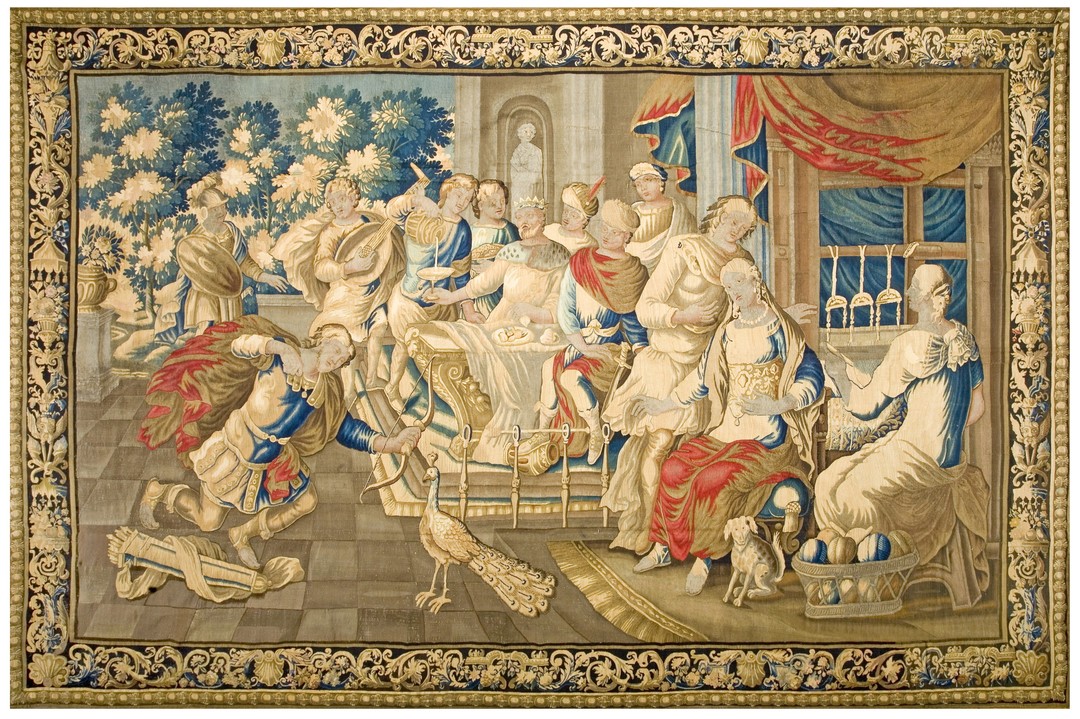
By the 17th and 18th centuries, these designs even inspired European workshops, particularly in Poland and France, where the archer motif was adapted into Baroque and Renaissance decorative vocabularies. Although figural motifs became rarer in broader Islamic weaving due to religious preferences for abstraction, they persisted in elite commissions, ensuring the survival of the tradition.
Archers therefore form a thread that links the earliest known carpet traditions with Safavid grandeur, Mughal adaptations, and later global reinterpretations.
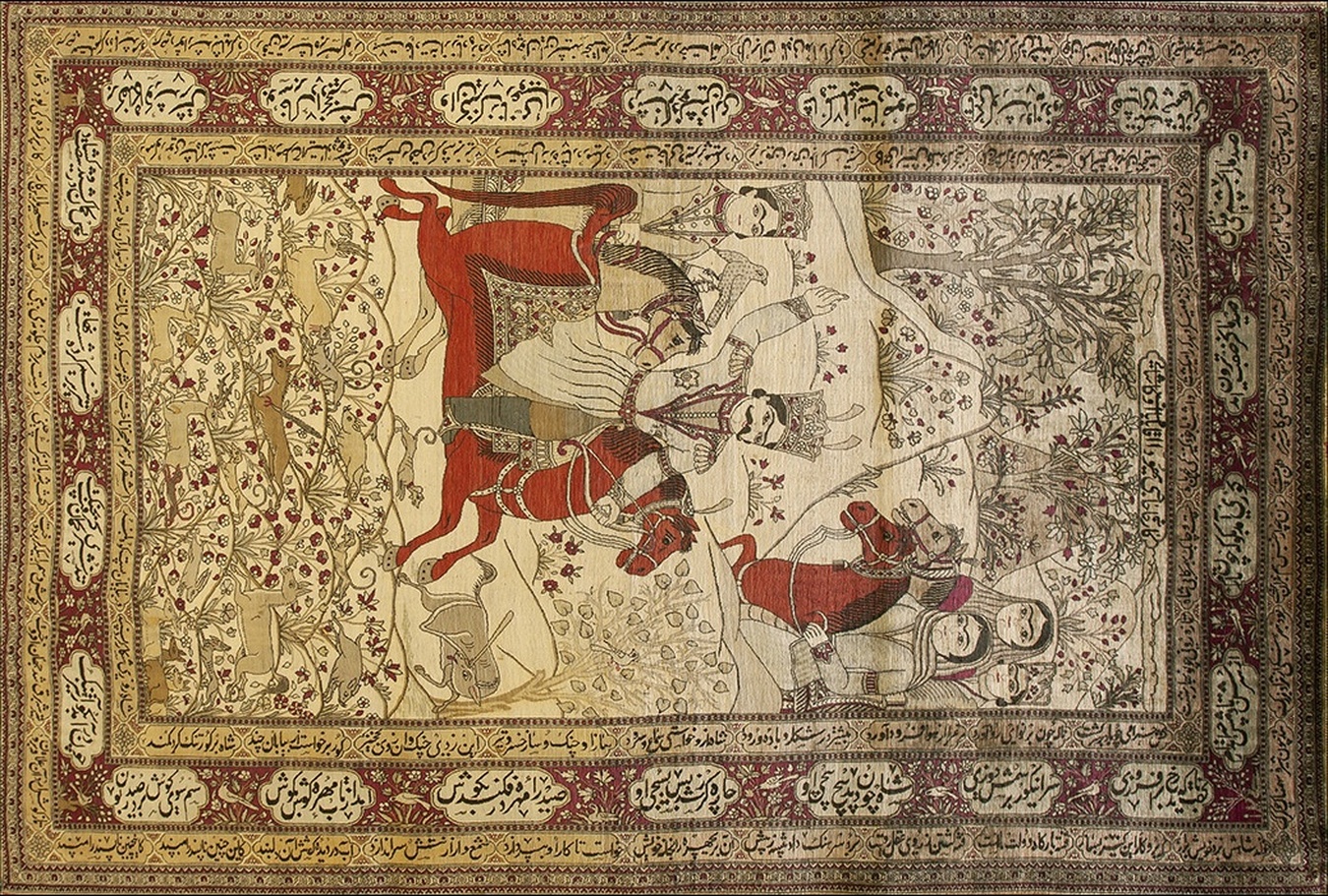
At every stage, they represented more than an image—they embodied the dual identities of the bowman as both hunter and protector, weaving together the symbolic worlds of survival, sovereignty, and artistry. Archer motif rugs today stand as visual testaments to this long lineage, uniting antiquity with courtly refinement and bridging cultures across centuries.
Symbolism and Cultural Meanings of Archers in Rugs
Why did ancient weavers include archers?
Ancient weavers included archer motifs in rugs as both protective symbols and declarations of power. In tribal and courtly settings alike, the bowman was a figure of vigilance, guarding the home or palace much like he guarded the battlefield.
Placed on the surface of a carpet—an object central to domestic and ceremonial life—the archers became a woven sentinel.
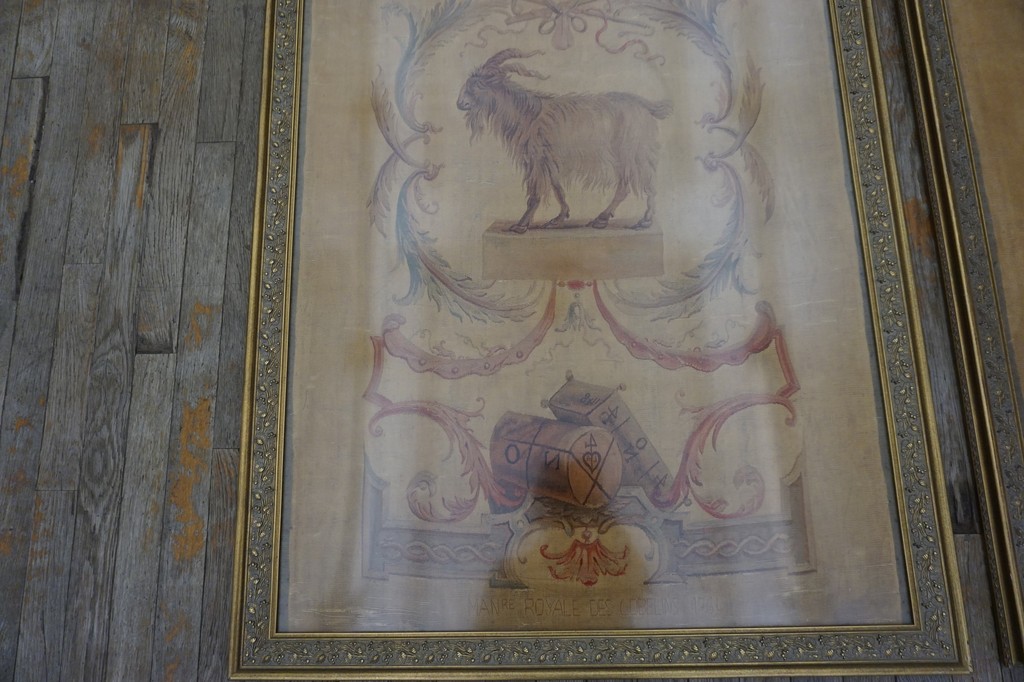
Pair of Scenic Antique 18th Century Beauvais French Tapestries by Rugs On Net
Beyond protection, the motif conveyed prestige: only societies with resources and nobility could afford to celebrate hunters and warriors in such lavish textiles. Thus, archer symbolism in rugs fused spiritual safeguarding with social status, making the design resonate across households and dynasties.
Royal, mythic, and protective meanings of archers
In Persian traditions, archers embodied royal virtues—courage, focus, and heroism. The legendary tale of Arash the Archer, who sacrificed his life by shooting an arrow that defined Iran’s borders, imbued the motif with patriotic and mythological resonance. Safavid hunting carpets, commissioned for courts, depicted bowmen pursuing animals not merely for sport but as metaphors for dominion over nature and rivals alike.
In Anatolia, the arrow motif meaning leaned toward bravery and protection, often appearing in tribal flatweaves where arrows and bowmen symbolized a community’s defense against misfortune. Among Caucasian weavings, archer or arrow imagery took on a dual role: a nod to heroic lineage and a talismanic figure believed to ward off evil.
These designs acted as protection motifs, ensuring the household or tent where the rug was spread remained safeguarded. Collectively, these interpretations show how the bowman moved fluidly between myth, history, and spirituality—sometimes a hero of legend, sometimes a warrior-guardian, and often a signifier of noble power.
Modern interpretations and metaphoric uses
- Arrow as progress — Why: Contemporary designers use arrow motifs to symbolize moving forward, echoing cultural narratives of ambition and focus.
- Focus and discipline — Why: The drawn bow represents concentration, making it a metaphor for clarity in purpose and goal-setting.
- Guardian of tradition — Why: Modern adaptations of archer imagery in rugs recall ancestral themes of courage and protection, connecting buyers to cultural heritage.
- Abstract strength — Why: Even when the figure of the bowman is replaced by simplified arrow forms, the design still carries the aura of resilience and protection.
Through these layers of meaning, mythological rug figures and their modern reinterpretations illustrate how archer imagery evolved from tangible warrior depictions into enduring metaphors of strength and direction.
Whether as literal guardians or symbolic guides, archers in rugs continue to reflect the values of protection, nobility, and purpose across centuries.
Visual Characteristics of Archers
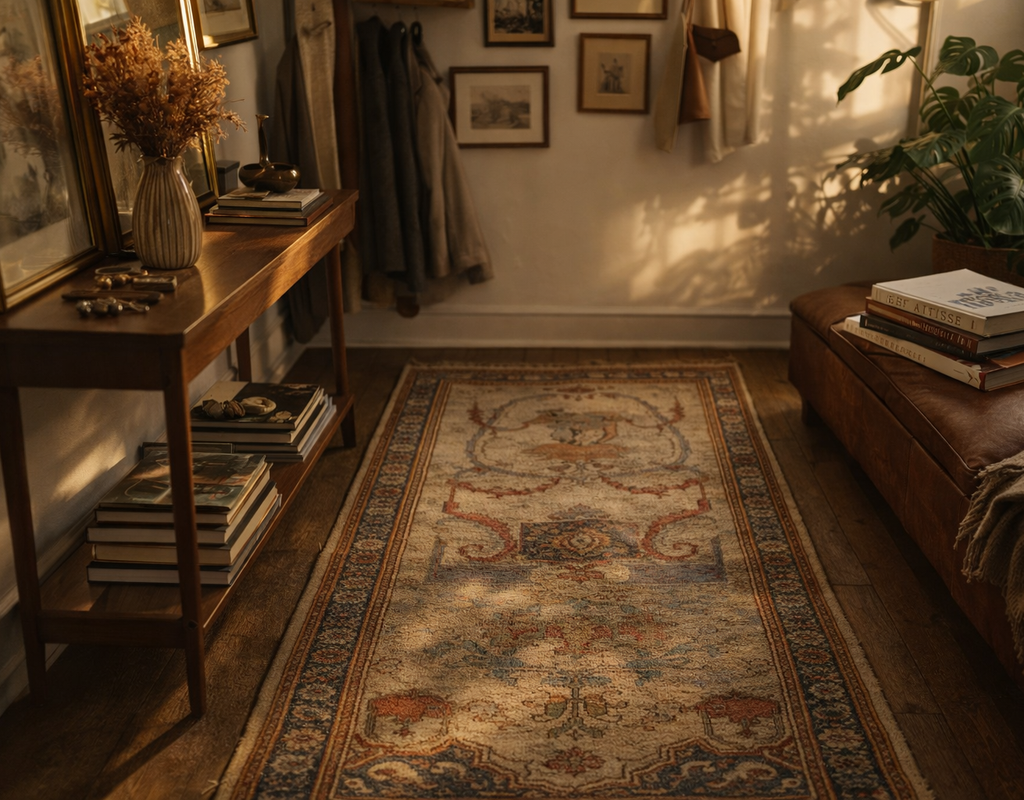
A beautifully illuminated hallway or entryway featuring a traditional runner rug complementing the rich wood and leather textures.
Dynamic depiction of a mounted archer in action.
How do archers appear visually on hunting-scene carpets?
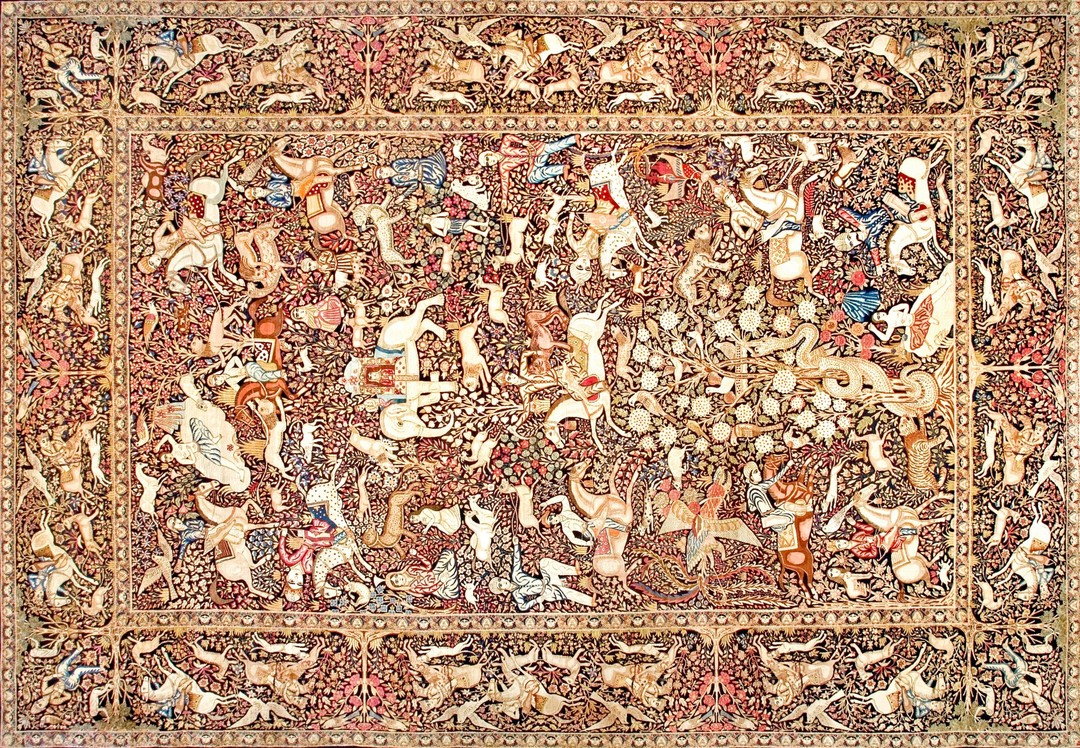
In a Persian hunting carpet, archers are almost always depicted in motion—drawing a bow with taut energy, often on horseback, sometimes executing the famed Parthian shot (firing backward while riding away). These figures are woven with remarkable attention to detail, showing flowing garments, expressive gestures, and finely modeled horses.
Such realism demands a high knot density and the use of fine wool or silk, hallmarks of courtly weaving. The essence of an archer carpet design lies in its sense of action: every bowstring pulled and every galloping steed conveys vitality and dynamism.
What symbols accompany archers in traditional hunting rugs?
The archers rarely appear alone. Supporting symbols in rug art emphasize the narrative of the hunt or the mythic struggle it represents. Prey animals such as deer, lions, or leopards signify both the skill of the hunter and the dominance of the ruler. Lush foliage, water features, and garden elements frame the action, tying the scene to paradise imagery common in Islamic art.
‘Supporting motifs include arrows, bows, quivers, hunting dogs, and even mythical beasts—dragons, griffins, or hybrid creatures—that elevate the archer from a simple hunter to a guardian and heroic figure. These visual accompaniments enrich the pictorial rug motif, layering meaning onto the action depicted.
Are archer-themed rugs always depicting royal hunting scenes?
While many of the most famous examples, particularly from the Safavid period, are grand royal hunting carpets, not all archer-themed rugs belong to courtly traditions. In tribal kilims and village carpets, the hunting scene rug often takes a more geometric or stylized form, with the archer reduced to a stick figure holding a bow.
These versions capture the spirit of bravery and protection without requiring fine detail. Some pieces also feature epic heroes or mythic archers rather than royal patrons, emphasizing cultural narratives over political power. Thus, the motif spans both palace workshops and humble looms, proving its universality.
Most common design layouts and supporting motifs
- Central medallion with surrounding hunts — Why: Symbolizes order and harmony, with action radiating from a focal point.
- Repeating narrative panels — Why: Creates a storytelling effect, weaving multiple hunting or heroic episodes across the rug’s field.
- Diagonal or border chases — Why: Uses movement along borders or diagonals to give the illusion of endless pursuit.
- Tribal geometric renderings — Why: Simplifies the archer into symbolic forms, preserving meaning even when technical detail is limited.
Whether executed with silk precision in a Persian hunting carpet or abstracted into bold tribal geometry, the archer carpet design always communicates motion, vitality, and layered meaning.
These pictorial motifs demonstrate how rug weavers balanced artistry with narrative, creating textiles that told stories of nobility, heroism, and protection.
Materials, Techniques, and Construction of Archers in Rugs
How are archers knotted differently from floral medallions?
Depicting a bowman in motion requires far more precision than weaving a vine or rosette. Persian rug knotting for archer scenes typically involves higher knot density, with every strand serving to sharpen the outline of a face, bow, or arrow. In Safavid masterpieces, asymmetrical (Persian) knots allowed weavers to achieve delicate curves and lifelike figures.
By contrast, floral medallions could be executed at lower counts because their repeating curves and blossoms tolerated looser interpretation. In the Caucasus, symmetrical knots created bolder, blockier depictions of hunters—stylized but no less meaningful. The difference highlights how archer rug materials and techniques dictated the level of realism possible.
Does wool or silk better highlight fine archers details?
When clarity mattered—such as in royal Persian hunting carpets—silk was the preferred pile. Its fineness allowed weavers to render expressive eyes, taut bowstrings, and detailed costumes with astonishing fidelity. Silk vs wool in rugs also determined value: silk archer rugs were prized as diplomatic gifts and palace treasures.
Wool, however, remained the traditional choice for tribal hunting carpets. While coarser, it gave durability and warmth, and its natural oils enhanced dye absorption, producing rich reds and blues. Thus, silk highlighted detail and prestige, while wool carried forward the cultural authenticity of everyday weaving.
Can modern power-loom rugs capture classic archer detailing?
Modern power-loom rug quality has advanced enough to replicate the outlines of hunting scenes, but these machine-made versions lack the tactile depth and visual nuance of hand-knotted works. In a woven archer figure, the human hand imbued subtle irregularities that created vibrancy, a quality machines cannot replicate.
Power-loom rugs often appear flat, with compressed textures and synthetic sheen. While suitable for decorative purposes, they cannot command the reverence or market value of authentic hand-knotted archer rugs, which remain labor-intensive cultural artifacts.
Is the color palette for archer rugs historically specific?
Yes—the historical rug color palette for archer scenes was distinctly Persian and courtly. Madder red, indigo blue, golden yellow, ivory, and verdant green dominated Safavid carpets, while Mughal examples introduced additional botanical tones. Vegetable dyes produced subtle abrash (shifts in hue) that lent natural depth to landscapes and clothing. Today, vegetable dye revivalists recreate these palettes to capture the authenticity of classical hunting carpets. The consistency of these colors over centuries marks them as hallmarks of archer rug identity.
Key weaving centers and hallmark technical features
- Tabriz — Why: Famous for court commissions, high knot counts, and silk archer hunting carpets.
- Kashan — Why: Produced luxurious silk-and-metal-thread pictorial rugs, prized by nobility.
- Qum — Why: Modern center continuing the Safavid figural tradition in silk with extraordinary precision.
- Karabagh (Caucasus) — Why: Known for bolder, geometric archer depictions with symmetrical knots.
- Mughal India — Why: Adapted Persian designs with Indian flora and fauna, creating hybrids of cultural artistry.
In every weaving center, the materials and techniques of archer rugs determined not only their look but also their place in history. Whether in silk splendor or woolen tribal strength, these textiles prove how construction shaped both beauty and meaning.
Regional and Historic Variations in Archers Rug Motifs
Persian, Caucasian, Central Asian, and Anatolian interpretations
In Persian archer rugs, the Safavid court workshops achieved the highest level of artistry. Their hunting carpets presented naturalistic riders, finely detailed prey, and lush landscapes, designed to echo royal pageantry. By contrast, Persian village or tribal rugs favored more stylized depictions, reducing bowmen to simplified figures while retaining the essential symbolism of bravery and protection. Caucasian weaving, particularly in Karabagh pictorial rugs, leaned toward bold coloration and angular geometry.
Here, archers and hunters appeared in rigid but striking forms, reflecting local Armenian and Azeri influences. These compositions were less concerned with realism than with powerful symbolic presence, making Persian vs Caucasian hunting rugs a study in naturalism versus abstraction. In Central Asia, explicit archer figures are rare, yet the warrior spirit survived in arrow motifs and geometric weapon symbols. Tribal weavers preferred to invoke protection and valor through abstraction rather than direct figural scenes.
Anatolian kilims rarely depicted human figures at all, but the arrow symbol itself became a talisman of courage and defense. Woven into flatweaves, it served as a protective emblem for families and tribes, showing how the essence of the archer motif endured without literal imagery.
Together, these regional differences illustrate how regional archer rug styles were adapted to local weaving traditions and cultural codes: naturalism in Persia, geometric boldness in the Caucasus, symbolic abstraction in Anatolia, and warrior echoes in Central Asia.
When did European workshops start copying Persian archers patterns?
European hunting scene carpets first emerged in the 17th century, when Persian Safavid rugs inspired the grand looms of France. Workshops like Savonnerie and Aubusson adapted Persian hunting motifs into French royal and aristocratic décor, often reinterpreting them with Rococo and Baroque flair.
By the 19th century, English and Russian workshops also produced imitations, commercializing the theme for broader Western tastes. While these rugs lacked the cultural weight of Persian originals, they testify to the motif’s enduring appeal across continents.
Notable periods and regional styles
- Safavid Persia (16th–17th c.) — Why: Represented the artistic pinnacle of naturalistic hunting carpets with royal patronage.
- Mughal India (16th–18th c.) — Why: Adapted Persian designs into hybrids with Indian flora and fauna, reflecting cultural fusion.
- Karabagh (18th–19th c.) — Why: Produced vibrant pictorial rugs with angular archers figures, blending local traditions with imported Persian themes.
- Anatolian kilims — Why: Emphasized symbolic arrow motifs as talismans of bravery and protection, rarely figural.
- European workshops (17th–19th c.) — Why: Copied Persian hunting scenes for Western aristocracy, translating the motif into courtly décor.
Across centuries, the archers rug motif demonstrated remarkable adaptability. From Safavid palaces to Caucasian villages, from Mughal courts to French salons, each cultural setting reimagined the bowman—sometimes as a lifelike hunter, sometimes as a symbolic protector—while always preserving his role as a timeless emblem of courage and authority.
Collecting, Authenticity, and Value of Archers Design Rugs
Should collectors favor vintage Qum archer rugs over new reproductions?
Collectors generally favor vintage Qum archer carpets from the 20th century because they represent some of the finest hunting-scene reproductions of the Persian tradition. Early Qum examples are hand-knotted with extraordinary silk precision, high knot counts, and natural dyes that have aged beautifully.
By contrast, new reproductions often rely on synthetic dyes or lower craftsmanship. While modern pieces can be attractive and affordable, vintage Qum rugs carry stronger market demand, historical continuity, and enduring investment value, making them the better choice for serious collectors.
How can buyers verify authenticity of antique archer design carpets?
Determining an authentic archers rug requires careful evaluation. Buyers should inspect materials—silk or fine wool is typical for originals—and assess knot density, since higher counts indicate more precise pictorial weaving. Pattern precision, dye quality, and natural abrash (subtle color variations) also help distinguish authentic works from modern fakes.
Provenance documentation, expert appraisals, and carbon or dye tests for age verification further support authenticity. Without these checks, buyers risk purchasing recent imitations that mimic hunting motifs but lack historical substance.
Why are high-knot Persian archers rugs priced at premiums?
The value of a Persian hunting rug is tied directly to labor and artistry. High-knot pieces require months or even years of weaving, with each knot contributing to lifelike facial expressions, taut bowstrings, and finely drawn prey animals. This density not only increases technical precision but also signals courtly or elite workshop origins.
As a result, collectors pay significant premiums for these carpets because they combine painstaking craftsmanship, cultural symbolism, and historic rarity. Premium pricing reflects both artistry and historical importance, not just size or age.
Does condition grading differ for archer hunting-scene carpets?
Yes—condition grading rugs with pictorial detail demands special scrutiny. Unlike abstract geometric carpets, where minor wear may go unnoticed, even small losses in an archers hunting-scene carpet can obscure figures or break narrative flow.
Collectors must assess clarity of motifs, presence of repairs, and whether fading has compromised facial detail or symbolic elements. A rug with intact imagery retains much higher value than one where wear erases critical scenes, making condition grading more exacting for pictorial pieces.
What framing or padding best preserves delicate archer motifs?
For preservation, delicate archer rugs should be mounted with acid-free backing materials and protected under UV-filtering glass or acrylic to prevent fading. When displayed flat, use natural-fiber padding to reduce friction and maintain even tension, avoiding distortion of the bowman’s outline.
Hanging should be done with a supportive sleeve or tensioned mount to prevent strain on individual knots. Proper rug preservation ensures that fine pictorial details remain intact for generations, protecting both beauty and value.
Key buying, care, and display tips
- Favor provenance-backed rugs — Why: Documentation and expert appraisal protect against costly fakes.
- Choose natural dyes and silk or fine wool — Why: They enhance both artistry and long-term value.
- Inspect knot density and clarity — Why: More knots equal more detail, essential for archer motifs.
- Grade carefully for imagery — Why: Pictorial clarity directly impacts market price.
- Use archival framing and padding — Why: Prevents fading, distortion, and long-term damage.
Ultimately, the worth of an authentic archer rug lies in its blend of technical mastery, symbolic depth, and cultural lineage. For collectors, investing in properly preserved, high-knot Persian hunting rugs is both an aesthetic choice and a legacy-worthy acquisition.
Contemporary Archers Design Rugs and Modern Design
Where are contemporary archers-design rugs mainly produced today?
Today, modern archers rug designs is carried forward by a mix of traditional and boutique workshops. In Iran, a handful of ateliers continue weaving hunting-scene carpets in silk, echoing Safavid traditions. India and Turkey have developed niche workshops producing pictorial carpets and kilims with stylized bowmen and hunting scenes.
In Armenia, small studios adapt historic Karabagh pictorial rugs into updated interpretations. Meanwhile, boutique Western brands experiment with the motif in contemporary forms, often treating the archer as a symbolic rather than literal figure. These diverse centers ensure that the contemporary hunting carpet remains both globally accessible and culturally layered.
Are archers-design runners suitable for modern minimalist interiors?
Yes. A well-chosen archers motif runner can transform a minimalist interior into a gallery-like space. In pared-down settings with neutral walls and clean lines, the intricate action of bowmen and symbolic arrows serves as a bold focal point. Designers increasingly hang runners as wall art, where the pictorial effect can be appreciated at eye level.
The key is balance: surrounding décor should remain restrained, allowing the runner’s narrative imagery to function as statement art. This trend makes archers designs surprisingly versatile for modern interiors.
Can eco-friendly vegetable dyes replicate classical archers palettes?
Modern workshops increasingly embrace eco-friendly rug dyes, turning to vegetable and natural sources to revive historical hues. These dyes successfully replicate the madder reds, indigo blues, golds, and greens characteristic of classical Persian hunting rugs.
While subtle differences in tone occur—vegetable dyes often produce softer shifts and abrash effects—many collectors see these as authentic and desirable. Eco-conscious buyers thus gain both sustainability and fidelity to the historical rug color palette, bridging classical aesthetics with modern values.
Who are notable designers reviving archers themes in contemporary rugs?
Several designers have championed the revival of archers imagery in contemporary weaving. Iranian-born Taher Asad-Bakhtiari, working with cc-tapis, has reinterpreted ancient motifs with modern geometric abstraction. Select Iranian and Armenian ateliers continue to weave traditional designer pictorial rugs, maintaining direct continuity with historic practices.
In the West, bespoke studios and custom brands reinterpret the bowman in symbolic forms—sometimes as abstract arrows or simplified silhouettes—showing that the motif remains fertile ground for experimentation.
Best current sources, interior applications, and modern trends
- Boutique Iranian and Armenian workshops — Why: Carry forward authentic craftsmanship with updated palettes.
- Indian and Turkish niche producers — Why: Offer accessible handmade options blending tradition and modern taste.
- Western designer brands — Why: Transform the archer into abstract art pieces suitable for minimalist or eclectic homes.
- Statement runners and wall-hangings — Why: Present the archer motif as visual art, not just flooring, aligning with contemporary interior trends.
- Eco-conscious collections — Why: Combine sustainability with the elegance of classical hunting-scene palettes.
In today’s market, modern archers rug designs embodies continuity and reinvention. Whether as a contemporary hunting carpet faithful to Safavid precedent or as archers motifs runner reimagined for minimalist interiors, these rugs connect ancient storytelling with modern living, proving the motif’s timeless capacity to inspire.
Explore a Few of Our Archers Design Rugs
FAQ
- What’s a quick tell that an archer motif rug is printed, not woven?
On printed look-alikes, the back shows blurry outlines and no true knots. On woven archer rugs, motifs appear crisply on the reverse and knots are visible in rows.
- Are there ethical or legal issues when buying antique archer motif rugs?
Request provenance and export/import compliance for archer motif rugs, especially older or silk masterpieces. Avoid pieces with signs of illicit removal from religious or public collections.
- How do I prevent fading in archer motif rugs?
Keep archer rugs out of direct sun, rotate every 3–6 months, and use UV-filtering shades. Avoid halogen spotlights aimed closely at silk or bright dyes.
- Will a robot vacuum damage archer motif rugs?
It can snag fringes or loose wefts. Disable edge-sweep near fringes, use low suction, and periodically hand-vacuum archer motif rugs with a brushless nozzle.
- How should I style archer motif rugs at home?
Let archer rugs be the focal point: neutral walls, simple furniture lines, and warm accent lighting. One large piece often looks better than multiple competing patterns.
- Are Mughal archer rugs different from Persian archer motif rugs?
Mughal archer rugs often borrow Persian layouts but depict Indian fauna and court dress, reflecting miniature-painting naturalism. Expect tropical wildlife and lively hunting tableaux.
- Do Caucasian or Oushak pieces feature archer motifs?
Archer figures are rarer there, though some Caucasian pictorials exist. Those regions more often show animals, talismanic symbols, or geometric stories rather than full hunting scenes.
- How can I authenticate an antique archer motif rug?
Compare design and palette to museum-documented hunting carpets, check knot structure and materials, and seek provenance. Independent appraisals add confidence, especially for silk archer motif rugs.
- What rug pad should I use under archer rugs?
For floor use, a felt or felt-rubber pad about ¼–⅜ inch stabilizes wool archer rugs and reduces wear. Skip thick pads for doors or tripping-risk areas.
- Can archer motif rugs work with pets and kids?
Choose wool archer rugs for durability and easier spot-cleaning. Avoid silk or metallic-thread archer motif rugs in high-play zones; place them as wall art instead.
- How do archer motif rugs compare to arrow-motif kilims?
Archer motif rugs depict people with bows in narrative hunts. Arrow-motif kilims (Turkish “ok”) are geometric symbols of protection—graphic borders rather than figural scenes.
- What materials are common in archer motif rugs?
Wool pile on cotton foundations is common; elite archer motif rugs may feature all-silk warps/wefts and silk pile, sometimes enriched with silver-gilt brocading threads.
- Where can I buy archer motif rugs in the US?
Look to specialist dealers and major auction platforms; verify return windows (e.g., 7–30 days) and request a written condition report with fiber/knot details before purchase.
- Which museums in the US display archer motif rugs?
In the US, the Museum of Fine Arts, Boston holds a renowned Safavid hunting carpet. The Met displays related Safavid animal carpets that contextualize archer motif rugs.
- What knotting and density appear in archer motif rugs?
Many Persian archer rugs use the asymmetrical (Persian) knot. Top silk pieces can be extremely fine—one museum hunting carpet records \~14,300 knots per square decimeter.
- How do I clean archer motif rugs?
Use a trusted rug specialist; avoid steam or high-alkaline cleaners, especially on silk or metallic threads. Routine care: gentle vacuuming without beater bar and quick blotting.
- How should I hang an archer motif rug safely?
Use a stitched sleeve and Velcro-on slat (museum method) or a continuous batten to distribute weight. Avoid nails or clips; allow at least ½ inch airflow behind.
- Are archer rugs durable enough for floors?
Wool archer rugs handle living rooms with proper pads; silk or metal-thread examples are display pieces. Reserve fragile archer motif rugs for low-traffic areas or walls.
- What sizes do archer motif rugs come in?
Sizes range from small 4×6 to palace-scale. The Vienna Hunting Carpet measures about 22.5×10.8 ft (687×331 cm), showing how grand historic examples can be.
- Are antique archer motif rugs valuable?
Yes—fine silk Isfahan or Kashan archer rugs often list in the low five figures (e.g., \~\$12k–\$15k for \~4×7). Condition, materials, knot density, and workshop signature drive price.
- How can I tell a Persian archer motif rug from a modern Pakistani version?
Persian archer rugs may use silk (sometimes with metal-wrapped threads) and very high knot counts; Pakistani versions are commonly wool/cotton with lower KPSI. Inspect materials, weave clarity, and inscriptions.
- Which regions produce archer rugs today?
Beyond Persian and Mughal traditions, many archer rugs are woven in Pakistan and India as Shekargah “revivals,” usually wool on cotton. City-workshop Persian pieces are rarer and often silk.
- What do archers symbolize on archer motif rugs?
On archer motif rugs, archers typically signify royal power, mastery, and courage; hunts also echo paradise-garden ideals. Safavid pieces often blend Persian and Chinese symbols like phoenixes and dragons.
- Where did archer motif rugs originate historically?
Most iconic archer motif rugs originated in Safavid Iran, c. 1500s, under royal workshops that translated miniature painting into carpets. A famed example is the Vienna Hunting Carpet (first half 16th century).
- What are archer motif rugs (aka archery motif rugs) in the context of rugs?
Archer motif rugs are figural “hunting-scene” (Shekargah) carpets showing mounted bowmen and prey. They peak in 16th-century Safavid Iran and later appear in Mughal India and modern reproductions.