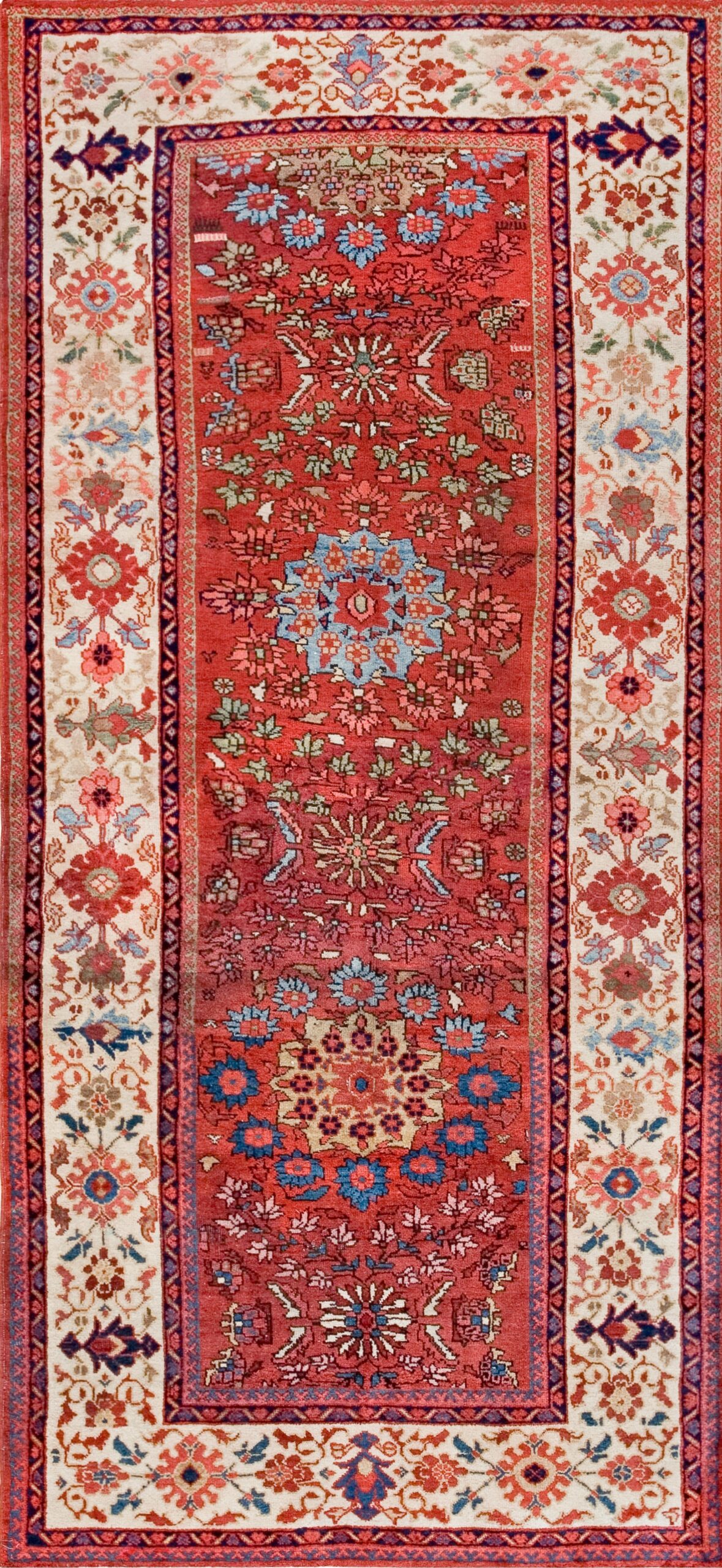
This late nineteenth-century antique red color Persian Sultanabad rug is a definitive example of the “Rustic-Elegant” aesthetic that has made Sultanabad weavings among the most sought-after textiles for high-end interior design. Originating from the Arak region, these tribal rugs were famously favored by the British firm Ziegler & Co. for their ability to blend traditional Persian motifs with a spaciousness and color palette that appealed to Western sensibilities.
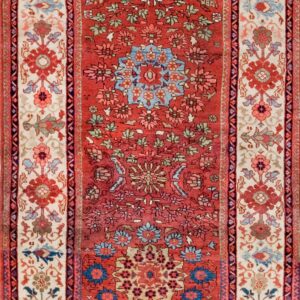
The composition features a captivating Tribal Floral design, characterized by its large-scale, “deconstructed” botanical motifs. Rather than the tight, crystalline precision found in urban workshop Persian rugs from Tabriz or Isfahan, this Sultanabad offers a more relaxed and spontaneous drawing style. The field is populated with oversized palmettes, curling vines, and serrated leaves that meander across the surface with a rhythmic, unhurried grace. This “painterly” approach creates a sophisticated, understated atmosphere that allows the rug to act as a soulful foundation rather than an overwhelming focal point.
The palette is anchored by a magnificent vibrant madder red foundation. This earthy, resonant ground provides a warm and inviting stage for the secondary accents. The floral motifs are rendered in a harmonious array of subtle, aged tones. Because this is a 19th-century antique, the natural vegetable dyes have mellowed into a magnificent “abrash” (tonal variation), where the colors shift subtly like the surface of an aged fresco, giving the red colored area rug a three-dimensional depth and a shimmering historical patina.
Technically, the Sultanabad is prized for its supple, “floppy” handle and its high-grade, hand-spun wool. The wool is exceptionally rich in natural lanolin, resulting in a matte, velvety texture that is incredibly durable while remaining soft underfoot. A defining characteristic of this group is the relaxed knotting, which contributes to the rug’s characteristic “rustic” drape and ensures that the large-scale patterns remain fluid and organic rather than rigid.
The borders act as a grand architectural frame, typically featuring a scrolling “Herati” or “Samovar” pattern that provides a sense of structural containment for the vibrant energy of the field. To possess this antique red Sultanabad rug is to own a piece of 19th-century art history. It bridges the gap between the rugged traditions of Persian village life and the refined elegance of the world’s most sophisticated homes—transforming any space into a sanctuary of historical gravity and warm, botanical soul.
Condition: Good.