
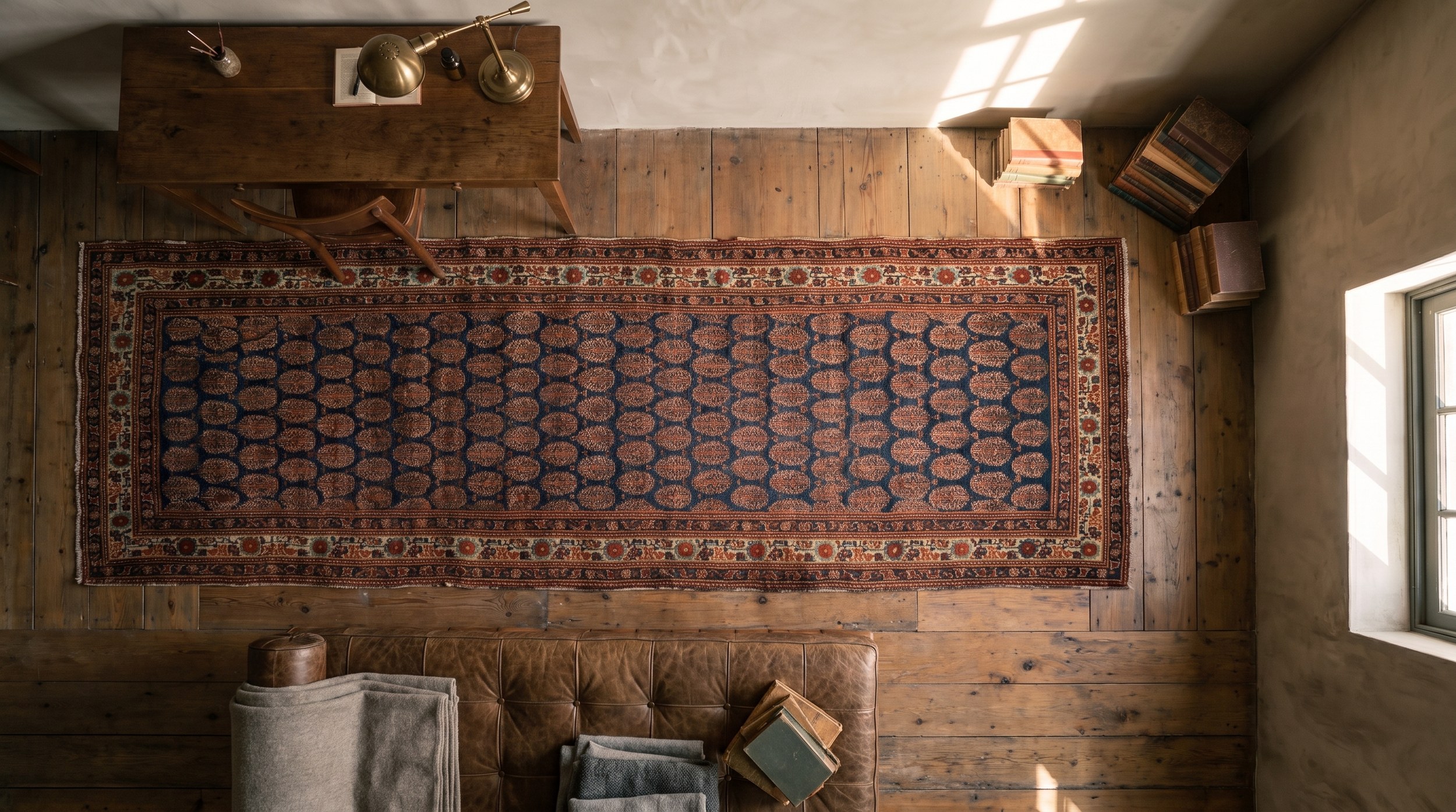
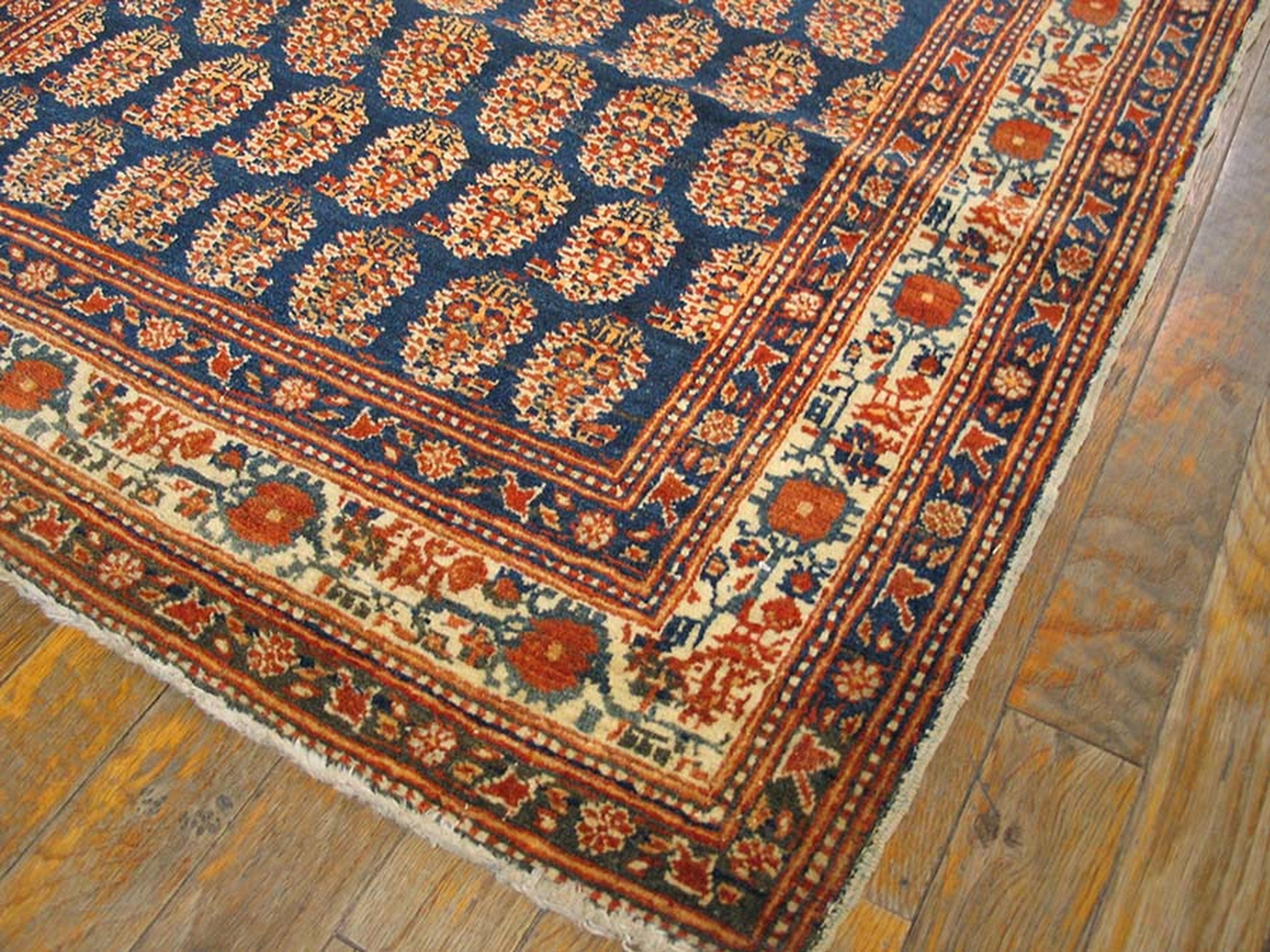
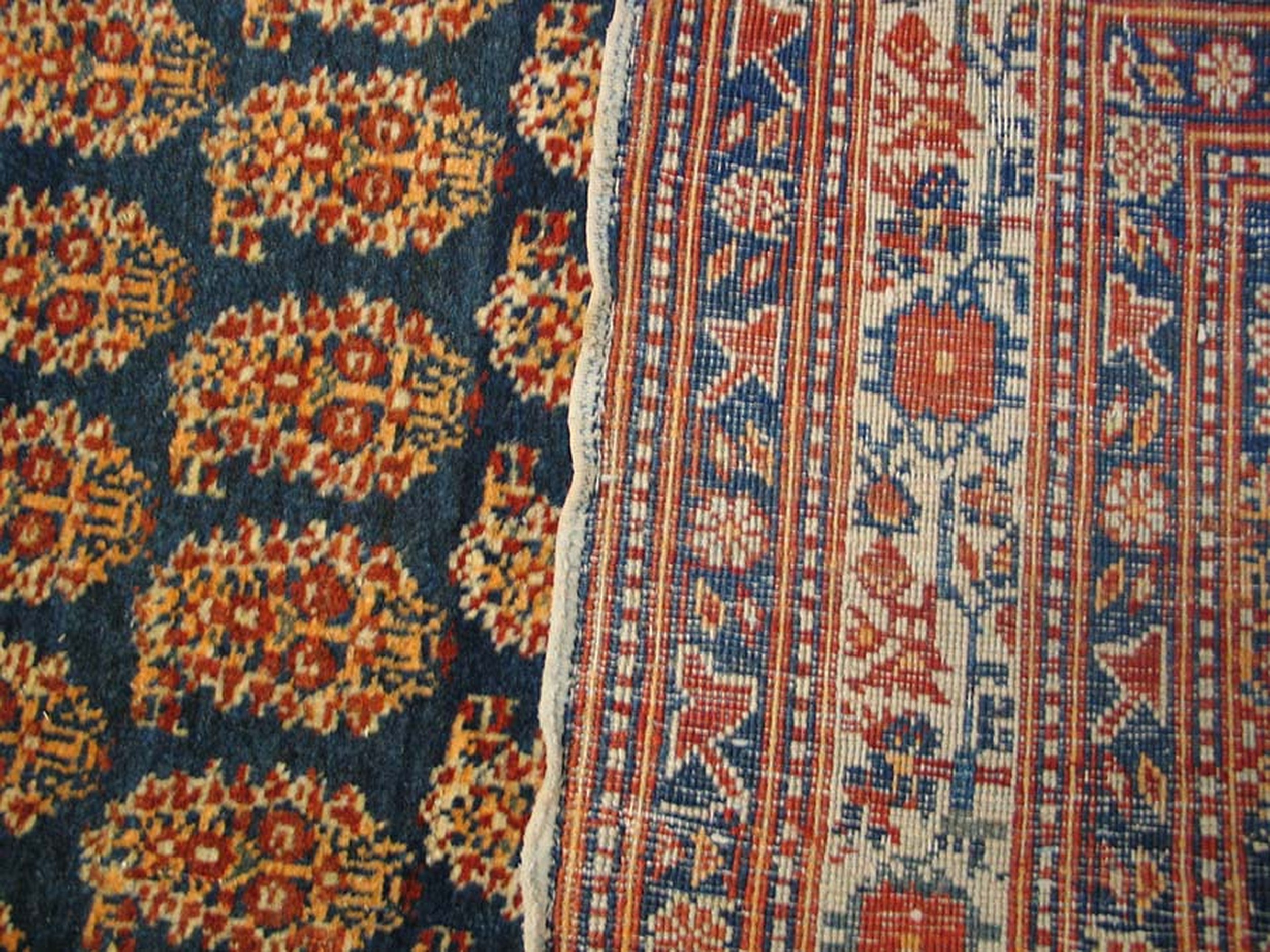


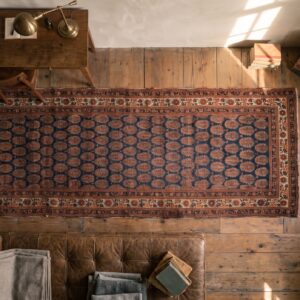
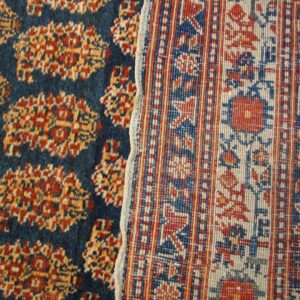


This rare Persian Tabriz late nineteenth-century antique hallway runner rug is a masterwork of “City Workshop” weaving, originating from one of the most intellectually and artistically significant centers of the Persian carpet world. Historically, Tabriz was a gateway for trade between the East and West, and its master weavers—the ustads—were renowned for their technical precision and their ability to translate complex miniature paintings into textile form. This specific specimen is defined by its sophisticated “midnight blue” field, a saturated indigo hue that provides a dramatic, nocturnal backdrop for the meticulous “all-over” arrangement of the Boteh (Paisley) design motif.
The composition features a rhythmic, repeating pattern of the Boteh, a venerable symbol in Persian iconography representing the “Flame of Zoroaster,” a budding leaf, or a drop of water—symbols of life, rebirth, and spiritual protection. In this Tabriz execution, the motifs are rendered with a level of clarity and “razor-sharp” fineness that is the hallmark of the region’s high knot density. Unlike more rustic tribal runners, this piece possesses a disciplined symmetry and a refined, low-profile handle, making it a “scholarly” textile that balances ancient symbolism with the formal elegance required for the grand hallways of the European and Persian elite.
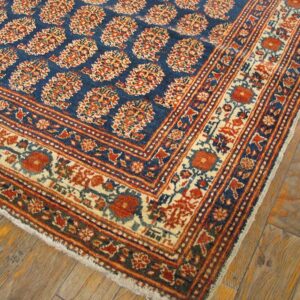
Technically, antique Persian Tabriz rugs of this period are prized for their use of the Turkish (symmetrical) knot and high-quality, resilient wool, often woven on a foundation of fine cotton to ensure a perfectly straight and durable structure. The “blue-on-blue” or high-contrast palette is characteristic of the late 19th-century Tabriz aesthetic, designed to maintain its graphic power even in the narrow, elongated format of a hallway runner. The borders are equally sophisticated, featuring a primary band of alternating rosettes and delicate foliate scrolls that “contain” the rhythmic energy of the central field. To possess a fine-weave Tabriz runner of this age and chromatic depth is to hold a monument to Persian textile engineering—a work that transforms a transitional architectural space into a gallery of Silk Road history and timeless, geometric grace.
Condition: Good.