
Introduction to the 8 Pointed Star Motif
Explore our curated range of eight-pointed star motif rugs to bring symmetry and meaning into your home.
The 8-pointed star motif often feels bold and radiating. With multiple axes of symmetry, it tends to create a vibrant, balanced pattern in rug design. To see how different point counts shift the expression, check out these related forms.
Explore other star motifs: 4-pointed, 5-pointed, 6-pointed, 7-pointed.
What is the 8 Pointed Star Design in Rugs?
The 8 pointed star motif, often referred to as an octagram, is a geometric figure composed of two overlapping squares or radiating lines that create eight balanced points. In rug weaving, it appears in multiple forms: as a bold central star medallion, repeated in borders for rhythm and symmetry, or scattered across the field in tribal and village weavings.
Known by many names—Lesghi star in the Caucasus, Star of Ishtar in Mesopotamian tradition, Seal of Solomon in Persian and Islamic art, Yıldız in Anatolia, and even the Star of Oğuz Khan in Turkic lore—it demonstrates the wide cultural embrace of this pattern.
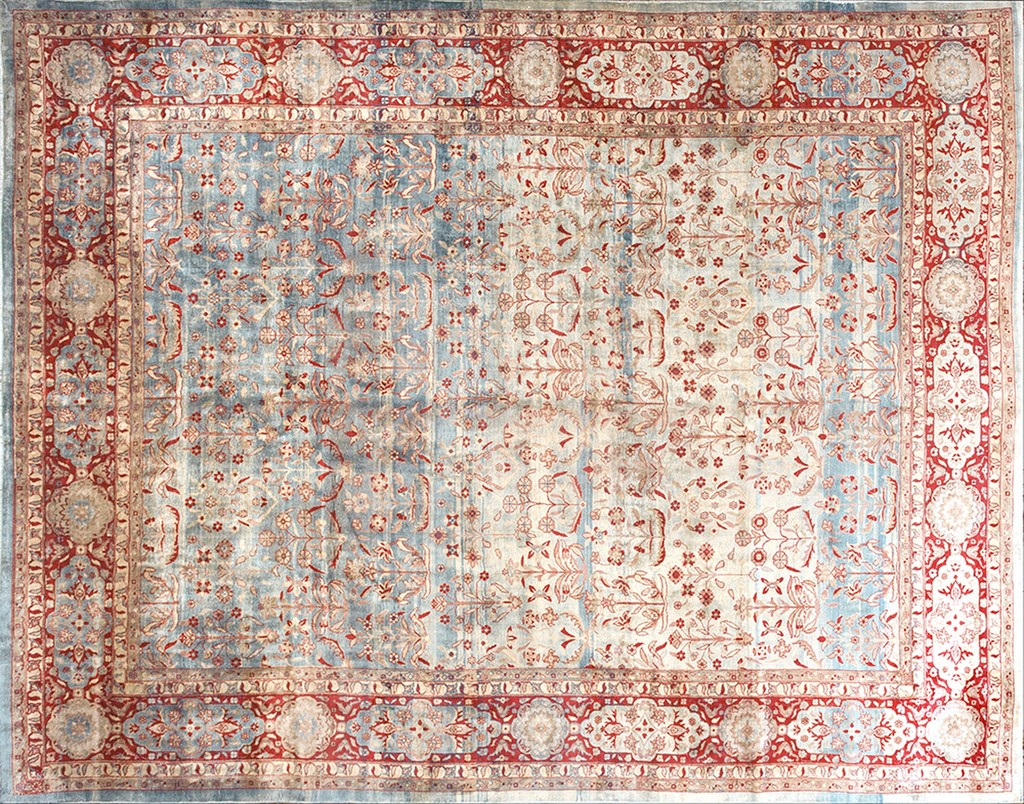
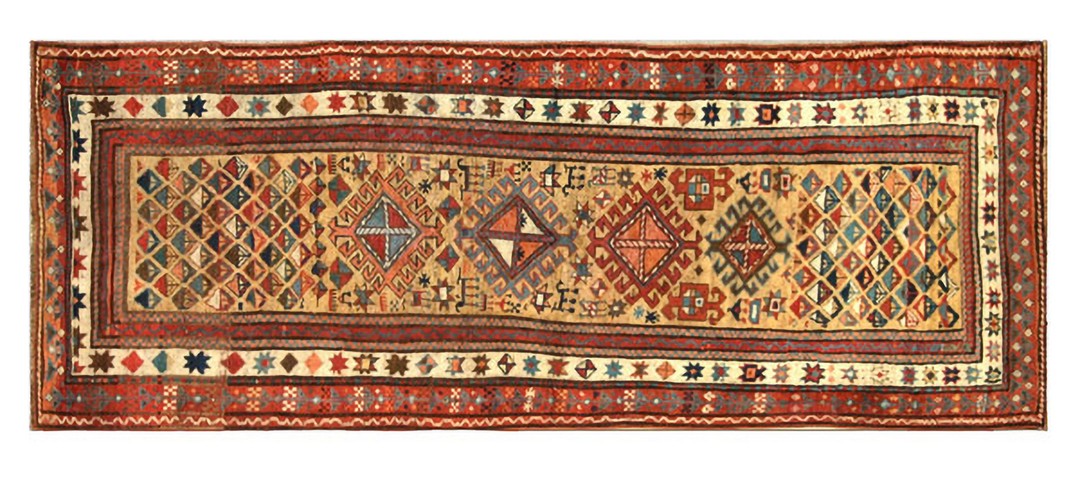
Antique Lahore Indian Knotted Rug by Rugs On Net
Its striking balance of geometry and ornament makes it one of the most recognizable features of tribal star rugs, prized by collectors and designers alike.
Core Meanings and Universal Symbolism
- Protection — Why: The 8 pointed star has long been woven into rugs as a talisman, believed to guard households from misfortune and spiritual harm.
- Luck & Prosperity — Why: Its symmetry conveys abundance and continuity, making it a popular motif in dowry and celebratory weavings.
- Wisdom & Knowledge — Why: In Islamic tradition, the star relates to divine light and guidance, representing the pursuit of truth and learning.
- Fertility & Life Cycles — Why: With its radiating form, the motif echoes natural rhythms of regeneration and cosmic order, often tied to agricultural symbolism in village rugs.
- Divine Unity & Balance — Why: The octagram embodies harmony between opposites—earth and heaven, male and female, material and spiritual—mirroring the values of unity found in multiple faiths and cultures.
The 8 pointed star motif is therefore both decorative and deeply symbolic, bridging art and spiritual meaning. Its crisp geometry lends itself to bold visual impact, while its universality reflects shared human values across Anatolia, the Caucasus, Persia, Central Asia, Morocco, and beyond.
For this reason, it remains a timeless favorite, equally at home in historical textiles and contemporary interiors where symmetry and symbolism make powerful statements.
Origins & Historical Spread
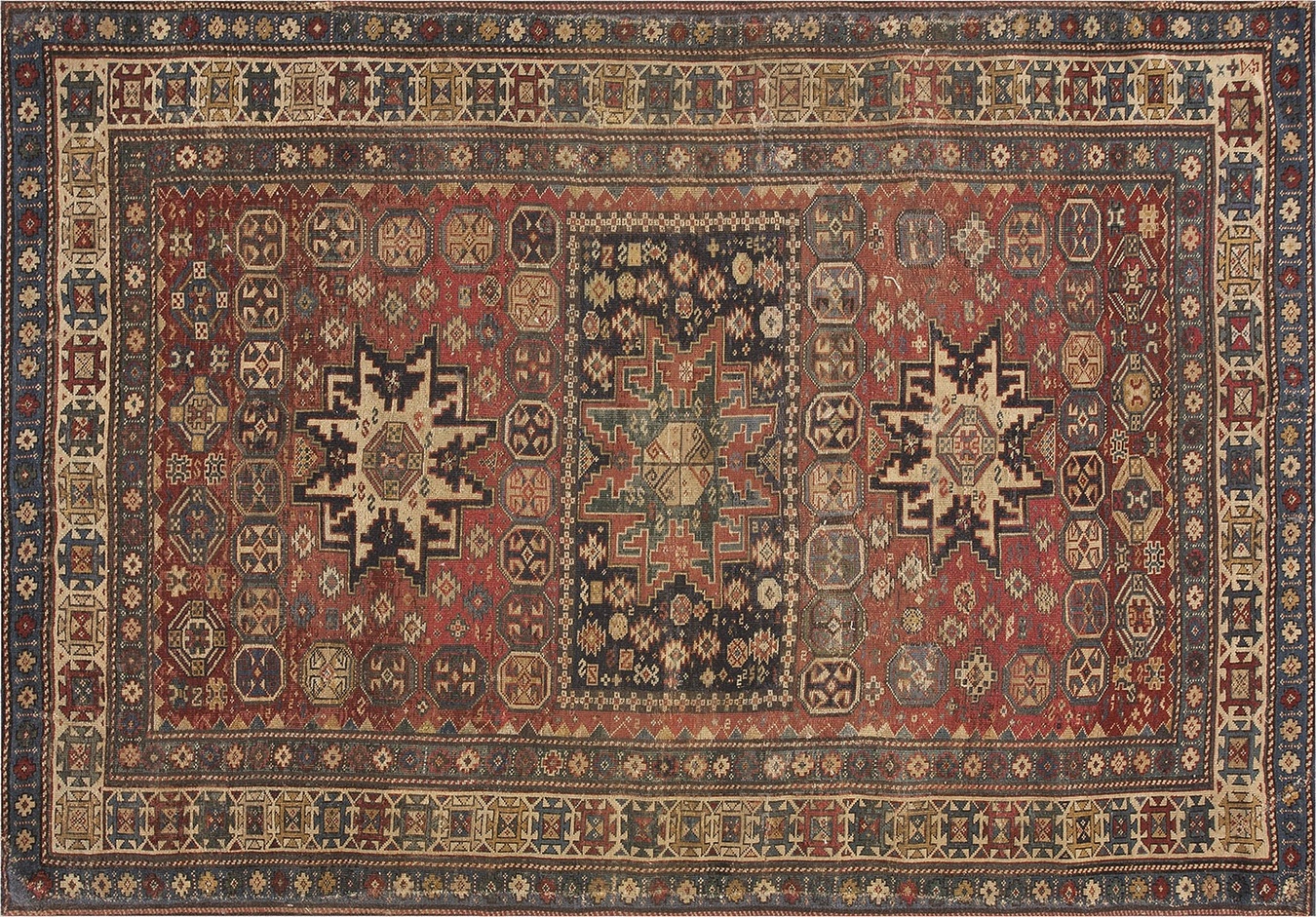
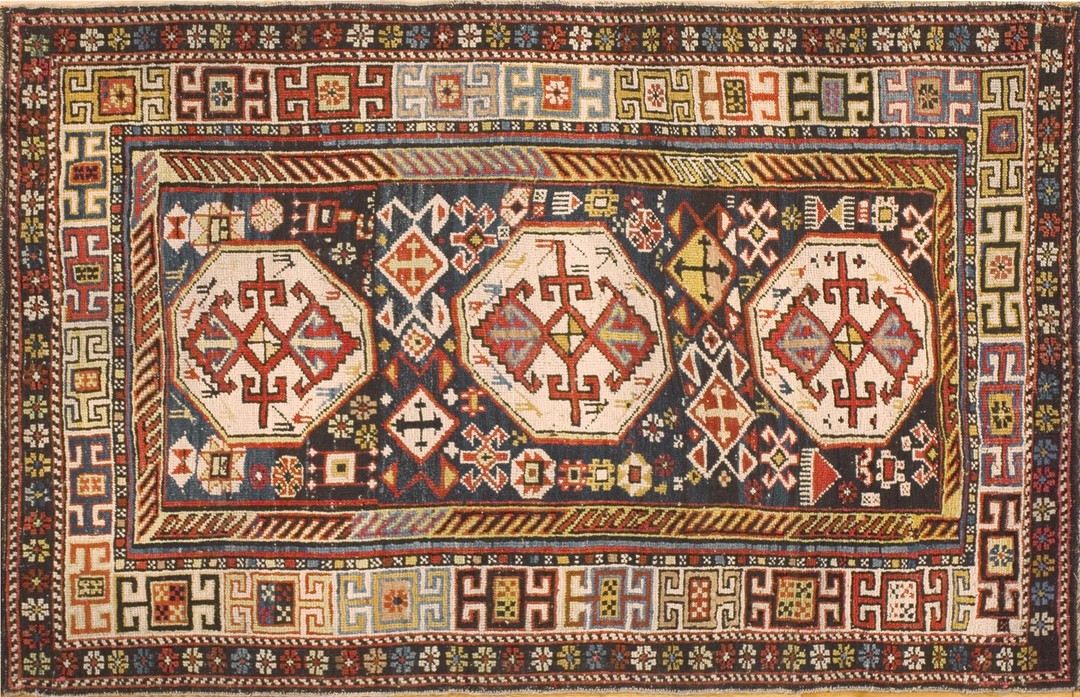
Antique Caucasian – Shirvan Caucasian Knotted Rug – by Rugs On Net
Ancient Roots and Earliest Rug Appearances
The actogram origins trace back to the civilizations of Mesopotamia and Anatolia, where the figure was known as the Star of Ishtar or Venus Star. In Babylonian iconography, it symbolized fertility, abundance, and divine protection, connecting humanity to celestial order.
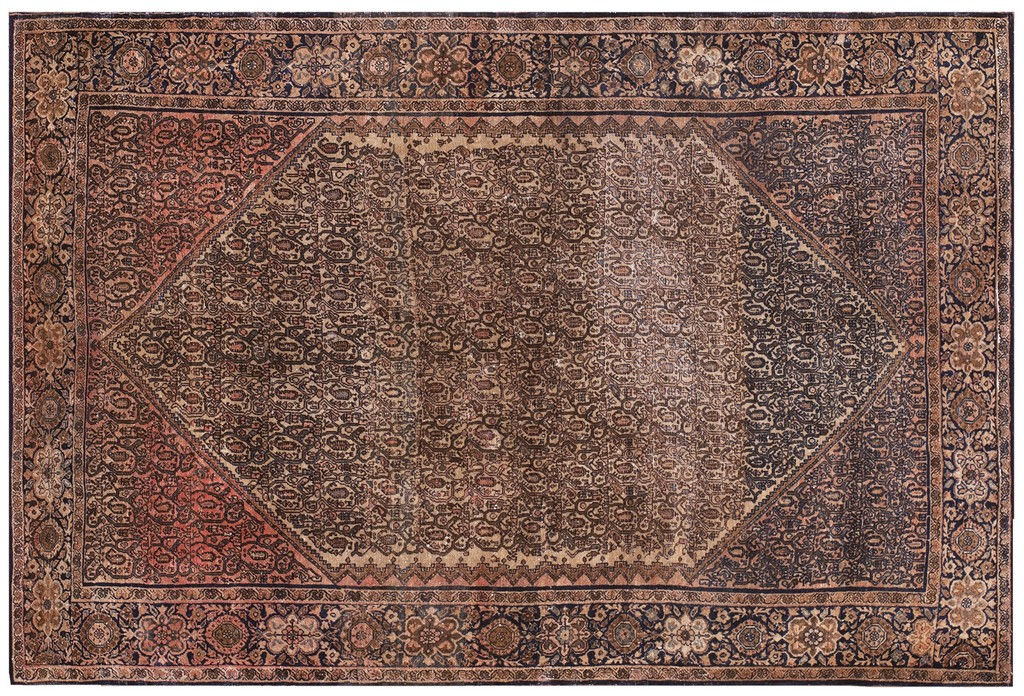
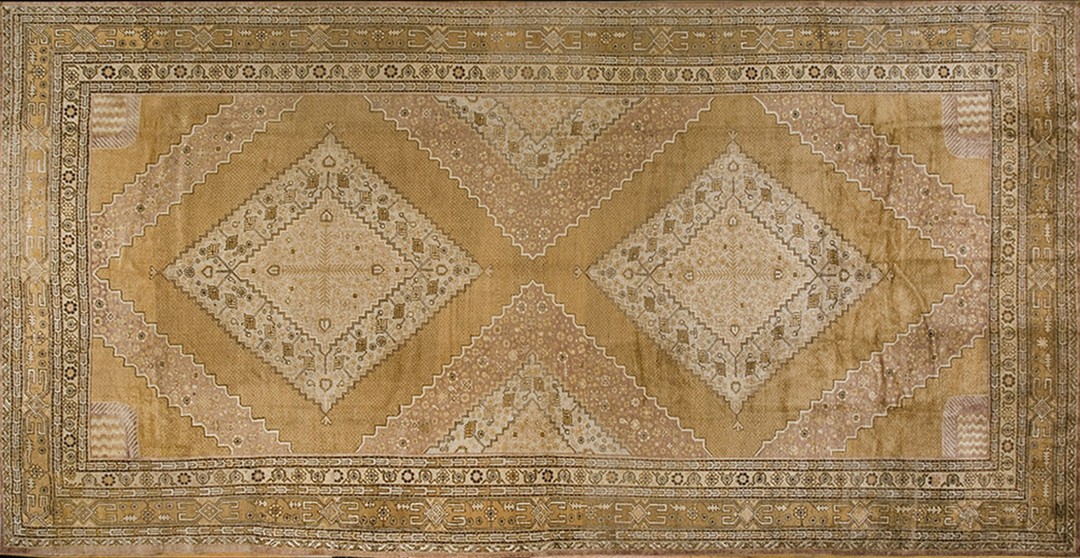
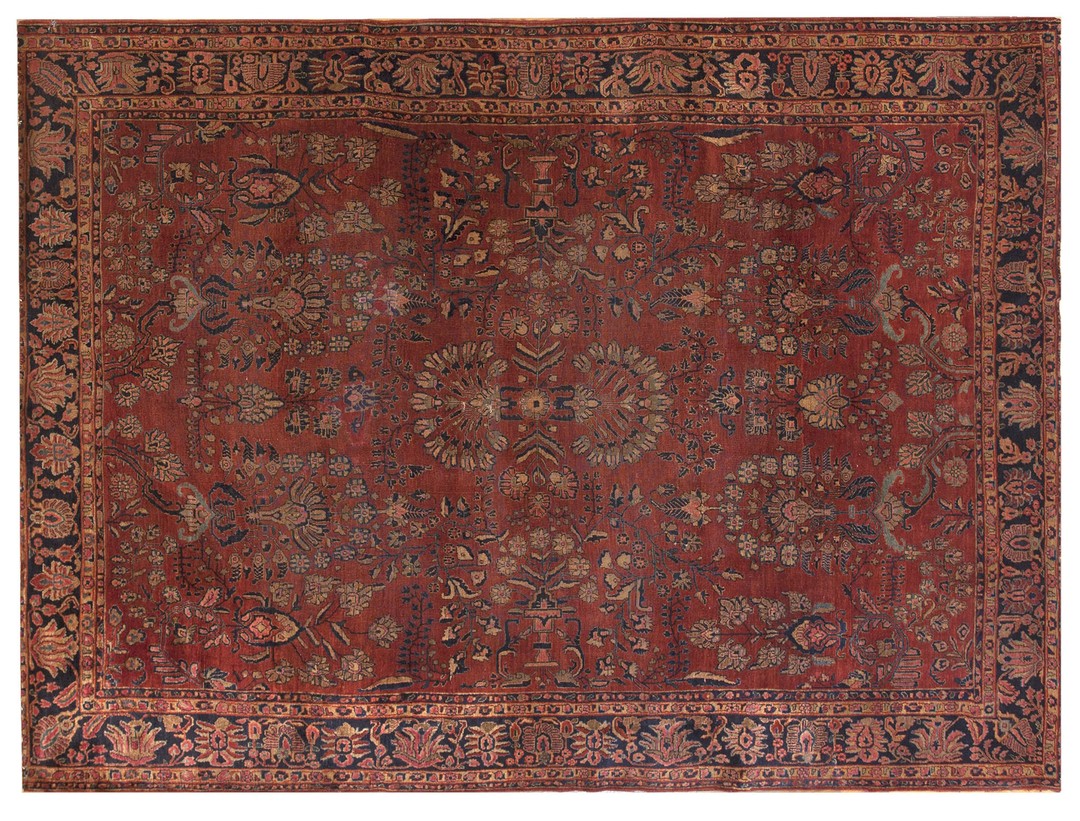
Antique Sarouk Small Scatter Size Wool Ivory Rug by Rugs On Net
Archaeological and artistic evidence shows the motif carved into stone, painted on pottery, and eventually adapted into textiles. When rugs emerged as both functional and artistic objects, the 8 pointed star became one of the earliest ancient rug motifs, embedding cosmic and protective meaning into domestic and ceremonial contexts.
Adoption in Islamic Art & Carpets
With the rise of Islam, the 8 pointed star motif was absorbed into a vast visual language of sacred geometry. In Islamic art, it became the Seal of Solomon (Khatim Sulayman), symbolizing divine wisdom, spiritual authority, and cosmic balance. The figure’s precise geometry resonated with Islamic ideals of harmony and order, appearing in mosque tiles, manuscripts, and stonework.
In carpets, workshops under the Seljuks and later dynasties stylized the motif into medallions and repeating fields. Some of the oldest surviving Seljuk star rugs from the 13th century Anatolia show 8 pointed stars integrated into their central designs, setting a precedent for later weaving traditions.
Tribal, Nomadic, and Regional Diffusion
The diffusion of the motif was inseparable from the tribal and nomadic weavers of Central Asia and the Caucasus, who carried it along migration routes and the Silk Road. Each region reinterpreted the star: the Caucasus emphasized bold Lesghi stars, Timurid weavers embedded them in monumental medallions, and Ottoman Anatolia transformed them into radiant Star Ushak designs that would influence European collections.
Nomadic groups used the motif in kilims and smaller tribal star rugs, ensuring its survival through oral and craft traditions even as urban workshops formalized it into luxury carpets. The 8 pointed star motif in carpets originated in the ancient Near East and flourished through Islamic and tribal art traditions. Its journey mirrors the cultural and artistic exchanges along the Silk Road, where regional creativity kept the symbol alive and constantly evolving.
Names, Regional Terms, and Iconic Types
Common Names and Cultural Variants
- Lesghi Star — Why: A hallmark of the Caucasus, the Lesghi star rug is recognized by its serrated arms and layered medallion structure, symbolizing strength and continuity in tribal weaving.
- Yıldız — Why: In Turkey, the Yıldız motif broadly represents star patterns in kilims, carrying meanings of joy, fertility, and household prosperity.
- Khatim Sulayman / Star of Solomon — Why: In Islamic contexts, the Star of Solomon rug design reflects divine authority and wisdom, often linked to religious and protective uses.
- Star of Ishtar — Why: Rooted in Mesopotamian tradition, this name ties the octagram to fertility and celestial order, emphasizing its ancient origins.
- Star of Oğuz Khan — Why: In Turkmen culture, it is associated with legendary ancestry, symbolizing unity among clans.
- Sibniyyah — Why: In Moroccan rugs, the sibniyyah embodies harmony and protection, a geometric safeguard woven into daily life.
Lesghi Star, Star of Ishtar, Yıldız & More
- Lesghi Star — Why: Distinguished by its bold, jagged points, this design dominates many Caucasian rugs and helps identify their regional provenance.
- Star of Ishtar — Why: Its association with the goddess Ishtar connects rugs to one of the earliest civilizations to use celestial symbols in textiles.
- Yıldız — Why: Anatolian kilims frequently feature this motif, where it is believed to attract happiness, fertility, and well-being into the home.
- Sibniyyah — Why: Woven into Moroccan traditions, it signals balance, acting as a visual prayer for harmony in both family and spiritual life.
Key Regional Interpretations: Turkey, Persia, Caucasus, Morocco
In Turkey, the star kilim is a staple of Anatolian weaving, where Yıldız patterns fill fields or borders with layered symbols of prosperity. In Persian and Islamic art, the Star of Solomon rug represents wisdom and divine light, integrated into mosque carpets and royal commissions. The Caucasus gave rise to the iconic Lesghi star rug, with bold geometric medallions stacked across the field, a favorite among collectors for its energy and precision.
Meanwhile, in Morocco, the sibniyyah octogram offers a softer, rhythmic interpretation, woven into flatweaves as a talisman of balance and protection. The many names and cultural terms surrounding the 8 pointed star are not just linguistic variations—they encode regional histories and symbolic values.
Recognizing these star types helps buyers and scholars alike identify a rug’s origin and authenticity while appreciating the breadth of meaning carried by a single motif.
Design & Technical Characteristics
Visual Appearance: Star Medallions, Borders, All-Over Patterns
An 8 point star pattern on a rug is instantly recognizable: bold, symmetrical, and radiating balance. It can appear as a dramatic central star medallion, repeated in borders to form a protective chain, or tessellated across the field in rhythmic lattices.
In tribal rugs, the stars often dominate the composition with geometric force, while in workshop carpets they may be refined into intricate latticework or combined with floral scrolls for a softer aesthetic. Whether singular or repeated, the octagram always commands attention as a focal motif.
Weaving Techniques for Crisp 8 Point Star Patterns
The clarity of the star motif relies on technique. In pile rugs, both symmetrical (Turkish) and asymmetrical (Persian) knots are used to define sharp edges, with higher precision achieved as knot counts increase.
In flatwoven kilims, crispness comes from tapestry interlocking techniques, where wefts interlock tightly to form clean angular outlines. Because the star aligns well with the square grid of weaving, the octagram is easier to render than motifs with odd-numbered points, ensuring that both tribal and workshop weavers could execute it with confidence.
Materials: Wool, Cotton, Silk & Dye Usage
The most common material in 8 pointed star rugs is wool pile, prized for its warmth, resilience, and dye absorption. Larger workshop rugs often use cotton warps and wefts for structural stability, while finer examples may include silk highlights or even metallic threads to enhance brilliance.
Traditional natural dyes—madder for reds, indigo for blues, walnut husks for browns, and cochineal for deep crimson—give these rugs striking contrasts and exceptional longevity. The choice of material and dye not only influences aesthetics but also determines how well the motif endures through generations.
Knot Density & Motif Clarity
Yes—knot density directly impacts the clarity of 8 pointed star motifs. A high knot density allows the weaver to produce smoother curves and sharper edges, resulting in crisp, refined stars often seen in Persian and workshop carpets.
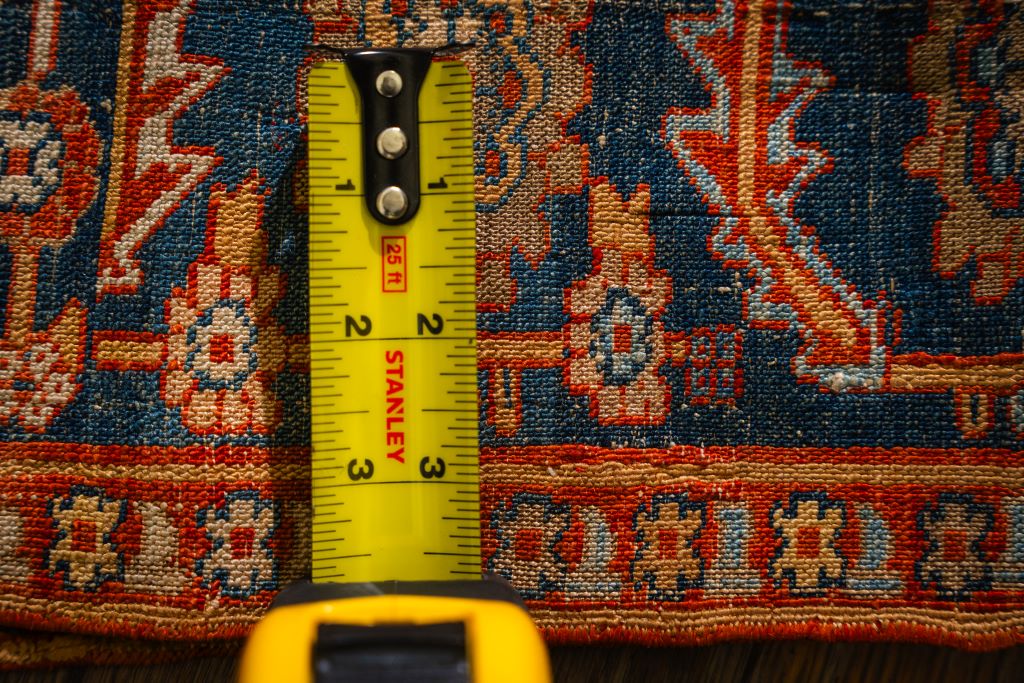
A detailed inspection of a richly colored oriental rug pattern while measuring its dimensions.
In contrast, coarser tribal rugs with fewer knots per square inch render the motif in a stepped, geometric style, giving them a rugged charm that highlights their handmade origins. Both approaches are valued: one for precision, the other for bold character.
Vintage vs. Reproduction: How to Spot Authenticity
Distinguishing a vintage Kazak rug featuring star motifs from a modern reproduction requires close attention.
Hallmarks of authenticity include:
- Natural dyes that age gracefully, developing a soft patina rather than synthetic uniformity.
- Hand-spun wool, which produces slight irregularities in thickness and color absorption, lending vibrancy to the star pattern.
- Visible age and wear, appropriate for a rug’s age, without artificially applied distressing.
- Regional structure and selvedges, such as correct Caucasian weaving techniques and finishes not found in factory-made copies.
- Design balance, with genuine vintage rugs showing organic variation, unlike the overly rigid symmetry of machine-made imitations.
The design and construction of these rugs show how much technique, material, and artistry affect the clarity, durability, and authenticity of the 8 pointed star motif—critical qualities that buyers and collectors must evaluate carefully.
Symbolism in Context
Protection, Fertility, Luck, and Spiritual Meaning
- Protection — Why: The 8 pointed star often functions as a rug protection symbol, believed to shield the home from evil influences and wandering spirits.
- Fertility — Why: In village weaving, it is tied to renewal and life cycles, symbolizing fertility and the blessing of children.
- Luck & Prosperity — Why: The motif is associated with abundance and fortune, a visual prayer woven into dowry pieces and household rugs.
- Spiritual Guidance — Why: As a form of sacred geometry, the Persian star motif suggests divine light and harmony, guiding the soul toward balance and enlightenment.
8 Pointed Star in Persian, Anatolian, and Moroccan Rugs
In Persian rugs, the 8 pointed star carries meanings of spirituality, protection, luck, and guidance, often placed in the center of medallions to radiate blessing into the household. In Anatolian kilims, the star represents happiness, fertility, and well-being, a theme deeply rooted in Turkish tradition where geometry encodes family hopes.
In Moroccan weavings, the motif—sometimes known as sibniyyah—signifies balance and harmony, reflecting local beliefs in weaving as a way to guard both body and spirit. Across these regions, the shared star symbolism in rugs shows how a single form adapts to local beliefs while maintaining universal resonance.
Storytelling & Tribal Identity
- Clan Signatures — Why: Many nomadic groups used the star as a tribal marker, encoding identity within the weave. The pattern itself often signified a specific clan’s heritage.
- Encoded Prayers — Why: Beyond decoration, the motif conveyed the weaver’s intentions, embedding prayers for protection, prosperity, and health into the textile.
- Oral Traditions — Why: The 8 pointed star was a storytelling device, carrying myths of creation, spiritual order, and ancestral lineage through its repeated geometry.
The 8 pointed star is therefore both an aesthetic choice and a vessel for encoded meaning. Its layered symbolism reflects the hopes, beliefs, and identities of the weavers, ensuring that every rug is not only a piece of art but also a woven prayer.
Regional Variations & Iconic Examples
Anatolian/Ushak, Seljuk, and Turkish Kilims
In Anatolia, Turkish kilims often feature bold, oversized 8 point star designs woven as field repeats or border chains. Known as yıldız motifs, these designs symbolize happiness, fertility, and household well-being. The Seljuk period (13th century) established some of the earliest known star carpets, setting a template for geometric precision in Anatolian weaving.
Later, the Star Ushak carpets of western Turkey became iconic in European collections: vast workshop rugs with repeating star medallions softened by floral infill, balancing power with elegance. These Anatolian examples reveal how the motif could be both deeply symbolic and stylistically versatile.
Persian, Qashqai, and Central Asian Interpretations
In Persian rugs, the star appears subtly—worked into central medallions or as secondary motifs in border systems. For tribal groups like the Qashqai, the star carries connotations of luck and household blessing, often woven into dowry weavings.
In Central Asia, stars were integrated into Turkmen designs such as gul variations, sometimes connected to the Star of Oğuz Khan, which reinforced clan identity and ancestral heritage. These uses reflect both cosmic spirituality and tribal symbolism, with more emphasis on meaning than bold geometry.
Caucasian Rugs: Lesghi and Kazak Star Rugs
The Lesghi star from the Caucasus is one of the most recognizable star forms in rug history. Defined by its serrated arms and stacked medallion format, it is typically rendered in vibrant reds, indigos, and ivory.
Similarly, Kazak star carpets use large-scale, angular stars in saturated tones, prized by collectors for their energy, craftsmanship, and cultural weight. These Caucasian interpretations highlight the star as a geometric force, embodying both tribal identity and regional artistry.
Moroccan Star Rugs vs. Caucasian Star Motifs
Why do Moroccan star rugs differ from Caucasian star motifs? Moroccan weavings, especially those with the sibniyyah design, often render the 8 point star with a more floral or rounded geometry, symbolizing balance and harmony. In contrast, Caucasian stars—particularly the Lesghi and Kazak forms—are sharply serrated, angular, and geometric, emphasizing wisdom, guidance, and tribal power.
While both traditions use the octogram as a protection and balance symbol, their visual languages are distinct: Moroccan stars feel organic and flowing, while Caucasian stars are bold and crystalline.
Navajo Star Rugs: Value and Recognition
Among Native American weavings, the Navajo star rug is a rare and highly collectible category. These rugs often feature a large central octagram rendered with striking symmetry and color contrasts. The resale value of 8 pointed star Navajo rugs depends on several factors:
- Age — older pieces command higher prices.
- Condition — rugs with minimal wear or restoration retain greater value.
- Rarity of design — octagram motifs are less common, enhancing desirability.
- Tribe or artist attribution — provenance tied to specific weavers or clans increases recognition.
- Design clarity — crisp, well-executed stars fetch stronger interest among collectors.
Across these regional traditions, the 8 pointed star transforms in shape, symbolism, and technique, from the floral Moroccan sibniyyah to the serrated Lesghi star or the monumental Star Ushak.
These iconic types remain among the most collectible and culturally resonant star rugs in the world.
Durability, Quality & Construction
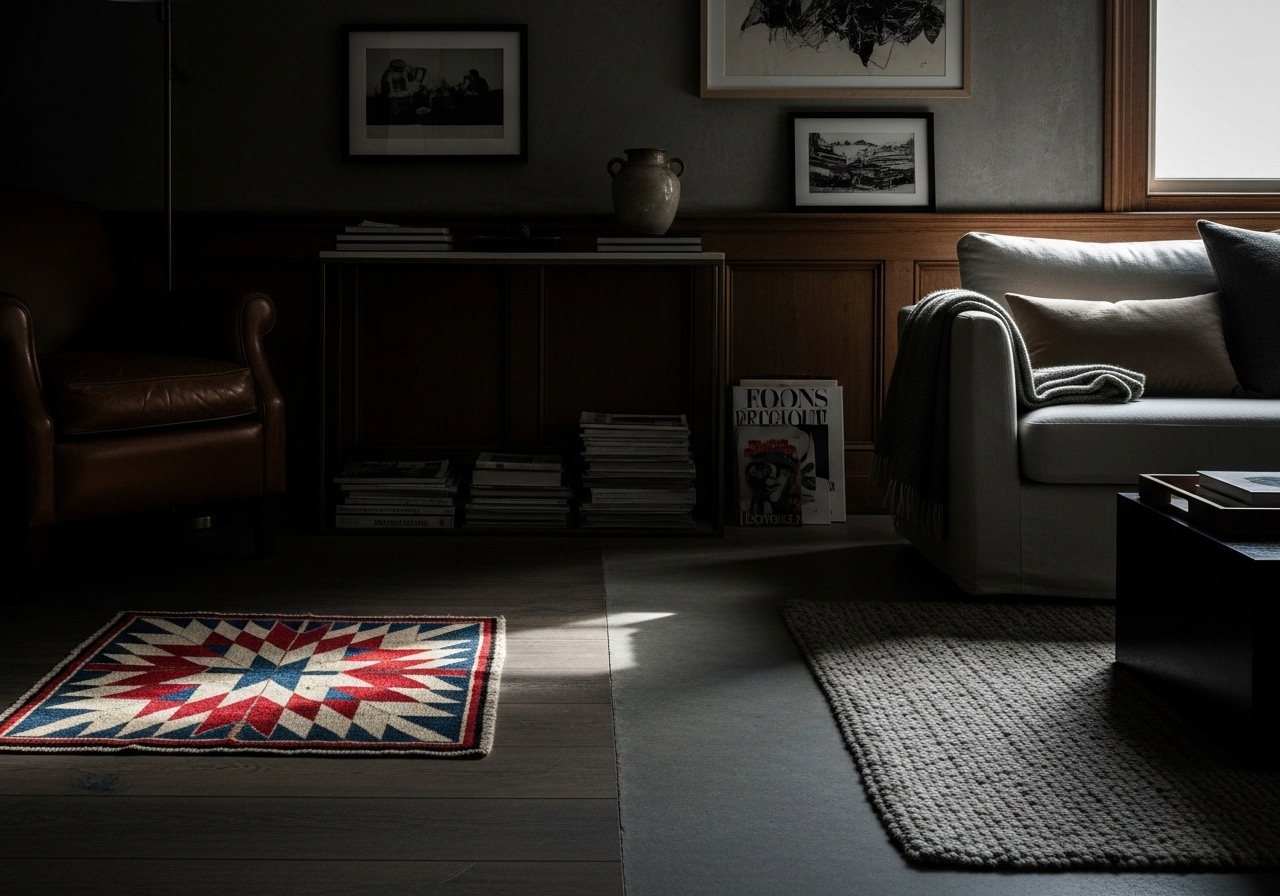
A small, geometric star rug anchors the space.
How Wool Quality Affects Rug Longevity
The durability of an 8 pointed star rug depends heavily on its wool. High-quality wool, rich in natural lanolin, is springy, dye-absorbent, and resistant to crushing. This resilience ensures that the motif retains its sharpness and color saturation even after decades of foot traffic.
By contrast, lower-grade wool tends to shed, mat, and lose vibrancy, causing the geometric clarity of the star to blur with time. Wool durability is therefore a direct predictor of how well the star’s lines and symmetry will endure, making it one of the most important quality markers for collectors and homeowners alike.
Durability of Star Motif Placement
Placement plays a key role in rug longevity. When the star appears as a central medallion, it often endures the heaviest wear from footfall, meaning the clarity of its points relies on dense construction and strong pile.
Border stars, by contrast, typically suffer less direct wear and may remain sharper for longer, even in older rugs. In all cases, the robustness of the weave—tight knots, durable warp and weft, and balanced pile height—ensures that the star maintains its visual authority despite years of use.
Hand-Knotted vs. Hand-Tufted: Pros, Cons, and Value
Should you choose a hand-tufted or a hand-knotted star rug? For long-term value and durability, a hand-knotted star rug is the superior choice. Hand-knotting interlocks every thread into the foundation, creating a textile that can last generations while preserving the crisp definition of the octagram. Hand-knotted rugs also hold higher collectible and resale value.
By contrast, a hand-tufted rug is produced by punching yarn into a backing and securing it with glue. While tufted rugs can be attractive and affordable, they lack the longevity and structural strength of knotted examples. Their value is more decorative than investment-grade, making them suitable for shorter-term use but not for serious collectors.
Ultimately, the strength of an 8 point star rug lies in its wool quality, motif placement, and construction method. These factors determine not only how beautifully the star presents itself today, but how faithfully it will carry its symbolism and geometry into the future.
Modern Market & Collecting
Price Factors: Antique vs. Reproduction
When evaluating an antique star rug price, the key drivers are age, authenticity, condition, rarity, and provenance. Genuine Caucasian and Anatolian examples, especially those with strong colors and well-preserved motifs, command significantly higher values than later workshop pieces.
Reproductions, while often attractive, are valued primarily as decorative items and lack the collectible appeal of antique hand-knotted works. Because demand among collectors remains strong, 8 pointed star rugs are often more expensive than other geometric designs, particularly when tied to culturally significant weaving traditions.
Auction Prices vs. Retail Listings
- Auction Sales — Why: At Sotheby’s, Christie’s, and regional auction houses, rare Lesghi star rugs or museum-quality pieces can exceed their estimated retail value. Competitive bidding often drives prices higher than expected, especially when provenance and rarity are clear.
- Retail Listings — Why: Reputable dealers and galleries offer more stable, predictable pricing. While prices may be lower than record-setting auctions, buyers benefit from greater assurance, condition reports, and established authenticity.
In short, auctions can offer rare opportunities but carry volatility, while retail provides steadier access to authentic works.
How Star Rugs Appreciate in Value
Can antique 8 point star Kazak rugs appreciate in value? Yes. These rugs are not only artistic treasures but also investment pieces. Their Kazak rug value has historically risen due to limited supply, strong collector interest, and the growing recognition of tribal and Caucasian weavings as art.
Exceptional condition, rare colors (like greens or purples), and finely rendered star motifs significantly increase appreciation potential. As collecting interest expands globally, well-preserved Kazak and Lesghi star examples are among the rugs most likely to gain in long-term value. Antique 8 pointed star rugs represent a category with both cultural depth and investment strength.
Collectors should carefully weigh auction vs. retail star rug opportunities, prioritize authenticity, and recognize that these pieces are among the most valued in the world of tribal and geometric carpets.
Styling & Interior Design
How to Style a Room Around an 8 Pointed Star Rug
How should I style a room around an 8 pointed star rug? The key is to let the rug’s geometry take center stage. As a statement rug decor piece, the octogram’s bold symmetry naturally draws the eye, making it ideal as a living room centerpiece, under a dining table, or in an entryway. Pairing it with neutral or muted furnishings—such as linen sofas, wood accents, or cream walls—allows the star motif to shine without competition.
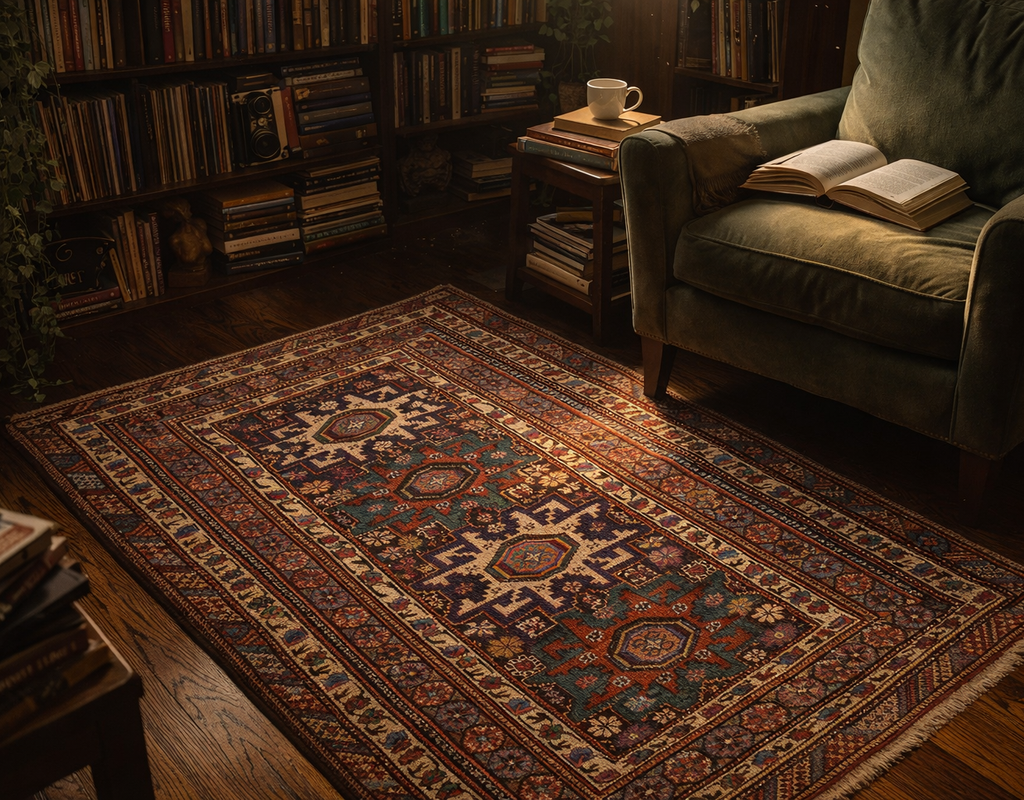
A traditional, highly detailed area rug defines the intimate reading space within the dark wood library.
Highlighting the rug’s history and cultural story through complementary decor, such as handmade ceramics, woven wall art, or regional textiles, deepens the sense of authenticity and meaning.
Can the Motif Work in Minimalist or Modern Interiors?
Yes—an 8 point star motif can work beautifully in pared-down interiors. In a minimalist setting, a single minimalist star rug adds both structure and energy, with its geometry reinforcing the sense of order while avoiding clutter. In modern or contemporary interiors, the clean lines of the octogram balance sleek furniture and architectural simplicity.
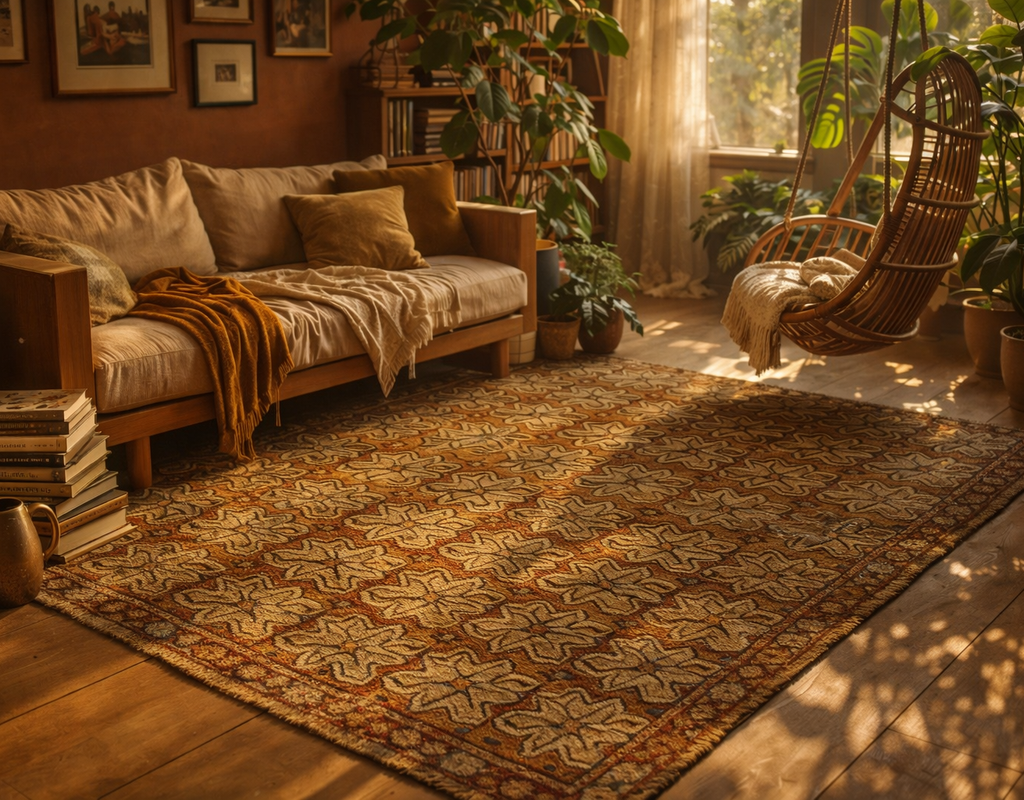
Sunlight streams across the richly patterned area rug, illuminating this cozy, plant-filled bohemian retreat.
Layering the rug with muted tones, metals, or glass accents emphasizes its geometry without overwhelming the room, making it a seamless bridge between tradition and modernity.
Star Rugs in Contemporary Decor
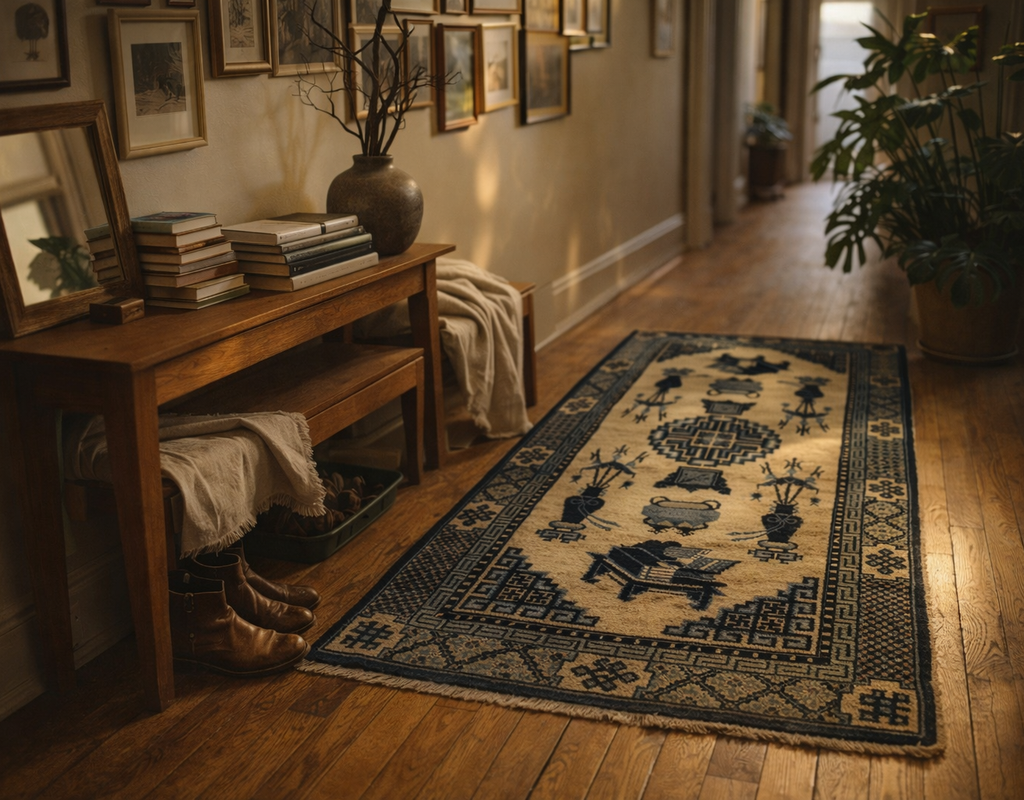
An entryway decorated with antique-inspired furnishings and a striking runner rug that guides the eye down the hall.
Today, styling star rugs is not limited to traditional homes. They adapt effortlessly into eclectic, boho, Mediterranean, and modern star rug interior designs. In boho settings, their bold geometry pairs with layered textiles and plants. In Mediterranean-inspired spaces, they echo tiled floors and sunlit courtyards.
In contemporary lofts or minimalist apartments, they serve as the anchor, injecting warmth, heritage, and narrative depth. An 8 pointed star rug is more than decoration—it is a focal point that anchors a room with balance, cultural depth, and visual rhythm, proving its versatility across both timeless and modern styles.
Care, Preservation & Dye Evolution
Natural Dye Aging: How Contrast Changes Over Time
How do natural dyes influence 8 pointed star contrast over time? In an authentic natural dye star rug, the colors evolve with age, often developing a subtle variegation known as abrash. This natural shift occurs as hand-dyed yarns absorb pigment unevenly, creating tonal variations within the same color field. Over decades, abrash lends depth and texture to the 8 pointed star motif, enhancing its character rather than diminishing it.
High-quality dyes—derived from madder, indigo, walnut, or cochineal—retain their brightness far longer than synthetic substitutes, ensuring the star’s symmetry continues to stand out even as the tones mellow.
Cleaning, Storage, and Preserving Star Motif Clarity
Preserving the clarity of a star design requires careful, consistent rug care. Rugs should be vacuumed gently with a brushless attachment to avoid pulling fibers, and rotated periodically so that wear and sunlight are distributed evenly.
Direct exposure to harsh sunlight may soften contrast, so placement away from strong UV sources—or the use of blinds—helps maintain vibrancy. For storage, rugs should be rolled (never folded) and wrapped in breathable cotton or muslin to prevent moisture damage.
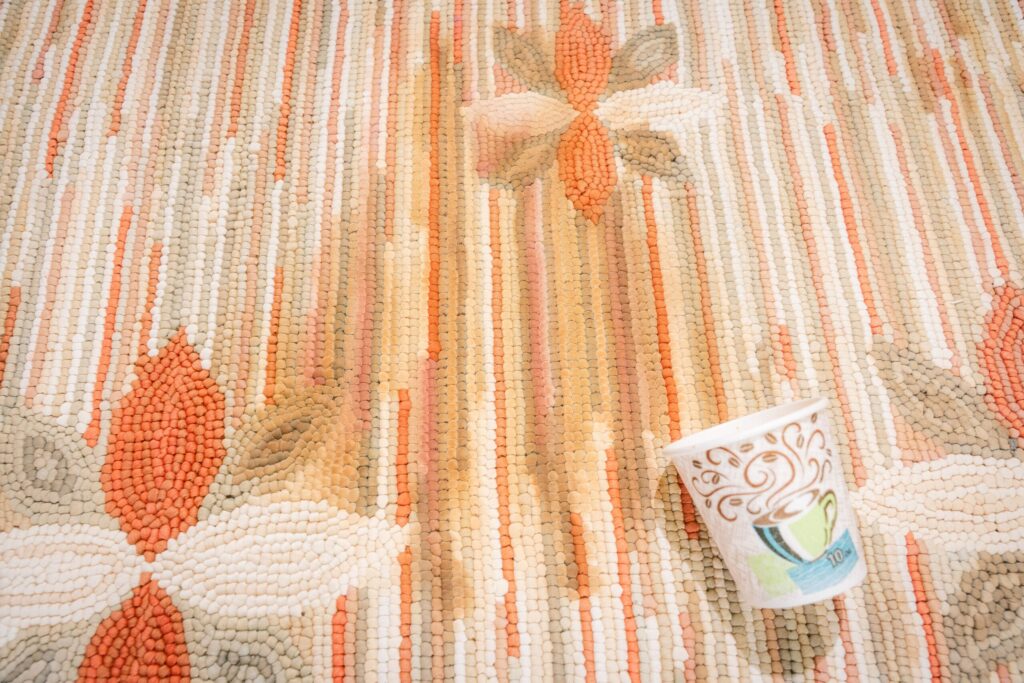
Close-up view of a tipped paper coffee cup resting on a handwoven wool rug, highlighting the rug’s dense pile, subtle color variations, and traditional geometric motifs in warm neutral and terracotta tones.
Periodic professional cleaning by specialists ensures that dirt and oils do not accumulate in the pile, which can dull the crisp lines of the motif. The 8 pointed star motif ages gracefully when treated with respect. Rather than diminishing, the interplay of abrash and natural wear adds authenticity and charm, transforming each rug into a living record of time.
With proper care, the bold symmetry of the star continues to radiate protection, balance, and beauty for generations.
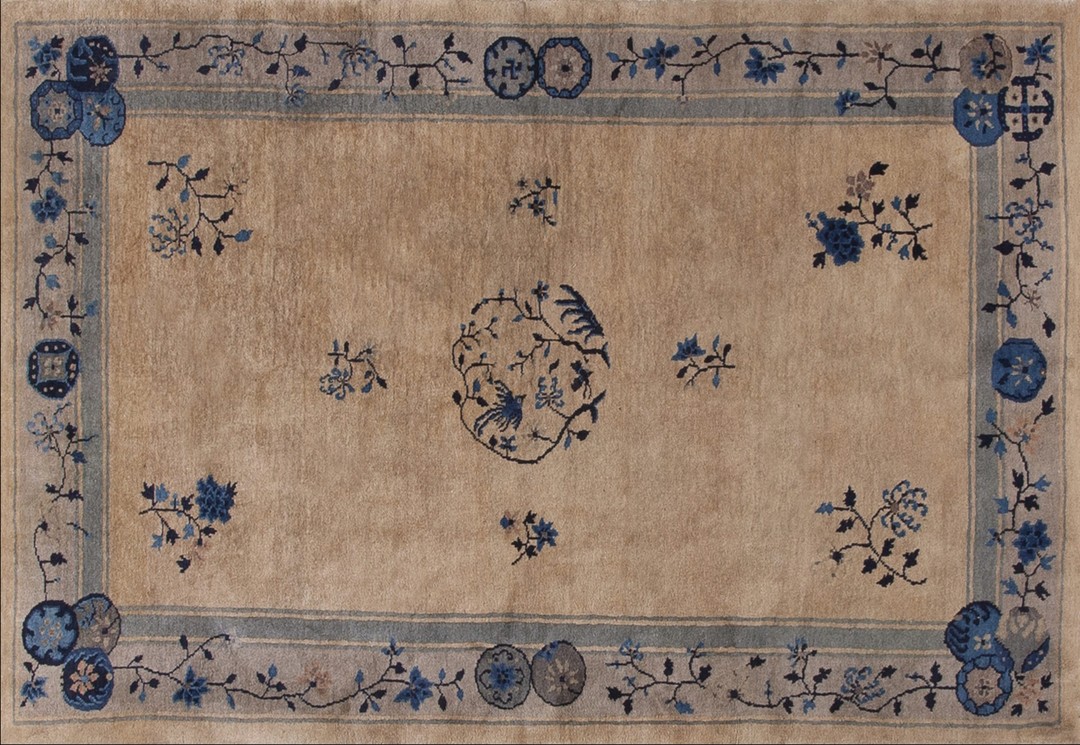
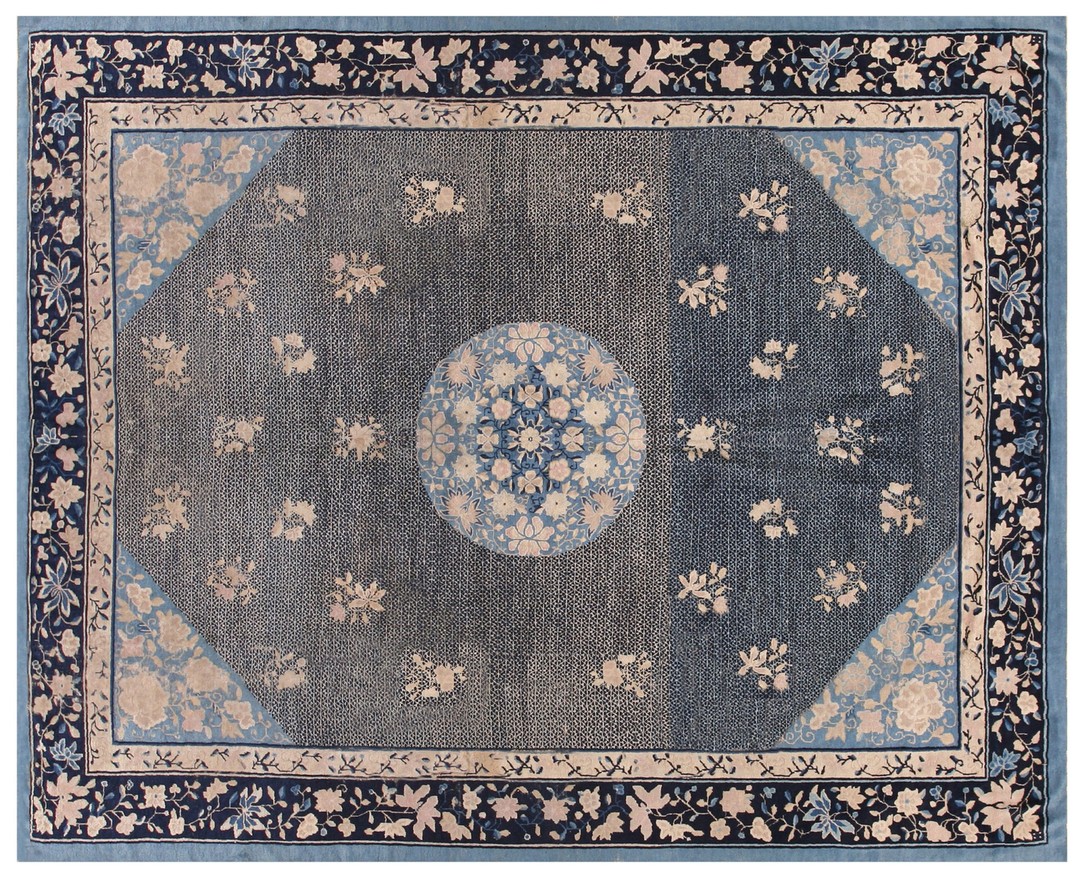
Explore a Few of Our 8 Pointed Star Rugs

FAQ
- Can I custom-order an eight-pointed star rug?
Yes. Many makers offer custom sizes and colors; expect roughly 8–16 weeks for hand-tufted and 4–8 months for hand-knotted orders.
- Where can I find 8-pointed star rugs in the U.S.?
Search specialty dealers and museum-inspired collections using terms like “Star Ushak,” “octagram,” or “Seljuk star.” Favor shops with 14–30-day returns.
- Are 8-pointed star rugs safe over radiant floor heating?
Yes, with care. Most wool and synthetics are fine; use heat-rated pads and keep floor temperature within manufacturer limits (often \~85°F).
- What rug pad works best under an 8-pointed star rug?
A felt-rubber pad adds grip and cushioning. Choose 1/8–1/4 inch thickness to clear doors while stabilizing the rug.
- Do 8-pointed star rugs fade in sunny rooms?
Sun can fade dyes. Rotate eight-pointed star rugs every 3–6 months and use UV-filtering shades; solution-dyed synthetics resist fading best.
- Are there 8-pointed star kilims?
Yes. Eight-pointed star kilims are common; flatweaves are reversible, thin (\~0.2″), and easy to fold—great under doors.
- Can I mix 8-pointed star rugs with other patterns?
Yes—pair with solids or subtle stripes. Keep one dominant color family and vary scale about 2:1 to avoid visual clash.
- Will an eight-pointed star motif make a room feel busy?
It can. Choose larger stars and lower contrast for calm; dense repeats and high contrast feel energetic. Balance with solid upholstery.
- What colors are classic in 8-pointed star rugs?
Traditional palettes include red, dark blue, green, yellow, and ivory. Modern eight-pointed star rugs often use gray, cream, and navy for quieter looks.
- Do eight-pointed star rugs carry religious meaning?
Sometimes, depending on context; most home use is decorative. If concerned, describe it as an “octagram geometric” design and choose neutral colorways.
- Are 8-pointed star rugs the same as Star Ushak rugs?
Not exactly. Star Ushak 8-pointed star rugs are a historic Turkish group with diagonal star medallions; many modern star rugs are inspired but not Ushak.
- How can I tell if an 8-pointed star rug is hand-knotted?
Flip it: visible knots and a mirrored back pattern indicate hand-knotted construction. Village pieces often measure 50–150 KPSI.
- What’s the price range for 8-pointed star rugs?
Machine-made 8x10s often cost \$100–\$600. Hand-knotted pieces start around \$1,500 and can exceed \$10,000; antique Star Ushak carpets command far more.
- Are 8-pointed star rugs outdoor-safe?
Only if labeled indoor/outdoor. Polypropylene/polyester options dry quickly; wool eight-pointed star rugs should stay indoors.
- What sizes do 8-pointed star area rugs come in?
Common sizes include 5×8, 8×10, and 9×12; round and square versions exist. For dining, allow 24 inches of chair clearance.
- Are 8-pointed star runners good for hallways?
Yes. Repeating eight-pointed star runners elongate halls visually. Typical widths are 2’3″–3′ and lengths range from 6′ to 14′.
- Can robot vacuums run on 8-pointed star rugs?
Usually, if pile is low to medium (≤0.5″). Keep fringes short or tucked, as tassels can jam rollers; bound edges are robot-friendly.
- How do I clean an eight-pointed star wool rug?
Vacuum weekly without the beater bar; blot spills with water and mild dish soap. Schedule professional washing every 12–18 months.
- Are 8-pointed star rugs kid- and pet-friendly?
Yes—pick low-pile wool or solution-dyed synthetics. Dark, high-contrast stars hide crumbs; pair with a felt-and-rubber pad for grip.
- Do 8-pointed star rugs work in modern interiors?
Yes. Their symmetry complements minimal spaces. Choose neutral palettes (ivory, gray, navy) and medium-scale repeats; a common living-room size is 8×10.
- Which materials are best for 8-pointed star rugs?
Wool for durability and crisp motifs; polypropylene/polyester for budget and stain resistance. Typical wool pile height is about 0.25–0.5 inches.
- How do 8-pointed star rugs differ from 6-pointed star designs?
Eight-pointed star rugs use an octagram (two squares), while six-pointed stars use a hexagram. Octagrams read bolder at distance due to four cardinal and four diagonal axes.
- Are 8-pointed star rugs traditional or modern?
Both. Historic Ottoman/Anatolian pieces exist, while contemporary eight-pointed star rugs are widely power-loomed in standard sizes like 5×8, 8×10, and 9×12.
- What does the 8-pointed star motif mean in rugs?
Meanings vary by culture; in Islamic art it’s linked to symmetry and order (Rub el Hizb). For décor, treat eight-pointed star rugs as geometric, not religious, motifs.
- What are 8-pointed star rugs?
Geometric area rugs featuring the octagram motif (two overlapping squares), seen in historic Star Ushak weavings and modern prints. Antique examples appear in 16th-century Turkish carpets.