
Introduction to 6 Pointed Star Rugs
Discover our curated selection of 6 Pointed Star Motif Rugs available for purchase now.
The 6-pointed star motif brings symmetry and classic geometry. Whether it’s subtle or bold in a rug, its structure often reads balanced and refined. For context in how star shapes vary, check these other point counts.
Explore other star motifs: 4-pointed, 5-pointed, 7-pointed, 8-pointed.
What Is a 6 Pointed Star Rug?
A 6 pointed star rug is a handwoven textile featuring the hexagram motif, created by two interlocking triangles. This design is one of the most recognizable geometric symbols in global visual culture.
In weaving, it appears as a central medallion, an all-over repeat, or as a protective emblem incorporated into the borders of kilims, pile carpets, and flatweaves. Far from being a purely decorative shape, the 6 pointed star has been imbued with layers of meaning: it represents cosmic balance, fertility, unity, and protection across cultures.
In kilim rugs specifically, the six-pointed star often functions as a talisman, believed to shield the household from evil while simultaneously invoking harmony and abundance.
Brief Historical Overview
The hexagram rug motif predates organized religion and has appeared in weaving traditions for millennia. Archaeological evidence traces its use back to prehistoric Anatolia and Central Asian steppe cultures.
It also appears in early nomadic textiles such as the Pazyryk carpet, the world’s oldest known pile rug, where geometric stars symbolized order and continuity. Over time, the 6 pointed star spread widely across the Middle East, North Africa, and Central Asia, carried by trade, migration, and artistic exchange.
In Islamic art, it became known as the Seal of Solomon carpet motif, representing divine wisdom and authority. In Jewish tradition, it was adopted as the Star of David motif rug, later becoming a central emblem of identity. In Turkish and Anatolian kilims, the star is referred to as Yıldız, appearing frequently in tribal flatweaves as a symbol of cosmic order and family protection.
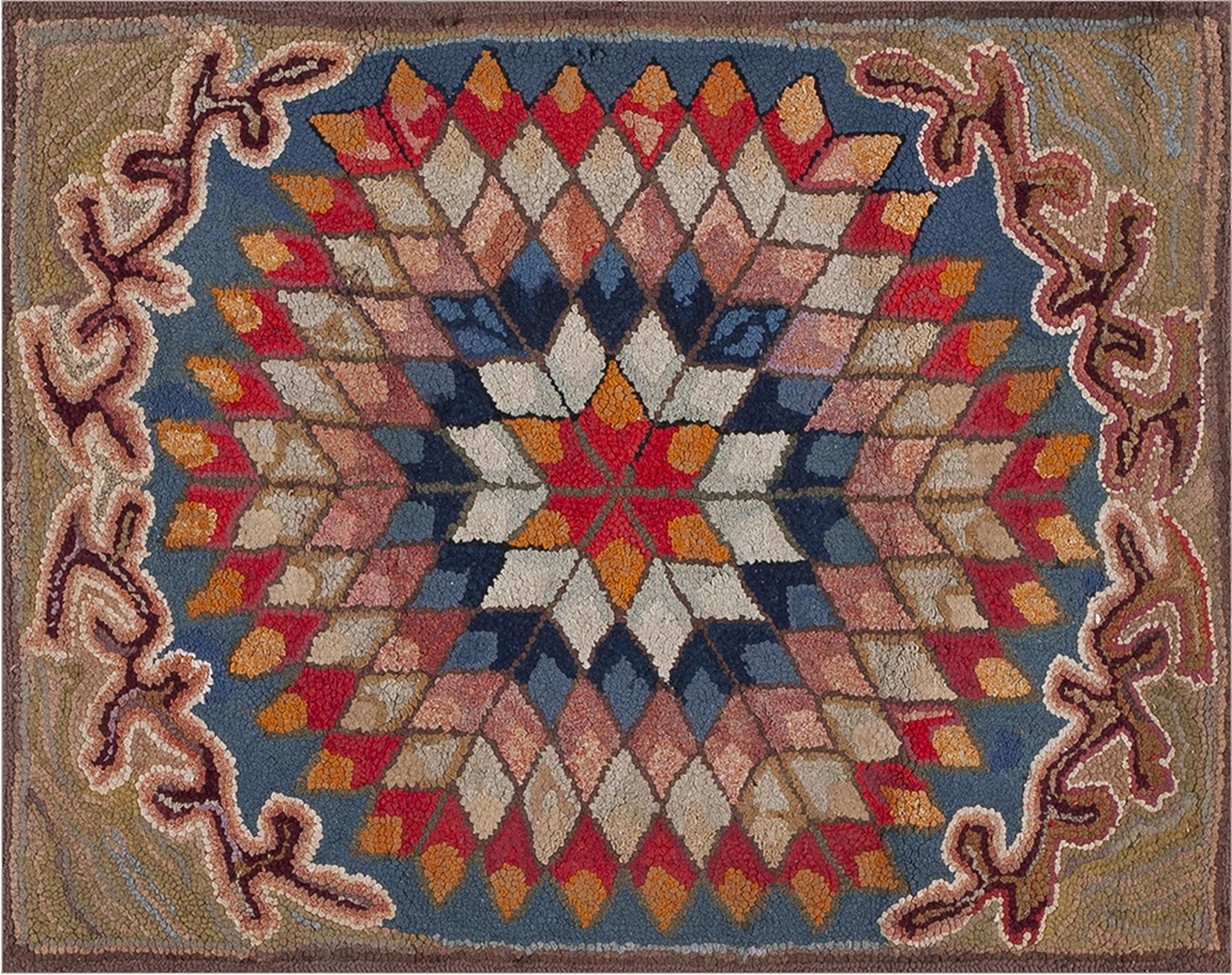
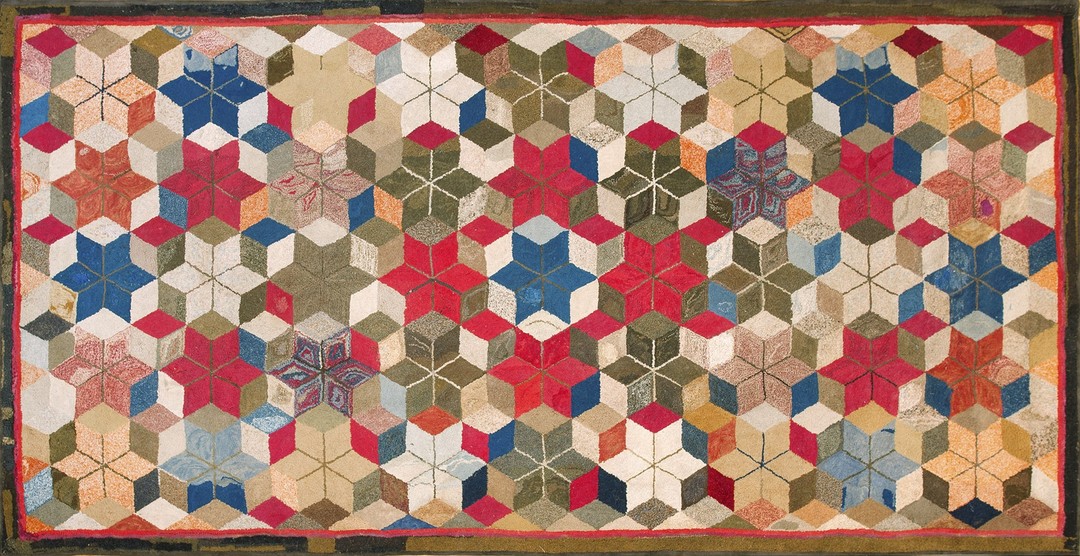
Antique American Hooked Small Scatter Size Wool & Cotton Multicolor Rug – by Rugs On Net
These examples reveal that the motif’s roots are non-religious and multi-regional, evolving organically across weaving cultures rather than belonging to any one faith or tradition.
Main Names and Terminology
The 6 pointed star has acquired multiple names depending on cultural context:
- Star of David motif rug – Jewish tradition, linked with protection and identity.
- Seal of Solomon carpet – Islamic art, symbolizing wisdom and divine authority.
- Yıldız kilim – Anatolian weaving, a term meaning “star” in Turkish, often woven into tribal kilims.
- Hexagram rug – the neutral, geometric description used in textile studies.
Each of these terms reflects a different interpretive layer, yet all point to the same fundamental design.
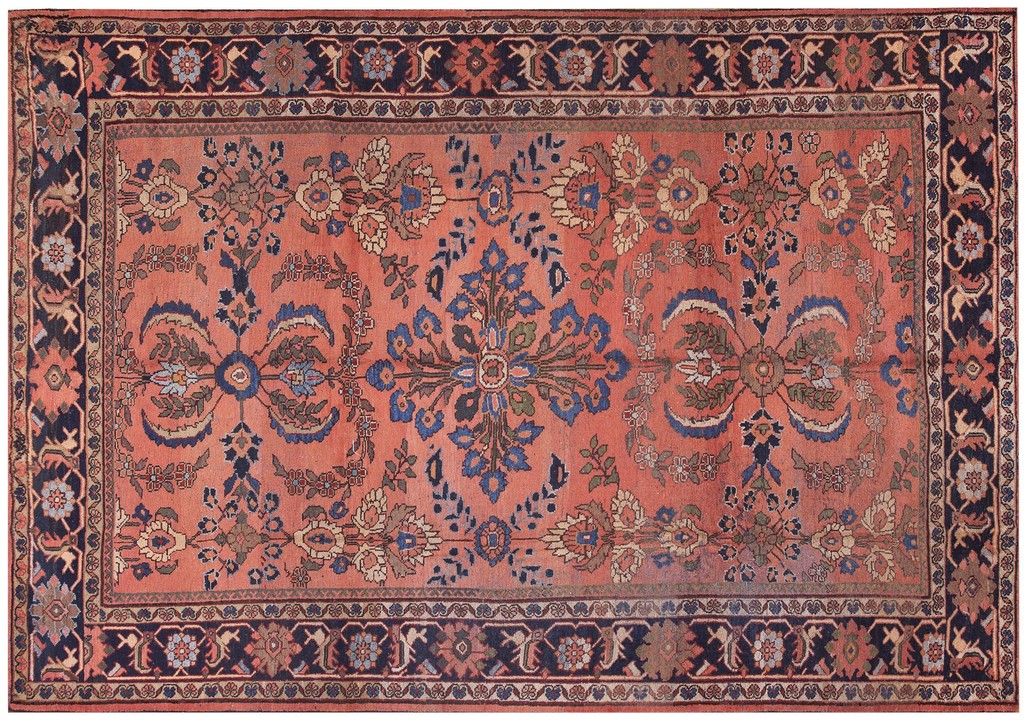
Antique Rustic Coral Color Floral Design Mahal Room Size Wool Persian Rug by Rugs On Net
Importantly, the 6 pointed star rug motif is not exclusive to one religion. It is a pan-cultural emblem found across weaving traditions, carrying protective, decorative, and cosmic meanings that long predate its later religious associations.
Who First Wove 6 Pointed Star Motifs into Oriental Carpets?
The earliest known examples of 6 pointed star motifs in Oriental carpets come from ancient Anatolian and Central Asian weaving traditions, where the design was used as a protective and symbolic emblem.
Nomadic weavers likely introduced it into kilims and carpets as part of their broader geometric vocabulary, centuries before it became tied to religious symbolism.
Origins & Historical Significance
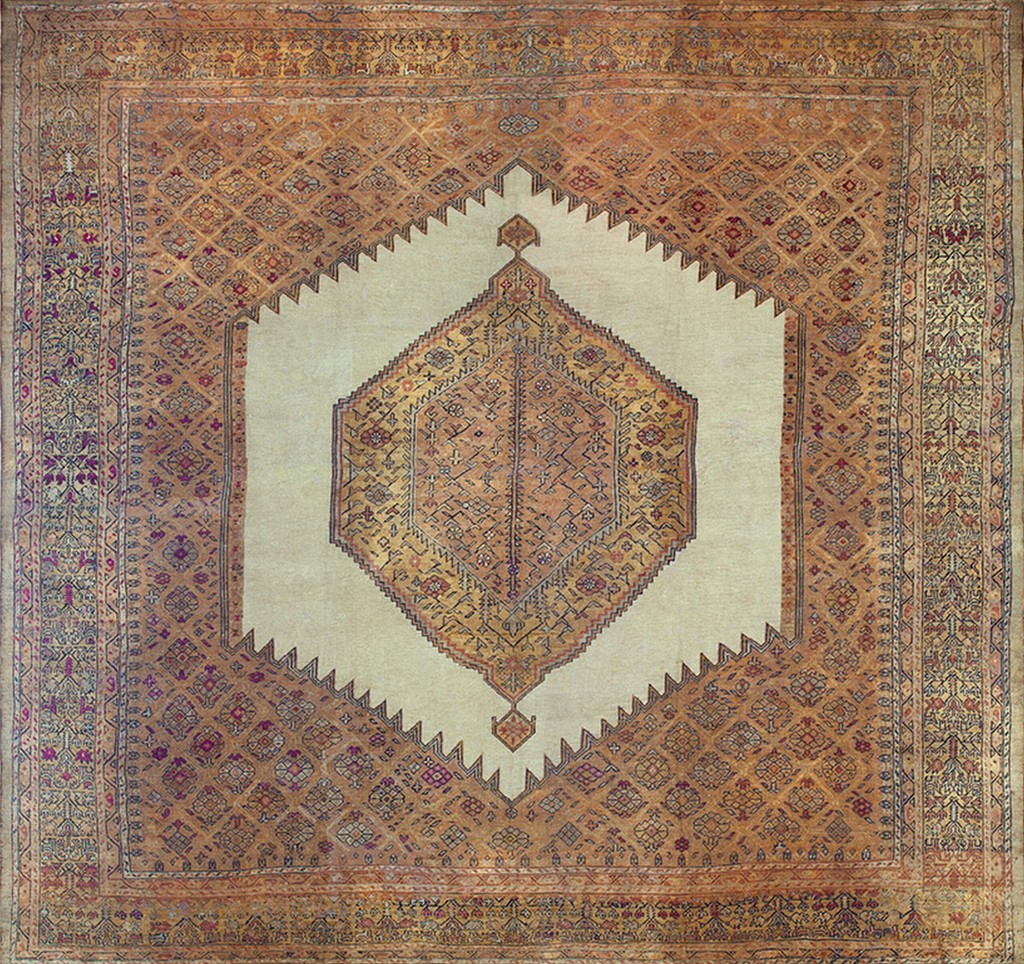
Wool Ivory Beige Cream White Hand Knotted Pile Antique Geometric Medallion 1890s Square Rug by Rugs On Net
Prehistoric Roots and Archaeological Finds
The ancient star motif that later became the 6 pointed star in rugs is far older than its religious associations. Archaeological finds confirm its presence in prehistoric Anatolia, where geometric designs connected to fertility and the Mother Goddess cult were woven or incised into early textiles and artifacts.
The most famous early example is the Pazyryk star rug, excavated from a frozen Scythian burial mound in the Altai Mountains and dated to the 5th century BCE. This carpet includes geometric star arrangements that likely functioned as tribal emblems of cosmic order, protection, and fertility.
Later, the Phrygians of Anatolia also employed hexagram forms in their decorative arts, reinforcing the motif’s deep antiquity. These discoveries demonstrate that the 6 pointed star appeared in weaving long before the rise of Judaism, Christianity, or Islam, serving first as a talismanic and cosmological sign.
Spread of the Motif Through Central Asia, the Middle East, and the Mediterranean
From its prehistoric roots, the historic 6 pointed star kilim motif spread widely through nomadic migration and trade routes. Steppe cultures carried the star westward into Anatolia and Persia, while Silk Road connections introduced it eastward into Central Asia. With the rise of Islamic dynasties, the design became embedded in courtly art, appearing in Seljuk carpets, geometric tilework, and illuminated manuscripts.
By the Mamluk period in Egypt, the star medallion took on more structured forms, radiating across finely woven carpets with precise symmetry. The pattern also reached the Iberian Peninsula through Spanish-Moorish weaving centers, where the hexagram appeared in Alhambra-inspired rugs and architectural ornament. This wide diffusion shows how the motif thrived in both tribal and courtly contexts, absorbing new meanings while retaining its symbolic essence of unity and protection.
How the Motif Evolved Through Major Weaving Cultures
- Nomadic and Tribal Weavers — Used the star as a talisman for fertility, protection, and cosmic order. — Why: Their woven rugs often doubled as spiritual and household guardians, embedding symbolic strength into daily life.
- Seljuk Carpets — Adapted the early star medallion into repeating geometric designs. — Why: Seljuk workshops emphasized balance and sacred geometry, aligning with Islamic artistic ideals.
- Mamluk Carpets — Refined the star into elaborate central medallions with radiating precision. — Why: These works embodied the Mamluk interest in mathematics and cosmic harmony, merging science and symbolism.
- Spanish-Moorish Rugs — Incorporated hexagrams into latticework and decorative fields. — Why: They blended Islamic geometry with Mediterranean aesthetics, exporting the motif into Europe.
- Ottoman and Anatolian Kilims (Yıldız) — Preserved the star in bold tribal weavings. — Why: The Yıldız star symbolized household protection and continuity of ancestral traditions.
- Contemporary Rugs — Reinterpret the 6 pointed star as both a heritage motif and a modern design element. — Why: Today’s artisans balance respect for historic meaning with demand for versatile, geometric patterns in modern interiors.
Evolution from Antique to Contemporary Styles
The question of who first wove 6 pointed star motifs into Oriental carpets points back to tribal weavers of Anatolia and Central Asia, who integrated the symbol into kilims and early pile rugs for talismanic and fertility-related purposes. Over centuries, these early star medallions evolved into structured patterns in courtly carpets and later became associated with religious symbolism.
A richly textured and moody reading space defined by warm leather, plush upholstery, and an eye-catching traditional area rug.
In contemporary weaving, the 6 pointed star rug continues to evolve: antique kilims emphasized talismanic function, while modern versions reinterpret the star as a striking geometric form that bridges tradition and design. This continuity underscores the enduring appeal of the hexagram motif as both ancient and timeless.
The 6 Pointed Star in Rug Design
An inviting, sunlit corner blending rustic charm with deep, warm textiles and rich wooden shelving.
How to Visually Identify a Six-Pointed Star in Rugs
To identify a 6 pointed star rug, look for the distinctive hexagram motif formed by two overlapping triangles—one upright and one inverted. This creates six prongs radiating outward with a small hexagon at the center. Because rugs often use dense geometric ornament, it is important to count the points carefully; not all star-like figures are six-pointed, and misidentification is common in vintage textiles.
Sunlight streams across the patterned rug, illuminating a comfortable seating area perfect for reading.
In pile rugs, the outline may be emphasized with contrasting colors, while in flatweaves such as a hexagram motif kilim, the star can appear more angular and abstract. A true 6 pointed star always shows the interlocked geometry that differentiates it from eight-pointed or other multi-pronged stars.
Typical Design Placements
The 6 pointed star may be incorporated into rug design in different placements, each carrying symbolic weight:
- Central Medallion — As seen in Star Ushak rugs, the motif dominates the field with large, often floral-filled stars. Central placement usually implies guidance, order, or divine balance.
- All-Over Lattice or Field Pattern — In Caucasian and Anatolian weavings, multiple stars may repeat across the entire field, symbolizing cosmic infinity and continuity.
- Border Accents — Smaller hexagrams can appear in rug borders, functioning as talismanic protection, guarding the edges of the textile and, by extension, the household.
Understanding where the star appears helps reveal its intended meaning—whether central for direction, scattered for cosmic order, or peripheral for warding off negativity.
Regional Layout Differences
- Star Ushak (Western Anatolia) — Characterized by monumental star medallions, outlined boldly and filled with floral ornament. — Why: Woven for Ottoman courts and export markets, these star medallion carpets emphasized grandeur and symbolism.
- Star Kazak (Caucasus) — Features bold, graphic hexagrams, often angular and outlined with strong color contrast. — Why: Nomadic and village weavers favored striking geometric clarity, enhancing visibility and talismanic function.
- Shirvan (Eastern Caucasus) — Uses smaller, repeating hexagrams across the field. — Why: The compact lattice conveys order, unity, and fertility in everyday household rugs.
- Anatolian Kilims (Yıldız) — The star appears as woven flat geometric forms, integrated into repeating diamond grids. — Why: The motif was considered protective and tied to family symbolism, woven into dowry and household textiles.
Identifying and Locating Six-Pointed Stars in Rugs
For collectors and enthusiasts asking how to identify a 6 pointed star pattern in vintage rugs, the answer lies in recognizing the overlapping triangle structure and verifying the count of six points. Central medallion stars are most common in Star Ushak carpets of Western Anatolia and Star Kazak rugs of the Caucasus, while smaller, repeating stars are frequent in Shirvan rugs.
Border applications and lattice repeats occur across Anatolia, Persia, and Central Asia, underscoring the motif’s wide distribution.
Symbolism & Meaning
Symbolism in Kilims and Tribal Rugs
In Anatolian weaving, the kilim star meaning is deeply tied to fertility, protection, and happiness. Women often wove the 6 pointed star into dowry textiles, cradle covers, and household kilims as a talisman to safeguard family life and encourage prosperity. The fertility motif rug tradition reflects beliefs that the interlocking triangles of the star symbolize the balance of male and female forces, ensuring harmony and continuity.
Beyond fertility, the star also functioned as a protective charm, warding off the evil eye and securing blessings for the home. These symbolic roles made the motif one of the most enduring elements in tribal rug design.
Religious, Folk, and Metaphysical Interpretations
The symbolism of star in rugs is multi-layered, shifting depending on cultural and spiritual context. In Islamic art, the six-pointed star is known as the Seal of Solomon, symbolizing wisdom, divine authority, and metaphysical protection. In Jewish tradition, it became the Star of David in carpet design, later associated with identity and spirituality.
Folk interpretations often emphasize its role as a sign of good fortune, harmony, and cosmic balance, while in esoteric traditions the star embodies the unity of opposites—heaven and earth, male and female, spirit and matter. By unifying religious, folk, and metaphysical dimensions, the motif proves itself to be both universal and adaptable.
Use as a Talisman, Symbol of Harmony, and Guidance
The 6 pointed star’s presence in rugs frequently reflects its role as a talisman. When placed at the center of a carpet, it serves as a guide for orientation and spiritual focus. When repeated across a kilim field, it radiates order and stability, embedding harmony into the textile.
Along borders, the star acts as a protective seal, guarding the thresholds of the home. Regardless of placement, the motif is most often associated with good fortune, balance, and guidance, qualities valued in both nomadic and urban households.
Addressing Common Questions
For those wondering what the 6 pointed star means in kilim rugs, it is best understood as a protective and fertility symbol, offering blessings of unity, harmony, and household prosperity.
Another common misconception is whether a 6 pointed star medallion indicates Jewish origin. The answer is no: while the motif was later embraced as the Star of David, its use in rugs predates that association by centuries. In many weaving traditions, it represents secular or talismanic meaning rather than direct religious identity.
Construction & Materials
How 6 Pointed Stars Are Woven in Pile Rugs vs. Flatweave Kilims
The weaving of 6 pointed stars differs greatly depending on whether the rug is pile-woven or flatwoven. In pile rugs, especially those tied with the Turkish (Ghiordes) knot, weavers can achieve precise, angular outlines. Each knot contributes to the sharp geometry of the star, making pile rugs ideal for producing crisp star medallion motifs.
In contrast, flatweave kilims lack pile and rely on interlocking warps and wefts. To create stars, weavers use techniques such as slit-weave (which produces sharp color separations at the edges of triangles) or brocading (inserting extra wefts to outline motifs). Because flatweaves are more linear, creating accurate 6 pointed stars is technically harder than in pile rugs—sometimes resulting in stars that look more eight-pointed or angular.
Best Weaving Techniques for Crisp, Sharp Star Shapes
- Turkish Knot in Pile Rugs — Produces angular clarity with strong edges. — Why: Each knot reinforces the triangular geometry of the star.
- Slit-Weave in Kilims — Allows weavers to separate color blocks cleanly. — Why: The “slits” at joins keep the star’s points sharp.
- Supplementary Weft Brocading — Adds detail and refinement in flatweaves. — Why: Enables more complex star outlines without distorting the structure.
- High Knot Density Carpets — Best for highly defined stars in Persian and court weavings. — Why: Dense knots mean more “pixels” to render the star with accuracy.
Material and Dye Effects on Clarity and Vibrancy
- Wool — The standard material for star rugs. — Why: Durable, elastic, and holds dyes well, producing long-lasting motifs.
- Silk — Found in fine Persian star rugs. — Why: Silk allows luminous sheen and minute detail but is delicate, making it better for display pieces.
- Natural Dyes — Indigo, madder, and other plant/mineral sources. — Why: They produce rich contrasts, making stars vibrant and timeless.
- Synthetic Dyes — Widely used in modern rugs. — Why: Offer bright colors but may lack the depth and longevity of natural dyes.
- Synthetic Fibers for Outdoor Rugs — Polypropylene or polyester can feature 6 pointed stars. — Why: These materials withstand weather, though clarity and symbolism are often secondary to durability.
Impact of Knot Density and Pile Height
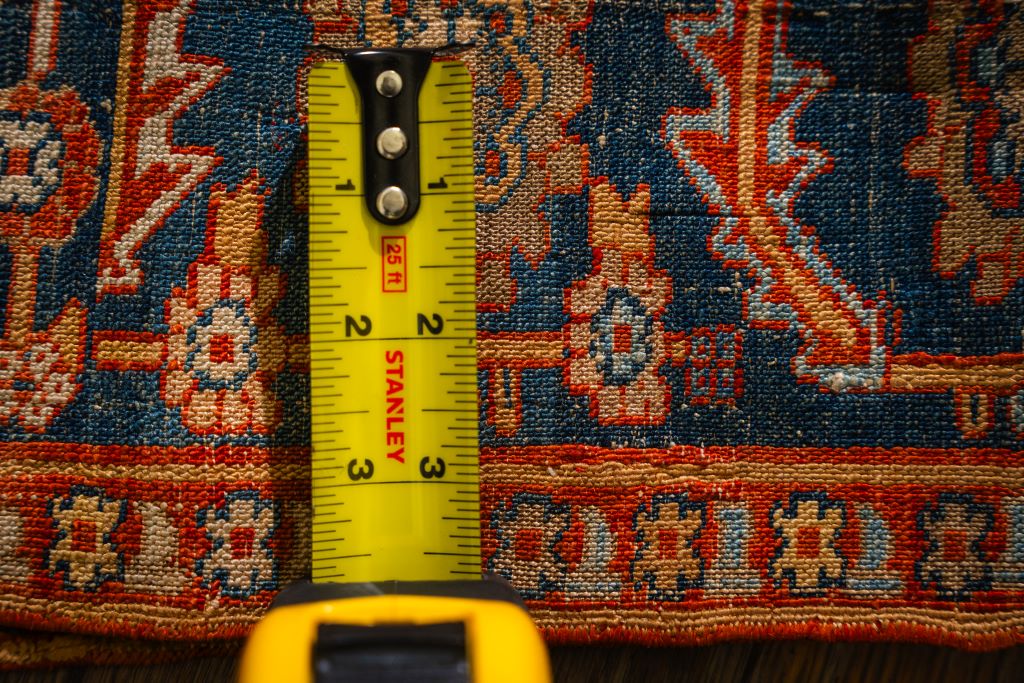
A detailed inspection of a richly colored oriental rug pattern while measuring its dimensions.
- Knot Density and Clarity — Higher density creates sharper star outlines. — Why: With more knots per square inch, the weaver has greater control over angles and symmetry.
- Low Pile Height — Enhances star definition. — Why: Shorter pile prevents the motif from blurring or softening.
- High Pile Height — Can obscure the crisp geometry. — Why: Plush surfaces blur sharp lines, making stars appear less distinct.
Addressing Common Questions
- What weaving techniques create crisp six-pointed stars in flatweave kilims? The slit-weave and brocading techniques are most effective for clear outlines.
- Does pile height affect clarity of six-pointed star designs? Yes—lower pile height produces sharper motifs, while high pile blurs lines.
- How does knot density impact 6 pointed star sharpness? Higher knot density increases clarity, allowing precise star points.
- How do natural dyes influence six-pointed star motif vibrancy? They provide deep, lasting contrasts, giving stars a more organic brilliance than synthetic dyes.
- Should I choose wool or silk for a six-pointed star Persian rug? Wool is durable for everyday use; silk offers unmatched detail and sheen but requires delicate care.
- Are synthetic fibers suitable for 6 pointed star outdoor rugs? Yes, synthetic fibers like polypropylene are durable for outdoor use, though they sacrifice traditional depth of color.
- Can I custom-order a six-pointed star motif in new rugs? Absolutely—many workshops and contemporary weavers offer custom star rugs in both wool and silk, tailored to size, color, and placement preferences.
Regional & Local Variations
Anatolian, Caucasian, Persian, Central Asian, and Berber Uses
- Anatolian Kilims — Feature bold, repeated six-pointed stars, often on rich red grounds. — Why: These regional star motifs functioned as talismans, woven into dowries and household textiles for fertility and protection.
- Caucasian Rugs — Particularly Star Kazak rugs with striking central medallions and strong color contrast. — Why: Village weavers favored bold geometric clarity, making these highly collectible.
- Persian Tribal Rugs — Small six-pointed stars appear as accents or filler motifs. — Why: Used to enhance fields and borders, reflecting unity and continuity in subtle form.
- Central Asian Weavings — The motif appears sparingly, sometimes integrated into guls or prayer rug ornament. — Why: It played a secondary decorative role, blending with local geometric traditions.
- Berber/Moroccan Rugs — Show primitive, singular six-pointed stars, often isolated. — Why: These were protective symbols, woven as simple guardians against misfortune.
Distinctive Types: Star Kazak, Star Ushak, Lesghi Star
- Star Ushak Carpet (Turkey) — Distinguished by monumental medallions, sometimes six- or eight-pointed, often filled with floral motifs. The large scale and balanced symmetry made them coveted by Ottoman courts and European buyers.
- Star Kazak Rug (Caucasus) — Recognized by bold, graphic star medallions dominating the center field. The strong color contrasts and angular lines give them a powerful, almost architectural presence. These are among the most collectible 6 pointed star rugs.
- Lesghi Star Rug (Caucasus) — Features multiple stars arranged in rows, each defined by serrated edges and high-contrast outlines. The repeated patterning makes them distinct from single-medallion Kazaks and more dynamic in composition.
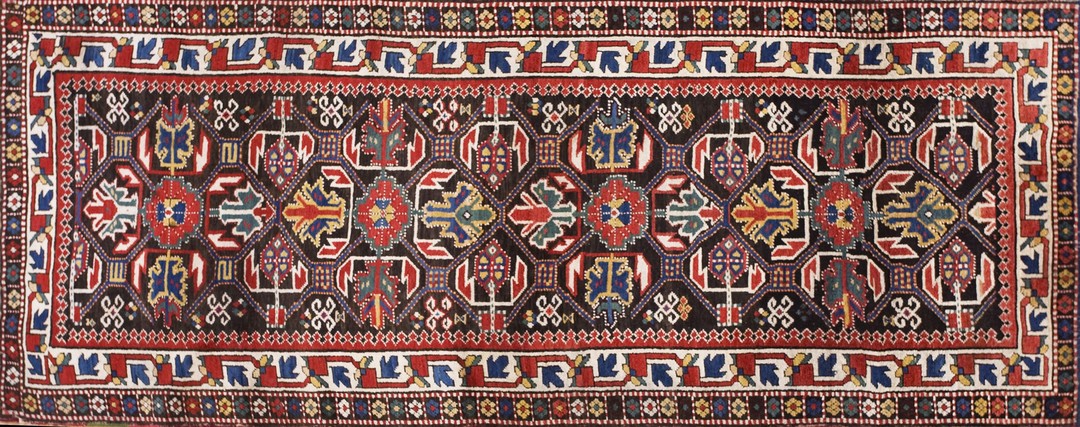
- Shirvan Rugs (Caucasus) — Often present smaller six-pointed stars arranged in lattices across the field, producing a dense, cosmic-like repeat.
Where 6 Pointed Star Medallions Are Most Common
6 pointed star medallions are most strongly associated with Caucasian weaving traditions, particularly in Star Kazak rugs and Lesghi star rugs, where the motif dominates the field. In Anatolia, the six-pointed form reached monumental scale in Star Ushak carpets, bridging Ottoman court design with talismanic heritage.
Smaller-scale hexagrams appear in Persian and Central Asian tribal rugs, while single protective stars remain a hallmark of Berber weaving. Across these regions, local style determines not only the placement and scale of the star but also its symbolic resonance.
Antique to Contemporary: Design Legacy
Timeline: Ancient, Medieval, and Modern Use
- Ancient Era (Pazyryk, Anatolia) — The earliest antique six-pointed star rugs drew from cosmic and fertility symbolism, embedding the hexagram into tribal textiles as a talisman of harmony. — Why: The star’s geometry resonated with early spiritual beliefs in balance and protection.
- Medieval Period (Seljuk, Mamluk, Ottoman) — The motif matured in court weaving, most famously in Star Ushak carpets and Star Kazak rugs, where it became monumental, structured, and highly collectible. — Why: Dynasties valued the star for its symbolism of order and its visual impact in architecture and textiles.
- Renaissance and Early Modern Europe — Ottoman and Moorish carpets featuring star medallions were prized exports to European courts. — Why: Their striking motifs fit both sacred and secular settings, from churches to aristocratic halls.
- Modern and Contemporary Periods — Today, the motif persists in both tradition and reinvention, appearing in contemporary hexagram rugs that reinterpret scale, color, and texture. — Why: Its timeless geometry allows endless adaptation to modern tastes.
How and Why Designers Reinterpret Star Motifs Today
The star design revival reflects a growing appreciation for patterns that bridge ancient heritage with modern aesthetics.
Designers revisit the six-pointed star for several reasons:
- Universal Appeal — The motif’s symmetry feels at once timeless and global, transcending cultural boundaries.
- Geometric Versatility — In contemporary workshops, the star is abstracted, overlapped, or distorted into new visual languages, making it ideal for avant-garde interiors.
- Symbolic Resonance — Many still associate the star with balance, protection, or harmony, lending a layer of meaning to modern décor.
- Eco-Friendly Adaptation — With renewed focus on sustainability, artisans now weave modern star motif carpets using natural fibers and dyes, carrying forward heritage in responsible ways.
Ongoing Popularity in Both Tradition and Innovation
The 6 pointed star’s enduring presence shows how easily it moves between past and present. Collectors continue to prize antique six-pointed star rugs for their rarity and craftsmanship, while homeowners embrace contemporary versions for their boldness and versatility.
Some area rugs preserve the talismanic clarity of a central medallion, while others push the motif into abstract, colorful, or minimalist interpretations. Whether woven as a contemporary hexagram rug or a carefully restored antique, the star remains both a heritage emblem and a modern design statement.
Addressing Common Questions
How have six-pointed star rugs evolved from antique to contemporary styles? They shifted from tribal talismans to monumental court carpets, and now to versatile, design-forward textiles that combine heritage with innovation.
Why are modern designers revisiting6 pointed star motifs today? Because the star embodies timeless geometry, cultural depth, and symbolic meaning, making it relevant for both tradition-inspired and modern minimalist interiors.
Collecting, Buying & Investing
How to Assess, Value, and Buy 6 Pointed Star Rugs
- Examine Motif Clarity — Sharp, well-defined stars indicate skilled weaving. — Why: Clear geometry enhances both aesthetic and collectible value.
- Check Age and Condition — Antique examples with intact borders and pile are more valuable. — Why: Wear, repairs, or fading reduce long-term worth.
- Evaluate Colors — Original natural dyes hold higher esteem than synthetic over-dyes. — Why: Natural hues add depth and durability, increasing market demand.
- Look for Provenance — Documentation of origin or ownership history raises prestige. — Why: Provenance assures authenticity and supports investment.
- Identify Region and Type — Star Kazak, Star Ushak, and Shirvan are the most collectible. — Why: Regional reputation and rarity affect pricing.
Pricing, Rarity, and Investment Potential
- Antique Star Rug Price Range — A 19th-century Star Kazak with crisp medallion often sells for $10,000–$50,000+, depending on condition and provenance. — Why: High-contrast colors and iconic design make them auction favorites.
- Star Ushak Carpets — Can command even higher values due to their monumental medallions and Ottoman prestige. — Why: They are rarer and historically tied to court weaving.
- Shirvan Rugs — Smaller star lattice designs tend to be more affordable but still prized by collectors. — Why: Their fine weave and repeating motifs attract niche buyers.
- Six-Pointed Star Rug Investment — Authentic, well-kept rugs with documented origin are considered strong long-term assets. — Why: Rarity, symbolism, and enduring demand support consistent value growth.
Where to Buy (Vintage, Custom, Regional Sources)
- Buy Vintage Star Kilim — Found at specialized rug dealers, international auctions, and reputable online platforms focusing on Oriental carpets.
- Custom Star Motif Carpet — Contemporary workshops in Turkey, Iran, and Morocco accept commissions for custom designs, allowing control over material, size, and palette.
- Regional Markets — Anatolian and Caucasian sources remain the strongest for traditional weavings, while Moroccan markets offer primitive protective-star rugs.
- Design Studios — Modern interior design houses reinterpret the star motif into bespoke, contemporary hexagram creations.
Authenticity, Provenance, and Care
- Rug Provenance Value — Provenance documentation can dramatically increase price, especially for museum-quality Star Kazaks and Ushaks. — Why: Collectors and auction houses value confirmed history as a safeguard against forgeries.
- Care to Preserve Stars — Avoid direct sunlight, rotate rugs regularly, and vacuum gently without beater bars. — Why: These steps prevent fading and fiber wear, keeping the motif crisp.
- Professional Cleaning — Use wool- or silk-safe cleaning by experts familiar with Oriental textiles. — Why: Harsh chemicals or improper washing can cause star designs to blur.
Addressing Common Questions
- Are 6 pointed star rugs considered good investment pieces? Yes, particularly Star Kazak and Star Ushak carpets, which hold long-term value.
- How much do antique 6 pointed star rugs typically cost? Prices range from several thousand dollars for minor tribal pieces to $50,000+ for pristine Kazaks or Ushaks with provenance.
- Where can I buy a vintage 6 pointed star Turkish kilim? Look to specialized dealers in Anatolian textiles, major auctions, or online heritage rug platforms.
- Can I custom-order a 6 pointed star motif in new rugs? Yes, many workshops offer custom star motif carpets tailored to design needs.
- Does provenance documentation increase value of 6 pointed star carpets? Absolutely—it boosts both financial and historic worth.
- What care steps prevent a 6 pointed star motif from fading? Limit sun exposure, maintain low humidity, rotate regularly, and seek professional cleaning.
Decorating & Interior Design Uses
Styling Star Motif Rugs in Minimalist, Modern, and Eclectic Spaces
- Minimalist Decor Star Rug — A rug with a single bold star medallion adds geometric drama without clutter. — Why: Its symmetry provides a focal point that complements pared-down spaces.
- Modern Interiors — Abstracted or large-scale 6 pointed stars work in open-plan rooms with sleek furnishings. — Why: The motif bridges heritage with contemporary design, offering both structure and visual intrigue.
- Eclectic & Bohemian Rooms — Multiple stars in colorful lattices suit layered, global-inspired aesthetics. — Why: The folk roots of the motif resonate in vibrant, pattern-rich spaces.
Choosing Wool vs. Silk
- Wool vs Silk Persian Star Rug — Wool is the most practical choice for everyday use. — Why: It is durable, resilient, and easy to maintain while still showing color beautifully.
- Silk — Reserved for luxury interiors and formal settings. — Why: Its sheen highlights fine details in the 6 pointed star, but it requires delicate care and is best in low-traffic rooms.
Outdoor and Synthetic Star Rugs
- Outdoor Synthetic Star Carpet — Rugs made from polypropylene or polyester replicate the motif for patios, entryways, and high-traffic zones. — Why: Synthetic fibers resist moisture, sunlight, and heavy wear, though they lack the depth and natural variation of wool or silk.
- High-Traffic Indoor Use — Synthetic star rugs are also suitable for family rooms and kitchens. — Why: They provide durability where spills and abrasion are likely.
Best Practices for Care and Preservation
- Avoid Direct Sunlight — Keep rugs out of prolonged exposure to prevent fading. — Why: UV light is the biggest threat to vibrant colors and motif clarity.
- Rotate Regularly — Change rug orientation to even out wear and light exposure. — Why: This preserves the crisp definition of the stars.
- Gentle Cleaning — Vacuum without a beater bar and use wool-safe or silk-safe cleaners. — Why: Overly harsh methods can blur motifs or damage fibers.
- Professional Care for Antique Rugs — Seek restoration specialists when needed. — Why: Expert cleaning ensures longevity and protects investment value.
Addressing Common Questions
- Can a six-pointed star rug complement minimalist interiors? Yes, its geometry suits minimalist décor, especially when used as a bold central accent.
- Should I choose wool or silk for a six-pointed star Persian rug? Choose wool for durability and daily use; choose silk for luxurious detail in formal rooms.
- Are synthetic fibers suitable for six-pointed star outdoor rugs? Yes, synthetic fibers like polypropylene are ideal for outdoor or high-traffic use.
- What care steps prevent a 6 pointed star motif from fading? Avoid direct sunlight, rotate rugs, and maintain gentle, professional cleaning.
Frequently Asked (and Locked) Questions
The 6 pointed star meaning in rug design has been addressed throughout: in kilims, it most often symbolizes fertility, harmony, and protection, while in Islamic and Jewish traditions it also carries religious significance as the Seal of Solomon and the Star of David. Importantly, its presence in tribal weaving predates religious use, making it a truly pan-cultural symbol of good fortune and cosmic order.
When learning how to identify star motif carpet designs, the key is to look for the interlocking triangles that create six distinct points. This differentiates it from eight-pointed or other star-like patterns. In antique pieces, especially Star of David rug antique examples such as Star Kazak or Star Ushak carpets, the clarity of the motif is directly tied to knot density, pile height, and dye quality.
Collectors prize these rugs not only for their symbolism but also for their sharp execution and historic provenance. For those looking to buy star kilim or shop for rugs online, vintage Anatolian and Caucasian kilims are widely available through specialist dealers and reputable auction houses. Many workshops also offer contemporary re-creations and even custom weaving, allowing people who are looking to buy rugs to request size, palette, and motif placement for a custom star design rug tailored to their interiors. Care remains essential for both antique and modern examples. To properly care for star design rug patterns, owners should avoid direct sunlight, rotate rugs periodically, and clean gently with wool- or silk-safe methods.
Natural dyes maintain vibrancy when treated correctly, and provenance documentation, combined with expert care, greatly enhances both the financial and cultural value of a rug. Together, these points confirm that 6 pointed star rugs remain timeless, highly collectible, and adaptable—anchored in deep history of rugs and cultures in general while continuing to thrive as both treasured antiques and bold modern design statements.
Explore a Few of Our Favorite 6 Pointed Star Rugs
FAQ
- Where can I buy six-pointed star rugs in the U.S.?
Check specialty rug galleries, reputable online dealers, and auction houses. Ask for fiber content, knot count, return policy, and any provenance for six-pointed star rugs.
- How do I spot a printed six-pointed star rug?
Printed six-pointed star rugs show the design mainly on the surface, with a white base showing when parted. Look for pixelation and stitched-on fringes.
- Are six-pointed star kilim rugs reversible?
Typically yes—flatweave six-pointed star kilims are woven without pile and can be flipped. Rotate every 3–4 months to distribute wear.
- How can I date six-pointed star rugs?
Examine wool quality, dyes (natural vs. synthetic), knot irregularity, and wear. Antique six-pointed star rugs often show abrash (color variation) and hand-finished edges—get expert appraisal.
- Do six-pointed star rugs work over radiant floor heating?
Yes—most wool six-pointed star rugs do, but keep surface temperatures below \~81°F (27°C). Use pads rated for heated floors and avoid glued backings.
- Is it culturally sensitive to use six-pointed star rugs?
Six-pointed star rugs span many cultures; context matters. If you’re referencing the Star of David specifically, be respectful of settings and consult community norms when unsure.
- Are colors on vintage six-pointed star rugs stable?
Not always—older natural dyes can bleed. Patch-test with a damp white cloth and keep professional cleaners informed to use dye-stable methods.
- Which rug pad works best under six-pointed star rugs?
On hard floors, use a 1/4″ felt-plus-natural-rubber pad for grip and cushioning under six-pointed star rugs. On carpet, try a firm felt pad to prevent creep.
- What should I know about six-pointed star runner rugs?
Six-pointed star runners are great for halls and kitchens, typically 2–3 feet wide and 8–14 feet long. Use a low-profile pad to clear door swings.
- Are six-pointed star rugs rarer than eight-point star rugs?
Generally, yes—eight-point stars are more common in Caucasian and Turkish designs. Six-pointed star rugs appear but are less frequently encountered.
- How much do six-pointed star rugs cost?
Printed or machine-made six-pointed star rugs often run \$100–\$500 for 5×8. Hand-knotted pieces range widely; antique Caucasian or Anatolian examples can reach several thousand dollars.
- Do six-pointed star rugs suit modern interiors?
Definitely. The crisp geometry of six-pointed star rugs complements minimalist, Scandinavian, and contemporary rooms—balance the pattern with solid textiles and simple furniture.
- Are outdoor six-pointed star rugs a thing?
Yes—polypropylene or recycled-PET six-pointed star rugs work outdoors. Expect quicker fading in full sun; rotate every 2–3 months for even wear.
- Can robot vacuums be used on six-pointed star rugs?
Yes for low or medium pile six-pointed star rugs; avoid tasseled fringes and high-pile shags. Consider edge guards and set no-go lines to protect corners.
- How do I clean wool six-pointed star rugs?
Vacuum with suction only (no beater bar) and blot spills with cool water and a wool-safe detergent. For deep cleaning, use a rug professional every 12–18 months.
- Are six-pointed star rugs good for high-traffic rooms?
Yes—choose low- to medium-pile wool six-pointed star rugs or flatweaves. Pair with a felt-and-rubber pad to reduce wear and slippage.
- What sizes do six-pointed star area rugs come in?
Standard six-pointed star area rugs commonly ship in 5×8, 8×10, and 9×12, plus runners around 2.5×8–12. Oversizes (10×14+) are available but less common and pricier.
- What materials are common in six-pointed star rugs?
Traditional six-pointed star rugs are wool on wool or wool on cotton. Modern options add cotton warps, jute, polyester, or polypropylene for lower cost or outdoor use.
- How can I identify hand-knotted six-pointed star rugs versus machine-made?
Flip it over: hand-knotted six-pointed star rugs show individual knots and slight irregularities; machine backs look uniform with gridlike stitches. Real fringe is warp threads, not sewn on.
- Which regions are known for antique six-pointed star rugs?
Look for Anatolian kilims, Caucasian pieces (e.g., Shirvan/Kazak), and Mamluk-influenced designs. Auction catalogs often note hexagram medallions or border stars in these groups.
- Are six-pointed star rugs the same as Star of David rugs?
Not automatically. In many textiles the hexagram is a pan-regional geometric; only some six-pointed star rugs explicitly reference the Star of David.
- Do six-pointed star rugs have a meaning?
Meanings vary by region; in Anatolian kilims the star can signal happiness or fertility. Treat symbolism as interpretive rather than fixed, especially on antique pieces.
- Where did six-pointed star rugs originate?
Six-pointed star rugs appear widely, with strong roots in Anatolian weaving and Islamic ornament. Some museum-attributed examples echo Cairo Mamluk geometries from the 15th–16th centuries.
- Are six-pointed star rugs the same as hexagram rugs or “Seal of Solomon” rugs?
Yes—those phrases all refer to the same six-point motif. Naming varies by context: “hexagram” is geometric, “Seal of Solomon” appears in Islamic art history.
- What are six-pointed star rugs?
Six-pointed star rugs feature a hexagram motif woven or printed into the design. You’ll see it in flatweaves (kilims) and pile rugs across Anatolia, the Caucasus, and modern lines.