
Introduction to Shirvan Rugs
Explore our unique collection of hand-knotted Shirvan rugs today.
Overview of Shirvan Rug Identity
Shirvan rugs are a distinctive group of handwoven carpets originating from the Shirvan region, a historic area of the Caucasus that lies within present-day Azerbaijan. This region has long been a crossroads of cultures, and the rugs produced there embody that legacy through their synthesis of local tribal art and influences from neighboring Persia and Turkic traditions. Typically smaller in size compared to other Caucasian rugs, Shirvan carpets are valued for their precision, clarity of design, and fine knotting.
They often display a restrained, elegant quality that sets them apart, with sharp geometry, subtle medallions, and a balanced interplay between bold motifs and negative space. The defining characteristic of Shirvan weaving is its combination of utility and artistry. These were rugs meant for daily use—covering floors, insulating walls, or serving in domestic rituals—yet they were executed with a craftsmanship so fine that many now stand as museum-quality pieces.
Collectors often remark that Shirvan rugs strike the rare balance between the spontaneity of tribal weaving and the sophistication of urban workshops. This duality has secured them a permanent place in the canon of antique Caucasian textiles.
Cultural and Artistic Legacy
The artistry of Shirvan carpets reflects centuries of cultural blending. The Caucasus has been home to diverse peoples, including Azeris, Lezgins, and other ethnic groups, each contributing to the weaving vocabulary. From Persia came the disciplined knotting and occasional floral flourishes; from Turkic tribes, the boldness of geometric motifs; and from local traditions, an instinct for symbolic abstraction and rhythm.
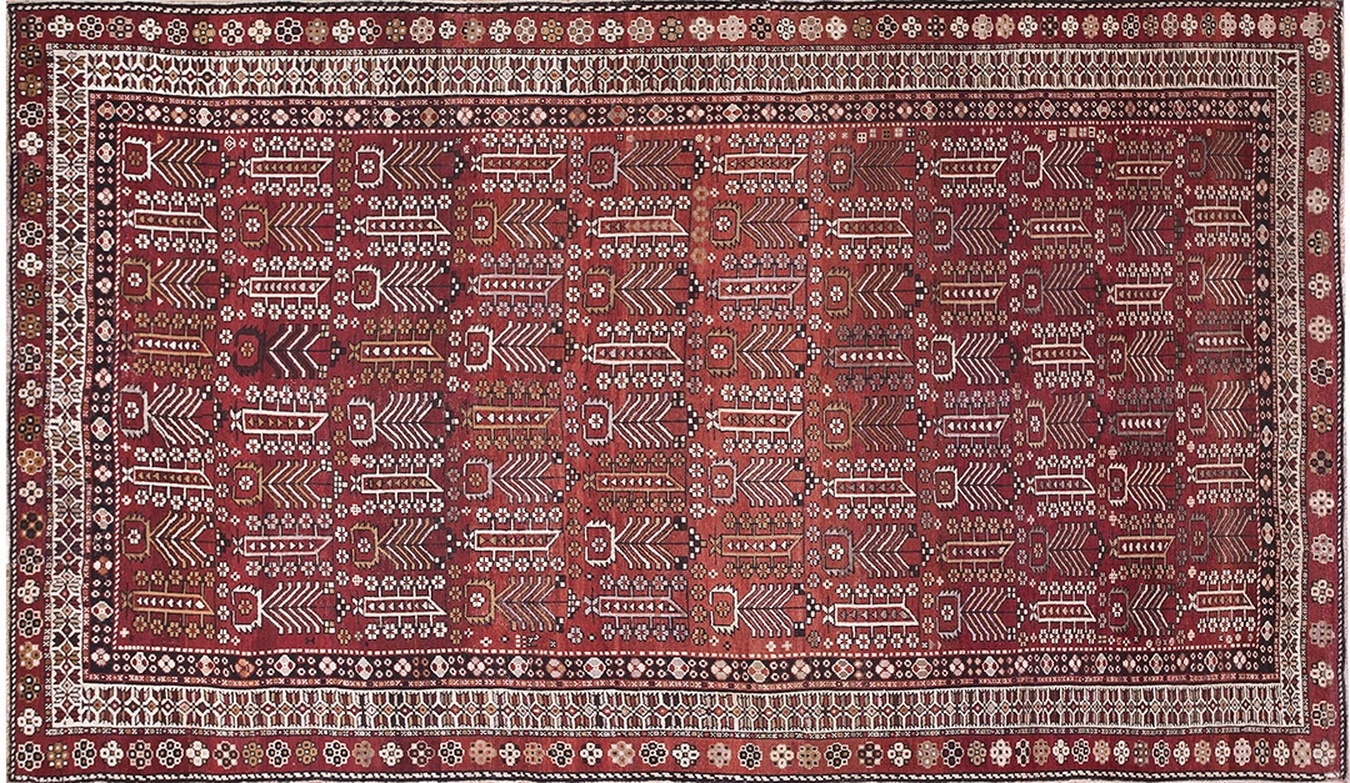
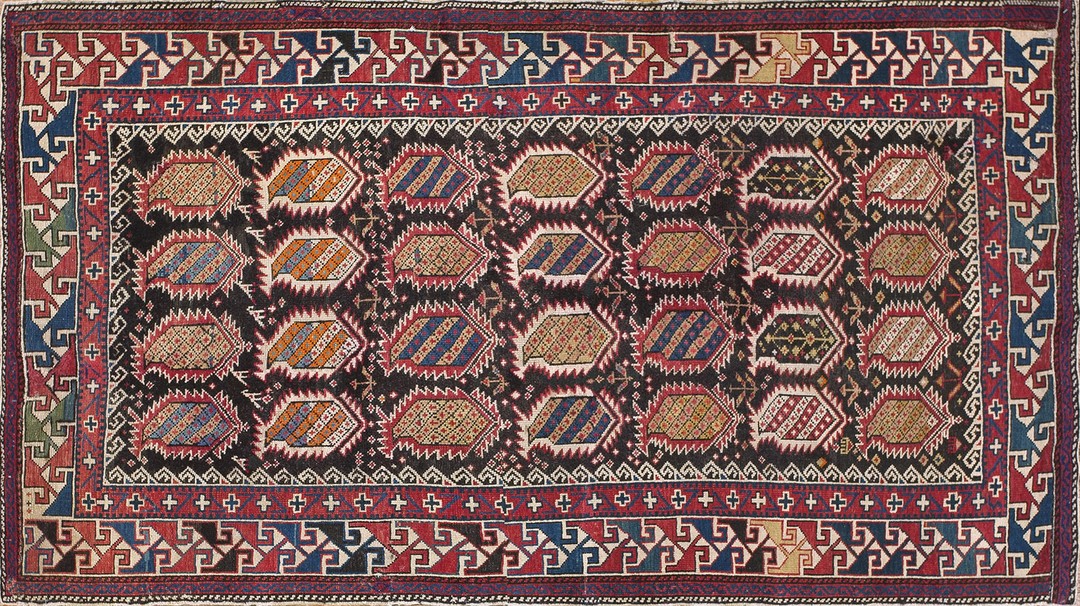
Antique Caucasian – Shirvan Caucasian 1900s Rug – by Rugs On Net
This convergence produced a unique regional identity, where motifs like hooked polygons, stylized animals, and serrated medallions coexist in harmonious symmetry. The palette of Shirvan rugs is another hallmark. Often described as “colder” than that of other Caucasian pieces, Shirvans favor blues, ivories, and cool reds over warmer, earthier tones. The effect is one of refinement and austerity, underscoring the mathematical precision of the designs. In addition, the weavers employed high-quality wool and tightly packed knots, resulting in durable rugs that maintain their clarity even after centuries of use.
Beyond aesthetics, Shirvan weaving carries cultural resonance. Carpets were integral to community life, serving not only as household furnishings but also as dowries, heirlooms, and markers of identity. In rural villages, weaving was often done by women, transmitting patterns and knowledge across generations. Each rug thus embodies both individual artistry and the collective heritage of the region.
Why Shirvan Stands Out Among Caucasian Rugs
While all Caucasian rugs share a foundation of bold design and tribal character, antique Shirvan rugs are distinguished by their meticulous execution and nuanced style. Karabagh and Kazak weavings, for instance, are known for their large-scale motifs and vivid colors, but Shirvans favor intricacy and proportion.
Their patterns are tighter, their details sharper, and their overall compositions more disciplined. Another element that sets Shirvan apart is its internal diversity. Within the broader category, sub-styles like Marasali prayer rugs, Akstafa rugs with bird motifs, and smaller village-specific designs showcase regional variation. This diversity enriches the Shirvan identity, offering collectors a wide range of expressions under the same cultural umbrella.
Today, Shirvan carpets occupy a coveted position in both private collections and museums. They stand as testaments to the ingenuity of Caucasian artisans and as enduring works of art that continue to inspire designers and connoisseurs alike. Their story is one of continuity—woven from threads of tradition, utility, and aesthetic ambition—and it begins in the mountains and valleys of Azerbaijan, where one of the world’s most elegant schools of rug-making took root.
Name, Etymology & Geography
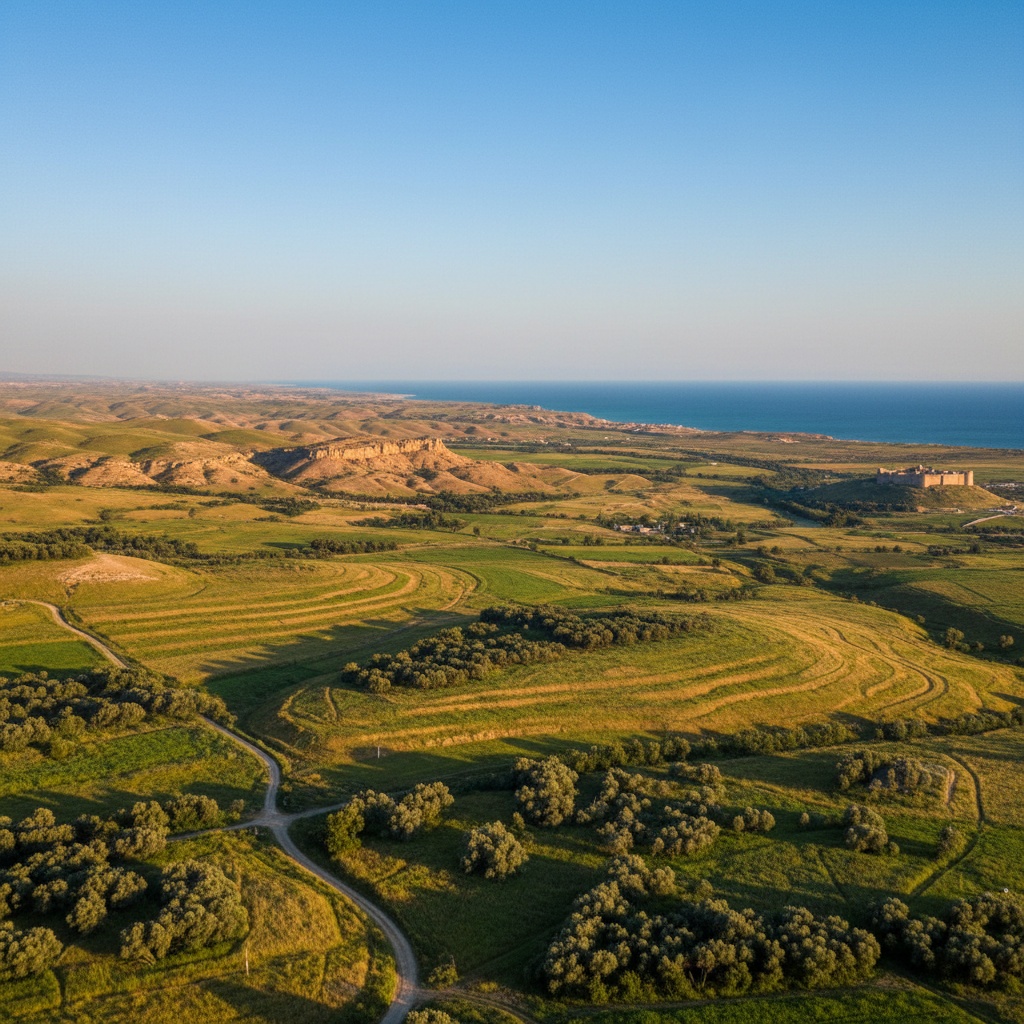
Geography of rolling hills meeting the sea.
Etymology of “Shirvan”
The name Shirvan carries layered meanings that reflect the region’s Persianate and local cultural history. Scholars most commonly trace its origin to the Persian word Shahrbān, meaning “governor” or “protector of a province.” This association highlights Shirvan’s long-standing role as an administrative and political center in the Caucasus.
Another interpretation links the name to the legendary Sasanian ruler Khosrow I Anushirvan, whose reign embodied justice and prosperity. Over time, folk traditions also developed poetic etymologies: Persian poets in particular coined the association of “Shirvan” with the cypress tree, a symbol of elegance, resilience, and eternity in Persian literature. These multiple layers of Shirvan etymology illustrate how the name came to signify not just a territory but also ideals of governance, natural beauty, and cultural refinement.
Historical Districts and the Geography of Weaving
Shirvan lies in present-day Azerbaijan, stretching between the Caspian Sea and the Kura River, a fertile and strategic location that shaped both its economy and artistic traditions. The Shirvan carpet-weaving school drew from numerous districts, each contributing distinct styles and motifs. These districts include Maraza, Akstafa, Bidjov, Khila, Surahani, the outskirts of Baku, and Kurdamir.
While some modern surveys debated the inclusion of Kurdamir, traditional scholarship affirms it as part of the Shirvan weaving zone, known for finely knotted rugs with intricate geometric detail. This patchwork of weaving centers gave Shirvan carpets their remarkable diversity. Marasali prayer rugs with their elegant arch designs, Akstafa rugs with their signature bird motifs, and the more abstract geometry of Bidjov and Khila all fall under the Shirvan identity. Together, these local schools demonstrate how the region’s geography—spanning coastal plains, mountain foothills, and river valleys—nurtured a wide range of artistic expression unified by shared technical excellence.
Palace of the Shirvanshahs and Shamakhi
Shirvan’s cultural prestige is embodied in two historic capitals: Shamakhi and Baku. Shamakhi was the longstanding cultural and political heart of Shirvan, celebrated for its poetry, crafts, and architecture. It is regarded as the cultural capital of Shirvan, where weaving traditions flourished alongside literary and artistic achievements. In Baku, another jewel of Shirvan’s legacy stands: the Palace of the Shirvanshahs. Located within historic Shirvan territory, this 15th-century palace complex symbolizes the dynasty’s wealth and cosmopolitan outlook.
While the palace itself was a seat of power, its architectural ornamentation resonates with the same aesthetic sophistication found in Shirvan carpets—geometric precision, rhythmic balance, and refined detail. Together, Shamakhi and Baku anchor Shirvan’s cultural geography, representing both the living heart of its weaving traditions and the monumental heritage of its rulers. The region’s name, its districts, and its capitals intertwine to form a story of artistry and identity, one that remains central to the study of Caucasian rugs and the legacy of antique Shirvan carpets.
Historical Context & Evolution
The Shirvan Khanate
The political identity of Shirvan in the early modern period was defined by the creation of the Shirvan Khanate, founded in 1748 after the collapse of the Safavid Empire. This khanate emerged as one of several semi-independent states in the Caucasus, ruled by local dynasties who balanced loyalty to larger powers with efforts to preserve their autonomy.
The khanate’s strategic location between the Caspian Sea and the interior of the Caucasus made it a hub of trade and culture, and weaving was a key element of its economy. Under the khans, Shirvan rugs gained a reputation as refined yet deeply tied to tribal traditions, reflecting the political blend of urban sophistication and rural independence that marked the region.
Weaving Traditions Under Persian, Russian, and Local Rule
Although the Shirvan Khanate formalized regional governance in the 18th century, weaving traditions in Shirvan go back at least to the Safavid period, when Persian cultural influence spread across the Caucasus. The Safavids introduced refined knotting techniques, intricate floral motifs, and courtly aesthetics that shaped Shirvan’s more disciplined side. Yet, the region’s tribal groups preserved their geometric abstraction, animal symbolism, and bold color contrasts.
The result was a hybrid vocabulary, where Persian refinement met Caucasian spontaneity. The 19th century brought profound changes with the expansion of Russian rule in the Caucasus. As Shirvan came under imperial administration, its rugs were increasingly absorbed into broader patterns of economic exchange. Russian merchants and state-sponsored exhibitions encouraged standardization of size and design, making Shirvan carpets more attractive to export markets. This new phase reinforced the durability of Shirvan weaving but also gradually shifted production toward Western tastes.
First International Recognition
The true global breakthrough for Shirvan rugs came in the 1870s, with the construction of the Trans-Caucasian Railway. This rail link connected the weaving villages of Azerbaijan, including Shirvan, with the Black Sea ports and, from there, to Western Europe. For the first time, Shirvan carpets gained international recognition, appearing in trade fairs, exhibitions, and private collections across Europe and beyond.
Western buyers were drawn to their fine craftsmanship, intricate patterns, and elegant palettes, which contrasted with the bolder and more rustic Caucasian rugs from neighboring regions. This surge in demand inevitably influenced the art itself. The need to supply a growing market encouraged more consistent production, new dye sources, and sometimes simplified motifs. Yet, even as these changes unfolded, the essential character of Shirvan rugs—an intricate balance of tribal vitality and refined design—remained intact.
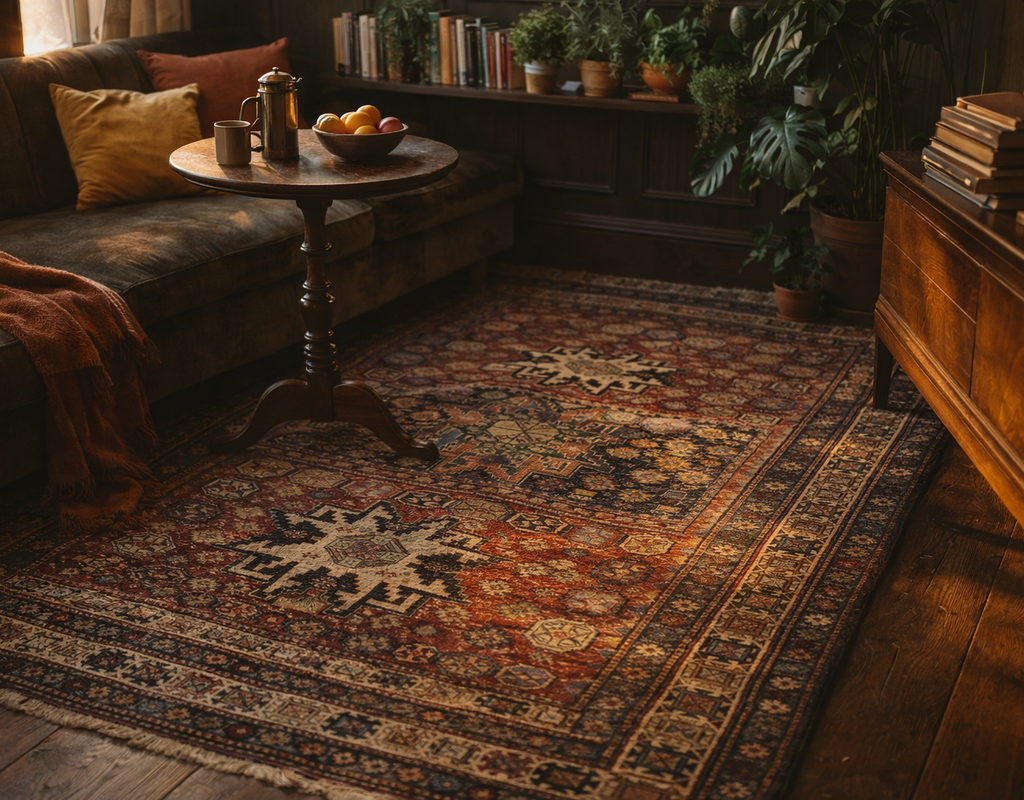
Rich textures and warm lighting create a moody, inviting aesthetic anchored by a vintage area rug.
The political shifts of Persian, Russian, and local rule thus served not to erase Shirvan’s identity, but to reinforce its adaptability and resilience in the face of changing worlds. From the rise of the Shirvan Khanate in 1748 to the rug’s international recognition in the late 19th century, the region’s carpets evolved alongside its political and economic transformations, leaving behind a body of work that continues to define the art of the Caucasus rug trade.
Shirvan Rug Design & Symbolism
Core Structure: Field, Medallions, Borders
- Field — The central ground of Shirvan rugs is often filled with finely drawn geometry, tight latticework, or an orderly scatter of small motifs. — Why: This density of design reflects Shirvan’s reputation for precision and control, setting it apart from bolder, more open Caucasian styles.
- Medallions — Central or repeating medallions, sometimes octagonal or star-shaped, organize the rug’s space into rhythmic balance. — Why: These medallions echo ancient cosmological symbols, emphasizing harmony and order in the weaving tradition.
- Borders — Shirvan borders often employ Kufic or Kufesque patterns, adapted from Arabic script into abstract linear ornament. — Why: The Kufic border conveys continuity and protection, enclosing the field like a written prayer around the design.
Motif Types
Shirvan design vocabulary is among the richest in the Caucasus. Eight-pointed Lesghi stars radiate cosmic meaning, their symmetry suggesting perfection. Ram’s horn motifs evoke fertility and strength, while the tree of life represents continuity between generations.
The dragon S-hook, a sinuous serpent-like curve, carries associations of protection against evil and echoes mythical creatures from regional folklore. Rows of the boteh motif—a paisley-like teardrop—convey growth, spirituality, and divine flame. Alongside these, the evil eye symbol and other protective emblems reflect ancient beliefs embedded in daily life.
Maraza/Marasali-Style Prayer Rugs
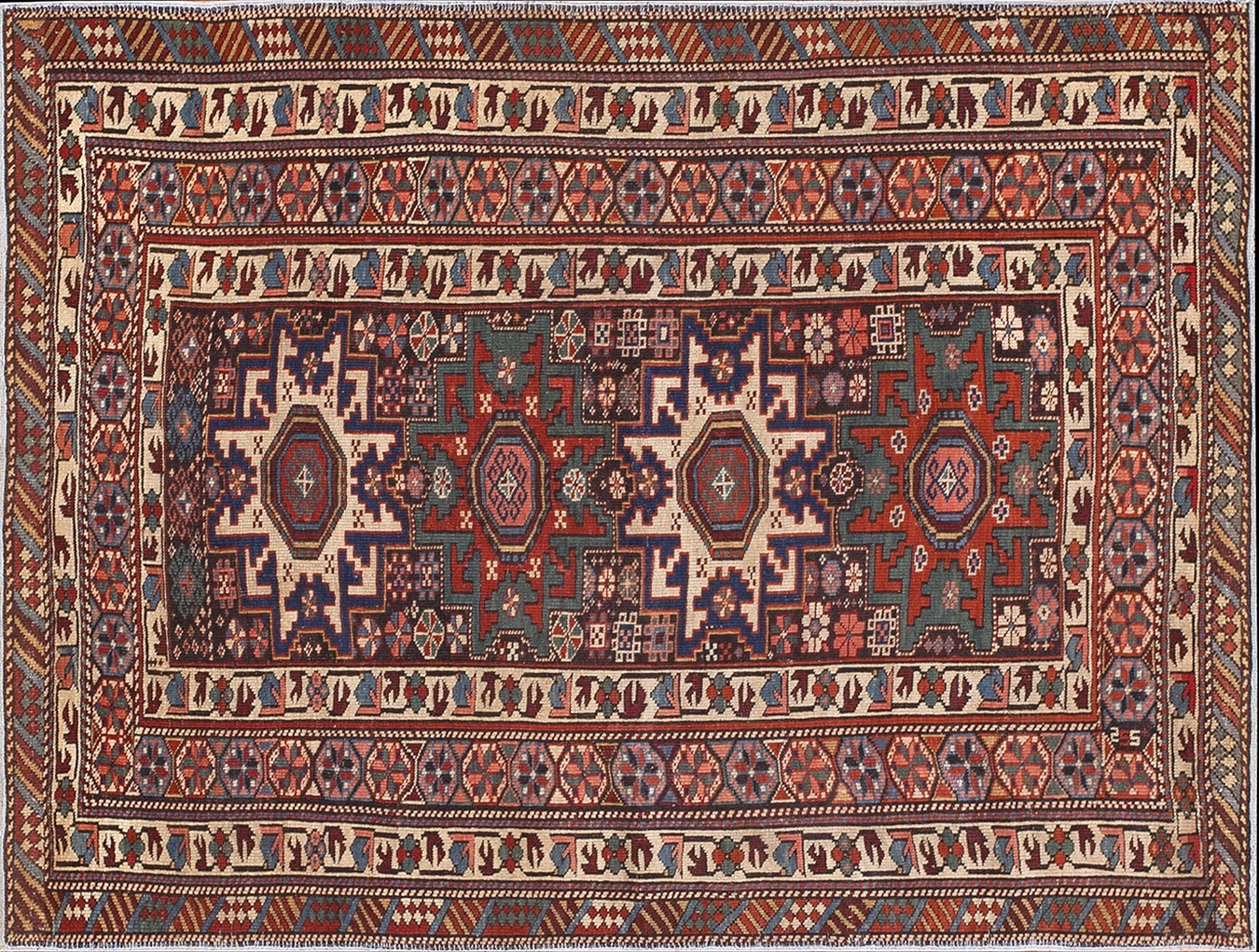
Rectangle Allover Geometric 1890s Blue Antique Hand Knotted Pile Wool Rug – by Rugs On Net
Among the most celebrated of Shirvan carpets are the Maraza (Marasali) prayer rugs. These are distinguished by a vertical niche or mihrab, woven in ivory, symbolizing the prayer arch. Across the field appear rows of alternating colored boteh motifs, often arranged with almost hypnotic regularity.
The repetition of boteh in these rugs carries dual meanings: the personal act of prayer and the universal themes of fertility, renewal, and divine blessing. Marasali rugs are highly sought-after among collectors, recognized as masterpieces of the Shirvan prayer rug tradition.
Regional and Sub-Style Variations
- Akstafa — Bird motifs, stylized and repeated, often filling the field. — Why: Represents freedom and spirituality, a local hallmark.
- Bidjov — Large star medallions, usually eight-pointed, dominating the composition. — Why: Adds celestial symbolism and bold visual focus.
- Konagkend — Octagonal and lattice layouts. — Why: Reflects structural order and symmetry, with ties to ancient geometric art.
- Khila — Columnar and afshan (floral spread) patterns. — Why: Evokes garden symbolism and Islamic design heritage.
- Surahani — Lattice structures and occasional figural designs. — Why: A rare glimpse into narrative weaving traditions.
- Kurdamir — Classic Shirvan geometry with densely packed motifs. — Why: Embodies the archetypal Shirvan look, balancing refinement with tribal rhythm.
Influence of UNESCO Gobustan Rock Art
A unique hallmark of Shirvan symbolism is its connection to the Gobustan rock art site, a UNESCO World Heritage landmark near the region. These petroglyphs, dating back thousands of years, depict humans, animals, and abstract symbols. Many carpet motifs—such as the ram’s horn, serpent-like S-hooks, and stylized lattice patterns—are believed to derive directly from this prehistoric visual language. The continuity between Gobustan carvings and Shirvan rugs illustrates how deeply Caucasian weaving is rooted in ancient heritage.
Differences from Kuba Rugs
Though geographically close, Shirvan and Kuba rugs are distinct schools of weaving. Shirvan rugs are finer, with tighter knotting and denser motifs spread evenly across the field. Their palette leans toward subdued and “colder” tones, emphasizing clarity and elegance. Kuba rugs, by contrast, often feature bolder motifs, looser spacing, and brighter, more saturated colors.
The comparison of Kuba vs. Shirvan highlights Shirvan’s reputation for refinement, proportion, and detail, distinguishing it within the wider group of Caucasian rugs. In sum, the Shirvan design system—from boteh-laden prayer rugs to lattice kilims—embodies layers of symbolism, cultural inheritance, and technical mastery. Its motifs remain one of the clearest windows into the spiritual, artistic, and communal life of the Caucasus.
Materials, Construction, and Techniques
Materials: Wool, Cotton, Silk
The foundation of Shirvan rugs lies in the use of natural fibers. Traditionally, these rugs were woven with a wool pile on either wool or cotton warps and wefts. The sheep of the Shirvan region produced high-quality, lustrous wool that could take on both strong vegetable dyes and the cooler, refined tones characteristic of Shirvan carpets.
Cotton was sometimes introduced in the foundation to provide extra stability and tension for finer weaving. Silk, while occasionally used in earlier centuries, declined sharply after the 18th century. Once prized in luxury weaving for Persian courts, silk production and trade in the Caucasus shifted, and market demand favored the durability of wool rugs over fragile silk pieces. As a result, silk Shirvan rugs are exceptionally rare today, mostly surviving in museum collections. This decline underscores how shifts in trade routes and consumer preferences transformed regional weaving practices.
Knotting and Pile
- Turkish Knot (Ghiordes Knot) — Authentic Shirvan pile rugs are woven exclusively with the symmetrical Turkish or Ghiordes knot. — Why: This knotting method produces durability and allows for the crisp geometry Shirvan rugs are celebrated for.
- No Senneh Knot — The asymmetrical Senneh knot, common in Persian weaving, does not appear in true Shirvan rugs. — Why: Its absence is an authentication marker; the presence of Senneh knotting would suggest non-Shirvan origin.
- Pile Height — Shirvan pile is typically cut low, enhancing the sharpness of motifs. — Why: This short pile contributes to the clarity and precision that define Shirvan design.
Shirvan Kilims
Alongside pile rugs, Shirvan weavers also produced kilims (flatweaves). These pieces use a non-pile weaving method with tightly interlaced wefts. One of the most famous patterns to appear in Shirvan kilims is the Khila lattice design, featuring a grid of repeating diamonds or lozenges.
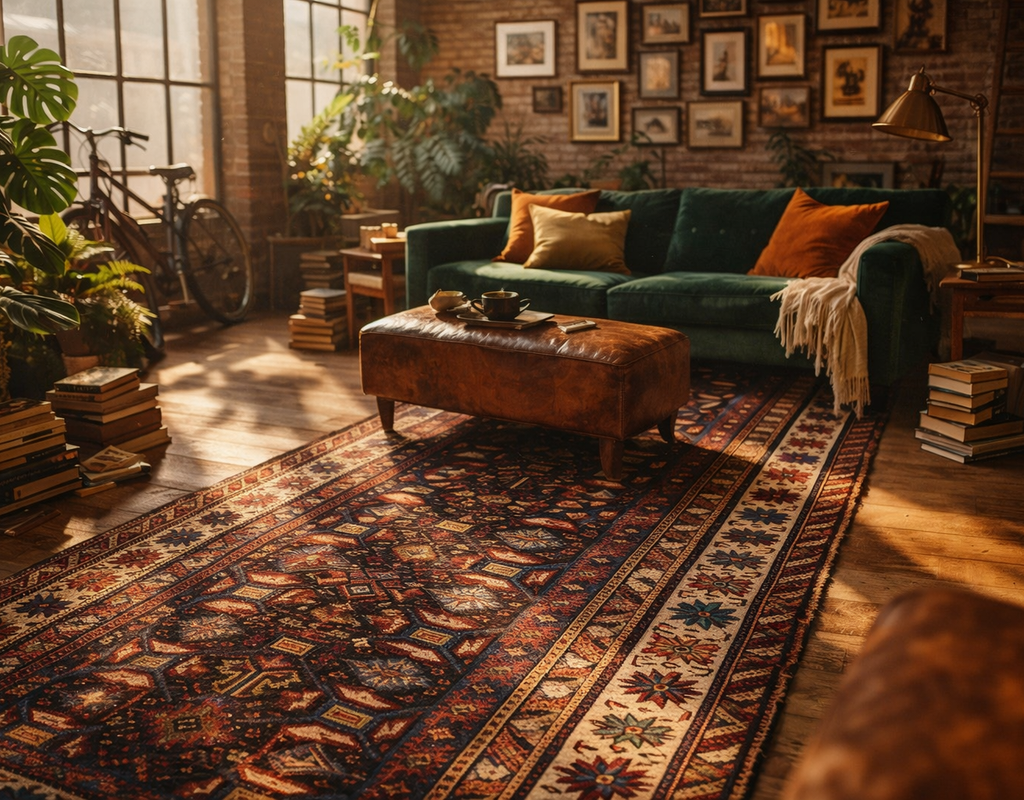
A richly textured, cozy reading nook bathed in warm afternoon light, showcasing a traditional runner rug.
This proves that the lattice motif, celebrated in pile rugs, had equal significance in flatwoven textiles, linking all forms of Shirvan weaving to a shared symbolic vocabulary.
Knot Density’s Impact on Value
Shirvan rugs are admired for their fine weave, typically ranging from 80 to 120 knots per square inch (KPSI), with some exceptional examples reaching higher counts. Knot density plays a direct role in the valuation of antique Shirvan rugs today.
A higher knot count not only indicates more time and labor invested but also allows for finer detail and more elaborate motifs. Collectors and appraisers consistently use knot density as a key criterion in assessing authenticity, quality, and price.
16th-Century Shamakhi Workshops and Gold-Thread Carpets
The prestige of Shirvan weaving reached a peak in the 16th century, when workshops in Shamakhi—then the region’s capital—produced luxurious gold-thread carpets for the Persian courts. These extraordinary works used wool or silk bases enhanced with supplementary weft techniques, where gold-wrapped threads were carefully inserted to create shimmering highlights.
Such carpets were diplomatic gifts, symbols of royal patronage, and testaments to the technical mastery of Shirvan’s artisans. Though few examples survive, they cement Shirvan’s place in the history of elite textile art. From wool-based tribal rugs to gold-thread masterpieces, Shirvan’s materials and construction methods embody both practicality and splendor. The reliance on the Turkish knot, the legacy of kilim weaving, the decline of silk after the 18th century, and the enduring importance of knot density together form the technical backbone of Shirvan’s weaving identity.
Socio-Cultural Significance
Role of Carpets in Daily Life and Ceremonies
In the villages of Shirvan, carpets were far more than floor coverings. They were functional necessities, insulating stone or earthen floors against cold winters and serving as cushions, bedding, and wall hangings. At the same time, they carried deep ceremonial meaning. Carpets were laid out for weddings, religious gatherings, and community feasts, marking spaces of honor and blessing.
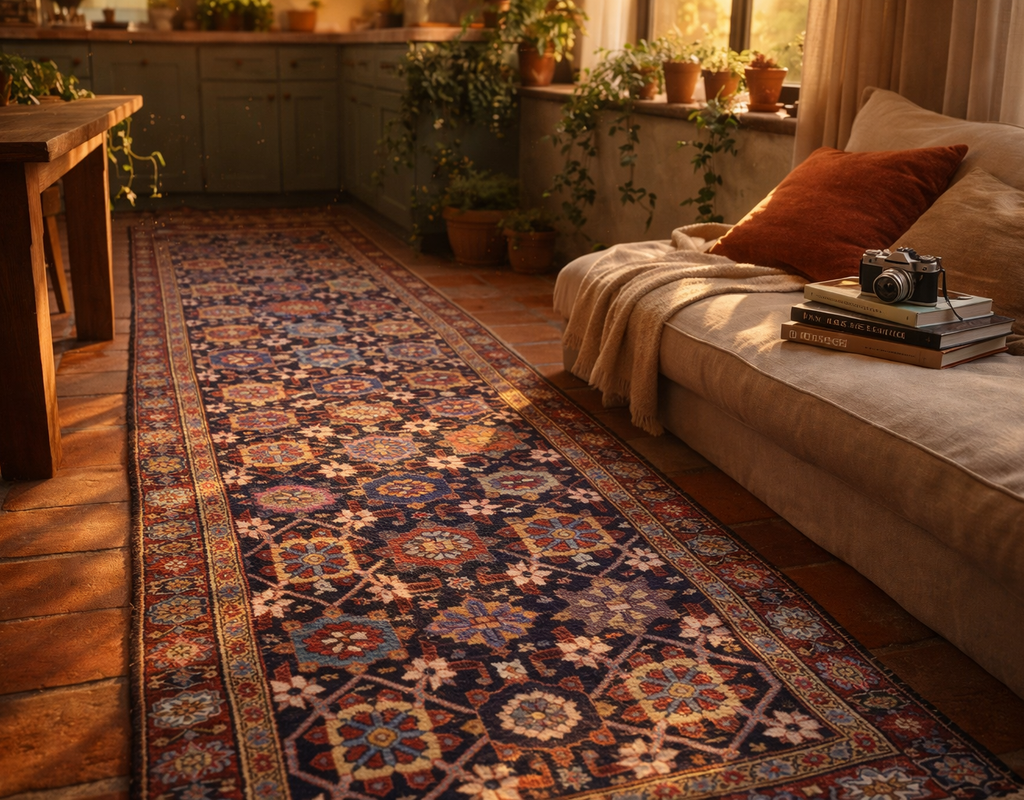
The rich, patterned runner rug anchors the cozy, light-filled rustic space.
A finely woven rug could transform a humble home into a place of dignity, and its presence in rituals reinforced the connection between material craft and spiritual life. In every Shirvan household, rugs stood at the center of both practical and symbolic worlds.
Gender, Family, and Transmission of Skills
The weaving tradition in Shirvan was primarily the work of women, who wove not only for their households but also as contributors to the family’s wealth and reputation. Girls learned the craft at a young age, sitting beside mothers and grandmothers at the loom. The act of weaving thus became a form of intergenerational transmission, binding families together through shared labor and knowledge.
These skills were not written down but carried in memory and muscle, ensuring that motifs and techniques survived intact for centuries. Every rug produced was both an individual expression and part of a lineage of artistry that defined Shirvan’s identity.
Rugs as Status, Dowry, and Folk Storytelling
In Shirvan society, carpets also served as markers of social status and wealth. A household’s finest rugs might be displayed to honor guests or offered as part of a carpet dowry, symbolizing the bride’s contribution to her new household. The dowry rug was not just a piece of furnishing—it was a statement of skill, heritage, and hope for prosperity.
Just as important, carpets functioned as a medium of folk art and storytelling. Through their narrative motifs—from protective ram’s horns to boteh teardrops symbolizing growth—Shirvan rugs encoded personal prayers, protective charms, and communal memory. In this sense, each carpet is a text in wool, carrying the cultural story of the Caucasian people who made it. The symbols were never arbitrary; they embodied wishes for fertility, protection from evil, success in harvest, or remembrance of ancestors.
Taken together, these threads of daily function, ritual presence, and symbolic meaning establish Shirvan rugs as living artifacts of Caucasian culture. Each rug is a story—woven by women’s hands, passed through families, displayed in life’s most important moments, and preserved as both folk art and cultural identity.
19th–20th Century Transitions
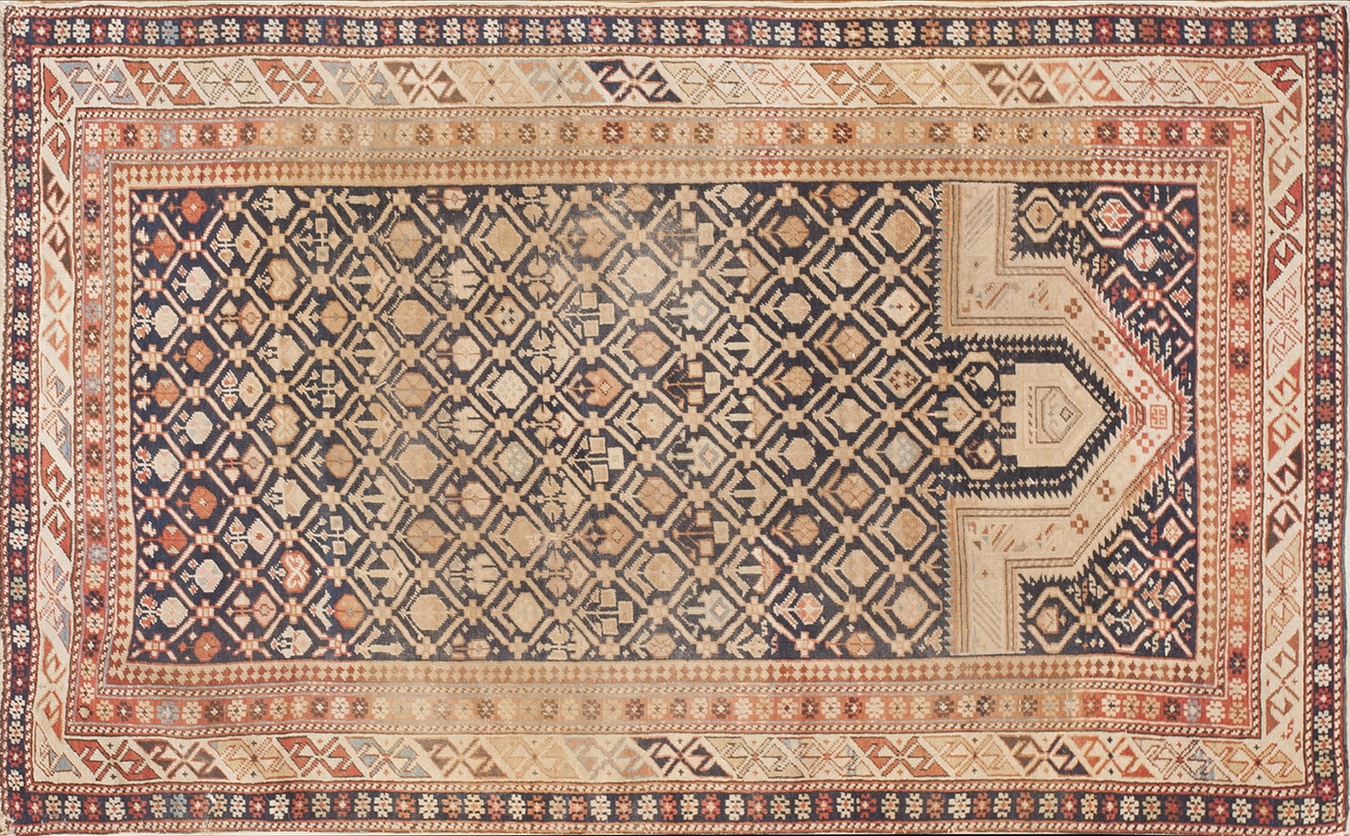
Tribal Geometric Antique Caucasian Shirvan Islamic Prayer Rug – by Rugs On Net
Impact of Russian and Soviet Industrialization
The late 19th and early 20th centuries marked a turning point for Shirvan carpets. Under Russian imperial influence and later the Soviet carpet industry, weaving shifted from village-based, family traditions to more centralized and standardized production. Soviet industrialization in particular reorganized weaving into state-run workshops, where patterns were replicated according to government-approved designs.
This system blurred the distinctiveness of regional styles, eroding the diversity that once characterized Shirvan weaving. Instead of dozens of village-specific motifs, carpets were produced according to uniform templates that prioritized quantity over individuality.
Workshop Production, Synthetic Dyes, and Market Changes
Another major change was the introduction of aniline dyes in the late 19th century. These synthetic colors offered speed and affordability but often lacked the subtlety and durability of natural vegetable dyes. The result was a sharper but sometimes harsher palette, with colors prone to fading unevenly over time. The rise of workshop rugs further encouraged regularity in design, replacing the improvisational charm of earlier folk carpets with more rigid, repetitive layouts. At the same time, demand for Caucasian rugs abroad continued to grow.
Export markets increasingly influenced production, leading to carpets tailored to Western tastes and standardized sizes that fit modern interiors. While this expanded commercial opportunities, it also distanced Shirvan weaving from its roots in symbolic, family-driven artistry.
Decline and 20th-Century Revival Efforts
By the early 20th century, the combined effects of industrialization, synthetic dyes, and centralized workshop control led to a marked decline in quality and artistry. The spontaneity, cultural symbolism, and individuality of antique Shirvan rugs gave way to more generic products. Collectors today view pre-20th-century Shirvan carpets, especially those woven before Soviet intervention, as the truest representatives of the tradition. Yet revival efforts emerged later in the century.
Local and international initiatives encouraged a return to traditional methods—hand-spun wool, natural dyes, and village-based looms. These revivals sought not only to restore technical excellence but also to reconnect weaving with its role as a bearer of cultural identity. In some workshops, artisans deliberately rejected synthetic dyes and standardized designs, producing rugs that echoed the artistry of their 18th- and 19th-century predecessors. The 19th–20th century transitions show a double movement: innovation through industrialization but also loss of tradition.
The enduring appeal of Shirvan rugs lies in their earlier forms, where craftsmanship, symbolism, and cultural voice were strongest. Modern revival weaving attempts to bridge this gap, ensuring that the legacy of traditional Shirvan rugs continues into the present.
Modern Shirvan: City, Nature, and Living Heritage
Shirvan City in Contemporary Azerbaijan
Today, Shirvan city stands as a vibrant urban center within modern Azerbaijan, balancing its historic legacy with contemporary development. According to the 2020 census, Shirvan had a population of 87,400, reflecting steady growth since Soviet times.
The city is a regional hub for trade, culture, and education, continuing its role as a focal point of Azerbaijani life. While much of the traditional weaving is now centered in rural areas and specialized workshops, the city remains a symbolic heart of the broader Shirvan identity, linking its historic past with a modern, urban present.
Shirvan National Park Wildlife
Beyond the city, the surrounding landscape preserves Shirvan’s natural heritage. The Shirvan National Park, situated near the Caspian lowlands, is one of Azerbaijan’s most important ecological reserves. Visitors can encounter:
- Gazelles — Why: The park is a sanctuary for the endangered goitered gazelle, a national symbol of grace and resilience.
- Wild boar — Why: Their presence highlights the park’s role in maintaining balanced ecosystems.
- Wolves and foxes — Why: As top predators, they indicate a healthy food chain within the steppe environment.
- Bird species — Why: The wetlands attract migratory and resident birds, making the park a renowned site for birdwatching and biodiversity conservation.
The coexistence of these species demonstrates the park’s success as a conservation project, ensuring that Shirvan’s landscapes remain as vibrant as its cultural traditions.
UNESCO Recognition and Modern Preservation
Shirvan’s cultural contribution to Azerbaijan has not gone unnoticed internationally. UNESCO has recognized Azerbaijani carpet weaving as Intangible Cultural Heritage, affirming the art form’s ongoing relevance and importance. For Shirvan, this recognition reinforces the value of preserving both the technical skills and symbolic motifs that define its rugs.
Modern preservation efforts focus on reviving local weaving projects. These initiatives emphasize natural dyes, hand-spun wool, and traditional designs, ensuring that new generations of artisans carry forward the artistry of their ancestors. At the same time, exhibitions, museums, and educational programs highlight Shirvan rugs as a living tradition—one that evolves while maintaining continuity with its cultural roots.
Together, the modern city of Shirvan, its national park wildlife, and its UNESCO-recognized weaving heritage demonstrate how the region remains a site of dynamic cultural and ecological significance. Shirvan’s story is not only written in antique rugs but also in the ongoing life of its people, its landscapes, and its artistic traditions.
Buying, Collecting, and Authenticating Shirvan Rugs
How to Authenticate a 19th-Century Shirvan Medallion Rug
For collectors, the first priority is learning how to authenticate a Shirvan rug, particularly prized 19th-century medallion pieces. Several key steps help determine authenticity:
- Examine the dyes — Why: Natural vegetable dyes age gracefully, producing rich but slightly varied tones, unlike the harsh uniformity of synthetic aniline dyes.
- Check knotting — Why: Shirvan rugs employ the Turkish (Ghiordes) knot, with dense packing that ensures durability and precision; deviations may indicate non-authentic or later workshop rugs.
- Count the knots — Why: A high knot count (80–120 KPSI or higher) is a hallmark of Shirvan craftsmanship; this fine weave allows intricate designs and greatly affects value.
- Identify motifs and borders — Why: Look for classic features such as the Lesghi star, ram’s horns, dragon-S hooks, and Kufic borders; these motifs tie the rug to regional traditions.
- Inspect the foundation — Why: Genuine antique Shirvans use wool or cotton warps and wefts, with slight irregularities from hand-spinning that confirm authenticity.
- Signs of wear and age — Why: Antique value increases with natural patina and gentle wear, though condition must remain stable for lasting investment.
By following these steps, buyers can distinguish an authentic 19th-century Shirvan medallion rug from reproductions or lower-quality imitations.
The Importance of Knot Density for Valuation
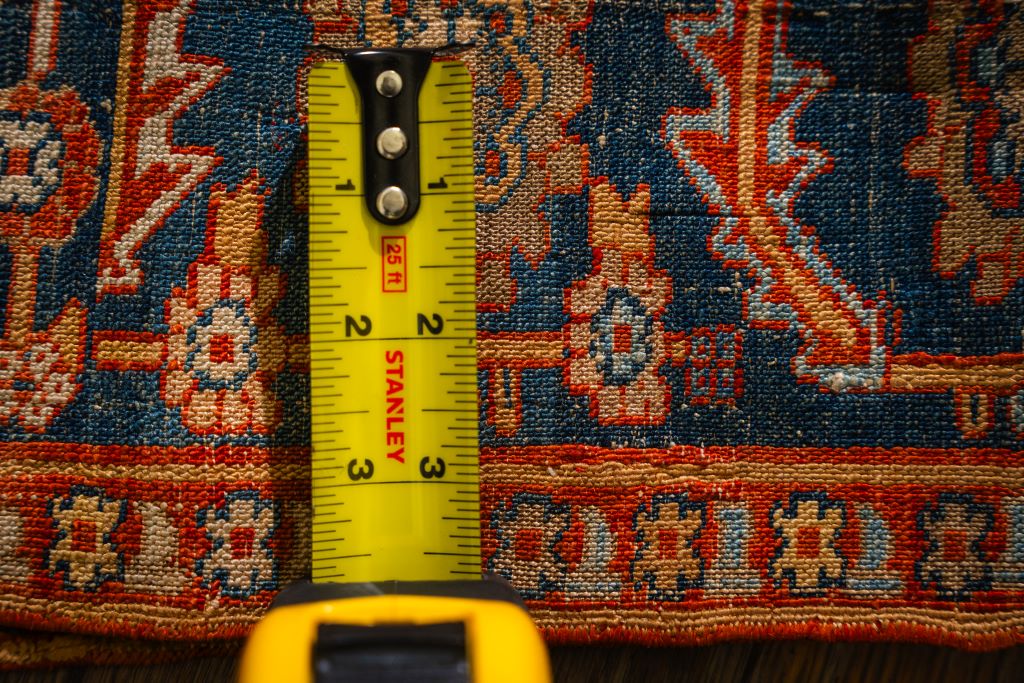
A detailed inspection of a richly colored oriental rug pattern while measuring its dimensions.
Among the factors influencing antique value, knot density is decisive. A finely woven Shirvan with a higher knot count demonstrates the weaver’s skill and allows for precise detail in medallions and motifs. Collectors and appraisers use knot density as a benchmark: the higher the number of knots per square inch, the greater the rug’s rarity and worth. While age, condition, and design complexity also matter, knot count remains one of the most consistent measures of quality in the collector’s guide to Shirvan rugs.
Trends in Collector Demand and Modern Reproduction
In today’s market, 19th-century Shirvan carpets are the most sought after, admired for their natural dyes, symbolic motifs, and impeccable craftsmanship. Prices for these pieces reflect their scarcity and cultural prestige. By contrast, early 20th-century Soviet-era rugs, with synthetic dyes and standardized patterns, command less interest among connoisseurs.
That said, the collector landscape also includes a growing appreciation for modern reproductions woven in Shirvan and across Azerbaijan. Many contemporary artisans now revive traditional methods, using natural dyes and hand-spun wool to recreate the look and feel of antique rugs. For buyers seeking the artistry of Shirvan without the high cost of antiques, these reproductions offer an accessible and authentic alternative.
Ultimately, whether investing in a rare antique Shirvan medallion rug or supporting modern workshops, collectors are guided by the same principles: craftsmanship, authenticity, and respect for tradition. The best acquisitions not only hold financial value but also carry the living legacy of Shirvan weaving into the present.
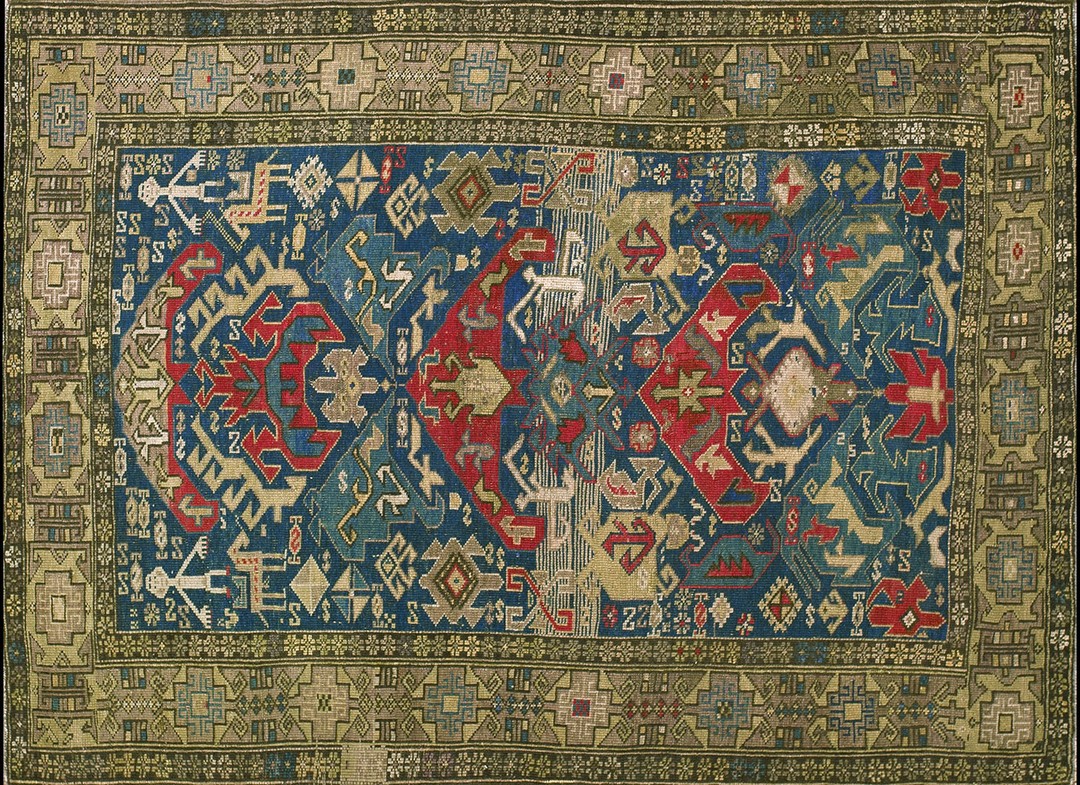
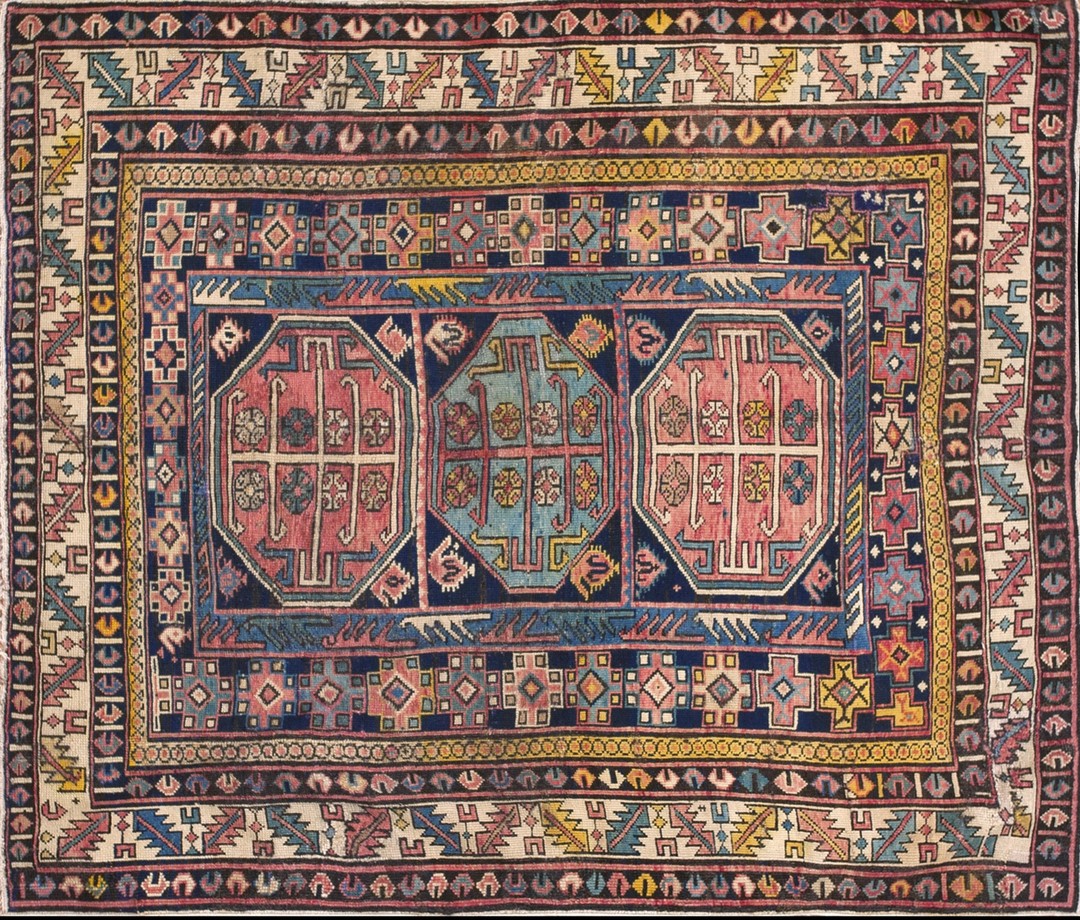
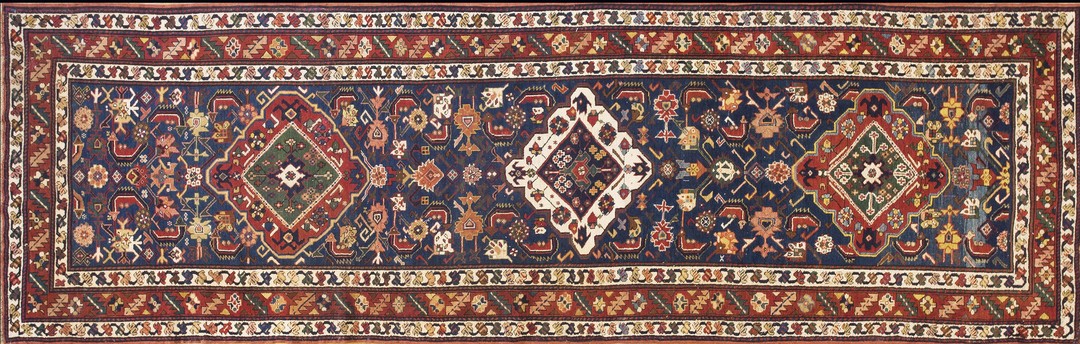
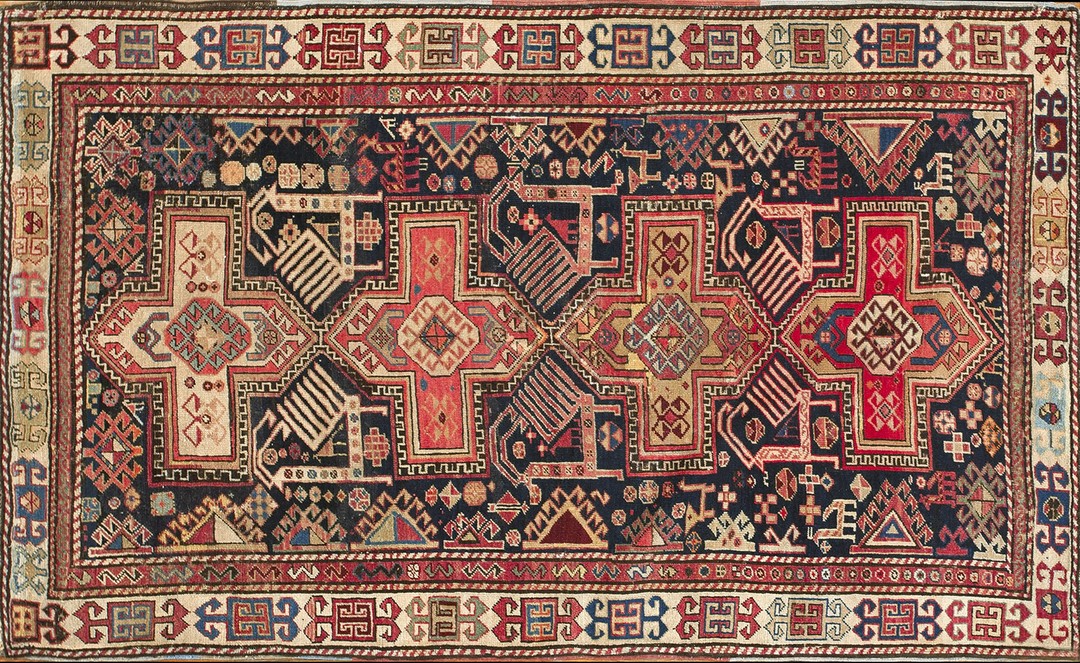
Explore a Few of Our Favorite Shirvan Rugs
FAQ
- How should Shirvan rugs be placed or layered in décor?
Use small Shirvan rugs to anchor entryways, studies, or bedside zones; runners elevate hallways. Layer over a neutral sisal/jute base for contrast and add a felt pad for stability.
- What makes Shirvan rugs collectible?
Fine weave, early dates, balanced natural dyes, and sought-after motifs (e.g., Marasali prayer or dragon designs) drive demand. Provenance and original condition can markedly increase value.
- How can I spot restoration on a Shirvan rug?
Look for shade shifts, changes in knot tension, over-repaired selvedges, or stiff latex-backed patches. Request daylight photos and a condition report for significant purchases.
- Do authentic Shirvan rugs have fringe?
Yes—fringe is the rug’s warp, not an add-on. Many Shirvan rugs show one fringed end and a looped or selvedge-finished opposite end, a helpful authenticity clue.
- Are Shirvan rugs good with pets and kids?
Patterns hide minor messes and wool naturally resists soiling. For antiques, mind claws and spills—choose darker palettes or consider a newer Shirvan-style rug in high-activity rooms.
- Do Shirvan rugs shed?
Short-pile Shirvan rugs shed minimally once settled. Light fiber release early on is normal; regular gentle vacuuming and a quality pad reduce fuzz.
- Can I use Shirvan rugs over radiant floor heating?
Generally yes; wool tolerates moderate radiant heat. Use a breathable felt pad and follow heating and pad manufacturer guidance to avoid trapping heat or moisture.
- How should I clean and care for Shirvan rugs?
Vacuum gently without a beater bar, rotate every 3–6 months, and blot spills with a wool-safe, pH-neutral solution. Professional washing every 1–3 years helps maintain fibers and dyes.
- Are new or reproduction Shirvan rugs available?
Yes—modern Caucasian-style reproductions exist from various weaving regions. Verify “hand-knotted” construction and ask about wool quality, foundation materials, and dye type.
- What colors are typical in Shirvan rugs?
Expect saturated madder red, deep indigo blue, ivory, saffron yellow, and greens. Palettes are clear and high-contrast to emphasize geometric drawing.
- Do Shirvan rugs use the Turkish (Ghiordes) knot?
Yes, Shirvan rugs predominantly use the symmetric Turkish (Ghiordes) knot. Knot density is typically fine, often around 100–200 KPSI, with some pieces exceeding that.
- What is a Marasali Shirvan rug?
“Marasali” refers to prayer rugs from the Marasali/Maraza area of Shirvan, noted for a mihrab (arch), floral trellises, and “flaming” boteh. Many date to the mid-19th century.
- What sizes are typical for Shirvan rugs and runners?
Most Shirvan rugs are small mats around 3×5 or 4×6 feet. Runners are common—often \~2.5–3 feet wide and 8–12 feet long.
- Are bright reds in Shirvan rugs natural or synthetic?
Early Shirvan reds are usually natural madder; more vivid crimson or pinkish tones often signal later aniline dyes (post-1860s–1870s). Aniline dyes can bleed if wet.
- How can I date a Shirvan rug?
Indicators include dye type (aniline reds appear from the late 19th century), foundation materials (cotton wefts in later pieces), and changing pattern density. For accuracy, seek a specialist appraisal.
- How much do Shirvan rugs cost?
Prices vary by age, condition, size, and rarity. In today’s market, many small antique Shirvan rugs run about \$1,500–\$15,000, with exceptional or early pieces exceeding \$20,000.
- How do Shirvan rugs compare to Kazak rugs?
Shirvan rugs are finer and lower-pile with tighter knots, while Kazak rugs have thicker pile and bolder, larger-scale motifs. Kazaks typically feel heavier underfoot.
- How do Shirvan rugs differ from Kuba rugs?
Shirvan rugs often have a slightly larger, more supple weave and favor medallion layouts. Kuba rugs more commonly use allover patterns with small repeating motifs.
- Are Shirvan rugs durable for everyday use?
Yes—tight knots and short pile handle traffic well, especially with a quality felt pad. Antique dyes are sensitive; avoid beater bars and direct sun to preserve color.
- What materials and knots do Shirvan rugs use?
Traditional Shirvan rugs use wool pile on wool warps and wefts with the Turkish (Ghiordes) symmetric knot. Later examples sometimes include cotton wefts for stability.
- How old are antique Shirvan rugs, typically?
Most antique Shirvan rugs were woven in the 19th and early 20th centuries. Documented dated pieces exist from as early as 1808/09.
- What designs are common in Shirvan rugs?
Shirvan rugs favor geometric medallions, boteh (paisley), and lattice fields, plus notable prayer designs. Some feature stylized “dragon/gymyl” motifs from older Caucasian traditions.
- Where do Shirvan rugs come from?
Shirvan rugs originate in southeastern Caucasus Azerbaijan, including areas around Baku and towns like Saliani and Marasali. The region’s weaving centers produced distinctive small carpets and runners.
- How do I identify an authentic Shirvan rug?
Look for a fine, symmetrically knotted wool pile, short nap, wool foundations, and neatly overcast sides. Many Shirvan rugs show 100–200 knots per square inch, with one fringed end and the other finished in loops.
- What are Shirvan rugs?
Shirvan rugs are finely woven Caucasian carpets from the Shirvan region of Azerbaijan, prized for tight knots, crisp geometrics, and small formats like mats and runners. Most antique examples date to the 1800s–early 1900s.