Turkmen Rugs
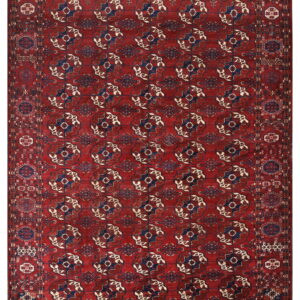
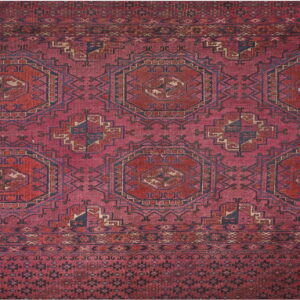
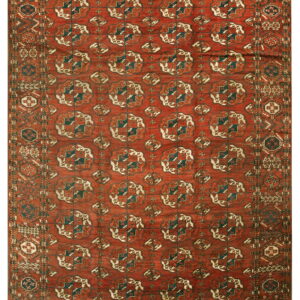
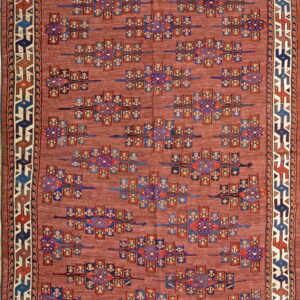
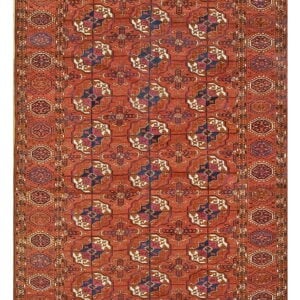
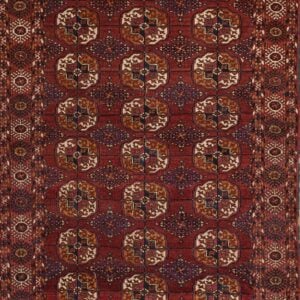
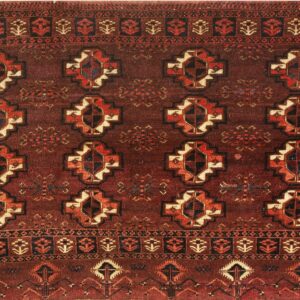
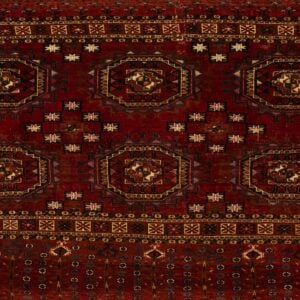
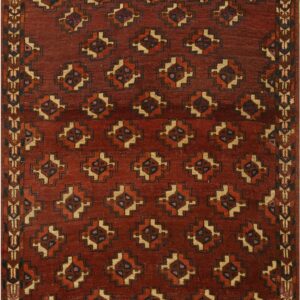
Turkmen weaving comes from the tribal confederations of Central Asia, and it is the most disciplined of all the great rug traditions. Almost every piece is built on the gul, a repeating octagonal medallion, set in ordered rows across a field that is usually dominated by deep madder red, with brown and coral as its usual companions. Dark blue and ivory, so common elsewhere, are the exception on the Turkmen pieces we hold. Each confederation favoured its own gul, which is how these rugs are attributed. The Tekke, the Ersari and the Yomud, which our listings spell Yamoud, are all represented here, while the Salor and Saryk are groups we do not currently stock. Formats follow tribal life rather than the furnished room. Alongside main carpets there are the ensi, woven to hang across the doorway of a yurt, and the bag faces that served as storage. Because the Turkmen design vocabulary travelled so widely, rugs drawing on it were later woven well beyond Turkmenistan, in Afghanistan, Persia and Pakistan, which is why the pieces gathered here span more than one origin. See also our Turkmen engsi rugs. Four measured facts about the antique Turkmen rugs we hold are worth having before you browse. Format is the first and it governs everything else: across the 41 in stock the median piece covers 21 square feet against 61 for our antique inventory, the median long side is 5.4 feet against 10.0, and not one of the 41 is larger than 150 square feet. Second, that smallness is not a discount. The median asking price is $6,375 against $9,800 across our antiques, which looks like a saving of a third, but measured by the square foot the group runs $188 against $167 and no cut matched on area shows a real reduction. Third, scale separates the confederations more clearly than anything else in our records: the 16 pieces titled Tekke have a median area of 10.5 square feet, the 14 titled Ersari or Beshir a median of 36.8. Fourth, this is the oldest group we have measured, with 32 of the 41 carrying a 19th century date and exactly one carrying a 1920s one. Our antique Turkmen rug buying and identification guide sets out the subgroup by subgroup data, the price per square foot bands, and how to separate a tribe from a function from a market town when all three appear in one name.
Prefer to see a rug in person?
-
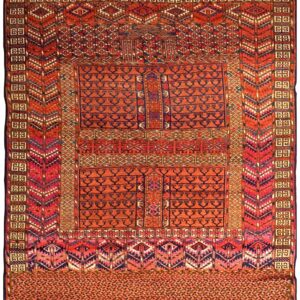
1900s Red Geometric Antique Turkmen Tekke Ensi Rug 4′ 1” X 4′ 6′ H’andknotted Wool Rug
$2,700.00 Antique RugsSKU: 40-473Rug sizes: 4 ft 1 in x 4 ft 6 in (1.24 m x 1.37 m) -
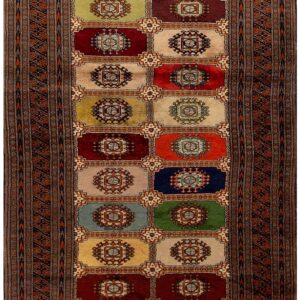
1980s Multicolor Geometric Vintage Persian Bukhara Rug Handknotted Wool Carpet
$1,200.00 Vintage RugsSKU: 40-5104Rug sizes: 4 ft x 5 ft 8 in (1.22 m x 1.73 m) -
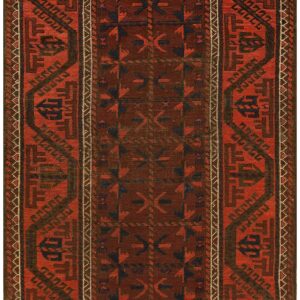
Antique Persian Baluch Rug, Hand-Knotted Wool, Central Asian Tribal
$1,700.00 Antique RugsSKU: 20-11024Rug sizes: 2 ft 9 in x 5 ft 5 in (0.84 m x 1.65 m) -
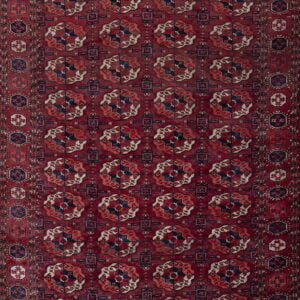
Classic Red Tribal Geometric Bokara Design 1850’s Antique Turkmen Tekke Rug
$21,999.00 Antique RugsSKU: 25280Rug sizes: 6 ft 9 in x 10 ft 3 in (2.06 m x 3.12 m) -
Red Antique Turkman Tekke Tribal Geometric Bokhara Design Rug
$11,000.00 Antique RugsSKU: 22769Rug sizes: 7 ft x 10 ft 6 in (2.13 m x 3.20 m) -
Antique Turkman – Tekke Small Scatter Size Wool Coral Rug
$1,500.00 Antique RugsSKU: 21395Rug sizes: 2 ft 4 in x 4 ft 2 in (0.71 m x 1.27 m) -
Red Bokara Design Antique Tekke Allover Tribal Geometric Turkmen Rug
$11,400.00 Antique RugsSKU: 21179Rug sizes: 6 ft 6 in x 9 ft (1.98 m x 2.74 m) -
Antique Turkmen Yamoud Hand Knotted Wool Pile Tribal Coral Rug
$6,800.00 Antique RugsSKU: 19033Rug sizes: 5 ft 2 in x 7 ft 10 in (1.57 m x 2.39 m) -
Late 19th Century Rustic Antique Turkmen Tekke Tribal Bokara Design Coral Rug
$6,000.00 Antique RugsSKU: 17783Rug sizes: 4 ft 9 in x 10 ft 9 in (1.45 m x 3.28 m) -
Antique Red Central Asian Turkman Tekke Allover Geometric Knotted Rug
$2,700.00 Antique RugsSKU: 23914Rug sizes: 3 ft 6 in x 6 ft (1.07 m x 1.83 m) -
Antique Red Central Asian Turkmen Allover Tribal Geometric Hand Knotted Wool Rug
$9,000.00 Antique RugsSKU: 23908Rug sizes: 2 ft 9 in x 4 ft 6 in (0.84 m x 1.37 m) -
Antique Turkmaan – Tekke Turkmenistan Geometric Knotted Red Rug
$22,500.00 Antique RugsSKU: 24398Rug sizes: 2 ft 4 in x 3 ft 8 in (0.71 m x 1.12 m) -
Antique Red Turkmen Turkmenistan Geometric Knotted Rug
$4,500.00 Antique RugsSKU: 24396Rug sizes: 2 ft 7 in x 4 ft (0.79 m x 1.22 m)