
What “Pile Height” Means in Rugs
Definition and Measurement Basics
Pile height is the precise measure of a rug’s thickness, defined as the distance from the foundation to the tip of the upright fibers, not including the backing or pad underneath. In rug terminology, the pile refers to the vertical tufts that create the face of the rug and provide texture underfoot.
When asking what is pile height, the answer is a technical measurement, usually expressed in inches or millimeters, that directly shapes how a rug feels, how detailed its design appears, and how it will wear over time. Unlike overall rug thickness, which may include multiple construction layers, rug pile measurement isolates only the visible fiber length, giving a standardized way to compare different area rugs.
 0.25 Pile |  0.5 Pile Carpets |
Cut vs. Loop vs. Cut-Loop
- Cut rug pile — Fibers are sheared at the top, creating an upright, velvety surface that feels soft and plush. Offers comfort and a smoother look, though it may show footprints or vacuum marks more easily.
- Loop rug pile — Fibers are left uncut, forming closed loops on the surface. Delivers excellent durability and a flatter appearance, ideal for high-traffic spaces.
- Cut-loop rug pile — A mix of sheared and uncut fibers arranged to form sculpted patterns. Adds dimension and textural variety, commonly found in modern and decorative designs.
Pile Height Ranges: Low, Medium, High
| Range | Inches | Millimeters | Typical Use |
|---|---|---|---|
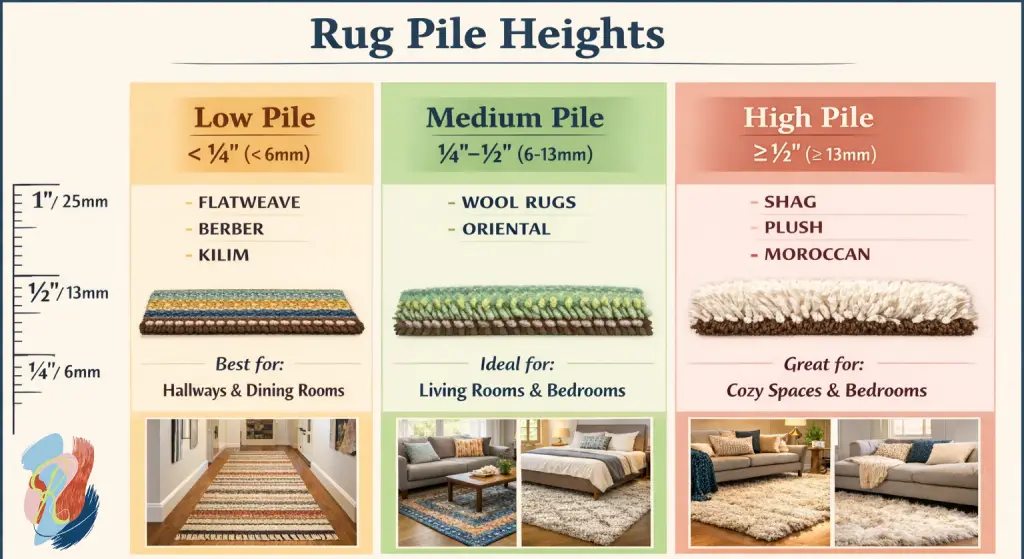
| Low pile | < ¼″ | < 6 mm | Easy cleaning, high-traffic areas, design detail clarity |
| Medium pile | ¼″–½″ | ~6–13 mm | Balanced comfort and maintenance, versatile in living rooms and bedrooms |
| High pile | ≥ ½″ | ≥ 13 mm | Plush, luxurious feel, cozy spaces like lounges and bedrooms, more upkeep required |
Why Pile Height Matters
The difference between low vs high pile goes far beyond aesthetics. Low pile rugs highlight intricate motifs and resist crushing, while high pile rugs emphasize comfort and warmth but demand more care. Medium pile often strikes the most practical balance.
Regardless of category, it is critical to measure actual rugs, since stated ranges are guidelines rather than strict rules. Ultimately, rug thickness influences appearance, touch, durability, and ease of cleaning, making pile height one of the most important factors in rug selection.
How Pile Is Built: Structure & Materials
Foundation, Knots, and Shearing
- Knots around warps — The pile begins when yarns are tied around vertical warp threads. These knots anchor each tuft securely, determining the rug’s durability.
- Wefts lock rows — Horizontal wefts pass between knots, pressing them in place. This interlocking creates a stable rug construction that holds the pile upright.
- Shearing the surface — After weaving, the pile is clipped down to a uniform length. Shearing sets the final pile height, shaping the rug’s texture, clarity of pattern, and feel underfoot.
Knot Types: Turkish vs. Persian
| Knot Type | Texture & Look | Typical Regions |
|---|---|---|
| Turkish (symmetrical) | Balanced, sturdy feel; pile stands upright with even thickness | Anatolia (Turkey), Caucasus |
| Persian (asymmetrical) | Allows finer detail, smoother flow in curvilinear motifs | Iran, Central Asia, India |
The type of knot affects the precision of the pattern and the tactile qualities of the rug. Turkish knots create strong, geometric impressions, while Persian knots favor fluidity and intricacy.
Fiber Choices by Pile Height
Wool is the most versatile fiber in rug construction, capable of supporting low, medium, or high pile. Its natural resilience allows both durability and softness. Silk is almost always clipped low, since its fineness reveals extraordinary detail but lacks the bulk for tall piles.
Synthetics such as nylon or polypropylene vary widely—some mimic the plushness of high pile, while others are engineered flat for easy cleaning. The pairing of density and fiber directly limits what pile height is workable; for example, a dense silk foundation is usually sheared short, while a wool tribal rug may carry a long shaggy pile.
Why Density Matters Alongside Height
When comparing pile height vs density, neither factor works in isolation. A tall pile with low density may collapse quickly, while a short, densely knotted pile can last for generations. Density sets the structural backbone, but shearing is what determines the rug’s final look and feel. When shopping for rugs, the most durable results come from considering both together: density for longevity, height for texture and visual impact.
Measuring Pile Height Correctly
Tools and Technique
- Calipers or ruler — Place the tool vertically at the rug’s surface and measure from the foundation to the pile tip. This ensures you capture the true rug pile measurement rather than total thickness, which may include backing.
- Millimeters and inches — Record in both units when possible. Sellers and buyers often list sizes differently, and mm vs inches pile conversions prevent confusion.
- Groom fibers first — Brush or lift flattened tufts before measuring. Crushed spots can give artificially low numbers and distort results.
Where to Measure on Handmade vs. Tufted
In handmade rugs, no two areas are identical. Measure multiple points across the field and borders, then average the results to reflect natural variation.
For tufted or machine-made rugs, measurements should exclude the latex or secondary backing; only the visible fiber length counts toward thickness. Because industrial construction is more uniform, a single sample point often suffices—but averaging is still best practice.
Common Measuring Errors
- Including backing layers: This inflates thickness, making the rug appear denser or higher-pile than it truly is.
- Measuring only one point on a handmade rug: These rugs vary knot by knot; consistency comes from averaging, not a single number.
- Using crushed traffic zones: Footworn areas sit lower than untouched corners, giving misleadingly low readings.
- Confusing overall rug thickness with pile height: Pads, adhesives, and base fabrics add bulk but are not part of the measured pile.
Why Consistency Matters
When deciding how to measure carpet thickness, accuracy comes from repetition and range, not perfection. Especially for hand-knotted pile rugs, buyers should expect stated pile height to reflect an approximate range rather than an absolute figure.
In every case, consistency in method ensures results that can be fairly compared across rugs and listings.
Low Pile (≤ ~6 mm / ≤ ¼″)
Why Weavers Shear Low
Low pile rugs are deliberately clipped short to emphasize design clarity. A shorter pile exposes each knot more directly, allowing medallions, borders, and intricate allover motifs to appear sharp and readable.
This is especially important in silk rugs, where low shearing prevents the delicate fibers from collapsing under weight. High-density foundations are typically paired with low pile, ensuring the rug can sustain both durability and visual precision over decades.
Best Rooms and Uses
- Dining rooms: Chairs slide smoothly across a low rug pile, avoiding snags.
- Hallways, Foyers and Entryways: Durable rugs for hallways must withstand heavy foot traffic, and low pile resists matting.
- Offices: Rolling desk chairs function best on flatter rugs.
- Formal living areas: Low pile highlights ornate designs, making it ideal for display-quality rugs.
Maintenance Advantages
- Easier vacuuming: Fibers are shorter, so dirt and debris stay near the surface.
- Lower risk of crushing: The structure holds up against compression, preserving the rug’s original shape.
- Reduced allergen build-up: Dust and pet dander settle on top rather than sinking deep into fibers.
Why Low Pile Excels in High-Traffic Areas
When asked is low pile better for high-traffic hallways, the answer is yes. Low pile rugs combine density with a short surface, making them resilient under constant use.
They maintain appearance longer, resist wear from shoes, and are simple to clean compared to medium or high pile options. For anyone prioritizing durability and pattern sharpness, low pile is the most practical choice.
Medium Pile (~6–13 mm / ¼″–½″)
Balanced Comfort vs. Detail
A medium rug pile offers the best of both worlds: enough fiber height to provide a soft, cushioned feel, yet low enough to preserve design clarity. Everyday hand-knotted village rugs and traditional workshop pieces often fall in this range.
This makes it the most common and versatile pile height in global weaving traditions. Medium pile rugs are particularly well-suited for households seeking both coziness and practical durability.
Ideal Placements
- Living rooms: Considered the best rug for living rooms, medium pile balances comfort for lounging with resilience for daily traffic.
- Family rooms: Cozy but durable rugs in this range withstand children playing, pets moving about, and frequent use.
- Bedrooms: Provides warmth underfoot without overwhelming the space, creating a comfortable retreat.
Cleaning and Care
- More dust retention than low pile: Fibers are longer, so particles settle deeper; requires stronger vacuuming.
- Still manageable upkeep: Not as demanding as high pile rugs, medium pile remains easy to maintain with regular cleaning.
- Pet- and kid-friendly: Offers softness for play while maintaining enough density to resist matting.
Why Medium Pile Fits Most Homes
When asked what pile height works best for living rooms, medium pile consistently emerges as the most practical option. It is a good compromise for families with kids and pets, combining comfort, versatility, and visual appeal.
With proper care, medium pile rugs deliver long-lasting durability while keeping spaces cozy and inviting.
High Pile (≥ ~13 mm / ≥ ½″)
Plush Texture Tradeoffs
High pile rugs deliver a luxurious, plush texture that feels indulgent underfoot. However, the same depth that creates softness also reduces pattern clarity and makes designs appear blurred.
Fibers compress easily, leaving visible impressions from footsteps or furniture. Crumbs and dust can sink deep into the pile, making cleaning more demanding. In short, high pile provides unmatched comfort but comes with higher upkeep and more visible wear.
Moroccan, Gabbeh, and Tibetan Examples
- Moroccan shag rugs: Known for their thick wool and cozy, relaxed look, they emphasize comfort and warmth over intricate detail.
- Gabbeh rugs: Tribal Persian weavings with thick pile and bold, simple patterns, highlighting tactile richness rather than fine precision.
- Tibetan rugs: Often woven with a distinctive loop-and-cut technique, they showcase thick pile and a dense, cushioned feel.
Where High Pile Works
- Bedrooms: A high pile bedroom rug adds softness for bare feet, creating a cozy retreat.
- Lounges or reading nooks: Plush rugs enhance comfort in low-traffic areas designed for relaxation.
- Accent or statement spaces: A shag rug can be a focal point, prized for texture rather than durability.
Dining Rooms and Furniture Considerations
When asked are high-pile rugs okay for dining rooms, the answer is generally no. Chairs snag and crumbs become embedded, making maintenance difficult. Likewise, furniture legs dent high-pile rugs more. This is because the longer fibers compress under pressure, dents from tables, sofas, or chairs are more pronounced and often slow to recover.
For heavy-traffic or furniture-heavy rooms, lower piles perform better.
High pile rugs should be chosen for comfort statements rather than durability, with the understanding that they demand more care and are best reserved for intimate, low-traffic spaces.
Variable Heights: Carving, Hi-Lo, and Mixed Constructions
Sculpted and Carved Effects
Beyond the standard low, medium, or high categories, some rugs use sculpted pile to add dimensionality. Carving involves shaving down background areas so motifs stand in relief.
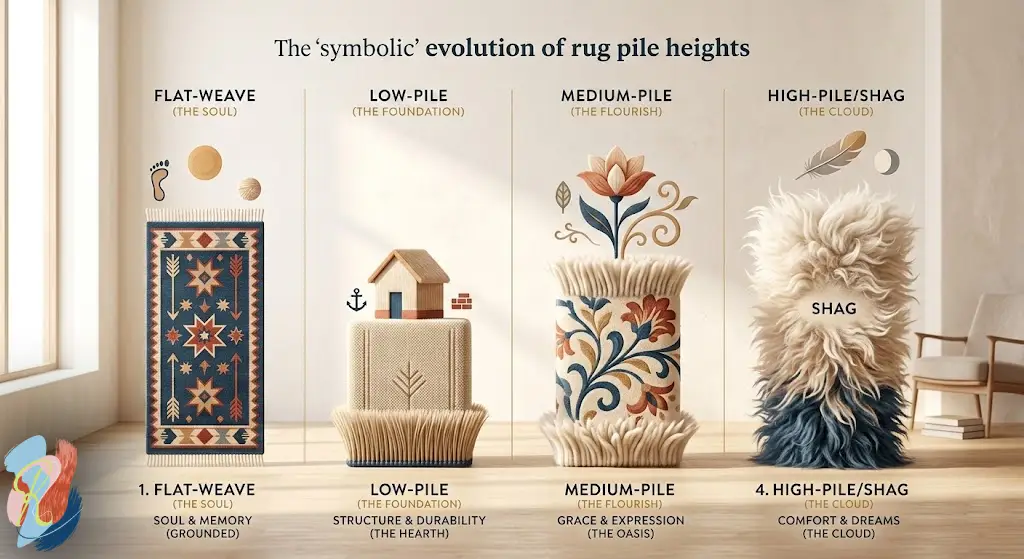
This technique unifies principles from all ranges: a low background height for clarity, a medium height for balance, and occasional higher tufts for plush impact. The result is a rug where design is not only seen but also felt underfoot, with patterns raised like bas-relief.
Loop–Cut Patterning
- Alternating loop and cut pile: Creates bold graphics with contrast in height and texture.
- Hi-lo textures: Break up flat fields, adding rhythm and visual movement.
- Shading effects: Different pile heights reflect light at varying angles, producing depth and subtle tone shifts.
This style of high low rug construction is especially common in contemporary pieces, where texture itself becomes a design language.
Regional Examples
Chinese Deco rugs of the early 20th century are classic carved rug examples, with motifs like lotus flowers or pagodas lifted above recessed fields. Tibetan and Nepalese weavings often combine loop-and-cut techniques, producing sculpted pile carpets that emphasize texture as much as pattern.
These traditions have carried into modern interiors, where carved and hi-lo designs remain popular.
Cleaning Considerations
While variable heights add beauty, recessed areas trap dust and debris more easily, requiring deeper vacuuming or professional cleaning to maintain crisp definition. When buying area rugs, people should weigh aesthetic impact against upkeep.
Style Relevance Today
When asked are carved high-low textures still in style, the answer is yes. From Art Deco revivals to contemporary minimalist graphics, height variation remains a respected design tool that brings depth and tactile richness to rugs.
Origins & Regional Signatures
Ancient to Court Workshops
- Imperial courts: Court carpets, especially Persian masterpieces, were woven with low, closely sheared piles to highlight curvilinear detail and refined artistry.
- Village and nomadic traditions: Traveling weavers needed rugs that doubled as bedding or insulation, so they favored thicker piles for warmth and practicality.
- Tribal production: Coarser, higher piles reflected functional needs over formal display, emphasizing resilience in harsh climates.
Nomadic vs. City Piles
| Context | Pile Habit | Why |
|---|---|---|
| Nomadic rugs | Thicker, longer pile | Provided insulation and padding for tent floors and sleeping use |
| City rugs | Low, precise pile | Allowed high knot counts and crisp curvilinear motifs suitable for palaces and courts |
This contrast shows that pile height was never random: it mirrored lifestyle demands as much as artistic preference.
Regional Contrasts
- Caucasus — Southern Caucasian rugs are known for thicker, coarser piles, suited to colder, mountainous living. By contrast, Northern Caucasian pieces were often cropped closer, emphasizing pattern clarity.
- Anatolia (Turkey) — Many Anatolian village rugs carry thicker piles than their Persian city counterparts, prioritizing warmth and durability over intricate detailing.
- Persia (Iran) — Persian city workshops, such as those in Isfahan or Kashan, traditionally wove rugs with low, finely clipped piles, reflecting their emphasis on detail, symmetry, and refinement.
Pile and Perceived Quality
Thicker pile does not mean better quality. Thickness alone signals function, not superiority. A high-pile nomadic Gabbeh is not inferior to a low-pile Persian court carpet; each reflects its maker’s environment and purpose. Quality lies in materials, knot density, and execution, not in whether a rug is thick or thin.
In every region, climate and lifestyle shaped pile norms, and recognizing these signatures helps identify origin while setting realistic expectations for pile height.
History of Pile Preferences
Golden-Age Low Piles for Detail
During the golden age of weaving, especially in Persian and Mughal court workshops, rugs were clipped to low piles to sharpen curvilinear designs and intricate motifs. As noted earlier, shorter fibers revealed knot precision and created clarity prized in palatial settings. These historic preferences highlight how early weavers equated low pile with refinement and artistic excellence.
Industrial Plush and 1970s Shags
- Machine tufting innovations: The rise of tufting in the 20th century allowed manufacturers to produce extremely tall piles quickly and cheaply, fueling the popularity of shag carpets.
- Décor trends: Shag carpet history shows how cultural fascination with comfort and casual interiors led to wall-to-wall installations with deep, plush fibers. The look prioritized softness and lifestyle ease over fine rug design visibility.
- Postwar prosperity — Why: Greater disposable income encouraged consumers to embrace thicker, “luxury feel” flooring as a symbol of modern living.
Contemporary Swings: Distressed vs. Shag
- Zero-pile distressed finishes: Designers today use aggressive shearing and antique washes to create rugs that appear timeworn, catering to the taste for vintage minimalism.
- Ultra-plush statements: At the same time, interior design embraces oversized shag or high-pile rugs as statement pieces, echoing the comfort-driven ethos of the 1970s but with modern fiber technology.
- Market duality: Current rug history pile height cycles show that extremes—flat, distressed surfaces and lush, shaggy piles—coexist to meet contrasting style preferences.
Why Low-Pile Rugs Are Trending Now
A common question is why are low-pile modern rugs trending now? The answer lies in practicality and aesthetics. Consumers favor low pile for its durability, ease of cleaning, and compatibility with high-traffic spaces.
In an era where open-plan living and multipurpose rooms dominate, rugs that offer crisp design and minimal upkeep align with modern lifestyles. At the same time, low pile supports the distressed trend by making antique-style wear easier to achieve.
Pile fashion has always reflected technology and lifestyle shifts—from courtly low-pile masterpieces to midcentury shag booms to today’s dual trends. The modern market supports both ends of the spectrum, proving that rug thickness continues to evolve with cultural taste.
Pile Height by Room & Lifestyle
Room Recommendations
| Room | Recommended Pile | Reason |
|---|---|---|
| Living Room | Medium (~6–13 mm) | Balanced comfort and durability; cozy for lounging yet easy to maintain |
| Dining Room | Low (≤ 6 mm) | Chairs glide smoothly; crumbs stay on surface for easier cleanup |
| Bedroom | Medium to High (≥ 13 mm) | Plush comfort underfoot; emphasizes coziness and relaxation |
| Nursery/Kids’ Room | Low–Medium (~6–10 mm) | Soft enough for play yet short enough for easy cleaning and reduced allergen build-up |
These ranges show that the best rug pile height by room depends on balancing function with comfort.
Traffic and Chair Movement
- Low rug pile for dining rooms: Dining spaces need rugs where chairs can move without snagging; low pile ensures smooth sliding and easy crumb removal.
- Medium rug pile for busy family areas : Provides softness without matting down quickly under daily traffic.
- High rug pile in low-use zones: Shag rugs add luxury to intimate spaces but aren’t suitable for constant wear.
Pets, Allergies, and Robot Vacuums
- Pet owners: Low or medium pile works best, as fur sits near the surface and vacuums more effectively.
- Allergy-friendly rugs: Low pile rugs trap fewer dust particles, while shag rugs trap more allergens deep in fibers.
- Robot vacuum compatibility: How does pile height impact robot vacuums?
- Low pile excels because the machine can glide easily, while tall shag or high pile rugs may stop the unit or cause clogging.
Practical Takeaways
Rugs for kids’ rooms and nurseries – a low-to-medium pile is ideal: soft enough for crawling and play but still easy to clean and maintain. For allergy-conscious households, shag rugs do trap more dust and allergens, making low pile the healthier choice.
Above all, match pile to function first, style second, considering traffic patterns, cleaning routines, and even whether robotic vacuums are part of your lifestyle.
Performance & Durability Signals
Pile Height vs. Density
When comparing rug density vs height, it is essential to recognize they are not the same. Pile height describes fiber length, while density measures how tightly knots or tufts are packed into the foundation.
A short but dense rug can outlast a taller, looser one. Quality assessments should weigh fiber type, density, and construction together. Height alone does not equal durability.
Furniture Dents and Recovery
- Low rug pile, high density: Fibers are tightly packed and short, so they resist crushing and bounce back quickly under furniture.
- Medium rug pile: Offers moderate resistance but may show impressions over time; occasional grooming helps recovery.
- High rug pile: Longer fibers collapse easily, leaving visible dents from chair or sofa legs. Furniture coasters and rug rotation help mitigate this.
Furniture legs will dent high-pile rugs more. This is due to the fact that deep, plush rugs are more prone to permanent impressions.
Pads by Pile Height
| Pile Range | Recommended Pad Type | Pad Thickness |
|---|---|---|
| Low pile | Thin, firm, non-slip | ~ ⅛–¼″ |
| Medium pile | Balanced felt + rubber | ~ ¼″ |
| High pile | Cushioned, grippy pad | ~ ⅜–½″ |
The best rug pad depends on pile: thin and firm pads preserve stability for low rugs, while thick cushioned pads enhance comfort and grip for shags.
Key Takeaway
When asked is pile height or density more important, density usually wins for performance, though both matter. Dense low piles resist wear best, while taller piles provide comfort but require more maintenance.
Pairing the right pad with the right pile height dramatically improves longevity, stability, and everyday function.
Clearance, Doors, and Layout
Door Swing Thresholds
Pile height directly impacts whether a rug can fit beneath a swinging door. The thicker the rug, the less likely a door will swing freely. Always measure the total stack height—rug plus pad—before installation.
For example, a medium pile rug at ½″ paired with a ¼″ pad creates a ¾″ stack, which may block standard doors. Low pile rugs are the safest option where rug under door clearance is tight. If needed, beveled thresholds or thinner pads can reduce the overall profile.
Under-Furniture Behavior
- Low rug pile: Chairs roll and slide easily, making it ideal for desks, dining sets, and high-use areas.
- Medium rug pile: Furniture sits stably but may leave mild impressions; manageable with rotation.
- High rug pile: Furniture legs can sink, creating dents and uneven balance. Not ideal for movable chairs.
Transition Edges and Tripping
- Thick rugs at thresholds: A tall carpet thickness at doors can create raised edges that trip occupants.
- Tapered pads: Gradual slopes reduce trip hazards and make vacuuming easier.
- Edge binding: Keeps the rug pile from fraying and lowers the risk of snags at transitions.
Practical Limits
In most homes, rugs plus pads should stay under ~½″ to ¾″ total thickness for smooth operation. Beyond that, doors may drag or require trimming. Careful planning of pile height, pad choice, and edge finishing ensures safe layouts that avoid clearance issues and tripping risks.
Modern Production & Treatments
Tufted and Loomed Controls of Height
- Tufted rugs: Machines punch yarn through a backing, then apply latex to secure it. Loop length can be set precisely, and shearing brings the pile to the target height.
- Loomed rugs: Power looms replicate knot effects but control fiber length mechanically, ensuring uniform rug thickness across mass production.
- Cutting precision: Industrial processes make it possible to deliver consistent low, medium, or high pile with little variation, unlike handmade rugs where averages matter.
Antique and Luster Washes with Shearing
Modern finishing can dramatically alter a rug’s pile. Antique wash rugs are chemically treated to soften colors and fibers, often thinning the pile in the process. Luster wash increases sheen by stripping fuzz from wool but reduces resilience, making rugs more vulnerable to wear.
Shearing is another step, evening out irregular surfaces or lowering pile to expose design clarity. The risk: every chemical wash or extra shearing cycle shortens the rug’s structural lifespan. Buyers should always ask sellers about finishing and shearing history, since appearances can mask reduced durability.
Overdyed and Zero-Pile Trends
- Overdyed rugs: Created by stripping or bleaching pile, then dyeing in bold tones; often left with overdyed low pile or even near-zero pile surfaces for a distressed look.
- Zero-pile rugs: Entirely shaved to the foundation, producing a flat, textile-like effect popular in modern minimalist interiors.
- Design appeal: These treatments highlight color and texture more than fiber depth, suiting urban and contemporary tastes.
Practical Considerations
Should vintage rugs be sheared to lower pile? In general, no—unless pile is severely uneven, shearing can erase history and reduce value.
Hand-knotted rugs can be re-sheared safely. That said, this should only by be done by experts and only to restore surface level; aggressive cutting risks exposing knots and weakening structure.
In today’s market, pile manipulation is as much about fashion as structure. Chemical finishes change both look and longevity, making it vital for buyers to balance desired appearance with long-term performance.
Conservation & Restoration
“Full Pile” vs. Even Wear
- Full pile rugs: These retain their original thickness, showing minimal use, which is prized for durability and resale value.
- Even wear: Collectors often prefer rugs that have worn down consistently across the surface, as it suggests authentic age and honest use. Uneven wear, by contrast, indicates neglect or poor maintenance.
Re-Piling Ethics and Methods
Re-piling replaces lost fibers by inserting new knots into the foundation. The method requires matching original knot type, density, and fiber choice. While effective, it alters the rug’s originality, so all re-piling work must be disclosed to preserve transparency in the market.
Ethical restorers prioritize stabilizing the structure rather than disguising age. Aesthetic perfection should never come at the cost of structural integrity.
Hand-knotted rugs can be re-sheared safely but only under professional care. Re-shearing can level uneven wear, but excessive cutting risks exposing knots or shortening the rug’s life.
Preventive Care by Pile Height
- Low rug pile: Cleans easily since dust rests near the surface; regular light vacuuming maintains clarity.
- Medium rug pile: Requires deeper vacuuming and periodic rotation to distribute wear evenly.
- High rug pile / shag: Do shag rugs trap more dust and allergens?
- Yes, because fibers are long and deep. To clean shag rugs properly, frequent shaking, specialized vacuums, or professional washing is required.
Conservation Principles
The guiding rule in rug conservation is simple: preserve structure first, aesthetics second. All interventions—whether re-piling, re-shearing, or deep cleaning—should be documented for provenance, ensuring future owners understand the rug’s history. By aligning preventive care with pile type, owners can slow wear, protect fibers, and extend the lifespan of valuable textiles.
Buyer’s Guide: Choosing the Right Pile
Decision Tree
- Step 1: Room use: Dining rooms need low pile for chairs, while bedrooms welcome plush comfort.
- Step 2: Traffic level: Hallways demand durability, so low pile is best; family rooms balance with medium pile.
- Step 3: Chair movement: Rolling or sliding furniture works only on flatter rugs.
- Step 4: Cleaning tolerance: If you want easy vacuuming, avoid shag; if you don’t mind deeper cleaning, high pile adds luxury.
- Step 5: Style preference: Low vs medium vs high pile changes not just feel but also design clarity and atmosphere.
This sequence helps buyers choose rug pile logically, preventing style-driven decisions that later conflict with daily needs.
Myths vs. Facts
| Claim | Reality | Why |
|---|---|---|
| “Thicker rugs last longer” | False | Density and fiber quality outweigh raw thickness for longevity. |
| “High pile hides wear best” | Partly false | While high pile masks footprints, it also dents and traps dust more easily. |
| “Patterns are always clear” | False for shags | Does high pile hide patterns and borders? Yes—designs blur as pile gets taller. |
| “Low pile feels uncomfortable” | Not always true | Dense low piles can still feel cushioned while keeping patterns sharp. |
When Custom Specs Help
Some situations require tailoring pile height. Odd-shaped rooms, stair runners, and tight door clearances benefit from custom-specified pile and pad combinations. Testing total stack height (rug + pad) against door swings prevents costly surprises. Similarly, stair runners often need lower pile for safety, while bespoke projects may call for a specific tactile effect.
Practical Recommendations
- What rug pile height works best for living rooms?
- Medium pile strikes the balance of comfort, design clarity, and durability.
- What rug pile height suits kids’ rooms and nurseries?
- Low-to-medium pile is safest—soft but still easy to clean and allergy-friendly.
- Does high rug pile hide patterns and borders?
- Yes, taller fibers reduce clarity, so choose low or medium pile if you want visible motifs.
Ultimately, the best rug pile height is the one that matches your room’s use and your lifestyle habits. Function-first selection prevents regrets, ensuring rugs remain both practical and beautiful for years to come.
FAQ
- How long should a rug with a given pile height last?
With care, low/medium piles can last 7–15+ years in living spaces. High pile may show traffic lanes sooner without rotation and pads.
- What rug pile height suits homes with underfloor heating?
Low to medium pile (≤0.5″) with breathable natural fibers improves heat transfer. Verify pad is heat-safe.
- How does rug pile height affect tripping risk?
Higher piles and thick pads increase edge lift. Keep transitions under ~0.5″ and use beveled pads or tape at edges.
- What rug pile height is best for entryways and mudrooms?
Low pile or flatweave (≤0.25″) handles grit and frequent vacuuming. Use a scraper mat outside to reduce soil.
- For US listings, is rug pile height shown in inches or millimeters?
Most US retailers list rug pile height in inches (e.g., 0.39″). Some show millimeters; 10 mm ≈ 0.39″.
- Is there a maximum practical rug pile height for homes?
Beyond ~0.75–1″, maintenance rises sharply and doors, robots, and chairs struggle. Reserve deep shag for low-traffic lounge spots.
- How do rug pads interact with rug pile height?
Consider total stack: rug pile height + pad. For doorways, keep combined thickness under ~0.5–0.6″ to avoid rubbing.
- What rug pile height resists furniture dents best?
Dense medium pile (≈0.35–0.5″) rebounds better than ultra-low, but use pads and move legs periodically. Caps spread weight.
- Are flatweaves considered a rug pile height category?
Flatweaves have near-zero pile height. They’re great for doors and dining rooms, often measuring under 0.2″ with pad.
- How does rug pile height impact cleaning and vacuum settings?
Lower pile tolerates higher suction; high pile needs adjustable height or “high carpet” mode. Vacuum with the nap direction.
- Do robot mops and wet cleaners affect shag rug pile height?
Avoid mopping high pile; fibers can retain moisture and soil. Set no-mop zones or lift-mop modes for piles ≥0.5″.
- Is a thicker rug pile height warmer or quieter?
Generally yes—more fibers absorb sound and provide insulation. Even moving from 0.25″ to 0.5″ can noticeably reduce echo.
- What rug pile height works under rolling office chairs?
Low pile (≤0.25–0.35″) or a flatweave with a hard chair mat. Larger 3″ casters roll better over short pile.
- How does rug pile height affect door clearance?
Interior doors usually have a 0.5–0.75″ gap. Subtract pad thickness to choose a rug pile height that won’t scrape.
- What rug pile height is compatible with robot vacuums?
Most bots perform best on low to medium pile (typically under ~0.6–0.8″). Very deep shags (≥1″) can tangle brushes.
- What rug pile height is most pet-friendly?
Low to medium pile (≤0.5″) resists snagging and cleans faster. Loop piles hide hair but can catch claws—prefer tight cut pile.
- Which rug pile height is better for allergies or asthma?
Low pile (≤0.25–0.35″) holds fewer allergens and vacuums easier. Use a HEPA vacuum weekly.
- What rug pile height is ideal for bedrooms?
High pile (≈0.5–0.75″) or plush feels cozy underfoot. Keep it away from closet doors and choose ≤0.5″ near swing areas.
- What rug pile height works best in a living room?
Medium pile (≈0.25–0.5″) balances comfort and care. Add a pad to reach 0.5–0.75″ total thickness for cushioned feel.
- What rug pile height is best for a dining room?
Low pile (≤0.25–0.35″) lets chairs slide smoothly and traps fewer crumbs. Aim for short, dense cut pile or flatweave.
- What rug pile height is best for high-traffic areas?
Choose low pile (≈0.25″ or less) for durability and easy vacuuming. Dense, loop or cut-loop constructions resist matting in hallways.
- Does a higher rug pile height mean better quality?
No—quality depends on fiber, density, and construction. Some premium hand-knotted rugs are under 0.3″ yet outlast thicker synthetics.
- How do I measure rug pile height accurately at home?
Press a ruler to the backing and read to the fiber tip (not including pad). Check multiple spots; differences of 1/8″ are normal on handmade rugs.
- How are low, medium, and high rug pile heights defined?
Common ranges: low pile under ~0.25″, medium 0.25–0.5″, high 0.5–0.75″+. Shag rugs can exceed 1″.
- What does rug pile height mean in area rugs?
Rug pile height is the thickness from backing to fiber tip. Measure with a ruler from base to tip; most home rugs range roughly 0.2–0.75 inches.