
Oushak Rugs at a Glance
Discover our exceptional range of authentic Oushak rugs available now.
What Defines an Oushak Rug?
The basics are as follows:
- Origin in Uşak, Anatolia — Why: The town of Uşak in western Turkey became one of the most important weaving centers of the Ottoman Empire, establishing a reputation for carpets that balanced courtly refinement with regional craftsmanship.
- Luminous Wool Quality — Why: Oushak rugs are renowned for their silky, glossy wool, which gives even muted tones a glowing appearance and makes them instantly recognizable among Turkish carpets.
- Large-Scale Designs — Why: Instead of tight repeats or busy fields, Oushak weavers favored expansive star Ushak or medallion Oushak layouts, creating carpets that feel grand in scale but calm in presence.
- Soft Palette Turkish Carpets — Why: Their pastel hues—ivory, soft blues, golds, terracotta, and faded greens—set them apart from deeper-toned Persian rugs, making them adaptable to both traditional and modern interiors.
- Enduring Collector Value — Why: Because of their iconic design vocabulary and presence in art history, Oushak rugs remain highly sought after by museums, designers, and collectors.
Visual Identity: Medallions, Stars, and Palettes
The visual vocabulary of Oushak rugs is dominated by monumental medallions and radiant stars that fill the field with a sense of celestial balance. These designs are often framed with palmettes, scrolling vines, or stylized floral motifs that echo both Ottoman court art and local Anatolian traditions.
The star Ushak pattern, with its radiating geometry, was one of the earliest Turkish carpet designs to achieve international fame, circulating through trade into European homes and churches. Their color identity is equally distinct.
Unlike the saturated reds and deep blues of other Ottoman carpets, Oushak rug features include soft, almost watercolor palettes: terracotta that feels sun-warmed, pale ivory grounds, gentle sky blues, and touches of golden ochre. This softness gives them a rare ability to feel simultaneously monumental and intimate, suitable for both palace halls and domestic settings.
The Angora Glow: Understanding the Fiber
What truly sets an Oushak apart is the quality of its fleece. Many of the most prized 19th-century examples utilized Angora wool (from the goats of the Ankara region). This fiber is naturally more lustrous and takes dyes with a watercolor-like transparency. When light hits an Angora Oushak, it doesn’t just reflect; it seems to glow from within. This is why Oushaks remain the most “luminous” of all Oriental rugs.
Why Are Oushak Rugs Historically Significant?
Oushak rugs occupy a pivotal place in both Ottoman art history and the European decorative imagination. From the fifteenth century onward, they were woven not only for domestic use but also as diplomatic gifts and religious offerings. Many were presented to mosques, where their monumental size and luminous color imbued sacred spaces with grandeur.
In Ottoman palaces, they functioned as markers of wealth and refinement, aligning textile art with imperial identity. Their global resonance emerged when Oushak carpets appeared in European Renaissance paintings. Artists such as Hans Holbein, Lorenzo Lotto, and Vermeer placed Ottoman carpets—often star or medallion patterns—beneath the feet of monarchs, saints, and merchants.
These depictions elevated the rug into a symbol of status, refinement, and cosmopolitan taste. By embedding Oushak designs in portraiture and altarpieces, European artists ensured their place not just in decorative arts but also in Western cultural memory.
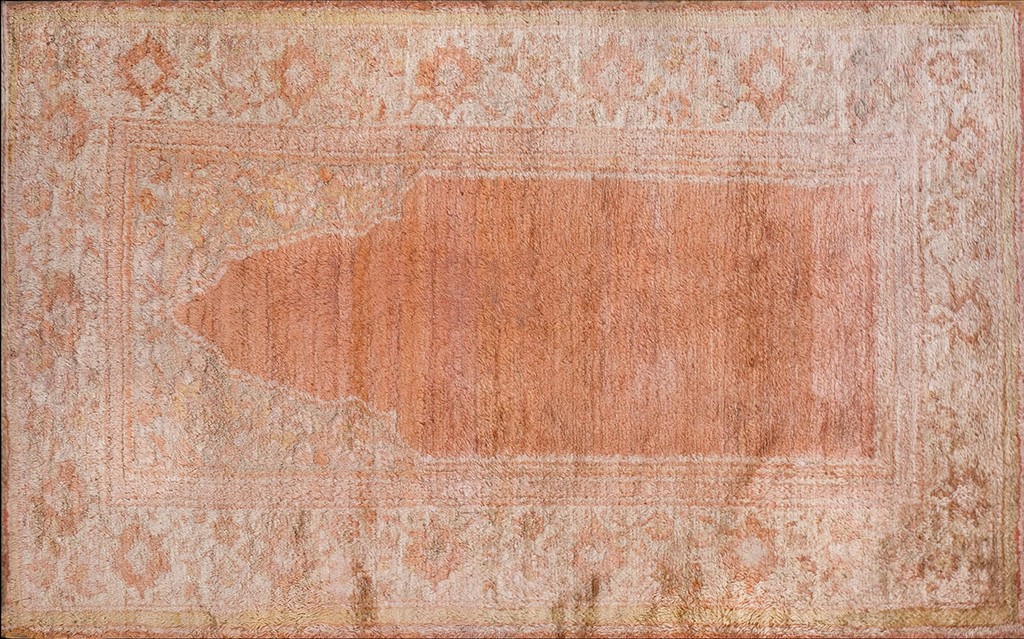
Antique Oushak Turkey – Angora Knotted Rug by Rugs On Net
The symbolism of Oushak motifs further deepens their historical weight. Stars signify cosmic harmony and order, palmettes and floral forms recall paradise and renewal, while scrolling vines suggest continuity and life. In this way, the rugs bridge visual languages: the Islamic symbolic universe, Ottoman imperial grandeur, and the Renaissance fascination with exotic luxury.
Oushak rugs remain celebrated because they embody both grandeur and warmth: their monumental scale and bold motifs project power, while their soft wool and gentle palettes invite intimacy. This duality explains why they continue to be valued by collectors, displayed in museums, and cherished in modern design. They are more than floor coverings—they are bridges between civilizations, carrying Ottoman artistry into European halls and now into global interiors.
Origins and Naming
Where Were Oushak Rugs First Woven?
The Uşak origin of these carpets defines their very identity. Located in western Anatolia, Uşak became one of the most important weaving centers of the Ottoman Empire beginning in the 15th century. Here, Turkish artisans combined regional techniques with influences from neighboring Persian designs, creating a new visual language that would become synonymous with Oushak carpet history.
The luminous wool, large-scale star and medallion motifs, and soft yet commanding palettes all developed from this specific cultural and geographic environment. Asking where were Oushak rugs first woven has only one true answer: in Uşak, where local traditions and imperial patronage converged to produce some of the most enduring Turkish carpets.
The Evolution of “Oushak” as a Name
The name itself reflects centuries of global circulation. In Turkish, the term is “Uşak Halısı” (Uşak carpet), rooted directly in the town’s identity. As area rugs spread across trade networks into Europe, the local name was adapted into different languages. By the Renaissance, “Ushak” and “Oushak” began to appear in inventories, merchant records, and later in English scholarship.
The spelling “Oushak” became standardized in the Anglophone world around 1901, cementing it as the international name for these Turkish rug naming traditions. Thus, the name we use today is not only geographic but also a marker of centuries of cross-cultural recognition and adaptation.
How European Demand Shaped Oushak Weaving
From the Renaissance onward, European import carpets profoundly shaped the development of Oushak weaving. European elites, merchants, and church patrons sought out the star Ushak and medallion designs, displaying them as symbols of wealth in homes and in paintings by masters like Lotto and Holbein.
This demand encouraged weavers in Uşak to scale production and refine stylistic features that resonated with Western tastes. By the 19th century, as transcontinental trade expanded, new markets in Europe and America drove further evolution.
Softer palettes, looser designs, and larger formats emerged to suit Victorian parlors and later modern interiors. At the same time, these carpets continued to retain their Ottoman roots—blending Turkish techniques, Persian-inspired forms, and European preferences into a cosmopolitan textile tradition.
How did European demand shape Oushak weaving history? It turned a regional craft into a global phenomenon, ensuring that Uşak’s looms supplied not only imperial palaces and mosques but also the salons of Florence, London, and Paris.
This interplay of local artistry and international appetite is central to the story of these carpets, which today remain a living testament to how trade routes and cultural exchange defined art history.
The Sivas Oushak: The Designer’s Secret
For those seeking the ultimate “neutral” rug, the Sivas Oushak is the gold standard. Woven in the Sivas region of Turkey, these rugs adopt Oushak patterns but use a much finer weave and a palette that leans toward ivory, pale celadon, and “dusty” rose.
They are the most sophisticated version of the Oushak family and are highly prized for their ability to disappear into a contemporary room while still providing historical weight.
Design Characteristics
Medallion vs. Star Oushak: Key Differences
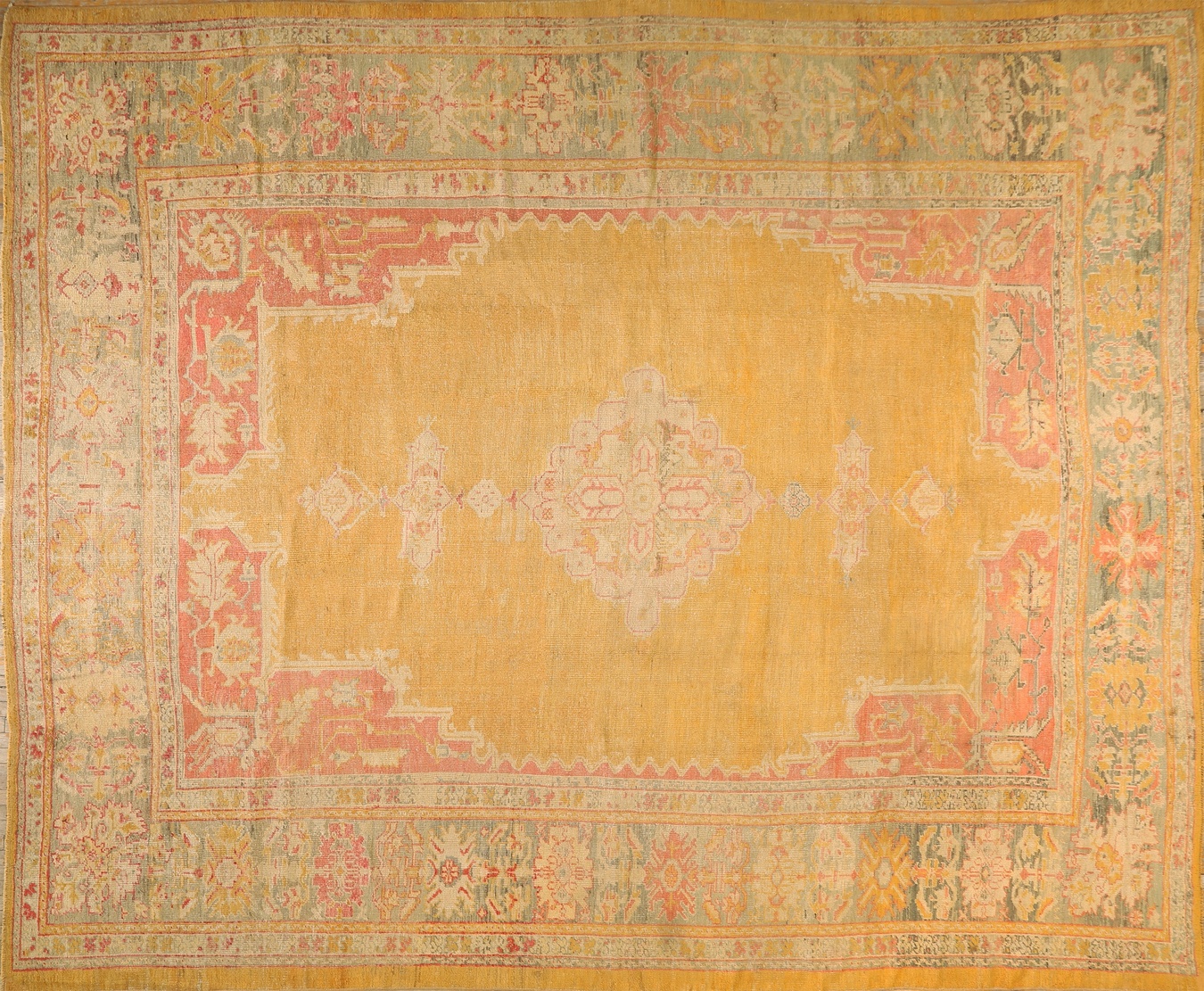
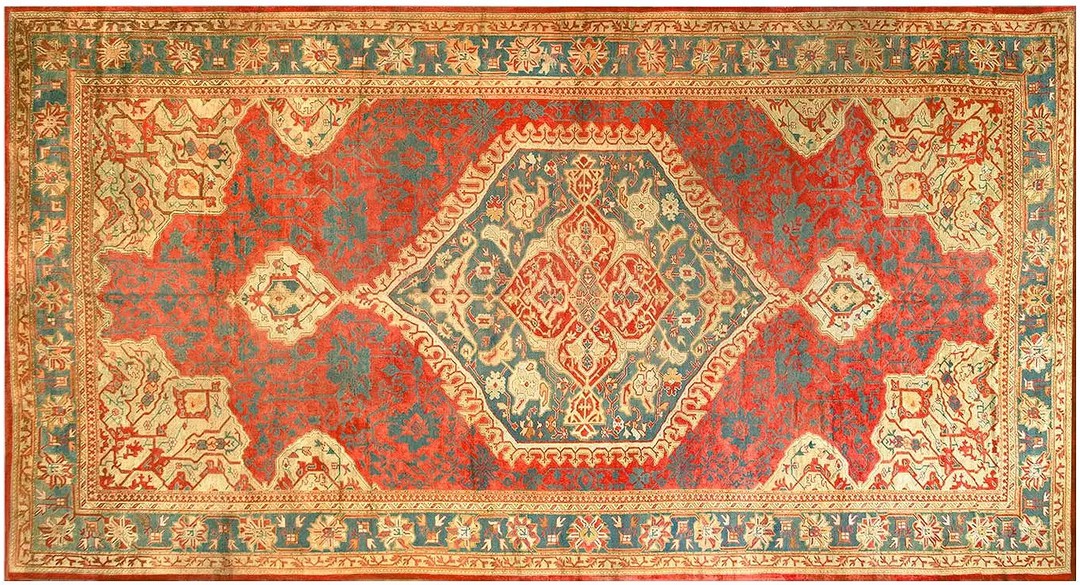
The two most celebrated of this rug design types—medallion and star—are visually distinct yet equally emblematic of Uşak weaving. Medallion Oushaks feature a dominant central medallion, often flanked by quarter-medallions in the corners, creating a bold and symmetrical presence.
Their spacious fields and generous scale contrast with Persian medallion rugs, which tend to be more intricate and densely patterned.
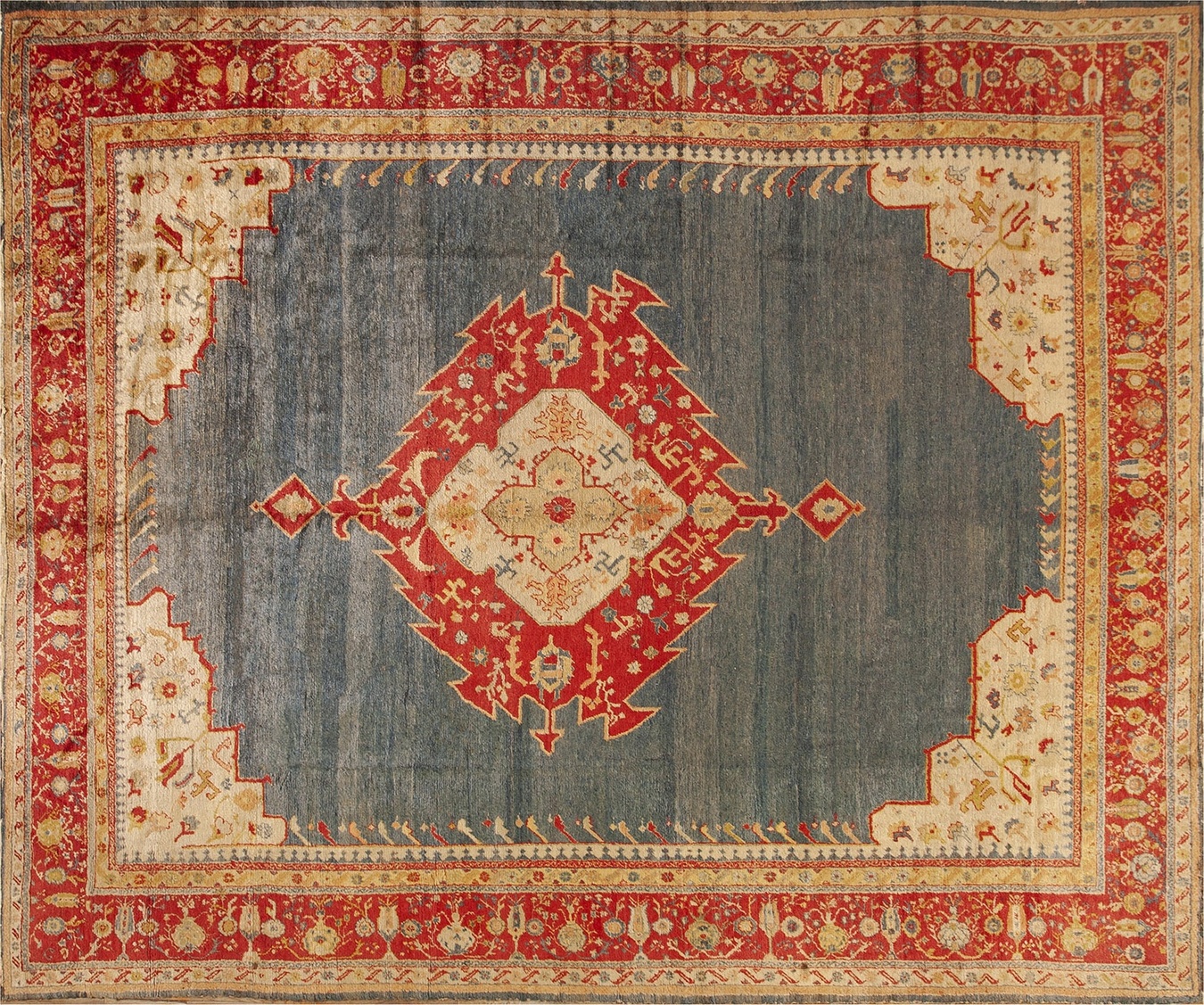
Antique Oushak Room Size Angora Blue Rug – by Rugs On Net
By comparison, Star Oushaks employ a repeating lattice of eight-pointed stars, often interlaced with cloud bands or angular vines. These patterns evoke cosmic order and rhythmic balance, establishing the star medallion rug as one of the earliest Turkish carpets to gain international renown.
Unlike Persian examples, which favor curvilinear precision, Oushak motifs maintain a looser, more geometric quality that underscores their Anatolian roots.
Can Large-Scale Botanical Motifs Signal Authentic Oushak?
- Palmettes and Tulips — Why: Palmettes and stylized tulips fill Oushak fields with Ottoman court symbolism, marking the rugs as Turkish rather than Persian.
- Oversized Vines and Blossoms — Why: Oushaks often feature large-scale, widely spaced floral patterns that emphasize openness rather than density. This scale sets them apart from finely knotted Persian rugs.
- Botanical Grandeur as Identity — Why: The monumental flowers and flowing vines function as a signature of authenticity, reinforcing the category of Turkish botanical rug motifs as a defining trait of Oushak weavings.
The Meaning Behind Oushak Motifs
Symbolism is embedded in the very fabric of Oushak weaving. Stars symbolize cosmic harmony, a reflection of Ottoman philosophical and spiritual ideals. Palmettes and tulips are courtly motifs, representing paradise gardens, fertility, and eternal rebirth. Vines and cloud bands suggest continuity, eternity, and divine order.
Together, these elements carry a cultural narrative that linked Ottoman court values with household artistry. The motifs make the rugs more than decorative—they are coded texts of status, belief, and identity, legible to both their Ottoman patrons and the European collectors who prized them.
Beyond Stars: The Lotto and Holbein Patterns
In the world of art history, Oushaks are categorized by the painters who loved them.
- The “Lotto” Rug: Named after Lorenzo Lotto, these feature an intricate, golden-yellow grid of geometric arabesques, usually on a vibrant red background.
- The “Holbein” Rug: Named after Hans Holbein the Younger, these are defined by rows of small, precise medallions known as guls.
Knowing these terms allows a collector to move beyond “Star” and “Medallion” into the elite tier of Turkish textile history.
Why Are Oushak Rugs Known for Soft Palettes?
Oushak carpets stand apart as soft color Turkish rugs, a reputation earned through both material and time. Natural vegetable dyes produced gentle shades of terracotta, gold, ivory, and sky blue, rather than the intense jewel tones favored in Persian workshops. The luminous Anatolian wool further softened these hues, producing a mellow glow.
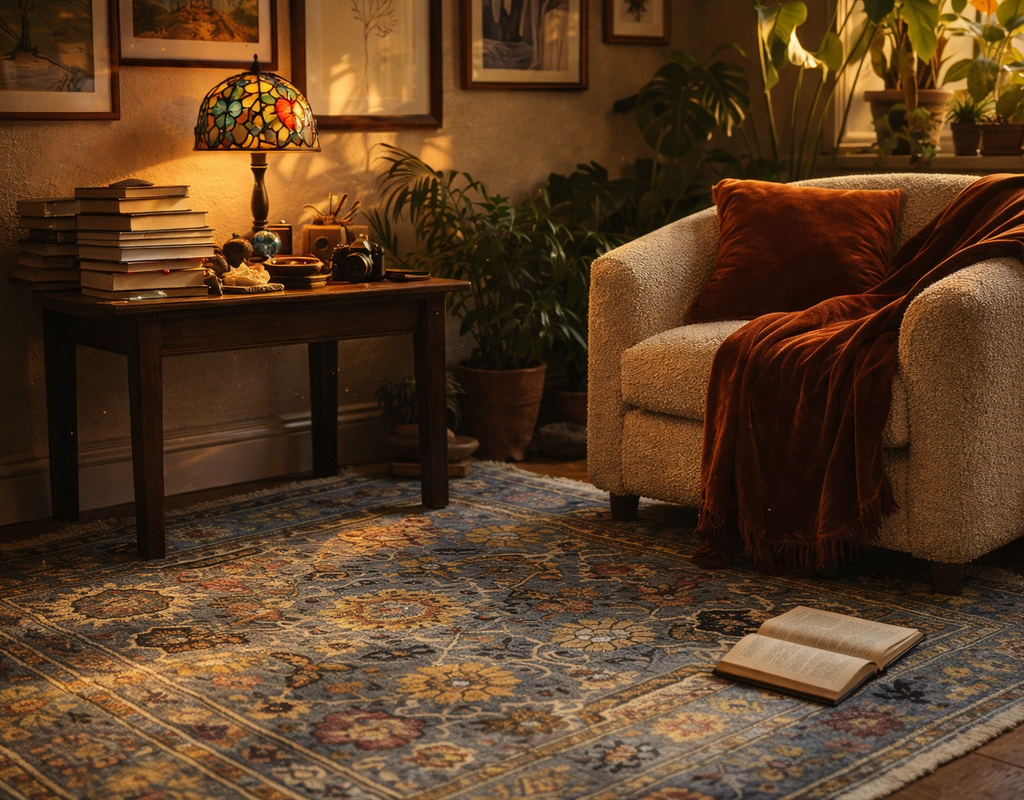
A beautifully lit corner featuring traditional rug patterns contrasting with modern, cozy textures for an inviting reading space.
Over centuries, the natural aging of these fibers created even more muted, watercolor-like tones, enhancing the rugs’ quiet elegance.
Why are Oushak rugs known for soft palettes? Because their dye sources, wool quality, and deliberate artistic choices all favored subtlety over saturation, making these rugs adaptable to interiors then and now.
In sum, these spectacular hand crafted carpets are less intricate than their Persian counterparts but unmistakable for their scale, symbolism, and luminous color. Their balance of monumental design and approachable warmth is what makes them both historically significant and continuously desirable.
Materials, Construction, and Quality
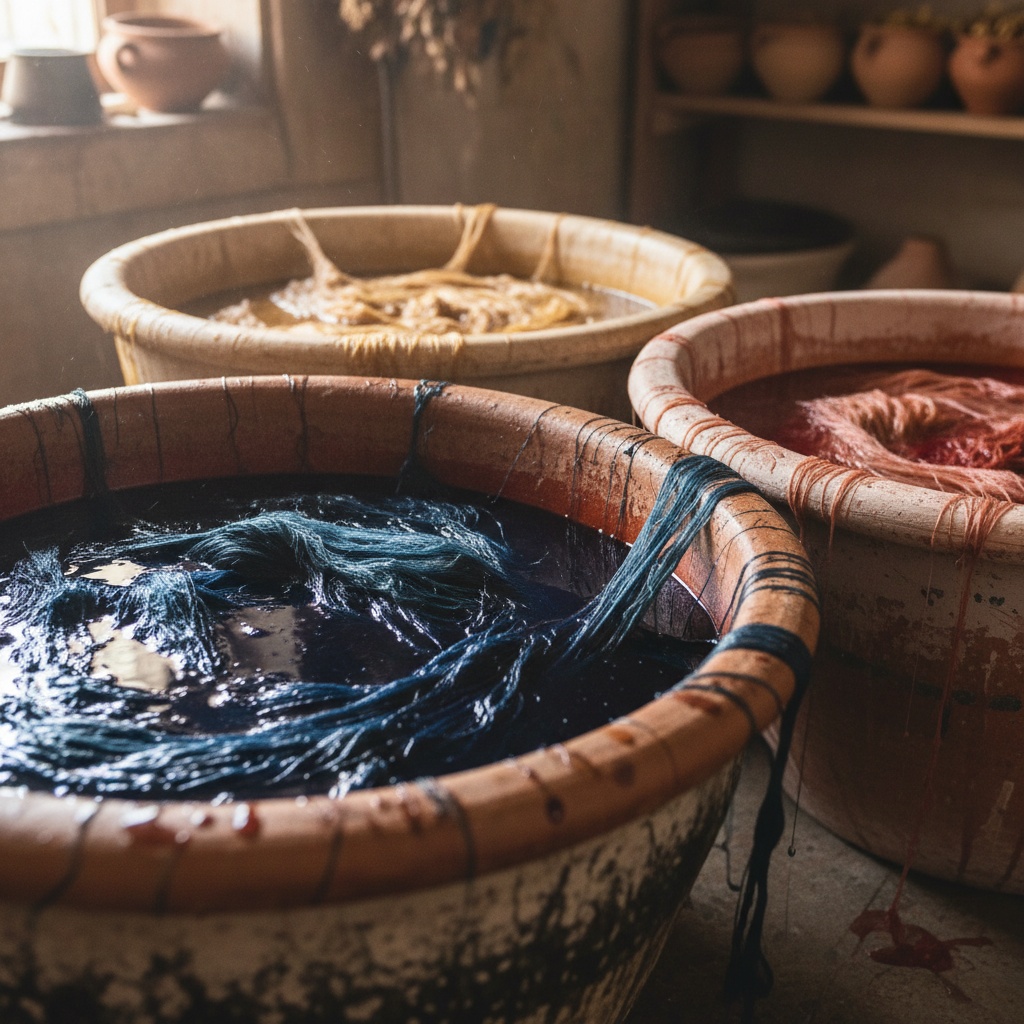
Yarn soaking in natural dye baths
What Materials Are Typically Used in Oushak Rugs?
- Wool Pile — Why: The defining feature of wool Turkish rugs is their lustrous pile, woven from the silky, long-staple wool of western Anatolia. This wool gives Oushaks their characteristic sheen and softness.
- Wool Foundation — Why: Antique examples often use wool for both pile and foundation, a choice that produces pliability and warmth.
- Cotton Foundation (Modern) — Why: In larger export pieces, cotton foundations provide greater structural strength, helping rugs hold their shape over time.
- Natural Dyes — Why: Dyestuffs derived from plants and minerals created soft terracottas, blues, ivories, and golds that became hallmarks of Oushak design.
Are Oushak Rugs Hand-Knotted or Machine-Made?
Authenticity rests on craftsmanship: hand-knotted Oushak rugs are the standard. Antique pieces, woven knot by knot using the symmetrical Turkish (Ghiordes) knot, represent one of the purest forms of Anatolian textile heritage.
Machine-made imitations exist for mass markets, but they lack the luminous wool, unique patina, and irregular charm of traditional handwoven work. To collectors and designers alike, the hand-knotted method is what ensures quality, character, and enduring value.
How Does Knot Density Affect Durability?
With an average of 25–40 knots per square inch in antique examples, Oushaks are not finely knotted compared to Persian carpets. Yet this moderate knot count produces a thicker, plush pile that enhances comfort and longevity. How does knot density affect the rug durability? In Oushaks, lower density does not mean fragility—it creates resilience.
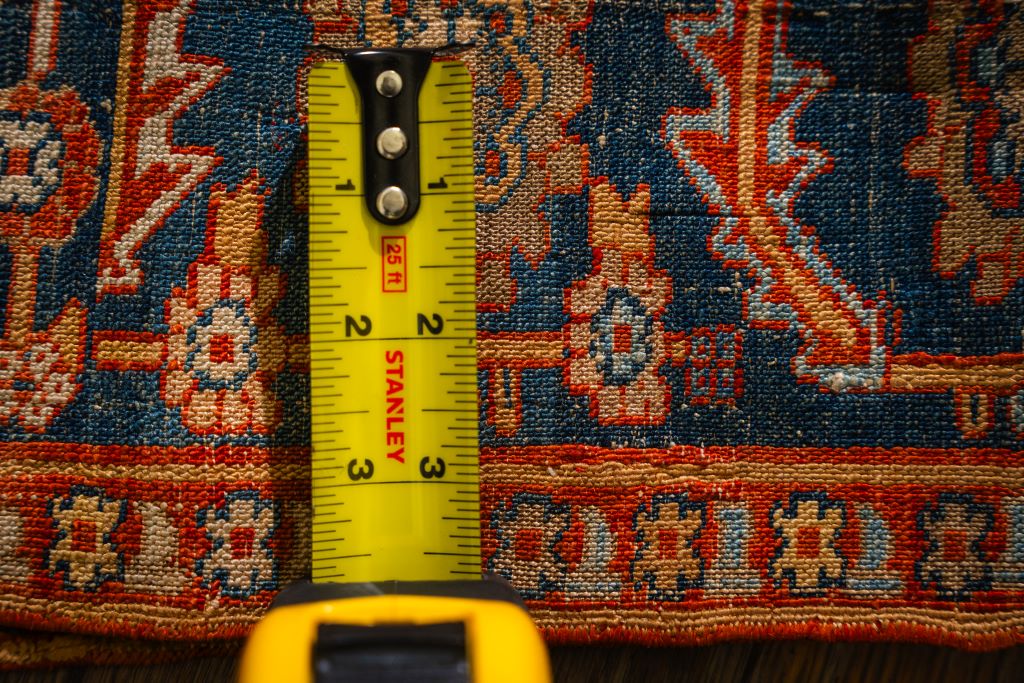
A detailed inspection of a richly colored oriental rug pattern while measuring its dimensions.
Their pile absorbs wear evenly, and the generous wool content contributes to the reputation of Oushak rug durability. This balance explains why many centuries-old examples survive in excellent condition.
Why Is Cotton Foundation Common in Oushak Carpets?
While early Oushaks were woven entirely from wool, cotton became common in larger 19th- and 20th-century rugs intended for European and American markets. A cotton foundation added tensile strength, preventing distortion in oversized pieces.
This practical shift allowed workshops to meet Western demand while still preserving the plush wool pile on top.
Why is cotton foundation common in Oushak carpets? It is primarily a structural choice, ensuring stability in export-scale production without altering the visual identity of the rugs.
Vegetable Dyes & the Oushak Patina
- Slow Fading — Why: Contrary to fears of quick fading, natural vegetable dyes in Oushaks fade gradually and gracefully, yielding nuanced tones over decades.
- Faded Oushak Colors — Why: Collectors prize the gentle mellowing of terracotta, blue, and ivory, often referred to as “patina,” which enhances aesthetic and market value.
- Authenticity Marker — Why: The presence of aged vegetable dyes helps distinguish antique handwoven Oushaks from synthetic-dyed reproductions.
The interplay of wool, knotting technique, foundation, and natural dyes is what gives these Turkish made area rugs their tactile luxury and visual warmth. Material choices directly shape texture and longevity, while the faded rug colors of antique examples reveal how these rugs age into beauty.
Each thread reinforces why these iconic area rugs and carpets remain both functional floor coverings and timeless works of art.
Historical Evolution
Interior architecture reflecting historical design.
Oushak Rugs from the Ottoman Era to Today
The story of antique Oushak rugs begins in the early Ottoman period, when precursors like the Lotto and Holbein carpets introduced bold geometric lattices and became fixtures in European Renaissance paintings.
By the 16th and 17th centuries—the golden age of Oushak weaving—the region produced monumental palace rugs featuring medallion and star motifs that symbolized Ottoman court power. These carpets, often commissioned for mosques and palaces, solidified Uşak as one of the empire’s most prestigious weaving centers.
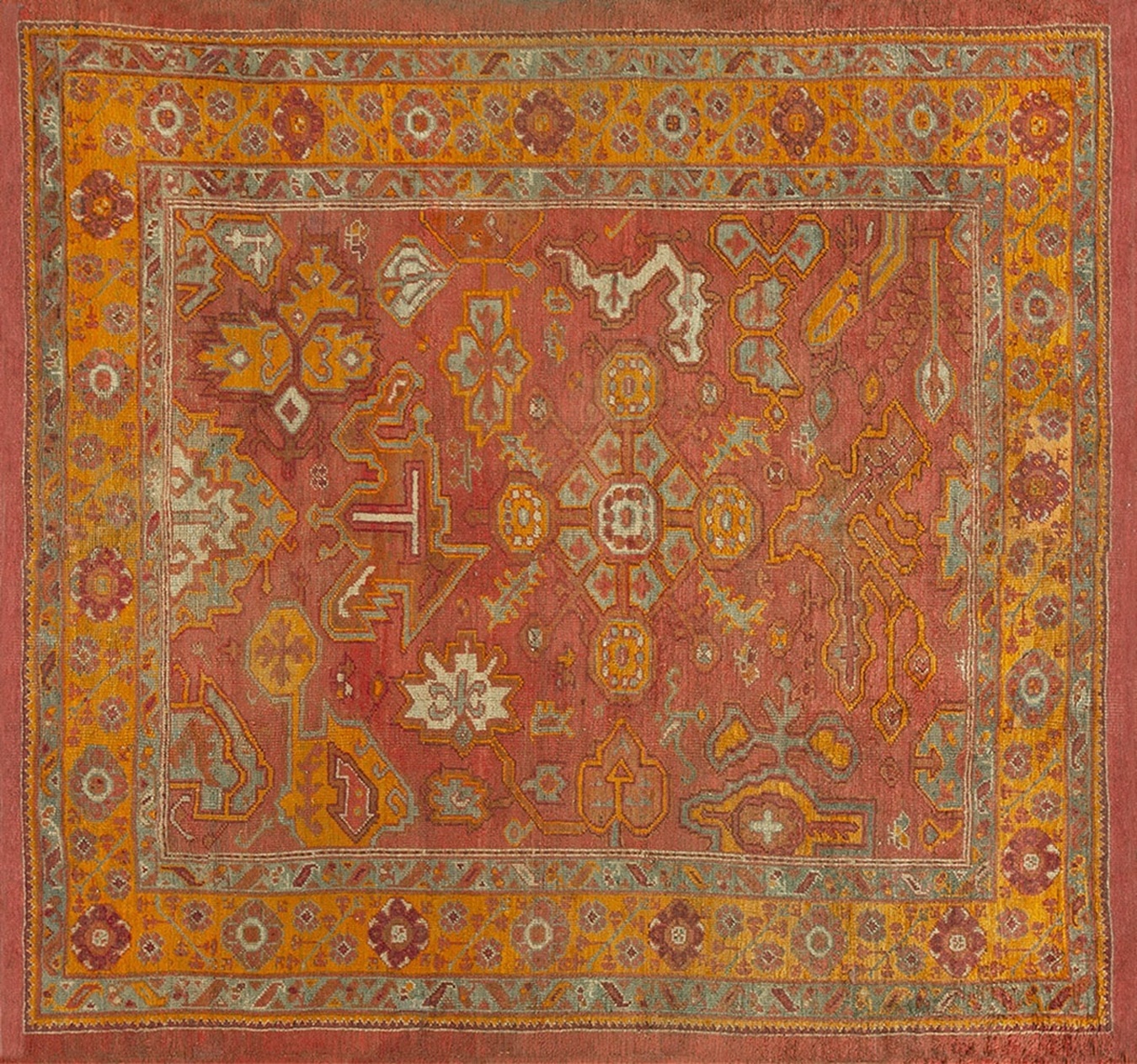
Antique Oushak Turkish Geometric Medallion Hand Knotted Pile Rug – by Rugs On Net
The 19th century brought a new chapter. After a period of decline, weaving revived under European demand, with workshops adapting to Western tastes by softening palettes and introducing more Persianized floral arrangements. Large-scale exports brought these fabulous are rugs into parlors and salons across Europe and America, ensuring their global reputation.
In the 20th and 21st centuries, local initiatives sought to preserve traditional methods even as global imitations proliferated, underscoring how Oushak rugs continue to adapt to shifting markets while maintaining a recognizable core identity.
How Did European Demand Shape Oushak Weaving History?
European markets did more than provide customers—they actively shaped Oushak aesthetics. Renaissance merchants commissioned star and medallion designs, later Victorian and modern buyers pushed for softer hues and Persian-inspired motifs.
This ongoing dialogue between Anatolian weavers and Western patrons expanded the visual vocabulary of Oushaks and ensured their survival through centuries of changing taste. In essence, Oushak weaving is as much a story of trade and revival as it is of local artistry, with European import markets guaranteeing international prominence.
Are Vintage Oushak Colors More Muted than New?
Yes. Vintage Oushak colors appear more muted because of natural wool aging and the slow fading of vegetable dyes. Terracotta reds soften into rose, blues pale into sky tones, and ivory grounds mellow into cream. This muted quality is distinct from newly woven copies, whose palettes—though soft by design—lack the layered depth achieved over decades.
In evaluating rugs, the gentle fading of an older piece is a hallmark of authenticity and artistry, transforming a functional object into a historical artifact.
Does Patina Increase the Value of Antique Oushak Rugs?
Absolutely. A patinaed rug, with its faded wool rug surface and mellowed vegetable dyes, is more than worn—it is enhanced. Collectors and museums often prize patina as a marker of originality, elevating the rug’s status and vintage Turkish rug value. Rather than diminishing worth, natural fading elevates antique Oushaks, making them sought-after investments.
The presence of patina signifies both age and survival, two qualities that connect a rug directly to centuries of history. From Ottoman palaces to modern interiors, Oushak rugs have navigated shifts in power, taste, and trade. They adapt with the times but remain unmistakable, their faded grandeur proving that beauty, when woven in wool and natural dyes, only deepens with age.
Regional Variations and Substyles
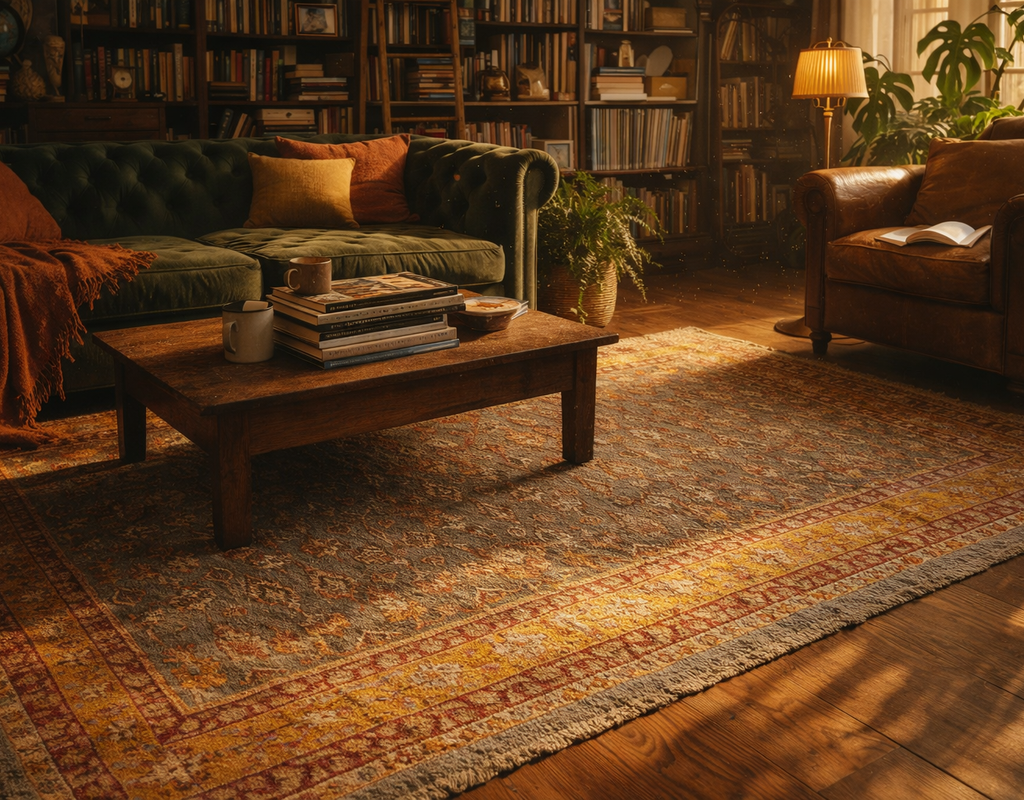
A warm, dimly lit library space decorated in a traditional, maximalist style.
Star vs. Medallion Oushaks
Among the most recognizable substyles, the star Oushak and the medallion designs stand at the forefront. As noted earlier, medallion carpets emphasize a singular, dominating central motif framed by corner spandrels, while star carpets rely on a repeating lattice of eight-pointed stars, sometimes enriched with cloud bands.
Both share the hallmarks of regional Turkish rugs—open layouts, large-scale forms, and soft palettes—yet each communicates a different visual rhythm: medallions project grandeur and singularity, stars embody harmony and cosmic order.
Lotto, Holbein, and White-Ground Ushak Carpets
Several distinct historical rug subtypes carry their own legacies. Lotto carpets, named after the Italian painter Lorenzo Lotto, feature a golden lattice of interlacing arabesques set against a red field. Holbein carpets, seen in portraits by Hans Holbein, employ geometric central medallions and repeating octagonal patterns, representing some of the earliest European-recognized Turkish rugs.
Another notable group is the white-ground Ushak carpets, often associated with the town of Selendi, which use ivory fields filled with colorful scrolling vines or floral sprays. These Selendi carpets became especially popular exports, celebrated for their lightness and adaptability in European interiors.
Prayer Rugs and Transylvanian Variants
Uşak was also a center for weaving prayer rugs, distinguished by their arch-shaped mihrab or niche, symbolizing the direction of Mecca. These smaller-format rugs blended devotional use with artistic refinement. In parallel, Transylvanian rugs, many woven in western Anatolia and later preserved in churches of Transylvania, represent a fascinating regional variant.
Their delicate borders and simplified floral motifs reveal how Oushak weaving traveled through trade into Eastern Europe, adapting designs for Christian as well as Islamic contexts. Today, Transylvanian rugs remain prized for their cross-cultural history and rare survival.
Geographical Indication and Modern Protections
- Geographical Indication (GI) Status — Why: The Turkish government has granted GI recognition to Uşak carpets, ensuring that the term “Oushak” applies only to rugs produced in the authentic region.
- Preservation of Local Sub-Varieties — Why: Subregions such as Eşme maintain weaving traditions, reinforcing the diversity within Oushak identity.
- Consumer Confidence — Why: GI protections help buyers distinguish authentic GI Turkish carpets from imitations, safeguarding both cultural heritage and market trust.
The world of Oushak weaving is not monolithic; it encompasses a spectrum of forms, from Renaissance Lotto and Holbein carpets to prayer rugs and white-ground Selendi carpets. Today, geographical indication protections reinforce this identity, ensuring that “Oushak” continues to mean not just a style, but a living regional tradition rooted in western Anatolia.
Modern Oushak Rugs & The Market
How Have Modern Weavers Adapted Traditional Oushak Motifs?
Contemporary workshops in Turkey, India, and Pakistan continue to produce modern Oushak rugs, but the fidelity to tradition varies. Turkish looms protected under geographical indication laws rely on hand-spun wool and natural dyes, maintaining continuity with centuries of heritage.
Indian and Pakistani productions, while often well-made, may employ cotton foundations or different knotting techniques, resulting in a slightly different look and feel. Across all markets, the star and medallion Oushak motifs remain central, but scale and color have been adjusted for modern interiors, with more neutral grays and muted pastels joining the classic terracotta, ivory, and sky blue palettes.
Should I Choose Vintage or Reproduction Oushak for Longevity?
When weighing vintage versus reproduction, consider both function and legacy. Vintage Oushaks—woven decades or even centuries ago—are renowned for their longevity, with soft wool and vegetable dyes that only improve with age.
These rugs, when well-maintained, can last generations and often carry significant collector value. High-quality reproduction Oushaks, however, can also be durable if hand-knotted with quality materials. They offer a practical solution for buyers who want the Oushak look at a lower price point or without concerns about wear on an antique. For longevity, both are viable; the choice depends on whether you prioritize historical authenticity or everyday practicality.
Where Can I Find Ethically Sourced Modern Oushak Rugs?
Buyers seeking ethical Turkish carpets should look for sellers offering GI-certified Uşak rugs, which guarantee regional authenticity and support local weavers. Fair trade retailers and artisan cooperatives also ensure fair wages and sustainable practices.
For non-Turkish versions of these area rugs, select vendors with transparent sourcing policies that avoid exploitative labor. Checking for certifications, country of origin labels, and reputations within the rug trade are practical ways to verify ethical sourcing.
How Much Do Hand-Knotted Oushak Rugs Cost Today?
- New Turkish Hand-Knotted — Why: Expect prices between $2,000–$10,000+, depending on size, wool quality, and knotting method. These represent authentic GI-protected rugs woven in Turkey.
- Antique Oushaks — Why: Exceptional pieces can climb into the mid to high five figures, reflecting rarity, patina, and historical significance.
- Indian or Pakistani Oushaks — Why: Often more affordable, ranging from low thousands, but with variations in construction and dyeing traditions.
- Machine-Made Reproductions — Why: These are the least expensive option, costing a fraction of hand-knotted rugs, but they lack both durability and collector value.
Are Tariffs Raising Prices on New Oushak Imports?
Yes, in many cases. Import duties and tariffs applied to Turkish, Indian, or Pakistani carpets can raise the Oushak rug price, particularly for U.S. buyers. Rates fluctuate with trade agreements, so it is wise to confirm current duties before purchase, especially for large or custom orders.
Does Rug Size or Rarity Drive Oushak Price More?
Both play a role, but rarity outweighs size in determining value. While larger rugs naturally cost more due to material and labor, a rare antique with unique colors, motifs, or provenance can far exceed the value of a massive but common piece. Collectors often prioritize distinctive design elements and historical significance over sheer scale.
Is Auction Bidding the Best Way to Buy Antique Oushak?
- Advantages — Why: Auctions can be a good way to buy antique Oushak rugs, sometimes yielding bargains on overlooked or underappreciated pieces. Prestigious houses also offer top-tier provenance.
- Risks — Why: Without expert knowledge, buyers risk overpaying for misattributed rugs or high-condition issues. Auction fees can also add significant costs.
- Best Approach — Why: Auctions suit seasoned collectors with expertise; for new buyers, trusted dealers may offer more transparency and security.
The modern Oushak market blends tradition with accessibility. Whether investing in an auction Turkish rug, a certified GI-protected carpet, or a high-quality reproduction, informed area rug buyers can balance beauty, ethics, and durability. Provenance, sourcing, and education remain the key to making confident choices.
A modern Oushak rug buyers tip
Many modern Oushak reproductions undergo a “luster wash” or “antique wash” to simulate 100 years of wear. While visually appealing, a buyer should check the base of the knot. If the color at the very bottom of the pile (near the foundation) is significantly darker or a different shade than the surface, the rug may have been chemically treated. While common, ensure the wool still feels oily and resilient, not dry or “brittle,” which indicates over-processing.
Care, Longevity & Buying Guide
Can Vegetable Dyes in Oushak Rugs Fade Quickly?
Vegetable dyes, the hallmark of antique and authentic Turkish weaving, are celebrated for their beauty and graceful aging. Under normal household use, they do not fade quickly; instead, they mellow into soft, nuanced tones that enhance a rug’s charm. However, excessive exposure to direct sunlight or harsh chemical cleaning can accelerate fading or cause uneven tones.
In contrast, older examples with well-established patina are less likely to bleed or lose vibrancy, as their colors have already stabilized over time. Thoughtful Oushak rug care—avoiding prolonged sun, rotating placement, and using gentle cleaning methods—ensures that these vegetable-dyed treasures retain their beauty for generations.
Actionable Collector/Buyer Tips
- Inspect Knotting and Materials — Why: Hand-knotted structure and luminous wool distinguish authentic Oushaks from machine-made imitations.
- Check Provenance — Why: Knowing origin and history adds value and confidence in purchase.
- Look for GI Label in New Rugs — Why: Geographical Indication guarantees authenticity and supports regional weaving communities.
- Match Rug to Use — Why: Antique or fragile rugs should be reserved for display, while modern reproductions can withstand daily traffic.
- Buy from Trusted Sellers — Why: Reputation ensures authenticity and fair pricing, reducing the risk of acquiring reproductions misrepresented as antique.
Choosing the Right Oushak: Vintage vs. New, Size, and Use
Selecting the ideal Oushak depends on purpose and lifestyle. Vintage Turkish carpets are prized for their muted colors and patina, making them best for decorative or low-traffic spaces where they can be admired and preserved. New buying options—whether Turkish GI-protected or high-quality reproductions from abroad—offer durability suited for everyday family use.
Size also matters: large antique palace rugs can serve as focal points in expansive rooms, while smaller prayer rugs or white-ground Oushaks fit intimate spaces. Matching rug size and condition to the intended environment ensures both longevity and satisfaction. Proper vintage Turkish carpet maintenance is not only about care but also about preservation of value.
With gentle handling and due diligence in buying, Oushak rugs serve as both heirlooms and daily companions. Their enduring elegance proves that when well cared for, a Turkish rug is not simply purchased—it is inherited, lived with, and handed down. (See also [Rug Care Guide] → related page)
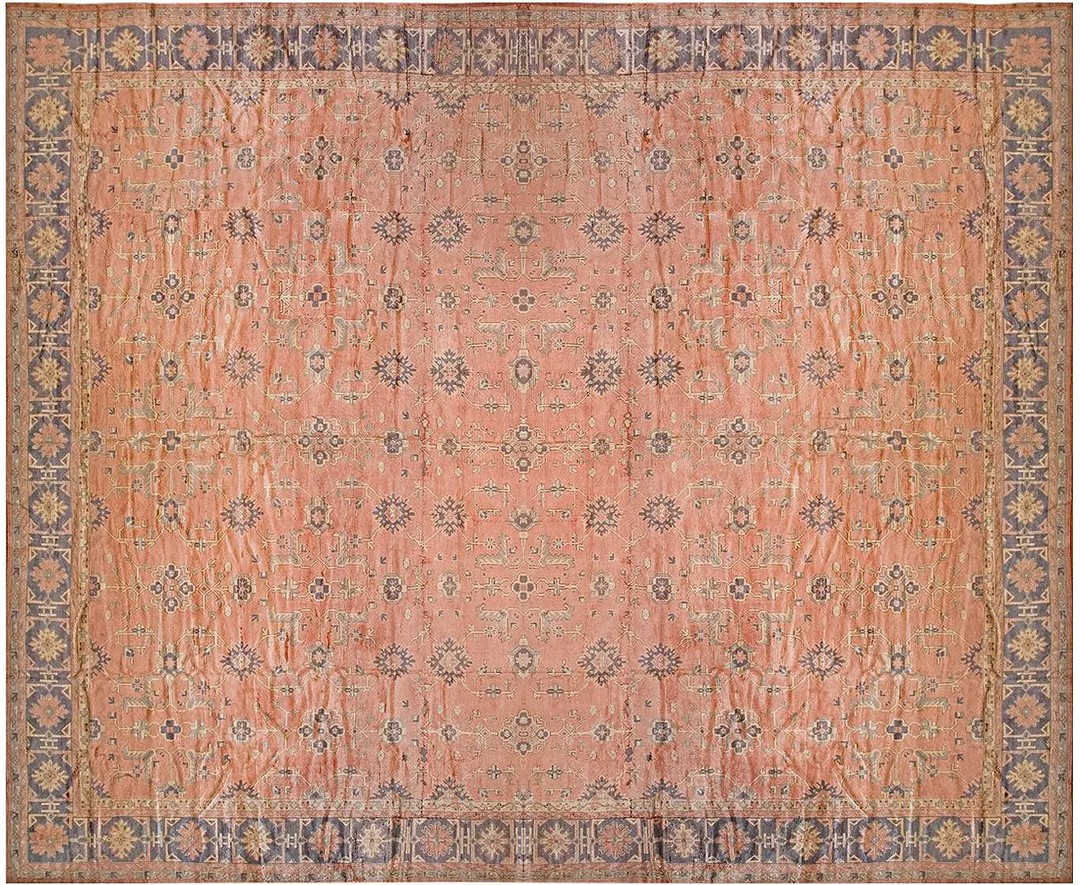
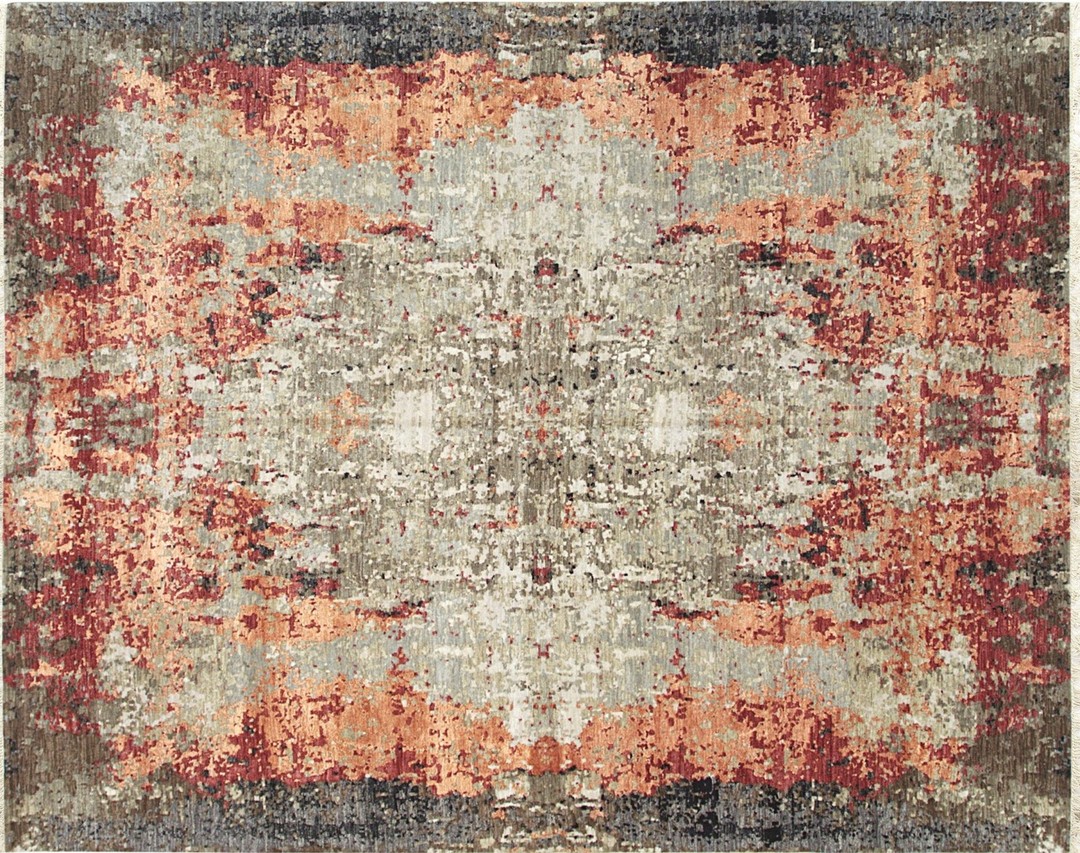
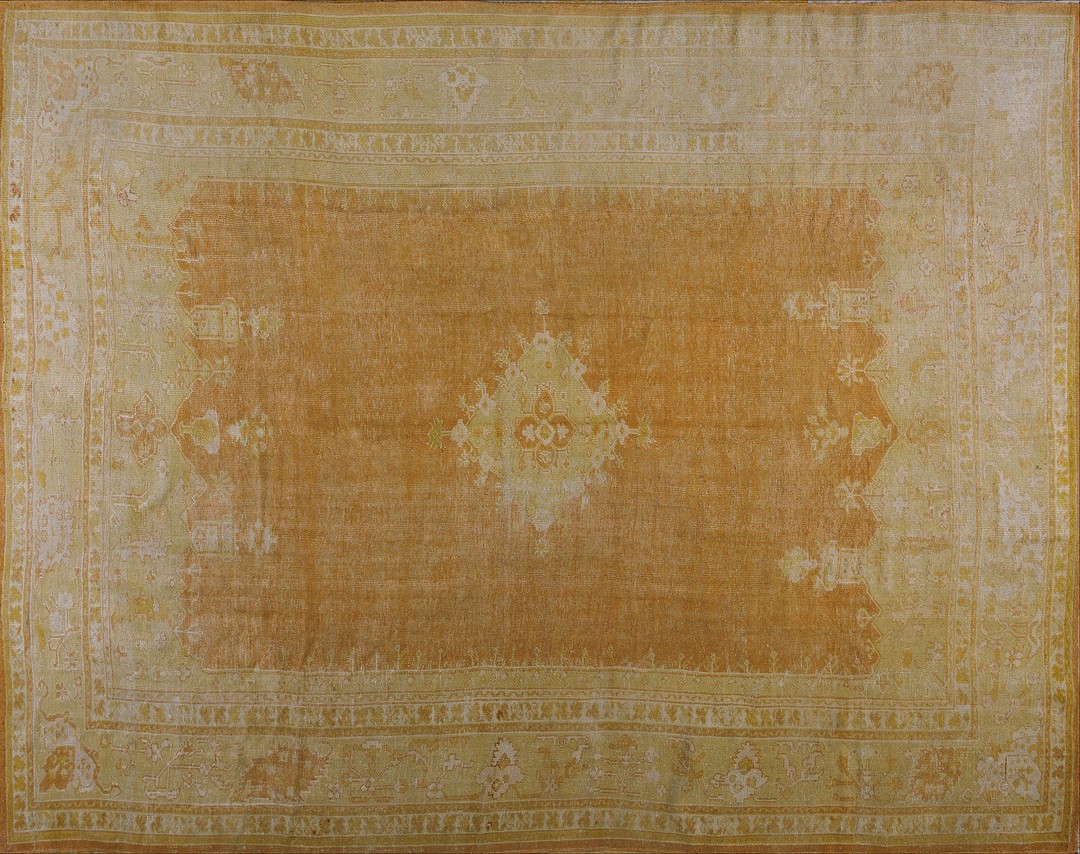
Explore Some of Our Favorite Oushak Rugs

FAQ
- How do I maintain Oushak rugs long-term?
Vacuum weekly without a beater bar, rotate seasonally, and address stains quickly. Professional cleaning every 1–2 years and a good pad can add decades of life.
- Where can I buy Oushak rugs in the U.S.?
Look to reputable rug dealers, auction houses, and vetted online sources. Ask about origin, fiber content, knot type, return policy, and care recommendations.
- How do I place Oushak rug runners?
Use Oushak rug runners in hallways, kitchens, and entryways, leaving 4–6 inches of floor visible on each side. Add a grippy pad to prevent sliding.
- What knot density do Oushak rugs have?
Oushak rugs often have lower knot counts than Persian fine weaves—commonly under \~120 KPSI. Lower density suits their large-scale, decorative designs.
- How old is the Oushak rug tradition?
Oushak rugs date to the Ottoman era, with star and medallion carpets seen in 16th-century European paintings. The weaving center remains active today.
- Can I use an Oushak rug outdoors?
No—Oushak rugs are indoor pieces; moisture and UV can damage wool and dyes. For covered porches, bring them in during wet or intense-sun periods.
- Are Oushak rugs low-VOC?
Hand-knotted wool Oushak rugs have minimal off-gassing compared to synthetics. If sensitive, avoid latex-backed tufted lookalikes and air the rug out before use.
- Will an Oushak rug fade in sunlight?
Yes—UV light lightens natural dyes over time. Rotate every 3–6 months and use curtains or UV window film to slow fading.
- What rug pad is best under an Oushak rug on hardwood?
A felt-and-natural-rubber pad balances cushion and grip. Trim it about 1 inch inside the rug’s edge; 1/4-inch thickness suits most Oushak rugs.
- What distinguishes Oushak rugs from Heriz rugs?
Oushak rugs lean soft-palette and large florals with a Turkish knot; Heriz rugs are bolder, geometric, and typically red/blue. Heriz often feels stiffer and more angular.
- Are antique Oushak rugs a good investment?
Some are, but value depends on rarity, condition, dyes, and market demand. Get an appraisal and consider insurance for pieces above a few thousand dollars.
- How much do Oushak rugs cost?
Hand-knotted 8×10 Oushak rugs often run \$1,500–\$5,000+. Antique room-size Oushak rugs can range from \$10,000 to \$60,000+ depending on age, condition, and provenance.
- How can I spot a hand-knotted Oushak rug?
Flip it—hand-knotted Oushak rugs show the same pattern on the back with visible knots, and fringe is part of the warp (not sewn on). Machine-made backs look uniform or latexed.
- Are Oushak rugs safe on heated floors?
Generally yes—natural-fiber Oushak rugs breathe well. Use a breathable felt-and-natural-rubber pad and keep floor temperatures moderate per the heating system’s guidelines.
- Can robot vacuums handle Oushak rugs with fringe?
Yes, with care. Set no-go zones or fold fringe under; use low suction and avoid brush bars that catch tassels.
- Are Oushak rugs kid- and pet-friendly?
Wool Oushak rugs resist soiling and odors and clean well when blotted fast. Choose medium tones or patterned designs to camouflage daily life.
- What size Oushak rug works for a bed?
For a queen, an 8×10 Oushak rug usually gives 18–24 inches around the sides/foot; for a king, use 9×12. Runners on both sides also work in tight rooms.
- Are Oushak rugs good under dining tables?
Yes—pick a low/medium-pile Oushak rug so chairs slide easily. As a rule, 8×10 fits six chairs and 9×12 fits eight, keeping all chair legs on the rug.
- How should I clean spills on an Oushak rug?
Blot immediately with a white cloth and a wool-safe, pH-neutral solution; test for colorfastness first. Schedule professional cleaning every 12–24 months depending on traffic.
- Do Oushak rugs shed?
New wool Oushak rugs may shed for several months before settling. Vacuum gently without a beater bar and expect shedding to decrease after 3–9 months.
- Are Oushak rugs durable for high-traffic areas?
Yes—wool is resilient and naturally stain-resistant. Choose denser Oushak rugs and use a quality rug pad to reduce wear in halls, living rooms, and entryways.
- How are Oushak rugs constructed?
Most Oushak rugs use the symmetrical Turkish (Ghiordes) knot with wool pile. Foundations are commonly cotton in newer weavings, though some antique Oushak rugs have all-wool foundations.
- What patterns and colors define Oushak rugs?
Oushak rugs feature oversized florals or medallions with generous open fields. Traditional palettes use reds, blues, and golds; modern pieces favor muted pastels like apricot, celadon, and soft blue.
- Where are Oushak rugs made today?
Oushak rugs originate in western Turkey, but Oushak-style rugs are also woven in Turkey, India, Pakistan, and Afghanistan. Ask sellers to distinguish “Oushak-style” from Turkish-made.
- What is an Oushak rug?
An Oushak rug is a Turkish hand-knotted carpet from Uşak known for large-scale motifs and luminous wool. Classic designs include star and medallion patterns dating to the 15th–16th centuries.