
Introduction & Overview of Ningxia Rugs
Explore our curated selection of historic Ningxia rugs available today.
What Are Ningxia Rugs?
Ningxia rugs, sometimes spelled “Ning-hsia” or “Ningsia,” are a distinctive group of antique Chinese rugs celebrated for their soft wool pile, refined designs, and serene aesthetic. Originating in the Ningxia region of north-central China, these carpets emerged as early as the Ming dynasty but reached their height of production between the 17th and 19th centuries, especially during the Qing dynasty. They are recognized by their understated elegance: balanced motifs executed in harmonious palettes of gold, indigo, and earth tones.
Unlike the exuberant ornamentation of some courtly Chinese imperial carpets, Ningxia rugs favor restraint, emphasizing clarity of line and a warm, meditative atmosphere. Technically, Ningxia carpets are noted for their durable wool, medium pile, and the suppleness of their weaving, which made them versatile for both decorative and functional purposes. They were woven in various formats, from large Buddhist monastery carpets covering temple floors to smaller meditation mats and throne seat covers used by monks and nobility.
This adaptability set Ningxia apart from other weaving centers in China, where production often leaned toward either grand-scale imperial commissions or village-level utilitarian weavings. To answer directly: Ningxia rugs are important because they embody a fusion of artistic restraint and cultural utility. They not only reflect the aesthetics of Chinese imperial taste but also supported religious and cultural practices across Tibet and Mongolia.
Their designs often feature Buddhist symbols, stylized floral borders, and geometric repeats that harmonized with the meditative spaces in which they were used. Over time, this gave Ningxia a central role in shaping the visual and spiritual landscape of East and Central Asia.
The Legacy of Ningxia in the Rug World
The legacy of Ningxia rugs is twofold: artistic and cultural. Artistically, these carpets illustrate the Chinese capacity for refinement in textile design. Where Persian and Central Asian rugs often dazzled with intricate detail or tribal boldness, Ningxia’s signature was restraint—an elegance born from balance, clarity, and softness. This quality made them especially appealing to Western collectors from the late 19th century onward, when antique Chinese rugs became prized in Europe and America for their ability to complement both ornate and minimalist interiors.
Culturally, Ningxia rugs served as a bridge between Chinese imperial courts and Tibetan Buddhist monasteries. Massive temple carpets, woven in Ningxia and transported across caravan routes, lined the prayer halls of Lhasa and beyond. In these settings, the rugs became more than floor coverings—they acted as ritual tools, visual symbols of harmony, and tangible links between artistic craftsmanship and religious devotion.
The portability of area rugs compared to architecture meant that Ningxia designs could travel widely, carrying with them an aesthetic vocabulary that blended Chinese courtly formality with Tibetan spiritual needs. Today, the timeless influence of Ningxia weaving is evident in both Asian and Western interiors. Their muted golds and blues sit comfortably in modern minimalist spaces, while their subtle motifs pair equally well with classic décor.
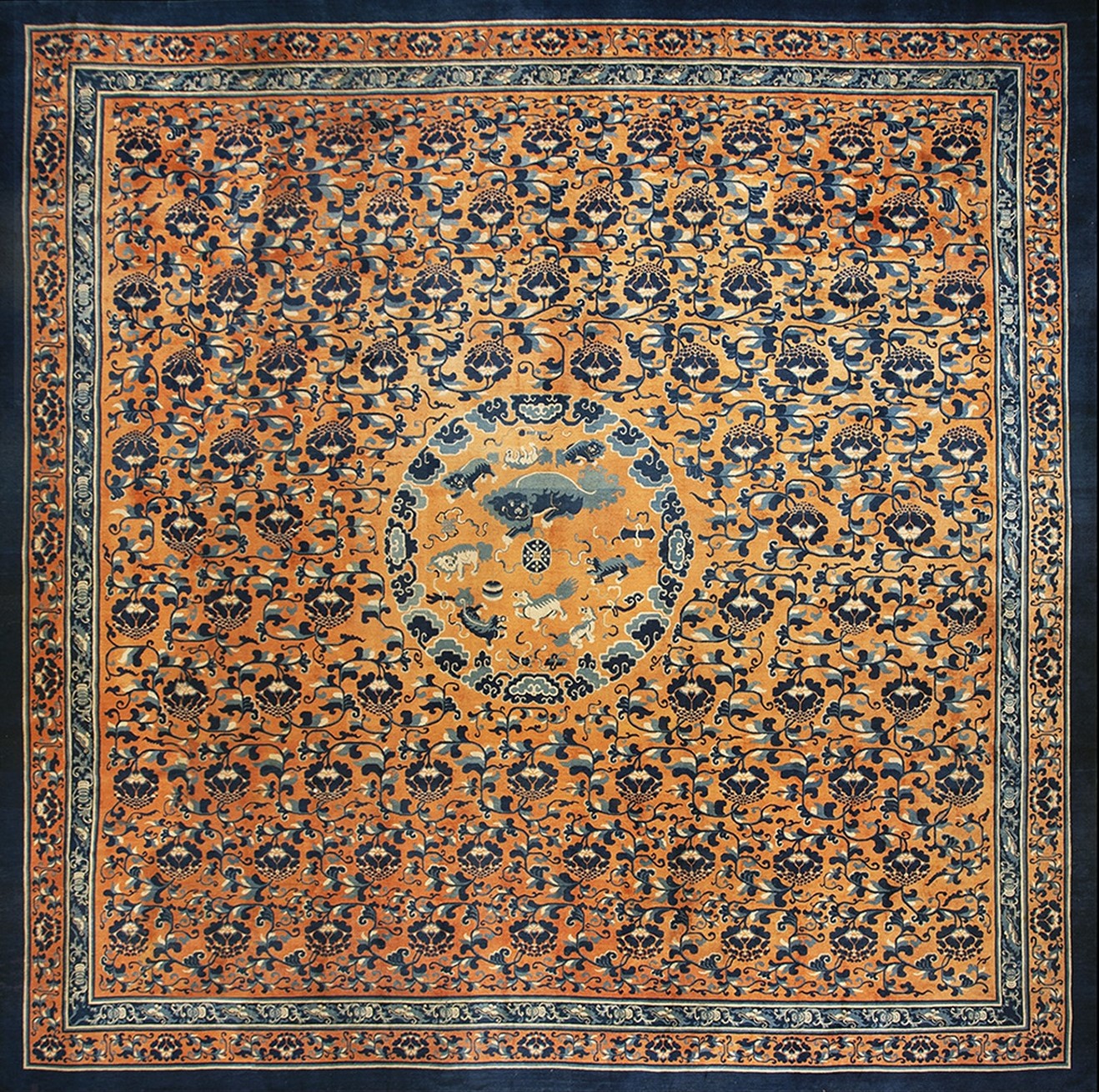
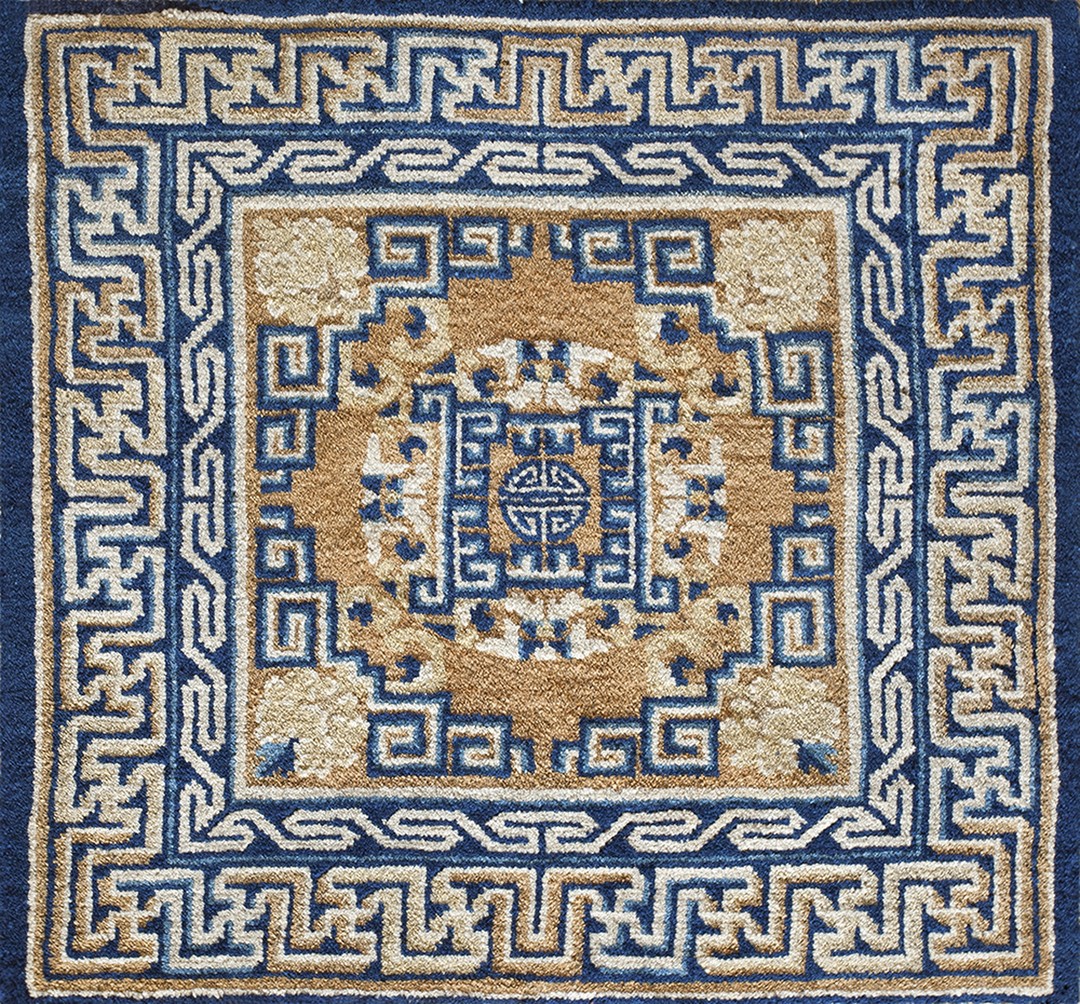
Antique Large Ningxia Chinese Hand Knotted Pile Rug – by Rugs On Net
Collectors continue to revere them for their rarity, cultural resonance, and ability to evoke warmth without overwhelming a room. More than simple furnishings, antique Ningxia carpets remain enduring artifacts of cross-cultural exchange, embodying the flow of ideas, aesthetics, and devotion across centuries.
In short, Ningxia’s weaving heritage stands as a quiet yet powerful testimony to China’s role in the global history of rugs and carpets: an art of understated elegance, spiritual depth, and enduring versatility.
Geographic, Cultural & Environmental Roots
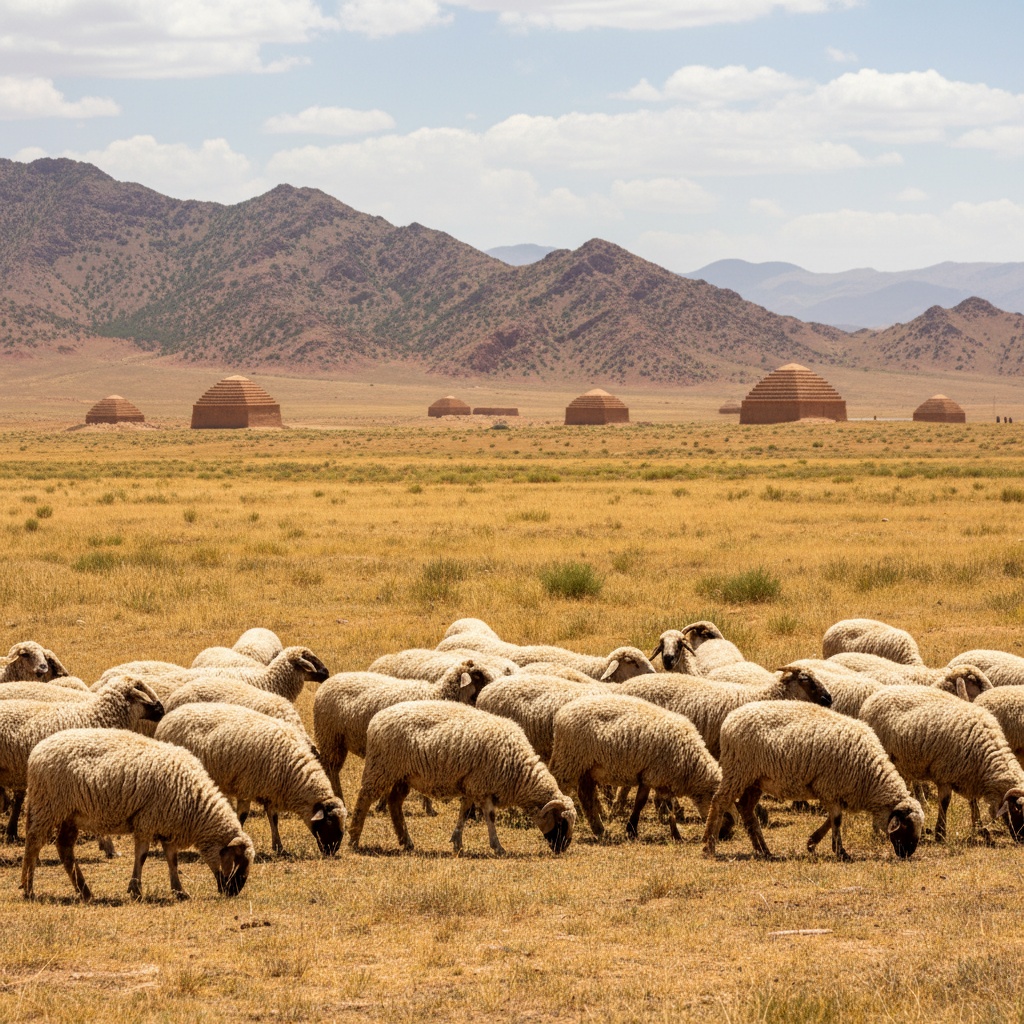
Pastoral scene with ancient burial mounds.
Ningxia’s Location and Climate
Ningxia geography places the region in north-central China, where it occupies a unique position along the upper reaches of the Yellow River. Bordered by Gansu to the west and Inner Mongolia to the north and east, it has historically functioned as a crossroads between the Chinese heartland and the grasslands of Central Asia.
This position was crucial in the development of trade routes that carried textiles, wool, and cultural traditions across empires. The Ningxia climate is semi-arid, defined by sharp seasonal contrasts. Winters are long and bitterly cold, while summers are hot and dry, with minimal rainfall spread across the year. These conditions, while harsh for farming, created ideal landscapes for extensive sheep grazing. The hardy flocks raised here produced wool of unusual softness and durability, providing the raw material that set Ningxia rugs apart from other antique Chinese rugs.
Regional Capital & Notable Sites
The regional capital of Ningxia is Yinchuan, a historic city that served as a hub for both political and cultural activity. Yinchuan remains a center of commerce today, but its heritage is deeply tied to the Western Xia dynasty. Just outside the city lie the Western Xia tombs, an impressive complex of imperial mausoleums often called “the Pyramids of China.”
These monuments not only preserve the history of the Tangut rulers but also stand as a reminder of the diverse influences that shaped Ningxia’s culture and artistic traditions. To the west of Yinchuan rises Helan Mountain, a landmark with both practical and symbolic significance. Historically, its slopes offered grazing lands for sheep and served as a protective barrier against encroaching deserts. Today, Helan Mountain is a popular tourist destination for its ancient rock carvings, scenic vineyards, and cultural resonance.
For those exploring Ningxia rugs, Helan Mountain remains worth visiting: it represents the very landscape that nurtured the flocks whose wool gave rise to the region’s renowned weaving tradition.
People, Sheep, and Wool
The people of Ningxia have long shaped the region’s weaving identity. Among them, the Hui Muslims—a prominent Chinese Muslim community—played a central role in the development of rug production, blending Chinese artistic aesthetics with patterns influenced by Islamic design and trade contacts. Their involvement exemplifies the cultural fusion that distinguishes Ningxia’s heritage.
Equally central to the story are the Tan sheep, a breed native to the region and celebrated for their high-quality wool. These sheep were bred by generations of local herders, who adapted grazing practices to the semi-arid environment. The resulting wool was exceptionally soft, lustrous, and resilient—qualities that defined the feel and longevity of Ningxia carpets.
Without the careful stewardship of the Tan sheep, the signature texture of these rugs would never have emerged. Together, the geography, people, and livestock of Ningxia created an environment perfectly suited to rug production. The rivers and mountains provided natural boundaries, the climate encouraged pastoralism, and the wool of Tan sheep supplied the raw material.
This combination made Ningxia not just a geographic location but a cultural landscape where art, religion, and environment interwove into the legacy of Chinese imperial carpets and Buddhist monastery carpets still celebrated today.
Historical Development of Ningxia Rugs
Early Beginnings
The origins of Ningxia weaving history trace back at least to the 17th century, though archaeological and documentary hints suggest that carpet-making in the region may have begun earlier, during the late Ming or even Han dynasty eras. Situated along routes that connected China with Inner Asia, Ningxia had both the pastoral economy and cultural exchanges necessary to foster a weaving tradition.
By the early Qing period, small workshops were producing soft, durable carpets intended for both domestic use and local temples. These early creations established the foundation of what would become one of China’s most important carpet-weaving centers.
Qing Dynasty Patronage & Expansion
The true turning point came under the Qing dynasty, especially during the reign of the Kangxi Emperor (1661–1722). Known for his keen interest in the arts, Kangxi encouraged textile production across the empire, and Ningxia’s rugs quickly gained recognition for their fine wool and balanced motifs. Imperial commissions poured in, with large-format carpets woven specifically for palaces and throne halls.
These Kangxi imperial rugs often combined Chinese court aesthetics—restrained palettes of gold and indigo, floral scrolls, and cloud motifs—with Buddhist iconography suitable for state-sponsored religious sites. As demand grew, Ningxia carpet production expanded dramatically.
Weavers supplied not only the Chinese imperial carpets for court use but also vast numbers of Buddhist monastery rugs destined for Tibet and Mongolia. This dual role—serving both the throne and the temple—positioned Ningxia as a vital bridge on the so-called “carpet road,” the textile counterpart to the Silk Road, which moved goods, artisans, and ideas across Asia.
19th–20th Century: Commercialization, Decline, and Western Craze
By the 19th century, Ningxia weaving entered a new phase of commercialization. Workshops multiplied, often staffed by Hui Muslim artisans who infused their skills into both imperial and monastic commissions. Furnishings such as meditation mats, throne covers, and prayer rugs became common exports. While still respected, Ningxia rugs now served wider markets and began to lose some of the exclusivity once tied to imperial patronage. The early 20th century brought both decline and rediscovery.
As China’s political and economic structures shifted, imperial commissions dried up, and many workshops closed. Yet at the same time, international interest surged. Western collectors, curators, and dealers began acquiring antique Chinese rugs, especially those from Ningxia, at auctions and through trade networks. Their muted tones and understated designs appealed to modern Western interiors, fueling what became known as the “Western craze” for Chinese carpets.
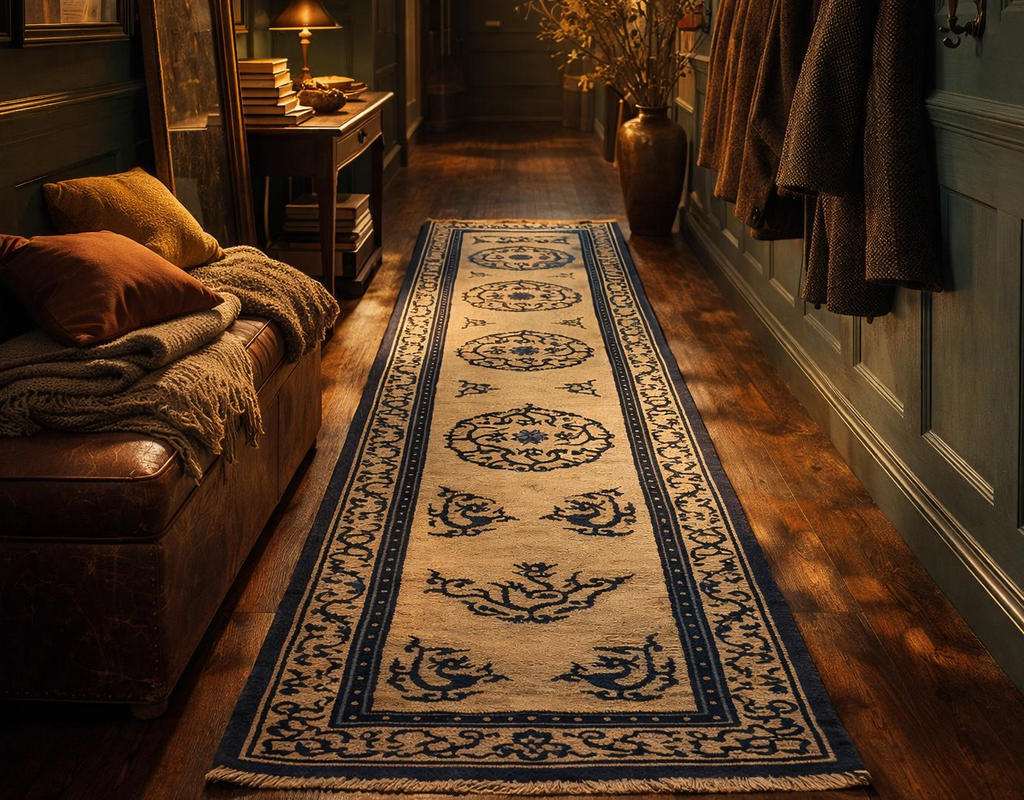
A striking blue and tan runner rug anchors the cozy, traditional aesthetic of this richly toned entryway.
Even amid political upheaval and cultural change, the tradition endured. From its early beginnings, through the flourishing Qing dynasty carpet production, and into the global market of the 20th century, Ningxia weaving adapted to shifting tides while retaining its distinctive identity.
The legacy remains one of resilience, artistry, and cultural exchange—woven into the very fibers of Buddhist monastery rugs and palace commissions that carried Ningxia’s reputation across continents.
Design, Motifs & Aesthetics
Classic Layouts and Patterns
Ningxia rug motifs are expressed through distinctive formats that reflect their ceremonial and functional roles. Throne rugs—often rectangular—featured medallions, cosmic diagrams, or Buddhist emblems in the center, carefully avoiding the depiction of dragons underfoot out of respect for imperial symbolism.
Pillar rugs, designed to wrap around the bases of temple columns, carried continuous designs of clouds, lotus blossoms, or waves, creating the illusion of sacred space. Meditation mats, smaller in scale, displayed more intimate compositions such as floral sprays or the character Shou (longevity), aligning with their use in Buddhist practice. Across all layouts, the unifying principle was clarity: bold but balanced imagery set against open fields that gave Ningxia carpets their signature calm.
Symbolism in Motifs
- Dragons — Why: Represent imperial authority and cosmic power, yet carefully placed to respect courtly taboos.
- Fu lions (Fu dogs) — Why: Protective guardians, commonly found on Fu dog seat rugs, embodying watchfulness and spiritual strength.
- “Shou” Longevity Characters — Why: A wish for long life and enduring prosperity, popular in both courtly and domestic settings.
- Bats — Why: A visual pun (fu, meaning both bat and happiness), symbolizing blessings.
- Lotus and Peonies — Why: Lotus signifying purity in Buddhism; peony revered as the “king of flowers,” symbolizing wealth and beauty.
- Mountains and Waves — Why: Evocations of sacred landscapes, linking heaven and earth.
- Swastika fret borders — Why: The swastika fret border, also called the Greek key, conveys infinity, continuity, and protection, appearing on nearly every classical example.
Colors & Dyes
One of the most recognizable features of antique Ningxia carpets is their palette of mellow gold carpets set against deep indigo blues. The most prominent shade was a saffron yellow, derived from vegetable-based dyes, chosen for its imperial resonance and its association with Buddhist ritual. Indigo blues and soft browns anchored the compositions, while ivory provided lightness.
Reds were sometimes used, but they tended to fade chemically over time, leaving behind a subdued, almost ethereal tonality. This mellow look—a soft gold and blue harmony—became both a chemical and aesthetic signature. The natural fading of vegetable dyes over centuries enhanced the carpets’ quiet elegance, transforming once-bright hues into the aged glow prized by collectors today.
Comparing Ningxia to Related Styles
When compared to neighboring traditions, Ningxia’s individuality becomes clearer. Unlike the Gansu kilims, which are flatwoven in slit-tapestry technique, Ningxia’s few flatweaves were wool pile on cotton foundations, giving them greater warmth and plushness. Gansu’s kilims emphasized strong geometry and linearity, while Ningxia favored open fields and symbolic clarity.
Similarly, Mongolian rugs differed in their rustic simplicity. Mongolian weavers often used fewer colors and larger, bolder motifs, resulting in a raw visual strength. By contrast, Ningxia carpets revealed a refined balance—more colors, subtler compositions, and greater attention to symbolic layering.
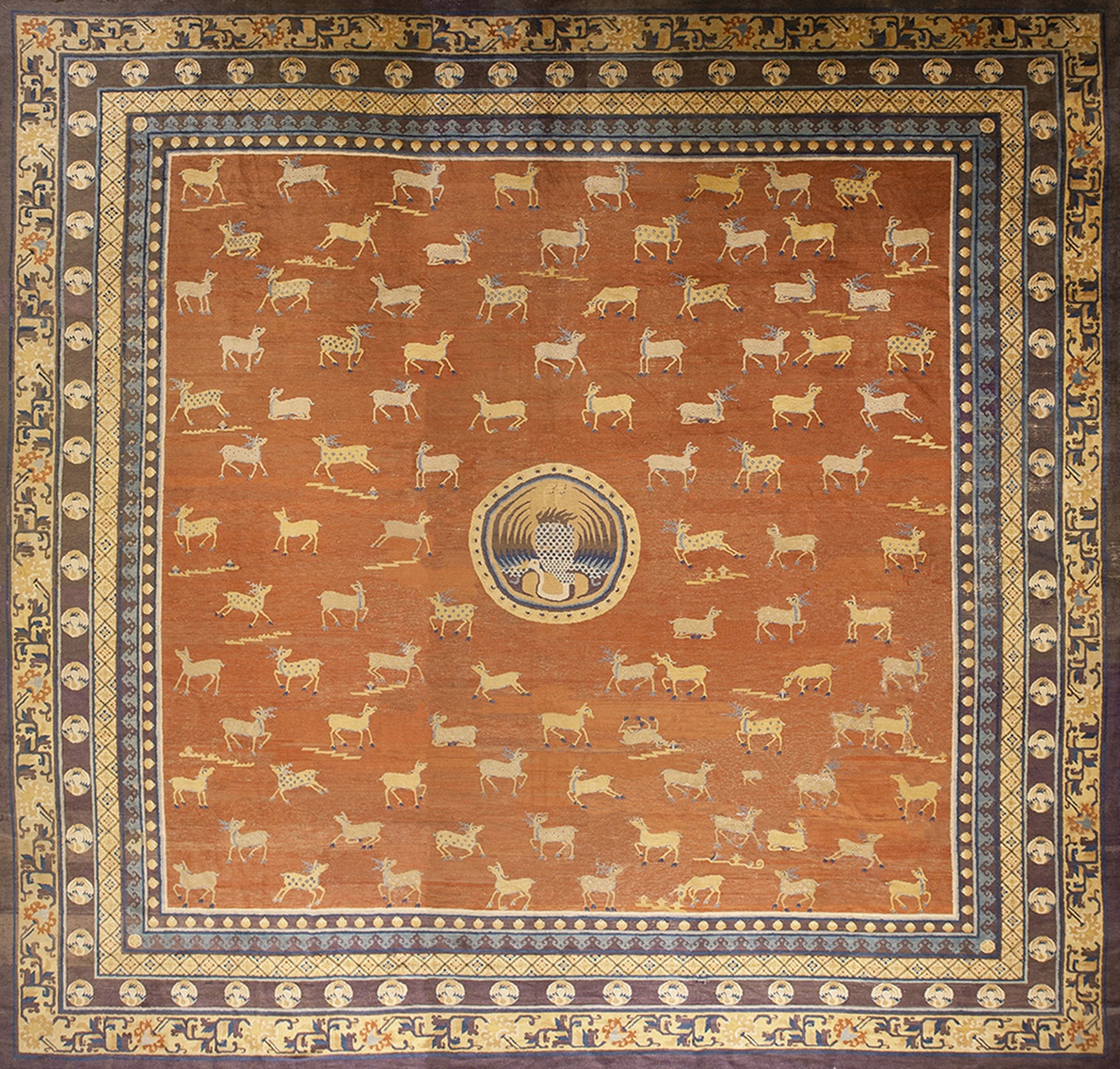
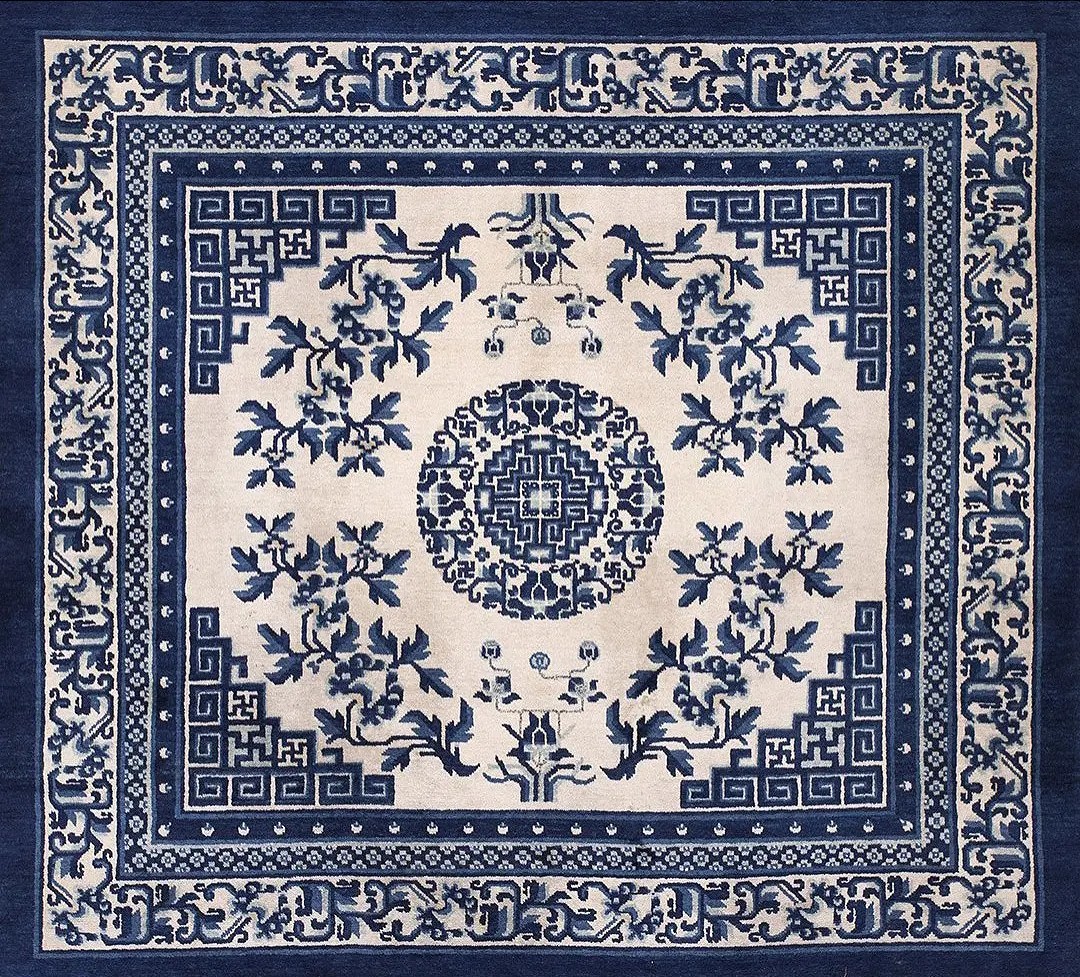
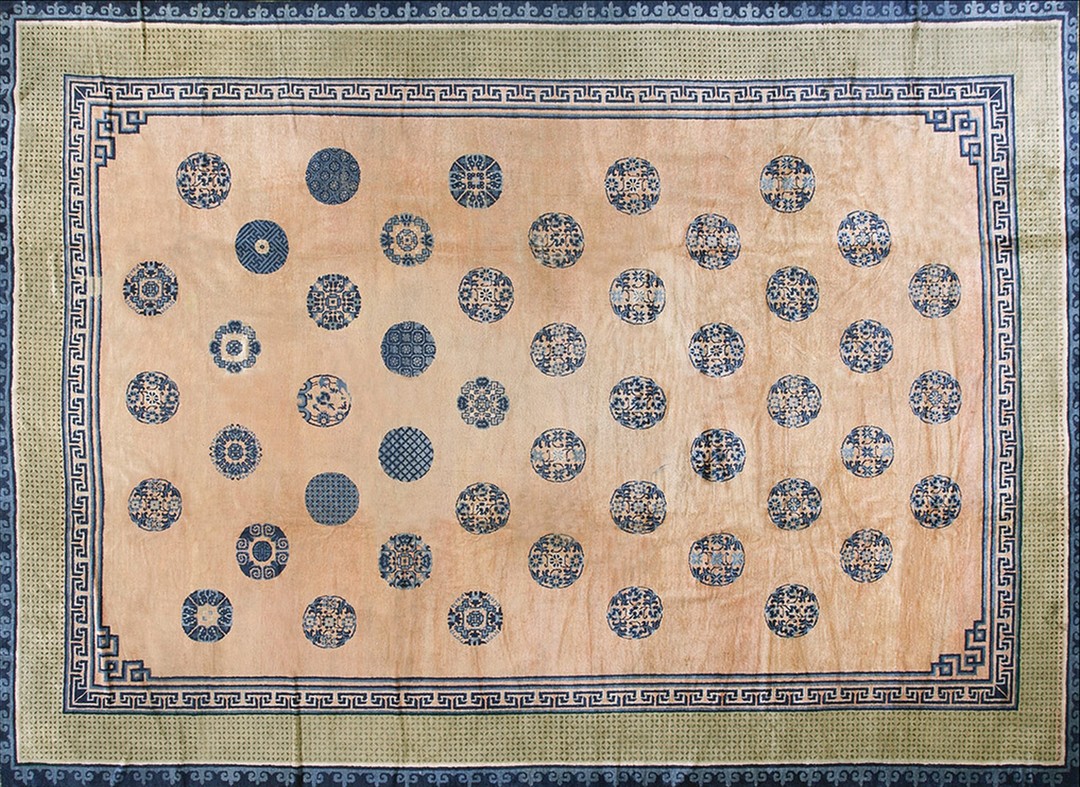
Antique Large Ningxia Chinese Medallion Knotted Rug – by Rugs On Net
In essence, the Chinese dragon carpets of Ningxia, the protective Fu dog seat rugs, and the swastika fret borders formed a canon of motifs that, combined with mellow saffron yellows and indigo blues, created a visual language both instantly recognizable and deeply tied to cultural meaning. It is this harmony of design, symbolism, and aged palette that cements Ningxia’s place as one of the most elegant schools of rug weaving in Chinese history.
Materials, Weaving & Construction
Fiber Sources & Pile Qualities
- Tan sheep wool — Why: Native to Ningxia, Tan sheep provided the high-lanolin, silky fibers that gave these rugs their hallmark flannel-like softness. Their wool was durable yet supple, ideal for carpets meant to serve both in austere Buddhist monasteries and in imperial palaces.
- Tibetan wool — Why: In some cases, Tibetan fleeces were incorporated through trade, adding luster and resilience. The mingling of regional fibers enriched the texture and broadened the quality range.
- Soft, fluffy handle — Why: The natural oils of the wool preserved flexibility, producing a pile that felt warm underfoot but retained strength for ceremonial or decorative use.
This combination of fiber sources created a wool pile that was unusually soft compared to many other antique Chinese rugs, while still maintaining durability.
Knotting, Density & Weaving Technique
Ningxia rug construction employed the asymmetrical knot (often called the Persian knot), tied around a handspun cotton foundation. The looms were vertical treadle types, suited to large-scale carpets such as throne rugs and monastery pieces. The knot density was moderate to low, typically 25–35 knots per square inch (KPSI).
Far from being a weakness, this density allowed bold, legible designs that carried well across temple floors or throne halls. Where Persian carpets sought intricacy through very fine knots, Ningxia’s weaving emphasized clarity of form, enabling dragons, lotus blossoms, or Buddhist emblems to appear strong and visually striking.
Rugs were double-wefted, enhancing stability and longevity. Thus, to answer directly: Ningxia carpet pile favors lower knot density because it serves the visual and functional needs of large-scale ceremonial designs. The relative openness is not a flaw but a conscious design choice that underscores their aesthetic.
Finishing, Flatweaves, and Regional Techniques
Finishing techniques reflected practical and symbolic considerations. Edges were reinforced with cotton bindings, while the wool pile was carefully sheared to maintain evenness. Over time, dye corrosion—especially in browns derived from iron-based mordants—and mellowing in yellows and reds became hallmarks of age.
These surface changes are among the most reliable forms of antique rug verification for collectors seeking 18th-century examples. Flatweaves were far less common in Ningxia, but when made, they employed the same high-quality wool pile on cotton foundations, contrasting sharply with the slit-tapestry techniques of Gansu kilims. This distinction further highlights the identity of Ningxia rugs within the broader Chinese and Central Asian textile traditions.
In short, Ningxia weaving combined soft Tan sheep wool, asymmetrical knotting, moderate density, and double-wefted cotton foundations to produce carpets both durable and elegant. Their construction methods explain why these rugs, centuries later, still carry an aura of warmth and sophistication—every technical choice serving the balance between palace grandeur and monastic calm.
Collectors seeking authenticity look not only to knot counts but also to signs of mellow age, making wear itself part of the enduring story of Ningxia carpets.
Functional Formats & Use Cases
Palace & Throne Rugs
Within imperial settings, the throne carpet was the most emblematic Ningxia format. Typically square and of substantial size, these rugs carried medallion or cosmic landscape motifs rather than dragons, since imperial etiquette forbade placing such sacred creatures underfoot.
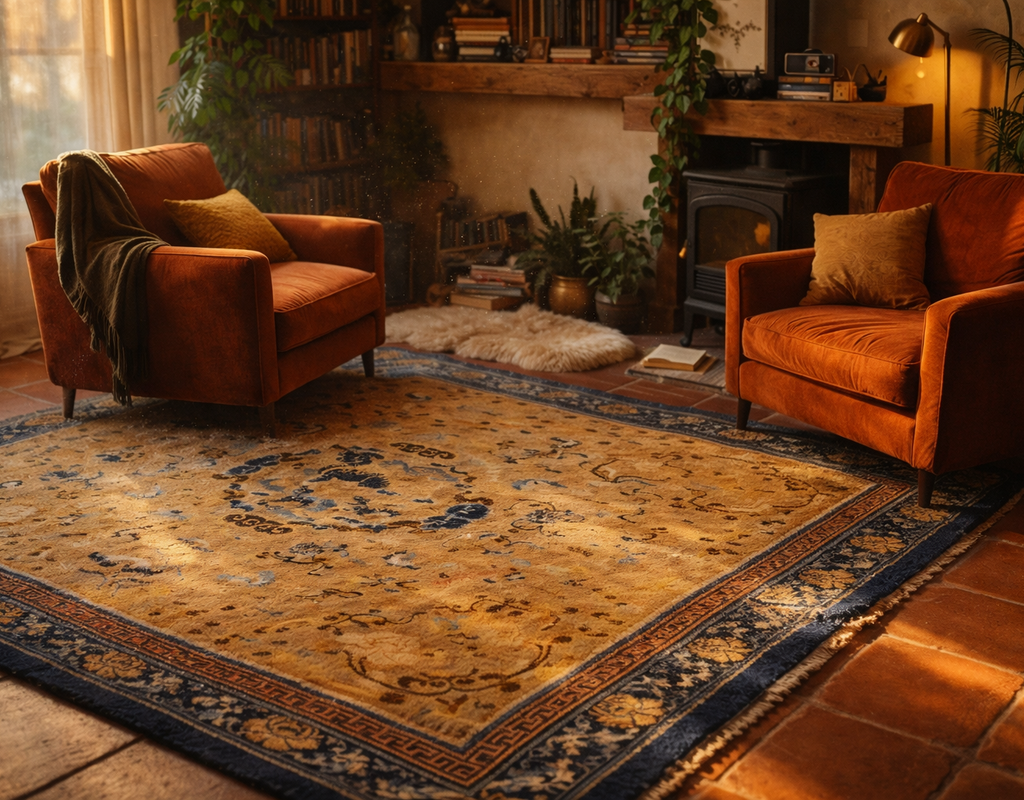
A richly colored, patterned rug defines a warm and inviting seating area by the fireplace.
Instead, the designs suggested harmony between heaven and earth, suitable for framing the emperor’s throne or dais. Their restrained fields of saffron gold and indigo blue projected dignity and gravitas while maintaining a visual clarity that elevated the presence of the court.
Monastery & Meditation Carpets
In Buddhist contexts, Ningxia rugs became indispensable furnishings. The Buddhist pillar rug was woven in elongated, paired lengths designed to wrap around massive temple columns, transforming wooden supports into radiant shafts of symbolic imagery—lotus blossoms, cloud scrolls, or wave patterns.
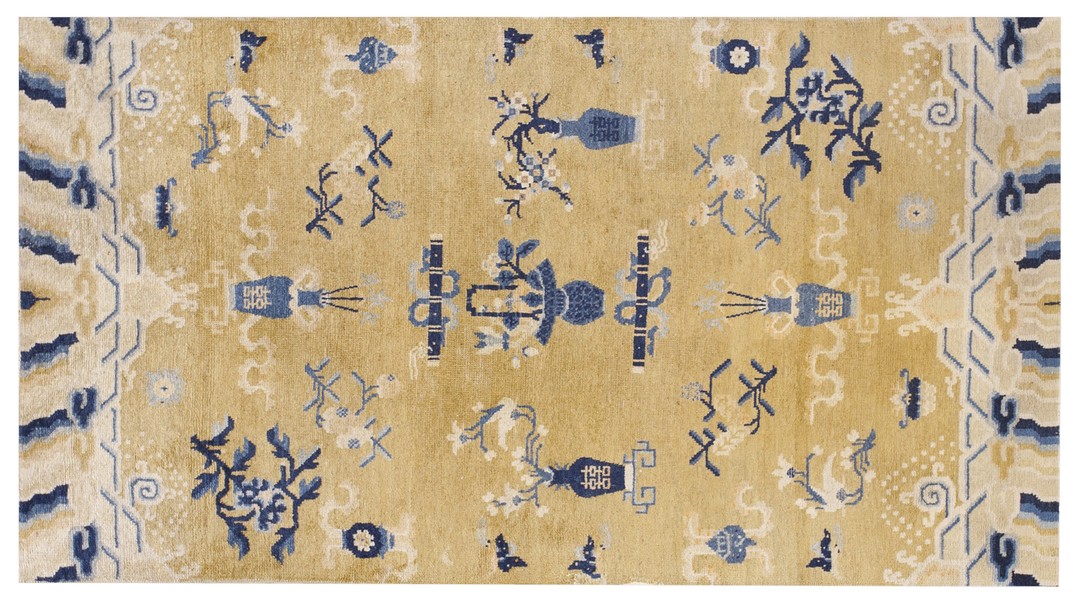
Smaller meditation mats (often known as khaden) carried the celebrated “Hundred Antiques” design, a collection of auspicious symbols—scrolls, vases, incense burners—meant to inspire contemplation and spiritual focus. Larger monastery carpets spread across prayer halls, their repeating motifs of lotus and fret borders anchoring ritual space in an atmosphere of sanctity and calm.
Domestic Use & Scholar Carpets
Beyond court and temple, Ningxia rugs entered the refined world of scholars and households. The kang platform rug, made for the raised brick beds common in northern China, offered both warmth and aesthetic delight.
Wall hangings decorated study rooms or reception halls, displaying motifs of longevity (Shou characters) or bats for good fortune. Some carpets were woven as part of dowries, functioning not just as décor but as markers of prosperity and cultural refinement. In every case, their subdued palettes and open compositions suited Chinese interiors, where balance and harmony were prized.
Flatweaves vs. Pile Rugs
While neighboring weaving traditions often favored flatwoven textiles, Ningxia remained primarily a producer of pile rugs. Flatweaves did exist but were rare, generally simple in weave and less ornate than their pile counterparts. The prevalence of wool-pile construction reflected both the practical need for comfort in cold climates and the symbolic importance of lushness in Chinese and Buddhist aesthetics.

A detailed focus on the intricate, vivid colors and geometric weave of a traditional textile rug.
In summary, Ningxia carpets were not monolithic but highly specialized by context: the square throne carpet underscored imperial power; the Buddhist pillar rug sanctified temple architecture; the meditation mat focused spiritual practice; and the kang platform rug provided warmth and elegance to domestic interiors.
Together, these forms illustrate how Ningxia rugs seamlessly bridged the worlds of palace, monastery, and home—functional artistry woven into every setting of Chinese life.
Regional Variations & Workshop Traditions
City and Workshop Profiles
The heart of Ningxia rug weaving has long centered on Yinchuan, the regional capital, and nearby Zhongwei. The Yinchuan carpet market historically supplied both palace and monastery furnishings, and though weaving there has declined, the city still hosts a handful of workshops preserving the craft.
Zhongwei rug workshops are particularly notable for their persistence in traditional methods, including the continued—though diminished—use of natural dye weaving, a rarity in China’s modern rug production landscape.
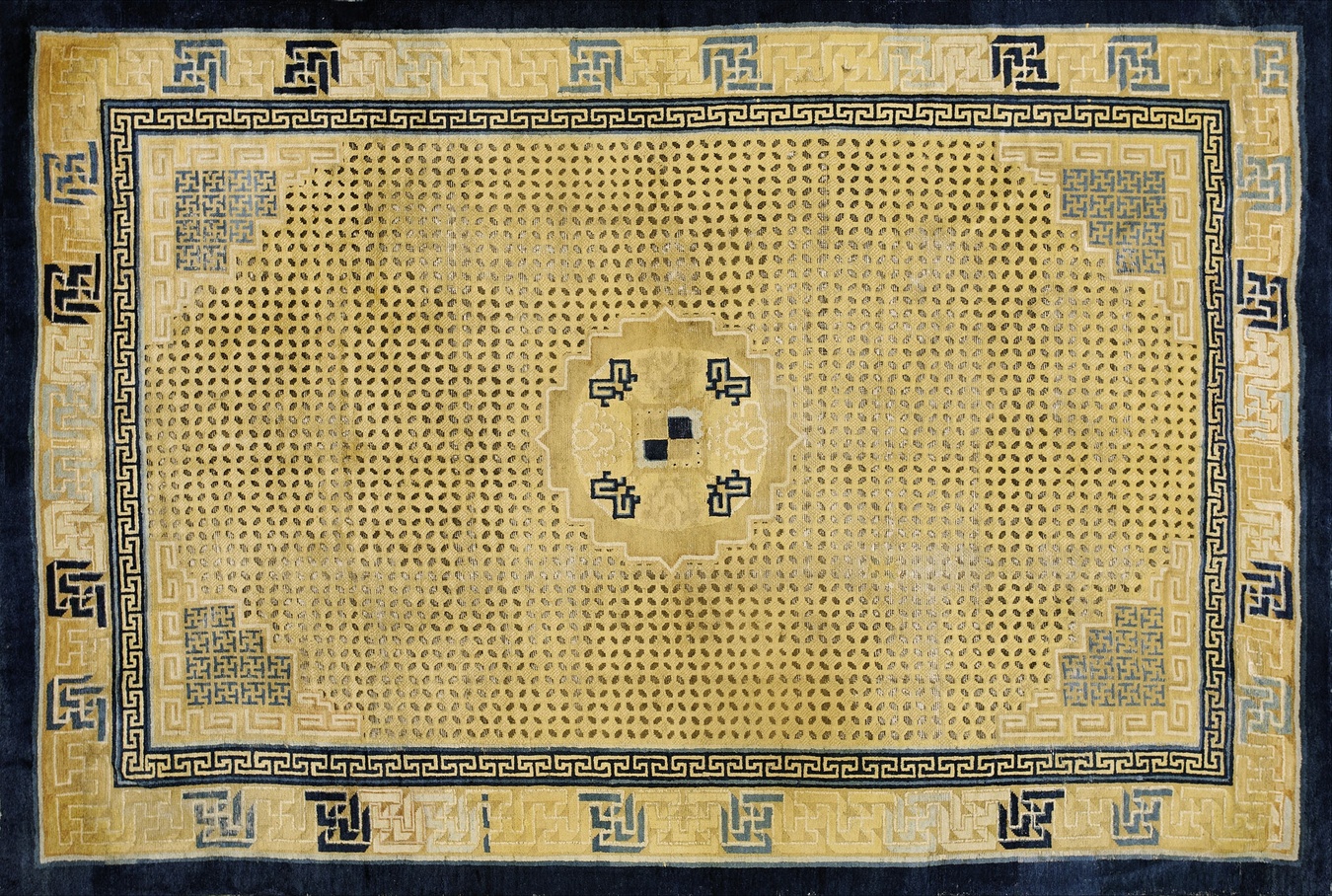
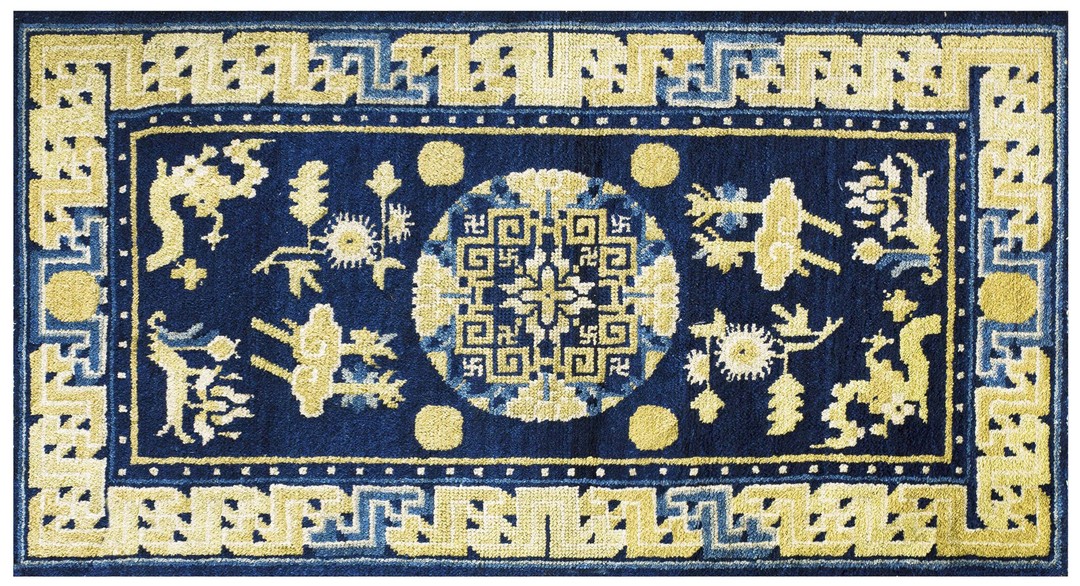
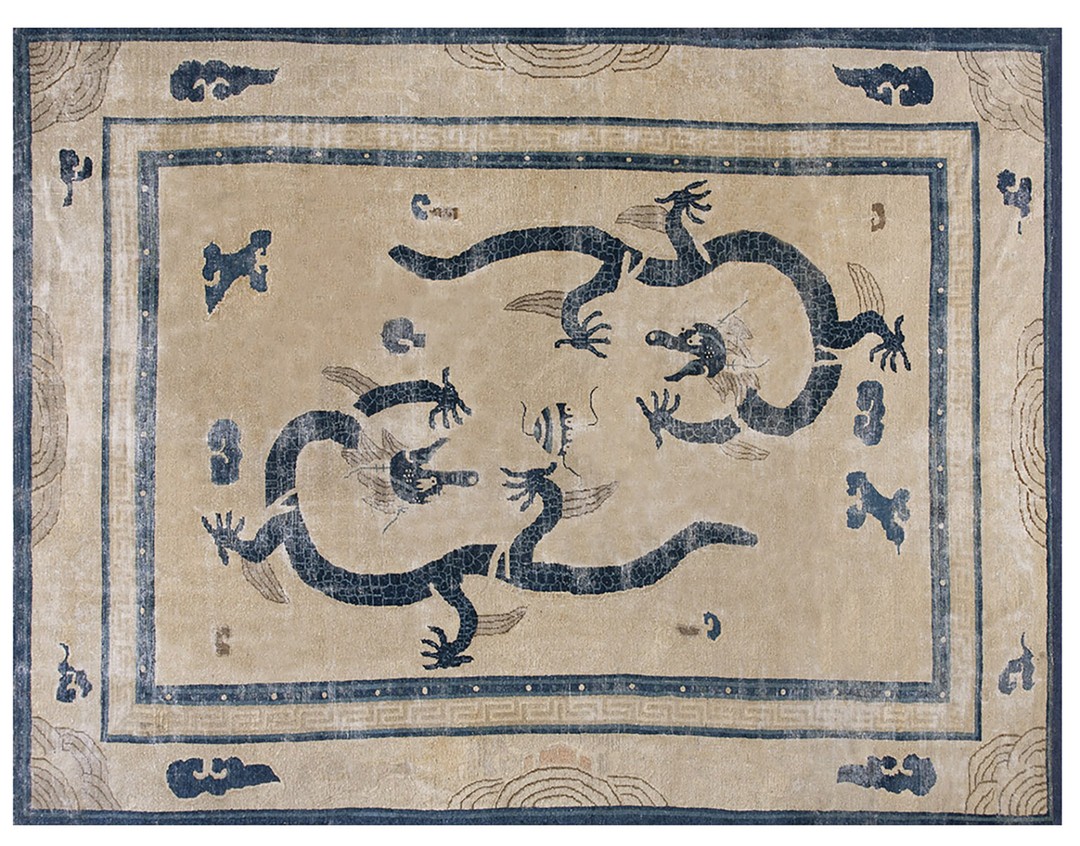
Antique Chinese – Ningxia Chinese Medallion Knotted Rug – by Rugs On Net
This makes Zhongwei a vital link to Ningxia’s historic identity, where saffron yellows and indigo blues once defined the region’s artistic vocabulary.
Comparison: Ningxia, Gansu, Baotou, Mongolian, and Tibetan Production
- Ningxia rugs — Why: Known for their mellow saffron and indigo palette, open fields, and symbolic Buddhist and imperial motifs, they project warmth and understated elegance.
- Gansu rugs — Why: Often confused with Ningxia, but usually flatter in design and slightly more muted in color. Their slit-tapestry kilims differ structurally from Ningxia’s pile carpets.
- Baotou rugs — Why: Produced in neighboring Inner Mongolia, these often share motifs with Ningxia but lean toward stronger blues and denser, more compact patterns.
- Mongolian rugs — Why: Bolder and more rustic, with fewer colors and larger-scale motifs. They emphasize strength over subtlety, contrasting Ningxia’s refinement.
- Tibetan rugs — Why: Traditionally thicker and higher-piled, but their Buddhist iconography often parallels Ningxia. Modern Tibetan and even Nepali production has borrowed from Ningxia’s classical repertory, adapting cloud, lotus, and fret patterns into contemporary designs.
Ongoing Use of Natural Dyes
To answer directly: Zhongwei weavers are still using natural dyes, though on a much smaller scale than in the past. This continuation not only preserves the authenticity of antique Chinese rugs but also provides collectors and enthusiasts a rare chance to see saffron yellows and indigo blues produced by traditional methods.
In sum, while Ningxia carpets share affinities with Gansu, Baotou, Mongolian, and Tibetan traditions, their visual clarity, mellow tones, and symbolic depth remain regionally distinct. With Yinchuan maintaining a modest presence and Zhongwei upholding dye heritage, Ningxia continues to assert its place in the broader landscape of Chinese and Central Asian rug weaving.
Symbolic, Spiritual & Cultural Relevance
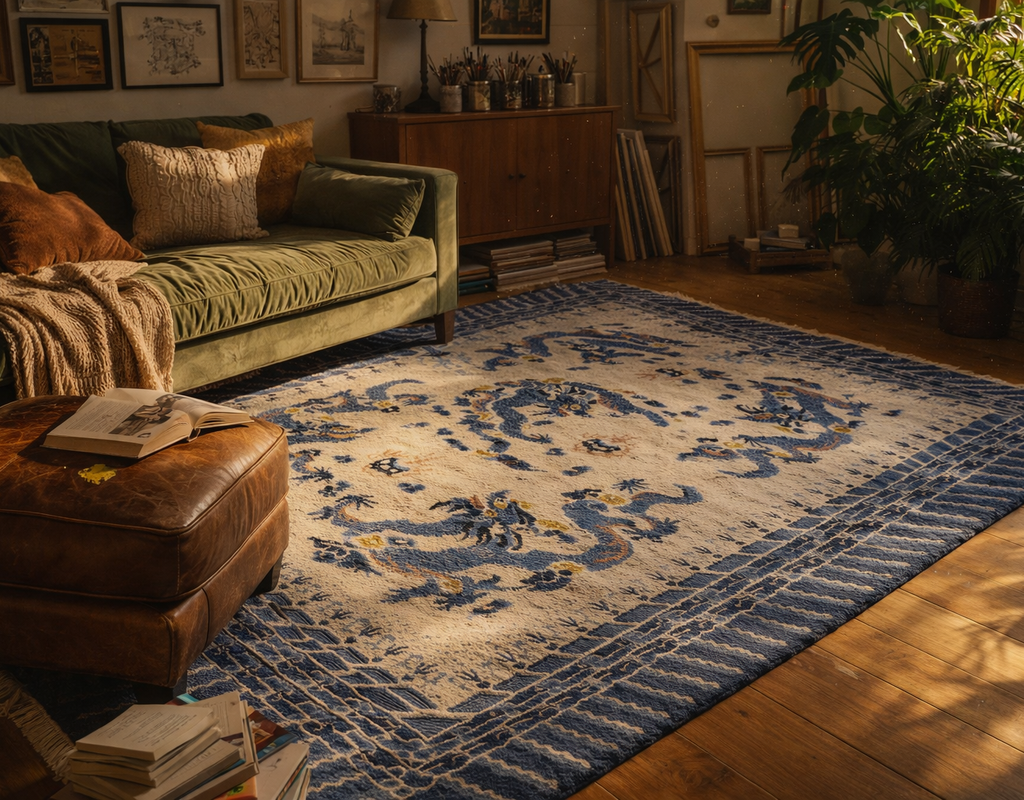
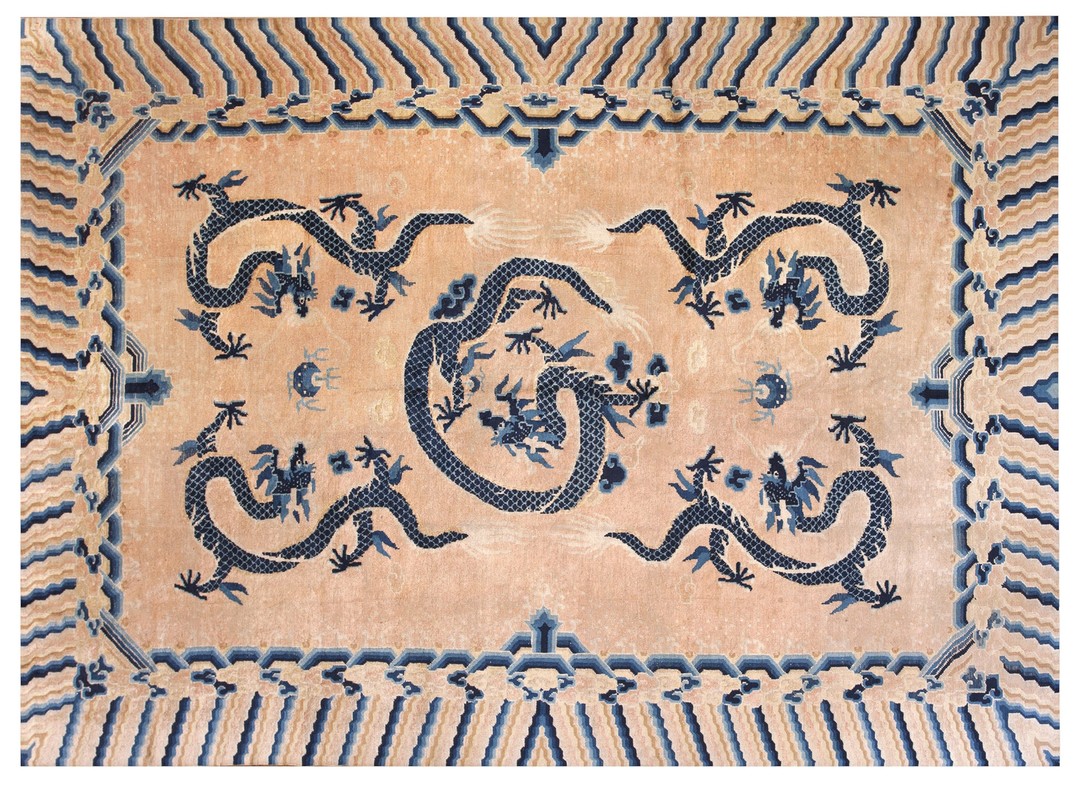
The rug’s Asian-inspired dragon pattern grounds this richly textured, art-filled living space.
Imperial, Religious & Social Meanings
- Dragons — Why: In the context of the imperial Chinese carpet, the dragon symbolized the emperor’s supreme authority, embodying cosmic power and divine rule.
- Lotus — Why: A central figure in Buddhist carpet symbolism, the lotus flower represented purity and spiritual awakening, making it essential in monastery and meditation settings.
- Bats — Why: Known for the bat motif meaning, bats (fu) were a visual pun for happiness and good fortune, ensuring blessings wherever the rug was placed.
- Shou characters — Why: These inscriptions signified longevity and enduring prosperity, reinforcing the wish for stability in both palace halls and family households.
Together, these motifs infused Ningxia rugs with layers of meaning, turning them into woven prayers, wishes, and affirmations of status.
The Role of Carpets in Ritual and Status
The functions of Ningxia rugs reflected their symbolic potency. In the palace, the throne carpet projected imperial dignity, with medallions and cosmic landscapes reinforcing the emperor’s role as the axis between heaven and earth. In temples, Buddhist pillar rugs, altar runners, and meditation mats helped sanctify ritual space, embedding spiritual symbols directly into the architecture of worship.
In domestic interiors, kang platform rugs and wall hangings marked refinement and wealth, doubling as both practical furnishings and status symbols. Across these settings, Ningxia carpets were not passive décor but active participants in rituals of power, worship, and cultural identity.
Cross-Cultural Exchange: Silk Road & Tibetan Buddhist Context
Ningxia rugs also served as cultural exchange rugs, carrying designs, techniques, and meanings across regions. Along the “carpet road,” merchants and monks transported these textiles into Tibet and Mongolia, where they became integral to Buddhist practice. In Tibet, Ningxia rugs lined prayer halls, wrapped temple pillars, and provided soft, sanctified surfaces for meditation.
At the same time, Tibetan motifs influenced Ningxia weaving, resulting in a two-way dialogue of artistic and spiritual traditions. This exchange was not merely material but deeply cultural: rugs acted as ambassadors, binding the spiritual aesthetics of Chinese courtly art with the devotional practices of Tibetan Buddhism.
To answer directly: Ningxia carpets hold symbolic and cultural meanings that intertwine Chinese imperial authority, Buddhist spirituality, and domestic refinement. They served simultaneously as status symbols, ritual furnishings, and instruments of cultural diplomacy. The dragon, lotus, bat, and shou became universal signs woven into wool—symbols that linked emperor, monk, and family across centuries of Chinese and Tibetan life.
The Modern Market & Collector’s Guide
Antique Value & Museum Collections
Today, authentic Ningxia rugs are among the rarest categories of antique Chinese carpets. Fewer than a thousand examples woven before 1800 are thought to survive, making them highly desirable to museums and serious collectors.
Institutions worldwide showcase “Hundred Antiques” meditation mats, grand pillar rugs, and throne carpets as benchmarks of Chinese textile art. Their restrained elegance and soft patina give them universal appeal, ensuring continued demand in both academic and private collections.
Authenticating 18th-Century Ningxia Rugs
- Mellowed saffron and gold tones — Why: Vegetable dyes naturally soften with age, creating the signature glow collectors prize.
- Dye corrosion in browns — Why: Iron-based mordants eat into wool over time, leaving a textured surface—a sign of genuine age.
- Moderate knot density (25–35 KPSI) — Why: Distinguishes Ningxia construction from finer Persian carpets while supporting bold, legible motifs.
- Classic motifs and borders — Why: Features such as the swastika fret, lotus, bats, and shou symbols indicate authentic tradition rather than modern imitation.
- Wear and patina — Why: Even, honest wear enhances credibility; overly “perfect” rugs may be recent reproductions.
Direct answer: Collectors can verify 18th-century Ningxia rugs by examining pile quality, mellow tones, corrosion patterns, knot count, and the presence of time-honored motifs.
Buying: Yinchuan, Outlets, and Markets
- Yinchuan rug market — Why: Offers access to traditional weaving centers and local vendors, though buyers must be cautious of tourist-grade imitations.
- Outlets and workshops — Why: Provide better opportunities to source quality modern pieces, sometimes using natural dyes, but rarely true antiques.
- International dealers/auctions — Why: Safest way to find verified 18th- or 19th-century Ningxia rugs, supported by provenance and expert curation.
Direct answer: Tourists may enjoy browsing the Yinchuan markets, but serious collectors should seek vetted dealers or museum-backed outlets to avoid inauthentic purchases.
Investment: Ningxia vs. Mongolian Rugs
- Ningxia carpets — Why: Exceptional rarity, museum-level appeal, and a long history of cross-cultural significance make them excellent investment rugs. Prices remain strong due to limited supply.
- Mongolian rugs — Why: Valued in their own right for bold rustic motifs but produced in greater numbers and with less consistent market demand, making them less secure as long-term investments.
Direct answer: Ningxia carpets are generally the better investment compared to Mongolian rugs, as they combine rarity, artistry, and strong demand from both collectors and institutions.
In today’s market, the allure of buying rugs and carpets from China still rests on the timeless prestige of Ningxia weaving. For collectors, these rugs offer not only material beauty but also a piece of cultural history—woven testimony to China’s imperial and Buddhist traditions, preserved in wool for centuries.
Care, Durability & Sustainability
How Durable Are Ningxia Wool Carpets?
- High lanolin content — Why: The wool from Tan sheep is naturally rich in lanolin, giving it a silky softness while also enhancing stain resistance and flexibility. This makes wool rug durability one of Ningxia’s hallmarks.
- Strong cotton foundation — Why: Double-wefted cotton warps and wefts add structural resilience, ensuring the rug retains shape and strength even under decades of use.
- Balanced knot density — Why: With 25–35 knots per square inch, Ningxia rugs favor legibility and sturdiness over extreme fineness, making them less prone to knot breakage in high-traffic areas.
Direct answer: Authentic Ningxia wool carpets are highly durable, capable of withstanding moderate to high foot traffic if properly maintained. Their softness does not come at the expense of strength.
Maintenance in High-Traffic Spaces
- Regular vacuuming — Why: Prevents grit from settling into the wool pile, which can otherwise cut fibers and accelerate wear.
- Rotation of placement — Why: Rotating rugs ensures even exposure to foot traffic and sunlight, slowing fading and wear in any one area.
- Gentle cleaning — Why: Avoiding harsh chemicals preserves vegetable dyes and wool softness, while professional hand-washing prolongs life.
- Moisture avoidance — Why: Excessive humidity or spills can weaken the cotton foundation, so dry conditions extend longevity.
In short, Ningxia carpet care is straightforward: consistent but gentle maintenance preserves both function and beauty for generations.
Modern Threats: Desertification & Wool Supply
Environmental change now casts a shadow over this legacy. Desertification risk to wool production in north-central China threatens the pastures that support Tan sheep herding. As grasslands shrink under climate pressure and overgrazing, the availability of the high-quality wool that defines Ningxia rugs could decline.
This ecological challenge not only endangers traditional livelihoods but may also raise the value of surviving antique and authentically made Ningxia carpets. Direct answer: Yes, desertification threatens Ningxia’s future wool supply. Without sufficient grazing land, the very foundation of the region’s weaving tradition could be compromised.
Thus, while Chinese rug maintenance ensures individual pieces endure, the broader sustainability of the craft depends on ecological preservation. For collectors and caretakers, the durability of the past is certain—but the future of Ningxia weaving will rest on the health of its land and flocks.
Explore Some of Our Favorite Ningxia Rugs
FAQ
- Where should I buy or appraise Ningxia rugs?
Seek established antique-rug dealers and major auction houses, and use certified appraisers for insurance. Ask for age, condition, repairs, and dye tests before purchasing.
- Where were Ningxia rugs historically used?
Ningxia rugs served monasteries, palaces, and scholar’s rooms—think pillar wraps, throne seats/backs, and kang mats. The Kangxi court famously ordered Ningxia carpets for audience halls.
- What are Ningxia saddle rugs?
Ningxia saddle rugs are horse pads, often two-part with a central notch and auspicious motifs. Many measure roughly 2′ x 3′ per panel and are highly collectible.
- Can I use a robot vacuum on a Ningxia rug?
Avoid it—robot vacuums snag fringes and can pull older fibers. Stick to light, directional suction with a hose and protect fringes by lifting when vacuuming edges.
- How can I spot a reproduction of a Ningxia rug?
Reproductions may have overly bright, uniform colors, machine-serged edges, or stiff backings. Authentic Ningxia rugs show hand-knotted backs, natural wear, and nuanced dye variation.
- Are Ningxia rugs a good investment?
They can be, especially early or rare formats in strong condition with provenance. Market values vary widely; buy for quality and documented originality.
- How much do Ningxia rugs cost today?
Prices range from a few thousand dollars for modest pieces to tens of thousands for large or early examples. Notable sales include pillar rugs around \$5k–\$10k and exceptional carpets far higher.
- What do bats and shou symbols on Ningxia rugs mean?
On Ningxia rugs, bats (fu) symbolize blessings and shou represents longevity. Combine them with peaches, clouds, and waves for wishes of a long, auspicious life.
- Can I hang a Ningxia rug on the wall?
Yes; mount using a hand-sewn sleeve and Velcro or a slat system to distribute weight. Avoid nails or clips; museum-style mounts protect edges and shape.
- Should I use a rug pad under a Ningxia carpet?
Yes—use a breathable felt or felt-rubber pad to reduce wear and prevent slipping. A pad can extend a Ningxia rug’s life and improve comfort underfoot.
- How should I clean an antique Ningxia rug?
Vacuum gently with suction only (no beater bar) and blot spills promptly with plain water. For washing, use a specialist in antique rugs; avoid steam or harsh chemicals.
- Are Ningxia rugs safe for homes with pets or kids?
They’re safe but delicate; claws and spills can damage antique pile and natural dyes. Prefer low-traffic rooms and use a pad and felt-backed furniture glides.
- Are Ningxia rugs durable for everyday use?
Antique Ningxia rugs are sturdy but should be placed in lower-traffic areas to preserve pile and dyes. Use a quality rug pad and rotate every 6–12 months.
- What sizes are common for Ningxia rugs?
Expect small seat mats (\~2′ x 2′), kang runners (\~2–3′ x 6–9′), pillar rugs (\~3–4′ x 8–14′), and occasional large room carpets. Chair sets come as coordinated seat and back pairs.
- How do Ningxia rugs differ from Peking (Beijing) rugs?
Peking rugs are generally later, often room-size, and can be more formal or Deco-leaning. Ningxia rugs are typically earlier with softer palettes and temple-or-scholar motifs.
- How do Ningxia rugs compare with Baotou rugs?
Baotou rugs often feature steely indigo fields and sharper contrasts, while Ningxia rugs skew warmer and subtler. Both are northern Chinese, but Ningxia palettes lean yellow/camel/ivory.
- How old are Ningxia rugs on the market today?
Many Ningxia rugs available are 19th-century, with earlier Qing examples also appearing. Auction records include 18th-century pieces, and later pillar rugs from the early 20th century.
- What materials and knots do Ningxia carpets use?
Most Ningxia rugs have wool pile on cotton warps/wefts with modest knot density. Knot type varies by piece; both symmetrical and asymmetrical knots are documented.
- What other formats do Ningxia rugs come in?
Beyond room carpets, Ningxia rugs include kang (bed-platform) mats, chair seat/back sets, long monastery runners, and saddle rugs. Kang pieces are long and narrow for platform beds.
- What is a Ningxia pillar rug?
A Ningxia pillar rug is designed to wrap around temple columns so the pattern meets seamlessly, often with a coiling dragon. Typical sizes run about 3–4 feet wide by 8–14 feet long.
- What motifs are typical of Ningxia rugs?
Common Ningxia rug motifs include shou (longevity), bats (fu), dragons, cloud bands, lotus, peony, and Greek-key meanders. Borders often alternate wave or fret patterns.
- Are all Ningxia rugs yellow?
No—Ningxia rugs also appear in camel, apricot, ivory, and blue-centered schemes. Dragons, cloud bands, and lattice or floral repeats can appear on non-yellow grounds.
- Why do so many Ningxia rugs have yellow fields?
Yellow held imperial and monastic significance in China and Tibet, so Ningxia weavers used it heavily. You’ll also see camel, apricot, and ivory grounds paired with blue details.
- How can I identify a Ningxia rug quickly?
Look for mellow yellow, camel, or ivory grounds with indigo motifs, fret borders, bats or shou symbols, and a soft, cushy handle. Older Ningxia rugs often show a corroded brown guard stripe.
- What are Ningxia rugs?
Ningxia rugs are antique Chinese carpets from the Ningxia/Gansu region, prized for restrained designs and soft palettes. Many date from the 18th–19th centuries with wool pile on cotton foundations.