
Luxury Rugs, Defined: What “Luxury” Actually Means in Rugs
As a starting Point – what is the origins of “luxury”?
Before we go into luxury rugs specifically, lets define the core term. The word “luxury” has a fascinating linguistic journey that mirrors its evolution from a moral failing to a symbol of high status. It originates from the Latin word luxuria, but its primary root is luxus.
The Latin Root: Luxus
At its most basic level, the Latin luxus meant “dislocated” or “shifted out of place.” * Medical Origin: It was originally used in a medical context to describe a bone that had been put out of joint (this is where we get the modern term luxation).
- Conceptual Shift: From “dislocated,” the meaning shifted to describe anything that was “excessive” or “offset” from the natural or necessary order. It represented a deviation from the stoic, disciplined Roman norm.
Luxuria: Excess and Riotous Living
By the time luxuria became common in Latin, it referred to “extravagance,” “profusion,” or “riotous living.” * In the Roman world, luxury wasn’t a compliment. It was often associated with ambitio (ambition) and avaritia (greed), seen as a corrupting force that weakened the state.
The Old French Influence: Luxure
The word entered the English language around the 14th century via the Old French word luxure. However, it didn’t mean “fancy items” yet.
- The Sinful Association: In Old French and Middle English, “luxury” was synonymous with “lust” or “lasciviousness.” * In religious texts of the time, “luxury” was one of the labels for the Seven Deadly Sins—specifically the sin of lechery.
The Modern Shift: 17th Century to Today
It wasn’t until the 17th century that the word began to shed its purely sinful connotations and take on its modern meaning.
- From Lust to Comfort: It shifted from describing sensual excess to describing material excess—specifically “sumptuous surroundings” or “great comfort.”
- The Status Symbol: By the 18th century, “luxury” became an economic term, used to describe high-quality goods that were desirable but not essential for survival.
The Evolution of “Luxury”
To understand the value of a high-end textile, one must look at the linguistic roots of the word itself. “Luxury” has traveled from the medical clinics of Rome to the cathedrals of France before arriving in the modern showroom.
| Era & Language | Original Word | Historical Meaning |
|---|---|---|
| Roman Latin | Luxus | “Dislocated” or “Out of Joint”—denoting a deviation from the necessary norm. |
| Middle Ages (French) | Luxure | Indulgence and Lust; historically categorized as a moral excess or sin. |
| Modern English | Luxury | Great comfort, sumptuousness, and the possession of rare, high-craft refined goods. |
The Rugs On Net Perspective: We define luxury by its original Latin root: something “dislocated” from the mass-produced world through extraordinary effort and master-level craftsmanship.
What makes a rug “luxury” in practice?
True luxury rugs are not determined by a price tag alone. Instead, luxury rugs are defined by a measurable convergence of four specific factors: rare fiber quality, master-level craftsmanship, specific design intent, and provenance. In practice, a rug earns this classification only when its technical construction surpasses mass-market standards. The difference must be visible in the structure, not just the surface appearance.
Luxury hand-knotted rug definition relies heavily on precision and density. While commercial rugs may look appealing from a distance, a luxury piece demonstrates high knot counts that allow for intricate, pixel-perfect distinctness. The materials used are often the finest wools with high lanolin content, pure Silk, or even metal-wrapped threads in ultra-exclusive pieces. Furthermore, provenance plays a critical role. A rug with a documented history or origin from a renowned weaving district holds a pedigree that elevates it from a furnishing to an investment asset.
Luxury rugs as “innate quality” plus “artistic value”
Beyond technical specifications, high-end handmade rugs must possess artistic depth. This distinguishes a technically proficient rug from a true work of art. The innate quality is found in the materials and the weave, but the artistic value is found in the symbolism and cultural context.
Design details that signal truly luxury rugs often include complex, symbolic motifs that carry meaning beyond simple decoration. These may include specific medallions, intricate foliage, heraldic emblems, guardian animals, or religious and dynastic themes. When these elements are present, the rug serves as a cultural artifact. This symbolism is a key differentiator; it elevates the object from a floor covering to a narrative piece. What makes a rug luxury is the combination of this deep cultural resonance with physical perfection—where the pile clarity allows every symbol to be read clearly.
The Rugs On Net Acquisition Standard
Where High-Net-Worth Design Meets Master-Level Vetting
1. Technical Vetting
We do not simply “stock” rugs; we audit them. Every luxury piece in our collection undergoes a structural integrity check, verifying that the warp and weft foundations are resilient and that the knotting tension is uniform. We reject 90% of what the market labels “luxury” to ensure our clients only see the top 10% of global output.
2. Material Purity Guarantee
We prioritize “Life-Cycle Integrity.” Our luxury inventory focuses on long-staple Highland wool and natural Mulberry silk. We are vocal about the limitations of “viscose” and “art-silk,” guiding our clients toward fibers that will actually retain their value and luster after a decade of use.
3. Direct-to-Atelier Sourcing
By maintaining direct relationships with master weaving ateliers and heritage workshops, we eliminate the “middleman markup.” This allows Rugs On Net to provide investment-grade provenance at a fair market valuation, ensuring your acquisition is a sound financial move as well as a design triumph.
Looking for a specific provenance or a bespoke size?
Contact Us For Private Consultation / Showroom Inquiry
Traditional luxury vs modern luxury concept shift
Historically, luxury rugs were the result of elite patronage. They were commissioned by courts and nobility, utilizing the absolute finest resources available to weavers. Today, the definition has expanded but remains rooted in exclusivity. Bespoke luxury rugs represent the modern evolution of this concept.
Modern luxury often implies limited editions, collaborations with world-class designers, and “artist rug” concepts where the floor covering is treated as a canvas. While traditional luxury focuses on knot density and classical motifs, modern luxury emphasizes customization, rare fiber blends, and unique color palettes. As we will explore in the History of Rug making, this shift represents a move from dynastic status symbols to individual expressions of taste, yet the requirement for superior construction remains unchanged.
The Triple Crown of Elite Weaving: Tabriz, Heriz, & Senneh
While regions like Ghom and Hereke dominate the pure silk market, the true “backbone” of investment-grade collecting lies in three distinct Persian regions. Each represents a different pinnacle of the craft: Mechanical Precision (Tabriz), Structural Resilience (Heriz), and Technical Sophistication (Senneh).
1. Tabriz: The Architectural Standard
Tabriz is the global benchmark for technical proficiency. Unlike village rugs, Tabriz pieces are woven using the Turkish Symmetric Knot and a metal hook (gullab), allowing for a mathematical level of detail.
The “Raj” System: Investment value is determined by the Raj (knots per 7cm). We recommend 50, 60, or 70 Raj for elite collections. At 70 Raj, the weave is so dense that silk is often used for highlights to create a three-dimensional effect.
Look for signatures: Beniam, Faradji, or Alabaf.
2. Heriz & Serapi: The “Iron Rugs” of Persia
Heriz rugs are prized for their bold, geometric medallions and legendary durability. However, the true investment grade is the Serapi—an older, finer-weave variant produced prior to 1910.
Material Integrity: These rugs utilize wool from sheep in the mineral-rich Azerbaijan mountains, creating a fiber with unmatched tensile strength and natural luster. They are the premier choice for luxury high-traffic zones like grand dining rooms and libraries.
3. Senneh: The Master of the Single-Weft
Senneh rugs represent the most sophisticated “Fine Village” weaving. They are technically unique due to their single-weft construction, resulting in a rug that is remarkably thin, stiff, and resilient.
The Mahi Motif: Senneh is famous for the Mahi (Herati) pattern. In a museum-grade Senneh, this repeating pattern is so intricate it challenges the resolution of the human eye. Historically, these were so finely woven they were used as royal covers for furniture as often as floors.
Quick litmus tests for real luxury rugs vs marketing hype
To distinguish genuine quality from marketing hype, buyers can use specific checks. True luxury rugs are finer detailed and incorporate better materials than commercial alternatives.
For a deeper understanding of technical specifications, refer to guides on “what makes a rug high quality” regarding rug fineness.
- Check the Knot Density: Higher knot counts per Square inch allow for curvilinear designs and durability; low density results in blocky, pixelated patterns.
- Inspect the Back of the Rug: The design should be clearly visible on the reverse side; a canvas backing or glue suggests a machine-tufted product, not a hand-knotted luxury piece.
- Test the Fiber Luster: High-quality Wool and silk have a natural sheen and softness due to oil content; synthetic fibers often feel unnaturally slick or plastic-like.
- Verify the Fringe: In a genuine hand-knotted rug, the fringe is the warp threads extending from the rug’s foundation; sewn-on fringe is a sign of mass production.
Common luxury claims
| Claim | What It Usually Means | What to Verify |
|---|---|---|
| “Hand-Made” | A broad term that can include hand-tufted (glued) rugs. | Verify if it is “Hand-Knotted.” Look for knots on the back, not a canvas cover. |
| “Silk Accents” | The rug uses shiny fibers to highlight details. | Ensure it is real silk (burn test smells like hair) and not Viscose/rayon (burns like paper). |
| “Museum Quality” | Extremely high knot count and rare age/condition. | Ask for provenance, exact KPSI (knots per square inch), and restoration reports. |
| “Bespoke” | Custom-made for a specific client. | Check if the design was truly original or just a standard pattern in a different color. |
| “Natural Dyes” | Dyes derived from plants/minerals, not chemicals. | Look for “abrash” (subtle color variation) which indicates natural dyeing processes. |
Traditional vs Modern Luxury Rugs: Same Idea, Different Context
Comparison of Traditional and Modern Attributes
While the definition of luxury has evolved, the distinction between traditional luxury rugs vs modern luxury rugs requires a nuanced understanding of materials, technique, and intent. The following table outlines how the attributes of high-end weaving have shifted from the era of court carpets vs contemporary luxury rugs.
| Attribute | Traditional Luxury Rugs | Modern Luxury Rugs |
|---|---|---|
| Materials | Hand-spun fine wool, pure silk, metal-wrapped threads. | Fine wool/silk, plus cashmere, Mohair, Bamboo Silk, and premium blends. |
| Weaving Quality | Fully hand-knotted; often exceeds 300 KPSI (Knots Per Square Inch). | Predominantly hand-knotted; typically ranges >200 KPSI depending on texture goals. |
| Design & Motifs | Medallions, intricate flora, guardian animals, royal symbols. | Abstract, art-driven, painterly effects, or reinterpreted classics. |
| Color/Dyes | Exclusively natural plant and mineral dyes. | Natural dyes combined with high-quality Swiss chromium dyes for wider palettes. |
| Production Context | Court and temple workshops; singular masterpieces for elite patronage. | Boutique ateliers, luxury fashion house collaborations, custom private clients. |
| Symbolism | Religious, dynastic, or talismanic meanings. | Personal expression, aesthetic experimentation, artist signatures. |
What stayed constant across eras
Despite the visual differences between a bespoke rug vs antique court rug, the core pillars of luxury remain immutable. “Luxury” is a continuity of standards that persists even as aesthetics change. The first constant is the insistence on rare fibers. Whether it is 16th-century Safavid silk or modern Tibetan wool mixed with mohair, the raw material must be the absolute best of its class.
Elite workmanship is the second constant.
What makes a rug “luxury” in practice?
It is the execution of the weave. In both eras, the structural integrity of the rug is paramount. Luxury rugs are built to last generations, utilizing dense knotting techniques that ensure the pile remains resilient. Finally, intentional design separates these pieces from commodity goods. In both traditional and modern contexts, the pattern is not merely a repeated stamp but a carefully composed image that fits the specific dimensions of the loom.
What changed in modern luxury
The shift to modern luxury represents a movement away from rigid dynastic symbolism toward authored design and textural experimentation. While traditional luxury was often dictated by regional identity—where a Tabriz rug looked distinctly like the Persian Tabriz rugs—modern luxury is defined by the vision of boutique ateliers and specific designer collaborations.
In this contemporary context, the “artist rug” concept has emerged. Here, a rug is treated as a woven canvas, often signed by the designer or the weaving house. The materials have also expanded; while traditionalists relied on sheep’s wool and silk, modern weavers of luxury rugs experiment with cashmere, Hemp, and allo to achieve specific tactile sensations. Furthermore, the modern market values customization. Limited edition luxury rugs are frequently commissioned to match specific interior palettes, moving away from the fixed color rules of historical weaving centers.
Luxury rugs vs commercial standards
Tthe divide between luxury and commercial standards is vast. This distinction becomes critical when analyzing modern “designer” rugs.
Buyers often ask: What’s the difference between luxury and “designer” rugs? A “designer” rug often refers to a licensing deal where a famous name is applied to a standard, machine-tufted, or mid-tier hand-tufted product.
In contrast, true luxury refers to the construction itself, not just the brand name. The luxury rugs maintain high knot density and material purity regardless of the label. Commercial standards prioritize speed and visual trend-following, often using glue-backed tufting or synthetic viscose that mimics silk but rots with moisture. Luxury standards prioritize the architecture of the weave, ensuring the rug holds its value as a tangible asset.
How to interpret modern “limited edition” language
In the modern market, scarcity is a major value driver. However, marketing language can be deceptive.
- Verify the Edition Numbering: True limited editions are numbered (e.g., “3 of 10”); vague claims of “limited release” often imply a time limit, not a production cap.
- Check the Production Method: If a “limited edition” rug is machine-made, the scarcity is artificial; true luxury rarity comes from the time-consuming hand-knotting process that naturally limits output.
- Investigate the “Artist” Involvement: Determine if the artist actually designed the weave structure or just licensed an image to be printed or tufted; the former is a collectible luxury, the latter is merchandise.
- Assess the Customization Rights: In high-end bespoke weaving, the client often owns the rights to the specific colorway, ensuring no identical rug will be produced for another buyer.
Why Luxury Rugs Became Status Symbols
How did luxury rugs become status symbols?
Historically, the status of a rug was not merely a function of its cost, but of the exclusive access required to produce it. High-value luxury rugs as status symbols emerged because their production was strictly controlled through royal patronage rugs and elite workshops. Only monarchs and the ultra-wealthy could command the resources—specifically the years of labor from master weavers and the supply of rare dyes like Tyrian purple or cochineal—necessary to create them.
Scarcity was manufactured by design. In the great weaving centers of Safavid Persia, Ottoman Turkey, and Mughal India, production was often centralized in court workshops. Here, the output was not for the open market but for the decoration of palaces, mosques, and the private estates of nobility. Public display of these Textiles in throne rooms or during state ceremonies signaled that the owner possessed the organizational power to command skilled labor on a massive scale.
The “Tangible Asset” Factor: Luxury Rugs as Investments
Unlike “Designer” rugs which depreciate 80% the moment they leave the showroom, a genuine luxury hand-knotted rug is a tangible asset. In the secondary auction market, value is driven by three factors: Condition, Scarcity, and Origin.
- Appreciation Potential: Rugs from defunct workshops (like certain 19th-century Hadji Jalili Tabriz pieces) are finite resources that have historically seen significant appreciation.
- Fiber Longevity: A luxury rug with high-lanolin wool can last 100+ years, meaning the “cost-per-year” is often lower than a mid-tier rug that requires replacement every decade.
Rugs as portable prestige
Unlike architecture, which was fixed to a specific location, luxury rugs served as portable prestige. They functioned as movable assets that could be rolled up and transported during campaigns, seasonal migrations, or diplomatic missions. This portability made them ideal vehicles for projecting power across borders.
In the context of diplomacy, rugs were high-ranking gifts exchanged between emperors and foreign dignitaries to cement treaties or favor. Receiving a carpet from a royal workshop was a tangible acknowledgement of political legitimacy. Furthermore, because fine hand-knotted rugs are incredibly durable, they became key items of inheritance. Passing down a significant carpet was equivalent to passing down land or jewelry; it preserved the family’s wealth and social standing through generations.
Symbolic motifs as “status language”
To the uninitiated, a rug might appear simply decorative, but to the elite, the design served as a legible language of power. Symbolic motifs in luxury rugs were deliberately chosen to communicate specific messages about the owner’s identity and authority.
- **Imperial Dragons and Phoenixes:** Often seen in Ming dynasty carpets or Persian Rugs influenced by trade along the Silk Road, these creatures represented imperial authority and the balance of cosmic forces.
- Paradise Gardens: The “Charbagh” or four-garden layout symbolized the ruler’s control over nature and suggested a divine right to rule, mirroring the layout of heaven on earth.
- Dynastic Emblems and Monograms: Specialized court carpets often featured the tughra (calligraphic seal) of the Sultan or specific Floral heraldry associated with the ruling house, marking the territory as under their protection.
Ways elite context increases value today
For modern collectors, the value of antique or vintage luxury rugs is often derived from its historical proximity to power. Provenance links a physical object to an elite context, transforming it from a furnishing into a cultural asset.
- Provenance Verification: A documented history of ownership by aristocracy or noted collectors validates the rug’s authenticity and elevates its market value significantly.
- Documentation of Origin: Identifying a rug as a product of a specific “atelier” or court workshop (e.g., a signed Serafian Isfahan) proves it was created under strict quality controls, not in a village setting.
- Rarity of the Design: Unique commissions that deviate from standard commercial patterns indicate the piece was likely a bespoke order for a high-status individual, increasing its scarcity.
Status mechanics by era
The function of status has shifted, but the mechanics of commissioning have always signaled hierarchy.
| Context | Who Commissioned | What It Signaled |
|---|---|---|
| Royal Courts | Emperors, Shahs, Sultans | Absolute power, divine right, and the ability to command vast resources (materials and labor). |
| Religious Institutions | High Priests, Waqf Endowments | Spiritual devotion and institutional wealth; large format rugs demonstrated the sanctity of the space. |
| Diplomatic Exchange | Ambassadors, State Officials | Political alliance and mutual respect; the quality of the rug reflected the importance of the relationship. |
| Merchant Elite | Wealthy Traders, Guild Leaders | Commercial success and cultural sophistication; an attempt to emulate the lifestyle of the nobility. |
The Materials That Feel Genuinely Luxurious
What materials make rugs feel genuinely luxurious?
The answer lies in the physics of the fiber. A truly luxurious feel—often referred to by experts as the “hand” of the rug—is determined by elasticity, sheen, and the weight of the drape. While design draws the eye, the material quality determines the tactile experience and the rug’s longevity.
- Hand-Spun High-Altitude Wool: Wool from high elevations (like the Himalayas or Zagros Mountains) produces longer staples and higher lanolin content, resulting in a naturally stain-resistant fiber that feels soft rather than scratchy.
- Pure Mulberry Silk: Silk proteins refract light, giving the rug a natural luminosity (sheen) and allowing for incredibly tight knotting that creates a “crisp” design definition.
- Cashmere and Mohair: These luxury fibers add an ultra-soft, velvet-like texture that commercial wool cannot replicate, offering a sensory depth often found in modern bespoke pieces.
- Cotton Foundation (Warp and Weft): A strong, thin cotton foundation allows the rug to lie flat and heavy on the floor (“drape”) without curling, providing the structural backbone for the pile.
Expert Warning: The “Silk” Deception
In the modern market, many “luxury” rugs are marketed as Art Silk, Bamboo Silk, or Viscose. While they mimic the sheen of real silk, they are chemically processed cellulose fibers.
The Real Luxury Test: Real Silk (Mulberry or Tussah) is a protein fiber. It is incredibly strong, flame-resistant, and retains its luster after professional cleaning. Viscose, however, is a “liquid-sensitive” fiber; a single water spill can permanently collapse the pile. If you are buying for longevity, insist on Natural Protein Silk.
Fine wool types and why they matter
Wool is the standard-bearer for rug construction, but in the luxury tier, the specific breed and origin are critical. Tibetan wool luxury rugs are prized because the sheep are raised in harsh, high-altitude climates. To survive, these animals develop wool that is exceptionally rich in lanolin (natural oil) and possesses a strong spiral crimp. This makes the fiber incredibly resilient; it springs back underfoot rather than matting down.
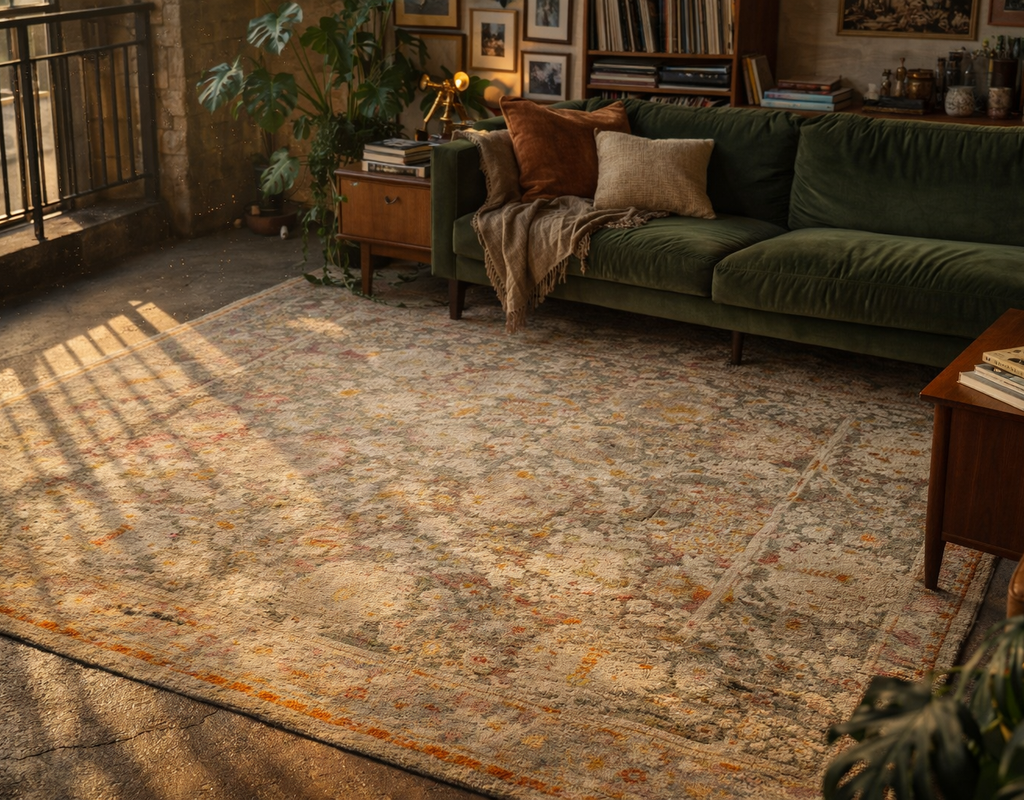
In modern luxury, weavers have expanded the palette to include even softer fibers. A cashmere rug fiber blend brings an unparalleled softness to bedroom or low-traffic Area Rugs, though it is more delicate than standard wool. Similarly, mohair luxury rugs use the hair of the Angora goat, which is renowned for its durability and high luster.
Crucially, these high-quality wools absorb dyes differently than cheap wool. The natural oils allow for deep, saturated color uptake that ages gracefully, developing a patina rather than fading flatly.
Silk: pile vs highlights
Silk is the ultimate indicator of refinement in silk and wool luxury rugs. It serves two distinct purposes: as the primary pile or as an accent. When used for the entire pile, silk creates a fluid, shimmering surface that feels cool to the touch. However, its most common strategic use is for highlights.
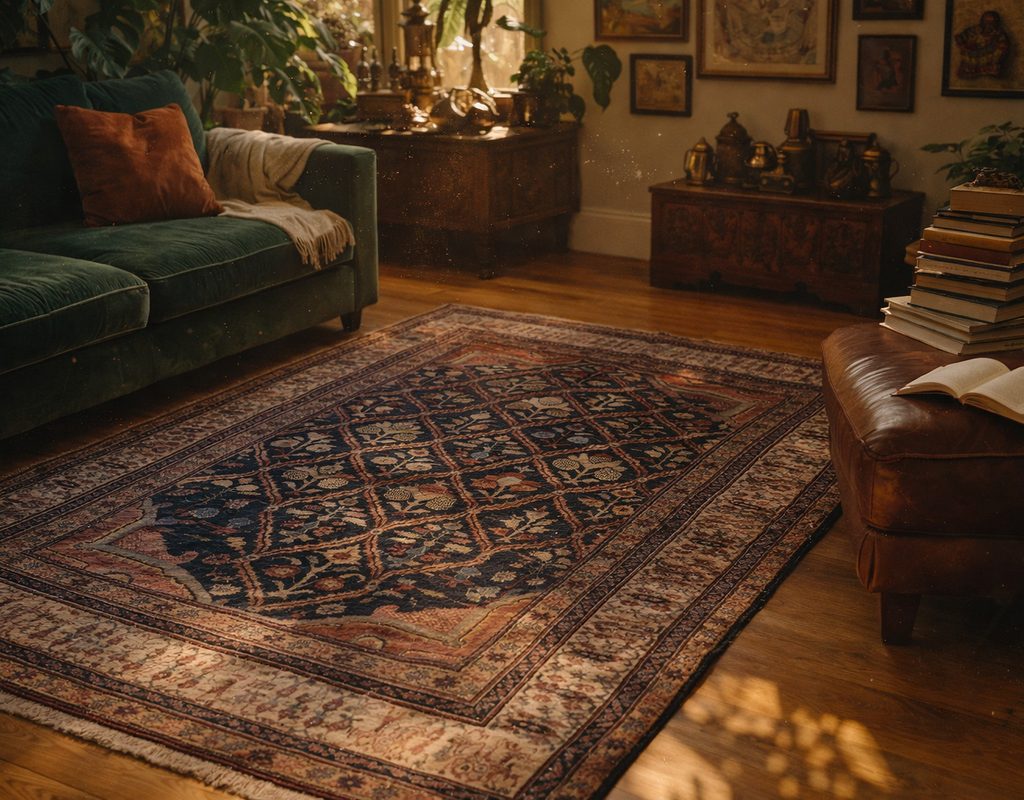
How do silk highlights change a rug’s look?
Weavers use silk to outline floral motifs or architectural elements against a matte wool background. Because silk reflects light while wool absorbs it, this creates a three-dimensional effect known as “embossment” or chatoyancy.
As the viewer walks around the rug, the silk details appear to glow and change color depending on the angle of the light. While beautiful, silk is sensitive to UV light and abrasion, requiring more careful placement than a sturdy all-wool rug.
Why are silk rugs considered extremely luxurious?
The Physics of Light (Refractive Index)
The primary reason silk is visually stunning is its triangular prism-like fiber structure. While wool fibers are round and scatter light, silk fibers are flat-sided.
- The Effect: This allows silk to reflect light at different angles, creating a “shimmer” that changes as you walk around the room.
- Visual Depth: A silk rug often has two distinct personalities: a “light side” and a “dark side,” depending on the direction of the pile.
Extreme Knot Density (KPSI)
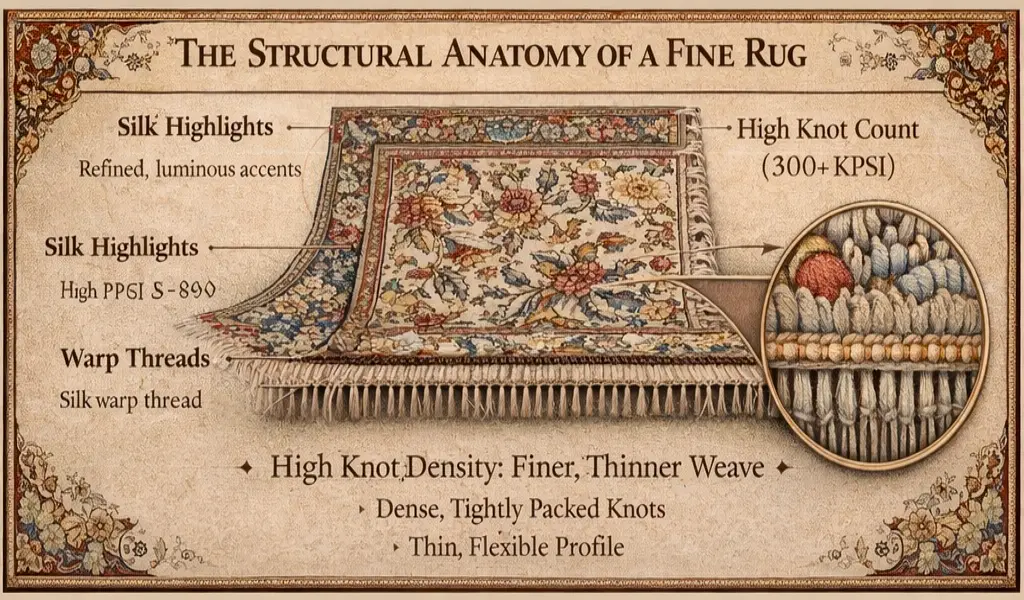
Because silk fibers are incredibly thin yet possess a higher tensile strength than steel of the same diameter, weavers can tie significantly more knots per square inch (KPSI) than they can with wool.
- High Resolution: While a high-quality wool rug might have 150–300 KPSI, a fine area rugs from silk can exceed 600–1,200 KPSI.
- Intricacy: This density allows for “pixel-perfect” detail. Curvilinear patterns, tiny floral motifs, and realistic animal figures are only achievable with the thinness of silk.
The Scarcity of the Material
Silk production is a slow, natural process. It takes approximately 2,000 to 3,000 cocoons to produce just one pound of silk.
- Labor Intensive: Every step—from the cultivation of mulberry leaves to the delicate reeling of the silk filaments—requires manual expertise.
- Material Cost: The raw material cost of pure Mulberry silk is exponentially higher than even the finest New Zealand or Highland wool.
Tensile Strength and Longevity
There is a common misconception that silk is “fragile.” In reality, silk is the strongest natural fiber.
- The Foundation: Because silk is so strong, weavers can create a very thin, “paper-like” foundation (the warp and weft). This allows the rug to lay perfectly flat and supple, almost like a heavy fabric, which is a hallmark of luxury.
To be classified as investment-grade, a silk rug must meet four rigorous criteria:
Extreme Density: The 600+ KPSI Threshold
The most objective measure of a silk rug’s value is its KPSI (Knots Per Square Inch). Because silk is so fine, it allows for a density that wool simply cannot achieve.
- Standard Luxury: 300–400 KPSI.
- Investment Grade: 600 to 1,200+ KPSI.
- The “Detail” Factor: At 1,000 KPSI, the weaver is essentially “painting” with silk. This allows for microscopic details in the eyes of animals, the shading of flower petals, and scripts of poetry woven into the borders.
Material Purity: “Mulberry” vs. “Wild” Silk
Investment-grade pieces exclusively use Mulberry Silk (Bombyx mori).
- The Process: The silkworms are fed a strict diet of mulberry leaves in a controlled environment. This produces a long, continuous, and perfectly uniform filament.
- Tensile Strength: This silk is significantly stronger than “wild” or “tussah” silk, allowing it to be spun into incredibly thin threads that can withstand the high tension of a master loom without breaking.
- Refractive Index: Pure mulberry silk has a unique triangular molecular structure that reflects light like a prism, giving the rug a “liquid” appearance that changes color depending on the viewing angle.
Provenance: The “Master Workshop” Signature
Just as a painting is valued by the artist’s signature, a silk rug’s value is dictated by its provenance. Investment-grade rugs often feature a woven “signature” (inscription) in the top border.
Elite Regions:
- Ghom (Iran): Currently the gold standard for pure silk investment pieces.
- Hereke (Turkey): Historically the source for Ottoman palaces; famous for “double-knotted” silk-on-silk.
- Kashmir (India): Known for specific “Tree of Life” designs in high-grade silk.
*Master Weavers: Names like Habibian, Serafian, or Jamshidi carry a “brand premium” that ensures the rug will hold or increase its value at major auction houses.
Structural Integrity: The “Silk on Silk” Construction
Many rugs have silk pile but are woven onto a cotton foundation. Investment-grade pieces are almost always “Silk on Silk.”
- The Foundation: Both the Warp (vertical strings) and the Weft (horizontal strings) are made of pure silk.
- The Result: This makes the rug incredibly thin, flexible, and soft—almost like a heavy silk scarf. A 9×12 silk-on-silk rug can often be folded into a surprisingly small bundle, a trait historically prized for “portable wealth” among the elite.
The Financial Logic: Why It’s an Investment
Unlike commercial rugs that depreciate, an investment-grade silk rug is a finite resource.
- Vanishing Skillsets: The master weavers capable of tying 1,000 knots per inch are a disappearing demographic. As the labor supply shrinks, the value of existing masterpieces rises.
- Global Currency: High-grade silk rugs are a “global currency.” They are traded in USD or Euro at major international auctions from London to Dubai, providing a hedge against local currency fluctuations.
- Longevity: Despite its delicate appearance, a pure silk-on-silk rug is physically resilient. If kept in a low-traffic, UV-protected environment, it will remain in museum condition for centuries.
Metal-wrapped threads
Historically, the most opulent rugs—such as the “Polonaise” carpets of the 17th century—incorporated metal-wrapped threads. These threads consist of a silk or cotton core wrapped in thin strips of silver, gold, or gilded copper.
These materials provide a literal, metallic visual glow that mimics illuminated manuscripts. However, they introduce significant conservation risks. Over time, the metal can tarnish or corrode, and the heavy metal strips can cut through the delicate silk core if walked upon heavily.
Today, these are rarely found in floor coverings and are mostly reserved for tapestries or art pieces intended for wall display.
Rayon/viscose “artificial silk”
A critical distinction in the current market is the viscose vs silk rug. Viscose (also labeled as rayon, bamboo silk, or banana silk) is a semi-synthetic fiber made from processed cellulose. While it mimics the sheen and softness of silk at a fraction of the cost, it lacks the structural integrity of a natural protein fiber.
Viscose is controversial in the luxury sector because it fails the heirloom test. The fiber is extremely absorbent and weak when wet; a simple water spill can cause the pile to mat permanently or yellow due to cellulose browning.
Furthermore, viscose does not hold dye as securely as wool or real silk, leading to color bleeding during cleaning. While it may look luxurious in a showroom, it generally does not retain its beauty or value over decades of use.
Craftsmanship Signals: How You Can Tell a Rug Is Finely Made
How can you tell a rug is finely made?
The distinction between a standard floor covering and a piece of textile art lies in the structural mechanics. Learning how to spot luxury rugs requires looking past the surface pattern to the engineering underneath.
A finely made rug is a coherent structural unit where every knot serves a purpose for both durability and design.
- Inspect the Pattern Definition on the Back: In a high-quality hand-knotted rug, the design on the reverse should be as clear and colorful as the front; a blurred or covered back suggests tufting or machine manufacturing.
- Test the Pile Density: Press your fingers deep into the pile; if you can easily touch the foundation grid, the rug has a loose weave (low density) which compromises longevity and definition.
- Check the Fringe Integration: The fringe should be the actual warp threads of the rug’s skeleton extending out; fringe that is sewn or glued on is a “cosmetic” addition found on lower-tier rugs.
- Assess the “Lay” on the Floor: The rug should lie perfectly flat without bubbling or rippling edges, indicating that the weaver maintained consistent tension on the loom throughout the months of production.
What design details signal true luxury rugs?
To answer that question, one must look at “drawing” and clarity. In rug terminology, the “drawing” refers to the fluidity of the lines. In the craftsmanship of luxury rugs indicators, curves should appear smooth and natural, much like a brushstroke. If a curved vine looks blocky, “stepped,” or pixelated, it indicates a knot count too low to support the complexity of the design.
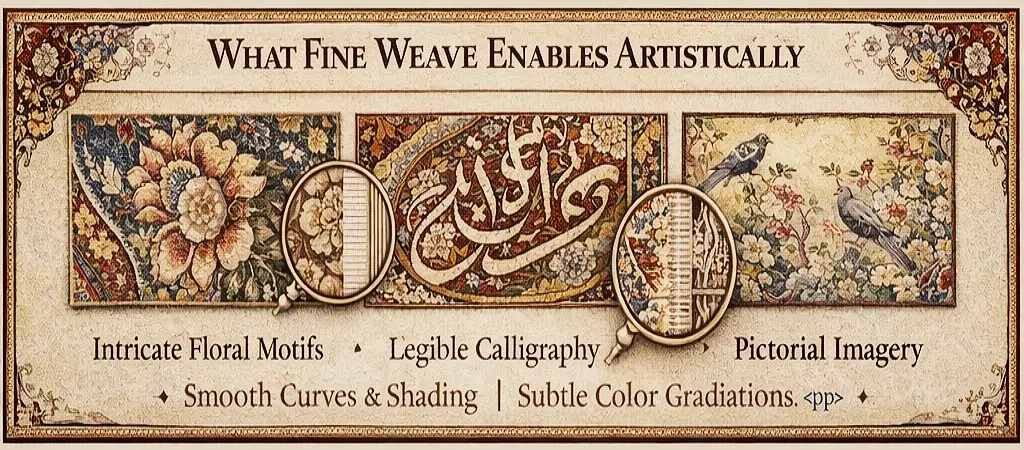
Clarity is a primary luxury tell. A masterpiece maintains its legibility even from a distance; the motifs do not “fuzz” or bleed into the background. This is achieved through precise color separation and distinct outlining, often using a single line of dark indigo or black knots to contain color fields. Furthermore, shading in luxury rugs is intentional. Master weavers use “abrash”—subtle variations in dye lots—to create depth and painterly effects, whereas commercial rugs often look flat and uniform like a printed image.
What are the visual hallmarks of workshop rugs?
Workshop rugs such as those from Isfahan, Tabriz, or Kashan, are produced under the supervision of a master designer and differ significantly from village or Tribal productions. The primary hallmark is consistency. These rugs are woven from a “cartoon” (a graph-paper blueprint), ensuring that the execution matches the design intent perfectly.
One specific sign of a high-end workshop rug is the resolution of the borders. In a carefully planned workshop rug, the pattern in the main border turns the corner seamlessly—the motifs (such as rosettes or palmettes) are perfectly centered at the 45-degree angle of the corner. In lesser quality rugs, the weaver often runs out of space, resulting in a cut-off or squashed pattern at the corner. This balance and refinement are critical workshop rug characteristics that signal professional, high-capital production.
Finishing and structural integrity checks
The finishing of a rug is often where cost-cutting occurs in mid-tier products. In true examples of luxury rugs, the finish is as meticulous as the weave. Structural integrity checks begin at the “selvedge” (the side edges). These should be tightly wrapped and feel like a solid cord. If they feel spongy or loose, they will unravel with foot traffic.
The ends of the rug (the Kilim strip before the fringe) must be secured tightly to prevent the rows of knots from sliding off the warp strings. Finally, the shearing of the pile is a major indicator of quality. Luxury rugs are sheared to a uniform, often quite low, height to maximize the crispness of the design. A “shaggy” or uneven pile often hides a lower knot count, whereas a short, glass-smooth pile exposes the weaver’s precision—there is nowhere to hide mistakes.
Practical inspection map
| What You See | What It Indicates | What to Inspect Next |
|---|---|---|
| Clear “Pixels” on the Back | Genuine hand-knotting. | Count the nodes in one inch (Vertical and Horizontal) to calculate KPSI. |
| White Dots in the Pile | The “nodes” of the warp/weft showing through. | Check if the pile is worn down or if the weave is simply too loose to cover the foundation. |
| Color Variation (Abrash) | Use of small-batch natural dyes. | Check the base of the knots; if the color is strong at the tip but white at the root, it may be chemically painted or sun-faded. |
| Curled Edges | Tension imbalance during weaving. | Feel the weft threads on the back; tight tension is good, but over-tightening causes curling. |
| Perfect Symmetry | Likely a workshop/city production. | Look at the corner resolution in the borders to confirm professional planning. |
Knot Density, KPSI, and the “Fine Detail” Threshold
How does knot density affect luxury rugs quality?
In the realm of woven arts, knot density—measured as Knots Per Square Inch (KPSI)—functions similarly to the resolution of a digital image. A higher knot count allows for significantly finer detail. Knot density luxury rugs utilize this tightness to create smooth, curvilinear lines rather than the blocky, stepped edges seen in lower-quality weavings. This capability allows for complex shading and minute distinctness in floral or figurative motifs.
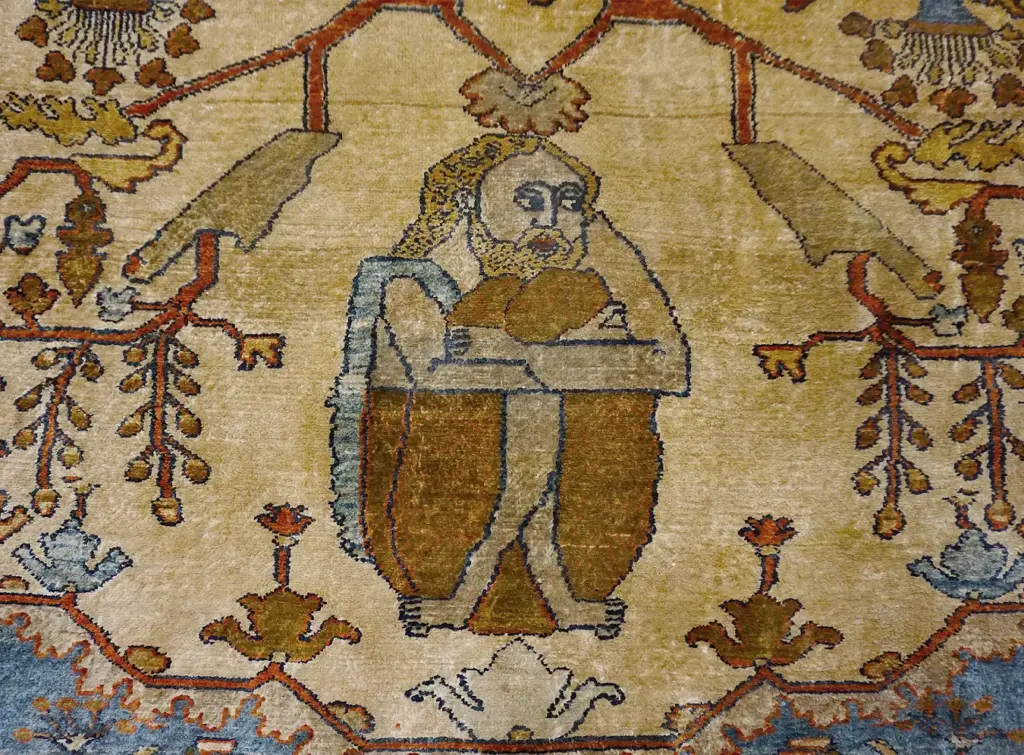
Beyond aesthetics, high density directly impacts durability and labor time. A rug with a high KPSI is structurally denser; the pile stands more vertically and packs together tightly, resisting the tendency to mat down under foot traffic. However, this precision comes at a cost measured in time. A rug with 400 KPSI requires four times as many individual hand-tied knots as a 100 KPSI rug of the same size, often extending the production timeline from months to years. This immense investment of skilled labor is a primary driver of the base cost.
Does higher KPSI always mean higher value?
The short answer is no. A common misconception among new collectors is that KPSI is the sole determinant of worth. While KPSI rug quality is a strong indicator of technical refinement, value is a holistic metric that includes materials, design rarity, and provenance.
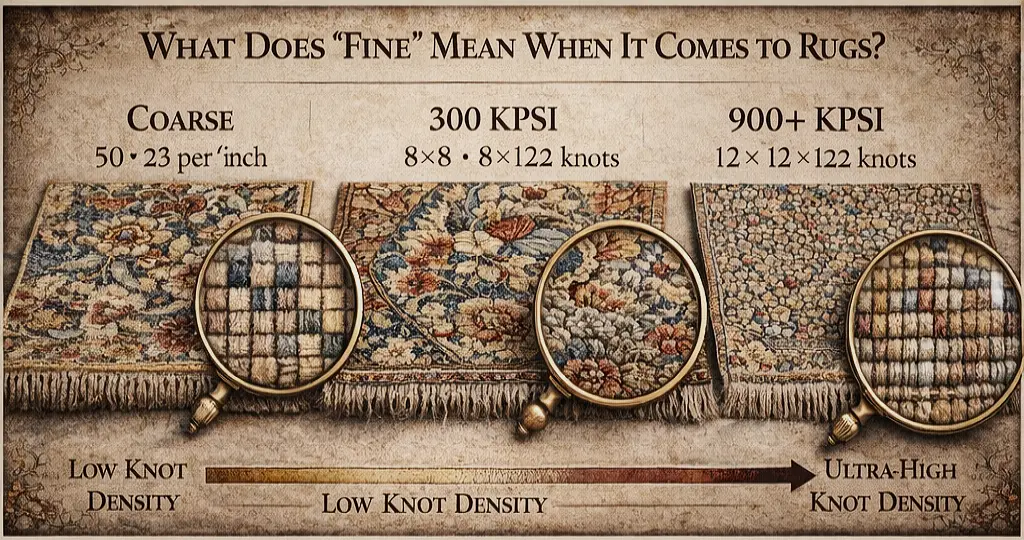
A rug with an extremely high knot count rug value can be diminished if the weaver used inferior wool that sheds, or synthetic dyes that fade unevenly. Conversely, many highly prized tribal or village rugs have relatively low knot counts (around 80–120 KPSI).
Their value stems from their bold, expressive artistry, the rarity of their nomadic origins, and the quality of their hand-spun wool and natural dyes. Therefore, KPSI should be viewed as a “capability spec”—it tells you how detailed the design can be, not necessarily how valuable the art is.
Famous benchmark examples
To understand the “fine detail” threshold, one must look at historical benchmarks rather than marketing hyperbole. The famous Ardabil Carpet, a masterpiece of 16th-century Safavid art housed in the V&A Museum, boasts a density of approximately 340 knots per square inch. This results in a staggering total of roughly 25 million knots.
While modern silk rugs can occasionally push past 1,000 KPSI, the Ardabil demonstrates that the “sweet spot” for monumental fine hand-knotted rug detail often lies between 200 and 400 KPSI. This range allows for perfect clarity of complex medallions and calligraphy without requiring the microscopic fineness that restricts the rug to being solely a wall hanging. These benchmarks remind buyers that “luxury” is about the balance of execution and scale, not just chasing the highest possible number.
Interpretive framework for KPSI
| KPSI Range | Visual Detail Potential | Typical Materials | Common Uses |
|---|---|---|---|
| 80 – 150 | Geometric, bold, blocky curves. | Thick hand-spun wool. | Tribal rugs (Gabbeh, Heriz), casual durability. |
| 160 – 250 | Stylized florals, readable script. | Fine wool, cotton foundation. | Village/Town rugs, standard high-quality flooring. |
| 300 – 500 | Precise circles, intricate shading. | Cork wool, silk highlights. | Workshop masterpieces (Isfahan, Tabriz), investment pieces. |
| 600+ | Photorealistic detail, “painting” look. | Pure silk on silk foundation. | Wall hangings, collector items, “Qum” silk rugs. |
What to pair with KPSI when judging luxury
Because KPSI is merely a count of nodes, it must be contextualized by other factors to determine true luxury status.
- Assess Fiber Health and Luster: A 500 KPSI rug made of dry, “dead” wool will crumble over time; the fiber must have the elasticity to support the dense structure.
- Evaluate Design Balance: High density enables detail, but if the drawing is cluttered or the colors clash, the technical skill is wasted on poor artistry.
- Check Condition and Restoration: Heavy metal mordants used in some antique dyes can corrode silk over time; a high-density antique rug with “rot” is worth less than a lower-density piece in pristine condition.
- Verify Dye Stability: In very dense rugs, color bleed is catastrophic because the details are so fine; wash-fastness is essential to maintain the separation of pixels.
Hand-Knotted vs Hand-Tufted: Is Knotted Always Better?
Is hand-knotted always better than hand-tufted?
In the debate of hand-knotted vs hand-tufted luxury rugs, the answer to “is hand-knotted always better than hand-tufted?” depends entirely on the buyer’s priorities. From an engineering and investment standpoint, hand-knotted rugs are structurally superior. In a knotted rug, the pile is tied around the warp threads, making it an integral part of the foundation. This construction allows for a hand-knotted rug lifespan that can span centuries, as there is no adhesive to degrade.
Hand-tufted rugs, by contrast, are created by punching strands of yarn through a canvas backing using a handheld tool. The pile is then secured with a latex adhesive and a secondary backing cloth. While this method is faster and less expensive, the reliance on glue means the rug has a finite lifespan; once the latex dries out and crumbles, the tufts will pull out. However, “better” is relative. If the goal is intricate, sculpted texture rather than multigenerational longevity, tufting offers unique artistic possibilities.
When tufted luxury rugs makes sense
While knotting is the gold standard for tradition, tufting has found a legitimate niche in modern luxury design. Tufting allows for extreme variations in pile height, enabling “sculpted” or “carved” effects that are difficult to achieve on a traditional loom. This makes it the best construction for luxury rugs design that prioritize tactile topography over flat pattern.
For “artist rugs”—where a contemporary painter or designer translates a vision to textiles—tufting allows for fluid, organic shapes and rapid prototyping. In low-traffic areas like a master bedroom or a private library, a high-quality, dense wool tufted rug can provide a plush, sensory experience that feels incredibly luxurious underfoot, even if it lacks the structural permanence of a knotted antique.
What to inspect on tufted pieces
If purchasing tufted luxury rugs quality pieces, buyers must inspect the construction to ensure it meets high standards, distinguishing it from mass-market disposable goods.
- Check the Backing Cloth Quality: High-end tufted rugs use heavy-duty cotton canvas backings; cheap versions use synthetic mesh that deteriorates quickly.
- Smell the Rug: A strong chemical odor indicates low-grade latex adhesive; superior tufted rugs use high-quality, low-VOC latex that is odorless and flexible.
- Test the Tuft Anchorage: Gently pull on a single tuft; if it slides out easily, the adhesive bond is weak, predicting premature balding.
- Examine the Shear Evenness: Because tufted pile is looped and then cut, a luxury finish requires precise shearing to ensure a smooth, velvety surface without jagged peaks.
Custom loom widths and atelier execution
The execution of custom orders often dictates the construction method. Hand-knotting requires a fixed vertical loom, limiting the width to the size of the beam. However, tufting is done on a frame, allowing for greater flexibility in creating odd shapes or oversized dimensions for specific architectural spaces.
The Anatomy of a Bespoke Commission
Why true luxury takes time.
A 1’x1′ sample is woven to verify dye accuracy and knot density before the full loom is warped.
A standard 9×12 luxury rug contains roughly 1.5 to 2 million individual hand-tied knots.
Atelier execution in modern luxury rugs ensures that even tufted pieces are made with the same premium materials—New Zealand wool or bamboo silk—as their knotted counterparts. The distinction is that the tufted rug is often “made to order” with a lead time of weeks rather than the years required for a knotted masterpiece.
Decision support
| Construction | Pros | Cons | Best For |
|---|---|---|---|
| Hand-Knotted | Extremely durable; repairable; holds value; washable. | Higher cost; longer production time; limited texture depth. | Living rooms, heirlooms, investment collections, high traffic. |
| Hand-Tufted | Lower cost; faster production; deep, sculpted textures. | Shorter lifespan (10–20 years); difficult to repair; backing degradation. | Bedrooms, guest rooms, trend-focused decor, low traffic. |
| Flatweave (Kilim) | Reversible; lightweight; casual aesthetic. | Thinner; can slip easily; lower sound insulation. | Kitchens, hallways, casual layering, summer homes. |
Where Luxury Rugs Come From Historically
Where do luxury rugs typically come from historically?
The geography of luxury rugs and weaving maps perfectly onto the world’s great historical centers of power. The core luxury rugs tradition emerged wherever dynastic wealth could support the immense time investment required for high-KPSI weaving. Historically, the primary zones of production were Persia (Safavid), Turkey (Ottoman), India (Mughal), France (Bourbon), and China (Ming/Qing). In each of these regions, the court itself acted as the manufacturer, establishing royal workshops to ensure that every carpet projected the aesthetic and political values of the empire.
Persian court carpets (Safavid/Qajar)
Persia is widely considered the spiritual home of the knotted carpet. Persian court carpets, particularly from the Safavid era (1501–1736), set the benchmark for classical design. These masterpieces are defined by their sophisticated curvilinear drawing, often featuring a central “Shamsa” (sunburst) medallion surrounded by intricate floral arabesques.
Key motifs include the “Paradise Garden” layout, which mimics the charbagh garden structure with water channels and abundant flora, symbolizing the ruler’s divine mandate. Inscriptions of poetry or Quranic verses are common in the borders, elevating the rug to a literary object. The Ardabil Carpet, a pinnacle of this tradition, utilizes silk warps to achieve a density that allows for photorealistic lamps and floral sprays.
Ottoman court carpets
While Persian rugs favored infinite floral repeats, Ottoman court carpets developed a distinct, bolder aesthetic centered in Istanbul and Bursa. Weaving under imperial patronage utilized the “Saz” style—a design language characterized by long, serrated leaves and stylized tulips, hyacinths, and carnations.
Ottoman luxury was often signaled by the inclusion of metal-wrapped threads (gold or silver) woven directly into the pile or used for brocading (flat-woven highlights). These carpets were strictly regulated by the court design atelier (the nakkaşhane), ensuring that the carpets gifted to European monarchs perfectly represented the Sultan’s wealth and artistic sophistication.
Mughal carpets
Mughal luxury rugs of India (16th–18th centuries) share a lineage with Persian weaving but evolved a unique botanical realism. Influenced by European herbals brought by traders, Mughal weavers abandoned the stylized abstraction of Persian flowers for naturalistic depictions.
Signature aesthetics include “millefleur” (thousand flowers) patterns and trellis layouts where individual flowering plants—poppies, irises, and lilies—are framed in lattice compartments. Unlike other Islamic traditions, Mughal carpets frequently depict animals and birds in realistic poses, capturing the emperor’s love for nature and hunting. The pile in these rugs is often cut extremely short to mimic the smoothness of velvet.
French Savonnerie & Aubusson
In the West, Savonnerie carpets Louis XIV represent the peak of European luxury rugs and weaving. Established in the 17th century to free the French court from reliance on imported Oriental rugs, the Savonnerie manufactory produced monumental carpets exclusively for the Louvre and Versailles.
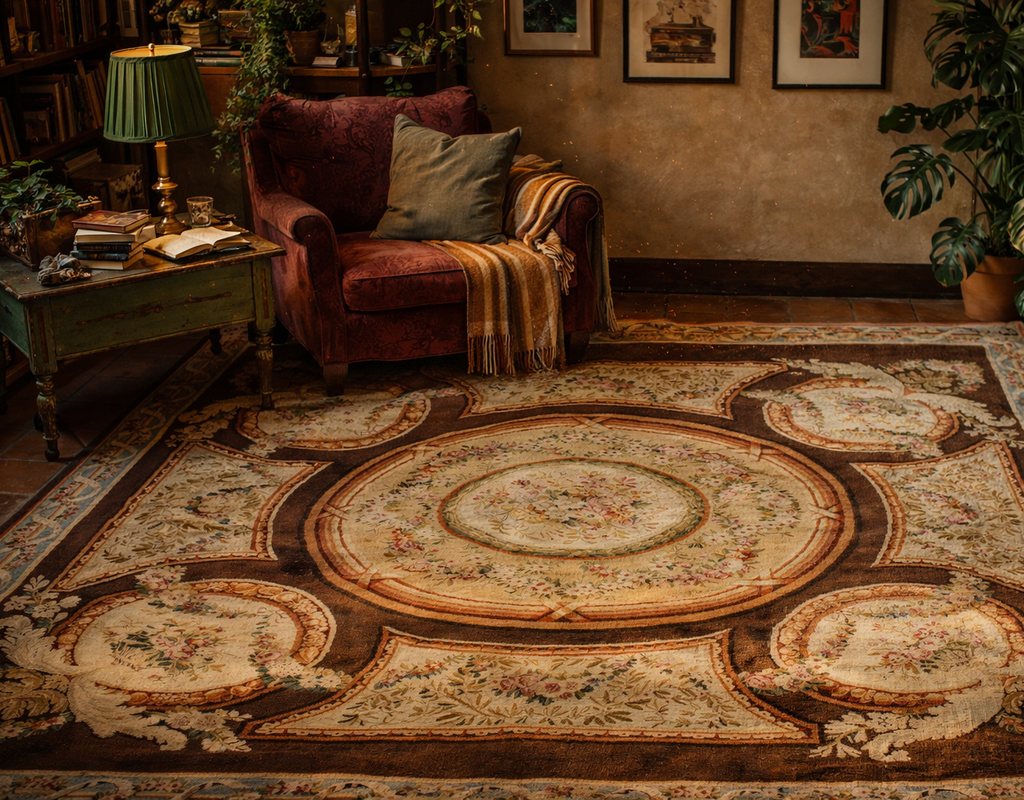
These rugs are characterized by their heavy, plush wool pile and designs that mirror the Baroque and Rococo ceilings above them. Motifs include acanthus scrolls, architectural cartouches, royal monograms (like the Sun King’s “L”), and allegorical figures. Unlike the infinite patterns of the East, Savonnerie designs were often framed like paintings, with a clear top and bottom intended to align with the room’s furniture.
Chinese imperial dragon carpets
Chinese imperial dragon rugs differ significantly in structure and symbolism. Woven primarily in the north (Ningxia and Beijing), these rugs utilized a thicker, coarser wool pile that emphasized texture over microscopic detail. The luxury element came from the symbolism and the user.
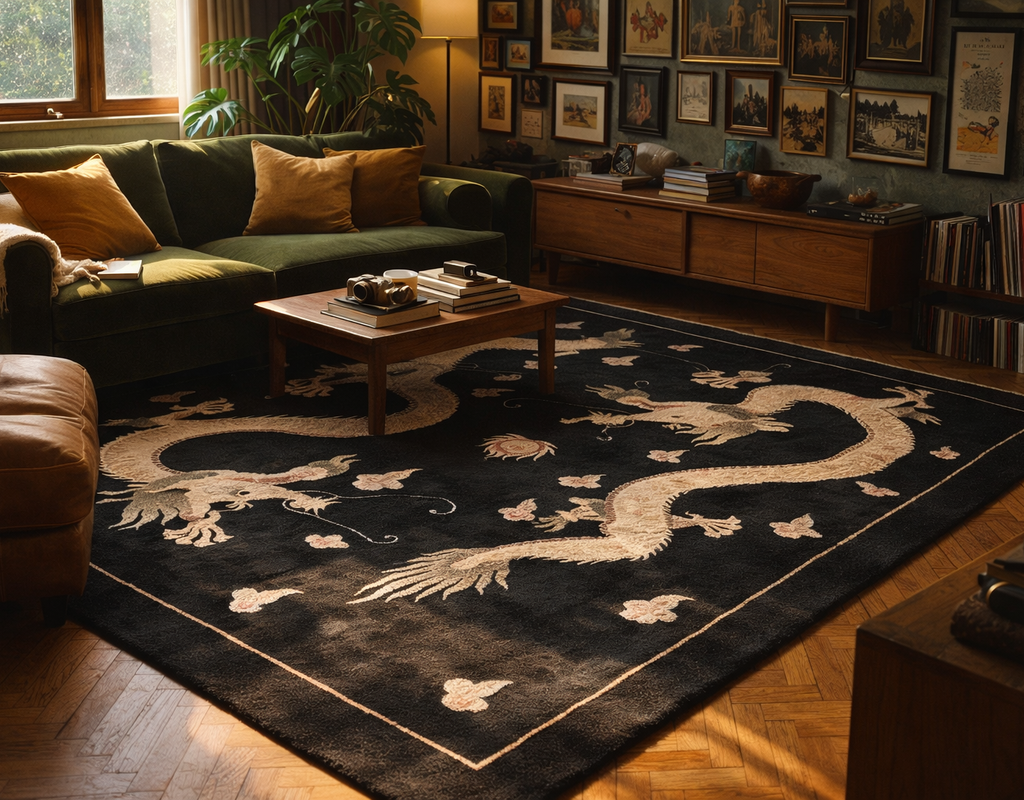
The five-clawed dragon is the ultimate status symbol, reserved exclusively for the Emperor and his immediate family. These dragons are often depicted chasing a “flaming pearl” amidst stylized clouds and waves (the lishui border). The color palette was strictly regulated, with “imperial yellow” being the most prestigious background color, signaling that the rug was made for the halls of the Forbidden City.
Tribal elite pieces
While court workshops dominated the luxury narrative, tribal confederacies also produced elite weavings. These were not for sale but for ceremonial use—dowries, chieftain tents, or weddings.
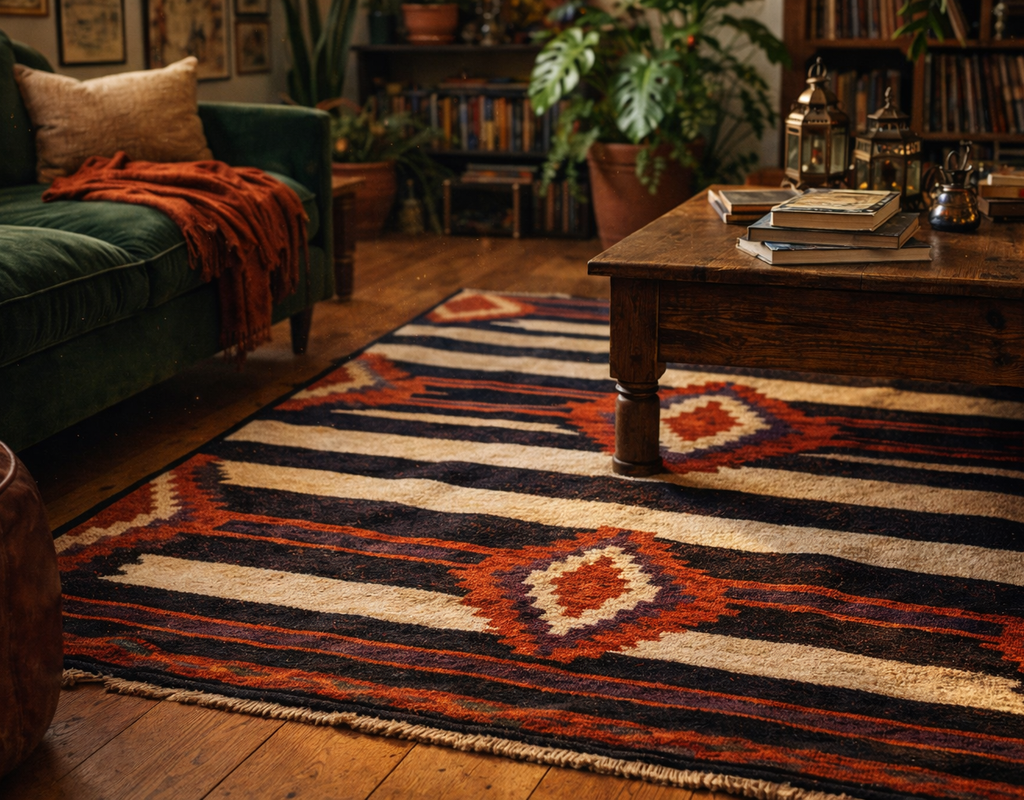
“Khan” quality rugs from the Qashqai or Turkmen tribes feature finer wools (often lambswool or silk highlights) and higher knot counts than their utilitarian counterparts. They are prized today for their “honest” artistry and deep, saturated natural dyes.
Historical luxury map
| Tradition | Era | Signature Motifs | Typical Materials | Why It’s “Luxury” |
|---|---|---|---|---|
| Persian Safavid | 16th–18th C. | Central Medallion, arabesque spirals, inscriptions. | Silk foundation, kork wool, natural dyes. | Technical perfection and poetic symbolism. |
| Ottoman Court | 16th–19th C. | Serrated Saz leaves, tulips, carnations. | Wool, silk, silver/gold metal threads. | Imperial branding and material opulence. |
| Mughal India | 16th–18th C. | Realistic flowering plants, trellis, birds. | Pashmina wool (goat), cotton foundation. | Unmatched softness and painterly realism. |
| French Savonnerie | 17th–18th C. | Acanthus leaves, royal crests, architectural depth. | Heavy wool pile, linen/hemp foundation. | Exclusivity; woven solely for the King. |
| Chinese Imperial | Ming/Qing | 5-clawed dragons, clouds, waves, pearls. | Soft wool, silk, gold thread backgrounds. | Restricted symbolism reserved for the Emperor. |
Designer vs Luxury Rugs, and New vs Vintage: What Changes the Value Story
What’s the difference between “designer” and luxury rugs?
Consumers frequently conflate high prices with high quality, leading to confusion regarding luxury rugs vs designer rugs. Fundamentally, “luxury” refers to the execution and materials—the objective quality of the weave, the rarity of the fiber, and the knot density. “Designer” refers to authorship and branding.
A “designer” rug may simply be a licensed image printed or tufted onto a mid-tier canvas foundation, where the price reflects the brand markup rather than the labor. However, in the highest tier of the market, these categories overlap.
True collectible designer rugs are those where a renowned artist or fashion house collaborates with a master atelier to create a hand-knotted piece that is both structurally superior and artistically unique. In this context, the buyer pays for both the “name” and the heirloom-grade construction.
Is a vintage rug more luxurious than new?
The debate of vintage luxury rugs vs new centers on the evolution of materials. Is a vintage rug more luxurious than new? Often, the answer is yes, due to the raw materials available in the past. Older rugs (pre-commercialization) frequently utilized wool from sheep flocks that were not subjected to chemical washes or aggressive processing, resulting in higher lanolin content and better luster.
Furthermore, vintage and antique rugs offer scarcity. A specific tribal design or a weave from a now-defunct workshop cannot be replicated, making it a finite resource. However, new luxury rugs offer “condition reliability.” They are free from the wear, foundation brittleness, or fading that characterizes older pieces, making them a safer choice for high-traffic areas where durability is paramount.
How do antique and vintage rugs differ in age?
To navigate the secondary market, buyers must understand the specific terminology used by auction houses and dealers.
Antique / Vintage / New Rugs Age Brackets:
- Antique: Strictly defined as items 100 years or older. In the rug world, this generally refers to pieces woven before the 1920s. This cutoff is significant because it predates the widespread industrialization of rug production and the dominance of synthetic chromium dyes.
- Vintage: Typically refers to rugs that are between 20 and 99 years old. This category includes the mid-century modern masterpieces of the 1950s, Art deco Rugs from the 1930s, and the post-war revivals of traditional Persian workshops.
- New / Contemporary: Rugs produced recently, typically within the last 20 years, sold as “first owner” goods.
Provenance and documentation
For a rug to transition from a beautiful furnishing to an investment-grade asset, provenance is key. In the world of antique vs vintage rug age, documentation validates the timeline. Provenance includes original receipts, auction catalog records, or photographic evidence of the rug in a historic estate.
In modern luxury, provenance is established through signatures woven directly into the guard border (common in masterpieces from workshops like Serafian in Isfahan or Haghagha in Qum) and certificates of authenticity for limited editions. A signed rug confirms that the piece was inspected by the master weaver and meets the atelier’s highest standards, distinguishing it from anonymous workshop output.
When “designer” adds real value, and when it’s just markup
Not all designer collaborations are created equal. Buyers must discern when the “designer” label represents a tangible asset versus a marketing ply.
- The Designer Created the Weave Structure: Value is added when the artist works with weavers to innovate texture or material use (e.g., varying pile heights), creating a unique textile art object.
- Limited Edition Production: Value is retained if the production run is strictly capped (e.g., “1 of 10”), ensuring scarcity similar to a fine art print.
- Atelier Supervision: If a famous fashion house commissions a known heritage mill (like those in Nepal or Aubusson) to produce the rug, the quality control is guaranteed.
- Merchandising/Licensing (No Value Add): If a brand simply prints a logo or pattern onto a standard tufted rug, the premium paid is purely for the name and vanishes the moment the rug is used.
Value Story Comparison Table
| Type | What You’re Paying For | Best For |
|---|---|---|
| New Luxury (Bespoke) | Perfection, custom color/size, fresh strong fibers, longevity. | Specific interior design projects; buyers who want zero wear. |
| Vintage (20–99 years) | “Lived-in” patina, softer colors (faded), mid-century aesthetic, lower price point than antique. | Eclectic interiors; adding warmth/soul to modern architecture. |
| Antique (100+ years) | Historical rarity, natural dyes, collectible status, cultural artifact. | Collectors; low-traffic formal spaces; investment diversification. |
| Designer (High-End) | Authorship, unique artistic vision, limited edition scarcity. | Art collectors; statement pieces; brand loyalists. |
Why Luxury Rugs Cost So Much and How to Budget
Why are luxury rugs so expensive per square foot?
The answer is primarily mathematical: the cost of a rug is a direct multiplier of time. Weaving high-density luxury rugs is one of the most labor-intensive human activities still practiced today. A 9×12 foot rug with a density of 400 KPSI contains over 6.2 million individual knots. A master weaver, tying perhaps 5,000 knots a day, would need years to complete a single piece. The price reflects these thousands of hours of skilled labor.
Beyond labor, cost drivers in handmade rugs include material waste and design complexity. Spinning premium wool to a thin, consistent gauge results in significant fiber loss (waste) during the carding process. Furthermore, complex curvilinear designs require constant consulting of the “cartoon” (blueprint), slowing down the weaving speed compared to simple geometric patterns.
When you purchase luxury rugs, you are paying for the physical time of a master artisan and the material yield of a premium flock.
How much should you budget for luxury rugs?
Determining how much should you budget for luxury rugs depends on the intended use and the traffic level of the space.
| Room | Use Level | Recommended Spend Tier | Material Notes |
|---|---|---|---|
| Formal Living Room | Low/Showpiece | High ($150–$300+ / sq ft) | Silk/wool blend or antique workshop piece. High KPSI for detail. |
| Family Room / Den | High Traffic | Mid-High ($80–$150 / sq ft) | 100% hand-spun wool for resilience. Focus on structure over silk accents. |
| Master Bedroom | Barefoot Only | High ($120–$250 / sq ft) | Cashmere, mohair, or soft wool blends. Plush pile is prioritized. |
| Dining Room | Chairs Moving | Mid ($60–$100 / sq ft) | Durable wool with low pile. Pattern should hide crumbs/spills. |
| Entryway / Foyer | Heavy Traffic | Mid-High ($90–$180 / sq ft) | Iron-tough tribal wool (e.g., Bijar). Darker palettes to hide soil. |
Cost drivers you can verify before purchase
To ensure the price tag aligns with reality, buyers should verify specific technical specifications. Why luxury rugs are expensive should always be provable.
- Count the Knots Per Square Inch (KPSI): A verifiable high knot count (300+) proves the labor intensity; if the count is low but the price is high, you are paying for markup, not craftsmanship.
- Test the Material Composition: Ensure “silk” is actually silk (protein) and not viscose (cellulose); viscose is cheap to produce but is often priced like silk in dishonest listings.
- Check the Number of Colors: A rug with 15+ distinct colors requires more complex dyeing and frequent wool changes during weaving, legitimately increasing the cost over a 3-color rug.
- Verify the Origin: Rugs from renowned city workshops (like Qum or Hereke) command higher market prices due to their historical reputation for quality control.
Investment vs enjoyment budgeting
When budgeting, distinguish between “investment assets” and “lifestyle assets.” An investment rug is typically an antique or a signed masterpiece purchased with the intent of appreciation or value retention. For this category, the budget must be flexible to acquire the best-in-class example, as “good” examples often stagnate in value while “great” ones rise.
For “enjoyment budgeting,” focus on goals-based spend. If the goal is a soft surface for children to play on, prioritize lanolin-rich wool that cleans easily, rather than delicate silk. If the goal is to anchor a room visually, prioritize size and color palette over knot count. Allocating the budget toward the rug’s primary function prevents overspending on unnecessary specs (like 800 KPSI for a Hallway Runner).
When to walk away
“Luxury pricing” without verifiable specs is a major red flag. Walk away if the seller uses vague terms like “bamboo silk” or “art silk” to justify a price point comparable to real silk. These are marketing names for viscose, which lacks the longevity of a true luxury fiber.
Avoid rugs with weak foundations. If the rug feels floppy or the back looks glued (indicating a hand-tufted construction disguised as knotted), the price should be significantly lower. Finally, be wary of mismatched materials—such as high-quality silk accents on a low-quality, shedding wool base. The rug will wear unevenly, ruining the investment within a few years.
Buying Authentic Luxury Rugs: Where to Shop, What to Ask, How to Protect the Purchase
Where can you buy authentic luxury rugs online?
The digital landscape for high-end textiles has matured, but safety requires sticking to vetted channels. You can buy these breathtaking rugs online safely through three primary sources: specialized reputable dealers, major auction houses, and direct-to-consumer ateliers.
Authentic luxury rug dealers distinguish themselves by providing extensive documentation. Unlike general furniture sites, a specialized dealer will offer high-resolution photography of the rug’s back (to show the weave), a detailed condition report, and a certificate of authenticity. Major auction houses like Sotheby’s or Christie’s provide a layer of trust through their vetting process, though they charge a buyer’s premium.
Finally, modern bespoke ateliers often sell directly to clients, offering the highest level of transparency regarding materials and labor practices. The key is to look for detailed provenance—authenticity is mostly paperwork combined with construction reality.
What questions should you ask before buying luxury rugs?
To filter out marketing hype and uncover the true quality of a piece, buyers must interrogate the seller.
Here are the critical questions to ask when buying luxury rugs:
- “What is the exact fiber composition of the pile and the foundation?”: You must confirm if “silk” is genuine insect silk or synthetic viscose, and if the foundation is cotton (standard) or silk (ultra-luxury).
- “Has this rug undergone any restoration or painting?”: While repair is common in antiques, undisclosed painting (adding ink to hide wear) is deceptive and significantly lowers value.
- “Can you provide the specific KPSI count?”: A vague answer suggests the seller does not understand the technical quality; a specific number (e.g., “320 KPSI”) indicates a professional assessment.
- “Is there a return policy or approval period?”: Lighting drastically changes how a rug looks; a reputable dealer will allow you to see the rug in your home before the sale is final.
- “Do you have provenance documentation or prior auction records?”: For investment-grade pieces, a paper trail linking the rug to a specific collection or weaver adds verifiable value.
Should you choose modern or vintage for investment value?
The answer depends on your investment timeline and risk tolerance. Antique and vintage rugs are generally considered stronger financial stores of value because of scarcity—no more 19th-century Persian Serapi and Heriz rugs are being made. If the condition is good, their value tends to appreciate or hold steady against inflation.
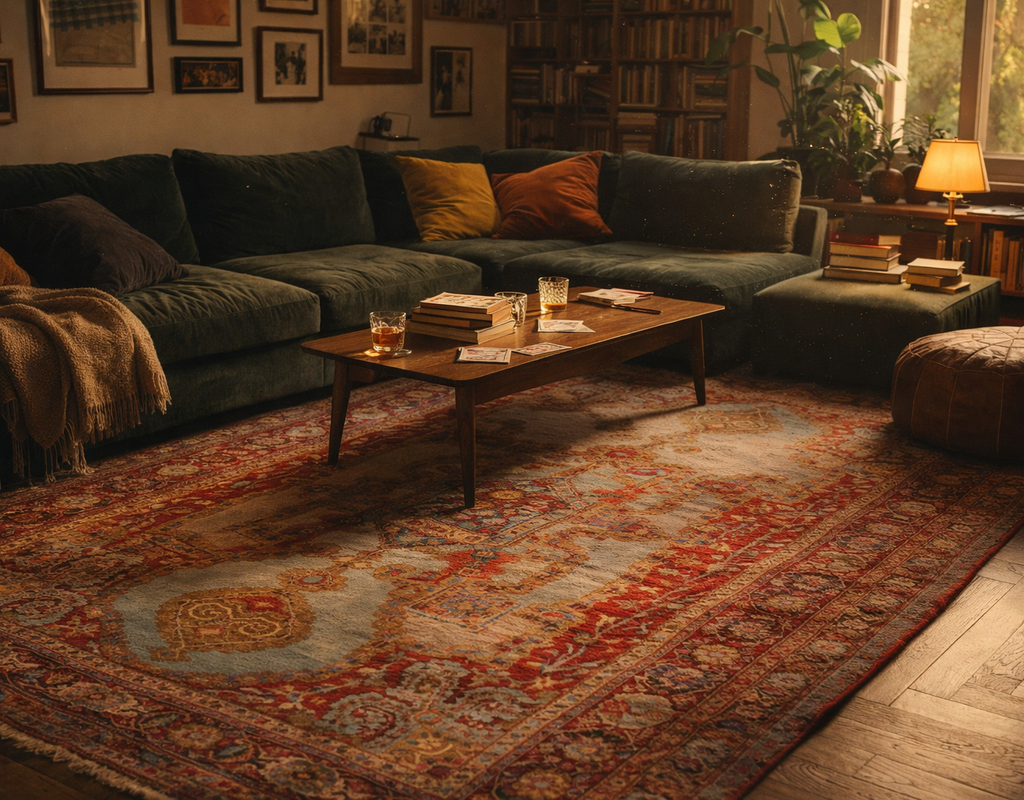
However, modern luxury rugs should be viewed primarily as “lifestyle investments.” While signed, limited-edition pieces from top ateliers can appreciate, most Modern Rugs are purchased for perfection in design and immediate durability. If the goal is a specific aesthetic to anchor a room today, modern is the superior choice. If the goal is to steward a cultural asset for the next generation, vintage or antique is the correct path.
Should you insure a high-value rug at home?
Yes, absolutely. Standard homeowners insurance policies often have caps on “textiles” or “household contents” that fall far below the replacement cost of a fine hand-knotted rug. To insure expensive rug at home properly, you need a “floater” or a scheduled personal property rider added to your policy.
This process requires a professional written appraisal, not just a sales receipt. The insurance company will need detailed photos of the rug (full view and macro close-ups of the weave), a description of the origin and dimensions, and an assessment of its current market replacement value. Insurance is not an afterthought; it is an integral part of the acquisition process for any piece worth over $5,000.
Buying Channel Comparison
| Buying Channel | Pros | Risks | Best For |
|---|---|---|---|
| Specialized Dealer (Online/Gallery) | Vetted inventory; allow “on approval” trials; education-focused; handle cleaning/repair. | Prices often include retail markup; inventory may be limited to dealer’s taste. | First-time buyers; those needing specific sizes/colors; safe transactions. |
| Auction House | Access to rare/investment pieces; potential for lower “hammer price” than retail. | “Buyer’s premium” adds ~25% to cost; no returns; rug sold “as is” (requires keen inspection). | Experienced collectors; investors seeking provenance; bargain hunters willing to restore. |
| Direct Atelier | Full customization; brand-new condition; ethical transparency. | Long lead times (6–12 months); value is in usage, not immediate resale. | Designers; homeowners wanting a specific palette; modern architecture. |
| General Marketplaces (1stDibs, etc.) | Massive selection; global inventory access; buyer protection guarantees. | High shipping costs; varying seller quality; difficult to verify texture/color via screen. | Browsing specific styles; finding international inventory; comparing prices. |
Conservation and Care: Keeping Luxury Rugs Beautiful for Decades
Silk conservation risks
While silk provides the sheen and intricate detail that defines many luxury rugs, it introduces specific conservation challenges. The primary enemy of silk is ultraviolet (UV) light. Silk conservation risks are compounded because UV exposure causes a photochemical reaction that breaks the peptide bonds in the protein fiber. This leads to “shattering,” where the silk becomes brittle and disintegrates into powder.
Furthermore, antique high end luxurious silk rugs sometimes contain “weighted silk”—fibers treated with metallic salts to increase their heft and drape. Over time, these salts can accelerate degradation, making the rug exceptionally fragile. Owners must treat silk rugs, especially those with black or dark brown dyes (often set with iron mordants), as light-sensitive art objects, positioning them away from direct sunlight.
Wool durability, but real vulnerabilities
High-altitude wool is naturally resilient, springing back underfoot and resisting stains due to its lanolin content. However, it is not invincible. The main physical threat to wool is abrasion from particulate soil. Sand and grit trapped deep in the pile act like microscopic sandpaper, cutting through the wool fibers as people walk over the rug.
Biological threats are also significant. Clothes moths and carpet beetles feed on keratin, the protein found in wool. These pests thrive in dark, undisturbed areas, such as under sofas or heavy furniture. Regular inspection and cleaning are the only defenses against infestation, as moth larvae can strip a rug of its pile in weeks.
Safe routine care
Maintaining luxury rugs requires a regimen of gentle intervention:
- Vacuum with Suction Only: Beater bars (rotating brushes) can pull knots loose and shred delicate fringe; use the upholstery attachment or turn the brush roll off.
- Rotate Every 6–12 Months: Rotation ensures even wear from foot traffic and prevents localized fading from sunlight, preserving the rug’s structural balance.
- Blot Spills Immediately: Rubbing a spill drives the liquid deeper into the pile and can distort the pile orientation; blotting lifts the liquid before it dyes the fiber.
- Use a Felt or Rubber Pad: A high-quality pad acts as a shock absorber, reducing the strain on the knots and preventing the foundation from grinding against the hard floor.
Specialist cleaning and restoration
Luxury rugs should never be subjected to Standard Carpet cleaning services that use steam extraction or harsh chemical shampoos. These methods can cause dye bleed, shrinkage, and the stripping of natural oils. Instead, specialist cleaning and restoration involves a full immersion wash in a dedicated facility.
Conservators use pH-neutral, enzyme-free soaps and enormous volumes of cold water to gently flush out soil. For antique pieces, the process is often done entirely by hand using soft paddles. If a rug sustains damage, such as a tear or moth holes, a restoration expert can re-knot the missing areas using color-matched vintage wool, a meticulous process that restores both the look and the value.
Environmental controls
Preventative environmental control is the most effective form of conservation:
- UV Filtering: Install UV-blocking window film or sheer curtains to protect silk and natural dyes from photodegradation.
- Stable Humidity: Maintain indoor relative humidity between 40% and 60%. Excessive dryness can make fibers brittle, while high humidity invites mold and mildew (dry rot).
- Traffic Management: Delicate fibers like silk or viscose should be placed in low-traffic zones. Traffic management preserves pile structure more effectively than any repair; preventing crush damage is easier than fixing it.
Care Decision Map
| Risk | What Causes It | Prevention | When to Call a Conservator |
|---|---|---|---|
| Fading | UV light exposure breaking down dye molecules. | Window tinting, rotating rug, closing blinds. | If colors are significantly uneven; they can sometimes “paint” or tint to restore balance (controversial). |
| Pile Wear | Abrasion from grit; repetitive traffic paths. | “Suction-only” vacuuming; rug pads; rotation. | When the foundation (white grid) becomes visible through the pile. |
| Dry Rot | Moisture trapped in the cotton foundation (mildew). | Keep dry; never place potted plants directly on rug. | If the rug feels stiff or makes a “cracking” sound when folded; urgent stabilization needed. |
| Moth Damage | Larvae eating wool protein in dark spots. | frequent vacuuming under furniture; monitoring traps. | If you see bald spots, webbing, or live larvae; requires immediate freezing or chemical treatment. |
| Fringe Loss | Vacuum beater bars; vacuuming the ends. | Tuck fringe under during cleaning; avoid vacuuming edges. | When the fringe detaches and knots start sliding off the end; needs “overcasting” or re-fringing. |
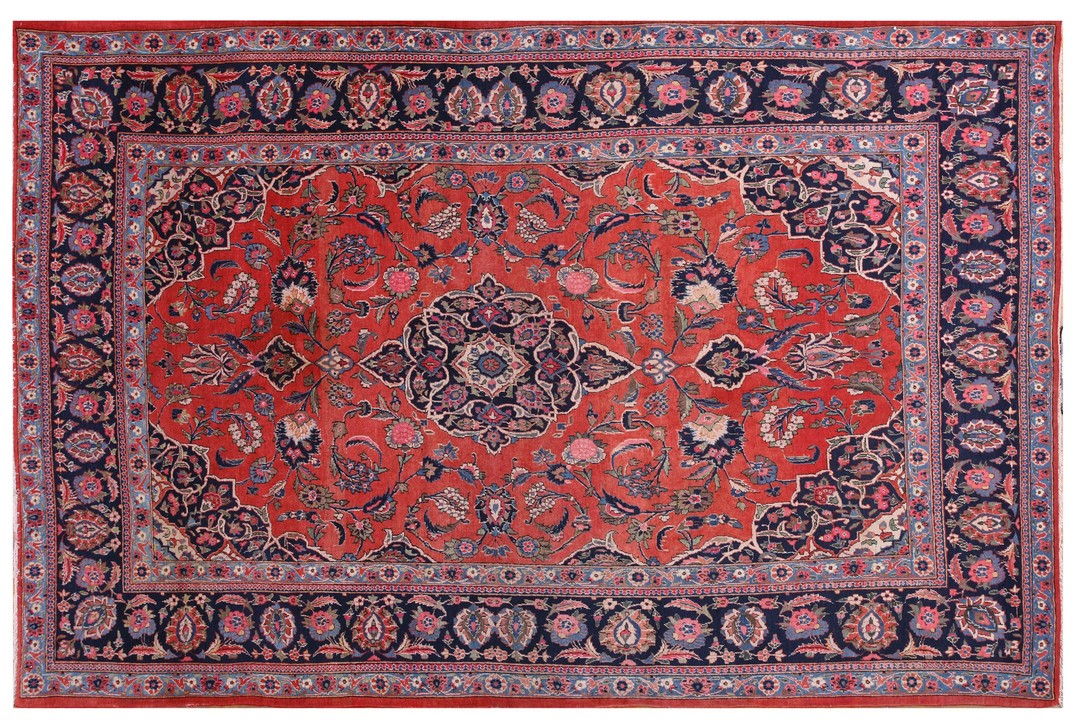
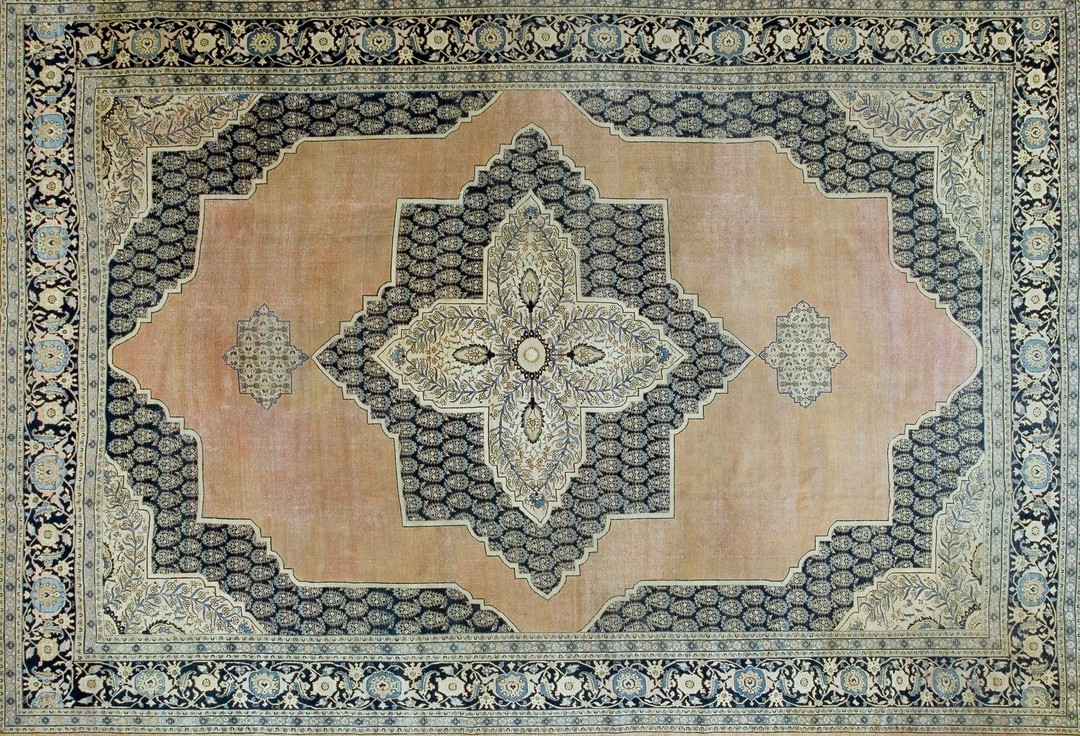
Explore a Few of Our Favorite Luxury Rugs
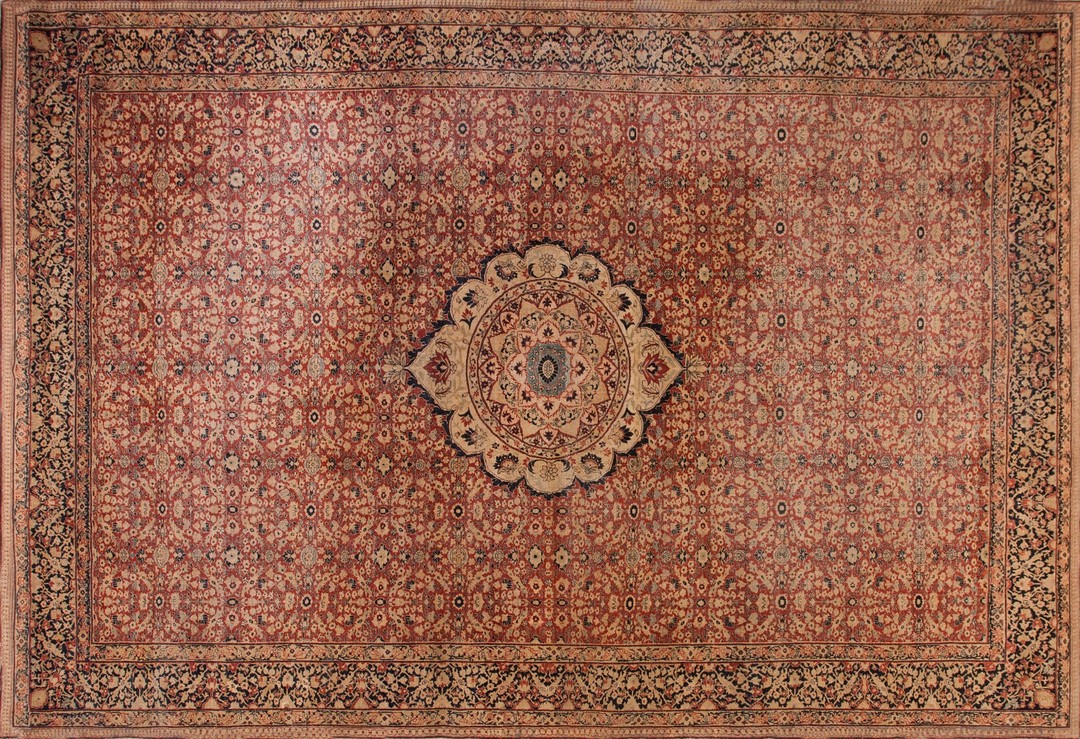
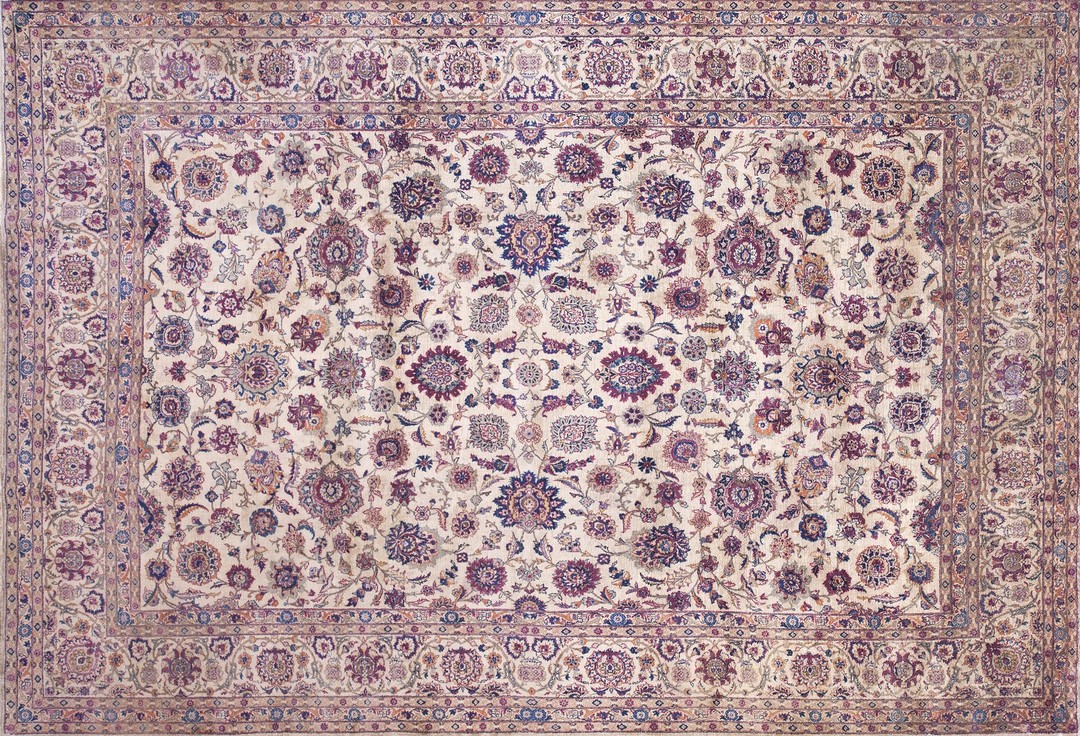
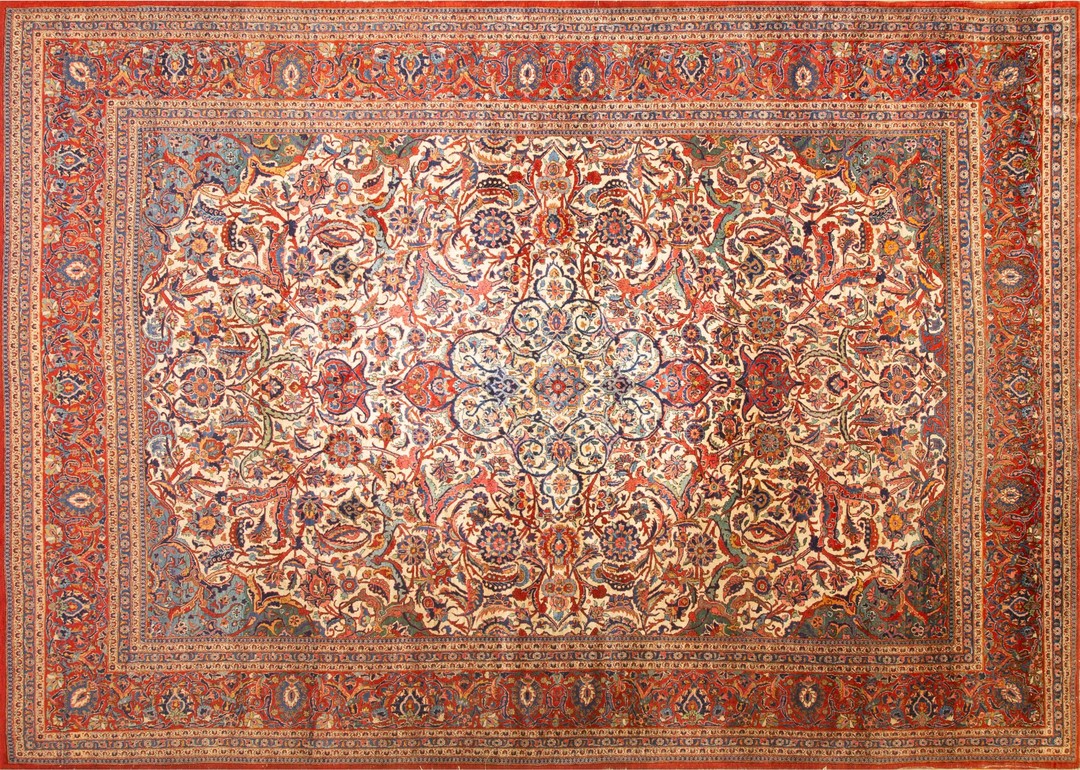
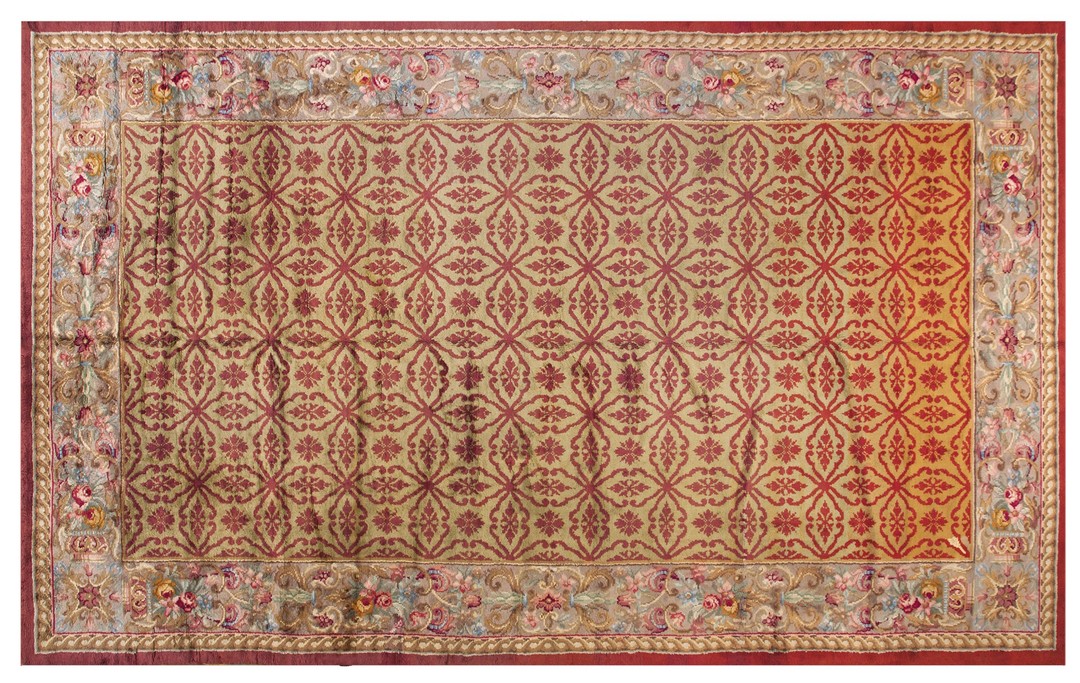
FAQ
- What are the biggest mistakes people make with luxury rugs?
The most common are using a beater-bar vacuum on delicate fibers, letting spills sit, and skipping a rug pad. Another mistake is placing viscose “silky” rugs where water exposure is likely.
- Can luxury rugs be cleaned at home, or do I need a pro?
Light maintenance (vacuuming, blotting spills) is fine, but deep cleaning is safer with a professional—especially for silk, viscose, or valuable hand-knotted luxury rugs. Avoid soaking and harsh chemicals.
- Do luxury rugs shed, and when does it stop?
Some shedding is normal, especially for newer wool luxury rugs and tufted pieces. It typically reduces over weeks to a few months with regular vacuuming and gentle use.
- How often should I rotate luxury rugs?
Rotate every 6–12 months to even out sun fade and traffic paths. If one side gets strong sunlight daily, rotate closer to the 6-month mark to keep color wear balanced.
- How do I vacuum luxury rugs without damaging them?
Use suction-only whenever possible, especially for silk or delicate piles. Vacuum in the direction of the pile and keep fringe out of the nozzle to prevent pulling and fraying.
- Can I put luxury rugs under a dining table?
You can, but pick a low pile so chairs move easily and crumbs vacuum out. Ensure the luxury rug extends about 24 inches past the table edges so chairs stay on the rug when pulled out.
- Are luxury rugs pet-friendly?
Some are—dense wool luxury rugs can hide soil and bounce back from foot traffic. Avoid looped constructions if pets snag, and skip viscose if accidents or water marks are likely.
- Can luxury rugs go in high-traffic areas like hallways?
Yes, but choose tough fibers (dense wool) and avoid delicate “shine fibers” like viscose in busy zones. A low-to-medium pile with a strong foundation usually performs best.
- Should I use a rug pad under luxury rugs?
Yes—rug pads help prevent slipping, add comfort, and reduce wear from grit grinding into the fibers. Many guides recommend trimming the pad slightly smaller than the rug (about 1–3 inches).
- What size luxury rug should I buy for a living room?
A common luxury rug rule is “front legs on” for sofas and chairs, leaving 8–18 inches of border to the walls. In many living rooms, 8×10 or 9×12 is the sweet spot.
- Is buying vintage luxury rugs a smart move?
Often yes—vintage luxury rugs can offer handwork and materials that would be very expensive new. Just inspect for repairs, dry rot, staining, and odor before committing.
- Do luxury rugs hold resale value?
Some do, especially well-made vintage or hand-knotted rugs in good condition. Condition, size, design demand, and documented origin matter more than the original retail price.
- Are luxury rugs worth the splurge?
They can be—many buyers value the comfort, visual depth, and long lifespan versus replacing cheaper rugs every few years. A well-made handwoven rug is often treated as a long-term piece.
- What’s a realistic price range for luxury rugs?
Luxury rugs range widely: a quality 8×10 can be “low four figures” to five figures depending on knotting, materials, and provenance. Size and fiber (silk vs wool) drive the biggest jumps.
- Do higher-knot-count luxury rugs always last longer?
Not always—fiber quality, foundation, and finishing matter too. Some lower-KPSI rugs are famously durable because they’re thicker and built for hard wear, even if the design is bolder.
- What is KPSI, and why does it matter for luxury rugs?
KPSI (knots per square inch) is a density measure for hand-knotted luxury rugs; higher counts usually allow finer detail. As a rough guide, ~70–80 is coarse and ~100+ is medium+.
- Why do some “luxury rugs” feel silky but aren’t silk?
Many use viscose (often marketed as art silk/bamboo silk) for shine at a lower cost. The tradeoff is it can be highly absorbent and prone to water marks and wear.
- Are silk luxury rugs durable enough for daily use?
Silk luxury rugs can be durable, but they’re best in lower-traffic rooms (bedrooms, formal living areas). Use suction-only vacuuming and avoid rough friction to protect fibers.
- Are wool luxury rugs actually more stain resistant?
Often, yes—wool fibers have natural lanolin that can help resist dirt and some stains if spills are handled quickly. It’s not stain-proof, but it’s forgiving.
- What materials are most common in luxury rugs?
Wool is the classic luxury rug fiber for resilience and comfort, while silk adds sheen and fine detail. High-end blends (wool-silk) are common for “soft glow” highlights.
- How can I tell if a luxury rug is truly handmade?
Flip the luxury rug over: handmade rugs usually show slight irregularities and a readable pattern on the back. Also check fringe—on many handmade rugs it’s an extension of the foundation, not sewn on.
- What’s the difference between hand-knotted luxury rugs and hand-tufted luxury rugs?
Hand-knotted luxury rugs are built knot-by-knot and often last decades; hand-tufted rugs are punched through a backing and generally wear out sooner. The back of a hand-knotted rug shows the pattern.
- Are luxury rugs usually hand-knotted?
Many luxury rugs are hand-knotted because it creates a durable pile structure and detailed patterns. Some luxury rugs are handwoven flatweaves or high-end hand-tufted pieces.
- What makes luxury rugs “luxury” compared to regular rugs?
Luxury rugs typically use premium fibers (like wool or silk), tighter construction, and stronger finishing. Hand-knotting and higher knot density are common markers of craftsmanship.