
Introduction to Art Deco Rugs
Discover our exquisite collection of authentic Art Deco style rugs ready to define your modern space.
Art Deco Origins and Cultural Context
The Art Deco movement emerged in the 1920s as a celebration of modernity, optimism, and luxury in the wake of World War I. It was both a cultural and artistic revolution, shaped by the Jazz Age and the newfound glamour of modern living. Rooted in the broader Art Moderne aesthetic, this design style rejected the elaborate ornamentation of the 19th century in favor of sleek, stylized motifs and streamlined elegance. Rugs created in this period became powerful symbols of the new modernist rug style.
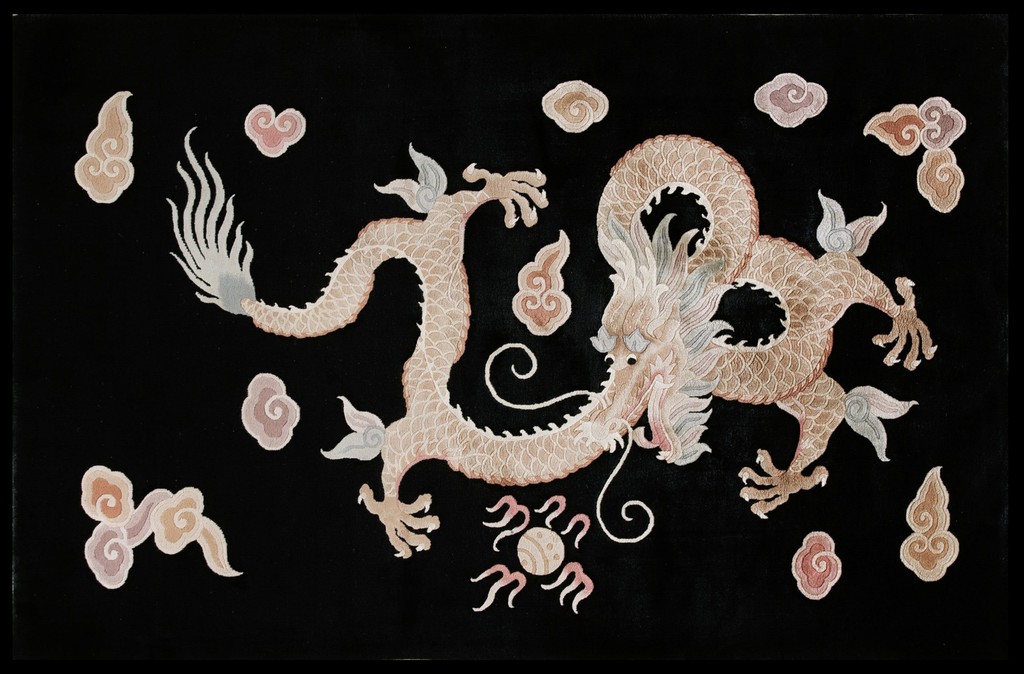
Vintage Benevolent 5 Claw Dragon Design Chinese Deco Rug by Rugs On Net
They mirrored the energy of jazz, the rise of cinema, and the dynamic changes sweeping across cities like Paris, New York, and London. Unlike traditional carpets, which often relied on floral or Oriental patterns, Art Deco rugs expressed the futuristic spirit of the 20th century, incorporating sharp geometry, bold contrasts, and daring use of color.
These Jazz Age carpets were not merely floor coverings but integral works of art designed to harmonize with modern interiors filled with chrome, glass, and lacquered furniture. The enduring appeal of Art Deco rugs lies in their ability to embody the optimism of the era while maintaining a sense of timeless sophistication. Their boldness captured the imagination of a generation eager to leave behind the hardships of war and embrace a new world of possibility.
What Makes Art Deco Rugs Unique?
- Geometric Abstraction — Why: Art Deco rugs feature sharp angles, zigzags, chevrons, and other linear forms that reflect the fascination with machinery, architecture, and the streamlined designs of the era.
- Stylized Motifs — Why: Instead of naturalistic depictions, motifs such as sunbursts, fans, and stepped patterns were abstracted and simplified, aligning with the modernist rug style.
- Vibrant Color Palettes — Why: Unlike the muted earth tones of earlier rugs, Jazz Age carpets embraced strong contrasts, using deep blues, golds, emerald greens, and striking black-and-white combinations to create dramatic visual effects.
- Integration with Interiors — Why: Art Deco rugs were conceived as part of a complete decorative scheme, designed to complement lacquered furniture, mirrored surfaces, and bold wall treatments, making them cohesive statements within the home.
- Symbol of Luxury — Why: Owning an Art Moderne rug signaled sophistication and worldliness. These rugs were often commissioned by wealthy patrons or designed for cosmopolitan urban apartments, symbolizing access to modern luxury.
- Cultural Reflection — Why: The designs echoed the cultural energy of the Jazz Age—music, dance, cinema, and architecture—making them visual embodiments of the optimism and dynamism of the 1920s and 1930s.
Art Deco rugs stand apart because they represent more than decorative objects; they are cultural artifacts that encapsulate an era defined by innovation and glamour. Their striking geometry and daring palette continue to inspire collectors, designers, and homeowners seeking to bring a piece of 20th-century modernist energy into contemporary interiors.
By uniting artistry with functionality, these rugs embody the very essence of the Art Deco movement—luxurious yet practical, bold yet refined, timeless yet distinctly modern. Their enduring popularity underscores their role not only as Jazz Age carpets but as living testaments to one of the most transformative design periods in history.
Defining Characteristics of Art Deco Rugs
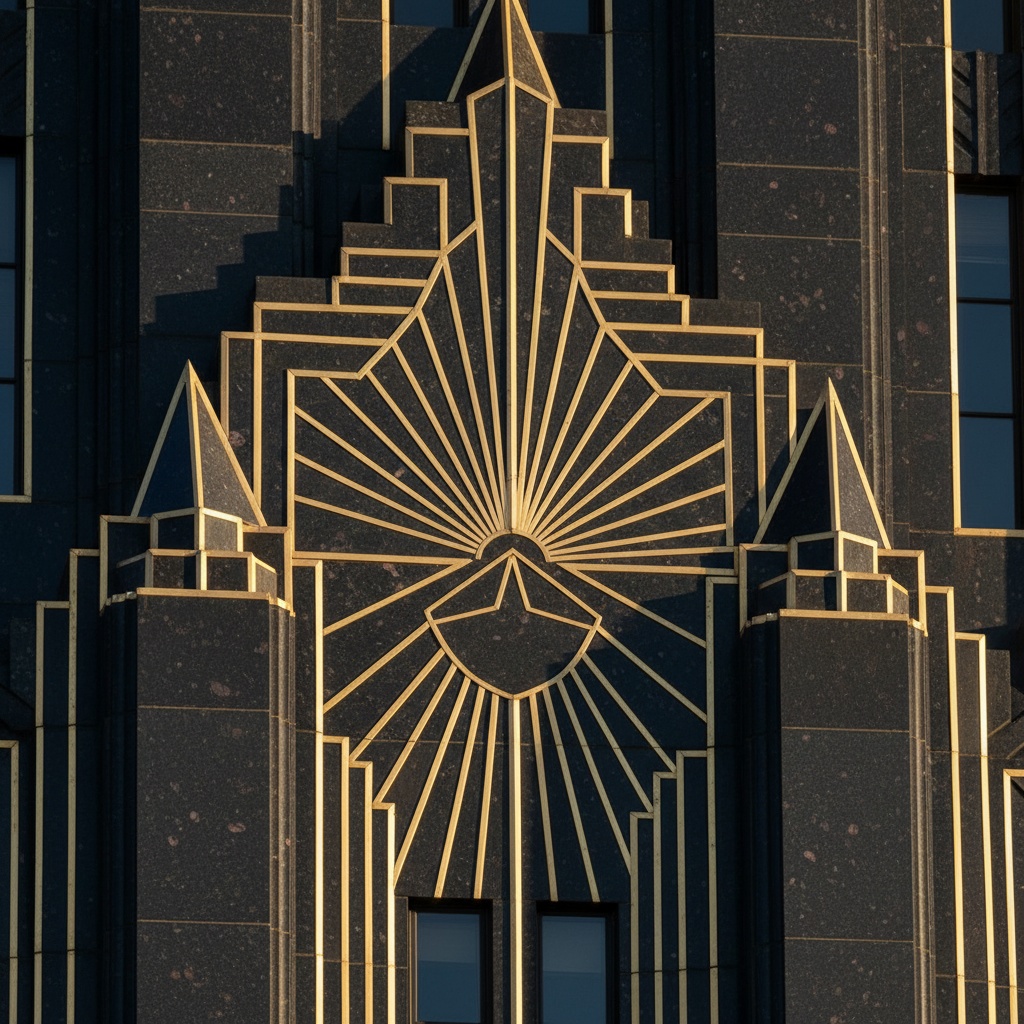
Geometric gold detailing on dark stone.
Deco Motifs & Patterns
Art Deco motifs are instantly recognizable for their modernist abstraction and sharp geometric rug patterns. Instead of traditional floral naturalism, the movement embraced forms that embodied dynamism and stylization. Sunbursts, zigzags, chevrons, stepped pyramids, and radiating fans dominate the vocabulary, echoing the architectural language of skyscrapers and the excitement of the machine age.
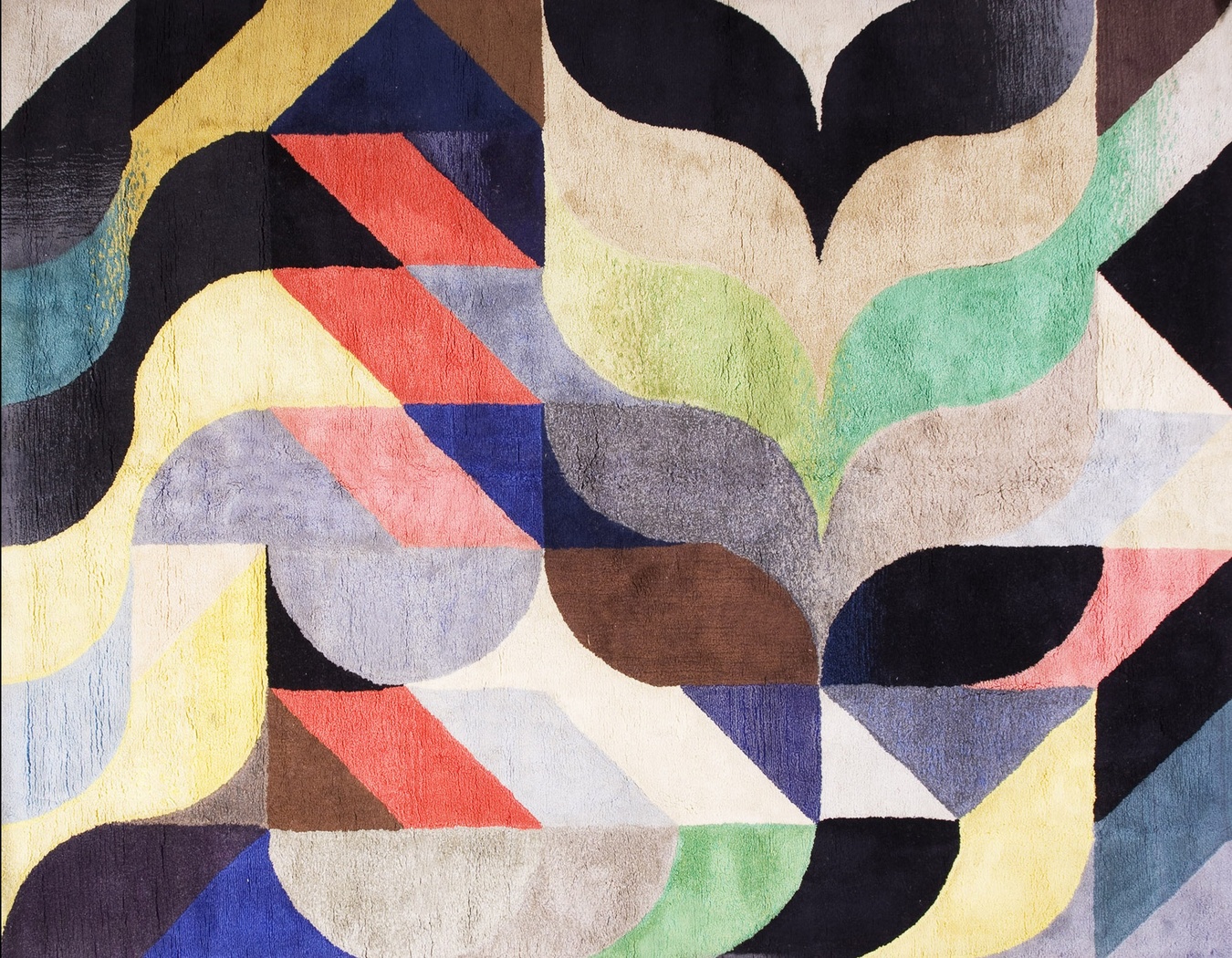
Even when flora and fauna appear, they are reimagined in a Cubist or streamlined style—roses reduced to geometric spirals, animals rendered with elegant simplicity rather than realistic detail. This reduction of natural forms into bold symbols is what sets Deco geometry and flora apart from earlier rug traditions, which favored intricate and naturalistic ornament.
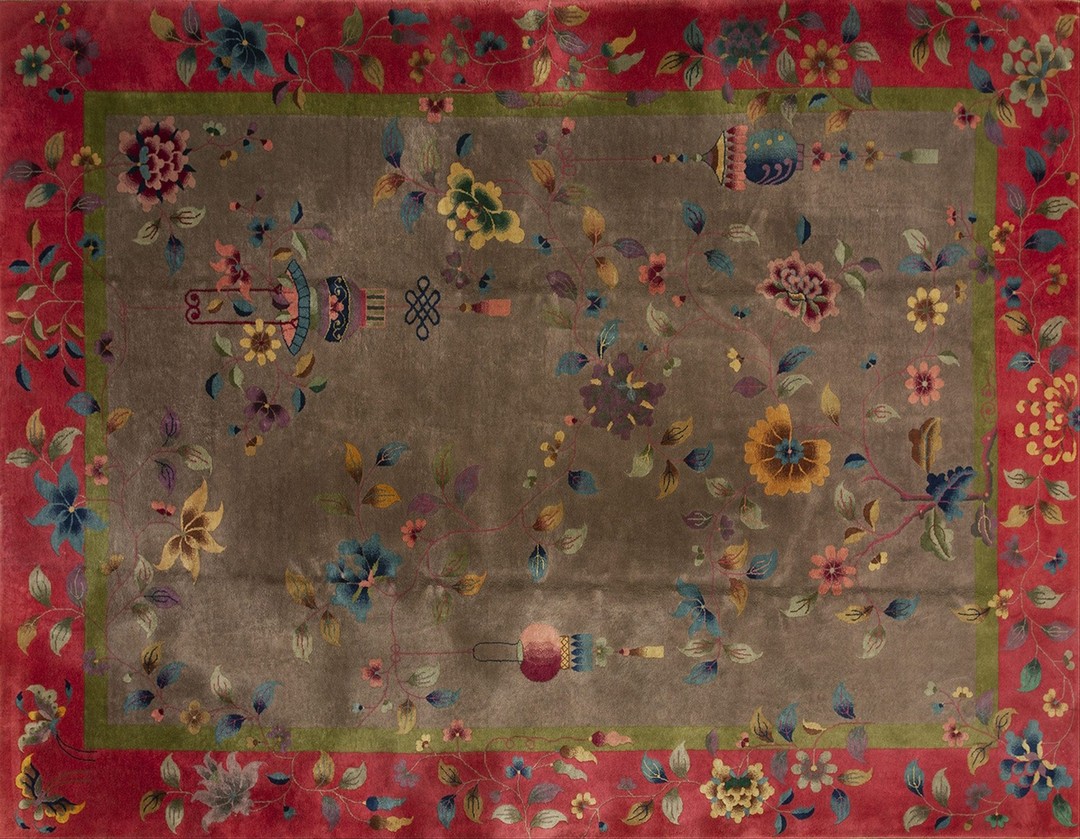
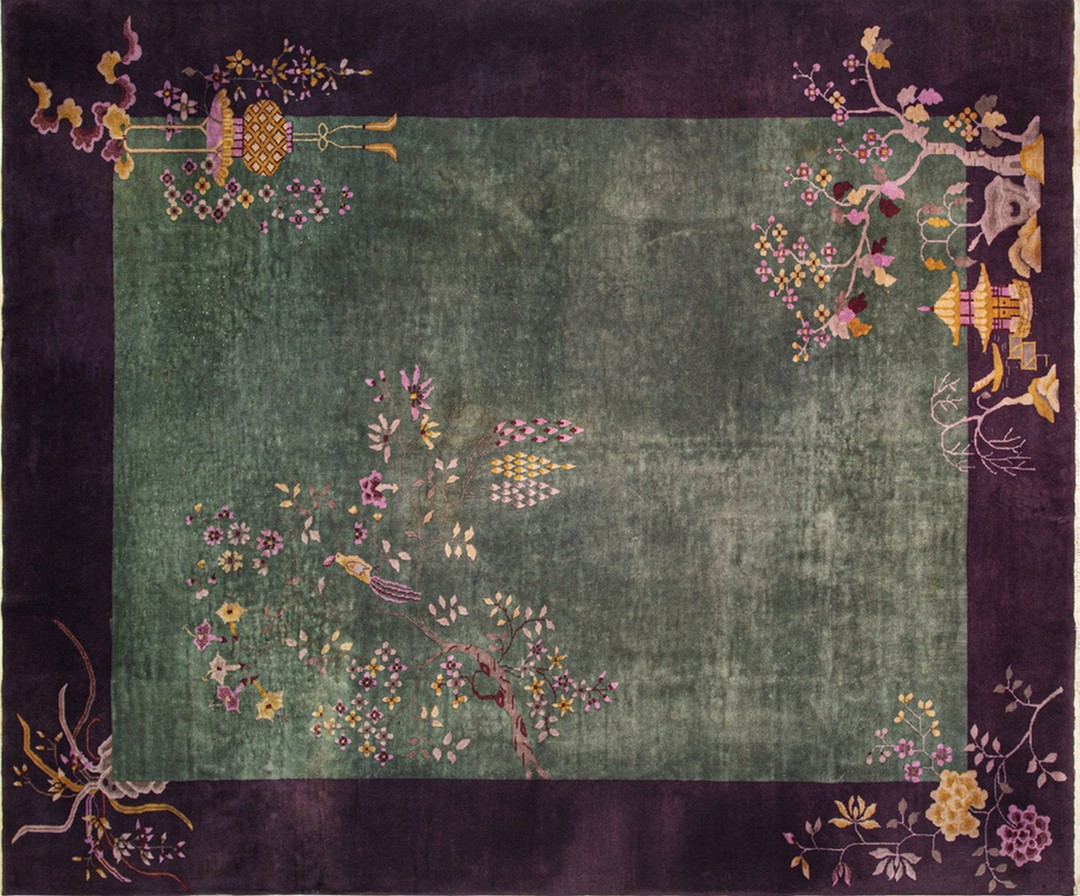
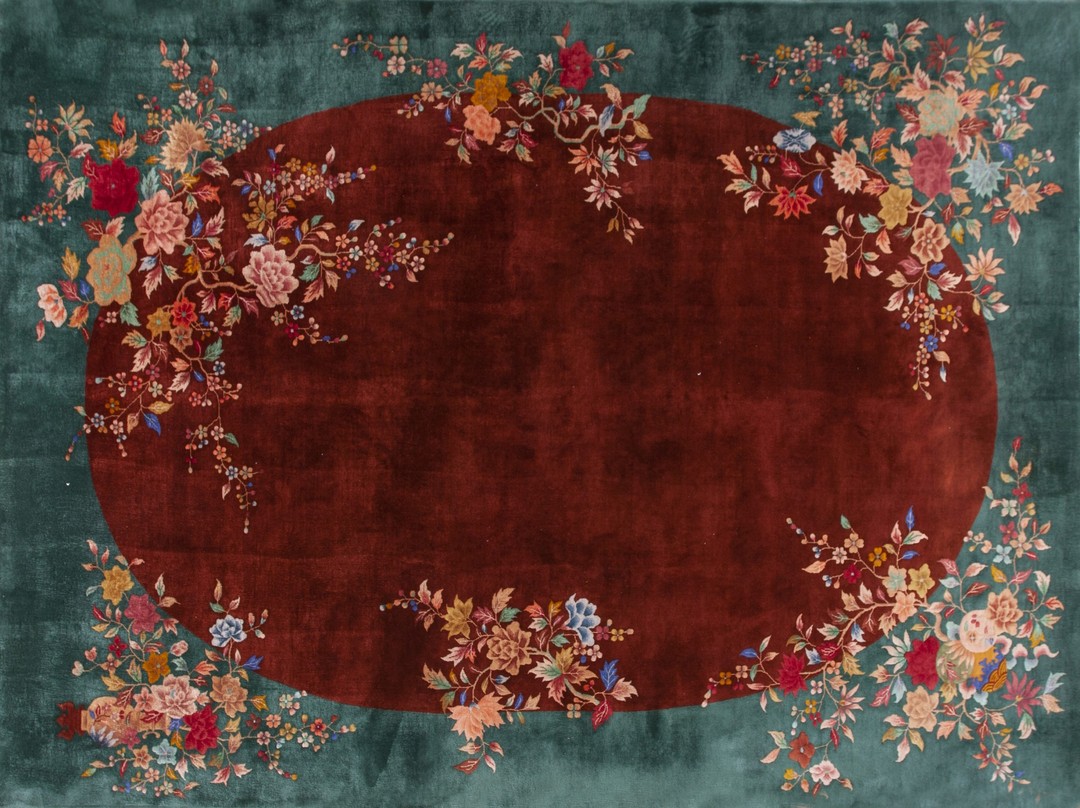
Chinese Art Deco rugs introduced their own interpretations of these motifs. Scattered sprays of stylized peonies, birds, or butterflies might float across an open field, blending Eastern botanical symbolism with Western Deco abstraction. This fusion produced some of the most striking variations of the style, simultaneously modern and rooted in Chinese decorative heritage.
Color Palettes & Dye Innovations
The Deco color palette marked a radical break from the subdued tones of earlier carpets. Jewel tones—sapphire, emerald, ruby, and amethyst—appeared alongside bold contrasts of black, ivory, and gold. Synthetic dye innovations, particularly aniline and chromium-based dyes, enabled weavers to achieve shades that were previously impossible, producing vibrant hues that matched the exuberance of the Jazz Age.
Western Art Deco rugs often favored high-contrast combinations, using deep navy or black grounds to heighten the drama of geometric rug patterns. By contrast, Chinese Art Deco rugs experimented with more adventurous tonal blends, layering unexpected color juxtapositions like teal with rose, or lavender with mustard. These palettes reflected a more painterly approach, offering softer gradations and a broader chromatic range while still embracing modern vibrancy.
Borders, Layouts & Structure
A defining structural innovation of Art Deco rugs is the treatment of borders and layouts. Many Western examples retained a degree of symmetry, sometimes featuring central medallions framed by simplified linear borders. Yet unlike traditional Oriental rugs, the borders were often minimized or eliminated entirely, allowing motifs to extend seamlessly to the edge of the carpet.
This “all-over” approach emphasized dynamism and broke away from rigid framing conventions. Chinese Art Deco rugs diverged sharply from this Western structure. They favored open fields punctuated by scattered motifs, deliberately asymmetrical to create a sense of movement and spontaneity. Instead of medallions, motifs might float freely—a dragon in one corner, a peony in another—balanced by voids of color. This asymmetry is a hallmark of Chinese Deco design, setting it apart from the structured geometry of Western Art Moderne rugs.
The interplay between Eastern openness and Western symmetry underscores the versatility of the style. Where Western rugs leaned toward architectural precision, Chinese Art Deco embraced fluidity and experimentation, resulting in some of the most distinctive asymmetrical Chinese rugs ever woven. Together, the geometric dynamism of motifs, the bold Deco color palette, and the structural innovations in layout define Art Deco rugs as icons of 20th-century design. They are not only decorative but also visual statements of cultural exchange, technological progress, and artistic daring.
Regional and Cultural Variations
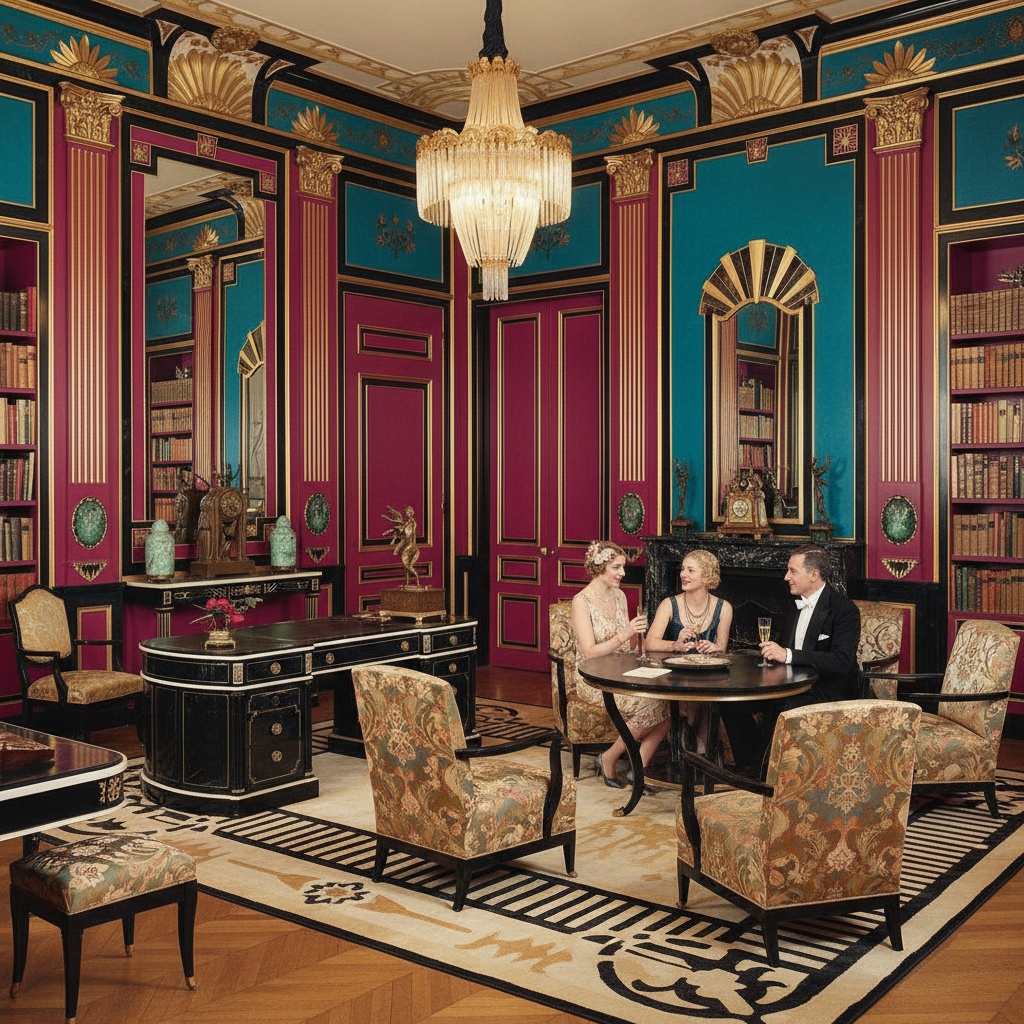
Rich color palette in an opulent interior setting.
French & Western European Deco Rugs
French Art Deco rugs set the benchmark for refinement and craftsmanship during the movement’s height. Produced in renowned workshops such as Savonnerie and Aubusson, these carpets translated the elegance of French Art Deco design into woven form. Their patterns were often symmetrical, balanced, and executed with exceptional technical skill, echoing the broader luxury culture of Paris in the 1920s.
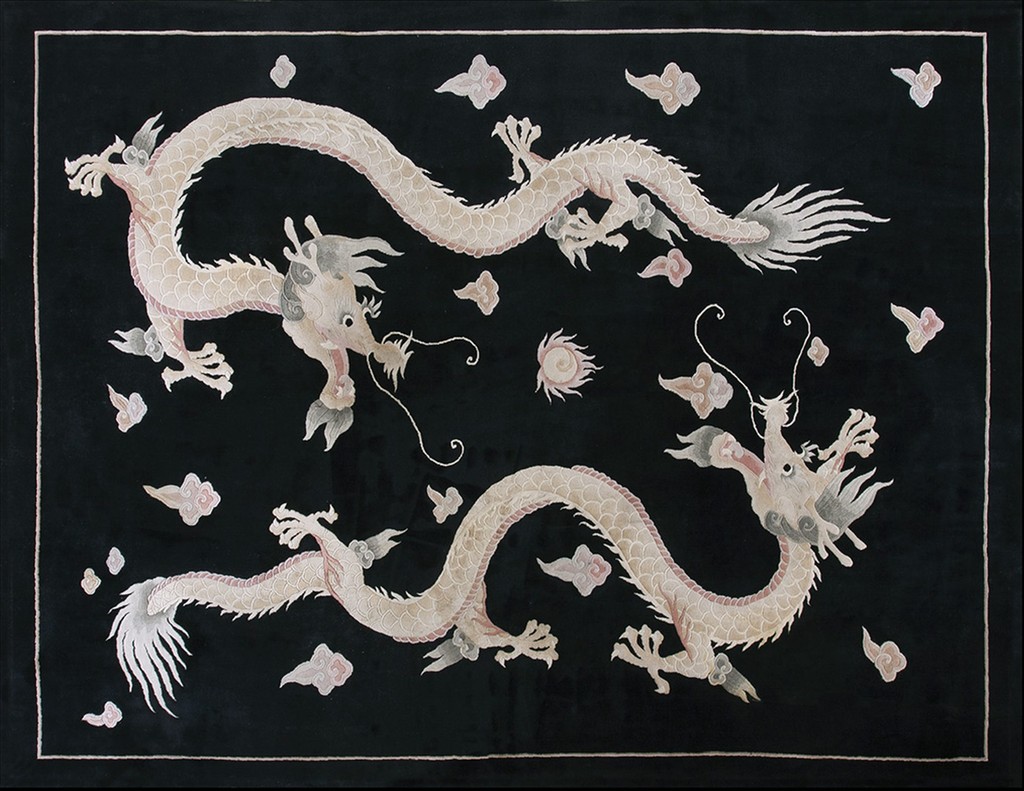
Vintage Black Double Five Claw Chinese Dragons Design Rug by Rugs On Net
Designers like Jacques-Émile Ruhlmann and Ivan da Silva Bruhns introduced bold geometric abstraction, yet always within a framework of elegance. The French approach embodied sophistication and restraint, making these rugs central to the Art Moderne interiors that graced the salons of Europe’s elite.
Chinese Art Deco Rugs
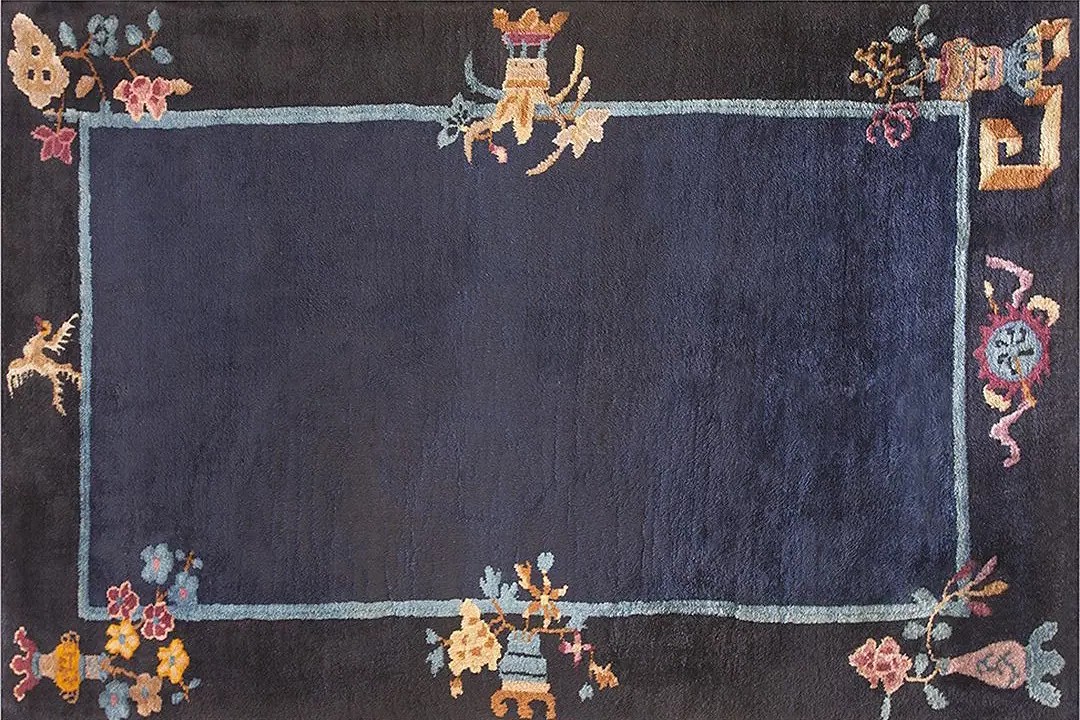
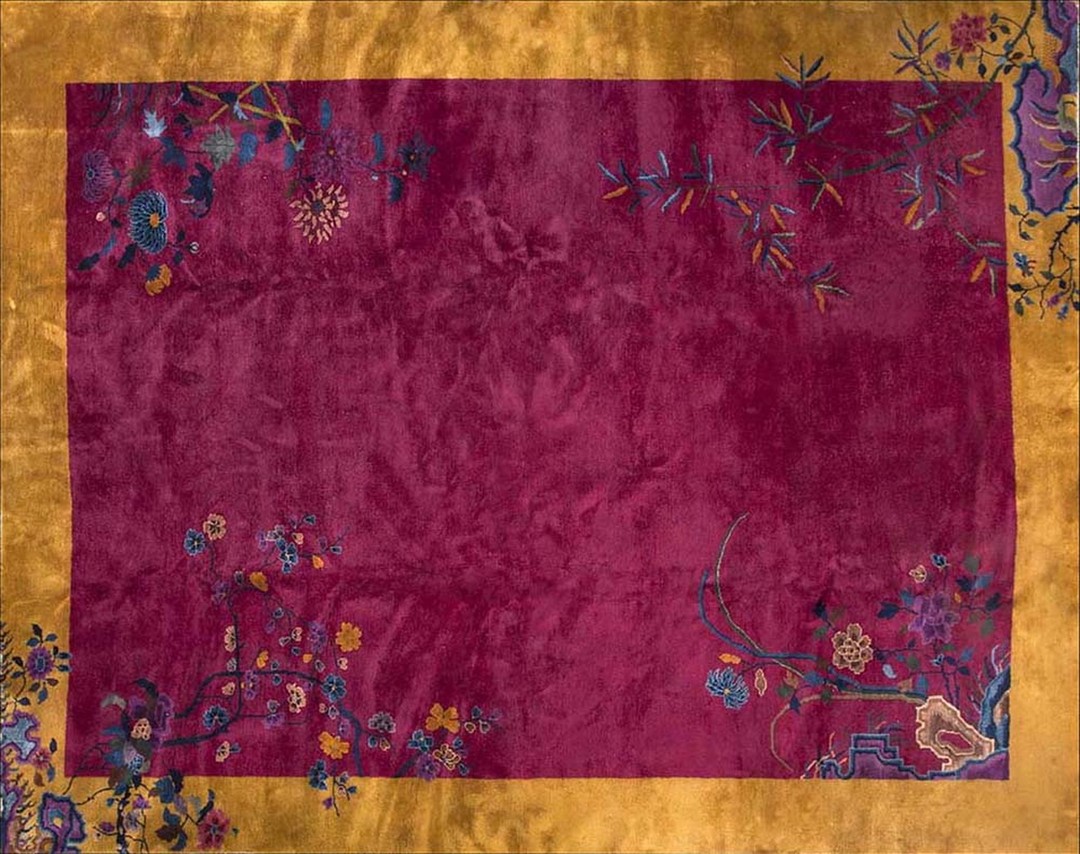
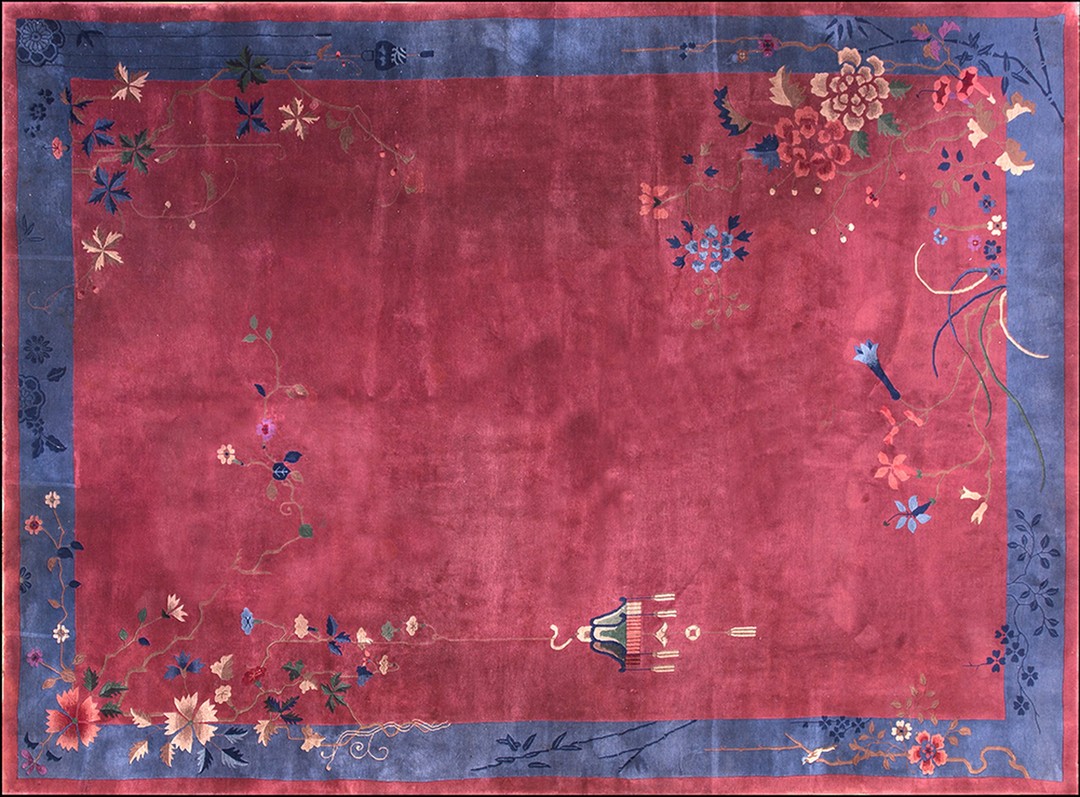
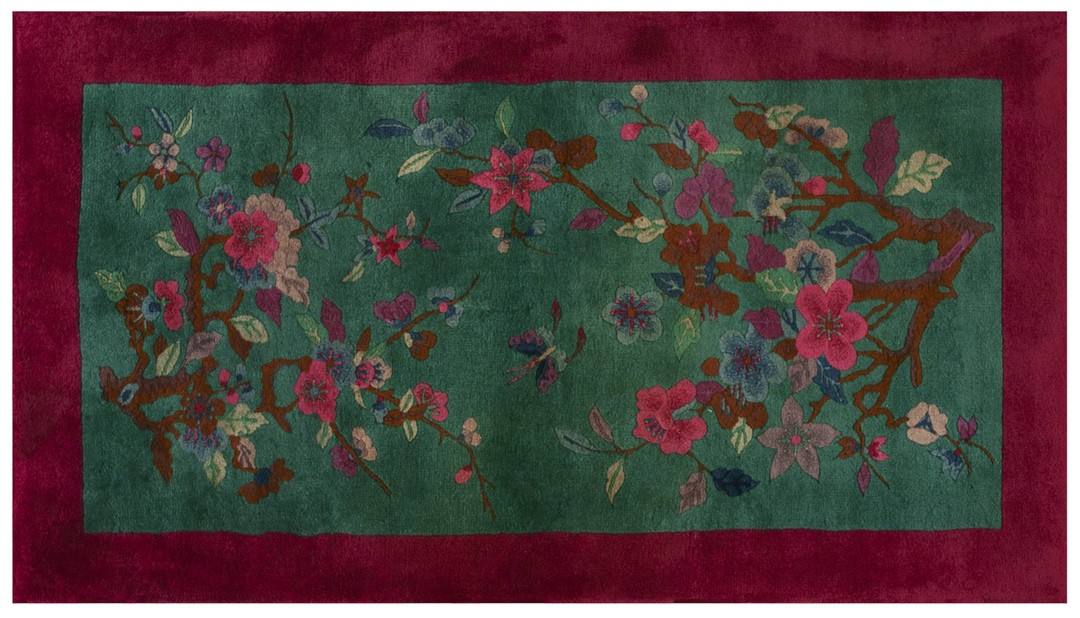
Chinese Deco carpets, produced primarily in Tianjin and Beijing during the 1920s and 1930s, became the most iconic East–West fusion within the movement. Their distinctiveness lay in blending modernist geometry with Chinese symbolism and decorative traditions. Instead of central medallions, designs often featured open fields with scattered motifs, asymmetrically placed dragons, peonies, butterflies, or pagodas. This asymmetry was revolutionary compared to Western structure, offering a freer, more painterly style. The international popularity of these rugs can be credited to export entrepreneurs such as Walter Nichols, an American who established weaving workshops in Tianjin.
Nichols championed bold jewel-tone palettes—lavender, teal, magenta, mustard—paired with modernized Chinese imagery. His efforts positioned Chinese Art Deco rugs as luxury exports tailored for Western markets, where their striking colors and originality captivated decorators and consumers alike. Chinese Art Deco weaving began in earnest in the early 1920s, spurred by demand for modern interiors in Europe and America. The style emerged at a moment when China’s textile workshops sought to reinvent themselves for export markets, combining modernist influences with local traditions. This adaptability explains why Chinese Deco carpets remain among the most collectible and celebrated examples of the style today.
- When did Chinese Art Deco rug weaving begin? — In the early 1920s.
- Who popularized Chinese Art Deco rugs internationally? — Walter Nichols and other Western traders who exported them to Europe and America.
- Where were most Chinese Art Deco rugs produced historically? — Tianjin and Beijing workshops.
- Why did Chinese Art Deco design emerge in 1920s China? — To meet Western demand for modern interiors while revitalizing China’s weaving industry with fresh, export-oriented designs.
American Art Deco Rugs
American Jazz Age rugs reflected the country’s appetite for bold, modern interiors in hotels, theaters, and private residences. While some high-quality handwoven pieces were produced domestically, many were machine-made, designed for durability and large-scale use.
Patterns tended to echo Western geometric motifs—zigzags, stepped forms, and radiating fans—mirroring the architecture of skyscrapers and the glamour of Hollywood. The scale of American demand, particularly for public spaces, ensured that Deco rugs became a defining element of the era’s interior design landscape.
Scandinavian, Indian, Middle Eastern Variants
- Scandinavian (Swedish Grace rugs) — Why: Blended Deco geometry with folk art traditions in flatweaves, producing minimalist, harmonious designs that reflected Nordic ideals of simplicity.
- Indian Indo-Deco carpets — Why: Though less widespread, Indian workshops experimented with Deco motifs, blending them with Mughal-inspired patterns, creating unique hybrids.
- Persian/Middle Eastern — Why: Traditional weaving centers absorbed Deco influences selectively, incorporating geometric abstraction into regional designs while maintaining heritage structures.
A Global Style with Local Voices
The adaptability of the Art Deco rug style ensured its survival across continents. French Art Deco rugs embodied refinement, American Jazz Age rugs captured scale and glamour, Scandinavian flatweaves highlighted restraint, and Indo-Persian variants offered hybrids.
Yet Chinese Deco carpets remain the most iconic expression of East–West fusion, redefining rug design through bold asymmetry, dazzling palettes, and symbolic innovation. This global dialogue cemented Art Deco rugs as one of the most versatile and enduring modernist rug styles of the 20th century.
Materials, Construction & Weaving Techniques
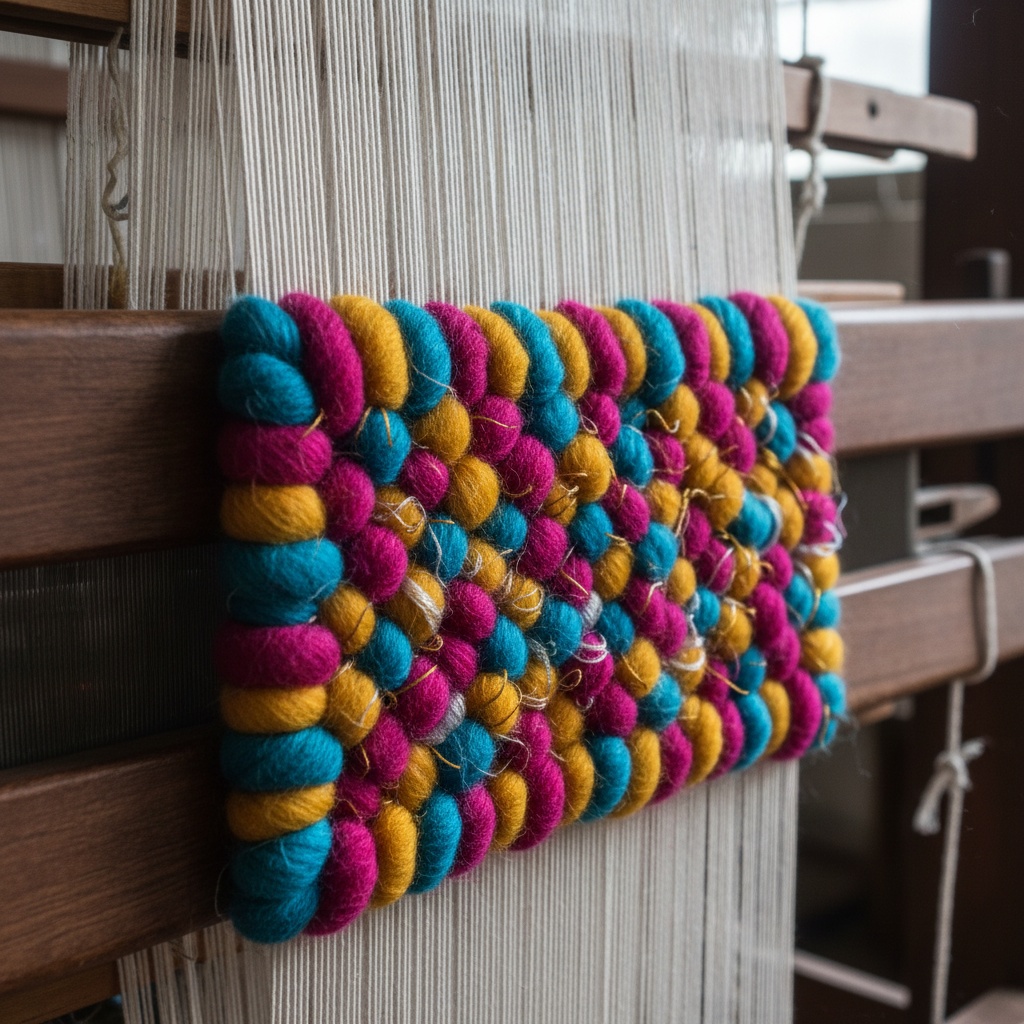
Textured bobble weave technique using thick yarn.
Wool, Silk & Cotton in Art Deco Rugs
The foundation of most Art Deco rugs lies in wool, prized for its durability, softness, and ability to hold vibrant dyes. High-quality wool gave Deco rugs their plush feel and resilience, making them suitable for the luxurious interiors of the 1920s and 1930s. In select pieces, silk was introduced either in highlights or entire motifs to provide a shimmering luster, emphasizing the glamour of the style.
Beneath the pile, cotton foundations were typical—especially in Chinese Art Deco rugs, where sturdy cotton warps and wefts stabilized the structure and allowed for greater design precision. Together, these Deco rug materials combined practicality with aesthetic richness, enabling the bold, modern designs to flourish.
Pile Thickness & Texture
One of the defining characteristics of Chinese Deco carpets is their thick, luxurious pile, which feels soft and opulent underfoot. This texture was achieved through a combination of high knot density, the use of exceptionally high-quality wool, and deliberate weaving techniques that built height into the pile.
Unlike thinner Western rugs, Chinese examples often featured a dense surface, enhancing their jewel-tone palettes and making them stand out in modern interiors. This thick pile rug structure not only created comfort but also showcased the depth of color, as the plush fibers absorbed and reflected light with remarkable richness.
- What materials are used in authentic Chinese Art Deco rugs? — Wool pile, often with some silk highlights, supported by a cotton foundation.
- How is pile thickness in Chinese Art Deco rugs achieved? — By combining high knot density with fine, durable wool to create a deep, plush surface.
- Should a Chinese Art Deco rug have a cotton foundation? — Yes, authentic examples almost always use cotton warps and wefts.
Dye Technology: Natural vs. Synthetic
The vibrant Deco color palette owes much to advances in dye technology. Earlier rug traditions relied on natural dyes, which produced subtle tonal variations but limited the range of colors. By the 1920s, aniline and chromium synthetic dyes were widely available, unlocking intense shades such as magenta, teal, lavender, mustard, and deep blues.
These hues became hallmarks of the Jazz Age aesthetic. Some workshops still blended natural and synthetic dyeing methods, allowing for nuanced gradations while capitalizing on the brilliance of synthetics. The result was a palette that perfectly matched the daring and modernist spirit of Art Deco design.
Hand-Knotted vs. Machine-Made Deco Rugs
While hand-knotted Art Deco rugs remain the most prized for their craftsmanship, texture, and authenticity, the rise of industrial production made Deco designs more widely accessible. Machine-made Wilton and Axminster carpets reproduced geometric motifs and bold color schemes on a mass scale, often used in hotels, theaters, and other public venues during the Jazz Age.
These machine-woven pieces democratized the style, bringing Deco design into everyday spaces. However, collectors and connoisseurs consistently value handmade rugs—especially Chinese Deco carpets with wool pile and cotton foundation—for their artistry, durability, and luxurious feel.
- Can Chinese Art Deco rugs be hand-knotted and machine-made? — Authentic examples are hand-knotted, but Deco-inspired machine-made versions also exist, particularly from Western factories.
Material Innovation as Deco’s Legacy
The material and technical choices of Art Deco rug weaving were central to the style’s identity. Wool and silk provided beauty and strength, cotton foundations ensured stability, thick pile construction defined Chinese luxury, and synthetic dye innovations gave the era its unforgettable color palette.
Together, these elements allowed Art Deco rugs to embody both artistic daring and practical elegance, ensuring their enduring appeal in interiors and collections worldwide.
Chinese Art Deco Rugs: In-Depth
Historical Origins
Chinese Art Deco rugs emerged in the 1920s in Tianjin and Beijing, during a moment of cultural reinvention and modernization in China. These carpets represented an East–West fusion, blending centuries-old Chinese weaving traditions with the bold abstraction and vibrant palettes of the Art Deco movement. The new style catered to Western tastes, reflecting the growing demand from the United States and Europe for modern interiors.
- When did Chinese Art Deco rug weaving begin? — In the early 1920s.
- Where were most Chinese Art Deco rugs produced historically? — Primarily in Tianjin and Beijing workshops.
International Popularity
The international success of Chinese Deco carpets is inseparable from the work of Walter Nichols, an American entrepreneur who established weaving workshops in Tianjin. Nichols recognized the Western appetite for bold, modern rugs and marketed these pieces with remarkable effectiveness. His designs—often labeled “Nichols rugs”—introduced daring colors, asymmetrical layouts, and Chinese motifs modernized for global appeal.
By targeting the American market, Nichols transformed Chinese Art Deco rugs into some of the most recognizable and desirable carpets of the 20th century.
- Who popularized Chinese Art Deco rugs internationally? — Walter Nichols.
- Why did Chinese Art Deco design emerge in 1920s China? — To supply export markets with modern, stylish rugs while revitalizing China’s weaving industry.
Iconic Motifs & Design Language
Chinese Art Deco rugs stand out for their innovative use of motifs and layouts. Common symbols include peonies, dragons, phoenixes, vases, butterflies, and stylized flora or fauna, all reinterpreted in simplified, modernist forms. Some rugs even depict narrative scenes with pagodas, landscapes, or mythological imagery.
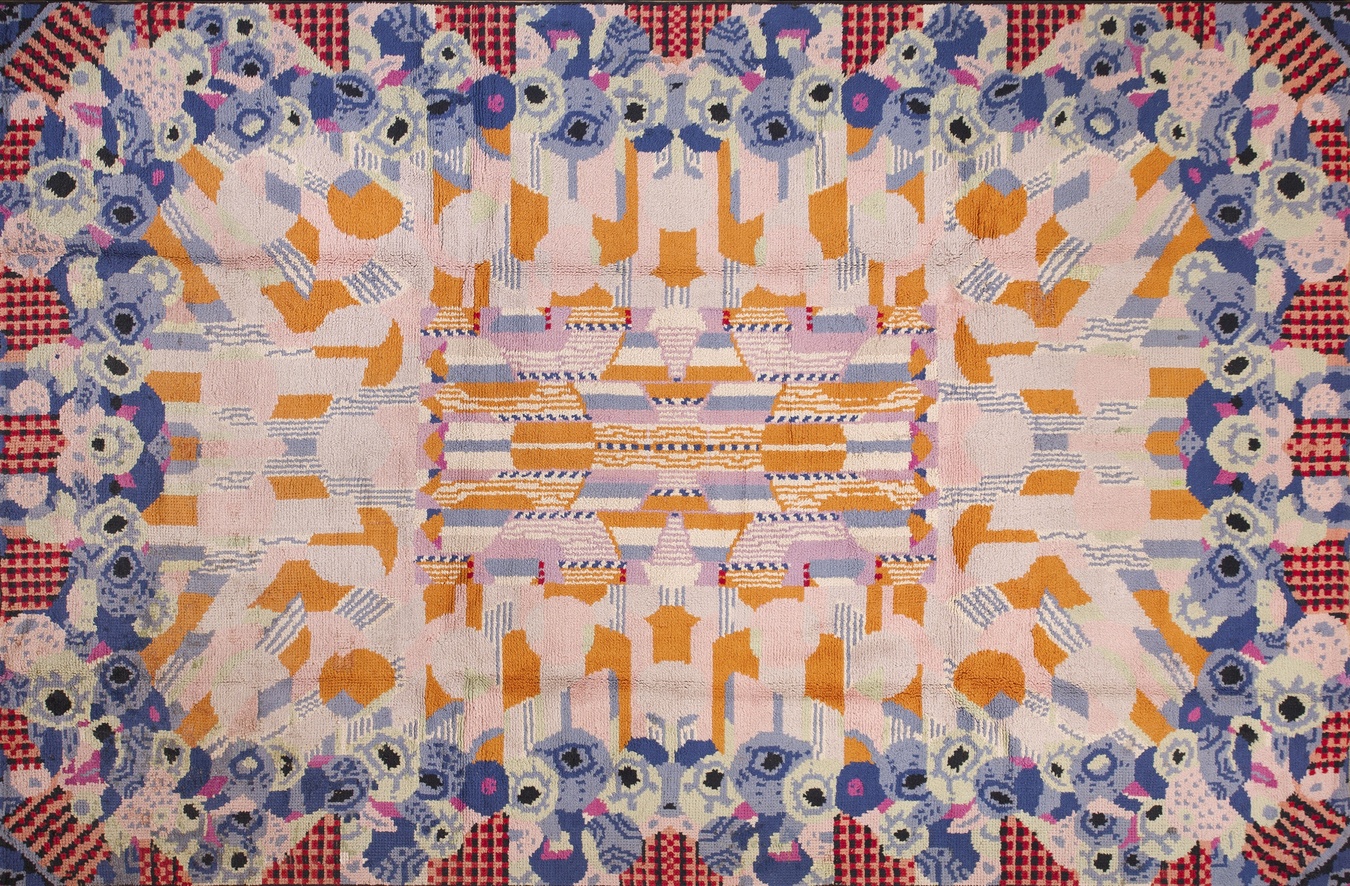
Antique Art Deco French Geometric Medallion Hand Knotted Pile Rug – by Rugs On Net
Unlike Western Deco rugs, which often relied on symmetry and medallions, Chinese examples embraced open fields and asymmetry. Motifs might float in corners or scatter across the surface, leaving large areas of solid color for dramatic effect.
- What motifs define Chinese Art Deco rug patterns? — Peonies, dragons, phoenixes, vases, butterflies, stylized flora/fauna, and sometimes narrative scenes.
- Does Chinese Art Deco feature asymmetrical layouts or medallions? — Yes, asymmetry is a defining trait, and medallions are often omitted in favor of open fields.
Color Usage & Palettes
Perhaps the most striking element of Chinese Deco carpets is their bold color palette. Made possible by modern aniline and chromium dyes, these rugs experimented with unexpected combinations—magenta with turquoise, lavender with mustard, gold with teal.
Such juxtapositions gave the rugs an avant-garde quality that aligned perfectly with Jazz Age interiors. While Western Deco rugs often relied on sharp contrasts like black and ivory, Chinese examples favored richer tonal blends, offering a painterly, layered approach.
- How do colors in Chinese Art Deco rugs differ from Western? — Western examples favored stark contrasts, while Chinese Deco carpets embraced adventurous and unexpected tonal blends.
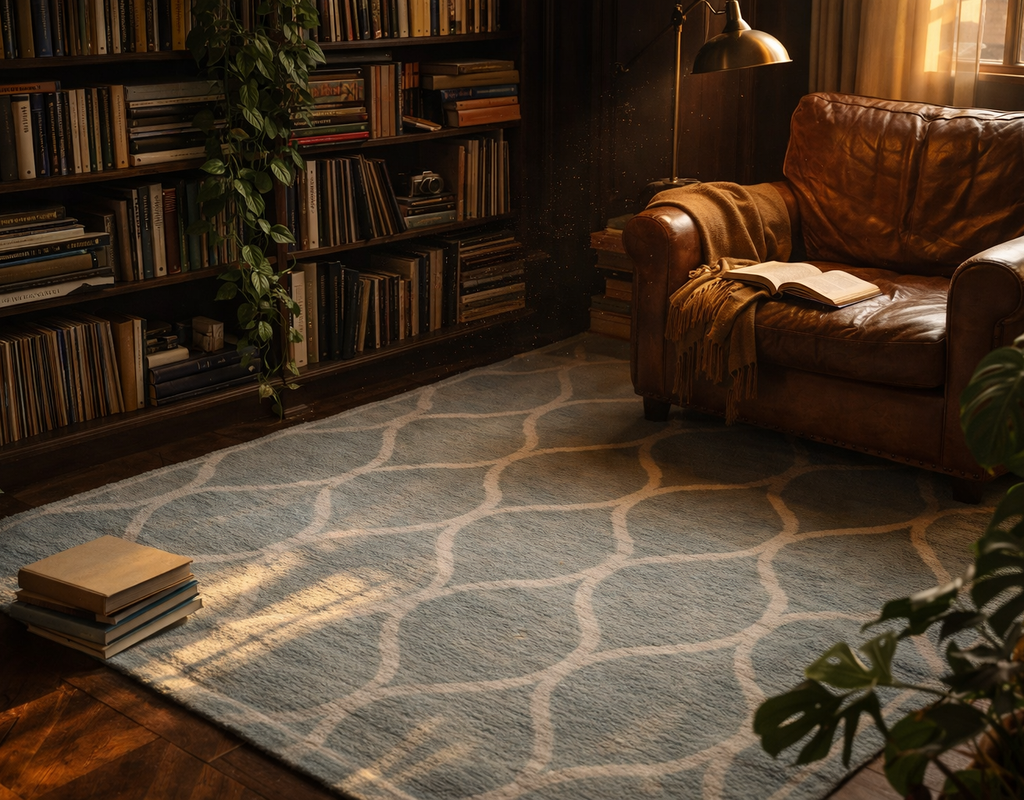
A tranquil reading corner defined by rich textures and soft natural light highlighting the contemporary geometric rug.
Construction Details
Authentic Chinese Art Deco rugs are defined by their high-quality wool pile woven on a cotton foundation, sometimes accented with silk highlights for added luster. They are hand-knotted, typically with a dense weave that produces a thick, luxurious texture. This plush surface amplifies the brilliance of their jewel-tone palettes. While machine-made versions existed, particularly for mass export, they are far less valued by collectors.
- What materials are used in authentic Chinese Art Deco rugs? — Wool pile, cotton foundation, occasional silk highlights.
- How is pile thickness in Chinese Art Deco rugs achieved? — Through fine wool, dense knotting, and deliberate weaving techniques.
- Should a Chinese Art Deco rug have a cotton foundation? — Yes, most authentic examples do.
- Can Chinese Art Deco rugs be hand-knotted and machine-made? — Yes, but hand-knotted rugs are prized, while machine-made examples hold less value.
Vintage & Modern Market
Today, vintage Chinese Art Deco rugs from the 1920s–30s command strong demand among collectors and interior designers. Notably, patina and vintage wear often enhance value, as fading and softening of colors contribute to the sought-after “vintage chic” aesthetic. Large-format or rare examples, particularly those linked to Walter Nichols, can command especially high prices.
Contemporary workshops also produce Chinese Deco–inspired rugs, often updating the palette with modern dyes or mimicking antique patina. Yet true vintage pieces retain a unique authenticity that cannot be replicated. Compared with Persian rugs, Chinese Deco carpets remain relatively undervalued, offering significant investment potential. Experts anticipate appreciation, especially for rare or named-designer pieces.
- What is the value of vintage Chinese Deco rugs today? — They range widely by size, condition, and rarity, but well-preserved 1920s–30s examples often achieve high prices.
- Do vintage wear and patina reduce value? — No; in fact, patina often adds to the desirability of vintage Deco rugs.
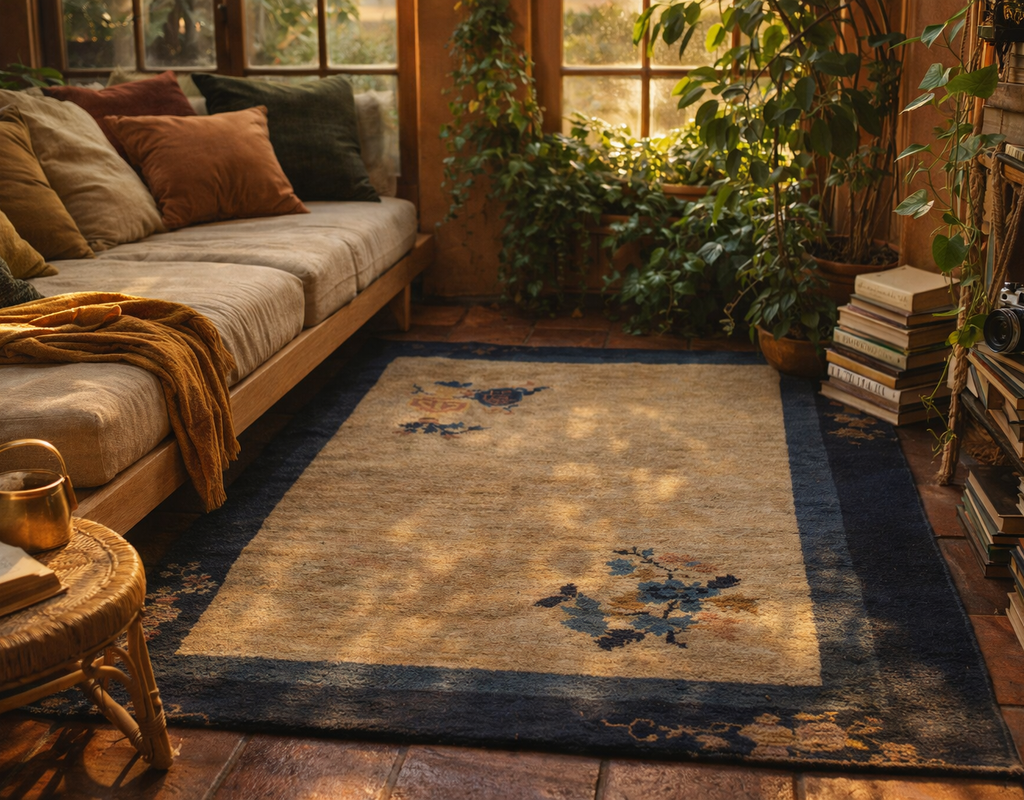
Golden light filters into this bohemian sanctuary, highlighting the subtle design of the area rug near the abundant houseplants.
A Lasting Legacy
Chinese Art Deco rugs embody the fusion of East and West, modern dye technology, and daring design choices of the 1920s. Through Walter Nichols’ marketing brilliance, Tianjin Deco carpets became icons of international design, celebrated for their asymmetry, vivid palettes, and luxurious construction.
Today, collectors prize them not only as decorative objects but also as cultural artifacts—symbols of a moment when Chinese artistry met Jazz Age modernism, leaving behind a legacy of enduring beauty and investment potential.
Art Deco Rugs in Interior Design: Past & Present
Role in Modernist & Contemporary Interiors
From their inception, Art Deco rugs were never just floor coverings but integral components of a holistic design language. In the Jazz Age style of the 1920s and 1930s, these rugs mirrored the sleek architecture of skyscrapers, the polished surfaces of lacquered furniture, and the symmetry of Art Moderne interiors. Their bold geometry and vibrant colors extended the visual dynamism of modernist spaces directly to the floor, uniting architecture, furniture, and decorative arts into a seamless aesthetic.
Today, Art Deco rugs remain highly versatile in interior design. In minimalist spaces, a Deco carpet provides a single bold anchor, injecting depth, texture, and historical resonance. In maximalist rooms, their dynamic patterns and jewel-tone palettes complement layered textiles, statement lighting, and eclectic decor. Whether in vintage glamour settings or contemporary lofts, they serve as a design pedigree piece that links modern living with a century of design innovation.
Cultural Symbolism
- Luxury — Why: Art Deco rugs were originally designed for wealthy, cosmopolitan audiences, and their materials, dyes, and craftsmanship continue to signify refinement.
- Optimism — Why: Emerging after World War I, Deco rugs embodied hope for a new future, celebrating color, geometry, and modern technology.
- Cosmopolitan Taste — Why: By combining global influences, from French refinement to Chinese asymmetry, they symbolized worldly sophistication.
- East–West Fusion — Why: Chinese Deco carpets in particular expressed the blending of cultural traditions, becoming icons of global modernism.
How to Style with Art Deco Rugs
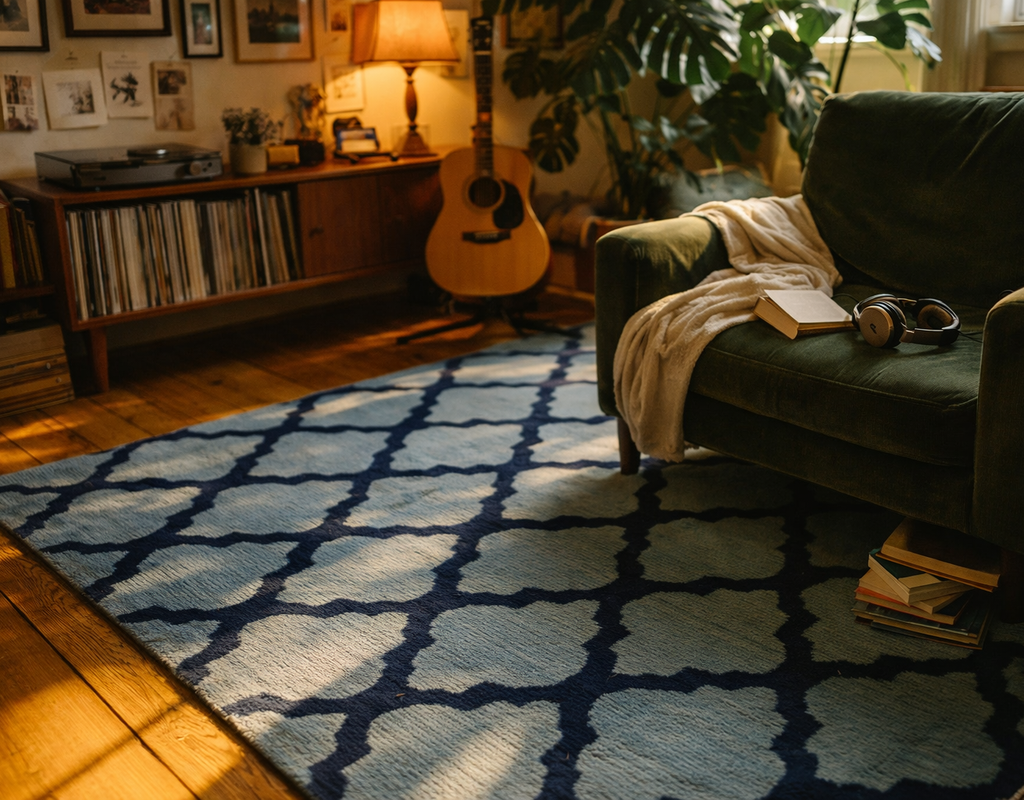
A stylish, relaxed corner perfect for listening to music or getting lost in a book.
- Anchor a Minimalist Room — Why: A bold Deco carpet provides pattern and vibrancy in an otherwise pared-back interior, creating a focal point without clutter.
- Layer into Vintage Glam Spaces — Why: These rugs harmonize with mirrored furniture, brass accents, and velvet upholstery, completing the Jazz Age style with authenticity.
- Add Edge to Eclectic Interiors — Why: The strong geometry and vibrant palette balance diverse decor elements, tying together antiques, art, and modern furnishings.
- Complement Clean Modern Lines — Why: In contemporary interiors with neutral palettes, a Deco rug introduces movement and history, preventing sterility.
- Highlight Cultural Depth — Why: Choosing a Chinese Deco carpet with asymmetrical motifs adds narrative symbolism and global design heritage to a space.
An Enduring Decorative Statement
A single Art Deco interior element such as a rug can transform a space, anchoring it with both visual impact and historical resonance. Whether used to channel the glamour of the Jazz Age or to bring color and pattern into a modern apartment, these carpets embody both artistic daring and cultural significance. Their adaptability ensures that vintage rug decor never feels outdated, making styling with Deco carpets as relevant today as it was in the 1920s.
The Modern Market & Legacy
Collectible Value & Investment
Art Deco rugs today are recognized as both decorative treasures and investment assets. Original works by noted designers such as Ivan da Silva Bruhns, Jacques-Émile Ruhlmann, and Walter Nichols can command extraordinary sums at auction, particularly large-scale examples with strong color and excellent condition.
For collectors, Chinese Art Deco rugs remain one of the most attractive buys on the market. Prices vary widely depending on size, rarity, and provenance. A small vintage Chinese Deco rug might sell for a few thousand dollars, while large-format 1920s–30s Nichols rugs in vibrant palettes can easily exceed tens of thousands.
- What does a vintage Chinese Art Deco rug typically cost? — Anywhere from a few thousand dollars for smaller or worn examples, up to tens of thousands for large, rare, or designer-linked pieces.
- How does vintage wear affect value? — Minor fading, abrash, or even moth tracks often increase desirability, adding authentic “vintage patina” and aligning with current collector tastes.
- Is investing in Chinese Art Deco rugs a good idea? — Yes. With rising global demand, they remain undervalued compared to Persian rugs and are expected to appreciate in the coming decade.
- Should I choose Chinese Art Deco over Persian for value retention? — Persian rugs are historically stable, but Chinese Deco rugs currently offer greater potential for rug value appreciation as collectors recognize their cultural and design importance.
- Are Chinese Art Deco rugs likely to appreciate next decade? — Most experts say yes, particularly large, colorful, well-preserved examples linked to iconic workshops or designers.
Revivals & Contemporary Production
Art Deco’s legacy continues through revivals and reproductions. Contemporary weavers in China, India, and Europe produce Chinese Art Deco–inspired rugs, often experimenting with updated color palettes to suit modern interiors. Some deliberately mimic antique finishes, producing new rugs with a distressed “vintage patina rug” look.
- Can a new Art Deco rug capture the vintage patina look? — New rugs can simulate patina through dyeing and finishing, but true patina—the softened colors and texture gained through decades of use—is unique to genuine vintage examples.
- Are contemporary weavers still making Chinese Art Deco–inspired rugs? — Yes, though reproductions vary in quality. The best use high-quality wool and hand-knotting, while lower-end versions rely on machine-made techniques.
Where to Find & What to Look For
Serious buyers turn to specialist dealers and auction houses—such as Nazmiyal, Doris Leslie Blau, FJ Hakimian, Christie’s, or Sotheby’s—for rare and authentic vintage pieces.
These sources offer provenance, authenticity guarantees, and access to museum-quality Chinese Deco carpets. For those seeking reproductions or budget-friendly options, mainstream retailers and online platforms offer Art Deco–inspired rugs, though these lack the historic and investment value of true antiques.
- Where can you buy Chinese Art Deco rugs online? — Trusted dealers like Nazmiyal, Doris Leslie Blau, and select auction platforms are reliable sources for authentic vintage. Mainstream retailers provide reproductions.
When buying, collectors should prioritize:
- Strong Color and Size — Larger rugs with bold jewel tones command higher values.
- Patina — Authentic vintage wear enhances character and can increase desirability.
- Condition and Provenance — Rugs linked to Walter Nichols or other iconic figures carry premium value.
- Hand-Knotted Construction — Cotton foundation and thick wool pile confirm authenticity.
A Lasting Legacy in Design and Collecting
Art Deco rug investment appeals to both aesthetes and financial-minded collectors. They are usable works of art—functional floor coverings that also carry design pedigree and cultural symbolism.
As more decorators and collectors seek the bold colors and East–West fusion of Chinese Deco carpets, demand and prestige continue to rise. For those looking to balance beauty, history, and financial potential, buying Chinese Deco rugs today may prove to be one of the most rewarding collecting decisions of the 21st century.
Actionable Takeaways & Buying Tips
Quick Bullet List of What to Look For
- Strong Colors — Why: Bold jewel tones and adventurous contrasts define authentic Deco style and drive collector demand.
- Crisp Motifs — Why: Sharp geometry or stylized flora/fauna indicate quality weaving and authenticity.
- Open Layouts (Chinese examples) — Why: Asymmetry and open fields with scattered motifs are hallmarks of Tianjin Deco carpets.
- Quality Materials — Why: Wool pile with a cotton foundation ensures durability and signals an authentic Deco carpet.
- Reputable Source — Why: Buying from trusted dealers or auction houses minimizes risk and protects long-term value.
How to Assess Authenticity, Condition, and Value
- Authenticity — Why: Hand-knotted Chinese Deco rugs with wool pile and cotton foundation are most desirable; beware of reproductions with synthetic feel or poor construction.
- Condition — Why: Patina, gentle fading, and minor wear enhance character and can increase value, but large holes or structural damage reduce worth unless priced for restoration.
- Value — Why: Rugs linked to noted figures like Walter Nichols or Da Silva Bruhns, or those with rare colorways, hold the greatest potential for appreciation.
- Can Chinese Art Deco rugs be hand-knotted and machine-made? — Yes, authentic examples are hand-knotted, while machine-made Deco rugs exist but hold less collector value.
Sourcing Recommendations for Every Budget
- High-End Collectors — Why: Turn to specialist dealers (Nazmiyal, Doris Leslie Blau, FJ Hakimian) and auction houses for rare, investment-grade Chinese and French Deco rugs.
- Mid-Tier Buyers — Why: Explore vintage retailers or trusted online galleries for smaller or moderately worn pieces that still offer design pedigree.
- Entry-Level Decorators — Why: Machine-made Wilton or Axminster Deco rugs, as well as modern reproductions, provide the look at a fraction of the cost.
- Are contemporary weavers still making Chinese Art Deco–inspired rugs? — Yes, updated reproductions are woven today, often with modernized palettes and finishes.
Insider Tips: Collectible Signatures, Rare Colorways, Market Trends
- Designer Attribution — Why: Nichols rugs and French Deco carpets linked to noted designers carry premium value.
- Rare Colorways — Why: Unique palettes such as lavender-and-gold or teal-and-rose combinations are highly sought after and distinguish rare examples.
- Market Trends — Why: Demand for Chinese Deco carpets continues to rise, with many experts considering them undervalued compared to Persian rugs, signaling strong potential for appreciation.
Maintenance & Care to Preserve Value
- Rotate Rugs Regularly — Why: Prevents uneven wear and sun fading, preserving colors and pile.
- Vacuum with Care — Why: Gentle suction removes dirt without damaging knots or fibers.
- Avoid Harsh Cleaners — Why: Strong chemicals can strip dyes; professional cleaning is safest.
- Protect from Moisture — Why: Wool and cotton foundations are vulnerable to mold; keeping rugs dry maintains structure.
- Preserve Patina — Why: The softened tones and vintage wear prized by collectors should be preserved, not erased by over-restoration.
Smart Collecting, Lasting Returns
When buying Art Deco rugs, knowledge is the best investment. By assessing rug value through authenticity, condition, and provenance, buyers maximize both aesthetic enjoyment and financial return.
Whether sourcing a vintage rug tip from a trusted gallery, hunting an authentic Deco carpet at auction, or purchasing a reproduction for décor, informed choices ensure lasting satisfaction. Above all, where to buy Deco rugs and how to care for them determine whether they remain merely decorative or evolve into cherished design and investment pieces.
Explore a Few of Our Favorite Art Deco Rugs
FAQ
- Are Art Deco rugs a good investment?
They can be, especially documented French or iconic Chinese Art Deco rugs in excellent condition. Values vary—seek appraisal for pieces you plan to collect.
- Where should I buy Art Deco rugs?
Check reputable antique dealers, auctions, vetted vintage marketplaces, and custom ateliers. For vintage Art Deco rugs, request condition reports and return windows.
- Can an Art Deco rug work in a minimalist room?
Absolutely—use one strong Art Deco rug as the focal point. Pair its geometry with solid upholstery and streamlined metals or lacquer.
- Do Art Deco rugs shed?
New wool Art Deco rugs may shed lightly for a few weeks; regular vacuuming helps. Viscose Art Deco rugs shed more and show wear faster.
- How can I tell if an Art Deco rug is hand-knotted or tufted?
On hand-knotted Art Deco rugs, the back mirrors the front and fringe is structural. Tufted rugs show cloth/latex backing and often have sewn-on fringe.
- Are viscose Art Deco rugs a good idea?
They mimic silk’s sheen but are moisture-sensitive and wear quickly. For longevity, choose wool or wool-silk Art Deco rugs instead.
- Are Art Deco rugs safe over radiant floor heating?
Yes—use thin natural-fiber Art Deco rugs with heat-rated pads and keep floor temps under \~81°F (27°C). Avoid thick pads that block heat.
- What rug pad is best under an Art Deco rug?
A felt-plus-natural-rubber pad adds grip and cushioning without staining floors. Trim it 1–2 inches smaller than the Art Deco rug on all sides.
- Can a robot vacuum handle an Art Deco rug with fringe?
Use caution—fringe can tangle. Secure the Art Deco rug with a pad and disable mop functions or set no-go zones over fringe.
- How often should a wool Art Deco rug be professionally cleaned?
Plan on every 1–3 years, sooner with pets or heavy traffic. Regular cleaning preserves color and pile.
- How do I clean a wool Art Deco rug at home?
Vacuum weekly with suction-only (no beater bar), spot-blot with wool-safe detergent, and avoid over-wetting. Rotate the Art Deco rug every 3–6 months.
- What size Art Deco rug fits a queen bed?
An 8×10 Art Deco rug is the safe pick for queen beds. In small rooms, a 6×9 can work if you keep 18–24 inches of visible rug around the bed.
- What size Art Deco rug should go under a dining table?
Pick an Art Deco rug that extends at least 24 inches past the table on all sides. For six chairs, 8×10 usually fits well.
- What size Art Deco rug works best in a living room?
Most rooms suit 8×10 or 9×12 Art Deco rugs. Aim for the rug to extend 6–8 inches beyond the sofa on both sides with 18–24 inches of walkway.
- What sizes do Art Deco area rugs commonly come in?
Typical sizes are 5×8, 6×9, 8×10, and 9×12. Many vintage Chinese Art Deco rugs were woven in generous room sizes near 9×12.
- Do Art Deco rugs off-gas or affect indoor air quality?
Wool Art Deco rugs are generally low-VOC; vintage pieces off-gas the least. Air out new rugs 48–72 hours and use ventilation to reduce odors.
- Are Art Deco rugs pet-friendly?
Wool Art Deco rugs naturally repel spills and spring back, especially in low pile. Choose busy patterns and blot accidents immediately for best results.
- Are Art Deco rugs durable for high-traffic areas?
Hand-knotted wool Art Deco rugs wear well and hide dirt with pattern. Silk or viscose Art Deco rugs are delicate—reserve them for low-traffic rooms.
- How much do Art Deco rugs cost today?
Vintage Chinese Art Deco rugs can start under \$1,000 at auction, with many midrange pieces \$2,000–\$20,000. Top French Art Deco rugs can reach six-figure prices.
- Are Art Deco rugs in style right now?
Yes—Art Deco rugs are resurging with a 2020s revival of glamorous geometry. New designer collections and vintage hunts make the look widely accessible.
- What sets French Art Deco rugs apart from other Art Deco rugs?
French Art Deco rugs skew abstract and architectonic, linked to designers like Ruhlmann and Da Silva Bruhns. They’re rarer and often command higher prices.
- What is a Chinese Art Deco rug (often called a Nichols Art Deco rug)?
Chinese Art Deco rugs from the 1920s–30s are plush wool with vivid colors and spare, pictorial motifs. Many room-size examples are around 9×12 feet.
- What colors and patterns define Art Deco rugs?
Art Deco rugs lean into saturated jewel tones, black/ivory contrasts, and metallic accents. Motifs include chevrons, stepped forms, fans, sunbursts, and stylized florals.
- How do I identify a genuine vintage Art Deco rug versus an Art Deco-style reproduction?
Look for hand-knotted wool or wool-silk, fringe that’s part of the foundation, and age wear. Tufted pieces have glued/canvas backings and often feel stiffer.
- What is an Art Deco rug?
An Art Deco rug features 1920s–30s geometry, symmetry, and luxe materials. Expect zigzags, sunbursts, and bold contrasts like black–gold or jewel tones.