
Introduction to Bird Designs and Motifs in Rugs
Bring the beauty of the natural world indoors when you explore our exquisite collection of bird motif rugs now.
What Makes Bird Designs in Rugs Unique
Bird designs in rugs stand apart in the world of decorative animal rugs because they embody a rare combination of cross-cultural appeal and symbolic depth. Across tribal villages, royal courts, and contemporary workshops, bird motif carpets have carried timeless associations with freedom, spirituality, and beauty. Their presence in rug design is never accidental—whether woven into the heart of a medallion, perched among floral arabesques, or paired to flank the Tree of Life, birds serve as living emblems of hope, transcendence, and storytelling.
Unlike purely geometric or floral patterns, rugs with birds offer a narrative quality. A single peacock may suggest paradise and immortality, while paired doves might represent love or harmony. In nomadic weavings, eagles and falcons often appear as guardians, protecting the household. This flexibility allows bird motifs to bridge traditions, appearing in both rustic tribal textiles and the refined carpets of palatial courts.
Their adaptability across weaving cultures—from Persian and Turkish workshops to Caucasian and Chinese looms—has made them enduring subjects for collectors.
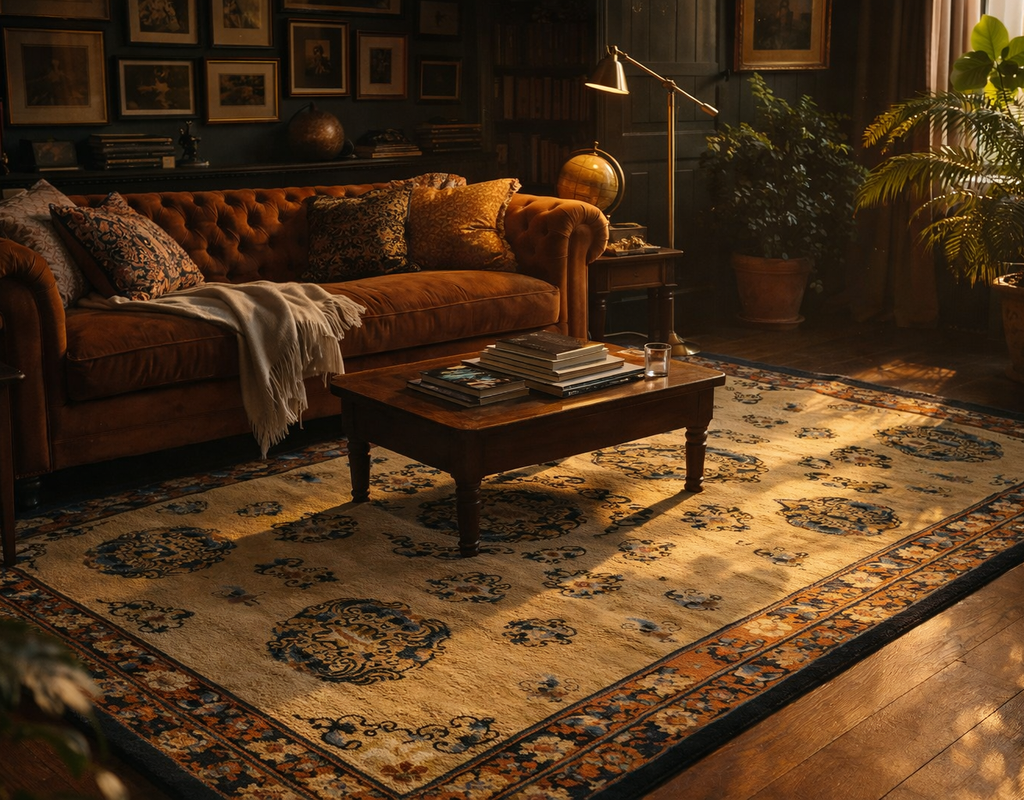
Sunlight warms the traditional oriental rug in this cozy, richly textured sitting room.
Modern interiors value these designs not only for their heritage but also for their natural elegance. Bird motif carpets introduce motion and life into a space, balancing the abstract and the figurative.
Their ability to connect ancient symbolism with present-day aesthetics makes them a sought-after choice for homeowners, designers, and art lovers alike.
Overview of Bird Symbolism in Rug Art
- Freedom and Transcendence — Birds in flight are woven as metaphors for the soul’s journey beyond the material world. — Why: Many weaving traditions saw rugs not only as floor coverings but as cosmic maps, where a bird could guide the spirit toward paradise.
- Love and Partnership — Pairs of birds, especially doves or nightingales, are common in symbolic rug designs. — Why: Their mirrored forms evoke harmony, marriage, and the balance of dualities within life and home.
- Guardianship and Power — Eagles, falcons, and other raptors appear in tribal rugs as protectors. — Why: In nomadic and warrior cultures, these birds symbolized strength and the watchful eye over family and land.
- Fertility and Renewal — Birds amid flowers or perched on the Tree of Life suggest cyclical rebirth. — Why: Weavers used these images as blessings for abundance, children, and prosperity within the household.
- Beauty and Paradise — Exotic birds such as peacocks or phoenix-like forms are found in courtly carpets. — Why: Their brilliant feathers and mythic associations served as metaphors for eternal beauty and divine reward.
Bird designs in rugs are more than decorative flourishes—they are visual poems, carrying layered meanings that speak across time and culture. Whether woven in bold tribal geometry or in delicate courtly curves, these symbolic rug designs invite the viewer into a story. They allow each rug to act as both a work of art and a vessel of memory, a bridge between past weavers’ beliefs and today’s living spaces.
Bird designs remain collectible treasures, not just for their artistry but for the stories they encode. To live with one is to welcome both history and imagination into the home.
Name, Etymology & Iconic Patterns
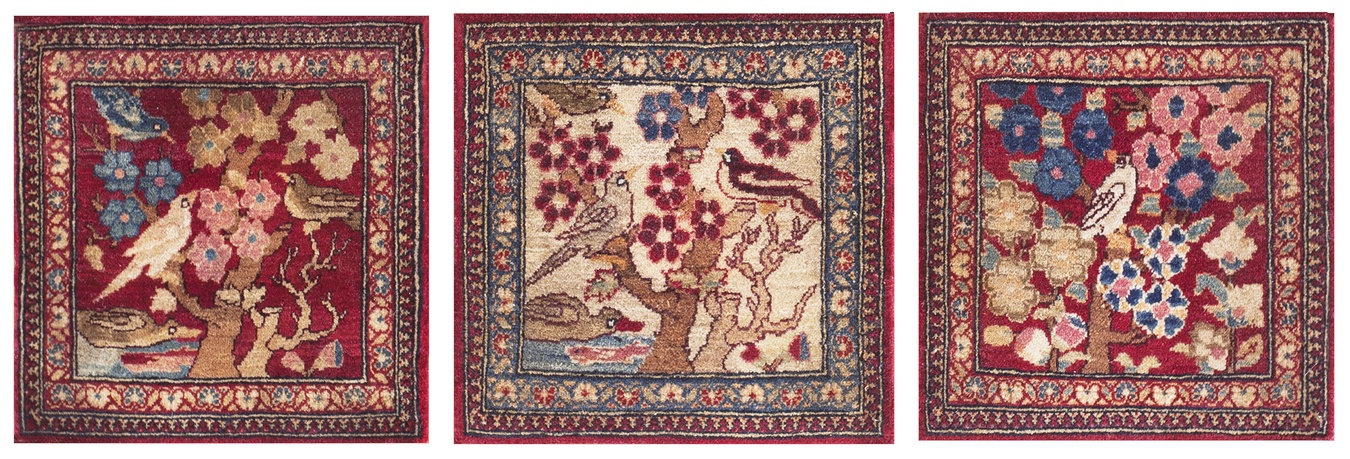
Antique Esfahan Small Scatter Size Wool Coral Rug – by Rugs On Net
Regional Terminology for Bird Designs in Rugs
The language of bird designs in rug weaving reflects the diverse cultures that produced them. In Persian traditions, the term morgh (مرغ) simply means “bird,” appearing in descriptions of Persian bird carpets that feature peacocks, nightingales, or mythical simurghs. In Turkish weaving vocabulary, kuş carries the same meaning, and the phrase kuşlu halı translates directly as “bird carpet.”
These regional terms highlight how weavers often blurred the line between real species and mythic beings, treating both as conveyors of beauty, power, and spirituality. Collectors and scholars often use localized names—such as Bird Ushak—to identify entire subcategories of Turkish bird rugs with distinct histories and designs.
The Origin of the Turkish “Bird Rug” Pattern
The term Bird Ushak refers to a group of Ottoman carpets woven in 16th-century western Anatolia, particularly around the town of Uşak. These rugs are not literal depictions of birds but instead feature stylized, wing-like motifs within geometric medallions that resemble bird silhouettes in flight. Their abstraction reflects Ottoman taste, where symbolic patterns were preferred over naturalistic representation.
Produced during the height of Ottoman court patronage, Bird Ushak carpets were exported widely to Europe, where they appeared in Renaissance paintings and became prized diplomatic gifts. This iconic Turkish bird rug pattern remains one of the most recognizable motifs in the canon of Islamic art.
Defining the “Bird of Paradise” Design
The Bird of Paradise rug is another celebrated pattern, characterized by its dramatic, exotic bird imagery. In these designs, the bird is usually depicted with elongated tail feathers, radiant plumage, and a proud stance amid flowering backgrounds. Unlike the abstracted Bird Ushak, the Bird of Paradise rug often leans toward the figurative, presenting a flamboyant, almost theatrical subject.
The imagery draws on both real tropical species and the mythical phoenix-like bird associated with eternal beauty and divine reward. In practice, these designs added a vivid and luxurious touch to courtly carpets, embodying themes of paradise, immortality, and splendor.
Why Names Matter in Bird Rugs
The bird pattern names—from morgh and kuş to Bird Ushak and Bird of Paradise—underscore how terminology carries layers of cultural meaning. Some terms are descriptive (Bird Ushak = a type of Turkish carpet), while others evoke myth and symbolism (Bird of Paradise = a vision of paradise in decorative form).
For collectors, these names are more than labels; they are keys to understanding the cultural geography of rug design, connecting Anatolian workshops, Persian courts, and global trade routes through a shared fascination with the image of the bird. Bird rug terminology varies across regions, but whether rooted in language or pattern, each term reflects the fusion of nature, myth, and artistry that defines this enduring tradition.
Historical & Geographic Origins
Ancient Roots of Bird Imagery
The origin of bird patterns in carpets can be traced deep into the medieval period, with early examples demonstrating how weaving traditions adopted avian forms as symbols of spirituality and protection. The Marby rug, a 15th-century Anatolian piece now in the Swedish History Museum, stands among the earliest surviving carpets with bird designs.
Its design features paired birds flanking a central motif, echoing cosmological and fertility themes. Such works reveal how early bird rugs were both decorative and symbolic, functioning as woven prayers for abundance and harmony. Bird imagery also spread along the Silk Road, where motifs traveled between Persia, Central Asia, India, and China.
In each cultural center, birds carried different associations—paradise and immortality in Persian traditions, auspicious harmony in Chinese symbolism, and dynastic grandeur in Mughal carpets. This circulation of ideas meant that bird designs in rug history developed not from a single source but from multiple points of inspiration, each adapted to local aesthetic and spiritual values.
Key Regional Influences
- Anatolia — Ottoman workshops in Uşak and surrounding regions pioneered the Bird Ushak style, which abstracted wings into bold, geometric medallions.
- Persia — Safavid court carpets frequently depicted nightingales, peacocks, and phoenix-like simurghs, blending poetic imagery with lush floral fields.
- Central Asia — Nomadic tribes in the Caucasus and Turkestan incorporated stylized bird figures into kilims and pile rugs, often as protective emblems for tents and households.
- China — Qing dynasty carpets frequently used cranes, phoenixes, and other auspicious birds in medallions and border designs, expressing longevity and imperial blessing.
Together these regions shaped the early bird rugs canon, weaving avian motifs into a shared visual language that resonated across Eurasia.
When Did Tribal Weavers Start Abstracting Bird Shapes Geometrically?
By the late medieval to early modern era (16th–18th centuries), tribal weavers began to abstract bird shapes into geometric motifs. In Anatolian kilims, wings became angular hook forms; in Caucasian rugs, bird heads reduced to simple lozenges or triangles.
This geometric shift reflected both the aesthetic of nomadic weaving—favoring bold, linear forms suited to flatweave looms—and a desire to distill sacred imagery into protective signs. The result was a vocabulary of tribal geometric motifs that still clearly referenced birds while integrating seamlessly into broader abstract compositions.
Cross-Cultural Exchange and Continuity
Bird imagery in carpets likely arose independently in several cultural centers but flourished thanks to trade routes and artistic exchange. Safavid Persia influenced Ottoman Turkey; Mughal India absorbed Persian naturalism while passing motifs back westward; Chinese auspicious bird symbols filtered into Central Asia.
By the 18th century, the presence of bird designs—from highly stylized guardians in tribal kilims to naturalistic peacocks in palace rugs—demonstrated both the diversity and continuity of this theme. The origin of bird designs in rug art thus rests at the intersection of independent invention and cultural transmission, making bird rugs one of the most globally resonant categories of symbolic textile art.
Design Characteristics & Artistic Styles
Typical Layouts and Motifs
Bird designs in rugs display a wide range of artistic rug styles, but certain layouts recur across weaving traditions. Symmetry is central: paired birds often face each other in mirrored balance, sometimes flanking the Tree of Life or perched atop vases of flowers. In other cases, a single bird dominates the central medallion, while smaller, scattered field birds fill the surrounding ground in rhythmic repetition.
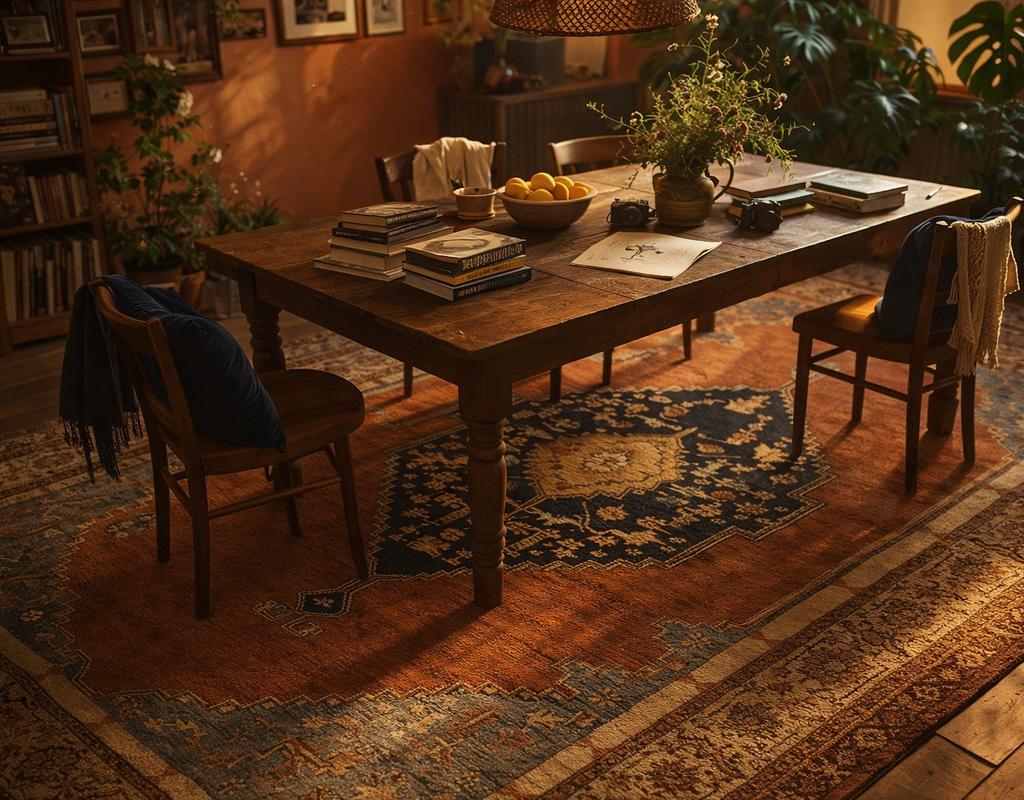
A rich, vintage-style area rug grounds this warm and inviting rustic dining space.
Antique khamse Persian Ivory 1880s Rug – by Rugs On Net
Borders may also carry continuous bird forms, creating a sense of movement around the edges. These patterns ensure that bird designs are never incidental—they occupy central, symbolic positions within the rug’s design language.
Village vs. City Bird Motifs
The difference between village vs. city bird rugs lies in both execution and intent. Village weavers favored stylized, geometric, and often playful birds. Their designs reflect tribal abstraction, with angular wings, hooked beaks, or simplified forms woven into kilims and pile rugs.
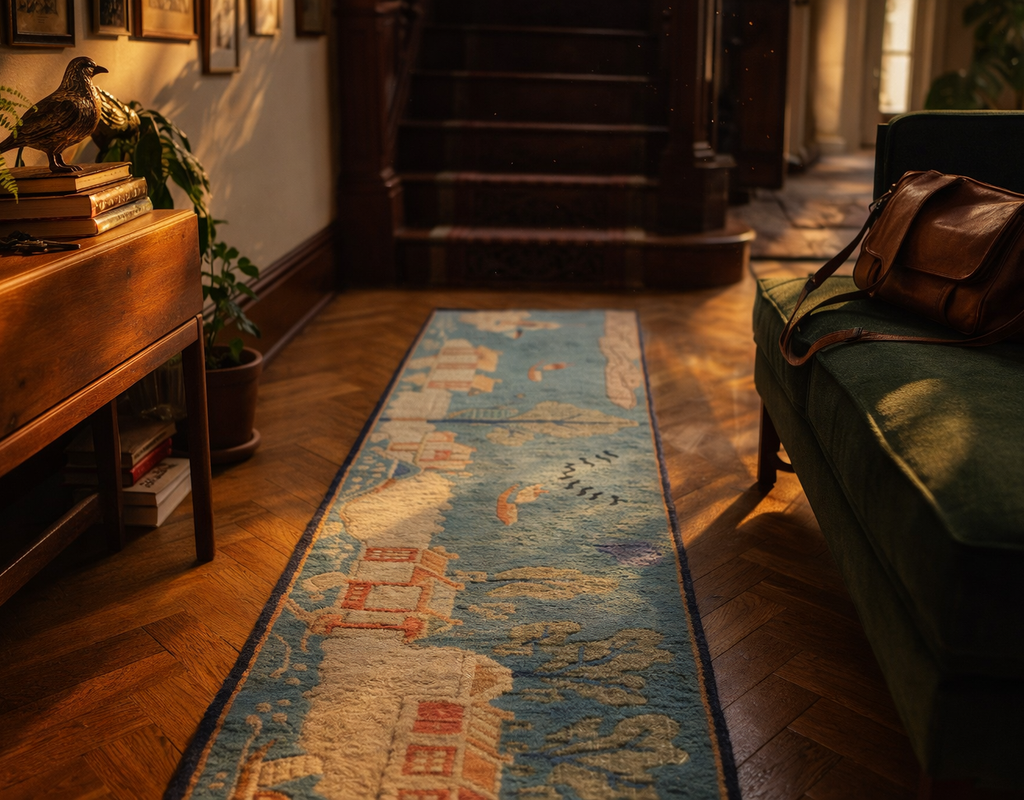
Dramatic afternoon light illuminates the vibrant colors of the runner rug in this richly appointed entryway.
By contrast, city workshops, particularly in Persia and Ottoman centers, pursued a more realistic and pictorial approach, using curvilinear drawing to render nightingales, peacocks, or parrots in naturalistic poses. Village rugs carry a charm rooted in folk art and symbolism, while city rugs showcase refined artistry and technical precision.
Materials for Intricate Bird designs Detailing in Pile Rugs
The choice of material directly affects how clearly bird designs appear in pile rugs. Wool remains the most common fiber, valued for its durability and ability to hold bold colors. However, when a design calls for delicate plumage or fine outlines, silk is preferred: its sheen and thin fibers allow highly detailed rendering of feathers and expressive poses.
Cotton warps provide structural precision, enabling tight knotting that enhances motif clarity. Together, these materials create a foundation where intricate bird designs detailing can be both vivid and lasting.
Creating Bird Outlines in Kilim Flatweaves
In kilim bird designs, outlines emerge not from knots but from interlocking colored wefts. Weavers carefully shift between contrasting yarns to form the edges of wings, beaks, and tails.
This technique produces crisp, angular silhouettes that suit the geometric language of tribal kilims. Though less naturalistic than pile weaving, flatweave bird designs achieve striking boldness through color blocks, rhythm, and repetition, making them some of the most iconic representations of avian forms in nomadic textiles.
Why Natural Dyes Enhance Bird Motifs’ Color Depth
Natural dye rugs bring out bird motifs with unparalleled richness. Madder reds, indigo blues, walnut browns, and cochineal crimsons yield subtle tonal shifts that mimic the iridescence of feathers. Unlike synthetic dyes, which often fade or flatten over time, natural dyes age gracefully, deepening in patina and preserving the vibrancy of the bird designs . For motifs meant to embody life, spirit, and paradise, these nuanced hues ensure the birds retain their color depth and vitality for generations.
Evolution from Antique to Mid-Century Bird Designs
In the antique era, bird designs often carried heavy symbolic weight—protective guardians in tribal rugs or allegories of paradise in courtly carpets. By the early 20th century, as rug weaving expanded for commercial export, bird motifs became increasingly abstract or decorative, sometimes losing their cultural specificity. Yet the mid-century revival of interest in folkloric and nature-based design reintroduced birds as central, expressive motifs.
Designers embraced both modernist abstraction and traditional inspiration, producing a range of bird designs in rugs that balanced heritage with contemporary aesthetics. This evolution reflects how bird imagery adapts across time, shifting between sacred symbolism and modern decorative art. In every era, from village kilims to city masterpieces, color, material, and layout choices remain the decisive factors that determine how clearly and powerfully bird designs come alive in woven form.
Regional Variations & Notable Birds
Birds Commonly Seen in Persian & Turkish Rugs
Persian bird designs frequently include the nightingale, beloved in Persian poetry as a symbol of longing and spiritual devotion. The peacock represents immortality and divine beauty, while the parrot appears in courtly carpets as a token of luxury and exoticism. Mythical birds such as the Simurgh, a benevolent guardian and healer, are also woven into Persian masterpieces.
In contrast, Turkish bird patterns often lean toward the stylized and geometric. Many Anatolian rugs feature generic birds (kuş) reduced to angular outlines, while others highlight heraldic motifs like the double-headed eagle, a symbol of imperial power. Together, these regional bird motifs show the balance between Persian naturalism and Turkish abstraction.
Why Peacocks Are Frequent in Akstafa Rugs
The Akstafa peacock rug, from the Caucasus, is among the most iconic bird designs of the region. The peacock is a universal symbol of paradise and nobility, but in Akstafa weaving it takes on an added layer of spiritual transcendence. Woven with elongated tail feathers and stylized bodies, these birds dominate the field as guardians of prosperity and protection.
Their placement often suggests both elegance and otherworldly presence, making Akstafa rugs especially prized by collectors for their powerful symbolism.
Phoenix Figures in Chinese Rugs: Spotting Them
The phoenix carpet, or fenghuang motif, is a hallmark of Chinese weaving traditions. These mythical birds are typically rendered in curvilinear outlines, with long sweeping tail feathers and elaborate crests.
They often appear in paired compositions with dragons, symbolizing the union of yin and yang—phoenix for the empress, dragon for the emperor. In border designs or central medallions, the phoenix radiates movement and grace, easily identifiable by its intricate plumage and mythic associations with rebirth and cosmic harmony.
Doves in Bakhtiari Rugs: Symbolism
In Bakhtiari carpets from western Iran, the dove motif appears as a tender symbol of peace, fidelity, and family life. These bird designs often perch on flowering branches or within cartouches, softening the otherwise bold tribal designs.
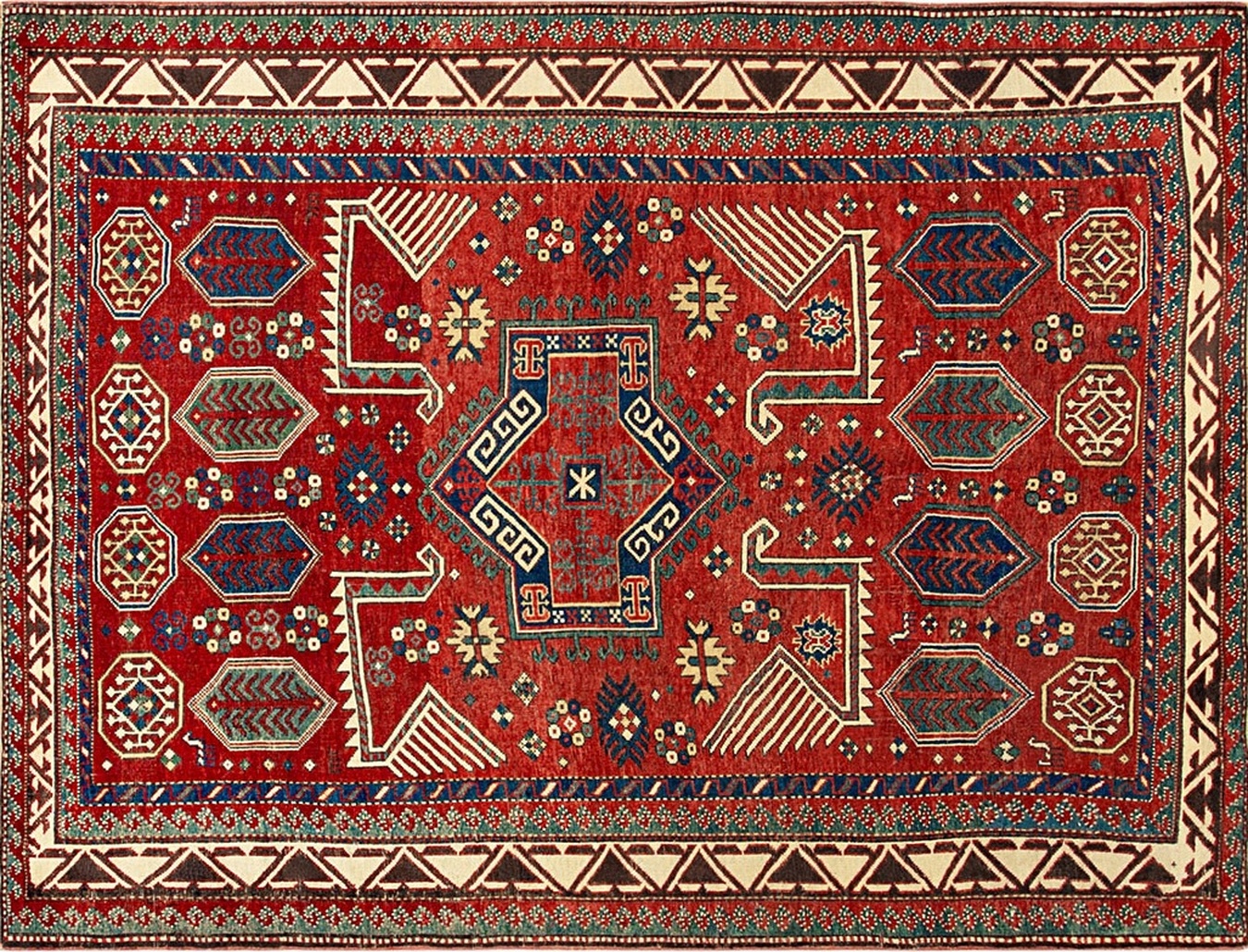
Their symbolism resonates with the values of kinship and harmony central to Bakhtiari culture. For collectors, Bakhtiari dove symbolism adds a layer of intimacy and meaning to these otherwise striking geometric rugs.
Bird Imagery: Caucasian vs. Persian Carpets
A comparison of Caucasian vs. Persian carpets reveals distinct approaches to avian imagery. Caucasian weavings, such as those from Shirvan or Kazak, present birds in highly geometric, abstract forms—triangular wings, diamond-shaped heads, and angular tails. They function more as protective tribal emblems than naturalistic depictions.
Persian carpets, by contrast, pursue lifelike renderings where plumage, posture, and setting align with poetry and courtly symbolism. The result is two very different traditions: one folk-based and emblematic, the other refined and narrative-driven.
Notable Regional Styles
- Bird Ushak (Ottoman Turkey) — Recognizable by wing-like medallions, one of the earliest and most famous Turkish bird rugs. — Why: Represents Ottoman court taste and wide European influence.
- Karabagh (Caucasus) — Known for peacocks, bold tribal geometry, and vibrant contrasts. — Why: Offers some of the most dramatic Caucasian bird designs imagery.
- Kashan (Persia) — Lifelike birds amid lush floral fields, often with poetic themes. — Why: Exemplifies Persian artistry and symbolic richness.
- Ladik (Turkey) — Distinctive stylized birds woven into prayer rug designs. — Why: Combines devotional function with folk charm.
- Mughal India — Realistic depictions of exotic birds like parrots and pheasants. — Why: Reflects imperial taste and naturalistic refinement influenced by miniature painting.
Bird designs in rugs are thus far from uniform. From the Akstafa peacock rug to the phoenix carpet and Bakhtiari doves, each region gives avian imagery its own voice—sometimes symbolic, sometimes decorative, always deeply cultural.
Cultural & Symbolic Meanings
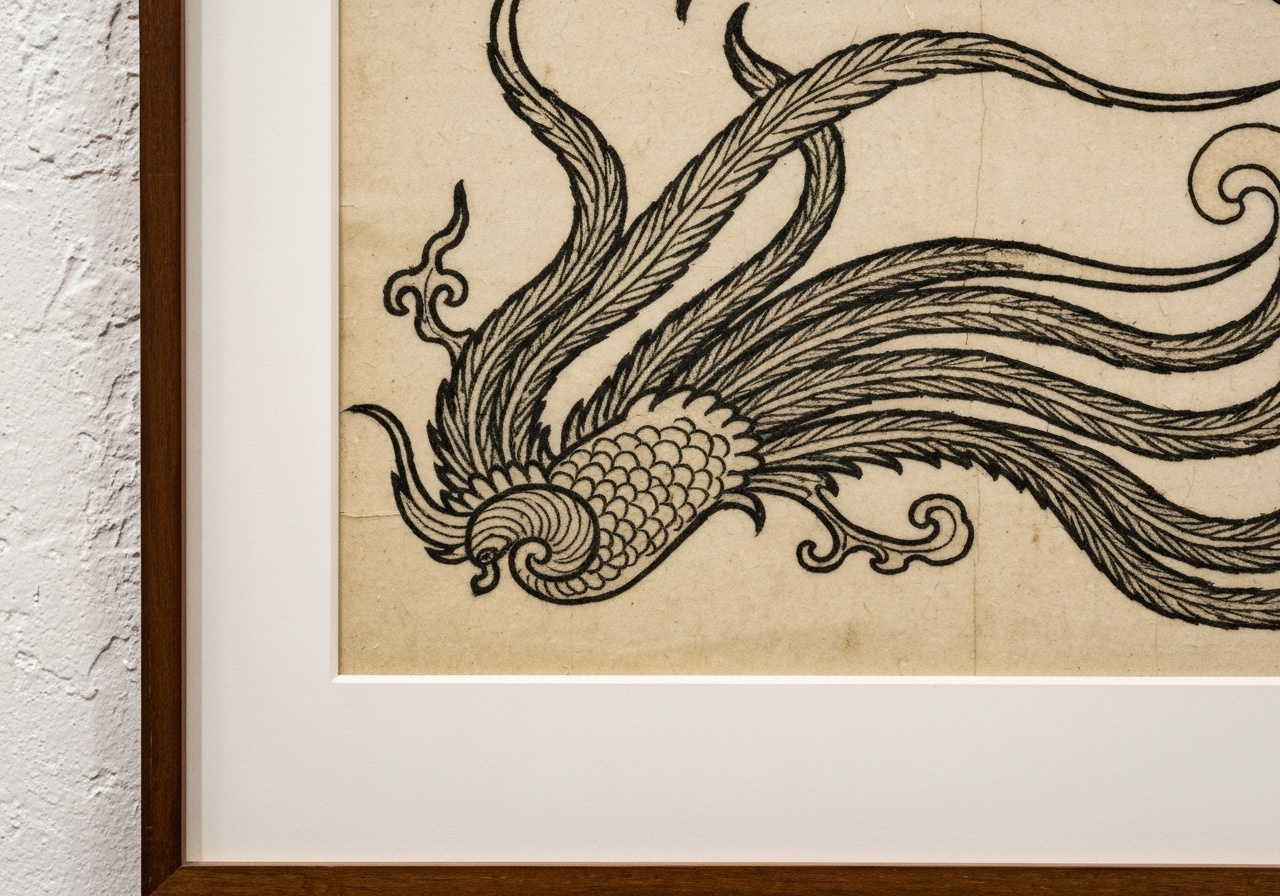
Detailed ink drawing of a stylized phoenix.
Universal Symbolism of Birds
Birds have carried universal significance across cultures, and their presence in woven art reflects these shared meanings:
- Freedom and Transcendence — Birds in flight embody the soul’s release from earthly bounds. — Why: Their ability to soar into the sky makes them natural metaphors for spiritual ascent.
- Happiness and Renewal — Birdsong and seasonal migration tie them to joy and cyclical rebirth. — Why: Rugs often depict them alongside blossoms, signaling spring and abundance.
- Fertility and Family — Nesting birds suggest prosperity, children, and household harmony. — Why: Weavers used them as blessings for domestic stability.
- Status and Paradise — Exotic species like peacocks signal luxury, nobility, and eternal paradise. — Why: Courtly carpets adopted birds as markers of refinement and divine favor.
- Protection and Guidance — Raptors or paired motifs stand as guardians. — Why: Many tribal weavers viewed birds as talismanic beings watching over the home.
These threads of bird carpet symbolism ensure that every motif, from the simplest hooked form to the most elaborate pictorial bird, carries layered meaning.
Mythic Birds in Rug Art
Beyond natural species, rugs often feature mythic birds that elevate the design into cultural storytelling:
- Simurgh rug motifs — A Persian guardian bird, symbolizing wisdom, healing, and cosmic balance.
- Phoenix symbolism — In Chinese and Persian contexts, the phoenix stands for grace, virtue, and renewal, often paired with dragons in carpets.
- Huma — A bird of fortune in Persian tradition, said to never rest on earth, symbolizing luck, divine favor, and kingship.
- Double-headed eagle — Prominent in Anatolian and Byzantine-influenced rugs, representing power, authority, and dominion over both east and west.
These mythic figures in cultural rug art allowed weavers to encode stories of creation, renewal, and authority directly into their textiles.
Status, Protection, and Everyday Symbolism
Not all bird motifs were distant or mythical—many served everyday functions in symbolic form. Doves carried connotations of peace, fidelity, and loyalty, while parakeets or parrots symbolized companionship and pleasure. Raptors such as falcons symbolized strength and watchfulness, offering protection for nomadic families. Meanwhile, the peacock embodied a fusion of worldly and spiritual nobility, linking royalty on earth with visions of paradise.
Are Bird designs More Than Decoration?
Yes—bird designs are unquestionably more than decoration. They represent a multi-layered symbolic system, where designs operate simultaneously as talismans, status markers, and cultural narratives. To the untrained eye, a carpet may seem purely ornamental; yet for the weaver and their community, every bird carried meaning—whether as a protector, a messenger between worlds, or an emblem of prosperity.
Understanding the symbolic meaning of bird rugs not only deepens appreciation for their artistry but also enhances their cultural and monetary value. Each bird, real or mythical, transforms the rug from a decorative textile into a woven story of belief, aspiration, and identity.
Construction Techniques & Materials
Hand-Knotted Bird Rugs: Where Still Made
Hand-knotted bird rugs remain alive traditions in several regions. In Iran (Persia), workshops in Kashan, Isfahan, and Bakhtiari villages continue to produce lifelike bird designs.
Turkey preserves the legacy of Anatolian styles, where both village and urban looms still weave bird-themed designs. Afghanistan contributes bold, tribal renditions of birds in wool pile. In India, particularly in Kashmir and Bhadohi, artisans weave intricate pictorial carpets with exotic bird forms.
Central Asian regions, including Uzbekistan and Turkmenistan, sustain tribal bird imagery in both pile and flatweave traditions. These centers ensure that bird designs remain part of living, evolving craft rather than museum relics.
Weaving Techniques for Pile & Flatweave

A detailed focus on the intricate, vivid colors and geometric weave of a traditional textile rug.
Bird designs can be expressed in several weaving methods, each producing a distinct artistic effect:
- Senneh knot (Persian knot) — Favored for curvilinear patterns, it allows weavers to create graceful wings and flowing feathers with subtle precision.
- Ghiordes knot (Turkish knot) — Produces geometric clarity, ideal for angular or tribal bird forms.
- Kilim weaving bird designs — Flatwoven, with bird silhouettes shaped through interlocking wefts in bold blocks of color.
- Soumak rug technique — Uses weft-wrapping embroidery to outline birds with strong linear definition, giving motifs a striking relief effect.
Each method shapes how a bird is perceived: smooth and lifelike in Senneh, bold and abstract in Ghiordes or kilim, textured and graphic in soumak.
Materials for Bird Motif Detail
The materials chosen determine how finely the bird appears. Wool pile on cotton or wool warps remains the most common, offering durability and richness of color. Silk, however, is unmatched for delicate detail—its thin fibers allow feathers and plumage to be woven with jewel-like clarity.
Cotton warps provide a strong foundation that supports intricate knotting, while in kilims and soumaks, contrasting wool threads sharpen the outlines. This fusion of fiber and technique ensures bird designs can range from playful abstractions to naturalistic portraits.
Modern Machine-Made Bird Designs Approaches
Today’s machine-made bird carpets can visually reproduce traditional motifs, even simulating the appearance of knots. Advanced looms can mimic both tribal stylization and Persian naturalism. However, what they cannot replicate is the symbolic heritage and talismanic intent behind the designs. A bird woven by hand carries cultural meaning passed down from generations of weavers; a machine-made version delivers pattern without narrative.
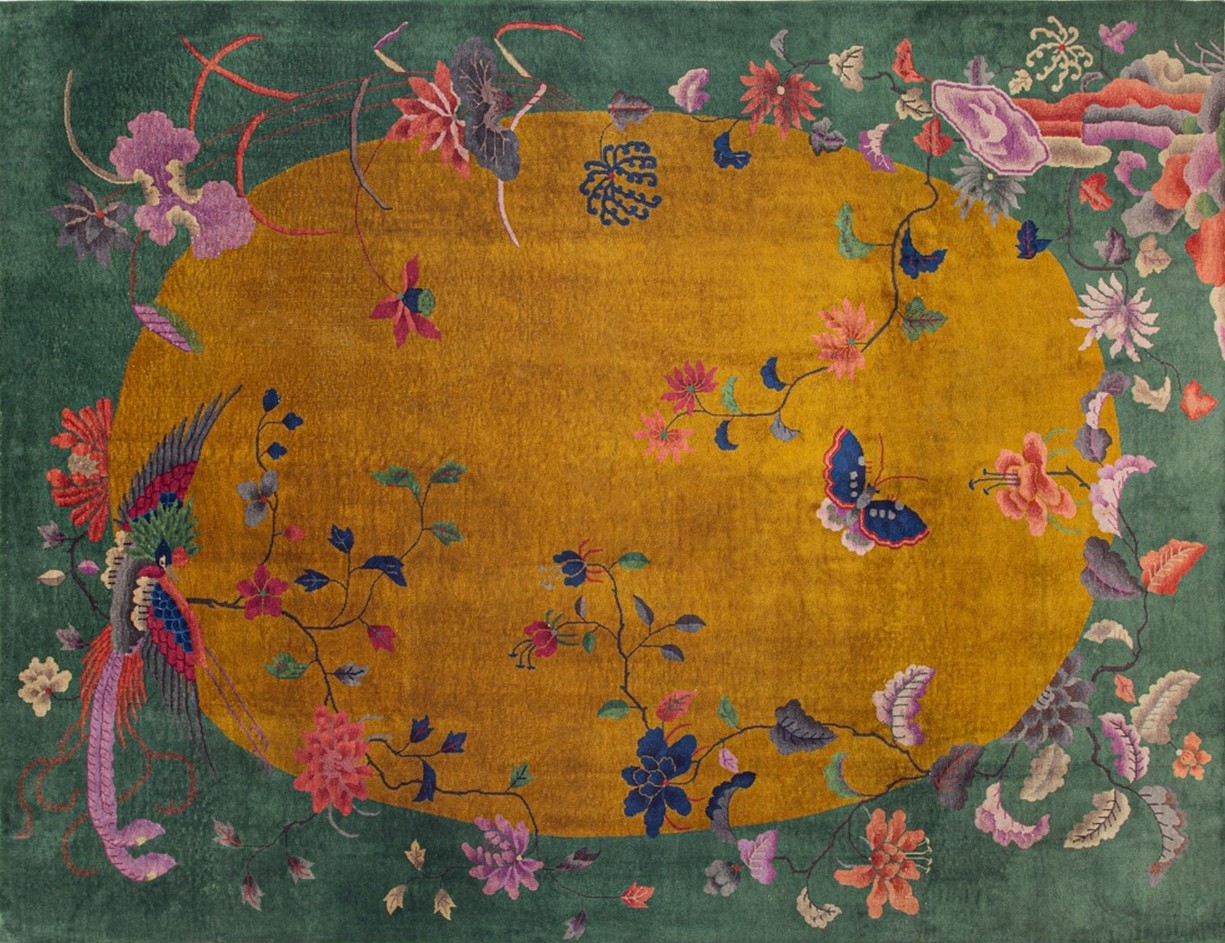
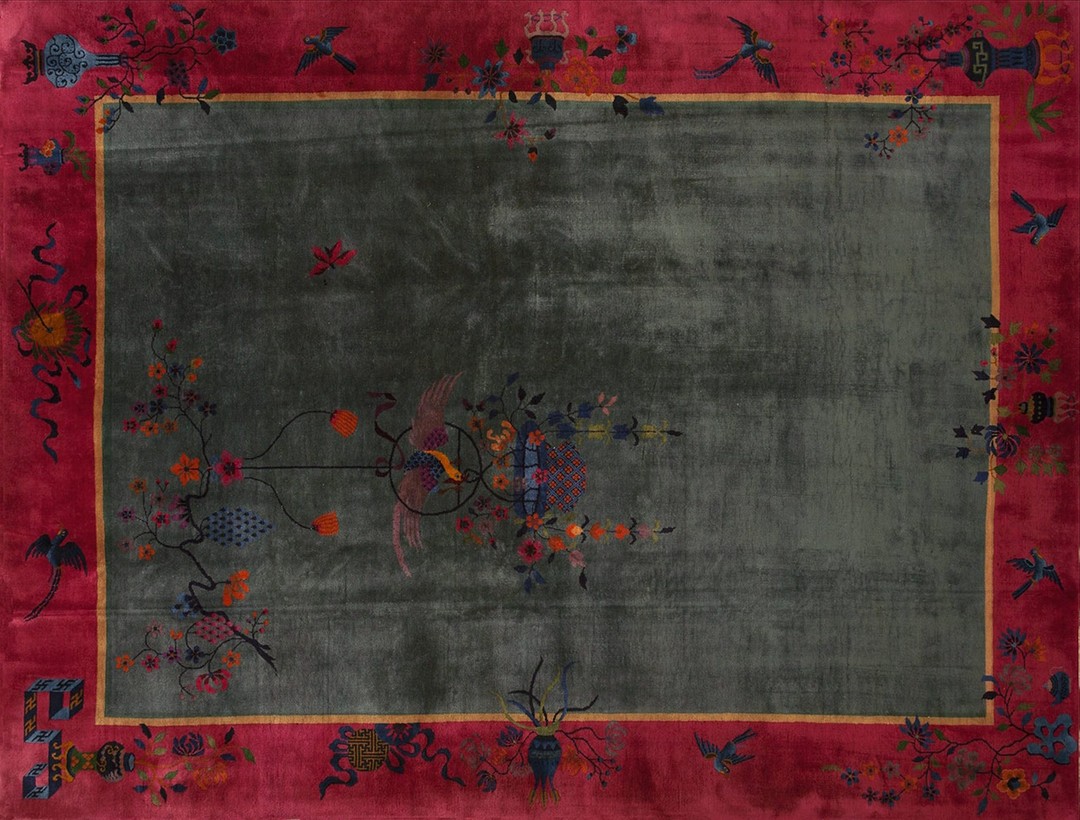
Wool Chinese – Art Deco Yellow 1920s Knotted Room Size Rectangle Antique Rug – by Rugs On Net
These rugs may serve decorative purposes, but they lack the spiritual and social significance embedded in their hand-knotted counterparts. Traditional techniques—whether Senneh knot or Soumak rug technique—remain the key to authenticity, ensuring that every bird woven into a carpet carries both artistic clarity and cultural depth.
Market Trends, Value & Collecting
Rarity of “Phoenix and Dragon” Carpets
Phoenix and dragon rugs are among the rarest categories of bird designs. These 19th-century pieces, primarily from Chinese imperial workshops, feature the phoenix (fenghuang) paired with the dragon in symbolic harmony. Surviving examples are almost exclusively found in museum collections or high-end auction sales, making them exceedingly difficult to acquire on the open market.
Their rarity lies not only in limited production but also in their dynastic associations, which elevate them beyond textiles into the realm of cultural artifacts. Collectors prize them as pinnacle works of bird rug symbolism.
Does a Peacock Border Increase Value?
Yes—when well executed, a peacock border can significantly increase the value of a Persian rug. The peacock, long tied to paradise, immortality, and nobility, adds both aesthetic drama and symbolic resonance. In finely woven Kashan or Tabriz carpets, peacock borders frame the central field with rich plumage motifs that draw collector interest.
Market value depends on condition: intact, richly dyed peacock borders command premium prices, while faded or damaged examples may lessen appeal. In short, a peacock border rug value is enhanced when the motif is both artistically balanced and preserved.
Restoration Costs & Market Impact
The question of bird design rug restoration plays a decisive role in market pricing. Professional restoration, using traditional materials and techniques, can preserve or even stabilize value, ensuring longevity and authenticity.
However, over-restoration—where too much of the original fabric is replaced—or poorly matched repairs can reduce both desirability and price. Collectors weigh restoration costs against future resale potential, knowing that subtle, expert work sustains the rug’s integrity while careless interventions compromise it.
Sourcing Reputable Vintage Bird-Design Rugs Online
For those seeking to buy vintage bird rugs, reputable sources are crucial. Major auction houses such as Sotheby’s and Christie’s regularly feature important bird motif carpets, offering detailed provenance. Specialty antique rug dealers provide expertise and curated collections. Museum shops occasionally release authenticated reproductions or deaccessioned pieces.
Select online marketplaces with buyer protection also host vintage bird carpets, but collectors are advised to demand documentation and authenticity guarantees before purchase. Trustworthy sourcing ensures both financial security and cultural integrity.
Custom Bird Rugs vs. Antiques: Investment Value
Custom bird carpets have grown in popularity for those wanting personal expression, often commissioning unique motifs for homes or institutions. While these pieces carry emotional and decorative value, they rarely appreciate in monetary terms.
Antique bird rugs, on the other hand, offer both historic and investment potential. Their scarcity, provenance, and symbolic depth make them desirable assets in the global rug market. For collectors prioritizing investment, antiques remain the stronger choice; for buyers prioritizing personalization, custom works hold a different, more sentimental appeal.
Modern Bird Rug Revival
Today’s design world has seen a revival of bird motif rugs, blending traditional symbolism with contemporary aesthetics. From mid-century abstractions to modern rugs featuring stylized avian forms, this revival demonstrates that the symbolic power of birds continues to inspire weavers and buyers alike.
For collectors and decorators, this means a diverse field: rare antiques for investment, and innovative contemporary works for fresh expression. Ultimately, whether considering a Phoenix and dragon rug, a peacock border Persian carpet, or a newly commissioned custom design, collectors must balance rarity, condition, authenticity, and provenance—the enduring pillars of value in the bird design rug market.
Care, Restoration, & Longevity
Restoration and Value
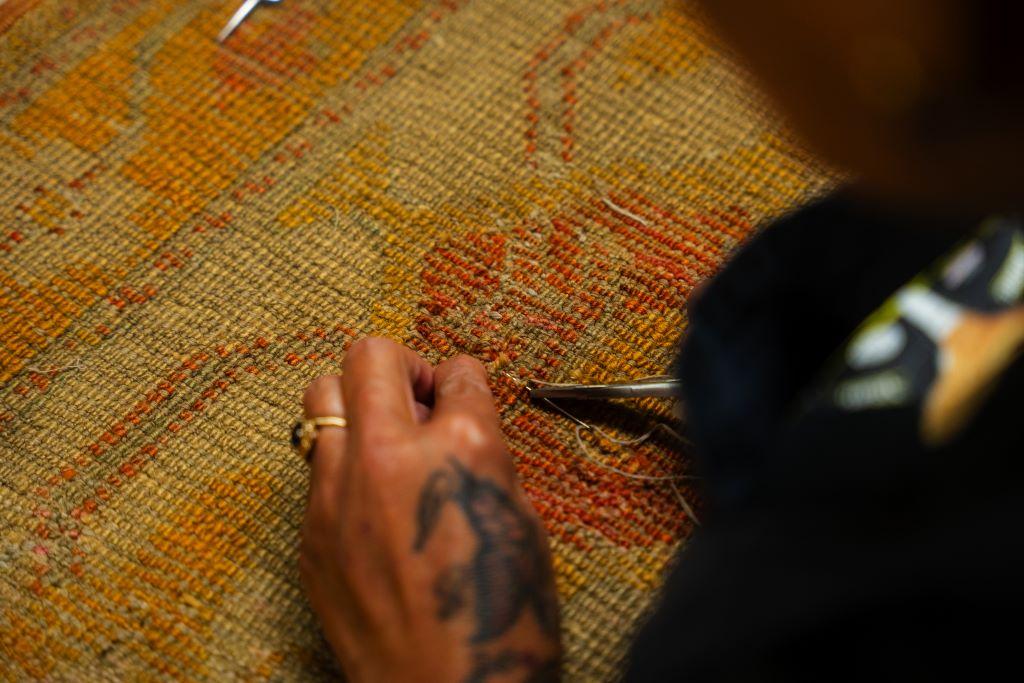
Detail of hands mending a rustic, richly colored woven rug.
As discussed in market trends, the impact of rug restoration on value depends on the quality and extent of the work. For antique bird carpets, professional restoration using traditional fibers and dyes can preserve integrity and stabilize price, ensuring the bird designs remain clear and culturally authentic.
However, excessive intervention or amateur repairs often reduce market appeal. Collectors are advised to keep restoration minimal, prioritizing motif preservation and historical accuracy over cosmetic fixes.
Best Practices for Preserving Color and Motif Clarity
- Avoid Direct Sunlight — Prolonged exposure causes dyes to fade, dulling the vibrancy of bird designs. — Why: Natural dyes in particular are sensitive to UV rays, and keeping rugs out of direct light preserves their depth.
- Use Professional Cleaning — Delicate or antique bird rugs should never be treated with harsh chemicals or DIY solutions. — Why: Trained specialists know how to clean without stripping fibers or weakening the knot structure.
- Rotate Rugs Regularly — Shifting position ensures even wear across the field and border. — Why: High-traffic areas can otherwise cause uneven fading, distorting bird motif clarity over time.
- Store in Breathable Material — Cotton sheets or muslin wraps protect rugs while allowing airflow. — Why: Plastic covers trap moisture, encouraging mold or fiber rot that obscures details in bird designs.
- Address Minor Repairs Promptly — Loose edges, fraying, or small holes should be handled by experts. — Why: Quick, skilled intervention prevents small damage from spreading and safeguards the precision of avian outlines.
Proper bird rug care directly affects both longevity and collector value. By protecting dyes, structure, and detailing, these rug restoration best practices ensure that bird designs retain their brilliance and clarity for generations.
For antique bird carpet care especially, the guiding principle is preventive protection and minimal, expert restoration—a balance that honors both artistry and history.
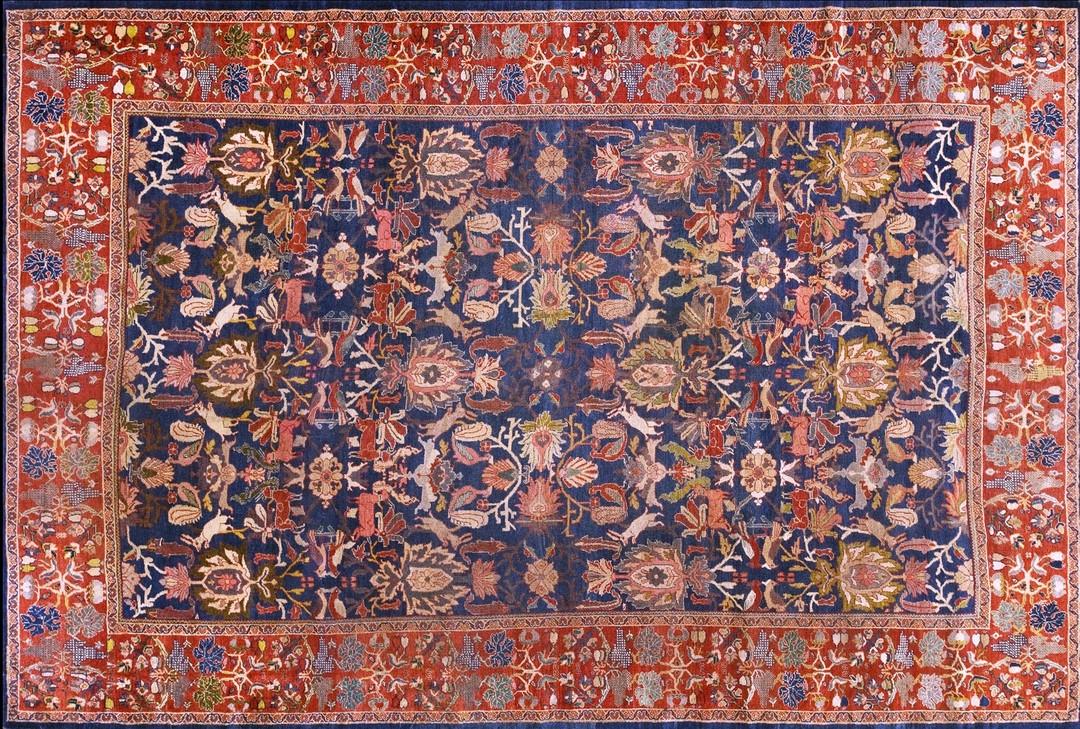
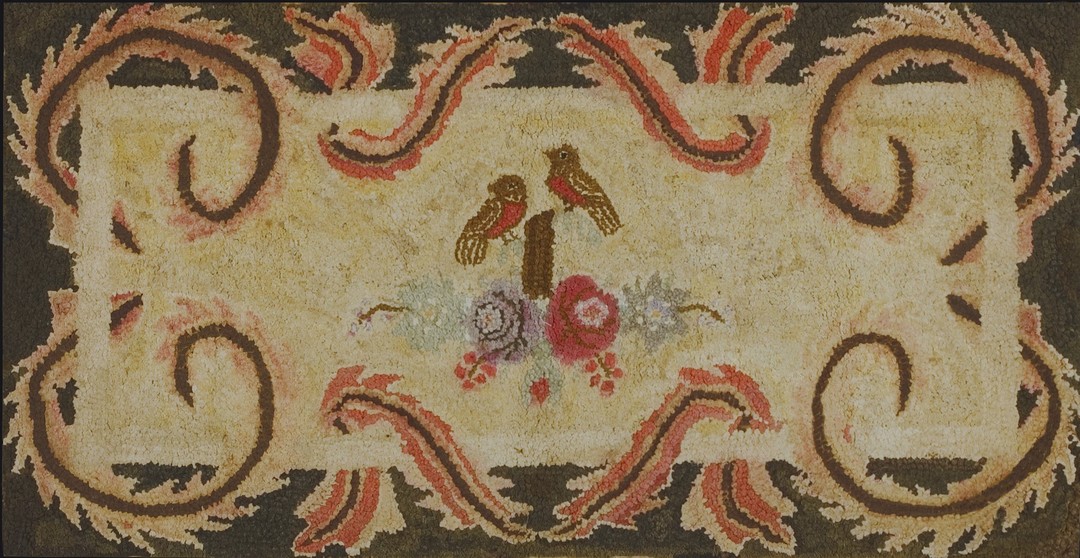
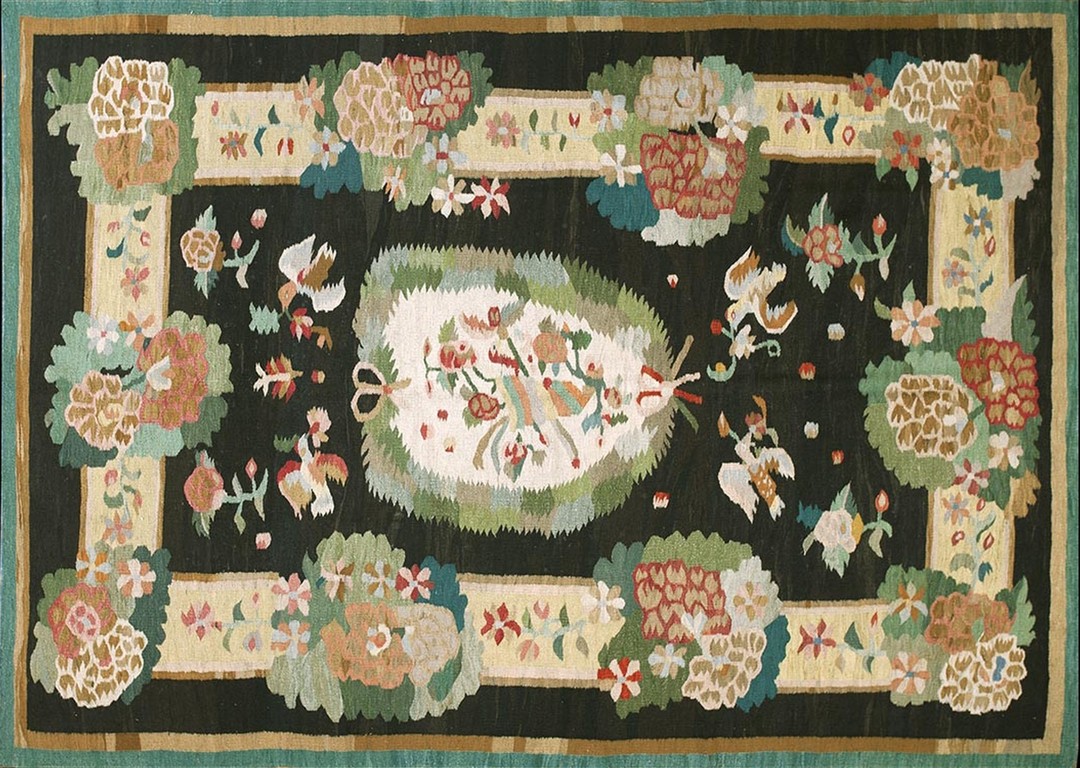
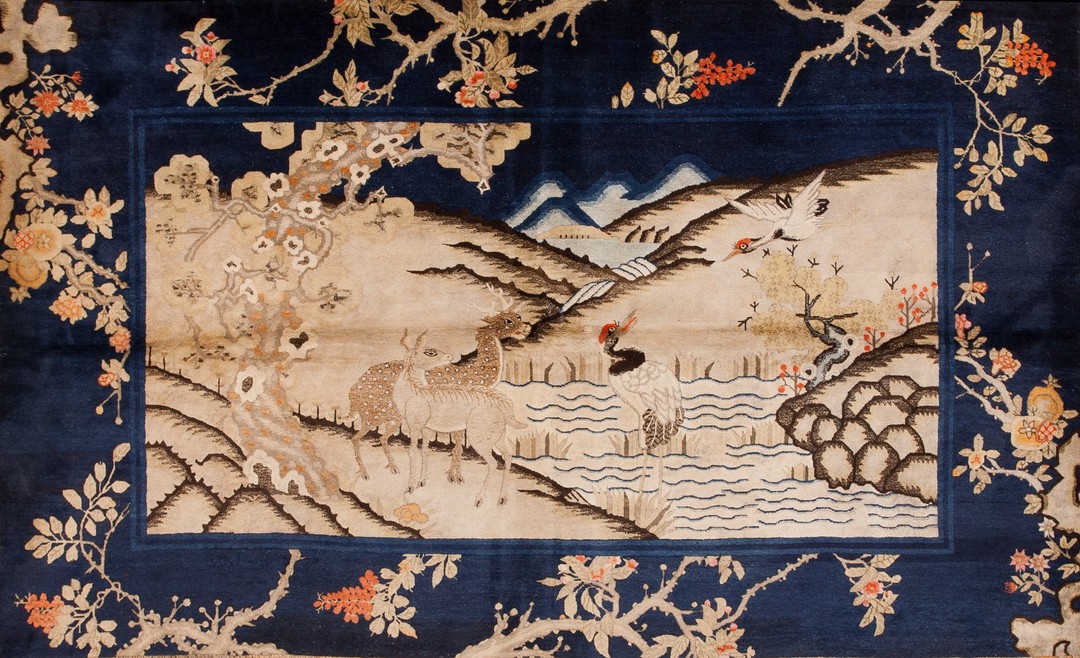
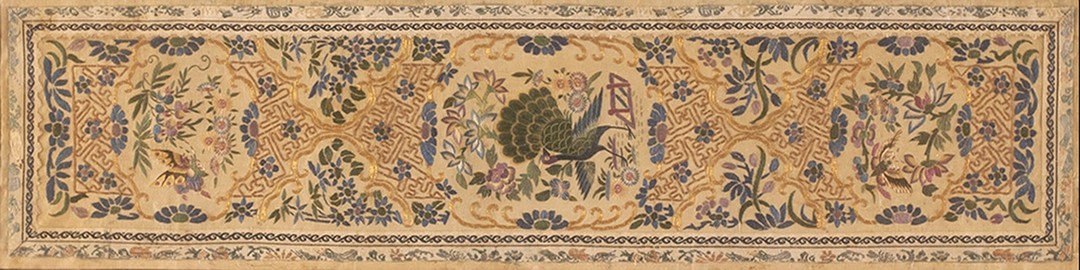
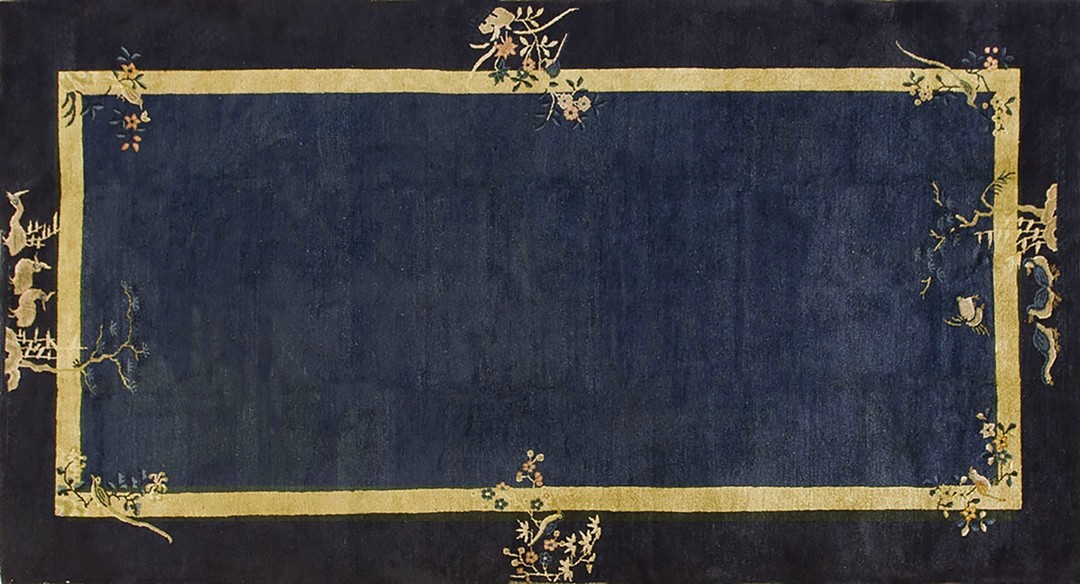
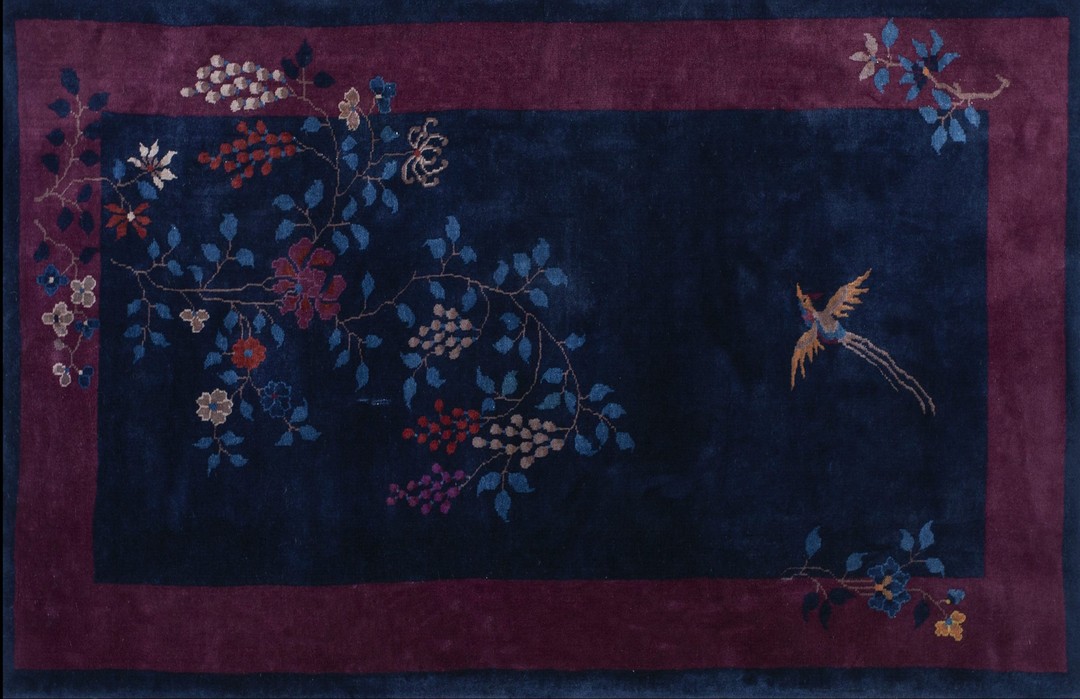
Explore a few of our favorite bird design rugs
FAQ
- Can bird motifs carry negative or protective meanings?
Occasionally. In some Anatolian traditions, owls/ravens portend bad luck, while pairing birds or phoenix-dragon motifs is intentionally auspicious.
- What keywords help when shopping for bird-design rugs?
Try “Bird Ushak,” “Akstafa peacock,” “Eagle Kazak/Chelaberd,” “Tree of Life birds,” “fenghuang/phoenix,” “crane Chinese,” and “kuş kilim.”
- Any care tips specific to antique bird-motif rugs?
Vacuum with suction only (no beater bar), avoid direct sun, and spot-blot with mild soap and water. For silk or very old pieces, use a specialist cleaner.
- Are bird motifs suitable for family or high-traffic rooms?
Yes—busy patterns conceal wear. Choose wool pile (naturally stain-resistant) and darker grounds, and rotate the rug every 6–12 months for even fading.
- How do I spot birds in very geometric tribal rugs?
Look for hooked beaks, two-pronged feet, or paired birds flanking medallions or trees. Borders may repeat “bird-head” shapes as tiny medallions.
- Do Tibetan rugs use bird symbols?
Phoenix motifs appear in Tibetan pieces, representing benevolence and long life. They likely entered via Chinese influence.
- What does the Persian “gul-o-bulbul” (rose and nightingale) theme express?
Love—earthly and mystical. The nightingale singing to the rose is a classic Persian image used across textiles and sometimes in carpets.
- Do Chinese rugs show mandarin ducks or magpies?
Yes. Mandarin ducks symbolize marital harmony, while magpies mean good news and joy.
- Is the “Eagle Kazak” actually an eagle?
It’s debated—many experts see an abstract sunburst or stylized eagle from above. The nickname persists due to resemblance to a double-headed eagle emblem.
- Which bird-motif rugs are most collectible?
Early Bird Ushaks are museum-level rarities; fine 19th-century Eagle Kazaks are coveted. Later 1920s export versions are common and less valuable.
- Can bird motifs help date a rug?
Sometimes. Bird Ushak points to 16th–17th-century Ottoman types; Akstafa and Eagle Kazak are usually 19th-century; phoenixes abound on 1920s–30s Chinese Art Deco.
- What is the Anatolian “kuşlu” (bird) kilim motif?
A flatweave symbol with many meanings—joy, news, love, or power—varying by village. Owls/ravens may signal misfortune, while doves and nightingales signal good luck.
- Which regions are known for specific bird motifs?
Caucasus: Akstafa peacocks, Eagle Kazak; Anatolia: Bird Ushak, kuş (bird) kilims; Persia: simurgh, Qashqai birds; China/Tibet: phoenix and cranes.
- How do I tell a phoenix from a peacock design?
Phoenix/fenghuang often appears with a dragon and long flowing tail feathers; peacocks show fanned “eye” tails. Art Deco Chinese rugs frequently feature the phoenix.
- Are bird motifs usually realistic?
Often they’re highly stylized or abstract. The Chelaberd “eagle” is effectively a bold sunburst-like medallion derived from earlier designs.
- Do Islamic traditions forbid bird imagery in rugs?
Not in secular textiles; figural motifs flourished in carpets and kilims. Aniconism applies mainly to religious settings, so birds are common in household weavings.
- What birds appear on “Tree of Life” rugs and why?
Peacocks, phoenixes, and eagles often guard the tree, expressing protection and paradise. Some Qajar-period examples frame the scene with poetry.
- Are bird motifs common in Qashqai or Southwest Persian weavings?
Yes—peacocks, bird-head medallions, and perched birds appear among animals and trees. Museum catalogs note Qashqai pieces with multiple peacocks in the field.
- How can I identify an Akstafa “peacock” rug?
Look for long Caucasian runners with rows of big fan-tailed birds flanking star medallions. Many use cotton wefts with wool warps, a helpful structural clue.
- What are “Bird Ushak” carpets?
16th–17th-century western Anatolian rugs with white grounds and repeating leaf forms that read as birds. Museum examples were woven in large sizes, often near 10–12 feet.
- What does a double-headed eagle motif indicate?
Sovereignty and watchfulness. Karabagh Chelaberd “Eagle Kazak” medallions resemble the Russian double-headed eagle and are typically 19th-century.
- What do cranes signify on Chinese rugs?
Longevity and peace. Historically, cranes appear on civil officials’ rank badges and temple textiles.
- What does the phoenix/fenghuang or Persian simurgh mean?
Renewal, harmony, protection, and virtue. It often pairs with a dragon for yin-yang balance; in Persian lore, the simurgh also embodies wisdom and healing.
- What does a peacock on a rug symbolize?
Immortality, beauty, and nobility. Caucasian Akstafa rugs famously show rows of fan-tailed “peacocks” around star medallions.
- Which bird motifs appear most in rugs?
Peacocks, phoenix/simurgh, cranes, eagles, and stylized small birds are common. Examples include Akstafa “peacock” Caucasians, Ottoman “Bird Ushak,” Chelaberd/Eagle Kazak medallions, and Chinese phoenix-and-dragon pairs.