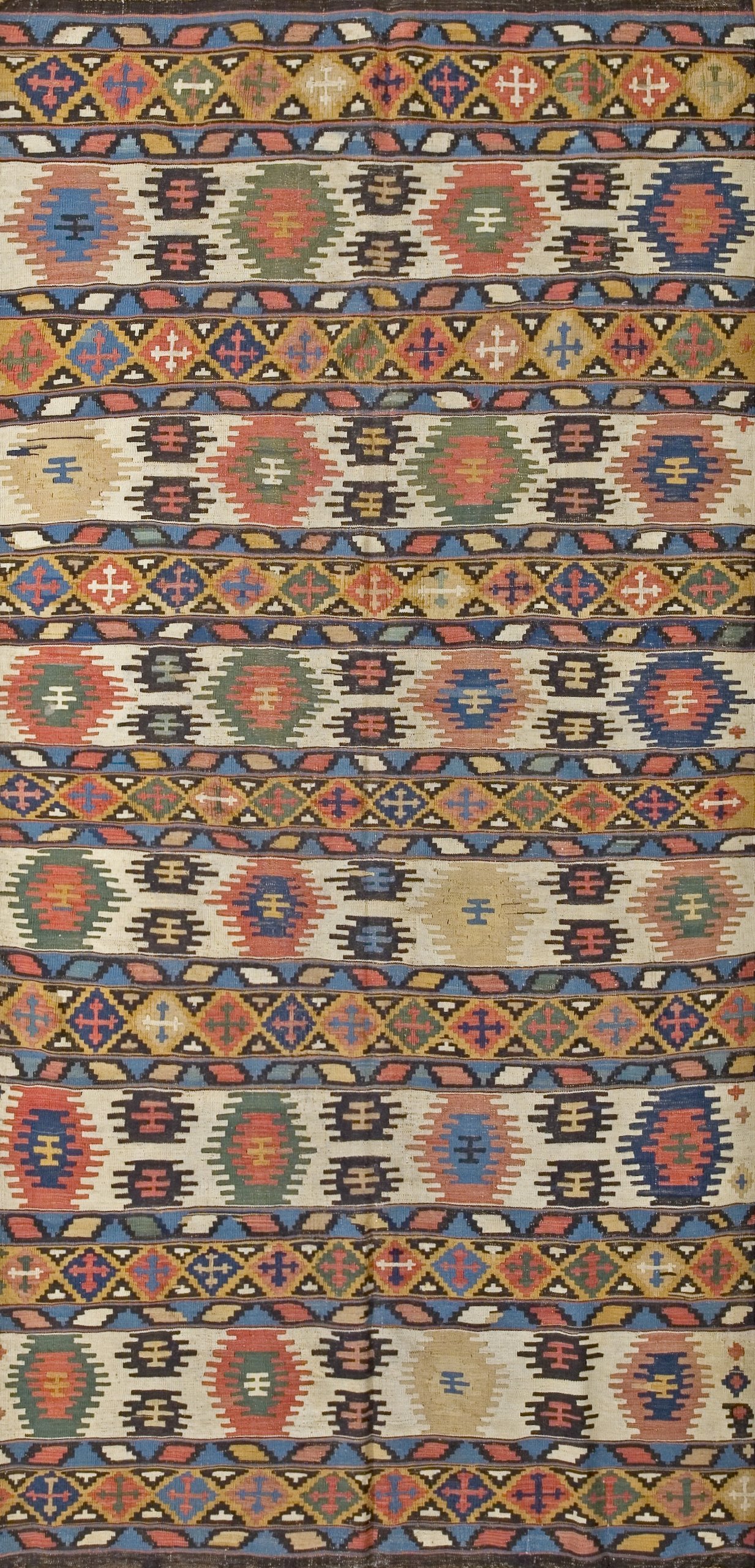
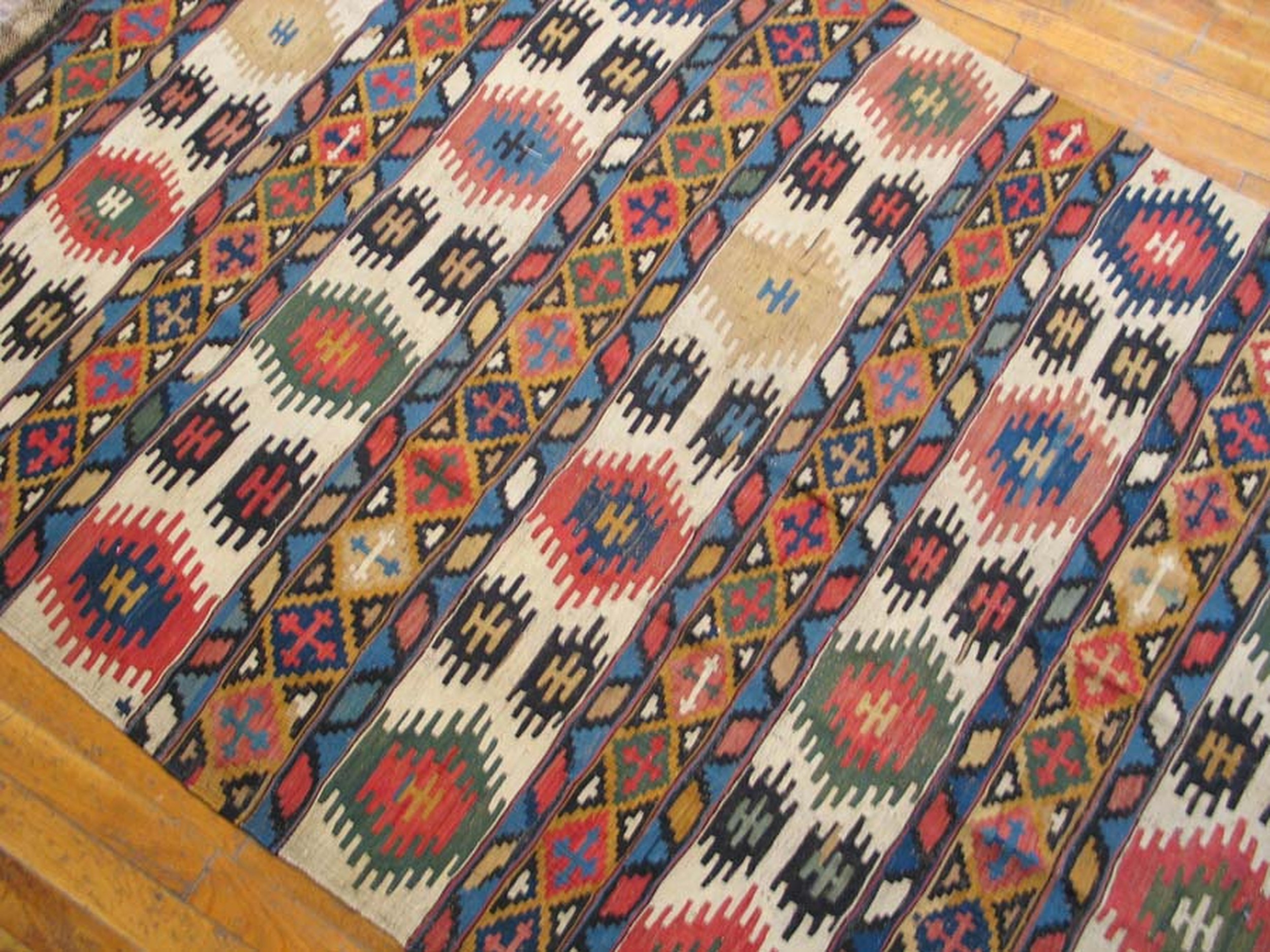
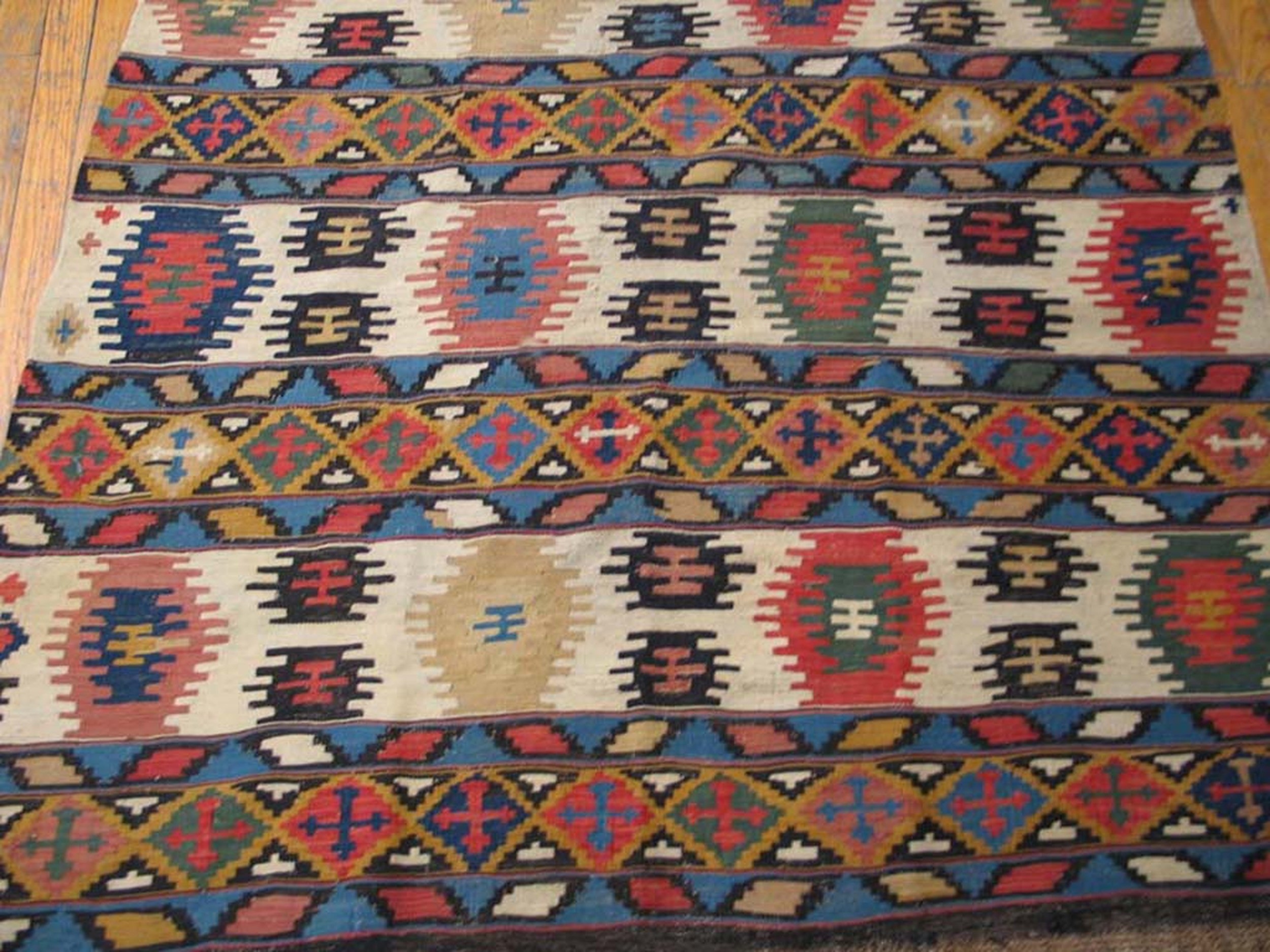
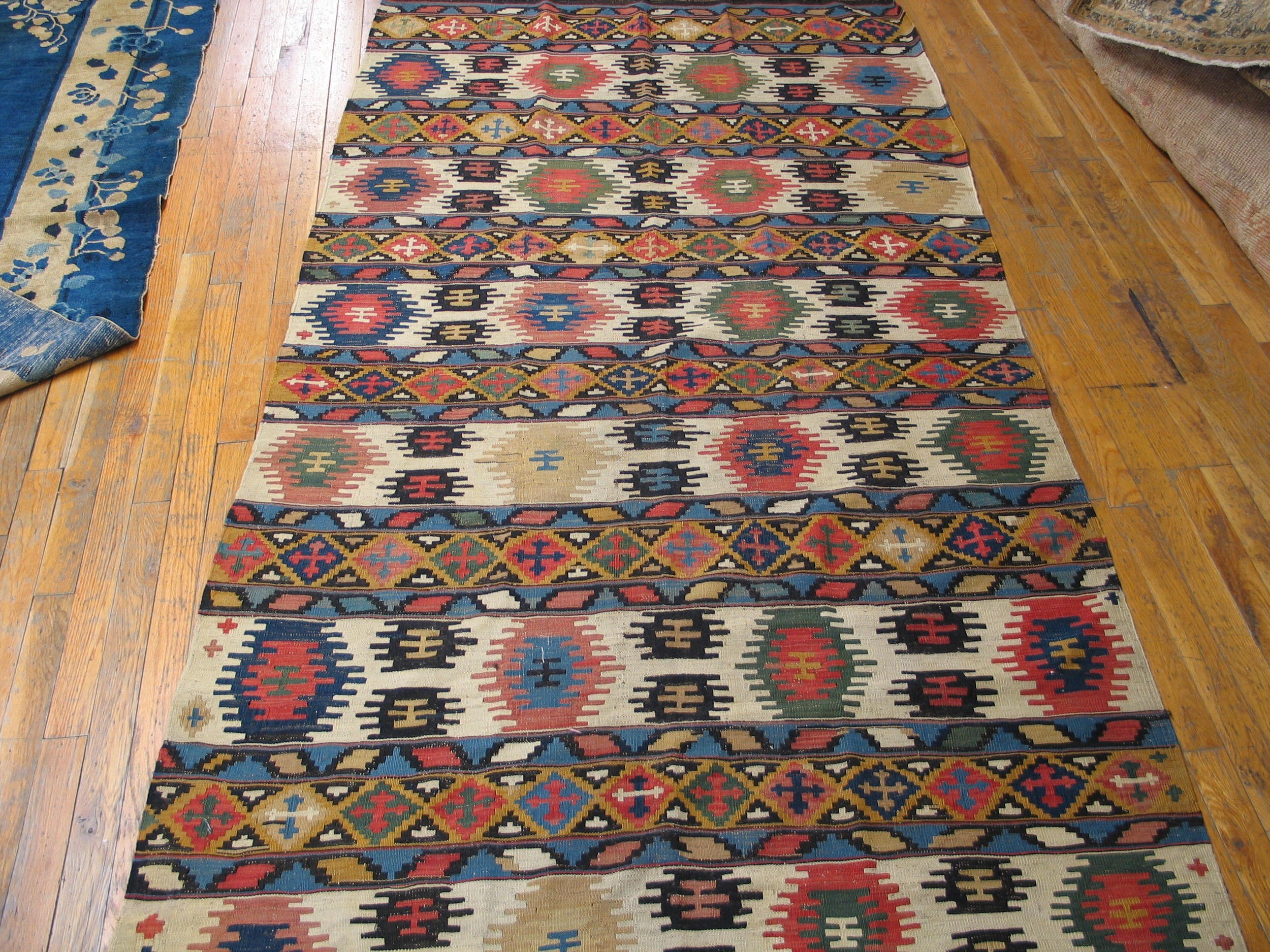
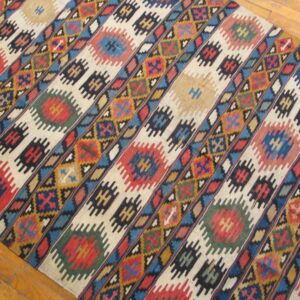
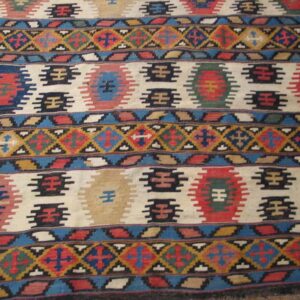
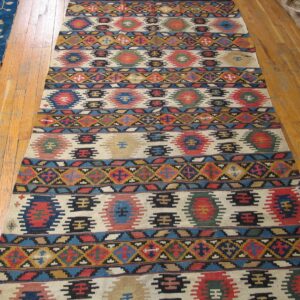
This late nineteenth-century Caucasian flat woven kilim is a vibrant monument to the nomadic weaving traditions of the Caucasus Mountains, a region celebrated for producing the most graphically bold and color-rich flatweaves in the world. While many Persian textiles lean toward floral fluidity, the Caucasian aesthetic is defined by its fierce geometric energy and “Cosmic” symbolism, making this rug a powerful focal point for both tribal collectors and modern designers.
The composition is centered upon a series of bold geometric design patterns, often featuring the “stepped” or “hooked” diamond motifs characteristic of the Shirvan or Kazak tribes. These forms are more than mere decoration; they are ancient talismans—symbols like the “Scarab” for protection, the “Star” for spirituality, and the “Running Water” border for life and purification. The drawing possesses a delightful “exhilarating asymmetry”—a hallmark of authentic tribal rugs and art where the weaver allows the pattern to evolve organically on the loom, resulting in a textile that feels alive and spontaneous.
The palette is a masterful display of saturated “Primary” colors, anchored by a rich foundation of Madder Red and Indigo Blue. Against this traditional base, the weaver has introduced a “kaleidoscopic” array of secondary tones, including vibrant saffron yellow, forest green, and crisp ivory. Because this is an antique specimen, the colors exhibit a magnificent “abrash” (tonal variation). These natural vegetable dyes have oxidized over a century to create a watercolor-like depth, where a single red band might shift from deep garnet to soft terracotta, providing a visual texture that synthetic dyes cannot replicate.
Technically, this kilim is prized for its tightly interlaced flatweave construction and its substantial, “leathery” handle. Unlike knotted pile rugs, the antique tribal Caucasian kilim rugs are woven using the “slit-weave” or “extra-weft” technique, resulting in a thin, reversible, and highly durable textile. The wool, sourced from high-altitude fat-tailed sheep, is exceptionally resilient and possesses a natural luster that makes the colors “pop” with a matte, yet luminous intensity.
The borders typically act as a disciplined architectural frame, often utilizing a “Wolf’s Track” or “Dragon” motif to “lock in” the vibrant energy of the central field. To possess this antique Caucasian tribal Kilim is to own a piece of “Ancient Modernism.” It bridges the gap between the rugged survivalist culture of the mountain tribes and the sophisticated requirements of contemporary “Boho-Chic” or “Global Minimalist” interiors—transforming any space into a sanctuary of historical gravity and bold, geometric soul.
Condition: Good.