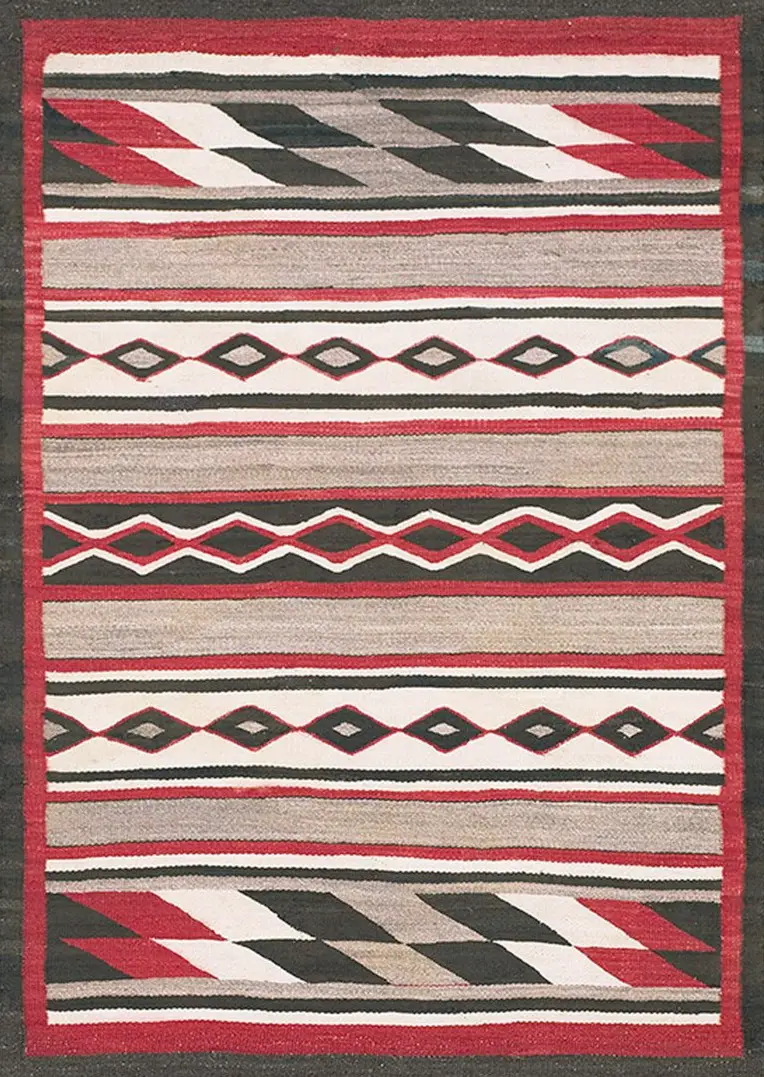
The “Chinle” style emerged in the 1920s and 30s as a deliberate aesthetic rebellion against the heavy, bordered, and often frantic “Eye-Dazzler” patterns of the late 19th century. Spearheaded by the visionary trader Cozy McSparron and Mary Cabot Wheelwright, the Chinle movement sought to return Navajo rug weaving to its “Classic Period” roots. This specific Native American flatweave rug embodies that revival—eschewing the rigid borders of the trading post era in favor of the infinite, open-ended horizontal bands that characterized the earliest Navajo wearing blankets.
This flatwoven area rug is a masterclass in the use of “negative space” and rhythmic repetition. The field is organized into a series of sophisticated, variegated bands. The palette is a curated selection of desert neutrals: toasted ochre, sand, and charcoal, punctuated by delicate geometric “squash blossom” or “shush” (bear track) motifs.
Unlike the high-contrast dyes of other regions, Chinle rugs are celebrated for their use of vegetal and soft-toned dyes. The colors here feel as though they were pulled directly from the canyon walls of Arizona—muted, organic, and designed to harmonize with the natural world rather than compete with it.
While deeply rooted in tribal history, the Chinle style is perhaps the most “modern” of all Navajo weaves. Its borderless design and horizontal orientation allow it to integrate seamlessly into contemporary interiors.
It serves as a perfect grounding element for:
- Mid-Century Modern spaces, where its clean lines mirror the era’s furniture.
- Japanese Wabi-Sabi environments, where the natural “abrash” (subtle color shifts) of the wool is celebrated.
- Art-Focused Collections, where it functions as a piece of “soft sculpture” on a wall or a storied floor covering.
Specifications:
- Style: Authentic Chinle Regional Flatweave
- Origin: Navajo Nation (Diné), Southwest USA
- Motif: Classical Banded Stripe with Geometric Inserts
- Palette: Vegetal Earth Tones, Alabaster, and Carbon
- Material: Hand-spun sheep’s wool on a traditional upright loom
- Significance: A highly collectible “Revival Period” aesthetic that prioritizes balance and ancestral tradition over commercial ornamentation.