
Introduction to Needlepoint Rugs
Explore our specially curated collection of authentic Needlepoint Rugs and find a timeless treasure for your home.
Definition and Distinction
A needlepoint rug is a flat, embroidered rug created by stitching wool or silk yarn through a stiff, open-weave canvas. This process—often called canvas work—relies on the precision of hand embroidery rather than loom weaving. Unlike pile rugs or kilims, needlepoint is not woven directly into a fabric structure; instead, the design builds up stitch by stitch, producing a surface that resembles tapestry but differs in construction. The distinction between tapestry vs. needlepoint is essential.
A magnificent tapestry is woven on a loom, where warp and weft threads interlace to form both structure and image. In contrast, a needlepoint floor covering or canvas work carpet is made entirely with a needle and yarn, applied to an existing canvas foundation. This difference in method impacts durability and flexibility: tapestry is inherently a woven fabric, while needlepoint is an overlay of embroidery on a prepared base. The term “needlepoint” itself only became common in the 19th century, though the craft has roots in earlier European embroidery traditions.
Visually, the two may look alike. Both can feature detailed floral, geometric, or figurative motifs with a painterly effect. But needlepoint’s reliance on repeated stitches across canvas produces a more grid-like uniformity compared to the seamless flow of woven tapestry. Recognizing this distinction clarifies why needlepoint rugs occupy a unique place among embroidered and woven carpets.
Primary Uses: Decorative and Functional Roles
The uses of a needlepoint rug extend far beyond being a simple floor covering. Historically, these embroidered rugs were valued as both luxury goods and practical furnishings. They appeared in aristocratic European homes not only as floor coverings but also as wall hangings, cushion covers, and upholstery for chairs and settees. Because the technique allowed intricate designs—roses, medallions, and even heraldic symbols—needlepoint became a medium of status display as much as comfort.
In domestic interiors, a needlepoint floor covering provided warmth and color, while its tapestry-like appearance introduced elegance without the heavy weight of woven carpets. For many households, owning an embroidered rug meant possessing a blend of utility and artistry: a piece that could be walked upon daily yet admired like a painting. Over time, the role of needlepoint rugs shifted toward versatility. Today, they serve as decorative accents in traditional and contemporary homes alike.
Some homeowners hang them as wall art, appreciating their hand-stitched quality as much as their design. Others use them as area rugs in living rooms, dining rooms, or bedrooms, where they balance old-world charm with practical resilience. Smaller needlepoint panels are often framed or used in upholstery, extending their function from the floor to furniture. In many cases, these embroidered rugs also act as heirlooms.
Families pass them down across generations, associating them with heritage and craftsmanship. Their longevity stems from both the durability of the underlying canvas and the cultural weight attached to handmade work.
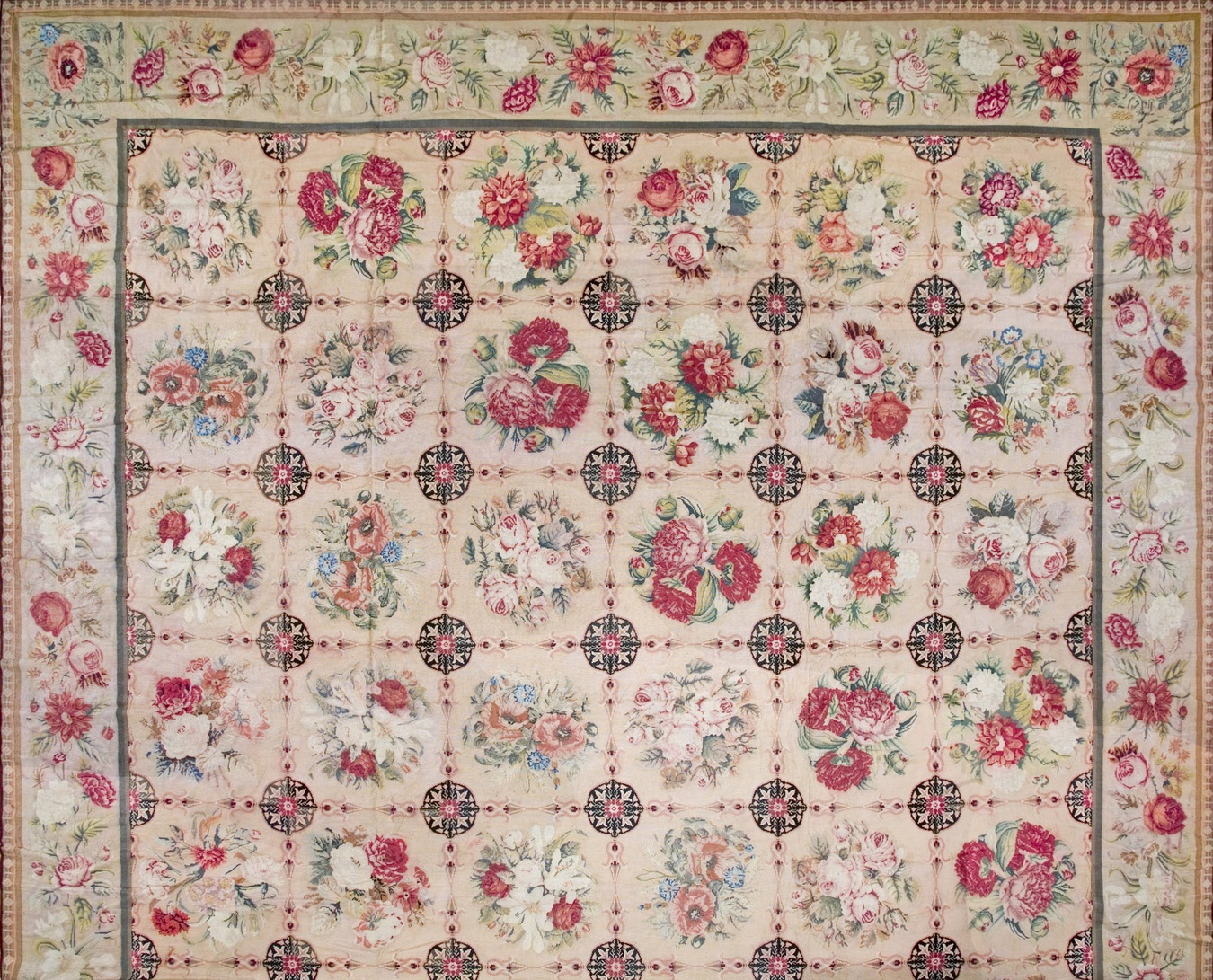
While once considered symbols of wealth, needlepoint rugs now hold value for their artistry, collectability, and ability to fit seamlessly into varied interiors. Ultimately, needlepoint rugs embody a dual identity: historic charm paired with functional versatility.
They recall the grandeur of tapestry-like art while adapting to everyday domestic use, making them one of the most distinctive categories of decorative textiles. Their enduring relevance lies in this balance—objects equally at home underfoot, on the wall, or cherished as family treasures.
Origins and Historical Development
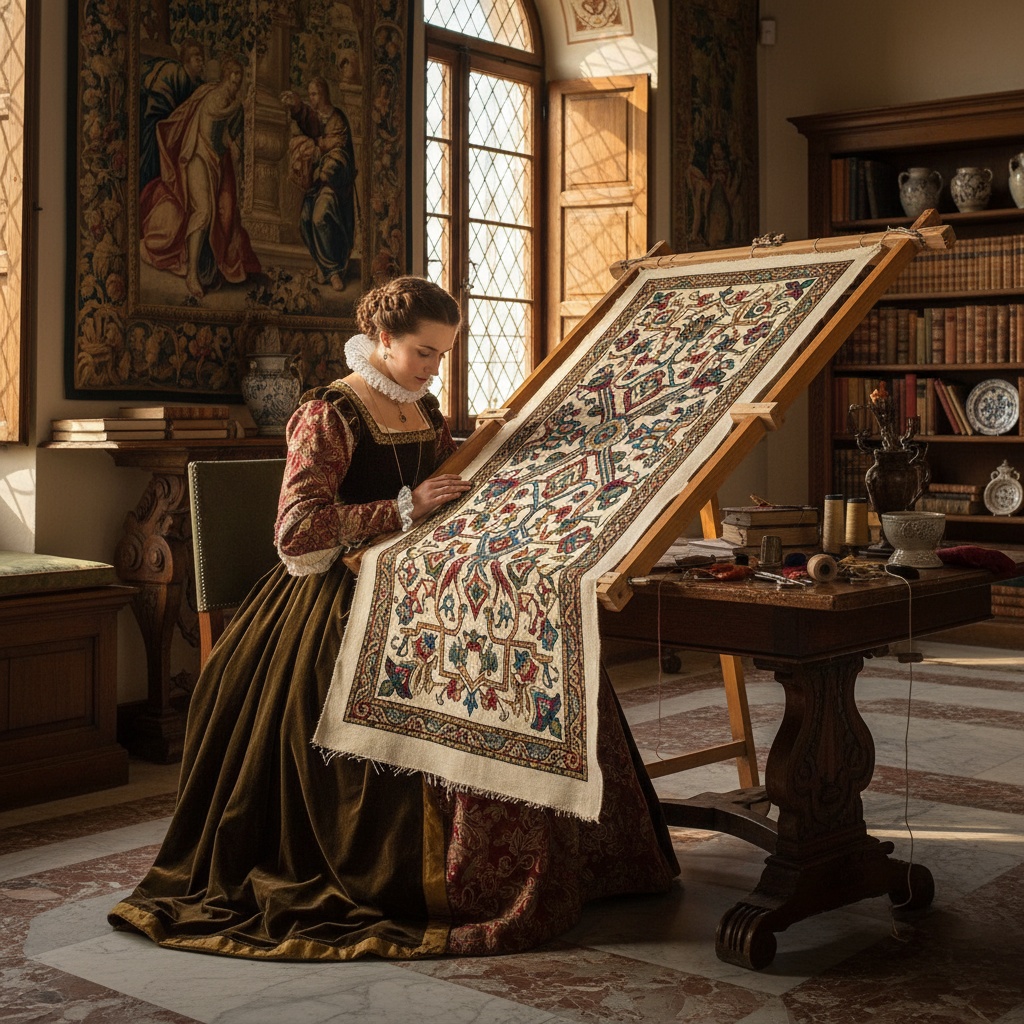
Historical embroidery on a large frame.
Ancient Roots and Early Canvas Work
The origin of needlepoint rugs can be traced back to ancient textile practices. Early forms of canvas work—where thread was passed through a grid-like foundation—were already known in Ancient Egypt, where tent-makers and craftsmen stitched decorative panels onto coarse fabrics. While these were not rugs in the modern sense, they established the principle of building surface designs through embroidery on canvas.
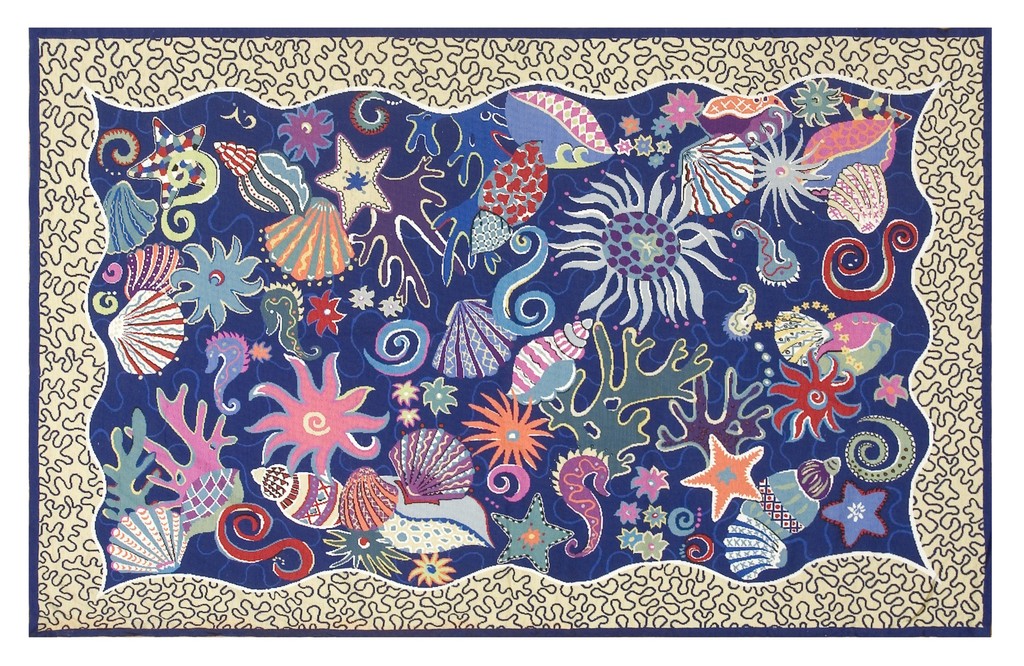
Vintage Mid Century Modern French Under The Sea Pattern Needlepoint Art Rug by Rugs On Net
Centuries later, during the Renaissance, this technique evolved into more elaborate decorative arts across Europe. Noble households employed needlework to create hangings, cushion covers, and “table carpets”—embroidered cloths that mimicked woven carpets yet served as coverings for furniture and ceremonial spaces. This transition from utilitarian canvas stitching to refined embroidered rugs set the foundation for what would become the needlepoint tradition.
Emergence in Europe
The true history of needlepoint carpets as floor coverings begins in 16th- and 17th-century Europe, particularly in England, France, and Portugal. Between 1550 and 1650, the earliest large embroidered carpets appeared, echoing the designs of imported Oriental rugs but made with local materials and needlework skill.
In England, gentry families displayed these “Turkey work” or embroidered carpets as symbols of refinement. France likewise embraced the craft, with aristocratic women often engaged in canvas work as part of their domestic accomplishments. By the 17th century, needlepoint was firmly embedded in the decorative arts of Europe, marking the shift from small-scale embroidery to large canvas work carpets meant for display.
Arraiolos Tradition
One of the most distinctive regional legacies of needlepoint emerged in Arraiolos, Portugal. The Arraiolos needlepoint rugs drew upon a blend of Jewish and Islamic influences brought into Iberia during the medieval period. Jewish artisans, expelled from Spain in 1492, found refuge in Portugal and carried with them skills in geometric embroidery and textile ornamentation.
At the same time, Moorish design traditions emphasized stylized floral arabesques and intricate geometry. The fusion of these cultural streams gave rise to a uniquely Portuguese folk art: brightly colored rugs worked in wool on linen canvas, featuring medallions, borders, and repeating motifs reminiscent of both Oriental and Iberian aesthetics.
Arraiolos rugs became not only household furnishings but also national symbols of Portuguese craftsmanship, reflecting how cross-cultural exchange enriched the development of needlepoint.
Mainstream Adoption in Home Decor
Needlepoint rugs did not remain confined to elite drawing rooms. By the late 18th and 19th centuries, they entered the mainstream of home decor. Several key factors explain why:
- Parlor culture in the 18th century — Why: A well-embroidered rug or carpet became a mark of gentility, fitting for parlor and drawing room spaces where guests were entertained.
- Industrial dye innovations in the 19th century — Why: The invention of synthetic dyes made colors more vibrant and accessible, expanding design options for needlepoint rugs.
- Mass-market pattern charts — Why: Publishers produced embroidery charts that allowed middle-class women to reproduce fashionable floral and geometric motifs without specialized training.
- Victorian domestic ideals — Why: In the Victorian period, needlepoint rugs flourished as part of a broader trend toward ornate interiors, where every surface was covered with decoration.
It was during this Victorian needlepoint surge that the craft truly democratized, transforming from aristocratic pastime into a widespread domestic practice. By the late 19th century, the needlepoint rug had become both a practical floor covering and a decorative emblem of bourgeois taste.
The development from Egyptian tent-stitch to European luxury parlor rugs reveals a continuous thread: a craft shaped by cultural exchange, technological innovation, and shifting social ideals. From Arraiolos cross-cultural artistry to Victorian mainstream adoption, needlepoint rugs embody not just decoration, but the layered history of textile traditions adapting to new contexts.
Materials and Construction
Canvas Foundations
Every needlepoint rug begins with its canvas foundation, the open-weave grid onto which stitches are worked. Historically, artisans used linen, hemp, or jute—fibers that provided strength but varied in smoothness and flexibility. Linen offered a taut, even surface prized for fine embroidery, while jute and hemp, though coarser, created sturdier foundations suitable for heavy domestic use. By the 19th century, cotton canvas became standard, prized for its affordability, availability, and consistent weave.
The choice of foundation material affects not only the longevity of the rug but also its tactile feel: a stiffer jute base yields a rugged texture, while cotton produces a more pliable, refined finish. Thus, the foundation is more than background; it determines how the rug will wear and how the stitches will sit over decades of use.
Wool vs. Silk Thread
The surface of a needlepoint rug is defined by its threads, and the choice between wool vs silk thread has always been decisive:
- Wool — Why: Strong, resilient, and naturally colorfast, wool is the gold standard for needlepoint rugs. It withstands foot traffic and maintains its vibrancy over years, making it the dominant choice for floor coverings.
- Silk — Why: Silk adds luster and delicacy, but it wears down more quickly under pressure. For this reason, silk is rarely used for entire rugs, appearing instead in small decorative passages or accents where sheen outweighs durability.
In practice, most embroidered rugs rely almost entirely on wool, sometimes blending in silk to highlight floral motifs or central medallions.
Common Needlepoint Stitches
The beauty and resilience of a needlepoint rug canvas depend on the stitch type. Among the most common needlepoint stitches are:
- Tent stitch — Why: The most traditional and widely used, producing a flat, uniform surface ideal for patterned rugs.
- Petit point — Why: A smaller, finer version of tent stitch, enabling intricate detail but requiring higher mesh counts and more time.
- Gros point — Why: A larger-scale stitch, bold in effect, often used for faster coverage on coarser canvas.
- Cross-stitch — Why: Adds texture and visual variety, though less common in full rugs.
- Basketweave stitch — Why: Offers superior strength and even wear, as stitches distribute tension diagonally across the canvas.
- Continental stitch — Why: Similar to tent stitch but sturdier, covering canvas more evenly to prevent distortion over time.
Stitch Techniques & Mesh Count
The stitch technique and mesh count directly influence durability, texture, and visual sharpness. Basketweave and continental stitches are particularly prized for rugs meant to endure foot traffic, as they spread tension more evenly than tent stitch, reducing the risk of distortion. They also provide smoother coverage, creating a denser and more stable surface.
Mesh count—the number of canvas holes per inch—is equally critical. A finer mesh count allows for petit point work, producing detailed floral or pictorial motifs with painterly precision, though at the cost of longer production time.
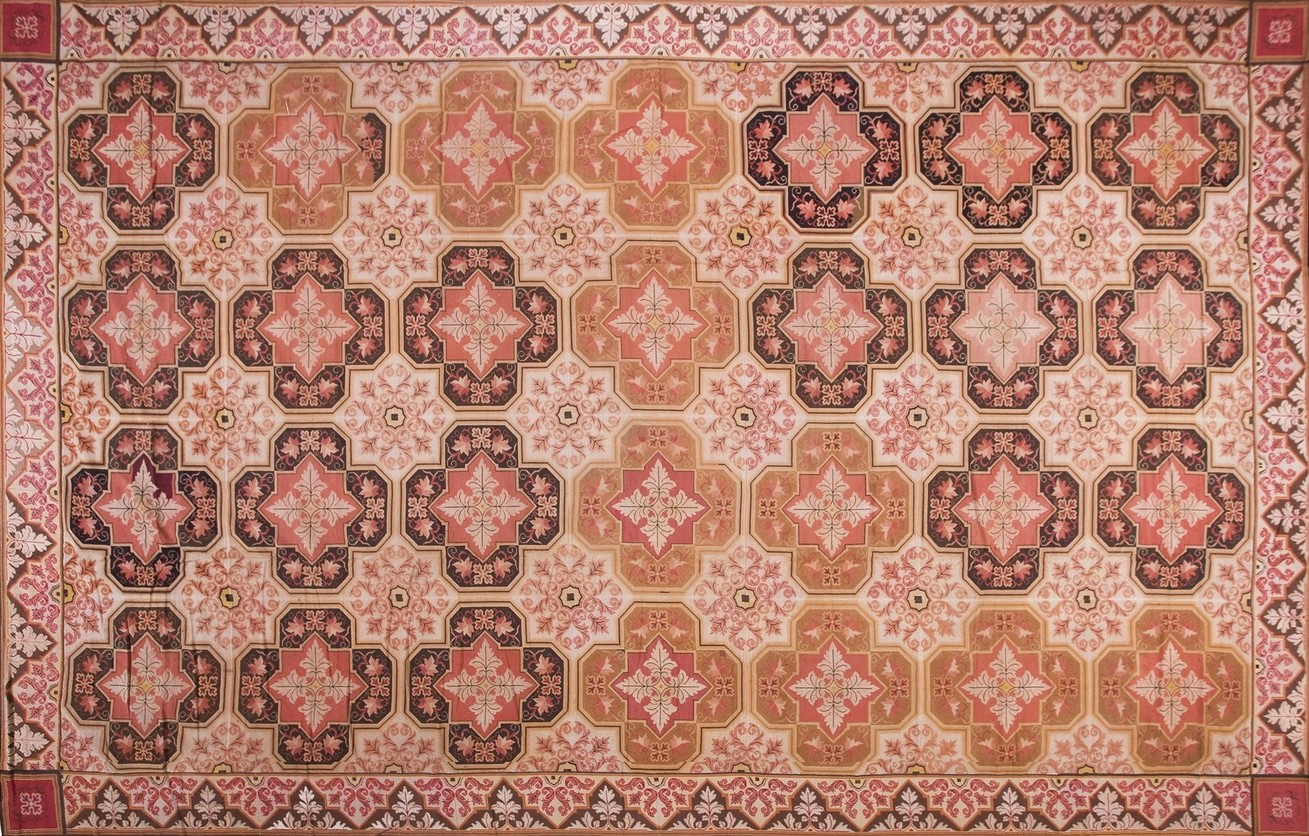
A coarser mesh supports gros point, yielding bold, graphic patterns ideal for larger-scale designs and quicker execution. In essence, mesh count governs both the tactile texture underfoot and the visual clarity of the design: fine meshes give crisp detail, while coarse meshes emphasize bold geometry.
Construction & Finishing Methods
Once embroidered, a canvas work carpet requires careful finishing. Edges are reinforced with binding or overcast stitching to prevent fraying, and many rugs are backed with a secondary fabric—often linen or cotton—to protect the stitching from wear. Larger rugs may also be lined or padded for stability. In historic practice, some were mounted onto stretchers for display, while others were integrated into upholstery or framed as wall hangings.
For functional floor coverings, finishing methods ensured durability, transforming delicate handwork into serviceable household objects. The interplay of foundation, thread, stitch, and mesh defines not only how a needlepoint rug looks but how it performs. A cotton canvas stitched with wool in basketweave stitch over a medium mesh remains the most balanced choice: strong enough for daily use, yet refined enough to highlight the artistry of the needlepoint tradition.
Design & Aesthetic Characteristics
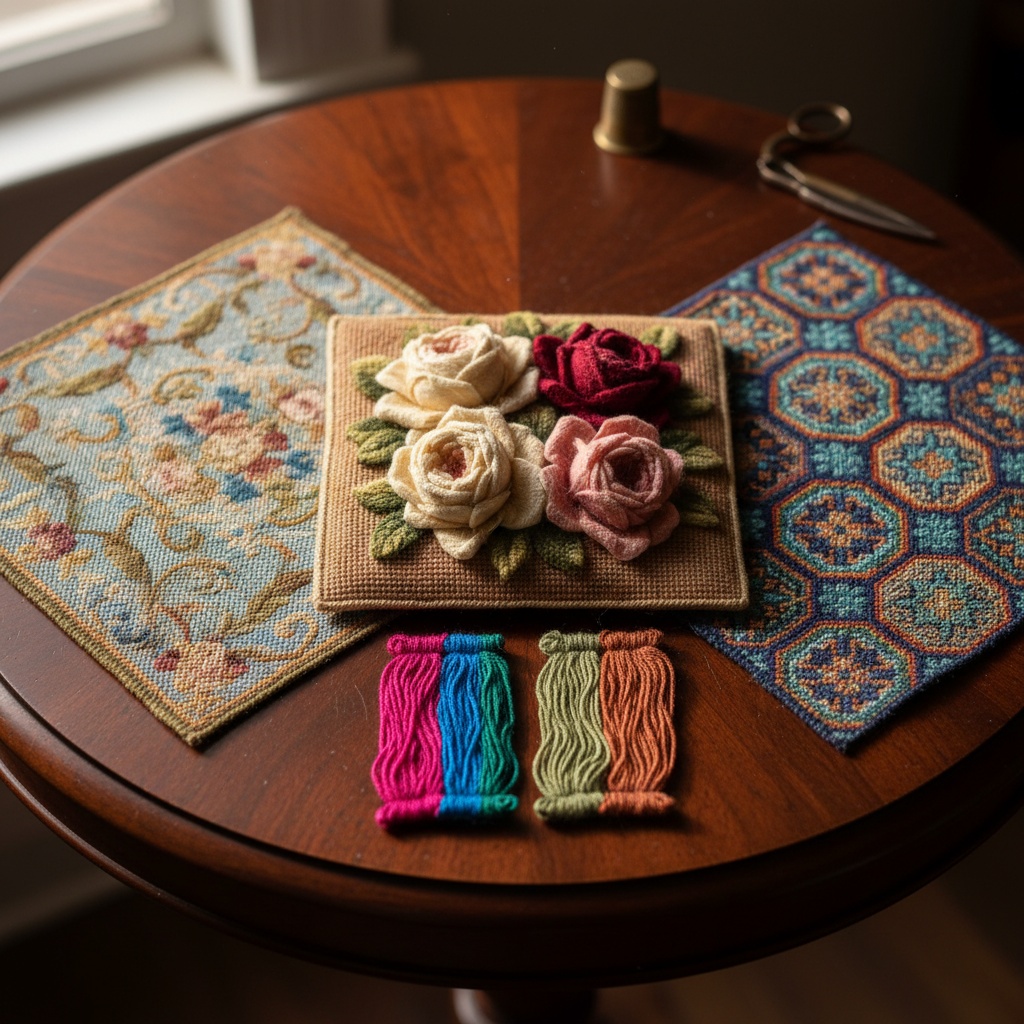
Dimensional needlepoint roses beside woven textile patterns
Signature Motifs: Florals, Pictorials, Heraldry
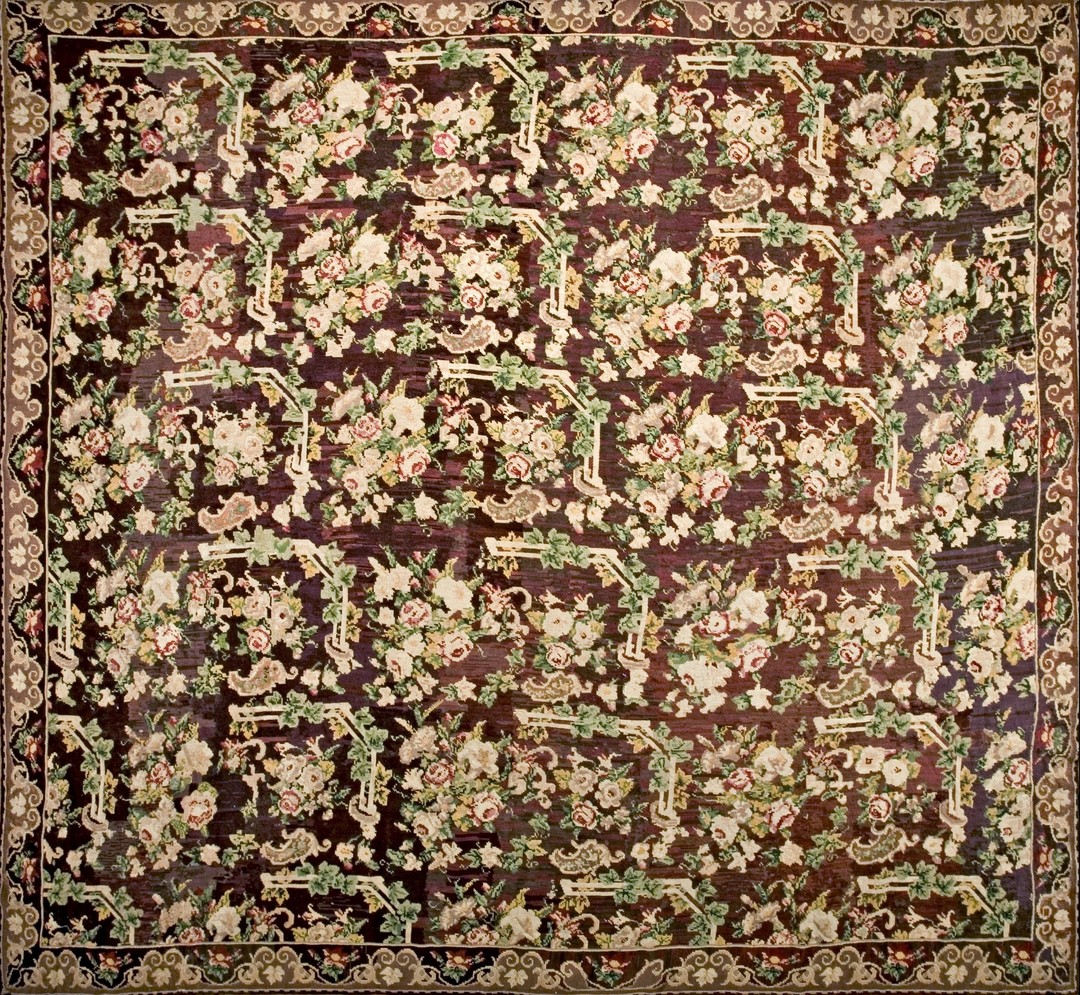
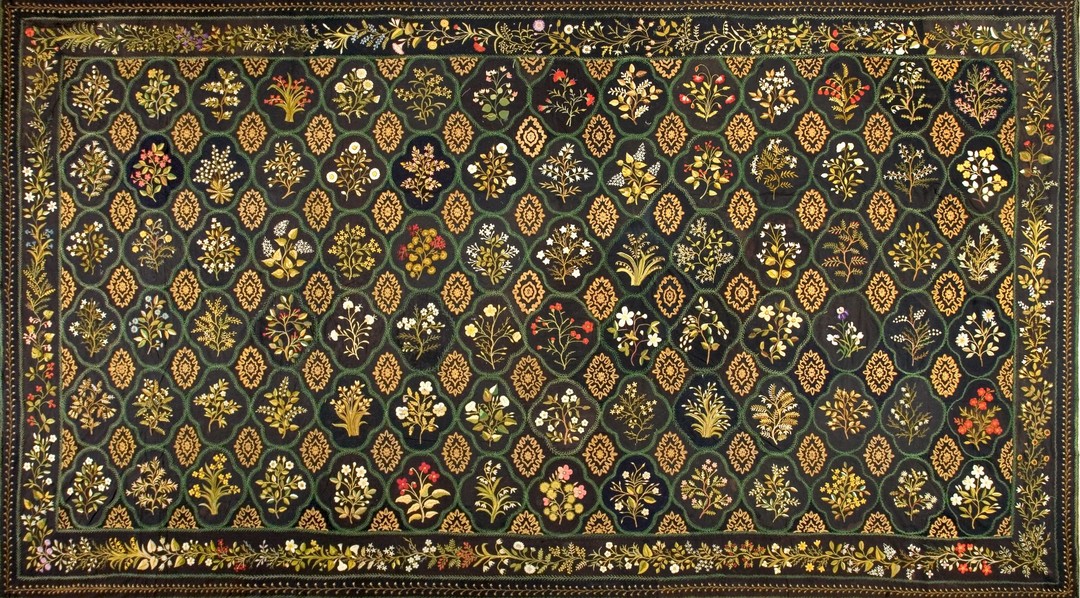
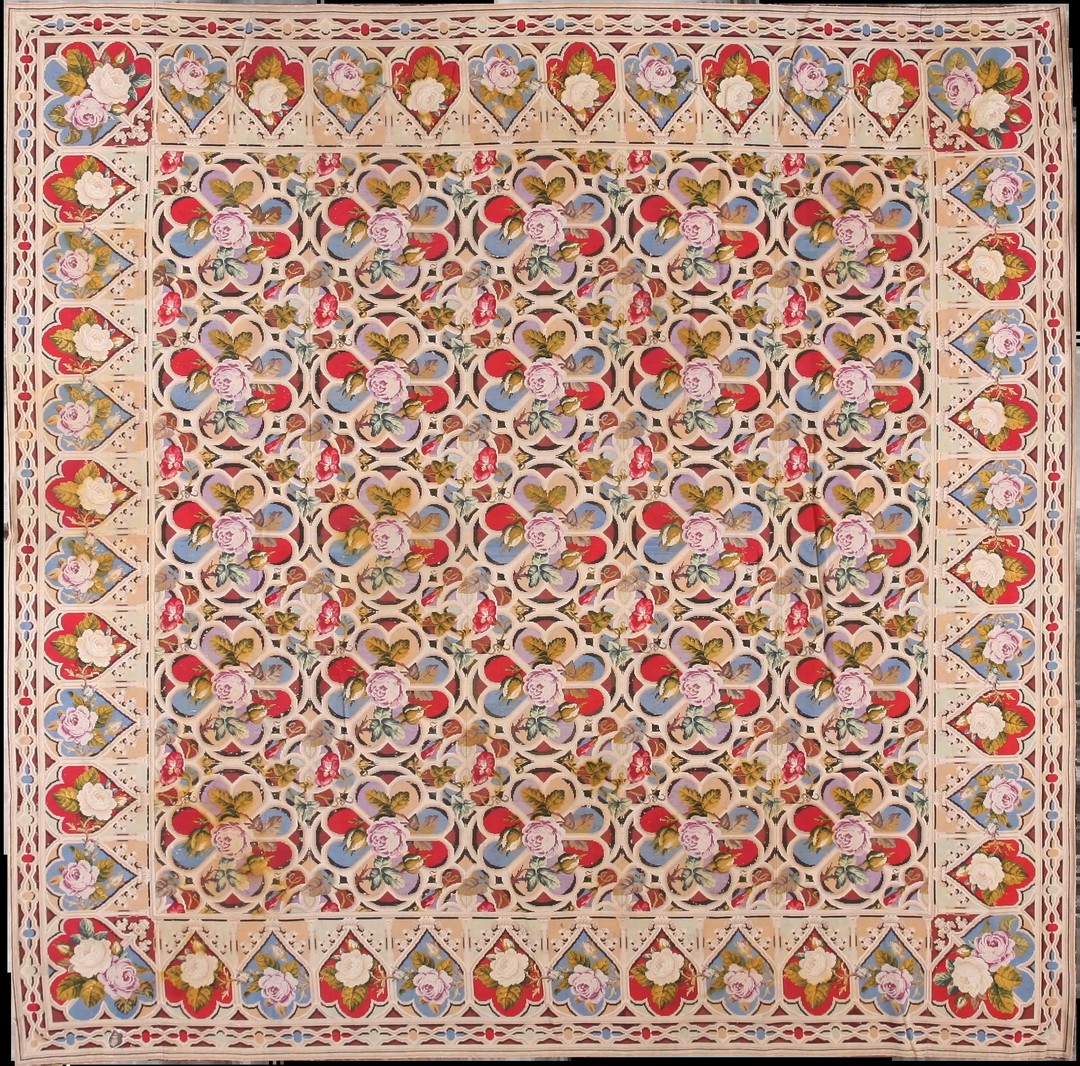
A defining feature of needlepoint floral design and related motifs is their versatility. Needlepoint rugs are capable of replicating nearly any artistic style, from delicate botanical arrangements to elaborate pictorials. Floral bouquets and botanical themes dominate, especially in 18th- and 19th-century examples, where roses, lilies, and vines appear with careful shading to imitate natural depth.
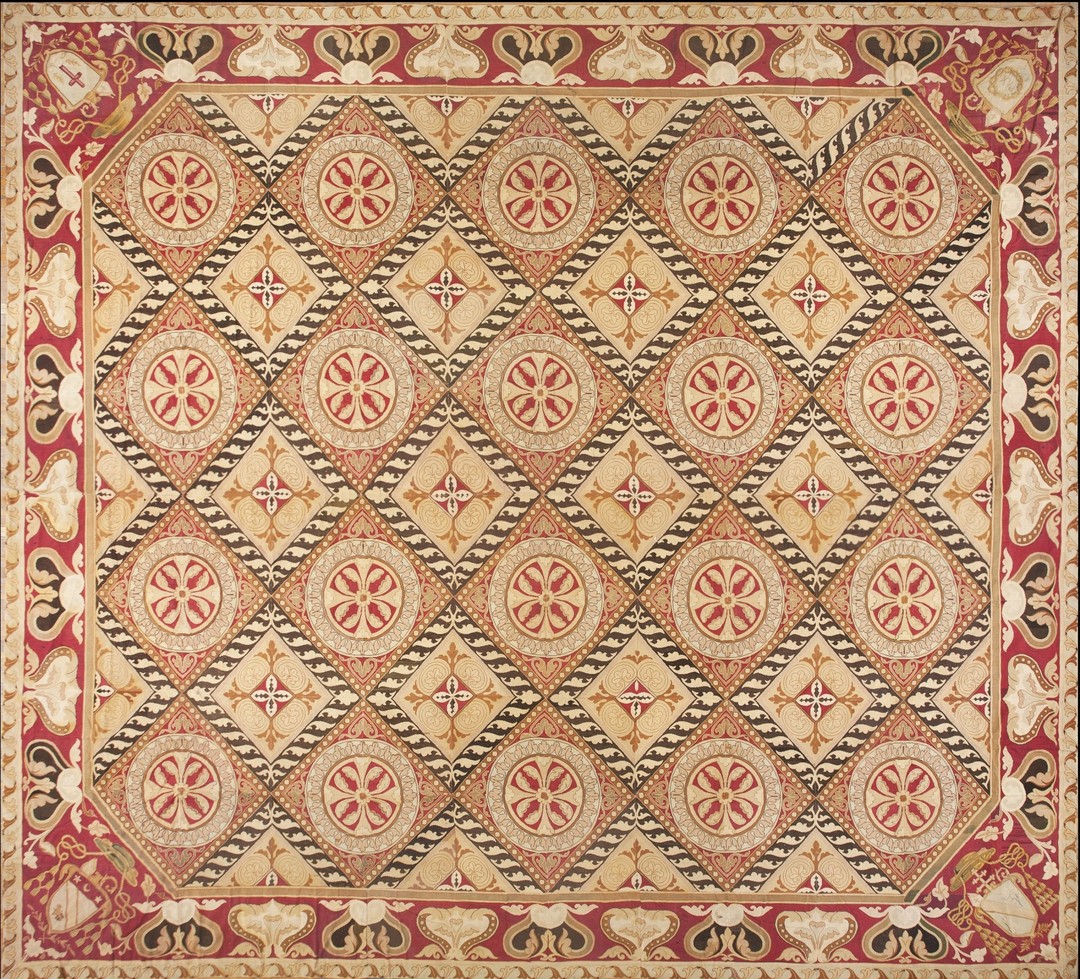
The Victorian era pushed this further, introducing three-dimensional shading techniques that gave blooms a lifelike quality. Alongside florals, pictorial needlepoint rugs depicted landscapes, pastoral scenes, or even mythological imagery, transforming the rug into a storytelling medium. Heraldic symbols and coats of arms also featured prominently, particularly in European commissions where family crests or royal insignia reinforced identity and prestige.
Geometric, Oriental, and Exotic Influences
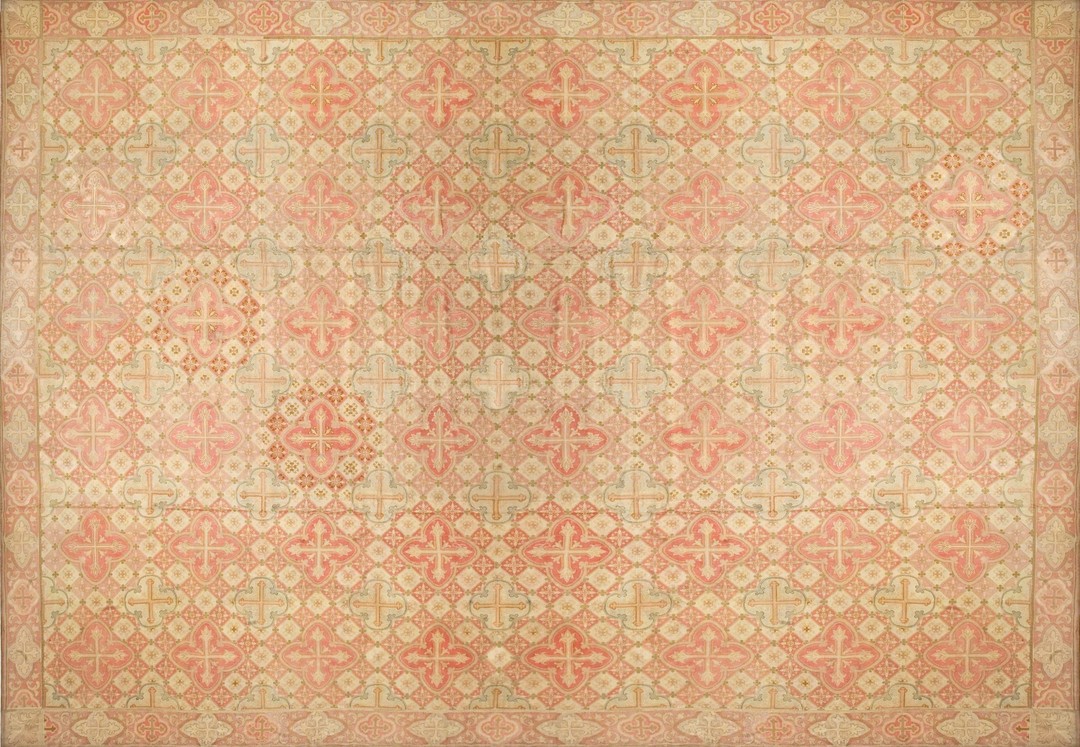
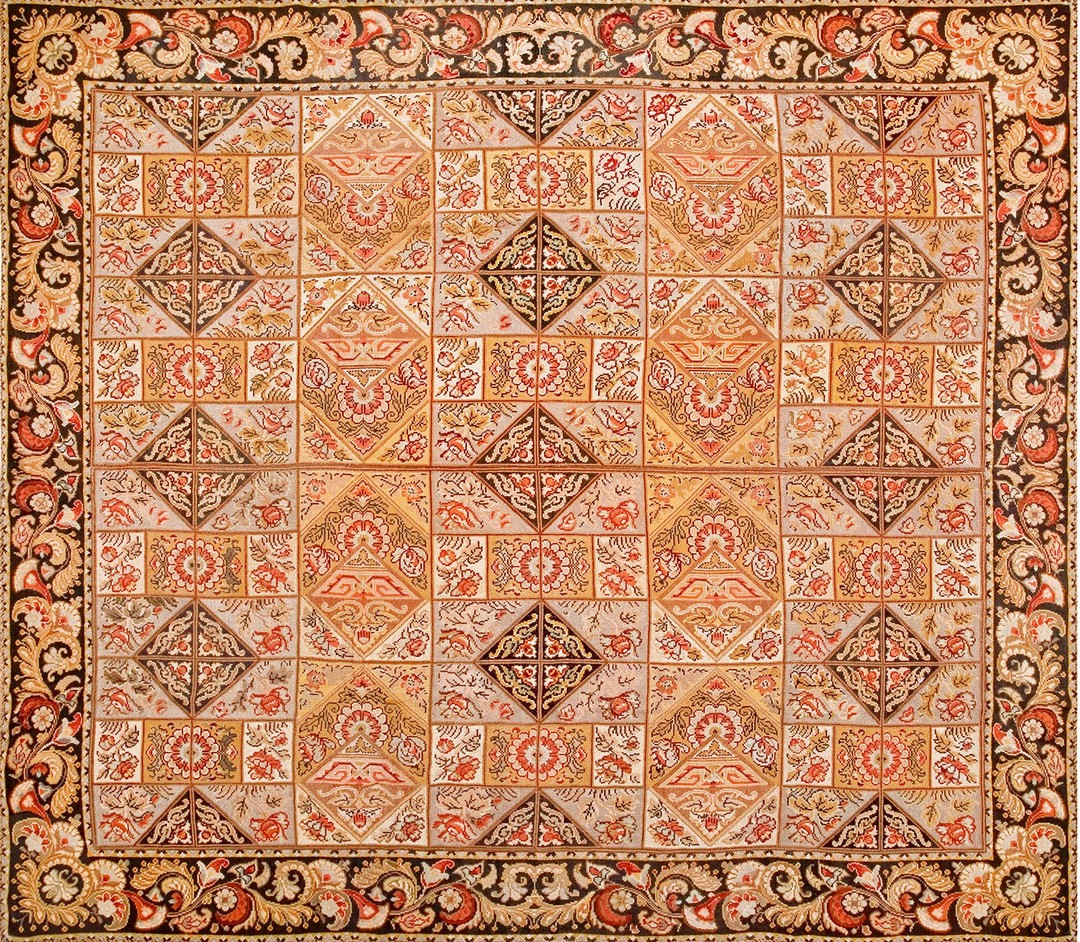
While florals and pictorials highlight Western tastes, needlepoint rugs also absorbed influences from abroad. Many designs borrowed directly from Oriental rug patterns, adapting Persian-style medallions, scrolling vines, or repeating borders to the needlepoint canvas. This gave rise to geometric needlepoint rugs that echoed Islamic arabesques and Moorish tile work.
The cross-cultural flow was not accidental—needlepoint often sought to imitate imported carpets, making “exotic” motifs highly desirable among European households. These influences broadened the visual vocabulary of needlepoint, allowing it to exist at the crossroads of local European taste and global design heritage.
Color Palettes
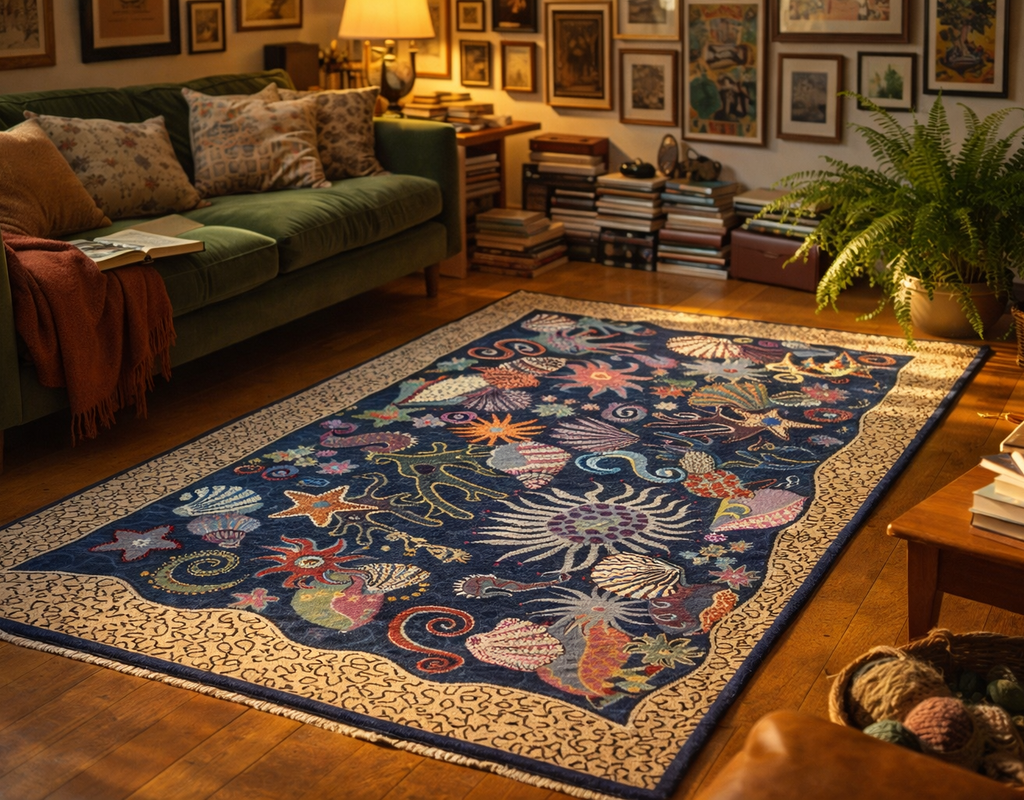
A captivating, marine-themed rug anchors this richly textured and book-filled reading nook.
The classic needlepoint colors of a rug instantly reveal its era and aesthetic intention:
- Muted natural dyes (sage greens, terracotta reds, woad blues) — Why: Common in early European and Arraiolos examples, these palettes reflect vegetable dye traditions and a softer, naturalistic look.
- Vibrant aniline dyes (deep black, mauve, magenta, nightgreen) — Why: Introduced in the mid-19th century, these synthetic colors defined the Victorian needlepoint style, making rugs appear brighter, bolder, and more theatrical.
- Contemporary palettes (neutrals, jewel tones, pastels) — Why: Modern makers experiment with updated hues, balancing tradition with current interior trends, from minimalist beige-and-grey schemes to avant-garde color blocking.
Aubusson Patterns
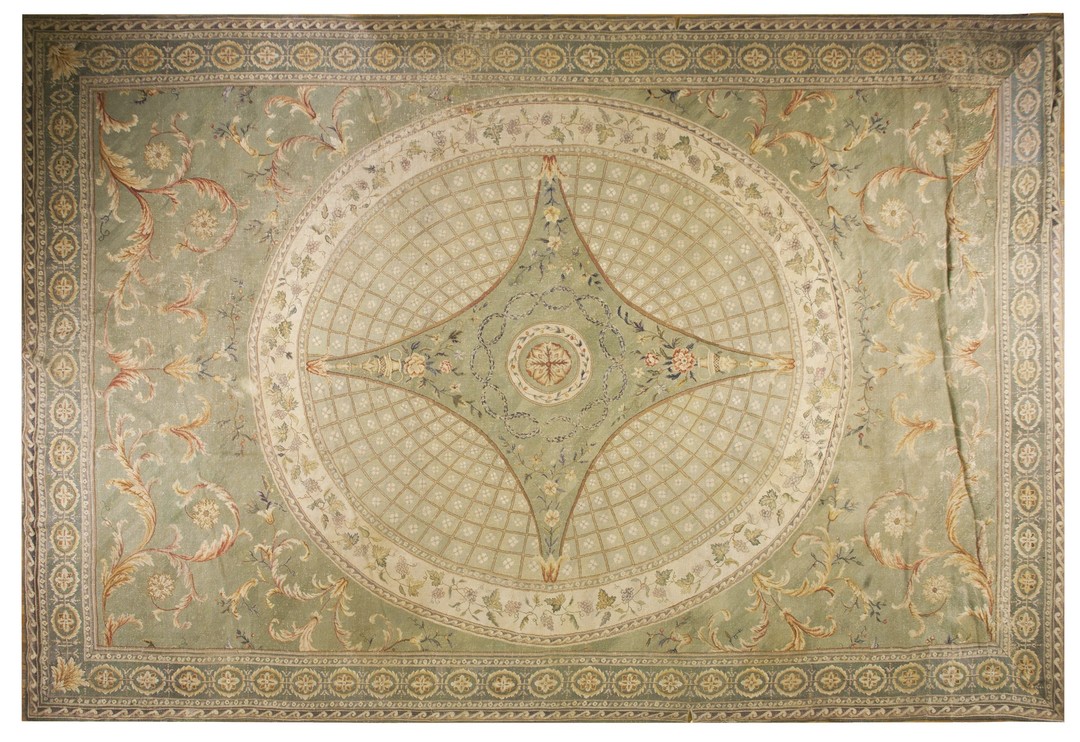
One of the most enduring inspirations for needlepoint rugs is the Aubusson pattern. Originating in France, Aubusson and its counterpart Savonnerie represented the pinnacle of woven carpet artistry. Needlepoint artisans embraced these patterns because they translated beautifully into embroidery: the medallion-centered layouts, ornate borders, and scrolling floral garlands lent themselves perfectly to canvas work. Their prestige also made them popular choices for aristocratic interiors seeking to emulate French refinement.
Why are Aubusson patterns popular in needlepoint? The answer lies in both elegance and practicality. Aubusson designs offered recognizable, balanced compositions that could be stitched without losing their sophistication. They evoked the grandeur of French heritage while remaining adaptable to the flatter, stitch-based construction of needlepoint. As a result, Aubusson-inspired rugs remain among the most widely produced and collected in the needlepoint category.
Layout & Composition
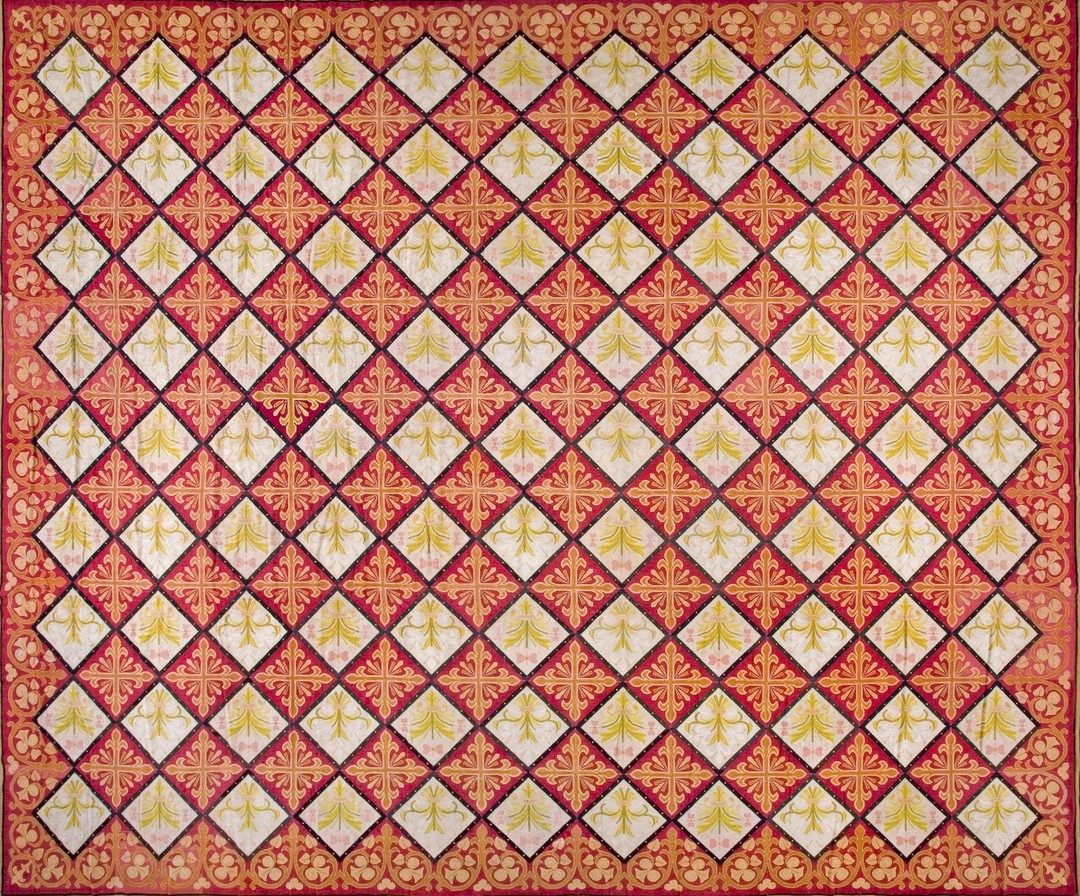
Beyond motifs and colors, the layout and composition of a needlepoint rug determine its visual impact. Central medallions framed by multiple borders were common, echoing Oriental rugs and Aubusson weaves. All-over floral repeats suited dining rooms or parlors, while pictorial or heraldic layouts were intended for statement pieces in drawing rooms.
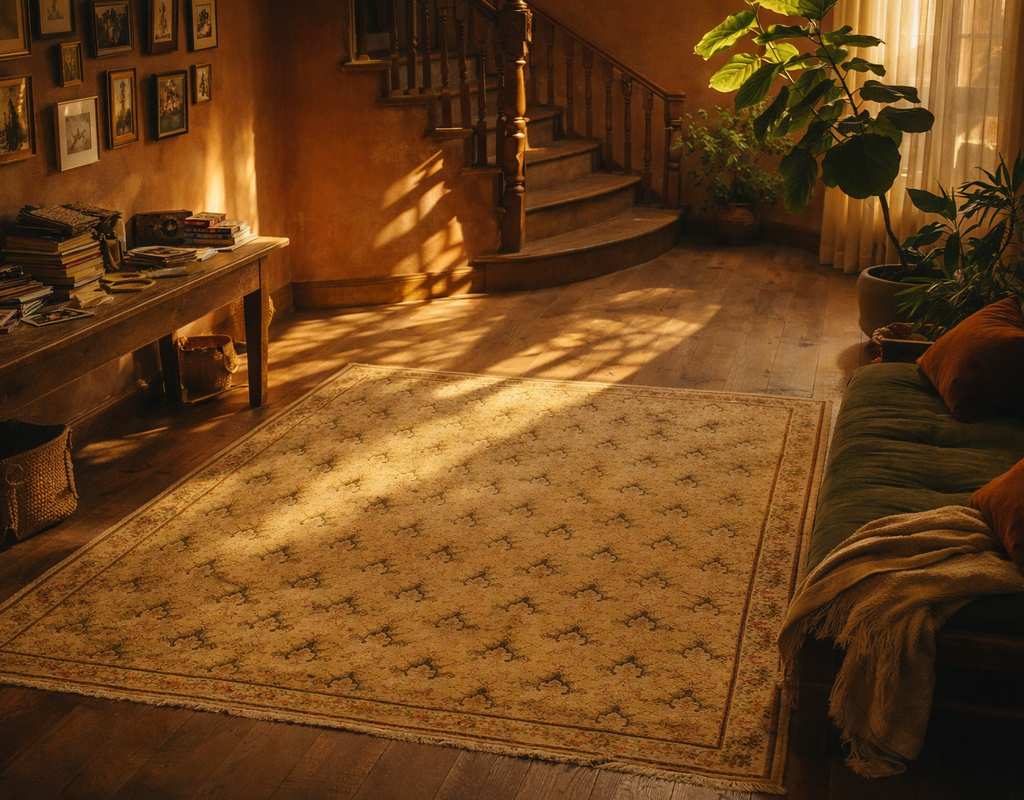
A richly textured, warmly lit space featuring a traditional patterned rug accenting the dark wood floors.
The flexibility of the medium meant artisans could scale a design from a small square to a full-room carpet, adjusting composition to fit the space. Ultimately, needlepoint rugs are defined by their ability to adapt almost any design tradition—from botanical still-life to geometric Moorish patterns—into a durable and decorative textile. Their use of classic needlepoint colors, embrace of Aubusson patterns, and wide-ranging motifs give them both historic authenticity and contemporary relevance.
Regional Variations and Notable Traditions
English & American Needlepoint Rugs
The English needlepoint rug tradition flourished from the 17th century onward, with designs that reflected the nation’s love of gardens and heraldry. Floral bouquets, roses, and ivy garlands became signature motifs, often arranged in repeating borders or all-over patterns. In the Victorian era, needlepoint in England embraced realism, with shaded blossoms and naturalistic depictions of fruit and foliage.
Heraldic crests and family emblems were also stitched into carpets, giving them both decorative and symbolic weight. When the craft crossed the Atlantic, American needlepoint rugs carried forward many of these floral and garden-inspired themes. By the 19th century, needlepoint had become a popular domestic pastime for middle- and upper-class women in the United States.
Rugs often featured patriotic symbols, stylized landscapes, or floral repeats suited to parlor display. The accessibility of pattern books and Berlin wool charts ensured that needlepoint remained one of the most enduring forms of home embroidery in both England and America.
French Needlepoint
French Aubusson needlepoint represents the most formal and aristocratic strain of the tradition. Inspired by the woven masterpieces of Aubusson and Savonnerie, French needlepoint rugs often featured central medallions, Rococo scrolls, neoclassical motifs, and elaborate borders.
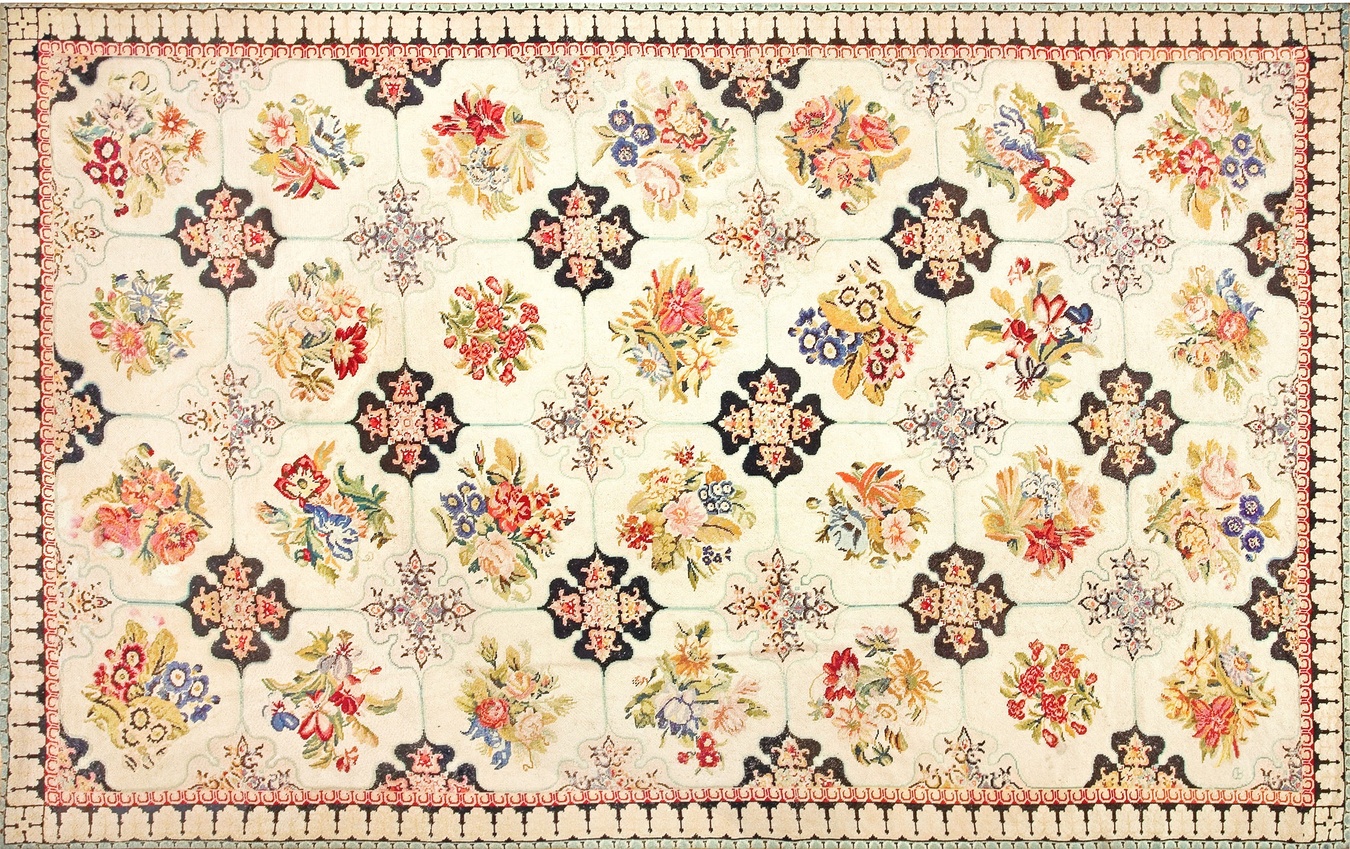
Antique Needlepoint Room Size Wool Ivory Rug – by Rugs On Net
These patterns translated well into the stitch-based medium, creating rugs that retained the prestige of their woven inspirations while remaining more affordable to produce. Their symmetry, elegance, and association with royal patronage ensured their enduring popularity across Europe and, later, in export markets.
Portuguese Arraiolos Rugs
The Arraiolos needlepoint tradition is one of the most distinctive regional variations. Produced in the Portuguese town of Arraiolos since the 16th century, these rugs are characterized by bold geometric and foliate motifs, stitched in vibrant wool on linen or jute canvas. Their diagonal stitch sets them apart technically, while their designs reveal the influence of Moorish arabesques and Jewish embroidery traditions brought to Iberia in the late medieval period.
What makes Arraiolos unique is their balance between folk art and fine craft. Unlike the formal Aubusson-inspired rugs of France, Arraiolos designs embraced Portuguese rural identity, often featuring stylized flowers, latticework, and bright color contrasts. Today, they remain symbols of national heritage, celebrated as a cross-cultural product of Iberian history.
Spanish, Central/Eastern European, and Chinese Production
Outside of the major Western traditions, needlepoint also found footholds elsewhere. In Spain, regional embroidery traditions influenced rug motifs, blending floral and geometric styles. Across Central and Eastern Europe, needlepoint rugs reflected local folk patterns, often featuring bolder contrasts and stylized borders distinct from Western European refinement.
The most significant expansion occurred in China during the 20th century, when workshops began producing Chinese needlepoint carpets for export. These pieces often replicated Aubusson and English floral patterns but stood out for their exceptionally fine craftsmanship and consistent quality. By catering to Western tastes while relying on skilled Chinese handwork, these exports revived global interest in needlepoint and ensured its continuation into modern markets.
Distinctive Regional Styles
Each region shaped regional needlepoint styles by adapting the medium to its cultural context. England and America favored florals and heraldry, France elevated Aubusson patterns into high art, Portugal blended Moorish and Jewish influences into Arraiolos folk designs and China reenergized the craft for the global stage.
Together, these traditions illustrate needlepoint’s remarkable adaptability, a textile form capable of embodying both local heritage and international exchange.
Cultural, Symbolic, and Artistic Relevance
Social Status, Gender Roles, and Symbolism
From their earliest appearance in European homes, needlepoint rugs carried meanings that extended well beyond decoration. To own or create one was a mark of wealth, refinement, and accomplishment, especially during the 18th and 19th centuries when embroidery was closely tied to women’s domestic roles.
Completing a large embroidered rug was considered evidence of patience, skill, and preparedness for married life. In many households, a needlepoint rug in the parlor was both a status symbol and a reflection of a family’s cultural taste.
Needlepoint rugs also functioned as personal and social signifiers. Women who stitched them often inserted initials, dates, or verses, transforming utilitarian objects into lasting records of life milestones. The act of making or owning one was intertwined with gender roles, reinforcing ideals of gentility and domestic virtue, while also allowing women a rare avenue of artistic expression within prescribed boundaries.
Motif Meanings
The needlepoint rug symbolism embedded in motifs was central to their cultural role. Common designs carried messages recognizable to contemporary audiences:
- Heraldic symbols — Why: Represented family lineage, authority, and social standing, turning a rug into a statement of identity.
- Roses — Why: Universally linked with love, beauty, and passion, often used in bridal or commemorative rugs.
- Ivy or vines — Why: Signified fidelity, continuity, and eternal connection, reflecting the ideals of family and loyalty.
- Lilies — Why: Associated with purity and spirituality, frequently included in ecclesiastical or commemorative pieces.
- Floral bouquets — Why: Expressed abundance and harmony, particularly popular in Victorian homes as emblems of cultivated taste.
Such motifs transformed rugs into more than floor coverings—they became symbolic texts, quietly narrating stories of devotion, family pride, or memory.
Needlepoint Rugs as Heirlooms & Collectibles
Over generations, many heirloom needlepoint rugs have been preserved as treasured family possessions. Their handcrafted nature imbued them with sentimental as well as material value. Passed down through households, they marked connections between generations and carried forward the artistry of ancestors.
Some rugs were even created specifically as memorials, commemorating marriages, births, or losses, ensuring their preservation as family testaments. In modern times, these rugs have also gained value as collectibles, sought after by museums, antique dealers, and private collectors. Their appeal lies not only in their craftsmanship but also in the stories encoded in their motifs—each stitch a fragment of personal, cultural, and artistic history. Ultimately, needlepoint rug symbolism shows that these textiles were never mere décor.
Through heraldic devices, floral motif meaning, and inscriptions, they embodied identity, continuity, and artistry. As both functional objects and heirlooms, they continue to bridge past and present, standing as reminders of how artistry, symbolism, and domestic life were interwoven across centuries.
Modern Market and Collecting
Where to Find Designer & Custom Needlepoint Rugs
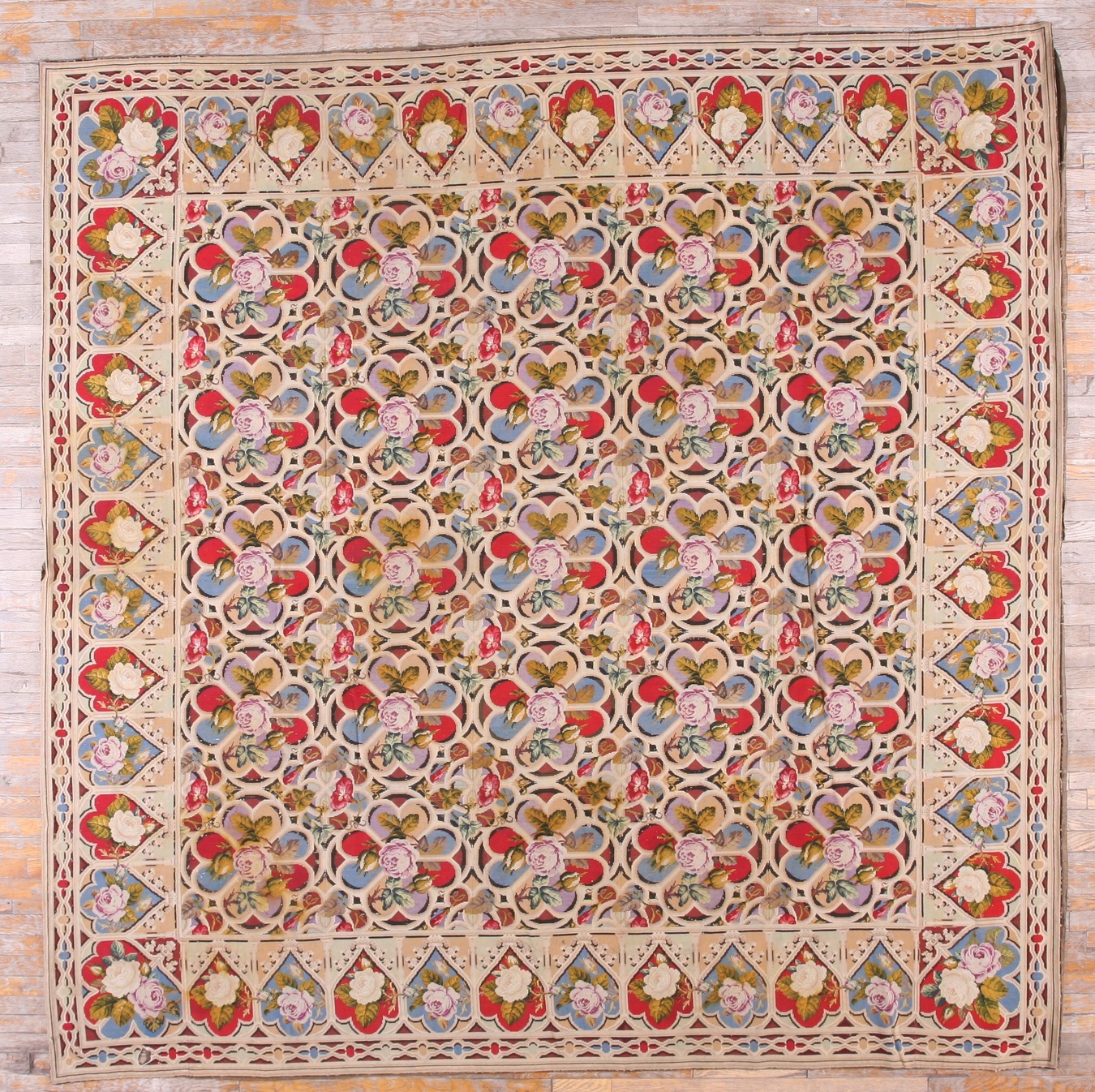
Today’s buyers have multiple avenues for acquiring designer or custom needlepoint carpets, ranging from antiques to contemporary creations:
- Specialty rug dealers and antique galleries — Why: Firms such as Doris Leslie Blau or Nazmiyal specialize in collectible textiles, offering authenticated antique and vintage needlepoint rugs.
- Luxury online rug retailers — Why: High-end shops curate selections of both antique and modern needlepoint carpets, often with detailed condition reports and provenance.
- Custom workshops in China, India, Vietnam, and Eastern Europe — Why: These regions remain major sources of hand-stitched rugs, capable of producing bespoke sizes and patterns.
- Interior designers and boutique studios — Why: Designers commission custom needlepoint floor coverings tailored to specific projects, blending heritage motifs with modern palettes.
For collectors or decorators, the needlepoint rug dealer remains the most reliable gateway to both historic and newly produced examples.
Contemporary Production & Major Sources
The modern market thrives on a combination of heritage reproduction and innovative design. Workshops in China have long produced fine-quality needlepoint carpets for export, emulating Aubusson, English florals, and contemporary patterns with tight stitching and durable wool. Production in India, Vietnam, and Eastern Europe complements this, offering both affordable and luxury-level rugs depending on workshop expertise.
Custom orders allow buyers to specify dimensions, colors, and motifs, ensuring that custom needlepoint carpets adapt seamlessly to modern interiors. Are contemporary needlepoint rugs resistant to heavy foot traffic? Yes—when crafted with high-quality wool and dense stitching, they are surprisingly durable and perform well in living rooms and dining areas. Antique or vintage examples, however, should be treated with care, often serving better as decorative accents or wall hangings.
Durability and Use in Modern Interiors
Beyond their decorative value, needlepoint rugs integrate easily into modern design. Their flat surfaces suit both traditional and contemporary settings, while their range of motifs—from floral to abstract—provides adaptability. Because they can be custom ordered to size, they are especially popular in interior design projects requiring a balance of historic charm and practical versatility.
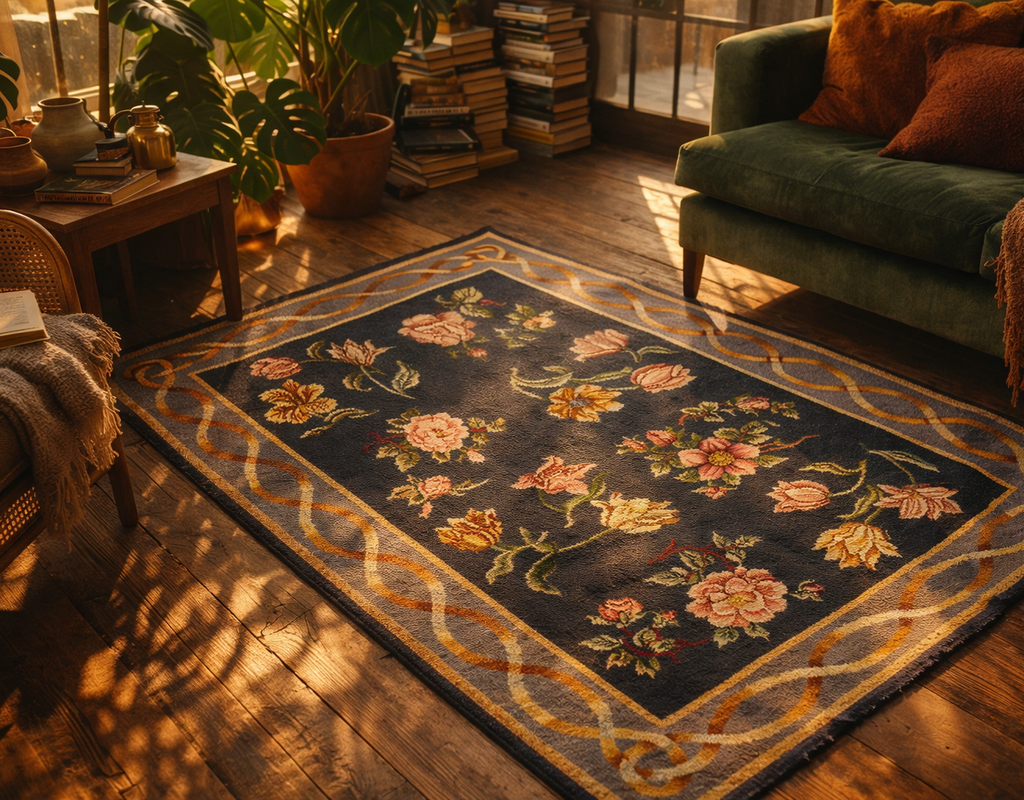
A richly patterned floral rug complements the warm, inviting tones of this sunlit reading nook.
Why do handmade needlepoint rugs command higher prices? The answer lies in their artisanal value. Each stitch represents hours of labor, and the quality of wool, canvas, and craftsmanship ensures longevity. Unlike mass-produced rugs, handmade needlepoints are often unique or produced in limited numbers, elevating them to the status of luxury textiles.
Appraisal, Restoration, and Investment Considerations
When evaluating an antique needlepoint appraisal, several factors determine value:
- Age and provenance — Why: Older rugs with documented history carry cultural and monetary weight.
- Condition — Why: Intact examples with minimal wear are prized; heavy damage reduces value.
- Materials and stitch technique — Why: High-quality wool, silk accents, and durable stitches increase desirability.
- Design and rarity — Why: Aubusson-inspired or heraldic motifs often fetch higher prices due to historic associations.
- Size — Why: Large-scale rugs demonstrate both technical mastery and greater decorative impact.
Should I invest in a restored needlepoint carpet or original? Original examples in good condition almost always carry higher value. Expert restoration can stabilize and preserve a rug, but amateur repairs reduce both aesthetics and price.
Collectors are advised to seek professional restoration only when it safeguards long-term integrity.
Online vs. In-Store Buying
The question of online needlepoint rug buying versus in-store acquisition often comes down to trust and access:
- Online buying — Why: Reputable dealers make it safe, provided buyers request high-resolution photos, condition reports, provenance documentation, and return policies. This expands access to global inventories without travel.
- In-store buying — Why: Physical inspection allows collectors to evaluate texture, stitch quality, and color firsthand, offering reassurance for high-value purchases.
In both cases, the collector’s focus should remain on provenance, craftsmanship, and condition. The modern market for needlepoint rugs demonstrates the balance between collectible antiques and flexible contemporary production.
Whether sourced from a leading needlepoint rug dealer, commissioned as a custom needlepoint carpet, or preserved as an investment needlepoint carpet, these textiles continue to attract attention as symbols of artistry, history, and enduring value.
Care, Maintenance, and Restoration
Cleaning Methods
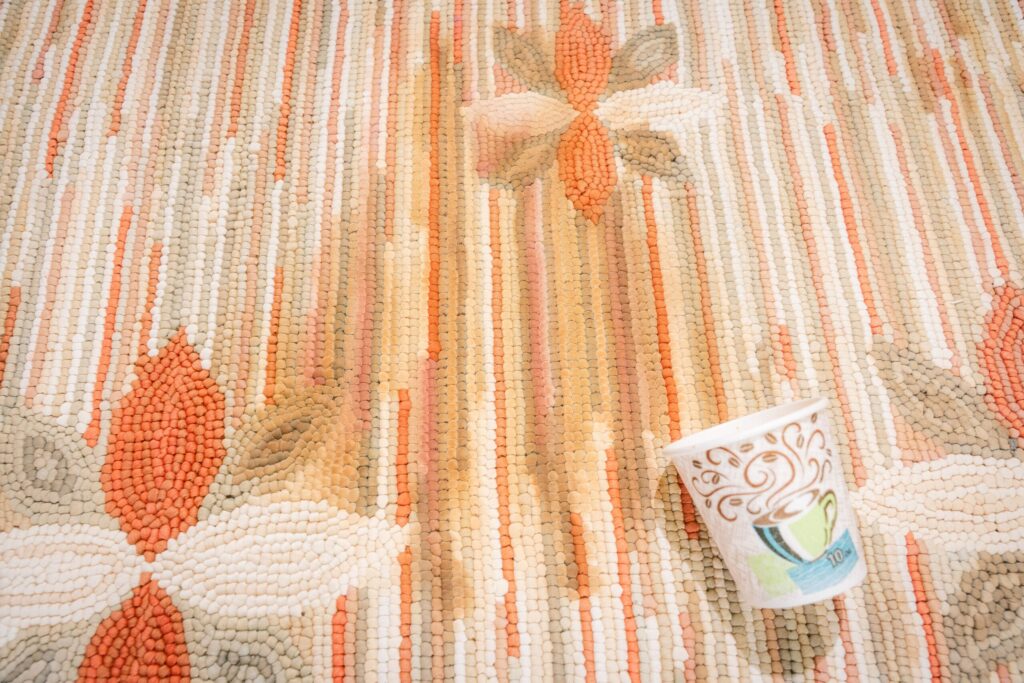
Close-up view of a tipped paper coffee cup resting on a handwoven wool rug, highlighting the rug’s dense pile, subtle color variations, and traditional geometric motifs in warm neutral and terracotta tones.
Proper maintenance is essential to preserving needlepoint carpets, especially fragile antique and vintage pieces. The safest approach to routine cleaning involves:
- Gentle vacuuming with a mesh screen — Why: A lightweight vacuum can remove dust and surface dirt, but the mesh prevents suction from pulling at delicate stitches.
- Professional hand-washing — Why: Trained conservators use mild, pH-balanced solutions to clean fibers without weakening the canvas foundation.
- Avoiding harsh chemicals — Why: Commercial cleaners and stain removers can strip dyes and damage wool or silk threads.
- Avoiding excessive wet cleaning — Why: Water can weaken canvas, distort stitches, and cause dye bleeding, particularly in fragile vintage needlepoint.
For households, the safest practice is light surface care at home combined with periodic professional cleaning, ensuring the rug retains both beauty and structural integrity.
Handling, Storage, and Display
Because needlepoint rugs are embroidered textiles, they require careful handling to prevent distortion. Always lift and move them with full support rather than dragging. When storing, rugs should be rolled rather than folded to avoid permanent creases, wrapped in breathable muslin or cotton cloth.
They should be kept in a cool, dry environment away from direct sunlight, which can fade dyes, and protected from humidity that encourages mold or mildew. When displayed, placement matters: avoid high-traffic areas for fragile antiques, and consider using a rug pad for modern or sturdier pieces to reduce wear. For particularly valuable examples, wall-hanging ensures preservation while still showcasing artistry.
Restoration vs. Original Value
At some point, many owners face the decision to repair or leave their rug in original condition. Should I invest in a restored needlepoint carpet or original? The answer depends on purpose and value. Original pieces in good condition almost always carry higher monetary and historical worth.
However, expert restoration of vintage needlepoint can extend usability, stabilize weakened areas, and recover visual appeal, provided it is done by professional textile conservators.
Poorly executed repairs, by contrast, may diminish both beauty and value. For collectors, restoration is best approached as a way to preserve needlepoint rugs rather than enhance them. When performed with archival techniques, it can safeguard a rug’s future while respecting its authenticity.
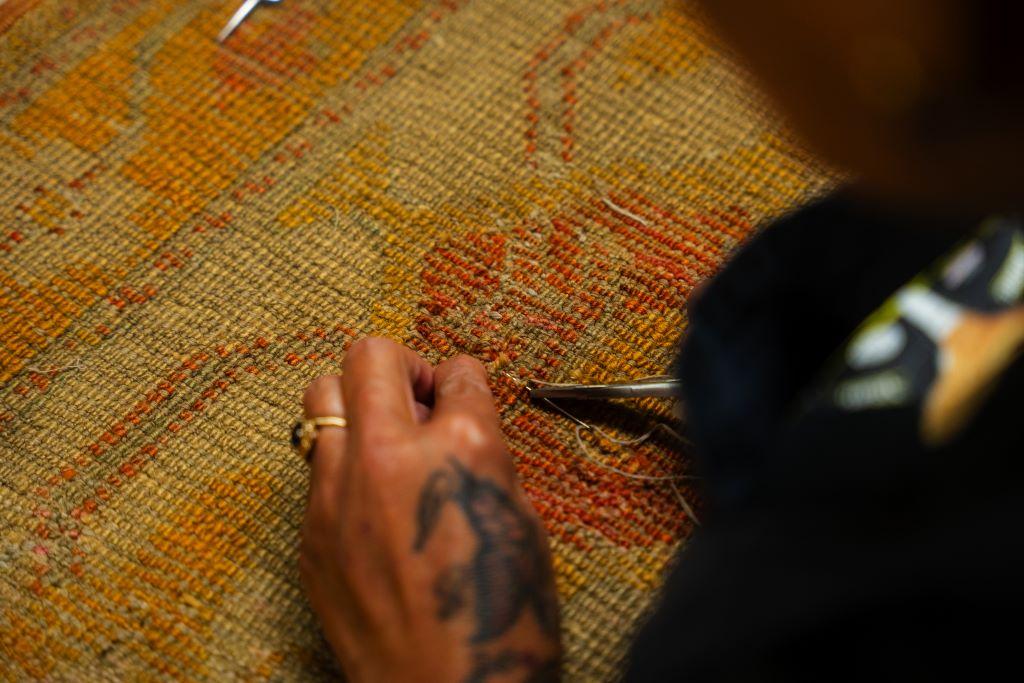
Detail of hands mending a rustic, richly colored woven rug.
For everyday owners, restoration can make a family heirloom suitable for continued use, even if resale value is secondary. Ultimately, needlepoint rug care is about balancing preservation with enjoyment.
By cleaning gently, storing thoughtfully, and considering restoration only under expert hands, owners ensure that these delicate embroidered works of art continue to endure for generations.
Browse Some of Our Needlepoint Rugs
FAQ
- How often should a needlepoint rug be professionally cleaned?
Every 12–18 months, sooner with pets/heavy traffic. Request dye testing and blocking to keep the canvas square.
- Can a needlepoint rug be used outdoors?
No—wool absorbs moisture and can mold. Keep needlepoint rugs indoors or in dry, covered spaces only.
- Where are needlepoint rugs from?
Historic English and French needlepoint rugs are common; Portuguese Arraiolos embroideries are iconic, and later Chinese needlepoint rugs appear from the 19th–20th centuries.
- What do needlepoint rugs cost?
DIY needlepoint rug canvases often run \~\$300–\$1,400; finished vintage/antique needlepoint rugs range from a few hundred dollars to \$50,000+ depending on size and provenance.
- How should I store a needlepoint rug?
Clean, roll (never fold), and wrap in breathable cotton or Tyvek—avoid plastic. Store in a cool, dry space; add cedar or traps to deter moths.
- How do I flatten a curled needlepoint rug corner?
Reverse-roll, lightly steam, then weigh the corner until dry. Corner grippers and a properly sized pad help prevent re-curling.
- Can I trim or cut a needlepoint rug to fit?
Avoid DIY trimming—the canvas can unravel. If resizing is essential, have a finisher rebind or border the edges professionally.
- Are needlepoint rugs good for stairs or hall runners?
They can work, but edges may curl and stitches can snag. Use professional installation, stair rods/tape where appropriate, and a non-slip underlay.
- Can I use a robot vacuum on a needlepoint rug?
Use suction-only modes and avoid spinning brushes or long fringe. Test a small area first and fence the rug in your robot’s app if needed.
- Can a needlepoint rug be used on radiant floor heating?
Yes—wool works with radiant heat. Choose a pad rated for heated floors (felt/natural-rubber), and avoid PVC pads that can off-gas or mark finishes.
- Are needlepoint rugs reversible?
Usually not—the back shows canvas and tie-offs. Use a pad to protect floors instead of flipping.
- What materials are needlepoint rugs made from?
Typically wool yarn stitched on cotton, linen, or jute canvas. Many modern needlepoint rugs use cotton backings; Portuguese Arraiolos examples use wool on jute/linen.
- Are needlepoint rugs the same as hooked rugs?
No. Hooked rugs pull loops through backing with a hook; needlepoint rugs stitch yarn through canvas (often tent/basketweave), creating a flat embroidered face.
- What’s the difference between an Aubusson rug and a needlepoint rug?
Aubusson is woven tapestry fabric; a needlepoint rug is embroidered (stitched) onto canvas. The look can overlap, but construction and wear differ.
- Do needlepoint rugs need a rug pad?
Absolutely—use a felt + natural-rubber pad for grip and protection. Aim for 1/8″–1/4″ thickness and trim the pad 1–2″ smaller than the rug.
- Will a needlepoint rug fade in sunlight?
Yes—UV light fades wool dyes over time. Use UV-filtering window film/curtains and rotate the rug every 3–6 months.
- Do needlepoint rugs shed?
Minimal compared to cut-pile rugs, but some surface lint is normal early on. Gentle, frequent vacuuming reduces fuzzing.
- How do I spot clean spills on a needlepoint rug?
Blot (don’t rub), then dab a mild dish-soap solution and rinse with a damp cloth. If color transfers to a white towel, stop and call a pro.
- Can I steam clean a needlepoint rug?
Generally no—high heat and moisture can loosen stitches and cause dye bleed. Choose professional low-moisture cleaning after a dye-stability test.
- How do I vacuum a needlepoint rug?
Use suction-only with the beater/brush roll OFF, weekly or as needed. Vacuum front and back; avoid catching fringe or stitching.
- Are needlepoint rugs pet-friendly?
Low pile helps with hair, but claws can snag stitches like other loop/embroidered surfaces. Keep nails trimmed and choose tighter “gros point” stitching for durability.
- Can needlepoint rugs go under a dining table?
Yes, but avoid chair casters and size the rug \~24 inches larger on all sides so chairs stay on the rug. Blot spills immediately to prevent dye bleed.
- Are needlepoint rugs good for high-traffic areas?
They handle moderate traffic (living rooms, libraries, dining), but avoid mudrooms or rolling-chair zones. Use a pad and rotate every 3–6 months to spread wear.
- Are needlepoint rugs durable for daily use?
Yes—well-made needlepoint rugs withstand regular living-room use, especially with a quality rug pad. Avoid rough abuse; millions of stitches are strong, but loops can snag under casters.
- What is a needlepoint rug?
A needlepoint rug is hand-stitched wool yarn on an open-weave canvas, creating a flat, no-pile surface. Designs are built stitch-by-stitch (often tent/basketweave) across the entire canvas.