
Introduction to Moroccan Rugs
Explore our complete range of authentic Moroccan rugs , Boucherouitte rugs and Berber Carpet collection available to purchase now.
What Defines a Moroccan Rug?
A Moroccan rug is instantly recognizable for its thick, tactile pile and bold, improvisational patterns. Unlike Persian carpets, which are typically woven according to meticulous blueprints and symmetrical medallions, Moroccan tribal rugs often follow no predetermined design. The weaver creates motifs spontaneously, drawing on personal memory, cultural symbolism, or tribal tradition.
This results in abstract, geometric forms—diamonds, zigzags, ladders, and symbolic figures—that carry meanings tied to fertility, protection, or spirituality. The heavy pile serves a practical purpose, originally designed to keep families warm in the harsh mountain winters of the Atlas or serve as bedding in Berber tents.
This utilitarian yet artistic balance is one of the most defining features of Moroccan tribal rugs. What makes Moroccan rugs unique compared to Persian rugs is precisely this contrast: while Persian carpets emphasize ornamental precision and luxury, Moroccan rugs emphasize warmth, abstraction, and improvisation. They embody a freer, almost modernist aesthetic that predates modern art movements by centuries, explaining their enduring popularity in contemporary interiors.
Ancient Origins and Cultural Heritage
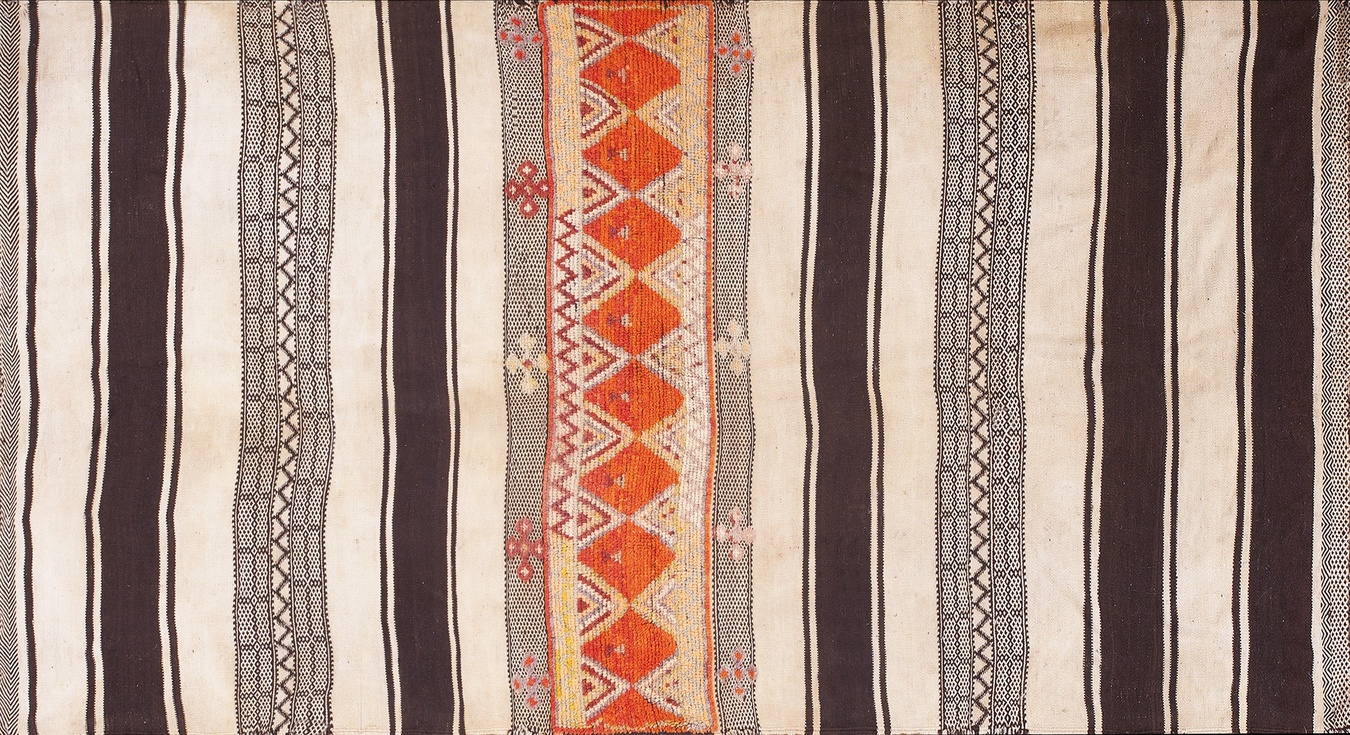
Antique Kilim – Moroccan Moroccan Knotted Rug – by Rugs On Net
The roots of Moroccan rug weaving stretch deep into antiquity. Archaeological evidence and stylistic comparisons suggest that weaving in Morocco may trace back thousands of years, with Paleolithic origins echoed in motifs that resemble ancient Mediterranean and North African art. This makes Moroccan tribal rugs not just home furnishings but living relics of one of humanity’s oldest textile traditions. Berber carpet history is central to this narrative.
The Berber tribes, indigenous to North Africa, are believed to have begun weaving rugs in Morocco in prehistoric times, long before the spread of Islam or contact with the Middle East. These early rugs were practical objects—made for insulation, sleeping, or floor covering—yet they simultaneously carried the weight of cultural storytelling. Each piece was imbued with motifs passed down through generations, linking the domestic to the sacred and the personal to the communal.
Today, the legacy of ancient rug weaving in Morocco continues to resonate. Moroccan tribal rugs have journeyed from humble tribal homes to global design capitals, celebrated for their authenticity, history, and abstract beauty. Their enduring appeal lies in this dual identity: deeply rooted in ancestral tradition, yet perfectly suited to modern minimalist aesthetics. In every knot and motif, they carry both the memory of Berber heritage and the timeless adaptability that keeps them relevant across centuries.
Name, Etymology & Key Rug Types
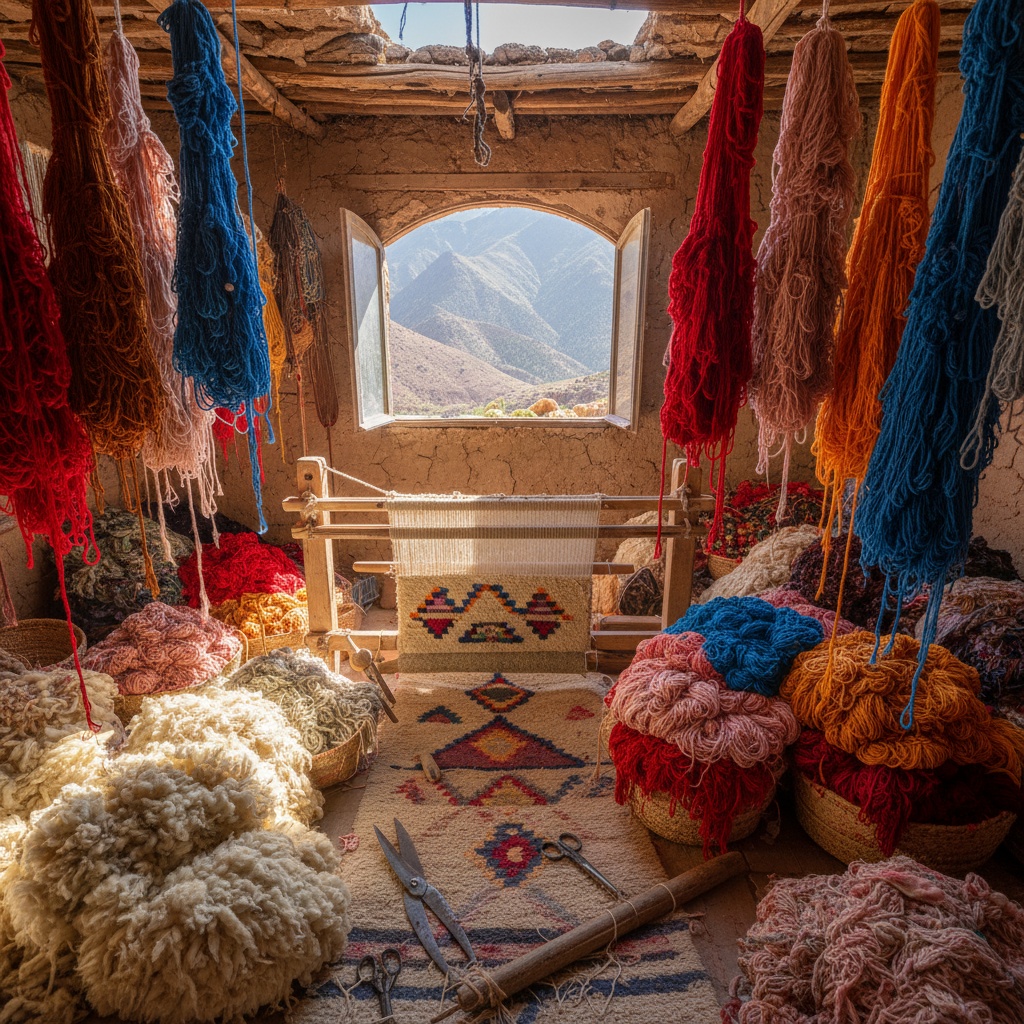
Materials and loom setup for traditional textile creation.
The Meaning Behind “Moroccan Rug”
The term Moroccan rug broadly refers to all handwoven carpets made within Morocco, though many are also described as Berber carpets, reflecting their deep ties to the indigenous Berber tribes. Unlike generic commercial labels, these names carry layers of meaning, pointing to a rug’s geographic, tribal, or cultural origin. Each designation is not simply a category but a clue—offering insight into the community that wove it, the environment that shaped it, and the traditions that continue to inform its design. Understanding these names is essential for distinguishing authentic Moroccan rug types from generic reproductions.
Common Regional & Tribal Substyles
- Beni Ourain Rugs — Thick, ivory wool rugs woven by the Beni Ourain tribes of the Middle Atlas Mountains. Their minimalist black diamond patterns and natural tones make them icons of modern design. — Why: They represent purity of material (undyed wool) and are among the most globally recognizable Berber carpet styles.
- Azilal Rugs — Named after the Azilal region in the High Atlas, these pieces are more colorful and experimental than Beni Ourain rugs, often blending abstract patterns with vivid hues. — Why: They embody the spontaneous artistry of Berber weavers and are prized for their expressive character.
- Boujad Rugs — Originating from the town of Boujad on the Haouz plains, these rugs typically use warm reds, pinks, and oranges with looser, improvised geometric motifs. — Why: They are beloved for their vintage charm, often appearing in mid-20th-century forms that appeal to collectors of Moroccan tribal rugs.
- Taznakht Rugs — From the town of Taznakht in the Siroua region, these rugs often combine kilim flatweave techniques with knotted pile, showcasing bold medallions and strong color contrasts. — Why: This mix of methods makes them some of the most technically sophisticated Moroccan rug types. The Siroua region remains the source of the most renowned Taznakht kilim rugs.
- Boucherouite Rugs — The word “Boucherouite” literally means rag rug, created from recycled textiles such as cotton, nylon, and wool remnants. — Why: They embody resourcefulness, sustainability, and creativity, turning discarded materials into vibrant household art.
Notable Terms: Beni Ourain, Azilal, Boujad, Taznakht, Boucherouite
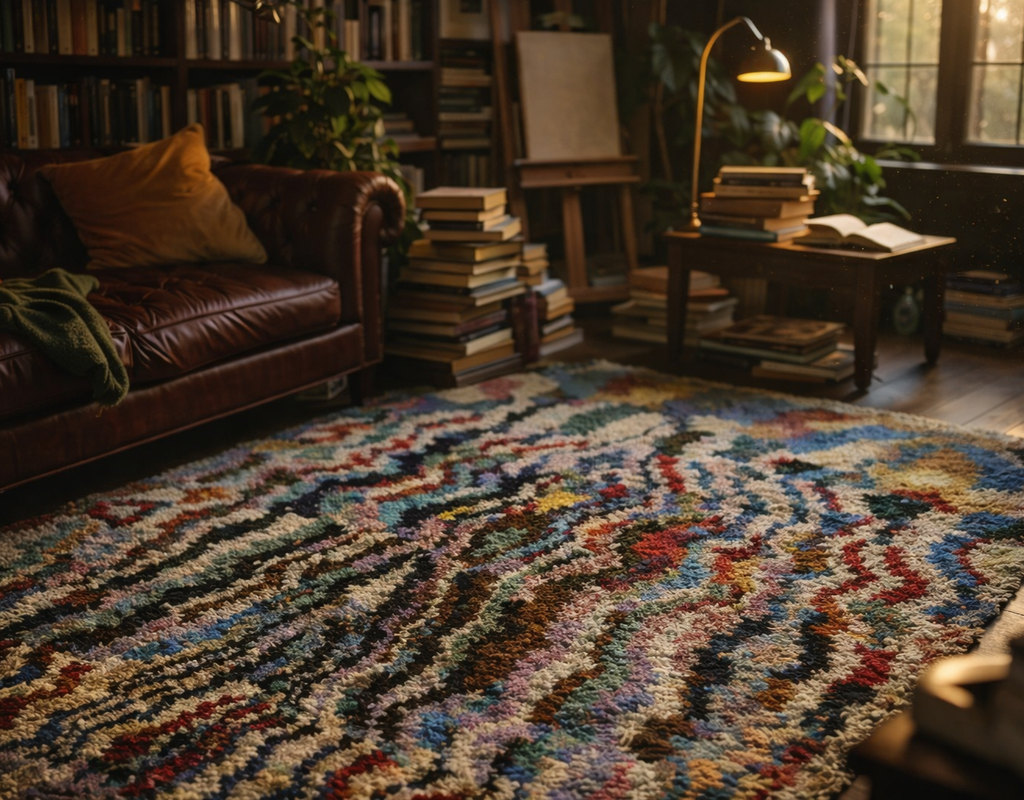
A colorful, modern abstract rug brings a playful contrast to a traditional, book-filled study.
Each of these terms reflects both a place and a way of life:
- Beni Ourain meaning: “Sons of Ourain,” a tribal designation tied to their snowy Atlas Mountain environment.
- Azilal rug definition: Woven in the Azilal region, defined by colorful improvisation and symbolic motifs.
- Boujad: A town whose rugs, mostly vintage, display warm palettes and looser tribal expression.
- Taznakht: A Siroua mountain town whose name is synonymous with fine kilim and pile-woven hybrids.
- Boucherouite: Meaning “rag rug,” highlighting the innovative reuse of textiles in Moroccan weaving.
Together, these substyle names form a map of Moroccan weaving traditions. They are not just design categories—they anchor rugs to specific landscapes, tribes, and histories, ensuring that collectors and enthusiasts can trace authenticity and cultural value.
Geographic & Cultural Roots
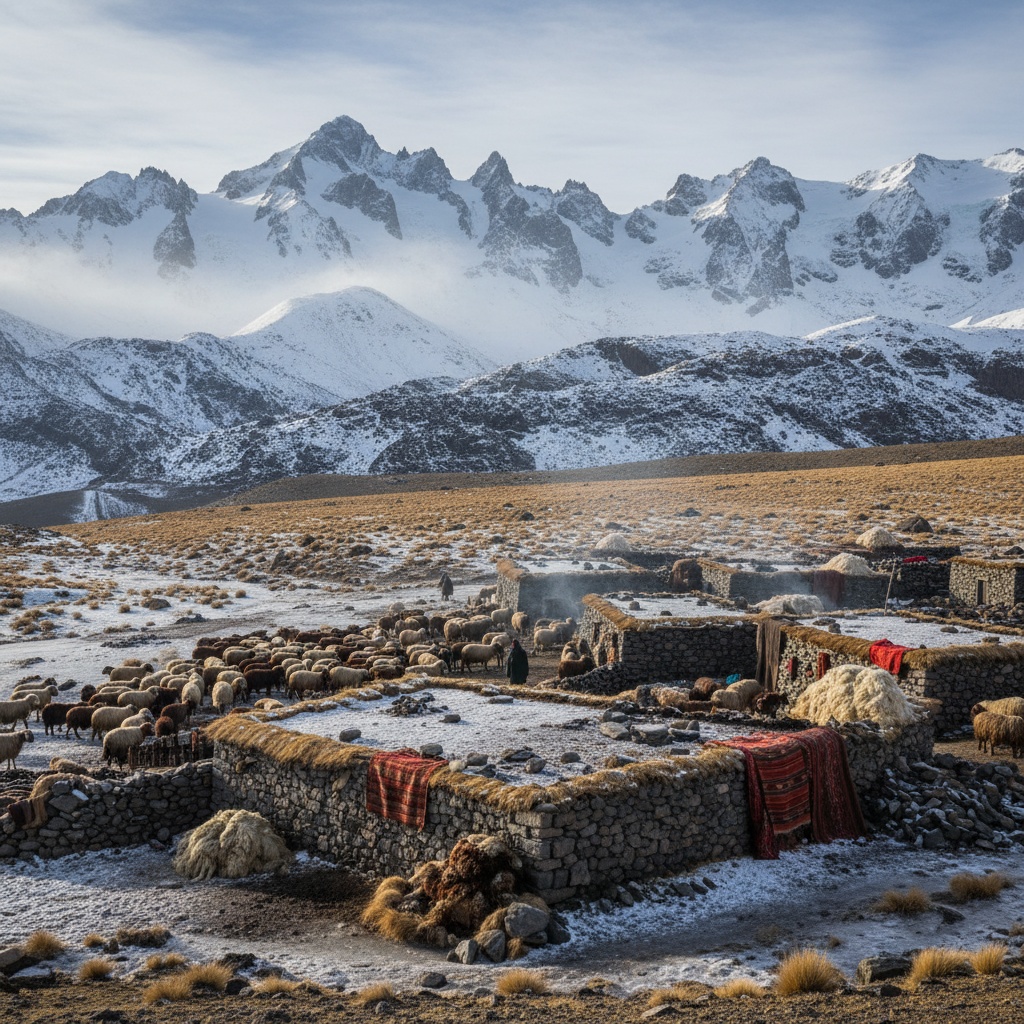
High-altitude pastoral life near rugged peaks.
Atlas Mountains’ Influence
The geography of Morocco, particularly the Atlas Mountains, is inseparable from the story of Moroccan rugs. The region’s dramatic climate—scorching summers, bitterly cold winters, and shifting altitudes—dictated the very structure of its textiles. High-pile rugs were developed by nomadic Berber tribes as insulation against freezing mountain nights, while lighter flatweaves served for milder conditions or seasonal migrations.
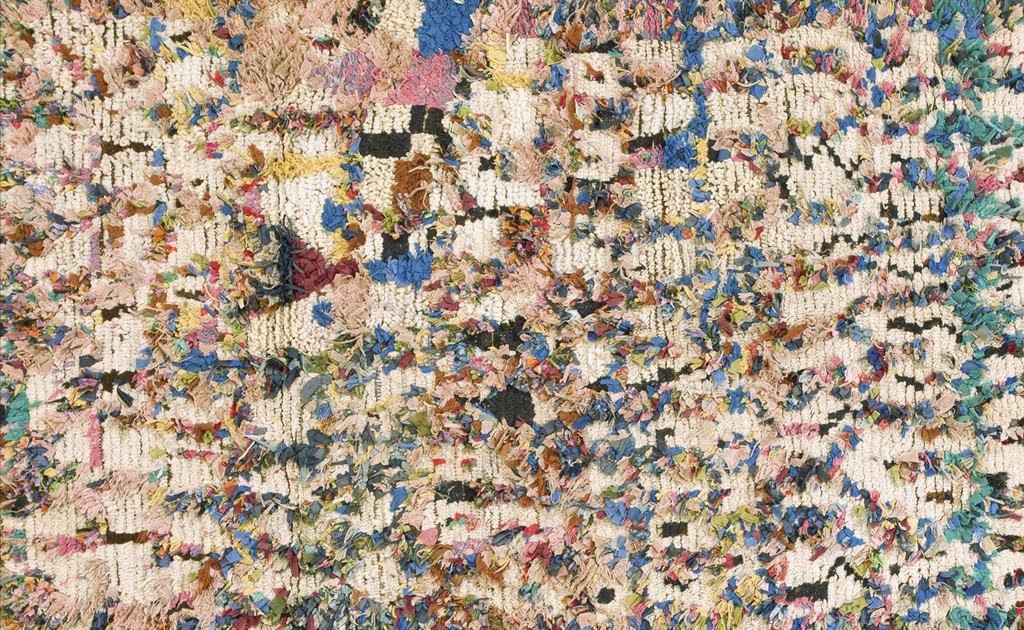
Vintage Berber Moroccan Boucherouitte Small Scatter Size Wool & Cotton Rug by Rugs On Net
This direct response to environment explains why Moroccan nomads developed thick, shaggy rugs: survival demanded warmth underfoot and as bedding. Local materials further reinforce this bond with geography. Sheep bred in the Atlas are prized for their dense, resilient wool, perfectly suited to heavy pile weaving. Even the dyes—drawn from indigenous plants, minerals, and earth—reflect the natural landscape.
Thus, the Atlas Mountains climate is not only reflected in rug designs but embedded in the very wool itself, shaping the plush textures that made areas such as Khénifra province renowned for producing some of Morocco’s most luxurious rugs.
Traditional Weaving in Berber Life
- Domestic necessity — Rugs provided insulation, bedding, and floor coverings essential to mountain and desert living. — Why: Weaving was born from practicality, with design emerging as a secondary but enduring layer.
- Symbolic storytelling — Motifs often carried protective or spiritual meaning, encoding Berber identity into everyday objects. — Why: This turned rugs into both useful textiles and carriers of cultural memory.
- Tribal identity — Each community developed distinct styles, knotting methods, and patterns tied to its geography. — Why: Rugs acted as a visual signature of tribal belonging, making them both personal and communal artifacts.
- Economic value — Beyond the home, weaving became a form of exchange and trade. — Why: It contributed to tribal resilience and connection with broader markets.
Role of Women and Generational Transmission
The Berber weaving tradition is profoundly matrilineal. Women are the keepers of this craft, transmitting skills, patterns, and stories from mother to daughter. Weaving was historically done within the home, occupying a central role in daily domestic life. Each rug reflected not only environmental adaptation but also personal expression—women often improvised motifs that represented fertility, protection, or stages of life. This generational continuity ensured the survival of Moroccan rug geography and culture through centuries of change.
Even as global markets embraced Moroccan tribal rugs for their abstract beauty, their roots remain in the hands of Berber women who wove them for their families long before collectors prized them. The rugs are thus both functional textiles and cultural documents, recording the intertwined legacies of landscape, survival, and identity.
Design Characteristics
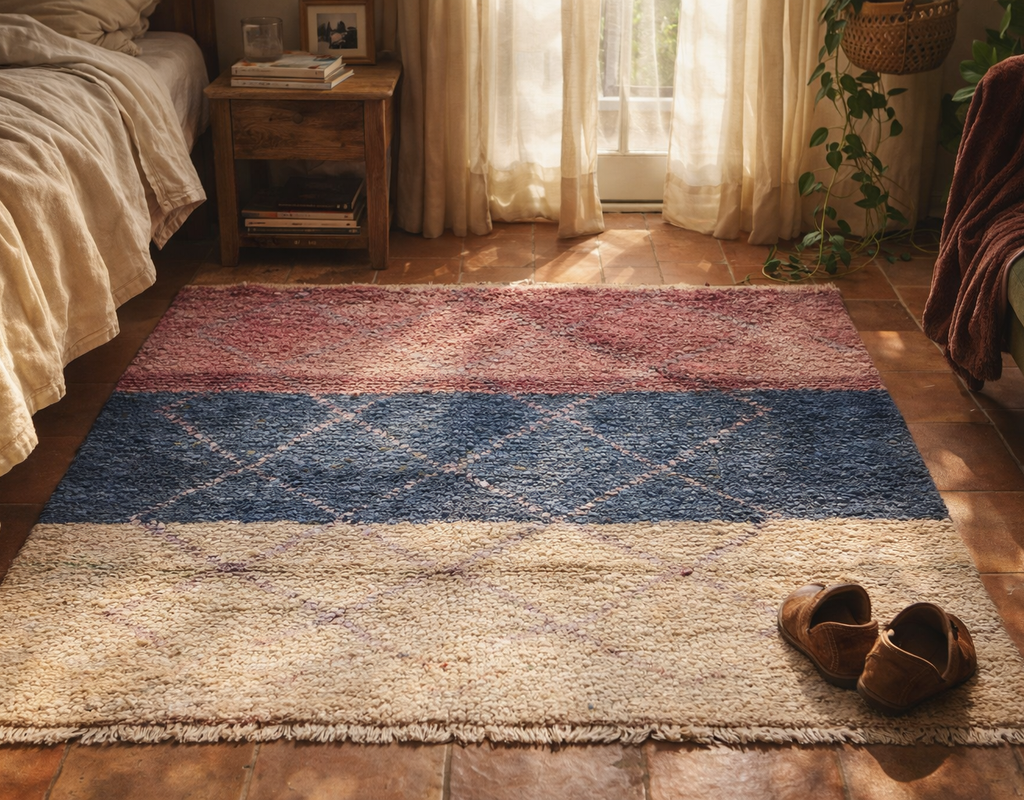
A textured, colorful area rug anchors this sun-drenched, relaxed bedroom space.
Geometric Motifs & Symbolism
- Diamonds — The most common Berber rug symbols, often interpreted as protection against the evil eye or as fertility icons. — Why: They embody both spiritual safeguarding and the cyclical continuity of life.
- Zigzags and lines — Represent water, serpents, or life paths, reminding the weaver’s family of survival and movement in the harsh Atlas terrain. — Why: These motifs directly tie the design to the nomadic lifestyle and landscape.
- Crosses and X-shapes — Protective symbols that ward off negative energy. — Why: Their presence highlights the deep spiritual function of Moroccan rug design.
- Abstract human or animal forms — Occasionally woven into Middle Atlas rugs, reflecting daily life and tribal mythology. — Why: These motifs act as cultural memory, embedding identity into utilitarian textiles.
The symbols most commonly appearing in Middle Atlas rugs are diamonds and zigzags, often arranged in loose grids or linear progressions.
Color, Palette, and Dye Sources
The Moroccan rug color palette ranges widely, from the natural ivory and charcoal tones of undyed wool in Beni Ourain rugs to the vivid reds, blues, saffron yellows, and pinks of Boujad and Azilal rugs. Historically, colors were derived from natural sources: madder root for red, indigo for blue, saffron or turmeric for yellow, and walnut husks for brown. With the 20th century came the introduction of synthetic dyes, leading to even bolder palettes.
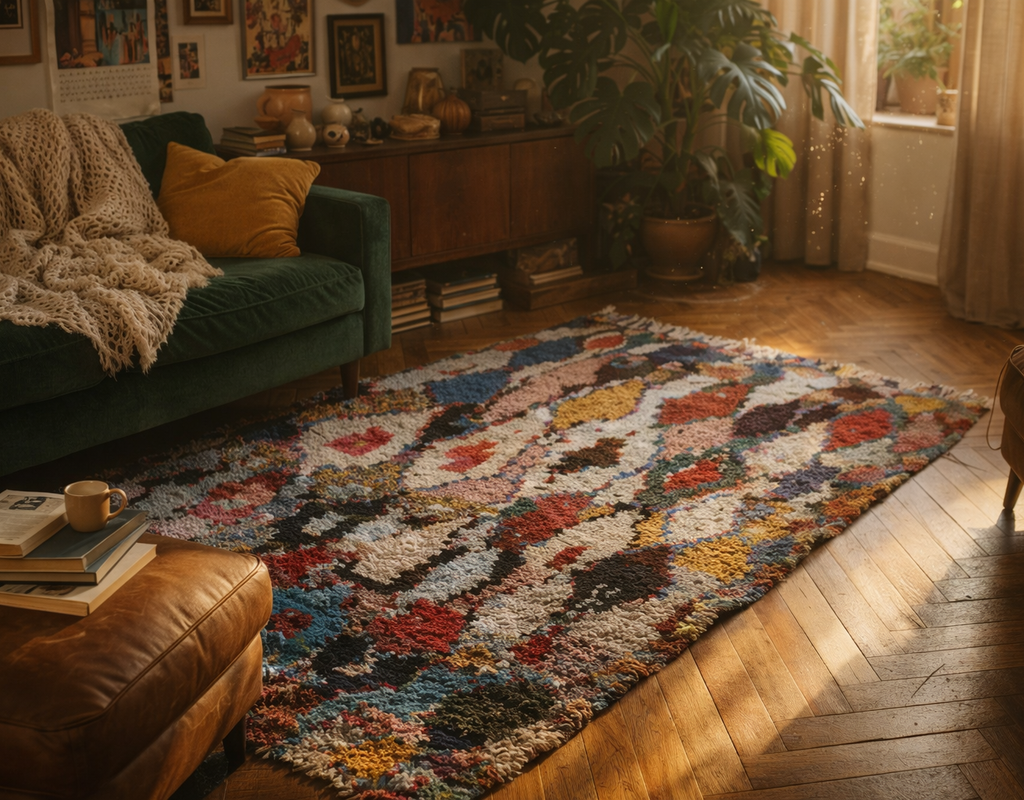
A vibrant, eclectic living space illuminated by sunbeams highlighting the rich textures of the furniture and rug.
Antique Moroccan – Rabat Moroccan Ivory 1940s Rug – by Rugs On Net
In Boujad rugs, red dominates the design. This is not merely aesthetic but cultural: red signifies vitality, protection, and female energy within Berber rug symbolism.
By contrast, Beni Ourain rugs remain subdued, with stark black geometric lines woven against a cream wool background. These dark lines stand out not only as decoration but also as a minimalist language of symbols, making their meaning both practical and spiritual.
Improvisation & Asymmetry vs. Persian Symmetry
A defining trait of Moroccan rug design is improvisation. Unlike Persian carpets, which are known for symmetrical medallions, balanced borders, and formal blueprints, Moroccan rugs embrace spontaneity. Borders are often absent, fields remain open, and motifs drift freely across the surface. Asymmetry is common, and irregularities such as abrash—subtle shifts in tone from hand-dyed wool—are celebrated as proof of authenticity.
This freedom of form means that no two Moroccan tribal rugs are alike. Each is a one-of-a-kind creation, echoing the weaver’s emotions, circumstances, and environment in real time. Where Persian rugs represent ornamental perfection, Moroccan rugs represent living expression.
Layout: Borders, Medallions, and Open Fields
The overall layout of Moroccan rugs reflects their tribal origins. Many are borderless, with designs bleeding into the edges, rejecting the structured frames of Persian weaving. Central medallions, so iconic in Persian carpets, are rare; instead, Moroccan rugs often feature open fields populated by scattered motifs.
Beni Ourain rugs exemplify minimalism with their unframed diamond chains, while Azilal and Boucherouite rugs fill the field with a riot of colors and abstract symbols. This contrast between minimalist Beni Ourain and the vibrant exuberance of Azilal or Boucherouite rugs illustrates the breadth of Moroccan weaving. Together, they demonstrate how Berber rug symbols and palettes can range from meditative restraint to expressive explosion—all rooted in cultural heritage and improvisational design.
Materials & Construction
Wool, Cotton, and Modern Fibers
- Wool — The cornerstone of Moroccan rug materials, prized for its warmth, durability, and availability from sheep grazing in the Atlas Mountains. — Why: Wool defines the plush pile of classic Moroccan rugs and reflects the pastoral life of Berber communities.
- Cotton — Often used for warps or as supplementary fibers in flatweaves. — Why: Cotton strengthens the structure and provides a stable foundation for intricate weaving.
- Goat hair — Occasionally blended with wool for durability, though coarser in texture. — Why: It demonstrates how Berber rug construction adapts to whatever fibers are locally available.
- Recycled textiles — Central to the Boucherouite style, which incorporates nylon, cotton, and leftover scraps. — Why: This innovation reflects sustainability and resourcefulness, transforming cast-off materials into vivid works of art.
Natural vs. Synthetic Dyes in Past and Present
Traditionally, Moroccan rugs were colored with natural dyes drawn from plants, roots, and minerals: madder root for rich reds, indigo for deep blues, saffron or turmeric for yellows, and walnut husks or pomegranate skins for browns. These natural dye Moroccan rugs produced hues that softened gracefully with age, a hallmark of authenticity. Today, many rural weavers still rely on these time-honored techniques, but the 20th century brought widespread adoption of synthetic dyes.
Synthetics allow for more vivid, varied palettes and are less costly. As a result, modern Moroccan rugs can range from naturally muted earth tones to intensely bright shades, depending on the weaver’s access to materials and markets. Natural dyes are still used, particularly in fine artisan rugs, but synthetics dominate mass production.
Weaving Techniques: Berber Knot, Flatweave, Mixed Methods
Traditional hand-knotted Moroccan carpets are often made using the Berber knot, a looping knot that produces a thick, lofty pile ideal for insulation. This differs from the symmetrical Turkish (Ghiordes) knot, which creates a denser, more uniform surface. Flatweave techniques—kilims or hanbels—require no knots, instead interlacing weft and warp threads for a lighter, flexible textile.
Some of the most sophisticated rugs, such as Taznakht pieces, blend techniques: sections of knotted pile combined with geometric flatweave panels. These mixed methods showcase the technical range of Berber weavers, with each approach tailored to climate and use.
How are Moroccan rugs traditionally made by Berber weavers? By hand, using wooden looms, natural fibers, and knotting or flatweaving methods passed down through generations. Each rug is woven slowly, often improvised in design, and shaped by the available wool, dyes, and tools.
Rug Texture: High-pile vs. Flatweave
The textures of Moroccan rugs directly reflect nomadic needs. High-pile rugs—plush, insulating, and heavy—were indispensable in the frigid Atlas Mountains, doubling as bedding and floor covering. In contrast, flatweave rugs thrived in warmer lowland regions, offering lighter coverings that were portable and easy to clean. This environmental response highlights how Berber rug construction was never just aesthetic but essential to survival.

A detailed focus on the intricate, vivid colors and geometric weave of a traditional textile rug.
Weaving a large, fine rug is an extraordinary commitment of labor. A hand-knotted Moroccan carpet such as a Taznakht masterpiece can take six to nine months to complete, depending on size and intricacy.
Every knot is tied by hand, every line built from memory or imagination, making each rug a slow work of endurance and artistry. In the end, materials and methods define both quality and character: wool or recycled fibers, natural or synthetic dyes, high pile or flatweave, each choice reveals how Moroccan weavers adapt to environment, necessity, and tradition.
Historical Evolution of Moroccan Rug Weaving
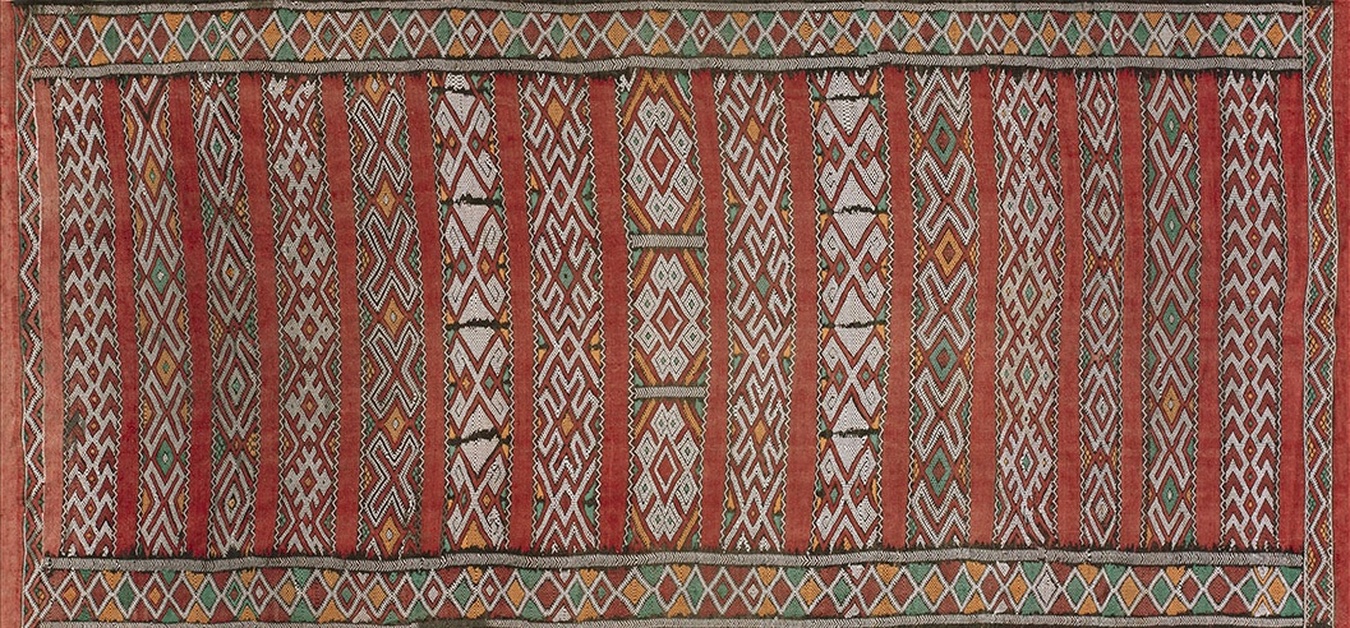
Antique Moroccan – Rabat Flat Weave Rug – by Rugs On Net
Pre-19th Century: Archaic Heritage
The history of Moroccan rugs stretches deep into antiquity, with weaving traditions likely thousands of years old. While the earliest written references appear in the 12th and 13th centuries, the Berber carpet evolution is rooted in prehistoric domestic craft, shaped by nomadic life in the Atlas Mountains.
Tribal rugs were created primarily for warmth, bedding, and survival, yet they carried symbolic motifs that encoded fertility, protection, and cosmology. These archaic weavings stand apart from the formal, courtly carpets of Persia or the Ottoman world. Their abstract, improvisational character reflects a heritage preserved outside of urban influence, making them living fossils of ancient textile art.
Urban Workshop Rise: Rabat, Fes, Salé
From the 17th century onward, Morocco’s major cities saw the rise of urban weaving centers. Rabat, Fes, and Salé workshops adapted elements from Ottoman and Persian traditions, weaving symmetrical carpets with ornate borders and medallions for the Moroccan elite. These urban rugs often used more formalized patterns than their rural counterparts, aligning with global Islamic design trends.
Meanwhile, tribal weavers in the mountains continued to produce abstract, geometric, and borderless designs that remained closer to Morocco’s archaic roots. This split—between urban sophistication and rural authenticity—became one of the defining features of Moroccan rug history.
French Colonial Era & Export Boom
The 20th century, particularly under French colonial rule, marked a turning point in Moroccan rug export. French administrators encouraged weaving for external markets, and European collectors began to view Berber rugs as exotic and modern. By the 1930s and 1940s, Western architects and designers—most notably Le Corbusier, Alvar Aalto, and Frank Lloyd Wright—embraced the raw, abstract beauty of Berber tribal rugs, incorporating them into modernist interiors.
This mid-century Moroccan rug moment catapulted styles such as the minimalist Beni Ourain into global design consciousness. Boujad rugs, woven in the Haouz plains, became especially prized during this era. Their warm pinks, reds, and oranges reflected a freer, more expressive sensibility that appealed to mid-20th-century tastes. While their roots are traditional, many Boujad examples collected today are vintage rugs, dating to the 1950s–1970s.
Contemporary Shifts: Co-ops, Revival, Commercialization
Today, Moroccan rug weaving balances between preservation and commercialization. Global demand has both sustained traditional practices and transformed them. How has global demand changed Moroccan rug weaving practices? It has led to the establishment of weaving co-operatives that preserve ancestral methods, while simultaneously fueling mass-produced imitations made for tourists and export markets.
In rural villages, women still weave by hand for their households and for small-scale sale, often through co-ops that protect authenticity. Meanwhile, large-scale workshops produce commercial rugs that mimic traditional styles but with standardized designs.
The result is a diverse market: genuine tribal rugs, vintage mid-century pieces, and modern replicas all co-exist, each catering to different buyers. By uniting ancient heritage with global design movements, Moroccan rug history illustrates both continuity and adaptation. From prehistoric Berber weavings to mid-century icons and today’s revivals, these textiles remain symbols of Morocco’s cultural resilience and universal appeal.
Major Regional & Tribal Variations
Beni Ourain Rugs
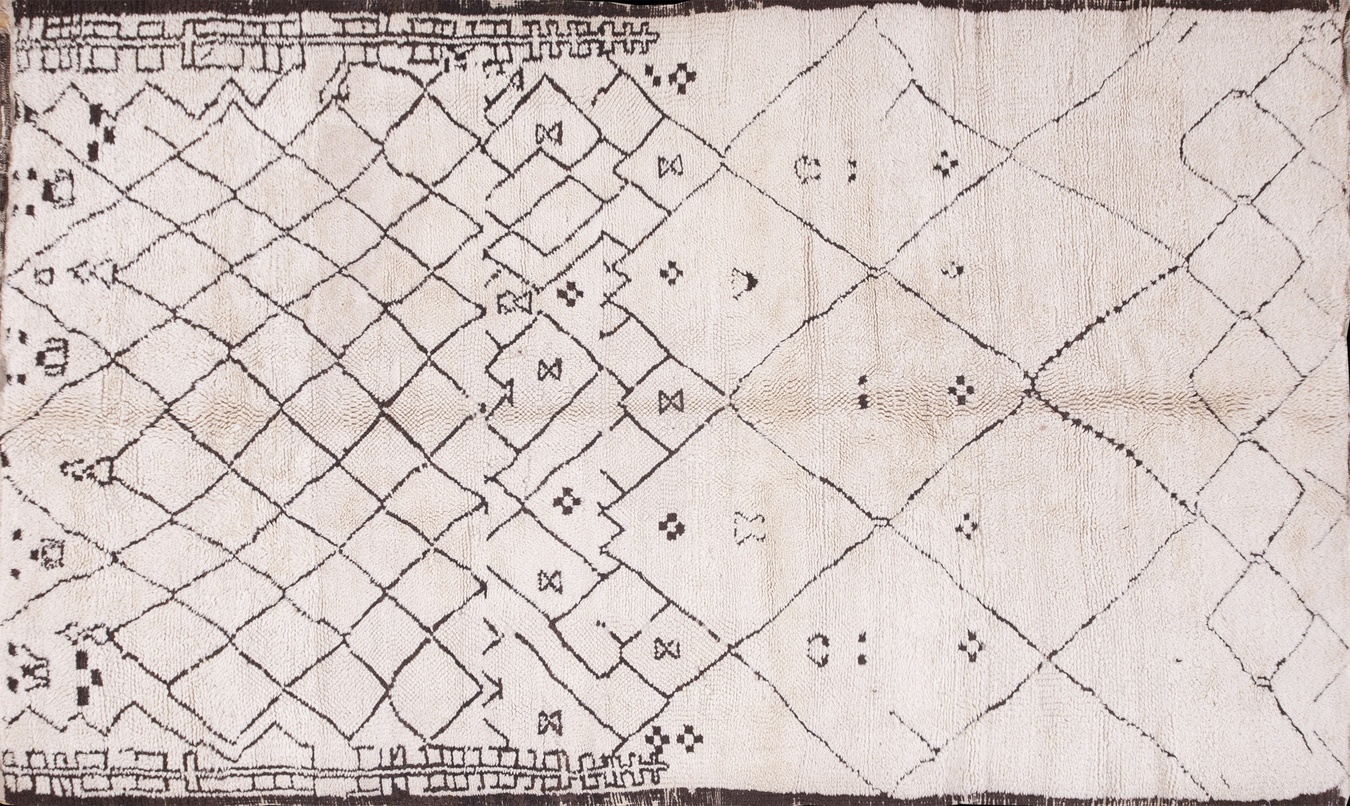
The Beni Ourain rug is perhaps the most iconic of all Moroccan tribal rug types. Woven by tribes in the Middle Atlas, it is distinguished by creamy, undyed wool fields accented with stark black or brown geometric lines—most often diamonds.
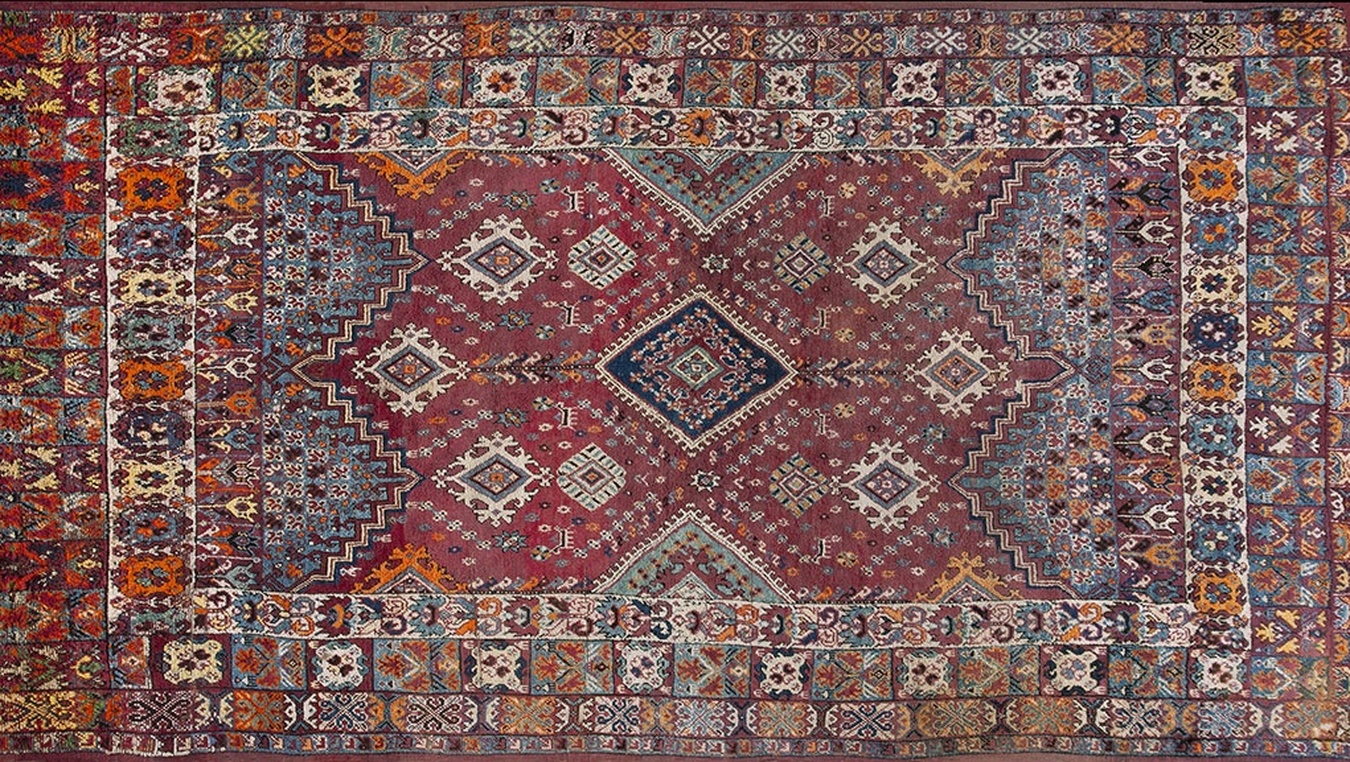
Antique Moroccan – Rabat Room Size Wool Rug – by Rugs On Net
The pile is thick and plush, reflecting the cold mountain climate where these rugs served as bedding as much as floor coverings. Typically borderless and minimalist, they achieve a striking balance of simplicity and symbolism. Their abstract geometry has made them beloved in both traditional Berber homes and modernist interiors.
Azilal Rugs
In contrast, Azilal rugs burst with color and improvisation. Originating in the High Atlas, they usually feature an off-white or cream field decorated with rainbow-colored motifs, zigzags, and abstract symbols.
Asymmetry is common, with motifs scattered unpredictably across the field, reflecting the spontaneity of the weaver. When comparing Beni Ourain vs. Azilal, the former embodies minimalism in monochrome, while the latter thrives on expressive color and playful abstraction.
Boujad Rugs
Boujad rugs, from the Haouz plains near the town of Boujad, are known for their warm, saturated color palettes—pinks, oranges, and reds dominate, often softened by age. Their motifs are looser, less rigid than other Moroccan tribal rug types, giving them an almost painterly quality.
Most Boujad rugs found on the market today are vintage, woven between the 1960s and 1980s, though new Boujad-style rugs continue to be produced. Thus, they straddle both categories: Boujad rugs are considered vintage when mid-20th-century pieces are collected, but modern interpretations also exist.
Taznakht & Ouaouzguite Rugs
From the Siroua region, Taznakht kilim rugs set the benchmark for Moroccan weaving sophistication. They often combine flatwoven kilim panels with high-pile knotted sections, creating layered textures and bold medallion layouts.
Their hallmark is a gold and red palette, achieved with both natural and synthetic dyes, alongside exceptional knot density. Neighboring Ouaouzguite rugs share many traits, particularly their durability and detailed execution. The Siroua mountains remain the Moroccan region most renowned for producing fine Taznakht kilims, admired for their craftsmanship and longevity.
Boucherouite Rugs
A modern evolution of the tradition, Boucherouite rugs are woven not from wool but from recycled textiles—cotton, nylon, or leftover fabrics. The name itself means “rag rug.” Explosions of multicolor and improvisation define the style, with no two pieces alike.
Beyond their striking aesthetics, Boucherouites embody sustainable art, reflecting adaptation in a changing economy where wool is expensive but creativity abundant. They represent both continuity and reinvention within Moroccan rug weaving.
Other Notable Styles
- Marmoucha rugs — Similar to Beni Ourain but with more angular motifs. — Why: They preserve regional variations within the Middle Atlas.
- Rehamna rugs — Known for deep burgundy hues and striped designs. — Why: They highlight how local dye traditions shaped distinct looks.
- Hanbel flatweaves — Lightweight, reversible rugs made for practical use. — Why: They show the adaptability of Berber weaving to warmer climates and nomadic life.
Together, these variations demonstrate how each Moroccan region adapted its rug materials, colors, and motifs to geography and culture. From the minimalism of Beni Ourain to the expressive energy of Azilal, the warmth of Boujad, the refinement of Taznakht, and the eco-creativity of Boucherouite, Moroccan rug types form a spectrum of artistry rooted in place yet admired worldwide.
Symbolism, Storytelling, & Cultural Roles
Decoding Common Symbols
- Diamonds — Among the most widespread Berber rug symbols, representing fertility and protection. — Why: They safeguard the household while invoking abundance and continuity of life.
- X-shapes — Associated with female figures and life itself, often interpreted as a symbol of womanhood. — Why: They encode the central role of women in family and community.
- Zigzags — Symbolize water, rivers, and the flow of life, reflecting the deep connection between survival and nature in the Atlas Mountains. — Why: Water was scarce and sacred; weaving it into rugs invoked its life-giving force.
- Red dye — Particularly important in Boujad rugs, where red signifies protection, vitality, and female energy. — Why: The red Boujad significance lies in its ability to invoke strength, fertility, and spiritual safety, making these rugs powerful cultural artifacts.
These are the symbols most commonly appearing in Middle Atlas rugs, woven into geometric chains or scattered improvisationally across the surface.
Rugs in Daily Life, Rites, and Dowries
Moroccan rugs were never simply floor coverings. They served as seating, bedding, and insulation, forming the foundation of domestic life. Beyond utility, they played vital roles in ceremonial contexts—used during weddings, births, and religious gatherings.
Brides often received rugs as part of their dowry, where the textiles symbolized fertility, protection, and a new beginning. In this sense, each rug was not just a household item but a vessel of meaning that accompanied families through life’s milestones.
Weaving as Women’s Creative Expression
For Berber women, weaving was often the primary creative outlet. Within each rug, women encoded personal stories, tribal identity, and protective prayers. The patterns were not copied from diagrams but carried in memory, improvised on the loom. This gave rugs the character of textile diaries, where private thoughts and communal heritage could coexist in woven form. The abstract motifs that outsiders see as decorative were, for their makers, coded languages of resilience and belonging.
Rituals, Blessings, and “Baraka”
Weaving was also a spiritual act. Many women engaged in chants or small rituals while working at the loom, infusing the textile with “baraka,” or blessing. This spiritual force was believed to protect the family, ensure fertility, and invite good fortune. Thus, the meaning of Moroccan rugs extends far beyond aesthetics: they embody cultural memory, women’s voices, and sacred energy. In their symbolism and their use, Moroccan rug stories bridge the gap between the everyday and the eternal. Each knot and color choice carried multiple layers of significance—personal, tribal, and spiritual—ensuring that these textiles remain not only works of art but enduring reflections of Berber identity.
The Modern Market: Collectibility, Export & Trends
Vintage vs. New Rugs: Authentication Tips
- Examine the wool — Vintage Moroccan rugs, particularly vintage Boujad rugs, feature soft, lanolin-rich wool that has aged with a natural patina. — Why: High-quality wool distinguishes authentic mid-20th-century rugs from newer reproductions.
- Check dyes — Natural dyes produce subtle, uneven tones that fade beautifully, while synthetic dyes appear uniform and sometimes overly bright. — Why: This helps confirm whether a rug is vintage or recently woven.
- Look for wear patterns — Genuine vintage Moroccan rugs show consistent wear in expected areas, like edges and fringes, without machine-made uniformity. — Why: Authentic wear validates age and use.
- Research provenance — Rugs sourced with documentation of region and tribe carry higher credibility. — Why: Provenance ties the rug back to its cultural and geographic roots, ensuring authenticity.
When asking how to authenticate an antique Boujad rug, these steps—wool texture, dye analysis, wear, and provenance—are crucial.
Global Demand, Pricing, and Value
The international appetite for vintage Moroccan rugs surged after mid-century designers introduced Beni Ourain and Azilal pieces to the West. Today, demand drives both opportunity and challenge. On the one hand, export has revitalized weaving as a source of income; on the other, mass production risks diluting traditional methods.
Prices for genuine vintage rugs continue to climb, while new rugs remain more accessible but vary in quality. The balance between authenticity and reproduction defines much of the current Moroccan rug market.
Buying in Morocco: Medinas, Co-ops, Cities
Travelers often encounter Moroccan rugs in the Marrakech Medina, where stalls line labyrinthine alleys with offerings ranging from museum-worthy textiles to tourist-grade imitations. Authentic rugs are available, but require an educated eye. Fez offers a similarly rich marketplace, while Tangier provides a more cosmopolitan shopping experience, often catering to international collectors. For the best rug deals, Fez and Marrakech are known for variety and negotiation, while Tangier provides curated, export-ready selections.
Beyond the medinas, buyers can access Moroccan rug cooperatives in rural areas such as Khénifra or villages in the Atlas. Purchasing directly from Khénifra women’s co-ops ensures fair wages and supports both tradition and community livelihoods, while also reducing the risk of buying mass-market pieces disguised as handmade.
Sustainability, Fair Wages, and the Role of Cooperatives
The global demand for Moroccan rugs has raised urgent questions of sustainability and fair trade. Co-operatives play a crucial role in protecting weavers, guaranteeing fair wages, and preserving traditional techniques in a market dominated by mass export.
Supporting these networks helps ensure that the future of weaving remains with local women rather than factory machines.
Influence on Contemporary Design
From minimalist Scandinavian interiors to eclectic bohemian spaces, Moroccan rugs continue to influence contemporary design. Their irregular motifs, asymmetric layouts, and bold palettes have inspired global brands to reinterpret the Marrakech Medina rug style for modern homes. Yet, no imitation rivals the character of an authentic handmade rug—woven slowly, irregularly, and filled with cultural meaning.
Ultimately, buying rugs in Morocco requires knowledge, patience, and cultural respect. Whether in the bustling Marrakech Medina, a Fez souk, or a cooperative in Khénifra, the key is to balance appreciation for design trends with support for the artisans who sustain this ancient craft.
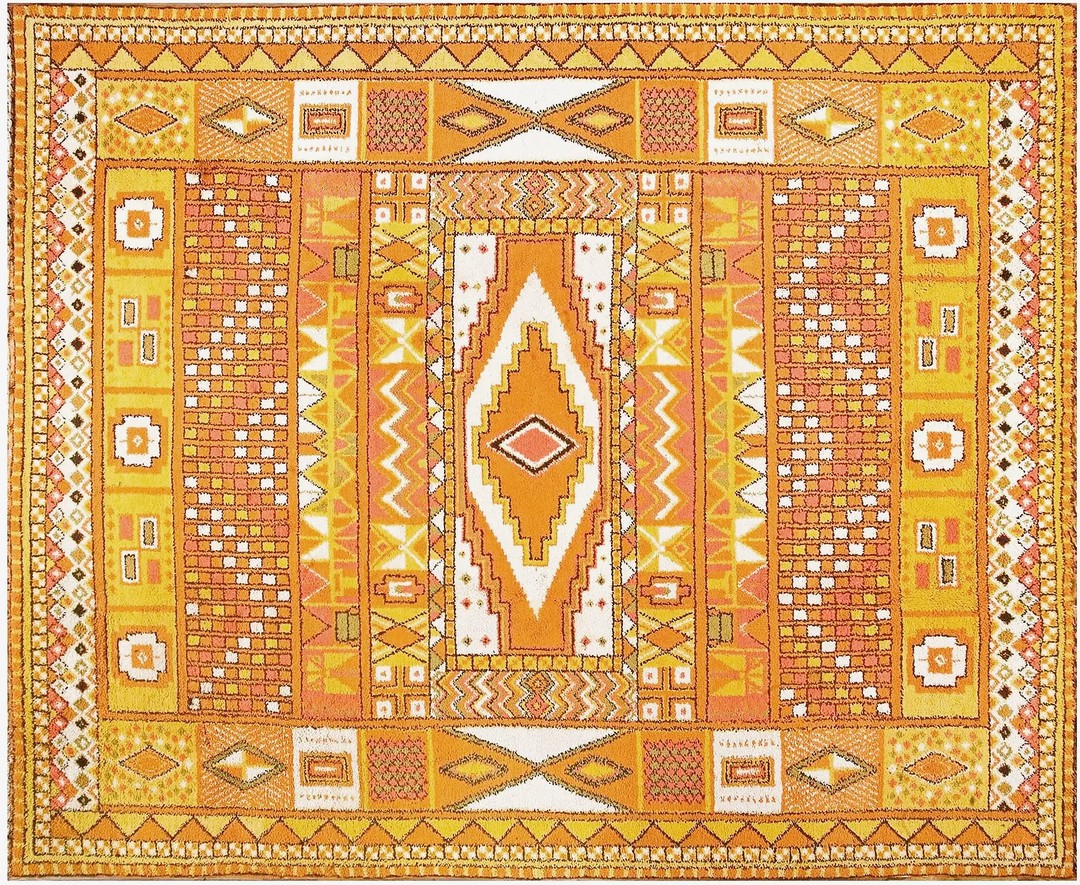
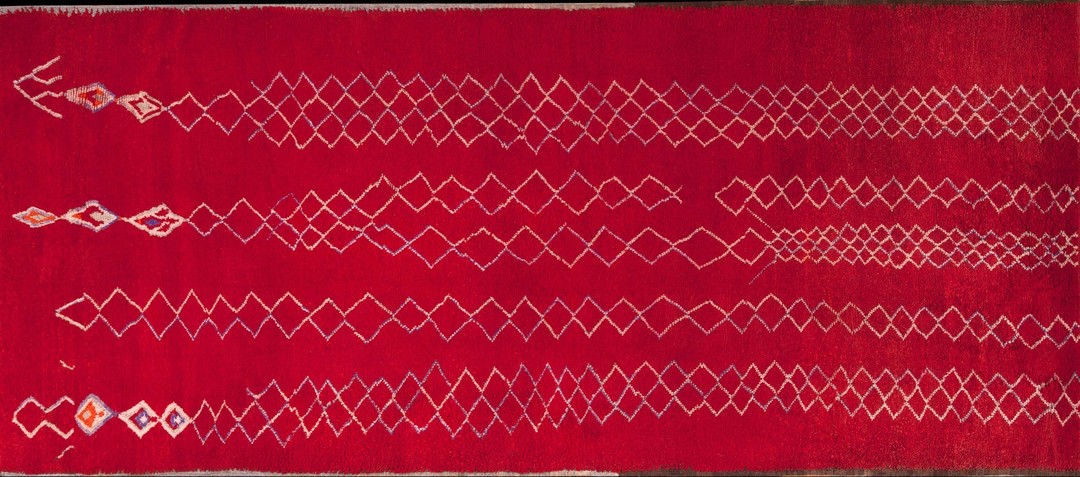
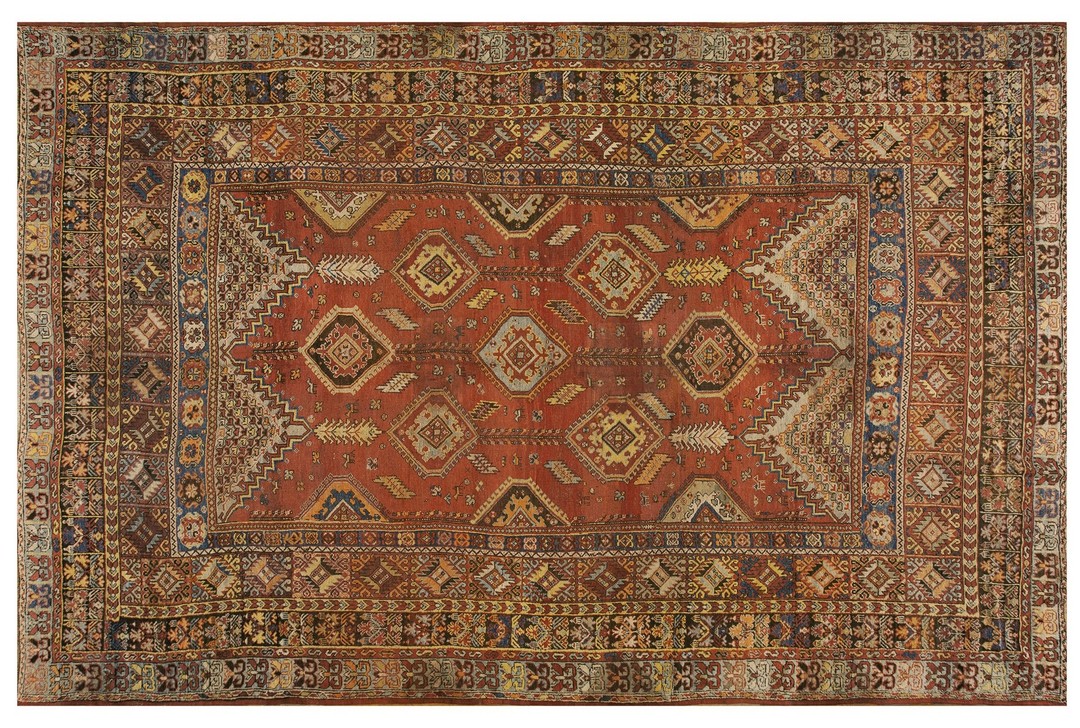
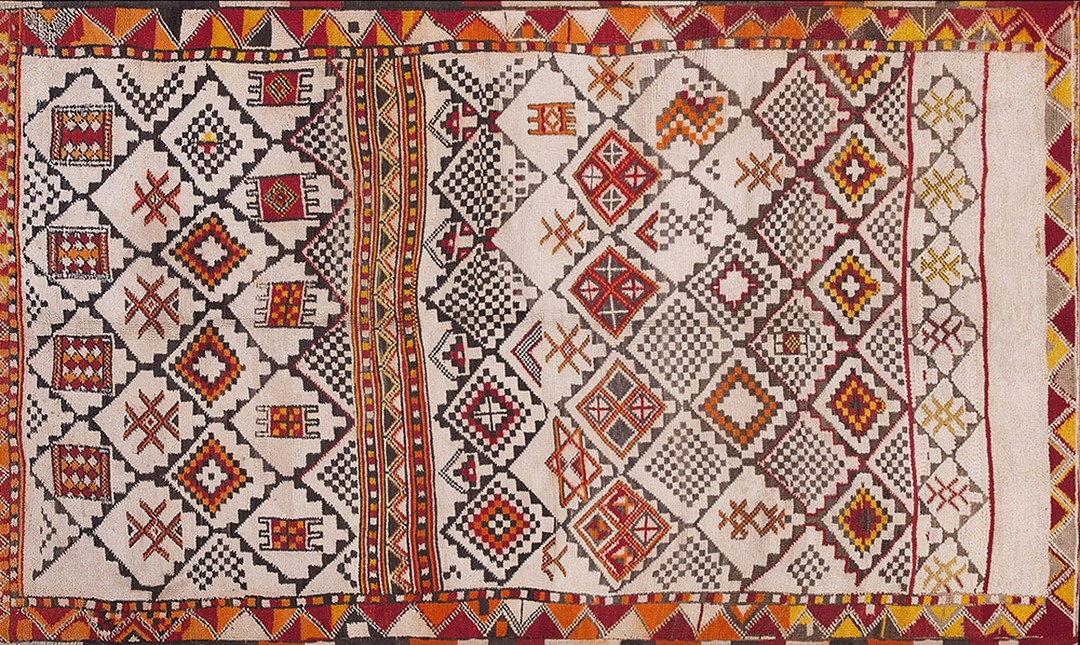
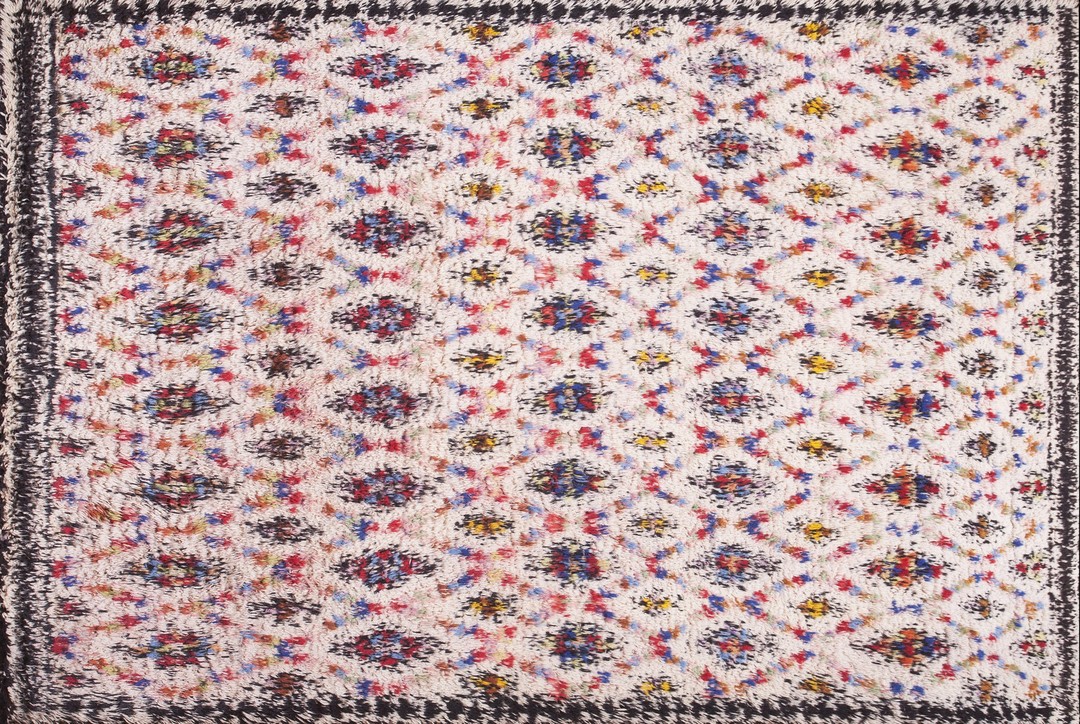
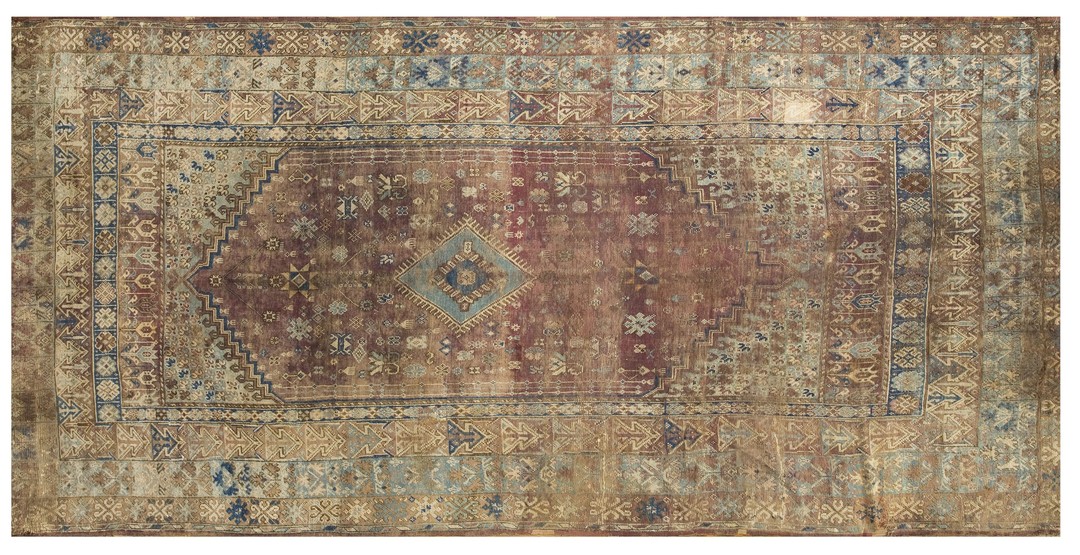
Explore a Few of Our Favorite Moroccan Rugs

FAQ
- Do robot vacuums work on Moroccan rugs with fringe?
Robot vacuums can snag fringe and struggle on high-pile Moroccan rugs. Use no-go zones, tuck fringe, or vacuum manually with suction-only tools to protect edges and knots.
- Where can I buy ethically sourced Moroccan rugs?
Seek artisan-led cooperatives and sellers with transparent pricing, direct maker attribution, and fair-trade practices. Look for clear origin details, natural materials, and repair disclosures.
- Are Moroccan rugs low-VOC or non-toxic?
Wool Moroccan rugs generally have lower VOCs than many synthetics and avoid plastic backings. Air out new arrivals; a mild lanolin scent typically dissipates within days to weeks.
- What’s the difference between Beni Ourain and Azilal Moroccan rugs?
Beni Ourain Moroccan rugs are plush, ivory with dark lattice and long pile; Azilal Moroccan rugs tend to be thinner, with lively, multicolor motifs and more contrast.
- How do I test a Moroccan rug for colorfastness before cleaning?
Dampen a white cloth and blot an inconspicuous spot; if color transfers, avoid DIY wet cleaning and call a professional. Vinegar or salt won’t “set” unstable dyes.
- How should I style Moroccan rugs in modern spaces?
Let a neutral Beni Ourain Moroccan rug ground the room, then add color with art or pillows. Layer a Moroccan kilim over a larger jute to add pattern and define zones.
- Can Moroccan rugs be used outdoors?
Authentic wool Moroccan rugs are best indoors; moisture and UV degrade fibers. For patios, choose outdoor synthetics or Tuareg mats, and store rugs dry in winter.
- Are Moroccan rugs practical under a dining table?
Yes—choose low-pile or flatweave Moroccan rugs so chairs glide and crumbs don’t sink. Aim for 8×10 or 9×12 so chairs stay on the rug when pulled out \~18–24 inches.
- Will Moroccan rugs fade in sunlight?
Any dyed rug can fade. Reduce UV with window film or shades, rotate your Moroccan rug quarterly, and avoid hours of direct sun to keep colors even.
- Can Moroccan rugs be used with underfloor heating?
Yes—pick low-pile Moroccan rugs and keep the rug+pad combined tog below \~2–2.5. Avoid thick shags that trap heat, and leave some floor area uncovered for efficient airflow.
- What rug pad works best under Moroccan rugs?
Use felt or felt-and-natural-rubber pads cut \~1–2 inches smaller than the rug. They add grip, protect floors, and reduce wear; avoid cheap PVC pads that can stick to finishes.
- Do Moroccan rugs shed?
New wool Moroccan rugs commonly shed for 1–6 months. Vacuum gently 1–2 times per week (suction-only), rotate occasionally, and expect shedding to taper significantly over time.
- How often should Moroccan rugs be professionally cleaned?
Plan a professional wash about every 12–18 months, sooner for dining rooms or entryways. Annual cleaning helps remove embedded grit that regular vacuuming can’t reach.
- How do I clean a Moroccan rug at home safely?
Blot spills immediately with a white cloth, then use cool water and a wool-safe detergent. Vacuum regularly with suction only (no beater bar) and always color-test before any wet cleaning.
- Are Moroccan rugs machine-washable?
Generally no—handwoven wool Moroccan rugs shouldn’t go in a machine. Cotton Boucherouite pieces may tolerate gentle hand-washing; for deep cleans, use a professional rug cleaner.
- Are Moroccan rugs good with pets and kids?
Wool Moroccan rugs are naturally stain-resistant and springy; patterns hide messes. Prefer low-pile or flatweave for easier cleanup and fewer snags; avoid looped piles for cats’ claws.
- Are Moroccan rugs durable for high-traffic areas?
Yes—choose low-pile or flatweave Moroccan rugs for busy rooms; wool’s lanolin helps resist soiling. Rotate seasonally and use a pad to minimize wear at edges and paths.
- What sizes do Moroccan rugs come in?
You’ll find common area sizes like 5×8, 8×10, and 9×12, plus runners about 2–3 feet wide by 6–14 feet long. Vintage pieces sometimes have narrow, longer proportions.
- Are vintage Moroccan rugs worth the premium?
Often yes—older dyes, patina, and one-of-a-kind character can command higher prices and hold value. Verify condition (restorations, moth damage) and ask for age/region details before paying up.
- How much do Moroccan rugs cost?
Handwoven Moroccan rugs typically range from about \$200 to \$10,000+, depending on size, age, dye quality, and provenance. An 8×10 handmade piece commonly lands in the low-to-mid thousands.
- What materials are Moroccan rugs made of?
Most Moroccan rugs use sheep’s wool; some include cotton foundations. Boucherouite Moroccan rugs use recycled textiles. Silk is rare; synthetics appear mostly in machine-made “style” versions.
- How do Moroccan rugs differ from Persian or Turkish rugs?
Moroccan rugs usually have lower knot counts, bolder geometrics, and thicker piles; Persian/Turkish pieces trend finer and more floral. Expect more asymmetry and texture from Moroccan weaving.
- How can I tell if a Moroccan rug is authentic versus “Moroccan-style”?
Authentic Moroccan rugs show hand-knotted irregularities, a unique backside pattern, and natural fiber feel. Look for wool odor (lanolin), uneven lines, and cooperative or origin documentation when possible.
- What types of Moroccan rugs are most common?
Popular types include Beni Ourain (plush neutrals), Azilal (colorful, high-low motifs), Boujad (warm reds/pinks), Boucherouite (recycled “rag” rugs), Mrirt (dense, luxe pile), and flatweave kilims (hanbel/zanifi).
- What are Moroccan rugs, exactly?
Moroccan rugs are handwoven textiles from Morocco’s Amazigh (Berber) traditions, often wool, featuring geometric motifs or plush shags. Many originals were made for mountain climates, so piles can be thick for warmth.