
Introduction to Mongolian Rugs
Ready to infuse nomadic elegance into your decor? Shop our exquisite collection of Mongolian design rugs now.
What Sets Mongolian Rugs Apart
Mongolian rugs occupy a distinctive place within the larger world of Asian carpet traditions. Unlike the densely patterned Persian carpets or the geometric precision of Caucasian weaving, Mongolian rugs are rare textiles marked by restraint, clarity, and cultural layering. Their visual hallmark is an open, “transparent” design: motifs appear to float on a solid, often bold-colored field, allowing space to speak as loudly as pattern. This minimalist quality reflects both nomadic practicality—where rugs needed to be read easily in the dim light of yurts—and a Buddhist aesthetic that favored symbolism over clutter.
Function was inseparable from form. Nomadic groups across the Mongolian steppe required robust, portable floor coverings, saddle rugs, and tent hangings that could withstand extreme climates. These textiles were durable yet adaptable, marrying artistry with survival. Over centuries, Mongolian carpets absorbed influences from multiple cultural crossroads: Chinese decorative motifs such as cloud scrolls and lotus flowers, Turkic steppe traditions of geometric order, and Buddhist iconography emphasizing harmony and balance. The result is a weaving tradition that stands apart for its synthesis of practicality and spiritual depth.
The rarity of antique Mongolian rugs enhances their value today. Few were produced on a large scale, and even fewer survived intact given their utilitarian role in nomadic households. Collectors prize them as rare witnesses to a lifestyle that blended mobility, resilience, and artistic refinement. In this way, Mongolian rugs are not just floor coverings but historic documents of steppe culture.
Defining Mongolian Rug Styles
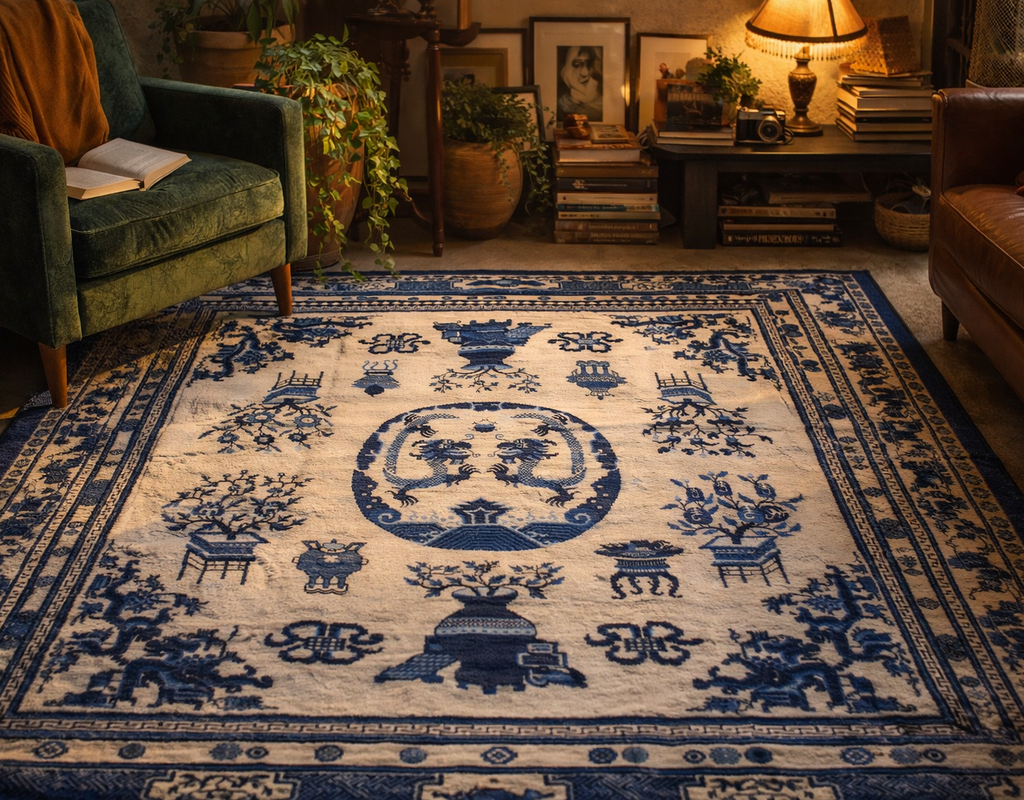
A striking blue and white Oriental-style rug anchors a cozy, richly textured reading nook filled with plants and books.
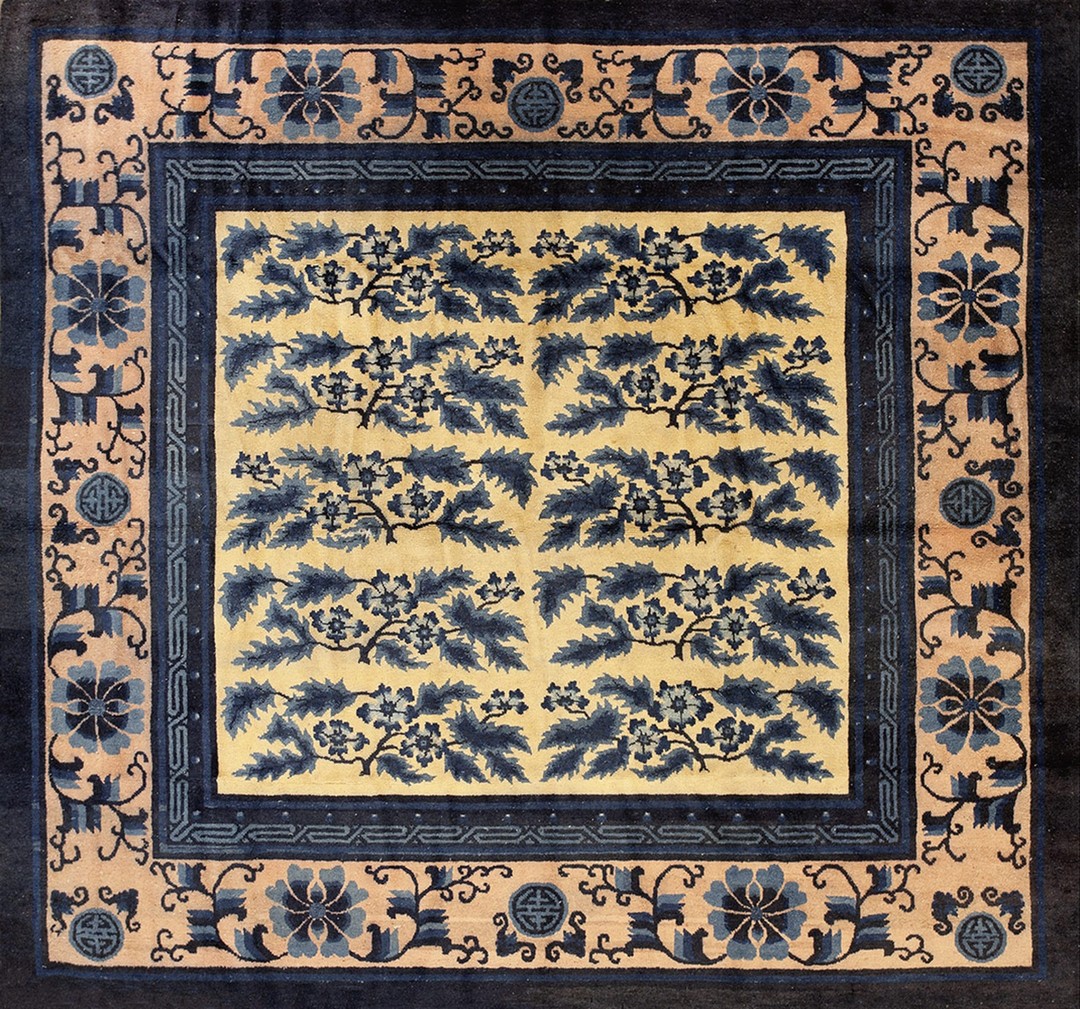
Antique Chinese – Mongolian Chinese Ivory 1900s Rug – by Rugs On Net
Mongolian weaving is not confined to a single form; instead, it encompasses a variety of textiles adapted to nomadic and spiritual life:
- Knotted Rugs — These pile weavings display the floating-motif aesthetic most clearly. Designs often emphasize medallions, Buddhist symbols, or sparse geometric elements. — Why: Knotted rugs show how Mongolian weavers translated both practicality and symbolism into carpets that could rival other Central Asian rugs in artistry while remaining distinct in openness of design.
- Flatwoven Rugs — Less common but prized for portability, these textiles echo steppe weaving traditions shared with Turkic neighbors. — Why: Flatweaves were lighter and easier to transport, aligning with the constant movement of nomadic communities.
- Felted Rugs — Feltmaking was central to Mongolian life, used in yurts, clothing, and floor coverings. Felt rugs could be plain or decorated with appliqué motifs. — Why: Felted rugs reflect the deep pastoral culture of the steppes, where sheep provided both wool and mobility, and felting required no loom.
- Shaggy Rugs — With a high pile, these served as warm underlays or bedding, essential in the freezing Mongolian winters. — Why: Shaggy rugs highlight the functional side of steppe textiles, prioritizing insulation and comfort.
- Saddle Rugs — Among the most iconic Mongolian textiles, saddle rugs were richly decorated, often with protective or auspicious motifs. — Why: These represent both practical gear for horse culture and artistic statements, reinforcing Mongolia’s identity as a land defined by horseback mobility.
Together, these types form a broad spectrum of Mongolian carpets, ranging from the utilitarian to the ceremonial. Each reveals how nomadic weavers adapted their skills to every aspect of life, from furnishing yurts to adorning temples.
Mongolian rugs thus stand apart for their rarity, their fusion of cultural influences, their transparent design language, and their balance of survival-driven function with artistic spirit. They are not simply another branch of Central Asian rugs but a distinct textile tradition that bridges nomadic resilience with enduring aesthetic value.
Name & Etymology
Meaning of “Mongolian Rug”
The term Mongolian rug carries both geographic and cultural weight. It identifies carpets woven by ethnic Mongols and those produced in territories historically under Mongol influence, including present-day Mongolia, Inner Mongolia (China), and border regions with Central Asia. In trade contexts, rugs from Inner Mongolia are often labeled as “Chinese Mongolian,” reflecting political boundaries, yet their designs and techniques remain deeply tied to Mongol culture and the steppe tradition.
Calling a carpet “Mongolian” signals more than just place of origin—it conveys a distinct stylistic identity. Unlike other Central Asian rugs, Mongolian carpets stand out for their spare compositions, floating motifs, and incorporation of Buddhist symbolism. The label thus becomes shorthand for a weaving heritage shaped by nomadism, horse culture, and the crossroads of Chinese, Turkic, and Tibetan influences. To collectors and scholars, “Mongolian” is a marker of rarity and of a unique visual language within the broader family of Asian and Central Asian rugs.
Local Terminology: Khivs and Language Roots
In the Mongolian language, the standard word for rug or carpet is khivs (хивс). This term anchors the tradition within the local lexicon, distinguishing it from neighboring cultures while also revealing shared linguistic ancestry. Etymologically, khivs is connected to Turkic terms for rug and textile, reflecting centuries of contact and exchange across the Eurasian steppe. These connections point back to Proto-Mongolic and Turkic roots, where terms for weaving and woolen products often overlapped, underscoring how intertwined pastoral life and textile production were across nomadic societies.
The linguistic significance of khivs lies in its ability to bridge identity and craft. While in English “Mongolian rug” describes the cultural category, khivs embodies the everyday, lived meaning of a rug within Mongol households. It suggests not only a decorative object but also a practical item central to nomadic life—used in yurts, on horseback, or in temples. The survival of this word across centuries affirms both continuity of tradition and the shared vocabulary of the steppe, situating Mongolian carpets within a wider Central Asian weaving culture.
In short, the Mongolian rug meaning is twofold: it indicates geographic origin and signals a distinct cultural and stylistic heritage. The term khivs enriches this picture, offering insight into the Mongolian carpet etymology and highlighting how rug terminology reflects deep-rooted connections between Mongol and Turkic weaving traditions.
Geographic & Cultural Origin
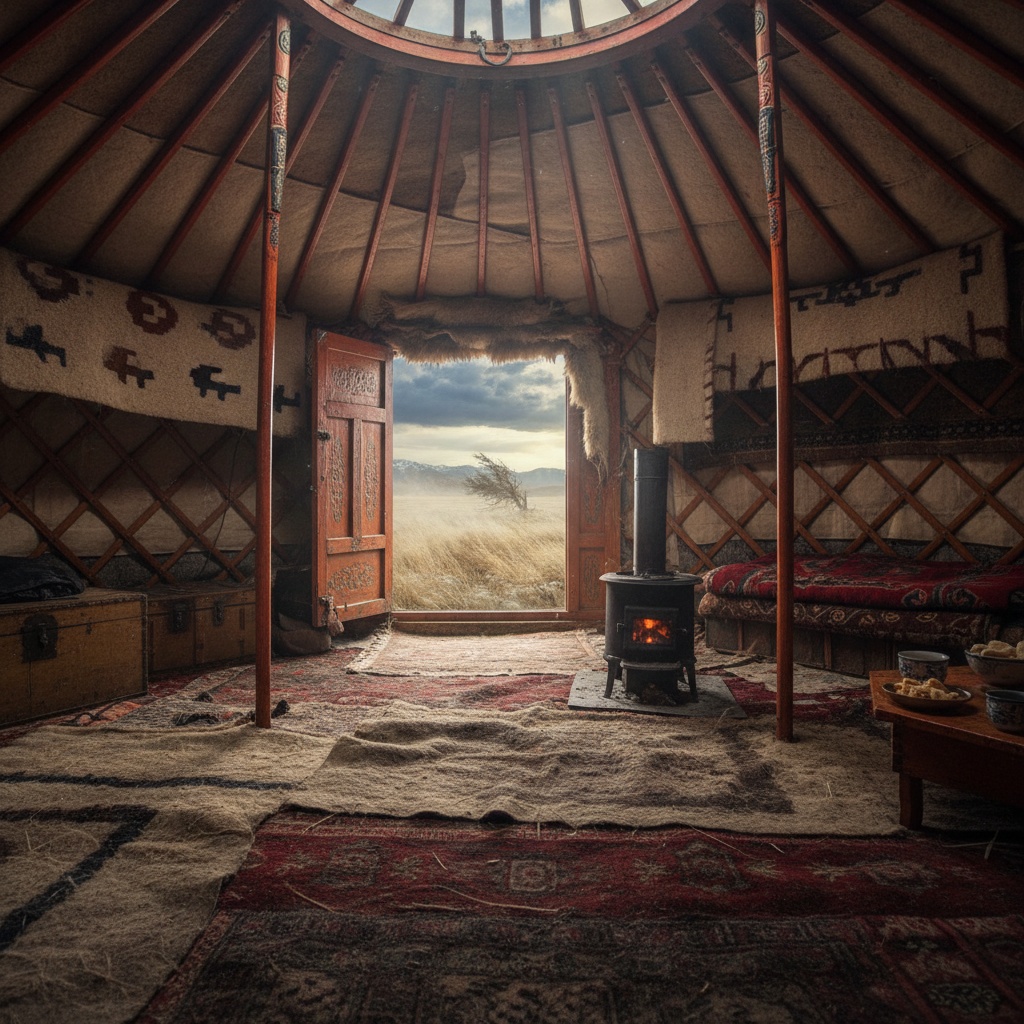
Warm interior of a traditional dwelling with textiles.
Nomadic Roots & Steppe Adaptation
The origins of Mongolian rugs are inseparable from the demands of life on the Central Asian steppe. For centuries, Mongol nomads lived in a climate of extremes—burning summers, subzero winters, and constant winds. In this environment, textiles were not luxuries but tools of survival. Rugs provided warmth and insulation, lined the walls and floors of gers (yurts), and served as portable assets easily rolled up and carried during seasonal migrations. Their portability and resilience mirrored the lifestyle of a people who lived on horseback, moving with herds and weather.
This adaptation shaped the visual and structural qualities of Mongolian rugs. Designs were simplified for quick recognition in dimly lit yurts, while materials had to withstand both wear and harsh conditions. The very identity of steppe weaving was born out of necessity, fusing practicality with expressions of cultural and spiritual life.
Early Weaving & Felting Traditions
Long before pile weaving, Mongolian felting defined the textile traditions of the region. Felting is one of humanity’s oldest fabric-making techniques, requiring no loom—just wool, water, and pressure. Archaeological evidence places Mongolian felting back thousands of years, with roots stretching into the Bronze Age. This felt rug history reveals its primacy in the steppe: felt served as ground coverings, saddle pads, wall hangings, and even the structural fabric of yurts themselves.
The Pazyryk carpet, excavated in the Altai Mountains and dated to the 5th century BC, offers the earliest surviving example of a knotted rug. Found near the Mongolian frontier, it demonstrates that advanced pile weaving was known in the region long before Mongol empire-building. Yet within Mongolia itself, felting remained the dominant textile tradition for centuries, pre-dating pile weaving by millennia and providing the foundation upon which knotted and woven Mongolian carpets later developed.
- When did Mongolian felting traditions first emerge? They originated in prehistoric times, with evidence dating back several millennia, making felting one of the oldest and most enduring crafts of the Mongolian steppe.
Evolution from Utility to Art
Initially, Mongolian rugs were purely functional—insulating yurts, protecting against frozen ground, and cushioning horseback saddles. Over time, however, utility gave way to artistry. Buddhist motifs, symbolic medallions, and stylized animals began to appear on rugs, transforming them into objects of spiritual expression as well as household necessity. Nomadic weaving and felting evolved to reflect both identity and aesthetics, balancing survival with the urge to create.
- Why are Mongolian yurts decorated with felt rugs? Because felt provided insulation and warmth, forming both functional coverings for walls and floors and decorative elements that turned the yurt into a comfortable, protective home in the severe Mongolian climate.
In this way, the steppe rug origins illustrate a continuum: from the prehistoric felting that sustained nomadic life, to the sophisticated pile weaving hinted at by the Pazyryk carpet, to the later tradition of Mongolian rugs that harmonized utility, resilience, and cultural artistry.
Wool Quality & Materials
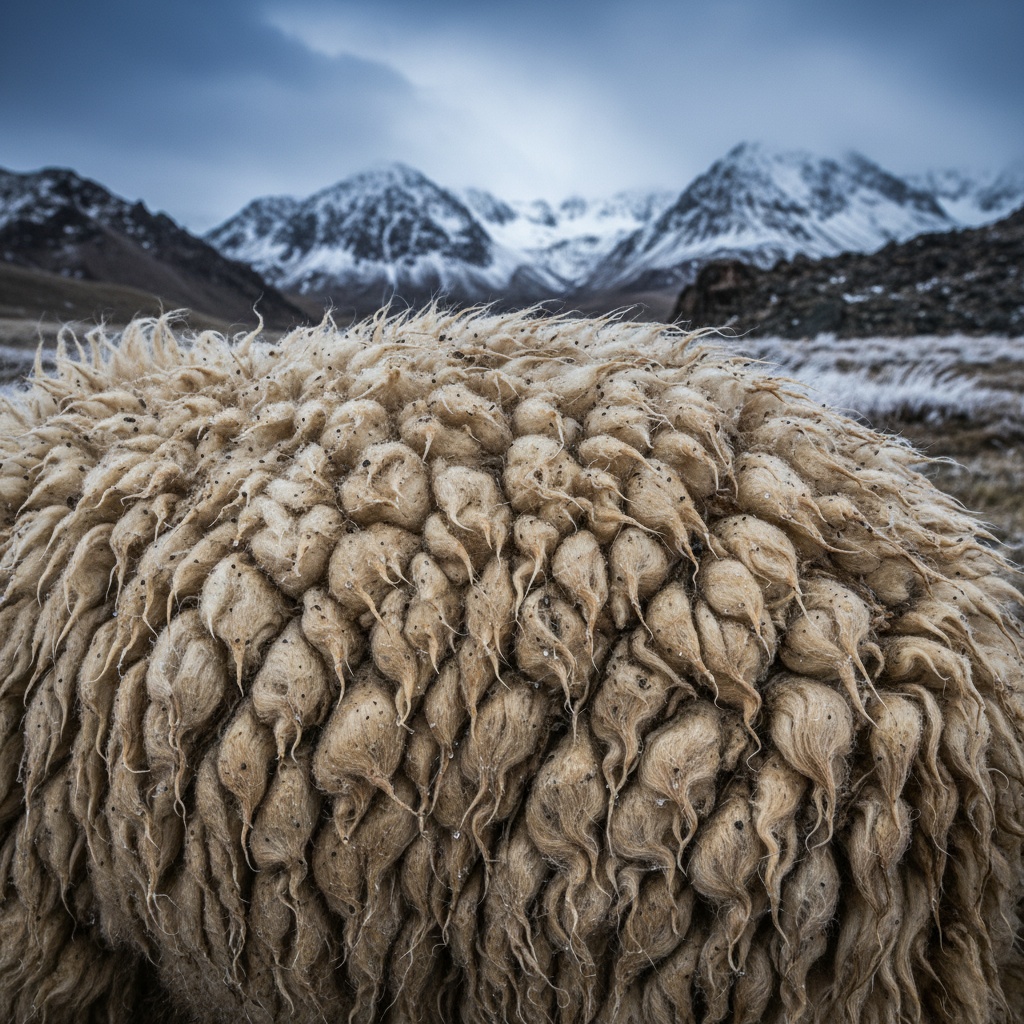
Thick, textured wool from a hardy animal in a cold climate.
Why Mongolian Wool is Ideal
The foundation of Mongolian wool rugs lies in the exceptional quality of the fleece itself. Mongolian sheep, raised across the windswept steppe, develop coats that are unusually thick, resilient, and warm—traits directly shaped by their environment. This density makes the wool not only highly durable but also excellent for insulation, qualities critical for both nomadic use and modern collectors seeking longevity. The natural crimp and luster of steppe wool allow for strong, enduring yarns that can hold dye beautifully and stand up to generations of wear.
- What makes Mongolian wool ideal for rugs? Its thickness, resilience, and natural insulation qualities, honed by steppe conditions, make it perfect for weaving long-lasting, durable carpets.
Impact of Steppe Climate & Altitude
The harsh Mongolian climate—with scorching summers, brutal winters, and sharp temperature swings—forces animals to grow protective coats of unusual quality. At higher altitudes, sheep and goats produce fleece with added strength and sheen, a natural adaptation that boosts both durability and market value. Collectors recognize that high-altitude wool not only feels richer but also commands higher prices due to its rarity and superior characteristics.
- How does the harsh steppe climate affect wool quality? Extreme conditions enhance fleece thickness and strength, producing wool that is warmer, denser, and more durable than that of animals raised in milder climates.
- How do altitude-reared sheep impact Mongolian rug pricing? Their wool is more lustrous and resilient, leading to higher demand and elevated prices for rugs woven from these premium fleeces.
Animal Fibers: Camel, Goat, Sheep, Cashmere
Mongolian rugs are not limited to sheep’s wool alone. Steppe weavers drew upon a variety of fibers to meet functional and aesthetic needs:
- Camel Wool — Coarser and stronger, camel hair offered durability and warmth, making it a valued addition in certain rugs. — Why: It added strength for heavy-duty floor coverings and insulation.
- Goat Hair — Hardier but less soft, often used for warp or foundation structures. — Why: It provided stability to the rug’s base, ensuring longevity under heavy use.
- Sheep Wool — The primary fiber in Mongolian wool rugs, balancing warmth, softness, and durability. — Why: It was abundant and versatile, ideal for both pile and felt.
- Cashmere — From fine-haired goats, this luxury fiber was rare in rug weaving but occasionally blended in for exceptional softness. — Why: It elevated tactile comfort and prestige, though it remained too scarce for common use.
- Does camel wool feature in Mongolian rug-making? Yes, camel wool was used for its strength and insulating qualities, particularly in heavier rugs and felted pieces.
Natural Dyes vs. Synthetic
Mongolian rugs historically used natural dyes derived from steppe plants, roots, and minerals, producing soft earth tones—browns, ochres, and muted reds. These dyes blended seamlessly with the landscape and reflected sustainable, traditional practices. By the late 19th and early 20th centuries, aniline dyes became available, introducing brighter hues but sometimes at the cost of colorfastness.
- Natural Dyes — Offer authenticity, sustainability, and enduring appeal to purists. — Why: Collectors prize natural dyes for their subtlety, historical integrity, and safety.
- Synthetic Dyes — Provided new color options but occasionally clashed with the restrained Mongolian aesthetic. — Why: They appealed to wider markets yet are less desirable in high-value, antique pieces.
- Should collectors prioritize natural dyes in Mongolian carpets? Yes—natural dyes enhance both authenticity and long-term value, making them the preferred choice among serious collectors.
Pile-Knot Weaving Introduction
While felting and flatweave dominated early Mongolian textiles, pile knot weaving was likely introduced through sustained cultural contact. Historical evidence suggests the technique reached Mongolia via Turkic neighbors and Chinese influences along the Silk Road, where weaving technologies and motifs circulated freely. Once adopted, Mongolian artisans adapted pile weaving to their own aesthetic—creating rugs with distinctive openness and symbolic restraint.
- Who introduced pile-knot weaving to Mongolian artisans? The technique was transmitted through interaction with Turkic weavers and Chinese traditions, entering Mongolian craft as part of wider Silk Road exchange.
Mongolian rugs, whether knotted or felted, thus embody the richness of steppe wool and its variants—sheep, camel, goat, and even cashmere—enhanced by natural dyes and the influence of foreign techniques. Their material foundation remains one of the keys to their durability, rarity, and collectible appeal.
Construction Techniques
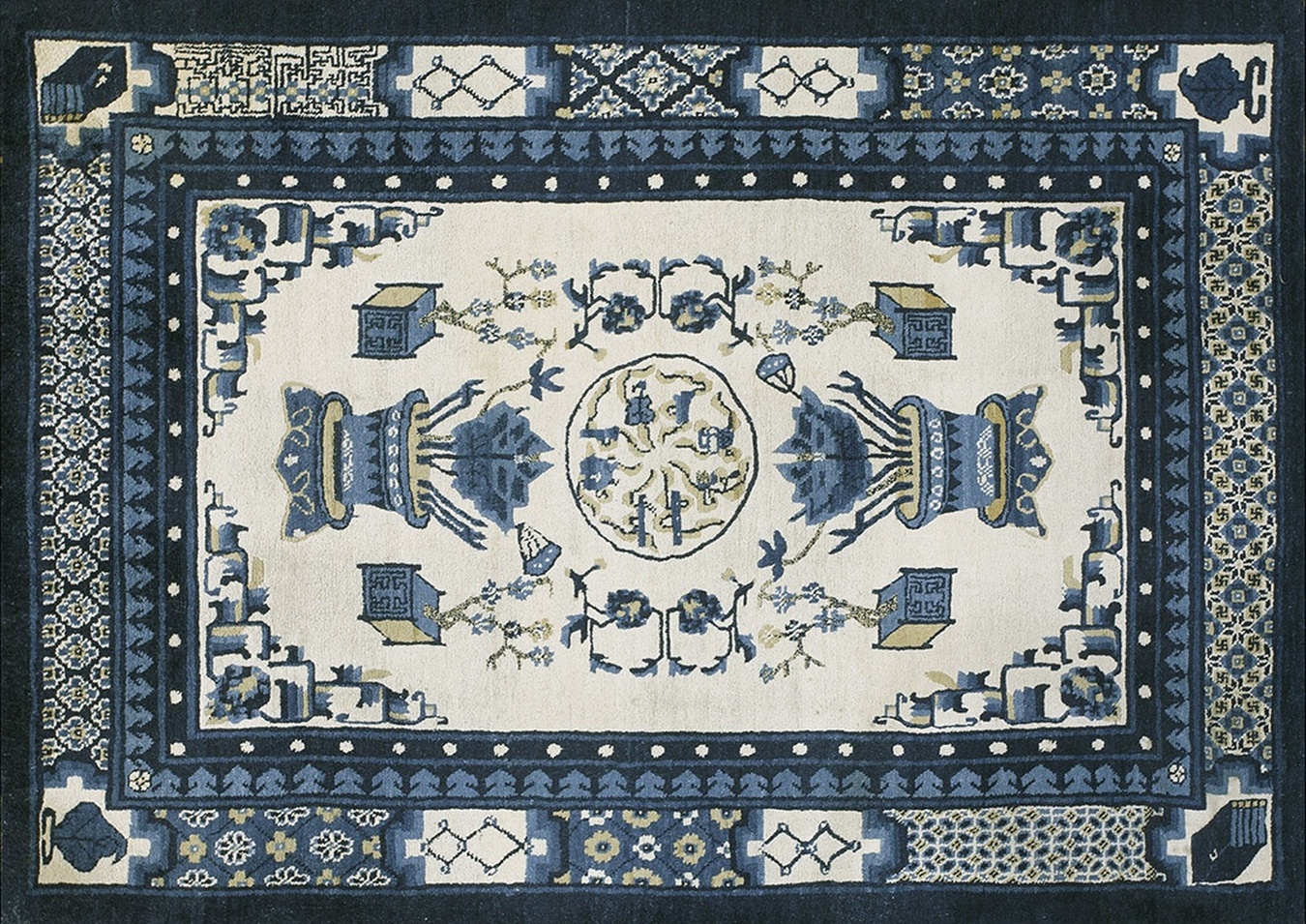
Antique Floral Medallion Wool Hand Knotted Pile Ivory Beige Cream White 1890s Rug – by Rugs On Net
Knotted-Pile Rugs
The dominant weaving technique for Mongolian carpets is the knotted pile rug, almost always employing the symmetric or Turkish knot rather than the asymmetrical Persian knot. This choice reflects regional ties to Central Asian and Turkic weaving traditions. Knot density tends to be moderate, prioritizing strength and durability over extreme fineness, which suited the practical needs of nomadic families. These rugs, while less intricate than Persian masterpieces, possess a clarity and boldness of design that pairs with their open “floating motif” aesthetic. The balance of durability and artistic restraint gives Mongolian pile rugs their distinctive character.
Flatweaves, Kilims, and Felt Rugs
Mongolian weaving extended beyond pile to include lighter, portable, and multifunctional textiles:
- Flatweaves — Lightweight and easy to carry, these were practical for everyday use. — Why: They could serve as floor coverings, partitions, or simple ground cloths for nomads.
- Kilim Rugs — Woven without pile, Mongolian kilims were strong and versatile. — Why: Used for mats, storage bags, and saddle covers, they demonstrated functional adaptability.
- Felt Rugs — The oldest textile form in Mongolia, made from compressed sheep’s wool. — Why: Felt rugs provided warmth, insulation, and often featured in dowries as essential household goods.
These categories underscore how rug-making addressed every aspect of nomadic life, from horse culture to domestic furnishings.
Rug Sizes, Looms, and Shaggy Pile Variants
Mongolian weaving relied on nomadic looms, usually ground-based and highly portable. This portability limited rug width, meaning most carpets were smaller, functional pieces rather than expansive palace-sized floor coverings. Yet within these constraints, artisans created rugs perfectly suited to yurts and transport.
Shaggy carpets with high pile offered extra insulation in freezing winters. Their thick, soft texture made them ideal for bedding or as layered coverings in gers, reinforcing the Mongolian balance of comfort and practicality. The production of such shaggy rugs highlights how environmental demands directly shaped construction techniques.
Felting Traditions in Mongolia
Felting is the bedrock of Mongolian textile heritage, predating pile and flatweave by millennia. Archaeological evidence shows felt production in Central Asia dating back to the Bronze Age, and in Mongolia, felting became integral to survival. Entire yurts were covered in thick felt panels, while rugs, clothing, and saddle pads were crafted from this durable medium.
- When did Mongolian felting traditions first emerge? They date back thousands of years, long before the advent of pile weaving, with evidence from the steppe placing their origins in prehistoric times.
- Can Mongolian felt rugs outperform hand-tufted imports for durability? Yes. Felt rugs, made from densely compacted wool fibers, are far more robust and long-lasting than modern hand-tufted imports, which often rely on adhesives and synthetic backings that degrade over time.
In short, Mongolian rug construction embodies the realities of nomadic life: portable looms, moderate knotting, versatile flatweaves, insulating shaggy carpets, and above all, the enduring felt rug tradition that safeguarded survival in one of the world’s harshest environments.
Rug Design & Symbolism
Core Motifs: Endless Knot, Dragons, Tigers, Medallions
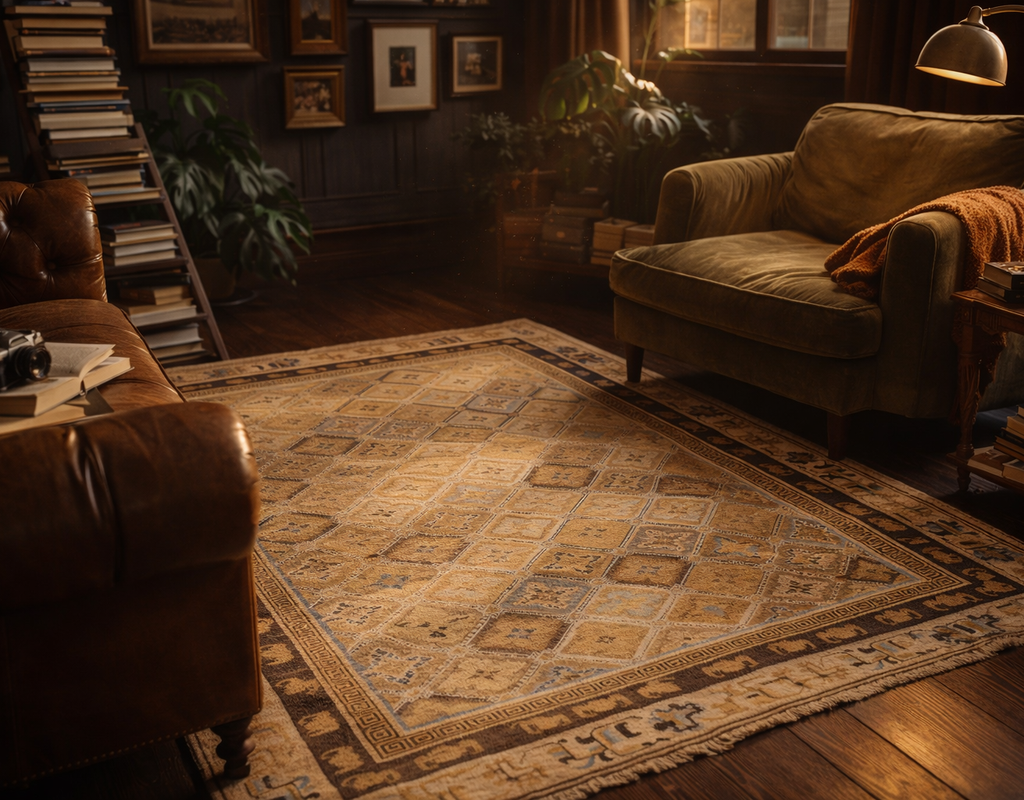
A warm, earth-toned area rug grounds the intimate reading nook furnished with classic leather and velvet seating.
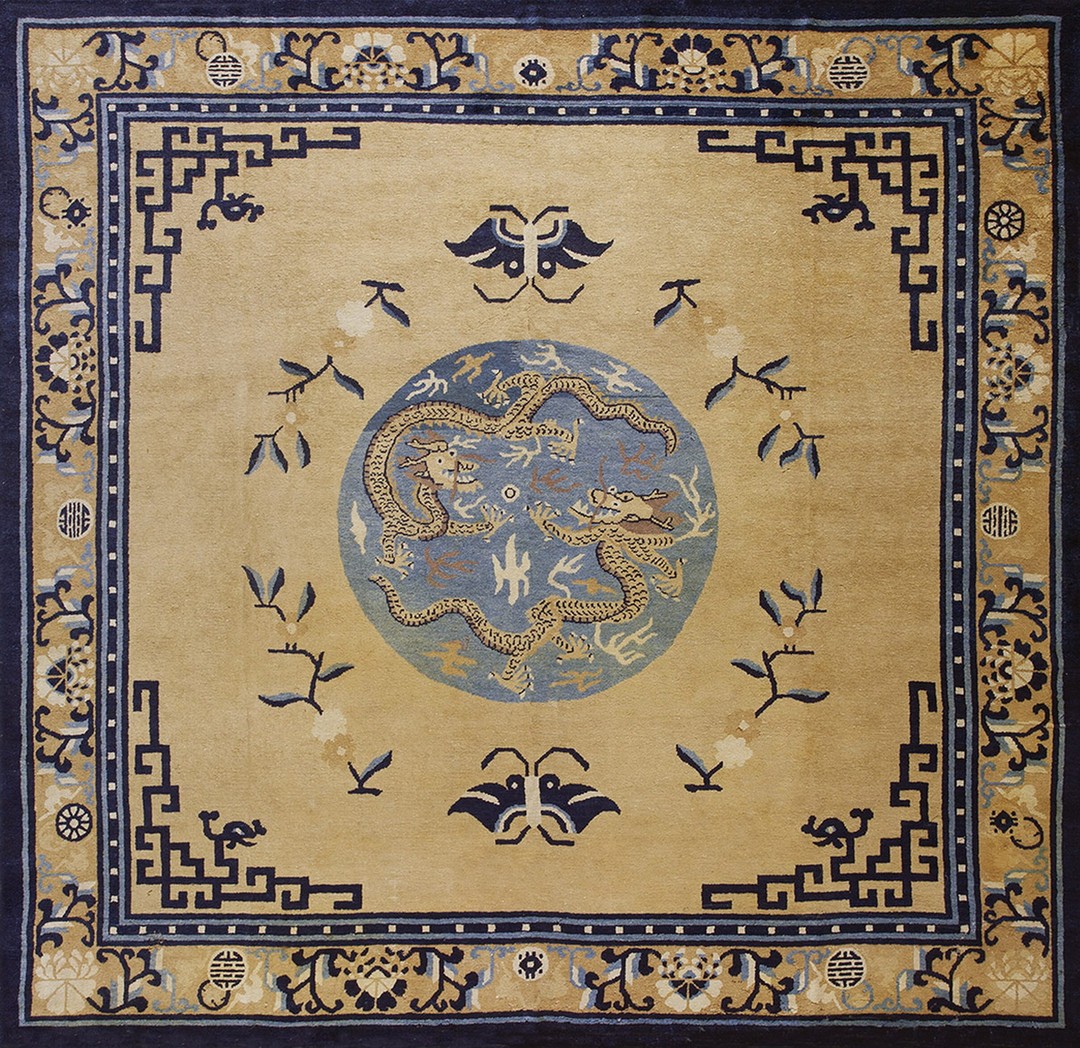
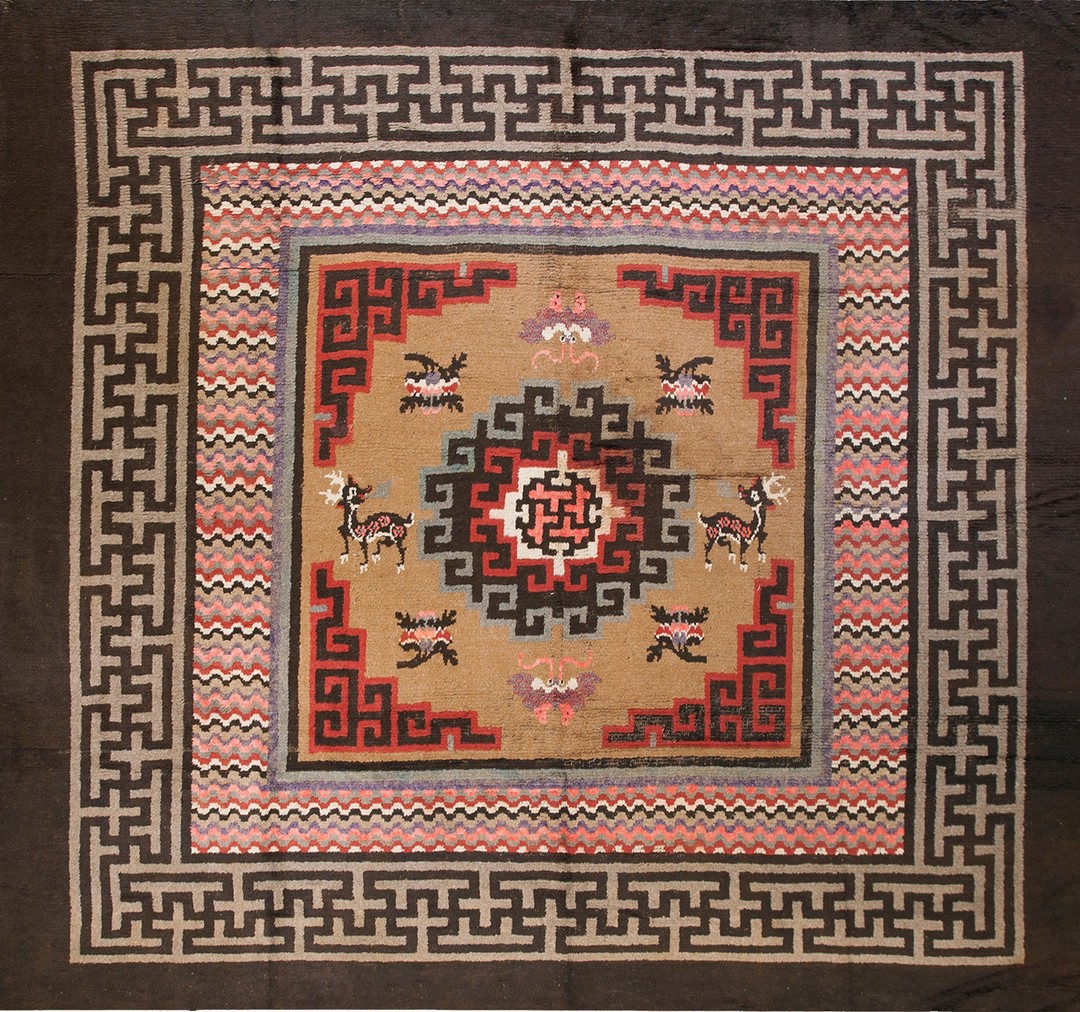
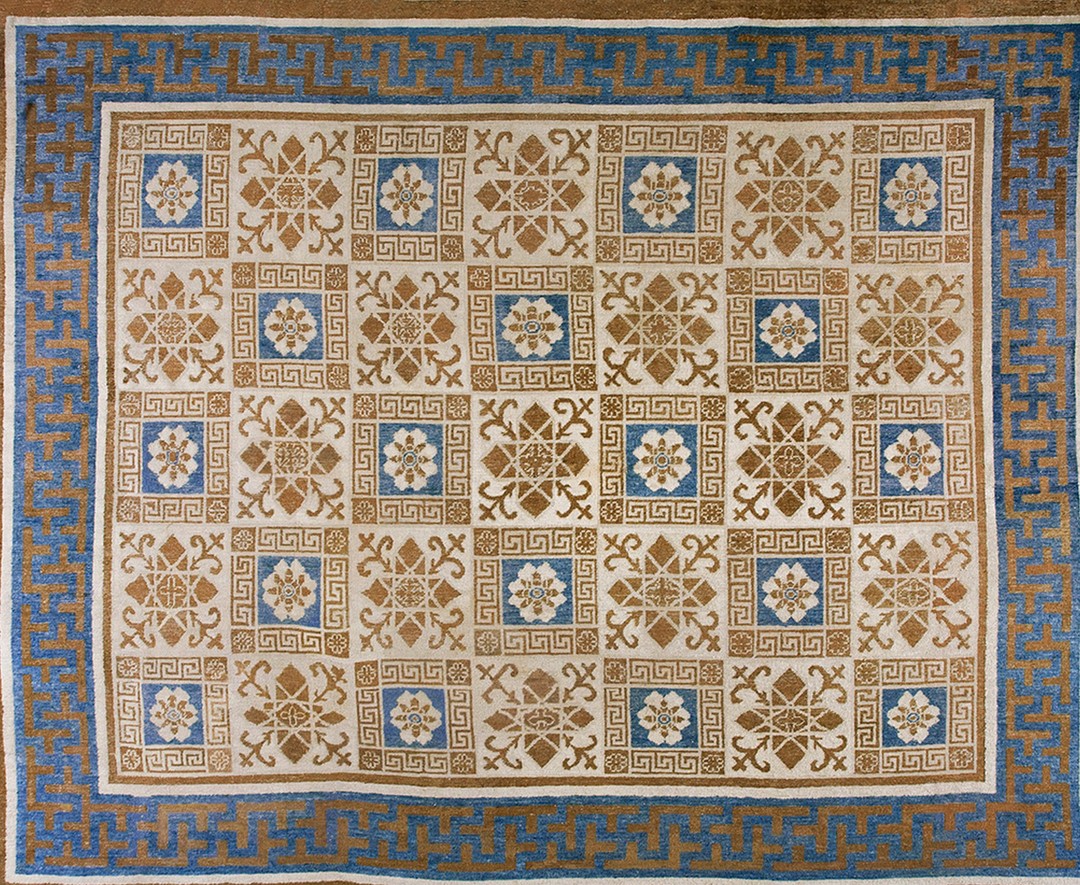
The symbolic language of Mongolian rugs is rich and layered, reflecting a blend of Buddhist, Chinese, and steppe traditions. The endless knot rug motif, one of the Eight Auspicious Symbols in Buddhism, represents the interconnection of wisdom and compassion. Dragons, borrowed from Chinese cosmology, appear as guardians of power and prosperity, while Mongolian dragon motifs often retain a distinctive, energetic style suited to the bold open fields of these carpets. Tigers are equally significant, embodying protection and spiritual strength, frequently found on saddle rugs or meditation mats. Floating medallions—sometimes single, sometimes repeated—dominate the composition, reinforcing the Mongolian preference for open, uncluttered designs. Borders often feature Greek key or fretwork, grounding the rug while framing its symbolic center.
- What symbols commonly appear on traditional Mongolian rugs? Endless knots, dragons, tigers, medallions, and Buddhist symbols are the most prevalent, representing protection, harmony, and spiritual teaching.
Colors & Dye Sources
Color was both practical and symbolic in Mongolian weaving, with dyestuffs drawn from the natural environment.
- Madder Root (Reds) — Provided deep reds and pinks. — Why: Red was auspicious in Buddhist and Chinese traditions, symbolizing life and power.
- Indigo (Blues) — Extracted from imported sources or cultivated plants. — Why: Blue symbolized the eternal sky, central to Mongol cosmology.
- Plant & Mineral Yellows/Greens — Derived from local herbs and soils. — Why: Represented harmony with nature and the earth’s fertility.
- Natural Browns & Undyed Wool — From sheep’s fleece or earthy mordants. — Why: Earth tones reflected the steppe environment and practical durability.
- Synthetic Dyes (Brights) — Introduced in the late 19th and early 20th century. — Why: Allowed brighter palettes but sometimes diminished traditional subtlety; prized less by collectors.
Collectors often prefer muted, naturally dyed carpets for their authenticity and harmony, while brighter synthetic examples tell the story of modern adaptation and market influence.
Regional/Tribal Variations
Mongolia’s vast landscape and diverse ethnic groups created regionally distinct weaving practices. While central regions emphasized Buddhist iconography and medallion-centered designs, other areas integrated more geometric or colorful approaches. Tribal identity often showed through in border treatments, pattern boldness, and choice of fiber blends.
Kazakh Influence in Bayan-Ölgii
The Bayan-Ölgii province, home to a significant Kazakh minority, stands out as a hub of cross-cultural weaving. Here, Kazakh rugs in Mongolia exhibit bright colors, bold geometric motifs, and compact knotting styles more closely aligned with Kazakh steppe traditions than central Mongolian Buddhist designs. These rugs illustrate how ethnicity and geography shaped design identity.
- Why does Bayan-Ölgii weave Kazakh-influenced carpet designs? Because its population is predominantly Kazakh, whose weaving traditions carry over into the regional textile style, resulting in more geometric and colorful designs compared to Buddhist-influenced Mongolian rugs.
Khövsgöl Puzzle Rugs
In the northern province of Khövsgöl, artisans developed a unique felt tradition known as Khövsgöl felt puzzle rugs. Constructed from interlocking felt pieces, these rugs form intricate geometric mosaics. Their modular design reflects both ingenuity and practicality: damaged sections could be replaced without discarding the entire rug. The puzzle format also highlights the creative dimension of Mongolian felting, moving beyond plain insulation into an art of assembly.
- What defines Khövsgöl province’s felt-puzzle rug style? Interlocking felt pieces arranged in geometric mosaics, prized for both their visual inventiveness and practical repairability.
Temple Carpets (Erdene Zuu)
Among the most culturally significant Mongolian textiles are the Erdene Zuu carpets, woven or felted for temple use at Mongolia’s oldest Buddhist monastery. These carpets were not ordinary household pieces but sacred objects used in rituals, teachings, and monastic decoration. Their designs carried profound symbolic weight, embedding Buddhist motifs within large ceremonial floor coverings. Today, surviving examples serve as cultural treasures, representing the height of Mongolian weaving devoted to spiritual life.
- How are Erdene Zuu monastery carpets culturally significant? They were integral to Buddhist rituals and teachings, embodying sacred symbolism and preserving Mongolian religious heritage.
Mongolian rug design and symbolism thus form a tapestry of meanings—spiritual, tribal, and regional. From endless knot rugs and Mongolian dragon motifs to the Kazakh-inspired weavings of Bayan-Ölgii, the interlocking mosaics of Khövsgöl felt puzzles, and the revered Erdene Zuu carpets, the tradition is a living testament to Mongolia’s place at the crossroads of steppe and spirituality.
Regional Variations & Markets
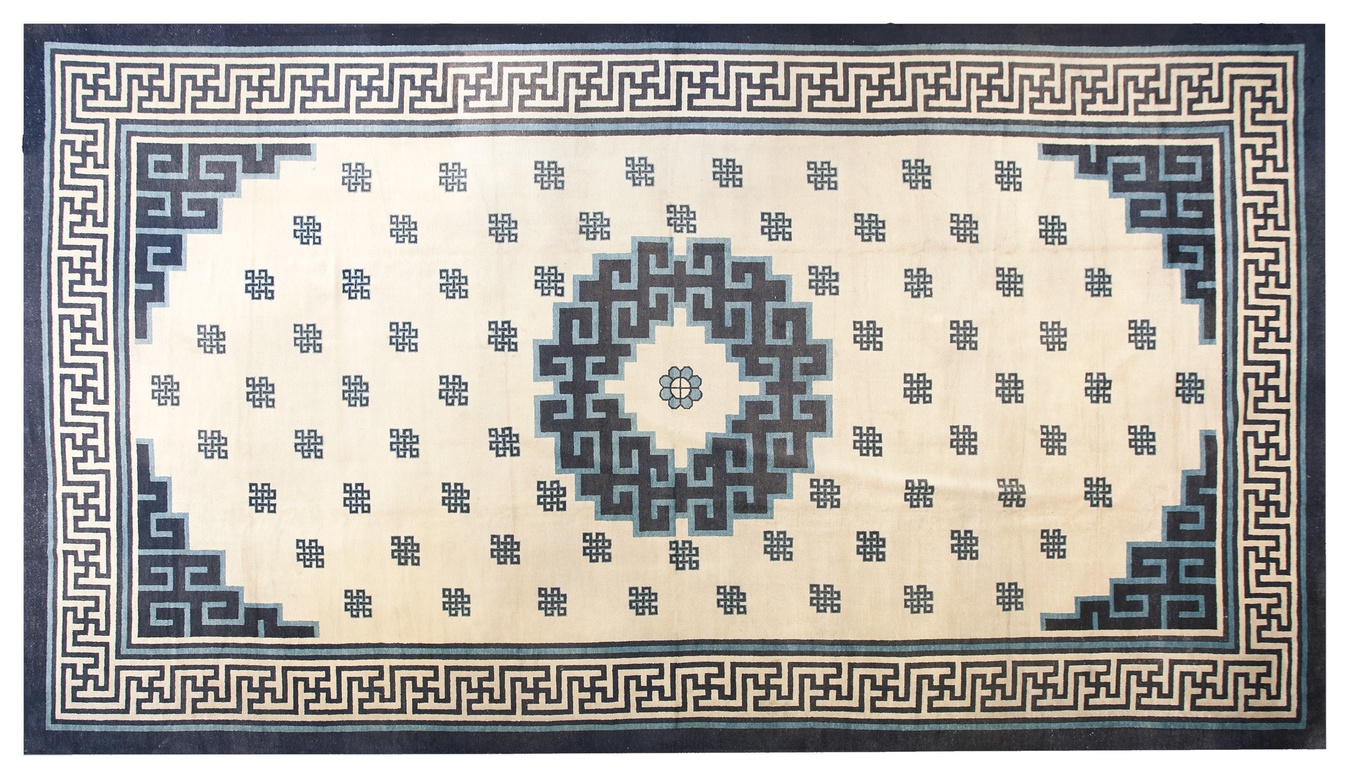
Antique Oversized Chinese – Mongolian Knotted Rug – by Rugs On Net
Inner Mongolia (Baotou, Suiyuan)
The weaving tradition of Inner Mongolia is best represented by the workshop rugs of Baotou and Suiyuan. These pieces, often produced on a larger scale, display the influence of Chinese aesthetics in their brighter colors, balanced medallion designs, and refined finishes. Unlike the wool-on-wool foundation of nomadic rugs, Inner Mongolian carpets frequently used a cotton foundation, giving them greater stability and precision. Baotou, in particular, became famous for its workshop system and for exporting carpets along trade networks into China and beyond. Saddle blankets, often vibrantly woven, were a specialty of the region, combining decorative brilliance with practical function. The Baotou carpet market still echoes this legacy, marking Inner Mongolia as a hub for fine workshop production.
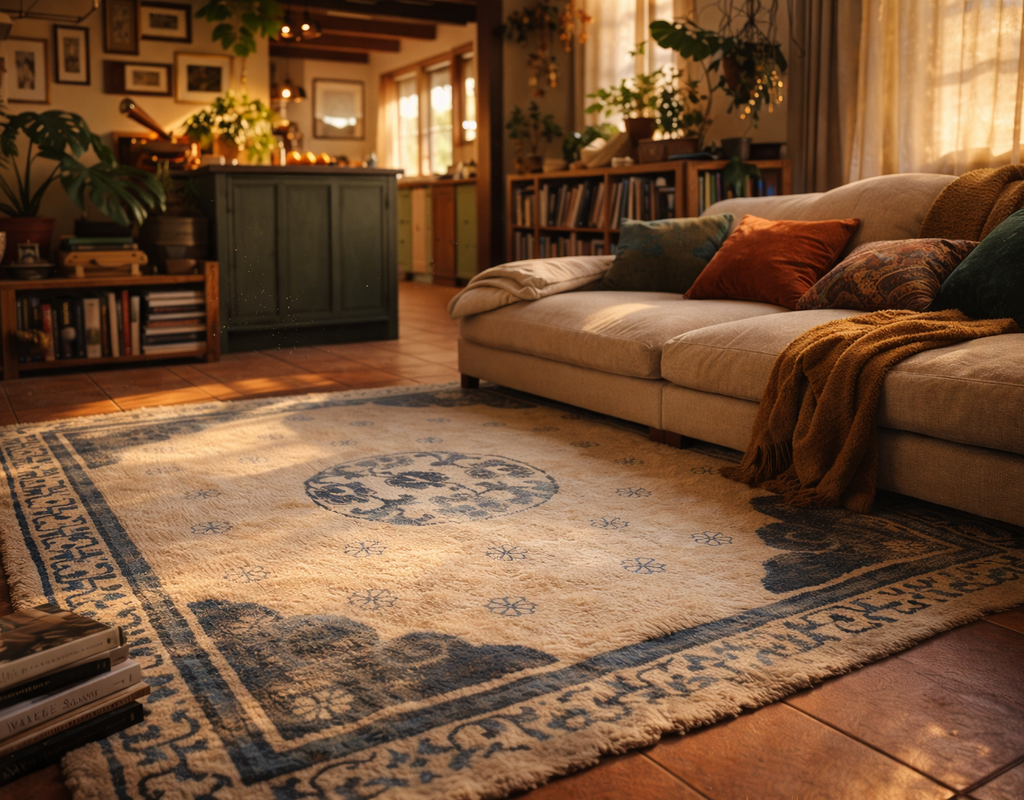
Sunlight warmly illuminates a cozy living room anchored by a distressed blue and cream patterned rug.
Outer Mongolia (Nomadic Provinces, Ulaanbaatar)
In contrast, Outer Mongolia retained a more tribal and rustic character in its weaving. Rugs here were woven on wool foundations, reflecting the complete reliance on sheep and pastoral life. The results were often coarser than Inner Mongolian workshop rugs but deeply authentic in their nomadic aesthetic. Designs were bold, minimalist, and symbolic, crafted to suit yurts and local needs rather than distant export markets. Fewer of these traditional Outer Mongolian rugs survived, as they were heavily used and rarely preserved. Today, Ulaanbaatar serves as a gathering point where such tribal pieces, along with modern productions, are traded in local bazaars.
Famous Carpet Markets
Historically, several places emerged as central markets for Mongolian carpets.
- Baotou — Renowned for its workshop production, Baotou remains one of the most recognizable names in Mongolian rug trade. — Why: It supplied both local and Chinese demand, becoming a linchpin of Inner Mongolian exports.
- Ulaanbaatar — The Ulaanbaatar rug bazaar has long been a destination for nomadic weavings, tribal goods, and more recently, urban buyers and tourists. — Why: As the capital, it concentrates diverse styles and provides a modern market setting.
- Erdenet — A factory town established in the 20th century, Erdenet carpets represent Mongolia’s industrial weaving era, with larger-scale production for domestic and international use. — Why: It shifted rug-making from purely nomadic to state-driven models during the socialist period.
- Lhasa (Tibet) — While not in Mongolia, Lhasa was historically a major node in the Tibetan-Mongolian trade of carpets, linking Mongol weavers with Buddhist monastic centers. — Why: It reflects the intertwined trade and religious exchange of the wider region.
- Where are Mongolia’s most famous carpet markets located? Baotou, Ulaanbaatar, Erdenet, and historically Lhasa.
Live Felting Workshops in Terelj
The revival of traditional crafts includes experiential tourism. In Terelj National Park, near Ulaanbaatar, visitors can participate in Terelj felting workshops, where artisans demonstrate the ancient art of wool felting. Tourists join in by rolling and pressing wool panels, gaining firsthand insight into a craft that predates knotted rugs by millennia. These workshops serve both as cultural preservation and as a way for local families to share and sustain their heritage.
- Where can visitors watch live felting workshops in Terelj? In Terelj National Park, where artisans host interactive demonstrations of traditional Mongolian felting.
Arkhangai Sheep Shearing & Cooperative Models
In Arkhangai province, the wool cycle is at the heart of rug production. Each spring, herders shear sheep to collect fleece, which is then processed for felting or spinning into rug yarns. Local cooperatives play an essential role in coordinating this work, pooling resources, and ensuring fair distribution of wool for weaving and felting. These Arkhangai wool co-ops represent both an economic model and a continuation of communal nomadic values.
- When do Arkhangai cooperatives shear sheep for carpet wool? In spring, when the seasonal molt allows wool to be harvested without harming the animals.
From the cotton-based workshop rugs of Baotou to the rustic wool traditions of Outer Mongolia, from the bustling Ulaanbaatar rug bazaar to Terelj felting workshops and the springtime rhythms of Arkhangai wool co-ops, Mongolian rug markets showcase both diversity and continuity. They link nomadic heritage with global trade while keeping alive the cultural essence of the steppe.
Cultural Roles & Symbolism
Function in Nomadic Life & Yurts
In Mongolia, rugs are inseparable from the yurt—the portable dwelling that defines nomadic life. Felt rugs cover the floor, line the walls, and sometimes even form the roof panels, creating insulation against the brutal cold and offering comfort on bare earth. Within the yurt, these textiles also serve as bedding, seating mats, and protective layers beneath saddles or household goods.
- Why are Mongolian yurts decorated with felt rugs? Because felt provides both warmth and protection, while also adding beauty and symbolic meaning to the home. Decorating a yurt with rugs transforms it into a lived, protective space where insulation, comfort, and cultural expression merge.
The yurt rug thus embodies practicality and artistry—anchoring daily life while embedding symbolism into the very architecture of nomadic existence.
Rugs in Dowry, Ritual, and Heritage
Beyond daily use, rugs carried immense social value. A bride’s dowry typically included hand-woven or felted carpets, marking her family’s skill and wealth. These dowry carpets were not only practical assets but also symbols of continuity, traveling with women into their new households as treasured heirlooms.
Rugs were also central to ritual life: gifted at weddings, used in seasonal festivals, or preserved as family heritage textiles. Their durability allowed them to serve for generations, becoming carriers of memory that embodied lineage and cultural identity. In this way, Mongolian carpets were not just household furnishings but vital links in the transmission of tradition.
Buddhism and Auspicious Motifs
With the spread of Buddhism, rug design became infused with symbolic motifs carrying spiritual weight. Buddhist motif rugs featured the endless knot for eternity, lotus flowers for purity, and tigers or dragons as guardians. These motifs transformed ordinary furnishings into spiritual protectors, believed to guard households against misfortune while encouraging harmony and prosperity. Rugs placed beneath altars or in meditation spaces acted as visual mandalas, grounding spiritual practice in woven form.
Use of Rugs in Monasteries & Ceremonies
Monasteries elevated the role of rugs into sacred practice. Large carpets were spread in assembly halls, layered beneath sacred scrolls, or used to define ritual spaces. Monks sat on woven mats during prayers, while ceremonial carpets carried Buddhist symbols central to teachings. The revered Erdene Zuu carpets, crafted for Mongolia’s oldest monastery, exemplify this spiritual use: they were not decorative alone but deeply embedded in ritual performance and monastic life.
By uniting insulation, dowry symbolism, spiritual imagery, and sacred ceremony, Mongolian heritage textiles reflect the fusion of utility, social status, and faith. They remain a living record of how the Mongols wove their survival, identity, and spirituality directly into their rugs.
Modern Market & Ethical Production
Erdenet Factory & Contemporary Revival
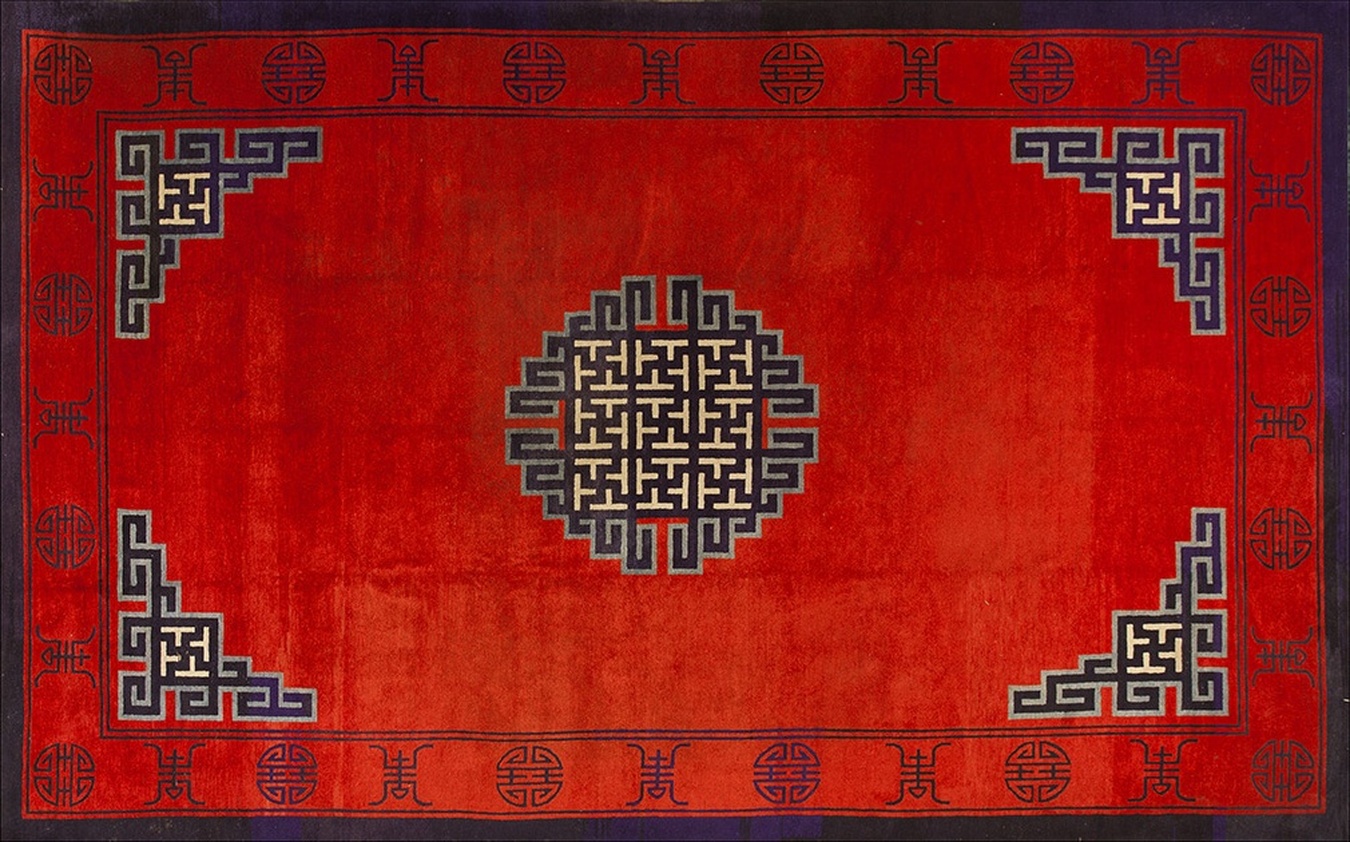
Antique Mongolian Chinese Medallion Knotted Rug – by Rugs On Net
The centerpiece of Mongolia’s modern rug industry is the Erdenet carpet factory, established during the socialist period and still in operation today. Located in one of Mongolia’s largest industrial towns, Erdenet transformed rug-making from nomadic cottage craft into organized, large-scale production. The factory weaves both traditional designs—echoing Buddhist and steppe motifs—and contemporary patterns aimed at domestic and international buyers. By using a mix of Mongolian and imported wool, it ensures both volume and versatility. This industrial revival safeguards traditional skills while adapting them to modern markets, providing livelihoods for artisans and sustaining cultural continuity.
Mongolian Lambswool Rugs & International Design
In the global market, Mongolian textiles extend beyond knotted carpets to include Mongolian lamb fur rugs and throws, which have become especially popular in interior design.
- Softness and Texture — Long, curly lambswool fibers create a luxurious, tactile surface. — Why: They offer unmatched comfort and appeal to high-end décor buyers.
- Versatility — Used as throws, accent rugs, or upholstery. — Why: Their adaptability fits both minimalist and eclectic interiors.
- Exotic Appeal — Marketed as rare, natural steppe products. — Why: Consumers value authenticity and the connection to Mongolia’s nomadic heritage.
- Sustainability Narrative — Wool is a renewable resource when herding is responsibly managed. — Why: Buyers increasingly seek eco-friendly luxury.
These products differ from woven carpets but highlight Mongolia’s ability to position wool and fur goods as luxury exports.
Tibetan/Mongolian Style Blending
Modern rug production often merges Tibetan and Mongolian traditions, especially in border regions and export workshops. This blending can be seen in hybrid designs where Tibetan cloud motifs meet Mongolian open fields or where knotting techniques overlap. Such rugs appeal to international buyers who appreciate both cultural aesthetics, while also reflecting the deep historic ties between the two traditions through Buddhism and shared trade routes.
Province-of-Origin Labeling & Value
In today’s rug market, provenance matters as much as design. A rug labeled from Baotou, Erdenet, or Arkhangai carries not only a geographic marker but also cultural credibility. Collectors and buyers value this transparency, as it assures authenticity and allows them to trace stylistic traits to specific weaving traditions.
- Does province-of-origin labeling affect Mongolian rug value? Yes. Province labeling boosts confidence, adds cultural depth, and can raise prices, as rugs tied to well-known weaving centers or ethnic groups are more desirable.
Rug Certification & Ethical Herding
With rising awareness of sustainability, rug certification is becoming more significant in Mongolia. Initiatives are emerging to trace wool provenance back to specific herds and to ensure fair labor conditions in rug production. Certification programs emphasize ethical herding practices—avoiding overgrazing, ensuring animal welfare, and supporting nomadic cooperatives.
- Are modern Mongolian carpets certified for ethical herding? While widespread certification is still developing, pilot programs exist to certify wool and carpets for sustainable, ethical herding and fair labor, making such rugs increasingly appealing to eco-conscious buyers.
By combining the industrial power of Erdenet carpets, the global allure of Mongolian lamb fur, the stylistic fusion with Tibetan weaving, and the assurance of province labeling and ethical certifications, the modern Mongolian rug market presents both a cultural revival and a forward-looking response to global consumer values.
Collector Guidance & Care
Durability: Felt Rugs vs. Hand-Tufted Imports
One of the most important considerations for collectors is durability. Mongolian felt rugs, crafted from densely compacted wool fibers, are exceptionally resilient. Unlike modern hand-tufted imports, which often rely on adhesives and synthetic backings that break down over time, felt rugs are entirely natural and structurally robust. Their ability to withstand decades of use—whether as yurt flooring or saddle pads—demonstrates their enduring strength.
- Can Mongolian felt rugs outperform hand-tufted imports for durability? Yes. Felt rugs are stronger and longer-lasting, making them a superior investment for collectors who value resilience and authenticity.
Natural Dyes as Value Factor
Collectors consistently prize natural dye rugs over synthetic-dyed examples. Natural dyes, drawn from plants, minerals, and insects, create subtle, harmonious palettes that age beautifully, gaining patina rather than fading. Rugs with natural dyes are considered more authentic and historically significant, often commanding higher prices at auction.
- Should collectors prioritize natural dyes in Mongolian carpets? Yes—natural dyes increase both authenticity and long-term value, making them the preferred choice for serious collectors.
Maintenance: Preventing Pilling
Like all wool rugs, Mongolian carpets require careful upkeep to preserve their beauty. Pilling or felting can occur with friction, particularly on softer wool. Collectors should adopt simple practices of Mongolian rug care:
- Gentle Vacuuming — Avoid heavy beater bars to prevent surface damage. — Why: Reduces dirt buildup without stressing the fibers.
- Rotation — Move the rug periodically. — Why: Ensures even wear and prevents traffic lanes from matting.
- Professional Cleaning — Periodic dry cleaning by specialists. — Why: Maintains fiber integrity and avoids moisture damage.
- What maintenance prevents felting pilling on Mongolian carpets? Gentle vacuuming, rotation, and professional cleaning keep wool fibers from compressing and help prevent pilling.
Altitude-Reared Wool & Pricing
The steppe’s unique climate directly impacts collector value. Rugs woven from the fleece of sheep raised at high altitudes possess wool that is stronger, shinier, and denser, a natural adaptation to harsher environments. These qualities make the rugs more durable and visually striking, which translates to greater demand.
- How do altitude-reared sheep impact Mongolian rug pricing? Their wool produces superior rugs that command premium prices due to enhanced resilience, luster, and rarity.
For collectors, the key lies in combining practical rug care with informed purchasing—favoring felt rug durability, natural dye rugs, and the prestige of altitude wool value. This approach ensures both the preservation of heritage textiles and the safeguarding of long-term investment.
Conclusion & Legacy
Enduring Nomadic Artistry
The story of Mongolian rugs is, at its core, the story of resilience. Born of necessity on the windswept steppe, these textiles embody the balance of survival and beauty that defines nomadic life. Whether crafted as felt for yurts, knotted-pile rugs with floating medallions, or saddle covers adorned with dragons and endless knots, they reveal a culture that wove artistry into every aspect of living. Today, Mongolian carpets continue to serve as authentic links to nomadic heritage, preserving traditions that have endured for millennia while adapting to modern tastes and markets.
- How is the legacy of Mongolian rugs being preserved and adapted today? Through a combination of community revival efforts, workshops, ethical certifications, and global collector interest, which together ensure the craft remains relevant while honoring its roots.
Future of Mongolian Rug Weaving
The path forward for Mongolian carpets reflects both continuity and change, offering key highlights for collectors, enthusiasts, and designers alike:
- Heritage Revivals — Local cooperatives and workshops are revitalizing felting and weaving. — Why: These initiatives secure knowledge transfer between generations and sustain nomadic communities.
- Global Design Integration — Interior designers are increasingly drawn to the minimalism of open-field Mongolian motifs. — Why: The clean, floating designs resonate with contemporary aesthetics while remaining deeply cultural.
- Sustainable Practices — Certifications and ethical herding standards are expanding. — Why: Eco-conscious buyers value transparency, linking rug heritage with modern sustainability.
- Tourism & Education — Hands-on workshops in places like Terelj give visitors a direct experience of nomadic crafts. — Why: Cultural tourism strengthens both preservation and economic opportunity.
- Collector Demand — Antique Mongolian rugs, rare and distinct, are gaining recognition in international markets. — Why: Scarcity and authenticity make them prized acquisitions, elevating their profile among museum curators and private collectors.
The Mongolian weaving legacy is thus not a relic of the past but a living tradition. Rooted in nomadic rug heritage, it continues to evolve—sustained by artisans, scholars, and collectors who recognize the unique place these textiles hold in world culture. The future of rug craft in Mongolia is one of resilience, adaptation, and renewed visibility, ensuring that the artistry of the steppe remains vibrant for generations to come.
Explore a Few of Our Favorite Mongolian Rugs
FAQ
- Where can I buy authentic rugs from Mongolia?
In the U.S., look for Mongolian felt rugs through specialty importers and fair-trade outlets, and reputable dealers for antique Ningxia pieces. Verify origin, fiber, and care details before buying.
- Can Mongolian sheepskin rugs be trimmed?
Yes—carefully. Light trimming can neaten Mongolian sheepskin rugs, but the new length is permanent; test a hidden area and use sharp shears.
- Are Mongolian rugs an ethical choice?
Many Mongolian sheepskin rugs are by-products of meat production, but claims vary. Seek transparent sourcing, traceability, and tanneries tested for restricted chemicals; consider high-quality faux if uncertain.
- How do I store Mongolian rugs long-term?
Brush and fully dry Mongolian rugs, then store in a breathable cotton bag in a cool, dry place. Avoid plastic, folding creases, and heat sources.
- Do Mongolian rugs need a rug pad?
Yes—Mongolian rugs benefit from a thin natural-rubber or felt rug pad to prevent slipping, protect floors, and help the wool loft stay airy.
- How should I style Mongolian sheepskin rugs at home?
Use Mongolian sheepskin rugs as cozy throws over chairs, benches, or bedside. Layer a single pelt over a flatweave base rug to add texture without creating tripping edges.
- Do rugs from Mongolia use Mongolian wool?
Yes—rugs from Mongolia and nearby centers draw on Mongolian wool; Inner Mongolia historically supplied wool for Ningxia and other Chinese carpets. Modern knotted pieces may blend local and regional highland wools.
- Are “Mongolian” and “Tibetan” sheepskin rugs the same thing?
Retailers often use the terms interchangeably; many pelts come from Tibet or Inner Mongolia with similar fine, curly wool. Ask sellers for exact origin and tanning method.
- How do Mongolian rugs differ from Tibetan rugs?
Mongolian rugs commonly mean felt floor pieces or sheepskin pelts; Tibetan rugs are hand-knotted wool (khaden) with motifs like tiger designs. Tibetan pieces use a distinct knot and typically shorter pile.
- What patterns appear on Mongolian felt rugs?
Traditional Mongolian felt rugs often feature alkhan khee (meander), ulzii/‘endless knot,’ and tümen nasan (‘ten-thousand-years’) motifs symbolizing continuity and longevity. Expect bold, repeated borders and mirrored appliqué.
- How can I tell real Mongolian sheepskin rugs from faux?
Real Mongolian sheepskin rugs have a suede leather back and tapered, irregular curly fibers; faux has knit/fabric backing and uniform strands. Real hides vary in outline and hair length.
- Will Mongolian rugs fade in sunlight?
Dyed Mongolian sheepskin rugs can fade or yellow with UV exposure. Keep them out of direct sun and rotate occasionally for even wear.
- Can Mongolian rugs sit on radiant-heat floors?
Yes on low settings, but protect Mongolian rugs: keep surface temps under \~81°F (27°C), use a rug pad, and avoid hot spots near vents or heaters.
- Can Mongolian rugs go in bathrooms?
Mongolian sheepskin rugs aren’t ideal in humid bathrooms—steam and splashes can stiffen leather and cause dye bleed. Use washable faux, or keep sheepskin in a dry-zone only.
- Are Mongolian rugs pet-friendly?
Pets love them, but claws and chewing can mat or pull wool on Mongolian sheepskin rugs. Choose shorter pile or faux, brush weekly, and use a pad to prevent sliding.
- Are Mongolian rugs safe for babies and kids?
As floor accents, yes—avoid Mongolian sheepskin rugs on sleep surfaces. Lanolin can trigger contact allergy in a small minority; ask your pediatrician if sensitive skin is a concern.
- How much do Mongolian sheepskin rugs cost in the U.S.?
Typical U.S. pricing: singles \$80–\$150, doubles \$200–\$350, quads \$350–\$600+. Rare colors, extra-large pelts, or premium tanning can cost more.
- What dimensions are available for Mongolian sheepskin rugs?
Singles are roughly 2×3 ft; doubles about 2×6; quads near 4×6; sextos \~5.5×6; octos around 6–7×6–7 ft. Multi-pelt Mongolian sheepskin rugs are sewn leather-to-leather.
- Do Mongolian sheepskin rugs shed or smell?
Expect a little loose fiber and a natural hide scent at first; both subside. Air Mongolian sheepskin rugs 24–48 hours and brush periodically to minimize shedding.
- How do I de-tangle or revive matted Mongolian rugs (sheepskin)?
Lightly mist with water and brush through with a wire carding/slicker brush, then shake. Avoid heat tools; they can shrink or harden the leather backing.
- Can Mongolian sheepskin rugs be machine-washed?
Only if the label says washable; many Mongolian sheepskin rugs aren’t. If permitted, use a wool cycle at 20–30°C (68–86°F), wool detergent, and dry flat away from heat.
- How do you clean Mongolian sheepskin rugs?
Use suction-only vacuuming, shake outside, and spot-blot with cool water and a wool-safe detergent; air-dry out of sun. Many dyed Mongolian sheepskin rugs are dry-clean–only—check the label.
- Are Mongolian sheepskin rugs suitable for areas with heavy foot traffic?
Not ideal. Mongolian sheepskin rugs have long, fine, curly wool that mats under heavy use—better for bedsides, chairs, or layering. Typical pile runs about 3–5 inches.
- Are Mongolian felt rugs durable on floors?
Yes—Mongolian felt rugs are dense and hard-wearing for daily life inside a ger. Their quilted panels and close stitching keep seams flat underfoot.
- What are Mongolian rugs?
Mongolian rugs include stitched felt floor pieces for gers, curly-pile Mongolian sheepskin pelts, and antique hand-knotted pieces from Inner Mongolia/Ningxia. Traditional felt rugs (shirdeg/toiruulga) are quilted, often stitched with camel-wool thread.