
Introduction to the Mahi / Herati Motif
Explore our curated selection of stunning Fish Mahi Herati rugs and find the perfect piece for your home.
Visual Features and Symbolism
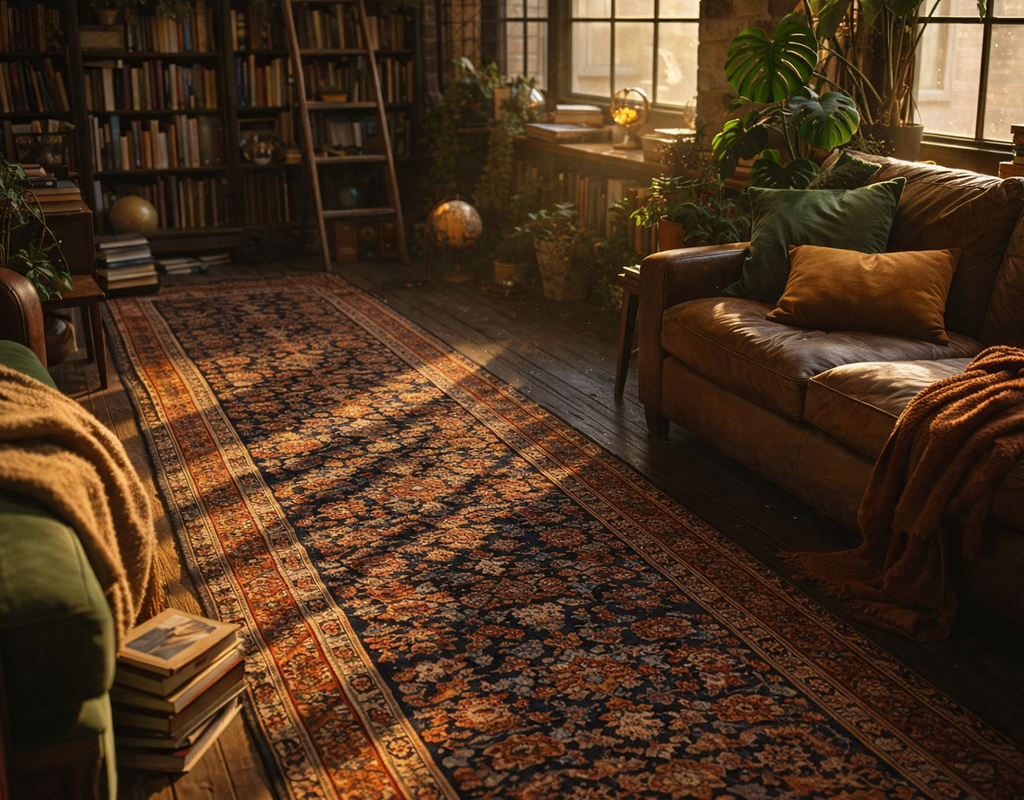
Warm, moody sunlight highlights the detail of the vintage-style runner rug in this inviting reading room.
- Central rosette or blossom — Why: This acts as the “moon” or “lotus,” the heart of the design around which the other elements orbit.
- Four curved leaves shaped like fish — Why: These are the hallmark of the Mahi rug, creating the illusion of swimming fish circling the center.
- Diamond or lozenge lattice — Why: The Herati pattern repeats endlessly, producing balance and visual rhythm across the carpet.
- Eye-like dots and serrated tails — Why: These small details reinforce the impression of living creatures in motion.
- Symbolic meaning — Why: The fish design carpet embodies water, fertility, and cycles of renewal; in Persian lore it suggests fish swimming around the moon or lotus, linking earth with cosmic order.
The Herati pattern is celebrated for its harmony of symmetry and movement. The repeating grid, while tight, never feels static—its subtle energy conveys life itself. This aesthetic complexity, combined with symbolic depth, is why collectors and weavers across centuries continue to favor the Persian fish motif.
Names, Etymology, and Alternative Terms
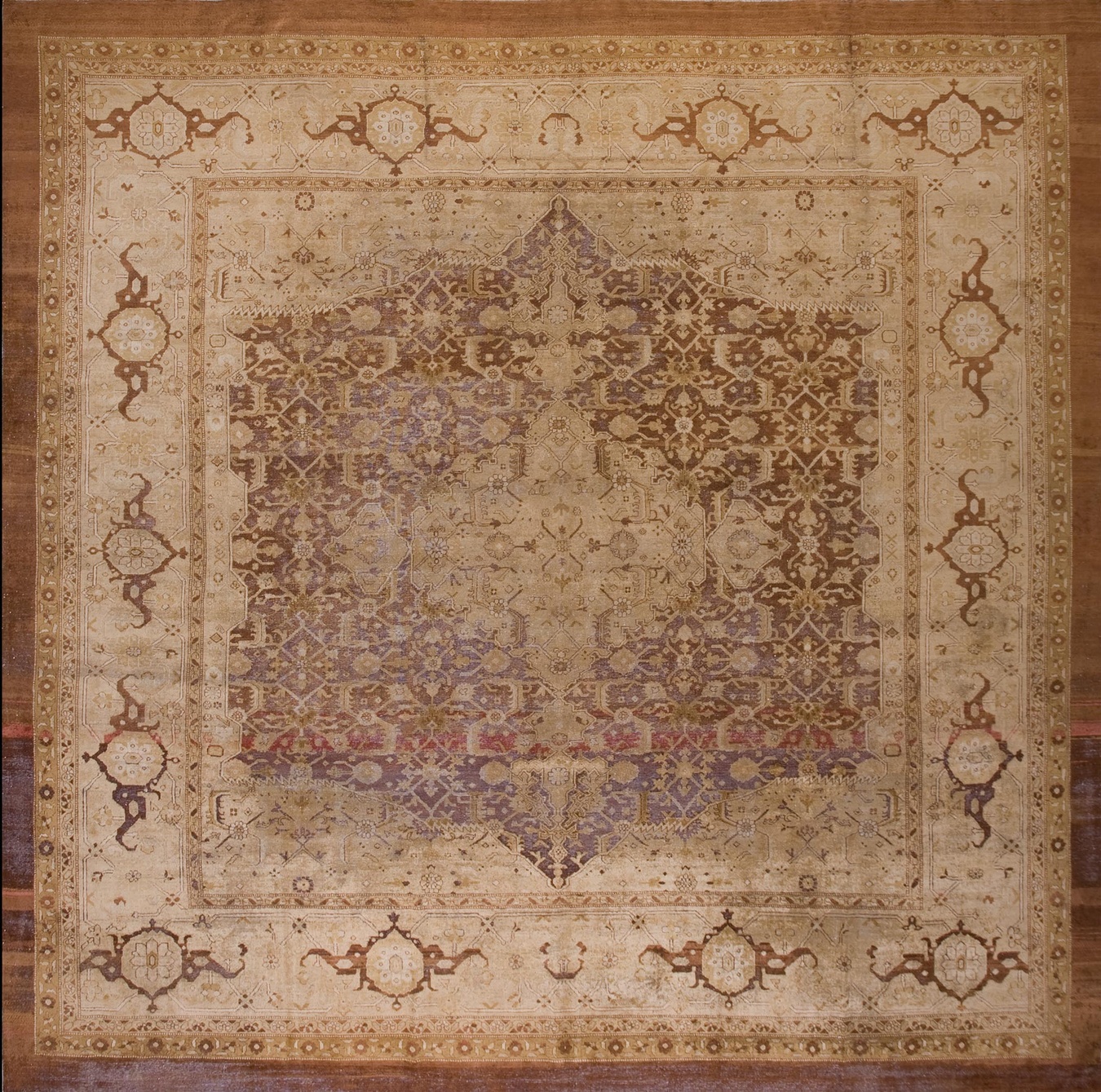
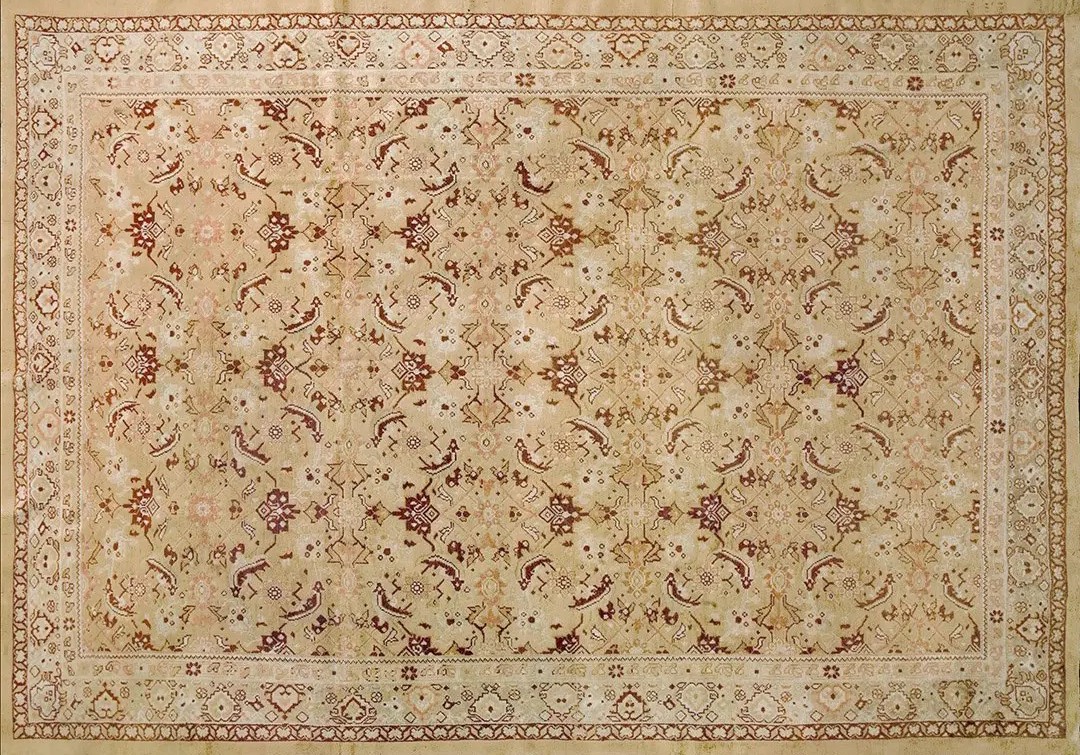
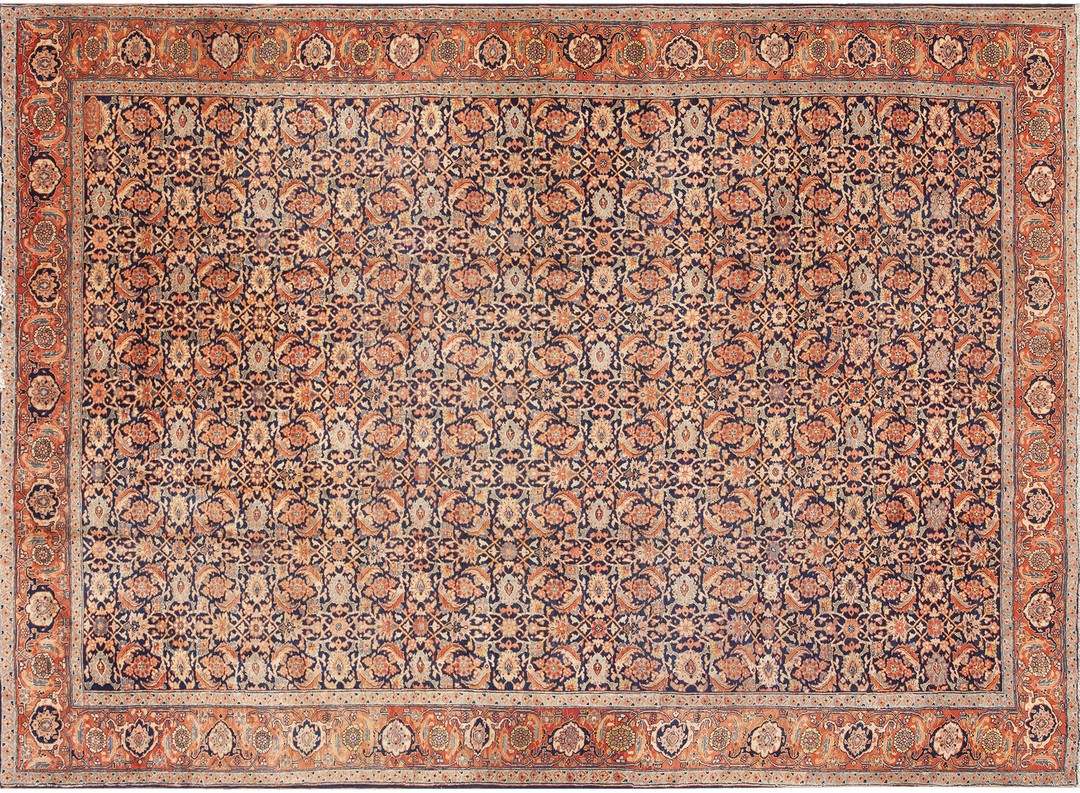
Antique Floral Medallion Wool Hand Knotted Pile Coral / Salmon Pink 1900s Rug – by Rugs On Net
The Mahi/Herati design carries multiple names that mirror its wide cultural reach. In Farsi, mahi literally means “fish,” and the phrase mahi dar ham (“intertwined fish”) describes the curling forms. The name Herati ties the pattern to Herat, a historic city in Afghanistan that served as a hub of Persianate weaving traditions. Western dealers often simplify it to “fish pattern” or “fish design carpet,” while connoisseurs alternate between Mahi rug and Herati motif. These overlapping names highlight not confusion, but rather the motif’s diffusion across regions and cultures, each adopting its own label for the same enduring design.
How to Identify a Fish Design in Carpets
- Look for a rosette or small blossom at the center — Why: This is always the anchor of the design.
- Check for four curved leaves surrounding the center — Why: These are the symbolic fish, arranged in a diamond-like embrace.
- Notice repeating lattice formations — Why: The Herati pattern almost always covers the entire field in an endless repeat.
- Examine details like eyes or serrated ends on the “fish” — Why: These refinements confirm it as a true Persian fish motif.
Identifying Herati rugs becomes easy once these cues are recognized: a flower-like core encircled by swimming “fish,” endlessly tessellated. This hallmark arrangement ensures that even in highly stylized or abstracted versions, the essence of the fish motif meaning remains instantly recognizable.
Origins and History of the Herati Motif
Geographic Roots: Herat, Persia, Khorasan
The origin of the Mahi motif lies in the Persian cultural heartland, specifically the city of Herat, now within Afghanistan. During the Timurid and Safavid periods (15th–16th centuries), Herat emerged as a major artistic hub where miniature painters, calligraphers, and carpet designers flourished. The Herati pattern likely drew on Khorasan weaving traditions, a region long associated with luxury textiles. Some scholars trace its symbolism back even further, to ancient Persian and Mithraic imagery, where two fish circling the moon or lotus represented water, fertility, and the cycles of life. This deep cosmological meaning gave the Persian fish pattern origins a spiritual resonance beyond mere decoration.
Historical Development and Evolution
As Herat rose under the Timurids and later Safavids, court-sponsored workshops in Tabriz and Isfahan adapted the Herati motif into formal carpet design. Royal painters such as Kamal ud-Din Behzād influenced the refinement of its lattice, bringing balance and elegance to the fish-and-rosette structure. By the 17th century, the design had become a staple of Timurid carpet design and then a signature feature in Safavid court rugs. Over time, it evolved in detail—sometimes the “fish” resembled serrated leaves, other times stylized animals—but its basic structure of a central rosette framed by curved forms remained intact.
Spread to Other Regions
From its Herat rug history, the motif radiated outward across empires. The Ottomans adopted it into Anatolian weavings; Caucasian and Central Asian tribes reinterpreted it with bolder, geometric lines; Indian Mughal carpets absorbed it into their palatial designs. By the 19th century, the origin of Mahi motif had given rise to a nearly universal template across Oriental carpets, recognizable from Persia to Turkey, the Caucasus, and beyond. Each region stamped its own identity onto the lattice, yet the essential image of “fish swimming around a blossom” endured. The Herati stands as a bridge across empires, at once tied to Persian roots and yet adapted by many weaving traditions. Its survival over centuries underscores not only its cosmological symbolism but also its adaptability, allowing the motif to resonate far beyond the boundaries of Khorasan.
Design Characteristics and Layouts
Classic Visual Structure: Rosette, Diamond, “Fish” Leaves
The Herati motif structure is both simple and endlessly adaptable. At its heart lies a small rosette or lotus blossom, which represents a moon or pond. Encircling this is a diamond-shaped lattice, within which four lanceolate leaves curve outward like fish, their points or serrated tips forming tails. These elements interlock so that the rosette of one unit touches the “fish” leaves of the next, creating an infinite repeat. The impression is one of subtle movement, as if fish were swimming endlessly in a pond beneath the lattice. This balance of geometry and motion is what makes the fish design in carpets instantly recognizable.
All-over vs. Medallion Layouts
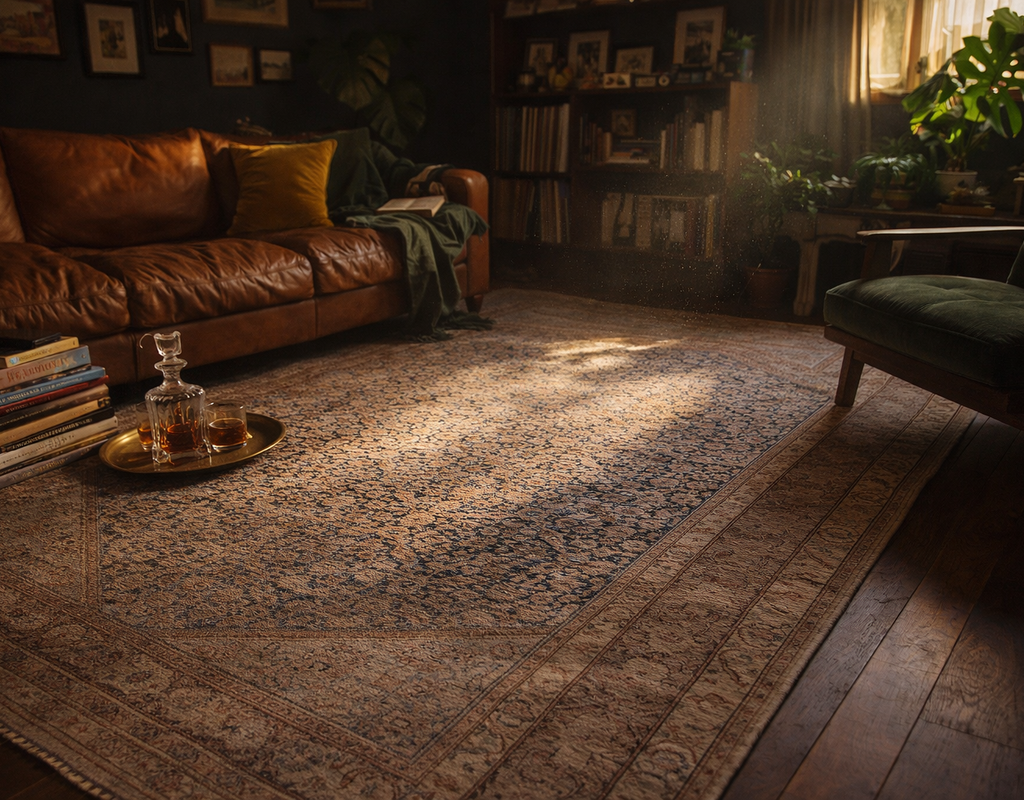
A vintage-inspired rug grounds this richly textured, dimly lit reading nook warmed by natural light.
- All-over layout — Why: In rugs such as Farahan, Bijar, and Moud, the motif covers the entire field with no central focal point, creating density, uniformity, and rhythm.
- Medallion layout — Why: Classic medallion Herati rugs from Tabriz place a diamond or oval centerpiece in the middle of the field, then surround it with Herati repeats, blending order with grandeur.
The Herati’s flexibility explains why it is so common in Tabriz rugs—its repeating geometry adapts easily to both expansive medallion fields and uniform lattice carpets, showcasing the versatility of local workshops.
Border Uses and Variants
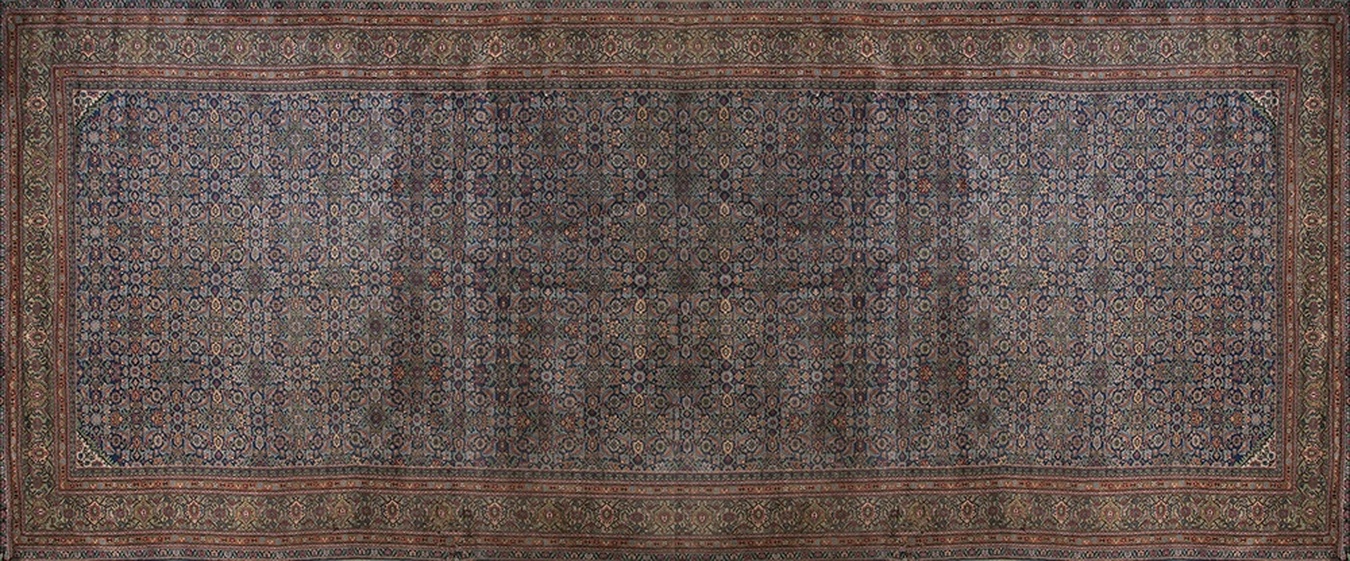
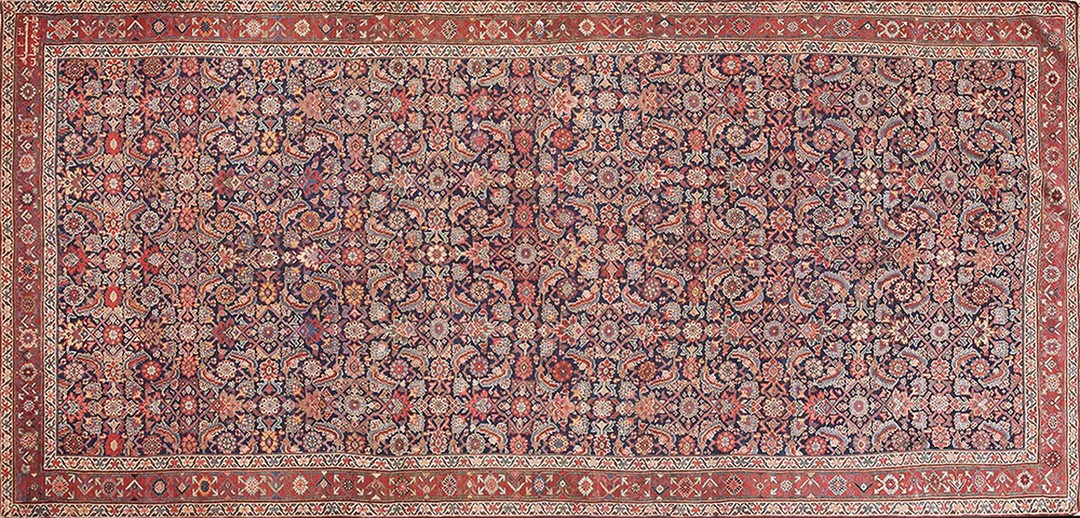
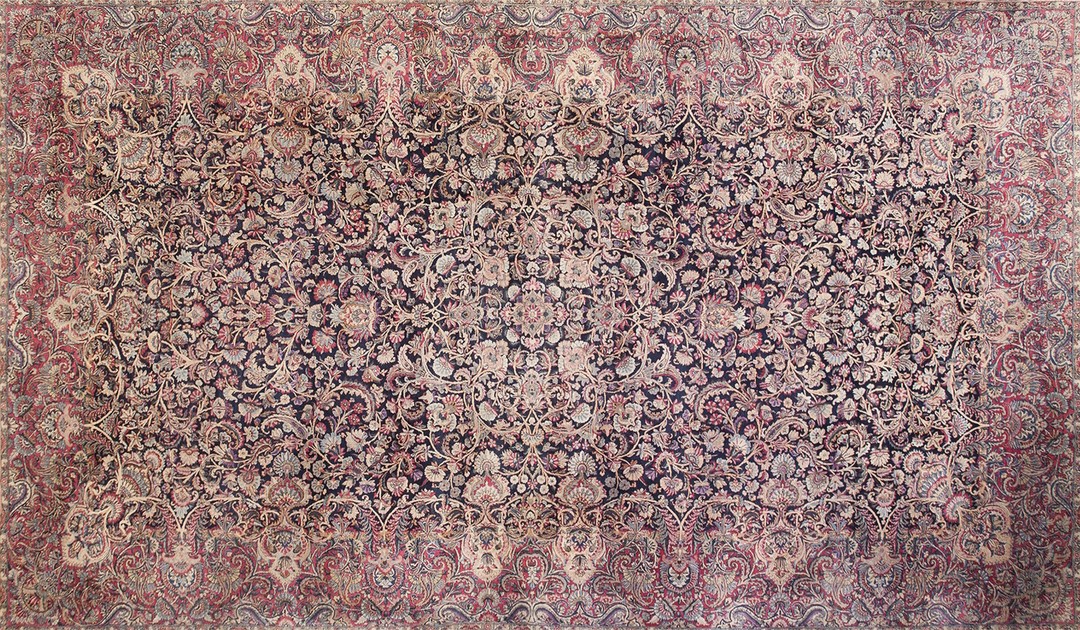
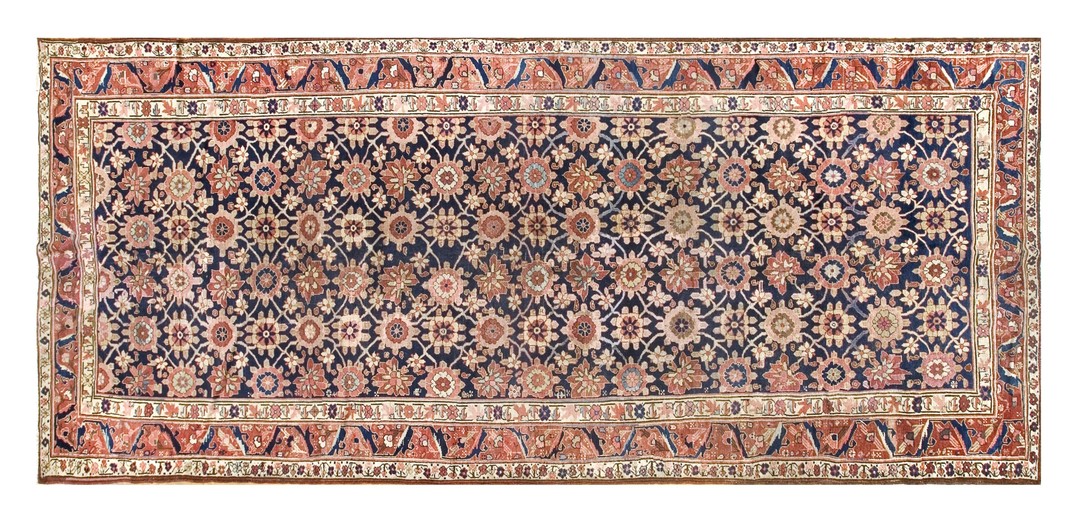
Antique Tabriz Oversized Room Size Wool Blue Rug – by Rugs On Net
The Herati border design takes the same rosette-and-fish unit and strings it along scrolling vines around the rug’s edges. This creates a sense of containment, visually anchoring the field. Depending on how tightly the motifs are drawn, the border may look delicate and floral or bold and architectural. Placement in the border can also heighten contrast, framing the rug like a living waterway flowing around its core.
Color Palettes & Aesthetic Effects
- Indigo or navy grounds with ivory highlights — Why: This classic Mahi colorway emphasizes the diamond lattice and gives the fish pattern a crisp, luminous quality.
- Madder red with soft green or beige accents — Why: These warmer palettes introduce harmony and richness, common in village and workshop productions.
- Blue, red, and green combinations — Why: Contrasting hues bring out the fine detail of serrated leaves and rosette blossoms, enhancing movement across the field.
Color is not incidental: the contrast between dark fields and lighter blossoms makes the Herati shimmer with depth, while softer blends yield calm, balanced compositions.
Symbolic Meanings
The Herati’s elements carry enduring symbolic weight. The fish evoke water, fertility, and good fortune. The rosette stands for the lotus, the moon, or a pond—sources of life and cosmic renewal. The endless symmetry is often linked to balance and the zodiac sign Pisces, reinforcing the idea of duality and cyclical order. When seen together, the Herati pattern becomes more than decoration—it is a woven emblem of life’s cycles, prosperity, and cosmic harmony. In short, the Herati design looks like a rosette enclosed by diamond-shaped fish forms, repeated across the rug in either a full lattice or around a medallion, with its symbolism and colorways giving it both beauty and meaning.
Materials and Weaving Techniques
Traditional Materials: Wool, Cotton, Silk
- Wool pile on cotton foundation — Why: This is the standard for most wool Herati rugs, providing a balance of strength and softness. Cotton warps keep the rug dimensionally stable while wool offers warmth and resilience.
- Silk highlights — Why: Adding silk to floral details or outlines in a silk Mahi carpet enhances luster, making the fish pattern shimmer.
- All-silk construction — Why: Reserved for luxury Herati rugs, full silk produces dazzling clarity and sheen but at a higher cost and delicacy.
- Kurk wool (fine lamb’s wool) — Why: This premium material creates exceptionally soft piles and crisp motifs, elevating the rug’s quality.
Choosing between wool and silk depends on purpose: wool ensures durability and affordability, while silk elevates elegance and precision.
Knot Types and Density
- Turkish (symmetrical) knot in Tabriz rugs — Why: Produces uniform tension and allows knot density in Persian rugs to reach 300–400 kpsi (50 raj), yielding very sharp fish motifs.
- Persian (asymmetrical) knot in Central/Eastern Persia — Why: Offers flexibility in curves and subtlety, though often at slightly lower density.
- Dense weaving — Why: Higher knot counts mean the Herati motif appears crisp, detailed, and small in scale.
- Lower knot counts — Why: Larger, more geometric fish motifs emerge, typical of tribal or rustic carpets.
In short, yes—knot density directly affects the clarity of the Herati design. Fine weaving captures every serrated leaf, while looser weaves favor bold geometry.
How Construction Affects Motif Clarity and Durability
Pile height plays a major role: a shorter pile reveals crisp outlines, ideal for delicate Herati repeats, while a longer pile softens lines but adds plush comfort. Durability also comes from weave strength: tighter knots and harder beating during weaving increase resistance to wear. A thick wool pile withstands heavy use, while silk piles—though exquisite—are more prone to abrasion. Buyers seeking longevity should prioritize dense wool or mixed-material construction for a truly durable Herati.
Regional Weaving Methods
Each region leaves its own mark on the Herati. Tabriz workshops, famed for precision, rely on cartoons to guide weavers and achieve miniature-like detail. Bijar weavers employ wet weaving, soaking wool before knotting to create extreme compactness—earning Bijars the nickname “Iron Rugs” for their near indestructibility. Khorasan and Eastern Persian looms favor asymmetrical knots, producing flowing curves and elegant adaptations of the fish pattern. Across these centers, overlap is constant: shared motifs, adapted materials, and exchanged techniques show how the Herati transcends local identity while still retaining regional flair. In essence, material and weave dictate the look, feel, and longevity of a Herati rug. Wool ensures durability, silk offers brilliance, and knot density determines how finely the fish motif swims across the carpet’s surface.
Regional & Stylistic Variations
Tabriz Mahi Rugs: Why So Common?
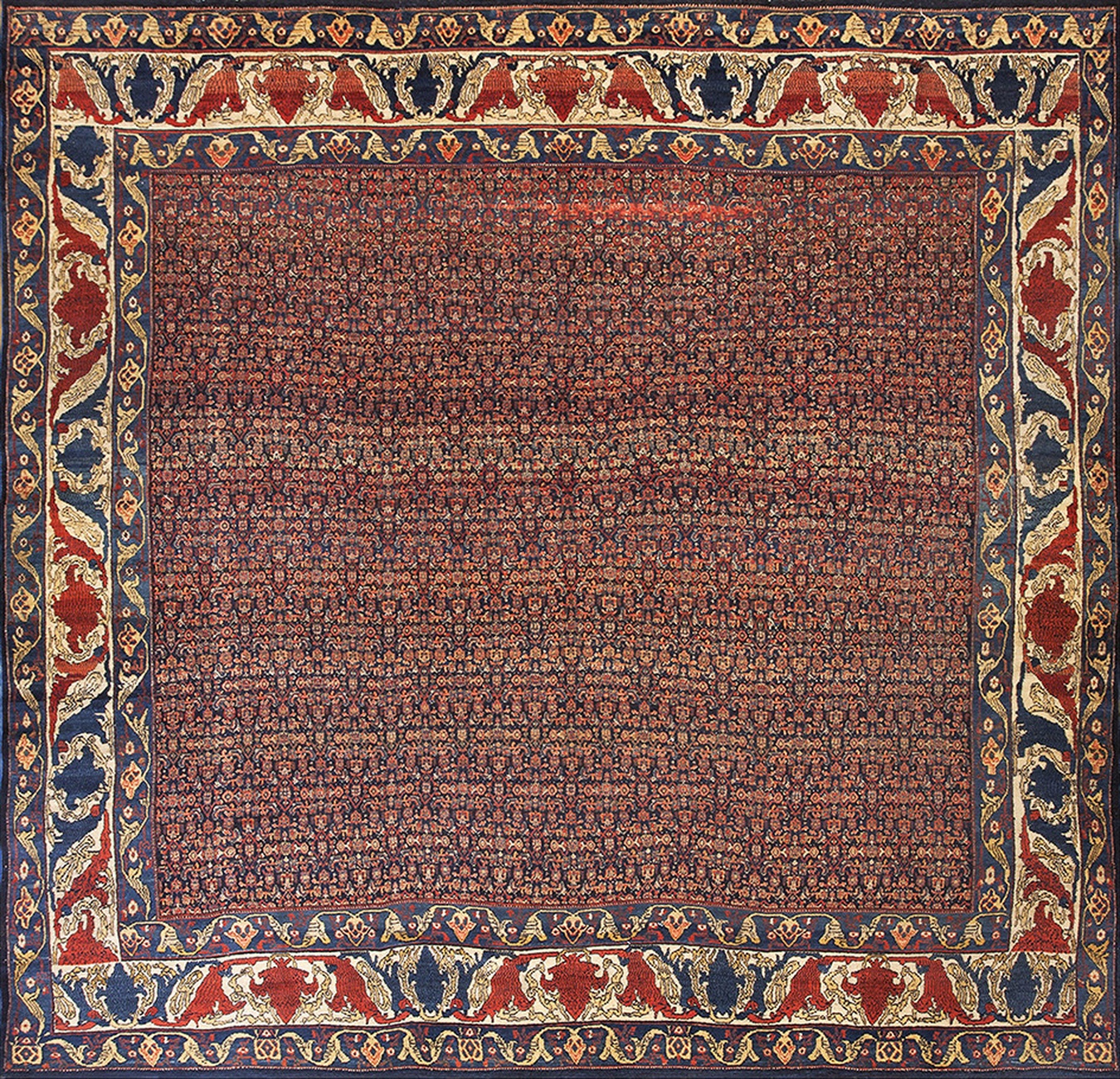
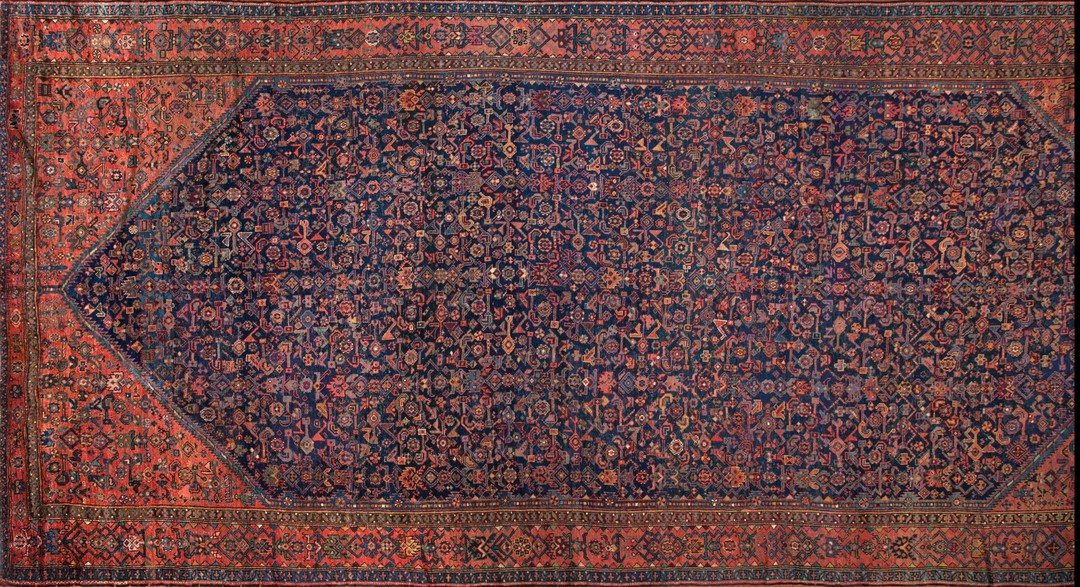
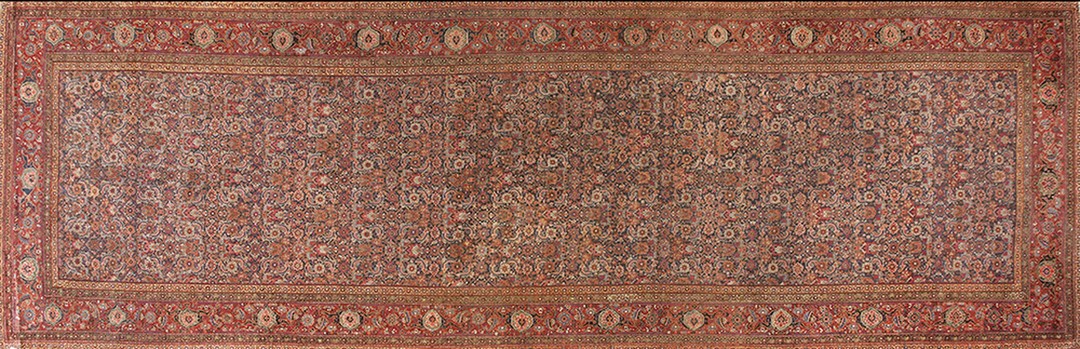
Antique Senneh Room Size Wool Dark Rug – by Rugs On Net
The Tabriz Mahi rug has become the global benchmark for the Herati pattern. Produced in one of Persia’s most sophisticated urban weaving centers, Tabriz rugs employ symmetrical knots, high knot counts, and precise drawing, allowing the fish motif to appear delicate and crisp. Workshops here perfected the medallion layout, where a bold central diamond is surrounded by a dense Herati field. Because Tabriz was both a royal and commercial hub, its workshop system allowed for consistent, large-scale production. This explains why the Herati pattern is so common in Tabriz rugs—city looms favored both artistry and repeatable quality, giving them prestige and widespread recognition unmatched by village variants. Bijar, Farahan, Sarouk, Khorasan, etc.
- Bijar fish carpet — Why: Known as the “Iron Rugs of Persia,” Bijars use wet weaving and thick wool, producing geometric, high-contrast Herati motifs that endure generations.
- Farahan Herati — Why: Characterized by pale backgrounds, airy spacing, and elegant proportions, making them highly collectible among antique carpets.
- Sarouk — Why: Lush rose fields and softer outlines give the Herati pattern a floral, romantic tone, appealing to Western buyers in the late 19th and early 20th centuries.
- Khorasan/Moud Herati — Why: Intricate, all-over lattices in deep blues and soft ivories showcase fluid lines and refined harmony, epitomizing the Persian fish rug at its most decorative.
Each of these centers adapted the motif to their own strengths, from Bijar’s durability to Farahan’s elegance, ensuring the Herati’s versatility across Persia.
Caucasian, Turkish, Afghan, and Modern Global Variations
Beyond Iran, the motif took on new identities. Caucasian and Turkish rugs simplify the fish motif into bold, angular forms with tribal character. The Afghan Herati rug often uses darker palettes, earthy tones, and larger-scale repeats, blending Persian structure with regional restraint. In today’s market, contemporary fish-design rugs are woven in India, Pakistan, Afghanistan, Turkey, and China, often on industrial looms. While these keep the motif alive in modern décor, Persian-origin rugs remain the most prized due to their historical prestige and craftsmanship.
Modern Adaptations: Scale, Color, Texture
Today’s modern Herati designs frequently alter the traditional layout. Some scale up the fish motif, turning it into bold, oversized graphics. Others favor tone-on-tone palettes, muting contrast for a contemporary, minimalist look. Texture is also a key innovation: rugs may combine wool and silk, vary pile heights, or use distressing techniques to mimic vintage softness. Compared to vintage examples, modern versions emphasize experimentation, while older rugs preserve the classical balance of water symbolism, symmetry, and contrast. In essence, the origin of a Mahi rug strongly impacts its value. A Persian Tabriz or Khorasan piece commands far higher prices than machine-made imports, not only for material quality but also for its role in carrying centuries of cultural history. Whether robust Bijar, airy Farahan, or sleek modern reinterpretation, each regional or global variant reinforces the Herati as one of the most adaptable and enduring motifs in rug weaving.
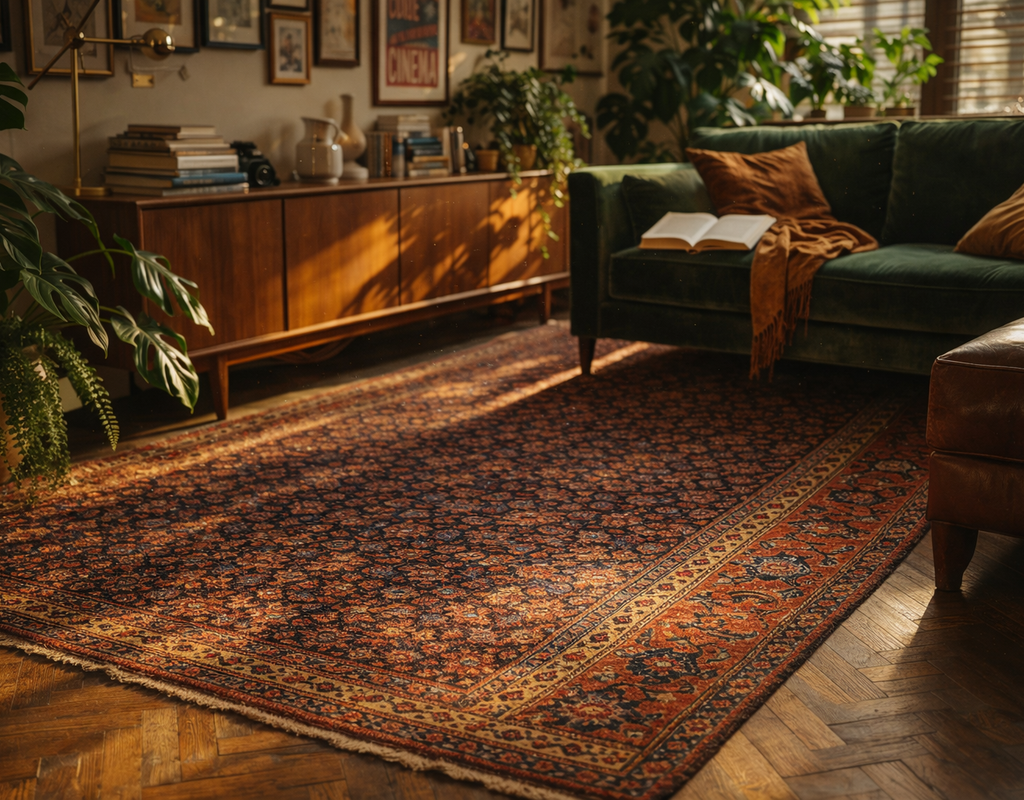
Warm, dappled sunlight highlights the rich textures and colors of the room’s decor and antique runner.
Market Guide: Buying & Valuing Mahi/Herati Rugs
Authenticity and Age Verification
- Check dye sources — Why: Natural dyes fade gracefully, while synthetic colors often look too bright or uniform.
- Examine wear patterns — Why: Genuine antique Herati carpets show even pile wear and patina, not artificial distressing.
- Study knot structure — Why: Hand-knotted fish rugs reveal irregularities, while machine-made pieces are overly uniform.
- Request provenance or certificates — Why: Documentation verifies origin, workshop, and sometimes the weaver’s name.
Knowing how to verify a Herati rug’s claimed age is essential—authenticity defines both value and collectability.
Fair Price Ranges
- Vintage or antique Herati carpets (Farahan, Tabriz) — Why: Expect several thousand to tens of thousands of USD, depending on condition and rarity.
- Modern hand-knotted fish rugs — Why: Usually range from a few hundred to several thousand USD.
- Machine-made Herati rugs — Why: Typically $100–$1,000, valued for affordability but not investment.
Thus, a fair price range for vintage Herati carpets is firmly in the higher tiers, while contemporary or machine-made versions are priced for décor rather than legacy.
Investment Potential: Signed Rugs, Tabriz Pieces
A signed Tabriz Mahi rug is considered investment-grade, especially when preserved well. Workshop signatures often mark high artistry, and these pieces may appreciate over time. Tabriz examples are prized not only for craftsmanship but also for their place in Persian weaving heritage, making them reliable investment carpets.
Impact of Origin and Material on Price
Origin is the single strongest driver of value:
- Persian (Tabriz, Farahan, Khorasan) — highest prices, most collectible.
- Afghan, Indian, Pakistani — more affordable but often well-made.
- Machine-made imports — least valuable.
Material also shifts pricing:
- Wool Herati rugs — durable, practical, and relatively affordable.
- Silk vs wool Herati — silk offers brilliance and detail but is delicate, expensive, and less practical in high-traffic areas.
Restoration and Value
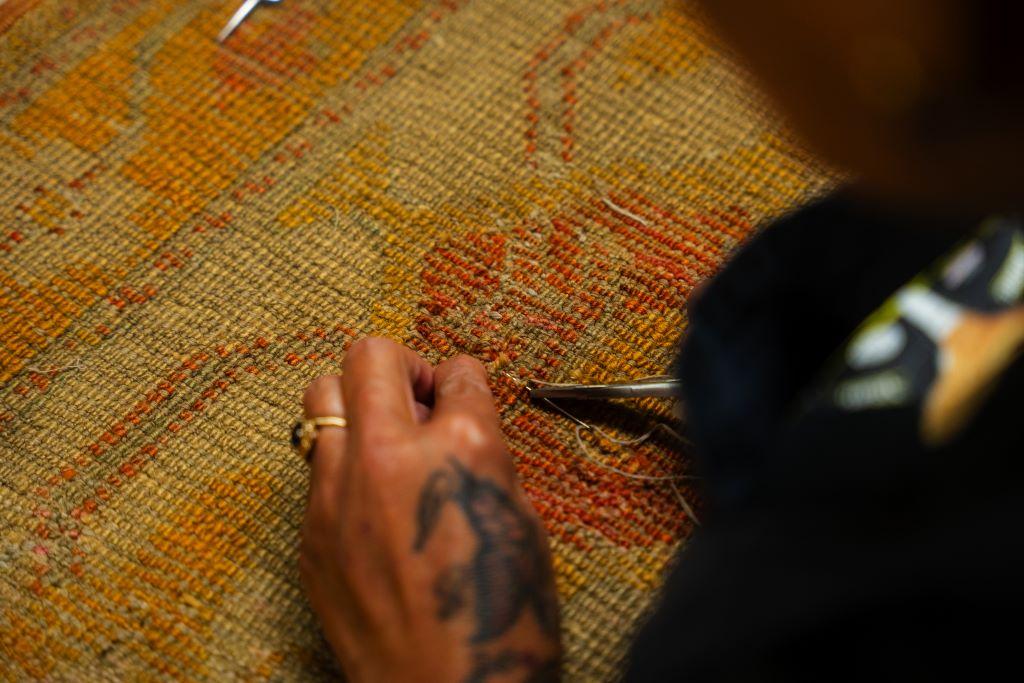
Detail of hands mending a rustic, richly colored woven rug.
- Expert, minimal restoration — Why: Preserves structural life and doesn’t greatly harm value.
- Heavy or obvious restoration — Why: May reduce value, especially for antique Herati carpets.
- Disclosure — Why: Buyers expect transparency; undisclosed repairs can undermine trust.
Thus, restoration should affect value—positively if done expertly, negatively if clumsy or excessive.
Hand-knotted vs. Machine-made: Pros & Cons
- Hand-knotted fish rugs — Why: Unique, durable, higher resale value, and true to Persian tradition. Worth the higher cost for longevity and authenticity.
- Machine-made Herati rugs — Why: Faithful in appearance but lack the nuanced irregularities of handmade work; lower in both cost and value.
For buyers, hand-knotted Herati runners are worth the higher cost, especially if longevity and authenticity matter.
Where to Buy Online Safely
- Reputable dealers with return policies — Why: Protects against misrepresentation.
- Look for certifications or origin labeling — Why: Helps confirm authenticity.
- Avoid unverified marketplaces — Why: Many machine-made rugs are sold as “Persian.”
- Educational resources — Why: Reference guides such as [How to Buy Authentic Persian Rugs Online] build buyer confidence.
For those seeking to buy a Mahi rug online, secure platforms and established dealers remain the safest path.
Color Trends: Muted vs. Vibrant Palettes
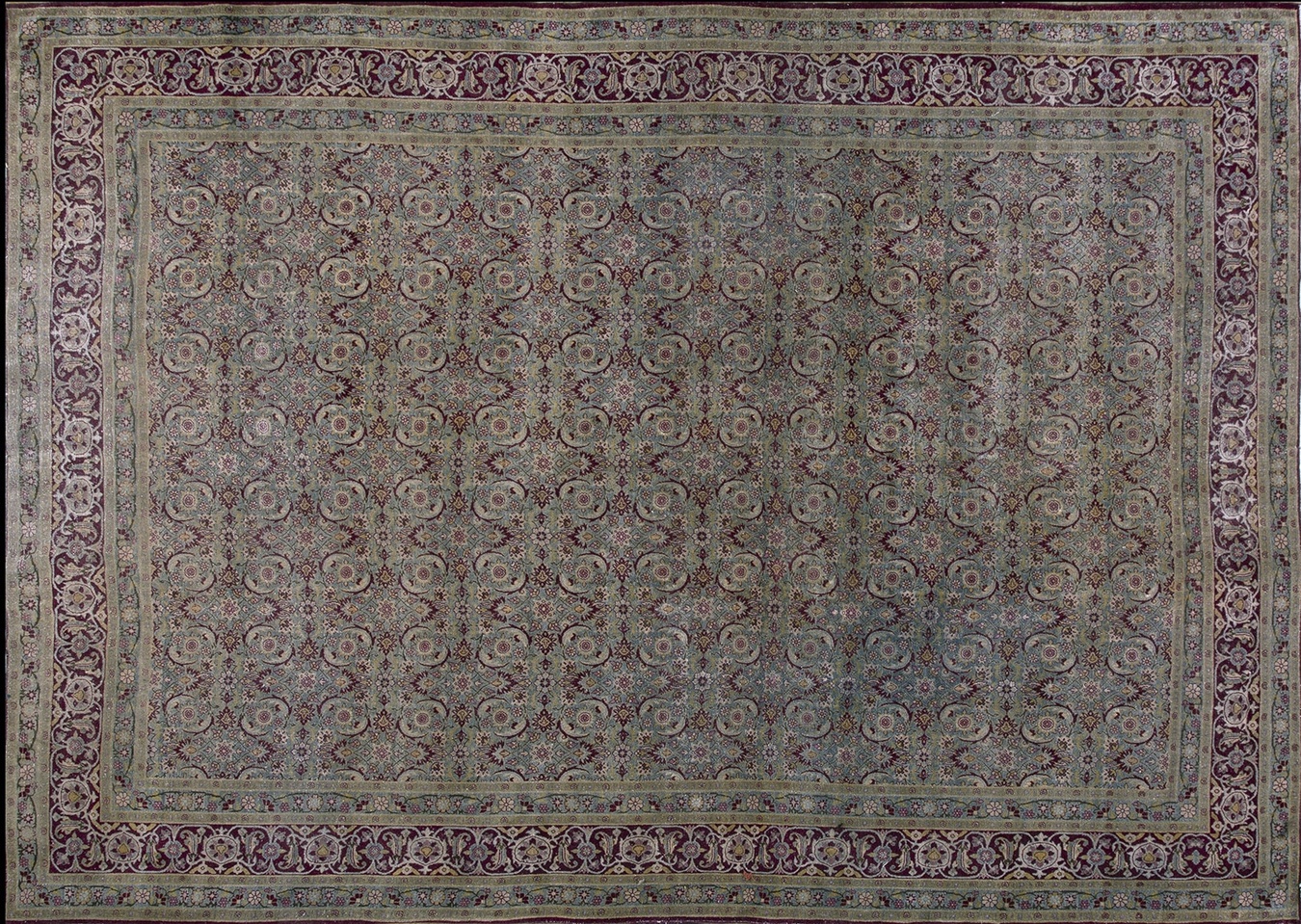
Both colorways retain appeal, but muted palettes—faded ivory, soft greens, and washed blues—are especially popular for modern interiors. Vibrant tones like deep navy, jewel red, and emerald remain classic for collectors who want traditional energy. Today’s market slightly favors muted tones, aligning with contemporary décor trends. In summary, the authentic Herati carpet market hinges on origin, materials, and knotting method. Tabriz Mahi investments stand out as collectible, silk offers luxury but less practicality, and machine-made rugs deliver affordability but not heritage. Buyers who understand authenticity, condition, and color trends are best positioned to secure lasting value.
Care, Use, and Styling
Pile Height, Wear, and Placement

A detailed focus on the intricate, vivid colors and geometric weave of a traditional textile rug.
- Higher pile — Why: Provides plush cushioning and softness underfoot, but blurs fine details of the fish motif and shows wear more quickly.
- Lower pile — Why: Keeps the Herati lattice crisp, resists matting, and makes for a durable Herati rug suitable for daily use.
- Placement — Why: The all-over Herati design hides stains and foot traffic, making it excellent for dining rooms, entries, or living spaces where durability matters.
In essence, pile height in Persian rugs directly affects both durability and design clarity—shorter piles extend life and preserve the sharpness of the motif.
Runner Rugs: Function and Value
- Hand-knotted fish pattern runners — Why: Cost more initially but provide superior durability, artistry, and lifespan, making them worth the higher investment.
- Machine-made runners — Why: Affordable and consistent, but less resilient in long hallways or heavy-use spaces.
- Functional use — Why: Runners protect flooring, soften narrow spaces, and add continuous pattern, making them ideal for hallways, kitchens, or entryways.
Thus, hand-knotted Herati runners are worth the higher cost when long-term use and authenticity are priorities.
Decorating Tips: Classic vs. Contemporary Interiors
The Herati motif adapts seamlessly to multiple styles. In classic interiors, bold reds, deep blues, and intricate borders anchor formal rooms with a sense of heritage. In contemporary settings, muted palettes—ivory, faded blue, and soft green—allow the fish pattern to act as a “neutral design,” offering elegance without overwhelming other décor. A decorate with Herati rug approach balances versatility with sophistication: subtle tones for understated rooms, or vibrant contrasts for dramatic focal points.
How Symbolism Informs Modern Use
The Persian fish motif brings more than visual appeal—it embodies prosperity, harmony, and the eternal cycles of life. Incorporating a Herati rug into a home or office can symbolize continuity and balance, making it popular not only as décor but also as a meaningful choice for milestones such as weddings or new homes. This deeper cultural resonance gives the rug a role beyond utility, turning it into a symbol of both beauty and blessing. Ultimately, the Herati rug excels in both high-traffic practicality and symbolic styling, proving itself as a timeless choice for both traditional and modern interiors.
Legacy and Cultural Impact
The Herati Motif as a Persian Icon
The Herati motif stands as a Persian Herati icon, instantly recognizable as one of the great achievements of Persian textile art. Its rosette-and-fish lattice is not only woven into carpets but also appears in manuscript illumination, architectural ornament, and museum exhibitions around the world. For collectors, it is a living emblem of Persian heritage—an aesthetic that embodies both technical mastery and symbolic meaning. The motif continues to appear in design branding, cultural showcases, and international art fairs, reinforcing its place as a cornerstone of Persian visual identity.
Globalization and the Modern Fish Pattern
In today’s marketplace, the global fish rug pattern has transcended its Persian origins. While traditional hand-knotted pieces remain the gold standard, machine-made rugs are faithful enough to the classic Herati pattern that they satisfy many consumers’ decorative needs. However, these lack the irregularities and artistry of handwoven originals, reducing their long-term value. Meanwhile, contemporary looms in India, Pakistan, Afghanistan, and Turkey reinterpret the lattice for new audiences, proving how adaptable the design is to different weaving traditions.
Lasting Popularity and Artistic Influence
The enduring appeal of the Herati lies in its dual nature: a timeless Persian heritage design and a global decorative staple. For interior designers, it remains a versatile “neutral” pattern—formal enough for classic décor, understated enough for modern minimalism. For collectors, it represents continuity, connecting modern Herati rugs with antique masterpieces. Compared to vintage examples, modern Mahi designs differ in scale, palette, and texture—often featuring oversized motifs, muted or tone-on-tone colorways, and varied pile heights to suit contemporary tastes. Yet the core symbolism of life, fortune, and cosmic balance remains unchanged. The Herati legacy is one of survival and reinvention. From its birth in the workshops of Herat to its presence in living rooms and galleries worldwide, the Mahi design influence continues to inspire, ensuring that this ancient pattern swims endlessly forward as a cultural and artistic treasure.
Explore a Few of Our Mahi Rugs

FAQ
- What should I inspect before buying an antique Herati (fish) rug?
Verify hand-knotted structure and integral fringe, check for repairs and moth damage, and test colorfastness discreetly. For silk or valuable pieces, request a professional condition report.
- How do Herati (mahi) rugs compare to Mina Khani or Boteh rugs?
Herati = rosette-in-diamond with fish-like leaves. Mina Khani = daisy rosettes linked in a lattice. Boteh = teardrop/paisley sprigs. Each repeats, but their units are distinct.
- How much does an 8×10 Herati (mahi) rug cost?
Hand-knotted Tabriz Mahi 8×10 commonly ranges about \$1,000–\$12,000+, depending on raj, materials, and age. Machine-made Herati lookalikes often run roughly \$200–\$800.
- Do Herati (fish) motifs have symbolic meaning?
Interpretations vary. Many read the leaves as “fish around a pond,” symbolizing abundance or protection, while others see purely floral forms. Treat symbolism as tradition, not strict fact.
- What colors are common in Tabriz Mahi (Herati) rugs?
Traditional palettes favor navy, red, and ivory with subtle accent tones; modern pieces add grays or softer neutrals. Silk outlines can make the lattice sparkle.
- Are Herati (mahi) rugs always allover patterns?
Mostly, yes, but Herati also appears in borders and within medallion-and-corner layouts. Allover Herati is the classic look.
- Will robot vacuums catch the fringe on a Herati (mahi) rug?
They can. Tuck or tape fringe under, set no-go zones, or enable carpet-avoidance modes. Busy patterns are fine; fringe and high pile are the usual culprits.
- What rug pad is best under a Herati (fish) pattern rug?
Use a felt+natural-rubber pad (⅛–¼″) for grip and cushioning. Avoid PVC pads that can stick or discolor hardwood finishes over time.
- How often should a wool Herati (mahi) rug be professionally cleaned?
In busy homes, every 12–18 months; in lighter traffic, up to every 3–5 years. Vacuum weekly, rotate 6–12 months, and address spills immediately.
- How should I clean a silk Tabriz Mahi (Herati) rug?
Vacuum with suction-only—no beater bar—and blot spills promptly. For washing, use a specialist; silk’s delicate pile and dyes can be damaged by DIY or harsh cleaners.
- Are Herati (fish) motif rugs good for high-traffic homes?
Often, yes. Busy Herati repeats help camouflage soil. For maximum toughness, choose a Bijar with Herati—the “Iron Rug” construction is famously dense and hard-wearing.
- Do Herati (mahi) rugs work in modern interiors?
Yes. The orderly Herati grid reads as subtle texture from a distance. Neutrals or blue-ivory palettes blend seamlessly with minimalist, contemporary, and transitional spaces.
- What sizes do Herati (fish) motif rugs come in?
Practically all sizes—mats to palace sizes—and lots of runners. Common area sizes include 5×8, 6×9, 8×10, and 9×12, making Herati easy to fit most rooms.
- Are Indo/Pak “mahi/Herati” reproductions good alternatives?
Many Indo/Pak Herati rugs are hand-knotted and durable at lower prices than Persian Tabriz Mahi. Judge by materials, knot density, and clarity of the Herati lattice.
- How can I tell if a Herati (mahi) rug is hand-knotted or machine-made?
Check the back and fringe. Hand-knotted Herati shows individual knots and a pattern mirroring the front, with fringe as part of the warp. Machine-made often has sewn-on fringe.
- Are Tabriz Mahi (Herati) rugs wool or silk?
Most are fine wool (often kurk) on cotton with occasional silk highlights; some luxury pieces use extensive silk. Material mix strongly affects sheen, detail, and price.
- What does “raj” or KPSI mean on Tabriz Mahi rugs?
“Raj” measures knots per 7 cm; higher raj = finer weave. Many Tabriz Mahi are 40–60 raj; 60+ raj pieces are very fine. A 50 raj rug is roughly \~280–320 KPSI.
- What exactly is a Tabriz Mahi rug?
It’s a Tabriz carpet woven with the Herati (mahi) design, typically fine, short-pile, and highly detailed. Many use wool with silk highlights and symmetrical knots.
- Which rug types commonly use the Herati (mahi) design?
You’ll often see Herati in Tabriz, Bijar, Senneh, Malayer, Khorasan/Mashhad, Hamadan, and Sarouk rugs. It appears as an allover field or within borders and medallion corners.
- Are Herati (fish) motif rugs geometric or curvilinear?
Both. Village or tribal versions skew geometric; city weaves like Tabriz render the same Herati (mahi) forms with curving, fluid outlines.
- What do “mahi darham” and “riz-mahi” mean in Herati rugs?
“Mahi darham” means “entwined/twisted fish,” a denser, rotating Herati. “Riz-mahi” means “fine fish,” a tiny-scale, highly detailed version often seen in finer city weaves.
- How do I recognize a Herati (mahi) pattern up close?
Look for a small rosette inside a diamond, flanked by four angled, curved leaves that can resemble fish. The repeat forms a neat diagonal lattice across the rug.
- Where did the Herati (fish) rug design originate?
The Herati motif is named for Herat (historically in Khorasan, now in Afghanistan). It spread widely through Persian, Anatolian, and Caucasian weaving traditions over centuries.
- Is “mahi” the same as the Herati motif in rugs?
Yes. “Mahi” means fish in Persian and refers to the fish-like leaves in the classic Herati layout. Many sellers use “Herati,” “mahi,” or “fish pattern” interchangeably.
- What are Herati (mahi/fish) motif rugs?
Herati (mahi) rugs feature a rosette inside a diamond with four curling “leaf/fish” forms repeating across the field. The design originated around Herat and appears in both geometric and curvilinear renderings.